Wholesome? 


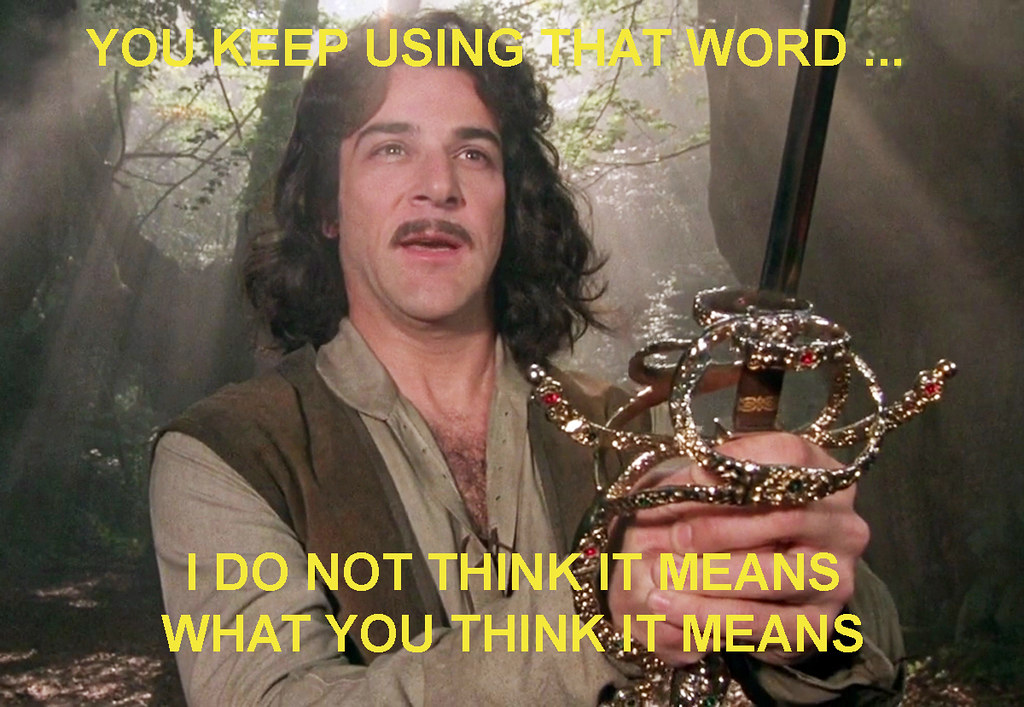
In The Princess Bride, one character questions another for the latter’s repeated use of a word telling him that he did not think that word meant what the one using it thought it meant. I have run into a little bit of that myself recently with the odd usage of the word “wholesome.” I grew up when “wholesome” described something good for the body, mind, or spirit. The folks at Lexico dot-com have my back on this one: 

  1. “Conducive to or suggestive of good health and physical well-being.”

1.1        “Conducive to or characterized by moral well-being.” 1 

However, for current usage, it sometimes helps to consult a tertiary source like Urban Dictionary dot-com. Anyone can define a word, and users vote for the meanings they think are best. User, 265daysofpatandspongebob, provided the most current and popular user-contributed definition of “wholesome.” 

“An embodiment of the following: self-less, considerate, sweet, compassionate, thoughtful, generous, genuine, doesn’t talk trash about other people,”2 

Yes, I realize that the grammar is not perfect, but that is not the point. Somehow people have come to associate this adjective with the result of having been nurtured by the wholesome. For example, it would be hard to be selfless without wholesome influences. A secondary definition offered by another contributor was essentially something or someone bringing a smile to another’s face.3 Finally, there was the usage I had encountered. The fourth most popular submission asserted that something wholesome expressed love and affection, not lewdness.4 

While I can appreciate that people realize that lewdness is not a virtue, not all love and affection are “wholesome.” The forum in which I encountered this word recently was about a story of a young adult who took in a runaway teen. Sadly, the young woman previously traded her body for a place to stay and assumed her new caretaker would desire the same type of “payment.” To his credit, he told her that she had value other than just her body and deserved good treatment with no strings attached. Those who are saying that the story was wholesome, I suppose, were expressing surprise that a vehicle of popular culture was not glorifying casual relations, especially between those of about a ten-year age difference. Thus far, the relationship presented is platonic. Perceptions of the story’s “wholesomeness” among audience members may change if a romance develops between the adult and the teen, even if the former waits to pursue romantic feelings until the latter reaches what the West considers the age of majority. 

While I would prefer people to react this way because of moral instruction, I fear it stems more from the self-righteousness associated with political correctness. In other words, it has more to do with #MeToo than God said. After finally understanding how people are using “wholesome,” I thought of how I’ve previously seen the word used by other forum members in the past. The very first time I encountered this odd definition of “wholesome” was in a story with a fantasy setting. A woman befriends a female dragon. The dragon assumes a human form and lives with the woman, and takes care of her like a maid. The dragon acts smitten with the human, but the human has no romantic interest. But with the addition of other dragons who take up residence with the human, the setting assumes the form of a non-traditional family. Like the other story, I referenced, the relationship is platonic. However, the LGBTQ+ community lifted it as a positive example of the gay lifestyle. Commentators talked about how “wholesome” it was. Again, the idea was that it highlighted love and affection without lewdness. Hence, making it more acceptable to the “straights” in the audience.  

It seems religious instruction is as lacking as English education today.  If newspeak continues replacing our language, we might see other words perverted to accommodate meanings wordsmiths never intended for them. I am mindful of the warning from God as given by His prophet, Isaiah. 

“Woe to those who call evil good, and good evil; Who substitute darkness for light and light for darkness; Who substitute bitter for sweet and sweet for bitter!” (Isaiah 5.20 NASB1995) 

In the interim, take the time to teach the young people in your life what is wholesome. Let them know that being wholesome requires more than the absence of lewdness, causing others to smile, or remaining selfless. To be wholesome means you surround yourself with makes you a better, more moral person. The only thing capable of doing this is Christ, the Word, and the church.    


Works Cited 


1 “WHOLESOME: Definition of WHOLESOME by Oxford Dictionary on Lexico.com Also Meaning of WHOLESOME.” Lexico Dictionaries | English, Lexico Dictionaries, www.lexico.com/definition/wholesome


2 265daysofpatandspongebob. “Wholesome.” Urban Dictionary, Urban Dictionary , 16 May 2019,www.urbandictionary.com/define.php?term=wholesome


3 thisisforyouemily. “Wholesome.” Urban Dictionary, Urban Dictionary , 9 July 2019,www.urbandictionary.com/define.php?term=wholesome


  1. littlejimmybig767. “Wholesome.” Urban Dictionary, Urban Dictionary , 23 February 2018,www.urbandictionary.com/define.php?term=wholesom
Creative Commons (Flickr)

How To Win Souls Without Compromising Doctrine

Wednesday’s Column: Third’s Words

Gary III

Gary Pollard

It’s hard to have balance while times change. Some seize current social realities and use them as opportunities to push unbiblical ideas (God’s design for marriage, leadership in worship, leadership in the home, etc.). As a result, our human nature kicks in and we’re ready to swing the other way. After all, we don’t want to be associated with groups who don’t teach or practice what God wants, right? 

Balance is way more difficult to maintain than reactionary practices in either direction. Both are extremely harmful to the church! Compromising doctrine is never acceptable, but gaining a reputation for being old-fashioned or otherwise incompatible with modern culture is equally harmful. 

I Corinthians 9.19-23 is an awesome text for this. We’ll look at a few key points in this passage briefly. 

  1. It’s About Serving Other People (9.19)
  2. It’s About Winning Them (9.19)
  3. It’s About Meeting Them Where They Are (9.20-22)
  4. It’s About the Message (9.23)

We do what we do because we want to save souls. We cannot maintain a church culture based on reaction because it does not save souls. It is not a sustainable culture and has led to many viewing the church as being incompatible with the modern world. This was never God’s design! We must never compromise doctrine, but we must always try to win souls. We need to do what we can to meet folks where they are and show them something better. 

“I have become all things to all people, that by all means I might save some” (9.20). 

The Lifeboat Baby

Monday’s Column: Neal At The Cross

pollard

Neal Pollard

While many today have no idea who Jesse Roper Mohorovic is, he was a celebrity from the moment of his birth on March 30, 1942, off Cape Hatteras, North Carolina. The United States had entered World War II only a few months before, and German U-Boats “prowled the Atlantic sea lanes, and the waters off the Virginia-Carolina coast were ‘the most dangerous on earth'” (C. Brian Kelly, Military History, 9/05, 74). In fact, the Germans killed twice as many seamen in their U-boat campaign off the east coast than died at Pearl Harbor. 

Jesse’s mother, Desanka, was 8 1/2 months pregnant, traveling on a passenger freighter that was torpedoed. She faced peril after peril, from getting out of her cabin to the harrowing escape in a lifeboat to an overnight storm. In the middle of all of it, the freighter sunk and her doctor injured in their dramatic escape, she gave birth in Lifeboat #4 to a baby boy at 2:30 A.M. Two days later, they were rescued by the Navy destroyer Jesse Roper. 

The media covered many of the early milestones of his life, and even documented his interests and favorite baseball team. He later appeared on the TV shows To Tell The Truth and I’ve Got A Secret. He earned a law degree, served in the Navy, and had a career in marketing. He died of lung cancer about two years after his 2003 retirement (via JOC.com). 

It is no wonder that “The Lifeboat Baby” would become such a sensation, especially given the real drama behind his birth. Perhaps he would have been part of anonymous tragedy if he and his mother had been among the 5000 who perished, but his birth and life became a symbol of hope and victory. Indeed, “Newspapers heralded Jesse as living proof the Allies could not be defeated” (Kelly). 

We live in increasingly grim times. Our current battle is spiritual in nature, as sin and immorality seem to have the upper hand. Souls are perishing in infinitely greater numbers (cf. Mat. 7:13-14). While we cannot save them all, we need to be in search of those we can reach with the gospel. We must muster greater courage to share the good news and help those searching reach safety. They need to know there is hope and victory possible, and that Christ will ultimately win (1 John 5:4-5; 1 Cor. 15:24-25).  These babes in Christ are unlikely to capture the attention of the media, but each of them have the rapt attention of heaven. God is counting on you and me helping to deliver them, regardless of how stormy things may be. Each individual matters to God. How wonderful that we might partner with God and His Word, and help a soul be one whose name is written in the Lamb’s Book of Life (Rev. 21:27)!


Photo via Naval History and Heritage Command

“Quit Yer Whinin'”

Wednesday’s Column: Third’s Words

20638721_440919206307154_5479040032968788217_n
Gary, with his wife Chelsea

Gary Pollard

I think we’ve all been in the uncomfortable position of witnessing a couple loudly arguing in public. Whether this is at a restaurant, the store, a gas station, or any other public place, it’s downright uncomfortable. Some thoughts going through our minds might be, “Where’s their self-awareness?” or, “They might need to see someone about those issues,” or, “Why here?” We definitely would not want to spend too much time with anyone whose conflict resolution abilities are so classless. Conflict in a relationship is unavoidable and, if handled properly, is vital to the health of a relationship. Poorly managed conflict, though, is sure to destroy it! 

Unfortunately, the world is seeing this more and more. Petty arguments between Christians over matters that have absolutely no bearing on our eternal destination are commonplace. Which Bible version is best? What will heaven be like? What should we wear to worship? Which college should one attend (“that college is liberal/conservative”)? Should we meet in a building or in homes? Should a Christian wear a head covering or not? Should a Christian celebrate certain holidays or not? Should a Christian carry a gun or not? Who should I vote for? 

These are topics I have seen debated in the ugliest possible ways in public forums, whether live or over social media. There is nothing wrong with disagreement handled in a godly way (Matthew 18.15-20). In fact, it can help grow the church because it often brings members closer together. However, when the argument is both non-essential to salvation and is handled unbiblically, it destroys the church. 

If I may be very blunt, this must stop. Our behavior is not only pushing the world away but generations of the church’s own members as well. When a Christian’s blocked list on social media is primarily members of his/her own spiritual family, we have reached concerning levels of dysfunction. I realize that this is not a pleasant article to read, but it is time for us to make a change. 

It is time to stop writing or sharing articles on inflammatory or controversial topics that have no bearing on our salvation. Religious keyboard warriors and trolls need to quit. People of authority and position must stop using their voice to divide and discourage the bride of Christ over non-essential matters (some examples are listed in the second paragraph). We will be held accountable for our words and influence over the body of Christ at judgment. 

When we inevitably find ourselves in disagreement with another Christian over a matter of opinion, we should either handle it privately and with patience and love, or let it go entirely (see Romans 14, I Corinthians 8, Matthew 18, Philippians 1.27, 2.1-5; 2.12, 2.14, 15; 3.17-19; 4.2). Being correct or winning an argument at the expense of peace is not worth losing our souls. This article is just as much for myself as it is for anyone reading this. It is for everyone. 

Around 156,000 people die every day (that’s about 56,000,000 people per year) and most them die outside of Christ. Our time is limited and our influence precious. Our words are among the most powerful tools and weapons ever created. Let us use them well, as they could very well influence someone’s eternal destination – or our own. 

“Weaponizing” The Bible

Neal Pollard

While politicians have quoted the Bible as far back as the founding fathers, have you noticed the trend especially in the last 20 years or so to use Scripture to push a policy or score a point? Perhaps it’s to pander to a group or to reinforce one’s position. During the historic impeachment proceedings in the House of Representatives, the Bible was “weaponized” by both sides of the aisle in embarrassing, repulsive ways. One side compared the impeachment trial of the President to Jesus before Pilate, producing a tasteless, horrific analogy. The other side ripped Romans 1:25 from context to admonish the President’s supporters as worshipping the “creature” more than the “Creator”–I wonder if this extremely liberal politician bothered to read the very next few verses? The God of heaven must be filled with righteous wrath over such misuses of His Word!

Unbelievers have long tried to weaponize the Bible against those who believe God’s Word is inspired. A favorite “go to” is Matthew 7:1 (“judge not that you be not judged”) as a shield for any number of immoral deeds which Scripture itself condemns. This is often an effort to turn what people claim to follow (the Bible) against them to defend their actions. John 8:7 (“let him that is without sin cast the first stone”) is a close second and used similarly 

Yet, each of us needs to be careful not to remove a Bible verse from its context to make it say what it is not saying. Peter warned that “the untaught and unstable distort” the Scriptures to their own destruction (2 Pet. 3:16). Often, it’s a general ideas like “God wants me to be happy” or misuses of Scripture like “where two or three are gathered together in my name” to have it say what it does not mean.  Perhaps we defend our actions with our physical or Christian family by appealing to wonderful Bible concepts like grace, love, and freedom, but in effect weaponize them to suit our lifestyle choices. Scripture itself says these concepts can be misappropriated (Jude 4, 1 Cor. 13:4-7, Gal. 5:13, etc.). 

Scripture is a powerful weapon which God intends for us to use in spiritual warfare (Heb. 4:12; Eph. 6:14-17). But, as with every weapon, it must be handled properly (2 Tim. 2:15). I must understand that God will be displeased if I misuse this omnipotent tool. Used properly and in context, Scripture is powerful. Used otherwise, we will hurt ourselves and probably others!

221b Baker Street

Why Is A Generation Leaving Religion?

Neal Pollard

Pew Research Center recently revealed that “Four in ten millennials (those, according to this source, currently between 23 and 38) now say they are religiously unaffiliated”(fivethirtyeight.com). The data seems to indicate that “today’s younger generations may be leaving religion for good” (ibid.). A contemporary study put out by the American Enterprise Institute reveals at least three reasons why: (1) They didn’t have strong religious ties growing up, (2) Their spouses are more likely to be nonreligious, and (3) They feel religious institutions are not relevant for shaping the morality and religion (or nonreligion) of their children. Parental example, dating choices, and biblical literacy and faith, then, are major drivers in this discussion. 

Those polled revealed their thinking. A majority felt that religious people are less tolerant of others, less informed or even intelligent than their secular counterparts, and less necessary for shaping their family’s moral viewpoints. At least, reading this one study and the authors’ interpretation, it seems that leaving church is a deliberate lifestyle choice of people who at least sometimes are encouraged out the door by poor examples of faith. 

Notice the startling closing paragraph of the article, which states,

Of course, millennials’ religious trajectory isn’t set in stone — they may yet become more religious as they age. But it’s easier to return to something familiar later in life than to try something completely new. And if millennials don’t return to religion and instead begin raising a new generation with no religious background, the gulf between religious and secular America may grow even deeper (“Millennials Are Leaving Religion And Not Coming Back,” 12/12/19, Cox, Daniel, and Amelia Thompson-DeVeaux). 

I found it important to share those findings for these reasons:

  • It is a matter of crisis. People abandoning God’s Word and will is foreboding (Judges 2:10ff; 2 Timothy 3:1ff; 4:3-4; 2 Peter 3:3ff). It is happening, and it must matter to us. It does to God. 
  • It is a matter of correction. The home can change course if it is on the broad way. Individual Christians can improve their ethics and morality in public (Ephesians 4:25ff). Soul-conscious Christians can make the most of our opportunities to share Jesus in Christlike fashion (2 Timothy 2:24-26). We must change what we can change. 
  • It is a matter of consequence. A culture does not get where ours currently is as the result of sincere devotion to Christ and His Word. Hosea 4:6 is incredibly relevant. The law of sowing and reaping is immutable, for good and bad (Galatians 6:7-8). Whatever we exalt as guide is leading us somewhere.
  • It is a matter of courage. The only way I can see for this to change is for you and me to not just believe something or hold a conviction. The early Christians didn’t confine their faith to the holy huddles of the assemblies. They stood up for Jesus every day and every way. 

Two of my three sons are millennials and the third is only a couple of years too young to qualify. This is, largely, their generation. They and their faithful Christian peers are faced with reaching them, and they need our help. Talk to them and have honest conversation about how to raise your effectiveness together in stopping and reversing this exodus. This is not about preserving a comfortable lifestyle, which is threatened by sin (Proverbs 14:34). This is about preserving souls, which will face Jesus some day (Matthew 25:31ff). 

Walking Away

A Strong Sense Of Family

Neal Pollard

Trevor Matich was being interviewed on ESPN radio, asked about why he thought that Clemson had built such a strong football program in the last few years. His quick response was, “They have built a strong sense of family.” He talked about how Head Coach Dabo Sweeney and his staff wanted players to see their coaches not just as coaches but also as husbands and fathers. Consequently, the coaches’ families spend a lot of time around the athletic facilities or hanging out with the players. They have intentionally built a strong family environment that doesn’t compartmentalize but rather coalesces. Recruits talk about sensing it when they make a visit, but, more importantly, players on the roster speak just as strongly about it. 

How many teams make such an emphasis isn’t clear, but you don’t seem to hear that said often enough. While I find such human interest stories heartwarming, it makes me wonder, “Do people describe our congregation with similar terminology?” Are we creating, developing, and nurturing a strong sense of family?

The early church definitely majored in that priority. From the time the first church of our Savior was established, we find this emphasis (Acts 2:42-47). Often, New Testament writers spoke of the church with family terminology (Eph. 2:19; 3:15; 1 Tim. 3:15; 5:1-2; Ti. 2:1-8; etc.). The church exists as a sub-community within the broader community around them. People from that broader community are looking for greater intimacy and meaningful relationships. One place they often turn is to various churches. Whether through our efforts to evangelize or through their seeking that brings them within our walls, we have an opportunity to expose them to a “strong sense of family.” 

But, by being faithful to New Testament teaching, we offer this in the context of truth rather than error. We cannot settle for simply offering truth, as eternally vital as that is. Along with it, we must love, embrace, and work to incorporate them into our family. God has His church designed to follow His written will in the context of a tight-knit, spiritual family. A true sense of family will draw them into a relationship with us. It will better open their hearts and minds to being drawn into a relationship with Christ. The net effect will be greater than a national championship. It will be many, many souls won to eternal life. We cannot afford to miss the opportunity to be spiritual family!

Dabo_Swinney_2008_01
Dabo in his early days at Clemson

The Fight Between The Skunk And The Snake

Neal Pollard

Some time ago, I wrote, “I passed by a skunk and a snake, fighting tooth and nail. I didn’t stop and pet either or take sides. I got out of there as fast as I could.” That was metaphorical rather than actual, though I’ve had encounters with each animal individually. My point had to do with some of the “fights” that regularly occur on social media about some of the most unnecessary causes.

The common ground of these posts and articles are their extremely polarizing effect, drawing a multitude of allies and opponents. So often, they relate to matters that, of themselves, will not effect a single person’s eternity (though the poor stewardship of time, emphasis, tone, and attitude might imperil more than a few).

I have been tempted to weigh in on probably a thousand of these spats and civil wars, but I do not. It’s not that I do not have decided views on nearly all the debates. Instead, I try to project myself into the future. Will it expand my influence for Christ for good? What will my comment add to the spirit of brotherly love, magnanimity, unity, and church growth? Will I truly be helping struggling souls? Will it elevate the view of Jesus’ bride in the eyes of the lost, the weak, and the wayward? 

After reflecting, the answer is always the same. I cannot answer that for my interjecting brethren. Nor am I one to avoid preaching or personally discussing matters because they may be unpopular or alienating. However, because social media is more impersonal and lacking in the interpersonal dynamics of face-to-face interaction, we run a much greater risk of being misunderstood. 

Today, controversy can be created in real time. As a good friend of mine put it, “Everybody has a megaphone now.” What really requires courage is stepping out from behind a computer or phone and personally interacting with someone we disagree with in civil, loving discourse. It may not foster page views, mass reactions, and reams of online comments, but in the end it may reach more hearts and minds. 

In our current culture, dividing people into camps against each other is incredibly easy. But is it wise? Is it right (Proverbs 6:19b)? 

maxresdefault

The Difference Between Current And Relevant

Neal Pollard

Relevant—Appropriate to the current time, period, or circumstances; of contemporary interest
Current—Belonging to the present time; happening or being used or done now

I think most of us would find the above definitions of these words to be satisfactory. In the context of the church, we are often concerned with both the matter of being current and relevant. The degree to which and the ways in which to achieve currentness may differ from congregation to congregation, but every congregation, to some degree, wishes to be current. It’s what drives members to arrive in automobiles, to paint and remodel the building, to use powerpoint for lessons and songs, have wifi access, a (hopefully) updated website, and the like. So long as the tool, idea, or method for being current is in harmony with Scripture, including proper stewardship as well as adhering to God’s pattern and authority, we should be as forward thinking as possible.

Relevance is, perhaps, a more subjective matter. With the maturing of each succeeding generation, we tend to obsess about whether or not our planning, actions, communication, and the like are sufficiently relevant to each generation. In other words, we might ask, “Are we relevant to millennials?” or “Will this resonate with iGens?” There are tools, ideas, and methods we should use to be “appropriate to the current time, period, or circumstances.” But, may we not lose sight of the fact that Scripture could not be more relevant, and it is never more relevant than when it is countercultural. The world’s ideas for how we should dress, talk, think, act, or respond to God may be the very definition of what’s current, but such is not relevant to God’s objective right and wrong on those specific matters. What we teach may be relevant to those areas of concern, but may seem old-fashioned or not what is being used or done now by the majority. 

We must emphasize that in our current circumstances, God’s Word, with its precepts and principles, is what is relevant! It’s what the world needs, and it’s what we each need. The church, so long as it boldly, lovingly declares those things, is the very essence of relevant. Let’s just let God’s Word and not the world define that for us. 

relevant


Alternate Realities

Neal Pollard

I don’t know when I first noticed it, but I’ve noticed that it has dramatically intensified in the last few years. We might call it the “CNN-Foxnews Dissonance” where a specific event is viewed, explained, and interpreted in such different ways that the observer is left believing that it could not be just one single event but two totally different events instead. The cultural divide in our country is distinctly felt, and it is baffling that the world could be seen in such different ways by people who coexist beside each other day by day. Environment partially explains it, where we grew up, who influences us, and what we value. However, what guides our life–our authority–is perhaps the biggest influence on how we see the world. All of us base our lives upon a premise, a purpose, and a prospect (i.e., where we came from, why we’re here, and where we’re going). This belief system materially effects how we see our world.

Your worldview effects:

  • The value you place on people, especially as compared to other living things (animals, plants, etc.)
  • The value you place on human life, especially the most vulnerable ones (the pre-born, mentally challenged, chronically ill, terminal, and elderly)
  • The value you place on other people, especially compared to your own rights, feelings, etc.
  • The value you place on objective truth (whether or not you believe it exists)
  • Your stance on moral and ethical matters involving human sexuality
  • Why and how you interact with people in your various relationships (work, school, family, friends, etc.)
  • How you think, talk, and act.

It’s no wonder that people see our culture and our world so differently from each other. It’s more a matter of perception than proximity.  What erases these typically harmful dissonances is a mutual willingness to submit to the supreme authority. If we let God through His Word tell us how to see the world and if we come to it truly determined to listen to Him without prejudice and hardened hearts, we can see eye to eye on anything that has ultimate meaning and impact. What divides us from each other may be ourselves as much as the other person–our view of God, His will, and our submission to it.

men-arguing-illustration1

Why Is The World Asking “Why?”

Neal Pollard

Today, everyone is hurting. Whether because of gun or knife violence or vehicular homicide, groups of people in our nation and other parts of the world are being torn from time and prematurely vaulted into eternity. We weep and mourn for the loss. We consider the enormous grief and heartache multiplied many families face from California to Florida, Connecticut to Texas, Colorado to Tennessee, Virginia to Nevada (and many other places).  Those whose voices we hear the most through all of this, like the national and local media, seem fixated on learning the perpetrator’s motive each time it occurs. Experts and analysts look at religious ideology or mental health issues. It seems as if they believe that if they can determine the motive, that will solve the violent epidemic that has disturbed the peace of so many people in our society. The danger of oversimplifying any specific tragedy notwithstanding, there are some right answers the world will have a difficult time embracing but that get us so much closer to resolving this plaguing problem. Why are these horrific crimes occurring?

  • The world has rejected God. Romans 1:28 says, “ And just as they did not see fit to acknowledge God any longer, God gave them over to a depraved mind, to do those things which are not proper….” “Not proper” seems benign to us in the way we use the phrase in English (bad table manners, having your shirt untucked, etc.). Kittel says, “Paul has in mind what is offensive even to natural human judgment. The decision against God leads to a complete loss of moral sensitivity, the unleashing of unnatural vices, and hence the type of conduct that even healthy pagans regard as improper” (386). Paul tells us this improper conduct includes “all unrighteousness, wickedness, greed, evil; full of envy, murder, strife” and other things we see in these current tragedies (29, cf. 30-31). Read the context to appreciate the rotten fruit of such thinking.
  • The world has redefined sin. A worldview or value system is built bit by bit, choice by choice. Paul writes, “Do not be deceived, God is not mocked; for whatever a man sows, this he will also reap. For the one who sows to his own flesh will from the flesh reap corruption, but the one who sows to the Spirit will from the Spirit reap eternal life” (Gal. 6:7-8). If we devalue human life through sinful practices like abortion or euthanasia, we plant destructive seed. If we glorify violence or imbibe in sins like pornography that objectify human beings, we plant desensitizing seed. Long ago, Isaiah warned, “Woe to those who call evil good, and good evil; Who substitute darkness for light and light for darkness; Who substitute bitter for sweet and sweet for bitter!” (5:20). Such leads to weeds which choke out spiritual fruit.
  • The world has rebelled against biblical counsel. The absolute truth of Scripture is lost in the shuffle of worldly values. Jesus says, “Treat others the same way you want them to treat you” (Luke 6:31). He says, “Love your enemies and pray for those who persecute you” (Mat. 5:44). Paul echoes, “Do not be overcome by evil, but overcome evil with good” (Rom. 12:21). He also writes, “Do nothing from selfishness or empty conceit, but with humility of mind regard one another as more important than yourselves; do not merely look out for your own personal interests, but also for the interests of others” (Phil. 2:3-4). The Bible urges us to be kind, unselfish, compassionate, and helpful through precepts and examples. The world has ignored the ethics of Scripture in preference of humanistic philosophy.
  • The world has replaced God with self as lord. What is the ultimate consequence of denying God the place that rightfully belongs only to Him? Isaiah referred to a worldly nation, saying, “I have spread out My hands all day long to a rebellious people, Who walk in the way which is not good, following their own thoughts” (65:2). Repeatedly, Scripture decries the folly of crowning ourselves king and dethroning God (Jer. 10:23; Prov. 14:12; 16:25).  When a society writes its own rules or tries to live life on its own terms, it charts a path for heartache and disaster. How concisely Solomon says this, that “Righteousness exalts a nation, but sin is a disgrace (shame, reproach) to any people” (Prov. 14:34). When whatever a person says, wants, or believes is what goes, ultimately nothing is out of bounds for him or her.

Brethren, in this frightening, dark, and uncertain atmosphere, a world which “lies in the power of the evil one” (1 John 5:19), we must share what we know! John says, “We know that we are of God…and we know that the Son of God has come, and has given us understanding so that we may know Him who is true; and we are in Him who is true, in His Son Jesus Christ. This is the true God and eternal life” (5:19a, 20). We have security, confidence, understanding, and hope, all because of God and His Son. Take courage and share that with everyone you can! It’s the only hope the world has!

kcmkjjb5i

Who Is The “Troubler Of Israel”?

Neal Pollard

Ahab was the most wicked king in Israel’s history (1 Kings 16:30). To top it off, he was married to perhaps the most immoral woman revealed to us during the time of the divided kingdom in the Old Testament. Her name, Jezebel, is still somewhat infamous today. She destroyed the prophets of the Lord (1 Kings 18:4). The prophets who survived feared for their lives because of Ahab (18:9). Instead, Jezebel kept a stable of false prophets, 450 prophets of Baal and 400 prophets of Asherah (18:19). Read this section of 1 Kings and the first nine chapters of 2 Kings to get the full flavor of who this notorious couple was.

How ironic that when Elijah appears to Ahab before the prophet’s infamous confrontation with the false prophets on Mount Carmel, Ahab’s first words to him were, “Is this you, you troubler of Israel?” (18:17). There was controversy, division, problems, and trouble in the land, but Ahab’s narrative was distorted. Ahab was like a reckless drunk driver weaving in and out of traffic and blaming a law-abiding pedestrian for being in his way on the sidewalk. Elijah was not the troubler of Israel for daring to oppose the false ways of Ahab and Jezebel. He was doing exactly what God wanted him to do!

In our present, lawless age, there are so many “prophets” who come along with a message appealing to right ideas like peace, grace, unity, and love. Many of them package themselves in the garments of relevance, using our culture as their props and stage. The causes célèbre which our age reveres, some of which are diametrically opposed to the doctrine, ethics, and morality outlined in Scripture, are pushed at God’s people—who are shamed and made to feel unrighteous if they dare protest what is said. In some circles, it is asserted that anyone teaching that the Bible is authoritative, contains a pattern, and is God’s objective truth for all times, is Pharisaical, consumed with self-righteousness, hateful, mean-spirited, and divisive. In short, that they are “troublers of Israel.”

As a quick side-note, there are some who do press their personal proclivities, traditions, and convictions as divine truth. This is as accursed a thing as seeking to nullify what God has bound in heaven (cf. Mat. 16:19; Rev. 22:18-19). Such folks manufacture trouble rather than trouble people by faithfully sharing God’s Word. These occupy unenviable ground, in view of the end of all things.

Yet, anyone who conscientiously tries to follow God’s blueprint for how to share His truth (Eph. 4:15; 2 Tim. 2:24-26; Col. 4:6), who takes care to handle Scripture accurately (2 Tim. 2:15), is going to invariably encounter the Ahabs, Jezebels, Baalites, and Asherahists. Teach the singular, undenominational nature of the church (Eph. 4:4), the role of women in the church (1 Tim. 2:9-12), the essentiality of baptism in God’s saving plan (Acts 2:38), God’s plan for marriage and sexuality (Mat. 19:1-9; Heb. 13:4; Rom. 1:26-27), and the like, and it will come. The Ahabs will label you the troublemaker and the source of the problem.

In what may sound dark and grim, Paul warns Timothy that difficult times will come (2 Tim. 3:1). He speaks of men immoral in nature and inaccurate in message who succeed with the weak and impulsive (3:6), who themselves are “always learning and never able to come to the knowledge of the truth” (3:7), who in fact “oppose the truth, men of depraved mind, rejected in regard to the faith” (3:8). Ultimately, they will not carry the day (3:9). But they will always have their eager followers who “accumulate for themselves teachers in accordance to their own desires, and will turn away their ears from the truth and will turn aside to myths” (4:3-4).

Suppress the victim mentality if you are trying to be an Elijah in this Ahab society. On the job, at home, in the community, within the religious community at large, and even at times within the church, “preach the word” (2 Tim. 4:2). Do it with great patience and instruction, as Paul counsels. Don’t be a troubler in God’s eyes, but know that you will be seen as one in the eyes of some in this world. Keeping company with Elijah is not a bad thing.

012-elijah-baal

One Of The Hardest Biblical Positions To State

Neal Pollard

There are few statements or pronouncements that are clearer than Jesus’ words in Matthew 19:9, yet perhaps none, in our current culture, is more intimidating to state. Jesus contrasts His will on marriage, divorce, and remarriage with the already existent stance of the Law of Moses. He says, “Because of your hardness of heart Moses permitted you to divorce your wives; but from the beginning it has not been this way. And I say to you, whoever divorces his wife, except for immorality, and marries another woman commits adultery” (19:8-9).  From this brief response (the Pharisees ask the question, testing Him in verse three), we see:

  • The teaching transcends time and culture—“From the beginning…and I say to you”
  • The teaching transcends all other authority—“I say”
  • The teaching transcends only believers—“Whoever”
  • The teaching transcends the caveats and conditions men have tried to place on the matter of marriage, divorce, and remarriage (not the specific law with its exception).

Yet, despite the clarity of Jesus on the subject, in the spirit of Christ we want to always approach this with utmost compassion, patience, and tenderness. Souls are at stake. Often, children are involved. Emotions are inevitably involved. A cold, callous treatment of people’s lives will surely draw Divine disapproval. That’s why Jesus’ stated position on this matter is one of the hardest to take. But, that cannot mean that we refuse to stand with Him in His teaching. However, we should ask why it is so hard to stand where the Bible stands on this matter?

—Learned men have stated different positions from this.
—Divorce is so prevalent in our culture.
—All of us have family members who are in marriages that violate Matthew 19:9.
—Marriage involves one of mankind’s greatest drives and needs (cf. Gen. 2:18-25).
—Leadership in more and more congregations refuse to deal with marriage, divorce, and     remarriage in the classroom, pulpit, or the hands-on shepherding of the local church.
—Few of us relish the role of being “the bad guy” (the one who has to break heartbreaking news to husbands and wives).

I could lengthen the list of reasons, and you could add several to it, but if the list grew to hundreds of reasons, we have one sobering, gut-wrenching question to ask, “Do any of them nullify the strength of Jesus’ teaching?” If Matthew 19:9 were not in the Bible, fewer preachers would have lost jobs, fewer elders would have lost favor, and fewer churches would have seen members go to congregations accommodating their marriages. But, Jesus warned that His way was difficult (cf. Matt. 7:14). He tells aghast disciples that discipleship requires whatever sacrifice is necessary to follow Him (Matt. 19:10-12). That message must be shared lovingly, gently, and patiently. There can be no other way (cf. Eph. 4:15). The harsh, unkind, or mean-spirited will deal with the Judge of all (cf. 1 Pet. 4:5; 2 Tim. 4:1). However, what will be the case for those who neglect, change, or distort what Scripture says to accommodate people? Perhaps there’s no way to ask that question without evoking a visceral reaction from those who have reinterpreted Jesus’ words, but in light of eternity it must be asked. Balance looks for biblical truth in between unbiblical extremes. However unpleasant a position that may put us in, that is the place we must always humbly stand. But, the only enduring place to stand is on the rock solid foundation of Christ (cf. Mat. 7:24-27; 1 Co. 3:11). God give us loving, but courageous, hearts to stand there.

16026538371_0dfe26b678_b

Victories Of Our Friends And Family Day

[Disclaimer: I mention specific names, knowing that I cannot possibly know every story and detail. These are included to encourage. God saw it all and will reward accordingly!]

Neal Pollard

  • There was an air of excitement. We did not meet our numerical goal, but there was a noticeable buzz yesterday. So many new faces milling around and so much focus on that, from Bible class to worship to the sermon, just charged the atmosphere.
  • We were very deliberate and thoughtful about how we approached worship.  Thom Vaught and Michael Hite put together the “explanation slides” for the acts of worship (which would be great to use every Sunday, I think). Doug McNary did a masterful job planning the worship and each man shined in leading us. There appeared to be such enthusiastic participation. Thom’s elder remarks at the end were worth the price of admission!
  • Many of our members got out of their comfort zone to meet and greet visitors. This is a significant area where we need to grow, but where we have grown. While there will always be some who do not step outside the known, so many did!  Some were “pulled in.” Others did the pulling in (Mike Ripperton was almost like a traffic cop in the foyer!). A warm, loving church is merely reflecting the face of Jesus.
  • We got future commitments from invitees.  Many of us invited several people to come, but they did not come or even backed out. Madie Murphy had two friends back out yesterday morning, but one is coming next week and bringing her mother! The Parkers and Maria Thompson invited a wonderful young couple who are searching for a church home. Look for that to bear fruit! I believe we will see people show up in the weeks and months to come because of our Friend And Family Day.
  • We asked people to come to church. Dean Murphy called this the biggest victory of the day, 100 people asking people to come to church. That is who we all need to become if we are not already that. God saw your attempts and was pleased. And if you, like me, had to fight nerves and fears to invite friends, keep practicing! It gets easier with the effort.
  • We planted so much seed. I am convinced that efforts like these will pay off in many ways we do not anticipate. I have never seen an endeavor like yesterday fail to yield return visits, Bible studies, community impressions, and unseen impacts that yield souls won to Christ. What we did in inviting friends and family was right and pleasing to God! He will not let that work produce nothing.
  • There were great, individual victories. Many of us did have non-Christian visitors in the assembly. The Walkers had a neighbor there. Danielle Thompson had her husband there. Guy and Kathryn Lindsay had a guest. The Fleury guys were back. No doubt there were other individuals. Derek Rose tracks our visitors and says that our response was off the chart. But the day would have been worth it if the only success was Janice Edwards. She’s not been a member of the Lord’s church very long, but she had NINE family members come with her yesterday—four children, two in-laws, and three grandchildren!
  • We focused on our “3 P’s.” Our mantra is “devoted to getting it right, inside and out” from Acts 2:42-47. That involves praise (worship), participation (family/community), and proclamation (evangelism). The more we can remind ourselves of our purpose as a church, the more productive and successful we will be at accomplishing the Lord’s work to His glory.

I loved the Bear Valley church of Christ before yesterday, but I love her even more this morning! Thank you for loving the Lord and souls enough to do what you did. Now, let’s keep doing it.

17352047_1358574034165630_9157918034812969913_n


“Just Divorced”

Neal Pollard

My sweet daughter-in-law, Chelsea, was incensed about how cavalier a “California-based” couple were about their divorce. She sent me the link to the article and it’s hard to believe this is not “fake news” or an April Fool’s joke written on a December day. The BuzzFeed News article, written by Remy Smidt and entitled, “These Parents Threw A Lit ‘Divorce Party’ To Make Their Split Less Awkward,” and subtitled, “Eat, Drink, And Remarry,” features a couple, married more than 20 years. They have two daughters, 20 and 18, who helped them plan their party. There was catered food, drinking, dancing, a “divorce cake,” and a life-sized poster of them both that says “just divorced.” Judging from the many comments below the story, a great many find their idea novel, noble, and neat. The daughters seem happy for them, the couple are cordial and friendly, and all that is missing is a line like “they each, separately, lived happily ever after” (article here).

In Matthew 19:6 and Mark 10:9, Jesus taught, “What therefore God has joined together, let not man separate.” In that context, He gives an exception that allows one to divorce and remarry (fornication, Mat. 19:9). Yet, He is anything but lighthearted when He says it. The situation when such divorces occur is most grave. To God, marriage is a sacred, solemn vow that, as is often stated, requires “for better or worse, richer or poorer, sickness or health, until death…” For a myriad of reasons other than Jesus’ stated exception, a great many husbands and wives give up on their marriages. They may not be lighthearted and all smiles, as Michelle Mahoney, Jeff Becerra, Rylie and Emma were, but they have about as much regard for God’s design and intention for marriage as this interesting family.

Through the ups and downs, the give and take, the good times and bad times that are inevitable between a husband and wife throughout time, something beautiful can be built. It requires growth, maturity, unselfishness, compromise, and mutual submission, but as God is the founder of this wonderful institution He knows how we can be best served. His regard for marriage is such that He uses it to illustrate the bond between Christ and the church (Eph. 5:22-34). Our society may be enamored with a disposable approach to something God meant to be permanent but may we be devoted to the daily effort and blessing of something God put in place at the very beginning of time. As we do, we will be blessed for it!

just_divorced

Let’s Not Mistake What Some Mean By “Tolerance”

Neal Pollard

Labor Commissioner Brad Avakian declared war on establishments which wished to decline services to those of the LGBT community. Aaron and Melissa Klein, owners of Sweet Cakes bakery, were driven out of business by a lawsuit in the wake of their refusal to bake a wedding cake for a lesbian couple. According to Todd Starnes,

They faced boycotts and picket lines and other wedding vendors were threatened with similar action if they did business with Sweet Cakes. The family’s young children received death threats and the store’s  social networking platforms were overrun by militant LGBT activists posting obscene and profane messages (read here).

On top of that, they were ordered by the court to pay the couple $135,000 in emotional damages.

The Kleins refused on the grounds that it violated their “deeply-held religious beliefs” (ibid.). Anyone familiar with the Bible could understand the roots of their conviction, even if those ones don’t agree with the Bible (Rom. 1:26-27; 1 Cor. 6:9-11; 1 Tim. 1:8-11). Unfortunately for the Kleins, “tolerance” was not extended to them. Freedom of religion did not cover their attempt to freely practice their religion in their daily lives.

We have seen forces within our country, in politics, education, the media, and the like, pushing a moral agenda that is often cloaked under the guise of creating tolerance for absolutely everyone. But such is a logical impossibility. For those who see the Bible as their unalterable, unchanging guide, there are moral, ethical, and doctrinal absolutes. Nothing, be it culture, situations, or moral shifts, can alter and change God’s commands. In other words, killing the unborn does not become morally acceptable just because our nation passed a law. We do not want our money to fund what we deem sinful. Fornication, adultery, homosexuality, and any other sexual relationship the Bible identifies as sinful does not cease to be so just because the culture embraces it. We don’t want to be forced to accept what we believe, from Scripture, to be unacceptable to God. Yet, the very articulation of such conviction is increasingly rejected. That seat at the table of civil discourse has been removed and stuck in the corner (if not thrown into the yard).

For some, tolerance has come to mean acceptance of their world view and philosophy. It is not extended to those who disagree or who advocate a divergent point of view (isn’t that what tolerance means?). But, such is inevitable. There is no such thing as absolute tolerance. Immorality and morality, biblically defined, cannot peacefully coexist. Paul says, “Put on the full armor of God, so that you will be able to stand firm against the schemes of the devil. For our struggle is not against flesh and blood, but against the rulers, against the powers, against the world forces of this darkness, against the spiritual forces of wickedness in the heavenly places. Therefore, take up the full armor of God, so that you will be able to resist in the evil day, and having done everything, to stand firm” (Eph. 6:11-13). It is a struggle against powers and forces. It requires a firm stand and a resistance. Not a physical, literal fight (cf. 2 Cor. 10:3-5). It’s a battle of the mind. It depends on the rank and file of people having properly trained, sharpened consciences, formed and spurred by God’s truth as revealed in Scripture.

Jesus says this is to be expected (John 15:19). Peter (1 Pet. 4:12) and John (1 Jn. 3:13) echo it.  Our task is to find the honest hearts and minds (Luke 8:15) who are seeking truth amid the cacophony of cultural noise. And, no matter what it costs us, hold onto truth and teach it to our children (cf. Deut. 6:1ff) which every way the cultural wind blows. Jesus did not call us to be tolerant (Rev. 2:2,20), but rather teachers of truth in love (Eph. 4:15). May we never lose sight of that.

acceptance-968458_640

KEEP YOURSELF ON THE LEVEL

Neal Pollard

The word is maligned by some, especially by those to the right of biblical truth who believe any attempt at it is “soft.”  The word is misunderstood by others, especially by those who believe avoiding difficult, hard truths constitutes the concept.  Yet, in this age of extremism, the need for it has never been greater.  While balance takes in a great many things regarding both one’s life and teaching, many seem to have forgotten the importance of pursuing it in following Christ.

Balance is threatened when we equate our opinions, judgment, proclivities, and personal beliefs with divine truth.  This is especially of great concern when those with heightened influence among us press these matters to the point that they are portrayed as matters of faith and fellowship.  Several issues of late have emerged as such tests–that dating is sinful, that homeschooling is the only biblical means of educating our children, that having a special program or even Bible classes for youth in a congregation is wrong, and the list seems to keep growing.  Often, the old “anti” argument is made: “Where is your authority for that?”  Yet, like our non-cooperation brethren, there is a glaring lack of understanding about how God authorizes (especially as regards “generic” and “specific” authority).  Can we be opposed to dating, public schooling, homeschooling, and the like?  Certainly.  Can we be divisive or draw lines over them in the Lord’s body?  Never!  God is as condemning of law-making as law-breaking (Rev. 22:18-19; Mat. 23:2ff).

Balance is threatened through compromise with the world.  Balance is not blending in with the world, as a chameleon in its environment.  Balance is certainly not conformity (cf. Rom. 12:2).  Some preachers never touch hot-button-issues like modesty, marriage, divorce, and remarriage, instrumental music, the sinfulness of denominationalism, and more through a misguided sense that such avoidance is balance.  While one must avoid making any of these subject “hobby horses” that are ridden endlessly and exclusively, these are all biblical matters part of the whole counsel of God (Acts 20:27).  Often, they are avoiding out of fear or favor.  Such is not balance!

Extremism, especially noised angrily and vociferously, looks more like the culture than the Christ.  Let those of us who teach, write, and otherwise publicly communicate beware of the higher standard to which the Lord holds us (Js. 3:1ff).  Let us stand firmly and courageously upon the foundation of Christ while being careful not to press what He has not taught or suppress what He has.

nik_wallenda_trains_for_june_23_2013_grand_canyon_walk_at_nathan_benderson_park_sarasota_fla-_june_7_2013

Five Facts About A Faithless People

Neal Pollard

The percentage of Americans who identify as atheists doubled from 2007 to 2014 (Michael Lipka, Pew Research Center). But that hardly tells the whole story. Our culture is drowning in a political correctness that stigmatizes Christian Values and that makes nearly any public stand or statement regarding what Scripture says about such things as homosexuality, objective truth, the sanctity of life, and creation a point of fierce contention and object of greatest scorn. A moral erosion and slippery slope has been in motion for several generations that has brought us to our current position. The Bible foresaw such decline as comes when a people turn their backs on God (cf. Prov. 14:34). In discussing the universal problem of sin, Paul points out five facts about a faithless people (Rom. 1:18-32):

  • Faithlessness ignites God’s fury (18). Wrathfulness is as much a part of God’s nature as graciousness. In fact, we appreciate grace so much because God gives it when we deserve His wrath. Paul says the object of His wrath is all ungodliness and unrighteousness. The unrighteous behavior Paul specifies is “men who suppress the truth in unrighteousness.” They don’t live the truth and they don’t want the truth to be told. Paul ends the section by pointing these out as those who practice ungodliness and heartily approve of those who do the same (32). It is clear that those who remain faithless are “sinners in the hands of an angry God.”
  • Faithlessness ignores the facts (19-20). Paul says that faithlessness is not due to an absence of facts, but a willful ignorance of them. He says that even the faithless can see God as they look inside themselves and outside themselves at the creation. It takes a deliberate effort to arrive at a position of unbelief. So much has to be continuously ignored.
  • Faithlessness includes futility (21). Faithlessness is built upon a flimsy foundation. It’s the slab of speculation. The faithless spend their lives running from the facts in favor of a worldview that makes no sense, gives no purpose, and instills no hope.
  • Faithlessness involves folly (22-23). It’s not just empty, it’s foolish. Paul’s words here are akin to David’s words in Psalm 14:1 and 53:1, that “the fool has said in his heart, ‘There is no God.’” Paul describes intelligent people who have made the most fundamentally foolish decision of all. They exchange faith in an infallible God for faith in fallible man.
  • Faithlessness instigates a fall (24-32). Paul pictures how a person arrives at wholesale immorality. One must first turn from God and run the other way. Then, God lets them go to find out what lies at the end of that broad way. He gives them over in the lusts of their hearts to impurity (24), He gives them over to degrading passions (26), and He gives them over to a depraved mind (28). The lusts led to the wrong object of worship and submission. The passions led to unnatural desires. The depraved minds led to every imaginable behavior, a long list of actions that have in common the fact that they lead to spiritual death. It encompasses both the perpetrators and those who validate them and tell them it’s OK to do them.

Why does Paul mention these faithless ones? It is proof of divine inspiration, because although this was written 2000 years ago it perfectly describes the current culture. But, there is a more important reason for Paul to write this. This horrible condition has a remedy. The theme of Romans is contained in the four verses prior to this section. The gospel has the power to save us from this. The solution is faith. Faith saves (1:16) and it gives life (1:17). The world is being swallowed by spiritual darkness, but God’s light is brighter. We who have faith have the light. We must share it. When we do, we help people have the most important possible commodity: faith!

birth_of_all_hope_by_mr_morph-d62i5un

HOW TO MAKE GOD SICK

Neal Pollard

When speaking of God’s attributions and actions, the Bible often resorts to a literary device called anthropomorphism (where human characteristics or behaviors are attributed to God—“the hand of God,” “the eyes of the Lord,” etc.).  But, there is one personification that’s absolutely terrifying.  Jesus utilizes it in describing the spiritual condition of Laodicea. He says, “I know your works, that you are neither cold nor hot. I could wish you were cold or hot. So then, because you are lukewarm, and neither cold nor hot, I will vomit you out of My mouth” (Rev. 3:15-16). Some translations, knowing “vomit” is felt to be too strong and graphic to the sensitivities of some readers, have gone the more antiseptic route by translating it “spit.”  But the Greeks had a word for the phrase “spit out” (you find that word translated in John 9:6, Mark 7:33, and Mark 8:23).

It has been said that what makes God sick often is what makes our culture tick. When you look at the Laodiceans, they were guilty of the following:

  • Indifferent to mission (Rev. 3:15-16).
  • Incorrect in self-analysis (Rev. 3:17).
  • Insensitive to need (Rev. 3:17).
  • Impenitent (Rev. 3:19).

Certainly, the world is blind to God’s purpose for their lives, is numb to its true spiritual condition, and is deaf to the biblical plea to repent and depend on God and His will. But these words are directed to Christians as a warning to us.  Our mission is to engage in the work He has us on earth to do, which is not to accumulate wealth, indulge in fleshly pleasures, and pursue the honor and praise of this world. Our need for God’s strength and help every step of the way must drive us to depend on Him and repent of a lack of zeal for and involvement in the work He has called us to do as Christians.

When we get so wrapped up in this world that we ignore His mission, when we get so conditioned to rely on our assets and attributes that we ignore His power, and when we get so hard-hearted that we ignore His grace and forgiveness, we make God sick.  No matter how you look at that, the very thought is just chilling! He loves us, pleads with us, and wants to reward us (Rev. 3:19-22). But that requires us to live differently from those ancient Laodiceans. We must let Scripture properly diagnose our spiritual condition or it will make God sick.

“This Perverse Generation”

Neal Pollard

What was life like in the first century?  One historian writes, “It has been rightly said, that the idea of conscience, as we understand it, was unknown to heathenism. Absolute right did not exist. Might was right. The social relations exhibited, if possible, even deeper corruption. The sanctity of marriage had ceased. Female dissipation and the general dissoluteness led at last to an almost entire cessation of marriage. Abortion, and the exposure and murder of newly-born children, were common and tolerated; unnatural vices, which even the greatest philosophers practiced, if not advocated, attained proportions which defy description” (Edersheim, Book 2, Chapter 11, p. 179).  Thus described the culture of the dominant world power of the day, Rome.

Those descriptions, almost without exception, could be applied to the current culture.  So many specific examples could be, and often are, set forth to depict life in our world today that mirror Edersheim’s chronicle of the world into which Christianity was born.  Not surprisingly, New Testament writers are prone to speak of the world in stark terms and with specific admonitions.  What they said then apply to us today, and they contain counsel that will help us to spiritual success in our slimy setting.

You can save yourself from this perverse generation (Acts 2:40). That was the final recorded appeal of the first recorded gospel sermon.  The message is one of hope and faith.  There is escape from the pollutions of the world (cf. 2 Pet. 2:20).  There is forgiveness of the sins like the ones described above as well as any and all others.  The promise of the gospel message is, “Repent, and each of you be baptized in the name of Jesus Christ for the forgiveness of sins” (Acts 2:38).  Those who gladly received that word did just that (Acts 2:41).

You can shine yourself to this perverse generation (Phil. 2:15).  Paul urges the Philippian Christians to prove themselves blameless and harmless in such an environment. He’s calling for distinctive Christian living, a life that would stand out in such deplorable circumstances.  We’re not trying to be oddball misfits, but faithful Christian living is detectable in the crowds we find ourselves in.  That example is the first step to helping someone else save themselves from this perverse generation.

You can share your Savior with this perverse generation (Mark 8:38). Jesus warns those whom He calls “ashamed of Me and My words in this adulterous and sinful generation.”  He tells us that a true disciple’s life is one of obedience, self-denial, sacrifice, and courage (cf. Mark 8:36-38).  If we never share the saving message of Christ with the people we meet and know each day, why don’t we? Could it be that we are ashamed to share His distinctive message to a world that pressures us to conform to and go along with it.  If we do not tell them about Him, how are they going to find out? What hope will they have to discard the perverse life for the pure one?

It is a scary, sinful world out there!  But God rescues us from its guilt through Christ’s sacrifice, then sends us back out there to tell them they can be rescued, too.  Live it and then share it, no matter what, until your end or the end—which ever comes first!