What Keeps People From Salvation?

Neal Pollard

  • Ignorance: They have not learned how to be saved
  • Fear: They know the potential cost of being saved
  • Pride: They do not want to admit they are not saved
  • Loyalty: They fear that they will be tacitly condemning those they care for if they are saved
  • Comfort: They do not want to do what it takes to be saved
  • Emotion: They feel they are saved
  • Guilt: They do not believe they can be saved
  • Prejudice: They cannot see the necessity of following what certain scriptures say they must do to be saved
  • Sin: They enjoy something(s) too much to surrender in order to be saved
  • Self: They want to follow their own terms to be saved
  • Blindness: They cannot see through their religious traditions and doctrines in order to be saved
  • Responsibilities: They are too busy with life to be saved

So many more excuses might be given by someone who refuses to do what God says to do in order to be saved, but whatever excuse is given overlooks the fact that God allowed no excuse to keep Him from sending His Son, that Christ allowed no excuse to keep Him from going to the cross, that the Holy Spirit allowed no excuse to keep Him from revealing to us through the Bible how to be saved, that the apostles and early Christians allowed no excuse to keep them from sharing and doing God’s will for salvation (even at the cost of their lives), and that so many throughout time have not allowed these same excuses to keep them from obeying the gospel to be saved. Salvation is so important, eternity is so long, the soul is so precious, sin is so destructive, the devil is so ravenous, and the world is so wrong that we must remove every barrier that might stand in our way. If we were to write down our reason for not being saved and keep it until the day of judgment, how valid and reasonable would it sound as we conveyed it to Christ? If we would not want to tell Him then, let’s not let it keep us from Him now.  “Behold, now is the acceptable time, behold, now is the day of salvation” (2 Cor. 6:2b).

South Fork Church of Christ baptistry mural looking in from the

Devon Allen’s Baptism

Neal Pollard

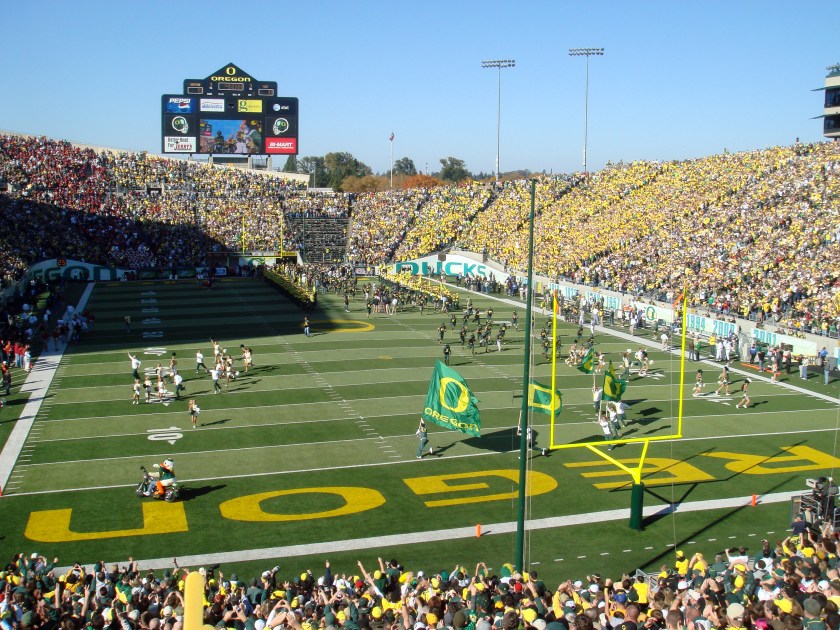
I will preface this by saying I cannot determine anything specific about the religion of Devon Allen, a remarkable college student-athlete at the University of Oregon. He is in the headlines now as a starting football player who qualified for the Olympics in track and field.  It was during his training and competition for the latter that he decided the time was right to be baptized. So he was, in the Willamette River in Eugene last Friday before the watchful gaze of family and teammates from his track and football teams. No less than ESPN reported on his religious quest alongside his impressive athletic achievements. The article ended with the proper sentiment, particularly if Allen was baptized in the right way for the right reason. It reads, “It was the right starting line for two different races” (Chantel Jennings, espn.com).

I am encouraged that Jennings found this newsworthy. I am encouraged that Allen thought baptism to be so important. I am encouraged that his friends and family showed up in impressive numbers to witness this act.

When even so many in Christendom go the extra mile in denying the importance and significance of baptism, Devon troubled himself to do it. We do not know, but he might have said what the Ethiopian said: “Look! Water! What prevents me from being baptized?” (Acts 8:36b). As he studied with Oregon football team chaplain, could he have been taught the New Testament truth that baptism is for the remission of sins (Acts 2:38), baptism washes away sins (Acts 22:16), baptism reenacts Christ’s death, burial, and resurrection (Romans 6:1-4), baptism puts one into Christ (Galatians 3:27), baptism buries one with Christ (Colossians 2:12), and baptism saves one (1 Peter 3:21)? If he was taught baptism from the New Testament, these are the kinds of things he would have heard.

Regardless of Allen’s understanding about baptism’s function in God’s plan to save us, one who is taught in accordance with the several passages above and who has a good and honest heart (cf. Luke 8:15) will want to be baptized without delay (cf. Acts 22:16). Like the jailor at Philippi, they will submit to baptism even if it is the middle of the night (Acts 16:33). Like the 3,000 on Pentecost, they will demonstrate gladly receiving the word by being baptized (Acts 2:41). Thus, they will be saved.

My prayer is that Devon Allen understand these Bible facts and responded the way he did because he humbly accepted their truth. More than that, my prayer is that those who need to make the decision to be baptized will not let anything hinder them from doing what Jesus died to make possible for us all. May we ignore all rationalization that leads us to resist the act which, from a believing, penitent heart, washes our sins away.

102707-oregon-autzen-uoentrance1

DO WE HAVE CONFUSING MENU TERMS?

Neal Pollard

Open Table, a company that facilitates reservations at better restaurants, sent a quiz today to test my familiarity with some of the more sophisticated menu terms one encounters. I made 40%, and at least a few of my right answers were lucky guesses. Truly, I’ve never heard of “okonomiyaki,” “Harissa,” “gochujang,” or “crudo.” These and others were foreign words, in the literal and culinary sense. Certainly, chefs, maitre d’s, refined diners, and the otherwise alimentary literate folks know these terms, but most of us are proud to differentiate between la fork and la spoon. We also do not like to be made to feel less than intelligent by the more informed foodie.

The more we try to be soul-conscious and truly sensitive to the visitors who attend our services, the more thoughtfully we should consider especially the terms we use and even take for granted. We’ve used them so long that maybe we assume everybody knows them.  But, these visitors may be sitting there, despite their intelligence and capability, feeling ignorant or uninitiated as we pepper them with “expediency,” “hermeneutics,” “extend the invitation,” “conversion,” “denominational,” “redemption,” and other terms that require the context of our learned church culture. Other terms, not at all hard to define, are terms that mean something specific to us but that mean something else to those without our “background”: sin, salvation, repentance, worship, born again, holy, works, grace, etc.  On many occasions, I’ve looked at some of the lyrics in our songbook and have found, especially in older songs where words have inevitably changed or fallen into disuse, we press on without defining or explaining these words to our youth, new Christians, or non-Christian attendees. “Could my zeal no respite know?”  “His garment too were in cassia dipped?” “Heavenly portals loud with hosannas ring?” Many, many more examples of such lines could be produced!

My point is not to be critical. There is no way we can define every word a visitor or newcomer may encounter in our worship services, but we do have so many who do not have our grasp of our unique terms. We have a serious obligation to them (cf. 1 Cor. 14:22-25). If we took some time to define the words of our songs, sermons, and even prayers, we would be helping those several groups who may not “get” it otherwise—teens and pre-teens, some of our young adults, a lot of our first-generation Christians, new converts, and those valuable visitors who may be termed “unchurched.” It will help the rest of us, too, to break down our rote and memorized sentences and think about what some of those “ten-cent” theological terms really mean. God desires worship that involves our heart (cf. John 4:24), and clear comprehension is a key to achieving that. May we deliberate on this when we assemble together this Lord’s Day!

OLYMPUS DIGITAL CAMERA
Who knows what this is?

Identifying The Source Of Trouble In The Congregation

Neal Pollard

One of my dad’s most memorable sermons, which he preached in more than one location, was actually a two-parter.  The first part was preached Sunday morning. Dad warned that he was going to identify the source of the problems in the congregation. He used a wipe board or chalkboard, and only put the first initial of each one up there as he preached. He said that everyone should come back that night and he would disclose the full names that went with the initials.  At one congregation, after the morning sermon, a large number of people came forward in response to the invitation.  Sure enough, that evening dad put the full names next to the initials:

  • Accuser of the brethren (Rev. 12:10)
  • Adversary (1 Pet. 5:8)
  • Beelzebub (Mat. 12:24)
  • Belial (2 Cor. 6:15)
  • Devil (Heb. 2:14)
  • Enemy (Mat. 13:39)
  • Father of lies (John 8:44)
  • God of this world (2 Cor. 4:4)
  • Prince… (Eph. 2:2; John 12:31)
  • Roaring Lion (1 Pet. 5:8)
  • Satan (Mat. 4:10)
  • Spirit that works in the sons of disobedience (Eph. 2:2)
  • Tempter (Mat. 4:3)

Now, in no way am I discounting the free will choices people make. James 1:13-15 very clearly places the blame of sin on the individuals choosing to act on their lusts and desires. One is not possessed or overtaken by the devil to do his will any more than a person is overtaken by God and made to do what’s right. But Jesus calls the devil the “father” of sinful behavior (John 8:44). John tells us that the one who practices sin is “of the devil” (1 Jn. 3:8). Those who sin are doing his will (2 Tim. 2:26).

Satan is at the heart of national, congregation, familial, and individual sin.  We’re told to resist him (Jas. 4:7; 1 Pet. 5:9). The hopeful fact is that, with God’s help, we can always successfully do so.  Let’s be aware that the devil does not want God’s children or His work to succeed. If he can thwart our efforts as a church to be united, faithful to God’s Word, evangelistic, and productive, he will do so. Knowing this, we should be more determined not to let him win!

lion-692219_960_720

In Awe Of The Greatest Freedom


Neal Pollard

I once was without representation,
Not a citizen of that chosen nation,
Enslaved and oppressed,
Deprived of the best,
And discouraged by my lowly station,

But my freedom was bought at a price,
With the one ransom that would suffice,
Sweet liberty was bought,
And my freedom I sought,
When I opted for virtue instead of vice.

Independence is becoming and sweet,
It is found when I fall at His feet,
And make Him my Master,
I avoid pain and disaster,
He offers me victory for my defeat.

I celebrate privileged position,
Embrace His heavenly mission,
Knowing the blessings He gives,
Is because He still lives,
He hears the faithful disciple’s petition.

As we celebrate the blessings in this land,
Bestowed by a Providential hand,
Let us never forget,
That He paid our great debt,
He’s preparing what’s infinitely more grand.

Whatever may become of our dear country,
I pray that our eyes will always see,
That no earthly place is home,
We are strangers who will roam,
’Til we reach the Great City across the sea.

flag-468345_640

Who Can Be Against Us?

Neal Pollard

Have you ever had someone that seemed to have it out for you? Not only did they not like you, but they actively undermined you. They may have slandered you or even lied about you. You may have even felt that they were trying to ruin your life!

Have you ever had something that seemed to overwhelm and overshadow you? It could be something from your past, present, or future, worry, guilt, regret, fear, trouble, pain, problem, or other stress. Maybe it was something that was nearly impossible to shake or something of which you were constantly reminded.

In a beautiful context writing about assurance, Paul asks, “If God be for us, who can be against us?” (Romans 8:31). That is an eminently fair question to ask. Here are some potential foes that could undo us: tribulation, distress, persecution, famine, nakedness, sword, death, life, angels, principalities, powers, the present, the future, height, depth, or any other created thing (35, 38-39). Examine that list closely. Doesn’t it include just about every potential threat and trial? Do we believe the assertion of Romans 8:31, this rhetorical question firmly implying that God is bigger and stronger than any potential problem or person?

When it comes to our righteous plans, isn’t this same principle vital to our process? What can we do and be as a church? The only limitation is that which goes against God’s will or that which can dominate God’s will. We must give great care to the first part, but we need not worry for a second about the second part. There will be factors that strain or intimidate. There will be reverses and failures. But, if we will persist and persevere, what can defeat us?

How exciting, in our personal and congregational lives, to serve a God more powerful than any foe or fear! We can succeed by His help and to His glory, come what may! Let us trust this timeless truth and live our lives as though we believe it!

24587741766_468160c634_b

THE RESCUER AND THE ONE IN TROUBLE

Neal Pollard

In Romans 8:26, speaking of the work of the Holy Spirit, Paul writes, “ In the same way the Spirit also helps our weakness; for we do not know how to pray as we should, but the Spirit Himself intercedes for us with groanings too deep for words.” The Holy Spirit “helps,” lending “a hand together with, at the same time with one” (AT Robertson) and coming to the aid of one (Bauer). This is said in connection with the Christian’s prayer life. It is an acknowledgement that sometimes we need the help of God’s Spirit in particularly agonizing times, times where words like “weakness” and “groanings” describe the struggles in prayer.

In the same passage, Paul says the Spirit “intercedes,” a picturesque word of rescue by one who ‘happens’ on one who is in trouble and ‘in his behalf’ pleads with ‘unuttered groanings’ or with ‘sighs that baffle words’” (Reinecker 367). What graphic imagery! When I am in real trouble, no one can help me like God can. Sometimes, only God can help me when I am in trouble. Paul teaches that there is no depth of struggle or trial in prayer too complex or incomprehensible for the omniscient God. As the Psalmist once wrote, “Out of the depths I have cried to You, O Lord. Lord, hear my voice! Let Your ears be attentive to the voice of my supplications” (Ps. 130:1). Paul is saying, “The Lord does hear and is attentive not only to my voice, but even to the unspoken, unutterable fears, desires, and longings in my heart that cannot be formed into words on my lips when I pray.

Our God is a God of rescue (Ps. 18:19; 116:8; 136:24). He has rescued man in dramatic ways, from the Red Sea crossing to Jericho to Gideon’s tiny army to Calvary’s cross. He has demonstrated that He wants to help us and will freely extend Himself to do so. But, He wants us to reach out to Him and appeal for help. Even when the words will not exactly come to us, He knows the intent and desire and He looks with an eye toward aiding His children (1 Pet. 3:12). Do not only come to Him when in trouble, but do come to Him when in trouble. You do not have trouble too big for Him to come along and rescue you from it.

Trust that!

maxresdefault

Tony Robbins And Proverbs Six

Neal Pollard

Perhaps you heard about the 30 “followers of motivational speaker Tony Robbins” who “were burned while walking on hot coals” in Dallas, Texas, over the weekend (nbcnews.com). Now, nearly 7,000 others were not injured, but when nearly three dozen were it became a national news story. The firewalk is “a symbolic experience that proves if you can make it through the fire, you can make it through anything” (ibid.).  But, there is a catch. Don’t run, have wet feet, or try to go across a firebed that is too long (the Guiness Book of World Records says the longest firewalk was just shy of 600 feet in Calgary in 2007).  No one seems to disagree that one cannot indefinitely walk on hot coals. God, who created fire and feet, moved Solomon to say, “Or can a man walk on hot coals and his feet not be scorched?” (Prov. 6:28).

This statement comes as part of Solomon’s warning about “the evil woman” and the “adulteress” (cf. 6:24).  He warns about her alluring beauty and ways (25), showing the consequences that one may miss when driven by lust rather than law: one is reduced (26), destroyed (32), wounded and disgraced (33), reproached (33), and repaid with revenge (34). One of Solomon’s two metaphors to depict adultery’s repercussions is feet being burned by walking on hot coals (the other is taking fire in his bosom and his clothes being burned).

Countless men and women have been deceived by the seemingly harmless effects of allowing attraction for someone other than their mate to grow in their hearts and minds. One may let admiration and attraction for this other person to take root in their hearts. Defenses are lowered and lines begin to be crossed. The thrill and excitement of the prospective relationship can come to eclipse rational thoughts, negative consequences, and the fallout in the lives of all the people affected. When David gazed at Bathsheba from his rooftop, he saw a beautiful, naked woman rather than murder, death, humiliation, dysfunction, loss of influence, and agonizing heartbreak. His unlawful desire for her prevented him from seeing past what he wanted in the moment.

God’s laws are immutable. One cannot flout them without the fruit that follows. So many who have crossed that line have desperately wished they could go back to the other side of that firebed and taken the righteous path. May each of us have the wisdom to see these kinds of things from God’s eyes, which are pure, right, and perfect. Realize that pursuing a person who is not your lawful mate is like playing with fire! Don’t get burned.

shoe-582851_960_720

Do We Need Permission?

Neal Pollard

For several years while in Virginia, I enjoyed going out with a couple of dear Christian brothers to hunt for Civil War relics.  Of course, hunting on federal property was a serious crime and was unthinkable. However, so many of the personal properties owned by residents in the Richmond area were treasure troves of those artifacts. Their woods and fields held bullets, shells, buckles, buttons, and the like. Dave Young, Jr., always followed the same procedure before our hunts. He would go see the homeowners where we wanted to hunt, people he had known, built friendships and done business with for years. If we got their permission—sometimes the thoughtless or unethical practices of other hunters made them inclined to refuse us—then we would go on their property and hunt for relics. It was their land and their right to permit or deny. If we had ever chosen to hunt one of those places without permission and got caught, it would have been a silly argument to say, “They did not tell us we couldn’t hunt here.”

This example is crude and imperfect, but I think it illustrates a principle most can understand. It is not natural to construe someone’s silence as permission. Yet, when it comes to matters of faith and practice in religion, we attempt that very approach.

When it comes to how we live and serve in this life, we have to have God’s approval for whatever we do (Col. 3:17). When He tells us what His will is on any matter, our response to that should be thoughtful, careful, and submissive.  To be otherwise would be thoughtless, careless, and rebellious—with God’s stated desires.  To think that God would give us physical life, generous physical blessings, incredible spiritual blessings, spiritual life, and powerful promises on a continuous basis and we could ever be callous or cavalier about what He wants reveals an unfathomable audacity. Frank Chesser once depicted such an attitude this way, saying, “It has no respect for either the sound or the silence of God’s voice. It only does what the Bible says in a given area because it happens to agree with the Bible on that point. At the first sign of conflict, it will have its own way ever time” (The Spirit of Liberalism 18).

Church music in worship often gets isolated from the larger principle.  How we worship God in song, whether with or without mechanical instruments, is just one specific of a much broader principle. God has told us what He wants for church music (Eph. 5:19; Col. 3:16). Whatever we do must meet His expressed will. Projecting songs, using songbooks or shape notes, having a song leader, or singing in parts or four-part harmony still falls within the category of His command that we sing. But this same principle covers everything we do in worship as well as the specific commands He has for us regarding our work as a church, our response to His grace in order to have His salvation, and the like.

Our culture teaches us to ask, “Why can’t I?” It encourages us to say, “You didn’t say I couldn’t.” But, “the whole world lies in the power of the evil one” (1 John 5:19). The humble spirit of a grateful, grace-receiving child of God, when viewing the will of God, should always be, “Do I have permission for that?”  Such is neither cowering fear or abject slavery.  It is adoration and reverence for a Lord who gave everything that we “may know Him and the power of His resurrection and the fellowship of His sufferings, being conformed to His death” (Phil. 3:10).

FullSizeRender 2
Some of my relics from back in the day

THE BOY WHO STAYED HOME

Neal Pollard

When we think of the parable in Luke 15, we inevitably think of the younger son who left home for the far country of sin. We appreciate God giving us the prodigal (reckless; wastefully extravagant) son in this parable to illustrate hope, love, and forgiveness, no matter what we may have done. Then we think of our favorite character in this story, the father. He represents God and reveals God’s eagerness to embrace and restore a sinner who repents. He gives the undeserved, unexpected, and unanticipated (cf. Eph. 2:4-8).

Then, there’s that other main character in the story. How does he strike you? After all, his brother has been reckless and irresponsible and his dad lets him off scot-free and even throws him a party. He robbed his father blind, and he isn’t even punished one bit. How do you see the brother who stayed home? Let at the text more closely and see how God sees him.

  • He was guilty of self-righteousness. He complains to the father about the reception his brother received (29). With self-righteousness, there’s an exaggerated view of our own goodness. There’s an exaggerated view of the other guy’s badness. There’s a comparison where we come out on top of the other guy. There are often judgmental assumptions made about the other guy. Let’s not forget that Jesus condemns self-righteousness (cf. Luke 18:10-14). If the Father walked up on some of our condescending conversations, He would spoil our fun since the spirit of self-righteousness is so far removed from the spirit of a loving Father who longs for His wayward children to come home.
  • He lacked self-control (28). He appears quick-tempered, not waiting for an explanation. We have the conversation between the younger son and the father, and the older son and the father. Where is the conversation between the two brothers. Didn’t he claim to be the good, righteous one? There was no self-control in the way he talked to his father or about his brother. “If anyone thinks himself to be religious, and yet does not bridle his tongue but deceives his own heart, this man’s religion is vain” (Js. 1:26).
  • He was selfish. Why did he wring his hands about the younger brother’s wasteful spending? The father, who knew this son, answered, “All that I have is yours.” There is no evidence that the older brother was concerned about his formerly depraved brother or his once-grieving father. He seems more interested in how these things impacted him. He appears faithful to his father, but for the wrong purpose. What difference would it have made if the older brother saw the prodigal as someone to serve rather than slam?
  • He had an unforgiving spirit. His brother has sinned against him, but he was unwilling to forgive him. One of the servants called him “your brother” (27), the father calls him “this brother of yours” (32), but the only time he directly refers to him he calls him “this son of yours” (30). Behind these parables, the Pharisees and scribes grumble at Jesus receiving sinners. In the first two parables, people sought the lost. In this last parable, the older brother made no effort to go after his brother. God implies as early as Cain and Abel that we are our brother’s keeper (cf. Gal. 6:2; Js. 5:19-20). Not only did he not search for his brother, but now he won’t forgive him.
  • He was jealous. He thought the father was better to his erring brother (29-30). You can almost hear him saying, “You love him more than you love me.” He couldn’t stand to see his brother honored. How contrary to the way God wants His children treating each other (Rom. 12:10; Eph. 4:31-32). The older brother was making accusations and he hadn’t even spoken to him. He thinks the worst of him and is utterly lacking in brotherly affection.
  • He was not humble, but rebellious against his father’s will.  He wanted to tell the father how to run his house. Do you notice the younger son respectfully addressing his father (21)? There’s little if any respect from the older son (29-30). The Bible condemns self-will. Peter condemned those despising authority and the self-willed (2 Pe. 2:10). Some people are loyal to the church as long as they can have their own way.

Some of us may find ourselves in the position of the prodigal. None of us will ever be in the position of the father. May we never find ourselves in the position of the boy who stayed home. If we do, we may lose our place in the father’s house!

hqdefault

Embracing The Struggler

Neal Pollard

So much is said about the deficiencies of youth and young adults in our current culture. While every generation has its shortcomings, I have observed a hopeful trend. Perhaps it rests on the faulty foundations of political correctness and relativism, but young people today seem much more prone to accept and nurture those who have discernible difficulties like handicaps, mental or physical challenges, or social limitations.

Another way it shows up, specifically in the church, is the way they rally around those who are spiritually broken or in need. When a teenager or young adult responds to the invitation, watch how their peers flock to their side to show their support. This beautiful, tangible act is reflective of the father in the parable of the Prodigal Son, and it is a trait that the father so wanted from the older brother (cf. Luke 15:20,31-32). It looks a lot like the tender goodbye between Paul and the elders in Acts 20:37.

This willingness to reach out and comfort one another is a supremely biblical way of interacting within the family of God. 1 Thessalonians 5:11 says, “Therefore encourage one another and build up one another, just as you are also doing.”  God calls His people to have that kind of nurturing spirit. When we see those who are physically hurting, we should respond (Mat. 25:35-36; 1 Jn. 3:17). When we see those who are emotionally hurting, we should respond (Rom. 12:15). When we see those who are spiritually hurting, we should respond (Gal. 6:1-2; Jas. 5:19-20). The response should be more than token and certainly should not be heartless and surface. It should not be shown with favoritism, but to everyone who is in need of it.

This warm and loving response may not come as naturally to some of us who are older, but oh how crucial it is that we stretch ourselves to do it. Embracing a sinner does not mean embracing a sin. Let us discipline ourselves to see the difference. Hear the words of the Hebrews 12:12-13: “Therefore, strengthen the hands that are weak and the knees that are feeble, and make straight paths for your feet, so that the limb which is lame may not be put out of joint, but rather be healed.”

13407188_10209411714315519_8514604783791013955_n

The Worst Way For Total Blindness To Occur

Neal Pollard

While visiting Ray and Lupida Lewis yesterday, I got to hear the story behind her current situation. This upbeat, sweet-spirited Christian woman was minutes from undergoing the first of at least three extensive back and neck surgeries necessitated by injuries suffered as she was walking and was struck by a driver going 35 miles per hour.

Lupida has had a degenerative eye condition since childhood. It had gotten to the point that she could barely see more than shapes, but, given her educational background, she had been recruited to serve as a teacher in the Colorado School for the Blind. By last year, despite corrective eye surgery, Lupida could only see light and nothing more. That fateful September day last year, she was struck in the crosswalk by the inattentive driver and suffered brain, neck and back injuries. Some of that may be remedied, and other issues will never be resolved. One that appears permanent is that her head injuries caused her to wake up without even the ability to see light. She says, “I see only darkness now. The light has gone away.” She observed that one cannot really imagine the huge difference between being able to see light and being in total darkness.

We did not discuss it together, but I believe Lupida would agree with me that, as tragic as her circumstances are, there is a blindness worse than her own.  Lupida lives with a faith and hope which assures her that her situation is, at worst, temporary. The song says, “Faith will be lost in heavenly sight.” She embraces that promise.

Today, you will constantly encounter people who may have the eyesight of an eagle when they submit to a physical test but who suffer a far greater blindness. Scripture often makes reference to wickedness as “walking in darkness” (Ps. 82:5; Prov. 2:13; Ecc. 2:14; Isa. 9:2; John 12:35; Eph. 5:8; 1 Jn. 1:6; 2:11). Tragically, it’s not the result of an accident–though it could be ignorance. Millions reject the light and pursue the darkness. They have every opportunity to see, but they don’t want to see. Ultimately, their voluntary journey through darkness leads to the outer darkness of condemnation (Mat. 8:12; 22:13; 25:30). Fortunately, their condition is reversible thanks to the Great Physician, but time is growing shorter by the moment. Ask God to lead you to those who are spiritually blind, and may we all endeavor to avoid such a condition ourselves (cf. Mat. 15:14; Rev. 3:17)!

julie-dan-1-1024x768


“GM”

Neal Pollard

I make a notation “GM” along with the date and place on the paper copy of my sermons to indicate that I preached that sermon in a gospel meeting. It is one of my homemade preacher shorthand notations. Growing up a “PK” (“preacher’s kid,” of course), I’ve got a lot of GM memories. I would not trade anything for them, especially the indelible imprint they made on me in shaping the adult I have become. Let me encourage you to bring your children and yourselves to our gospel meetings for what they will mean to your faith and for the part of you they will forever become. To me, the GM of gospel meeting stands for a few other things, too.

Great Memories. When James Watkins held a meeting for us in 1984 in Franklin, Ga., I led singing that Sunday night. I was 14, and this participation was a big deal to me. I led, “Hallelujah, Praise Jehovah” and in verse three mistakenly bellowed out, “All ye fruitless trees and cedars.” Once when the air conditioner was out, we opened the side doors on either side of the pulpit for relief in that muggy July, west Georgia heat. This was an open invitation for the horse fly that landed on the calf of my leg during the chorus of “the song before our opening prayer,” which bit mercilessly until I could swat it during said prayer (which was by no means a quiet slap).

I remember attending a meeting in Carrollton, Georgia, and being jolted by Bobby Duncan’s dramatic cries of “the boy is home!” in his powerful telling of the story of the prodigal son. I remember, though, I was no more than 5 or 6, the smell of hay and watching members set up a portable baptistery for a tent meeting my dad preached in Aragon, Ga. I remember the family car rides when we rode to others’ meetings. I remember the baptisms, restorations, preaching, and fellowship so much a part of these special times.

Giant Men. Through this venue I first became acquainted with men who became my heroes: Frank Chesser, Perry Cotham, Howard Swann, James Watkins, Bobby Duncan, Truman Cobb, Franklin Camp, Winfred Clark, Wendell Winkler, Glen Posey, Ken Thomas, V.P. Black and others. I remember playing basketball with Ken Thomas, who had to play in his socks and still took us all to school (he also demolished me in a game of “punt, pass, and kick”). I recall having me heart stirred and being convicted of sin by the penetrating preaching of Frank Chesser.

I vividly recall being amazed by Perry Cotham, who seemed to me even three decades ago to be a very old preacher (I saw him preach in California when he was in his late 90s). I will never forget being touched by Franklin Camp’s tender heart as he told the story of Christ’s crucifixion. I was wowed by J.J. Turner’s ability to turn a phrase. There was the time when I walked by James Watkins’ hotel room and saw him diligently studying his Bible in the middle of the afternoon. These men were spiritual giants to me.

Gospel Message. Even as a child, I learned so much from the sermons I heard. I saw things in a new way because every preacher has his own unique style, history of study, and method of delivery. I was challenged by the Bible-centered approach these men faithfully took. I got my first glimpse at sermon organization, taking crude notes and main points from sermonic masterpieces. Meeting after meeting, year after year turned my heart and mind more and more to the Bible. Even then, I saw, at least to a juvenile degree, the effectiveness of this method of evangelism and edification.

Give your children, your mate, your non-Christian friends and neighbors, and yourself the pleasure of experiencing these unparalleled joys. The Godhead and the heavenly host pay particular interest to each service of every gospel meeting. Let us join them there and grow from hearing anew the wonderful story of love. It will stay with you for a lifetime.

dad-gallery-042407

THE BEAUTY IN CHRISTIANITY

Neal Pollard

  • I have witnessed many people love, accept, help, and open their homes and lives to people of different races, backgrounds, and income levels.
  • I have watched families, including my parents, who barely had enough to buy their own groceries buy a poorer family a week’s worth of groceries.
  • I have seen love, assistance, and tears profusely given to people who frankly confessed their struggles with a variety of sexual sins, addictions, and the like. A hundred pledged love, help, and support for any one that stood back in harsh judgment of them.
  • I have experienced men, women, and children going into scary neighborhoods to share food, clean homes, and help explain the Bible to those who lived there.
  • I have noticed people who were taken advantage of as thanks for their generosity but who responded only with kindness and positivity.
  • I have observed so many cheeks, slapped with libel, untruths, gossip, and hypercriticism—from faithless unbelievers—humbly turned in benevolent, benign gentleness.
  • I have beheld godly people lose their jobs because of their fidelity to their faith and their conviction in the Christ, who maintained trust and left no room for bitterness and resentment at the unfairness of their treatment.
  • I have regarded families give up the luxuries of this country to go to poor countries and live among the people there, sharing the good news of Christ with those who don’t talk or look like them.
  • I have met more people than I can count who made the difficult choice to obey the gospel in the face of utter rejection and persecution from friends and family who disapproved their decision.
  • I have known countless, from the most aged to the youngest, whose demeanor, speech, and deeds were seasoned with compassion, understanding, sympathy, and patience—not conditioned on the skin color, orientation, political affiliation, educational attainment, or similar surface characteristics of others.

Where? Where has such magnanimous, merciful, and munificent behavior occurred? In the church of Christ! My heart sings the archaic hymn, “I love Thy kingdom, Lord.” In it, I have found the best people in the world, trying their hardest to be like Jesus. May we unite to oppose every instance of unkind, un-Christlike behavior among us, but do so with the same patience and understanding we afford anyone else.

13240772_10153682075820922_280342329215061650_n

INTELLIGENT DESIGN

Neal Pollard

A child was sent to school one day,
By parents walking the narrow way,
The child learned many a concrete rule,
On Math and English in that school.
The history class did pretty well,
Spelling and language arts were swell,
But right before lunch, to science class,
Biology lessons one needed to pass.
Talk was made of ironclad “fact,”
“Evolution!” Of course.  The talk was packed
With tales of geology billions of years old,
And transformations a wonder to behold.
Every smart person, any rational mind
Accepts this “fact,” oh who’d be so blind,
So Neanderthalish to speak of design—
Intelligent purpose, such talk unbenign!
‘Tis a danger, the courts should never allow
A nod up to heaven or a teacher to bow
To the concept of design purposefully forged
Such poisonous food for a young mind to be gorged.
What’s next? Talk of accountability?
A Creator in heaven? Judgment? Eternity?
Outrageous that Bible thumpers insist
To include in school teaching such mythical mist.
Let’s stick to the concrete, from our father of faith
Brother Darwin’s didactics, so sacred and safe.
“Amen!” to Precambrian. Naturalism? “Preach on!”
Such humanistic glory, let God talk be gone!
We got here by purposeless, meaningless oops,
Universal precision via primordial soups.
So close up your Bible, turn off your mind,
Away with your dangerous, intelligent design.
Content yourself wholly with invertebrate grandmothers,
And bask in the beauty of babboonish brothers.
Any questions, young minds?  No?  Class is dismissed!
Go out into a world of designless abyss.

Ignore clues from systems both solar and lunar,
Or circular or vascular, far better the sooner,
The opposite of intelligent? Slow-minded and shallow
Of design? Confusion, a mess, a fog, or fallow.
How many a little mind, trusting and bright?
Are being led blindly minus logical light?
By teaching unintelligent, but doubtless by design,
To eternal unreadiness via moral decline?

505532328_e707b390ee_o_d

Transgender Voyeurism?

Neal Pollard

It’s a clash of political correctness agendas, though the latter one is extremely legitimate.  On one side, we have the recent, insane push for recognizing transgenderism—even that which is simply claimed and asserted at the apparent whim of the claimant.  On the other side is an important, needed aspect of feminism—protecting women from the sexual aggression of men. Both are fiercely championed by those of a liberal mindset, and the two came face to face in the “gender neutral” bathrooms of Whitney Hall at the University of Toronto.  Ironically, two incidents of voyeurism, where male students were “caught holding their cellphones over female students’ shower stalls and filming them as they showered” (dailywire.com), occurred in September, 2015, just as the push was heating up for men and women to choose the public bathroom of the gender they felt themselves to be. Our sitting president even defended a federal transgender directive for public school bathrooms, allowing “transgender students to use the bathroom that matches their gender identity, saying that society must protect the dignity and safety of vulnerable children” (nytimes.com, Julie Hirschfeld Davis, 5/16/16). The outlandishness of such baseless thinking had already been demonstrated well before this “guidance” issued by the Education and Justice Departments was made public this Spring.

There is a biblical and biological answer to what has amazingly become an enigma and conundrum for everyone from politicians to corporations. Jesus said, “But from the beginning of creation, God made them male and female” (Mark 10:6). There are external ways to both test and validate these, and are as accessible as a basic medical examination. I trust a Creator whose ability is demonstrated everywhere from the order and continuous operation of the universe to the magnificence of the earth to the intricacies of the body’s circulatory and respiratory systems to somatic cells to our DNA.

In the world’s rabid desire to reject His authority, there’s no wonder that people concoct such far-fetched, senseless ideas as we are seeing put forward at the present time. Paul traces the genesis of such ludicrous ideas, saying, “And just as they did not see fit to acknowledge God any longer, God gave them over to a depraved mind, to do those things which are not proper…” (Rom. 1:28). Until that mindset changes, we are likely to see more issues like the push to accept transgenderism and welcome it into our public private places (like bathrooms in stores and dorms) even if they produce the kind of actions reported in Whitney Hall.  May more people simply and humbly follow the perfect guidance of God’s Word.

15799031740_a8ddefcdfa_o-2
On December 10, 2014, The Kaiser Permanente Center for Total Health and National Center for Transgender Equality are hosting a Community Clinician Roundtable for providers who care for transgender patients in the Washington, DC, MD, VA community. The roundtable will include physicians, nurses, therapists, attorneys, and health care staff who support this population. The Center for Total Health will convert two existing multi-stall restrooms to be Gender Neutral during the roundtable. The Center has previously made this designation for LGBTQ supportive events, and is collaborating with the Kaiser Permanente Garfield Innovation Center to pilot multi-stall gender neutral restrooms in health care facility construction moving forward

The Danger Of Being Swept Away

Neal Pollard

You may have heard that I was caught in a rip tide during Carl’s senior trip. We were at St. Pete’s Beach in the Tampa-area, swimming and playing in the water not far from a fishing pier. Somehow, I was pulled into a riptide and quickly pulled out toward the Gulf. The shore quickly grew distant and my subpar swimming abilities were tellingly useless. A couple of fishermen told me I was caught in it and my best hope was to try and move parallel to the waves and angle for a point about a half-mile up from where I was. That was a painfully slow process, and the water kept taking me where it wished.  I was on the other side of the pier, moving generally toward that point but still in the grips of the tide, when Dale swam out and helped pull me out of the current until I could finally get to shallower water and make my way back onto the beach. At the risk of sounding melodramatic, I believe Dale saved my life.

Only after this did I learn that, according to the CDC, there was an annual average of 3,536 fatal, unintentional drownings in the United States from 2005 to 2014. That’s about ten deaths per day. Nearly 80% of all people who die from drowning are male. A lack of swimming ability is the greatest risk factor in drowning, and 57% of all people, age 15 and over, who drown do so in “natural water settings” (like the ocean)(cdc.gov).  I also was reminded, from the Pandora playlist Dale piped through our van’s sound system, that he has an interesting sense of humor—playing “Under the Sea,” “The Ocean,” “High Tide, Low Tide,” “In Too Deep,” “Riptide,” “Drowing,” and “How To Save A Life” (plus a bunch more).

But I also have a different perspective toward some of the songs in our songbook:

  • “Soul you are drifting along on the tide, out on life’s ocean so boundless and wide…”
  • “Some poor fainting, struggle seaman, you may rescue, you may save…”
  • “Throw out the lifeline, someone is drifting away…”
  • “While on the sea hear the terrible roaring…”

As I look back, the currents were strong but the force was subtle. It did not take long for me to be moved away from the shore and taken away. Making the right efforts played a part in my staying afloat. Ultimately, however, I needed outside help to come back to shore.

The writer of Hebrews says, “For this reason we must pay much closer attention to what we have heard, so that we do not drift away from it” (2:1). A.T. Robertson says of the word “drift”: “Here the metaphor is that ‘of being swept along past the sure anchorage which is within reach’ (Westcott), a vivid picture of peril for all” (342). BDAG says it is an imagery of flowing water and means “be washed away” or “drift away” (770). The Greek Old Testament uses the word in Proverbs 3:21, where Solomon urges his son to not let wisdom “vanish from [his] sight.” The epistle’s nautical metaphor pictures vividly what can happen in our spiritual lives. We can  lose sight of where we are, and we may begin to struggle and start to succumb to the pull of the current. We must continue to make the effort to pull away and we should accept the attempts of those who seek to rescue us.

Spiritually, none of us want to become a casualty. We do not want to perish. May we realize that falling away from God is not usually sudden or dramatic. It is often subtle and gradual. Let’s pay much closer attention to what we have heard! It’s our lifeline.

13237839_10153686555335922_4716771003949535795_n

The Reality Of Jesus Christ

Johnson Kell

He was born of a virgin and when He was about thirty years of age He was baptized in the Jordan River by John the Baptist. And being full of the Holy Spirit He began His ministry walking the dusty roads of Judea, Samaria and Galilee, performing miracles and preaching the gospel. And He did go out carrying His own cross toward Calvary, and He did hang there for hours writhing in anguish and pain. And He did cry out, “My God, My God, why have You forsaken Me?” He did die there, shedding His blood for the sins of the world.

But there was a resurrection and He spent forty days with His apostles providing many proofs of a bodily resurrection–the tomb was found empty. And after forty days He spoke to them for the last time and as they watched intently He disappeared through the clouds on His way back to heaven. Some time later, when Stephen was being stoned to death, he cried out, “I see the heavens opened and the Son of man standing at the right hand of God.”

And so we have the assurance that our Savior is at His Father’s side making intercession for each one of us. And we can recall in the letter that the apostle Paul wrote to the Christians in Colosse, where he cried, “Christ in you the hope of glory!” So as we are born-again children, we, too, can say, “Christ in us the hope of glory!”

This was and this is the reality of Jesus Christ.

IMG_3446

The Eye Test

Neal Pollard

We covet those parking spaces close to the store, whether because we think we will save a little time or several steps by nabbing them.  Yet, we are in “competition” with others who are seeking the same spaces. No one rushes to the back of the parking lot to grab up those spots. But at a Costco in Canada recently, this vying turned violent as two middle-aged couples literally fought over a parking space. As in, it came to fisticuffs. As of this writing, police are still investigating and there may be fine details to be added to the story. Basically, however, as a YouTube video shot by a local realtor shows, anger over who should put their automobile in that space escalated to foul language, pushing, shoving, name-calling, and thrown punches. Four people who might otherwise be respectable, dignified contributors to society now share an infamy that may dog them for a long time. All because of a failure to conduct themselves properly in a public place.

We shake our heads at this animalistic behavior, but in our self-righteous sense of superiority we might do well to examine how exquisitely we execute our example before the eyes of the world. Consider some places where Christians can be oblivious to the watchful eyes of others:

  • Social media brawls, whether over matters clearly addressed in Scripture or matters of judgment and opinion.
  • Bible class discussions, where visitors, new Christians, and weak Christians might see the redeemed’s  inhumanity to the redeemed.
  • Public arenas, from the retailers to the restaurants and from the grocery store to the department store, where subpar (or even adequate) customer service evokes an unChristlike response from a disciple of Christ.
  • Arguments between spouses or parents and children, members of a “Christian home,” who resort to the tactics of their worldly counterparts as they wage war before such witnesses.
  • At ball fields, concerts, movie theaters, and the like, where something displeasing to us provokes an impatient, harsh, and retaliatory response that eclipses any view of Christ.

Certainly, these are just a few ways and places where we might forget ourselves and squash our precious influence by allowing the flesh to dominate our presumed spirituality. It is good for us to consider that those things cannot come out of us unless we are allowing improper things come into us. We must guard against the things that might creep in—“immorality, impurity, passion, evil desire, and greed, which amounts to idolatry” (Col. 3:5), “…enmities, strife, jealousy, outbursts of anger, disputes, dissensions, factions…” (Gal. 5:20, which are a bulk of the works of the flesh specifically identified by Paul), and more (cf. Mark 7:22-23, etc.).  We must work to control what comes out, harnessing the tongue (Jas. 3:2ff) and controlling the temper (cf. Eph. 4:26). We must strive to cultivate thoughts and feelings that, when expressed, build up and draw others to Christ (Col. 3:12-13; 1 Pet. 3:8-11; Gal. 5:22-23; etc.).

Like it or not, we’re hilltop cities and lighthouses (Mat. 5:14-16). Let us keep our behavior excellent among the “Gentiles,” as they observe our deeds, so that they will see Jesus at work in us (cf. 1 Pet. 2:12). Our attitudes, speech, and actions may not become a viral video, but we are still being watched. Let’s take care to display ourselves in a way that would not embarrass (or condemn) us were we to see it again, played by the Lord, at the Judgment Day.

cju0cyfw0aaufb9

THE LITTLE GRAVES THAT HAVE NO NAME

Neal Pollard

Lance Corporal Francis Ledwidge, a 26-year-old Irish soldier, was one of 10 million people killed in World War I.He died July 31, 1917, in Belgium. He was a poet, and he wrote the following before the war:

And now I’m drinking wine in France, the helpless child of circumstance.
Tomorrow will be loud for war, how will I be accounted for?
It is too late now to retrieve a fallen dream, too late to grieve
A name unmade, but not too late to thank the gods for what is great;
A keen-edged sword,a soldier’s heart, is greater than a poet’s art.
And greater than a poet’s fame a little grave that has no name.
(Gilbert, Martin. The First World War, Holt & Co., NY, 1994, 353).

Ledwidge sounds neither devout nor decent, but his last stanza rings loudly. This poor, fallen man glorifies the soldier, prolific even in anonymity. Glory rather than shame is to be memorialized in an unnamed grave.

Greater far than those whose spirits departed on plains and beaches of Europe or Asia or even Canaan during Joshua’s days are those who lost their lives in service to God. In the great memorial of Scripture they are mentioned, but without their names. One day, in heaven, their identities will be known as the Lord reads the names of those written in His Book of Life.

The writer of Hebrews speaks about many such unnamed heroes of the spiritual war that endures generation after generation. Among those are unnamed prophets of valor (Heb. 10:32-34). Unidentified women are remembered for their faith (35).

Following them, the writer holds up the generic others–children of God persecuted and even killed (10:36-38). Together they form that multitudinous throng of witnesses in Hebrews 12:1. Under centuries of dust, sand and silt lie their unmarked graves. God does not even reveal their names to the reader. But they sacrificed and persevered in hope of eternal life. They gained approval through their active faith (11:39). They stand as an example and a motivation for Christians today (12:1).

Throughout the world there are scores of Christians toiling in obscurity. For every big-name preacher and high-profile teacher and widely known missionary, thousands of godly mothers are training their children to follow Christ and running their homes with grace and virtue (Ti. 2:5; Pr. 31). Without recognition, elders are praying for, shepherding, defending and feeding lambs in places as far away as India and Africa and as close as Indiana and Alabama. Hidden from the watchful pens of our sharp-sighted editors and authors are saints, as soldiers, fighting Satan without ceremony or earthly commendation. One day their bodies will fail and fall into graves, known only to family and friends, but unmarked in the graveyard of brotherhood greats.

Too, in the church, day by day great things are done by saints that never make the bulletin, announcements, or bulletin boards. Masked by their modesty, they brighten many lives by walking in the light. The elders, preachers, or deacons may never know so much of what they do, but God sees and will reward them. When they lay their armor down, they may sleep in an unmarked plot in the cemetery of church history, but with God they will have greater fame than those who etched their mark in the annals of the world.

So, fight (1 Cor. 9:26)!

german_military_cemetery_normandy_1