Studying a map, Peter travels the road from Jerusalem northwest through Emmaus until he reaches the village of Lydda. This is the Lod of the Old Testament, part of the southern kingdom mentioned in 1 Chronicles 8:12, Ezra 2:33, and a few times in Nehemiah. The only time it occurs in the New Testament is in this paragraph. We can assume that the church was established by those present to hear Peter and the apostles preach on Pentecost. Or, perhaps, it was the efforts of those who were scattered from Jerusalem who went everywhere preaching the word (8:4). The route Peter takes to Joppa crisscrosses the road Philip took from Gaza to Caesarea Maritime (Azotus is a couple of towns south of Lydda). Whichever the case, there were already saints when Peter reaches Lydda. This includes a paralytic man named Aeneas, who Peter heals. This causes all who lived at Lydda and Sharon (Song of Sol. 2:1) to turn to the Lord (35). Faith is flourishing and the church is growing.
Peter continues his travels northwest until he reaches the seacoast city of Joppa (today, it is one of the most important cities in Israel, known today as Haifa). When Peter arrives, he’s also there to visit the church (36ff). About the time of his visit, one of the Christian women “fell sick and died” (37). We learn several things about her:
She was a disciple (36). This means she is a learner associated with Jesus’ views (BDAG 609).
She “was abounding with deeds of kindness and charity which she continually did” (36). This should not surprise us, as it seems to further define and defend the fact that she is a disciple. Jesus went “about doing good and healing all who were oppressed by the devil” (10:38). She was simply doing as He had done.
She was loved and missed by the local church (38-39). Her death was an urgent matter. They plead with Peter to come quickly. When he arrives at the upper room where she’s laid, the Christian widows are “weeping and showing all the tunics and garments that Dorcas used to make while she was with them” (39).
She was raised (40-42). Peter brings her back and presents her alive to the church. We can only imagine what joy this brought the church, but we know that this act caused many to believe in the Lord (42).
The miracles and signs performed in the early church all served the same purpose. They were to create faith in Jesus, the Man, His message, and His mission. Peter remains in Joppa many days, staying with a tanner named Simon (43). It is here that he will be a part of a dramatic turn of events that takes him north along the seacoast (Acts 10).
When Peter was invited to follow Jesus, he was told, “…I will make you fishers of men” (Mat. 4:19). Did he take any opportunities to go down to the seacoast and fish the Mediterranean while at Simon’s house? I don’t know. I do know that his primary focus now was on fishing for men. God used him mightily in that effort, both to encourage the saints and reach the lost. Likewise, whatever we were and whatever we did before becoming a disciple of Jesus, He can use us in those ways (as He did Dorcas) and leverage our experience to bring about great results to His glory!
Worry not. I am not writing an article about the 2021 National Champion Georgia Bulldogs, even though that is an article I had wished to write for decades. No, I am thinking of an archaeological discovery made in a Pompeiian house (“House of the Tragic Poet”) renowned for its exquisite frescoes and mosaics. Within the house’s vestibule, there is a dog mosaic. Below the dog, there are also these two words in Latin: “Cave Canem.” I imagine you have guessed from the context of our title what those Latin words mean. Yes, they read, “Beware of the dog.” (Literally, “Beware the dog.”) The mosaic dates to the second century BC.1
Did you imagine that the ancient Romans had “Beware of the Dog” signs? I admit being unaware of this until I stumbled upon a bit of clickbait on social media promising interesting archaeological finds. OK, so maybe this “sign” wasn’t the most breathtaking discovery ever. But it was interesting. It serves as an example of Solomon’s inspired truth that there is nothing new under the sun (Ecclesiastes 1.9).
Typically, we think of the “Beware of the Dog” sign as a warning to unwanted visitors. It says, “We have a dog, and it may bite you.” However, scholars believe that the sign’s original purpose was the opposite. Visitors did not have to worry about dog attacks but needed to avoid trampling the family dog. “When you come inside, you will encounter a small animal we cherish. Please be mindful of him.”
The Italian Greyhound, for example, is an older breed originating more than two thousand years ago. It is the smallest of the sighthounds. The AKC states that breeders bred them as “noble companions.”2 That fits what we know of Pompeii, a resort town for wealthy Romans who would surely own such canines. Indeed, the House of the Tragic Poet was not the only house in Pompeii with a “Cave Canem” mosaic. It was just the first one excavated.
Now, why would I spend so much time within a religious forum talking about a “Beware of the Dog” sign? It so happens that Paul used that expression in Philippian 3.2: “Beware of the dogs, beware of the evil workers, beware of the false circumcision” (all ref. NASB1995 unless otherwise indicated). In Koine Greek, that is “Βλέπετε τοὺς κύνας.” As odd as it sounds to the dog-loving United States today, Arabs and Jews were more likely to despise dogs. Remember that even Jesus cautioned us, “Do not give what is holy to the dogs…” (Matthew 7.6).
Dogs were often wild and roamed in packs in ancient Judea. There was no archaeological evidence of pet dogs in the region until the post-exilic era.3 In their nondomesticated state, these dogs would do disgusting things like eating the bodies of the dead (e.g., 1Kings 14.11). These reasons are why generic Biblical scholarship believes Jews and Arabs dislike dogs and use the term as a byword for detested people. (Indeed, Western languages now likewise use “dog” in a derogatory manner, but it doesn’t impact the Western perception of the animal.)
Paul didn’t straddle the fence when it came to the truth, but he did straddle a cultural divide. He who was the “Hebrew of Hebrews” (Philippians 3.5) would be the Apostle ordained to take the Gospel to the gentile world (Acts 8.15). That is why as outrageous as it sounds, we benefit from “Cave Canem” since knowing cultural concepts helps us better understand a verse’s context.
So, what was Paul saying here? To the Gentile, being asked to “beware of the dog” meant looking out for him, lest you trip over him. To the Jew, “beware of the dog” meant being wary of the one with a vile nature, fitting with their cultural perception of a dog. So, Paul begins with a Jewish insult. The third noun, translated as “concision” (KJV) or “false circumcision” (NASB1995), actually means “mutilation.” Would those Judaizers insisting that Gentiles be circumcised to become Christians enjoy being called a “mutilator?”
It sounds less like we are talking about multiple groups troubling the church at Philippi and more like Paul describes one group by using three noun descriptions. Two of the nouns speak more loudly to one cultural group. So then, what of the “evil workers?” Would this not also describe the same “mutilating dogs?” That seems to fit the context better. This second noun and its adjective also remind one of the words of Jesus in Matthew 7.23, particularly in the King James Version: “Depart from me, ye that work iniquity.” These latter “iniquity workers” felt they had done laudable things but discovered they neglected to do God’s Will (Matthew 7.21-23). We can make the case that such was true of the Judaizer also.
Lest anyone interpret this sentiment as anti-Semitic, we emphasize that the three nouns used by Paul work as well for any false teacher. Yet, the Judaizers were a thorn in Paul’s side as he fulfilled his ministry. And even though Gentiles doubtlessly read the words of this epistle, their Jewish brethren in this cosmopolitan congregation of Philippi could provide greater meaning while also helping their Gentile brethren be wary of the “leaven of the Pharisees and Sadducees.” (cf., Matthew 16.6)
In conclusion, although the Bible serves as its own best commentary, we note we can obtain understanding through additional sources of information. Sometimes those sources can be surprising, like a dog mosaic in the vestibule of a Pompeiian house. Yes, there might be some put off by this idea that it takes effort to delve deeper into the word of God as we look for answers within God’s Word and without, in sources like archaeology. However, the proper mindset makes Bible study more attractive, even fun. You can find faith-building things everywhere. Just think about that the next time you see those words, “Beware of the Dog.”
Most people can think of a specific location that brings them joy. It could be a vacation destination, a certain getaway spot, or a favorite city or park. It’s a location that is filled with memories and good times. We find ourselves dreaming about those places when we are loaded down with life. What we wouldn’t give to be relaxing on that beach, away from all the work and responsibilities. What is it about these places that causes us to long to be there? It’s the thought of being somewhere that’s free of care and worry. In scripture, salvation is often described as being found in a very specific location. The Bible records numerous examples of when God saved His people in a specific location. The Passover in Exodus 12 is an example of this. If the people wanted to keep their firstborn children, they were to spread blood on the doorposts of their homes. By doing this, the death angel would pass over the houses with blood on them. There are several other examples of salvation being in a specific location such as Noah’s ark in Genesis 6-9 and Rahab’s home in Joshua 2. If salvation was found on the ark and in Rahab’s home, where is it now? Scripture teaches us that the church Christ died to establish is the place of safety today.
—The plan: a new covenant (Mark 14:24) –The purpose: save the souls that are added to the body (Rom. 8:1-3) –The promise: eternal life (1 Jn. 5:11)
The Old Testament examples mentioned all contained specific instructions: Build the ark out of gopher wood, pick a certain amount of animals, and tie a scarlet rope to the window. These specific locations brought salvation but only through obedience to God and His plan. What specific instructions do we have today? The contents of the New Testament explain in perfect detail how we can be added to God’s location of salvation. The ark saved Noah and His family from destruction, the scarlet rope tied to the window of Rahab’s home saved her and her family, and baptism (Acts 2:38; 1 Pt. 3:21) will save anyone and everyone that wishes to be added to the church.
If you’re reading this right now, it means you have access to electricity and internet. If you have access to those, you’re already familiar with the subject of this article. This specifically applies to Christians living in the United States, but I encourage those who don’t consider themselves religious to think about the following as well. There’s no other way to address this, so I apologize for having to write it.
“Let’s go Brandon” is everywhere: gas pumps, sporting events, social media posts, bumper stickers, etc. I thought it would die out by now, but it’s everywhere. I see it almost every day on gaming platforms, with many adopting some form of it as a username/handle. It’s become colloquial, used to “thank” the president for any less-than-ideal circumstance.
I am not a fan of our current president. If you drive, you know how much gas is right now. Afghanistan. The Russian ammo ban (and other anti-freedom measures). If you eat food, you’re already familiar with inflation’s impact on groceries. We could go on for a week, but this is a long-winded disclaimer and I need to get to the point.
No Christian should ever adopt the mentality behind the phrase at the beginning of the second paragraph. Besides the crass and hateful language it represents, it’s a sinful way to view our president. Christians are supposed to respect their government leaders (I Pt 2.17). In that passage it’s not a suggestion, it’s an order. The word τιμᾶτε (timate) is an imperative. It means “to show high regard for” someone (BDAG, τιμάω).
Paul wrote, “You should pray for rulers and for everyone who has authority. Pray for these leaders so we can lead a quiet and peaceful life…” (I Tim 2.2). Paul was under an emperor similar to our own president. God’s expectations for Christian behavior don’t change when the president is bad. We don’t have to like him, but we certainly have to respect him and pray for him.
We should not expect to live with God forever if we talk about the president the way so many others do. I get it – it’s hard. Politicization of the medical field under his administration has had a direct impact on my own quality of life. Praying for/respecting the president is not easy at all. But it wouldn’t have been easy for Christians under any of the Roman emperors in the first century, either. If they could do it, so can we. Please think about the serious impact our words have on where we spend eternity. Our first allegiance is to God. If He’s really our King, we’ll have respect for our president.
It hurts and it’s hard to become attached to anyone who isn’t living faithfully because they’re lost. That means they’re not going to heaven. Sometimes lost people pretend like that’s not their reality by distracting themselves with things that make them feel like they’re not lost (Ecc. 2.24-25).
There’s a good chance that you know people who aren’t going to heaven and many of you love people who aren’t and we’ve got to convince them to hear Jesus out.
What can we do?
We can simplify spiritual concepts so that people can understand a message that they desperately need to hear.
Please don’t let anything get in your way of going home. If you think something might be in your way, God can use us to help you. There are more things to fear than Covid, vaccines, tornados, elections, and riots.
Everybody responds to the invitation that Jesus extends. Many choose to say no— but nobody ever regrets saying yes.
To you, responding might be a personal resolve and commitment to christ.
“For those who live according to the flesh set their minds on the things of the flesh, but those who live according to the Spirit set their minds on the things of the Spirit.”
We’ve experienced some interesting things in the past few years, don’t you think? Some of it has been unpleasant, but I have seen so many good things come out of it. We’ve grown closer to our friends and family. In general, being kind to the strangers all around us! In times of struggle and disaster, helping the community in a very hands on way. Maybe we got caught up in some of the negativity in the beginning, but more and more I’m seeing positivity and the spread of it! At the start of a new year, I like to read over some of my favorite verses. These verses help me in a lot of different ways, and I’d like to share them with you.
“Praise be to the God and Father of our Lord Jesus Christ. He is the Father who is full of mercy, the God…
In the lead up to the College Football Playoff National Championship, I have read a few articles about tonight’s game. More than once, the players and coaches have talked about the need to “trust the process.” That idea applies to the entire program, to the season, to preparing for every game including this last one, to both sides of the ball, down to the individual player’s preparation for this game. “The process” is comprised of every fundamental principle intended to bring about the highest success. There will be trying moments and setbacks, even failures. But when the tendency to doubt is the greatest, it is then that you most need to “trust the process.”
They say that athletics are a metaphor for life. The inspired apostle Paul thought so. Long before Nick Saban or Kirby Smart and their players used the mantra, the first-century native of Tarsus was teaching the idea in the Bible. Here is how he put it, “Share in suffering as a good soldier of Christ Jesus. No soldier gets entangled in civilian pursuits, since his aim is to please the one who enlisted him. An athlete is not crowned unless he competes according to the rules. It is the hard-working farmer who ought to have the first share of the crops” (2 Tim. 2:3-6). No, he does not say, “Trust the process.” He gives it instead: Endure, focus, follow the rules, and work hard. Just as coaches use metaphors, making comparisons to chopping wood, flying the plane, rowing the boat, etc., Paul refers to the soldier, the athlete, and the farmer to illustrate principles in the process of living the Christian life.
Our goal is the enjoy ultimate success. The Bible defines that as overcoming the world (Jn. 16:33; 1 Jn. 4:4; 5:4; Re. 2:7,11,17, etc.). There are times this is very difficult, but at all times we must “trust the process.” Trust the process…
When you are encountering various trials (Js. 1:2ff).
When you are aiming at church growth (Acts 2:42-47).
When you are combatting temptation (Js. 4:7-8).
When you are offended or have offended (Mt. 5:23-24; 18:15-17).
When you are trying to win back a fallen brother (Gal. 6:1-2).
When you are seeking to follow Jesus (Lk. 9:23-26).
When you are working on your marriage (Eph. 5:22-33).
When you are running the marathon of childrearing (Eph. 6:1-4; Dt. 6:4-9).
When you are building your relationship with God (Ps. 1; Col. 3:1ff).
When you are shepherding the flock (1 Pt. 5:1-4; Acts 20:28).
When you are dealing with prosperity (1 Ti. 6:17-19) or poverty (Js. 1:9-12).
When you are struggling with sins of the tongue (Js. 3:1-12).
When you are wondering if it’s worth it to keep going (2 Tim. 4:1-8).
When you are being persecuted for your faith or for no good reason at all (Mt. 5:38-48).
In other words, whatever our specific struggle, problem, difficulty, or trial, God has given us a proven process. How many, through the ages, have overcome and won simply because they trusted it? As a loyal, long-suffering fan of the guys in red and black, I am hoping their overall process ends a 41-year drought. If it doesn’t, life will go on. As you follow Jesus, I am hoping that by trusting the process found throughout Scripture you win the crown of eternal life (Js. 1:12). When all is said and done, that is all that matters!
If you asked me to belay the fears of those worried about climate change quickly, I would do so by citing one Scripture. Granted, this would only work for a minority of people who 1) believe in God and 2) accept the Bible as His infallible revelation to humanity. Nevertheless, I would still begin with God’s words to Noah.
“As long as the earth remains, there will be planting and harvest, cold and heat, summer and winter, day and night.” (Genesis 8.22 NLT)
If you are a person of faith, that is all you need to hear. It does not matter what computer models claim. Behind the climate change hype, one notes that, typically, politicians are trying to seize more money and control through industry regulation and carbon taxes. I realize that it feels empowering to think the task of saving the planet is yours to undertake. I imagine it gives a sense of purpose. Yet, a person of faith sees that this ability to “save the planet” exceeds his or her grasp. God told the patriarch Job that He alone could bring the sword to His creation (Job 40.15ff).
Lastly, people of faith will likewise acknowledge that Holy Writ reveals a history of periods of extreme weather. In particular, one notes the seven years of feast and famine foreseen by the pharaoh and interpreted by Joseph via God’s Spirit (Genesis 41.29-31). That dearth of food, brought on by drought, was bad enough that it impacted even Joseph’s brothers living many miles away (Genesis 41.57-52.2). The foretold famine of Genesis 41 was not the only drought depicted in Scripture. The conditions leading to famine understood as drought, caused the patriarchs Abraham (then Abram) and Isaac and Naomi and her husband to take refuge where they could find food (Genesis 12.10; 26.1; Ruth 1.1).
Drought was not limited to the Old Testament. For example, in Acts 11.28, the prophet Agabus foresaw a “great dearth” (KJV) that would occur during the reign of Claudius Caesar. Though people have repeatedly undertaken the challenge of disproving the veracity of Luke’s scholarship, Luke has always proven true. There were, in total, four famines noted in secular history during the reign of Claudius Caesar. One such famine centered in Judea and served as the impetus for Paul’s missionary journeys (Acts 11.29-30). At this point, hopefully, the person of faith has had his or her fears about “climate change” assuaged. But what about those who do not accept the existence of God or the inspiration of Scripture?
Well, let’s play devil’s advocate. The late comedian, George Carlin, had a great point about “saving the planet” within one of his stand-up routines for those embracing evolutionary dogma. He mentioned that the planet has allegedly been here for billions of years by evolutionary timetables. In comparison, humans have supposedly only been here for a couple of hundred thousand years. Even then, humanity has only engaged in heavy industrialization for about 200 years. Yet, species of flora and fauna have come and gone whether “we” have done anything or not. Carlin says that nature takes care of itself.1 (By the way, Christians agree somewhat with this sentiment since we accept that Christ sustains His creation—Colossians 1.15-17; Hebrews 1.3.)
Meanwhile, the evidence touted by academics promoting today’s climate change hysteria points to such things as more significant amounts of greenhouse gases in earth’s remote past “before man.” (These scientists said that our current greenhouse gases, purported to be thanks to human activity, now matchedwhat they observed in that distant past.)2
Other factors impacting weather and climate have nothing to do with man. For example, thanks to volcanic activity, our world entered a mini-ice age persisting for several centuries, despite the birth of industrialization, into the late nineteenth century.3 And there are likewise such factors as orbital changes (i.e., Milankovitch cycles) and sunspot activity influencing the weather. Regarding the impact of sunspots, scientists note the Maunder minimum that persisted for over twenty years between the latter seventeenth and early eighteenth centuries. It added bitterness to the already cold mini-ice age.4
The weather is going to change. It always has and always will. Though the climate is different from weather, one notes climate is the weather record over a protracted period. And when was the last time your weatherman gave you an accurate weather forecast for a month into the future? Of course, they cannot do that, can they? No, they are constantly observing the computer models and giving you their best guess from their resources’ data. A forecast can drastically change within a day.
Computer programmers have a mantra as old as modern computing: “Garbage in, garbage out.” In other words, a program is only as good as the data entered into it. Therefore, if you have bias, the results of your programming will reflect that bias. Those crying “climate change” benefit from computer modeling that paints an apocalyptic future picture. Fear is a great motivator. Unscrupulous people will use unfounded fear to get you to go along with the message they are peddling.
Does this absolve us of our role as God’s caretakers (Genesis 1.26-28)? No, we ought to be good stewards. Therefore, we accept as a principle what Paul said of man’s stewardship of the Gospel: God must find us faithful (1 Corinthians 4.2). If God has given us stewardship of the planet, we ought not to pollute or abuse it. The Dust Bowl and Georgia’s Providence Canyon reveal what happens from poor farming practices that rob the earth of the protective soil: severe erosion. In like manner, belching industrial smokestacks and burning fires wreak havoc on the lungs of the asthmatic. Without rushing headlong into a hysteria that ultimately doubts God’s power or fails to accept His promise, we can grasp these truths.
I will close as I began, with those words God spoke in the presence of Noah to all of humanity.
“As long as the earth remains, there will be planting and harvest, cold and heat, summer and winter, day and night.” (Genesis 8.22 NLT)
It’s physically impossible for us to know everything about God. Our minds wouldn’t be able to comprehend Who He Is, but this doesn’t give us an excuse to not try and know more about the Creator. When I was younger, I believed in God. I knew He existed, but I failed to grasp some very important things about God. For example, how much He cares for us. Matthew 10:31-32 says, “But the very hairs of your head are all numbered. So do not fear; you are more valuable than many sparrows.” Have you ever stopped to think about the fact that God cares for you personally? When we pray to Him, He takes the time to listen to our problems. People pay thousands of dollars for someone to listen to them. This care that God has for us is greater than anything on earth. With this in mind, we need to spend more time trying to grow our relationship with Him. John 3:16 shows just how badly God desires to call us His own. God loved the world. He cares for us and wants us. Knowing how much He cares for us, let’s use this to work harder in our relationship with God. Earthly relationships take work. If we love someone it takes effort to have a healthy relationship. It takes time, commitment, sacrifice, and communication. It’s the same in our relationship with God. My parents used to say, “Remember who you are and Whose you are.” If we would understand more about God, the fact that He is our Father and that He is the source of Love, we can live right for Him. Knowing these things about the Father brings understanding. We now understand that,
Note: This is not going to be a quick read. Any answer to the question addressed is going to require some theological/philosophical consideration.
Stephen Fry is a well-known actor, activist, humanist, and athiest. When asked what he would say to God in a face-to-face, he replied, “Bone cancer in children, what’s that about? … How dare you create a world where there is such misery that is not our fault?” There’s more to the quote, but this sums it up.
“How can evil and a loving God coexist?” At some point, we have to confront this question in our own faith. Some can accept the problem of evil as being a byproduct of a fallen world. Others – especially those who have experienced evil firsthand – have a hard time justifying the two.
Most answers offered sound something like this: “The creation groans with the pains of childbirth up to now. Man, as a free moral agent, transgressed God’s law and brought the consequences of sin upon humanity. God cannot look upon evil, and certainly does not cause it. Every good thing and every perfect gift comes down from the father of lights, with whom there is no variation or shifting shadow.”
While the principles in this explanation are correct, it fails to address the question on at least two levels. One, it does not answer how God could allow evil to affect humans. We exist, technically, against our will. Two, it utilizes jargon. It’s easier to say religious-sounding things to answer difficult questions, but anyone struggling with this problem knows how frustrating this answer can be. It doesn’t address the question, and sometimes comes across as avoiding it altogether.
The following is based on personal study, as I’d wrestled with this problem, too. To be very clear: God loves us, and the existence of evil does not change that at all. This question was answered for me through an unrelated study that put a few things into perspective. Here’s the condensed version:
God created reality, and it was flawless (Gen 1.31). In fact, Jesus described heaven as being a return to this flawlessness (Matt 19.28). The code of reality was intact. God didn’t force us to love him, he gave us freedom to choose for ourselves. According to Romans eight, nature was fundamentally affected by the choice we made. This choice essentially introduced a bug into the code of reality. God didn’t create evil, we did.
Even though our choice has consistently been rejection – and we’re solely responsible for messing everything up – he still gave up everything to give us a second chance. Yes, Jesus sacrificed himself on a cross. This was extremely selfless and loving in itself. But this was NOT the only sacrifice he made.
Jesus – the one who designed and built reality (John 1) – permanently demoted himself for humans. He gave up his status to die for us (Heb 2.7). He’s in the father’s chair right now, but will step back down after the end of time (Heb 1.14; 2.8-9). He is still God, but permanently lower because he’s still human, too (I Tim 2.5; I Cor 11.3; I Jn 3.1-3; Heb 2.11-18).
So, how can evil and a loving God coexist? We’re stuck with the way reality is now, but he fundamentally changed himself to give us a second chance. He works full-time to get his family home (Rom 8.27; I Tim 2.5; I Jn 2.1-2). We changed the terms, but he changed the consequences. The most powerful entity in the universe stepped down – forever – knowing most of us would ignore it. When we look at it that way, it puts our own culpability into perspective and demonstrates God’s infinite capacity to love.
There are several variations of a quote that goes something like, “People can inspire you or they can drain you…choose wisely.” Sage advice if it’s true that we become like the people we spend the most time with. We need to invest in relationships that will bring out the best in us, and be careful around those whose disagreeable traits could rub off on us.
Don’t you think it’s pretty easy to tell the difference? When I think of those who inspire me, I can rattle off several reasons why. The same goes for those who drain me (that sounds harsh, I know). Here’s how that looks to me:
Matthew 7:1-5 contains that well known verse, “Judge not that you be not judged.”
This has been a misquoted and misunderstood section of scripture because some have taken this to mean that Jesus is implying that not judging someone involves a complete acceptance of a sinful lifestyle. This obviously isn’t the case since later in this same chapter He tells us that we can judge others based on their fruits. How will we know if a “sheep” is really a “wolf” in disguise?
We can sort the wool from the wolves by judging the actions of both.
Some level of judgment, then, must be passed on our part, but this is not to be an action of belittlement. Jesus will masterfully use the illustration of the plank-eyed man attempting to remove a speck out of another’s eye. Notice how our Lord doesn’t reprimand the attempt to remove the speck, but that we can see the speck better when that metaphorical plank is removed from our own eye.
Jesus is not teaching an acceptance of sin, nor is it a lack of love. Unconditional love is a requirement, but Jesus shows that it is possible to love the sinner and hate the sin. A speck can keep us from the narrow gate just as easily as a plank can– and both should be removed.
Here are three thoughts to consider on these verses
Our own planks aren’t as obvious to us as they are to others. Before becoming agitated and aggravated with a brother or sister we should keep in mind that they may not know what is so obvious to others.
Our eyes must be clear if we are ever going to help others.
Jesus is not saying we shouldn’t help, but that we are required to.
Your version may use the word “hallelujah” to begin Psalm 135. Hallelujah means “praise the Lord.” While it is synonymous with giving thanks, it means to laud a superior quality or act, to acclaim and express joy in doing so. What is so noteworthy is that the psalmist does this in very specific ways, recounting times in history when God demonstrates His power and glory on behalf of His people. As we walk through the psalm, we see this. Why is He to be praised?
HIS CHOOSING OF HIS PEOPLE (4)
HIS NATURE (5)–Great, Above All
HIS WORK IN CREATION (6-7)–Heaven, Earth, Seas, All Deep, Vapors, Lightning, Wind, Rain
HIS DEFEATING OF THEIR ENEMIES (8-11)–Egypt, Amorites, Canaanites
HIS BLESSINGS (12)–Gave His People A Heritage (Possession)
HIS POWER (13)–His Name And Remembrance
HIS PROMISES (14)–Compassionate Judgment
HIS SUPERIORITY OVER HIS RIVALS (15-18)–Deaf, Dumb, And Blind Idols, Just Like Humans
The writer calls on God’s people to praise and worship Him in song, expressing their adoration (1-3). He ends with a threefold call to “bless the Lord” (19-21). May I suggest that you work through something both in your daily life and in your preparation before every time you assemble to worship? Call it setting the table for fellowship with the Divine. Either meditate on the specific works and ways of God that are worthy of admiration, praise and honor or pray to Him, expressing these matters in specific terms. Focus on how He’s demonstrated greatness in blessing your life and the lives of those around you. Perhaps it’s answered prayer, providence, deliverance, or relief. Focus on His power and might in the affairs of our nation, in the activities of our congregation, and the occurrences within your family and personal life. Let the worship flow as you look around at all you see in nature, from the universe to right out your window. Think about the gift of Jesus for your sins. All of this will surely cause you to echo the writer in Psalm 135 and call out to others, “Praise the Lord!”
Some people’s sin struggles are evident. If they wrestle with foul language or lying, you can hear it. If they wrestle with immodesty or drunkenness, you can see it. Some spiritual weaknesses, though, are insidiously difficult to see–especially in ourselves. In Luke 9:46-56, in events that follow each other in very short order, the disciples’ struggle with pride is exposed by Jesus. We can understand why they struggled with pride. They were walking with the Messiah! He was training them for a special mission. Now, the only matter for them to settle was how they ranked among each other. Jesus exposes that very mindset in these verses.
PRIDE SEEKS PREEMINENCE (46-48). The disciples argue among themselves about who might be the greatest. Not only is this childish, but it reflects their short memory. They just displayed a deficiency of faith that prevented them from casting out the unclean spirit. Perhaps Peter, James, and John, given privy to the transfiguration, might have felt that if they had been among these other disciples they would have been able to cast it out. We don’t know. All we know is that Jesus rebukes the very idea of the arguing by placing a child in their midst. Children were barely noticed among first-century adults, but Jesus makes paying attention to and ministering to the least of people the mark of greatness. Discipleship is not about glory and visibility. It’s about having our eyes open to the humble and our hearts open to serving them.
PRIDE SHOWS PREJUDICE (49-50). While some have tried to use these verses to say that there are saved Christians in religious groups outside of the New Testament church, they totally misunderstand Jesus’ point (not to mention, miss the teaching of a great many passages). What was John’s bone of contention? There was a disciple of Jesus who was doing works in His name (acting by His authority; recognizing His identity). They tried to prevent him “because he does not follow along with us” (49). They concluded this person couldn’t be acceptable because he wasn’t accompanying them. Jesus knows this man is on His side, but the disciples’ needed to hear this: “Do not hinder him; for he who is not against you is for you” (50). This territorial mentality can creep into our thinking. We should hold hands with all those who are on the Lord’s side, doing the Lord’s work. This is true if it regards the good works of others in the local congregation or if it is area congregations.
PRIDE SEEKS PUNISHMENT (51-56). Pride shows itself in a very different way shortly after this. Jesus sends some followers on a mission, but they were rejected. James and John’s solution was to exact vengeance on them. They were anxious to call down fire from heaven and consume them. Whatever they expected as Jesus’ reaction, they had to be surprised at His rebuke. He corrects their thinking, saying that He came to this earth to save rather than destroy men’s lives. Jesus’ solution was simply to move on to more receptive hearts (56). Sometimes our impatience with others or disappointment in their displays of unbelief can make us trigger happy. Whether we are indignant on the Lord’s behalf or we feel personally slighted, we need to remember the patient, charitable response Jesus makes to those who, in the moment, refused to receive Him. That patience and kindness may or may not ultimately reach their hearts, but it is the best route to success in trying to both be a disciple and win disciples for Jesus.
Do a Bible search and see what God says about pride. It’s at the top of the list in those deadly sins of Proverbs 6:16-19, things God says He hates! Both Testaments say that it leads to our downfall (Prov. 3:34; Jas. 4:6; 1 Pet. 5:5). So often, we see it as a struggle for those who are already in the body of Christ. I must constantly watch for this self-centered behavior, keeping my focus on other disciples, the lost, the less fortunate and weak, and especially the Lord. Let me remember that it’s all about Him and them, and say with John the Baptist, “He must increase, but I must decrease” (John 3:30).
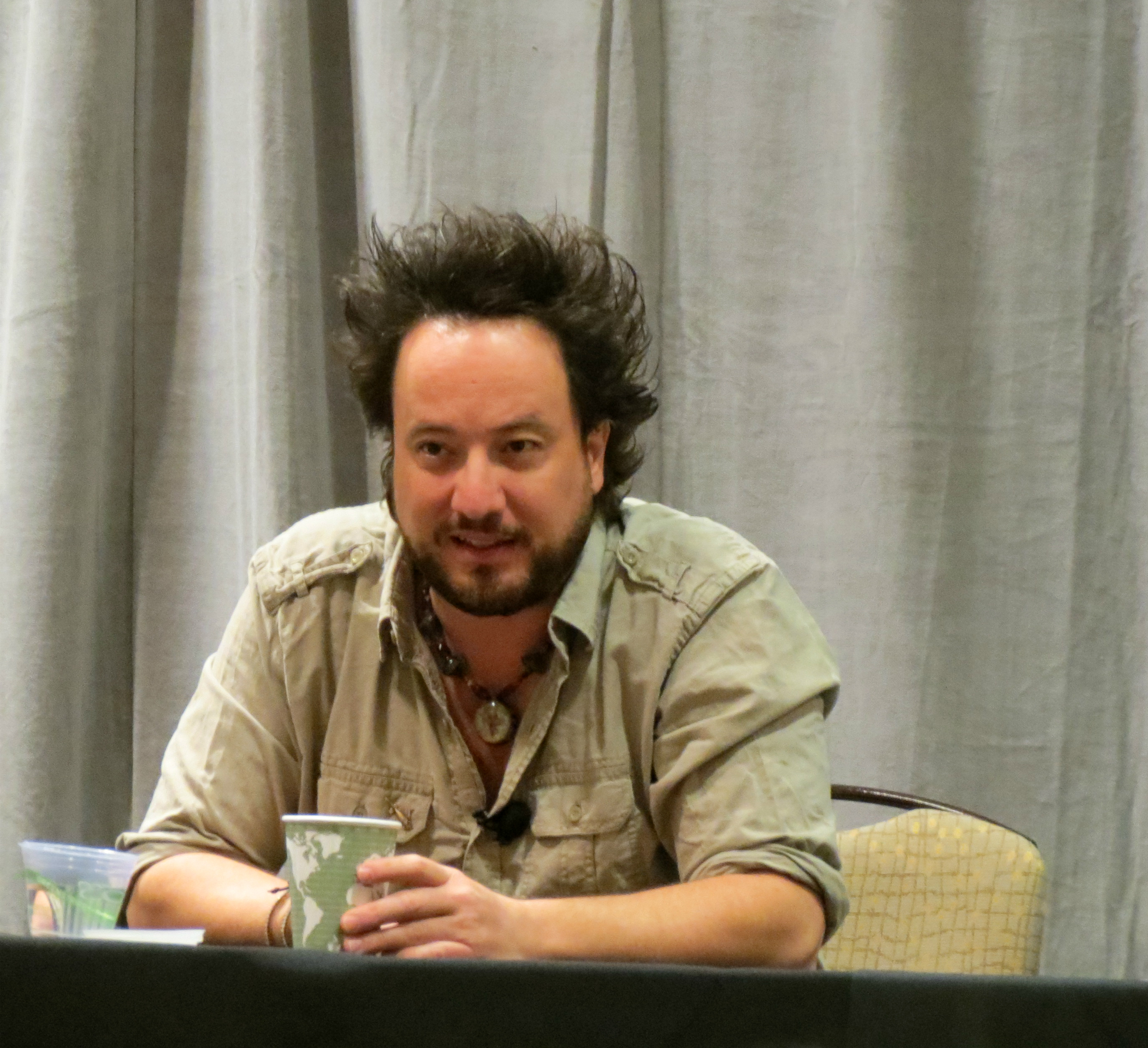
An older internet meme, originating in 2010, features Giorgio A. Tsoukalos from the History Channel’s Ancient Aliens program.1 As Tsoukalos believes ancient astronauts visited our planet in our distant antiquity, he often speaks enthusiastically about how such extraterrestrial visitors interacted with our remote ancestors. Hence, a screenshot of Tsoukalos from Ancient Aliens sporting his crazily coiffed hair and hands frozen in mid-gesticulation conveys the simple message to the viewer of “Aliens.” Another version of the meme, also featuring the same screenshot of Tsoukalos, reads, “I’m not saying it was aliens, but it was aliens.”
What is the point of posting random pictures on the internet? Honestly, what is the purpose of any meme? The word “meme” derives from the Greek word “mimeme,” meaning something imitated.2 Without becoming too bogged down in explanation, a meme is a vehicle by which internet posters convey ideas. Then, others who identify with the message share it. In that simple act of reposting, one “imitates” the intent of the meme’s creator. When many people do this, we proclaim that the meme has “gone viral.” However, the power of the meme is that it will invoke a response so that even those angered by it will respond to it. For example, the “Aliens” meme is employed by those jokingly offering a Deus ex machina-type explanation for things to which we may or may not have the answers. How did ancient builders erect megalithic structures? Aliens. Who ate my last donut? Aliens.
I cannot help but hear the voice of Giorgio A. Tsoukalos saying “aliens” in my head as I read headlines like this one from Yahoo!News: “How would humans respond to the discovery of aliens? NASA enlisted dozens of religious scholars to find out.”3 For some reason that escapes me, Hollywood has often speculated that the revelation of extraterrestrial life would destroy the faith of believers. You have likely seen such movies. There is typically some cabinet member telling the fictional President to keep things quiet lest the disclosure of the existence of extraterrestrials leads to chaos. By the way, rather than becoming terrified by the thought of aliens, the article suggests that religious people would most likely be better prepared to receive such visitors from afar. I agree with that conclusion.
I cannot speak for other Christians, but I can say why I wouldn’t lose my faith in Jesus Christ because someone proves that the Roswell greys exist. First, my belief that God created everything that exists convicts me of the truth that if “aliens” also exist, God created them too. Genesis 1 details how God made the heavens with their inhabitants. A Christian realizes that, though the creation account mentions nothing about planets, the voice of God made Jupiter and Saturn, which are planets. Would it require more faith to believe that there could be one planet orbiting a star capable of supporting life in that sea of stars we see at night? No. Again, Genesis 1 tells us God created the heavens and the earth. It would be more a matter of what God has chosen to reveal to us. Deuteronomy 29.29 reminds us that God has only given us what He has revealed. The secret things belong to Him alone.
Second, we ask what we can even understand about God apart from His Word. Isaiah 55.8-9 reminds us that the thoughts and ways of God are above our own. Science fiction author Arthur C. Clarke once stated what has since become known as one of Clarke’s Laws: “Any sufficiently advanced technology is indistinguishable from magic.”4 We might substitute the word “supernatural” for “magic.” The existence of aliens would not destroy my faith because I might ask whether the strange phenomena I was witnessing were not “aliens” but “heavenly visitors.” Maybe Ezekiel’s “wheel in the middle of the wheel” was a UAP (Unidentified Aerial Phenomena) (Ezekiel 1.4ff). Would it matter to you if God created the universe using advanced technology to which only He has access? Either way, He has the power to create and destroy us (cf. 2 Peter 3.12).
Ultimately, all of this talk has more to do with scientists’ expectations regarding the recent launch of the James Webb Space Telescope.5 In addition to thinking they will see the Big Bang, scientists believe we might finally see those elusive extraterrestrials and life-sustaining planets. And why not? The government has even declassified reports about the existence of “Unidentified Aerial Phenomena.”6 Having said what I have about not having my faith shaken by the sudden revelation that there is other life out there, though, I find it more likely that each discovery reveals what we have known all along. God placed us in a particular spot within the cosmos to see His intelligent design and realize, yes, it had a beginning. It is not eternal. And one day, we will meet Him, Who created it all.

















 The Preacher Pollard Blog