The Quality That Won The War For Independence

Neal Pollard

This week is the 250th anniversary of the birth of America, as July 4, 1776, was the signing of the Declaration of Independence. Because of this incredible milestone, I have been rereading David McCullough’s classic, simply entitled 1776. It is a captivating chronicle of one of the most monumental events in all human history. What this nation has achieved and the freedom and opportunity its citizens enjoy is unparalleled in so many ways.

As powerful, prosperous, and influential as the United States is on the world stage in 2026, the fledgling, ragtag people seeking its independence from the British was far different. McCullough writes that 1776 was “a year of far too few victories, of sustained suffering, disease, hunger, desertion, cowardice, disillusionment, defeat, terrible discouragement, and fear, as they would never forget, but also of phenomenal courage and bedrock devotion to country, and, that too, they would never forget” (294).

McCullough says this in the context of the leadership of George Washington, whom he describes as without brilliance as a strategist and tactician, not an orator or intellectual, and a general who had made “serious mistakes in judgment” (293). Yet, he preached “perseverance.” McCullough includes quotes from several of Washington’s letters to congress, officers, and general orders where he passionately admonished patience, courage, and perseverance. As McCullough informs us, “the war was a longer, far more arduous, and more painful struggle than later generations would understand or sufficiently appreciate. By the time it ended, it had taken the lives of an estimated 25,000 Americans, or roughly 1 percent of the population” (294).

Perseverance is “the capacity to hold out or bear up in the face of difficulty” (BDAG, 1039). That quality helped a humble, tiny, and outmatched fledging nation emerge victorious against seemingly impossible odds. We still reap the benefits of their endurance.

Far greater than this nation and this world, the Christian must relentlessly fight for something that is literally timeless. Regarding this war, God through His inspired writers urges “perseverance” dozens of times. We must bear fruit with perseverance (Luke 8:15). We must do good in pursuit of eternal life by perseverance (Romans 2:7). Our proven good character is forged by perseverance (Romans 5:3-4). Our hope is shaped by perseverance (Romans 15:4). We are commended as servants of God through perseverance (2 Corinthians 6:4). We are strengthened with all power by perseverance (Colossians 1:11). Spiritual warfare is won by perseverance (1 Thessalonians 1:3; 2 Thessalonians 1:4). The man of God pursues perseverance (1 Timothy 6:11). Perseverance is essential to receive what God has promised (Hebrews 10:36). We must run the spiritual race with perseverance (Hebrews 12:1). Through perseverance, we can be made perfect and complete, lacking in nothing (James 1:4)–like Job (James 5:11). Perseverance is one of those Christian graces that will get us to heaven (2 Peter 1:6). Christ commends multiple churches of Asia Minor for having perseverance (Revelation 2:2-3, 19; 3:10).

The odds are stacked against us. We are Christian soldiers more apt to gaffes and missteps than brilliant tactics and strategies (1 Corinthians 1:26-27). At so many turns, our efforts seem futile and pointless. But, with God’s help and guidance, we are guaranteed victory (1 John 5:4). However, we must not quit!

I am proud to be an American, but I am also reminded by God that “our citizenship is in heaven, from which also we eagerly wait for a Savior, the Lord Jesus Christ” (Philippians 3:20). I cannot let physical and material blessings, even liberty and freedom, to keep me from pursuing “a better country” (Hebrews 11:13-16). The quality that makes the difference in our spiritual fight is perseverance!

Don’t give up the fight!

We Gotta Stop!

Wednesday’s Column: Third’s Words

Gary Pollard

If you’re reading this right now, it means you have access to electricity and internet. If you have access to those, you’re already familiar with the subject of this article. This specifically applies to Christians living in the United States, but I encourage those who don’t consider themselves religious to think about the following as well. There’s no other way to address this, so I apologize for having to write it.

“Let’s go Brandon” is everywhere: gas pumps, sporting events, social media posts, bumper stickers, etc. I thought it would die out by now, but it’s everywhere. I see it almost every day on gaming platforms, with many adopting some form of it as a username/handle. It’s become colloquial, used to “thank” the president for any less-than-ideal circumstance.

I am not a fan of our current president. If you drive, you know how much gas is right now. Afghanistan. The Russian ammo ban (and other anti-freedom measures). If you eat food, you’re already familiar with inflation’s impact on groceries. We could go on for a week, but this is a long-winded disclaimer and I need to get to the point.

No Christian should ever adopt the mentality behind the phrase at the beginning of the second paragraph. Besides the crass and hateful language it represents, it’s a sinful way to view our president. Christians are supposed to respect their government leaders (I Pt 2.17). In that passage it’s not a suggestion, it’s an order. The word τιμᾶτε (timate) is an imperative. It means “to show high regard for” someone (BDAG, τιμάω).

Paul wrote, “You should pray for rulers and for everyone who has authority. Pray for these leaders so we can lead a quiet and peaceful life…” (I Tim 2.2). Paul was under an emperor similar to our own president. God’s expectations for Christian behavior don’t change when the president is bad. We don’t have to like him, but we certainly have to respect him and pray for him.

We should not expect to live with God forever if we talk about the president the way so many others do. I get it – it’s hard. Politicization of the medical field under his administration has had a direct impact on my own quality of life. Praying for/respecting the president is not easy at all. But it wouldn’t have been easy for Christians under any of the Roman emperors in the first century, either. If they could do it, so can we. Please think about the serious impact our words have on where we spend eternity. Our first allegiance is to God. If He’s really our King, we’ll have respect for our president.

Image courtesy Flickr.

Knowing What D.C. Stands For

Neal Pollard

Inasmuch as we don’t want laws or policies enacted that violate God’s Word and we want precious freedoms, especially religious ones, preserved and protected, we can really get into what is going on in Washington, from Capitol Hill to Pennsylvania Avenue. Many know that “D.C.” is an abbreviation for “District of Columbia,” an area of land created at about the time of our nation’s founding under the direct jurisdiction of the U.S. Congress that is not a state.

However, as politics has vied for sports and entertainment as an idol in our culture, it has become the source of unnecessary and even immoral strife between Christians. Blind support and allegiance for one major political party or the other can do more than make us inconsistent. It can make us a stumbling block. It seems to me that D.C. can stand for some dangerously different things.

Distracted Christians. Search high and low in your New Testaments, written during the time of the wicked, often unfair-to-Christians, Roman Empire.  The disciples were about the business of evangelism (Acts 8:4) and growing the church (Acts 6:7). Can the rumblings and drama from the nation’s capitol get us so transfixed that we cannot see past it or through it to our individual and collective mission as God’s people? He has us here to get people into the Kingdom of His dear Son (Col. 1:13). Everything else is secondary. 

Divided Churches. For as long as I’ve been preaching, I’ve seen politics come between brethren in the local church. Thankfully, it does not usually become significant enough to trouble the entire congregation but I have seen it do so. What’s more, I’ve seen brothers and sisters become so confrontational and flagrant about politics–especially through the relatively recent medium of social media–that it has been a stumbling block to new and weak Christians. Perhaps the political world in our country has never been so intensely divisive as it currently is, and what typically troubles the world troubles the church. But, when souls are negatively impacted, God will hold the offenders accountable. 

Devil’s Cauldron. Please don’t misunderstand. Politics, like money, is a neutral matter. But, like money, it can become the root of all sorts of evil (cf. 1 Tim. 6:10)–enmities, strife, outbursts of anger, disputes, dissensions, and factions (Gal. 5:20). Just prior to this list of activities that are the carrying out of the desires of the flesh (Gal. 5:16), Paul warns, “For the whole Law is fulfilled in one word, in the statement, ‘You shall love your neighbor as yourself.’ But if you bite and devour one another, take care that you are not consumed by one another” (Gal. 5:14-15). Who benefits when things like politics distract and divide Christians? It is not the lost, the church, or the Lord!

I can think of a least three godly, wonderful Christians who are public servants in political office and making a profound impact for good–Bill Reiboldt, Sheila Butt, and John DeBerry. They demonstrate that God’s people can devote themselves to politics without sacrificing their faith and example. For those of us “on the outside looking in,” in our love of country and freedom, may we never allow our attitude, words, or actions to betray our highest calling. The more effectively we reach lost souls, reflect the mind of Christ, and reveal the hope of the gospel, the better our nation (and world) will become. What will that make us? Disciples of Christ!

11168488_10153052239815922_846243704468580330_n
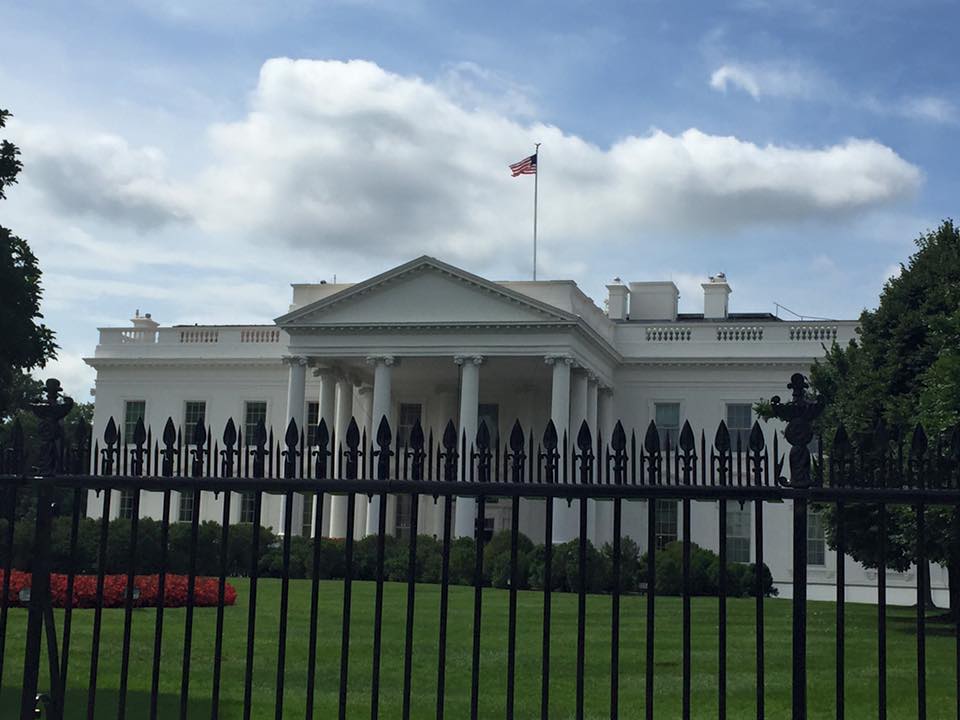
From my last trip to Washington, a few summers ago. 

What To Do When Faced With A Sinking Ship

Neal Pollard

The ship is breaking apart. The timbers of civility. Crack! The planks of morality. Splinter!  The mast of critical thinking. Pop! As we hope to stay afloat, we cannot help but feel growing apprehension over the current state of our society. It’s not a matter of preserving or plastering over a past. It’s a matter of preserving peace in the present, but only if that means God’s people are serious about sharing the only possible remedy–Jesus! Yet, as it increasingly seems our country is ratcheted by prejudice, hatred, division, and rancor, we see the tranquility and calm from so many quarters threatened with the dark storms of violence and uncertainty.

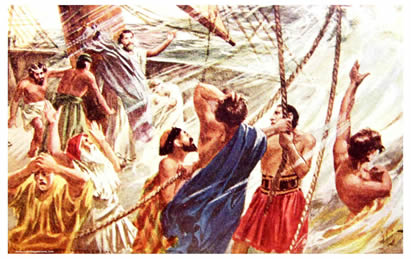
In Acts 27, Paul was with 275 other passengers on a boat bound for Rome from Caesarea, and its captain decided to test the Mediterranean Sea at a turbulent time. A violent storm, known as Euraquilo, caught the ship and ultimately battered it to pieces. It must have been an apprehensive time for the passengers and crew. Luke says the wind was violent, the ship was driven, the sun and moon didn’t appear for days, violently storm-tossed, they incurred damage and loss, and that all hope of their being saved was gradually abandoned. I cannot imagine the helpless, vulnerable feeling they must have felt. At least not literally.

It would be easy to let our national unrest and storminess tempt us to act irrationally (like some on Paul’s ship were tempted) or to give in to fear. But, Paul did five things we should do as we try to respond to the current turbulence.

  • He listened to God (Acts 27:23-24). Nobody else had a better or equal solution to their dire problem. The only way to be saved was to listen to God. Paul sought to persuade the people of this. In the ruckus and tumultuous noise, listen harder to God’s Word! It’s an anchor in stormy waters.
  • He believed God’s Word (Acts 27:25). It’s one thing to comprehend something, but quite another to put your trust in it. What God promised must have seemed quite far-fetched, that this way would save everyone. But, Paul didn’t waver. He said, “I believe God that it will turn out exactly as I have been told” (25). We are surrounded by people who need to witness our faith. As many as are persuaded will escape a shipwreck of faith (cf. 1 Tim. 1:19).
  • He encouraged hope (Acts 27:21-26). Despite the foolishness of their leaders, these people were given a message of hope. Paul says, “Keep up your courage!” (22,25). Despite the frightfulness of the moment, Paul offered a possible escape. Right now, you and I are uniquely positioned to give the only true hope available. It’s like an anchor for the soul, both sure and steadfast (Heb. 6:19)!
  • He warned the disobedient (Acts 27:31-32). There were those trying to break from God’s Word and will and do things another way. They were trying to take matters into their own hands. Paul spoke up against this! Such was defiance against the divine plan. What a message for us, who justify their sins rather than repent of them. We need to keep the message of righteousness, self-control, and the judgment to come before people (Acts 24:25).
  • He prayed faithfully (Acts 27:35). In this ordeal, Paul was a public example of prayer. Read every epistle of Paul’s and you’ll see his faithfulness in and dependency upon prayer. He appealed to the God he knew was the only hope for salvation. How much are we praying about the turmoil in our country (and world)? How much do those around us believe that we are dependent upon God?

Instead of focusing on the frightful winds currently blowing, let’s focus on the One who can calm the storm. Let’s get others to join us in that focus. Whatever happens to our nation, we must save as many souls as possible!

paul20in20storm