“Let love be genuine.” This phrase from Romans 12.9 is familiar and deceptively simple. It sounds good and feels good! But what does it mean?
It means we can’t pretend to love people. Ανυποκριτος means “not pretending” or “acting” something. In other words, don’t pretend to love people with the goal of getting something out of it. Don’t pretend to love people when we don’t.
We don’t usually show our real selves to other people. Aside from our close friends and family, we show other people who we want them to see. There’s nothing wrong with this; all cultures adopt levels of social scripting and behaviors based on how close we are with another person. The church is a family, and it’s hard to remember that sometimes. We’d rather keep people at arm’s length (I’m guilty of this) than get into the messiness of close relationships.
Once we get past the formal, arm’s length level of closeness, things get complicated and messy. But they’re also rewarding and uplifting! Whatever we see in our Christian family, God expects us to love like we mean it. There’s no room for fake in this family! Since our lifestyle can be challenging, we need to know that we can rely on each other.
God showed us genuine love by proving it. He proves it every day by keeping us “good to go” if we’re walking in light (I Jn 1). Showing real love has personal benefits, sure, but it mainly benefits others. We may never know how much showing genuine love impacts another person, but it could be the pivotal point of their relationship with God! How cool is it that, just by being genuine, we potentially change people’s eternity?!
When it comes to the families that make up the church, what ties us together is a common bright future. While every family has its differences, one constant remains— the church. All strive to follow those guidelines laid out in scripture. Paul says in Philippians 1:6, “And I’m SURE of this, that He who began a good work in you will bring it to completion at the day of Jesus Christ.”
The writer speaks with assurance and that confidence is well-placed. From His-story we see that God always completes His projects. He never dreams, He creates. He decided to create the world and here it is. He decided to save the world, and here we are.
Paul also would write in Romans 7-8 that the flesh tends to get in the way of the spiritual. God is perfect, but we’re not. That’s what makes us a work in progress. Aren’t we thankful that God provides the solutions to “fix” us up?
We’re involved in a great work because there simply is no better work than what is being done by His church. That being said, many of us struggle with overcomplicating things. We try to make sense of our individual lives, and when we leave God out it all becomes a discouraging battle. Where’s the peace? Joy? Confidence? Maybe it was left behind when we left God’s path. Thankfully God came down to earth years ago to teach us everything we need to know. We see that in His interactions with people. Even His twelve original followers were an odd group.
Each had a diverse background. Some were Fishermen and some tax collectors.
Each one had a unique personality too! They ranged from timid to assertive.
Each one had spiritual battles from greed to crippling doubt.
Yet each one rallied under His leadership and were united through a common hope.
What’s changed? Not much.
The personalities, talents, backgrounds, and flaws mixed together create a unique blend that make up each one of us. Yet, here we are rallied under His leadership, united in common hope.
Members of the church in the Bowling Green area at an FCA fundraiser.
A few months ago, Lehman and a bunch of other churches went to church camp. During that week, I got to think about family. A quote I read once by Lisa Weed said, “Being a part of a family means you are a part of something very wonderful. It means you will love and be loved for the rest of your life.”
Let me start off by defining family. According to Webster’s dictionary, one definition is “the group of one or more parents and their children living together as a unit.” That kind of family can be shown through the illustration of a loving husband giving his wife some facial masks on Christmas Morning. As she opened the gift, her 5-year-old daughter asked what they were. The Mom replied, “It’s a present to make me beautiful.” After the mom applied one of the facial masks, the little girl looked at her mom and replied, “Mom, it didn’t work.”
Another definition Webster’s gave is “all the descendants from a common ancestry.” To me, that sounds like the relationship God has with His church. 2 Corinthians 6:18 says, “And I will be a father to you, and you shall be sons and daughters to Me,” says the Lord Almighty. Ephesians 5:25-27 defines the church family as being without blemish. “Husbands, love your wives, just as Christ also loved the church and gave Himself for her, that He might sanctify and cleanse her with the washing of water by the word, that He might present her to Himself a glorious church, not having spot or wrinkle or any such thing, but that she should be holy and without blemish.”
Thankfully, God has given us the opportunity to be part of a perfect family. Maybe you’re not a member of the church family, and you would like to put Christ on in baptism or you want us to pray with you and for you so you can get your life on track. Whatever your need, please reach out to God’s perfect family.
When it comes to the families that make up the church, what ties us together is a common bright future. While every family has its differences, one constant remains— the church. All strive to follow those guidelines laid out in scripture. Paul says in Philippians 1:6, “And I’m SURE of this, that He who began a good work in you will bring it to completion at the day of Jesus Christ.”
The writer speaks with assurance, and that confidence is well-placed. From “His-story” we see that God always completes His projects. He never dreams; He creates. He decided to create the world and here it is. He decided to save the world, and here we are.
Paul also would write in Romans 7-8 that the flesh tends to get in the way of the spiritual. God is perfect, but we’re not. That’s what makes us a work in progress. Aren’t we thankful that God provides the solutions to “fix” us up?
We’re involved in a great work because there simply is no better work than what is being done by His church. That being said, many of us struggle with overcomplicating things. We try to make sense of our individual lives, and when we leave God out it all becomes a discouraging battle. Where’s the peace? Joy? Confidence? Maybe it was left behind when we left God’s path. Thankfully God came down to earth years ago to teach us everything we need to know. We see that in His interactions with people. Even His twelve original followers were an odd group.
Each had a diverse background. Some were Fishermen and some tax collectors.
Each one had a unique personality too! They ranged from timid to assertive.
Each one had spiritual battles from greed to crippling doubt.
Yet each one rallied under His leadership and were united through a common hope.
What’s changed? Not much.
The personalities, talents, backgrounds, and flaws mixed together create a unique blend that make up each one of us. Yet, here we are rallied under His leadership, united in common hope.
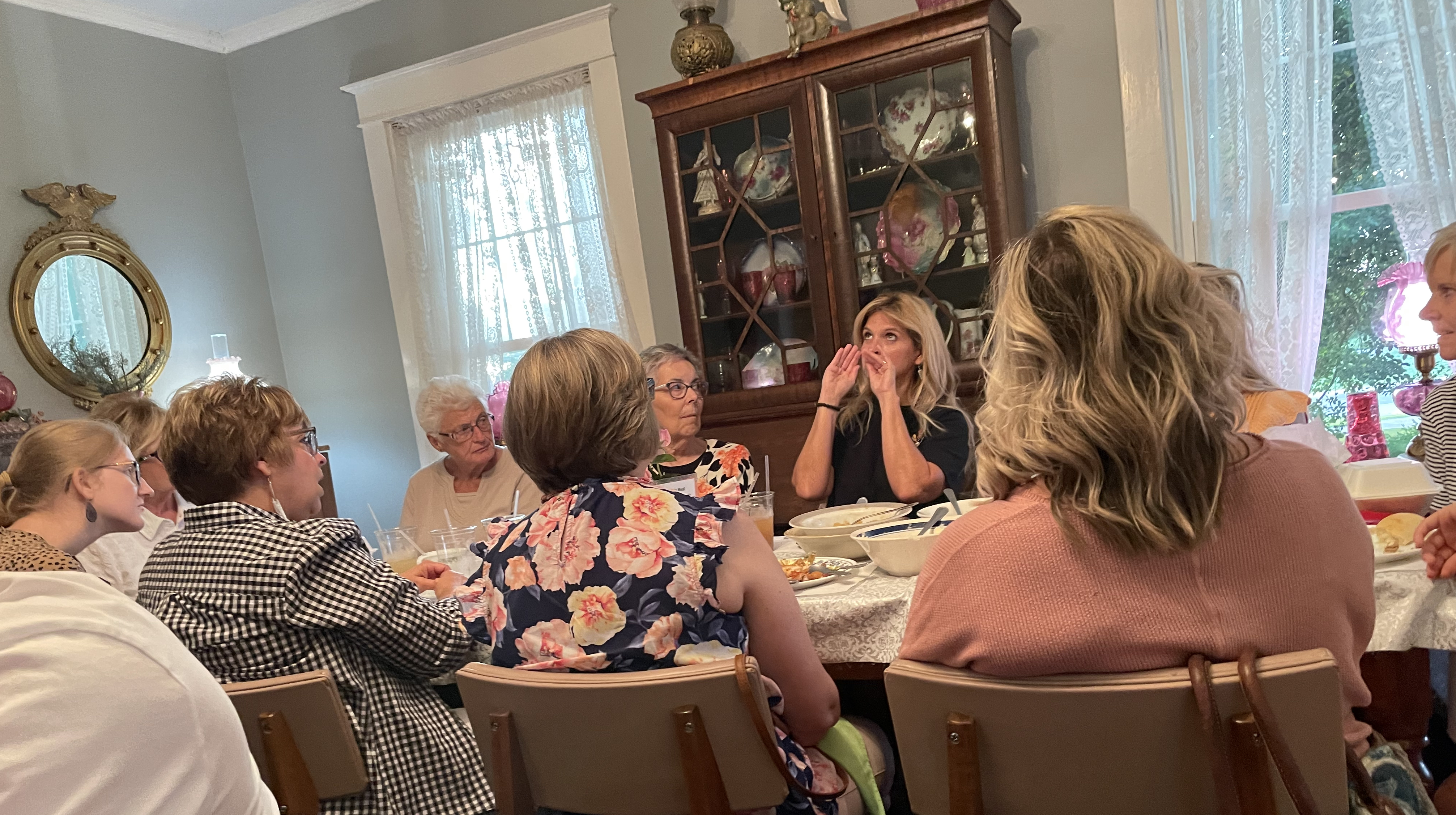
Several Lehman ladies (men are at the table in the foreground) enjoying “Federal Grove” the night before it (sadly) closed, being regaled with one of Kathy’s stories. I think this one was about snakes crawling out of a hole.
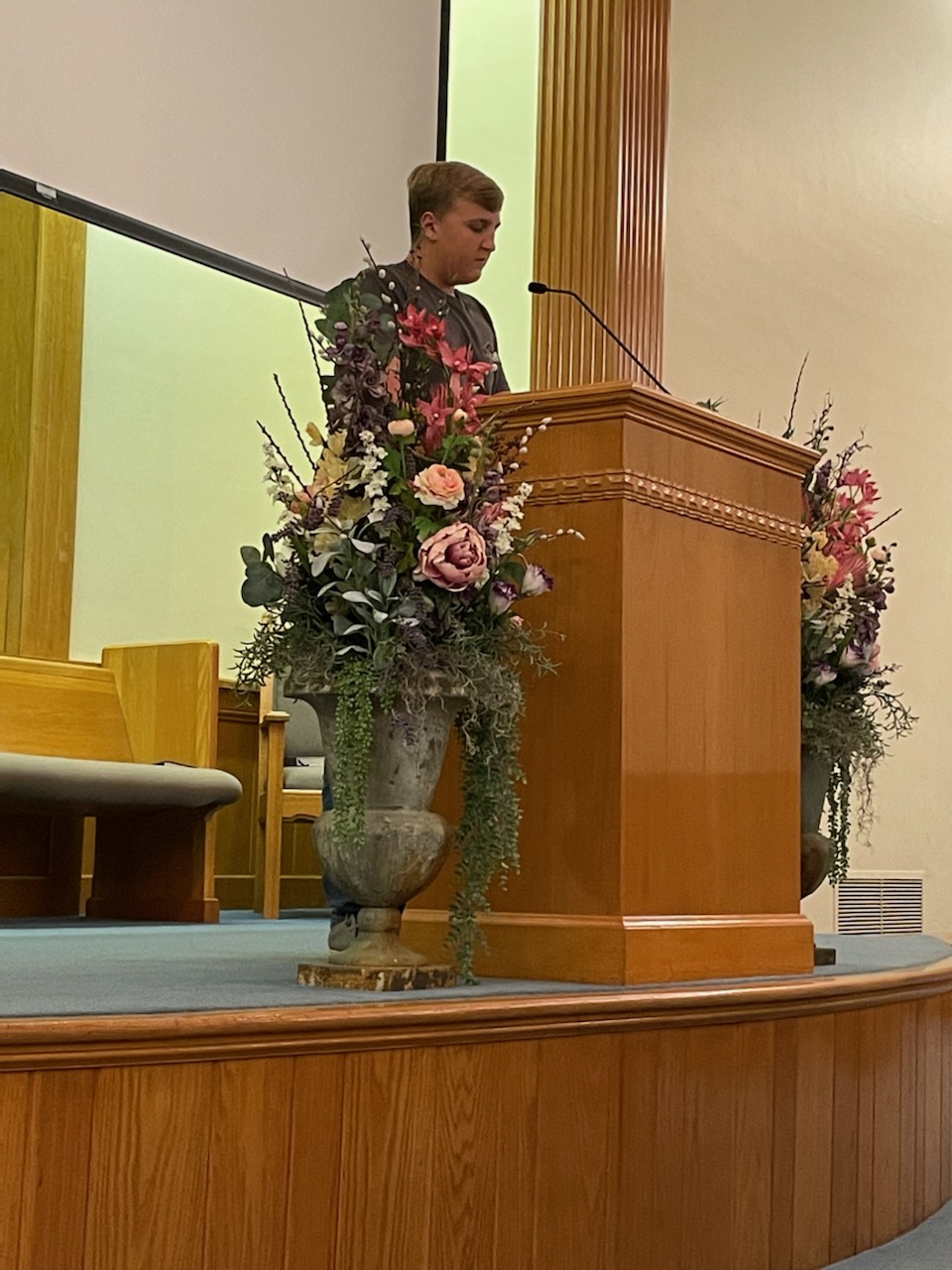
(Today, I’m pinch-hitting for Carl, who’s on his honeymoon this week. This is the wedding sermon portion of the ceremony performed last Friday in Summerville, GA. It was a beautiful wedding venue and occasion).
Neal Pollard
Introduction
A. One Of The Most Unsung Love Stories In The Bible Is Isaac & Rebekah
B. Their Romance & Relationship Is Revealed In Gen 24
1. What impresses me most re: them is how they did so much right
a. Rebekah is a very beautiful & pure young woman (16)
b. She was a hard worker (16-20) & she had a wonderful attitude (58)
c. She had a good relationship w/her family & his
2. Isaac had a good head on his shoulders, he was a man of faith & family
(25:21)
a. & it apparently was love at first sight for Isaac (24:67)
b. He was successful in his life's work (26:12-14)
c. He was a patient & peace-loving man (26:20)
3. In a day when God permitted a man to have more than one wife, &
his father Abraham did & his sons Jacob & Esau did
a. Isaac was a one-woman-man
4. It was a beautiful lifelong love story
a. It was a story of devotion & affection
D. Their Story Is Not Unlike Yours
1. I think Emily has the attributes of Rebekah we just saw
2. Carl is a lot like Isaac in the ways we observed
3. & your devotion & affection is so much like theirs, too
E. & To All Of Us Who Have Come To Witness This Joyful Occasion,
There Are Other Parallels For Us To Consider:
1. Many had invested so much into the moment the young couple met
a. In Gen. 24, there was Abraham, his servant, & Rebekah's family
b. They had invested their prayers, possessions & plans for these 2
2. God was at the heart of both families' lives
a. "God" is found 7 Xs in Gen 24, "LORD" is found 16 Xs
1. Both families invoke His name a similar number of Xs
2. Their faith was strong, & they conveyed that deep faith to I & R
a. The moments before Isaac met Rebekah, he was worshipping (24:62)
b. She was willing to leave her home to go to Isaac's home out of her trust in God's providence & guidance in her life
3. Their families encouraged them to serve & obey the Lord
a. Abraham wanted his son to have a wife God would be pleased with
b. Rebekah's brother & parents saw God's will in this & encouraged her to marry Isaac
F. For A Few Minutes, I Want To Share With You Both Some Of TheBlessings & Promises Shared With Isaac & Rebekah
I. YOU WILL LIVE LIFE TOGETHER BEFORE THE LIVING ONE WHO SEES
A. When Isaac Met Rebekah, He Was Standing At Beer-Lahai-Roi
1. It was the well at the place Hagar called "El-Roi," "A God whosees" (16:14)
2. In 25:11, we read that the newly weds lived in this place
B. May I Encourage You To Remember That Today & Every Day For theRest Of Your Lives, You Will Be Living Before The God Who Sees
1. Let that bring you comfort & hope, to encourage you
2. He will see your ups & downs; Your victories & defeats
3. There will be times when His presence & help are undoubtable
a. Other times, you may be tempted to wonder
C. He Will Walk With You Both Throughout Your Lives
1. Give Him 1st place, the most honored & cherished seat at the table ofyour marriage
2. Pr 15:3--The eyes of the Lord are in every place, beholding the evil & the good
a. It's not just a warning vs. sin; It's a promise as you do good
II. GOD WANTS TO HEAR YOU PRAY FOR YOUR SPOUSE
A. There Came A Time Of Stress & Adversity In Their Marriage
1. You're aware that you'll face moments like those, too
B. It's Beautiful To See How Isaac Responds To This
1. 25:21--Isaac prayed to the Lord on behalf of his wife
2. Of all the good Isaac did in his life, nothing was better than this
C. There Will Be Moments When Your Problems May Threaten To Cause AWedge Between You Two
1. The best thing you will ever do in these Xs is to pray for each other, motivated by your love & care for each other
2. You will always need God's help; Let nothing keep you from praying to Him together
3. & let nothing keep you from faithfully praying to God for each other
4. 1 Pt 3:7--You husbands in the same way, live with your wives in an understanding way, as with someone weaker, since she is a woman; and show her honor as a fellow heir of the grace of life, so that your prayers will not be hindered
a. When Peter says "your prayers," it's plural (God's encouraging bothof you to pray for each other)
5. When you do, God will hear as He heard Isaac's prayer for Rebekah
III. ALWAYS KEEP THE LINES OF COMMUNICATION OPEN
A. I've Heard Sermons And Bible Classes Re: The Danger Of Showing Favoritism With Your Children & This Couple Is Used As Exhibit A
1. But after the deception of Jacob & Esau's anger & grudge, Rebekah comes to Isaac & freely shares her concerns w/Isaac (27:48)
a. Isaac listens & the 2 of them work together to resolve the problem
B. Don't Wait For Problems To Arise Before You Start Communicating
1. But certainly, when problems arise, be sure that you communicate freely, lovingly, & persistently
2. Companionship is re: needing each other & leaning on each other
C. Carl, Nourish & Cherish Emily; Love Her As X Loved The Church (Ep 5:25-28)
1. Emily, love your husband so as to honor God's word (Ti 2:4-5)
2. & realize the vital role communication plays in conveying your love
IV. FIND LOVE & COMFORT FROM ONE ANOTHER
A. Their Marriage Came At The Time Isaac Lost His Mother
1. But the Bible tells us re: how they shared love & comfort w/one another (Gen 24:67)
2. God has given you such a blessing in your marriage
B. Never Miss An Opportunity To Express It To Each Other
1. Like Solomon said
a. Song 4:10--How beautiful is your love, my sister, my bride! How much better is your love than wine,
b. Or Song 7:6--How beautiful and how delightful you are, My love, with all your charms!
2. & like his bride said to him
a. Song 1:16--How handsome you are, my beloved, And so pleasant!
b. Song 2:3--Like an apple tree among the trees of the forest, So is my beloved among the young men. In his shade I took great delight and sat down, And his fruit was sweet to my taste.
C. Of Course, Do More Than Say It; Show It--Never Miss An Opportunity
1. It will keep you on the sunny side of life on the stormiest days
Listening to the best man speech right before their exit.
I’ve never known a day when I didn’t live in a “preacher’s home.” “Preacher’s homes” are very much like every other home–problems, inside jokes, traditions, hobbies and interests, sin, laughter–except the chosen profession of the father is to serve either full-time or part-time as a proclaimer of God’s Word. At times, the home I grew up in was made of figurative glass, meaning I was occasionally subjected to unfair favoritism and criticism.Kathy, also a lifetime resident of a “preacher’s home,” knows that feeling, too. Then, we subjected our sons to the exact same thing!
Whenever we are asked about what it is like to live this unique life (and lifestyle), different words would be appropriate:
Challenging–There can be elevated expectations and unrealistic assumptions about the preacher’s personal life, marriage, parenting, and the like. What Shakespeare’s Jewish character says of his people in the “Merchant of Venice” applies: “If you prick us, do we not bleed? If you tickle us, do we not laugh?” Life’s pressures and temptations visit our homes, too.
Lonely–Occasionally, we feel alone and stand alone because of the message we preach. Usually, it’s not others who make us feel this way, but an innate part of the life.
Ordinary–Most preachers probably love to hear church members and those in the community say, “You’re just an ordinary person with an ordinary life.” To be genuine and real is, in my view, a worthy aim. See the opening paragraph.
But, please understand that the most fitting, usual words used to describe the life in preaching are positive, superlative words and phrases–“important,” “exciting,” “fulfilling,” “full,” “rewarding,” “humbling,” “meaningful,”and “uplifting.” Yesterday, we said “so long” to one of God’s greatest churches as we prepare to move to work with another one. I asked Kathy to describe a one-word assessment that best described how she felt in light of the generous words and acts from our spiritual family throughout the day. She used words like “Overwhelmed,” “grateful,” and “touched.” But then, scanning her brilliant mind as if to find that perfect summary word (as she usually does), she simply said, “Blessed.”
We’ve been blessed by a lifetime of living the “preacher life.” Blessed by 27 years of full-time preaching. Blessed by 13 years of preaching at Bear Valley. Blessed by the opportunity to preach in this “next chapter” of life at Lehman Avenue. Blessed, as cracked pots (2 Cor. 4:7), to be used by the Master Potter. Far from a perfect life, it is certainly a blessed life.
Thank you, Bear Valley, for your many acts of kindness–yesterday and for the entirety of our time with you in Colorado. We love you and will miss you!
May 14, 2004, was the day I preached my maternal grandfather’s funeral. It was a signal honor to do so. He had passed away early on Wednesday morning, May 12. The morning he passed, I wrote this about him:
Within you today are a temper and trends
A view toward the unfolding tomorrow
Have you stopped to question on what that depends
From what spiritual bank you do borrow?
Though each person forges his own internal road
Based on unique decisions and conscience
Before him to help pave it is an influence to goad
A role model, an example bestowed.
For those so endowed with a godly loved one
One righteous, driven by the Giver of grace.
To see their own faith is to look at one done
A journeyman who victoriously ran his own race.
I know one like that, a follower of Him
Who led much family both of flesh and of faith
Who shaped hearts and lives in times good and times grim
Who laid course that to follow was safe.
When we all get to heaven and give praises unending
Who knows what will be or how we’ll appear?
I know that for anyone in that Paradise spending
That all who shaped our faith will be clear.
Everyone that knew Harold Edward Mitchell, Sr., was closer to heaven because of his influence. He lived over 90 years, converting from denominationalism in young adulthood and ultimately serving decades as an elder. At his funeral, I shared five facts about my “Papaw Mitchell.”
He loved his family. He wasn’t gregarious, but rather reserved. Yet, he taught his family the right way to live and how to face death, to know what ultimately counts, what was right and what was wrong.
He had a sense of adventure. From semipro baseball as a teen to seeing the entire country in retirement, a lifelong cotton farmer had a wider view of the world. He came of age in the depression and endured some terrible grief, but no one could remember hearing him complain.
He worked hard. He wasn’t a waster of resources, least of all time. He was up with the sun and down with the sunset. He instilled that work ethic in his children and grandchildren.
He put Christ above all else. As a Christian, he took what the Bible guided him to do and be in life at face value. His life went beyond mere rule-keeping. He kept the rules, but he loved the rule-maker. You could see Jesus living in him.
He was ready to die. That’s the most important thing any of us could have said of us.
I saw grandpa the Monday night before he passed away. He was able to talk, but it was the first time I saw him that I felt he might not live forever in that earthly body he took such good care of. It was probably the first time I thought seriously about my own mortality. Our spirits are engineered for eternity, but our bodies of clay wind down more each day. In the fifteen years that have passed since then, I am more aware of that than I was even then. Our pilgrimage here won’t go on indefinitely, though we’ll live as long as God lives.
Examples like my Papaw motivate me to clear the hurdles from my path and stay dependent upon God to help me, like him, to finish my face. To die faithful and prepared means to live faithfully and make preparation. One day, someone will speak at your funeral and mine. What can they honestly say about the example and influence we will have left on others?
Papaw (L) and Uncle Larry (my mom’s older brother), probably between 30-40 years ago.
Trevor Matich was being interviewed on ESPN radio, asked about why he thought that Clemson had built such a strong football program in the last few years. His quick response was, “They have built a strong sense of family.” He talked about how Head Coach Dabo Sweeney and his staff wanted players to see their coaches not just as coaches but also as husbands and fathers. Consequently, the coaches’ families spend a lot of time around the athletic facilities or hanging out with the players. They have intentionally built a strong family environment that doesn’t compartmentalize but rather coalesces. Recruits talk about sensing it when they make a visit, but, more importantly, players on the roster speak just as strongly about it.
How many teams make such an emphasis isn’t clear, but you don’t seem to hear that said often enough. While I find such human interest stories heartwarming, it makes me wonder, “Do people describe our congregation with similar terminology?” Are we creating, developing, and nurturing a strong sense of family?
The early church definitely majored in that priority. From the time the first church of our Savior was established, we find this emphasis (Acts 2:42-47). Often, New Testament writers spoke of the church with family terminology (Eph. 2:19; 3:15; 1 Tim. 3:15; 5:1-2; Ti. 2:1-8; etc.). The church exists as a sub-community within the broader community around them. People from that broader community are looking for greater intimacy and meaningful relationships. One place they often turn is to various churches. Whether through our efforts to evangelize or through their seeking that brings them within our walls, we have an opportunity to expose them to a “strong sense of family.”
But, by being faithful to New Testament teaching, we offer this in the context of truth rather than error. We cannot settle for simply offering truth, as eternally vital as that is. Along with it, we must love, embrace, and work to incorporate them into our family. God has His church designed to follow His written will in the context of a tight-knit, spiritual family. A true sense of family will draw them into a relationship with us. It will better open their hearts and minds to being drawn into a relationship with Christ. The net effect will be greater than a national championship. It will be many, many souls won to eternal life. We cannot afford to miss the opportunity to be spiritual family!
In James 5:7, James gives us some specific instructions concerning being patient. It is said as a response to those whose patience was being inflamed by the sinful actions of those in James 5:1-6. In just a few words, James has some pretty exhaustive instruction.
He addresses the who—“Be patient brethren.” There’s an ethic and morality expected of those in God’s family that is more than for everyone else. Almost every use of the word “brethren” in the New Testament is addressed to Christians. As light-shiners and salt-spreaders, we must exhibit patience with others and especially other Christians.
He addresses the when—This command has a duration (an expiration date)—“Until the coming of the Lord.” How long are we to remember Christ in the Lord’s Supper? 1 Corinthians 11:26 says, “Until He comes.” How long was Thyatira to hold onto what they had? Revelation 2:25 says, “Until Jesus would come.” How long was Corinth to refrain from unrighteously judging one another? 1 Corinthians 4:5 says, “Until the Lord comes.“ You don’t encounter this phrase very often, but every time it regards a matter of significance. There will not come a point in time when you can cease being patient—it’s as long as you live or until Christ comes again, whichever comes first.
He addresses the how—You’ve got to strengthen your heart (be inwardly committed, cause to be more firm in attitude or belief). James is saying, “Steel yourself because this is going to get hard sometimes.” When I think of people who have fallen away from the Lord, I think of conversations with people who say they gave up on the church or the elders or the preacher. They weren’t responsive enough, caring enough, or too nosy or not what they needed when they needed it. But ultimately this means these fallen ones weren’t firm and unchanging within.
He addresses the why—“The coming of the Lord is near.” Don’t focus on a time element here, but on the need to endure for as long as the time is. It’s constantly drawing nearer, not in a chronological sense, but an expectation and assurance that we expect it any time. I don’t want to be caught living in a state of impatience with my brethren. If I am, it means I’ve lost focus on Christ’s second coming!
I need to be convicted that impatience is not “no big deal.” James ties it to spiritual harmony, divine superintendence, and eternal safety. We can’t chalk up failure in this area as just our makeup, personality, and temperament. We must be obedient to the heavenly injunction and “be patient”!
I was cleaning out the basement and found a box of old photos. You know the kind of photos I’m talking about. Cheesy, dated, and awkward family photos. There was a reason we had them hidden in the darkest corner of our house. They weren’t worthy to be put on display, but they were also too precious to merely throw away. As I flipped through them, I stumbled across some ancient photos of my dad. In one picture he had an afro and this corny smile on his face. In another picture, my dad was standing by an old pickup truck wearing a long and baggy cut-off T- shirt. He had 80’s frame glasses on with large lenses, and a truckers hat that barely sat on his head.
To most people, those were embarrassing pictures. To most people, those were things that I should hang my head in shame over. But you know, all I felt was pride. I was so proud of who I came from, and as weird as he looked, I sat there defending his fashion choices in my mind. I’m proud to be the grandson of a preacher and the son of a preacher. But, there is nothing that fills me with more pride than the fact that I am a child of God.
There are so many reasons that I’m proud of that fact, but here is the main reason… because He loves me more than I deserve. Our sins put Christ on the cross. It was my sin problem that made Jesus cry out in agony, “My God, My God, why have You forsaken me?” (Matt. 27:46). When we commit sin, we are participating in the very thing that Christ came to die for. And yet, despite all of that, my God loves me. My Father has still taken me in. He has shown unconditional love, a love stronger than any mortal could show. My Heavenly Father has offered salvation, the forgiveness of sins, and a hope of eternal glory.
I’m proud to be a child of God.
Dale is the associate minister of the Forrest Park church of Christ in Valdosta, Georgia.
There are few statements or pronouncements that are clearer than Jesus’ words in Matthew 19:9, yet perhaps none, in our current culture, is more intimidating to state. Jesus contrasts His will on marriage, divorce, and remarriage with the already existent stance of the Law of Moses. He says, “Because of your hardness of heart Moses permitted you to divorce your wives; but from the beginning it has not been this way. And I say to you, whoever divorces his wife, except for immorality, and marries another woman commits adultery” (19:8-9). From this brief response (the Pharisees ask the question, testing Him in verse three), we see:
The teaching transcends time and culture—“From the beginning…and I say to you”
The teaching transcends all other authority—“I say”
The teaching transcends only believers—“Whoever”
The teaching transcends the caveats and conditions men have tried to place on the matter of marriage, divorce, and remarriage (not the specific law with its exception).
Yet, despite the clarity of Jesus on the subject, in the spirit of Christ we want to always approach this with utmost compassion, patience, and tenderness. Souls are at stake. Often, children are involved. Emotions are inevitably involved. A cold, callous treatment of people’s lives will surely draw Divine disapproval. That’s why Jesus’ stated position on this matter is one of the hardest to take. But, that cannot mean that we refuse to stand with Him in His teaching. However, we should ask why it is so hard to stand where the Bible stands on this matter?
—Learned men have stated different positions from this.
—Divorce is so prevalent in our culture.
—All of us have family members who are in marriages that violate Matthew 19:9.
—Marriage involves one of mankind’s greatest drives and needs (cf. Gen. 2:18-25).
—Leadership in more and more congregations refuse to deal with marriage, divorce, and remarriage in the classroom, pulpit, or the hands-on shepherding of the local church.
—Few of us relish the role of being “the bad guy” (the one who has to break heartbreaking news to husbands and wives).
I could lengthen the list of reasons, and you could add several to it, but if the list grew to hundreds of reasons, we have one sobering, gut-wrenching question to ask, “Do any of them nullify the strength of Jesus’ teaching?” If Matthew 19:9 were not in the Bible, fewer preachers would have lost jobs, fewer elders would have lost favor, and fewer churches would have seen members go to congregations accommodating their marriages. But, Jesus warned that His way was difficult (cf. Matt. 7:14). He tells aghast disciples that discipleship requires whatever sacrifice is necessary to follow Him (Matt. 19:10-12). That message must be shared lovingly, gently, and patiently. There can be no other way (cf. Eph. 4:15). The harsh, unkind, or mean-spirited will deal with the Judge of all (cf. 1 Pet. 4:5; 2 Tim. 4:1). However, what will be the case for those who neglect, change, or distort what Scripture says to accommodate people? Perhaps there’s no way to ask that question without evoking a visceral reaction from those who have reinterpreted Jesus’ words, but in light of eternity it must be asked. Balance looks for biblical truth in between unbiblical extremes. However unpleasant a position that may put us in, that is the place we must always humbly stand. But, the only enduring place to stand is on the rock solid foundation of Christ (cf. Mat. 7:24-27; 1 Co. 3:11). God give us loving, but courageous, hearts to stand there.
In the annals of American history there is a remarkable story you may not know. Daniel Bakeman was born on October 9, 1759. He married Susan Brewer on August 29, 1772, though not yet a teenager. Soon thereafter, he joined the American army during the Revolutionary War. Not only did he survive the war, he lived almost another 100 years. When he died on April 5, 1869, he was most likely the last surviving veteran of the war that made us a country. He lived about four years after the end of the Civil War. As remarkable as that distinction is, he also was part of another world record that still stands to this day. His marriage to Susan lasted until September 10, 1863, when she passed away. That means the Bakemans were married for 91 years and 12 days!
I cannot find anything about the details of that marriage, though they left many descendants who carry, through various spellings of the family name, the names Bachman, Beckman, Bakeman, Bateman, and even Baker (genealogytrails.com). Various archives indicate that Mr. Bakeman was spry and humorous to the end and that Mrs. Bakeman exhibited needlework she had done without the aid of glasses when she was 102. They lived and died in a town called Freedom, and Mr. Wakeman holds the distinction of having voted in every election from Washington to Grant!
As remarkable as his military distinction is, his marriage distinction deserves higher honor. He fought in and survived a war that lasted less than ten years. He endured hardships, who knows how many ups and downs, and undoubtedly some trying marital moments en route to almost a century of marital bliss. They were together to the end, an exaggerated example of commitment and highest love.
You will almost certainly fail to break the Bakemans’ record for length of marriage, but you might exceed what they enjoyed for depth and breadth. What are you doing to build upon the highest love for your spouse? What daily investments are you making? Your marriage will be remembered by those who know you. How it will be remembered is something over which you exert full control. Make it a legacy of lasting love!
Pride: They do not want to admit they are not saved
Loyalty: They fear that they will be tacitly condemning those they care for if they are saved
Comfort: They do not want to do what it takes to be saved
Emotion: They feel they are saved
Guilt: They do not believe they can be saved
Prejudice: They cannot see the necessity of following what certain scriptures say they must do to be saved
Sin: They enjoy something(s) too much to surrender in order to be saved
Self: They want to follow their own terms to be saved
Blindness: They cannot see through their religious traditions and doctrines in order to be saved
Responsibilities: They are too busy with life to be saved
So many more excuses might be given by someone who refuses to do what God says to do in order to be saved, but whatever excuse is given overlooks the fact that God allowed no excuse to keep Him from sending His Son,that Christ allowed no excuse to keep Him from going to the cross, that the Holy Spirit allowed no excuse to keep Him from revealing to us through the Bible how to be saved, that the apostles and early Christians allowed no excuse to keep them from sharing and doing God’s will for salvation (even at the cost of their lives), and that so many throughout time have not allowed these same excuses to keep them from obeying the gospel to be saved. Salvation is so important, eternity is so long, the soul is so precious, sin is so destructive, the devil is so ravenous, and the world is so wrong that we must remove every barrier that might stand in our way. If we were to write down our reason for not being saved and keep it until the day of judgment, how valid and reasonable would it sound as we conveyed it to Christ? If we would not want to tell Him then, let’s not let it keep us from Him now. “Behold, now is the acceptable time, behold, now is the day of salvation” (2 Cor. 6:2b).
I witnessed something beautiful last night. A young man responded to the invitation and I was amazed by an outpouring of love and support shown by so many of his spiritual family. At least a dozen people, young men and young women as well as older men and women, came forward, too. They were not responding to the invitation to confess sin, but responding to this young man’s response. But there was room for about five on that short pew. The rest of them either stood nearby or sat on adjoining pews. They just wanted to be there for their friend and brother.
I could not help but think about what a beautiful display of family that was! This young man was hurting and struggling. It takes a lot of courage to admit wrong, to ask for help, and to do so publicly. It is obvious that this congregation has concluded that no one should ever have to do that alone.
It is not the only way to do this, but it is definitely one way to bear one another’s burdens (Gal. 6:2), encourage and build up one another (1 Th. 5:11), provide edification according to the need of the moment (cf. Eph. 4:29), to bear the weaknesses of those without strength (Rom. 15:1), and to strengthen the hands that are weak and the knees that are feeble (Heb. 12:12). Think about what occurs with such an overwhelming outpouring of comfort! It tells the one who has come forward that they are special, important, and that they matter. It treats their problem(s) as most serious. It makes a statement about how they are seen, as a vital member of the body.
What would happen if every time anyone—a middle-aged man, an elderly widow, a struggling divorcee, a new member, a deacon, elder, or preacher, a teen, or any other sub-classification—publicly responded, they were met with such encouragement and consolation? Wouldn’t we be reflecting the heart of the Prodigal Son’s father in Luke 15, who ran to meet the boy who’d come home? Please consider this the next time someone publicly responds. Don’t worry what others may think of you. The one who responded didn’t worry about it. Don’t stop to ask what it might look like. That broken man, woman, boy, or girl didn’t. If we’re going to err, let’s err on the side of charity and not severity! The church should ever seek ways to create a culture of compassion!
Remember the words of Paul: “So, as those who have been chosen of God, holy and beloved, put on a heart of compassion, kindness, humility, gentleness and patience; bearing with one another, and forgiving each other, whoever has a complaint against anyone; just as the Lord forgave you, so also should you” (Col. 3:12-13).
Paul especially urges a particular quality that seems rarer these days. However, this is not a trait disappearing only with those in the world, but one that seems harder for us who claim to be disciples of Christ. He uses a word in Galatians 5:23, Ephesians 4:2, Colossians 3:12, and 1 Timothy 6:11, among others—James does, too (1:21; 3:13). The word, πραΰτης, means “gentleness of attitude and behavior, in contrast with harshness in one’s dealings with others” (Louw-Nida, Greek-English Lexicon, 1996, n. pag.). They suggest the word includes “always speaking softly to or not raising one’s voice” (ibid.). Another Lexicon, in defining the word, speaks to what may prevent one demonstrating gentleness, namely “…being overly impressed by a sense of one’s self-importance” (Arndt, Danker, et al, 2000, n. pag.). Yet, surely there are other impediments to our bearing the fruit of gentleness.
We struggle to be gentle, don’t we?
With our children’s weaknesses and mistakes.
When responding to our spouse, whether in impatience or aggravation.
With rude fellow-shoppers, incompetent cashiers, or pokey or inattentive drivers.
Being at odds with a brother or sister in Christ in a clash of personalities or purposes.
Having thoughtless or rude neighbors.
Engaging in a disagreement with a faceless, nominal acquaintance on social media.
Dealing with customer service, especially if we get an ESL representative.
This is just a sampling of situations which tempt us to abandon a gentle spirit. Aristotle called this quality “the middle standing between two extremes, getting angry without reason…and not getting angry at all” (Zhodiates, Dictionary, 2000, n. pag.). The New Testament does not tell the Christian that we cannot defend ourselves, protect our rights, or get what we pay for, for example. But, in addressing concerns, needs, and problems, how we do this makes all the difference.
For many of us, gentleness needs to be intentional. It doesn’t come naturally. We need to pray about it, prepare ourselves for it, and practice it. Our passion needs to be harnessed. Our speech needs to be tempered. Just making the need for gentleness a conscious priority in our lives will greatly improve our performance, with family, friends, brethren, and strangers. It is a powerful tool to win hearts and shape lives, beginning with our own.
About one quarter of the men on Old Providence Island are gone, and in many cases their families have no idea where they are. They are not vanishing into thin air. These Caribbean islanders are excellent mariners, and, being technically part of the country of Colombia and lying off the coast of Nicaragua, they have been swept into the net of drug trafficking. Very often, they are hired as pilots of “narco-speedboats.” If they successfully deliver their load, they make thousands of dollars. If they fail, they go to jail. Old Providence veteran journalist, Ampara Ponton, says, “There are families where the great-grandfather, grandfather, father and son are imprisoned” (via BBC.COM).
The impact of these “vanishing” husbands and fathers is incalculable. Children grow up without having a daddy to train, guide, and provide an example for them. Wives are deprived of helpmeets.
This mirrors a figurative epidemic that has been in place in many cultures, not only in our day but in days gone by. One derogatory term for this is “deadbeat dads,” those who sire children but are uninvolved, physically, spiritually, emotionally, and financially, in their lives. This dysfunctional model spreads its influence in society causing further dysfunction.
Yet, too many homes have men who are physically present but spiritually absent. They do not provide spiritual guidance, do not study or model the Bible, never pray in their family’s hearing, show no interest in or commitment to the way of the Lord, and prioritize one or several things before the kingdom of God and His righteousness. These have not technically disappeared, but they are spiritually invisible.
We cannot forget who God holds most responsible for the direction of the home. Asaph says God told the fathers to tell their children about God and His work (Psalm 78). Fathers are to bring up children in the discipline and instruction of the Lord (Eph. 6:4). In both testaments, God commands fathers’ presence, making right and lasting impressions upon their families. Husbands and fathers, let’s do our best to be present and impactful in the lives of our families as faithful stewards of this charge. Eternity hinges upon it!
Years ago, for a school project, I was asked to trace my ancestry and make a family tree. In the process I learned some things I did not know about my heritage. Some of that made me proud, and some of it did not. I also learned that a family tree is always living and growing. Now that I am a husband and father, I appreciate that my children (and, one day, grandchildren) will be affected by how I lead my family.
You are nourishing your family tree, too. How are you caring for it? That is called a legacy. It will affect those who live after you are gone. Consider some things every family tree has, and ask yourself what kind of tree you are growing in your home.
Your family tree has…
ROOTS. Something is central to your home. It is what drives and motivates you. It is where you have your primary interest and investment, measured in dollars, energy, and time. For your family tree to survive, you must be “firmly rooted and…built up in [Christ]” (Col. 2:7).
BRANCHES. Your home is an influence on the larger community surrounding you. Every facet of your life, your job, your friends, the church you attend, and your community, is impressed, positively and negatively, by your home. You have a reputation. You are seen. As your family branches out into the world, what impact is it making for Christ? Remember, “If the root be holy, the branches are too” (Rom. 11:16).
NUTRIENTS. God made the tree to eat and drink, and by such it lives. If the nutrients are cut off (via drought or disease or damage), the tree dies. Likewise, our family tree must be nourished properly to keep each member of it alive. We must keep “constantly nourished on the words of faith and of the sound doctrine” (1 Tim. 4:6).
FRUIT. It may be acorns, cones, blossoms, or edible fruit, but trees bear fruit. When a fruit-bearing tree ceases production, it is a sign of trouble. At best, such a tree has lost its value. Our family tree will be known by its fruits (cf. Mat. 7:16,20). Failing to bear good fruit (Gal. 5:22-23) or bearing bad fruit (Luke 6:43) is condemned by God.
PREDATORS. “Dutch Elm Disease,” beetles, ants, and termites can all prematurely end the life of a tree. Sometimes, what kills the tree cannot be readily seen. Trees can be eaten from the inside out, and by the time the damage is visible it is too late. How like the damage predators do to the home! Three are so many! Tragically, sometimes the damage comes from within—what we do or allow to happen in the family. Satan is the predator of the home, but he works through human agency.
LEAVES. There are evergreens, conifers, and pines, but hardwoods are the most fascinating to me. I like their annual cycle. In Spring, the trees are in bloom and put on their leaves. They flourish in Summer. In Autumn, they are vibrant in color and beautiful. In Winter, they die and leave the tree. Parents, think of your children as those “leaves.” From birth, they bud and grow. Hopefully, in the teen years after trial and tribulation they begin to absorb and emulate the good principles we have taught. It can be a beautiful time. Then comes the time for them to leave. Remember that they are going to leave home some day. Make sure they leave spiritually and eternally prepared.
It was a bit ironic to me as a stood up to preach on the subject of family that I had my parents and two of my children sitting and listening. How rare and wonderful that, normally separated by a couple of time zones and over a thousand miles, we were all able to be together in the same worship service! It makes me long for heaven, when we can be in the presence of God in eternal adoration of Him and sweet fellowship with one another. Being together with family is a blessing many of us take for granted and can maybe only fully appreciate when it tends more toward the exception than the rule.
One of the many incredible facets of God’s perfect design for the church is that He made us a family. Paul depicts us as fathers, mothers, brothers and sisters (Titus 2:1-4). He refers to it as God’s house (1 Timothy 3:15). Christ is the bond that brings us together, with all our diversities (skin, background, income, education, etc.), to be a spiritual family. The best attributes of family—love, acceptance, encouragement, motivation, understanding, heritage, leadership, unity, sympathy, assistance—come together in God’s family. This is what has always baffled me when I think of brothers and sisters who can stay away from their spiritual family for weeks, months, and years at a time. Who could sustain us and fill the vacuum caused by earthly life like God’s children, our spiritual siblings?
When you look at the church, you perceive it a certain way. I’m convinced you are either drawn to it or repelled by it. You long for her members or loathe them. Certainly, there are the indifferent, the lukewarm, and those who are essentially unfeeling toward other members. But these are steadily moving toward abandoning their family. Their hearts have already done so, if their bodies haven’t yet. The indifferent and hostile may blame the church for their attitude, but we choose our mindset. God puts us in this family (Acts 2:47), a plan He gave to help us successfully survive this life and obtain eternal life. It’s a sign of spiritual health to long to be around, grow closer to, and be in love with the church. Luke records, “And all those who had believed were together…” (Acts 2:44a). What a beautiful picture! We get to enjoy the same blessing today. May we never take it for granted, but relish it.
It was Adolf Hitler who famously said, “When an opponent declares, ‘I will not come over to your side,’ I calmly say, ‘Your child belongs to us already… What are you? You will pass on. Your descendants, however, now stand in the new camp. In a short time they will know nothing else but this new community’” (Shirer, The Rise and Fall of the Third Reich). Recently, an AP article by Zeina Karam and Vivian Salama reports of ISIS militants luring children from Iraq and Syria to fight in the battles they are waging across the middle east. One photo shows two children posing with automatic weapons as an Islamic militant fighter has his hand affectionately on one of their shoulders (The Denver Post, 11/24/14, 13A). Lest our culture get too sanctimonious, ideologues in our educational, political, and media realms have long been indoctrinating our youth on matters like radical feminism, abortion, homosexuality, climate change, evolution, and the continuing list is lengthy. The world has long known that the way to effect and control philosophical change is by reaching the hearts of children.
Once, in the context of teaching about possessions and stewardship, Jesus made the observation that “the sons of this age are more shrewd in relation to their own kind than the sons of light” (Luke 16:8b). Have we, in the body of Christ, ever conceded to the spiritual enemy regarding our children? Do we let the world set the standard of right and wrong? Arrange their priorities? Set their moral compass and define their worldview?
At no time is the human heart more impressionable and moldable than in the days of youth. What can we do to reach the hearts of our children? Consider these areas:
Worship. To me, a most practical disadvantage of programs like “Children’s Church” is that it deprives children of the culture and environment of worship, where they not only practice engagement but also group participation. Since children are such quick and able learners, we can teach them so much about praise and adoration to God with each other in worship (cf. Psa. 95:6).
Acts of service. Rather than creating an atmosphere that caters to children’s desires, why not create opportunities that teach them the value and importance of service, unselfishness, and giving. By helping them serve, we open their eyes to the joy and fullness of heart that follows doing for others (cf. Acts 20:35).
Fellowship. Why not do more as a church and as individual families to emphasize the beauty and joy of Christians being together? Involve children in preparing for these times and making them an active part in times spent together with others—teaching them requisites like good manners, courtesy, thoughtfulness, and respect for adults. It will live and grow in them as they pass from childhood to adulthood (cf. 1 Th. 5:11).
Give thought to other areas where we can reach the hearts of our children, helping them to remember their Creator at their tender age (Ecc. 12:1). They are such a vital resource to the heart of God, so much that He calls them “a gift” (Psa. 127:1). May we not, by neglect, default, or shortsightedness, let the world shape and influence them. Through both the church and Christian homes, may we “recruit” our children to love and follow God with all they are (cf. Mat. 22:37).
Brooklin Yazzle, a Mesa, Arizona, wife and mother, apparently handed out her wedding ring with the Halloween candy last week. She had taken off her ring and put it in a candy jar to help her children carve pumpkins. Later, things got hectic and she absentmindedly dumped her ring along with the candy into a candy bag to give to children. Complicating things, among her treats were plastic rings. She has made an appeal through the news to get it back, stating that while it isn’t worth much monetarily it has great sentimental value (FOX News).
Many of us can relate to such a mindless blunder. To my everlasting chagrin, I lost my wife’s High School class ring back while we were dating (she married me anyway!). It is not uncommon for a person to remove their wedding ring to work or play, but removing it in such cases is to protect it from harm or loss.
The American Community Survey and the Daily Beast collaborated to provide a list of the “Divorce Capitals of the U.S.” The ignominious top ten list, from “top” to bottom, is: (1) Panama City, FL, (2) Sierra Vista, AZ, (3) Charleston, WV, (4) Medford, OR, (5) Reno, NV, (6) Deltona, FL, (7) Pueblo, CO, (8) Palm Bay, FL, (9) Jacksonville, FL, and (10) Grand Junction, CO. In six states, the divorce rate is between 12.64-14.35% per 1,000 people, age 15 and older (Alabama, Alaska, Arkansas, Kentucky, Maine, and Oklahoma). Yet, the best of states still average 6.05-7.65% (Ashley Reich, The Huffington Post, 11/4/13).
This survey is but an example of a trend that is only tempered by a falling marriage rate, as more and more couples are living together without the sanctity of marriage. It shows that the dissolution of marriage is not confined to one area of the country, or more like in a “Red” or “Blue” state. Are there steps we can take to keep our wedding rings?
Spend time together.
Have shared interests.
Focus on pleasing your spouse more than being pleased by him/her.
Make marriage a priority, not an afterthought or a “no thought.”
Make spiritual investments together (devotions, prayer, serving, etc.).
Spend time with couples whose marriages are healthy and happy.
Practice hospitality together.
Keep romance alive.
Keep Christ King of your home.
Avoid pettiness.
This list is not exhaustive, but it already gives all of us areas to work on and improve in. We should remember God’s feelings, who said, “I hate divorce” (Mal. 2:16). Let’s hold on to our wedding rings!


















 The Preacher Pollard Blog