Why Do You Serve?

Neal Pollard

Has a preacher ever been motivated by finance, popularity, or fame? Has an elder ever been motivated by power, influence, or notoriety? Has a Christian ever served in any way for notice, accolades, or to satisfy pride? In individual cases, it’s so hard to tell (ultimately, it’s impossible). But, knowing human nature, we would have to say motivation can be tainted and corrupted.

Paul says as much of preachers, that they preached Christ from envy, strife, and selfish ambition (Phil. 1:15,17). Greed propels some preachers (1 Th. 2:5; 2 Pet. 2:3,14). Woe to the preacher who falls into traps like those! He may do harm in this life, but it cannot compare to the ultimate harm he does to himself and others. Peter calls out elders who he says serve for sordid gain or on a power trip (1 Pet. 5:2-3). Woe to the elder who serve from such a base motive! He will not joyfully anticipate the appearing of the Chief Shepherd (cf. 1 Pet. 5:4)! Christians have been led by their appetites and an earthly mindset (Phil. 3:19). Woe to the Christian who serves God for selfish reasons. Such will not be able to successfully endure their spiritual race.

Sometimes, our words and actions betray our motives and intentions. So often, what gets in the way is self— self-service, self-will, self-interest, self-indulgence, self-importance, selfish ambition. It leaves a sour taste and sounds ugly when said. It is manifestly unattractive to even read the words. It is detestable when witnessed in others. But “self” is such an impediment to spiritual service.

I don’t know why anyone else is serving Jesus. But I need to be careful to examine myself. How terrible to let my speech and actions be the cause of anyone questioning what moves me to render any act or service. Let our goal be to live so selflessly that no one has legitimate cause to ask why we do what we do in God’s Kingdom. Paul contrasts Timothy with others, saying, “ For they all seek after their own interests, not those of Christ Jesus” (Phil. 2:21). Let’s be a Timothy, moved by a genuine concern for others (Phil. 2:20). That’s just what this cynical world needs to see!


waiterattable

Open Mic At Bear Valley

Neal Pollard

It is one of the preacher or teacher’s public speaking nightmares. And it happened to me yesterday morning between Bible class and worship services. I had no clue until I began to be approached by multiple members. My wireless mic was “hot,” and I was visiting with several people and, true to form, I was having plenty to say. As far as I know, I said nothing personal or embarrassing, but after I was informed of my amplified voice I began thinking back to who I spoke to and what I said. My private conversations were being broadcast throughout the auditorium, foyer, nursery, and beyond.

The Bible gives us some insights into what the day of judgment will be like. How much is accommodative language and how much depicts what it will be like is something we must leave until we are there. Yet, there are some statements made that are not open to interpretation. Solomon writes, “For God will bring every act to judgment, everything which is hidden, whether it is good or evil” (Ecc. 12:14). There is appointed a day when “God will judge the secrets of men through Christ Jesus” (Rom. 2:16; cf. 14:10-12; 2 Cor. 5:10). Jesus taught, “But I tell you that every careless word that people speak, they shall give an accounting for it in the day of judgment. For by your words you will be justified, and by your words you will be condemned” (Mat. 12:36-37). Clearly, the words we speak—even those which are not public—are subject to the universal judgment at the end of time.

With that in mind, I want to be more careful to control that hard-to-tame tongue (cf. Jas. 3:2ff). Lying, gossiping, complaining, bitter, slanderous, angry, malicious, backbiting, or jealous words can flow freely, especially in private conversations. I may think I am covered by the cloak of secrecy or privacy, but how would I speak if I knew that everything I said what being broadcast for everyone to hear? If I could think of my speech in that way, how much more positively would I speak of others, of my own circumstances, of the church, and of my God?

Yesterday was good for me! If all of us could experience an unplanned moment like that at least once, it might cause us to reflect on what we are saying when we think that those around us can’t (or won’t) hear. It might help us live soberly, righteously, and godly in view of the end.

shure_mikrofon_55s

Misguided Anarchists

Neal Pollard

In her excellent book about the many events leading up to World War I, Barbara Tuchman, in The Proud Tower, spends a chapter talking about the anarchist movements swirling particularly around Europe and the United States. It was the inspiration for several assassinations of important political figures, including one of our presidents—William McKinley. In the wake of the industrial revolution, many immigrant, uneducated, illiterate, and otherwise disadvantaged people, worked an incredibly high number of hours each week for less than living wages. They lived in deplorable conditions and had nearly no prospects of improving their plight or the plight of their children. A growing proposal around the industrialized world was to throw off all government and institute what amounted to a global commune with a total sharing of assets. It was not Communism because it did not want any organization or officials to rule and govern. Those who truly embraced the cause put total faith in man, in every case, to be noble and devoid of base motives like greed, power, and self-interest. It was anti-religious, anti-capitalist, anti-authority of any kind. Other than inspire attacks on famous people, the anarchists never came close to materializing their desired revolution. Rationale people knew there must be order and law.

Periodically, a similar movement rears its head even within the body of Christ. Christianity, in their view, is reduced to a single, undefined maxim: “Love Jesus.” While it can seem appealing, when it is viewed uncritically, it is unsustainable and self-defeating. When Jesus was asked the greatest commandment in the Law, He replied by saying it was a total love of God. He added that the second greatest command was loving others. Yet, throughout the gospels, Jesus expressed so many other specific commands for His followers that build upon that vital foundation. The men to whom He delegated authority to reveal His will and commands (John 14:26; 16:13) revealed His expectations of His followers. Pulpits and leaderships that deemphasize, avoid, or attempt to nullify these commands may be acting from high motives and noble desires, but they are more harmful than those anarchists of over 100 years ago. They encourage more than civil disobedience. They encourage disobeying the God who will one day judge mankind. Human governments may rule from corruption, self-service, and oppressive intentions, but God’s Word never does. What God commands for us is only for our good. How should we respond? We should humbly, reverently, lovingly, and totally submit to His reign and rule in our lives. May that be our highest aim!

london_0

Walking With Confidence

Neal Pollard

I want to serve and follow Him
But I’ll stumble on the way
When I’m weary or the way seems dim
I’ll revive when I hear Him say:

“I am the way, just trust me brother,
The Father’s house is ahead.
Stay on this path, don’t seek another,
This is the path all the faithful tread.

I am the truth, ignore other voices,
They’ll invite you onto a deadly detour,
What looks like easier, better choices
Is destructive, let me assure!

I am the life, which you so yearn
Down a road surrounded by death
That leads to a House the holy discern
Follow me ’til your dying breath!”

I take those words in John fourteen
As if spoken from Him to me
Because such they are, as in that scene
To disciples He gives security.

Those men He walked with were faced
With a grim thought of His leaving
His truth they’d learned, His steps traced
His life they longingly were receiving.

Like them, I long to see the Lord
The map He’s made sure I can read
His way embrace, His truth adored
From His life I’ll joyously feed.

252786305_caabcd3efb_z

THE DIFFERENCE BETWEEN MARTYRDOM AND A MARTYR COMPLEX

Neal Pollard

Will the day come when government attempts to shut down our Bible study and worship services? Looking back at history, particularly the books of Acts and Revelation, we know this can occur. Certainly, the current environment in our society reveals a trend toward greater intolerance of the biblical worldview. We are growing more secular and more sensual as a nation. Public symbols of Christian religion are disappearing from the public square, while public expressions of Christian religion have long since disappeared from public education. That said, we do not do service to Christ by manufacturing problems where they do not exist.

Isn’t it interesting that back when Christians were experiencing mistreatment, the Holy Spirit guided men and women to have a different attitude than that of a victim. From a prison cell he would never leave alive simply because he was preaching Christ, Paul sought to bolster a young preacher’s faith by saying, “God has not given us a spirit of fear, but of power and of love and of a sound mind. Therefore do not be ashamed of the testimony of the Lord, nor of me His prisoner, but share with me in the sufferings for the gospel according tot he power of God” (2 Tim. 1:7-8). When Peter and John were beaten for their faith, “They departed from the presence of the council, rejoicing that they were counted worthy to suffer shame for His name” (Acts 5:41). When they were mistreated and released earlier in this episode, the church gathered to worship and pray (Acts 4:24ff). Peter urged readiness (1 Pet. 3:15). John urged faithfulness (Rev. 2:10). Stephen showed endurance, boldness, and compassion as he became the first Christian martyr (Acts 6-7).

It is an incongruous idea to imagine the early Christians wasting precious time organizing email campaigns, seeking to draw sympathy from the media, picketing, and playing the victim. Instead, driven by their living hope (1 Pet. 1:3), they committed their lives to Jesus while they spent their days trying to spread the good news of Christ (Acts 8:4; Col. 1:23). Even as Christians were martyred (Stephen, James, those assaulted by Saul of Tarsus’ efforts, and those during the time of the book of Revelation and shortly thereafter), there is no hint of any of them roaming around with a martyr complex. Let us emulate their great example!

work-martyr

What To Do When Faced With A Sinking Ship

Neal Pollard

The ship is breaking apart. The timbers of civility. Crack! The planks of morality. Splinter!  The mast of critical thinking. Pop! As we hope to stay afloat, we cannot help but feel growing apprehension over the current state of our society. It’s not a matter of preserving or plastering over a past. It’s a matter of preserving peace in the present, but only if that means God’s people are serious about sharing the only possible remedy–Jesus! Yet, as it increasingly seems our country is ratcheted by prejudice, hatred, division, and rancor, we see the tranquility and calm from so many quarters threatened with the dark storms of violence and uncertainty.

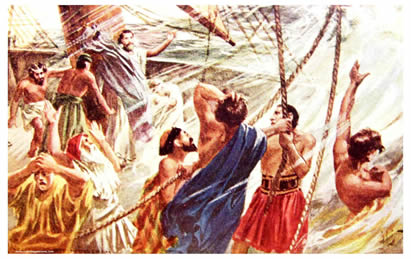
In Acts 27, Paul was with 275 other passengers on a boat bound for Rome from Caesarea, and its captain decided to test the Mediterranean Sea at a turbulent time. A violent storm, known as Euraquilo, caught the ship and ultimately battered it to pieces. It must have been an apprehensive time for the passengers and crew. Luke says the wind was violent, the ship was driven, the sun and moon didn’t appear for days, violently storm-tossed, they incurred damage and loss, and that all hope of their being saved was gradually abandoned. I cannot imagine the helpless, vulnerable feeling they must have felt. At least not literally.

It would be easy to let our national unrest and storminess tempt us to act irrationally (like some on Paul’s ship were tempted) or to give in to fear. But, Paul did five things we should do as we try to respond to the current turbulence.

  • He listened to God (Acts 27:23-24). Nobody else had a better or equal solution to their dire problem. The only way to be saved was to listen to God. Paul sought to persuade the people of this. In the ruckus and tumultuous noise, listen harder to God’s Word! It’s an anchor in stormy waters.
  • He believed God’s Word (Acts 27:25). It’s one thing to comprehend something, but quite another to put your trust in it. What God promised must have seemed quite far-fetched, that this way would save everyone. But, Paul didn’t waver. He said, “I believe God that it will turn out exactly as I have been told” (25). We are surrounded by people who need to witness our faith. As many as are persuaded will escape a shipwreck of faith (cf. 1 Tim. 1:19).
  • He encouraged hope (Acts 27:21-26). Despite the foolishness of their leaders, these people were given a message of hope. Paul says, “Keep up your courage!” (22,25). Despite the frightfulness of the moment, Paul offered a possible escape. Right now, you and I are uniquely positioned to give the only true hope available. It’s like an anchor for the soul, both sure and steadfast (Heb. 6:19)!
  • He warned the disobedient (Acts 27:31-32). There were those trying to break from God’s Word and will and do things another way. They were trying to take matters into their own hands. Paul spoke up against this! Such was defiance against the divine plan. What a message for us, who justify their sins rather than repent of them. We need to keep the message of righteousness, self-control, and the judgment to come before people (Acts 24:25).
  • He prayed faithfully (Acts 27:35). In this ordeal, Paul was a public example of prayer. Read every epistle of Paul’s and you’ll see his faithfulness in and dependency upon prayer. He appealed to the God he knew was the only hope for salvation. How much are we praying about the turmoil in our country (and world)? How much do those around us believe that we are dependent upon God?

Instead of focusing on the frightful winds currently blowing, let’s focus on the One who can calm the storm. Let’s get others to join us in that focus. Whatever happens to our nation, we must save as many souls as possible!

paul20in20storm


Another Heroic Sacrifice

Neal Pollard

Heather Christensen, a 33 year old music teacher from Spanish Fork, Utah, contributed the ultimate sacrifice on behalf of dozens of band students on October 10, 2009. The bus driver, bringing back the band competition winners from Idaho State University, slumped over in his seat and Christensen left her seat and grabbed the steering wheel in an attempt to keep the bus from crashing. While there were still several injuries, there was only one fatality. The 44 students on board were treated but released from the hospital. The 50 year old driver also survived. Only Christensen, partially ejected in the bus’ rollover, died.

It melted the hearts of an entire community that Heather was willing to lose her life in an attempt to save and rescue everyone on the bus. A gymnasium full of people at American Fork High School honored her at a Sunday night vigil. She was hailed as a true heroine.

The future of 45 people was dramatically changed by Heather’s decision to act. The obvious reaction of these students’ friends and family was to honor her sacrifice. It would be shameful to ignore it!

Jesus Christ deliberately decided, from eternity, to die on a cross in an attempt to save all mankind. His was a completely selfless act, requiring Him to take the place not of one but of all. Tragically, the majority of humanity for whom He offered Himself ignore His sacrifice. It does not move or touch them, and it certainly does not motivate them to do what they should do. Yet, for those of us who have obeyed the gospel and are Christians, we come together–not once–but once every week to commemorate His sacrifice. Each day we live, we live mindful of what He did in our place and for our sins. May our hearts stay soft to this supreme act of heroism!

6713611_orig

Avoid Being Ironic

Neal Pollard

Friday night, Carl and I flew to Bismarck, North Dakota. Why? Well, of course, we wanted to attend the “Melita Banana Days” in Melita (pronounced Meh LIT Uh), Manitoba. That, and stay in a Bed and Breakfast in Carnduff, Saskatchewan, that doubles as an ice cream shop. Saturday night, we were back in our own beds sleeping. While we were registering at the festival  on Saturday morning and talking with some of the organizers, we told them we had flown up from Colorado to check them out. From what we could tell, we were the only attendees from America. They were mildly intrigued by that fact, but basically brushed us off. Which was fine. We also wanted to check out Oak Lake beach about 60 miles north of there. But it was ironic to read on their website that this event is about promoting tourism. Perhaps our tepid reception was an exception to how they welcomed outsiders checking them out.

On a family vacation not too long ago, our family visited a small congregation on a Wednesday night. We drew a few stares from the local members as we took our seat right as Bible class began. Afterward, we were briefly greeted by one member who explained that their little group was going to have a meeting to discuss strategies for being more evangelistic. We were a family of strangers to them, and we might have been newcomers or non-Christians. They would not know. None of them tried to connect with us. We were essentially shown the door. We found this ironic.

It is ironic to sing, pray, preach, teach, and otherwise emphasize about the church’s mission and then to practically ignore it. Our assemblies are foremost about worshipping God and building up the body, but even first-century gatherings were attended by those other than the local Christians (cf. 1 Cor. 14:22-25).  In our zeal to deepen and build our relationships with one another, we must not ignore or be cold toward those who “enter” our assemblies. Instead, we should seek opportunities to start conversations and create opportunities to open doors which lead them to Christ. Certainly, they should leave our assemblies aware of our intense interest in them. To do otherwise is to undermine our very purpose and mission. That would be the ultimate irony!

20729287_10154898594805922_5226860467365340615_n

Why We Need The Word

Neal Pollard

Many know that Psalm 119 is the greatest, inspired tribute to the Word of God known to man. 176 verses, eight verses under the heading of every Hebrew letter, grace these pages of our Bibles. All but a few verses mention some synonym for God’s Word. So many individual studies can be made of themes and thrusts in Psalm 119, but by reading it one discovers David giving many benefits or needs for studying the Bible. Consider what is no doubt an inexhaustible study.

  • To keep from sinning against God (11)
  • I am a stranger in the earth (19)
  • The influential can be against us at times (23)
  • Our soul often melts from heaviness (28)
  • To keep our eyes from worthless things (37)
  • To have an answer for him who reproaches us (42)
  • It causes hope (49)
  • For comfort in affliction (50, 76)
  • It causes righteous indignation (53)
  • It leads us to seek God’s favor with our whole heart (58)
  • It makes us choose better companions (63)
  • It brings good judgment and knowledge (66)
  • It prevents apostasy (67)
  • It makes us more attractive to the God-fearing (74)
  • That I may live (77, 93, etc.)
  • For revival (88)
  • For greater understanding (99)
  • To be upheld and safe (117)
  • To have a proper sense of self (125)
  • For a proper sense of values (128)
  • For proper emotional investment (136)
  • For righteous zeal (139)
  • For a proper sense of dependency (147)
  • It brings confidence (152)
  • It gives us the proper sentiment toward the world (158)
  • To develop a proper “praise life” (164)

psalm119

A Small Portion Does Not Mean Small Proportion

Neal Pollard

Those who address us prior to our giving often make a statement like this, that we are giving back but a small portion of what God has blessed us with. In other words, if you could owned and could contribute all the world’s wealth, week after week, how would that compare to the sacrificial gift of Christ (cf. Mat. 16:26)? In fact, how could it compare with the many additional blessings besides atonement—a body equipped with the ability to perform involuntary actions (breathing, blood flow, cell regeneration, etc.), an environment conducive to life (air to breathe, photosynthesis, etc.), a planet in harmony with sun and moon making life possible, and the list is endless. It is not only impossible to out-give God, it is impossible to come anywhere close.

The Bible does not dictate a percentage for the New Testament Christian giver. The inferior covenant (cf. Heb. 8:7-8) required a tenth of all (Heb. 7:5), a pretty good benchmark for those of us having access to the better covenant established upon better promises. It is impossible to know what anyone might be thinking who hears the well-intended, if well-worn, statement, “We have the opportunity to give back a small portion of the many blessings we have received…” It does not mean, “A small proportion.” Nowhere does the Bible sanction stingy, leftover-style giving. In fact, it condemns such (read Malachi). Instead, Paul writes, “Now this I say, he who sows sparingly will also reap sparingly, and he who sows bountifully will also reap bountifully. Each one must do just as he has purposed in his heart, not grudgingly or under compulsion, for God loves a cheerful giver” (2 Cor. 9:6-7).

Giving involves a monetary, financial exercise, but it is a distinctly spiritual activity. It is an act of trust, a faith that the God who has provided will continue to provide and bless the one who bountifully shares what he has been given. When we, like the Macedonians, give beyond what we believe is beyond our ability (2 Cor. 8:1-5), we open up an exciting door in our walk with Christ.

If you are one who gives a small proportion of your income, may I challenge you to increase it? See what happens in your life. You are not giving to manipulate or coerce God, but you will experience a growth not possible on the “small proportion” side of generous giving. Trust Him! He has never broken a promise yet (read Mal. 3:10 and Luke 6:38).

article-2189659-14951d3a000005dc-746_468x311

The Rubber Band Metaphor

Neal Pollard

The rubber band’s a handy tool
If it but follows a simple rule
It must know how much that it can take
If it goes beyond that, it might break

It does no good inside the drawer
Or on a peg inside the store
It must assume its intended use
If sitting unused, it amounts to abuse

But when in working operation
It must guard against its ruination
Stretched too often or too far
It will not work or be up to par.

Just like that loop which holds together
That which needs a trusty tether
You and I must know our max
And not our limit to unduly tax

We’re not useful up on the shelf
We must work hard, extend ourself
But taken too far, we risk too much
We can hurt ourselves by doing such

Let’s prayerfully consider each opportunity
And realize none has complete immunity
From burnout, fallout, stress and strain—
Then we’ll be useful, happy, strong and sane!

1036633_large

“Wait Until Fall”

Neal Pollard

It was a beautiful experience, talking with our newest brother in Christ last night. It was beautiful watching him be bombarded with love and attention from member after member. Listening to him tell his story built my confidence in the simplicity of the Bible when a person reads it without prejudice or agenda. What an affirmation that God has a will for us and He made sure it was understandable to the seeker. As Jesus put it, “Seek, and you shall find” (Mat. 7:7).

Roberto has been seeking. As he has been attending a large, area Community Church, he has also been studying his Bible. He’s been a diligent student. Along the way, he read the repeated emphasis upon baptism as a necessity for salvation. This prompted him to approach his church and ask if he could be baptized. He was told that they baptize in the fall, and he could be baptized then. His immediate concern? What if I am killed in a car wreck or my phone blows up when I charge it? There was no manipulative or badgering teacher filling his head with such scenarios. Instead, he could make the connection between a command from God and the consequences of disobeying it.

He started Googling the importance of baptism and eventually found World Bible School. This led him to connect with Terry Pace, a Christian in Flint, Michigan, who studied with him. Roberto wanted to know if he could be baptized. Terry went to work. Terry’s son, Sam, happens to preach at the Northwest congregation in Westminster. One of the Northwest members, Allan Javellana, met him to study with him on Monday and found out he had sufficient understanding to be baptized. Since he lives close to Bear Valley, Allan brought him to our building where Wayne Nelson let him in. Allan stressed with Roberto the importance of working and worshipping with a group that is trying to answer Bible questions with Bible answers.

On Pentecost, they asked “What shall we do?” (Acts 2:37). They were told (Acts 2:38), and they acted that day (Acts 2:41).

On the road to Gaza, the eunuch asked Philip (who had preached Jesus to him, Acts 8:35), “Look! Water! What prevents me from being baptized?” (Acts 8:36). They stopped the chariot right there and then, and he was baptized (Acts 8:38).

At Cornelius’ house in Caesarea, this Gentile asked Peter to come over from Joppa (Acts 10:23ff). Cornelius knew Peter would be speaking words by which he could be saved (Acts 11:14). When it was clear that God wanted Gentiles to be saved (Acts 10:44-47), Cornelius and his household were baptized on the spot (Acts 10:48).

In the prison in Philippi, the jailor asked, “What must I do to be saved?” (Acts 16:30). He’s told to believe on the Lord Jesus Christ (Acts 16:31), Who they proceed to teach him about (Acts 16:32). Armed with this knowledge of the Savior, this jailor “immediately…was baptized, he and all his household” (Acts 16:33).

Nobody waited because God’s answer was “now.” What has changed from then to now? What would make a different answer acceptable today? Roberto is another, amazing example of what a receptive heart does when faced with God’s Word and will. Simply, humbly do what He says. Oh, that I will approach God’s Word the same way!

water-baptism

It Will Work!

Neal Pollard

  • Planting gospel seed (cf. Luke 8:11) will result in people of all ages, backgrounds, and nations becoming Christians.
  • Overcoming evil with good (Rom. 12:17-21) will soften hard-hearted enemies.
  • Approaching a wayward brother or sister in lovingkindness (Gal. 6:1; Jas. 5:19-20) will bring some back to faithfulness.
  • Faithful attendance will stimulate to love and good deeds (Heb. 10:24-25).
  • Singing psalms, hymns, and spiritual songs from the heart and with purpose will help us and everyone else who is present (Eph. 5:19; Col. 3:16).
  • Spending time together and getting to know each other will make us closer to one another (Acts 2:44; 4:32).
  • Investing in a heartfelt relationship with God will lessen anxiety and increase peace and joy (John 14:27; Phil. 4:7).
  • If the church stays committed to souls and service, it will grow (Acts 6:1-7).
  • Speaking to (rather than about) those who we feel have offended us results in greater harmony and reconciliation (Matt. 18:15-17).
  • Culture is met mightily by transformed, sacrificial representatives for Christ (Rom. 12:1-2).
  • We will win more in the world if we are not trying to simply embrace and imitate it as it is (Jas. 4:4).
  • Emphasizing leadership will result in people rising up to lead (cf. Ti. 1:5-11; 1 Th. 5:12-13).
  • Homes united in dedication to putting Christ’s kingdom first will have a high rate of success in raising faithful children (Pr. 22:6; Eph. 6:1-4).
  • If we will consult Scripture for answers to our dilemmas, we’ll uncover the best solutions possible (Ps. 119:105).

In our search for relevance, effectiveness, and success in our present world, let’s not overthink it! Whatever the question, if it matters (2 Pet. 1:3), the Bible has the answer. It will work!

blueprint-964629_1920

Traditions Of Men Versus The Word Of God

Neal Pollard

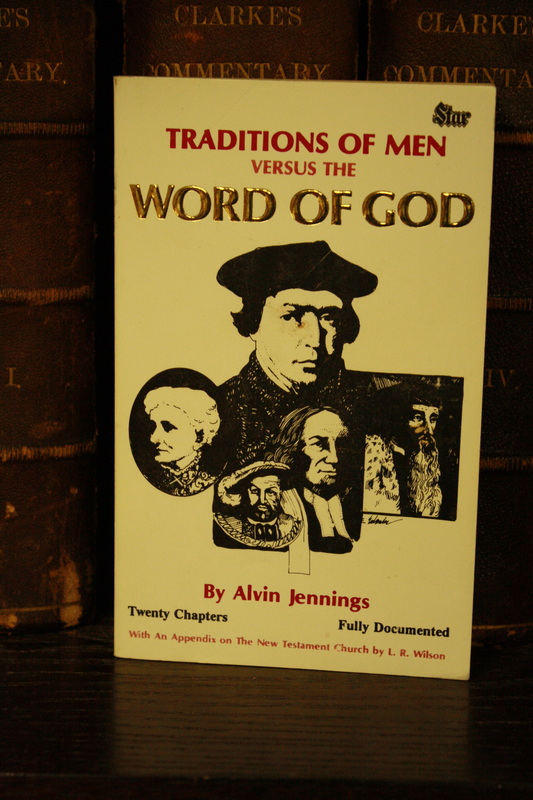
For as long as I have been preaching, I have had at least one copy of the Alvin Jennings’ book bearing the title above. The book was originally printed in 1972, but it has been reprinted several times. Jennings clarifies the way he uses the word “traditions” in his title. Rather than the sense of being a writing handed down from God (2 Th. 2:15; 3:6; 1 Co. 11:2), he used the word to refer to “religious laws and traditions originating from the minds of men and handed down orally and/or in printing from generation to generation” (iv.). He rightly points out that such traditions were condemned by Christ (Mat. 15:2-3,6; Mark 7:3,13; Col. 2:8; 1 Pet. 1:18; Gal. 1:14). Some of the problems with these traditions were that they got in the way of obedience to what God commanded, caused negligence regarding and the setting aside of God’s commands, enslaved one to something or someone other than Christ, and created a zeal that could lead to unhealthy consequences. The traditions Jennings examines substituted  false, human ideas for clearly revealed, divine truth. Anything that binds where God has not bound or gives permission where God doesn’t permit must be rejected. It’s a tradeoff with the gravest consequences (cf. Rev. 22:18-19).

However, I hope that as we strive to follow the pattern for New Testament Christianity we will be careful about elevating any tradition to be on a par with Scripture. There are some traditions we may choose to observe (or not):

  • Offering an invitation after every sermon
  • Having worship leaders, including the preacher, wear suits and/or ties
  • Women wearing dresses to church services
  • Songs or songbooks reflecting a particular time period (whether old or new)
  • Mandating a specific Bible version be utilized in the public assemblies
  • Choosing to have an evening assembly
  • Replicating the format of the morning assembly (in lieu of using the time for class, for example)
  • A particular order of worship (including whether the Lord’s Supper precedes or follows the sermon)
  • Offering the Lord’s Supper on Sunday evening
  • Any practice or tradition that arises from expedience or the realm of judgment, but that is not specifically mandated in Scripture

The church finds itself at a crucial crossroads. Undoubtedly, there is nothing new under the sun, but we do find ourselves at a unique place in cultural history. Since we live in an argumentative, rancorous atmosphere fueled by everything from cable news to social media, we should be careful to maintain a spirit of love and kindness whenever we sort through matters like these. We should never cherish non-binding traditions more than we do people. Those of us who are older and presumably more mature should consider carefully where and when we might compromise regarding matters not tied down in Scripture. More than that, we should foster rather than fear an environment that allows for such discussions to occur—without animosity or distrust. This will mean spending much more time developing our relationships with one another on the local church level (across generations). The better we know each other and the more we grow our love for each other, the better equipped we should be to sort through such things. Coupled with serious Bible study, this will hopefully sharpen our ability to distinguish between traditions and truth. May we have the grace to listen to each other without prejudice or minds already made up. Instead or ridiculing or caricaturizing the church in demeaning ways, let all of us “put on a heart of compassion, kindness, humility, gentleness and patience; bearing with one another, and forgiving each other, whoever has a complaint against anyone…” (Col. 3:12-13a). 

s702601590478870340_p115_i1_w533

WHAT DID MOSES CONFRONT?

Neal Pollard
Moses is remembered for his meekness, yet he also is the man who in indignation killed an Egyptian slave driver. He was afraid to lead, but what a leader he was with God’s help. In Exodus three, we see this man who has gone to hide among his father-in-law’s sheep as one who was ready for confrontation. Of course, at times this was good and at times it was not. What did Moses confront?

–Moses confronted his God. Receiving his Great Commission at the burning bush, Moses was introduced to the God who desired to work with him to accomplish some of the greatest feats of the entire Old Testament period. Moses learned just who his God was, a lesson that would continue the rest of his life.
–Moses confronted himself. He was a man with a bag of excuses, all of which he apparently pulled out to try and avoid the task God was handing him. He rightly saw his personal inadequacies, but he reluctantly began to see the Moses he could be in God’s omnipotent hand.
–Moses confronted his people. He had to go back to his hometown. Many of us would have a hard time being effective in that forum, but Moses had the gall to go. Did he have to face the two Hebrew men whose fight he had tried to break up, men who had either witnessed or at least heard about Moses’ murder? It must have been to go back and face his fellow country men, but he did it.
–Moses confronted his enemy. Rarely has an enemy been so formidable as Pharaoh was. His heart was hard to his very end. He was arguably the most powerful man on earth and as stubborn as he was strong.
–Moses confronted his faith. Hebrews 11 affirms the greatness of his faith. It was challenged and he did not possess a perfect faith, but inspiration proves that it was exemplary and memorable faith.
–Moses confronted his penalty. At the end of his journey with a stubborn and disobedient, yet chosen, people, Moses took too much on himself. He disobeyed God and failed to properly glorify him. Consequently, he was denied the Promise Land. The result of his sin was separation; for him, it was from the physical land of promise. For the disobedient who fail to repent, it will be from the spiritual land of promise. We all confront the fact that our sin has consequences.

Moses was a man who talked to God as friend talks with friend. He was an imperfect man and even occasionally an impetuous man. Yet, he was a successful man in part because of his willingness to confront. May we be so bold!

moses_burning-bush

Sharing Trade Secrets Or Sharing The Wealth?

Neal Pollard

Last month, Von Miller gathered some of the NFL’s elite sack specialists at Stanford University for what he called a “pass rush summit.” The participates were star defensive players from around the league, with several different teams represented. Addressing concerns that each man was sharing his trade secrets, Miller replied that it was more like sharing the wealth. He said, ““A sack is a sack. I’m going to get sacks, they’re going to get sacks. You really can’t stop that. You really benefit more from really just sharing that knowledge and just trying to be the best players that you can possibly be” (Denver Post, Nicki Jhabvala, 6/29/17). Do you find that surprisingly magnanimous and unselfish? Yet, don’t you find it refreshingly classy and helpful?

When I think about the spiritual battle God calls us to, I often think about the outposts God has in towns and cities throughout our state, country, and world. These individual congregations of the Lord’s church are facing struggles with a formidable foe (cf. 2 Cor. 10:2-4; 1 Pet. 5:8-9; Eph. 6:10-17). God has endowed us with a mission and purpose, reaching those outside of Christ, showing charity and compassion to the world, and helping to strengthen those already in Christ. We seek to achieve this through various ideas, ministries, programs, efforts, and events. We bring in speakers, host activities, organize, and create. When we find ways to be productive and get results, we should be ready to help. When he hear of such things, we should be eager to hear. At times, we may inadvertently develop a sense of competition rather than a spirit of cooperation. But this ought not to be so.

What is our goal with every benevolent outreach, every evangelistic attempt, and every edifying work? Isn’t it to get more people to heaven, to shine the light of Christ into a world of ever-deepening darkness? Why do we host camps, have lectureships, train preachers, hold fellowship activities in homes and at the building, reach out to our homeless community, stock pantries, build a robust youth program, minister to young professionals, young families, and seniors, do evangelism training, have marriage seminars, worship leadership training, and the like?

What about works our brothers and sisters are doing all over the country? Polishing the Pulpit, Focal Point, Fishers of Men, Gospel Broadcasting Network (GBN), Truth.fm, Mission Printing, World Video Bible School, Bear Valley Bible Institute’s Extension Program, World English Institute, House to House, Heart to Heart, and many, many others are what our larger church family are doing to grow the church and build its strength. Yet, there’s much more that could be done by so many more of us, working together to accomplish the mission. But we must see ourselves as cooperators rather than competitors. Obviously, there can be impediments making this impossible in specific situations, but as we acknowledge that are we missing opportunities. Meanwhile, countless souls are rushing toward eternity. Let’s band together to find out how to more effectively reach more of them. That will mean more saved souls and more glory to God!

Screen_Shot_2017_06_30_at_9.49.53_AM.png
Vanguard Sports photo of the Pass Rush Summit

LOOKING IN THE WRONG PLACE FOR JESUS

Neal Pollard
Periodically, we read or hear of “sightings” that unbelievers have a field day with. I refer to “Jesus sightings,” people are claiming in such things as clouds, Cheetos, dental X-rays, cooking utensils, windows, walls, and trees. Wikipedia even has an entry for it (“Perceptions of religious imagery in natural phenomena”). People vehemently defend the idea that these are intentional, divinely sent images. Meanwhile, secular and agnostic witnesses to such claims gather up baby and bathwater together, using such superstitiousness to show how deluded those in Christendom really are. Yet, while responding to superstition in religion would be a fitting use of time, another thing comes to mind when hearing these sad stories. It is a reminder that people are looking for Jesus in all the wrong places.
They want some heavenly sign, some overwhelming feeling, some sensory sensation, and some sort of religious fireworks to create or validate their faith. While God has embedded plenty of these in the marvels of nature and creation, through the product of answered prayer that defies logic or explanation, and by the amazing process of transformation that occurs when people follow Christ, He calls on us to seek for Him in a much less electrifying and cataclysmic place.
When we pick up God’s Word and regularly, intently read, meditate, and study (cf. Psalm 1) it, we see Jesus come alive in powerful, sustaining ways! When we walk with the Lord each day, the resulting relationship built on His character and our trust in Him is powerful! When we actively serve Him and others and put into practice what He teaches us through the Bible, we see Jesus in a vivid way. Daily Christian living, the longer we practice it, brings Jesus into unmistakeable, clear focus. Maybe that is what these “seers” truly desire, and what they need is our help to truly find Him. Let us take that as a challenge and help people really “see Jesus” (cf. John 12:21; Heb. 2:9).

10391950_190406240921_3760525_n

FOUR GOOD FRIENDS

Neal Pollard
I do not know how many friends make up your inner circle of confidantes, companions, and cheerleaders, but there is value in positive, godly friends. We take comfort from scriptures that remind us “a friend loves at all times, and a brother is born for adversity” (Pr. 17:17), “a man who has friends must show himself friendly, but there is a friend who sticks closer than a brother” (Pr. 18:24), “faithful are the wounds of a friend, but the kisses of an enemy are deceitful” (Pr. 27:6), “the sweetness of a man’s friend gives delight by hearty counsel” (Pr. 27:9), “do not forsake your own friend” (Pr. 27:10), and “as iron sharpens iron, so a man sharpens the countenance of his friend” (Pr. 27:17). Only in very wicked times must we lament, “Do not trust in a friend; do not put your confidence in a companion” (Mic. 7:5a).

The Bible reveals four good friends, friends who surely were like the ones extolled in the Proverbs. I am not referring to Job’s four “friends,” Eliphaz, Bildad, Zophar (the “miserable comforters”), and Elihu. Instead, these friends’ names are locked away in the mind of God, known only to their contemporaries and lost to history. But, they were friends in deed. Drawing mainly upon Mark’s gospel account, we find several reasons–implied or plainly stated–why they should be considered good friends.

They cooperated for the good of their friend (2:3). These individuals befriended a paralyzed man, a man in need of healing. Whose idea was it? Was one or two of them stronger? Did one of them know the way? What did each contribute? How far did they have to carry him? Scripture answers none of these questions, but we are told that all four of them took him to Jesus. Apparently, all four of them were needed. Hoisting “dead weight” would have required cooperation. In my experience, no one is brought to the Lord alone. It requires a team effort, even if only one invites his or her friend to come to the assemblies or to engage in a study. The “friend” needs encouragers, instructors, and friends!
They persisted for the good of their friend (2:4). These men might have given up and rationalized, when they arrived at the house where Jesus was and found it overcrowded, that they tried. No, they stopped at nothing to get this man to Jesus. They took the road less traveled! It was apparently not as easy as simply lifting straw off of a roof. My son, Gary, tells me that there were three layers of roof to penetrate in the average first-century, Palestinian house. As he taught the teen class last night, “The roof was made up of three layers. First, a basic wooden platform was probably nailed into the body of the house. Second, there appears to have been a layer of insulation that was probably made up of rocks over a base and held together with tar. Third, the regular roof was made up of straw and the like. They not only dragged a man onto a roof, they also to dug thru the layers of roofing & even to get onto the roof would take a lot of trouble.”
They believed for the good of their friend (2:5). The Bible says that Jesus saw THEIR faith and then addressed the friend’s needs. Those friends could not have faith for this man, but their faith put him in a position to have faith himself. Jesus noticed their faith before He turned His focus to the paralyzed man. Think about how we can bless others’ lives by bringing them to Jesus. Also, think about how heaven regards us for making such efforts.

What kind of friend are you? Are you the kind willing to bring your friend to Jesus? Remember, Jesus forgave the sins of the man brought to Jesus by his friends. All of us have friends in need of God’s forgiveness. Let us have the courage to bring them to Jesus!

p1092536531-3

WHY WE ARE TEMPTED NOT TO TEACH TRUTH

Neal Pollard

Most preachers know the unpleasant burden of having to preach on difficult subjects. There are some who, whether they find it unpleasant or not, are unpleasant in their demeanor and fully ready to frequently preach on moral, doctrinal, ethical, and other sin-related issues. However, it is distasteful business to most men who stand before congregations or sit before individuals to preach and teach the Word. What are reasons why we may be tempted not to teach truth?
1) Fear of repercussions. This is not said with cynicism or judgement of men’s motives and hearts, but for most of us there is usually fear of unwelcome consequences from preaching on a difficult subject. We do not want to offend people or their sensitivities. We do not want to cross people of influence who might encourage criticism or discontent against us personally. We do not want to see angry or hurt faces.
2) An overreaction to issue-oriented preachers. Most of us can think of a preacher or preachers who seemingly cannot stand before an audience without mounting their familiar hobby horse. Some have a stable of such stallions and a field of such fillies. Because we do not want to be that guy, we may be tempted to avoid difficult, thorny subjects.
3) Not being fully convinced that it’s truth themselves. I am convinced there are preachers who do not believe the truth on certain subjects, but they know the leadership or some in the membership do. So, they avoid preaching those subjects. If questioned on this, they can point to their lessons and defend themselves by saying they have not advocated error on a particular matter. Further investigation would reveal their silence on the matter altogether.
4) An assumption that people already know the truth on a subject. Without proper vigilance and attention to balanced preaching and teaching, this is inevitable. Especially if many in the audience grew up in the church and older members remember certain subjects being regularly addressed in their lifetime, they may not feel a sense of urgency that such subjects be periodically visited. We can raise an entire generation, assuming they believe what we came to believe through studying and hearing these matters preached. This assumption is both faulty and false.
Ephesians 4:15 and Colossians 4:6 are beacons and guides that determine how we preach. Acts 20:27 guides us as to what we preach. Fear is not an excuse for omitting certain subjects from our sermon repertoires (cf. Rev. 21:8). An overreaction that causes us to avoid all controversial, “hard” sermons is in itself an extreme (cf. Josh. 1:7). One not convinced about truth owes it to themselves and their hearers to stop preaching until they get that resolved (cf. Jas. 3:1). Assuming people know and understand the truth on a subject can make us poor stewards of the high charge we have as preachers and teachers (cf. 1 Cor. 9:16). Let us be transparently kind, caring, and concerned for people when we stand before them to teach and preach. Yet, let us have a righteous boldness and unwavering trust in the Lord to declare the whole truth so as to please Him.

13133128_10208994065306983_3707281101666231429_n
In loving consideration of my three most favorite preachers in the world!

“My Cat Unplugged My Alarm Clock”

Neal Pollard
A few years ago, the Baltimore Sun wrote an article about the outlandish excuses some people gave for not coming into work. To sample this pathetic pool, there was “my cat unplugged my alarm clock,” “I couldn’t find my shoes,” “my garage door is broken,” “my cat has hairballs,” and “my partner and I need to practice for the square-dancing contest in town today.” But, John Campanelli of the Cleveland Plain Dealer, relates perhaps the most classic excuse I have ever heard. It was related to him by Andrea Barnett, a human resources rep, whose MIA employee gave the excuse that he had been in jail. He had borrowed a friend’s car to get to work, which car was reported stolen by police. He said he was put in jail for possession of stolen property, a car he said had been used in a robbery. This caused the police to grill him about it, which kept him from calling in to work. He eventually convinced law enforcement of his innocence, thus earning his release. Incredible story! Incredibly untrue, Barnett found out when she called the sheriff’s office for whom that was a revelation. Runners up from Campanelli’s article include the man who was experiencing morning sickness due to his wife’s pregnancy or the guy who had to make an emergency visit to the dentist to remove dental floss that got lodged between his teeth getting ready that morning.

Excuses are not confined to employees. Students give excuses for late or incomplete assignments. Spouses and children give excuses to other family members for bad behavior or shortcomings. Leaders give excuses to followers, and followers give excuses to leaders. If we are honest, nearly all of us have been guilty of excuse-making. What we must guard against is perpetually making excuses for failing to do the will of God! Those who make any excuse to explain why they have not become a Christian will not successfully put them past the Lord on the great day of judgment (cf. Acts 17:30; 2 Th. 1:7-8; Jude 15). Christians who needed to publicly repent of a sinful lifestyle cannot expect to be successful standing before that same, perfect Judge (cf. Matt. 25:34-40).

Let us also strive to avoid flimsy excuses we give for lack of involvement or for failure to faithfully attend worship services. On the surface, these excuses may sound good to us. But, if we will step back and try to look at it from heaven’s perspective, it may sound less important and solid. Maybe we have not thought it through, that we are choosing things that are solely earthly, material, and temporary to the neglect of God’s will and purpose. We may need new and different excuses to cover our failures, but will they work in the end? God has placed us on this earth to accomplish His purpose, but if we fritter away our days and years on what will decay and dissolve to the indifference and disregard for heavenly matters what will we tell Him? Whatever we say, will it be less hollow or shallow than the excuses the fine workers of Baltimore and Cleveland gave? Rather than excuses, let us give God our best efforts. Instead of rationalizing why we cannot, let us realize why we can (cf. Phil. 4:13; 1 John 4:19).

alarm-clock-007