Build That Wall!

Neal Pollard

The partisan vitriol ramps up whenever subjects like border security and immigration are mentioned. It is a subject as much a part of the political divide as “Russian Collusion,” tax reform, and affordable health care. Let the politically passionate debate all those topics, but did you know Scripture talks about the importance of having a properly-built, fortified wall? There were walls erected around a city to protect it from external dangers. If the citizens inside were righteous, they were kept safe even against all seeming odds (2 Kings 18-19). If the citizens inside were wicked, no wall, however seemingly impregnable, would hold (Joshua 6).  But, I’m referring to a different kind of wall.

Scripture tells us that the individual must build a wall and properly maintain it, too. The way Solomon put it is, “Like a city that is broken into and without walls is a man who has no control over his spirit” (Prov. 25:28). Words flow without restraint, many of which wound, offend, and separate. Anger and even rage can erupt over even the slightest or even perceived infractions. Personal conduct that indulges the flesh, from overeating to pornography to fornication, can be impulsive and destructive of self and others. Indecent thoughts, fed and fueled by the thinker, can crumble this vital hedge.

What a challenge for me on many levels! How easily do trials and setbacks in the normal functions of life, from standing in line to driving in traffic to dealing with customer service, set me off in unrestrained thoughts, words, and actions? How do I handle words of opposition, face to face, by written correspondence, or through some form of social media? How strong is my wall when I disagree with my mate, children, neighbors, or brethren?

Solomon teaches me that I can have control over my spirit. No cop out or blame game changes that. Whatever sinful thing I allow over that border into my life is guaranteed to be harm me! So, I must build a wall that preserves my spirit. My eternity literally hinges upon it.

170216172849-griffin-dnt-trump-border-wall-lead-full-169

Putting A Price Tag On The Value Of Our Youth

Neal Pollard

Perhaps you’ve seen the news story about the six year old boy who made $11 million dollars this year on YouTube reviewing toys. Ryan, of Ryan ToysReview, has been reviewing toys since he was three years old. He has over 10 million subscribers to his channel, which had a 40-week streak of most viewed YouTube channel this year. He even had NBA star Kevin Durant appear in one of his video reviews in September. His videos are described as simple, innocent, and personable (Samantha Schmidt, Washington Post, 12/11/17 via www.washingtonpost.com/news/morning-mix).

That’s incredible! Such savvy, drive, and entrepreneurship. One of the traps we need to avoid is selling the intelligence and abilities of young people short. That’s even truer in the church than in the world.

When I look at our youth, I see perhaps the most evangelistic demographic in our congregation. Teens invite classmates to church just to “see what it’s about.” Then, our other teens reaching out and welcoming them into the group. They have a fearlessness about them that can drive the rest of us to greater effectiveness in this arena.

When I look at our youth, I see tenderheartedness. It doesn’t just drive them to be baptized or to publicly respond to the invitation. It moves them to be compassionate, to help the unfortunate or to be concerned for those who others may overlook. They are shamed by their sins and moved by praising the greatness of God.

When I look at our youth, I see a boundless resource of energy. They are active and alive, and when they channel that to serve–whether our elderly, the homeless, or each other–it’s exciting to see. You see it when they get together, talking and laughing. So many of us feed off of their vitality.

When I look at our youth, I see hope and idealism. Life too often depletes them of these priceless commodities. We need to do more to build them. Hope is about confident expectation, and isn’t the Christian life to be founded upon that (Romans 8:24)? Idealism may be seen as having higher expectations than are realistic, but it’s this mountain-moving faith that causes churches to grow and do what only can be done when God is factored into the equation. He is perfect and able (Ephesians 3:20-21).

Through their evangelism, example, energy, and expectation, our youth are of inestimable value to the church as a whole. Let’s nurture them and help them grow. Let’s give them opportunities to make an impact right now. All of us will reap infinite value from these infinitely valuable ones (cf. Matthew 18:1-6).

17523151_10212884844293080_7163968835894994377_n


Audience Analysis

Neal Pollard

People, in talking about public speaking, will sometimes speak of “audience analysis.” What they mean is that you need to know your audience or you run the risk of being irrelevant, disconnected, and even possibly offensive. You may assume too much of them or sell them way short. Neither extreme is effective.

A wonderful sign for any congregation is the presence of especially non-Christian visitors, especially those from our community. Hopefully, we are doing something right when these visitors make repeat visits to our assemblies. However, too often, I fear that we have not done sufficient “worship neighbor analysis” or, equally, “Bible class neighbor” analysis. I recently was in a class when a teacher made a remark about how poorly a specific religious group scored on a Bible comprehension quiz. The remark itself was poignant and effective, but the cackling laughter from a few near the front of the class was easily heard throughout the classroom. I’m sure it was heard by two students sitting near them whose background is in that religious group. One is a brand new Christian and the other is a non-Christian visiting with him. Not only was the members’ reaction unnecessary, it displayed a lack of awareness of who else was present.

At times, we select songs from a century when “thees” and “thous” were commonplace and whose vocabulary was drastically different from how we speak today (“guerdon,” “cassia,” “pinion,” “dross,” and “hoary”). Even songs I have long been fond of read in ways that seem almost foreign to us today. Preparation for worship leadership should include a cognizance of how new Christians, young people, non-Christians, and the like will process or even if they can process such.

Specifically biblical or theological terms which we know people like our neighbors, coworkers, and classmates do not understand should not be uttered undefined. Making assumptions in an age marked by a growing lack of biblical literacy can undermine our effectiveness. It can make the most relevant message of all seem irrelevant and incomprehensible.

Of course, most fundamentally, one of the most unforgivable sins in the eyes of the typical visitor is to be ignored or made to feel invisible. We may hesitate to engage someone because we lack awareness of their “status” (visitor or member). Instead of risking embarrassment, scorn, or an expenditure of time, we walk past them or speak to someone we know we know. Perhaps, in believing that true seekers find, we let ourselves off the hook despite Jesus’ call for us to sympathetically consider others (Lk. 6:31; 1 Pet. 3:8).  Common sense should move us to see that we can attract or detract, depending on how we react.

Spiritual maturity will steer us to be mature, kind, patient, and self-aware. Basic thoughtfulness will help us prepare, speak, and act in ways that make us magnets for the Messiah rather than repellant from the Redeemer. The effort will be appreciated and, I truly believe, rewarded. If we need to, let’s break out of our bubbles of isolation and seek to see things through the eyes of others—especially “the little” (Mat. 10:42; 18:6-14) and “the least” (Mat. 25:40).

4aee607aa23e1943b2f475b58974c89f-bulletin-board-church

My Social Media Pledge

Neal Pollard

  • I will try to use social media to encourage and edify others (1 Thess. 5:11; 1 Cor. 14:26b).
  • I will avoid the shocking, inflammatory, and divisive tactics increasingly characteristic of S.M. (cf. 1 Cor. 1:10; Prov. 12:18; Prov. 15:2,4; etc.).
  • I will ask, “Would I say this in the way I am saying this?,” if face to face with this person or this group of people (Prov. 23:7).
  • I will not use Social Media to pick fights or put people on the defensive (cf. 2 Tim. 3:1ff).
  • I will not be Nellie Nitpicker and Contrary Charlie. About. Every. Single. Little. Thing.
  • I will respect that my connections have connections that are not Christians and I want to be sure to say what I say in accordance with Ephesians 4:15 and 2 Timothy 2:24-26.
  • I will sever connections with individuals who consistently display a lack of self-control with their words and attitudes. Souls are too precious.
  • I will abhor the thought of doing what would put Christ to an open shame (cf. Heb. 10:29).
  • I will double-check myself to avoid bragging and self-promotion (1 Cor. 13:4-5).
  • I will conquer the desire to have the last word, pile on, or fight fire with fire (Mat. 5:39-42).
  • I will not let the false teaching, bad attitude, or meanness of another be my rationale for behaving in a way that brings Christ shame or jeopardizes my own soul (cf. 1 Cor. 9:24-27).
  • I will always be trying to set the table for productive evangelism or retrieving the wayward (Jas. 5:19-20; Col. 4:6).
  • I will always try to portray the doctrinal, moral, and ethical values of my Lord, thus avoiding reflecting and glorifying whatever values conflict with His (Mat. 5:14-16).
  • I will try to promote, not pummel, the bride of Jesus, appreciate, not attack, the elders, and unite, not untie, wherever possible.
  • I will shun passive aggression in myself first, but also in others.
  • I will deal with dirty laundry in its appropriate way, which is not on Social Media.
  • I will actively try to show grace to everyone, including cantankerous curmudgeons.
  • I will, foremost, realize my own imperfections and try every day I use Social Media to do so in the way Jesus would, if He had Facebook, Snapchat, Instagram, Twitter, a blog, LinkedIn, etc. In a way, through you and me, He does. I will let that sink in!

20080704_p070408jbweb-0279-515h

Coarse Discourse

Neal Pollard

Is it just me or are we much more open about using profanity in ordinary discourse? Our sitting president has exhibited an unprecedented amount of “curse words” in the public square, even if transcripts of historic documents reveal that a great many of the last several presidents have used language salty enough to make sailors blush. Hollywood reactors to the president have seemingly been trying to “trump” his salacious speech and have, in many cases, upped the ante in indecent language. Recent news story include Bette Midler, congresswoman Kamala Harris, and Kirsten Hillibrand (aka “Senator Potty Mouth,” via The Daily Mail) using shocking words that the thoroughly secular media acknowledges as inappropriate and indecent—at least measured by cultural norms and moors.

I have to admit being thoroughly baffled by church members, even teachers and preachers, who adamantly argue that Scripture has nothing to say about such things. Implicitly, even explicitly, their point is that such speech is legitimate for a follower of Christ. While we must be careful not to make laws God does not make in His Word, neither can we be so reckless as to hurt Christ’s cause by encouraging the Christian to mimic the world’s behavior, speech, or attitudes without discernment. When godless media, non-believing coworkers, classmates, and cul-de-sac compadres, and others in society associate certain words with the rebellious, humanistic lifestyle, shouldn’t we take pause?

Is there room in Paul’s admonition to Ephesus (4:29; 5:4) and Colosse (4:6) or Jesus’ public discourse (Mat. 12:34ff) for the kind of words that so many in society still find shocking and inappropriate? Are the principles of godly influence (Luke 17:1), salt and light (Mat. 5:14-16), example (cf. 1 Tim. 4:12), and the like not enough to cause us to feel strongly about how we use our words with people? Do we feel like well-chosen swear, scatological, and smutty words are essential to successfully relate to and connect with the rougher elements of society in an effort to win them to Christ?

We can relate to and reach people without resorting to irreverent and indecorous words. We can keep pure in speech without becoming isolationists in society. It does not have to be an either-or proposition.  May we realize that what we say (and how we say it! See Gal. 5:20, Rom. 3:14, and Jas. 10, for example) will impact people like we do not realize and in ways that we do not realize. It extends well beyond just our speech, but our words paint a picture of us for the very people we should desperately want to reach for Jesus. Please, give thought to the power of your words (cf. Prov. 18:21).

597px-profanity-svg

THE POWER OF THE TONGUE

Neal Pollard

One of the leading stories in today’s news concerns a young woman, Michelle Carter, facing manslaughter charges for allegedly coercing her boyfriend, Conrad Roy, to commit suicide. He was 18 and she was 17. While at earlier points in their relationship she tried to dissuade his talk of suicide (he had attempted suicide before meeting her), by the end she was insistent and even steered him onto the subject of taking his own life. The night he succeeded in killing himself by carbon monoxide poisoning, she even urged him at one point to get back into the truck. The hundreds of text messages she wrote are disturbingly callous and malicious, and she faces 20 years in jail if convicted. Her words are at the heart of this case, and prosecutors say she is complicit in his death because of all that she said (The Washington Post online, 6/7/17, Kristine Phillips and Swati Sharma).

It is incredible to consider that this young woman used her words to so discourage and deflate another human being, to even actively push him to die. Yet, Scripture tells each of us that, spiritually, we all are exercising the power to either promote life or death through our words. Proverbs 18:21 tells us, “Death and life are in the power of the tongue.…”  This is why Paul urges us to give thought about the character and nature of our speech, saying, “Let your speech always be with grace, as though seasoned with salt, so that you will know how you should respond to each person” (Col. 4:6). Our speech can kill in many ways:

  • Vulgar, coarse speech that can encourage others to think of the unwholesome and sinful
  • Hypercritical speech that can deflate and discourage people’s good works
  • Gossipy speech that can cause people to be divided and distanced from undeserving victims
  • Dishonest speech that can lead people astray from the truth
  • Railing, sinfully angry speech that can be self-destructive to the speaker
  • Hypocritical speech that can cause people to be turned off by Christianity

We may be prone to excuse our words as harmless when in fact they can be a matter of spiritual life and death for ourselves or someone else. Our prayer should mirror that of the psalmist, who pleads, “Set a guard, O Lord, over my mouth; Keep watch over the door of my lips” (Psa. 141:3). We possess such power! Let us harness it and use it for life, not death (cf. Jas. 3:2-12).

maxresdefault

It’s Not Business; It’s Personal

Neal Pollard

Some years ago, when our sons were all teenagers and they were given a cell phone, there were times when they failed to use those to communicate if they got to their destination or answer when we needed to reach them. While I never did it, I was tempted on more than one occasion to contact the cellular provider and suspend their service. Why? Was it because I thought it was wasted cost? No. It was because it reflected a lack of thoughtfulness and responsibility. It wasn’t business. It was personal.

Hebrews 10:25 is a sobering, New Testament passage. It addresses the Christian’s attitude toward the sacred assemblies of the church. What makes it sober is its contextual attachment to the eternal ramifications of abandoning those assemblies. God speaks of “no more sacrifice for sins,” “severer punishment,” “vengeance,” and “terrifying” (26-31) in connection with sinning willfully, of which forsaking the assemblies is a contextual example. But, why is God so exacting about this matter of our meeting together? In a nutshell, it is because these times, to God, are personal. The Bible is full of references to God’s desire to be worshipped and receive our worship. He is worthy. As Creator, He has the right. But, in this passage, it is personal in the sense that what He commands is so helpful to you and me.

Written on the foundation of the fact that our High Priest, Jesus, has given us access to God (19), the writer urges us to do three things: (1) Draw near (22), (2) Hold fast, and (3) Consider. It’s the third one I want to briefly notice:  “and let us consider how to stimulate one another to love and good deeds, not forsaking our own assembling together, as is the habit of some, but encouraging one another; and all the more as you see the day drawing near” (24-25).

There should be a personal connection. Notice how the writer reveals this. He says “us” and “our.” He says “one another” twice as well as “together.” Christianity is not a solitary condition. We must see ourselves in connection with the rest of the body. Assembling is about seeing ourselves as a vital piece of a more important whole. Forsaking the assemblies is, for whatever reason, selfish and self-centered. It is done blind to the needs of others.

There should be a personal submission. The command is “consider” followed by two participles that tell us how to obey the command: “not forsaking” and “encouraging” (more on that in a second). So, in a discussion about the whole group, there is a command each must strive to obey. As it is a command, ultimately this is as personal as God and the individual. I fail to consider my role, I fail in my relationship with God.

There should be a personal obligation. Each of us is obligated to stimulate and encourage everyone else. It’s not just those who publicly lead worship or teach class. The reclusive saint who dashes out before services are over has missed this. The clammed up Christian who never reaches out to fellow saints but is closed to others misses this. The discouraging and unloving brother and sister rebels against their duty. I should never be focused on how well others are stimulating and encouraging me. Instead, I should be so lost in my efforts to be a blessing to others that I have no or energy to evaluate how others are doing.

There should be a personal anticipation. This is more than social and emotional. It’s spiritual and eternal. Those other aspects are means to that end, but don’t miss the end. Be a blessing to others at “church services” “as you see the day drawing near” (25). Not Sunday. Keep reading. The Judgment Day. I need to remember that “here we do not have a lasting city, but we are seeking the city which is to come” (13:14). One of the best places to stay reminded of that is through our assemblies, as our activities in class and worship and our teaching and preaching keep us anchored to that ultimate reality. This world is not my home!

Christianity is not about the business of going through the motions, even doing right things. No, no! It is personal. May that truth permeate our attitudes toward not just God, but His children.

1024px-business_plate_green-svg

Learning About Worship From Children

Neal Pollard

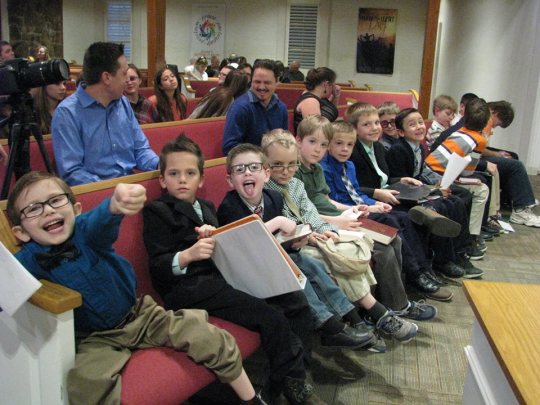
Thom Vaught gave the “elders remarks” last night after the Young Lions participated in their annual program of Scripture reading, song leading, prayer, and preaching. The fourteen first through six graders obviously listened well and learned much. Thom noted how we look at the Christian life as a marathon, but these boys (and the seventeen God’s Precious Daughters who hosted a tea in the fellowship hall at 4:00 PM yesterday afternoon for 80 Christian women!) were actually the next leg in a relay race.  Everybody seemed to leave the assembly last night so spiritually full and energized. Perhaps that was because of what we had seen (and learned) throughout last evening’s service.

…That genuine enthusiasm is infectious.
…That worship should be characterized by purity.
…That you cannot easily fake sincerity.
…That sometimes truth gets told most poignantly and effectively from such an innocent heart.
…That it is encouraging to see someone overcome their fears to lead.
…That we appreciate seeing those who lead us unashamedly show us their hearts.
…That worship should be joyful.
…That we should carry the experience of worship out the door with us into our lives.

When Thom asked those present last night who had formerly been through Young Lions and God’s Precious Daughters to stand along with the 31 children involved this year, it was overwhelmingly encouraging to see so many scattered among our healthy crowd last night who had received this wonderful training. The leadership training they have received through the years has contributed to the teenagers and young adults they have become, serving Christ and others. Some of them are married now. Others have graduated from preacher training schools or are students there. Others have gone on to Christian Colleges. They lead us in every phase of our worship regularly and effectively. We appreciate the men and women who came up with this program and all those who have served through the years. All of us are the better for it. Last night was a reminder of something Trent Woolley, who helped lead this year’s program, said to us, “Truly I say to you, unless you are converted and become like children, you will not enter the kingdom of heaven” (Mat. 18:3).  I pray we will carry these lessons learned into worship with us next week and the weeks beyond that!

17191020_997645827047006_5867707409707217276_n

16939339_803329306482297_3212391089732137726_n

The Tactics Of The Tactful

Neal Pollard

“To ensure people listen to you, insult their race, politics, and intelligence. Be sarcastic. Be close-minded. Don’t attempt to hear what they have to say. Do not gently reason and certainly do not be patient and thoughtful. Courtesy should be thrown to the wind, along with assuming the best and thinking before speaking. Inflammatory statements are sure to win the hearts of people on the fence or on the other side of the issue from you. When they disagree or offer a dissenting view, really let them have it. Call them names, make baseless assumptions and accusations, and angrily dismiss them. Persuade them with harsh, rude, coarse, crude words and phrases, and even resort to cursing to strengthen your point.”

I don’t suppose I’ve ever seen anyone give the advice above, but an incredibly large number of people seem to have adopted those very tactics through social media to promote their own points of view and to attack those of others. Beyond the right and wrong of specific issues, there is the attitude and demeanor the Christian is to maintain. The late Wendell Winkler would often tell us “preacher boys” that “you can be right and still be wrong.” How sad to lose the moral high ground of an issue because we yield to the fleshly tendency to rip, tear, and insult “the other side.”

Scripture counsels this approach instead: “Be kind to one another, tender-hearted, forgiving each other” (Eph. 4:32); “The Lord’s bond-servant must not be quarrelsome, but be kind to all, able to teach, patient when wronged, with gentleness correcting those who are in opposition” (2 Tim. 2:24-25a); “Do not be overcome by evil, but overcome evil with good” (Rom. 12:21); “Let your speech always be with grace, as though seasoned with salt, so that you will know how you should respond to each person” (Col. 4:6); “A gentle answer turns away wrath, But a harsh word stirs up anger” (Prov. 15:1).

Oh, sure. People will rationalize their ugly, insulting speech through distorting the words and actions of Jesus, Paul, and others. People often rationalize their sin and disobedience. How many have done the same thing in the face of Scripture commanding baptism and teaching the singular nature of the church? But, make no mistake about it! Venomous, hateful, insulting speech is not the way of the faithful Christian.  The source of that is from a distinctly different direction!

Be convicted and courageous, but cloak it in Christlike kindness! In addition to being right, it will be far more successful. May our goal be to win hearts and souls and not just arguments!

636044778227119944-152056580_another20guy20yelling20at20his20computer

THE CHRIST?ANS

Neal Pollard

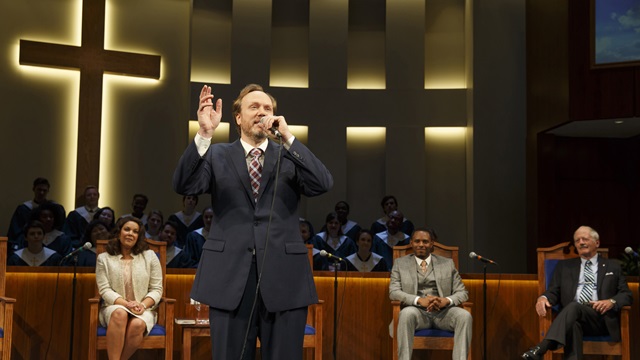
I’ve seen the play advertised locally. Lucas Hnath, a 36-year-old playwright, has a background in religion. His mother attended seminary and he even sat in her classes. The New Yorker reveals that there were expectations early on in his life for him to become a “pastor,” a choice he forewent for the arts instead (“Divine Intervention,” 9/7/15, Hilton Als). The play is about a megachurch preacher who has come to believe there is no hell and who believes God gave him this revelation. The result of his divulging this in a sermon is a church split, led by the assistant pastor who does believe in the reality of hell. While doctrine lays at the heart of the split, the play is said to focus on the personalities and behavior of various folks making up the church. Alissa Wilkinson, in a flamboyantly titled review, says this play resonates because “schisms, church splits, or at least disgruntled storming-outs are familiar to virtually everyone who stays in a church long enough to be committed to its life” (Christianity Today, 9/23/15). At least in advertising I’ve seen, the play title appears “The Christ?ans.” The idea is that, judging from their behavior, it is questionable whether or not they are truly Christians.

There are heartbreaking stories of congregations of the Lord’s church whose internal battles became known to the community and the brotherhood at large. Some have resulted from battles over doctrinal issues, whether regarding morality, fellowship, worship, leadership, or the like. Some have resulted from dueling strong personalities, jockeying for power, position, and prominence. Some have boiled down to squabbles about money. In all of them, tragically, Christ has been relegated to the corner and forced to be quiet while His “followers” duke it out.

While the implications over a doctrinal dispute and a personality power play are different, too often the predominant feature is a show of the flesh.

Many with a background in religion will be able to relate to the theme of the play because they have seen schisms in churches before. The world is a divided place, full of rancor, backstabbing, infighting, and unfair fighting. The church, particularly the church of the New Testament, must never exhibit such traits. Corinth set off such an alarm with Paul for this very reason. He urges no division to mar them (1 Cor. 1:10-13) and goes on to address both doctrine and attitudes in the letter. Philippi had two quarreling women straining the unity of that church (4:2) and Paul goes right to the heart and the mind.

We must strive to conduct ourselves with one another in a way that is always exemplary before the eyes of the community, the brotherhood, and the world. I thank God to work with a church that has been around so long and been through so much and who have weathered those storms by sticking together. Yet, too often, people have aired their dirty, unsightly laundry out on the clothesline of public purveyance. This soils the reputation of the Savior! That fact alone should horrify every child of God. May we always strive to be a beacon of light (Mat. 5:16), shining a spotlight on the Sinless Savior and not squabbling saints!

63611

Who Is The Greatest?

Neal Pollard

  • The preacher who dazzles with his insight, personality, influence, popularity, or following?
  • The teacher who is the students’ favorite?
  • The member who is “balling” (making a lot of money and having a lot of success in business)?
  • The family with the biggest house and nicest automobiles?
  • The one with the best academic pedigree, with the proverbial alphabet soup behind their name?
  • The folks who are best known and most influential in our community?
  • The ones who are incredibly fit and attractive?
  • The greatest debater, philosopher, and reasoner we know?
  • The elder who is most successful in his career?
  • One who seems to combine a great many or even all of these attributes?

It could be one of these individuals, but despite and not because of the specifics just mentioned. But, we so easily fall into the trap that causes us to think that those criteria are what make one greatest.  Such can cause us to vest blind trust in them or put them in a higher place than is right. Worse, we can try to be motivated to define and promote ourselves as greatest through these means.

The tendency is so fundamental. Jesus warned against it in places like Matthew 20:25-28 and 23:12. His disciples, like James (4:6-10), Peter (1 Pet. 3:8; 5:5-6), Paul (2 Cor. 10:12-18), Jude (16), and the rest, at least implicitly, address the same trap. We all fight the desire to be seen so as to be admired. We may do so through our marriages, our children’s accomplishments, our economic status, our apparent importance, our having it all together, our professional prowess, or any other asset we feel responsible for having. If we use these things to place ourselves above and/or push others below, we are disqualifying ourselves for greatness in the only way that matters—God’s way. False modesty isn’t the answer, either.

We must look at ourselves as dependent creatures. It’s all His and without Him we’d have nothing!
We must look at ourselves as devoted stewards. It’s all His and He expects us to use it wisely, on His behalf!
We must look at ourselves as divine instruments. It’s all His and He works through us to do His will!
We must look at ourselves as dutiful slaves. It’s all His and so are we, living and serving at and for His pleasure!

The warning and disclaimer is that this transformation must happen at heart-level, rooting out thoughts and attitudes that, while fleshly, are so easy to embrace. If the weeds of pride aren’t dislodged from deep within, this effort will prove impossible. But, if it could not be done, God would not have spent so much time instructing us to live and walk by the Spirit rather than by the desires of the flesh and mind. It is the old song, “None of self and all of Thee.” To the degree we adorn that mindset and make that transformation, to that degree we will achieve greatness God’s way!

5122193

A Footprint, A Fingerprint, And An Imprint

Neal Pollard

“What do you want to be when you grow up?” “What will they put on your headstone?” It’s the kind of fundamental questions that accompany us all along the road of life. We want to have significance, to serve purpose, and to matter.  Whether motivated by legacy or something larger than self, the thoughtful periodic evaluate the difference they are making to those whose lives they touch. Of all people, Christians should take that matter seriously.  Consider this.

You Are Leaving A Footprint. Your decisions are observed by friends, family, and even those who only know you incidentally or even not at all. You are a leader.  So many people will eventually wind up somewhere because of what you do with and in your life. Paul could say, “Be imitators of me, just as I also am of Christ” (1 Cor. 11:1). In the most dramatic facet of this fact, people will be led toward an eternal destination through your influence. You are leading people toward or away from heaven. It’s in your heart, attitude, words, priorities, conduct, and passions.  To a line of folks longer than you could imagine, you are yelling, “Follow me!” Ask yourself, “Where am I going?”

You Are Leaving A Fingerprint. You are touching people’s lives. Your hands are in a variety of endeavors—your occupational life, your social life, your personal life, and your spiritual life. You are a servant of something and someone. Paul says it’s inevitable (Rom. 6:16). Everyone works at something, even if it’s laziness. It’s a legacy of labor. Where will people remember that your hands were most often seen? Will your chief legacy be whatever your occupation was? Your civic service? Your material accumulation and notoriety? Your pursuit of pleasure? Or will it be your involvement in people’s lives and with people’s souls? Consider this challenge, to “strengthen the hands that are weak and the knees that are feeble” (Heb. 12:12). Your hands will find something to do (cf. Ecc. 9:9). Make it count for God.

You Are Leaving An Imprint. Isn’t it sobering to think that all of us are associated with some quality. When our name is brought up, something—either directly or indirectly—is attached to it. For some, it will be: “grouchy,” “gossipy,” “complaining,” “foul-mouthed,” “critical,” “selfish,” “dishonest,” “arrogant,” “icy,” and the like. Fair or not, such broad labels are typically made interaction by interaction. For others, it will be: “humble,” “sincere,” “encouraging,” “dependable,” “loving,” “joyful,” “godly,” “positive,” etc.  You may feel yourself plain and insignificant, but you will leave an indelible impression on others throughout your life.  Even the one talent man, who tried to bury his talent, had to give an account for it (Matt. 25:14-30).

Leadership, labor, and legacy. These are gifts given by God to us all. What a powerful opportunity, one that lies before us daily! The great news is that if we don’t like the footprints, fingerprints, and imprints we have left and are leaving behind, we can change course. My favorite version of A Christmas Carol (and the best version!) is the one starring George C. Scott. He captures the remarkable transformation of Ebenezer Scrooge, a malevolent miser who becomes a merry mirth-maker. Charles Dickens shows us that anyone is redeemable if they’ll genuinely and fervently change. Of course, the Bible beat him to that message (Rom. 12:2; Acts 3:19; etc.).  Our time here is so short. May we all have the wisdom to know what is most important and pursue it relentlessly.

george_c_scott_fixed

NO SMILE RULE!


Neal Pollard

“Stop smiling!”  DMV photographers in Virginia, Arkansas, Nevada, and Indiana are among the states requiring grin-free pictures on residents’ drivers licenses.  Apparently, face-recognition software is thrown off by curled up kissers.  The objective is to curtail fraudulent drivers licenses.  So, by rule, there will be no smiling when the photographer says “cheese.”

Like you, I know a great many people who need no such rule–whether at a DMV or any one of a million other locations.  They are perpetually miserable, and their faces show it.  Incredibly, too many of those I know like this claim to be Christians.  They sport their sour dispositions and spread thunder clouds and downpours wherever they go.  To borrow Paul’s words on more than one occasion, “My brethren, these things ought not so to be.”

“Happiness” is synonymous with “Christianity.”  The Christian’s life is far from  problem-, stress-, or trouble-free, but the greatest problem (sin) is solved, the greatest stress (earthly concerns) is benign, and the greatest trouble (death) is surmountable.  People hurt us, betray us, offend us, and undermine us, but we are heaven bound!    We can be happy because “if God is for us, who can be against us?” (Rom. 8:31).  Isn’t it hard to obey commands like “be thankful” (Col. 3:15), “rejoice in the Lord always” (Phil. 4:4), “rejoice and be exceedingly glad” (Matt. 5:12; Luke’s account says, “Rejoice in that day and leap for joy”–6:23), or similar injunctions with a sour face and a permanent frown?

Matthew Hite was eight years old when he took his first missionary trip to Tanzania.  While there, he made up a little game he called “Sweet And Sour.”  He would smile at all the pedestrians walking down the road.  If they smiled, he counted it as a “sweet.”  If they scowled or simply failed to smile, he counted it as a “sour.”  Almost everyone of the impoverished people of that nation were “sweets.”  Are you a “sweet” or a “sour”?  If you are a Christian, remember that God has not imposed a “no smile rule” on you.  If anything, He’s done the opposite!

4605621230_89213e53b8_z

What Would YOU Do?

Neal Pollard

On the one hand, Brunhilde Pomsel says she knew nothing but on the other says she saw the “ranting, rowdy man,” the “raging midget” that her boss, Joseph Goebbels, could become. Though usually sophisticated and elegant, if arrogant, he was the propaganda minister for Hitler’s Nazi regime, culpable in the murder of millions of Jews and other Nazi targets, and she was his secretary. She’s 105-years-old and is the star of a documentary film, A German Life, set to be released soon (The Guardian, Kate Connelly, 8/15/16, “Joseph Goebbels’ 105-Year-Old Secretary: No One Believes Me Now, But I Knew Nothing”). One of her most poignant comments was this:  ““Those people nowadays who say they would have stood up against the Nazis – I believe they are sincere in meaning that, but believe me, most of them wouldn’t have.”

After the rise of the Nazi party, “the whole country was as if under a kind of a spell…”

Her point, even if uttered in rationalization, is pretty poignant. It’s so easy to look back on horrific actions like those perpetrated by the Nazi machine and say we’d die fighting it. But, the rank and file of the German people in the 1930s and 1940s were “normal” people. I’m sure it would have been possible for someone like Brunhilde to keep herself in a bubble from the truth, but I’m not sure it exonerates her. I’ve read too many books about so many who secretly and openly defied the evil of that fascist government to protect the innocent, especially the Jewish people.

One of history’s hardest challenges has been to go against the flow of culture and society. Scripture reveals some of those struggles, like faced by Daniel, Shadrach, Meshach, and Abednego. Imagine facing the “rage and anger” of a ruthless king who demanded you to sin, and saying, “O Nebuchadnezzar, we do not need to give you an answer concerning this matter. If it be so, our God whom we serve is able to deliver us from the furnace of blazing fire; and He will deliver us out of your hand, O king. But even if He does not, let it be known to you, O king, that we are not going to serve your gods or worship the golden image that you have set up” (Dan. 3:17-18). Then imagine seeing him “filled with wrath, and his facial expression” being “altered” toward you. While the event was transformational for the king, they still needed the courage to be distinct in their times.

It is frightening to think of how our country has changed in such a relatively brief period of time. As morality erodes and attitudes toward God and the Bible change for the worse, we have opportunities to stand. The ruling powers may not seem as evil as Nazism does in the rearview mirror, but their hostility toward Christianity is becoming clearer. While we remain the respective, obedient citizens Scripture commands us to be (Rom. 13; 1 Pet. 2), let us be willing to stand with the likes of Peter and John and always say, “We must obey God rather than men” (Acts 5:29).

brunhilde20pomsel20color

Each One Will Bear His Own Load

Neal Pollard

Ulm Minster, a Lutheran church building in southern Germany, is the tallest church building in the world, has the tallest steeple in the world, and is the 4th tallest structure built before 1900. Construction began in the 1300s and was finished in 1890. The masonry building is thought to be the tallest load-bearing brick or masonry building in the world. That means that each brick supports its own weight (Wells, Matthew. Skyscrapers: Structure and Design, King: London, 2005. p. 8).

In Galatians 6, Paul urges Christians to reach out, gently and introspectively, to help a fallen brother (1). We do so because it is the fulfillment of Christ’s law to help each other (2). None of us is above this (3). But at the same time, we have personal accountability (4) and responsibility (5). The example, in context, is financial support of the Word rather than fleshly indulgence (6ff). But a fair application of this principle extends to the need we each have to pull our own weight. Just as I need to help others in need, I need to realize my need to stand on my own two feet. What are some areas where the individual Christian must bear his own load?

  • Involvement in the work of the church. 1 Corinthians 12 tells us every member plays a vital part to the overall function of the body. I cannot just be a pew-sitter. I must be at work. When I hear announcements about needs or opportunities, I should not console myself thinking that others will do it. Let them do their part. I must do mine.
  • Financial contribution to the church. Being in a generous, giving church is no substitute for my personal obligation. The command is to “each one of you” (1 Cor. 16:2; 2 Cor. 9:6-7).
  • Personal relationship with God. A godly spouse, parent, or child is a wonderful asset in our lives, but none are a substitute for my own faith and intimacy in the relationship with God. No one can say my prayers, read my Bible reading, or walk my walk with the Lord.
  • Battling temptation.  Temptation is common to all men and escape is available to every man, but none can do the escaping for me (cf. 1 Cor. 10:13). I can draw strength from others and receive prayers from others and confess to others, but it is ultimately a battle I must win, with God’s help, in the trenches of my own life.
  • Being an encouragement to those in need. The exhortation to “therefore encourage one another and build up one another” (1 Th. 5:11) is very personal. The uplift I give is uniquely mine and no one can give this in the way that I can.
  • Visiting those who are sick, in prison, and the like. Matthew 25:31-46 puts the individual in the Judgment before Christ. That means I will answer for whether or not I did this, whether preachers, elders, deacons, or others did.
  • Meeting benevolent needs. The same passage challenges me in meeting the physical needs of those around me. Paul makes it personal, too, in Galatians 6:10.
  • Loving the brotherhood, with each individual brother and sister. This is to be the trademark trait of a disciple of Christ (John 13:34-35). And, it is individual (cf. 2 Th. 1:3). As I measure how I treat, talk about, and think about the spiritual family, am I bearing my load?

Pink Floyd was pessimistic when they said, “All we are is just another brick in the wall.” But, there is such an exciting prospect when we consider that we make up that holy temple to the Lord (Eph. 2:19-22). When all of us, as individuals, bear our part of the load, more and more growth and expansion is possible! Help each other, but do your own part. It’s the way Christ wants it.

ulmer_mc3bcnster-westfassade

Unmistaken Identity

Neal Pollard

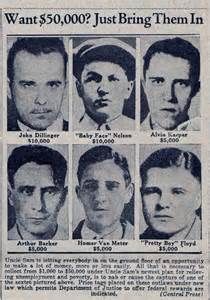
They both had a mole next to one eye and a scar on the left wrist. They lived 54 miles apart, one in Brookville and the other in Mooresville, Indiana. It was said they were practically identical twins. For notorious bank robber John Dillinger, that was no problem. But, for upstanding Ralph Alsman, it was a nightmare. Alsman was arrested 17 times and shot 11 times. When arrested, though he was always released, he had to undergo stressful interrogations in which he had to prove he wasn’t Dillinger. Only when the real Dillinger was gunned down in 1934 did the unbelievable saga end for the hapless Alsman (information taken from The Pittsburgh Press, 6/18/34, p. 11). Can you imagine having to look over your shoulder everywhere you went just because you looked like someone else—a really bad someone else?

The thought occurs to me as I read that harrowing account, based on my attitude, speech, and actions, “Who or what would people mistake me for?” As I live out my life before the world, waiting in lines or in traffic, when under pressure at work, as people mistreat or frustrate me, judging from my relationships, my ethics, and my morality, would people say that I strongly resemble Jesus? He is supposed to be living in me (Gal. 2:20). It has been the case that bystanders have recognized people as having been with Jesus (Acts 4:13). Of course, Scripture does not at all emphasize the physical appearance of Jesus (Isaiah 53:2), but Paul speaks of bearing the marks of Jesus (Gal. 6:17). While his “marks” were literal stripes from a tormentor’s whip, there are unmistakeable traits of Jesus that we, too, can and must bear.

I have so much need and room for improvement in my spiritual life.  Every day, I want to look more like Jesus. I want people to see Him when they look at me. If they do, He will be pleased and they just might be saved. Let’s work on our appearance! It may mean eternal life for somebody in our life.

588ee71ddf6914b974d4e69f24c6b8c8

What Kind Of Church Do We Want To Be?

Neal Pollard

V–ictorious? Faith is the victory that overcomes the world (1 Jn. 5:4). No coach hopes to win without first planning and architecting. The blueprints have already been put in place (Rom. 6:17), but we must work the plans to be a success in God’s eyes!

I–nvolved? Do we want to merely keep house and meet together each week? That is not New Testament Christianity (cf. Acts 2:46). They took Christianity out of the church building’s doors. They were tangibly involved in doing God’s work. Will be be?

S–erving? This is a self-serving world. Many seem intent to climb over whoever is in their way to the top. Jesus’ religion runs contrary to that (John 13:12-17), and He calls us to follow His example. A serving church is a living, thriving, arriving, surviving church.

I–mpactful? Do our neighbors know who we are? What about the surrounding communities? What about the farthest reaches of our world? Don’t you want to be part of a church putting a Christ-sized impression on those around us?

O–bedient? We have one authority (Col. 3:16-17; John 14:1-6; Acts 4:12). There are potential masters, but only one will lead us to heaven. A church that steps outside His “lines” will become eternally out of bounds. Those intent on obeying Him will be saved (Heb. 5:9).

N–urturing? Don’t we want to be part of a people with an infinitely more profound purpose than that found by the patrons and workers portrayed in the old sitcom Cheers? We want everyone to know our name and be glad that we came, but we should also want a place where we can grow in every right, positive way. This must be a church that cares about all, whatever our age, background, interests, income, or education!

A–ble?  Do we want to focus on our liabilities or, through Christ, our limitless resources? We have so much to do, but we’ve been given so much to do it. Don’t we want to be part of a “can do” church, doing with our might what our hands find to do?

R–eaping? If we are a working church, we will see results. They will come through baptisms, programs of work, outreaches, visitation, stronger fellowship, missionary success, and much, much more. As my good friend, Cy Stafford, says, “What God controls, grows.” The law of sowing and reaping is positive, too (Gal. 6:8).

Y–earning? A church that is alive and growing is full of holy desire, enthusiasm, and a confidence that we can do all things through the Christ alive within us (Phil. 4:13). Our greatest desires will be to do spiritual things to the glory of God.

How does a church become a visionary church? We must be intentional! What do we intend to do?  With God’s help, that is up to us!

12642872_1029468160409554_6928711640322573340_n

Misguided Malice

Neal Pollard

I served the Livingston Police Department in Sumter County, Alabama, as a reserve officer for two years. I had a uniform and a badge, though the service I rendered was as chaplain.  The relationship between law enforcement and citizens there was very positive, but I remember talking with officers about the media bias and agenda of liberal politicians they witnessed locally and nationally. This was nearly a quarter century ago, long before the advent of social media and nearly omnipresent camera phones and videos which can be deceptive both for what they show and what they do not. In light of baffling events in Dallas, Texas, and Baton Rouge, Louisiana, in the last few weeks, as well as the inane calls to defund police, it is hard not to think that huge numbers of people have been duped by political rhetoric and a thoughtless mob mentality. While no profession can be completely free of corrupt individuals (who should be found out and prosecuted with full vigor), the existence of law enforcement and peace officers is a vital cog in the wheel of civilization and order in society. Eliminating these agencies is tantamount to removing a fence keeping a pack of bloodthirsty pit bulls from a neighboring playground full of children.

It is a characteristic of worldliness to disdain authority.  The Christian’s attitude and response is to be different. To Christians living in a world with not a fraction of the liberties we enjoy in society today, Paul instructed, “Every person is to be in subjection to the governing authorities. For there is no authority except from God, and those which exist are established by God. Therefore whoever resists authority has opposed the ordinance of God; and they who have opposed will receive condemnation upon themselves. For rulers are not a cause of fear for good behavior, but for evil. Do you want to have no fear of authority? Do what is good and you will have praise from the same; for it is a minister of God to you for good. But if you do what is evil, be afraid; for it does not bear the sword for nothing; for it is a minister of God, an avenger who brings wrath on the one who practices evil. Therefore it is necessary to be in subjection, not only because of wrath, but also for conscience’ sake” (Rom. 13:1-5). There are sobering, inescapable truths here which should be revered by those who are servants of God. God is mentioned five times in these verses, and He is intrinsically tied to earthly authorities. They are from God (1), established by God (1), an ordinance of God (2), and ministers of God (4).

In 2 Timothy 3, Paul tells us the earmarks of difficult times. So many of these traits are evidenced in the growing anarchy of the present day—revilers, unloving, irreconcilable, without self-control, brutal, haters of good, treacherous, and reckless (1-4).  In addition to such attitudes and actions being sinful, they are too often misguided. Police are symbols of law and order, and they are easy targets for those who commit or are effected by lawlessness. It seems that more of our passion and animus should be directed toward criminals and less toward our crime stoppers.

Let us take to heart Peter’s counsel to persecuted Christians and “submit [ourselves] for the Lord’s sake to every human institution, whether to a king as the one in authority, or to governors as sent by him for the punishment of evildoers and the praise of those who do right. For such is the will of God that by doing right [we] may silence the ignorance of foolish men” (1 Pet. 2:13-15). If we can rationalize and argue away this Bible truth, why can we not do the same with any other timeless principle of Scripture? May God help us all to hold tightly to the Light of the Bible, that the world may see how it should respond in this troublesome world.

1185791_10151610389890922_1576500141_n

I Don’t Want To Know!

Neal Pollard

Too often, it’s a great disappointment to learn about the personal lives of politicians, athletes, musicians, actors and actresses, and other professional entertainers. Their public persona and abilities may attract, inspire, and move us, but the aforementioned details are all too sordid. What might look wholesome on closer examination has a very seedy side.  Perhaps this says as much about any of us who place them on a pedestal, but that doesn’t lessen the chagrin.

Hypocrisy is something that can occur among “normal” people like Christians, too. Sadly, we can appear to be one thing around those of “like, precious faith” but have a different side that we show away from them. This is a spiritual malady that can afflict anyone, preachers, elders, deacons, and their families included. It can have such a devastating effect. To think that our poor example could cause a new, a weak, or any other Christian to stumble and fall should fill us with dread.  The precious influence we build by our talents and positions must never be squandered by defects of character or even bowing to pressures in specific circumstances.

Peter preached the first and second recorded gospel sermons. He was an apostle and one of Jesus’ closest friends on earth. Yet, Paul recalls an occasion where Peter succumbed to his flesh and sinned in a way that hurt his influence. In Galatians 2:11-14, Paul says,

But when Cephas came to Antioch, I opposed him to his face,
because he stood condemned. For prior to the coming of certain
men from James, he used to eat with the Gentiles; but when they
came, he began to withdraw and hold himself aloof, fearing the
party of the circumcision.  The rest of the Jews joined him in hypocrisy,
with the result that even Barnabas was carried away by their hypocrisy.
But when I saw that they were not straightforward about the truth of the
gospel, I said to Cephas in the presence of all, “If you, being a Jew, live
like the Gentiles and not like the Jews, how is it that you compel
the Gentiles to live like Jews?

Peter was driven by fear and favoritism. His action was devastating, dragging even “the son of encouragement” to follow his discouraging behavior. Thankfully, Paul loved Peter (and the Lord) enough to challenge the hypocrisy.

Friends, none of us will ever be perfect. We’re continually susceptible to sinful words and deeds. But let us guard against secret, double, or insincere lives knowing that such can totally destroy the faith of those who look to us to show them what Christlikeness looks like. In other words, let us be what we tell others that we are and that they should be. Consistency and integrity are some of the Lord’s most potent tools in our lives to bring others to Him.  Take care of His tools!

SONY DSC

Are We Trampling Upon Romans 14:19?

Neal Pollard

Paul’s words in Romans 14:19 seem to have fallen upon hard times, often among those who are in a position of greater trust and influence. In that particular verse, the apostle is drawing a conclusion about his instructions to Christians, saying, “So then we pursue the things which make for peace and the building up of one another.” We are living at a time where not only is peace not pursued, but strife and division are what are being chased.  We can expect the godless world to be inflammatory, provocative, and disrespectful. We should not expect the precious children of God to interact with each other in this way. Especially through this written medium, here in the information age, we often feel free to make statements we should reasonably expect will upset and divide one another and other onlookers. We may feign shock when the inevitable, virtual fist-fight breaks out, but a few moments of deliberation about the matter would have easily anticipated (and, prayerfully, avoided) it. These words of Paul’s are to presumably mature Christians, sensitive to one who may be “weak” (1) but one who is certainly a “brother” (10). Often, we fixate on the subject matter—“eating meat” or “observing a day”—and on which brother (strong or weak) we are. Those are the illustrations. Beneath the issues, there are timeless principles we must strive to follow.

  • None of us lives for himself, and not one dies for himself (7).  This is the principle of INFLUENCE.
  • We will all stand before the judgment seat of God (10,12). This is the principle of ACCOUNTABILITY.
  • Do not destroy… him for whom Christ died (15b). This is the principle of BROTHERLY LOVE.
  • The kingdom of God is…righteousness and joy and peace in the Holy Spirit (17). This is the principle of SPIRITUALITY.
  • He who in this way serves Christ is acceptable to God and approved by men (18). This is the principle of RIGHTEOUSNESS.
  • Do not tear down the work of God (20). This is the principle of WISDOM.

There are further observations we could make from this context, but these are enough to give us pause to consider (a) what we choose to say which might inflame the sensitivities of others and (b) how we interact with each other in discussing any matter.  What do we hope to gain that we would risk something so precious and valuable to God as a brother or sister in Christ? Do we wish to bring out the best or worst in others.  Let us take care not to slaughter kindness, consideration, gentleness, and brotherly love on the altar of things “which give rise to speculation rather than furthering the administration of God which is by faith” (1 Tim. 1:4) or “worldly and empty chatter” (1 Tim. 6:20).

kindness-boys-on-path