GOD’S WAY TO GET UP AND GO 

Tuesday’s Column: Dale Mail

Dale Pollard

It’s hard to find a better Scripture to serve as a goal or vision statement than Hebrews 10.24. 

Let’s consider how to provoke one another towards love and good deeds.” 

First, notice the verse begins with the key to the beginning of biblical love and good deeds. In a group setting, love and good deeds should be considered together. One person’s dreams and schemes will lack the crucial insight of others. 

Second, consideration implies that putting to practice the love and work of God takes some thoughtful planning. In order for our families and church families to experience God’s love, we’ve got to personalize it for them. In order for us to move on from declaring that love to proving it, the action must stem from observational consideration. The proof of love is in a sacrificial point of good deeds. 

Third, in order to motivate (provoke or spur) people towards these goals, we must experiment. What gets people excited and moving? What gets your people excited and moving? Since all groups and family units have different needs, the motivation methods should be focused on them. It’s all too easy to formulate a strategy and perfect plan, but we’ll never know of any flaws in that plan until others have had the opportunity to communicate their own thoughts. They have knowledge and insight that one person alone lacks. If after careful consideration and prayerful provoking there still isn’t movement, reexamination might be necessary. 

The goal of creating an environment of godly love and work is not a walk in the park, which is why the Hebrew writing records these three steps to success. How much of an impact could we make if we changed, “let’s consider how to spur one another” to “we know what it takes to spur others on.” 

3 Reasons Vacation Bible School Is Worth It!

Tuesday’s Column: Dale Mail

Dale Pollard

This time of the year congregations are planning and preparing for another Vacation Bible School. When and why was this summer tradition started? It seems that even those who aren’t “church goers” still share childhood memories with those of us in the religious world. Across America kids will soon be drinking kool-aid and making Noah’s ark out of Popsicle sticks. They’ll also make memories that will stick with them for their whole lives.

The Hazy History 

 As much as this week means to many of us, one might assume the history to be well documented. However, who started the first VBS and when— is still debated. Some claim it all began in 1870, while others place the date closer to the 1920s. So the “when”’proves to be a little fuzzy, but the “why” seems constant. A thread that can be traced through many a VBS origin story is the reason it’s done. It was always designed with our children’s spiritual growth in mind. The goal was always to provide them wholesome entertainment while at the same time, introducing them to God and the Bible. 

So with that in mind… 

Here are 3 reasons why VBS is a worth the effort: 

  1. Youthful brains need this week. Studies done by Psych INFO, ERIC, MEDLINE, and Google Scholar as well as the University of Virginia library, all seem to agree that kids from 12-18 years old are the most impressionable. Meaning, the things they are taught and their experiences in these years will often impact their worldview for the rest of their lives. Any program within the church that’s geared towards teaching young people about Jesus can only have a positive influence on them. That window is relatively short so it’s crucial that parents do all they can to set them up for spiritual success. 
  2. Church families need this week. VBS takes a lot of work and it’s the kind of work that brings the church together. It’s mainly about the kids, but it’s not all about the kids. This is a time where members have an opportunity to bond and grow closer through the planning and preparation. Work days, crafts, skits, staff/teacher curriculum, decorating, T-shirt’s, and advertising all take teamwork. Team work is good work for good teams. 
  3. Adults need this week. The happiest among us are typically the children. With all of that work, the sweat, tears, and time that’s shoveled into this event— the payoff is the sound of an auditorium filled with energy and excitement. It’s good for adults to spend a week listening to the sound of voices singing loudly and unashamed. It’s good for the teachers and the chaperones to act and look a little ridiculous. There’s value in letting kids see us trade the khakis and neckties for face paint and costumes because it will send a message. To be a christian doesn’t mean to be serious, stoic, or stern— all the time. Those of us who have been members of the church for sometime know this to be true, but children who’s parents don’t think or speak highly of Christianity now have a chance to experience something to the contrary. 

While there might be mixed feelings about VBS within the church, there’s no denying it’s potential to effectively introduce Jesus to the young and young at heart. 

A picture of a Wyoming VBS from several decades ago.

Capitalizing On Visitors

Monday’s Column: Neal At The Cross

pollard

Neal Pollard

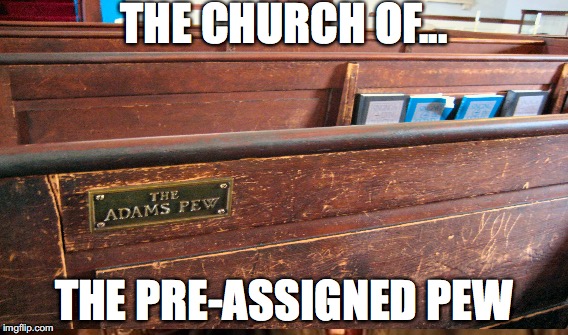
It is a pretty courageous move for someone to make the decision to attend a church they are unfamiliar with full of people they do not know. From the moment they park, they are deciding whether or not this is a one-time deal or the first day of a beautiful relationship. Church growth statistics say that things like the cleanliness and attractiveness of the facilities, the preaching and worship services, and the location of the building are important, but so many of the factors revolve around how members respond to them. Thom Ranier gave a list of 10 reasons why over 1,000 people surveyed never returned a second time. The list included unfriendly church members, no place to get information, bad church website, poor signage, insider church language (not theological terms as much as initials–think CYC, EU, MPR, etc.), and members telling visitors they were in their pew (Source). How can we prepare for, then provide for a great experience for visitors, then make progress with those who “check us out”?

TEST. Evaluate.How are we doing at this? Every single church whose members are asked, “Are you friendly?,” invariably answers “yes.” Most visitors, when asked by poll-takers and surveys, say of a church that they are unfriendly. How could that be? We are more often friendly to those already “part” of the group, but not to people we don’t know. We’re uncomfortable talking to “strangers.” We’re afraid of offending someone who we find out is already a member. We’re unsure of what to say. But, we need a way to evaluate where we are and how to improve. This may be done through something akin to “secret shoppers,” perhaps brethren from far enough away not to be known to local church members who pose as visitors and report their experiences to church leaders. This can be done by QR codes and/or Google forms hosting.a brief survey evaluating their “guest experience.”

TEACH.  What the leadership emphasizes, the membership internalizes. What does Scripture have to say about this vital interaction? James 2:2-4 is the most explicit New Testament passage, warning against personal favoritism with such encounters. But Matthew 4:19 says we’re to be fishers of men, and these are fish who have fallen into our own pond. 1 Timothy 2:3-6 reminds us of God’s feelings toward every “all men” and “all,” which certainly includes those who visit. We are to be “finders” (John 1:40-41), and who is easier to find than one who comes to us. These are just a few passages which should build our conviction to connect with visitors.

TRAIN. We may need help to become more effective at making the most of the visitor’s visit. That includes emphasizing the discipline of simply looking for those who may be new or what to say when inviting someone to come. It includes getting organized, properly utilizing the welcome center, greeters and/or ushers, new member orientation, and all that needs to be implemented and improved to make us intentional with newcomers, first-timers, and returnees. It is really the whole-life mentality that we must incorporate to further this precious relationship.

TIME. In the 1980s, Herb Miller published the statistics that 85% of visitors return if visited in the first 48 hours, 60% if in the first 72 hours, and 15% if visited in the first seven days (Source). Today, that may mean text, email, or call, but even in today’s tech-first world, it’s hard to beat even a brief, friendly face-to-face visit. But, following up quickly is key to success. Taking it to the next level includes building a way for more than elders and preachers (or even deacons) to be the one making contact.

TRANSFORM. What is or should be our interest in visitors? We are trying to move them from the “visitor” column to the “member” column. If they are not New Testament Christians, that means something totally different than if they are “transfers” moving from another location. To transform the relationship, we must inform them. That includes where to go, who we are, what we are doing, etc. That can be in a welcome brochure or packet, or with an attractive, informative web site, or with a key “front man” or “front woman” who connects with them when they come through the door. Ideally it is all of the above. Likewise, to transform the relationship, we must communicate with them. Where’s the bathroom? Where’s their child’s classroom? Why are we taking the Lord’s Supper, singing instead of having a concert, or doing X instead of Y? That can be done in a user-friendly rather than confrontational way that is positive and helpful. The point is, we often assume people understand more than they do. To transform the relationship, we must connect with them. They will need to form at least five connections, according to experts, in order to “stick.” Again, this must be intentional. To transform the relationship with specifically non-Christians, we must study with them. At some point, we must work up the courage, when we know they have not obeyed the gospel, to ask them if they will study the Bible with us. That takes us back to the “training” step because the more of us trained to do that (and the follow up with new Christians), the more we will grow and the better we will transform those who come among us.

Consider this list more of an appetizer than a five-course meal. There’s so much needed to leverage these crucial relationships. This is the easiest opportunity within the Great Commission. These are the “come into all the buildings” rather than “go into all the worlds.” Let’s be good stewards of our visitors. The stewardship principle includes the idea that the better we manage what we are entrusted with, the more opportunities we are given! Let’s make the most of those opportunities (Col. 4:5)!


hospitality-greeter

Made To Be Functional

Wednesday’s Column: “Third’s Words”

Gary III

Gary N. Pollard, III

Ephesians 4 describes some spiritual gifts. Their purpose is to allow the church to function as it should. A properly functioning church spends eternity with God. 

A functional church is on the same page (one mind), has spiritual depth, and is workable (more on that in a bit). 

Ephesians 4.12ff is about members’ roles. What are they for? Everyone serves to equip saints. Saints are people who have pledged allegiance to God. 

We train for morally good works and become stronger through encouragement (12,16). We work toward a unified mindset, knowing Jesus, spiritual maturity, and we pursue the highest standard (Jesus) (13,14). 

We work to avoid immaturity and gullibility (14). We pursue maturity until our mindset emulates Christ’s (15). He’s described (multiple times) as the standard we have to have. There’s no room for spiritual laziness here. 

Jesus causes growth spiritually, but only if we’ve become soil that can be worked. If our minds aren’t mature, we aren’t workable. Elders are spiritual farmers, our hearts are the soil. If we use Jesus as our standard, we are workable. If not, we’re spiritually dead. 

So, what can we do individually? Make the church strong by pursuing unity, by having spiritual depth, and by being workable. If we work on those things we will spend forever with God. 

WHY PLANNING IS POWERFUL

Monday’s Column: Neal At The Cross


Neal Pollard

  • It forces us to focus. So often, churches just “do stuff.” We don’t ask who, what, where, when, or how. We don’t ask if the thing is effective, evangelistic, edifying, or empowering. Is it outmoded? Is it merely self-serving? Can it be improved? Planning clarifies. 
  • It makes us intentional. Whether we are looking at what is currently done or what should be done, planning makes us deliberate. Especially is this true when we consider whether or not the activity, program, or work is merely internally-focused (for us) or externally-focused (for lost souls). Do we plan to grow? Reach a tangible number of people each year? Increase the depth of our footprint in the community? If so, how? Specifically how? 
  • It says that leadership is thoughtful. Planning takes precious man hours from the leadership, but how it pays off! Personal analysis, congregational analysis, and biblical analysis require thought. Done well, it will build conviction that doctrine is never to be tampered with, but that methods and means in harmony with Scripture require judgment, discrimination, and scrutiny. Putting thought into the church’s works and needs is Acts 20:28 in motion.
  • It combats chaos. So often, a church’s works lack cohesion and coordination. There are no filters in place to ask if an individual work fits with the church’s vision and mission. Works may be good, but who knows what goes on with them or if they are working. Who is accountable? To whom are they accountable?
  • It expresses discontent with the status quo. It is easy to continue with works, programs, and activities that are already in place and have people managing and executing them. But, most of our methods and means of doing church work need to be evaluated regularly to ask if changes are needed. Change brings discomfort and takes work, but as our resources change–time, talent, treasure–we may find that we are more or less able to engage in the various works of the church. We should always be looking for more and better ways to serve and glorify God. 
  • It is biblical. Jesus had a tangible plan for world evangelism (Acts 1:8). Paul had a tangible plan for growing the church through the missionary journeys (Acts 15:36ff). Look at how 1 Timothy reflects and requires planning to help the Ephesus church (1 Tim. 3:15). Paul had a tangible plan for establishing elders in congregations throughout the island of Crete (Ti. 1:5ff). Something that was in God’s mind in the eternity before time (Eph. 3:9-11) deserves our best effort, using our brightest minds to find biblical ways that are most effective to grow and strengthen it! 

Goals, dreams, intentions, and ideas will not, by themselves, accomplish anything. We must work to make those things a reality. But, a crucial first step is to articulate where we want to go. That makes planning so powerful! 

“First, Sit Down…”

Screen Shot 2019-12-21 at 9.08.51 AM
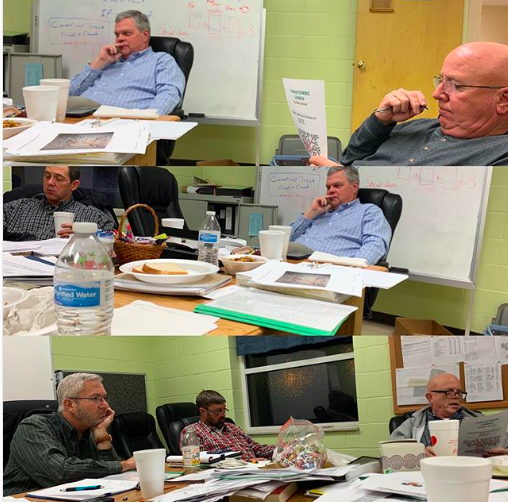
Not pictured: Riley, who was under the weather. 

Neal Pollard

In Luke 14, Jesus gives a couple of short parables about counting the cost of discipleship. He prefaces them by saying, “If anyone comes to Me, and does not hate his own father and mother and wife and children and brothers and sisters, yes, and even his own life, he cannot be My disciple. Whoever does not carry his own cross and come after Me cannot be my disciple” (26-27). If we drink deeply of this statement, we see exactly how challenging it is. The choice is always between Jesus and everything and everyone else. How badly do we want what only Jesus can give? Think hard, then decide!

Then come the parables. The first is a construction parable, of one building a tower. He first sits down and calculates the cost in order to be able to finish and avoid ridicule (28-30). The second is a military parable, of a king going into battle. He first sits down and considers whether or not he can win (31-32). The common denominator in both parables is to first sit down and deliberate. Ultimately, there is action which follows, but the planning precedes it.

In how many congregations do elderships or men in the absence of elders never get proactive and formulate a plan for the immediate, intermediate, and far off future? Leadership must cast the vision and deliberate about where that congregation is going and how it will get there. What will be done to grow? How can we get more members active? How can we best utilize the collective resources of the congregation? The Bible reveals all the answers, but it is essential for the church’s leaders to gather around the drawing board.

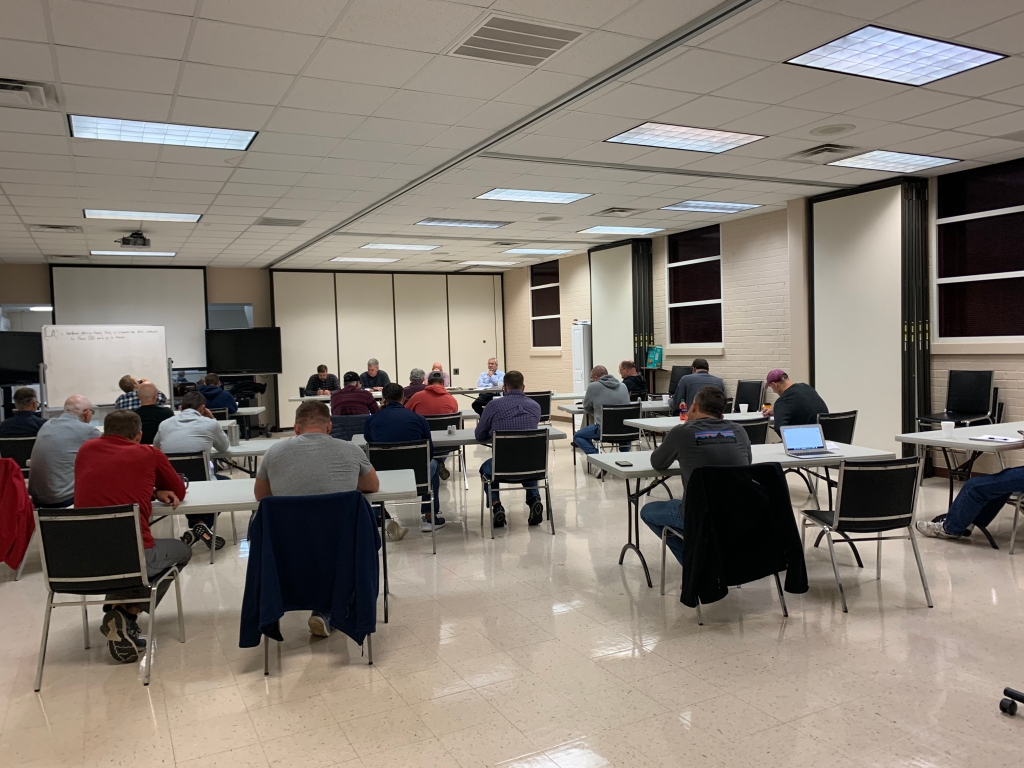
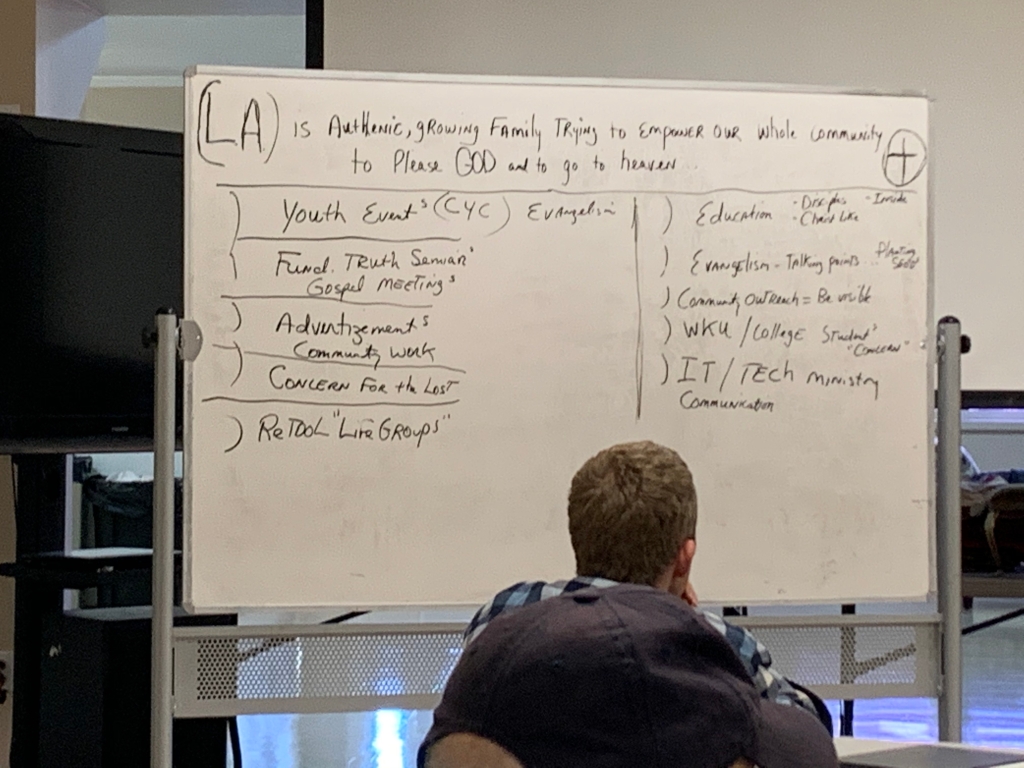
It was exciting to spend a few hours at the Lehman elders’ 2019 retreat to discuss the short-term plans of the congregation. These men are convicted about the stewardship of the work they eagerly consented to do as our shepherds. They want us to be more effective, but they are determined to set the tone and example for us. I’m amazed at how deeply they care about us and the growth they want us to collectively experience. Words like emphasis, accountability, and purpose continually came up. Building a biblical culture, which works against our contemporary culture of consumers rather than producers, is foremost in their minds. They desire for us to “grow together” as a church, drawing those outside of Christ to our spiritual family.

I cannot wait to see what God will do through such capable leaders in 2020 and beyond. We are blessed with such godly, conscientious elders. Please don’t miss a day praying for Russell, Riley, Kevin, John, Darrell, and Bobby and their families. Also, please never miss an opportunity to express your love, encouragement, and support of them as they strive to do their best to fulfill their God-given duty. Or, as Paul put it, “But we request of you, brethren, that you appreciate those who diligently labor among you, and have charge over you in the Lord and give you instruction, and that you esteem them very highly in love because of their work. Live in peace with one another” (1 Th. 5:11-12). 

They are first sitting down this weekend, but then they will challenge us all to “rise up and build” (cf. Neh. 2:18). 

Be Dependable!

Neal Pollard

One of the hamstrings of most every church is a lack of dependable Christians. When Christians do show themselves undependable, they contribute so much to a church—much frustration, disappointment, and friction. We should all be dependable. You probably know little about Shelemiah, Zadok, Pedaiah and Hanon.  Little is said about them. But listen to what is said.  They were placed in charge of the storehouses because “they were considered reliable” (Neh. 13:13).

What a glowing epitaph. One the other hand, David wrote of some wicked individuals, of whom he said, “There is nothing reliable in what they say” (Psa. 5:9). Too many otherwise good people are leaving such a reputation for themselves. In frustration, sometimes elders may join Solomon in asking, “Who can find a trustworthy man?” (Prov. 20:6). But, good news!  We can all be dependable.  Why?

First, we are ABLE. God blesses us with talents, time, and treasure. With them, we can (as good stewards) use our resources to God’s glory. If something hinders us from doing our duty, we can let others know and cover for us. But, whenever and wherever and however we can, we use ourselves as workers in the kingdom (Mat. 9:37).

Second, we are DEPENDENT. God pours blessings into our lives (Eph. 1:3; Js. 1:17). Without Him, we are nobody! Except God provided all our needs, we would be nowhere and have nothing. We are obligated, and our best efforts could never earn or repay God’s graciousness (Lk. 17:10). But, surely, appreciating His grace, we will be workmen (Eph. 2:8-10). When needs are made known by our elders or other church members—food or teachers or folks to visit or calls to make or new Christians to aid or missions to encourage or elderly, shut-ins to help—let us remember our dependence upon God and be dependable for those dependent folks around us.

Finally, you are thereby DEEPENED. When we do what we can in the kingdom, giving it our best, we are enriched and strengthened thereby. Our relationship with Christ is deepened, for we are imitating Him. Our appreciation for God’s blessings is deepened when we sacrifice and extend ourselves. Our faith is deepened by our interaction with those in need and by our participation in what needs doing. Our joy is deepened by being active and involved in the Lord’s work.

One song in our song book asks, “Can he depend on you?” If He has no hands but our hands to do His work today, shall we allow our hands to sit idle? Christianity is a commitment. It’s a wonderful commitment, but commitment nonetheless. Let us take it seriously and be a brother or sister upon whom our brethren and our God can rely!

800px-the_truesdell_bridge_collapse2c_view_from_the_south

“You’ll End Up Naming Everybody On The Team”

1280px-walter_johnson_and_calvin_coolidge_shake_hands_final

Neal Pollard

Quirky closer (a redundant statement) Sean Doolittle was interviewed last week right after the Washington Nationals clinched the city’s first trip to the World Series since FDR was first inaugurated there. Asked how they did it, Doolittle said, “I think once you start naming guys that stepped up in different ways, you’ll end up naming everybody on the team. We got so many contributions from different guys who had to embrace new roles. There are so many examples of that up and down this team” (MLB.COM). That’s frequently the testimonial of winners. It takes everybody pitching in and doing their part, All-Stars or role players, starters or reserves, veterans or rookies. However you distinguish between them, each person must step up and successful teams do just that!

Have you thought about how the church was designed to be that way? Congregations successful in executing the mission of Jesus are filled with members who step up in different ways, make contributions, embrace new roles, and exemplify team spirit. Paul tells us that “we are to grow up in every way into him who is the head, into Christ, from whom the whole body, joined and held together by every joint with which it is equipped, when each part is working properly, makes the body grow so that it builds itself up in love” (Eph. 4:15-16). Notice the all-inclusive wording of Paul, pointing out what Jesus desires for His church. “Grow up in every way…” “From whom the whole body….” “Held together by every joint….” “When each part is working properly….”

God expects each of us to step forward, using our talents, opportunities, financial blessings, influence, time, energy, and intellect to reach lost souls, strengthen the church, and meet needs. A church filled with people stepping up and embracing Christ’s mission will stand out in a community and glorify God. We will grow and be built up. 

In 1895, Vilfredo Pareto observed that society divided into what he called the “vital few” and the “trivial many.” There is a top 20% and a bottom 80%. From such a genesis, we ultimately got the 80/20 rule, that 20% of the people in an organization do 80% of the work (Explained here: FORBES.COM). Maybe, we’ve heard that so much that we’ve just resigned ourselves to it being a universal truth. Do not be content until you discuss the growth and work of this church, and by the time you’re done “you’ll end up naming everybody on the team.” That’s the goal! Let’s pursue it!


“Hello, My Name Is Roger Johnson”

Neal Pollard

Yesterday morning, I learned how much of a sense of humor the Lehman Avenue church members have. I prefaced my sermon by sharing a great tip a fellow-preacher passed along to me last week. He told the folks at his new work, “Please introduce yourself by name until I greet you by name when I see you.” So, I decided to give an example, saying, “Every time you introduce yourself, say, ‘Hi, Neal, I’m Roger Johnson (if that is your name)…” Well, that helped me ferret out some of Lehman’s finest comedians. Did you know there are 15 or 20 Roger Johnsons here (except that the guy I thought was Roger introduced himself as “Frank Sinatra” after church). But, everyone was upstaged by young Kamdyn Depp. Kamdyn came up to me right before evening worship, promptly shaking my hand and saying, “Hello, my name is Roger Johnson.” She deadpanned it perfectly, and it took me a while to stop laughing.

Kamdyn may never know how much it meant to me that she did that. First, it meant she was listening to my sermon. Second, as I found out it was her own idea, it meant that I meant enough to her for her to take the time to come tease me (side note: my mom used to tell me that people only tease you if they like you). It told me she was thinking about me. Third, it meant she was willing to engage me. We don’t know each other very well yet (though last night was a great head start), but she took the initiative.

Much talk is made of being a friendly church and how important that is to church growth and evangelism. All of us should take a page from Kamdyn’s playbook. Pay attention to people. Care about them. Don’t be afraid to engage them. You may quickly forget your act, but the recipient won’t!  We will have visitors at most of our assemblies. Your taking just a moment of time with someone might be the first seed that germinates in such a way that he or she ultimately is in heaven. It’s that big of a deal! So, go on up to that new person, smile, look them in the eye, and introduce yourself, but it’s probably best if you use your real name. Even if it isn’t Roger Johnson!

64811583_10214910701869510_838670885136105472_n
This is NOT Roger Johnson

Dark Churches

Neal Pollard

I was intrigued by an article written by Janet Thompson of crosswalk.com. The eye-catching title asked, “Why Is The Church Going Dark?” She meant this literally. Her complaint was about the design of many auditoriums having dim lighting and being windowless, almost like a movie theatre or concert venue. She wondered if this was to reach a younger generation or to set a certain mood. 

While I prefer a well-lit room, there is a more significant concern. Jesus taught, “You are the light of the world. A city set on a hill cannot be hidden; nor does anyone light a lamp and put it under a basket, but on the lampstand, and it gives light to all who are in the house. Let your light shine before men in such a way that they may see your good works, and glorify your Father who is in heaven” (Mat. 5:14-16). His words have nothing to do with church building designs, LED lighting, or window sizes. Preaching to His disciples, Jesus wants us to know that those reflecting His light cannot be hidden, but shine in such a way that others will see our good works and glorify God. 

  • Dark churches are situated in neighborhoods that know nothing about them.
  • Dark churches are so indistinct that the world can see no difference between themselves and those churches. 
  • Dark churches have no vision or plan to fulfill God’s purpose for them.
  • Dark churches exist to assemble, but not much more.
  • Dark churches focus inwardly, but neither outwardly nor upwardly. 
  • Dark churches operate from fear and prefer the safe route, taking no risks and attempting only what they can produce.
  • Dark churches are disconnected from the Light of the world.

It is good for us to constantly challenge ourselves, when setting budgets, making plans, gauging our true priorities, or evaluating the leadership or the pulpit. Are we doing what will help us be “Light-Bearers” or what will cause us to be “Dark Churches”? What an important question! Our actions determine the answer. 

dark churches

Satan’s Schemes

Neal Pollard

Paul makes an interesting statement while addressing the successful effort the Corinthian church made in disciplining an erring brother along with the successful outcome of his having repented. He urges them to show him love, comfort, and forgiveness. The bottom line Paul gives for the urgency of their obedience is “so that no advantage would be taken of us by Satan, for we are not ignorant of his schemes” (2 Cor. 2:11). Back in the first letter, the church’s attitude and actions regarding a brother needing discipline was horrible, and Paul commanded them to act (1 Cor. 5). Here, they have acted and their efforts worked. They were in a prime position to grow and thrive. Yet, Paul reminds them of Satan’s motivation (to take advantage of us) and means (his schemes). 

But, when does Satan like to try and employ his schemes and take advantage of us? When we aren’t being sober and vigilant (1 Pet. 5:8). When we aren’t focused on resisting him (Jas. 4:7). When we aren’t standing firm in the Lord or against his schemes (Eph. 6:10ff). When we aren’t exercising self-control (1 Cor. 7:5). If you study those contexts and others that mention Satan more closely, you will see that he would like to take advantage of us in good times and bad times. He may be at work through the willing choices, words, and actions of people who unwittingly aid his cause through their sins. 

When might he seek to employ his schemes?

  • When new elders are appointed
  • During building programs
  • As numbers swell through baptisms and families placing membership
  • When preachers come and go
  • In a flurry of exciting activities
  • In the heart of some church problem or struggle
  • At the center of some personality struggle or conflict within the congregation
  • Through some controversial doctrinal, moral, or even cultural issue
  • When brethren put politics, race, or another issue of lesser importance over Christ and His church

Obviously, there are many more examples. The point is that Satan would love to use the good times or bad times we experience as a church to undermine and harm the work of the Lord. That should not make us paranoid, so paralyzed by fear that we refuse to act, or petrified to make needed changes. It does mean that we must not be ignorant of the fact that he doesn’t want the church to grow or move forward, and he will do what he can to stop it. What is so exciting is that he stands no chance against God. James says, “Submit therefore to God. Resist the devil and he will flee from you” (4:7). Let us never be afraid to “dare and do” for God. We can do great things for Him and keep an eye out for the devil’s schemes.

25073405_10155181501925922_4154416753663879067_o
Picture from my last trip to Ngorogoro Crater, Tanzania, 12/17.

I-N-V-O-L-V-E-M-E-N-T Equals Church Growth

Neal Pollard

The early church grew (Acts 2:41; 5:14; 6:1,7; 9:31; 11:24). As we read of this growth explosion, we see the key role member involvement played. Christians were spreading the word (8:4), involved in each other’s lives and in the lives of the lost around them. This is such a simple concept, but churches not practicing it are not growing. What is involved in involvement?

  • I–“I” am the heart of involvement. I must resolve to be involved. I must do my part, for I will give an account for my level or lack of involvement (1 Cor. 3:8).
  • N–“Negativity” is the enemy of involvement. “I can’t help.” “It won’t do any good.” “I don’t like working with that person.” Listen closely. Involved Christians rather say “I can do” (Phil. 4:13) and “we are well able” (Num. 13:30).
  • V– “Visitation” is a part of involvement. Matthew 25:34-46 confirms it. Non-Christian visitors, sick, imprisoned, and needy folks need it. Those who do it are richly rewarded, and those who are recipients of it profoundly appreciate it.
  • O– “Obedience” is the cause of involvement. Faithful Christians believe the commands to make disciples (Mat. 28:19), build up brethren (Rom. 14:19), and meet needs (Js. 1:27).
  • L– “Love” is the motive of involvement. Paul says good deeds, without love, are profitless (1 Cor. 13:1-3). The counsel of Scripture is “by love serve one another” (Gal. 5:13).
  • V– “Victory” is the goal of involvement. By being involved, we help others win the victory (Js. 5:19-20), we help the cause of Christ advance, and we aid our own walk in the light that leads to eternal reward (1 Jn. 1:7).
  • E– “Everybody” is the scope of involvement. What able-bodied Christian is excluded from the work God has given the church? Once, a man did nothing and gave every excuse imaginable. We remember how that turned out (Mat. 25:28-30).
  • M– “More” is the adjective of involvement. That is, “more involved” and “more people involved.” Has there ever been a church with too many involved? God is able to do more than we ask or imagine (Eph. 3:20), and He wants to see us always trying to do more for Him!
  • E– “Evangelism” is the fruit of involvement. Active churches attract the curiosity of the community. Those involved in the church’s work naturally grow more spiritual-minded, and by this grow more bold in sharing the gospel.
  • N– “Now” is the time for involvement. What in our lives do we definitely know will change between now and the never-seen tomorrow (Prov. 27:1)? Let’s kill the excuses! Resurrect the enthusiasm! Start today!
  • T–“Teamwork” is the mindset of involvement. We’re to work together. No one man, no staff, no eldership, no group of deacons or others can or should do the work of an entire congregation. The local church is a team.

To become adequately involved, let’s ask three questions.

“What needs doing in this church?”
“Who needs help in doing it?”
“What can I do?”

Be an Isaiah, a child of God who enthusiastically says, “Here am I, send me” (Isa. 6:8)!

41824748_10216815660249540_2034412809957146624_n

I Met A Soul Today (POEM)

Neal Pollard

A lonely soul was crying out
For someone to direct
Their mind to know the will of God
But I chose to deflect.

An edgy soul was acting out
Intimidating and coarse
Yet they were searching for the truth
I recoiled with too little remorse.

A hopeful soul was reaching out
And attended our worship service
But I was busy, too much to do
To connect, plus I was nervous.

A hurting soul, in time of loss
Crossed my path today
I felt so bad that he was grieved
But still I hurried on my way.

A lost soul was needing Christ
She is destined for eternity
I was busy, nervous, no zeal for her
Guess I was too caught up in me

The next soul that I come upon
Lord, may I try with zeal
To share your grace and teach your Word
And your matchless love reveal.

a20cold20day2015

Going Places (GUEST BAKER: Trent Woolley)

Trent Woolley

The other day I stumbled upon this rather innocuous quote – “Once a year, go someplace you’ve never been before” (Life’s Little Instruction Book).  Obviously, this quote is talking about travel, but I would like us to think of it as challenging ourselves to do things that we may have never done before. So, let’s take a look at some things that might help us, as a church, go places that we may have never been before:

  •   Volunteer to teach a class, or help teach a class, or help teach others how to teach a class
  •   Offer to pick-up someone who needs a ride to church
  •   Spend a month at the greeting table getting to know our visitors
  •   Prepare and present a 90 Seconds of Power
  •   Pray with an elder
  •   Commit to visit all the shut-ins this year
  •   Write a note of encouragement to all our members whose last name begins with R,
  •    or M, or C…
  •   Host a devotional for: the teens, the young professionals, the young families, the
    tweeners, the seniors
  •   Teach the congregation a new song, or an old song we don’t know
  •   Stand at one of the doors and greet everyone who comes in

    This is just a short list of some places we might have never been before, I’m sure
    there are other places that we all would like to try and go to.

    And if we start to think “I can’t do that”, let me remind us of what God tells us in Joshua 1:9: “Have I not commanded, you? Be strong and courageous. Do not be frightened, and do not be dismayed, for the LORD your God is with you wherever you go.”

night-camera-lens-map


The Best Thing To Do For The Body This Year

Neal Pollard

When it comes to caring for the physical body, I have a lot to learn. While I work out nearly day, my most developed muscle is the table one. I will be working to use that muscle far less this year. But judging from all the new faces in the gym this morning, there are a lot of people who are going to be exercising their bodies who haven’t been doing so—at least for the next few days or weeks.

When it comes to caring for the spiritual body of Christ, I have even more to learn. Helping the church grow, develop, and fulfill its purpose better is a challenge that grows more daunting with each new year as our culture changes, our own distractions mount, and our sight is so easily eclipsed by the influence of this world. With that in mind, there is something we can do for His body that will give it its best opportunity to please God.  It centers around what we do with the Bible, as a church.

We must have confidence that God’s Word will give us what we need to have to be what we need to be. Through such, we will be “nourished on the words of the faith and of the sound doctrine” (1 Tim. 4:6). It takes the Word to cause “the growth of the body for the building up of itself in love” (Eph. 4:16). Isn’t this what Paul is also saying to Colosse, when he urges them to hold fast to the head so that the body would grow “with a growth which is from God”? (Col. 2:19).  We cannot hope to strengthen and protect Christ’s spiritual body locally without consulting the training manual of the Great Physician.  Let’s make that specific and practical:

  • Preachers must lovingly preach even the difficult subjects (i.e., God’s law of marriage, divorce, and remarriage, the distinct plan of salvation, the undenominational, singular nature of the New Testament church, God’s sexual ethics, the role of men and women, God’s pattern of worship, personal purity, etc.) and be a living example of the believer as their ethic is driven by that Word.
  • Elders must shepherd guided by the infallible Word and not with personal favoritism, deciding solely on popularity or what the majority favors, bending to political correctness, fear of offending influential members, and the like.
  • Deacons must function in a way that shows discipline, dedication, devotion, and discretion which is shaped and guided by the New Testament pattern for their works.
  • Members must follow with love, esteem, and cooperation when their leaders urge them to follow God’s truth, even if it’s distasteful to us or challenges our comfort and complacency.
  • Individual Christians must discipline their hearts and minds to be open and submissive to what they encounter in Scripture rather than be defensive and rebellious.
  • Families must dedicate themselves to studying and honoring the Word at home, in their daily lives, to grow and mature in the Words of truth.
  • Each of us must see the mandate to save souls, repeated throughout the New Testament, as a personal responsibility for which God holds us all accountable.

Isn’t it exciting to think about how much stronger the body of Christ where we are might be this time next year? If each of us will allow God’s inspired word to be the beacon and guide of our lives, His body is going to be powerful, noticeable, and desirable. We will draw men to Christ. We will be the picture of spiritual health. As you make your resolutions, won’t you determine to let the Word of Christ richly dwell within you (Col. 3:16).

Working out

Dying Villages (And Dying Churches)

Neal Pollard

Liza Zhakova and Dima Zharov have written an extensive expose of a phenomenon I was totally unaware of—the depopulation of villages throughout the Kostroma region northeast of Moscow, Russia. 200 villages have been abandoned and 20,000 villages have faded away, a remarkable, mystifying fact for a vast region—it counts merely “660,000 residents for its 23,000 square miles” (source). Factors contributing to this include “low living standards, high unemployment, and a lack of housing and public services” (ibid.).  The ones who have remained are an odd assortment who either prefer isolation or cannot see another way.

Appreciation for salvation, the power of the gospel and the beautiful simplicity of the restoration plea, the exalted mission of the church, and much more should cause the church to spread and grow across the nation and throughout the world despite the opposition of the darkest forces against it. But, especially in America, the statistics show a decline in total number of members even as the nation’s population rises. Last Spring, Christian Chronicle reported that over 100,000 fewer souls were members of the church in 2015 than in 1990 (source). The United States’ net population increase over that period was 70 million (source). My experience in visiting churches in various parts of the country and in visiting with brethren from all over is that most churches are not experiencing growth. Some have seen an increase in attendance, almost always as the result of transfer from other congregations (over doctrinal issues, lack of resources and activities, or even churches that have to close their doors). But instances of churches that are taking the gospel into their communities and winning souls should, per the factors cited above, have us growing like wildfire.  In especially “mission fields” and rural areas, the church is often fighting for survival. My parents and brother, for example, work in a ministry called Carolina Outreach. Through their exposure to churches in the Carolinas, they witness and work with tiny congregations fighting to keep their doors open. They lack funds and workers to get the gospel to the souls in need of the truth in that part of this nation. I have spent over 20 years as a local preacher in states that are typically considered a mission field, outside of the traditional “Bible Belt” (i.e., Virginia and Colorado). In these and surrounding states, I have been saddened to hear about churches closing their doors or simply fighting just to “keep their doors open.”

As the Lord looks down at these shrinking parts of His glorious body, His heart must be breaking. Yet, He gave us the blueprint to address this problem and to reverse this trend when He gave us the New Testament. It is not more vibrant youth programs. These are wonderful and beneficial, but many of us faithful to Christ today grew up in small churches with virtually non-existent youth programs (including Kathy and me). It is not big, beautiful buildings. These can at times cause more problems than not. It is not extremism, whether to the right or the left. Building on the foundation of man is sand (Mat. 7:24-27). It is a resource available to everyone, in rural and urban areas, in depressed or booming economies, in north, south, east or west. In a word, it is “commitment.” The first commentary on the first church begins, “They were continually devoting themselves…” (Acts 2:42). Christianity meant everything to them in their daily lives. They were dedicated to seeking the lost, dedicated to helping each other, dedicated to following their Lord and Savior. They were dedicated in prosperous and perilous times. Their living hope was so strong (1 Pet. 1:3), they persisted even in dire persecution (see the rest of 1 Peter).

What a challenge this is to me. My dedication and commitment has room to grow. My complacency and apathy must decrease and His importance in my life must increase. If the church all over catches hold of this, the familiar phenomenon of “dying churches” will be a bad memory. May God grant us the strength and courage to reverse this tragic trend. May it begin with me!

zhakovazharovdesert-16

What Would Our Slogan Be?

Neal Pollard

A Bear Valley member gave me a mailer she received from a new, area denomination.  The oversized postcard, in attractive colors (the background of which looks to be a paint palette), leads with the header, “Messy Grace.” The subtitle reads, “It’s okay to not be okay.” The brief message beneath says, “God loves you. God cares for you. God wants a relationship with you. NO MATTER WHAT!”  Now, there is a lot of truth in that message, if we don’t necessarily care for some of the jargon. Could it leave a wrong impression? Yes, if the message does not include the response we need to make to His amazing grace. We cannot stay messy, if that means willful sin. But we will all continue to have our messes, even after coming to Him.

But, the mailer itself, with the self-appointed slogan, is what got me to thinking. If our visitors got to write our slogan, what would it be? For some places I’ve visited, it could be the following: “Don’t Sit On My Pew!”, “Race You To The Restaurants!”, “Visitors? What Visitors?”, “Joy Is For Liberals”, or “Are You Ready To Rumble?”  If the Lord wrote our slogan, what would it be?  For some congregations He diagnosed, it was also less than flattering: “We’ve Left Our First Love” (Rev. 2:5), “We’re Following False Teachers” (Rev. 2:14-16), “We Tolerate Immorality” (Rev. 2:20ff), “We Look Alive, But We’re Really Dead” (Rev. 3:1), and “We Think We’re Something Great, But We’re In Really Bad Shape” (Rev. 3:15ff).

Here at Bear Valley, there are several potential slogans I would hope represent who we are and what we are trying to convey by the way we act when we’re together on Sunday and Wednesday as well as our interaction at other times. Here are some good options:

  • “We Love One Another” (John 13:35).
  • “We Walk In Truth” (3 John 4).
  • “We Continue In His Word” (John 8:31).
  • “We Bear One Another’s Burdens” (Gal. 6:2).
  • “We Like Being Together” (Acts 2:42ff).
  • “We Look For Our Lost Sheep” (Luke 15:4).
  • “We Know Who The Enemy Is” (Eph. 6:11).
  • “We’re Not Conformed But Transformed” (Rom. 12:2).
  • “We Put Others Before Self” (Phil. 2:3-4).
  • “We Act Toward Others As If Doing For Christ” (Mat. 25:40).

The thing is, we are going to have a general character and emphasis as a congregation. Whatever we prioritize and do, that’s what it is. It’s not what we say, sing, or “sloganize.” To see it in print is sobering. May we collectively strive to earn a reputation that reveres our Master, reflects our mission, and renews our minds.

1akxyz

What Kind Of Church Do We Want To Be?

Neal Pollard

V–ictorious? Faith is the victory that overcomes the world (1 Jn. 5:4). No coach hopes to win without first planning and architecting. The blueprints have already been put in place (Rom. 6:17), but we must work the plans to be a success in God’s eyes!

I–nvolved? Do we want to merely keep house and meet together each week? That is not New Testament Christianity (cf. Acts 2:46). They took Christianity out of the church building’s doors. They were tangibly involved in doing God’s work. Will be be?

S–erving? This is a self-serving world. Many seem intent to climb over whoever is in their way to the top. Jesus’ religion runs contrary to that (John 13:12-17), and He calls us to follow His example. A serving church is a living, thriving, arriving, surviving church.

I–mpactful? Do our neighbors know who we are? What about the surrounding communities? What about the farthest reaches of our world? Don’t you want to be part of a church putting a Christ-sized impression on those around us?

O–bedient? We have one authority (Col. 3:16-17; John 14:1-6; Acts 4:12). There are potential masters, but only one will lead us to heaven. A church that steps outside His “lines” will become eternally out of bounds. Those intent on obeying Him will be saved (Heb. 5:9).

N–urturing? Don’t we want to be part of a people with an infinitely more profound purpose than that found by the patrons and workers portrayed in the old sitcom Cheers? We want everyone to know our name and be glad that we came, but we should also want a place where we can grow in every right, positive way. This must be a church that cares about all, whatever our age, background, interests, income, or education!

A–ble?  Do we want to focus on our liabilities or, through Christ, our limitless resources? We have so much to do, but we’ve been given so much to do it. Don’t we want to be part of a “can do” church, doing with our might what our hands find to do?

R–eaping? If we are a working church, we will see results. They will come through baptisms, programs of work, outreaches, visitation, stronger fellowship, missionary success, and much, much more. As my good friend, Cy Stafford, says, “What God controls, grows.” The law of sowing and reaping is positive, too (Gal. 6:8).

Y–earning? A church that is alive and growing is full of holy desire, enthusiasm, and a confidence that we can do all things through the Christ alive within us (Phil. 4:13). Our greatest desires will be to do spiritual things to the glory of God.

How does a church become a visionary church? We must be intentional! What do we intend to do?  With God’s help, that is up to us!

12642872_1029468160409554_6928711640322573340_n

Would Jesus Scrub Grape Juice Stains?

Neal Pollard

Bob Russell tells the story of Dwight Day, a UPS pilot who had come back to church after many years away. Russell walked into the auditorium one day to catch Day scrubbing grape juice stains off the pews. This pilot was an important man with sufficient money to hire someone to do the job, but there he was scrubbing. He “wasn’t too important to clean the pews” (When God Builds A Church, 178).

Who visits the elderly members in the nursing home? Who participates in the workday? Who takes the poor, ill member to a doctor’s appointment? Who prepares the communion? Who teaches the cradle roll class? Who grades the correspondence courses? Who gives a lift to someone who needs a ride to church? Who does the many “invisible,” thankless tasks that must be done for the church to grow and meet its many responsibilities? The servant!

The serving Christian is not necessarily the one-talent, lower-class, uneducated person ill-equipped to do something more “sophisticated” and “important.” These are the kinds of things anyone can do, but only the servant does them. Lest we consider such tasks too menial and such people meaningless, we reflect on John 13. That chapter records the all-knowing, all-powerful Creator of the universe (you can’t one-up that) pouring water into a basin, washing the disciples’ feet and drying them with a towel he had put around Himself (v. 5). They had to have been baffled, this group who had been jockeying for a seat on His left and right hand in the vision of Kingdom greatness they had imagined (cf. Mat. 20:21). What were they thinking as Jesus tells them, “Do you know what I have done to you? You call Me Teacher and Lord; and you are right, for so I am. If I then, the Lord and the Teacher, washed your feet, you also ought to wash one another’s feet. For I gave you an example that you also should do as I did to you. Truly, truly, I say to you, a slave is not greater than his master, nor is one who is sent greater than the one who sent him. If you know these things, you are blessed if you do them.” (12b-17).

This was a gut-punch to them and to so many of us. We can be more interested in getting the good seat than stooping to wash the dirty foot (or scrub the grape juice-stained pew). But we will miss the heavenly definition of spiritual greatness unless we lower ourselves. Jesus told the Sons of Thunder and their mother to remove the worldly gauging of greatness out of their thinking (Mat. 20:25-28). Perhaps He’d have that conversation with you and me, too. May God grant us the humility to see the opportunities and serve as stain scrubbers and every other, similar task that allows Him to use us for His glory. If that spirit permeates a congregation, it will turn the whole world upside down (cf. Acts 17:6)!

broom_sponge_and_towel

What It Takes To Grow The Church In Our Culture

Neal Pollard

It was such a treat to be among the hearty, faithful Christian men of central Wyoming and the Bighorn Basin. By Bible-belt comparison, they come from small congregations. But their passion and desire to grow the church is humongous. Near the end of their men’s retreat, they divided into groups to discuss the obstacles to growth and suggestions for growth. What they came up with was incredibly insightful, helpful to especially anyone living in the current, western culture.

Among the obstacles they listed were:

  • Lack of commitment
  • Fear
  • Political correctness
  • Biblical ignorance
  • Sin
  • Apathy/indifference
  • Misplaced priorities
  • Lack of adequate leadership

For those in Alabama, Oklahoma, and California who would say, “Those are our obstacles!”, isn’t it interesting how common our struggle is.  The same factors are holding back our growth all over the nation.

Yet, I love the suggestions they came up with. I think they are key to tapping into our growth potential throughout the country and, to a great extent, throughout the world. They suggested the following:

  • Increase fellowship—The key to growth is being in each others’ lives more
  • Emphasize and empower Bible study—There can be no spiritual or numerical growth without growing our knowledge and understanding of God’s Word
  • Think outside the box—Staying faithful to truth, get out of method ruts and overcome fear of rejecting a different, scriptural method just because it is new
  • Challenge greater application of biblical truth—Every class and sermon must have a viable “so what”
  • Be intentional in our relationships—Realize that our jobs, community involvements, friendships, etc., are means to an end rather than an end of themselves. They all exist as opportunities to evangelize.

Our brethren in the deep south, the north, the Atlantic region, the upper midwest, the southwest, the far west, the northwest, and, in short, any recognizable region of the country share a desire to be relevant and meaningful in our communities. We want to honor Christ and grow His body. But it will take measurable steps. It won’t happen incidentally! We must act on our hopes and desires. We must personally engage ourselves in enacting these suggestions daily! In so doing, we’ll not only avoid being part of the problem but we’ll be part of the solution.

13118907_10153650222335922_7374883366678402046_n