God’s “House-Law”

Wednesday’s Column: “Third’s Words”

Gary III

Gary Pollard

Every home has some kind of system in place to keep order. Maybe you were told to take your shoes off at the door, keep your elbows off the table, make your bed in the morning, or brush your teeth more than twice a month. Every home is different and the expectations for conduct and cleanliness vary accordingly. However your home was structured, you were at least bound to a set of rules in some form.

God’s house is no different. I’m not just talking about the building we meet in for worship, but that anytime His family offers up worship to Him we are expected to follow His rules. I Timothy 1.4 talks about God’s “house-law” (often mistranslated “stewardship” or “godly edification”). The word is οικονομία (oikonomia), combining οίκος (house) with νόμος (law). What does this mean in context? In I Timothy Paul publicly berates two members who were teaching “myths and endless genealogies which do not promote the house law of God in faith” (1.3, 4; 20).

If any teaching goes against what God has told us He wants, it’s a violation of His house-law. We understand this when it comes to daily life outside of religious activities. If we break the law we are held accountable to it. We understand that violating the laws our governments put in place to maintain order and promote justice carries consequences. Some, though, do not act as if the same applies to God’s people in a religious context.

God’s house-law is more specifically defined in I Timothy 2.1-8. Anytime and anywhere Christian men and women offer worship together, God expects qualified Christian men to lead. This is made clear with the phrase, “…in every place” (2.8). God’s house, God’s rules.

Not just any man can lead, though! He must be someone who is able to lift holy hands (that is, he is pure in life and can offer worship without the stain of sin), he must be cool-headed, and he can’t be unstable in his faith (2.8). God’s house, God’s rules.

God expects women to avoid drawing undue attention to themselves (2.9, 10) and are to allow godly men to lead them in worship (2.11-14). His house, his rules.

In all of my vast wisdom and experience as a child, I didn’t always agree with or like all of my family’s house rules. Probably every teen and their unfortunate parents experience this. My feelings about a house rule did not alter its validity in any way. It was not my house so I was not in a position to change or violate the rules. Trying to do so was not only futile but often carried consequences.

God’s design for His church is not acceptable to the secular world. In their disagreement or downright hostility toward it they have pushed many churches into changing God’s house-laws. This doesn’t fly in the legal world, the home, or in any setting where rules were set in place by those most qualified to make them. Why would it work with God?

We may not always understand why God made the laws that He did, but this is where the faith aspect of 1 Timothy 1.4 comes into play. We have to ask ourselves, “Do we trust that God knew what He was doing when He made these laws, and do I really want to challenge Him on the rules He made for His own family?” At the end of the day we must remember that in God’s house we follow God’s laws. Many of the problems facing the church in 2020 can be solved simply by accepting this fact! If we do – as in any family – we will not only have harmony in the church, but a permanent, peaceful home with God after this life.

Job 38.4-7

“Christianity Is Not Communist”

Friday’s Column: Brent’s Biblical Bytes

Brent Pollard

This article requires a preface. Christianity is apolitical. Were our Savior in the voting booth, He would not have a party affiliation. Though I cannot say Jesus Christ would stand with David Lipscomb, advocating Christians abstain entirely from political involvement, I know our Lord would remind us that the Father establishes the governments of men (cf. Daniel 2.20-21;4.17,25; Romans 13.1ff). Frankly, I cannot imagine our Emmanuel casting a ballot. However, I think He would still be concerned by a government allowing abortion on demand and loose sexual ethics since these things subvert God’s Will. 

2020 is, of course, an election year in the United States, and it is safe to say that the world is watching to see how this election will turn out. Obviously, other governments have preferences about whom they would rather work with on the global stage. Vladimir Putin of Russia is no different. On October 7, 2020, various news outlets reported Putin’s statement about the upcoming election. Putin stated he could see himself working well with a Joe Biden Administration since the latter’s party shared “common values” with the Communist Party of the Soviet Union (Gehrke). One may recall that Putin was a member of the communist party and KGB officer (Wiki).

Despite what you may be anticipating, I am not using Putin’s “endorsement” as a means to influence the American reader to vote for “the other guy.” I am taking issue with Putin’s words that these shared values are akin to “Christian values” (Swindoll). Unfortunately, there is a lie that primitive Christianity was communist. This misunderstanding is an extrapolation from the benevolence of the early church. Yes, Christians are said to have held all things, including their property, in common (Acts 4.32). Yet, context is critical. There was no mandate to forfeit personal, worldly property to the leadership of the church. In communism, by contrast, the State (i.e., leadership) owns all capital.   

After Barnabas gave the proceeds from his real estate sale to the Apostles (Acts 4.36-37), Ananias and Sapphira also sold their property (Acts 5.1). Acts 5 records how Ananias and Sapphira decided to keep a portion of their profit but lie about the size of their donation to the church’s coffers. They told the Apostles that they were giving all. Peter exposed their lie. In addition to his rebuke of the foolish pair, which included their sudden deaths, Peter said, “While it remained unsold, did it not remain your own? And after it was sold, was it not under your control? Why is it that you have conceived this deed in your heart? You have not lied to men but to God” (Acts 5.4 NASB—emphasis mine).  Note that Ananias and Sapphira maintained ownership of their capital in contradiction to socialist dogma. 

We think Paul went on his journeys to found local congregations of the Lord’s church, but God tasked Paul with collecting aid for the brethren of Jerusalem and Judea during a famine (Acts 11.27-30). As Paul instructed these new local congregations about their contributions (cf. 1 Corinthians 16.1-2), he told them God did not want them to feel compelled to give. They were to provide as they purposed in their hearts cheerfully (2 Corinthians 9.7). Like the Macedonians, some presented themselves to God so that they could give despite their poverty (2 Corinthians 8.1-5). Others, however, such as the Achaeans, were able to give more freely. Hence, Paul used the example of the Macedonians to encourage the Achaeans of Corinth to be liberal with their giving (2 Corinthians 8.10-15). 

So, I am sorry, Mr. Putin, that you have confused communist values with Christian values. Christianity is not communist. The church can be benevolent without being socialist and should be (cf. Matthew 25.31ff). 

Sources Cited 

Gehrke, Joel. “Putin Touts ‘Common Values’ Shared by Democrats and Communists.” Washington Examiner, Washington Examiner, 7 Oct. 2020, www.washingtonexaminer.com/policy/defense-national-security/putin-touts-common-values-shared-by-democrats-and-communists. 

“Vladimir Putin.” Wikipedia, Wikimedia Foundation, 15 Oct. 2020, en.wikipedia.org/wiki/Vladimir_Putin. 

Swindoll, Jeffrey. “Putin Favorably Compares Biden, Democrats to Soviet Communists.” Disrn, Disrn, LLC, 10 Oct. 2020, 14:48, disrn.com/news/putin-favorably-compares-biden-democrats-to-soviet-communists. 

A Simple Way To Simply Live Better

 Tuesday’s Column: Dale Mail

DaleandJanelledirectorypic

Dale Pollard

We would all like to improve in many ways, but many of us are also well aware of the flaws we feel are holding us back. Those shortcomings tend to get in the way, slow us down, or even prevent us from achieving the quality of life that we desire. While there is plenty of room for improvement in my life, I have found that there is a simple way to clearly envision where I am currently, and also plan for where I would like to be in the future. 

It’s true that our burdens often come from our blessings. For example, the blessing of having a car may result in the burden of expensive bills that follow a mechanical issue. 

I believe that there are five major buckets of blessings that we all must give our time and attention to. They are the five categories that if purposefully tended to, our lives can be wonderful. On the other hand, if neglected, we find ourselves in a head spinning spiral of worry and anxiety. 

These buckets are: 

  1. Faith 
  2. Mental maturity 
  3. Physical health 
  4. Relationships 
  5. Work 

If one of those buckets isn’t filled with the proper content, I’m sure you’re aware of the negative effects. If these crucial categories are filled correctly, our quality of life will only improve. 

God is the Creator of life itself which makes Him the leading authority on the subject. Consider how He can help you in each of the five areas listed above.

Faith 

By denying self, our focus is diverted away from our negative self- absorption. Putting God and others first can give you a better, fresh, and positive perspective. 

Acts 20:35

Mental maturity 

When we seek to understand our own minds and what makes us tick, we’ll be able to identify where these negative thoughts and reactions originate. 

Philippians 4:8

Physical health 

Poor health habits like fast-food diets, lack of physical exercise, and sleep deprivation only make dealing with stress all the more difficult. God designed your body to function properly when properly taken care of. 

Luke 1:37 

Relationships 

Every kind of relationship, whether marriages, friendships, family, co-workers, or the church, has one thing in common—they were made by God. Thankfully, God wrote a book to help us understand who we are to be to each individual that make up those groups. 

Romans 12:16

Work 

God built us to work— He expects us to. Some choose to be lazy and suffer. Others choose to constantly work to the neglect of the four other areas mentioned. There must be a balance, and God knows that. 

Psalm 128:2 

While there’s a lot more to be said concerning these five categories, I hope this simplified things and helped you refocus on what really matters. 

Hopefully, looking at life through His divine lens has reminded you of Who you should turn to for everything. He has given you the ultimate assurance— and He is willing to give you the ultimate assistance. 

I Am Not A Preacher

Tuesday’s Column: Dale Mail

image

Dale Pollard

We don’t know that much about the life of Christ between the ages of twelve and thirty, but many of us have this image of Jesus in our minds doing the work of a carpenter with His father, Joseph. 

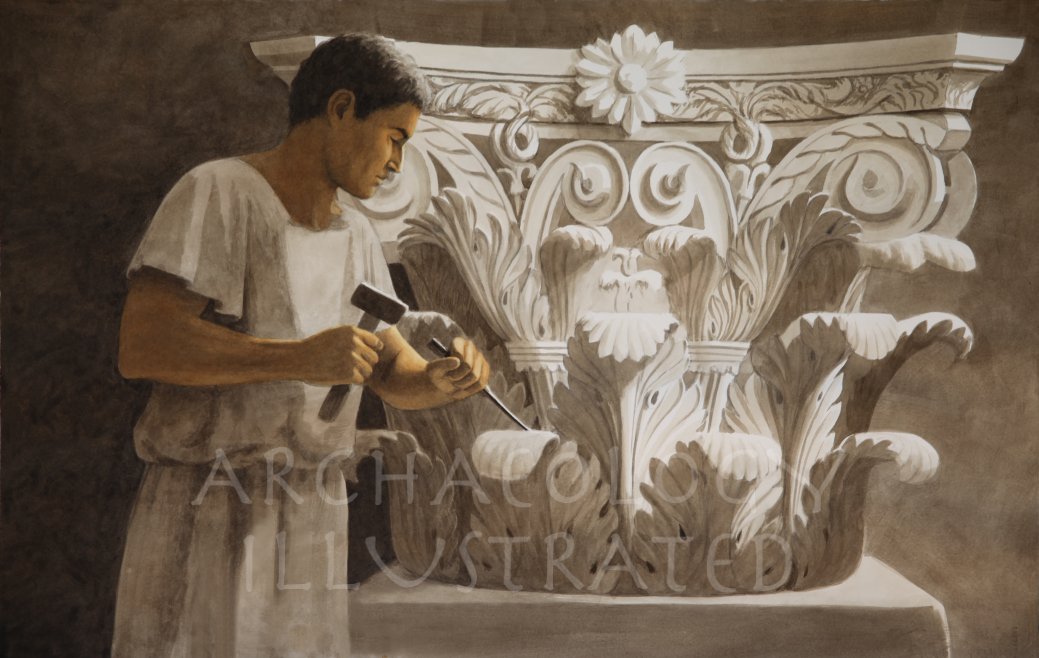
One Hebrew scholar, by the name of James Fleming, makes the argument the word “carpenter” in Mark 6:4 and Matthew 13:56, could actually be a bad translation of the Greek word “Tekton.” Fleming points out that the homes in Nazareth were largely made of Stone, not wood. We also know that the Herod at the time, Antipas, spent a great deal of energy making the city of Sepphoris (Zippori) his “Jewel of Galilee” by giving it a total makeover. This developing city was located only three miles away from the hometown of our Lord. 

There was a rock quarry half way between Nazareth and Sepphoris where Jospeh, and perhaps Jesus, could have spent their time cutting stones for the Herod’s great project. An undertaking of this size would have likely employed all the surrounding builders, including those in Nazareth. Of course, Jospeh and Jesus working as stonemasons is pure speculation.

 Scripture doesn’t give us a detailed account of Jesus’ childhood, but Luke 2:52 tells us that He, “…grew in favor with God and men.” This passage indicates that Jesus was well liked by those who knew Him growing up, but when you compare this verse with Matthew 13:57, that “favor with man” isn’t there anymore. Matthew records, “And they took offense at Him.”

 In both Matthew and Marks account of Jesus’ returning to His hometown, the locals ask the question, “Is this not the son of a carpenter?” After Christ is questioned, He doesn’t perform any great miracle for all to see, but He heals a few of their sick. He doesn’t try to argue with them, but He goes through the town teaching. The gospels don’t tell us exactly what He was teaching, but there’s a simple lesson here for all of us. 

Don’t be a carpenter. 

Jesus lost favor with many when He broke out of their social mold and when He did things they weren’t accepting of. People no longer liked Him when He also began teaching things they weren’t used to hearing. The identity of Jesus was not wrapped up in the job He was trained to do, He was and is much more than that. If you’re a follower of Christ, your identity is not your profession. 

Jesus is not the son of a carpenter, He’s the Son of God. He’s given us a new identity, and we should never cheapen who we are by seeing ourselves as doctors, engineers, truck drivers, preachers, teachers, butchers, bakers, and candlestick makers. We’re Christians. 

Even when He lost some positive popularity, Jesus looked for those who were willing to be healed and willing to hear. This is exactly what should be filling our time as well. Who do you know that needs to be spiritually healed by Jesus? Who do you know that needs to hear the wonderful soul-saving truth about the real Identity of Jesus? 

I’m a Christian— not a preacher. 

stone-mason-at-work-3572

Assumption Consumption

Monday’s Column: Neal at the Cross

Neal Pollard

The definition is stark and candid: “A thing that is accepted as true or certain to happen, without proof.” We live in an age where making assumptions is rampant and relentless. In current society, we make assumptions about one another based on political affiliation, skin color, and even masks. Charity and the benefit of the doubt are disappearing from too many circles, and that should have us all concerned. But, instead of panicking and giving up, Christians should see this as an opportunity to reach hearts for Jesus.

Immediately after writing about how powerful the command to love one another is (cf. Mat. 22:40; Rom. 13:8), Paul warns, “But if you bite and devour one another, take care that you are not consumed by one another” (Gal. 5:15). The current, so-called “cancel culture,” public humiliation, online shaming, boycotting, etc., is presumptuous and worldly. While the nuances of what we are seeing these days may be unique to us, the mindset and behavior are ancient and basic. If you keep reading Paul’s words, you can identify the culprit. A failure to walk by the Spirit leads us to carry out the desires of the flesh (Gal. 5:16). 

How can we know which characterize us? It is palpably simple. Notice.

Check Your Deeds

Paul lists out 15 specific deeds of the flesh–plus an encompassing “things like these”–which keeps the practicers from inheriting the kingdom of God. Nestled among sexual immorality and drunkenness are “enmities” (hostility and hatred), “strife” (to express differences of opinion with antagonism or hostility), “outbursts of anger” (intense, passionate “boiling over” of displeasure; rage), “disputes” (a feeling of hostility or being against), “dissensions” (party strife within a community, TDNT 89; i.e., Republican, Democrat?), “factions” (division based upon different opinions or loyalties)(Gal. 5:20). If God chose to drop the apostle Paul into our country right now for a week, surely he would preach this text to us! He’s describing the current crises and even many Christians’ response to it and one another. These are very nearly half of the deeds of the flesh specifically mentioned. Read your newsfeed, look at the articles being forwarded, watch cable or online news, and the like. More personally, I need to ask if I am exhibiting these deeds of the flesh in my words and actions. 

The antithesis of such deeds and the fruit which counteracts and conquers them. “Love, joy, peace, patience, kindness, goodness, faithfulness, gentleness, self-control” (22-23). Insert each of these qualities into your deeds and see if those fleshly deeds can survive. It has become routine and expected to see the incivility and hostility of the deeds of the flesh. The fruit of the Spirit will overcome them! But we must discipline ourselves to exhibit them, even in the face of those employing those worldly ways.

Crucify Your Flesh

Sounds painful doesn’t it? It doesn’t sound like something that comes easily or naturally. But, if Jesus owns you, these “passions and desires” must be put to death (24). Kill them! Harness the hostility and defeat those desires. We cannot give ourselves the old “that’s just the way I am” pass. We are not our own. We belong to Him. Nail it to the cross of self-denial!

Chart Your Course

Paul says, “If we live by the Spirit, let us also walk by the Spirit” (25). “Walk” means “to be in line with a person or thing considered as standard for one’s conduct” (BDAG 946). It means living in conformity with a set standard. We don’t have to guess what that is, and understand that it will look very different from the world’s standard. We cannot stoop to their level or conform to their rule (Rom. 12:1-2). 

Consider Your Brethren

To end this discussion, Paul tells us how not to treat others–“boastful, challenging one another, envying one another” (26), then how to treat others (6:1-2). We gently restore one another and bear one another’s burdens. We are protective and constructive. We care about souls, and that takes precedence over winning arguments and having our incisive one-liners quoted. We see souls like Jesus sees them!

It’s discouraging to see our society losing the ability to reason and discuss respectfully. It is destructive to see our brethren giving in to such devilish tactics. May we be aware that we are not serving and honoring our Master if our means to accomplish our ends cause us to use fleshly ways. Paul says it best: “But each one must examine his own work” (Gal. 6:4). God help me to do so humbly and honestly! 

How To Be Worthy

Thursday’s Column: Captain’s Blog

IMG_0806

Carl Pollard

Nothing is worse than washing your hands only to find that there aren’t any more paper towels. A paper towel roll with no towels is completely worthless. You can’t dry your hands with the roll (trust me I’ve tried), and you’re left feeling grumpy as you wipe your hands on your clothes.
 
In Matthew 5:13, Jesus tells us that we “are the salt of the earth.” Why are we given this description? The Greek word for salt is “halas” and its definition will blow your mind…it means salt. Jesus is talking about literal salt, so why would He tell us that we are a high sodium white crystalline substance? Salt adds flavor, it preserves food, and in small amounts can fertilize land. The Christian is salt because we add flavor to the world in the form of the gospel. We are able to preserve people’s souls through Christ. We help people grow with the help of God’s Word. That’s our job. We are the salt of the earth.
 
But what happens if we lose our flavor? We become worthless. Salt loses flavor when it comes in contact with moisture. If we become exposed to the world and let it take away our Christianity, what are we good for? We can’t add flavor, preserve, or even be fit to throw on some dirt. A paper towel roll with no towels does nothing. It can no longer be used for the purpose it was made for. The Christian who doesn’t live for Christ is deserting their purpose, and God sees them as worthless.
 
What are we showing the world? Are we carrying out our duty as followers of Christ? Don’t let it be said of us that we have lost our flavor. Don’t let God look at our life and say it is worthless to Him.

Discipleship

Wednesday’s Column: Third’s Words

20638721_440919206307154_5479040032968788217_n

Gary Pollard

We are supposed to be disciples. Discipleship is a mark of a healthy church. If we want to be true disciples, we must simply love God and we’ll know what it means to be disciples. Be a disciple. Discipleship is good. 

You’ve heard these statements before. They go along the same lines as, “We need to love God,” or, “We need to be godly,” or, “We need to be good Christians.” These are all true statements, but – at best – are greatly impractical and – at worst – are greatly discouraging. Ambiguous statements with no specific instruction will never accomplish anything. 

So, what is a disciple? The word used in the New Testament is μαθητής (mathetes). It describes someone who “engages in learning through instruction from another” and “who is rather constantly associated with someone who has a pedagogical reputation or particular set of views” (BDAG 609). 

A disciple is someone who passionately pursues something or someone in a specific subject field. A passing interest in pulmonology does not make one a pulmonologist. We know this. A passing interest in Christianity does not make one a Christian. 

If we’re there every time the doors are open but our Bible knowledge is lacking, we are not disciples. If we claim the title “Christian” but the foundation of our faith is a political viewpoint, we are not disciples. 

A disciple passionately studies. A disciple is an exegete. Disciples passionately incorporate and live out the teachings of scripture, which they get from their study. If we are as enthusiastic about our faith as we are about our hobbies, we are disciples. If we want to be called disciples, we must also be considered dedicated students of the word and of the One. 

open_bible

Spirituality Needs to Find Its Expression

Friday’s Column: Supplemental Strength

81121814_2462862270639428_5746232403106463744_n

Brent Pollard 

In the waning days of the last millennium, I happened to catch a program on public television about a dance competition held by Native Americans in rural Connecticut. If you are wondering why I still remember that show some 20 years later, it was because of the responses given by some of those interviewed. The dancers participating expressed the idea that their dance was an outward expression of their inward spirituality. The master of ceremonies echoed their sentiments as he explained spirituality needs to find expression. Ponder that last part with me for a moment; spirituality needs to find expression. Indeed.

I’m not suggesting that we incorporate carnal expressions of our spirituality in our worship of God, like dancing to a beating drum. Yet, if we are spiritual, shouldn’t there be an outward expression of it? Christians have a magnificent treasure stored within themselves (cf. 2 Corinthians 4.7). Sometimes, though, observation of Christians suggests otherwise. We who are blessed still covet for more. We who are given joy from within have sour attitudes. We allow ourselves to become filled with anxiety. Our brethren anger us, rather than receiving our love. Those without the church may think we are sad rather than happy. We who serve the One owning all withhold the bounty of that Providence and Wisdom of His Revelation from those needing it. We fail to be lights shining in a dark world as we are commanded (Matthew 5.14-16).

Yes, spirituality needs to find its expression. Can you recall the depth of emotion you felt when you first realized you were in love? You wanted to proclaim your love in loud tones to any who would listen. Do you remember the joy and zeal that was yours when you put on Christ in baptism? You wanted to proclaim the praises of Him Who had brought change to your life. Why don’t we allow our faith to find its expression today through the sharing of the Gospel? Why not do good to all, especially to those of the household of faith, as we have the opportunity? (Galatians 6.10) Lastly, let us worship God in spirit and truth without being begged to do so by elders, preachers, and Bible class teachers. If we do these things, no one will doubt the spirituality we claim to possess.

20121205-tribal-nations-audience

How TEN Creative Congregations Are Growing In 2020 

Tuesday’s Column: Dale Mail

DaleandJanelledirectorypic

Dale Pollard

COVID19 may be a serious problem, but the real damage is the affect it has had on congregations who are tempted to just throw in the towel. These congregations are just hoping that next year will be a better one. It’s this mindset that makes some feel like God has somehow lost control over this year— is God smaller or weaker than the virus? Absolutely not. 

Here are TEN creative congregations that have decided to adapt and overcome some of the challenges of 2020— and they’re working! Who’s to say it won’t work for your church family? 

  1. The Hebron church of Christ in Grant, Alabama, despite a smaller building, bought new microphone equipment so that they are able to have drive-in services and members are able to listen through their car radios. An un-intimidating way for visitors to be able to drive up and hear the gospel preached from the comfort of their own vehicles. Many other churches are also doing this, bringing people from the community to hear the gospel preached.
  2. The Chase Park church in Huntsville, Alabama, has implemented the local police force to help people exit in and out of the building in an orderly fashion. This has developed a great relationship with the police officers who have shown interest in the church after meeting some of the loving members. 
  3. The Farley church in South Huntsville, Alabama, had a food drive for those in the community who have fallen on hard times. Gloves and masks were worn to load the groceries up in people’s cars. Some church pamphlets were given, emails and phone numbers were written down, along with any prayer requests they might have. It has resulted in several local contacts. 
  4. Many of the Lehman Avenue church members in Bowling Green, Kentucky, led by the elders, have been driving around every Sunday afternoon to visit shut-ins. They deliver bread, sing, and pray with them. It has made a great impact on the morale within the body there. 
  5. The Wisconsin Avenue church in Huron, South Dakota, have come up with a creative way to reach out to the community by building what they call a “Blessing Box” in front of the building. In this box the locals have access food and Bible study material. 
  6. The preacher of the LaFollete church, Ben Shafer, in Tennessee, has been producing daily devotional videos to help the members stay connected and in the Word. This is also being done by Bud Woodall, the preacher for the Northeast congregation in Albuquerque, New Mexico, Andy Miller, a minister for the Southern Hills church in Franklin, Tennessee, and in countless other congregations.
  7. The hispanic minister, Chase Turner, at the Jackson Street church in Monroe, Louisiana, has discovered that posting videos/messages in Facebook groups that locals are a part of is a great way to get people interested in spiritual conversations. It has proven to be very effective! 
  8. Colt Mahana, who ministers at the Dahlonega church in Georgia, has started a daily college Bible study over Zoom. This daily study has made the college group there more engaged than they were before the pandemic. 
  9. Dr. Bob Turner had this to say about a church in Mannford Oklahoma: “I visited with several elders from numerous congregations over the last few months…I wanted to share what an eldership in Mannford, Oklahoma, has done over this period of time. While they do their classes over Facebook live, they have done additional things to help the congregation. First, they spend their Wednesday night time for prayer. Instead of teaching a class, they invited people from the community to submit prayer requests and they spend Wednesday evening praying for all the requests they receive. Second, they make special use of each holiday. For example, at Easter, since they could not host an Easter Egg hunt at the park with a potluck, the elders and wives stuffed eggs and the elders went to every home with children in the congregation and hide eggs for all the kids to have their own hunt at home. For Mother’s Day, they made a customized card and personally wrote a note and signed each card for every mother in the congregation. These are a few of the areas they have been creative to do and help members know they are cared for, thought about, and prayed over during this time. They have also emphasized that when they get back together, they want to do it right in order to make a good impression on anyone that might visit. They have constantly communicated with everyone in the congregation each week to make sure they have opportunity to share anything they might be dealing with.”
  10. Chuck Ramseur is working with a congregation in Virginia Beach, Virginia. This church family set up the Marco Polo app and encouraged everyone to share anything and everything going on during the day in their lives. It has helped them stay connected daily. Another area they took up working on is helping with the Crisis Pregnancy Center (alternative for woman thinking about abortion).This ministry has been one of the best outreach programs for the church. They’ve also planned services in the park on Sundays when they could not meet in the building, but could meet with social distancing in an open area.

So, there’s the proof! God is bigger than COVID19.

105950189_3248468518508147_1343333531772853091_o


The Haste Of The Hermandads

Monday’s Column: Neal at the Cross

pollard

Neal Pollard

In the 1100s, in an effort to protect travelers going from northern Spain over the Pyrenees to Santiago de Compostela in Galicia (Dogs of God, Reston, 50), a military force known as the hermandads (“the brotherhood”) was organized.  Soon, these vigilantes spread across Spain and offered themselves as protectors of roads and merchants.  Eventually appointed as a national police force who could collect taxes and prevent insurrection in every municipality, they would go on to exterminate untold numbers of Muslims, Jews, and other “enemies of the state” during the Middle Ages.  Reston mentions an unsettling “right” granted to the hermandads in the 15th Century, during the famous reign of Isabella and Ferdinand.  He writes, “In a curious turnabout, executions took place first, and trials were held afterwards” (51).

Given our country’s constitutional concept of “innocent until proven guilty,” this practice seems both backward and barbaric.  How useful is a trial to present facts about a case after the defendant has been executed?  What if the deceased was found innocent? What if there was no proof of guilt?  Of course, the “facts” of every case incredibly supported the punitive action that preceded it.

While we may find such a practice appalling, how often do we do the same with our tongues?  Through rash anger, reckless gossip, and rabid prejudice, we can serve as judge, jury, and executioner of the reputation and actions of another.  How often do we jump to conclusions and assassinate another’s character, but later revelations prove our actions both premature and unjustifiable?  Unfortunately, the damage having been done, nothing done by way of reparation can fully undo the effects upon the victim.

What we need to see is the spiritual danger we face who “execute” before “trial.”  Solomon wrote, “He who gives an answer before he hears, it is folly and shame to him” (Prov. 18:13).  A few verses later, he says, “Death and life are in the power of the tongue…” (21a).  That New Testament “wisdom writer,” James, adds, “But no one can tame the tongue; it is a restless evil and full of deadly poison. With it we bless our Lord and Father, and with it we curse men, who have been made in the likeness of God;  from the same mouth come both blessing and cursing. My brethren, these things ought not to be this way” (3:8-10).

Be very careful!  Even when we think we have the facts about another, let us post a guard outside the door of our lips (cf. Ps. 141:3).  Better to deliberate and reserve judgment than to execute before the trial has been held!

Fantastic Fact About Forgiveness

Wednesday’s Column: Third’s Words

Gary III

Gary Pollard

When we forgive someone we usually do not forget what we forgave. Unless there is an underlying condition, our minds do not automatically or immediately delete irrelevant information, like something we no longer hold against another person. Because of this, it can be hard to understand what God’s forgiveness means for the Christian. We’ll think, “I know He has forgiven me, but there’s no way He’s forgotten about it. Maybe it will ‘cloud’ His decision to forgive me next time I ask.” 

This is a very common mindset, and one that I struggle with daily. When we look at scripture, though, it paints a very different picture of what God’s forgiveness really does! 

Forgiveness is the word ἀφίημι (afiemi). It has several definitions, according to Bauer: 

1. To dismiss or release someone from a place or presence. 

2. To release from a moral obligation or consequence, to cancel, remit, or pardon. 

3. To move away with implication of causing a separation, to leave or depart from. 

(BDAG 155)

Knowing this, we should look at Hebrews 8.12, “For I will be merciful to their iniquities, and I will not remember their sins anymore.” We understand that context is geared toward contrasting the old and new covenant, but it at least gives us insight into the process behind forgiveness. 

When we get forgiveness from God, that sin is eradicated. It no longer exists, it will not affect our relationship with God anymore. “Remember” in Hebrews eight is, “To call information to memory.” It’s not only that God no longer holds a sin against us, it’s that it ceases to exist in His mind. How awesome is that? 

When we ask God for forgiveness, let’s approach His throne with humility, yes, but also with confidence that He has the power and desire to make that sin disappear from our account forever. 

67838971_10156520118915922_8108397968467427328_n

Tolerating Different Opinions

Wednesday’s Column: Third’s Words

20638721_440919206307154_5479040032968788217_n

Gary Pollard

Dale and I were recently talking about the marked differences in preference among gun owners, bikers, etc. He made the observation that those who are pro-fill-in-the-blank (revolvers vs magazine-fed, 1911 vs Glock, etc., cruisers vs sport bike, Chevy vs Ford, and so on) are often very enthusiastic about their preference and very hostile to what is the antithesis of their preference. 

To use the term in its purest and least twisted sense, there is very little tolerance concerning differences of opinion among those who are passionate about the same things. With motorcycles, those who enjoy cruisers might scoff at those who prefer sport bikes. “They’re more difficult to maintain, you can’t practically go long distances, they’re more dangerous…” Sport bikers might do the same, “Cruisers aren’t as fast or agile, they’re old man bikes, you lose so much power with a belt or shaft drive, they don’t look as cool…” We could go on forever, but if you have any interests where differences of opinion abound (which is just about any hobby or interest), you know what I’m talking about. 

We face the same things in the church. Culture influences our preferences in matters of opinion, and I don’t have to go into detail about those opinions or traditions. We’re aware of the range of preferences and the way we can be tempted to respond to opposing preferences. Of course, I’m not talking about doctrines that cannot and should never be altered, but of opinions and traditions that do not affect salvation. 

The same responses we observe in every other aspect of our lives – passionate support or passionate opposition – can sometimes be observed in the church. We exist in the world, but we are supposed to be different from the world. Matthew 5.43ff tells us that we should love our enemies. We sometimes treat those with different preferences in the church as enemies; the level of hostility that we (and I mean me, too) can show over those preferences proves this. Do we love them anyway? Are we praying for them? 

Matthew 5.46-48 points out (in principle) that if we’re only nice to those on “our side,” it means nothing. In fact, it’s wrong! Twice in this passage we are called to change and be different from everyone else. That is a salvation issue. 

The word “tolerance” has become perverted over the last generation or so, but we can’t forget that it does play a role in our faith. We must not tolerate false doctrine, but we must tolerate our differences in matters of opinion. This carries over to everything we’re passionate about! 

How we treat those who disagree with us will show others who we serve far more effectively than our professed beliefs will. Does our treatment of those with whom we disagree show that we are genuinely Christian, or does it serve as a perfect deterrent? This is up to us. As things slowly return to normal we can change the status quo in a very positive way – let’s make the best of it!

What It Means To Be A Christian

Thursday’s Column: Captain’s Blog

IMG_0806

Carl Pollard

The life of a true Christian is filled with change. We learn where we are weak and try to be better. It’s kind of like a never-ending home improvement project. There will always be areas of our spiritual walk with God that could be better. Because this is the case, many religious books, sermons and Gospel meetings are created around a theme that will help us to grow. In the Church there is a plethora of information to help us in our Christianity, but I want to focus on the basics and answer a vital question. What does it mean to be a Christian?
I want to answer this question with a passage in Scripture that we may not immediately think of. We may think of 1 Timothy 1:5 or 2 Peter 1:5-7, which are great verses, but I’d like to suggest that Jesus in Luke 18:15-17 gives us the bottom line of Christianity.
It reads, “Now they were bringing even infants to him that he might touch them. And when the disciples saw it, they rebuked them. But Jesus called them to him, saying, “Let the children come to me, and do not hinder them, for to such belongs the kingdom of God. Truly, I say to you, whoever does not receive the kingdom of God like a child shall not enter it.”
Jesus teaches the importance of humility. You want to enter the Kingdom of God? Have an attitude of humility. He uses the example of children, and Luke even uses the Greek word for infant. These are very young kids and babies that are being brought to Jesus. So He uses this as a moment to teach a valuable lesson.
Babies show their humility in their inability to provide for themselves. Every child that is born is completely dependent on its parents and has a wholehearted trust in them to provide what they need.
What does it mean to be a Christian? It means being humble enough to admit that we need God. It means we trust in God rather than our own “power.”
Humility plays an important role in every aspect of Christianity. It helps with showing love to others, it helps us subject ourselves to God’s Word, it helps us treat others the way we want to be treated, it helps us accept the hard topics that Scripture contains, and the list goes on and on.
Do you want to be a part of the Kingdom? Make humility an everyday practice. And that is what it means to be a Christian.
#MyToesHurt

11892209_10153120312215922_882787250566779690_n
Back before Carl was a giant. #littlebabycarl

Heaven’s “Start Up”: The Ultimate “Rags To Riches” Story

Monday’s Column: Neal at the Cross

16174665_10154303308455922_2453812807432667966_n

Neal Pollard

Some of the wealthiest companies, Apple, Hewlett-Packard, Amazon, Mattel, Google, Tesla, and The Walt Disney Company, started in the quaint, quiet haven of a garage. Often, they had little more than an idea of a product or service, but they refused to stop until they achieved success. These rags to riches stories intrigue us and fire our imaginations.

Have you thought about the “start up” that began in heaven? It was conceived in the eternity before time. A couple of millennia ago, a poor couple staying in an obscure little village laid a newborn baby boy in an animal trough. This Child continued to grow and become strong, increasing in wisdom; and the grace of God was upon Him as He kept increasing in wisdom and stature, and in favor with God and men. Nothing more is said about this amazing adolescent until He is thirty years old and began sharing new ideas and promising the thing every person in every place in every generation absolutely cannot afford to be without. 

Though He was executed for His radical claims, thoughts, and actions, His followers refused to keep what He had to offer hidden. Many of them gave their lives to advance this cause, they believed so much in it. Most of them were poor, uneducated, and ordinary people, but they relentlessly carried His offer to every creature under heaven. People began to describe their efforts by saying these men have turned the world upside down! 

And indeed they have. Those who heard the Man who started it all shared it with those who shared it until this ultimate hope went everywhere. Today, multiplied centuries today, their work lives on. Taking that same, original plan, written down in one Book, people of every race, color, country, and economic strata continue to start from nearly nothing and grow in extraordinary ways. 

No wonder! That newborn is God in the flesh. What He came to offer is the eternal salvation of our souls. Where He offers it is in His body He calls the church. Anyone can have it, if they are willing to give Him everything they are and have. At this very hour, there is an untold number of men, women, and young people who desperately want what He has to offer, but they need to know how to get it. That’s where we come in. He is counting on us to share His offer today, while there’s time for them to take advantage of it. If we truly believe in the power of it, nothing will keep us from getting this indescribable gift to the masses!

29472998_1861193667226061_7295196647418494976_o

“Quit Yer Whinin'”

Wednesday’s Column: Third’s Words

20638721_440919206307154_5479040032968788217_n
Gary, with his wife Chelsea

Gary Pollard

I think we’ve all been in the uncomfortable position of witnessing a couple loudly arguing in public. Whether this is at a restaurant, the store, a gas station, or any other public place, it’s downright uncomfortable. Some thoughts going through our minds might be, “Where’s their self-awareness?” or, “They might need to see someone about those issues,” or, “Why here?” We definitely would not want to spend too much time with anyone whose conflict resolution abilities are so classless. Conflict in a relationship is unavoidable and, if handled properly, is vital to the health of a relationship. Poorly managed conflict, though, is sure to destroy it! 

Unfortunately, the world is seeing this more and more. Petty arguments between Christians over matters that have absolutely no bearing on our eternal destination are commonplace. Which Bible version is best? What will heaven be like? What should we wear to worship? Which college should one attend (“that college is liberal/conservative”)? Should we meet in a building or in homes? Should a Christian wear a head covering or not? Should a Christian celebrate certain holidays or not? Should a Christian carry a gun or not? Who should I vote for? 

These are topics I have seen debated in the ugliest possible ways in public forums, whether live or over social media. There is nothing wrong with disagreement handled in a godly way (Matthew 18.15-20). In fact, it can help grow the church because it often brings members closer together. However, when the argument is both non-essential to salvation and is handled unbiblically, it destroys the church. 

If I may be very blunt, this must stop. Our behavior is not only pushing the world away but generations of the church’s own members as well. When a Christian’s blocked list on social media is primarily members of his/her own spiritual family, we have reached concerning levels of dysfunction. I realize that this is not a pleasant article to read, but it is time for us to make a change. 

It is time to stop writing or sharing articles on inflammatory or controversial topics that have no bearing on our salvation. Religious keyboard warriors and trolls need to quit. People of authority and position must stop using their voice to divide and discourage the bride of Christ over non-essential matters (some examples are listed in the second paragraph). We will be held accountable for our words and influence over the body of Christ at judgment. 

When we inevitably find ourselves in disagreement with another Christian over a matter of opinion, we should either handle it privately and with patience and love, or let it go entirely (see Romans 14, I Corinthians 8, Matthew 18, Philippians 1.27, 2.1-5; 2.12, 2.14, 15; 3.17-19; 4.2). Being correct or winning an argument at the expense of peace is not worth losing our souls. This article is just as much for myself as it is for anyone reading this. It is for everyone. 

Around 156,000 people die every day (that’s about 56,000,000 people per year) and most them die outside of Christ. Our time is limited and our influence precious. Our words are among the most powerful tools and weapons ever created. Let us use them well, as they could very well influence someone’s eternal destination – or our own. 

Youth In Action 

Thursday’s Column: Captain’s Blog

img_0806-e1577969955736.jpg
Carl preaches for the Hebron church of Christ, Grant, AL

Carl Pollard

One of the first verses that we tend to think of when it comes to youth being active in their faith is I Timothy 4:12. Most teens have heard, “Let no one look down on your youthfulness” at some point in their lives. What about the second half of the verse? In I Timothy, Paul had been instructing Timothy on how to deal with men like Alexander and Hymenaeus. These men had been blaspheming and teaching false doctrine. Paul clearly states that the goal of their instruction should be love from a pure heart, a good conscience and a sincere faith (1:5).

Skipping down to chapter 4, Paul tells Timothy that no one should look down on him because of his age. Timothy is charged to teach the gospel and handle the men that have been teaching false doctrine. To do so, he can’t let others’ views of him cause him to stop doing his job. When Paul says “youthfulness,” the original text uses a word that could be ascribed to someone as old as 30. Paul’s main point is that in “speech, conduct, love, faith and purity, show yourself an example of those who believe.” This is what Timothy should have been doing. Forget your age, forget what other men are saying, and LIVE as an example. Paul wanted Timothy to be a “tupos” or “type” that men could follow. Timothy could do nothing about his age, so his effectiveness was to be rooted in his example.

So, young Christians today, what can we do to be an example? There are five ways that we can do this.

First, your speech. This is external. People can hear the way you talk in your everyday life; Make sure it is blameless and pure. Don’t give someone a reason to reject you because of how you speak in your private life.

Second, your conduct. Once again this is external. Having proper conduct is vital if people are to see you as something more than just a youth. Be a man/woman of God whether you’re being watched or not.

Third, in love. This is more internal than external. This love is an agape love,  sacrifice for others at the expense of your own good. This also goes back to 1:5 and “love from a pure heart.”

Fourth, in faith. This is also internal. Work on your own faith. Build your own relationship with God.

Finally, in purity. Be pure in your relationships and in your life when no one else is around. Do these things as “an example (type) to those who believe.”

Paul continues on in verses 4:13ff to discuss other ways he can be an example: giving attention to the public reading of scripture, exhorting and teaching, and using his spiritual gift he had been given by the Holy Spirit. Paul wanted Timothy to be a living example. When these men were looking down on him for his age, Paul didn’t tell him to focus on his experience, but on the source. Focus on your own spiritual life, your own personal reading of God’s Word, your own prayer life. Don’t blame others or use them as an excuse. Be an example they can respect and follow. Show them what a true Christian looks like.

Timothy had a hard job on his hands; he was facing false teachers and blasphemers that were tearing apart the church. He had to work and be the proper influence for the Christians there at Ephesus. As teens today, you also have a hard task ahead of you. Many in the church think that you don’t need to be working yet. God says otherwise. You can and should be an example for others to see. Each one of you have your own group of friends that only you can influence. So, be the example. In your speech, in your conduct, in your love, your faith and your purity. Show them the truth, and never neglect your own Christianity

What’s The Point?

Neal Pollard

Years ago, Wes Autrey sent me a copy of the “Idiot Report.” To this day, I still wonder why he thought of me as he read something with that title. I found all the entries hilarious, but one attributed to a Wichita probation officer was particularly funny. This august report said, “the stoplight on the corner buzzes when it’s safe to cross the street. I was crossing with one of my coworkers, who asked if I knew what the buzzer was for. I explained that it signals blind people when the light is red. Appalled, she responded, “What on earth are blind people doing driving?” Hopefully, you get where she missed the purpose of the corner buzzer. If not…

How many miss the point of Christianity? The decision to become a Christian is the best and most important decision this side of time. Living the Christian life is the best life to live. Worshipping the living God is a privilege that is awe-inspiring and of unsurpassed joy. Prayer is a lifeline without which none of us should feel equipped. Bible study with an eye toward applying its truths is vital to growing stronger and closer to God.

To go through life as a Christian filled with fear, sadness, anxiety, envy, anger, apathy or resentment really misses the point of what it means to be in Christ. That does not mean that we will automatically be immune from any of these feelings and attitudes. In fact, all of us will be confronted by them throughout life. But, if we spend a lifetime given in to these things, we have missed the point! Being in Christ means having the only true access to courage, happiness, trust, satisfaction, peace, zeal and acceptance that there is. We could go so many places in the New Testament which affirm this, but just look at Ephesians one. In Christ are the faithful saints (1:1), every spiritual blessing (1:3), election (1:4), grace (1:6), redemption (1:7), all-sufficiency (1:10), hope (1:12), the seal of the Holy Spirit (1:13), and strength (1:19-20). We have a forgotten past, a purposeful present, and a hopeful future in Christ!

The world’s values and thinking are backward (cf. Isa. 5:20). Do not fall prey to their convoluted way of thinking. We are Christians! We know why we are here and where we are going! That’s the point!

crosswalk-button-1

Don’t Miss The Privilege Of Worship

Neal Pollard

Yesterday, John and Carla Moore, Kathy, and I worshipped with the church of Christ in Nazareth. We have been there a few times, but there was something extremely special about yesterday. In attendance was Wissam Al-Aethawi, an Iraqi and Muslim-born brother in Christ whom I first met at Polishing the Pulpit. What was so special is that this man, who explained that he has been a believer for 20 years and a New Testament Christian for 10 years, was able to worship in his native Arabic tongue for the first time ever. Can you imagine being a child of God for a decade before you ever had the opportunity to sing, pray, or hear preaching in the language you were born and raised to know? 

Every Lord’s Day, most of us have the privilege to worship God in our native tongue. In fact, such is probably an afterthought if a thought at all. I got the sense that brother Al-Aethawi would relish the idea of being able to worship in Arabic each week, and there’s no doubt he would not take it for granted. But do I appreciate that privilege? Does worshipping God mean so much to me that I prioritize it over everything else? When I am in attendance, do I pour my heart and soul into it? Do I let the words of the songs touch me, the prayers reach me, and the sermon change me? As I am able to stimulate the others to love and good deeds with words that come naturally to me, do I appreciate the blessing of fellowship felt before, during, and after worship?

What a shame if I let the glory of praising God seem so ordinary that I fail to treasure each service! What if we approached each time as if it was the first time we were able to worship God with the people of God ? What a difference it would make to the energy and passion of worship, if each of us did that. 

66271316_10156439099590922_7012873238573219840_n
Wissam presiding over the Lord’s Supper. 

The Influence Of Papaw Mitchell

Neal Pollard

May 14, 2004, was the day I preached my maternal grandfather’s funeral. It was a signal honor to do so. He had passed away early on Wednesday morning, May 12. The morning he passed, I wrote this about him:

Within you today are a temper and trends
A view toward the unfolding tomorrow
Have you stopped to question on what that depends
From what spiritual bank you do borrow?

Though each person forges his own internal road
Based on unique decisions and conscience
Before him to help pave it is an influence to goad
A role model, an example bestowed.

For those so endowed with a godly loved one
One righteous, driven by the Giver of grace.
To see their own faith is to look at one done
A journeyman who victoriously ran his own race.

I know one like that, a follower of Him
Who led much family both of flesh and of faith
Who shaped hearts and lives in times good and times grim
Who laid course that to follow was safe.

When we all get to heaven and give praises unending
Who knows what will be or how we’ll appear?
I know that for anyone in that Paradise spending
That all who shaped our faith will be clear.

Everyone that knew Harold Edward Mitchell, Sr., was closer to heaven because of his influence. He lived over 90 years, converting from denominationalism in young adulthood and ultimately serving decades as an elder. At his funeral, I shared five facts about my “Papaw Mitchell.”

  • He loved his family. He wasn’t gregarious, but rather reserved. Yet, he taught his family the right way to live and how to face death, to know what ultimately counts, what was right and what was wrong.
  • He had a sense of adventure. From semipro baseball as a teen to seeing the entire country in retirement, a lifelong cotton farmer had a wider view of the world. He came of age in the depression and endured some terrible grief, but no one could remember hearing him complain. 
  • He worked hard. He wasn’t a waster of resources, least of all time. He was up with the sun and down with the sunset. He instilled that work ethic in his children and grandchildren. 
  • He put Christ above all else. As a Christian, he took what the Bible guided him to do and be in life at face value. His life went beyond mere rule-keeping. He kept the rules, but he loved the rule-maker. You could see Jesus living in him.
  • He was ready to die. That’s the most important thing any of us could have said of us.

I saw grandpa the Monday night before he passed away. He was able to talk, but it was the first time I saw him that I felt he might not live forever in that earthly body he took such good care of. It was probably the first time I thought seriously about my own mortality. Our spirits are engineered for eternity, but our bodies of clay wind down more each day. In the fifteen years that have passed since then, I am more aware of that than I was even then. Our pilgrimage here won’t go on indefinitely, though we’ll live as long as God lives.

Examples like my Papaw motivate me to clear the hurdles from my path and stay dependent upon God to help me, like him, to finish my face. To die faithful and prepared means to live faithfully and make preparation. One day, someone will speak at your funeral and mine. What can they honestly say about the example and influence we will have left on others?

grandpa mitchell and uncle larry
Papaw (L) and Uncle Larry (my mom’s older brother), probably between 30-40 years ago.

New Testament Christianity

Neal Pollard

  • The New Testament claims to be the source of authority for all we do of eternal importance, no matter when or where we live (Col. 3:17; 2 Pet. 1:3,20-21; 2 Tim. 3:16-17).
  • The New Testament will not share authority with any other book or “revelation” (Gal. 1:6-9; Jude 3).
  • The New Testament reveals how a person becomes a Christian (Acts 2:37-47; Eph. 4:4-6).
  • The New Testament teaches us that the Lord adds Christians to His church (Acts 2:47).
  • The New Testament shows us how that church is organized and led (Acts 20:28; 1 Tim. 3:1-12; Phil. 1:1; 1 Pet. 5:1-4).
  • The New Testament gives us the day the Christians met to worship (Acts 20:7; 1 Cor. 16:1-2).
  • The New Testament clarifies for us the various roles and responsibilities God has given to each gender of Christians in the work and worship of His church (1 Tim. 2:8-15).
  • The New Testament teaches the Christian how God wants to be worshipped (John 4:24).
  • The New Testament outlines the Christian’s purpose and work (Eph. 4:11-16).
  • The New Testament is dedicated to showing how one, as a faithful Christian, has eternal life and the hope of heaven (Ti. 1:2; Rev. 2:10; ch. 21-22).
  • The New Testament helps one understand how God wants marriage and family to function, to build Christian homes (Mat. 19:1-12; Eph. 5:22-6:4; 1 Pet. 3:1-7).
  • The New Testament urges Christian growth and thoroughly teaches how that is accomplished (2 Pet. 3:18; Ti. 2:11-14; John 15:1ff; etc.).
  • The New Testament constantly speaks of how the Christian needs to and benefits from developing an intimate relationship with the Godhead (1 Th. 5:17; 2 Tim. 2:15; John 15:14; Mat. 22:36-40).
  • The New Testament teaches that Christians prove to others their discipleship to Christ by loving one another (John 13:34-35).
  • The New Testament reveals that Christians are tasked with duplicating themselves by teaching the gospel to those outside of Christ (Mat. 28:18-20; Acts 8:4; Col. 1:23).
  • The New Testament asserts itself as the unfailing, universal guide regarding anything that will ultimately matter (2 Pet. 1:3; John 14:26; 16:13; etc.).

If what we are after is divine guidance for who a Christian is, what he or she does, and how God wants one to live, where else would we turn but to the New Testament? A God who engineered us for eternity and tells us we have but two eternal dwelling places would be cruel and unloving if He did not give us clear, thorough answers to any matter that is important to Him. How loving and faithful for God to give us such an unambiguous guide.

58366-nt-rely.800w.tn_