Assorted Blessings

Neal Pollard

Running water. Electricity. A stove. A microwave. Family. Sanity. Health. Domestic tranquility. Health care. Dexterity. Opposable thumbs. Involuntary muscle movement. Singing. Friends. Children. Parents. Nature. Mountains. Breezes. Fireplaces. Automobiles. Law enforcement. Aspirin. Hot water. Showers. Eyesight. Clotting. Emotions. Dogs. Sunsets. Siblings. The ocean. Companionship. Passion. Nerve endings. Shelter. Rocking chairs. Reading. Running. Refrigerators. Board games. Evangelism. The church. Firefighters. Pockets. Paved highways. Ozone. Cotton. Kindness. Shoes. Trees. Songbirds. Smiles. Waves. Shoes. The wisdom of the aged. Elders. Dentists. Coffee. Babies. Modesty. Make up. Music. Lights. Stars. Comfortable chairs. Eyeglasses. Leftovers. Devotionals. Airplanes. Sunrise. FedEx. Interstates. Telephones. Fresh, hot, and homemade bread. GPS. Front porch swings. Memories. Fertile fields. Prayer. Reading comprehension. Hearing. Smelling. Touching. Tasting. Harmony. Trust. Forgiveness. Wedding cake. Teachers. A spirit of cooperation. Sunglasses. Charity. Soap. Good neighbors. Fresh fruit. Beds. Fireflies. Encouragement. Imagination. The Lord’s church. Coffee. Thread. Belts. Livestock. Peace and quiet. Laughter. Pain. Flowers. Hikes. Language. Swallowing. Breathing. Teeth. The Bible. Maps. Love. Blankets. Wildlife. Humor. Curtains. Bedspreads. Snow. Sunshine. Rain. Clouds. Hope. Canned goods. Grandparents. Fellowship. Heaven. Providence. The cross.

“Every good thing given and every perfect gift is from above, coming down from the Father of lights, with whom there is no variation or shifting shadow” (James 1:17)

sun-flowers

Processing…

Neal Pollard

I woke up just before 5 AM to an ominous notification from my Jerusalem Post app. Downstairs, turning on the news, the horrific truth was confirmed. The worst mass shooting in modern American history. Not long after, I was in my gym locker room. A gym buddy, Mike, a self-described C&E (i.e., “Christmas And Easter”) Catholic, greeted me. Usually, I am not tempted to ask this, but I found myself asking him, “How does something like this happen?” His 5-word, profound answer was, “No love, no Jesus, man.”

Some random thoughts occurred to me, in processing the events in Las Vegas late on Sunday night, October 1st.

  • Luke 13:1-5. This did not happen because the people in Las Vegas, Nevada, are more wicked and evil than people in other parts of this country or the world. The need among the over 20,000 accountable adults at that country music festival is the same need that all of us have, to be penitent believers in Christ.
  • Second Amendment And Gun Control. Investigations are still ongoing, but there is preliminary reason to believe that at least one or some of the guns used by the shooter would have been obtained illegally. Gun control laws would not prevent illegal weapons. At the same time, there were several fire arms on those in attendance. They proved useless against a shooter from 1000 feet away and 32 stories high. Guns are not inherently evil nor the all-encompassing answer.
  • Man. Man was both perpetrator and victim. Yet, man is so limited. We are not all-knowing or all-powerful. Highly trained law enforcement officers and first responders, who doubtless saved many lives, did not prevent this. How humbled these events make us!
  • Atheism. Nearly every news interview ended with the reporter or anchor with a pledge of prayers or similar reference to God. The president’s brief statement continuously referred to God and even quoted Scripture. Nobody invokes “survival of the fittest,” “big bang,” or “there is no God” to provide help, comfort, or strength to anyone. A Godless worldview is a hopeless one.

Big questions emerge from this fog of suffering. Christians, we not only have the answer, but as God works through us, we are the answer! I read a social media post from Sheila Butt, challenging us to take Christianity off the pew and into our daily lives. The soul we reach and life we help change might change the course of the world for good (or the prevention of evil). Mike nailed it. “No love, no Jesus, man.” Amen!

297901_10150264597445922_585245921_7806090_7777855_n-1

Who Is The “Troubler Of Israel”?

Neal Pollard

Ahab was the most wicked king in Israel’s history (1 Kings 16:30). To top it off, he was married to perhaps the most immoral woman revealed to us during the time of the divided kingdom in the Old Testament. Her name, Jezebel, is still somewhat infamous today. She destroyed the prophets of the Lord (1 Kings 18:4). The prophets who survived feared for their lives because of Ahab (18:9). Instead, Jezebel kept a stable of false prophets, 450 prophets of Baal and 400 prophets of Asherah (18:19). Read this section of 1 Kings and the first nine chapters of 2 Kings to get the full flavor of who this notorious couple was.

How ironic that when Elijah appears to Ahab before the prophet’s infamous confrontation with the false prophets on Mount Carmel, Ahab’s first words to him were, “Is this you, you troubler of Israel?” (18:17). There was controversy, division, problems, and trouble in the land, but Ahab’s narrative was distorted. Ahab was like a reckless drunk driver weaving in and out of traffic and blaming a law-abiding pedestrian for being in his way on the sidewalk. Elijah was not the troubler of Israel for daring to oppose the false ways of Ahab and Jezebel. He was doing exactly what God wanted him to do!

In our present, lawless age, there are so many “prophets” who come along with a message appealing to right ideas like peace, grace, unity, and love. Many of them package themselves in the garments of relevance, using our culture as their props and stage. The causes célèbre which our age reveres, some of which are diametrically opposed to the doctrine, ethics, and morality outlined in Scripture, are pushed at God’s people—who are shamed and made to feel unrighteous if they dare protest what is said. In some circles, it is asserted that anyone teaching that the Bible is authoritative, contains a pattern, and is God’s objective truth for all times, is Pharisaical, consumed with self-righteousness, hateful, mean-spirited, and divisive. In short, that they are “troublers of Israel.”

As a quick side-note, there are some who do press their personal proclivities, traditions, and convictions as divine truth. This is as accursed a thing as seeking to nullify what God has bound in heaven (cf. Mat. 16:19; Rev. 22:18-19). Such folks manufacture trouble rather than trouble people by faithfully sharing God’s Word. These occupy unenviable ground, in view of the end of all things.

Yet, anyone who conscientiously tries to follow God’s blueprint for how to share His truth (Eph. 4:15; 2 Tim. 2:24-26; Col. 4:6), who takes care to handle Scripture accurately (2 Tim. 2:15), is going to invariably encounter the Ahabs, Jezebels, Baalites, and Asherahists. Teach the singular, undenominational nature of the church (Eph. 4:4), the role of women in the church (1 Tim. 2:9-12), the essentiality of baptism in God’s saving plan (Acts 2:38), God’s plan for marriage and sexuality (Mat. 19:1-9; Heb. 13:4; Rom. 1:26-27), and the like, and it will come. The Ahabs will label you the troublemaker and the source of the problem.

In what may sound dark and grim, Paul warns Timothy that difficult times will come (2 Tim. 3:1). He speaks of men immoral in nature and inaccurate in message who succeed with the weak and impulsive (3:6), who themselves are “always learning and never able to come to the knowledge of the truth” (3:7), who in fact “oppose the truth, men of depraved mind, rejected in regard to the faith” (3:8). Ultimately, they will not carry the day (3:9). But they will always have their eager followers who “accumulate for themselves teachers in accordance to their own desires, and will turn away their ears from the truth and will turn aside to myths” (4:3-4).

Suppress the victim mentality if you are trying to be an Elijah in this Ahab society. On the job, at home, in the community, within the religious community at large, and even at times within the church, “preach the word” (2 Tim. 4:2). Do it with great patience and instruction, as Paul counsels. Don’t be a troubler in God’s eyes, but know that you will be seen as one in the eyes of some in this world. Keeping company with Elijah is not a bad thing.

012-elijah-baal

A Tangled Mess!

Neal Pollard

Late in 2010, Jason Good was surveying timber in Meigs County, Ohio, when he came upon a bizarre sight. Three huge whitetail deer were dead, floating in a creek with their antlers locked. It was an 11-pointer, a 10-pointer, and an 8-pointer. The landowner, Brien Burke, figured that two of them were fighting when the third came in on the opposite side. Then all three were so tightly locked together that they could not pull loose (Field & Stream, Steven Hill, 12/5/10, online ed.). How sad that three beautiful, majestic creatures got themselves tangled up so much in a fight that they fell into a creek and drowned. Fighting brought these deer to a tragic end.

The same thing can happen in our human relationships. James writes, “Who among you is wise and understanding? Let him show by his good behavior his deeds in the gentleness of wisdom. But if you have bitter jealousy and selfish ambition in your heart, do not be arrogant and so lie against the truth. This wisdom is not that which comes down from above, but is earthly, natural, demonic. For where jealousy and selfish ambition exist, there is disorder and every evil thing. But the wisdom from above is first pure, then peaceable, gentle, reasonable, full of mercy and good fruits, unwavering, without hypocrisy. And the seed whose fruit is righteousness is sown in peace by those who make peace” (3:13-18).

Wise, understanding people prove such through gentle wisdom. The opposite have bitter jealousy and selfish ambition in their hearts. James says that where this is, there is disorder and every evil thing. How often do we forfeit peace and gentleness due to a large dose of selfish ambition? We tangle with others and hurt them and often hurt ourselves. At its worst, we can inflict spiritual death. When that happens, we are in just as much trouble. What we need in our relationships with others is the wisdom from above, described in James 3:17. But we must sow peace to reap the fruit of it. Let’s be at peace with men and God!

lock2

Do You Want A Better Life?

Neal Pollard

Who would answer “no” to that question? Who wants a worse life or a life that never gets better? But the better question is, “How do you get a better life?” Advertisers have so many answers to that, involving their currency or investment tool, their pill, diet, or workout routine, their travel agency or vacation destination, or product for your home, transportation, business, and the like. So many put so much into these promising plans, but still find their life wanting.

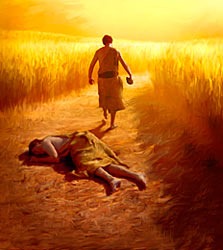
In religious matters, there is no room for subjective thought when it comes to what it takes to have a better life. We find ourselves often bobbing in a sea of religious confusion. Many groups claim to be the best religion and point to their ingredients as reasons for such claims. They point to their numeric size, number of programs they have, or how socially active they are. Our religious attitude ought to be one of humility, not boasting of our achievements or comparing ourselves with others (cf. 2 Cor. 10:12). Genesis 4:1-16 points us to the first recorded version where more than one kind of worship was offered to God and how God rated them. But this chapter also paints a picture of two ways of living life.

Cain is mentioned by three Bible writers after Moses writes about him in this chapter. The writer of Hebrews calls Abel’s offering more excellent than his (Heb. 11:4). John calls his works evil and his allegiance “of the wicked one” (1 John 3:12). Jude implies that the way of Cain is the wrong way to go (11). It seems that Genesis four shows us the better ingredients for a better way of living today.

  • Better living isn’t determined by age (1-2). Cain was the firstborn, a place of honor and privilege especially throughout the Old Testament.  But under the New Covenent, there is no spiritual advantage because of birth order. It is not a matter of firstborn, but a matter of being born again (John 3:1-7). Growing older should mean growing wiser, but reaching a milestone on a calendar does not equate to better living.
  • Better living isn’t determined by occupation (2).  Growing up, we might be tempted to see our occupation as the gateway to happiness and satisfaction, financial freedom and security, independence, and privilege.  When we look at Cain and Abel, what they did for a living wasn’t the determiner of the quality of their lives. Some occupations can stand in the way of better living, whether the nature of the job or the quality of the people one works with. Some can let their jobs stand between them and their relationship with God and His church. But, one can do right in unfavorable work circumstances, staying faithful to God.
  • Better living is determined by worship (3-4). That statement may be offensive to our multicultural world that says there are no absolute rights or wrongs. Contrast our culture’s thinking on this matter with what we read in Genesis four. Both Cain and Abel brought an offering to the Lord. God responded to both offerings, but He accepted one while rejecting the other. While many make worship nothing more than taste, preference, and personal, we learn here that not all worship is equal. God “had regard for” Abel’s, but not for Cain’s. It does not say if Cain was sincere. It doesn’t seem to matter. We learn here that the worshipper and the worship offered rise and fall together. God regarded Abel and his offering, but rejected Cain and his offering. Can one offer God vain worship, and have God reject it but accept him? Apparently not.
  • Better living is determined by attitude (5-7). Cain reacts to having himself and his worship rejected by God. He was very angry. His insides burned! His countenance fell. He took on an ugly look. We’re not told how old he was, but it almost sounds like a temper tantrum. Whether home training, lack of discipline, poor stress management, pride, jealousy, or anything else leads us to lose our tempers, all of them are matters only we can control. When we don’t control them, we’re responsible! Ill-tempered people are not living the better life! A positive life doesn’t require prospering, education, or earthly success. But you can’t have a positive attitude without mastering self.
  • Better living is determined by action (8-16). The word “sin” is first used in Genesis 4:7, but God was looking ahead with perfect foresight to what Cain was going to do to his brother (cf. 1 John 3:11-15). Bible writers speak of his deeds, offering, and way. These are all action words. After his sin, he is rebuked and punished by God and separated from God. Sin will not deliver what it promises. All actions have consequences (Gal. 6:7-9).

Someone said, “The line of Cain gives us murder, cities, polygamy, musicians, metal workers, and poetry, but not one who walked with God.  In fact, Cain’s legacy led to a repeat of his violent ways by a descendant (cf. 4:23). Abel leaves no physical lineage, but he leaves a great spiritual heritage (Heb. 11:4). We each get to choose what kind of life we’ll pursue. It matters which way we decide.

cain-and-abel

REDEMPTION AND PEARL HARBOR

Neal Pollard
Al Capone’s lawyer was nicknamed “Easy Eddie.” He was a slick, successful lawyer whose smooth, professional skills continually kept Capone from being imprisoned for his organized crime activities. For his skill, Easy Eddie was paid lavishly and protected like royalty. He lived the high life. He was likely a co-participant in illicit activity himself. Whatever his motivation, Eddie went to the authorities in 1931 and came clean about Scarface Capone, testifying against the mob. That decision most likely led to his losing his life, being gunned down on the streets of Chicago eight years after testifying against his former boss.

Eddie, also known as EJ, had a son. That son went to the Naval academy, graduated, and due to the attack on the U.S. Navy at Pearl Harbor, Hawaii, was dispatched from the U.S. Naval Training Center in San Diego, CA, on December 8, 1941, to join the fight in the Pacific Theatre. Butch O’Hare would go on to win the Medal of Honor and be killed in action, the victim of friendly fire, about two years later. Chicago’s main airport, O’Hare International, is named for Easy Eddie’s son. The O’Hare name no longer was inextricably linked to crime, but to valor instead.

While some have worked hard to build the case that Easy Eddie had a change of heart (among them, Frank J. Wilson, the Treasury Department investigator who called Eddie one of his best undercover men in bringing Capone down on tax evasion), it matters little concerning the moral of the story. It was Butch’s valor and patriotic service that redeemed the family name and led the “second city” to rename its airport “O’Hare.” Butch overcame the dubious shadow cast by his father’s activities to restore honor to his surname. Yet, it was the surprise attack by the Japanese on December 7, 1941, and the loss of 2,350 lives at Pearl Harbor mobilized Butch and so many others just like him.

Likewise, it was Jesus’ appearance as a man and vicarious death on the cross that redeemed mankind. As all are sinners (Rom. 3:23; 5:12), all needed the efforts made by Jesus to give us the opportunity to overcome the ignominy of our past. In the fullness of time, God sent His Son through the seed of woman to redeem us all (Gal. 4:4-5). His Son, though fully human (cf. Phil. 2:7-8), was unlike the rest of humanity in that He never sinned (2 Cor. 5:21). And when we take His name, the name of Christ, we can overcome whatever dark shadows hung over our past.

eddie-and-butch-ohare
Eddie and Butch

Why We Are Here

Neal Pollard

It’s so easy to lose sight of our purpose. Even as Christians, our identity can become the things that are associated with this earth and this life. We can move along the road of life, unmindful of why we’re hear and what we’re to be doing with our time. Since at least my college days, I have asked God, “Help me make the most of my opportunities to Your glory.” He has opened doors I did not even know existed. These have not happened because of who I am, but all of it has happened because of who He is. That doesn’t mean that any of us can sit back passively until God makes things happen, but it is an exciting thing to try and order your life in such a way that He can use you for His purposes in the brief time we have on this earth.

The longer we live, the more we see our utter dependency upon Him and understand that “it is God who causes growth” (Col. 2:19; 1 Cor. 3:6-7). The Bible is His Word revealing His will, and we serve at His pleasure for His glory (Phil. 2:13). We can never forget that as long as we live in this life. None of us is indispensable and irreplaceable. Yet, for the brief period of time we’re here, we are a tool in God’s hand (cf. Rom. 6:12-13). We should work hard and prepare ourselves for service, but it’s exciting to watch God open doors and make things happen!

Life has its difficult moments, dark days, trials, temptations, and disappointments. But no life can compare to the Christian life. With all the temptation to be distracted by issues that will ultimately not matter to the dead and those in eternity, let us reflect daily on why God has us here.

If you would make for self a name, to seek for glory or for fame,
At life’s quick end, you’ll know the shame of serving self, not God.

If you make pleasing men your aim, and fawn and fumble for their acclaim,
When life is done, an empty same, of serving self, not God.

But if for Him you will proclaim, and let His glory be your flame,
At life’s great end He will exclaim, “Come home, O servant of God!”

—NP

04052016083009an-article-of-life-1000x0

PEWAUKEE’S DRESS CODE

Neal Pollard

Pewaukee is a small city in southeast Wisconsin, home to a high school whose most famous alumni is probably Houston Texan NFL superstar J.J. Watt. But the high school is not in the news due to the recent philanthropic gesture of Watt in the wake of Hurricane Harvey, but for another decision that resulted in a media tidal wave against the Waukesha County school district. Specifically, reaction is against a school policy “requiring all ‘dress-wearing’ students and guests to send photos of their attire before they can buy tickets to the Pewaukee High School homecoming dance next month” (Annysa Johnson, Milwaukee Journal Sentinel, 9/15/17). Though the policy actually was enacted in 2015, the email reminder to families  last week created a backlash from some students and parents. One mother complained, “The girls are essentially being held responsible for the wayward thoughts (administrators) think boys have” (ibid.).  There are policies aimed at boys, too, but the school superintendent “said it was girls who forced the district to impose the pre-dance check by pushing the boundaries of appropriate attire at school formals” (ibid.).  While some parents seem upset that the school district is not trusting their judgment, others seem not to want to be told what to do or to have arbitrary boundaries set.

Pewaukee High School has boundaries about clothing. Dads and moms, have you taken the time to consider what that is for yourselves and for your children? When Paul speaks to women about clothing and uses such words as “proper,” “modestly,” and “discreetly” (1 Tim. 2:9), have you thought about what that will mean within your family? We have such a golden opportunity as stewards of influence, godliness, purity, and modesty. The world benefits from distinctive Christian living that reflects itself in a variety of ways, including modesty. “Dress code” is a phrase often used in a pejorative, contemptible way, but all of us have one. May ours reveal a thoughtful premeditation toward reflecting the glory of our wonderful Redeemer.

hanger06

WE ARE RACING UP A MOUNTAIN

Neal Pollard
Ueli Steck was the world’s greatest free-soloist climbing. He was routinely snatching up new records in the part of the sport of mountain climbing that is most dangerous. It was not unusual for him to attempt dangerous routes without ropes and other safety gear. The Swiss alpinist was, as you would imagine, about as fit as a human being can be, and he attempted what most cannot (and would not). He was described by friends and fellow competitors as focused, deliberate, and thoughtful. He did not climb for the beauty of the nature around him–which he often only briefly glimpsed. No, he was a mountain marathoner. Speed climbing, as it is considered, was something Steck wanted to apply to higher mountains in the Himalayas–the final frontier for mountain climbers. He did, setting several records in the loftiest part of the world. The 2015 National Geographic Adventurer of the Year died earlier this year doing a climb on one of the western routes up Mount Everest, without supplemental oxygen, falling 1,000 meters during an early morning climb.

While you and I would not consider ourselves world class athletes, we are in a race (cf. 1 Cor. 9:26; Phil. 2:16; 2 Tim. 4:7). How often does it seem not only like a steep race course, but a perilous one, too? Many times, it will seem tempting to simply give up the trek toward heaven. What it takes for us to succeed comes right out of Steck’s “playbook”–focus, deliberation, and thoughtfulness. It is easy to forget why we are climbing. Or, we fail to properly plan or execute our plans. Or, maybe we just do not think about what the purpose of our rapid climb up this mountain is. We are not climbing for earthly recognition or monetary reward. Of course, we are not going solo, either. We have each other for support. Even when we feel alone in our meteoric ascent, we will safely and triumphantly summit as we rely on our Savior! God has given us the tools, resources, and make up to endure exceedingly difficult and complicated turns in the course upon which we find ourselves. Time is going by so quickly, but the way does not get less steep or challenging. Let us keep our resolve to race up the mountain until we get there and not put ourselves into a position to fall! We can, like others before us (Heb. 12:1), succeed!

220px-ueli_steck
Photo of the late Euli Steak

The Eye Of The Beholder

Neal Pollard

The theme of our recently completed lectureship was, “Every Man Did What Was Right In His Own Eyes.” This seems to be the summary statement of this entire period of Bible history. It is interesting that this idea shows up more than in just the two verses where the statement appears (Judges 17:6; 21:25). Samson wanted the woman of Timnah because “she looked good to” him (Judges 14:3,7; literally, “she was right in his eyes”). In reality, she was a loose, treacherous, and idolatrous woman, but she seemed right to him. In that dark story about the Levite man, the elderly Ephraimite man, the Levite’s concubine and the Ephraimite’s virgin daughter, the old man, seeking to placate the wicked Benjamites, offered the women to them “to do with them whatever” they wished (Judges 19:24; literally, “the good in your eyes”). Obviously, what was right in these men’s eyes was reprehensible and vile. It is one of the most extreme examples of wickedness recorded in the Bible.

Elsewhere, the Bible says, “The way of a fool is right in his own eyes” (Proverbs 12:15a), and “Every man’s way is right in his own eyes” (Proverbs 21:2a). We often think things seem right when they are far from it (Proverbs 14:12; 16:25; 18:17).  After talking about those who mix up right and wrong and good and evil, Isaiah tells us why they do this. He warns that they “are wise in their own eyes and clever in their own sight” (Isaiah 5:21).

In the world, the church, and our own lives, we are tempted to do what is right in our own eyes. We justify habits, relationships, desires, religious practices, lifestyles, and choices about which God warns in His Word by ignoring that and rationalizing, rewording, and reframing them. We use emotional arguments. We twist Scripture. In the end, when we do these things, we reject God’s authority and seek to become the standard ourselves. The book of Judges was written, in part, to show us what happens when we do it and how God feels when we do it.  The well-worn phrase goes, “Beauty is in the eye of the beholder.” That may be. But right and wrong is not such as is in the eye of the beholder. That is determined by the One who possesses “the all-seeing eye” (Proverbs 15:3).

eye-211610_640

My Social Media Pledge

Neal Pollard

  • I will try to use social media to encourage and edify others (1 Thess. 5:11; 1 Cor. 14:26b).
  • I will avoid the shocking, inflammatory, and divisive tactics increasingly characteristic of S.M. (cf. 1 Cor. 1:10; Prov. 12:18; Prov. 15:2,4; etc.).
  • I will ask, “Would I say this in the way I am saying this?,” if face to face with this person or this group of people (Prov. 23:7).
  • I will not use Social Media to pick fights or put people on the defensive (cf. 2 Tim. 3:1ff).
  • I will not be Nellie Nitpicker and Contrary Charlie. About. Every. Single. Little. Thing.
  • I will respect that my connections have connections that are not Christians and I want to be sure to say what I say in accordance with Ephesians 4:15 and 2 Timothy 2:24-26.
  • I will sever connections with individuals who consistently display a lack of self-control with their words and attitudes. Souls are too precious.
  • I will abhor the thought of doing what would put Christ to an open shame (cf. Heb. 10:29).
  • I will double-check myself to avoid bragging and self-promotion (1 Cor. 13:4-5).
  • I will conquer the desire to have the last word, pile on, or fight fire with fire (Mat. 5:39-42).
  • I will not let the false teaching, bad attitude, or meanness of another be my rationale for behaving in a way that brings Christ shame or jeopardizes my own soul (cf. 1 Cor. 9:24-27).
  • I will always be trying to set the table for productive evangelism or retrieving the wayward (Jas. 5:19-20; Col. 4:6).
  • I will always try to portray the doctrinal, moral, and ethical values of my Lord, thus avoiding reflecting and glorifying whatever values conflict with His (Mat. 5:14-16).
  • I will try to promote, not pummel, the bride of Jesus, appreciate, not attack, the elders, and unite, not untie, wherever possible.
  • I will shun passive aggression in myself first, but also in others.
  • I will deal with dirty laundry in its appropriate way, which is not on Social Media.
  • I will actively try to show grace to everyone, including cantankerous curmudgeons.
  • I will, foremost, realize my own imperfections and try every day I use Social Media to do so in the way Jesus would, if He had Facebook, Snapchat, Instagram, Twitter, a blog, LinkedIn, etc. In a way, through you and me, He does. I will let that sink in!

20080704_p070408jbweb-0279-515h

Accept Jesus As Your Personal Savior

Neal Pollard

The phrase is abused by those in denominations. With it, they suggest that such is the totality of one’s responsibility in order to receive salvation. It is synonymous with the idea of the “faith only” doctrine of Christendom. Yet, it is biblical to the core. Observe.

   “Accept.” Jesus says, “He who rejects Me…has one who judges him” (John 12:48). We accept Jesus when we humbly receive the implanted word (James 1:21). 1 Timothy 1:15 says, “It is a trustworthy statement, deserving full acceptance, that Christ Jesus came into the world to save sinners, among whom I am foremost of all.” We must accept Jesus’ will as well as the assertions He makes. The question is, “Have we fully accepted Jesus at the point of our belief in Him?” No! He commands us to repent (Luke 13:3-5) and be baptized (Mark 16:16). Refuse those commands and you have not accepted Jesus. Can we take only part of Him and be whole?

     “Accept Jesus as your…Savior.”  He came to this world for that purpose. Before Jesus’ birth, Joseph was told, “You shall call His name Jesus, for it is He who will save His people from their sins” (Matt. 1:21). Jesus is identified as the Savior throughout the epistles. 2 Timothy 1:5 and Titus 3:5 both say, “He saved us” by His mercy, purpose and grace. Salvation is the common need (Rom. 3:10,23) and there is no other way but Jesus to meet it (Acts 4:12). We cannot stop at accepting who Jesus is, but must further accept what Jesus has done.

“Accept Jesus as your Personal Savior.” The Bible teaches that Jesus’ redemptive work at Calvary was for the whole world (John 3:16; 1 John 2:2). Yet, will the whole world be saved? No! In fact, most will not be saved (Matt. 7:13-14). Even some religious folks will be lost (Matt. 7:21-23). Therefore, accepting Jesus must be done at the personal level! must act upon the saving knowledge of Jesus. As I will be held personally accountable for my life (2 Cor. 5:10), I cannot blame my parents, children, friends, people at church, people in the world, or even my mate for my disobedience. In my own mind, I must accept what the Bible says about Jesus and do what Jesus says do. Nobody can do that for me (Rom. 10:9).

The baggage surrounding the phrase is most unfortunate. The facts, as presented here,  must be understood. It is not as our religious friends teach, who share that as the totality of our responsibility, and yet it is true that each of us–while we have breath in the body and the hope of heaven–must accept Jesus as our personal Savior!

By The Name of Jesus


EVERY NAME IMPORTANT

Neal Pollard

Today marks 16 years since the most infamous and iconic attack rocked our collective consciousness. Each year, there is a solemn ceremony conceived in such wisdom and executed with a poignancy that never abates. That is the reading of the names of those who died in the 911 Attacks in New York, Pennsylvania, and Washington, D.C. The soft music playing behind the readers accents the mood, punctuated by every reader mentioning the name of a family member they lost that fateful day. September 11th resonates with us so deeply because it was an attack on our country, but also because of the death of each and every individual who perished that day. Behind each name are family members, memories, joy and sorrow. Each person, in such a dramatic, untimely way, was taken from time into eternity. God loved and loves each one with an infinite, eternal love and wanted each one to be saved. Christ gave His life to provide salvation for each one. The Bible was written for the benefit of each one. The Lord’s church was meant to pursue and teach each one.

Though each individual is numbered among such a large group, around 3,000 of them, each one means more than the whole world (Mat. 16:26). This touching memorial is a tribute to the overall value of human life. It reminds us that we are surrounded by individuals all possessing an eternal soul.  Everyone you see today is heading toward eternity. Each one will either hear “well done” or “depart from me” (cf. Mat. 25:31ff). What is said about God’s attitude toward those victims specially remembered today is true of every person we meet and see today.

May we have our hearts stirred by the sobriety of that truth. May we never lose sight of our urgent responsibility to share the message of Christ with the people in our lives. As moving as the ceremony that occurs each year in New York City on September 11th, we really cannot imagine what the Day of Judgment will be like. Each person who ever lived, including you and me, will hear our name called (cf. 2 Cor. 5:10). As important as our own name is, every name is important. Let us pray that this realization will propel us to tell the best news of human history and help someone find the only way, truth, and life.

26687246253_33721e4ba2_b

Having Real Wasabi

Jackson Davidson

Who here likes wasabi?  Who here even knows what wasabi is?  It’s a spicy, green plant used in or with many Japanese foods like sushi, and chances are,  you’ve never had the real thing.  Only thirteen percent of wasabi is the real thing.  Most is just horseradish colored green.  And the reason that most is fake is that there just isn’t enough to go around.   Wasabi is one of the hardest foods to cultivate. One plant takes fifteen months to grow.  If there is too little sunlight, the plant won’t grow.  Too much, and the plant withers and dies. Aso, the pure spring water that flows through the plants has to be 13-18 degrees Celsius.

In many ways, this is like denominations.  Many churches claim to be the right church and make it look quite convincing.  Others try to be right, often times trading out the truth for opinion.  Matthew 24:24 says,  “For false messiahs and false prophets will appear and perform great signs and wonders to deceive”

We should also consider Psalms 18:30,  which says “as for God, His way is perfect, the Lord’s word is flawless, He shields all who take refuge in Him.”

We have to be careful to make sure we as the church are teaching the truth, God’s perfect way, and are Wasabi in its pure form, and not Wasabi that is just green horseradish.

fresh_wasabi_rhizomes


Why Do You Serve?

Neal Pollard

Has a preacher ever been motivated by finance, popularity, or fame? Has an elder ever been motivated by power, influence, or notoriety? Has a Christian ever served in any way for notice, accolades, or to satisfy pride? In individual cases, it’s so hard to tell (ultimately, it’s impossible). But, knowing human nature, we would have to say motivation can be tainted and corrupted.

Paul says as much of preachers, that they preached Christ from envy, strife, and selfish ambition (Phil. 1:15,17). Greed propels some preachers (1 Th. 2:5; 2 Pet. 2:3,14). Woe to the preacher who falls into traps like those! He may do harm in this life, but it cannot compare to the ultimate harm he does to himself and others. Peter calls out elders who he says serve for sordid gain or on a power trip (1 Pet. 5:2-3). Woe to the elder who serve from such a base motive! He will not joyfully anticipate the appearing of the Chief Shepherd (cf. 1 Pet. 5:4)! Christians have been led by their appetites and an earthly mindset (Phil. 3:19). Woe to the Christian who serves God for selfish reasons. Such will not be able to successfully endure their spiritual race.

Sometimes, our words and actions betray our motives and intentions. So often, what gets in the way is self— self-service, self-will, self-interest, self-indulgence, self-importance, selfish ambition. It leaves a sour taste and sounds ugly when said. It is manifestly unattractive to even read the words. It is detestable when witnessed in others. But “self” is such an impediment to spiritual service.

I don’t know why anyone else is serving Jesus. But I need to be careful to examine myself. How terrible to let my speech and actions be the cause of anyone questioning what moves me to render any act or service. Let our goal be to live so selflessly that no one has legitimate cause to ask why we do what we do in God’s Kingdom. Paul contrasts Timothy with others, saying, “ For they all seek after their own interests, not those of Christ Jesus” (Phil. 2:21). Let’s be a Timothy, moved by a genuine concern for others (Phil. 2:20). That’s just what this cynical world needs to see!

waiterattable

Open Mic At Bear Valley

Neal Pollard

It is one of the preacher or teacher’s public speaking nightmares. And it happened to me yesterday morning between Bible class and worship services. I had no clue until I began to be approached by multiple members. My wireless mic was “hot,” and I was visiting with several people and, true to form, I was having plenty to say. As far as I know, I said nothing personal or embarrassing, but after I was informed of my amplified voice I began thinking back to who I spoke to and what I said. My private conversations were being broadcast throughout the auditorium, foyer, nursery, and beyond.

The Bible gives us some insights into what the day of judgment will be like. How much is accommodative language and how much depicts what it will be like is something we must leave until we are there. Yet, there are some statements made that are not open to interpretation. Solomon writes, “For God will bring every act to judgment, everything which is hidden, whether it is good or evil” (Ecc. 12:14). There is appointed a day when “God will judge the secrets of men through Christ Jesus” (Rom. 2:16; cf. 14:10-12; 2 Cor. 5:10). Jesus taught, “But I tell you that every careless word that people speak, they shall give an accounting for it in the day of judgment. For by your words you will be justified, and by your words you will be condemned” (Mat. 12:36-37). Clearly, the words we speak—even those which are not public—are subject to the universal judgment at the end of time.

With that in mind, I want to be more careful to control that hard-to-tame tongue (cf. Jas. 3:2ff). Lying, gossiping, complaining, bitter, slanderous, angry, malicious, backbiting, or jealous words can flow freely, especially in private conversations. I may think I am covered by the cloak of secrecy or privacy, but how would I speak if I knew that everything I said what being broadcast for everyone to hear? If I could think of my speech in that way, how much more positively would I speak of others, of my own circumstances, of the church, and of my God?

Yesterday was good for me! If all of us could experience an unplanned moment like that at least once, it might cause us to reflect on what we are saying when we think that those around us can’t (or won’t) hear. It might help us live soberly, righteously, and godly in view of the end.

shure_mikrofon_55s

Misguided Anarchists

Neal Pollard

In her excellent book about the many events leading up to World War I, Barbara Tuchman, in The Proud Tower, spends a chapter talking about the anarchist movements swirling particularly around Europe and the United States. It was the inspiration for several assassinations of important political figures, including one of our presidents—William McKinley. In the wake of the industrial revolution, many immigrant, uneducated, illiterate, and otherwise disadvantaged people, worked an incredibly high number of hours each week for less than living wages. They lived in deplorable conditions and had nearly no prospects of improving their plight or the plight of their children. A growing proposal around the industrialized world was to throw off all government and institute what amounted to a global commune with a total sharing of assets. It was not Communism because it did not want any organization or officials to rule and govern. Those who truly embraced the cause put total faith in man, in every case, to be noble and devoid of base motives like greed, power, and self-interest. It was anti-religious, anti-capitalist, anti-authority of any kind. Other than inspire attacks on famous people, the anarchists never came close to materializing their desired revolution. Rationale people knew there must be order and law.

Periodically, a similar movement rears its head even within the body of Christ. Christianity, in their view, is reduced to a single, undefined maxim: “Love Jesus.” While it can seem appealing, when it is viewed uncritically, it is unsustainable and self-defeating. When Jesus was asked the greatest commandment in the Law, He replied by saying it was a total love of God. He added that the second greatest command was loving others. Yet, throughout the gospels, Jesus expressed so many other specific commands for His followers that build upon that vital foundation. The men to whom He delegated authority to reveal His will and commands (John 14:26; 16:13) revealed His expectations of His followers. Pulpits and leaderships that deemphasize, avoid, or attempt to nullify these commands may be acting from high motives and noble desires, but they are more harmful than those anarchists of over 100 years ago. They encourage more than civil disobedience. They encourage disobeying the God who will one day judge mankind. Human governments may rule from corruption, self-service, and oppressive intentions, but God’s Word never does. What God commands for us is only for our good. How should we respond? We should humbly, reverently, lovingly, and totally submit to His reign and rule in our lives. May that be our highest aim!

london_0

Walking With Confidence

Neal Pollard

I want to serve and follow Him
But I’ll stumble on the way
When I’m weary or the way seems dim
I’ll revive when I hear Him say:

“I am the way, just trust me brother,
The Father’s house is ahead.
Stay on this path, don’t seek another,
This is the path all the faithful tread.

I am the truth, ignore other voices,
They’ll invite you onto a deadly detour,
What looks like easier, better choices
Is destructive, let me assure!

I am the life, which you so yearn
Down a road surrounded by death
That leads to a House the holy discern
Follow me ’til your dying breath!”

I take those words in John fourteen
As if spoken from Him to me
Because such they are, as in that scene
To disciples He gives security.

Those men He walked with were faced
With a grim thought of His leaving
His truth they’d learned, His steps traced
His life they longingly were receiving.

Like them, I long to see the Lord
The map He’s made sure I can read
His way embrace, His truth adored
From His life I’ll joyously feed.

252786305_caabcd3efb_z

THE DIFFERENCE BETWEEN MARTYRDOM AND A MARTYR COMPLEX

Neal Pollard

Will the day come when government attempts to shut down our Bible study and worship services? Looking back at history, particularly the books of Acts and Revelation, we know this can occur. Certainly, the current environment in our society reveals a trend toward greater intolerance of the biblical worldview. We are growing more secular and more sensual as a nation. Public symbols of Christian religion are disappearing from the public square, while public expressions of Christian religion have long since disappeared from public education. That said, we do not do service to Christ by manufacturing problems where they do not exist.

Isn’t it interesting that back when Christians were experiencing mistreatment, the Holy Spirit guided men and women to have a different attitude than that of a victim. From a prison cell he would never leave alive simply because he was preaching Christ, Paul sought to bolster a young preacher’s faith by saying, “God has not given us a spirit of fear, but of power and of love and of a sound mind. Therefore do not be ashamed of the testimony of the Lord, nor of me His prisoner, but share with me in the sufferings for the gospel according tot he power of God” (2 Tim. 1:7-8). When Peter and John were beaten for their faith, “They departed from the presence of the council, rejoicing that they were counted worthy to suffer shame for His name” (Acts 5:41). When they were mistreated and released earlier in this episode, the church gathered to worship and pray (Acts 4:24ff). Peter urged readiness (1 Pet. 3:15). John urged faithfulness (Rev. 2:10). Stephen showed endurance, boldness, and compassion as he became the first Christian martyr (Acts 6-7).

It is an incongruous idea to imagine the early Christians wasting precious time organizing email campaigns, seeking to draw sympathy from the media, picketing, and playing the victim. Instead, driven by their living hope (1 Pet. 1:3), they committed their lives to Jesus while they spent their days trying to spread the good news of Christ (Acts 8:4; Col. 1:23). Even as Christians were martyred (Stephen, James, those assaulted by Saul of Tarsus’ efforts, and those during the time of the book of Revelation and shortly thereafter), there is no hint of any of them roaming around with a martyr complex. Let us emulate their great example!

work-martyr

What To Do When Faced With A Sinking Ship

Neal Pollard

The ship is breaking apart. The timbers of civility. Crack! The planks of morality. Splinter!  The mast of critical thinking. Pop! As we hope to stay afloat, we cannot help but feel growing apprehension over the current state of our society. It’s not a matter of preserving or plastering over a past. It’s a matter of preserving peace in the present, but only if that means God’s people are serious about sharing the only possible remedy–Jesus! Yet, as it increasingly seems our country is ratcheted by prejudice, hatred, division, and rancor, we see the tranquility and calm from so many quarters threatened with the dark storms of violence and uncertainty.

In Acts 27, Paul was with 275 other passengers on a boat bound for Rome from Caesarea, and its captain decided to test the Mediterranean Sea at a turbulent time. A violent storm, known as Euraquilo, caught the ship and ultimately battered it to pieces. It must have been an apprehensive time for the passengers and crew. Luke says the wind was violent, the ship was driven, the sun and moon didn’t appear for days, violently storm-tossed, they incurred damage and loss, and that all hope of their being saved was gradually abandoned. I cannot imagine the helpless, vulnerable feeling they must have felt. At least not literally.

It would be easy to let our national unrest and storminess tempt us to act irrationally (like some on Paul’s ship were tempted) or to give in to fear. But, Paul did five things we should do as we try to respond to the current turbulence.

  • He listened to God (Acts 27:23-24). Nobody else had a better or equal solution to their dire problem. The only way to be saved was to listen to God. Paul sought to persuade the people of this. In the ruckus and tumultuous noise, listen harder to God’s Word! It’s an anchor in stormy waters.
  • He believed God’s Word (Acts 27:25). It’s one thing to comprehend something, but quite another to put your trust in it. What God promised must have seemed quite far-fetched, that this way would save everyone. But, Paul didn’t waver. He said, “I believe God that it will turn out exactly as I have been told” (25). We are surrounded by people who need to witness our faith. As many as are persuaded will escape a shipwreck of faith (cf. 1 Tim. 1:19).
  • He encouraged hope (Acts 27:21-26). Despite the foolishness of their leaders, these people were given a message of hope. Paul says, “Keep up your courage!” (22,25). Despite the frightfulness of the moment, Paul offered a possible escape. Right now, you and I are uniquely positioned to give the only true hope available. It’s like an anchor for the soul, both sure and steadfast (Heb. 6:19)!
  • He warned the disobedient (Acts 27:31-32). There were those trying to break from God’s Word and will and do things another way. They were trying to take matters into their own hands. Paul spoke up against this! Such was defiance against the divine plan. What a message for us, who justify their sins rather than repent of them. We need to keep the message of righteousness, self-control, and the judgment to come before people (Acts 24:25).
  • He prayed faithfully (Acts 27:35). In this ordeal, Paul was a public example of prayer. Read every epistle of Paul’s and you’ll see his faithfulness in and dependency upon prayer. He appealed to the God he knew was the only hope for salvation. How much are we praying about the turmoil in our country (and world)? How much do those around us believe that we are dependent upon God?

Instead of focusing on the frightful winds currently blowing, let’s focus on the One who can calm the storm. Let’s get others to join us in that focus. Whatever happens to our nation, we must save as many souls as possible!

paul20in20storm