Origen’s “On First Principles” (Book 1, Number 6)

How do you explain the mind and intelligence of God. Origen masterfully illustrates such from nature itself in a powerful explanation….

Gary Pollard

[Editor’s Note: Gary is translating the Ante-Nicene Fathers works, beginning with Origin’s work. It is meant to update the British English of Roberts and Donaldson. What follows is part of that translation]

Note: I am now using an LLM to modernize the language of the text. This allows me to focus solely on editing and restoring as much of the original narrative as possible. The LLM’s accuracy so far has been astounding — I was on the fence about AI before, but at least for these kinds of projects they are extremely useful. I will still edit the material and compare the modernized text to primary sources. Using this tool, however, frees up a huge amount of time and mental energy. Modernization alone accounts for the bulk of my work, which leaves a lot less time and energy for restoring an original narrative. Now I can un-Rufinus Peri archon in less time and with less potential for human error. 

It might help to use another example to explain this idea more clearly. Our eyes can’t always look directly at the sun itself because its light is too intense. But when we see its rays shining through a window or a small opening, we can understand how powerful and vast the sun’s light really is.

In the same way, the things we see in the world—nature, the universe, and everything around us—are like rays of God’s presence. They give us a glimpse of his greatness, even though we can’t fully comprehend his true nature. Just as our eyes can’t directly see the sun, our minds can’t fully grasp God as he truly is. However, we can understand something about him by looking at the beauty and order of his creation.

God is not a physical being; He doesn’t exist within a body or have any physical form. He is pure intellect1, without any parts or divisions. He doesn’t have a “greater” or “lesser” side—he is completely unified2, the ultimate source of all intelligence. Unlike physical things, which need space and shape to exist, the mind doesn’t require size, color, or form to function.

Because of this, God’s nature is not limited or slowed down by anything. If he were made of multiple parts, that would mean something existed before him, which contradicts the idea of him being the absolute beginning of everything. His mind isn’t like a human mind, which depends on the body.

We can see proof of this by looking at our own thoughts. Our minds don’t need to move from place to place in order to think. For example, if someone is at sea, tossed by waves, they might have trouble thinking clearly—not because their mind needs land to function, but because their body is unsettled. The same thing happens when someone is sick; their mind struggles not because of where they are, but because their body is weakened. Since we are made of both body and intellect3, our mental abilities are affected by our physical state.

However, God, as the source of everything, is not made of different parts like we are. If he were, that would mean something else came before Him to create those parts, which isn’t possible. Unlike our physical bodies, which grow in size, the mind grows through learning and experience. A person doesn’t become wiser just because their body gets older; instead, their intellect develops through study and practice. But this growth doesn’t happen immediately. A child’s mind can’t handle complex thoughts right away because their body—specifically, their brain—is still developing. Over time, as they learn and strengthen their abilities, they can take on more complex ideas.

 1 Translator’s footnote: simplex intellectualis natura
 2 Originally μονας and ένας
 3 Originally “soul”, but context suggests “intellect” or “consciousness” is more appropriate. 

Questions From The Bible: Where Are You?

Brent Pollard

As we reflect on the Bible’s questions, we can begin with the first question mentioned in its pages: “Where are you?” (Genesis 3.9). To provide context, Adam and Eve had consumed the forbidden fruit. God came to them in the cool of the day. When the guilty couple heard God, they hid because they felt the weight of their sin. Even though God knew where Adam and Eve were, He still posed our question. So, what is its purpose?

From a literary perspective, this question is a masterstroke, injecting tension and driving the narrative forward. God’s question sparks a dialogue that redefines the dynamics between humans and their Creator and among humans. The Bible is not just a compilation of stories but a source of divine inspiration that can profoundly impact and transform lives.

We can see that God is asking a rhetorical question to benefit Adam and Eve rather than himself. God is not seeking information but rather prompting Adam to consider his actions and their consequences. God intends for the question to prompt introspection, guiding Adam (and Eve) to contemplate their present circumstances, encompassing both their physical concealment and spiritual transgression. The question is rhetorical because it aims to highlight the rupture in Adam and Eve’s relationship with God resulting from their sin. The rhetorical question extends beyond its immediate context for contemporary readers, encouraging them to examine their lives and relationships with God. It serves as a timeless prompt for introspection and spiritual reflection.

God’s question is also a powerful pedagogical tool because it encourages self-examination, promotes accountability, facilitates dialogue, illustrates consequences, invites reflection, and employs inquiry-based learning. These elements make it an effective means of teaching important spiritual and moral lessons.

However, this inquiry was also an invitation for Adam to confess his sin, seek reconciliation, and demonstrate humility. If Adam had confessed right away, he would have shown a willingness to be honest and accept responsibility for his actions. This act of repentance could have demonstrated his humility and willingness to admit his mistake as soon as he realized it. While the fundamental consequences of sin, such as the curse and expulsion from Eden, may still apply, Adam’s prompt confession could have led to a more compassionate handling of those consequences, with mercy outweighing justice.

This question holds significant relevance for modern-day readers. Throughout history, God has consistently asked, “Where are you?” in a spiritual context, encouraging individuals to reflect on their spiritual condition. This inquiry urges us to reflect on our connection with God and our moral compass. Therefore, it serves as a metaphor for self-awareness in both spiritual and ethical aspects. Note the theological implications:

Self-awareness and Spiritual Condition: Theologically, “knowing where you are” frequently refers to understanding your current spiritual state. This includes recognizing your relationship with God, your moral standing, and areas where you may fall short of divine expectations.

Repentance and growth: We recognize that the first step toward spiritual growth and repentance is acknowledging one’s spiritual state. One must identify their separation from God before embarking on the journey back.

Accountability: Being aware of one’s spiritual state promotes personal responsibility. When one knows where one stands spiritually, ignoring or justifying behaviors contradicting one’s faith is more difficult.

Humility: Recognizing where you truly stand concerning God and His standards can help you cultivate humility, which God regards as a critical virtue.

Divine-human relationship: Recognizing your spiritual position can deepen your connection with the divine, leading to heartfelt prayer, genuine worship, and a clearer realization of your dependence on God.

Discernment: Knowing your spiritual state can help you understand God’s will and make faith-based decisions.

Eschatological preparation: Understanding your spiritual standing is crucial for preparing for death, judgment, and humanity’s ultimate destiny.

Authenticity in faith: Self-awareness promotes a more genuine faith experience, rather than just going through religious motions without real engagement.

Appreciation of grace: Understanding one’s true spiritual condition can lead to a greater appreciation for divine grace by recognizing the gap between where one is and where God calls one to be.

The theological concept of “knowing where you are” is often linked to practices such as self-examination, confession, and spiritual direction, illustrating its practical applications. We see it as an ongoing process, not a one-time realization, promoting continuous spiritual growth and faith.

In conclusion, God’s profound inquiry, “Where are you?” echoes throughout history, surpassing its Genesis roots and retaining relevance for spiritual self-examination. This inquiry is a poignant prompt for spiritual self-examination, accountability, and personal growth. It prompts us to contemplate our relationship with God, assess our moral integrity, and consider our place in the broader faith narrative. In our spiritual path, God perpetually calls us to respond to this inquiry verbally and through our deeds. Consistent self-reflection leads to deeper understanding, authentic faith, and transformative grace, nurturing spiritual growth. Ultimately, God’s question encourages us to engage in a conversation that can lead to reconciliation, spiritual development, and a deeper connection with the divine. Amid modern life’s intricacies, let’s take a moment to reflect: where are we positioned on our spiritual path, and how will we respond to this enduring call?

Spiritual?

Gary Pollard

The word “spiritual” and the concept of “spirit” is something I’ve been trying to understand for well over a decade now. I wish it was possible to say, “I now understand it,” but that would be grossly inaccurate. But with the complexity of reality, with the multidimensional nature of scripture (and Christianity in general), with its relationship to the material universe, and with the daily march of life, I was not satisfied with what seems to be the general understanding of “spiritual”. Many seem to believe (because this is how it’s taught) that “spiritual” means “otherworldly” or “preternatural” — ie., not physical, tangible, or substantive, but inaccessibly transcendent, ghostly, incompatible with this universe. It brings to mind an essentially alternate reality of spirit beings in a dimension totally foreign to our own. 

This is not a “salvation issue” or anything so serious as that. However, I don’t believe the Bible explicitly communicates the idea of “spiritual” in the way that we might understand it. This article is me thinking out loud, so please keep that in mind if you continue to read. 

The simplest definition of “spiritual” or “spirit” that I could think of is this: the sum of its parts. There are billions of people on earth, most of them far more intelligent than I could ever dream of being, so there’s a good chance someone else has already outlined this far better than I’ll be able to. 

What does this definition mean? In the following example, the object under consideration is a forest with materials of interest to many different disciplines: 

  1. The trees are examined by various scientific professionals and their findings recorded. 
  2. The soil is examined by its respective professionals, their findings recorded. 
  3. Fossils and the remains of other forms of life are studied, findings recorded. 
  4. Archaic buildings (if present) are studied, the findings recorded. 

All of these disciplines, studying the same problem, offer “up” a piece of the puzzle. A writer will eventually attempt to construct a tangible puzzle from each of those pieces, presenting to the world a tentative picture of what happened, or what the significance was, or what may happen in the future, etc. Other writers may attempt the same thing, but the result will usually be some kind of contribution to narrative. Narratives become/define culture. Culture has zeitgeist. Zeitgeist is the spirit of the times. 

Jesus “upholds the universe with the word of his power” (Hb 1.3).  

What does that mean for earth? He promotes or suppresses narratives to enact his will. He sets up governments and dismantles them. He creates the boundaries of each nation, and manages their constant evolution. He is the King of kings and Lord of lords. 

What does that mean for our local system? He ensures the continued, fixed rotation of earth, allowing us to see evidence of this stability through precession and many other processes. He keeps the planets in a predictable, steady orbit around the sun. He manages the cosmic objects we swim through in our rotation. He keeps everything just as it needs to be, and ensures that all things stay consistent. He is the creator and sustainer. 

Thinking about spiritual things means taking the highest altitude “view” with the most appropriate “resolution” for each aspect of reality. The most important command is “love the lord your God with all your heart” — that is the spirit behind everything we do. The second is like the first, “love your fellow man the same way you love yourself.” That should drive all of our decisions, imperfect as we are. 

So, “spiritual” seems to be something like “the sum of its parts” and “the highest altitude view with the most appropriate resolution for each entity’s purpose.” It is the summary of many smaller causes. It is the result of conscious input. It is the picture of a completed puzzle, rather than its individual pieces. It is our hope for immortality, sometimes dampened by our obsession with material things. It is the mind’s desire to be like Jesus, in opposition to our body’s desire to satiate physical desires. It is the complete working of God, through Jesus, in infinite specific forms. It is the system, not the cells, though composed of cells. It is really, really difficult to define in one article, or understand in one lifetime. 

2 + 2 = MILK

Thursday’s Column: Captain’s Blog
Carl Pollard
 
 
28 US states have an official state beverage. 21 of those 28 chose milk.
Russians used to put frogs in their milk buckets. That seems strange at first, but frogs secrete an antibiotic liquid from their skin that keeps milk from spoiling. To get the measure of calcium that’s in an 8 ounce glass of milk, you’d need to eat 7 oranges, 1/4 cup of broccoli, or six slices of bread. In a recent report, the countries whose residents consume the most dairy per capita, win the most Nobel Prizes.
 
This may seem like a strange list of random milk facts and that’s because it is. It’s almost as if I Googled “strange milk facts.” But there’s a point to all the milk facts. The church at Corinth had problems. There was division. They failed to have unity. Paul wrote to them in an attempt to correct these issues. Because of their problems, Paul had to deal with them like little children. Since they displayed this childlike spirituality, Paul gave them milk because they couldn’t handle meat.
 
There is a very clear distinction between milk and meat. It is up to us to discern between milk and meat. Our end goal is spiritual maturity as Christians.
 
In 1 Corinthians 3:1-3, Paul writes, “But I, brothers, could not address you as spiritual people, but as people of the flesh, as infants in Christ. I fed you with milk, not solid food, for you were not ready for it. And even now you are not yet ready, for you are still of the flesh. For while there is jealousy and strife among you, are you not of the flesh and behaving only in a human way?”
 
When compared side by side, milk and meat are quite similar. Both milk and meat contain high levels of protein. Both milk and meat have fat (unless it’s skim milk aka “white water). This isn’t that surprising since they both usually come from the same source. The content of milk and meat is basically the same.
 
This principle is true in the world of education. You see this in reading, writing, math, and history. From Pre-K through college the same things are taught but with increasing complexity. In math, the milk would be 2+2 while the meat would be the square root of 10. The milk can be easily understood and the answer isn’t too hard to come up with. 2+2=4. While the meat is harder to answer since the number 10 is not a perfect square which has a number 0 at its unit place. Since the number 10 is an even number but not a prime number, it has 4 multiple factors: 1,2,5 and 10. The square root of 10 would be 1.414×2.236 which gives us the approximate answer of 3.162. Okay enough math. Do you see the difference?
 
Milk and meat have the same content, but at different levels of difficulty. Spiritual milk contains the same teaching as spiritual meat. The same spiritual nutrition is contained in both. All teachings in scripture, whether milk or meat, comes from the inspired word of God (2 Tim. 3:16-17). By drinking the milk of the word and eating the meat of scripture, there will be spiritual growth. Whether it is milk or meat it still contains the same basic truths, but at varying levels of difficulty.
 
With these facts in mind, we can deduce several points:
  1. New converts cannot digest meat.
  2. Christians must mature and grow from milk to meat.
  3. There is spiritually a time and place for both. 

Spirituality Needs to Find Its Expression

Friday’s Column: Supplemental Strength

81121814_2462862270639428_5746232403106463744_n

Brent Pollard 

In the waning days of the last millennium, I happened to catch a program on public television about a dance competition held by Native Americans in rural Connecticut. If you are wondering why I still remember that show some 20 years later, it was because of the responses given by some of those interviewed. The dancers participating expressed the idea that their dance was an outward expression of their inward spirituality. The master of ceremonies echoed their sentiments as he explained spirituality needs to find expression. Ponder that last part with me for a moment; spirituality needs to find expression. Indeed.

I’m not suggesting that we incorporate carnal expressions of our spirituality in our worship of God, like dancing to a beating drum. Yet, if we are spiritual, shouldn’t there be an outward expression of it? Christians have a magnificent treasure stored within themselves (cf. 2 Corinthians 4.7). Sometimes, though, observation of Christians suggests otherwise. We who are blessed still covet for more. We who are given joy from within have sour attitudes. We allow ourselves to become filled with anxiety. Our brethren anger us, rather than receiving our love. Those without the church may think we are sad rather than happy. We who serve the One owning all withhold the bounty of that Providence and Wisdom of His Revelation from those needing it. We fail to be lights shining in a dark world as we are commanded (Matthew 5.14-16).

Yes, spirituality needs to find its expression. Can you recall the depth of emotion you felt when you first realized you were in love? You wanted to proclaim your love in loud tones to any who would listen. Do you remember the joy and zeal that was yours when you put on Christ in baptism? You wanted to proclaim the praises of Him Who had brought change to your life. Why don’t we allow our faith to find its expression today through the sharing of the Gospel? Why not do good to all, especially to those of the household of faith, as we have the opportunity? (Galatians 6.10) Lastly, let us worship God in spirit and truth without being begged to do so by elders, preachers, and Bible class teachers. If we do these things, no one will doubt the spirituality we claim to possess.

20121205-tribal-nations-audience

The Angels’ Struggle (And Ours)

Wednesday’s Column: Third’s Words

Gary III

Gary Pollard

We sometimes have a tendency to give up when we mess up spiritually. We’ll think, “Guess I blew it, there’s no point in trying now.” Guilt or frustration over the difficulty of living for God and falling short is a powerful Achilles Heel of ours. Paul describes our struggle with sin as combat with self (Romans 7). 

A Christian who is fighting to follow God is still going to sin at some point. We sometimes allow the loss of that battle to drag us into a pattern of sinning solely because we’ve become discouraged that we even allowed that sin to happen. 

I’d like to point out that we aren’t alone in that struggle. Consider Job 38.7: angels – who do not need faith because they live in the presence of God – were up close and personal to the creation of our incredible universe. They watched in awe as God fabricated the stars. They heard those stars sing, which means that they were amazed by the sheer power and majesty of what we can only hear as obscure signals. They were right there! 

Some of those same angels were caught up in sin (II Peter 2.4ff; Jude 6-9). Satan currently has followers who were at one time up close and personal to the Power behind our existence (Romans 12.7ff; Matthew 25:41). 

If an angel, a being who does not serve God based on a mere belief in His existence, but because they were originally created for the sole purpose of carrying out His will, and who are eyewitnesses to His existence and unlimited power, can be tempted to the extent that they are willing to abandon the presence of God and forfeit ever seeing His face again, who are we to think that our struggle is that defeating? 

God does not have a salvation plan for angelic beings (II Peter 2.4). When they breach their boundaries, that’s it. The moment they act outside of God’s will is the moment they forfeit the presence of God for eternity. 

We are lower than angels on the creation totem pole (Psalm 8.5), yet we have Jesus as a mediator defending us before God (I John 2.1) and constantly making us sinless in God’s eyes when we’re doing our best to live for Him (I John 1.7). We have a gift that angels do not enjoy: we get extra chances. As long as we are willing to wage war with our sinful desires, as long as we are striving to be like Him, and as long as we are trying to incorporate the word of God into our lives, we have grace. 

We’re stepping out of the concrete and into conjecture, but there is at least some evidence that lust (Genesis 6; II Peter 2; Jude 6-9) and perhaps tragedy (Matthew 18.10) are enough to make an angel forfeit their home. Again, this is pure conjecture but it has, at the very least, some scriptural evidence to suggest legitimacy. 

When we sin, we need to take a step back and get some perspective. We must not brush off sin as being inconsequential, but we also must avoid allowing a mistake to send us into a dysfunctional pattern just because we think, “I’ve blown it, there’s no point in trying now” or, “This struggle is too great for me.” If angels aren’t immune, why on earth would we think that we are supposed to be? 

The beauty of Christianity is found in God’s grace. It is understandable, seeing how some have abused the subject, to want to avoid the topic altogether. How many, though, have found themselves trapped in sin because they did not understand or believe in the power of God’s continual forgiveness?

Understanding what we have when we make a concerted effort to follow God is of the highest importance. We will sin. If we say that we have no sin, we are liar and there is no truth in us (I John 1.8). When we do sin, let’s remember that not only can we have forgiveness if we’re walking in light, we’re not especially awful just because we find ourselves falling short. If even God’s angels can be tempted to the point of leaving His presence forever, so can we who have not seen His face. And let that cause us to seek His face with even more enthusiasm than before! 

I Corinthians 10.13

II Peter 3.9

573a4f4881b5ac289f8fd610e9755dcb

Your Favorite Pair Of Shoes?

Monday’s Column: Neal At The Cross

pollard

Neal Pollard

Growing up, I heard my dad preach a sermon comparing different type of shoes to various people’s religious attitudes. You can imagine the application of such shoe types as the slipper, the loafer, the work boot, the Sunday shoe, the combat boot, etc. It was a clever illustration to encourage everyone to live a faithful Christian life and avoid a mentality that hurts the church.

Do you have a favorite kind of shoe? I’d venture to guess that you even have a favorite pair or couple of pairs of shoes. Usually, you’ll find me either in a pair of cowboy boots or in a pair of running shoes. What goes into why you favor a pair of shoes? Quality? Style? Comfort? 

To make a spiritual point by referring to footwear is more ancient than my dad’s efforts to do so. No less than the apostle Paul referred to “having shod your feet with the preparation of the gospel of peace” (Eph. 6:15). Indirectly, Isaiah and Paul give attention to this very idea by complimenting the “beautiful feet” of those who bring good news of good things (Isa. 52:7; Rom. 10:15). 

You would think, to borrow dad’s analogy, that some “shoes,” figuratively, shouldn’t be adorned as part of our Christian armor. Flip-flops aren’t good (Jas. 1:8). Neither are skate shoes (Rom. 12:11; Col. 3:23). Camouflage boots can be a liability (Rom. 12:2). It would seem counterproductive for a preacher or teacher to favor tap dancing shoes (2 Tim. 4:3), since our responsibility is to stand firm (Eph. 6:11,13,14). 

Staying with the analogy, some shoes are excellent if used according to their design. Running shoes are essential to running the Christian race (1 Cor. 9:24,26; Heb. 12:1), but not to run in vain (Gal. 2:2; Phil. 2:16), run with sinners to sin (1 Pet. 4:4), or run after false teachers (Luke 17:23). Work boots can be misused in prioritizing occupation and career over the kingdom, but when used in the exercise of our talents and resources to grow the kingdom they are worn well (Mat. 5:16; 9:37-38). 

You get the idea, and you can no doubt add to the analogy with your own ideas. But, spiritually, what is your favorite pair of shoes? John the Baptist suggests that Jesus, like most all others of His day, wore sandals (Mark 1:7). John felt unworthy to even untie them. Yet, Peter, later on, would say “follow in His steps” (1 Pet. 2:21). Jesus’ shoes carried Him to Samaria to minister to the woman at the well. They presumably walked on water. They took Him to Lazarus’ tomb. He doubtless wore them as He ascended the mountain to preach the greatest sermon ever delivered. Was He permitted to wear them as He carried His cross to Calvary? 

We aren’t qualified and worthy to be in His shoes, but, as the song suggests, we must be “trying to walk in the steps of the Savior.” Another hymn avers, “Where He leads me, I will follow.” Our favorite shoes should be the ones revealing the footsteps of Jesus. We follow Him and anyone can follow us (1 Cor. 11:1). They will help us walk in good works (Eph. 2:10), in a worthy manner (Eph. 4:1), in love (Eph. 5:2), and carefully (Eph. 5:15). 

pythonboots

“I’m Armed”

Neal Pollard

God’s people around our nation are praying for our brethren at the West Freeway church of Christ outside Fort Worth, Texas. Most congregations I know have long since devised church security solutions, including security cameras, personnel to watch at entrances, and procedures for handling potential threats. In likely every congregation, there are a number of individuals both with concealed and visible firearms. Though this is a politically divisive issue, the fact that a gunman disrupted the most sacred moment of worship makes this preeminently relevant. You likely feel very strongly about this matter, regardless of where you stand on it.

Whatever your position on the second amendment of the U.S. Constitution, did you know that the Bible commands us to be armed? Consider what the Holy Spirit through various writers has to say regarding something that transcends time and earth. Wherever we go, we must not be without these weapons for our spiritual warfare.

–“Be armed with the purpose of suffering” (1 Peter 4:1). This word means to take up arms. It is in the context of suffering righteously for Christ’s sake. In a world filled with people who are aimless, Christians have the ultimate purpose. In fulfilling that purpose, we will be opposed, threatened, and tempted to quit. Only by preparing ourselves for the Christ-life will we survive whoever or whatever attempts to destroy our faith.

–“Be armed with the weapons of righteousness for the right hand and the left” (2 Cor. 6:7). Paul did not want Corinth to receive the grace of God in vain. That is, He wanted the sacrifice of Jesus and the hope of heaven to benefit these Christians. Part of that required them to live lives which didn’t discredit their ministry (3) and commended themselves as servants of God (4). One of several ways they could do that was by being armed with the weapons of righteousness. What are these? Well, Paul will address that in 2 Corinthians 10:1ff as well as in his writing to the church at Ephesus (6:10ff). In simplest terms, righteousness itself is a powerful weapon. We are made right (5:21) to do right (6:7). In a world of darkness, light stands out. In a world going wrong, doing right and being right is powerful!

–“Be armed with divinely powerful weapons for the destruction of fortresses … against the knowledge of God” (2 Cor. 10:4-5). Paul contrasts the flesh and spirit, identifying this as the ultimate battlefield. How do you win against such frightening foes and forces? Arm yourself with the only weapon that is divine and destructive. What it destroys is what stands against God. Don’t think fleshly (or bodily). This goes beyond that.

I fear that the gun rights-gun control debate will rage on in the culture of politics and the politics of culture. But, do not be distracted! There is an eternal war going on which requires every one of us to be equipped. Do not dare be unarmed for that fight!

13844066275_2ea2f384e0_b


The “Nothings”

Neal Pollard

What the child is always doing, despite evidence to the contrary (“nothing”). What is wrong with one’s spouse who sits nearby, quietly and tightlippedly fuming (“nothing”). What the interrupted person was going to say (“nothing”). The word which defines itself is “nothing.” The Bible teaches, “For if anyone thinks he is something when he is nothing, he deceives himself” (Gal. 6:4).

Those low in self-esteem think of themselves as nothing. Children and spouses who are constantly told so think of themselves as nothing. Those not as wealthy as their friends or neighbors often conclude themselves to be nothing. Those unrecognized for their accomplishments can feel like they are nothing. But the inspired apostle refers to some who think themselves to be something who are actually “nothing.” The Bible makes mention of that arrogant family, The “Nothings.” They are a haughty, proud, self-involved, earthly-minded crew.

Meet The Nothings.

There Are The “Good For Nothings.” Jeremiah introduces them. He says, “This evil people, which refuse to hear my words, which walk in the imagination of their heart, and walk after other gods, to serve them, and to worship them, shall even be as this girdle, which is good for nothing” (Jer. 13:10). They were unaware of problems they had. They were evil, spiritually deaf, selfish, and idolatrous. He compares them to a good for nothing, straight from a hole in the ground, dirt-soiled belt!

No one is inherently worthless, but we can choose a lifestyle that is wicked, lukewarm, or indistinct (cf. Mat. 5:13). Christians, by our distinctive nature, are of great value to God (1 Pet. 2:9). Yet, by surrendering our Christian influence, we can become “good for nothing.”

There Are The “Brought To Nothings.” After referring to the danger of making decisions based solely on human reasoning, Jeremiah prays that God will not bring him to nothing (Jer. 10:23-24). God will rename some the Brought to Nothings, those who believe man’s ideas over God’s facts. Paul warns that God will “destroy the wisdom of the wise, and will bring to nothing the understanding of the prudent” (1 Cor. 1:19; Isa. 29:14). The wisest and most scholarly man who discounts God’s Word will be a regretful member of the Brought To Nothings someday.

There Are The “Need Of Nothings.” These are the overly comfortable, spiritually out of shape members of the Nothings clan. They live their lives saying, “I am rich, and have become wealthy, and have need of nothing,” and they do not know that they “are wretched and miserable and poor and blind and naked” (Rev. 3:17). They aren’t really bad people, but they aren’t all that good either. They’re just quite satisfied with what they have done for Christ, which isn’t all that great and not too bad. They merely yawn through their spiritually lives, only occasionally stirring from spiritual sleep (cf. Eph. 5:14). They half-heartedly do just enough to deceive themselves into thinking they’re pleasing the Lord.

Unrelated to these Nothings are some good folks, like the Ashamed In Nothings (Phil. 1:20), Terrified By Nothings (Phil. 1:28), Anxious For Nothings (Phil. 4:6), and the Wavering In Nothings (Jas. 1:6, KJV). But the Nothings family mentioned above are black sheep in God’s family. No one should want to “take after” them.

256px-nothing_is_nothing

DO WE HAVE CONFUSING MENU TERMS?

Neal Pollard

Open Table, a company that facilitates reservations at better restaurants, sent a quiz today to test my familiarity with some of the more sophisticated menu terms one encounters. I made 40%, and at least a few of my right answers were lucky guesses. Truly, I’ve never heard of “okonomiyaki,” “Harissa,” “gochujang,” or “crudo.” These and others were foreign words, in the literal and culinary sense. Certainly, chefs, maitre d’s, refined diners, and the otherwise alimentary literate folks know these terms, but most of us are proud to differentiate between la fork and la spoon. We also do not like to be made to feel less than intelligent by the more informed foodie.

The more we try to be soul-conscious and truly sensitive to the visitors who attend our services, the more thoughtfully we should consider especially the terms we use and even take for granted. We’ve used them so long that maybe we assume everybody knows them.  But, these visitors may be sitting there, despite their intelligence and capability, feeling ignorant or uninitiated as we pepper them with “expediency,” “hermeneutics,” “extend the invitation,” “conversion,” “denominational,” “redemption,” and other terms that require the context of our learned church culture. Other terms, not at all hard to define, are terms that mean something specific to us but that mean something else to those without our “background”: sin, salvation, repentance, worship, born again, holy, works, grace, etc.  On many occasions, I’ve looked at some of the lyrics in our songbook and have found, especially in older songs where words have inevitably changed or fallen into disuse, we press on without defining or explaining these words to our youth, new Christians, or non-Christian attendees. “Could my zeal no respite know?”  “His garment too were in cassia dipped?” “Heavenly portals loud with hosannas ring?” Many, many more examples of such lines could be produced!

My point is not to be critical. There is no way we can define every word a visitor or newcomer may encounter in our worship services, but we do have so many who do not have our grasp of our unique terms. We have a serious obligation to them (cf. 1 Cor. 14:22-25). If we took some time to define the words of our songs, sermons, and even prayers, we would be helping those several groups who may not “get” it otherwise—teens and pre-teens, some of our young adults, a lot of our first-generation Christians, new converts, and those valuable visitors who may be termed “unchurched.” It will help the rest of us, too, to break down our rote and memorized sentences and think about what some of those “ten-cent” theological terms really mean. God desires worship that involves our heart (cf. John 4:24), and clear comprehension is a key to achieving that. May we deliberate on this when we assemble together this Lord’s Day!

OLYMPUS DIGITAL CAMERA
Who knows what this is?

How Could He Not Take That Shot?

Neal Pollard

His coach, Jay Wright, and teammates expected and wanted him to take the last shot in the 2016 NCAA basketball championship game. The senior point guard had intentions of doing so, too, but at almost the literal last second he turned and delivered a short pass to Junior Kris Jenkins who sank a three-pointer just before the final buzzer. It was the game-winning shot, lifting Villanova over North Carolina for the Pennsylvania school’s first championship since their legendary victory in 1985. Ryan Arcidiacono, who grew up 20 miles from campus and constantly dreamed of hitting a game-winning shot for the championship, will be remembered, as much as Jenkins, for delivering one of the most exciting games in college basketball history—Jenkins for his beautiful shot and Arcidiacono for his unselfish pass.

For those who know coach Wright’s philosophy, this turn of events is absolutely no surprise. Google “Jay Wright unselfish” and a multitude of articles come up talking about how the coach drills the idea of putting everybody else above yourself from the time kids enter his program. Players earn his trust and confidence by proving themselves converts to his selfless style of play. It is heartwarming to see such values being instilled in impressionable young people.

The local church must adopt the philosophy of its leader, Christ. He modeled it (Ph. 2:5-11) and mandated His followers do the same (Ph. 2:3-4). An atmosphere of unselfishness cultivates spiritual and numerical growth, just as selfishness inhibits such growth. Selfless service is most often bypassed by the world, though most deeply appreciate seeing demonstrations of it. Deference to others is a mark of distinctiveness that must be found in disciples. The better we do this, the brighter the light of Christ can shine through us!

1024px-2005_1104hoopsmania0005

A BLIND SPOT TO MY BALD SPOT

Neal Pollard

Positively traumatic.  I don’t know another way to describe it.  Sure, I knew about the gentle receding of hair on my forehead—or “sixhead,” as my good friend Dean Murphy recently called it. However, nothing prepared me for “the picture.”  Sure, I’ve had people, even recently, noting the thinning of my hair on top.  I found the noting of that irritating and even, at times, amusing. But, the stark, unflinching, and brutally honest photo was utterly convicting.  There, in living color, was my immutably glabrous cranium.  OK. My bald spot.  I have no idea how long I’ve walked around sporting this condensed coif, but I can see it now… every time I look at that picture.

That blind spot was more vain than dangerous.  There are situations in life where a blind spot can be more serious.  Driving down the highway, we may miss another vehicle that is in our blind spot—not visible in our rearview mirrors but still most definitely there.  But the far more common blind spots of our lives have to do with what we cannot, do not, or choose not to see.

It is easy for us to see the faults of others, their sins of attitude, speech, and action.  We marvel that they seem oblivious to them.  After all, we see it all so clearly.  Yet, in our own lives, we may not be seeing clearly.  We do not realize how unfriendly we appear to others, how self-promoting, how braggadocios, how sarcastic, how unhelpful, how harsh, or how suggestive our words and deeds appear to others.  Solomon notes that “all the ways of a man are clean in his own sight” (Prov. 16:2a). Relying on others to tell us is really not fair to them.  After all, they must navigate around and through their own blind spots on the commutes of their daily lives.

Paul helps us identify these social and spiritual blindspots. He writes, “Test yourselves to see if you are in the faith; examine yourselves” (2 Cor. 13:5).  The best way to actively view our lives is through the mirror of God’s Word (cf. Jas. 1:23).  As we look closely and carefully into it, we see ourselves better.  How vital that we get a better view of how our own lives impact others, for good or ill!  This is about more than vanity.  This has more serious far-reaching implications.  May the Lord give us the courage to see our blind spots and the strength to eliminate them.

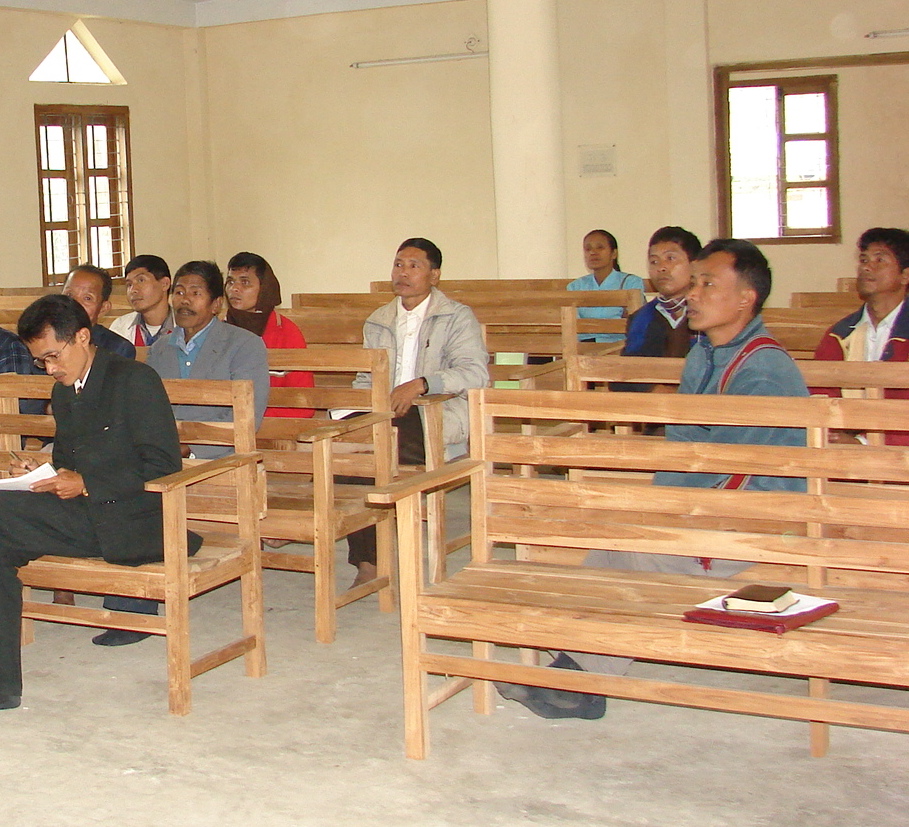
There it is on the fella in the sweater in the far left seat of the front row.

Addicted To The Taste

Neal Pollard

On a slightly different life’s path, Kathy could easily be a world-famous, wealthy celebrity on Food Network.  Her culinary skills and creativity in the kitchen has yielded some incredible dishes that would cave the iron-willed. Incredibly, she has learned through the years to make things that are good for you not simply palatable but tasty!

In 1 Peter 2, Peter urges Christians, facing an ultimate inheritance from a God who wanted them though impeded by persecution by a world who did not want them, “Therefore, laying aside all malice, all deceit, hypocrisy, envy, and all evil speaking, as newborn babes, desire the pure milk of the word, that you may grow thereby, if indeed you have tasted that the Lord is gracious” (1-3).

Peter urges them to purge from their spiritual diet those dangerous additives of attitudes in verse one.  They are more than malnourishing; they are poisonous!  Instead, he calls for them to hanker for the pure milk of God’s Word.  What would heighten their craving was having tasted the Lord’s graciousness.

May I suggest that this is a cyclical process.  In other words, we must be willing to begin feeding on the word.  For most, this is an acquired taste.  But from the first serving, the reader gets a taste of God’s good food.  It nourishes and satisfies.  It illuminates the soul.  It is practical in daily application.  It helps forge a closeness with God.  It gives strength in a difficult world.  The blessings of Scripture are multifarious, endless, and inexhaustible. The very experience of all of this by the consumer drives him or her right back into the Word for more!

Are you addicted to the sweet savor of Scripture?  If you are not partaking, you are starving your soul!  Those hunger pangs you feel cannot be satisfied by adulterated alternatives. Let us say with the ancient patriarch Job, “I have not departed from the commandment of His lips; I have treasured the words of His mouth more than my necessary food” (23:12).


THIS SATURDAY’S DOOR-KNOCKING

Neal Pollard

Two wonderful upcoming events should have us excited! Vacation Bible School is a prime opportunity for us to be evangelistic with our neighbors, friends, and co-workers.  It showcases the many talented people we have in our education program for children and it is always pulled off in an impressive way.  Our seminar/gospel meeting will be conducted by one of the most engaging, genuine preachers among us.  Steve Higginbotham will do an outstanding job.  There are several things we can do, but this Saturday’s door-knocking can accomplish so much to try and draw our nearest community neighbors to both these events.  May I make a personal appeal to you to be at our building this Saturday at 1 P.M.  To encourage you, consider three brief and true statements.

  • It Is Easy.  We are not setting up Bible studies.  We are simply inviting (or leaving fliers at the door if they are not home).  A quick, pleasant “hello” and statement of what we are inviting them to attend is all you need to know.  If you have access to small children, they always serve as an excellent buffer.  But, no matter your age or degree of cuteness, you will find this the easiest evangelizing you will ever do.
  • It Is For You.  Door-knocking is not just for the students, preachers, elders, or teens.  Parents, deacons, men, women, middle-aged folks, young adults, professionals, unprofessionals, blue-collar, white-collar, tall, short, fat, skinny, and if there be any other category, your presence is vital to the success of this.  So often, we assume others will do the work.  Please do not make this assumption.  If you are tempted to feel that way, know that others share that struggle.  Encourage somebody else.  Call or email them and tell them you are coming and ask them to come, too.
  • It Is Important.  You may be helping somebody take their first step toward heaven.  You might find somebody who has been searching for truth.  You may knock the door of somebody who has been struggling and looking for answers.  God may use you this Saturday to save a soul!  How wonderful to be able to face our dear Savior some day having taken opportunities like this Saturday to expose people to the Lord’s church.

I feel pretty confident that you will not regret participating in this Saturday’s mass inviting. It will require a little time, gas, and energy, but it is also one of those things that just leaves you feeling like you have helped the Lord a little in His mission of reaching the lost.  My highest hope is that I will see you this Saturday at 1 P.M. as we try to take greater Bear Valley for Christ!

THE MASTER MERITS MORE THAN MEDIOCRITY

Neal Pollard

  • In our giving–not grudgingly, stingily, just the leftovers and the afterthoughts; sacrifice.
  • In our living–be a light, be salt, make a difference for Christ in the world each day. Know that morality and example matter.
  • In our attending–not just Sunday morning or if nothing else is going on; come evenings and during special events like lectureships, seminars, and gospel meetings.
  • In our serving–whether in the sunlight or the shade, white-collar or blue-collar tasks, whether thanked or thankless the task.
  • In our praying–unselfishly, faithfully, constantly, praising and thanking along with the requesting.
  • In our speaking–take courage, keep it pure and wholesome, unite with your words.
  • In our loving–sincerely, fervently, without favor, following the example of Christ.
  • In our forgiving–from the heart, permanently, without digging it back up, humbly.
  • In our studying–dig, use word-study tools, pen and paper, perspiration, zeal.
  • In our evangelizing–pray about it, work up the nerve, and do it, consistently.
  • In our leading–be it elders and the church, parents and children, saints and sinners. 
  • In our teaching–pray, prepare, and present with passion; avoid laziness and volunteer
  • In our feeling–be joyful, be positive even in discouraging circumstances, be gentle always.
  • In our uniting-lead others to come together in Christ; avoid and discourage cliques, build up His body, remember it is His (Eph. 4:16).
  • In our worshipingput your heart in it; be enthusiastic; pay attention; yearn to co-participate with other saints in glorifying God wholeheartedly


He is the Great I Am.  He gave the most precious gift.  He loves us infinitely more than anyone else.  He will ultimately judge us. He is Awesome and worthy!  He is the source of every spiritual blessing.  He will never forsake us or leave us. He is the giver of every good and perfect gift.  He deserves our best!

GOD’S RELATIONSHIP TO ME

Neal Pollard

The prophet Jeremiah was concerned about the task before him. He felt he was unqualified and unseasoned (1:6).  He was wrestling with fears (1:8).  Whether or not we preach the gospel, as Christians living in this world we can relate to how hard it can be to stand up for Jesus.

The “omniscient” (all-knowing) God makes three statements about the as yet unborn Jeremiah. The God who sees the future as though looking at the past (cf. Isa. 46:10) says some things about Jeremiah before he was placed in his parents’ arms.  Consider three things God tells Jeremiah to reassure him and that bear relevance to us today.

God knew him. This seems to be specific and personal. How exciting to think that God sees us, as our hair, organs, bones and features develop, and knows who we are.

God set him apart.  He says, “I consecrated you.”  Some in religious error have made too much of this, teaching that God chooses us against our will and arbitrarily decides whether we are saved or lost.  God is simply saying, “I had you in mind to work for me.”  Isn’t it incredible to think that God thinks so much of us as to give us work to do.  The Great Commission confirms that God thinks that way about you and me, too (cf. Mark 16:15).

God gave him a job.  He says, “I appointed you.”  Does God determine your occupation, location, and station in life?  I cannot answer for Him, but He says that Jeremiah was appointed a prophet.  Jeremiah could have exercised free will and rejected the assignment, but that does not negate what God saw for him.  I know that Paul says we have differing abilities (cf. Rom. 12:6; 1 Cor. 12:4ff).  Observation says that we have different personalities, temperaments, and characteristics.  Whatever that is, we are all well-suited to serve some way in God’s kingdom.  The question then only remains, “Will we do our job?”

God is not detached and unconcerned about this world or the seven-plus billion people currently inhabiting it.  We can deduce that from the way He spoke of just one man who died over 2,500 years ago.  It is another proof of God’s desire to “relate” to us.  It should move us to want to “relate” to Him.

THE CONDITION OF THE PEWS

Neal Pollard

Since I was a little boy, I’ve heard the frets and tsks

Of spilled juice and food stains, and other soiling risks

End caps have threatened to come off, legs seemed near collapse

Faithfully we’ve scrubbed and hammered, to avoid “what ifs” and “perhaps”

The fabric fades with time and use, the joints are loosed with sitting

And many the lady and the man have saved them by nails and knitting

Let’s get a few more years from them, the cost to replace is too great

We’ll bolt them down and prop them up, and save them from an awful fate

But what is the condition of the pews, when speaking metaphorically.

By that I mean the people on them, as we’ve used the phrase historically.

If too many are old and dying, and no efforts are made to reach others.

Those pews will look sparse and scattered from lack of sisters and brothers.

If those who use them think of Christian living as only time spent on them

They will not take their faith into a daily walk spent with Him.

I love the pews, the people that are striving to be more useful

Who love the Lord, who live that love, and refuse to be “excuse-full.”

They come and worship, with eyes all bright, and voices blending gladly

They help the sick, they reach the lost, they want to serve God badly.

What are you doing for the pews, for those who through Christ you’re related?

Is your love for those upon the pew growing stronger or has it abated?

The next time you go to take your seat and settle in for the worship time

Reflect a moment on these words set in this simple rhyme,

“What will I do to save the pew?  How much can I afford?

When I show care for every pew, I’m saying I love the Lord.”

CONTRADICTING: The Pastime Of Our Time

Have you noticed that, no matter what the topic or matter one may choose to bring up, someone or ones seem to feel compelled to say something to contradict it?  What fuels the activity is known only to the doer, whether a need to seem expert or more knowledgeable, pride, a habit of argumentativeness, or the worldly, age-old practice of “disputing” (Phil. 2:14; 1 Tim. 6:4).  Doctrinally, we are called to lovingly defend God’s truth (Eph. 4:15), to gently help correct a brother (Gal. 6:1) or non-Christian (2 Tim. 2:24-26), and to guard the name of Christ against all attacks.  That is courageous and spiritual.

But, do you know what I am referencing?  That nit-picky, minute, non-essential practice of increasingly many to just “have” to correct somebody and everybody.  Why is that?  Perhaps forums like Facebook feed that tendency, where folks “drive by” somebody’s wall and “need” to be heard and seen as the guru and all-wise.  Perhaps it is something far more benign.  Surely, we don’t see how easily we sign up for the sport of sparring speech.  But, all of us are well served to ask, “What is my purpose in contradicting? What fruitful thing am I seeking to accomplish?”  If we can find no good answer, let’s challenge our own desire to challenge another.  Such makes for “seasonable speech” (cf. Col. 4:6).

Don’t Take A Dog By The Ears

Neal Pollard

I was shocked to hear this morning that local NBC morning news anchor, Kyle Dyer, was bitten on the lip by an Argentine Mastiff in a “feel good story” about the dog, who was rescued by a local fireman from a frozen pond in Lakewood.  The segment was a reunion between the dog and its owner and the rescuer.  The dog showed no signs of aggression, but Dyer leaned in way too close as if to kiss or snuggle with “Gladiator Maximus.”  Though certainly showing that she is a dog lover, Dyer would no doubt, in hindsight, have done things differently.  Considering the size, the breed, and even the trauma through which the dog had just undergone, this was not a wise move.  Dyer had reconstructive surgery and may be off the job for as much as a month.

In Proverbs 26:17, the writer says, “Like one who takes a dog by the ears is he who passes by and meddles with strife not belonging to him.”  The inspired writer is referring to one “sticking his nose” in someone else’s “business.”  I have not ever taken a dog by the ears, but when I was four I tried to throw a house cat into a 50 gallon barrel on our carport.  The insides of my forearms did not fare well, as I bore skid marks from biceps to wrists.  That cat was minding its own business when I foolishly made it (the cat) my own.

Maybe you have never been so foolish with a dog or cat, but have you ever made someone else’s business your own?  It could have been unsolicited advice, taking sides in a conflict between two parties, being a busybody, or the like.  Avoid such a habit!  Sooner or later, you will receive a painful lesson that might hurt badly!  Your interference may hurt others, but you may will inevitably injure yourself–your feelings, reputation, or even character.  Maybe, meddlers should get a sign that reminds them, “Beware of the dog.”  Save yourself!  Let others’ business be just that.

Psalm 15

Neal Pollard

Who may permanently pitch his tent on the holy hill of the Lord?
Who is the one that may stay, content, without harm or hurt or discord?
The one who with godliness walks and works, with truth upon his heart
A trustworthy person who wickedness shirks, who in evil takes no part
His tongue he watches and reins, his friends do not fear he’ll betray
From slanderous, evil speech he refrains, he avoids every disloyal way
His sense of right and wrong is clear, his word is ironclad,
His fear of the Lord his actions steer, he despises all men who are bad.
The innocent he carefully protects, he’s compassionate if he lends.
The hurting he never neglects, the downtrodden are his friends.
What happens to such a man, the one up on God’s holy hill?
Move him? No one can! He is entrenched in God’s  unchanging will!