TRY THE CONTEXT!

Neal Pollard

“Big dummy!” That can be a derogatory statement or the description of a large mannequin. Context makes all the difference! So it is with matters of infinitely greater significance. So much religious error exists because of a failure to consider the context of biblical passages.

Our friends in religion who believe that Jesus is a created being rather than one of the three everlasting personalities of the Godhead defend their view with passages such as Colossians 1:15, which says, “He is the firstborn of all creation.” A further study of the use of the word “firstborn” shows that it is used literally (Heb. 11:28) and figuratively (Heb. 12:23) in the New Testament. Context determines the difference. What is it in Colossians 1:15? The context says that Jesus made everything that was made (16-17). Did He make Himself? No, He cannot both be literally, physically born and be the One who created “all things.” Logically, Paul is speaking in a figurative sense, that in His human nature Jesus is “at the head of His class.” He is first in order, preeminent among men (18). As a human, He is above us and first among all of us.

Others of our friends teach salvation by faith only. They appeal to a couple of passages to assert this idea. One passage is Acts 16:31, where the Philippian jailer is told, “Believe in the Lord Jesus, and you will be saved, you and your household.” This is given as proof positive that salvation comes at the point of faith. Another text cited, the “golden text of the Bible,” says, “For God so loved the world, that He gave His only begotten Son, that whosoever believes in Him should not perish, but have eternal life” (John 3:16). This statement is made as part of a conversation Jesus is having with Nicodemus.

In the case of the jailer, who saw the miraculous power of God in opening the jail doors and who asked what he must do to be saved, he is told to believe in Jesus. It is noteworthy to ask, “How much would the average Philippian jailer know about Jesus?” Thus, Luke adds the important detail that before we read of the man’s response, “They spoke the word of the Lord to him” (31). His response is found in verse 32, where he washes Paul and Silas’ wounds and is immediately baptized. This accords with the broader context of Acts, where believers are told to repent and be baptized for the forgiveness of their sins (2:38; 22:16).

In the case of Nicodemus’ instruction, Jesus’ makes the statement of John 3:16 in a certain context, too, a context that included talk of water (3:5) and an illustration from the book of Numbers. That illustration is very noteworthy for showing that more than belief is necessary for salvation. It concerns the serpents God sent upon the murmuring and complaining Israelites. Numbers 21:9 says, “So Moses made a bronze serpent, and put it on a pole; and so it was, if a serpent had bitten anyone, when he looked at the bronze serpent, he lived.” How did salvation come, simply by believing in God’s plan or by believing AND looking? Likewise, the broader context of scripture shows faith and works joined together. Israel did not earn the saving of their lives by looking any more than we earn salvation from sin by believing and being baptized. Yet, God makes it as essential to obey today as He did during the wilderness wandering. Context bears this out.

Let us never be “scripture isolationists,” those who peel a verse away from its context or who rest our confidence in doctrines that have been thus constructed. God saw to it that we would have His word and will preserved. How wise of us to make sure we properly study it in context!

8695269997_dfc20e7b8a_z

The Courage To Try

Neal Pollard

About nine months ago, a man walked into our building a day after being immersed into Christ. He had been searching diligently for the truth, a man whose hunger for the Bible caused him to study his Bible for hours every day (including on audio at his job as a metal fabricator). He continues those habits today.

A man whose life is as interesting as his name–Roberto Yrey–has been a blessing to us at Bear Valley.  One of the reasons I’ve grown to love him so much was on full display last night. Each Wednesday, a different man delivers a 90-second devotional talk. Last night, Roberto spoke. Don’t misunderstand. He writes devotions, short sermons, and articles all the time in order to articulate his understanding of a Bible chapter or topic he has been studying. He changed his mind multiple times before settling on the one he delivered last night. If you were there, you know that Roberto was nervous. He has told several of us how difficult public speaking is for him. His only previous public speaking opportunity was a Scripture reading during a devotional back during the holidays.

What he chose to speak about last night so aptly reveals a mindset that makes him so endearing. His message was that you don’t have to know everything to study with someone. Don’t be afraid to tell someone, “I don’t know.” It’s OK if you don’t know or understand everything. He encouraged us, “Say, I don’t know but let me ask someone who might know. Or let’s fellowship and find the answer.”  But his message was to not let the fear of not knowing keep you from talking to someone about the Bible.

I admire the fact that Roberto had the courage, as a babe in Christ, to speak to a room full of people some of whom have been preachers and teachers for decades, teachers in our Bible school for many years, and are mature, seasoned Christians. But I admire him even more for practicing what he was preaching. In our midst last night were two visitors–Estevan (there for the first time) and Sean (who’s become a regular attender with Roberto for several months). He had the courage to invite them. Today, we baptized Sean into Christ for the forgiveness of his sins. A young Christian has already brought a friend to Jesus. All it took was the courage to try, to do what anyone can do who is moved by simple, trusting faith to just do what God has told us to do. I don’t know about you, but Roberto’s example helps me have the courage to try harder!


6EDBBE5E-E7F1-45A2-A97C-7BDFAFAE2790
(L) Sean being baptized today by Allen Javellana, who studied with him. (R) Roberto preaching at Bear Valley last night.

Misusing The Bible

Neal Pollard

Ashley Despain now holds a dubious, ignominious distinction. Visiting an inmate in a Nevada, Missouri, jail, Ashley tried to sneak him marijuana and methamphetamines by sticking them into the binding of the Bible. Officials say they have seen many ways used to smuggle drugs to prisoners, but it’s the first time the Bible was the means chosen (via http://fox2now.com/2018/03/29/).

File that under “truth is stranger than fiction.” As incredible (and audacious) as that sounds, Ashley was not the first to misuse the Bible. How many have tried to use the Bible as a means of enriching themselves? Peter speaks of false teachers who exploit listeners with false words because of the teachers’ greed (“make merchandise of,” KJV, 2 Pet. 2:3). How many have tried to use the Bible as a means of defending personal sin or a sinful lifestyle? How many have tried to use the Bible as a billy club to pound their own hobbies, convictions, and opinions over the heads of others? How many have tried to use the Bible to peddle some false doctrine? Peter experienced that, too (2 Pet. 3:16). How many have tried to use the Bible to manipulate others into doing things they themselves aren’t doing? Jesus warned against that very thing (Mat. 23:4). How many have tried to use the Bible to tempt others into disobeying God? That’s literally a Satanic trick (cf. Mat. 4:6).

James warns potential teachers to be careful, examining themselves in light of the judgment (3:1). This is not meant to scare potential Bible teachers away, but instead should help us consider carefully how we use the Bible. Paul mentions some that misused the Bible, even if what they said was true. From prison, he writes, “ Some, to be sure, are preaching Christ even from envy and strife, but some also from good will; the latter do it out of love, knowing that I am appointed for the defense of the gospel; the former proclaim Christ out of selfish ambition rather than from pure motives, thinking to cause me distress in my imprisonment” (Phil. 1:15-17).

Like Paul, we have a stewardship (1 Cor. 9:17; Eph. 3:1-2). Let’s be faithful stewards! None of us will probably try to smuggle drugs with a Bible. But, in every sense, let’s be sure to be “accurately handling” it (2 Tim. 2:15)!

ashley-despain-mug

HOW IS TRUTH DETERMINED?

Neal Pollard

Recently, I received some feedback on a recent article (Truth Is Truth, No Matter Who Disagrees With It). Negative feedback is not rare, but expected when we put ideas down on paper (or on electronic media like blogs). This feedback was not personal, nor unkind. Yet, it reflects the thinking of so many who shun the idea of absolute, objective truth. Consider the major arguments made by the one who wrote:

—No matter what you believe, the majority disagrees with you.
—You are no smarter or more sincere than those who disagree with you.
—Everyone is certain their religion is right, but this is a function of the brain and proof of nothing
—Conflicting views within the “Restoration Movement” shows the fallacy of being certain about truth
—Certainty is dangerous because it does not allow for change

The last three arguments seem more of a confrontation of certainty than arguments against truth, but consider each of these individually.

Does the inevitability of disagreement nullify the idea of absolute truth? If someone argues our answer that two plus two equals four, and were able to get a majority to side with them that the answer is five, does that nullify the truth of what two plus two equals?

If a person with demonstrable intellectual capacity and apparent sincerity nonetheless avers that two plus two equals five, do we rewrite the laws of addition and reprint the textbooks? If not, why not? Is it not because we can take two of something, add it to two more of the same something, like integers or apples or books, and find the inescapable, universal truth that now there are four?

Can any religion be certain that they are right, but be wrong? Universalists believe everyone will ultimately be saved. Those who believe that murdering those they deem “infidels” pleases their God and they teach others that this is truth. Cults often dub their leaders the Messiah. On what basis would we object or oppose any religious tenet, like these, without an objective standard of truth?

Does the imperfection of people in applying revealed truth impugn the reality of absolute truth? It will never be suggested that anyone is perfectly interpreting or applying the perfect standard of truth, including those trying to restore New Testament Christianity (which, incidentally, implies belief in a perfect, objective standard of truth). But, does that mean restoration can or should be rejected for ideas which clearly contradict what the New Testament says (i.e., “sinner’s prayer’ versus how the New Testament teaches people were saved)?

If there is a conflict between the certainty of New Testament teaching and the desire for change, which is to be preferred and chosen? The religious world has changed a myriad of things that the New Testament explicitly teaches must be done or taught a certain way. Isn’t it a faulty premise to choose change proposed by men, when it assaults a certainty revealed by God?

That there is religious confusion and division is indisputable. It is disheartening. The Bible warns that articulate, polished religious leaders would teach things contrary to the revealed truth of the New Testament (Gal. 1:6-9; 2 John 9-11; Rev. 22:18-19). Let us never put confidence in man, but let us ever put confidence in the truth of Scripture.

OLYMPUS DIGITAL CAMERA

“Vain Jangling”

Neal Pollard

The English language has done some changing in the 400-plus years since the King James Version was made available. Within its pages, you’ll find phrases like “straitened in your own bowels” (2 Cor. 6:12), “superfluity of naughtiness” (Jas. 1:21), “bloody flux” (Acts 28:8), “filthy lucre” (Ti. 1:7), and “the thick bosses of his bucklers” (Job 15:26). There is a beauty and picturesqueness to the Elizabethan English, though. One example of this is in 1 Timothy 1:6, which warns against “vain jangling.” To me, that’s a vivid way of translating a compound Greek word translated elsewhere as “fruitless discussions” (NASB), “idle talk” (NKJV), “vain discussion” (ESV), “meaningless talk” (NIV), and “empty talk” (MEV). Have you ever heard anyone jangling keys or coins in their pockets? It’s usually a nervous tic and mindless habit, but it can loud and annoying. In the 17th Century, the word meant to “talk excessively or  noisily, squabbling” (Apple Dictionary, 2.2.2).

In context, Paul gives the culprits, the creed, the consequence, the contrast, and the cause of this “vain jangling.” The culprits are “certain men” (1:3) or “some men” (1:6). Their creed is “strange doctrines” (1:3), “myths and endless genealogies” (1:4), and this “fruitless discussion” (vain jangling). The consequences are dire, as such will “give rise to mere speculation” (1:4). The contrasts are “the administration of God which is by faith” (1:4) and “instruction (in) love from a pure heart and a good conscience and a sincere faith” (1:5). The cause is revealed in verse 7, that “they want to be teachers of the Law, even though they do not understand either what they are saying or the matters about which they make confident assertions.” Paul had a particular circumstance in mind, but is there an application to us today?

In 2018, there are numerous platforms and avenues to communicate. It can be easy to forget that James’ warnings about the tongue are not limited to words which are audibly heard, but whatever we speak. I need to be cautious about being a religious noisemaker, banging and clanging with reckless abandon. My words have meaning, and they hold the power of spiritual life or death within them (Prov. 18:21). Thus, great restraint, copious forethought, and thoughtful execution ought to permeate my speech, wherever it is “heard.” Otherwise, I may simply be declaring my thoughtless ignorance, both uninvited and unwelcome, and come off sounding like three dollars of pennies churning in the pocket of a champion fidgeter.

Paul speaks of Christians as “ambassadors” for Christ (2 Cor. 5:20). We must represent Him righteously and accurately. We may be the first and only megaphone through which Christ is proclaimed, so let us speak accordingly. Let’s make Him proud, for His message is “words of sober truth” (Acts 26:25), not vain jangling.

ntts3l5

Truth Is Truth, No Matter WHO Disagrees With It

Neal Pollard

Today, one of the most famous preachers of modern times died just short of his 100th birthday. Not only did he achieve longevity, his name was almost synonymous with American religion in the 20th Century. He reached hundreds of millions of people through live crusades, radio, and television. He was regularly listed as one of the “Ten Most Admired Men in the World.” His website claimed that he preached to more people in live audiences than anyone else in history (info via FoxNews.com).  His influence on society is unmistakeable.

However, this much loved and now much lamented man used the weight of his name and influence to oppose something which Scripture seems very clearly to teach. In the answer section of his website, he addresses the question, “Is baptism necessary for salvation?” While answering that he believed it to be important and that he had done it himself, he also said, “If baptism were a requirement for salvation, we would certainly say that.” His answer makes clear that one becomes a saved convert before baptism, the thief on the cross being used as proof of that claim. Many of those who left comments under his answer shows how deeply influential and popular his teaching on this was.

I believe in the vitality of the saying, “It’s never a matter of ‘who’s right,’ but ‘what’s right.’” Something is never right because I say it, some other preacher, or even the most famous preacher of the 20th Century says it. Something is right because Jesus and His apostles and prophets said it. Here is what they said:

  • “He that believes and is baptized shall be saved” (Jesus)
  • “Repent, and each of you be baptized in the name of Jesus Christ for the forgiveness of sins” (Peter)
  • “Get up and be baptized, and wash away your sins, calling on His name” (Ananias)
  • “Or do you not know that all of us who have been baptized into Christ Jesus have been baptized into His death? Therefore we have been buried with Him through baptism into death, so that as Christ was raised from the dead through the glory of the Father, so we too might walk in newness of life” (Paul)
  • “For you are all sons of God through faith in Christ Jesus. For all of you who were baptized into Christ have clothed yourselves with Christ” (Paul)
  • “ Corresponding to that (Noah and family brought safely through the water, 20, NP), baptism now saves you—not the removal of dirt from the flesh, but an appeal to God for a good conscience—through the resurrection of Jesus Christ” (Peter)

I feel the loss of this renowned preacher is sad and tragic.  I appreciate his vast influence and the way he tried to use that for good in so many regards. Yet, if the Bereans found it necessary to compare the great apostle Paul’s preaching and teaching with Scripture, any of us who preach and teach today should want people to do the same. That’s the only way we will be able to determine what’s right!

55b-3246-1-1024x819

Deathbed Repentance?

Neal Pollard

“From the stirrups to the ground,
Mercy I asked for, mercy I found”
That is a distorted view of grace,
Which seeks God only in death’s face.

It cheapens that which cost Him much,
To use Him only as a deathbed crutch.
Unlike the seeker at his eleventh hour,
Who sincerely reaches for His saving power,

The hardened sinner who in last resort
Hedges his bets for some eternal life support.
So many never reach a deathbed sound in mind,
Or care for His will ’til their death warrant’s signed.

While God is long-suffering, wanting all to be saved,
The majority spend their lives to sin’s power enslaved
They only think heaven when earth’s living is through,
But an afterthought gesture will just not do.

Scripture says “come now,” not “wait til tomorrow,”
So many delayed to their own regret and sorrow.
Instead of relegating God to a last-ditch recourse,
Submit to Him now, you He’ll publicly endorse.

Deathbed repentance is not found in His Word,
No matter what men from their wisdom you’ve heard.
Obey from the heart what His doctrine requires,
Let His word be your truth, let all others be liars.

thinkstockphotos-sb10069454g-001

It’s Great To Be A Preacher!

Neal Pollard

Preachers have:

  • The greatest message to communicate (Rom. 1:16). It is infinitely better and more important than that shared by broadcasters, news anchors, and sports analysts (cf. 1 Cor. 1:18).
  • The greatest “boss” to please (Eph. 6:6-7). I have known and worked with so many great elders. I understand that they “hired” me and can “fire” me. Ultimately, though, I work for God–no greater One for whom a man could work!
  • The greatest mission to fulfill (Mat. 28:18; Mk. 16:15; Lk. 24:46). Doctors save bodies, firemen save lives and property, and accountants save money. Preachers save souls!
  • The greatest people on earth to serve (Eph. 3:21). The church certainly has its problems and members who hurt the cause. Yet, so many are wonderful, encouraging, and supportive! They love the Bible.
  • The greatest colleagues in the world (Ph. 1:15-17). True, some are sore tails, jacklegs, unethical, theologically radical, and theologically liberal. However, the “average” preacher (far from that) is worthy of hero-status! Remember Romans 10:15.
  • The greatest opportunities in the world (cf. Gal. 6:10). You never know what the new day will bring! Preachers get to study the Bible several hours each day, visit with Christians, set up and teach Bible studies, do mission work, preach gospel meetings and lectureships, and just have the privilege of preaching and teaching week after week!
  • The greatest retirement plan possible! It includes a crown of life (Rev. 2:10), a heavenly home (Heb. 11:16), and souls won to Christ “to their account” (1 Cor. 3:12ff).
20915072_10213397375266980_537118901696140542_n
A few of my favorite preachers (and a couple of their ladies)

The Religious Freedom Rally For Jack Phillips

Neal Pollard

It was my privilege to be in attendance at the “Religious Freedom Rally for Jack Phillips,” held on the campus of Colorado Christian University in Lakewood, Colorado. If you do not know, Jack Phillips is the owner of Masterpiece Cake Shop, a business he opened and has operated since 1993. Because he refused to decorate a cake for a same sex couple, Phillips was sued. His case has gone through the various court systems and will be heard before the United States Supreme Court on December 5, 2017.

While the Event Center where it was held was not packed and overflowing, there were hundreds present. I met and walked in with a young man and woman from Sweden, who came to the United States primarily to cover this event for a Christian Magazine in their country. The rally’s speakers included the head of Catholic Charities, the managing director of Jewish values, a state senator, a congressman, part of Phillips’ legal team, university officials, Barronelle Stutzman (the owner of Arlene’s Flowers in Richland, Washington, who was sued by Robert Ingersoll because she refused, out of conscience, to make a floral arrangement for the same-sex wedding of Ingersoll and Curt Freed), and others.  There were many poignant moments and memorable quotes. A team member from the Alliance Defending Freedom, representing Phillips, said, “America did not give us freedom of religion. Freedom of religion gave us America.” Mrs. Stutzman still does not know if her case will be heard by the SCOTUS, and she stands to lose everything financially. Yet, she was gentle, meek, and soft-spoken, though obviously full of conviction. The tone was cordial and respectful, from every speaker to everyone in attendance. The rabbi, Yaakov Menken, said, after talking about ancient, longstanding forms of “political correctness,” that “what is new and profoundly disturbing is the use of civil rights to trample civil rights.” Last of all, Jack himself spoke. It was understated, almost matter-of-fact. He spoke eloquently and simply about the importance of our being able to act in accordance with consciences shaped by Scripture. Everyone spoke of the importance of believing and behaving in accordance with convictions that are dear because they are true.

Today was a stark reminder of the reality of forces who are actively assaulting faith in God and His Word. These are willing to do whatever they can to prevent us from doing what God has commanded us to do—share the pure, unaltered will of the One who gave us life and saved us from our sins. They are not bound by biblical ethics, so they will deceive, distort, manipulate, bully, attack, suppress, and fight divine truth. We are bound by a higher law, but truth, kindness, mercy, and love, as taught by God, will prevail. If not now, if not under our government and institutions, then undeniably at the very end of all things. Don’t lose heart. Whatever else you may lose at the hands of those described by Jesus in Matthew 5:44ff, some things cannot be taken away from us! Hold onto to those things.

Screen Shot 2017-11-08 at 1.37.31 PM

Religious Freedom Rally For Jack Phillips

Who Is The “Troubler Of Israel”?

Neal Pollard

Ahab was the most wicked king in Israel’s history (1 Kings 16:30). To top it off, he was married to perhaps the most immoral woman revealed to us during the time of the divided kingdom in the Old Testament. Her name, Jezebel, is still somewhat infamous today. She destroyed the prophets of the Lord (1 Kings 18:4). The prophets who survived feared for their lives because of Ahab (18:9). Instead, Jezebel kept a stable of false prophets, 450 prophets of Baal and 400 prophets of Asherah (18:19). Read this section of 1 Kings and the first nine chapters of 2 Kings to get the full flavor of who this notorious couple was.

How ironic that when Elijah appears to Ahab before the prophet’s infamous confrontation with the false prophets on Mount Carmel, Ahab’s first words to him were, “Is this you, you troubler of Israel?” (18:17). There was controversy, division, problems, and trouble in the land, but Ahab’s narrative was distorted. Ahab was like a reckless drunk driver weaving in and out of traffic and blaming a law-abiding pedestrian for being in his way on the sidewalk. Elijah was not the troubler of Israel for daring to oppose the false ways of Ahab and Jezebel. He was doing exactly what God wanted him to do!

In our present, lawless age, there are so many “prophets” who come along with a message appealing to right ideas like peace, grace, unity, and love. Many of them package themselves in the garments of relevance, using our culture as their props and stage. The causes célèbre which our age reveres, some of which are diametrically opposed to the doctrine, ethics, and morality outlined in Scripture, are pushed at God’s people—who are shamed and made to feel unrighteous if they dare protest what is said. In some circles, it is asserted that anyone teaching that the Bible is authoritative, contains a pattern, and is God’s objective truth for all times, is Pharisaical, consumed with self-righteousness, hateful, mean-spirited, and divisive. In short, that they are “troublers of Israel.”

As a quick side-note, there are some who do press their personal proclivities, traditions, and convictions as divine truth. This is as accursed a thing as seeking to nullify what God has bound in heaven (cf. Mat. 16:19; Rev. 22:18-19). Such folks manufacture trouble rather than trouble people by faithfully sharing God’s Word. These occupy unenviable ground, in view of the end of all things.

Yet, anyone who conscientiously tries to follow God’s blueprint for how to share His truth (Eph. 4:15; 2 Tim. 2:24-26; Col. 4:6), who takes care to handle Scripture accurately (2 Tim. 2:15), is going to invariably encounter the Ahabs, Jezebels, Baalites, and Asherahists. Teach the singular, undenominational nature of the church (Eph. 4:4), the role of women in the church (1 Tim. 2:9-12), the essentiality of baptism in God’s saving plan (Acts 2:38), God’s plan for marriage and sexuality (Mat. 19:1-9; Heb. 13:4; Rom. 1:26-27), and the like, and it will come. The Ahabs will label you the troublemaker and the source of the problem.

In what may sound dark and grim, Paul warns Timothy that difficult times will come (2 Tim. 3:1). He speaks of men immoral in nature and inaccurate in message who succeed with the weak and impulsive (3:6), who themselves are “always learning and never able to come to the knowledge of the truth” (3:7), who in fact “oppose the truth, men of depraved mind, rejected in regard to the faith” (3:8). Ultimately, they will not carry the day (3:9). But they will always have their eager followers who “accumulate for themselves teachers in accordance to their own desires, and will turn away their ears from the truth and will turn aside to myths” (4:3-4).

Suppress the victim mentality if you are trying to be an Elijah in this Ahab society. On the job, at home, in the community, within the religious community at large, and even at times within the church, “preach the word” (2 Tim. 4:2). Do it with great patience and instruction, as Paul counsels. Don’t be a troubler in God’s eyes, but know that you will be seen as one in the eyes of some in this world. Keeping company with Elijah is not a bad thing.

012-elijah-baal

Do You Want A Better Life?

Neal Pollard

Who would answer “no” to that question? Who wants a worse life or a life that never gets better? But the better question is, “How do you get a better life?” Advertisers have so many answers to that, involving their currency or investment tool, their pill, diet, or workout routine, their travel agency or vacation destination, or product for your home, transportation, business, and the like. So many put so much into these promising plans, but still find their life wanting.

In religious matters, there is no room for subjective thought when it comes to what it takes to have a better life. We find ourselves often bobbing in a sea of religious confusion. Many groups claim to be the best religion and point to their ingredients as reasons for such claims. They point to their numeric size, number of programs they have, or how socially active they are. Our religious attitude ought to be one of humility, not boasting of our achievements or comparing ourselves with others (cf. 2 Cor. 10:12). Genesis 4:1-16 points us to the first recorded version where more than one kind of worship was offered to God and how God rated them. But this chapter also paints a picture of two ways of living life.

Cain is mentioned by three Bible writers after Moses writes about him in this chapter. The writer of Hebrews calls Abel’s offering more excellent than his (Heb. 11:4). John calls his works evil and his allegiance “of the wicked one” (1 John 3:12). Jude implies that the way of Cain is the wrong way to go (11). It seems that Genesis four shows us the better ingredients for a better way of living today.

  • Better living isn’t determined by age (1-2). Cain was the firstborn, a place of honor and privilege especially throughout the Old Testament.  But under the New Covenent, there is no spiritual advantage because of birth order. It is not a matter of firstborn, but a matter of being born again (John 3:1-7). Growing older should mean growing wiser, but reaching a milestone on a calendar does not equate to better living.
  • Better living isn’t determined by occupation (2).  Growing up, we might be tempted to see our occupation as the gateway to happiness and satisfaction, financial freedom and security, independence, and privilege.  When we look at Cain and Abel, what they did for a living wasn’t the determiner of the quality of their lives. Some occupations can stand in the way of better living, whether the nature of the job or the quality of the people one works with. Some can let their jobs stand between them and their relationship with God and His church. But, one can do right in unfavorable work circumstances, staying faithful to God.
  • Better living is determined by worship (3-4). That statement may be offensive to our multicultural world that says there are no absolute rights or wrongs. Contrast our culture’s thinking on this matter with what we read in Genesis four. Both Cain and Abel brought an offering to the Lord. God responded to both offerings, but He accepted one while rejecting the other. While many make worship nothing more than taste, preference, and personal, we learn here that not all worship is equal. God “had regard for” Abel’s, but not for Cain’s. It does not say if Cain was sincere. It doesn’t seem to matter. We learn here that the worshipper and the worship offered rise and fall together. God regarded Abel and his offering, but rejected Cain and his offering. Can one offer God vain worship, and have God reject it but accept him? Apparently not.
  • Better living is determined by attitude (5-7). Cain reacts to having himself and his worship rejected by God. He was very angry. His insides burned! His countenance fell. He took on an ugly look. We’re not told how old he was, but it almost sounds like a temper tantrum. Whether home training, lack of discipline, poor stress management, pride, jealousy, or anything else leads us to lose our tempers, all of them are matters only we can control. When we don’t control them, we’re responsible! Ill-tempered people are not living the better life! A positive life doesn’t require prospering, education, or earthly success. But you can’t have a positive attitude without mastering self.
  • Better living is determined by action (8-16). The word “sin” is first used in Genesis 4:7, but God was looking ahead with perfect foresight to what Cain was going to do to his brother (cf. 1 John 3:11-15). Bible writers speak of his deeds, offering, and way. These are all action words. After his sin, he is rebuked and punished by God and separated from God. Sin will not deliver what it promises. All actions have consequences (Gal. 6:7-9).

Someone said, “The line of Cain gives us murder, cities, polygamy, musicians, metal workers, and poetry, but not one who walked with God.  In fact, Cain’s legacy led to a repeat of his violent ways by a descendant (cf. 4:23). Abel leaves no physical lineage, but he leaves a great spiritual heritage (Heb. 11:4). We each get to choose what kind of life we’ll pursue. It matters which way we decide.

cain-and-abel

“Wait Until Fall”

Neal Pollard

It was a beautiful experience, talking with our newest brother in Christ last night. It was beautiful watching him be bombarded with love and attention from member after member. Listening to him tell his story built my confidence in the simplicity of the Bible when a person reads it without prejudice or agenda. What an affirmation that God has a will for us and He made sure it was understandable to the seeker. As Jesus put it, “Seek, and you shall find” (Mat. 7:7).

Roberto has been seeking. As he has been attending a large, area Community Church, he has also been studying his Bible. He’s been a diligent student. Along the way, he read the repeated emphasis upon baptism as a necessity for salvation. This prompted him to approach his church and ask if he could be baptized. He was told that they baptize in the fall, and he could be baptized then. His immediate concern? What if I am killed in a car wreck or my phone blows up when I charge it? There was no manipulative or badgering teacher filling his head with such scenarios. Instead, he could make the connection between a command from God and the consequences of disobeying it.

He started Googling the importance of baptism and eventually found World Bible School. This led him to connect with Terry Pace, a Christian in Flint, Michigan, who studied with him. Roberto wanted to know if he could be baptized. Terry went to work. Terry’s son, Sam, happens to preach at the Northwest congregation in Westminster. One of the Northwest members, Allan Javellana, met him to study with him on Monday and found out he had sufficient understanding to be baptized. Since he lives close to Bear Valley, Allan brought him to our building where Wayne Nelson let him in. Allan stressed with Roberto the importance of working and worshipping with a group that is trying to answer Bible questions with Bible answers.

On Pentecost, they asked “What shall we do?” (Acts 2:37). They were told (Acts 2:38), and they acted that day (Acts 2:41).

On the road to Gaza, the eunuch asked Philip (who had preached Jesus to him, Acts 8:35), “Look! Water! What prevents me from being baptized?” (Acts 8:36). They stopped the chariot right there and then, and he was baptized (Acts 8:38).

At Cornelius’ house in Caesarea, this Gentile asked Peter to come over from Joppa (Acts 10:23ff). Cornelius knew Peter would be speaking words by which he could be saved (Acts 11:14). When it was clear that God wanted Gentiles to be saved (Acts 10:44-47), Cornelius and his household were baptized on the spot (Acts 10:48).

In the prison in Philippi, the jailor asked, “What must I do to be saved?” (Acts 16:30). He’s told to believe on the Lord Jesus Christ (Acts 16:31), Who they proceed to teach him about (Acts 16:32). Armed with this knowledge of the Savior, this jailor “immediately…was baptized, he and all his household” (Acts 16:33).

Nobody waited because God’s answer was “now.” What has changed from then to now? What would make a different answer acceptable today? Roberto is another, amazing example of what a receptive heart does when faced with God’s Word and will. Simply, humbly do what He says. Oh, that I will approach God’s Word the same way!

water-baptism

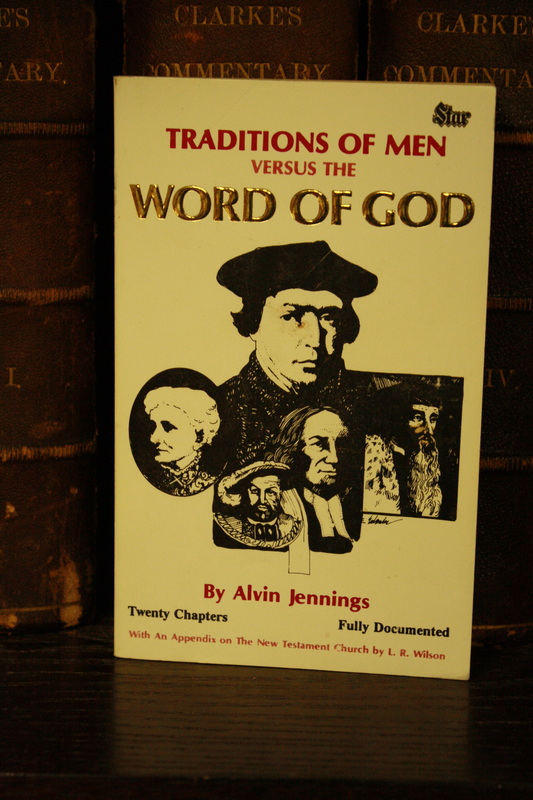
Traditions Of Men Versus The Word Of God

Neal Pollard

For as long as I have been preaching, I have had at least one copy of the Alvin Jennings’ book bearing the title above. The book was originally printed in 1972, but it has been reprinted several times. Jennings clarifies the way he uses the word “traditions” in his title. Rather than the sense of being a writing handed down from God (2 Th. 2:15; 3:6; 1 Co. 11:2), he used the word to refer to “religious laws and traditions originating from the minds of men and handed down orally and/or in printing from generation to generation” (iv.). He rightly points out that such traditions were condemned by Christ (Mat. 15:2-3,6; Mark 7:3,13; Col. 2:8; 1 Pet. 1:18; Gal. 1:14). Some of the problems with these traditions were that they got in the way of obedience to what God commanded, caused negligence regarding and the setting aside of God’s commands, enslaved one to something or someone other than Christ, and created a zeal that could lead to unhealthy consequences. The traditions Jennings examines substituted  false, human ideas for clearly revealed, divine truth. Anything that binds where God has not bound or gives permission where God doesn’t permit must be rejected. It’s a tradeoff with the gravest consequences (cf. Rev. 22:18-19).

However, I hope that as we strive to follow the pattern for New Testament Christianity we will be careful about elevating any tradition to be on a par with Scripture. There are some traditions we may choose to observe (or not):

  • Offering an invitation after every sermon
  • Having worship leaders, including the preacher, wear suits and/or ties
  • Women wearing dresses to church services
  • Songs or songbooks reflecting a particular time period (whether old or new)
  • Mandating a specific Bible version be utilized in the public assemblies
  • Choosing to have an evening assembly
  • Replicating the format of the morning assembly (in lieu of using the time for class, for example)
  • A particular order of worship (including whether the Lord’s Supper precedes or follows the sermon)
  • Offering the Lord’s Supper on Sunday evening
  • Any practice or tradition that arises from expedience or the realm of judgment, but that is not specifically mandated in Scripture

The church finds itself at a crucial crossroads. Undoubtedly, there is nothing new under the sun, but we do find ourselves at a unique place in cultural history. Since we live in an argumentative, rancorous atmosphere fueled by everything from cable news to social media, we should be careful to maintain a spirit of love and kindness whenever we sort through matters like these. We should never cherish non-binding traditions more than we do people. Those of us who are older and presumably more mature should consider carefully where and when we might compromise regarding matters not tied down in Scripture. More than that, we should foster rather than fear an environment that allows for such discussions to occur—without animosity or distrust. This will mean spending much more time developing our relationships with one another on the local church level (across generations). The better we know each other and the more we grow our love for each other, the better equipped we should be to sort through such things. Coupled with serious Bible study, this will hopefully sharpen our ability to distinguish between traditions and truth. May we have the grace to listen to each other without prejudice or minds already made up. Instead or ridiculing or caricaturizing the church in demeaning ways, let all of us “put on a heart of compassion, kindness, humility, gentleness and patience; bearing with one another, and forgiving each other, whoever has a complaint against anyone…” (Col. 3:12-13a). 

s702601590478870340_p115_i1_w533

One Of The Hardest Biblical Positions To State

Neal Pollard

There are few statements or pronouncements that are clearer than Jesus’ words in Matthew 19:9, yet perhaps none, in our current culture, is more intimidating to state. Jesus contrasts His will on marriage, divorce, and remarriage with the already existent stance of the Law of Moses. He says, “Because of your hardness of heart Moses permitted you to divorce your wives; but from the beginning it has not been this way. And I say to you, whoever divorces his wife, except for immorality, and marries another woman commits adultery” (19:8-9).  From this brief response (the Pharisees ask the question, testing Him in verse three), we see:

  • The teaching transcends time and culture—“From the beginning…and I say to you”
  • The teaching transcends all other authority—“I say”
  • The teaching transcends only believers—“Whoever”
  • The teaching transcends the caveats and conditions men have tried to place on the matter of marriage, divorce, and remarriage (not the specific law with its exception).

Yet, despite the clarity of Jesus on the subject, in the spirit of Christ we want to always approach this with utmost compassion, patience, and tenderness. Souls are at stake. Often, children are involved. Emotions are inevitably involved. A cold, callous treatment of people’s lives will surely draw Divine disapproval. That’s why Jesus’ stated position on this matter is one of the hardest to take. But, that cannot mean that we refuse to stand with Him in His teaching. However, we should ask why it is so hard to stand where the Bible stands on this matter?

—Learned men have stated different positions from this.
—Divorce is so prevalent in our culture.
—All of us have family members who are in marriages that violate Matthew 19:9.
—Marriage involves one of mankind’s greatest drives and needs (cf. Gen. 2:18-25).
—Leadership in more and more congregations refuse to deal with marriage, divorce, and     remarriage in the classroom, pulpit, or the hands-on shepherding of the local church.
—Few of us relish the role of being “the bad guy” (the one who has to break heartbreaking news to husbands and wives).

I could lengthen the list of reasons, and you could add several to it, but if the list grew to hundreds of reasons, we have one sobering, gut-wrenching question to ask, “Do any of them nullify the strength of Jesus’ teaching?” If Matthew 19:9 were not in the Bible, fewer preachers would have lost jobs, fewer elders would have lost favor, and fewer churches would have seen members go to congregations accommodating their marriages. But, Jesus warned that His way was difficult (cf. Matt. 7:14). He tells aghast disciples that discipleship requires whatever sacrifice is necessary to follow Him (Matt. 19:10-12). That message must be shared lovingly, gently, and patiently. There can be no other way (cf. Eph. 4:15). The harsh, unkind, or mean-spirited will deal with the Judge of all (cf. 1 Pet. 4:5; 2 Tim. 4:1). However, what will be the case for those who neglect, change, or distort what Scripture says to accommodate people? Perhaps there’s no way to ask that question without evoking a visceral reaction from those who have reinterpreted Jesus’ words, but in light of eternity it must be asked. Balance looks for biblical truth in between unbiblical extremes. However unpleasant a position that may put us in, that is the place we must always humbly stand. But, the only enduring place to stand is on the rock solid foundation of Christ (cf. Mat. 7:24-27; 1 Co. 3:11). God give us loving, but courageous, hearts to stand there.

16026538371_0dfe26b678_b

Singing With The Understanding: “Beneath The Cross Of Jesus”

Neal Pollard

Most of us have favorite songs and hymns. My favorite category of hymns is songs about the cross. I love the somber, dramatic feel of Beneath the Cross of Jesus, a hymn penned right after the close of the Civil War by Elizabeth C. Clephane and one set to the music we sing with it by Frederick Maker a dozen years later in 1881. The cross of Calvary is treated as a metaphor of protection for one in a wilderness. One might envision the wandering Israelites making their way to the Promised Land and apply that, figuratively, to our journey through this world of sin toward heaven. But the song will change scenes multiple times until, in the last verse, it is a most personal challenge to each of us to be faithful disciples of this crucified Lord.

The first verse introduces the foot of the cross as a shadow of a mighty rock where we find relief and a home to rest in from trials and difficulties while pilgrims in a weary land (the world). We might easily think of Israel’s exodus from Egypt. Some songbooks have a notation to define “fain,” a word used in the first line. It means “gladly.” I am happy to shelter behind Christ’s cross in adversities.

The second verse builds upon the metaphor of the first verse, then subtly shifts to an event from the book of Genesis. The cross is, again, a shelter and refuge. But, then, he shifts to an allusion to Jacob’s dream (Genesis 28:10ff). He has left his father’s house and his brother’s wrath and beds down near Haran. He lays down, using stones for a pillow, and falls asleep. Moses writes, “He had a dream, and behold, a ladder was set on the earth with its top reaching to heaven; and behold, the angels of God were ascending and descending on it.  And behold, the Lord stood above it and said, “I am the Lord, the God of your father Abraham and the God of Isaac; the land on which you lie, I will give it to you and to your descendants” (12-13). This is where God reaffirms the promise He had made to Jacob’s grandfather and father to make of them a great nation. It symbolized hope, reward, and heavenly assistance. The song writer says the cross is just like the ladder in Jacob’s dream, except that I ascend to heaven by way of the cross. Again, Clephane uses a poetic, if obscure word, in this verse: “trysting.” The word means “meeting.” At the cross, God’s perfect love and justice meet. His love is shown and His justice satisfied by Christ’s sacrifice.

The third verse becomes a straightforward look at a literal remembrance of the graphic, horrific suffering of Jesus on the cross. She focuses on what our reaction should be–a smitten heart, tears, and a proper conclusion. How great is His love! How unworthy I am that He would demonstrate it to me (cf. Romans 5:8).

The last verse is the challenge to respond to that sacrifice. We are to live in the shadow of the cross, daily reflecting upon it and letting it affect how we live. We are to ignore all else to focus on Him. Clephane seems to allude to Paul’s words in Galatians 6:14, if ever so subtly. Too, there’s a challenge to not be ashamed of Jesus and the cross, but reserve our shame only for the sin in our life that made the cross necessary.

It is beautifully and intricately woven. Despite some unfamiliar, even archaic, poetic words, it is powerfully written. What a great song to prepare our minds for the Lord’s Supper or to sing when our motives gets clouded and our priorities get muddled. May we take the time, when we sing it, to consider the truth it teaches and the challenge it contains.

shadow-205510_960_720

The Dilemma Of Discipleship: Doctrine Or Duty

Neal Pollard

Obviously, that’s not the dilemma. It is not either/or. It is both/and. But, as the church, we can find ourselves weighted one direction or the other. Some years ago, a close relative of mine was explaining why he had left a congregation that heavily emphasized doctrinal truth but were totally invisible to their community to go to a congregation heavily involved in the community but was not concerned with a distinctive message beyond the Deity and sacrifice of Jesus. Matters like women’s role, church music, the role of baptism in salvation, or even restoring New Testament Christianity were not even on their radar. When I asked him about it, he replied, “Which is worse? A church that teaches right but doesn’t practice, or a church that practices right but teaches wrong?” After a lengthy discussion, my question was, “Why can’t we strive our best to do both?”

Have we convinced ourselves that this is impossible, that one of the two have to be sacrificed upon the altar of faith? It cannot be! The early church impacted their community. They shared. They helped. They were known (Acts 2:47; 6:7; 17:6; Col. 1:23). But, their message was distinct beyond just a few vital facts about who Jesus is and what He did. There was an emphasis on teaching (Acts 2:42; 1 Tim. 4:16; 2 John 9-11; Jude 3). The inspired writers didn’t say, “If you have to choose one, choose Jesus.” No, choosing Jesus meant choosing to follow all that He commanded (Mat. 28:20; Col. 3:17).

We need to challenge ourselves by asking, “What are we doing to reach this community? Do the people near the building know about Jesus through us? Do our neighbors, co-workers, and other friends?” Yet, in increasing our efforts to be known to our community, will we have the courage to stand upon the rock of revealed truth (cf. John 8:32)? It is possible to do both, but we will always have to check and challenge ourselves. We can remain reverent and relevant. But we will always be fighting a tension between isolation and indistinctiveness. Let us have the faith and boldness to make that effort. The church is in a prime position to grow, given the cultural climate. We must be there, seen and heard for Him. If they did it in the first-century, we can do it today! Let’s keep trying.

76019

STUBBORN TRUTHS

Neal Pollard

—And I say to you, whoever divorces his wife, except for immorality, and marries another woman commits adultery (Mat. 19:9).
—Repent, and each of you be baptized in the name of Jesus Christ for the forgiveness of your sins; and you will receive the gift of the Holy Spirit (Acts 2:38).
—For this reason God gave them over to degrading passions; for their women exchanged the natural function for that which is unnatural, and in the same way also the men abandoned the natural function of the woman and burned in their desire toward one another, men with men committing indecent acts and receiving in their own persons the due penalty of their error (Rom. 1:26-27).
—And He put all things in subjection under His feet, and gave Him as head over all things to the church, which is His body, the fullness of Him who fills all in all…There is one body (Eph.1:22-23; 4:4).
—And do not get drunk with wine, for that is dissipation, but be filled with the Spirit, speaking to one another in psalms and hymns and spiritual songs, singing and making melody with your heart to the Lord (Eph. 5:18-19).
—A woman is not allowed to teach or exercise authority over a man, but to remain quiet (1 Tim. 2:11-14).

Passages like these are hotly debated, denied, and derided by those who either cast them against other Scripture or subjugate them to current cultural expectations. Those who desire to accept verses like those above as simple truth are often thought to be ignorant or, worse, dangerous.

The same book reveals the person and sacrifice of Jesus. It reveals the nature and attributes of God. It tells us where we came from and where we are going. It speaks of grace and faith. We accept these truths at face value. But when we come to passages that go against the grain of popular opinion (in or out of religion), cultural mores, or religious orthodoxy, we somehow attempt to say they do not say what they say they say. Jehoiakim’s scribe’s knife and his brazier fire did not eliminate truth (Jer. 36:23). It actually intensified the message against him (36:29ff). The number of academic degrees, religious followers, or oratorical skill will not change the truth of Scripture. It is what it is. Our role is to humbly submit to it or forever beat ourselves against it. May we love and revere God enough to always do the former.

pic_related_050115_sm_burning-books

The Best Thing To Do For The Body This Year

Neal Pollard

When it comes to caring for the physical body, I have a lot to learn. While I work out nearly day, my most developed muscle is the table one. I will be working to use that muscle far less this year. But judging from all the new faces in the gym this morning, there are a lot of people who are going to be exercising their bodies who haven’t been doing so—at least for the next few days or weeks.

When it comes to caring for the spiritual body of Christ, I have even more to learn. Helping the church grow, develop, and fulfill its purpose better is a challenge that grows more daunting with each new year as our culture changes, our own distractions mount, and our sight is so easily eclipsed by the influence of this world. With that in mind, there is something we can do for His body that will give it its best opportunity to please God.  It centers around what we do with the Bible, as a church.

We must have confidence that God’s Word will give us what we need to have to be what we need to be. Through such, we will be “nourished on the words of the faith and of the sound doctrine” (1 Tim. 4:6). It takes the Word to cause “the growth of the body for the building up of itself in love” (Eph. 4:16). Isn’t this what Paul is also saying to Colosse, when he urges them to hold fast to the head so that the body would grow “with a growth which is from God”? (Col. 2:19).  We cannot hope to strengthen and protect Christ’s spiritual body locally without consulting the training manual of the Great Physician.  Let’s make that specific and practical:

  • Preachers must lovingly preach even the difficult subjects (i.e., God’s law of marriage, divorce, and remarriage, the distinct plan of salvation, the undenominational, singular nature of the New Testament church, God’s sexual ethics, the role of men and women, God’s pattern of worship, personal purity, etc.) and be a living example of the believer as their ethic is driven by that Word.
  • Elders must shepherd guided by the infallible Word and not with personal favoritism, deciding solely on popularity or what the majority favors, bending to political correctness, fear of offending influential members, and the like.
  • Deacons must function in a way that shows discipline, dedication, devotion, and discretion which is shaped and guided by the New Testament pattern for their works.
  • Members must follow with love, esteem, and cooperation when their leaders urge them to follow God’s truth, even if it’s distasteful to us or challenges our comfort and complacency.
  • Individual Christians must discipline their hearts and minds to be open and submissive to what they encounter in Scripture rather than be defensive and rebellious.
  • Families must dedicate themselves to studying and honoring the Word at home, in their daily lives, to grow and mature in the Words of truth.
  • Each of us must see the mandate to save souls, repeated throughout the New Testament, as a personal responsibility for which God holds us all accountable.

Isn’t it exciting to think about how much stronger the body of Christ where we are might be this time next year? If each of us will allow God’s inspired word to be the beacon and guide of our lives, His body is going to be powerful, noticeable, and desirable. We will draw men to Christ. We will be the picture of spiritual health. As you make your resolutions, won’t you determine to let the Word of Christ richly dwell within you (Col. 3:16).

Working out

Let’s Not Mistake What Some Mean By “Tolerance”

Neal Pollard

Labor Commissioner Brad Avakian declared war on establishments which wished to decline services to those of the LGBT community. Aaron and Melissa Klein, owners of Sweet Cakes bakery, were driven out of business by a lawsuit in the wake of their refusal to bake a wedding cake for a lesbian couple. According to Todd Starnes,

They faced boycotts and picket lines and other wedding vendors were threatened with similar action if they did business with Sweet Cakes. The family’s young children received death threats and the store’s  social networking platforms were overrun by militant LGBT activists posting obscene and profane messages (read here).

On top of that, they were ordered by the court to pay the couple $135,000 in emotional damages.

The Kleins refused on the grounds that it violated their “deeply-held religious beliefs” (ibid.). Anyone familiar with the Bible could understand the roots of their conviction, even if those ones don’t agree with the Bible (Rom. 1:26-27; 1 Cor. 6:9-11; 1 Tim. 1:8-11). Unfortunately for the Kleins, “tolerance” was not extended to them. Freedom of religion did not cover their attempt to freely practice their religion in their daily lives.

We have seen forces within our country, in politics, education, the media, and the like, pushing a moral agenda that is often cloaked under the guise of creating tolerance for absolutely everyone. But such is a logical impossibility. For those who see the Bible as their unalterable, unchanging guide, there are moral, ethical, and doctrinal absolutes. Nothing, be it culture, situations, or moral shifts, can alter and change God’s commands. In other words, killing the unborn does not become morally acceptable just because our nation passed a law. We do not want our money to fund what we deem sinful. Fornication, adultery, homosexuality, and any other sexual relationship the Bible identifies as sinful does not cease to be so just because the culture embraces it. We don’t want to be forced to accept what we believe, from Scripture, to be unacceptable to God. Yet, the very articulation of such conviction is increasingly rejected. That seat at the table of civil discourse has been removed and stuck in the corner (if not thrown into the yard).

For some, tolerance has come to mean acceptance of their world view and philosophy. It is not extended to those who disagree or who advocate a divergent point of view (isn’t that what tolerance means?). But, such is inevitable. There is no such thing as absolute tolerance. Immorality and morality, biblically defined, cannot peacefully coexist. Paul says, “Put on the full armor of God, so that you will be able to stand firm against the schemes of the devil. For our struggle is not against flesh and blood, but against the rulers, against the powers, against the world forces of this darkness, against the spiritual forces of wickedness in the heavenly places. Therefore, take up the full armor of God, so that you will be able to resist in the evil day, and having done everything, to stand firm” (Eph. 6:11-13). It is a struggle against powers and forces. It requires a firm stand and a resistance. Not a physical, literal fight (cf. 2 Cor. 10:3-5). It’s a battle of the mind. It depends on the rank and file of people having properly trained, sharpened consciences, formed and spurred by God’s truth as revealed in Scripture.

Jesus says this is to be expected (John 15:19). Peter (1 Pet. 4:12) and John (1 Jn. 3:13) echo it.  Our task is to find the honest hearts and minds (Luke 8:15) who are seeking truth amid the cacophony of cultural noise. And, no matter what it costs us, hold onto truth and teach it to our children (cf. Deut. 6:1ff) which every way the cultural wind blows. Jesus did not call us to be tolerant (Rev. 2:2,20), but rather teachers of truth in love (Eph. 4:15). May we never lose sight of that.

acceptance-968458_640

Everyone Can “Do” Evangelism

Neal Pollard

  • Pray, specifically, about having opportunities to share your faith. Think about the people in the various places you spend your time and ask God for inroads with these individuals specifically. Pray for courage, wisdom, and your words (cf. Col. 4:2-6). Pray for their hearts. Pray to pick opportune times to approach them.
  • Cultivate your fields. Spend time thinking about who you have or can build a relationship with. That will be your area of greatest success. Be involved in their lives (see below). Work at growing the number of people you could share Christ with.
  • Develop genuine interest in the lives of the people in your life. Learn spouse’s and children’s names, occupation, interests, hobbies, and passions in their lives. Ask about those things. File away and remember those facts, as your specific recall with them will impress them with your sincerity and concern. How is trust won? Time and transparency.
  • Be able to speak openly and wisely about religion with them. That means picking your battles wisely. You will hear people spout misinformation and false ideas when religion is being discussed. Always maintain control and calm, being gentle in discussing religious matters (cf. 2 Tim. 2:24-26). If asked (and you eventually will be) about some specific, like salvation or church organization or what “denomination” you are a member of, be winsome and kind but courageous enough to give a biblical answer.
  • Work at working in your faith and the church into your conversations naturally. This may require prayer and thought, but practice turning your conversations with people toward the spiritual. Like anything, if you’ve not had practice, it may seem clunky and awkward initially but not ultimately. If something is going on at church that relates some way to what your friend is saying, bring it up matter of factly. If their issue or struggle concerns something you have come across in your recent Bible study, share the verse with them.
  • Be prepared to serve and help. So many of our co-workers, associates, neighbors, and other friends have messy lives. They are struggling and, without Christ, have no bearings on how to address their problems. As human beings, they inevitably struggle with the same things all people struggle with—relationships, family, finance, uncertainty, health, fear, etc.  Remind yourself that you are here, on earth, to serve (cf. Mat. 20:28; Gal. 5:13).
  • Watch yourself. Your example, especially under the pressures and fires of life, can make or break your evangelistic opportunities. Your temperament, reaction, attitude, and the like are a display case for the Lord or the world. Regularly remind yourself of this (Ti. 2:8; 1 Tim. 4:12; 1 Pet. 2:12).
  • Remember the mantra, “It’s not a matter of ‘who’ is right, but ‘what’ is right.” I received this counsel decades ago, as a young preacher, from David Sain. I have used it countless times in soul-winning circumstances. Truly, ultimately, all religious questions must be settled upon the foundation of Scripture. Feelings, opinions, what churches teach and practice, what religious leaders say, and such must be subjugated to what the Bible says. Those other standards may fail us. Scripture won’t!

Evangelism will always be intimidating because it ultimately calls for courage and conviction. Not every specific situation will be a success story, but if we can remind ourselves of our purpose on this earth and how much people need what we have learned we will act! And there will be success!

20939720692_87c24e71f4_b