PREVENTING A POST-ANTIBIOTIC APOCALYPSE

Neal Pollard

Economist Jim O’Neill had readied a report about drug-resistant infections, “bacteria and other microbes that have become impervious to antibiotics” (The Atlantic, Ed Yong, 5/19/16). O’Neill’s prognostication is grim and macabre. On our current trajectory, 10 million will die every year by the year 2050 and that doesn’t include those undergoing procedures only safe because of antibiotics (surgeries, transplants, and chemotherapy, for example). No doubt, this report is no fodder for a bedtime story, but it is not without suggestions of what can be done to prevent such an ominous occurrence. O’Neill gives a nice, round ten suggestions to avert this potential “plague” on humanity.  They include: improve sanitation, a global surveillance network, a public-awareness campaign, better diagnostic tools, avoid unnecessary use of antibiotics in agriculture, promote effective alternatives, improve incentives for workers, rewards those working on the problem, adequately fund those working, and build a global coalition (ibid.). All in all, this seems like a practical, workable solution.

I read this in light of the global epidemic you and I are engaged in to fight together. It is the most dangerous threat any of us will face and it will be with us, if the world continues, in 2050 and beyond. What I find interesting is that many of O’Neill’s suggestions for fighting these microbes are the marching orders God has given us to fight our plaguing antagonist—sin.  Holiness, unity, improved evangelism, Bible study, avoid unnecessary fights, example, focusing more on eternity, better giving, and increased mission efforts all factor in saving more souls! It’s a system that will work locally, nationally, and globally.

Frankly, we don’t know that O’Neill’s prediction will come to pass. But, the Bible tells us in no uncertain terms that “it is appointed unto men once to die, and then the Judgment” (Heb. 9:27). The majority will be lost (cf. Mat. 7:13-14)! God is counting on us, Christians, stemming that tide as much as possible (Mark 16:15-16).  Every individual you and I reach with the gospel is one less who will succumb to this eternally fatal threat!

novamoxin_antibiotic

Facts Deduced About Baptism From The Eunuch

Neal Pollard

The book of Acts is wonderful for teaching the history of the church as well as providing examples of how people became Christians. From the first gospel sermon (Acts 2), baptism is central and essential to God’s plan of salvation. The emphasis is even found through facts implied from these statements and examples. Consider some facts deduced about baptism from the conversion of the Ethiopian eunuch.

  • First, baptism is part of preaching Jesus. In Acts 8:35, Philip began with the eunuch from the passage the eunuch had been reading (Isaiah 53), and “he preached Jesus to him.” Consequently, the eunuch, when they came past a body of water, said, “Look! Water! What prevents me from being baptized?” Why would this man ask such a question unless preaching Jesus included preaching the necessity of baptism?
  • Second, baptism is part of believing (Acts 8:37). Philip ties his request for baptism to the essentiality of faith preceding baptism. The eunuch confesses belief “that Jesus Christ is the Son of God.” Jesus had sent His disciples with this understanding, that “he who has believed and is baptized shall be saved” (Mark 16:16a).
  • Third, baptism involves urgency (Acts 8:38). The eunuch ordered the chariot to stop. Why? Why not wait until he was back in Africa? Why not wait until Philip collected several others and then have a baptismal service for them all at once? When the Eunuch saw water, for some reason he wanted to submit to baptism right then and there.
  • Fourth, baptism involves immersion (Acts 8:39). We primarily know this because the word “baptism” means “strictly dip, immerse in water (Friberg & Miller, 87). However, the fact that Philip and the eunuch both went down into the water indicates that baptism must involve more than sprinkling or even pouring. This man  (and Philip) went to the trouble of getting wet by going down into the water.
  • Fifth, baptism produces rejoicing (Acts 8:39). The first evidence of joy comes after the eunuch comes up out of the water, not when Philip preached Jesus or when the eunuch confessed belief in Jesus. There was something important and necessary about the act of baptism.

Despite a religious world filled with groups who resist, argue against, and deny the importance of baptism, that one example (and there are several others–Acts 2:36-47; 8:12-13; 9:18+22:16; 16:15; 16:30-33; etc.) leaves no doubt about the indispensable part baptism plays in God’s plan to redeem humanity. Thank God for this conversion example in Acts 8. May our hearts be open to accept what the Word says to us (Luke 8:15).

13055587_1079852015371168_1598737744818493967_n
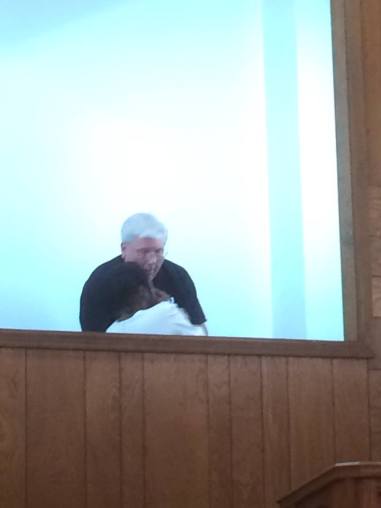
Megan Meeks was baptized this past Thursday, 4/21/16, in Denver, CO. The plan has not changed since Acts 8.

We Sure Love Baptisms!

Neal Pollard

There are some things about social media that are extremely irritating—click baiting, pot-stirring, fight-picking, self-pitying, and the like. But there are a great many positives in that medium, too. Of all of them, I believe that posts of baptisms have to be my favorite. I do not appear to be alone in that estimation.  Judging from post reactions and comments, a great many others do as well. We love it when there are pictures. We love the “back story.” We love knowing that our friends, neighbors, co-workers, and family members have good, honest hearts softened by the power of Divine Revelation. We love knowing they have a clean slate and a fresh start, and are poised to begin their walk on Narrow Road.

All of this leads me to several random observations:

  • True good news needs no hype, trumping, manufacturing, or baiting.
  • It is New Testament thinking to rejoice at such good news (Acts 8:39; 15:3).
  • What a confirmation the obedience of others to the gospel is to our own decision to do so.
  • It restores our faith in the potential of humanity and the power of the gospel (Rom. 1:16; Heb. 4:12).
  • It builds our confidence in the Bible to see people imitate the examples of the New Testament, doing what they did the way they did it (Mark 16:16; Acts 2:38; 8:13, 38; 9:18; 10:48; 16:14-15; 31-33; 22:16; Rom. 6:3-4; Gal. 3:26-27; Eph. 5:26; Col. 2:12; Titus 3:5; 1 Pet. 3:18-21).
  • The average Christian wants what is best for others, which is just one reason Christians are the best people on earth.
  • We want good news to travel fast, far and wide.
  • We know it pleases the Lord when a person comes to Him in obedient faith (see Luke 15).

There are doubtless many more observations we could make, but these are enough for me to thank God for His people and those who daily make the decision to become His people. It builds my faith and hope in my fellow human beings and my trust in heaven’s plan of salvation.  Thank you for finding joy in the right and best things! And let’s keep striving to perpetuate that joy through leading souls to the Savior.

12924440_10207948347340678_5218772026345282016_n
“Debbie” being baptized into Christ during a gospel meeting with Keith Mosher in Sylvester, GA, this week (photo credit: Jason Willis)

“Truly In Vain Is Salvation Hoped For From…”


  • A politician or political party.
  • Wall Street.
  • Military might.
  • Our net worth or economic savvy.
  • Government programs.
  • The second amendment.
  • Popularity and fame.
  • The worship of nature.
  • Exercise and fitness.
  • The appeal of our good looks.
  • Walls.
  • The importance of our occupation or position.
  • Our national identity.
  • The Supreme Court.
  • Ethnicity and race.
  • Science and technology.
  • Any religious figure besides Jesus Christ (even those claiming to represent Him).
  • Family members and friends.

In Jeremiah 3:23, the prophet writes, “Truly in vain is salvation hoped for from the hills, and from the multitude of mountains: truly in the Lord our God is the salvation of Israel.” Jeremiah’s brethren put all their eggs in the wrong baskets. They neglected to see where true hope was found and where saving faith was to be put. Their misguided trust led to their downfall. It cannot be otherwise in any generation, including our own.

We may never say we put our trust in anything besides God, but “the proof is in the pudding.” We demonstrate what’s first and foremost to us every day, in word and deed. Ultimate deliverance from our greatest trials, struggles, and challenges comes from only one source. Jeremiah succinctly identifies it.  Is that what you are trusting? If so, let’s make sure everyone who knows us knows that!

—Neal Pollard

11800435_10153091791310922_2631856048550949852_n

Can You Imagine Being $53 Million In Personal Debt?

Neal Pollard

USA Today’s Maria Puente is reporting music star Kanye West’s tweet where he writes, “I write this to you my brothers while still 53 million dollars in personal debt…Please pray we overcome…This is my true heart….” (USAToday.com).  Hearing that Facebook creator Mark Zuckerberg and wife Priscilla were going to give away some of their billions to philanthropic causes, West tweeted that he wanted to be a recipient of some of that charity.  Since most of us will probably not make a total of $53 million in our lifetimes, we have a hard time imagining how someone could accrue that amount in personal debt! Perhaps horrible investing, profligate lifestyle decisions, and the like might explain it, but the lack of restraint and wisdom seems appalling. How could one person be so foolish and wasteful? We wring our hands and shake our heads, maybe condescendingly.
Until we consider something.

In a spiritual sense, we all faced a debt infinitely greater. Jesus illustrates this in a parable regarding a slave who owed his master 10,000 talents (Mat. 18:23ff). Biola University business professor Philip Massey did some modern-day math equivalency with that figure and estimates in 21st Century dollars that debt would be $7.04 billion dollars, and according to the 2010 Forbes list of billionaires would need to be at least the 102nd most wealthy person on the entire planet just to be able to pay such a debt (chimes.biola.edu).  Jesus’ point in the parable is to show how utterly audacious it is not to forgive the relatively minuscule transgressions others commit against us in light of how great our spiritual debt is to God.  All the combined wealth of the world is not enough to pay for one sin (cf. Mic. 6:6-8; Mat. 16:26). Colossians 2:14 uses the term “debt” to describe our sin problem, but the same verse tells us that we had someone more powerful and capable than any earthly magnate or mogul to help us pay off our debt.  In fact, “having nailed it [the certificate of debt consisting of decrees against us] to the cross,” He provided payment sufficient for the sin debt of every single person in this world.

Can you imagine anyone refusing help who faced such an insurmountable obligation? Yet, the majority of this world has done and will continue to do so. By refusing to submit to the Lordship of Jesus, they continue to pile up their debt. When the Day of Accounting comes, they’ll stand bankrupt and unable to pay. The consequences will be eternal!

Without Christ, we all face a debt that cannot be sufficiently estimated.  We need His blood applied to our sins or our situations are hopeless! How Zuckerberg will respond is unclear. How Jesus will respond is ironclad! Reach out to Him.

kanye_west_at_the_2009_tribeca_film_festival-2_cropped

Live Beyond Yourself


Neal Pollard

“Two little lines I heard one day,
Traveling along life’s busy way;
Bringing conviction to my heart,
And from my mind would not depart;
Only one life, ’twill soon be past,
Only what’s done for Christ will last.”

The first stanza of the powerful, convicting poem by C.T. Studd has been the seeming anthem of one of God’s great, 21st Century spiritual warriors, Cy Stafford. I first met Cy around 2000, and his balanced, measured information and guidance helped us identify and deal with a false teacher in East Africa. His interest and concern were for the Christians, new and more seasoned, who might be impacted by this man’s influence.  That godly zeal for God’s people was an indicator of the mind of a missionary, minister, and mentor of men.  The subsequent years have shown me what a true leader and visionary, with God’s help and to God’s glory, can accomplish. Cy is not larger than life, gregarious, charming per se, or glossy in any way. He is steady, focused, and determined.  He has helped change the world by equipping men and women to reach the world. Alongside so many missionaries and Christians indigenous to East Africa, Cy has steadily worked to grow the church and its influence where some of the earth’s poorest and humblest people live.  He often has spoken of the window of opportunity that daily shrinks and he has worked with an urgency to do what he can to make sure everyone has the opportunity to hear the gospel at least once.

Cy and Stephanie have made countless sacrifices of time, comfort, safety, and security because their mission was far broader than themselves. While some in ministry appear motivated by self-interest, self-promotion, and self-absorption, the Staffords have valiantly sought to put the spotlight foremost on Christ and then upon others’ needs.  On whatever day each exchanges the cross for the starry crown, their legacy will have been that of living beyond themselves.   What a convicting challenge to each of us to engage in thoughtful self-examination! What is my agenda? What is my aim? What is my aspiration?

“Give me Father, a purpose deep,
In joy or sorrow Thy word to keep;
Faithful and true what e’er the strife,
Pleasing Thee in my daily life;
Only one life, ’twill soon be past,
Only what’s done for Christ will last.”

Hebrews 11 speaks of great Old Testament heroes of faith who lived and died as those with a “desire” for “a better country, that is, a heavenly one…” (16). These same ones are called “strangers and exiles on the earth” (13), whose sight was set much higher than self. The whole of the New Testament reveals that a heart set on heaven will reside in one who also has his eyes on others (cf. Phil. 2:3-4). All too rarely do we receive such vivid examples of individuals who have so fully committed themselves to the Great Commission, who challenge us to imitate them in living beyond self. Cy is one of the best examples of this I will ever know.

“Only one life, yes only one,
Now let me say,”Thy will be done”;
And when at last I’ll hear the call,
I know I’ll say “twas worth it all”;
Only one life,’twill soon be past,
Only what’s done for Christ will last. “

God, give us more Christians like Cy Stafford! Let that begin with me.

cy and stephanie

How Do You Spell “Cross”?

Neal Pollard

  1. “SEE”– Look at Calvary. Don’t turn away. I know it’s not easy. What is done to Him is shameful. I know. But, look closely! Past the spittle. Beyond the blood. There. In His eyes. Friend, that is love. It is love for you! See the nails in His hands and feet, fastening Him to a tree He created for man’s use. Look at the love He has for you!
  2. “ARE?”–Are you able to see that He bled and died for you? Are you willing to admit you’re lost without Him? Are you ready to submit to His will, to obey Him, and to live for Him? Are you prepared for eternity? Are you convinced?
  3. “OH”–Hear His cries of pain and agony. The death of a thousand deaths. Bitter moans of His disciples. The gasp of heaven’s angels. The sorrow of a Father for His only begotten Son! The gasps and exclamations of a hateful mob.
  4. “SS”–That’s the hiss of the beguiling serpent. The one who is bruising the heel of the perfect One, putting God the Son in the tomb. This is his moment of triumph. Though resurrection will soon spell victory for Christ and hope for man, at the cross the devil must be enjoying his front row seat at Calvary. Doesn’t he anger you? Disgust you? Motivate you? Live for Jesus, the Lion of Judah. Don’t live for the roaring, devouring lion.

Friends, the cross spells the difference between heaven and hell, hope and hopelessness, joy and sorrow, night and day!

4468491785_0c64a0f076_o_d

WHO KILLED CUSTER?

Neal Pollard

There’s quite the controversy over who killed General George Custer at the Battle of Little Big Horn in Montana on June 25, 1876. There is even a book by the title, “Who Killed Custer?,” authored by Bruce Brown. There are so many mysterious and hard-to-document events that made up this notorious battle that symbolizes the “Indian Wars” of the late 1800s.  Brown, analyzing eye witness accounts, gives an interesting top three suspect list:  (1) an Oglala Sioux warrior named White Cow bull, shooting him near the beginning of the battle, (2) Custer himself, committing suicide as he dashed away from the battlefield near the battle’s end on his horse Victory, and (3) Brave Bear, a Southern Cheyenne warrior, given the honorary title of “Custer’s Killer” at an Indian council in 1909 (www.astonisher.com/archives).  About ten years ago, the Helena Independent Record revealed the long-circulated, but secret oral history of the Northern Cheyenne Indian storytellers, crediting a woman, Buffalo Calf Trail Woman, for striking the fatal blow (helenair.com).

It is fitting that a man surrounded by so much controversy and whose reputation and achievements are incredibly enigmatic would have such a mysterious cloud hanging over his death. His killer is upheld by many as a tangible standard-bearer of justice and righteous revenge. For others, it is simply a matter of historical fascination.  There are even those who lamented his death, as the brash and rash Custer was widely viewed as a “war hero” by his U.S. contemporaries in the years immediately following his death. Yet, one thing we know for sure.  Custer was killed.  Two fatal bullet wounds loudly testify.

There is another mystery, one with far weightier and eternal implications.  Who killed Jesus?  He is the most enigmatic figure in human history.  He was viewed contemptuously as a blasphemer and traitor by the religious leaders of His day. He was viewed with depraved indifference by the masses who switched from adoration to execration in a matter of days.  He is viewed even more diversely today, 2000 years after He died on the cross.  The power and proof of the resurrection is a matter to write about another day (see, for example, https://www.christiancourier.com/articles/644-resurrection-literal-or-merely-symbolic).

But, there is another vital question surrounding the death of Jesus.  Who was really responsible?

  • Was it the devil? Yes!
  • Was it the Jewish leaders? Yes!
  • Was it the onlookers that day? Yes!
  • Was it Pilate? Yes!
  • Was it the Roman soldiers? Yes!
  • Was it God? Yes!
  • Was it you and me? Yes!

How could all of these be mutually responsible for the death of Christ? There is no controversy.  The devil desired Jesus’ death, through which he longed to defeat the Lord’s purpose (cf. Gen. 3:15; Rev. 12:4ff). In this, he failed (Heb. 2:14). The people that day were instruments in the hands of God, who accomplished His eternal plan of salvation through Christ’s death, burial, and resurrection (Acts 2:23; 3:18; etc.). We are responsible because we sin (Rom. 4:25) and He had to be made sin for us (2 Co. 5:21). The good news is that the death of Jesus was not the defeat of God’s plan. It accomplished the plan.  However, for the plan to be effective, we must properly respond to it.  The fact of His death does nothing for us, if we do not respond to it the way Scripture tells us to.  Thus, there is a much more important question than, “Who killed Jesus?” It is, “Who will follow Jesus?”

See The Living God (Poem)

Neal Pollard

I cannot stop staring at the mountains and the skies

The beauty is so breathless, an endless feast for my eyes

I cannot look at all this and give credit to luck or chance

I’m a victor of the Creator, not a victim of circumstance.

The heavens preach this sermon, Our God He loves and lives

All nature shares the message, what joy and hope it gives

He’s up in heaven waiting until the day He’ll bring us home

For now He’s left us evidence, and we pray, “Lord Jesus, come.”

I cannot stop looking into my little baby’s eyes

I see his parents’ imprint when he laughs and when he cries

In awe my tears are welling as his face shows eternity

This little one God’s endless power shows to all who clearly see

You cannot look at people and fail to see the living God

Our design says a designer, to say “no God” is to play the fraud

He’s patiently waiting for more people to come to Him and live

What will you do with this moment?  Give what you have to give.

I cannot stop reading this Book that explains it all

My cause, my purpose, my destiny, His plan, His way, His call

It has proven to be perfect, it’s been tried and tried again.

It says there is an answer to my problem it calls sin.

The Bible shares the mind of God, it helps us find the way

It helps us understand His heart, and how to live today

It pierces our hearts so we’ll make room to put His will inside

How great our God to show us the path where we can walk at His side

“Let’s Go Throw Rocks At The Campbellite Preacher!”

Neal Pollard

That one statement was what introduced my great grandfather to the gospel and is a big reason why my mom was raised in the church and why I was, too.  A “Campbellite preacher” (so named because of Alexander Campbell, a leading figure of the 19th Century who pleaded with people to throw off the division of denominationalism and restore simple New Testament Christianity) was in their Mississippi community, preaching at the local school house.  Several teenage boys, including my then 19-year-old great-grandfather, conspired together to stand outside and throw rocks at the preacher.  The big talk apparently came to nothing harmful, but standing out there my grandfather was convicted by the preaching.  As the result, he studied more deeply and carefully the Scriptures and found that the denomination he was a part of did not teach the same plan of salvation he read in the New Testament.

Plain, New Testament teaching and preaching, which faithfully and accurately handles the Scripture, has a profound effect on an honest heart.  One who is already persuaded that the Bible is the inspired Word of God, who is convicted that it was faithfully transmitted through time, can see from gospel preaching what God’s will is for “matters of life and godliness” (2 Pet. 1:3).  Such allow the powerful Word to operate skillfully upon their hearts, being persuaded of its penetrating truths (Heb. 4:12).  Even one who may start out angry at the messenger but who is “fair-minded” (cf. Acts 17:11) will “receive the word with all readiness, and [search] the Scriptures daily to find out whether these things [are] so.”  Such an unprejudiced, open-minded attitude will serve such individuals well not only in learning how to become a Christian, but also in how to live the Christian life.  We must keep an honest and good heart if we will be the “good soil” Jesus praises in His parable of the soils (Luke 8:15).

Whatever your age, position in life, race, education level, or physical address, are you teachable? Do you receive the word in humility (Jas. 1:21)?  James says that your soul’s salvation is ultimately at stake.  Whether it regards becoming a Christian or living the Christian life, keep an open and tender heart!  You’ll be eternally grateful that you did.  So may many of your descendants!

What Do We Make Of God’s Second Chances?

Neal Pollard

We were living in Cairo, Georgia, and I was in the third grade. It was during a game of kickball on the playground and I was the “pitcher.”  A kid kicked it hard and I caught it.  As the ball hit me in the gut, I felt a sharp pain.  Something wasn’t right.  My parents took me that week to see the local doctor.  He thought it might be a hernia. Exploratory surgery in Thomasville instead revealed a tumor on my liver.  My parents and I flew to Atlanta, Georgia, where I was checked into Egleston Children’s Hospital.  Extensive testing there and Emory Hospital, the general campus for Egleston, led my team of doctors to the same conclusion. It was cancerous. They tried to prepare my parents for how slim my chance of survival was.  Even if their diagnosis was wrong, surgery and attending blood loss may well be more than I could stand. My parents maintained great faith, and my dad solicited prayers from congregations all over the place. Dr. Gerald Zwiren, who led a team of highly-skilled doctors, brought the news to my parents that I survived the surgery and later shared the oncology report that my tumor was benign. That was close to 40 years ago and to this point I have never had further complications. I certainly received a second chance.

Periodically, I ponder at length what I have done with that second chance. The scar I bear from that surgery has long since become invisible to my daily view.  I suffer no lingering consequences. That event is certainly not why I chose to become a preacher, as if to try and pay a debt to God for saving me. Sadly, despite His mercy in sparing me, I have sinned in ways great and small that reveal, in addition to all else, a failure to appreciate that blessing. Spiritually, whether as a preacher, husband, father, or Christian, I am saddled with the realization of how far I have to go.  With the help of His Word, His providence, and His strength, I continue to try to make the most of this extra time He gave me back in 1979.

All of us who are New Testament Christians face the same spiritual situation.  We suffered the terminal condition of lostness in sin. By all human calculations and efforts, nothing could be done to save us.  Yet, when we responded to His grace by believing, repenting, and being baptized (cf. Mark 16:16; Acts 2:38), He gave us all a “second chance.”  We passed from death to life.  More than that, God gave us a way to continually receive the benefits of the blood and grace of His Son as we strive to walk in His light (1 Jn. 1:7-10).  You may have messed things up badly in your life.  You may feel that it is impossible for God to love and forgive you.  Friend, “With people this is impossible, but with God all things are possible” (Matt. 19:26).  God is the God of the second chance!  His diagnosis is perfect, and His is the only one that counts!  Trust in the Great Physician.  He has never lost a patient who followed His prescription!

Picture of me (2nd from left) about a year after the surgery.

Do You Love Your Country?

Neal Pollard

Are you one who looks back with affection,
Reminiscing about days of yore?
Waving flags and praying for protection,
For your nation from shore to shore.
There are songs and celebrations sweet
Speeches that rouse the emotion
Fierce loyalty for the land beneath your feet
That inspires a most patriotic notion

But what about the better land beyond,
The place you can truly call your own?
Is that yearning great, is that hope fond,
To live in the land of the Risen Son?
If so, are you packing and preparing
For the journey that will reach beyond time?
Down here do you feel alien and wayfaring?
Is citizenship there of importance most prime?

Join a people most ancient whose love was great
For a better, a heavenly country
Who felt like exiles here, were the object of hate
By earthly counterparts who put their scorn bluntly
Fix your eyes on a grand immigration
Made possible by the Great Emancipator
Make sure you’re a member of the holy nation
And your eternal home will be infinitely greater.

Ft. McHenry (Maryland)

Right Back Into The Deep

Neal Pollard

I read the account of Ron Ingraham, who was lost at sea last December in the Pacific Ocean off the coast of Hawaii after his boat had taken on a dangerous amount of water.  He was presumed dead by the Coast Guard after he made distress calls and they responded, searching for four days, covering 12,000 square miles, and finding nothing. 12 days later, while his friends were planning his memorial, he was found weak, hungry, and dehydrated, but alive.  Family and friends hailed it as a miracle, and Ron felt he was given a new lease on life.

Then, tragically, near the end of April, Ron was fishing with a buddy when the 34-foot-boat they were on, The Munchkin, was smashed against the reef after midnight and totally broke apart. His friend found their emergency radio (EPIRB) in the wreckage, but there was no sign of Ingraham.  Now, a month later, it is almost certain that he perished in that water about a mile from the cliffs of Molokai (facts from The Washington Post, Elahe Izadi, 4/30/15, http://www.washingtonpost.com).

What a graphic illustration of something that happens all the time in a spiritual sense.  Paul urged Timothy to fight the good fight, “keeping faith and a good conscience, which some have rejected and suffered shipwreck in regard to their faith” (1 Tim. 1:19).  At times, it can be very difficult to live the Christian life as the world assaults our faith through temptation or persecution.  The trial may be internal, as we struggle with doubt or suffering.  We may allow an unhealthy relationship to do the damage. In so many different ways, we can suffer shipwreck to our faith. Sometimes, we can be overtaken by one of these spiritual threats, leave and then return.  We experience the thrill of forgiveness, the peace of restoration, and the hope of a new start.  Then, we find ourselves returning to the very thing that upended us before.  We must realize that there is more than one hazard while sailing on life’s sea.

Peter warns the Christian about the possibility of falling away.  He says, “For if, after they have escaped the defilements of the world by the knowledge of the Lord and Savior Jesus Christ, they are again entangled in them and are overcome, the last state has become worse for them than the first.  For it would be better for them not to have known the way of righteousness, than having known it, to turn away from the holy commandment handed on to them. It has happened to them according to the true proverb, ‘A dog returns to its own vomit,’ and, ‘A sow, after washing, returns to wallowing in the mire’” (2 Pet. 2:20-22).  Certainly, as John reminds us, we can live with blessed assurance (1 John 5:13), but that is not for those who put themselves in peril by doing what will certainly shipwreck their faith.

May we live the beautiful prayer of Edward Hopper: “Jesus, Savior, pilot me over life’s tempestuous sea; unknown waves before me roll, hiding rocks and treacherous shoal; Chart and compass came from Thee—Jesus, Savior, pilot me.”

“This Perverse Generation”

Neal Pollard

What was life like in the first century?  One historian writes, “It has been rightly said, that the idea of conscience, as we understand it, was unknown to heathenism. Absolute right did not exist. Might was right. The social relations exhibited, if possible, even deeper corruption. The sanctity of marriage had ceased. Female dissipation and the general dissoluteness led at last to an almost entire cessation of marriage. Abortion, and the exposure and murder of newly-born children, were common and tolerated; unnatural vices, which even the greatest philosophers practiced, if not advocated, attained proportions which defy description” (Edersheim, Book 2, Chapter 11, p. 179).  Thus described the culture of the dominant world power of the day, Rome.

Those descriptions, almost without exception, could be applied to the current culture.  So many specific examples could be, and often are, set forth to depict life in our world today that mirror Edersheim’s chronicle of the world into which Christianity was born.  Not surprisingly, New Testament writers are prone to speak of the world in stark terms and with specific admonitions.  What they said then apply to us today, and they contain counsel that will help us to spiritual success in our slimy setting.

You can save yourself from this perverse generation (Acts 2:40). That was the final recorded appeal of the first recorded gospel sermon.  The message is one of hope and faith.  There is escape from the pollutions of the world (cf. 2 Pet. 2:20).  There is forgiveness of the sins like the ones described above as well as any and all others.  The promise of the gospel message is, “Repent, and each of you be baptized in the name of Jesus Christ for the forgiveness of sins” (Acts 2:38).  Those who gladly received that word did just that (Acts 2:41).

You can shine yourself to this perverse generation (Phil. 2:15).  Paul urges the Philippian Christians to prove themselves blameless and harmless in such an environment. He’s calling for distinctive Christian living, a life that would stand out in such deplorable circumstances.  We’re not trying to be oddball misfits, but faithful Christian living is detectable in the crowds we find ourselves in.  That example is the first step to helping someone else save themselves from this perverse generation.

You can share your Savior with this perverse generation (Mark 8:38). Jesus warns those whom He calls “ashamed of Me and My words in this adulterous and sinful generation.”  He tells us that a true disciple’s life is one of obedience, self-denial, sacrifice, and courage (cf. Mark 8:36-38).  If we never share the saving message of Christ with the people we meet and know each day, why don’t we? Could it be that we are ashamed to share His distinctive message to a world that pressures us to conform to and go along with it.  If we do not tell them about Him, how are they going to find out? What hope will they have to discard the perverse life for the pure one?

It is a scary, sinful world out there!  But God rescues us from its guilt through Christ’s sacrifice, then sends us back out there to tell them they can be rescued, too.  Live it and then share it, no matter what, until your end or the end—which ever comes first!

Mission Accomplished

Neal Pollard

Reader’s Digest tells the story of Walter Wyatt, Jr., an amateur pilot whose plane goes down in the Atlantic between the Bahamas and Miami, Florida.  He’s in the deep all night, fighting off bull sharks and feeling he will not survive.  He does live and a ship, the Cape York, rescues him after sunrise the next day.  He wearily climbs on board and kisses the deck.  He is saved, but he needed outside help to save him from the depths and from certain death.

So it was with us.  As the song suggests, we were sinking deep in sin and far from the peaceful shore.  Jesus lifted us, and He did so through Calvary.  Yet, He saved us from a fate infinitely worse than death by a physical predator.  Each Lord’s Day, we have the opportunity to remember this as well as He who rescued us.  As Paul once said, “Indeed, in our hearts we felt the sentence of death” (2 Corinthians 1:9).  In Hebrews two, we consider three important truths about the Man who saved us from death.

First, He is over us (Hebrews 2:1-10).  He is our Lord and Master.  He is over us by right of accountability (1-3).  In other words, we are reminded that each of us are accountable to Him.  We cannot escape if we neglect so great a salvation!  He is also over us by right of approval (4), namely God’s approval (cf. Matthew 17:5).  During His ministry, Jesus demonstrated His power to prove His identity (cf. Acts 2:22-24).  Further, He is over us by right of authority (5-8).  We read, “For in subjecting all things to him, He left nothing that is not subject to him.”  Then, He is over us by right of arrangement (10).  He is our Creator.  He made us.  He knows us.  Finally, He is over us by right of affliction.  By virtue of His passion, Christ has compassion.  For all these reasons, we see Jesus as One who is on a par with none.  Before He was in a manger or up on a cross, He was in the beginning with God and as God (cf. John 1:2).

Second, He is like us (Hebrews 2:11-14).   No matter how much we like or dislike a king or president, we may feel like he or she is unreal or unlike us.  We cannot relate to their lives, and we are certain they can relate to ours.  Yet, Jesus, though King of kings, is a Savior who is like us.  We are of the same family, the human family (11).  He associates Himself with us (11-12).  Then, He shared in our humanity to the fullest, to the point of experiencing death for us (14).  Nobody can rightfully say to God, “You don’t know what it is like!  You don’t understand!”  He is fully divine and became fully human, making Him uniquely able to relate to both the Father and humanity.

Finally, He is for us (Hebrews 2:15-18).  The last few verses serve as final pieces of evidence proving how Jesus is on our side.  He has done His part to take the fear out of death (15; cf. 1 Corinthians 15:19-20).  Of all created beings, He gives His aid to us (16).  He longs to be our High Priest (17).  He wants to help us when we are tempted (18).  Of all the Great Cloud of witnesses (Hebrews 12:1), who do you think is leading the cheers for those of us trying to make our way through this world and up to heaven?

A decade ago, I said a sentimental goodbye to the “Black Bullet,” my 1985 Chevy Custom Deluxe pickup which I traded in on a “new” 1992 Dodge Dakota.  I had to go to the DMV and transfer my tag and title.  They did not charge much for vanity plates, so I chose “PRCHNG1.”  This seemed clear enough to me.  As I picked up a number at the front counter,  I had my tags in hand and the receptionist saw them.  She said, “Oh, I’ve always wanted to try that. I bet that’s so fun. Is it scary?” I was confused. She said, “Your tags. How long have you been parachuting?” PRCHNG1 stands for “Preaching One.” I thought it was clear, but apparently my fellow motorists had been concluding that I was in some airborne division or maybe purchased hand guns. This dear lady misunderstood me, my work, and my interests.

Let us not make that mistake with the Savior we pause to commemorate each Sunday.  He is over us—He’s our King!  He is like us—He’s our brother!  He is for us—He’s our friend!

CHANGING YOUR ORBIT

Neal Pollard

On September 16, 1991, the space shuttle Discovery dodged a chunk of a Soviet Cosmos rocket.  It came within 10 miles of the van-sized debris.  If Discovery had not changed its orbit, it would have been so close a call that it would have been yet another tragedy for our then active space program.  Mission commander John Creighton said it was “very simple” to maneuver, but absolutely vital to ensure the crew’s survival.

When I mention “conversion” in a spiritual context, what do you think about? Following his mention of Elijah’s exemplary prayer life, James ends with a big dose of encouragement.  James uses the word translated “convert” or “bring back.” It is an active word, meaning we cause one to change his or her belief or course of conduct, with a focus on that one then turning in the right direction.  The end result, conversion, is the state of their having done that.

To me, it is a blessing to see somebody back in attendance and being involved after they have been away from the Lord and His church.  It would be better for a brother or sister to never fall away, but it is definitely a joy to see one have the determination and courage to come back home.

Doesn’t heaven view it the same way? Jesus says in one of the “lost parables,” “I tell you that in the same way there will be more rejoicing in heaven over one sinner who repents than over 99 righteous persons who do not need to repent” (Luke 15:7).  In conversion, one is changing what their life is orbiting.  It is no longer sin and self, but God.  What a blessing to see someone go from a path of destruction to the way of life! May this perspective drive our actions in reaching out to our “erring brethren.”

Selling What You Don’t Own

Neal Pollard

One of the more ingenious and amusing entrepreneurial moves I’ve ever heard is the company that offers to sell you a star.  For a price, you can buy a star and name it for a loved one.  The company will send you a gift pack along with registering the star in the name of the one you, the buyer, designate.  I have never been able to figure out how that company earned the right to sell something no one will ever visit, hold, or otherwise show tangible ownership of.

When I think about some of the new, strange religious ideas along with some long held, established ones, it reminds me of the folks selling the stars.  Preachers and whole denominations offer salvation on their own terms, altering and subtracting from the Lord’s established will as if salvation was theirs to offer.  They urge people to pray a prayer or accept Christ in their hearts, guaranteeing them salvation by so doing.  Or they tell a seeker that the Holy Spirit will irresistibly come upon them, filling them and by so doing indicate an experience of grace.  Or they urge parents to sprinkle their babies, saving them from what they call inherited sin.  The problem in all these scenarios is that people are offering what is not theirs to give.  Christ has already established the plan that saves the lost person—hearing the gospel (Rom. 10:17), believing it (Rom. 10:10), repenting of sins (Rom. 2:4; 6:17-18), confessing Christ (Rom. 10:10), and being buried in water in order to enjoy the new life in Christ (Rom. 6:1-4).

The same things occurs with worship.  People claim to stand in the place of Christ and tell others what is and is not acceptable to God.  They propose changes in who can lead in worship (cf. 1 Tim. 2:11-12), how worship music is to be done (Eph. 5:19; Col. 3:16), and when the Lord’s Supper can be taken (1 Cor. 11:23-26; Acts 20:7).  Some would say that dance, weightlifting, incense-burning, drama, and the like are acts of worship God will accept, though they do so without a scintilla of appeal to the New Testament.

When it comes to the will of God, He has exclusive rights over that.  Christ does not share His authority with anyone (Mat. 28:18).  He makes the rules and determines right and wrong.  Beware of anyone who is selling anything else (cf. 2 Cor. 2:17).

A Physician Not Afflicted With The Disease He’s Fighting

Neal Pollard

Buried in the headlines today is news that the doctor in charge of fighting an outbreak of Ebola in his country has contracted the disease himself.  The health minister of Sierre Leone said that Dr. Sheik Humarr Khan has a confirmed case of the deadly virus that has killed over 600 of his fellow-countrymen in 2014.  Three of the nurses working alongside Khan recently died trying to treat this disease for which there is no known cure or vaccine. Despite meticulous precautions, Khan could not evade contracting Ebola.

It is an unappealing prospect to consider having a job like Khan’s.  Exposing yourself to something utterly deadly (at times, Ebola has as high as a 90% mortality rate) to try and save your fellow-citizens is about as great a risk as a person can assume on this earth.  Not surprisingly, Khan has been hailed as a hero for using his expertise as a virologist to combat this frightful killer.  Now, his own life hangs in the balance (via news.yahoo.com).

The writer of Hebrews contrasts Jesus with the Levitical priests under the Old Law.  They were “sick” with the very sin they were appointed to “treat” among the nation of Israel (Heb. 7:27).  The writer says that Jesus had no need to do this for Himself because He was “holy, innocent, undefiled, separated from sinners…” (Heb. 7:26).  In other words, though thoroughly exposed to the deadly malady of sin, Jesus never succumbed to it.  Earlier, the epistle says, “For we do not have a high priest who cannot sympathize with our weaknesses, but One who has been tempted in all things as we are, yet without sin” (4:16).

Simply put, the One God sent to provide a cure for the deadliest condition ever known was fully exposed to it but did not fall prey to it.  He did, however, die because of it.  Incredibly, that was God’s intention from eternity. Yet, His ultimate sacrifice makes it possible for us to be cured of this otherwise hopeless and eternally fatal condition!  No wonder we praise Jesus as the “Great Physician.”

A GLOBAL EPIDEMIC

Neal Pollard

MERS is the latest pathogen to seize the world’s attention, and this middle-eastern sprung virus, having a 30% mortality rate, is cause for some concern.  Yet, it is the latest in a long line of alarming diseases that have struck fear in people—AIDs, Asian Flu, Spanish Flu, smallpox, bubonic plague, and leprosy, just to name a few.  Whether the horrific presentation, swift action, or painfulness of these conditions, just the names of these diseases raise the shudders of those informed about how deadly they are.  An ailment that commonly brings about mortality gets our attention.

Sin, however, often does its work on the individual without the dramatic presentation and many times in a way that feels painless to the “sufferer” until it is too late.  But, nothing is deadlier or more serious.  That is why God made it a prominent subject in the only book He ever wrote.  He identifies it in its every form, reveals the symptoms, warns of the potentially deadliness of it, and provides the cure.

The majority do not recognize it for what it is, they incorrectly identify it, offer the wrong cures for it, and a great many just ignore what it is doing to them.  They call it by other names, thinking that by doing that they are eradicating it from themselves.  While that may numb them through this life, it will not serve them well in eternity.

Variously, the Bible says “sin is exceedingly grave” (Gen. 18:20), “sin is unhealthy” (Psa. 38:3), “sin is a disgrace” (Prov. 14:34), “sin brings guilt” (Mark 3:29), “sin brings spiritual death” (Rom. 6:23; Jas. 1:15), “sin enslaves” (Rom. 7:14,23), “sin is deceitful” (Heb. 3:13), “sin entangles” (Heb. 12:1), “sin is lawlessness” (1 John 3:4), “sin is of the devil” (1 John 3:8), and “sin is unrighteousness” (1 John 5:17).  Yet, despite this, we know “fools mock at sin” (Prov. 14:9).  A vicious disease is at work in them and, unresolved and untreated, it will lead them to eternal pain, but because it afflicts the unseen part of a person they cannot see the damage to their souls.  They often see its effects in their own lives and in others’.

That’s where Christians come in, Physician’s assistants for the Great Healer.  We are to get healing to as many as are willing to take the cure.  We may be treated hostilely by some of those eternally ill, but we must risk sharing it for their good.  We face a terrible epidemic but we have a cure that is 100% effective when properly applied!

Avalanche Season

Neal Pollard

They are calling it an historic avalanche season in Colorado.  With snowpack at well over 100% due to massive amounts of mountain snowfall, conditions are prime for avalanches to breakout all over the backcountry. Already, six have died in avalanches this winter.  In fact, there have been three deadly slides just in the past week.  Warnings continue to come in from The Colorado Avalanche Information Center about dangerous conditions following two weeks of heavy snow.  Others have escaped death, but have harrowing tales of survival and, in some cases, broken bones.  Avalanches travel at the rate of a speeding car and hit with the force of a freight train. Typically, those buried in an avalanche lie beneath a ton of snow and the most common killer is either suffocation or blunt force trauma.  The head of the CAIF says the three most important tools are the beacon, probe, and shovel. The first is worn by the potential victim, while the other two are used by the rescuer.  Though these events can happen and be over in a matter of seconds, they can bring permanent consequences (information via FoxNews and Time’s Science And Space).

How often do we face overwhelming circumstances which we might liken to an avalanche?  They happen suddenly and seriously, and the aftermath can feel almost suffocating.  Though with different images, Bible writers speak of the feeling of burdens and sins being heavy and over their head (Ps. 38:4; Lam. 3:54).  David says similar things about trouble (Ps. 119:143) and iniquity (Ps. 40:12) overtaking him so that he cannot look up.  Maybe you can relate to such feelings, whether brought on by the guilt of sin or the difficulties of life. Both can threaten to bury us.  These things have even led to spiritual death.

May I suggest that we need the same three tools for our spiritual escape.  We have a beacon (Ps. 119:105), yet it also serves as a probe (Heb. 4:12) and a shovel (cf. Ps. 107:20; 147:16ff).  He also blesses us through prayer and providence.  Through all He does, God provides us a way of escape (1 Co. 10:13)!   We can survive, even in those times when problems crowd into our lives and threaten to bury us!  God is greater and stronger.  When swept up, hold on! Help is on the way.