WHY WE KEEP FAITHFULLY SERVING AND LEADING

Neal Pollard

It took the Expert House Movers of Sharpstown, Maryland, 17 years and 23 days to complete the move of the Cape Hatteras Lighthouse 2900 feet away from the eroding Atlantic Ocean beach on the North Carolina Outer Banks location where it had been standing. They started in 1982 and finished in 1999. Little things may get done quickly, but big things take time.  Someone once said, “Most people tend to overestimate what they can do in a week and underestimate what they can do in a lifetime.” Paul was in a position to look back over his life and see, if his humility allowed it, a lifetime just since his conversion to Christ that was marked by much fruitful labor.  Luke chronicles some of that work from Acts 11-28. Paul reflects back on some of it in 2 Corinthians 11. But in what is firmly believed to be his last inspired writing, 2 Timothy, he has a brightly lit torch in his condemned hand. He is ready to hand it off to the young preacher, Timothy.

I imagine most of you are blessed to lay claim to someone, either still living or now dead, who was a Paul to you. Having a mentor or mentors to help us grow and develop, spiritually, is priceless. When Paul tells Timothy what he does in 2 Timothy 4:1-8, a passage we typically use to encourage preachers, he is urging a precise attitude and precise teaching. The reasons why he wanted that for Timothy are reasons that should motivate us to live faithfully and to encourage our own Timothys to persevere until the current pressures. Here are three reasons why Paul encouraged Timothy to be faithful:

  • BECAUSE PROBLEMS ARE COMING (3-4). It was a fourfold problem (you’ll notice it by reading these two verses). Paul told Timothy to handle it with great patience and teaching. You cannot always anticipate what the problem is going to be, but as long as you come in contact with people there will be problems. You cannot hope to be an influence on them if you do not cultivate the attitude of patience. When problems arise, be patient and stick to the doctrine of Christ.
  • BECAUSE YOU ARE DIFFERENT (5). No matter how you are treated (or mistreated), you cannot stoop to the level of unethical, immoral, or unscrupulous people. These false teachers Paul references were willing to discard truth, and many wanted that kind of teacher. We will encounter people who don’t play by the Lord’s rules, but we must be different. We must be sober in all things, endure hardships, do the work of an evangelist, and fulfill our ministry. We are to have a better character, and we have a better message. We aim higher because we are the people of God.
  • BECAUSE JUDGMENT IS COMING (6-8). Paul looks ahead to the very end of all things. Because he was faithful, he anticipated the crown of righteousness. Why do you want to serve the Lord? Is it for prominence, popularity, or influence? To successfully endure, do what you do in view of the Judgment. God won’t forget your faithfulness (see Heb. 6:10)!

Your faith will be tested. You may be resisted, rejected, ignored, disbelieved, and debated. The question is, “How are you going to handle it?” Will it make you better or better. It will try your patience, but will you be found guilty or not guilty? If you will be patient and faithful to God’s Word, you will be an example to more than you’ll ever know. Keep your eyes open for your own Timothys to train and members to mentor. The more we have who listen to and follow the advice of this passage, the greater the influence of Christ will be in this dark, sinful world.


3_30_home_pass_the_torch_before_it_goes_out__148950268

Doing It Our Way Instead Of God’s Way

Neal Pollard

I have pondered lately about why there is such a growing tendency to overlook the plainly revealed will and mind of God in favor of what either lacks authority or violates His Word. It would be impossible to be exhaustive, lacking the ability to read the mind, judge the motives, and know the heart. However, in a general way, here are a few observations.

  • Feelings have taken priority over reason. Personal preference and one’s inner voice becomes the guiding star for one’s behavior and concepts, and truth gets dethroned. Hearts are hardened against revealed truth and decisions are made based on personal sentiment. In an attempt to avoid hurting feelings, escape ostracism, preserve an image with the world, and have its good will, individuals become their own judges, juries, and pardoners.
  • We have witnessed people of influence “get away with it.” For years, our national heroes and leaders, athletes, politicians, and celebrities, have “gotten away with it” (see both presidential candidates). If society’s elite and influential can do wrong and get away with it, why shouldn’t everyone else?
  • God does not practice instant retribution in the Christian Age. God does not execute immediate punishment upon the wicked or wrongdoer today. “He has fixed a day in which He will judge the world in righteousness…” (Acts 17:31). The fact that some do not get “caught” in sin in this life does not mean God won’t exact justice upon the impenitent ultimately, but because He does not immediately execute sentence against an evil work we can conclude He will not at all (cf. Ecc. 8:11).
  • Man has developed an insatiable hunger for instant gratification. Pleasure and passion, for many, have become stronger determining influences than eternity and judgment. When the flesh is in control, spiritual things are crowded out of the mind. Jesus says that one can only submit to one master, never two (Mat. 6:24). Flesh and spirit are warring parties (Rom. 8:4-8). Gratifying the flesh can kill concern over the consequence of misdeeds.

We cannot do it alone, without God. The fact is, we must totally surrender to Him. His guidance must be embraced. His will must rule. His strength must be accepted. Truly making Him Lord means making His Word the governing influence of our hearts and lives. Such a humble, honest, and heartfelt submission will help us defeat a mindset set on minding our thoughts and ways over His (see Isa. 55:8-9).

Grandpas' Bibles
My grandpas’ Bibles (Mom’s Dad’s on the left, Dad’s Dad’s on the right). 


Some Hurdles I Just Cannot Jump Regarding Instrumental Music In Worship

Neal Pollard

How often the matter gets discussed among preachers in churches of Christ, I cannot say. But, I know that it does. More members of the church than we might care to think do not have this matter settled in their minds, especially as it has to do with the state of those who have been immersed for the forgiveness of sins, submit to the authority of Christ in other areas of their lives, but who use the instrument in worship. Some have said they think its use is wrong and we have been right to argue against its use but do not think they can say it is a salvation or fellowship issue. It should be stated that many of these are sincere brethren who love the Lord and people nor are they change agents intent on trying to destroy the Lord’s body. Too often, we have lacked an environment where we could have healthy, constructive dialogue free of name-calling, suspicion, and visceral discussion. But failing to discuss and work through matters like these does not make them disappear.

Having said that, here are some hurdles I just cannot jump regarding this matter:

  • The presence of singing and absence of instruments in New Testament passages. The fact that every instance of singing in the context of the Christians’ activity together reveals singing (Greek is a precise language; ado means to utter words in a melodic pattern [Louw-Nida] and ). Psallo, according to Lexicographers, encompassed playing musical instruments at an earlier time in its linguistic history, but did not mean that in New Testament times (e.g., BDAG, 1094; TDNT, 8:494). Interestingly, the translators of English translations, beginning with the King James Version, were unanimously members of religious groups that used mechanical instruments in music. Despite their obvious bias in worship practice, they translate the Greek “singing and making melody in your hearts.”
  • The absence of instrumental music in worship in early church history. Though a member of the church of Christ, Everett Ferguson has the utmost respect from scholarship across the religious spectrum. In multiple volumes, Ferguson meticulously sets forth the case that instrumental music was absent in the church from its establishment until many centuries later. His studied conclusion is that this was neither incidental nor coincidental. He writes, “The historical argument is quite strong against early Christian use of instrumental music in church” (The Instrumental Music Issue, 98; the whole chapter is a worthwhile read). In another work, he states, “The testimony of early Christian literature is expressly to the absence of instruments from the church for approximately the first thousand years of Christian history” (The Church of Christ: A Biblical Ecclesiology for Today, 272). John L. Girardeau, a Presbyterian scholar, devotes an entire, well-documented chapter to the historical case of only vocal music in Christian worship for many centuries and upon doctrinal grounds (see Instrumental Music in the Public Worship of the Church, 86-100).
  • The examples of how God dealt with unauthorized worship throughout history. What do we make of what God does with Cain’s worship in Genesis 4, Nadab and Abihu’s worship in Leviticus 10, and Jeroboam’s worship in 1 Kings 12? Why would God care in the Patriarchal and Mosaic Dispensations that His commands for worship be followed per His instructions, but lose that desire under His Son’s covenant?
  • The fact that God draws definitive, doctrinal conclusions through the use of silence. The writer of Hebrews says, “For it is evident that our Lord was descended from Judah, a tribe with reference to which Moses spoke nothing concerning priests” (7:14). The argument shows that Jesus could become a High Priest after the order of Melchizedek, but not under the Old Testament rule and covenant. Why? God specified Levi as the tribe for the high priest under the old law. It did not explicitly say that a high priest could not come from any other tribe, but it did not have to. What it specified was sufficient, an argument made in the New Testament.
  • The fact that authority can and must be tangibly determined.  Why is it that we sing in worship at all? Is worship merely a matter of what we come up with and wish to offer? Few would argue such. The basis for worship arises from what the New Testament teaches. Nearly everyone, then, would say there are definitive, delineated boundaries. If there is and must be divine authority for worship, and thus “rules” that are objectively determined, there must be activity that falls out of those bounds. Where will we find the boundary markers if not in Scripture?

This list is not meant to be exhaustive and it cannot, in one brief article, be exhaustive. It is included here to show us the great pause that should exist in changing our minds or our teaching on a matter where God has been vocal and specific. The weight of that is not insignificant or inconsequential. May we lovingly and wisely approach this matter and take great care before we relegate a matter of divine importance to a mere matter of human preference.

music-musician-piano-player-audio

Better Living 

Neal Pollard

We find ourselves often bobbing in a sea of religious confusion. Many groups claim to be the best religion and point to their ingredients as reasons for such claims. Several years ago, our boys played basketball in a league hosted by a huge community church in the Denver area.  Their church’s campus includes a K-12 school, two restaurants, a gymnasium half the size of our church building, a coffee shop, and a hundred social program. Other groups would make their claim as “better” or “best” based on their numeric size, the number of programs they have, or how socially active they are.

Our religious attitude ought to be one of humility, which does not boast of our achievements or compare ourselves with others (cf. 2 Cor. 10:12).  Genesis 4 is not just about two kinds of worship, but also about two ways of living life. Cain is mentioned by three Bible writers after Moses introduces him in Genesis. The writer of Hebrews calls Abel’s offering more excellent than his (Heb. 11:4). John calls Cain’s works evil and his allegiance “of the wicked one” (1 Jo. 3:12). Jude implies that the way of Cain is the wrong way to go (11). Let’s make a few brief observations from Genesis four and see if we can find the elements which make for a better way of living today.

  • BETTER LIVING IS NOT DETERMINED BY AGE (1-2).  By birth order, Cain came first. He was the first person to be born in the natural order of childbirth. He was the very first newborn to be held in his mama’s arms. She didn’t realize that her cooing, sweet infant was a future murdering, and she was proud of him. She called him “a man child with the help of the Lord.” This depicts such a bright, optimistic future, and by contrast Scripture says, “Again, she gave birth to his brother, Abel” (2). Abel began in his brother’s shadow, first known to us as “his (Cain’s) brother.”
  • BETTER LIVING IS NOT DETERMINED BY OCCUPATION (2). When we look at these brothers, what they did for a living was not the determiner of the quality of their lives. While what they did had an indirect bearing on the events of this account, the fact of their occupation was spiritually neutral—Cain farmed and Abel tended sheep. One can reap blessings from tilling the ground (Heb. 6:7), but they may have to fight thorns, thistles, and weeds doing it (Gen. 3:18-19). Tending sheep may be done by slaves (Luke 17:17), kings (1 Sam. 17:34), or apostles (John 21:17). God’s pleasure or displeasure was not connected to either’s occupation.
  • BETTER LIVING IS DETERMINED BY WORSHIP (3-4). Moses says both brought an offering to the Lord. He also says God responded to bother offerings, accepting one and rejecting the other. That very notion is foreign to many people in our society today, even those in religion. Many make worship nothing more than taste, preference, and personal inclination. But, Moses shows us (1) Not all worship is equal: God had regard for Abel’s, but not Cain’s. The words “had respect to” signify in Hebrew to look at something with a very serious glance. God tells us how He wants worship done, in attitude and action; (2) The worshipper and the worship rise and fall together: God had regard for Abel AND his offering and did not for Cain AND his offering. That’s a sober reminder for me that my personal relationship with God is hindered or helped based on the way I worship God. Can I offer God vain and ignorant worship, and have God reject it but accept me? We are not earning God’s favor by getting worship right. At the same time, are we tempting God and hoping we stay in His favor while disobeying His commands for worship? People have tried to make this an “either-or” proposition, that Cain and Abel’s offering was either about getting the worship right or was about the nature of the person offering the worship. In other words, is it sincerity or obedience, our both sincerity and obedience? To thoughtfully ask the question is to answer it!
  • BETTER LIVING IS DETERMINED BY ATTITUDE (5-7). Cain reacts to having himself and his worship rejected by God by burning with anger and his face taking on an ugly look. He sounds like a small child in the throes of a tantrum or a teenager huffing and sulking in anger. God warns Cain of the recipe for disaster he was making through his attitude. He told Cain that his tempestuous attitude was an invitation for sin to pounce on him, but He told him he could master it! You can have a positive attitude without prosperity, education, or earthly success, but you cannot have a positive attitude without mastering self.
  • BETTER LIVING IS DETERMINED BY ACTION (8-16). Improper worship and attitude preceded and precipitated improper action. The first time “sin” is used (Gen. 4:7), God was looking ahead with perfect foresight to what Cain would do to his brother. He does the unthinkable, killing his own brother (cf. 1 Jo. 3:11-15). His deeds and ways were a recipe for disaster: He is rebuked by God, punished by God, and separated from God. Sin promises a good time and fulfillment, but it’s not true.

It’s been said that the lineage of Cain gave us murder, cities, polygamy, musicians, metal workers and poetry, but not one who walked with God! Thanks to his legacy, a descendant repeats his violent ways (Gen. 4:23). Abel seems to leave no physical lineage, but he still speaks after death. His was a life of faith, generosity, good works, righteousness, and obedience. We get to choose the kind of life we want to pursue. If we choose well, we will be satisfied, others will be blessed, and God will be pleased.

the_story_of_cain_and_abel_bible_card

Celebrating Independence Day

Neal Pollard

Scores of people from virtually every nation on earth make the journey by land, sea, and air to come to the United States, “the land of the free and the home of the brave.”  The day in American history, marked by the signing of the Declaration of Independence during the Revolutionary War with Britain, is considered the birthday of America.  “Independence Day” symbolizes not merely a day, but a way of life and the blessings of living in a free nation.

Mark’s gospel begins with the life of John the Baptist, the forerunner of Christ.  In the passage, Mark tells about the many people from Jerusalem and all the land of Judah who came to be baptized by him.  This immersion, though not the one to which all believers must submit today for salvation (cf. Mark 16:16), was an important precursor to Jesus’ earthly ministry.  Apollos (Acts 18:25) and certain men of Ephesus (Acts 19:1ff) were among those even in the Christian age who had previously undergone it.  The baptism bears a remarkable resemblance to the water baptism of the Great Commission.  It was a baptism involving repentance (Mark 1:4), as is baptism under Christ’s covenant (Acts 2:38).  It was a baptism resulting in the remission of sins (Mark 1:4), as is baptism into Christ today (Acts 2:38).  It was a baptism done in much water (Mark 1:5; cf. John 3:23).  So it is with baptism into Christ (Acts 8:38-39; Romans 6:3-4).  It was a baptism properly submitted to only by those understanding its importance in light of their sin problem (Mark 1:5).  So it is with baptism into Christ (Acts 22:16).

Both the baptism of John and the baptism of the Great Commission share this, too.  Both brought freedom and independence from sin, each in its proper dispensation.  Freedom to vote, own property, and pursue happiness are wonderful, but nothing compares to the Independence Day we celebrate when we are baptized into Christ.

miamifireworks

REPOSTED FROM 10/3/16 (in light of Vin Scully’s recent passing): What It Means To Be A Man

Neal Pollard

Recently, there have been several experiences that have been instructive to me concerning true manhood. I participated in a wonderful retreat, the theme of which was “Act Like Men.” Great lessons inspired us to be real men, as God defines it. One man from Utah, who was searching for truth, attended and after studying with James Pfiffner become a son of God through baptism for the remission of his sins! He was seeking to become a better man, and I’d say he made the biggest step in that direction.

Yesterday, Kathy and I watched the last inning of 89-year-old Vin Scully’s 67-year career as a broadcaster for the Dodgers. I first remember him as one half of the duo that brought America NBC’s game of the week, with Joe Garagiola. Among his historic calls are the lone perfect game of the World Series (by Don Larsen in 1956), Hank Aaron’s 715th home run in 1974, breaking Babe Ruth’s record, Bill Buckner’s famous error at first base in the 1986 World Series, and Kirk Gibson’s infamous walk-off home run during game one of the 1988 World Series. He called some of baseball’s biggest moments, but what most remember is how classy and dignified he was. He did not resort to perverse, unwholesome speech, but he symbolized achievement in his field.

Scully is cut out of the same cloth as Bear Valley’s senior statesman, Johnson Kell. Kathy and I sat in his living room late last week, and the 97-year-old, World War II veteran, demonstrated so many qualities we have long come to appreciate about this beloved man of God.  He is a perfect gentleman, genuinely concerned about all others, tender-hearted, unabashedly devoted to Christ, well-informed, upbeat, and ever-ready with a smile. Despite recent physical setbacks, his physical condition—still a trim 162 pounds—and sharp mind belie his actual age. Yet, it is who Johnson is on the inside that makes him a real man.

The world sends out destructive messages about what it means to be a man:

  • Sexual prowess
  • Physical formidability
  • Financial acumen
  • Personal charisma
  • Societal clout
  • Sharp wit
  • Professional achievement

None of those qualities are inherently wrong, kept within their bounds. Yet, this is where the world begins and ends its definition. These very standards, absent the most important qualities for a man, have led to the downfall and ruin of every civilization and nation to have toppled. It will undo any that currently stand which do not make course corrections.

As men who are trying to live in that kind of world, we have a prime opportunity to stand out in the very best way. What will it take? Find the perfect example of a man and follow him. Where will you find him?  Let’s let Paul have the last word: “Be imitators of me, just as I also am of Christ” (1 Cor. 11:1). The Son of man is the standard of manhood.

scully_gm
Vin Scully recent headshot.
37461_404333990921_4919662_n
Johnson in 2010 at his 91st birthday party.

Johnson Kell passed away on May 11, 2017. Vin Scully died August 2, 2022. 

WHAT YOU DO WITH WHAT YOU HAVE

Neal Pollard

In discussions about the smartest person who ever lived, William James Sidis’ name will come up as being in the mix. Though measuring IQs with a specific number is not an exact science, he is reputed to have had an IQ of 200 or more. He was reading the New York Times at 18 months old. He taught himself eight languages and made up another one. He enrolled at Harvard University at the record young age of 11. He was a professor at what’s now Rice University by the age of 17. He was a renowned mathematician. But, adjusting to mainstream society proved an ongoing problem for Sidis, whose extreme, socialistic politics and eccentric behaviors dogged him for the rest of his life. He died of a brain aneurysm in 1944 at the age of 46. With such a brilliant mind, his contributions to the world were relatively small. In fact, most of us have never heard of Bill Sidis (much information from Amy Wallace’s sometimes disputed biography, The Prodigy, Dutton: New York, 1986).

We all know people who rose from poverty, dysfunction, and perceived disadvantage who have risen to great heights in their profession and their personal lives. Those abused as children, those who grew up in homes afflicted with drug use or alcoholism, and those whose parents went through failed relationship after failed relationship, have grown up to break such patterns by becoming loving, effective parents and spouses. Some who were given little have done much with it.

Jesus teaches the parable of the talents in Matthew 25, which demonstrates the good and bad stewardship of three particular individuals. Two faithfully used what they were given, but another was unfaithful. The Lord shows us God’s dim view toward one who fails to use what he or she has been given.

Most of us are somewhere on the continuum between the one talent man and the world’s smartest man. Scripture shows us that we must be faithful stewards (1 Cor. 4:2) and that we will give an account for our stewardship (Mat. 25:14-30), whether money, abilities, opportunities, time, or whatever our relative resources. May we be encouraged to do as much as we can with what we have been given. How great to be acknowledged by Christ before all nations as one who did the most with what we had!

william_james_sidis_1914

Adorable Children

Neal Pollard

We are blessed to have quite a few young children in our congregation. Little boys and little girls, with unexpected observations, expressive faces, and humorous behaviors, make sure there is not a dull moment when they are around. Inspired writers use terms like “inheritance” (Prov. 13:22) and “gift” (Psa. 127:3) to impress us with their value. Jesus demands imitation of them (Mat. 18:3). Parents get so proud of their children, displaying their cuteness in pictures on social media. While so many kids reflect the good looks of their parents, it’s not looks that most make children adorable.  What makes children adorable?

  • Obedience to parents
  • The practice of good manners, courtesy and respect for others
  • A pleasant demeanor and general good mood
  • Avoiding the pattern or habit of tantrums and ill-temper
  • The ability to speak and make eye contact when spoken to
  • Laughter that reflects a genuine joy of living
  • Engagement and interest in worship and Bible class
  • Serving especially the elderly—visiting them, making cards or little presents for them
  • Speaking respectfully to adults

The qualities above reflect an attractiveness of godly parenting and an appreciation for biblical principles of conduct that will make them adorable adults one day.  It reflects the “others before self” mentality Christ wants to see in God’s children (Phil. 2:1-4). It reflects the humility and service that causes greatness in His Kingdom (Mat. 20:25-28). It reflects the thoughtful consideration that ought to typify Christians (Col. 3:12; Rom. 15:1ff). It reflects the spiritual mindset necessary to be winsome, attractive ambassadors for Him (cf. 2 Cor. 5:20; Rom. 12:17ff; etc.). Sometimes, much greater emphasis is given to the style of their clothes than to the strength of their character. We cannot put fashion before faith, image over integrity, or sophistication above spirituality.

I want to thank so many parents who get this ideal and are striving toward it. No one’s children are perfect, just like none of their parents (or critical adults) are. But, parents who are trying to instill quality inner qualities in their children deserve highest honor! Keep rearing adorable children. You’ll have a lifetime to be grateful that you did.

544683_378951785461198_996986824_n

The Brooks-Sumner Affair

Neal Pollard

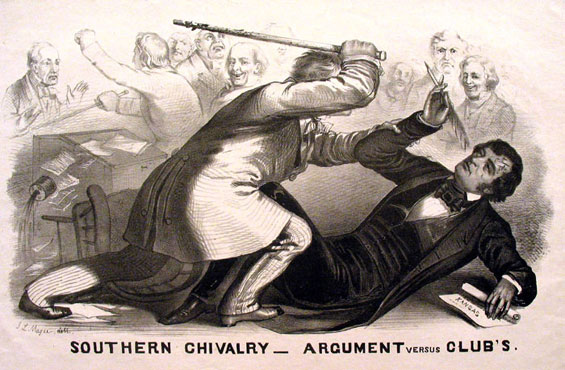
In 1856, Charles Sumner, a Massachusetts Senator, delivered an excoriating speech full of vicious name-calling and personal insults—especially against Senators Douglas and Butler—for their defense and advocation of slavery and especially the violence in Kansas in response to the actions of John Brown and his followers. The speech went on for two days, and shortly after its completion a man named Colonel Preston Brooks, a U.S. representative from South Carolina and distant relative of Andrew Butler, retaliated by beating Sumner with a cane. It was a serious enough beating that Sumner would take years to recover. Sumner would become an iconic hero to northerners and Brooks, who as punishment for the crime was fined $300, a darling of the south. Newspaper headlines of the time, in each region, painted their man a hero and the other man a demon (read a sample here: http://history.furman.edu/benson/docs/sumenu.htm). It is not the loathsome sin of slavery that I wish to highlight here, but the age-old tendency to blindly defend a person or position one feels inclined toward and the incredible efforts to vilify those on the other side of the issue—no matter what.

People are inclined to line up behind men rather than the Messiah. It is not just during political season or for certain social agenda items that this occurs, but more importantly in every season of the year when it comes to religious matters. Paul decried men’s tendency to be “of Paul…of Apollos…and…of Cephas” (1 Cor. 1:12). In the religious world, division has occurred because men have lined up behind some man’s teaching. Often, this teaching is a misconstrued view of a passage (for example, John 3:16, Acts 16:31, Mark 16:17, etc.) or a teaching without benefit of a passage (for example, having an experience of grace, saying a sinner’s prayer, infant baptism, etc.). As with politics, people can become blind apologists for their leaders and champions who promote what they already believe. Often, no amount of reason and logic can overcome the predisposed bias of the adherents. Lost in the cacophony of religious debate can be clear, simple biblical truth. Religious division is not the product or prompting of God (1 Cor. 1:10; 14:33). It is entirely of human origin. While there are some matters where God has not legislated, there are also some clear “right” and “wrong” matters in Scripture. Where God has spoken, we must take His word and will over that of absolutely anyone else. Otherwise, we will find ourselves guilty of elevating one above the One we must all ultimately give an account to. That would be an injustice and violation to top even “The Brooks-Sumner Affair.” May we keep our allegiance to God free from the taint of personal prejudices, even in the matter of our religious convictions. Psalm 119:89.

southern_chivalry

He Can Carry What’s Too Heavy For You

Jeff Wiant has been a Christian since early 2015. Since then, he has written 11 hymns. They are all beautiful, but this may be his best. It’s his first invitation song to write.

Poem inspired by this beautiful new song by Jeff Wiant, member at Bear Valley.  Click on the link below to hear it:

CLICK HERE: Jeff Wiant’s “Won’t You Come”

Neal Pollard

We struggle and strain to carry our load
We buckle as it gets heavier on our backs
We fall and hurt on this rough, rocky road
The weight makes us stop in our tracks

Looking around with a face full of pleading
We wonder who is observing our pain
We’re wounded, weary, broken and bleeding
Set to surrender from the stress and strain

Tears flow freely, we have been here before
We know how the journey seems endless
Certain we can’t make it alone to the door
We feel solitude, helpless and friendless

It’s bigger than us, crushing and enormous
And the contents shameful and unsightly
We’ve borne it so long it’s begun to conform us
To a stooped struggler holding on tightly

A voice calling gently, “Bring it over to Me,
I can help you and give you My best,
Your burden is heavy, I know you are weary,
Come to Me and I will give you rest.”

Could you double down, wincing and worn,
Grit your teeth and ignore His free aid?
Eventually, it will bury you after making you mourn
You know an exorbitant price must be paid.

He is able and willing, but waiting for you
To seek what He offers you without reservation
Let Him do for you what only He can do
Give your burdens to Christ with no hesitation.

Think of the journey, partnered with One
Without limits in power, purity and pity
Who’ll stay with you until your journey is done
As together you arrive at His heavenly city.

Dockers de Cap-Haïtien

Who Is Behind This “Race War”?

Neal Pollard

I’m a child of the ‘80s, which, in south Georgia, seemed to be “post-racist.” Maybe it was the naivety of youth, but one of my closest friends, Greg Gwyn, was black. We were “Bird” and “Magic” (on the basketball court, at least in our minds). We were “Crockett” and “Tubbs.” We both rejected, out of hand, the notion of being “Wonder” and “McCartney” (too cheesy). While our High School had cliques, a timeless problem, they were determined more by interest than race. Sure, there was prejudice, as that is also timeless. But it was not the mainstream attitude.

I have preached full-time for three congregations, in Alabama, Virginia, and Colorado. All three are integrated, having not only “white-collar” (forgive the adage) professionals but also inner city representation among our African-American members. But, all three have wealthy and poor caucasians, too. Individuals in all three congregations probably struggled with making all kinds of arbitrary distinctions, including on the basis of race, but such attitudes have not been fostered. If uncovered, they are addressed with the power and authority of Scriptures like “God is not one to show partiality…” (Acts 10:34), “He made from one man every nation of mankind…” (Acts 17:26), “There is neither Jew nor Greek…for you are all one in Christ Jesus” (Galatians 3:28), “Do not hold your faith in our glorious Lord Jesus Christ with an attitude of personal favoritism” (James 2:1; and, if you do, “have you not made distinctions among yourselves, and become judges with evil motives,” vs. 4), etc. Our elders, deacons, Bible class teachers, and general leaders in these congregations, men like Kevin Turner, Ron Herman, Bill Burton, Jimmy Reynolds, Ron Thompkins, Joe Cook, King Taylor, and Ronnie Royster, would not be thought of in terms of their race if not for the point of this article.

So, as we see fiery debate, protests, wagon-encircling, hatred, and acerbic rhetoric, scratching our heads as to how all-consuming it has become, do we stop to ask who would be behind such division and strife? No, I don’t mean Republicans or Democrats, protest groups or activists, or hobby horse riders among brethren.  I think it is more sinister and serious. Who is ever behind separating not just mankind, but the Lord’s bride? Who benefits from people building walls to keep out others on any arbitrary basis? Who wins in the face of such crushing losses? Maybe we need to be asking that question and focusing on that issue more!

40492_1499404838050_6800990_n


Preach Him!

Preach Him…

  • In spite of opposition.
  • When men sin.
  • When men hurt.
  • When the world is on the brink of disaster.
  • When all forsake you.
  • When the stakes are high.
  • When men don’t listen.
  • When anguish sweeps over your soul.
  • When it is not popular.
  • To all men…black…white…rich…poor…educated…uneducated…nice…hateful…friends….enemies…high…low…
  • When paid and when not paid.
  • When you have to stand alone.
  • When exhausted.
  • When it would be easier not to.
  • To those who listen…those who will not listen…with hearts open…with hearts closed
  • Till Jesus comes.
Preach him!   –Billy Lambert, 2016 Bear Valley Lectures
14358684_10153962700550922_5667401840173838167_n

Answering Our Accusers

Neal Pollard

There was a time when it was possible to engage in respectful, loving dialogue with brothers and sisters we disagreed with or had a problem with. Even if we felt passionately, we could discuss it civilly and retain or even strengthen our relationship with our “disputant.” We should be thankful that there are still many who are open to such a biblical methodology.  However, there are some who seem intent only on winning the day, seizing some perceived moral or doctrinal high ground, or championing what appears to be a self-serving cause. Some of these same individuals are rife with rancorous rhetoric, baiting or calling out those they seem to see as enemies or the guilty. When we are called out, are we scripturally obligated to answer them or defend ourselves? Or, as the late Wendell Winkler put it, are we simply giving them a platform to spread their extreme views?

For the minority of brethren whose minds are made up, no matter what, or who seem eager to tangle, the question is whether or not it is necessary or helpful to answer their accusations.  I realize there were circumstances like 2 Corinthians where Paul, who was innocent, wrote by inspiration to defend himself. But I also remember when the Lord stood before Herod, Pilate and the Jews and “answered…nothing” (Mat. 27:12; Mark 15:3,5; Luke 23:9; Isa. 53:7). While none of us are nearly so good as our Lord, He is the example we are to strive to follow (1 Pet. 2:21). Before answering an accuser, it is wise to determine the following:

  • What is my motivation for answering? Is it to save face for myself? Is it to somehow punish or put my accusers in their place? Is it to prove I’m right and they are wrong? Pride, anger, and hurt feelings are not proper motivations for answering an accuser.
  • What do I hope to accomplish by answering? Will I change their minds or those to whom they pander? Are they actually desirous of an answer? Will I rescue my reputation or harm it by going to their level?
  • What are the ethics of my accusers? Is this a hobby or obsession of theirs (i.e., do they have a pattern and history of doing this with others)? Do they have the facts straight? Do they assert things as facts that are quantifiably wrong? If so, will they deal honestly with the answers I give them or twist them to suit their own agenda?

Here is the judgment call we have to make. Solomon gives divergent advice in Proverbs 26 when he says, “Do not answer a fool according to his folly, lest you also be like him. Answer a fool according to his folly, lest he be wise in his own eyes” (4-5). Sometimes you do, and sometimes you don’t.  Perhaps the Lord has placed that ball in our court, trusting us to use our judgment. If my Lord’s name and cause is threatened, I will be ready to jump to His defense. If someone tries to do that with my name, I should be more careful and if this is a means to allow the common sense observer to look at both of our works and discern each of our characters, may I have the patience and maturity to see it as an opportunity to fulfill Matthew 5:38-48. We don’t have to attend every fight people goad us to join.

marywarren

How Determined Are You?

Neal Pollard

Karoly Takacs has one of the most interesting stories in Olympic History. The right-handed pistol marksman and sergeant in the Hungarian Army was a world-class shooter, but was denied an opportunity to compete in the 1936 games since only commissioned officers could compete. That prohibition was lifted after these games and Takacs anticipated competing in 1940, but a faulty grenade exploded in his right hand during army training in 1938. Unbeknownst to the Polish public, Karoly began practicing shooting with his left hand. He showed up at the 1939 Hungarian National Pistol Shooting Championship, and when other competitors came to offer condolences about his accident, he said, “I didn’t come to watch, I came to compete.” In fact, he won those games. But, he was unable to compete in the 1940 or 1944 Olympic Games because they were not held due to World War II. By the time of the 1948 games, held in London, Takacs was 38 years old. But, he qualified and won the Gold Medal there. Then, he turned around and did it again at the 1952 Olympics in Helsinki. He barely missed qualifying in 1956!  For this, he holds a place as one of Poland’s greatest Olympic heroes of all time (information via Quora.com authors Ankur Singh and Swati Kadyan).

In the New Testament, God shows us how beautiful proper determination is. Starting with Jesus’ determination to save us from our sins, as we read about Him because of anticipated joy “endured the cross, despising the shame” (Heb. 12:1), we find the greatest example of resolve. But, then there was Paul. Before conversion, he was determined to exterminate the Christians (read Acts 26:9-11). After being won to Christ, he refocused his determination toward winning as many as possible to Christ (1 Cor. 2:2; 9:24-27) and he urged others to do the same (2 Tim. 2:1-6; Tit. 3:8; etc.). No one will make it to heaven without making a determined effort to do so. That does not mean that anyone will earn their salvation, but it just as true that no one accidentally goes to heaven. The way Jesus put it is, “Strive to enter through the narrow door; for many, I tell you, will seek to enter and will not be able” (Luke 13:24). How badly do you want to go to heaven? What are you willing to give up in order to go there?

karoly

Gleanings From The 2016 Bear Valley Lectures

Neal Pollard

  • We were honored with so many, enthusiastic guests (not including speakers and their families, we had brothers and sisters attending from Alabama, Arizona, Arkansas, California, Colorado, Indiana, Kansas, Kentucky, Mississippi, Missouri, New Mexico, Oklahoma, Tennessee, Texas, Utah, and Wyoming). Most of the Denver-metro area congregations had representation and nearly 30 congregations throughout the state were represented.
  • We were blessed by great congregational participation (this huge undertaking is underwritten financially by the Bear Valley Bible Institute and everyone associated with the school is involved in multiple tasks, but the Bear Valley congregation donated food, cooked for the banquet, helped set up, move things, and “break down” tables, chairs, providing security, coordinating parking, and the like, and attended in unprecedented fashion. From the leadership down, there was much support from the home crowd. This church is taking increasing “ownership” of this great, annual event).
  • We were reminded that God’s people want to hear from “The Book” (our textual studies continue to be popular with men, women, and teens. The ability to “walk through” a book of the Bible was met with constant, thoughtful compliments and enthusiasm! Letting God speak through His inspired Word is an unbeatable approach).
  • We were treated to great preaching and teaching throughout (it was put many ways, like “there was not a dud in the bunch,” “there was no let down, not even for one session,” and “there wasn’t a session you felt like you could skip to do something else.” That is a tribute to the men and women who handled their assignments so superlatively. So many good things were said about how rich and encouraging this year’s program was).
  • We were witnesses to continued growth (the first fact above gives insight into the fact that our attendance continues to climb.  We set attendance records at one session on Friday and five on Saturday, and we came close to matching records at several other sessions throughout the weekend. It was great seeing a “full house” throughout the lectureship).
  • We were made even more proud of our alumni (some of the most “rave reviews” about sessions concerned our alumni who spoke. We got to see and hear about the progress and success our graduates are having in their local works. So many of our former students showed up from near and far to support this year’s program. We learned at the banquet that, once again, a large number of our current student body received encouragement to come from our graduates. We want to deepen and strengthen our tie with the men who came through our school).
  • We were left anticipating an even better year next year (would you begin to make your plans, even now, to be a part of the 2017 Bear Valley Lectures? I hope so!).

14329874_10153962701025922_558042233759973345_n

Avoiding A Ride On An Ancient Cycle

Neal Pollard

It has been called “The Dark Ages Of The Old Testament.” During the period of the judges, there was moral, economic, social, political and religious decline. We often read that, during this time, the children of Israel did that which was evil in the sight of the Lord.

History keeps repeating itself in the book of Judges. The people do evil, God allows and oppressor to persecute them, the people turn back to God and plead for deliverance, and God raises up a deliverer to defeat the oppressor and deliver Israel. Here, we speak of the “cycle” of Judges: sin, servitude, sorrow, supplication, and salvation.

Their enemy invaders came from the East (Mesopotamia), the Southeast (Moab), the North (Canaan), the East (Midian and Ammon), and the Southwest (Philistia). It is interesting that Israel overcame Canaan in the militarily brilliant strategy orchestrated by God (Central Canaan—Josh. 7-8, Southern Canaan—Josh. 9-10, and then Northern Canaan—Josh. 11-12). As a result of Israel’s failure to utterly destroy the inhabitants of Canaan, the six oppressions came from the central, south, and north—each places where God had given them victory. What a reminder that when we don’t defeat the enemy, he will return! The enemy was sin!

Here is my summary of the book of Judges, as seen in Judges 2:16-19:

  • The rulers—“Judges”
  • The role—“Delivered”
  • The rescued—“Them” (Israel)
  • The rivals—“Those” (God’s enemies)
  • The ruination—“Plundered them” (oppression)
  • The refusal—“They did not listen to their judges”
  • The reveling—“Played the harlot after other gods”
  • The retreat—“Turned said quickly”
  • The right road—“In which their fathers had walked”
  • The role models—“Father, obeying the commands of the Lord”
  • The resolution—“They did not so”
  • The raising—“The Lord raised them up judges”
  • The relationship—“The Lord was with the judges”
  • The restoration—“Delivered them from the hand of their enemies”
  • The repentance—“The Lord was moved to pity” (KJV—“It repented the Lord because of their groanings…”)
  • The return—“When their judge died, they would turn back”
  • The retrogression—“Acted more corruptly than their fathers”
  • The resilience—“Didn’t abandon their practice or stubborn ways”

The judge was the savior of the people. Time and time again, the people put themselves in a position to need some serious rescue, and our long-suffering God was willing to soften His heart to their cries. Eventually, His patience ran out and even in this time period there were severe consequences. How often do we need the blood of Christ and the forgiveness of the Father? Often, we need forgiveness for the same sins repeatedly. We wonder how Israel could fall into the same traps, but we do well to identify and avoid them in our own times. We have the benefit of both Old and New Testament Scripture, and they would have only had the writings of Moses and Joshua when they lived. May we learn from these ancient lessons (cf. 1 Cor. 10:11) and stay off that ancient cycle.

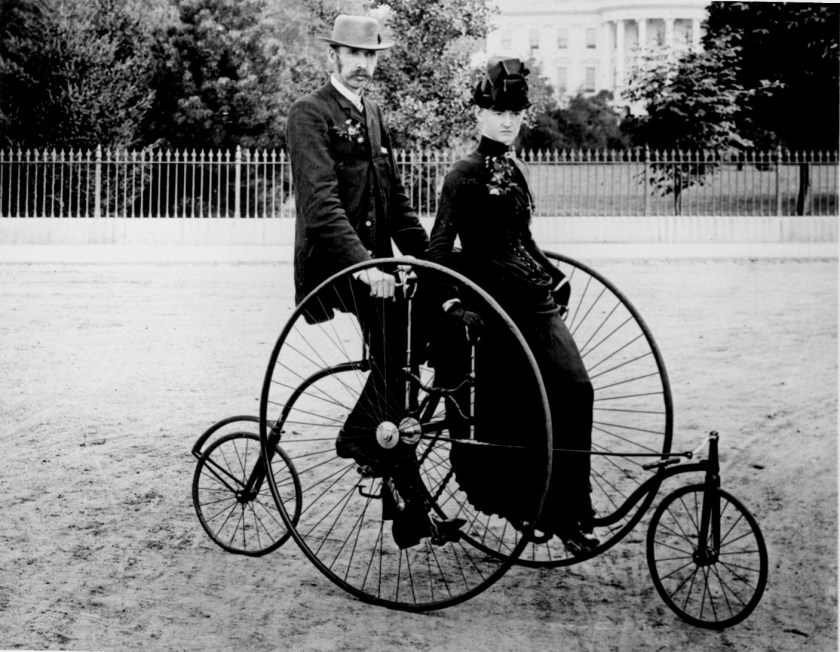
bicycle_two_1886

What Would Our Slogan Be?

Neal Pollard

A Bear Valley member gave me a mailer she received from a new, area denomination.  The oversized postcard, in attractive colors (the background of which looks to be a paint palette), leads with the header, “Messy Grace.” The subtitle reads, “It’s okay to not be okay.” The brief message beneath says, “God loves you. God cares for you. God wants a relationship with you. NO MATTER WHAT!”  Now, there is a lot of truth in that message, if we don’t necessarily care for some of the jargon. Could it leave a wrong impression? Yes, if the message does not include the response we need to make to His amazing grace. We cannot stay messy, if that means willful sin. But we will all continue to have our messes, even after coming to Him.

But, the mailer itself, with the self-appointed slogan, is what got me to thinking. If our visitors got to write our slogan, what would it be? For some places I’ve visited, it could be the following: “Don’t Sit On My Pew!”, “Race You To The Restaurants!”, “Visitors? What Visitors?”, “Joy Is For Liberals”, or “Are You Ready To Rumble?”  If the Lord wrote our slogan, what would it be?  For some congregations He diagnosed, it was also less than flattering: “We’ve Left Our First Love” (Rev. 2:5), “We’re Following False Teachers” (Rev. 2:14-16), “We Tolerate Immorality” (Rev. 2:20ff), “We Look Alive, But We’re Really Dead” (Rev. 3:1), and “We Think We’re Something Great, But We’re In Really Bad Shape” (Rev. 3:15ff).

Here at Bear Valley, there are several potential slogans I would hope represent who we are and what we are trying to convey by the way we act when we’re together on Sunday and Wednesday as well as our interaction at other times. Here are some good options:

  • “We Love One Another” (John 13:35).
  • “We Walk In Truth” (3 John 4).
  • “We Continue In His Word” (John 8:31).
  • “We Bear One Another’s Burdens” (Gal. 6:2).
  • “We Like Being Together” (Acts 2:42ff).
  • “We Look For Our Lost Sheep” (Luke 15:4).
  • “We Know Who The Enemy Is” (Eph. 6:11).
  • “We’re Not Conformed But Transformed” (Rom. 12:2).
  • “We Put Others Before Self” (Phil. 2:3-4).
  • “We Act Toward Others As If Doing For Christ” (Mat. 25:40).

The thing is, we are going to have a general character and emphasis as a congregation. Whatever we prioritize and do, that’s what it is. It’s not what we say, sing, or “sloganize.” To see it in print is sobering. May we collectively strive to earn a reputation that reveres our Master, reflects our mission, and renews our minds.

1akxyz

Some Things I Love About Assembling On The Lord’s Day

Neal Pollard

  • Watching young parents gather their kids and lead them into the building
  • The happy, excited chatter of people who act like they’re attending their favorite reunion ever
  • The many brief, but meaningful, conversations
  • Seeing the new faces that are inevitably there and being thrilled at the prospect
  • Noticing members greeting and welcoming people who are visiting
  • Feeling the anticipation of class and worship
  • The steady faithfulness of widows and widowers who, despite the loss of their partner, are still in love with the Lord
  • New Christians leading and enthusiastically participating in the worship service
  • Witnessing worshippers who appear to be very engaged and enjoying themselves
  • The sound of Bible pages rustling (or being close enough to see mobile devices going to the Scriptures cited)
  • Elders making spiritual encouragement and admonition
  • Little boys picking up the attendance cards
  • Young parents persevering in training their learning lads and lasses (even when that means occasioning the “training room”)
  • Even the tone-deaf lifting up their voices to make a “joyful noise” to the Lord
  • Husbands and wives united in their desire to be present before the Great I Am (and appear to be enjoying doing so together)
  • The display of emotion and heartfelt engagement by those leading us in worship
  • The very elderly or infirm, sometimes on walkers or in wheelchairs, who with great effort make the appointment they disdain missing
  • The many ways being in Christ brings interesting combinations of people together (educated with uneducated, rich with poor, the very old with the very young, those of different races, etc.)
  • Hearing the Bible conversations that start and continue after “the last amen”
  • Watching Christians rally around and embrace those who respond to the invitation
  • Knowing Christ is present and participating in the assembly (Heb. 2:12)
  • The intimate connection with God that results from His pattern and design for worship, perhaps especially in the weekly observance of the Supper
  • The piercing conviction to live better and serve Him for actively that results from assembling
  • Realizing how many things that are to love about assembling on the Lord’s Day

What would you add?

200227925-001

Is It A “Sign”?

Neal Pollard

I read about the discovery of World War I shells found in the Sea of Galilee, likely dumped by fleeing Turkish ships lightening their load to escape the pursuit of the British. There is a bigger story, though, than a 100-year-old wartime artifact being found in an unlikely place. The shell was uncovered through an unprecedented drought that has left exposed an island in the middle of that sea. Some religious Jews think it presages their long-awaited Messiah, their conviction based on their view of Psalm 66:6, Zechariah 14:8, and Isaiah 15:9. Adam Eliyahu Berkowitz, a veteran of the Israel Defense Forces and freelance writer, cites various rabbis who say that the present weather anomaly and its consequences are prophesied signs. Yosef Berger, the rabbi of David’s tomb in Jerusalem, says, “Just like in prayer, which is a dialogue with God, our thoughts are taken into account in Heaven, and can bring the desired prophecy into existence… By people believing that the Galilee drying up is part of the prophecy, it will help the Messiah come” (Breaking Israel News).

I appreciate any people who believe in the truth of the Messiah, and I see any such looking and longing of a transparent sincerity. However, these well-meaning Jews are 2000 years too late. The kind of Messiah they seek is not clearly stated, but their forefathers rejected the kind of Messiah Jesus Christ was and is. The Old Testament prophesies of His birth, ancestry, forerunner, earthly ministry, opposition, crucifixion, resurrection, and church were fulfilled in the time of Jesus. The New Testament often looks back at prophesies and show how Jesus fulfilled them.

The Jews of Jesus day stopped their ears and shut their eyes to the signs and miracles He did, repeatedly proving to the open-minded observer that what such revered men as Moses, David, Isaiah, Micah, Zechariah, Malachi, and others wrote concerning the Messiah was fulfilled by the nature, birth, life, death, burial, and resurrection of Jesus of Nazareth (cf. Luke 24:44-47; John 20:30-31). Their lack of faith cost them at Jerusalem in A.D. 70. It will cost them eternally, if they do not believe in the Christ who has already come.

The drought-stricken waters of Galilee are a sign of a lack of sufficient rain, but nothing more. Those still awaiting the One who already came should instead learn of Him and follow Him. Because His second coming will be without signs (cf. Mat. 24:36ff). May we all be ready for that day!

sea_of_galilee_bw_21


LESSONS I WANT MY SONS TO CARRY INTO ADULTHOOD

Neal Pollard

I preface this simply by saying that I have far too imperfectly modeled these lessons far too often, but I maintain their worthiness. The world is rooting for our children to fail and fall, but the Word is written to counteract that! Prayerfully consider the following:

–Character Is More Important Than Charm And Charisma
–Hard Work Is Its Own Reward
–Be Honorable In Every Relationship—The World Sees Too Little Of This
–Conduct Yourself As A Gentleman, No Matter What Society Preaches
–Have The Courage To Stand Up For What’s Right, Even If You Stand Alone
–Notice The “Little” People—Those Who Cannot Advance Or Help You
–Trust Divine Principles Over Cultural Practices…Every Time!
–Purity Of Heart Is Directly Connected To Cleanliness Of Life
–Do Not Leave Devotional Time Out Of Daily Living (There Is No Day You Don’t Need Him)
–Stewardship Is A Whole Life Concept
–Serve God Faithfully And Forever, Whatever Your Profession
–The Church Needs You Now—Procrastination Here Is The Devil’s Delight
–Stay Humble, Especially When You Succeed Or Do Something Well
–Volunteer For Jobs No One Likes To Do
–Who You Marry Has The Most Impact On Where You Are Going—Choose Wisely!
–“Count Your Blessings, Not Your Crosses” (A.U.)—There’s Equal Opportunity To Do Either.
–Love And Respect The Church’s And Society’s Eldest Members
–Realize There Are People Watching You When You Least Expect It—Shine!
–There Will Always Be Those Who Are Led By Your Actions—Be Wise!
–Happiness Is Self-Determined, Not Externally-Driven
–Appreciate The Gravity, Value And Importance Of Your Word
–Never Outlive Your Love For Christ
–Don’t Allow Your Negligence To Cost Other People (Whether Time, Money, Trust, Or Good Will)
–Do Not Let The World Rob You Of The Profundity Of Your Purpose
–Honor The Name You’ve Been Given By Living A Godly Life
–A Moment’s Passion And Indiscretion Can Destroy A Lifetime Of Godly Living
–“Never Do Anything In Your Mate’s Absence You Wouldn’t Do In Her Presence” (Wendell Winkler)
–Appreciate The Preciousness Of Life Every Day
–Make Spreading Cheer A Conscious Priority (And Involve Your Face).
–Choose Compassion Over Cruelty
–Keep A Song On Your Lips
–Lead As Many People To Heaven As You Can And Know That Your Life Will Open More Doors Than Your Lips.
–Integrity Trumps Image… Every Time!

11216243_10208526183610233_7251361887396784630_n
Psalm 127:3