The Samaritans in the Bible: A People Caught Between Two Worlds

Brent Pollard

A Forgotten People Who Never Left

Would it surprise you to learn that the Samaritans are still with us? Fewer than a thousand of them remain, clustered near Mount Gerizim—the very mountain a weary Teacher once gazed upon as He spoke to a woman at a well. “Our fathers worshiped in this mountain, and you people say that in Jerusalem is the place where men must worship” (John 4:20, NASB 1995). That sentence has a long history. It reaches back seven centuries before a single water jar was ever left beside that Samaritan road.

Modern genetics has added a curious wrinkle to the account. Commercial DNA analysis reports that Samaritans cluster neither with ethnic Jews nor with Arabs, despite having lived among both peoples for millennia. Their Y-chromosome lineage, however, does appear to link them to ancient Jewish roots. In a strange way, a laboratory has handed us a footnote to 2 Kings 17.

What the Assyrians Really Did

We are prone to imagining the captivities as a total evacuation—every Israelite marched off, every home left empty, every village reduced to a ruin. It is a tidy picture, and it is wrong. The Assyrian Empire was not in the business of emptying lands. It was in the business of breaking identities. Mass deportation and resettlement were policies designed to smother rebellion and to blur the memory of nationhood, and the Assyrians typically removed only the elite: the leaders, the skilled craftsmen, the warrior class—the very people most likely to foment a revolt.

The ordinary farmer, the village potter, the shepherd on the hillside—many of these were left where they had always been.

Sargon’s Oddly Specific Number

Sargon II took credit for the fall of Samaria, though the siege had largely been the work of his predecessor, Shalmaneser V. That is the way of kings and their inscriptions. Still, the figure he recorded is worth pausing over: 27,290 people. That is not the round, swollen number of a boaster; it has the flavor of an actual tally. By contrast, his son Sennacherib claimed to have carried off more than 200,000 captives from the kingdom of Judah—a figure that strains credulity, given that Sennacherib had only swept through several Judean towns before ever reaching the walls of Jerusalem. One wonders whether suburban Judah contained so many souls to take in the first place.

And as every student of Scripture remembers, Sennacherib’s Jerusalem campaign did not end with a triumphal procession. It ended with a single messenger of God walking through a camp at night. “Then it happened that night that the angel of the Lord went out and struck 185,000 in the camp of the Assyrians” (2 Kings 19:35, NASB 1995). Isaiah had already announced the outcome: Sennacherib would hear a report, return home, and fall by the sword (cf. 2 Kings 19:7). Every word of it came to pass, though the assassination by his sons Adrammelech and Sharezer would not arrive for another twenty years.

Hoshea’s Samaria, we should remember, was a city of only about eight hectares. Even allowing for the wealth the prophet Amos lampooned with his ivory beds (Amos 6:4), the population could not have been vast. Add to that the earlier Assyrian sweeps under Tiglath-pileser III, when “Ijon and Abel-beth-maacah and Janoah and Kedesh and Hazor and Gilead and Galilee, all the land of Naphtali” were taken away (2 Kings 15:29, NASB 1995), and Sargon’s modest figure begins to look entirely believable.

The Making of a Mixed People

Here is where our story bends. Into the half-emptied villages of the northern kingdom, the Assyrians planted new settlers “from Babylon and from Cuthah and from Avva and from Hamath and Sepharvaim” (2 Kings 17:24, NASB 1995). These newcomers carried their gods with them. God, in turn, sent lions among them. The frightened settlers sent word back to the Assyrian king: they needed someone who could tell them how the local deity wished to be worshiped. A priest from among the exiles was sent to instruct them.

What sort of instruction did he give? We are not told. We know only that a syncretism took root—an uneasy marriage of the worship of the God of Israel with the old inherited cults. It is worth remembering that Israel’s perennial temptation had never been simply to abandon the Lord; it had been to worship Him in vain. Archaeological evidence from the ancient southern Levant suggests that some of YHWH’s worshippers tried to pair Him with Asherah, a thing God Himself would never tolerate. The new Samaria inherited a habit of mind that was already centuries old.

When the Jews returned from Babylon to rebuild the temple, the Samaritans offered to help, insisting they had been sacrificing to God since the days of Esarhaddon (Ezra 4:1–3). Their offer was refused. Whatever their sincerity, the returning exiles saw a people whose worship was not clean.

Josephus and the Muddied Record

The historian Flavius Josephus, writing centuries later, describes a temple on Mount Gerizim founded in the time of Alexander the Great. According to his account, it was built for a priest expelled from Jerusalem for refusing to put away his foreign wife. Nehemiah mentions such a priest, though without naming him (Nehemiah 13:28). Josephus gives him a name—Manasseh—and ties the whole affair to the Hellenistic period. The trouble is that Nehemiah’s ministry lay deep in the Persian period, and the archaeology of Gerizim shows a sanctuary already standing there before the Greeks arrived. Josephus has preserved something of the tradition; he has also compressed the centuries into a shape that does not fit the ground.

Gerizim and the Woman at the Well

Names, we forget, are often given from the outside. Many of the people we call by one name called themselves by another; the label sticks only because the outsiders made it stick. The Samaritans did not call themselves Samaritans. They called themselves “keepers,” or simply Israelites. They were, in their own eyes, the faithful remnant, while the Jews to the south were the innovators. By the time Jesus passed through Sychar, a settled tradition among them claimed that the priest Eli had corrupted the Torah by moving the place of worship from Mount Gerizim to Shiloh. Every Samaritan who looked across the valley at that mountain believed he was seeing the true house of God.

Read John 4 again with this in your ear. When the woman says, “Our fathers worshiped in this mountain,” she is not making small talk. She is stating a creed. Two peoples, two mountains, two rival accounts of where history went wrong. And Jesus answers her not by choosing a side of the valley but by lifting the whole question: “an hour is coming when neither in this mountain nor in Jerusalem will you worship the Father…. But an hour is coming, and now is, when the true worshipers will worship the Father in spirit and truth” (John 4:21, 23, NASB 1995).

What the Well Still Says to Us

Every generation wants to relocate worship. Some want to move it up a mountain; some want to move it into a sanctuary; some want to shrink it down into their own private preferences. The gospel moves it somewhere else entirely. It moves it to the heart of the one who worships, and it anchors that heart to the Savior who, of all places, chose a Samaritan well to disclose plainly that He was the Messiah (John 4:26). If a tired Jewish Teacher could cross a valley of seven centuries’ hostility to speak life to a woman drawing water at noon, then there is no history too tangled for Him to untangle and no heritage too mixed for Him to redeem. The Samaritans are still among us—and so is the thirst He came to satisfy.

https://www.lifeandfavor.org/shoplifeandfavor

https://www.posthou.se/atinyspark

THE DIFFERENCE OF MORE THAN A YEAR

Neal Pollard

Have you ever researched famous people born on your birthday? I have. I share a birthday with Babe Ruth, Bob Marley, Zsa Zsa Gabor, Queen Anne, Isidor Strauss, J.E.B. Stuart, Tom Brokaw, and, of course, a great many others. Two of the more fascinating, by contrast, were born a year apart. The one born in 1911 was a man. The one born in 1912 was a woman. He was an American patriot and two-term president. She was the companion of a Nazi dictator. He was shot, but survived. Her end was presumably self-inflicted. He lived into his 90s. She died in her 30s. He was Ronald Reagan. She was Eva Braun.

Both were born in two-parent households of modest means. Both had Catholic backgrounds. Both were second-born children. Both were athletes in their youth. Both possessed a talent for the arts. Both were fiercely loyal.

There is much more that could be said by way of comparison and contrast, but consider this. They were born and raised into the world at almost the same time. They were both born with the freedom to choose. Both found themselves in a place of great influence. Why was their ultimate influence so different from one another? It is surely more complex than can be measured from so great a distance of time and geography. Yet, it is a question played out an infinite number of times every day.

The day you were born, you were given a set of resources: time, talent, inclinations, opportunities, and influencers. For all of us, some of those resources present challenges and some present advantages. In other words, all of us have problems to overcome and privileges to leverage. In every case, we get to decide what we do with what we are given.

One of the applications of the parable of the talents (Mat. 25:14-30) is stewardship. Each man was given resources. Each was held accountable for what he did with them. Each made choices regarding them. Each reaped what he sowed.

I do not know how my final epitaph will read. It will certainly not be American president or German dictator’s companion. For that matter, it will not be Hall of Fame baseball player, British royalty, actor, composer, or broadcast journalist. 

I know how I want it to read–Faithful Christian, faithful husband, faithful father, faithful preacher, and faithful friend. Am I using my resources to work toward that goal? The only way I get to choose my legacy is by building it day-by-day, decision-by-decision. The same is true of us all. That means we must all use time wisely (Eph. 5:16) to forge it. By doing so wisely, we can be numbered among those to whom the Lord, at the end of it all, says, “Well done, good and faithful servant” (Mat. 25:21). 

berlin-3835504_960_720
Braun and Reagan shared a legacy that includes Berlin, Germany.

The Brooks-Sumner Affair

Neal Pollard

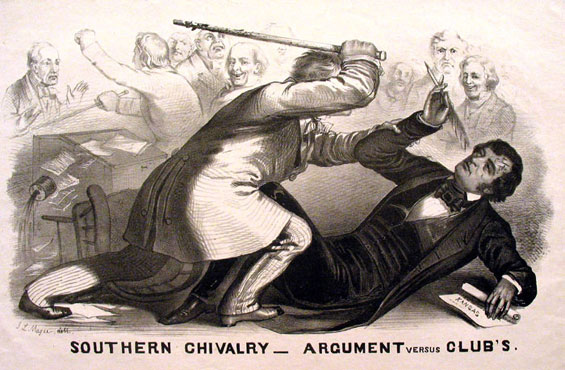
In 1856, Charles Sumner, a Massachusetts Senator, delivered an excoriating speech full of vicious name-calling and personal insults—especially against Senators Douglas and Butler—for their defense and advocation of slavery and especially the violence in Kansas in response to the actions of John Brown and his followers. The speech went on for two days, and shortly after its completion a man named Colonel Preston Brooks, a U.S. representative from South Carolina and distant relative of Andrew Butler, retaliated by beating Sumner with a cane. It was a serious enough beating that Sumner would take years to recover. Sumner would become an iconic hero to northerners and Brooks, who as punishment for the crime was fined $300, a darling of the south. Newspaper headlines of the time, in each region, painted their man a hero and the other man a demon (read a sample here: http://history.furman.edu/benson/docs/sumenu.htm). It is not the loathsome sin of slavery that I wish to highlight here, but the age-old tendency to blindly defend a person or position one feels inclined toward and the incredible efforts to vilify those on the other side of the issue—no matter what.

People are inclined to line up behind men rather than the Messiah. It is not just during political season or for certain social agenda items that this occurs, but more importantly in every season of the year when it comes to religious matters. Paul decried men’s tendency to be “of Paul…of Apollos…and…of Cephas” (1 Cor. 1:12). In the religious world, division has occurred because men have lined up behind some man’s teaching. Often, this teaching is a misconstrued view of a passage (for example, John 3:16, Acts 16:31, Mark 16:17, etc.) or a teaching without benefit of a passage (for example, having an experience of grace, saying a sinner’s prayer, infant baptism, etc.). As with politics, people can become blind apologists for their leaders and champions who promote what they already believe. Often, no amount of reason and logic can overcome the predisposed bias of the adherents. Lost in the cacophony of religious debate can be clear, simple biblical truth. Religious division is not the product or prompting of God (1 Cor. 1:10; 14:33). It is entirely of human origin. While there are some matters where God has not legislated, there are also some clear “right” and “wrong” matters in Scripture. Where God has spoken, we must take His word and will over that of absolutely anyone else. Otherwise, we will find ourselves guilty of elevating one above the One we must all ultimately give an account to. That would be an injustice and violation to top even “The Brooks-Sumner Affair.” May we keep our allegiance to God free from the taint of personal prejudices, even in the matter of our religious convictions. Psalm 119:89.

southern_chivalry

Copperopolis, California

Neal Pollard

It boomed when “copper was king” and owed its thriving existence to shell casings made for the Union Army in the far-away Civil War.  Fittingly, her downtown streets were Union, Grant, Lincoln, and Sherman. There were 90 businesses in “Copper City” from 1865-1867. The extraction and production of copper ore found in such strikes as at Gopher Ridge, Quail Hill, and Hog Hill made Copperopolis a boom town for a short time.  A huge fire in the center of town, in 1867, coupled with the enormous drop in demand for copper following the end of the Civil War, left the community a virtual ghost town. So, despite a few modest copper mining rebounds periodically through World War II, Copperopolis, which yielded $12 million in copper from 1861 to 1946, is a shell of its former self. It is a resort and recreation area today, a modest little town who  once entertained the likes of Mark Twain, Nikola Tesla, and “Black Bart” (Charles Boles)(mymotherlode.com,  calaverashistory.org/copperopolis).

History is fascinating, with its “rags to riches,” “riches to rags,” and even “rags to riches to rags” stories.  Family histories play out the same way.  So can the rise and fall of nations.  The history of the church, wherever she has existed, may follow the same trajectory.  The Jerusalem church of Christ, where it all began, once boasted thousands of members.  In time, due to persecution and the introduction of false doctrines, the church there faded from view.  Today, it has only a modest presence. The same could be said of other congregations we read about in the New Testament.  Our congregation is somewhere on its course from the past to the future.  Where will it be in 10 years? 50 years?

Then, I look at my own life.  I have been a Christian for over 30 years.  I have preached for over 25 years. There have been Bible studies with non-Christians and new Christians. There have been efforts to try and influence others with the gospel.  My three sons are all nearly grown and on their own.  My wife and I have labored together to serve Christ.  But, each day, I must look and sincerely investigate what my spiritual trajectory is.  Am I growing nearer to Christ, acting more like Christ? Am I bearing more or less fruit? Are my best days in His kingdom behind me or in front of me? The good news is that, to a great degree, that lies within the scope of my free will and deliberate choices. With God’s help and to His glory, I can make today, tomorrow, and beyond the brightest days of service to Him.

Look at your life.  What legacy are you building? You will help determine that by what you do today.  Paul says, “Therefore be careful how you walk, not as unwise men but as wise, making the most of your time, because the days are evil” (Eph. 5:15-16).

Photograph taken of ruins in Copperopolis, California.

A LINK TO HISTORY

Neal Pollard

He was named after a World War I general, born in Los Angeles in 1918 just after the American doughboys went “over there.”  There are four men who played Major League Baseball older than Robert Pershing (“Bobby”) Doerr (Mike Sandlock in 99, Eddie Carnett and Alex Monchak are 98, and Carl Miles in 16 days older than Bobby), but his Major League debut was the earliest.  Unlike anybody else among the top 15 oldest living baseball players, Doerr was an everyday player who achieved some notoriety. He’s the oldest living player who is in the Hall of Fame.  But, making his debut in 1937, Doerr is a part of these interesting facts.  He played against Lou Gehrig, Joe Dimaggio, Mel Ott, Hank Greenburg, Schoolboy Rowe, Lloyd and Paul Waner, and Pie Traynor, as well as many other all-time greats.  Jimmy Foxx and Lefty Grove were teammates. Lefty pitched to Babe Ruth, Ty Cobb, and Tris Speaker. In 1925, his rookie season, Grove sat across the dugout from Jimmy Austin (age 46), Oscar Stanage (age 42) and Chief Bender (age 41). Sitting in his dugout, though, was Jack Quinn (age 42), who was a teammate of Austin’s on the 1909 New York Highlanders, a team that also included Willie Keeler and Jack Chesbro. We could keep going, but we’ll stop there. Doerr, a man still in his right mind, could tell you all about Lefty Grove and heard who knows how many stories Grove told about players who played in the 1800s, connections to the earliest days of baseball.  Doerr is a link to history (info via baseball-reference.com).

How many have pointed out the interesting facts from the Genesis genealogies, where it is possible that Noah’s grandfather, Methusaleh, may have known Adam?  They were most certainly contemporaries, and that covers a span of 1656 years (https://answersingenesis.org/bible-timeline/timeline-for-the-flood/).  Noah and Seth, Adam’s third son, would have been alive together for 34 years before Seth’s death. To appreciate how incredible that is, consider that 1656 years ago was the year 359 A.D., 4 years before Constantine’s grandson, Julian the Apostate, becomes Roman emperor (http://www.fsmitha.com/time/ce04.htm).

It would not take a lot of digging around in our congregations to find individuals who provide us a link to church history.  Consider Bear Valley for a moment. Johnson Kell had Hugo McCord stay in his home one summer several decades ago, the two even going on a long run together.  Converted as a soldier during World War II, Johnson would have been in the church when great preachers like Marshall Keeble, N.B. Hardeman, and others were helping the church grow so much.  Harry Denewiler grew up in the church, and at nearly 90, could have been in the assemblies when great preachers of the 1920s were filling the pulpits of the midwest.  Two of our members, Jean Wilmington and Maurya Fulkerson, were baptized by Rue Porter when they were school-age girls. No doubt others have recollections of the church that reach back to the 1920s and 1930s, like Neva Morgan, Carolyn Barber, the Brennans, and others. Many conversations I had some years ago with Rooksby and Bea Stigers centered around their recollections of those who spoke of the establishment of the church in the Denver area.

As a lover of history, I am thrilled in my soul to think that we are linked to great men and women of God who helped start and build up the Lord’s church.  When I was seven years old, my family and I visited in the home of Zana Michael, a then 100-year-old sister in Christ who was a member where dad was preaching in Barrackville, West Virginia.  She was four years old when the church there was established. Some of the great preachers of the 19th Century traversed the bergs and valleys around Barrackville and sister Michael heard several of them. We got to hear her, regaled by her clear recollections, and linked through her to such wonderful history.

Screen Shot 2015-06-10 at 9.53.39 AM
Zana Michael is the lady in the middle

Isn’t it thrilling to think of ourselves as being surrounded by so great a cloud of witnesses (Heb. 12:1), sometimes getting to hear from those who heard from those who take us further back in time toward the beginning of the church?  This afternoon, as Carl and I sit and watch the Rockies and Cardinals lock horns on the baseball diamond, we’ll get another chance to join the historical continuum of a grand old game. Every Lord’s Day, as we engage together in worship to God, we join in the grandest historical continuum of all, linked ultimately to Peter, Paul, John, and the rest. Until we exult in heaven some day, what could exceed that thrill?