A PROVEN RECIPE FOR PEACE

Wednesday’s Column: Third’s Words

10423661_10207901451272315_9069631728203375436_n

Gary Pollard

Peace conjures a number of different images in our minds; from hippies to nature’s beauty to inner calm to lack of anxiety. Nearly every group of people in the world craves peace – no rational human being wants to live in constant upheaval. We all want to have peace, but our world somehow is still getting worse and worse. Why is this? The prince of this world is not a being who desires peace (II Corinthians 4.4; Ephesians 2.2; John 12.31). His very existence is dedicated to bringing down anyone who believes in God (I Peter 5:8) and he has no care or concern for the fate or well-being of anyone on this earth. Total, lasting world peace will never be possible as long as time continues (see Romans 8.18-25: sin caused the earth to be subjected to futility). 

Total, lasting world peace may not be possible in this life, but this does not mean the world cannot experience any peace at all. How can we experience peace in our lives? 

Firstly, it has to come from us. The world will never act in a way that brings peace. Anytime the world wishes to better its conditions, it incites civil unrest, riots, protests, and other not-very-peaceful behaviors. Christians, however, are called to be different. I Timothy 2.1ff tells us that praying to God on behalf of all men, for kings, and all who are in authority will allow us to lead quiet and tranquil lives in all godliness and dignity. We can have peace by being obedient to government authorities – even if we do not agree with them politically – because God put them in place (Romans 13). If we want peace, we have to show that peace by how we live. Since man is naturally attracted to peace, our quiet, godly lives will draw others to Christ. 

Secondly, even if our world is in chaos we can have inner peace. Philippians was written to break up a nasty fight between Euodia and Syntyche. To have the “peace beyond what we can understand,” they had to rejoice in the Lord, be reasonable, not be anxious, and reach out to God for their every need. The same applies to us today! Do we get our joy from God or from worldly pursuits? Are we worried about meeting personal needs or do we rely on God (see Phil. 4.19; Matt. 6.25)? Do we try to fix our own problems, relying on our own strength, or do we place them in God’s hands and work with His guidance and providence? The Christian life is not easy, nor is it always peaceful, but the inner peace that a faithful Christian experiences, knowing that their name is in the book of life and that nothing in this short life can disrupt God’s love for them, makes every struggle in this life worth the pain. 

If we want peace, we have to be that peace. We have to live peaceful lives. We have to submit to governing authorities (as long as it is within the parameters of godliness). We have to be unified as a church. We have to look to God for all of our needs. We have to trust that He will take care of us, even if that isn’t in this life. If we can do these things, we will have peace.


33335219_10155570504230922_7279042811561771008_n

Korah’s Rebellion 

Tuesday’s Column: Dale Mail

IMG_1381

Dale Pollard

For the next few weeks we will look at some of the lesser known Biblical accounts, and the lessons we can learn from them. 

In Numbers sixteen there is a strange and terrifying event that unfolds. It has all the ingredients of a great movie. There’s rebellion, jealousy, vengeance, and drama but it’s so much more than a story. It’s history, and it’s been divinely recorded for our learning.

Korah seems to be the individual that starts a rebellion against God’s chosen leader, Moses. He hops up on his high horse and rallies together two hundred and fifty other leaders among the people. This group, no doubt, gave him the confidence to directly confront Moses face to face. He says, “You’ve overstepped yourself, Moses! Take a look around at the people you’re trying to lead. They are just as righteous as you, and God is in their midst!” Moses falls on his face, then says, “Tomorrow, God will make His stand with who He chooses.”

When morning comes, Korah and his fellow rebels bring incense to the Tent of Meeting to offer up to God. In the meantime, an intense conversation between God and Moses takes place. God, filled with righteous anger, is about to demolish every one of them in their tents, but Moses pleads with God to give them a chance. So, a warning is given to the people, “stay away from the tents of these evil men!” No sooner had the warning been given, the earth opens up and Korah and all those belonging to him are swallowed up by the earth. Fear spreads among the people as they were afraid for their lives, and who could blame them? God then strikes down the two hundred and fifty leaders with fire— the worship offerings still in their hands. What an account! Of course there are several applicable lessons for us, but here are just three.

Mind your Maker.

God chose for His people who He wanted to be in the leadership positions. When Korah felt that he knew better, the consequences were fatal. May we never fall victim to the mindset that tells us that we know better than God. Our Lord wants us to live a certain way, and worship a certain way. When we make changes to His divine commands, just like Korah, we have overstepped our bounds.

Mind your mingling.

How did so many band together with Korah? They were all mingling in the wrong crowd. Every one of those men made a choice. They chose to grumble and complain together, then they died together. It doesn’t matter how many people think the same way we do if that thinking isn’t Patterned after God’s thinking.

Mind your motives.

What drove these men to take such a stance? They were motivated by pride, discontentment, anger, greed, and self-righteousness. All of these attitudes are toxic for the church today, and all of them still lead to destruction.

While this account is a humbling reminder of God’s reaction to disobedience, there’s more to the story. Although Korah was out of line, his descendants would prove to be more upright (Numbers 26:11). They even go on to write some of the Psalms in the years to come, including Psalm 42. Your upbringing and roots do not have to dictate your eternity. Like Korah, we all have a choice. My prayer is that as these historical events are read we learn from them and press forward, more determined to be faithful children to a perfect Father.

“As the dear thirsts for water, so my soul longs for you, O God. My soul thirsts for God, for the living God.” 

Psalm 42:1-2

40455086_10155783567500922_7374175323555889152_n

Your Favorite Pair Of Shoes?

Monday’s Column: Neal At The Cross

pollard

Neal Pollard

Growing up, I heard my dad preach a sermon comparing different type of shoes to various people’s religious attitudes. You can imagine the application of such shoe types as the slipper, the loafer, the work boot, the Sunday shoe, the combat boot, etc. It was a clever illustration to encourage everyone to live a faithful Christian life and avoid a mentality that hurts the church.

Do you have a favorite kind of shoe? I’d venture to guess that you even have a favorite pair or couple of pairs of shoes. Usually, you’ll find me either in a pair of cowboy boots or in a pair of running shoes. What goes into why you favor a pair of shoes? Quality? Style? Comfort? 

To make a spiritual point by referring to footwear is more ancient than my dad’s efforts to do so. No less than the apostle Paul referred to “having shod your feet with the preparation of the gospel of peace” (Eph. 6:15). Indirectly, Isaiah and Paul give attention to this very idea by complimenting the “beautiful feet” of those who bring good news of good things (Isa. 52:7; Rom. 10:15). 

You would think, to borrow dad’s analogy, that some “shoes,” figuratively, shouldn’t be adorned as part of our Christian armor. Flip-flops aren’t good (Jas. 1:8). Neither are skate shoes (Rom. 12:11; Col. 3:23). Camouflage boots can be a liability (Rom. 12:2). It would seem counterproductive for a preacher or teacher to favor tap dancing shoes (2 Tim. 4:3), since our responsibility is to stand firm (Eph. 6:11,13,14). 

Staying with the analogy, some shoes are excellent if used according to their design. Running shoes are essential to running the Christian race (1 Cor. 9:24,26; Heb. 12:1), but not to run in vain (Gal. 2:2; Phil. 2:16), run with sinners to sin (1 Pet. 4:4), or run after false teachers (Luke 17:23). Work boots can be misused in prioritizing occupation and career over the kingdom, but when used in the exercise of our talents and resources to grow the kingdom they are worn well (Mat. 5:16; 9:37-38). 

You get the idea, and you can no doubt add to the analogy with your own ideas. But, spiritually, what is your favorite pair of shoes? John the Baptist suggests that Jesus, like most all others of His day, wore sandals (Mark 1:7). John felt unworthy to even untie them. Yet, Peter, later on, would say “follow in His steps” (1 Pet. 2:21). Jesus’ shoes carried Him to Samaria to minister to the woman at the well. They presumably walked on water. They took Him to Lazarus’ tomb. He doubtless wore them as He ascended the mountain to preach the greatest sermon ever delivered. Was He permitted to wear them as He carried His cross to Calvary? 

We aren’t qualified and worthy to be in His shoes, but, as the song suggests, we must be “trying to walk in the steps of the Savior.” Another hymn avers, “Where He leads me, I will follow.” Our favorite shoes should be the ones revealing the footsteps of Jesus. We follow Him and anyone can follow us (1 Cor. 11:1). They will help us walk in good works (Eph. 2:10), in a worthy manner (Eph. 4:1), in love (Eph. 5:2), and carefully (Eph. 5:15). 

pythonboots

When the Tempter Has You Out On A Limb

Friday’s Column: Supplemental Strength

brent 2020

Brent Pollard


You can learn much by observing nature. Not only can one know God by looking at nature (Romans 1.18-20), he can learn specific lessons on various topics by looking at specific aspects of God’s creation (e.g. ants teach industry, Proverbs 6.6-8). I was watching a humorous scene outside my office window recently and was reminded of this.

 Our household, despite being full of “dog-people,” has cats for “pets.” Let’s just say that we feed the cats and provide them outdoor shelter for keeping mice, moles, and snakes away from the house. In many respects, they’re feral but become domesticated long enough to eat the kibble we put out. And, if they feel like initiating it, contact resembling petting may occur. If there is one thing I don’t like about cats, though, it is their murderous nature. Even though well-fed, cats will kill for sport. 1

 This latter observation creates a conflict for someone who has always enjoyed feeding and watching birds as well. We had to give up putting out birdseed when the cats became a part of our household. At first, the birds avoided our house. Yet, kittens learn by watching adult cats. If adult cats don’t teach kittens how to hunt, they aren’t as successful at it. As the senior hunters have passed from disease and predation or gone fully feral, being chased off by other cats, the birds have begun coming back without our encouragement. Frankly, I think a few of those “birdbrains” must be rather smart.

 One such smarty was teasing one of our cats the other day. He or she served as a good example of the tempter. As Angelo, a cat with a pattern of “angel’s wings” on his back, was slowly climbing up a budding, dogwood tree, the bird did not fly away. Instead, the avian adversary just side-stepped further to the right out on to thinner branches. The higher Angelo climbed, the thinner the branch on which the bird rested became. It seemed as if the bird knew that if Angelo tried to pounce on him or her, he would go crashing to the ground while he or she would just fly away. Angelo really thought about his situation. It took him several minutes, but he finally understood that despite his prowess, continuing towards his coveted prize would lead to his harm. Thus, to his chagrin, he slowly made his way back down the tree to the safety of the ground below.

 Herein is the lesson from nature. The tempter will lure you out from “relative safety” in order to bring your desire close, only to ensure when you pounce on it, you will end up falling flat on your face (consider Romans 6.23). We must ensure we are aware of where we are (Hebrews 2.1-4). The branches upon which we make our way may grow thin quickly, depriving us of a solid foundation, and causing us to fall.

 Of a truth, no one ever sets out to fall, he just fails to appreciate the gravity of the situation. Keep your eyes on what lies beneath your feet (1 Corinthians 10.12).

cat-1647775_960_720


1 Traywick, Catherine. “Killer Kitties: Study Proves They’re Not as Innocent As They Look.” Time, Time, 9 Aug. 2012, newsfeed.time.com/2012/08/09/killer-kitties-study-proves-theyre-not-as-innocent-as-they-look/.

The World Is Desperate

Thursday’s Column: Captain’s Blog

IMG_0806

Carl Pollard

Generalizations are almost always wrong. For example, just because you’re from Colorado doesn’t mean you smoke weed, or just because you’re homeschooled doesn’t mean you’ve never seen a person before. Just because you live in Alabama doesn’t make you an Alabama fan. Just because many people fall into a category, doesn’t mean that every person is the same.

There is one generalization that is true: the world is desperate. Without Christ, many issues in life go unsolved. Family problems are harder to overcome, job issues get blown out of proportion, and questions go unsolved. Over the next few weeks I’d like to look at three major issues that the world has no answer for. But these three topics are easily explained through God’s Word.

Each one of us has had these thoughts before. Every single person ever born at some point will have these questions. So number one, the world is desperate for Guidance (Psa. 119:105). Ever been lost? It is amazing how easy it is to get turned around. I’m terrible with directions, and even with maps up on my phone, I still find a way to get lost.

The world feels the same way–they’re lost. They don’t have direction in life. They float around going from one thing to the next looking for guidance. As Christians, our guide is God’s Word. It gives us a map for life. Psalm 119, the longest chapter in the Bible, has to do with guidance. Each section in this chapter covers different aspects of keeping God’s Word. In the first eight verses, the psalmist says things like, “blessed are those who walk in the Law of the Lord,” and “I shall not be put to shame, having my eyes fixed on all your commandments.” The rest of the chapter sticks with this pattern.

If you ever find yourself questioning why you follow scripture, study this chapter and you will find reason after reason. Looking at verse 105, it says this, “Your word is a lamp to my feet and a light to my path.”

Are you anxious? Turn to God’s Word. Are you hurting? Turn to God’s Word. Are you afflicted? Turn to God’s Word (119:107). Has your family disowned you? Turn to God’s Word. Have your kids left the Church? Turn to God’s Word. Did you lose your job? Turn to God’s Word. See, the world doesn’t turn to scripture when it faces these problems, and they are left without a guide, without comfort, and without something to rely on. There’s a reason God inspired men to write the Bible, and that reason is so that flawed man can have a guide through life.

563871_3978156290465_1606961254_n
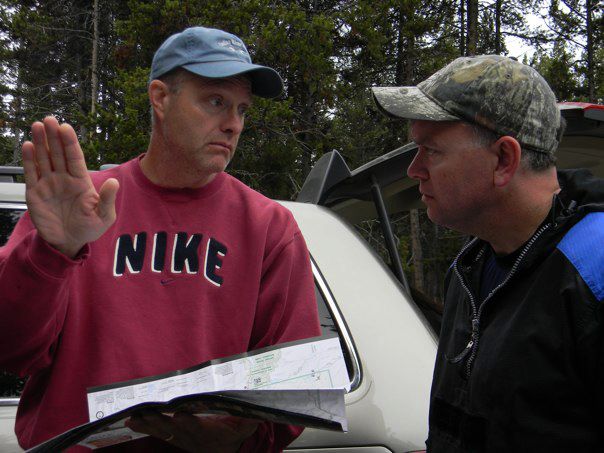
As my dad and Wes Autrey demonstrated in Yellowstone Park, you also                    need to know how to use a roadmap to avoid getting lost.


It’s A “Miracle”?

Wednesday’s Column: Third’s Words

20638721_440919206307154_5479040032968788217_n

Gary Pollard

It is tempting to believe that an incredible recovery, acquisition of a needed job or asset, or escape from a major life issue is an example of the miraculous. In the religious world, a miracle is something a few believe can be invoked with prayer, a special religious service, or even a social media post (“pray that ______ will be healed by a miracle from God”).
Despite living in an age where notions of the supernatural are considered unscientific or are chalked up to circumstances we simply don’t understand yet, there is still much confusion surrounding the miraculous.
Miracles served a specific purpose both in the Old and New Testaments: they were designed to glorify God. Parting the Red Sea, striking a rock to get water, a talking donkey, an endless supply of oil and flour, the sun standing still, and all of the other miracles were – by design – impossible to perform without divine help. The Hebrew word for miracle meant “a sign or wonder” (Hebrew & Aramaic Lexicon of the Old Testament). Its purpose was to prove to the recipient that God was in control, was all powerful, was perfect, righteous, to be feared, and to be obeyed. Miracles were also used to prove that someone’s message was actually from God or that God was with them.
In the New Testament, miracles served to prove that Jesus was the Son of God and that the Apostles’ message was certainly from God. Water was turned into wine, the dead were raised, sicknesses were healed, people who were uneducated could suddenly speak multiple languages, predict the future, read someone’s mind, etc. The Greek word for miracle meant “a deed that exhibits the ability to function powerfully” (BDAG 263). These deeds were impossible to perform without God’s help, and they served a specific purpose: to prove that a message came from God, or to prove that a purpose originated with God.
While it certainly is a nice sentiment that an otherwise unlikely recovery or escape is an example of the miraculous, it’s important to remember that miracles served a specific purpose no longer relevant to our time. We no longer need miracles to prove our message comes from God because we have His complete and perfect word in scripture (I Corinthians 13).
Not having miracles in our world may be a downer to some, but we have this to look forward to: a place without sin for those who die faithful (II Peter 3.13). A place without death for those who die in Christ (Revelation 20.14). A place without sorrow for those who sleep in God after a lifelong battle in this sinful world (Revelation 21.4).
Miracles existed because this world is fallen (Romans 8). Their purpose was to demonstrate God’s power over Satan and sin in a world characterized by all that cannot coexist with goodness. Those who are living life in view of the next find hope and comfort in the miracle of Scripture, the miracle that will bring us home if we follow it.
66043362_10156431482270922_6278654536441659392_o
A view of the Valley of Aijalon, where God caused the sun to stand still. 

How To Make The Best Of A Bad Situation 

Tuesday’s Column: Dale Mail

IMG_1381

Dale Pollard

Rattlesnakes are large, venomous snakes that live throughout North and South America. In my humble opinion, they are one of the most terrifying creatures on the planet–from the hair-raising sound of that rattle to those intimidating fangs that can be up to six inches long. The bite from one of these monsters is excruciatingly painful. If you were to be bitten, at first you would experience a tingling feeling, followed by an intense burning sensation. After this you would feel lightheaded and begin sweating profusely. Your vision would become blurry, and each breath would be more strained than the last one.

If left untreated, it can be fatal to humans. All of that sounds terrible doesn’t it? What good could possibly come from a deadly rattlesnake? Well, at some point in history, somebody looked at these snakes and decided that they would make a beautiful pair of boots. That’s how to make something great, out of something terrible. There is no doubt in my mind that the inventor of snakeskin boots was an optimist. He could see the good, even when staring into the dark vertical pupils of pure reptilian evil.

When faced with hardship, that simply comes from living in a fallen world, it can be a challenge to see the silver lining in each dark cloud. American basketball player, Charles Barkley once said, “Sometimes the light at the end of the tunnel is a train.” That’s definitely how it can feel sometimes! Although we have books in the Bible like Job and James that teach us how we should view our earthly struggles, here are just a few reminders from our God.

Number one, remember that each day is worth rejoicing over. Psalm 118:24 gives us the reason why— because today is another day that the Lord has made. It’s not my day; it’s God’s day. Reminder number two, what we can’t see in times of difficulty, is worth waiting for. Paul would inform us in Romans 8:27, “But if we hope in what we don’t see, we wait for it with patience.” In the muck of life it may feel at times that there’s just no way out. Just because you may not see the end in sight, rest assured that our hope is in a promise that was put in place before time itself began (2 Timothy 1:9). The last reminder is simply this, that God made the world you are living in and Jesus is currently creating the world we will one day live in (John 14:1-3). I firmly believe each day that passes can only mean that heaven will be that much more beautiful. If God created this world in six days, in all it’s beauty, imagine the splendor of our home to come. Now, if that doesn’t make a bad situation a good one, I don’t know what will! Here are the lyrics to an optimistic hymn that I hope get stuck in your head for quite a while.

“I care not today what tomorrow may bring, if shadow or sunshine or rain. The Lord I know ruleth o’er everything, and all of my worry is vain. Living by faith in Jesus above, trusting confiding in His great love. From all harm safe in His sheltering arm, I’m living by faith and feel no alarm.”

rattlesnake boots
One of two pair of rattlesnake skin boots I own.

Heaven’s “Start Up”: The Ultimate “Rags To Riches” Story

Monday’s Column: Neal at the Cross

16174665_10154303308455922_2453812807432667966_n

Neal Pollard

Some of the wealthiest companies, Apple, Hewlett-Packard, Amazon, Mattel, Google, Tesla, and The Walt Disney Company, started in the quaint, quiet haven of a garage. Often, they had little more than an idea of a product or service, but they refused to stop until they achieved success. These rags to riches stories intrigue us and fire our imaginations.

Have you thought about the “start up” that began in heaven? It was conceived in the eternity before time. A couple of millennia ago, a poor couple staying in an obscure little village laid a newborn baby boy in an animal trough. This Child continued to grow and become strong, increasing in wisdom; and the grace of God was upon Him as He kept increasing in wisdom and stature, and in favor with God and men. Nothing more is said about this amazing adolescent until He is thirty years old and began sharing new ideas and promising the thing every person in every place in every generation absolutely cannot afford to be without. 

Though He was executed for His radical claims, thoughts, and actions, His followers refused to keep what He had to offer hidden. Many of them gave their lives to advance this cause, they believed so much in it. Most of them were poor, uneducated, and ordinary people, but they relentlessly carried His offer to every creature under heaven. People began to describe their efforts by saying these men have turned the world upside down! 

And indeed they have. Those who heard the Man who started it all shared it with those who shared it until this ultimate hope went everywhere. Today, multiplied centuries today, their work lives on. Taking that same, original plan, written down in one Book, people of every race, color, country, and economic strata continue to start from nearly nothing and grow in extraordinary ways. 

No wonder! That newborn is God in the flesh. What He came to offer is the eternal salvation of our souls. Where He offers it is in His body He calls the church. Anyone can have it, if they are willing to give Him everything they are and have. At this very hour, there is an untold number of men, women, and young people who desperately want what He has to offer, but they need to know how to get it. That’s where we come in. He is counting on us to share His offer today, while there’s time for them to take advantage of it. If we truly believe in the power of it, nothing will keep us from getting this indescribable gift to the masses!

29472998_1861193667226061_7295196647418494976_o

My First Sermon

Neal Pollard

My dad was holding a gospel meeting somewhere in the Carolinas and he asked me to preach the Sunday evening sermon of the week he was gone. It was April 12, 1987, and I was a Junior at Bradwell Institute (high school) in Hinesville, Georgia. He gave me one of his sermons and I basically, with little change, got up and preached it. I remember being scared out of my mind. I had no formal training (which is obvious from the grammar and pronunciation). Afterward, the congregation flooded me with compliments, which says everything about them and nothing about my abilities. But, it encouraged me. It helped solidify my desire to preach and became the foundation for my willingness to go preach around the area over the next year-plus (preaching in such places as Glennville, Jesup, and Brunswick, GA). It led me to choose Faulkner University, to major in Bible and meet great preachers and teachers like Wendell Winkler, Ken Randolph, Carl Cheatham, Leonard Johnson, Eris Benson, Donnie Hilliard, and others. My family led me to believe that gospel preaching was an honorable, important occupation. So did the Hinesville church of Christ, on that occasion and subsequent ones. So did brethren in those places where I filled in.

What an important lesson for families and congregations today! Paul asks some questions of eternal consequence: “How then will they call on Him in whom they have not believed? How will they believe in Him whom they have not heard? And how will they hear without a preacher? How will they preach unless they are sent? Just as it is written, “HOW BEAUTIFUL ARE THE FEET OF THOSE WHO BRING GOOD NEWS OF GOOD THINGS!” (Romans 10:14-15).  I pray that more adults will send a clear message to young men: preaching is important, respectable, and valuable! It should be considered as an option exercised by normal and even talented and intelligent individuals.

We’ve been engaged in full-time ministry for 28-plus years, and it has blessed our lives tremendously! It’s thrilling to watch our three sons giving themselves to that life, too. Let’s send more preachers!

(It’s hard for me to listen to, but it should encourage anyone who says, “I don’t have any talent for preaching!”)

When Adversity Makes You Feel Unproductive

Friday’s Column: Supplemental Strength

brent 2020

Brent Pollard

If there’s one thing disappointing me most, it’s the lack of productivity I often feel. There are many things I want to do. I don’t think I get even a quarter done. For many facing a similar predicament, it’s a matter of poor time management. Time is precious. We’re told to make the most of it since the days are evil (Ephesians 5.16). Contextually, this pertains to the efforts made by first-century Christians in their daily walk. Persecution was coming. Indeed, for some, their lives would soon be at an end. Did they want to depart for eternity’s shore feeling as if more could have done but had not been? That message remains prescient today. We enjoy civil liberties now including religious freedom. However, a tempest has been growing for half a century which seeks to strip away the vestiges of religion and morality from the body politic. In but a short time we may face the same uncertain prospects as they. Hence, our struggle to be productive is as important as ever.

This exhortation may be limited in scope, but I wish to address those who might have certain mitigating factors making Paul’s inspired admonition more difficult to keep. It’s one thing to be a timewaster when one is able-bodied. It’s another matter entirely when you’re limited from accomplishing as much by the limitations of the flesh. There are those accustomed to doing much. One day they young, full of vigor. In the blinking of an eye, though, they no longer recognize the person staring back at them in the mirror. The snow of many winters covers what hair is left on their heads. For such, it hurts getting out of bed. Something as simple as buttons on garments becomes a time-consuming challenge. They may be asking, “Why can’t I get as much done as I used to?” This can be especially vexing, spiritually.

Perhaps, you have an illness of the body or mind. Maybe you don’t have old age to blame for your aches and pains but an autoimmune disease that others dismiss because, from appearances, you look fine. Not only are you in pain but you feel alone because some have unfairly surmised you’re just lazy. It could be that you’ve had chemotherapy and experience what has been termed “chemo brain.” You find yourself struggling to remember simple details. If you don’t write something down, you’ll forget about it. Truly, I could share a plethora of other scenarios in which some malady besets the body or mind and causes one to feel unproductive or a timewaster. These should suffice.

Fortunately, we serve a gracious God. Not only is His grace sufficient for coping with our lot in life (2 Corinthians 12.9), but it takes into consideration our current estate. One can debate whether there are degrees of punishment from Luke 12.48. That’s not my purpose. A principle is established here, however, stating that we’re held accountable according to the responsibility entrusted to us. Why would God hold the enfeebled or impaired to the same standard as the able-bodied? This must be true of redeeming one’s time as well. Note, one cannot forsake his or her Christian duty. Yet, rather than beat up on yourself because of what you left unaccomplished, trust that God knows your situation intimately. The main thing is to show up and do the work of which you are capable (Matthew 20.1-16; 21.28-32). This is how you remain productive even while facing adversity in these evil days.

20190621_113147


“High Carb Diet”

Thursday’s Column: Captain’s Blog

IMG_0806

Carl Pollard

We all love a good piece of bread. Whether it’s garlic bread, cheesy bread, or just plain bread, everyone loves it. Bread is the greatest invention of all time, maybe ever (can you tell I wrote this before lunch?).
Jesus is described as being our spiritual bread. In John 6:35 Jesus is the “bread of life.” And in verse 32 He is called “the bread out of heaven.” Why would Jesus be called bread? When we take a closer look at these two verses, we can notice a few reasons why.
“Jesus then said to them, “Truly, truly, I say to you, it was not Moses who gave you the bread from heaven, but my Father gives you the true bread from heaven” (John‬ ‭6:32‬). There’s an analogy given by John that helps us to wrap our mind around Jesus being the Bread. Moses provided manna in the wilderness for Israel (bread from heaven), and Jesus (the bread) was sent from heaven to feed us spiritually.
It was amazing growing up with mom, THE Kathy Pollard, as the cook. And many times we would describe her food as “out of this world.” When we think of Christ, the Bread out of Heaven, He is literally out of this world.
Point is, we need to be feeding ourselves with this Bread. We need to be consistently meditating on God’s word, continually making it apart of who we are, and courageously manifesting it in our everyday lives.
“Jesus said to them, “I am the bread of life; whoever comes to me shall not hunger, and whoever believes in me shall never thirst” (John‬ ‭6:35‬). Two words in this verse are in the present tense– “comes” and “believes.” This means that for Jesus to be our bread we must continually come to Him and believe. Jesus is nourishment to those who are spiritually starved, mentally broken, and emotionally lost.
No matter how much bread we physically eat, it will never compete with how full and complete we will be in Christ. Are we turning to Him?
12764594_10208245679077795_625453659382235834_o
Just an example of some of the bread mom sustained me with growing up

Unity Between The Old And The Young

Wednesday’s Column: Third’s Words

10423661_10207901451272315_9069631728203375436_n

Gary Pollard

An engine needs three things to run: fuel, spark, and air (compression). Engines have come a very long way since their initial designs and unless you’re driving an e-car, these items still have to be in place and tuned properly. I’m partial to older engines simply because they’re easy to understand and work on. 

When diagnosing a problem, you can often tell if you’re getting fuel by looking at the in-line filter or simply smelling for it. You can tell if you’re getting spark by disconnecting a plug, grounding it to the body, and looking for a spark. You can tell if you have compression by sticking your finger over a plug-hole and turning the engine over. The older engines were simple. 

Newer engines are far more difficult. They operate under the same basic rules, but computers and fuel injection systems and tight spaces make it much harder to work on them. However, they are generally more reliable, fuel efficient, and powerful. Carl’s 1986 F-150 with a 351 Windsor (5.9L V8) has about half the power (and a third of the fuel economy) of his 2017 F-150 with a 2.7L Ecoboost, for example. 

The church is made up of more than just one generation. There are both old people and young people. Both are prone to emphasizing the strengths or weaknesses of their generation when it comes to the health of the church. Young people might complain that old people move too slowly (getting things done), are too traditional, and have no place in the future of the church. Old people might complain that young people are too quick to change things, don’t take church seriously, and are self-centered. 

Both generations are vital to the health of the church. The elderly bring experience, toughness, and proven life experience to the table. They’ve been through it, they’ve seen it, and they got through it. Younger Christians must learn from this experience and show older Christians the love and respect they deserve. Younger Christians bring energy, enthusiasm, and a willingness to execute vision to the table. As stated before, modern engines still have the critical components of older engines at the heart of their function. They may be more efficient, but would not be operational without those functions. 

When the church works together, older and younger alike, to promote growth, unity, and faithfulness, the result is awesome. No other group can enjoy that kind of peace! A church that works together will influence the world in ways that terrify satan. Not only is this something we should want, it’s also commanded (I Timothy 5.1; Romans 12.10; See also Leviticus 19.32; Proverbs 16.31). 

In a polarized world, we can really make a difference when we’re loving and respectful to everyone in our spiritual family. It is a breath of fresh air to anyone who experiences it, it proves the church is from God, and it will save lost souls. 

august2008pictures154
My brothers and me with Ela Beth and George Bailey at Polishing the Pulpit, 2008

6 Things About Gossip That I Don’t Like

Neal Pollard

As masterfully and humorously portrayed in the 15th episode of the first season of the Andy Griffith Show (“Those Gossipin’ Men”), gossip can seemingly appear, full-blown, out of thin air. It can be personally hurtful, but it’s part of the territory of living and breathing.  Here are 6 things I particularly dislike about the ugly specter of gossip.

  • It’s GallingIt “reveals secrets” (Prov. 11:13). It separates friends (Prov. 16:28), yeah even “intimate friends” (Prov. 17:9). While cowardly, it still takes a lot of nerve!
  • It’s Obstructive. Billing itself as “helpful” and “instructive,” it usually serves the opposite purpose. It “reveals secrets” (Prov. 20:19) and is the hallmark of idle busybodies (1 Tim. 5:13).
  • It’s Spurious. As previously mentioned, gossip is as apt to be false and inaccurate as it is to be trustworthy.  Even if there is a grain of truth, it can have an admixture of inaccuracy blended in.  Tragically, it is often received as the truth and nothing but the truth.
  • It’s Sinful. Find it listed alongside “strife,” “jealousy,” “slanders,” and “arrogance” (2 Cor. 12:20). God calls the spreader of such “a fool” (Prov. 10:18). It’s an “evil weapon” (cf. Isa. 32:7) and “stubborn rebellion” (Jer. 6:28). See also Romans 1:29, 2 Timothy 3:3, and Titus 2:3.
  • It’s Inconsiderate. Few gossips would want to be treated the way they treat their subjects (Luke 6:31).  Repeatedly, Christians are urged to “be kind to one another” (Eph. 4:32). We’re to love each other without hypocrisy and “be devoted to one another in brotherly love; give preference to one another in honor” (Rom. 12:9-10).  Gossiping is rarely wrapped in forethought and careful circumspection.  It’s not “friendly fire.” It’s just fire.
  • It’s Presumptuous. Gossip is acting with entitlement, believing that it is fair and right to spread (whether true or false) information about the subject thereof. The gossip believes himself or herself qualified to share something about someone else, and such are usually mortified if the tale is traced back to them.

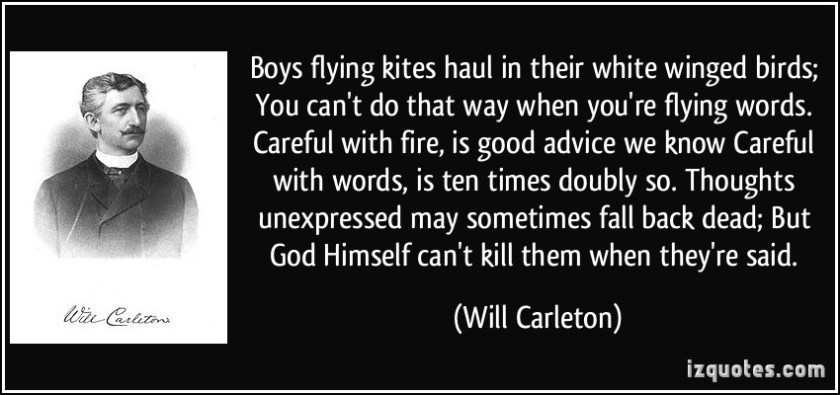
Yet, indignation should be tempered with realization.  Few have so mastered the tongue that they are above the fray we mention here.  Let’s be convicted to practice saying good and kind things behind each other’s backs. Remember to investigate before you propagate, and even then only carefully and prayerfully. Usually, prayer and care will render the “juicy tidbit” dead on the floor of your mind, safely unspoken and incapable of doing any harm. Remember the famous words of 19th Century Michigan poet Will Carleton: “Boys flying kites haul in their white winged birds; You can’t do that way when you’re flying words. Careful with fire, is good advice we know Careful with words, is ten times doubly so. Thoughts unexpressed may sometimes fall back dead; But God Himself can’t kill them when they’re said.”

quote-boys-flying-kites-haul-in-their-white-winged-birds-you-can-t-do-that-way-when-you-re-flying-words-will-carleton-377399

The Bible Is Not Boring (“Grace”

65093899_10156405640240922_1795016641457684480_o

Another of the episodes Gary, Dale, Carl, and I recorded in Fort Payne, Alabama, recently. In this episode, we discuss an often misunderstood, misapplied, but absolutely vital Bible subject. This topic is anything but boring.

Click here for audio

Defeating The Adversity of Loneliness In The Communication Age

Friday’s Column: Supplemental Strength

brent 2020

Brent Pollard

Human connections are necessary. Though stated in the context of needing a mate comparable unto himself, God nevertheless said of man it wasn’t good for him to be alone (Genesis 2.18). Thus, God provided Adam with Eve. Elsewhere, the wise man of God reminds us of the advantages of having companions:

Two are better than one because they have a good return for their labor. For if either of them falls, the one will lift up his companion. But woe to the one who falls when there is not another to lift him up. Furthermore, if two lie down together they keep warm, but how can one be warm alone? And if one can overpower him who is alone, two can resist him. A cord of three strands is not quickly torn apart. (Ecclesiastes 4.9-12 NASB)

Hence, even if being around many people wearies our soul, we admit it’s a blessing to have those precious few upon whom we can depend to be there for us when we emerge from our solitude.
Jesus had His close companions. We don’t doubt He loved all those men He chose to be His apostles, but He singled out Peter, James, and John to be His “inner circle.” They were His confidants. It was to these three alone He shared His true glory (Matthew 17.1ff). Peter, James, and John also went further into the Garden of Gethsemane with Jesus as He prayed (Mark 14.32-35). In addition, John refers to himself throughout the Gospel he was inspired to pen as “the disciple whom the Lord loved” (John 21.20). This same passage also shows us that John leaned against the Lord during the last Passover (Can you imagine?).

God never intended us to face life alone. As mentioned previously, God provided the foundation for the family in the very beginning. The family has often been called the “bedrock of society.” Aristotle wrote in Politics that humans organized themselves first in families that birthed villages which, in turn, gave rise to the polis (i.e. city-state).  As we live in a world into which sin was welcomed, we understand people bound to us, even by ties of blood, may betray or abandon us. We see, then, the wisdom of God in giving to us the church.
It’s a sad paradox in a world of virtual, perpetual interconnectedness people feel lonelier than ever. The HRSA reveals that loneliness and social isolation is as bad for one’s health as smoking 15 cigarettes a day! 1 Just type in the words “loneliness epidemic” in a search engine and see what pops up. This isn’t a problem just for our seasoned citizens either. 2 There’s no excuse for the child of God to be lonely, however. Christ instituted the church to be God’s Household on earth (Ephesians 2.19). If we assemble as we ought, we will be stirred to love and the performance of good works (Hebrews 10.24-25). Furthermore, we encourage and build up one another in the church (1 Thessalonians 5.11; Ephesians 4.15-16).
Yes, we’re currently facing a global epidemic not physical in nature. It’s a disease of the heart perpetuated by loneliness, which focuses one’s attention inward on troubles and wants. God didn’t create you to be alone. Dismiss the foolish notion that the church is for the weak and embrace the strength it supplies the lonely heart. You’ll never find an app that can do for you what the church can.

References

1 “The ‘Loneliness Epidemic.’” Health Resources & Services Administration, HRSA.gov, 10 Jan. 2019, www.hrsa.gov/enews/past-issues/2019/january-17/loneliness-epidemic.


2 Howe, Neil. “Millennials And The Loneliness Epidemic.” Forbes, Forbes Media LLC, 3 May 2019, 13:21, www.forbes.com/sites/neilhowe/2019/05/03/millennials-and-the-loneliness-epidemic/#77096a8f7676.


66176598_10156443546915922_8223081566729928704_o

The Mouse And The Cups 

Thursday’s Column: Dale Mail

83538761_557569434843824_1603081807199207424_n

Dale Pollard

In the pantry there’s a package of white foam cups. A small gray mouse struggles to carry a cup out into a man’s front yard one at a time. Just one cup and one each day. The man sticks to a normal routine. He goes to work early, and he comes home late. He watches TV, cooks a meal, tinkers on projects in the garage, and goes to bed. It’s mindless, it’s robotic, but day in and day out the cycle repeats itself. He leaves for work and the mouse drags yet another cup out onto his lawn. It isn’t until his yard is filled with foam cups that the man takes notice. What a mess! He walks through the yard and picks a few of them up. As he examines them he says, “What a waste. Perfectly good cups, now useless and dirty. We have a limited amount of foam cups in our package, and there’s a day when the mouse will grab the last one. We better put them to use. ”

If God came to you and gave you the chance to make a single request, what would you ask for? Our prayer lives are usually filled with our personal wants and needs. There are countless things that tug at different areas of our heart as we approach our Father, the Creator of the universe. He can do anything, He has all the power, and in one way or another we all desire some Divine intervention. I would like my family to be healthy and happy. I would like to live out the rest of my days with no more worries or anxieties. I would like the peace that comes with total financial stability. I wish my dog would live to be one hundred and five. I would like to be successful in everything I put my mind to.

There are five hundred wants in my heart, but what do I desire more than anything? The answer to that question is deeply connected to our spiritual life. What my heart chases after, where my time and energy goes, and even what I ask God for spreads my top priorities before me. David writes in Psalm 27:4, “One thing I ask of the Lord, this is what I seek. That I may dwell in the house of the Lord all the days of my life, to gaze upon his beauty and inquire in His temple.” David is known as the man after God’s own heart, simply because his heart was after God. David’s one desire was to form a deep and meaningful relationship with God. He understood what truly matters in this life. He even makes that his specific and singular request of the Lord. He puts his faith in action as he seeks that relationship with God. His life was built around this, and everything else is secondary to him. His seeking was that hopeful expectation— the effort he put in to this pursuit was a demonstration of that belief in God’s ability to grant him his one thing. David spent his time wisely. Almost every day that was granted to him he used as an opportunity to seek His Lord.

God is the Alpha the Omega, the beginning and the end. His eyes can see the very point in time in which He decided to create everything. He can also step back and look at His timeline and see the exact moment in which He will bring all things to an end. The Bible is a gift and glimpse into His mind. In it we can see the powerful beginning to the world we live in. We can see how God works in our present, and we can read about a grand event that will come when the days run out.

What is that one thing you want more than anything else? Don’t let the cups pile up in your yard. Let’s all use the time we have to pursue the only thing that matters.


racing-mouse-3499446_1280

Tired Shoulders

Thursday’s Column: Dale Mail

IMG_1381

Dale Pollard

It’s common in the age we live in to get stuck on the “daily grind.” We wake up, drink coffee, get dressed, go to work or school, come home at the end of the day, and start all over again in the morning. It’s repetitive and the days can seem to blend together. On top of this monotony, you have your own problems to solve. We’ve got our own responsibilities to keep up with. For some it’s family and for others it’s homework or any number of other duties. This can cause anxiety or depression. Those thoughts that are familiar to so many can creep into our minds. Thoughts like, “why am I even doing this? What’s the point?” Our shoulders are tired with the burden of life. There’s too much going on and we may just want to shut down or sleep to escape the day. The weight is heavy.

So try something. Wake up! When our minds are full of our problems and our responsibilities and everything that’s wrong with our lives and our circumstance, we miss something precious. We miss out on the lives of everybody else that also share this planet. Solve your problems and shake the daily grind by branching out. Strive to achieve selflessness by loving others and showing compassion. Solve your problems by trying to help others with theirs. If I personally have my own problems as a young adult, I know that there are others with problems much bigger than mine. Their shoulders are killing them and they’ve been carrying the weight longer than me.

There are people all around you struggling with the same things or worse. The next time you Tweet, begin to create a Facebook status, or blog, are you about to be another problem for someone else? Or are you about to ease their aching shoulders?

unknown

Who Will You Listen to? (1 Kings 12) 

Wednesday’s Column: Captain’s Blog

IMG_0806

Carl Pollard

I remember it like it was yesterday, I was standing in my brothers’ room while they were trying to convince me that I had swallowed a marble. After enough talking, they finally convinced my 3-year-old self that I had swallowed a marble. A couple of hours later we left the ER after being told by the doctor that there, in fact, was no marble in me. What on earth happened? Well, I’ll tell you what happened. I listened to my brothers and their prank went a little farther than they thought it would. 

This reminds me of an account that is recorded in 1 Kings chapter 12, where Rehoboam listens to some unwise advice from his brothers. The people come to him asking their new king to lower the taxes his father Solomon had placed on them. So Rehoboam reaches out to those who served with Solomon, and they tell him to lower the taxes; but Rehoboam didn’t like this answer. In fact, he wasn’t looking for that answer. So he goes to his friends, the guys he grew up with, and this is what they say, “‘My little finger is thicker than my father’s loins! Whereas my father loaded you with a heavy yoke, I will add to your yoke; my father disciplined you with whips, but I will discipline you with scorpions’”(1 Kings 12:10-11). Rehoboam takes the advice of his younger council, and because of this the kingdom of Israel split. 

When it comes to who we take advice from, it is always best to come at it with all biases aside. Rehoboam was talked into doing something that split the kingdom. The next time we have a decision to make, we must not make the mistake Rehoboam made or what I did in listening to my brothers. Let’s be wise and make our decision after praying with a heart which honestly seeks God’s will. 

600px-7dbpc315432-marble

“It’s all Greek to me.”

Tuesday’s Column: Third’s Words

20638721_440919206307154_5479040032968788217_n

Gary Pollard

This is a familiar phrase to most of us, usually used when responding to something so difficult to understand that it warrants saying. Advanced math brings this phrase to my mind (no one should never mix the alphabet with numbers, by the way). For most people, any topic or conversation with very difficult-to-understand components will prompt, “It’s all Greek to me.” We understand that it is used in good humor and not as a slight against Greek, but I believe that it has also discouraged the “average” Christian from studying the original language of the New Testament. 

Before I continue, allow me a disclaimer: I am not a scholar, by any means, in the use of the Attic/Ionic-based ancient language known as Koine Greek. I am an enthusiastic student of the language, but not an expert. The purpose of this article is to hopefully knock down some of the myths surrounding the language and hopefully encourage us all to pursue a knowledge of it. 

Myth #1: Greek Is Super Hard to Learn

This could not be further from the truth. Greek makes a lot more sense than English! This is not to say that it is easy (learning any language is difficult), but it is most certainly attainable. Start with the Greek alphabet and memorize it. Once you can sound out words, try memorizing as much vocabulary as you can. If you can, find a Greek New Testament with a lexicon in the back and memorize those. With that base, learning the more complex grammar rules and language structure becomes significantly easier. 

Myth #2: You Need to Be an Expert to Get the Benefits of Greek Study

Regardless of what anyone says, the New Testament really comes to life when you can read it without the third party that is translation. You get the full emotional and intellectual impact of a writer when you can read his words first-hand. You do not have to be a Greek scholar to get some of that impact! Technology today can be an incredible tool. One such tool is Logos Bible Software. It is a free app that allows anyone to look up a word in the New Testament and understand more about its meaning. Another resource is a good lexicon like BDAG. This can be had (in an earlier edition) on abebooks.com for a couple of dollars. 

Why study Greek? It will help you grow immensely in your spiritual life. It will help you understand truths more clearly. It will give you even more joy and excitement in your study. It will give you a better grasp of the English language. It will give you a firsthand look at scripture without the bias sometimes present in translation. This is not, by any means, necessary for salvation or even spiritual growth and maturity. It is, however, one of the most incredible tools any Christian will have for in-depth bible study. As an added bonus, you can chuckle a little more anytime someone says, “It’s all Greek to me.” 

authentic-greek-1649223_1280

The Infamy Of The Edsel

Monday’s Column: Neal At The Cross

16174665_10154303308455922_2453812807432667966_n

Neal Pollard

The Ford automobile named for Henry’s own son made its debut in 1957 after unprecedented hype. They had started planning and developing the Edsel back in 1955 based on consumer research, polls, and interviews. Ford thought it had tapped into the heart of the buying public with a car that would win its heart. It turned out to be a disaster in every way one can measure such–it was too big, too unreliable and poorly-made, too unattractive, too expensive, and, well, too weird. Even the name is strange. When Ford’s marketing department polled people about how they liked the name, many asked, “Did you say ‘pretzel’?” (info from “The Flop Heard Round The World,” Peter Carlson, Washington Post, 9/4/07).  While today the Edsel has become a collector’s item, selling for as much as $100,000 or more, it will forever live among the automotive lemons’ Hall-of-Fame lineup that includes such stellar machines as the AMC Gremlin, Ford Pinto, Chevy Chevette, Yugo GV, and De Lorean DMC-12. 

Marketing can be a mean business. Especially is it risky when you take a proven, respected name and attach it to something that dishonors and degrades it–like “Ford” and “Edsel.” So many researchers have sought to identify why the Edsel was such a colossal failure, but the answer often goes back to the problem that “with too many hands working on the Edsel, the project had no direction” (“The Edsel Proved Why You Should Never Design A Car By Committee,” Chris Perkins, Road & Track, 1/23/17). 

What does all of this have to do with God and the Bible or Christ and the church? Well, several things.

  • Jesus is the Perfect Man who offers something unique that cannot be outdone–salvation which is located in His body, the church (Eph. 1). This is what we have to offer this world, and this is what the world needs. 
  • Sometimes, we spend too much time in gimmickry, marketing hype, and mining for felt needs, and at the end of the day we wind up offering a cheap, poor, and disappointing product that dishonors and degrades His perfect name. May we ever respect the warning of Galatians 1:6-9. 
  • It is easy for us to lose sight of our mission and sense of direction, if Jesus is not the heart of our mission, purpose, plans, and activities. As disciples, He leads and we follow (Luke 9:23-26). 
  • We never want, as a church or as an individual, to sully His precious name by our association with it–whether by ungodliness, worldliness, legalism, mean-spirited, hateful behavior, doctrinal compromise, etc. I suppose that David’s name, as king of Israel, defamed God for a long time after his sin with Bathsheba (2 Sam. 12:14). We should disdain the very prospect of such.
  • It’s not too late to correct even infamous blunders. Ford is not defined by the Edsel. It went on to produce some automobiles that more than restored its good name. That can be true for churches and individuals. Jesus would not have gone to the trouble to admonish Ephesus, Sardis, and Laodicea if they were a lost cause. The same is true of Euodia, Syntyche, the man in 1 Corinthians 5, and others.  There cannot “un-be” an Edsel, but there can be a brighter future.

The Ford Edsel became the focus of a great many studies by the likes of John Brooks and Bill Gates. Its failures helped many industries, not just the auto industry, learn from its basic mistakes. I think there’s insight in it for the greatest “business” of all–i.e., soul-winning. May we get the greatest name (Jesus) to the greatest audience (the world) through the greatest message (the gospel)! That’s a guaranteed recipe for the greatest success (salvation)!

ford-3886280_640