In every chapter of Ecclesiastes you can expect at least two kinds of verses. At least one verse will make you wonder what Solomon is talking about and one verse will hit you in a profound way. As it turns out, humans haven’t changed that much over the years and our current experience of life share many similarities. Here are twelve amazing truths found in this book.
1.4-8
Some things never change.
2.24-25
Pleasing God will bring you more joy than chasing the things that bring momentary pleasure.
3.9-11
God has given us a desire to know the future. Because of this, we understand that while we don’t know the future we’re better off serving a God who does.
4.9-12
It’s by design that we can accomplish more with help. God can do more with us when we are team players.
5.19-20
There’s joy to be found in hard work and that too is by design. Satisfaction is a natural feeling produced by the work of our hands.
6.6
If you don’t find joy in life then life will drag on and feel slower.
7.13-15
When life is good, enjoy it. When life is hard— remember that it’s like that for everybody. Ups and downs are part of living.
8.16-18
This world is not just but don’t let that fool you into thinking that God isn’t just. We can’t understand how God’s mind operates in every circumstance.
9.11-12
Not everything happens for a reason! God might have a hand in any event, Satan may have something to do with it— or maybe it’s all a coincidence.
10.8-15
Every job has it’s dangers but wisdom can make a job run smoother just as a sharp knife can make a task easier.
11.7-8
It’s good to be alive! It’s nice to see the light from the sun. You should enjoy the life you live with eternity on your mind.
12.11
You can put your trust in any wisdom and teaching that comes from God.
Each chapter of Ecclesiastes is filled with wisdom and life changing words. Our world needs to spend more time studying this inspired collection of truth.
Sometimes, preachers will tell other preachers, “Here’s an outline. Take it and make a good lesson out of it.” Last Sunday morning, I preached a sermon from 2 Corinthians 4 I entitled, “When Life Deals You A Blow!” After overviewing what the chapter is about, I told the story of an elderly bank robber and then had five points that when life deals you a blow…
I. FOCUS ON YOUR PURPOSE (1-6) II. RECOGNIZE YOUR POWER SOURCE (7) III. PROPERLY VIEW YOUR PROBLEMS (8-12) IV. MAINTAIN YOUR PRINCIPLES (13-15) V. KEEP YOUR PERSPECTIVE (16-5:1)
It always warms my heart when our young people give me a copy of their notes. It tells me they are engaged, listening, and thinking about the sermon. I always treasure these and keep these. I definitely will be doing that with Lilah’s notes from the lesson, which her dad, Josh, gave me. She has his sense of humor. It lets me know she was really thinking.
In bullet points, she wrote…
When life deals you a blow, blow back.
When life gives you lemons, make lemonade.
Stuff that is important, take care of it and do it.
Be a good sport.
Don’t be a loser. Be kind.
Don’t rob banks.
The late Cleon Lyles once wrote a book entitled, Wish I’d Said That. I couldn’t have said better what Lilah said in her “retelling” of my lesson. While she took her thoughts a little different direction, think of the nuggets of wisdom from her good young mind.
First, don’t cave in and give up when you face trials. Fight back! We have God on our side (Rom. 8:31). We will gain the victory (1 John 5:4). Resist the devil (Jas. 4:7; 1 Pet. 5:8). “Blow back!”
Second, make the best of your trials. Don’t feel sorry for yourself or dwell on the negative. Find the positives in your difficulties. Trials train us, and that’s God’s doing (Heb. 12:11). We can even rejoice even in our distressing trials (1 Pet. 1:6). “Make lemonade.”
Third, take care of important stuff. Don’t fret over it, worry about it, neglect it, or dismiss it. Deal with it (Mat. 6:33)! If you’re not a Christian, become one! If you’re not a faithful Christ, be one! “Do it!”
Fourth, be a good sport. When it comes to our trials, it’s tempting to be a bad sport. We complain about how unfair it is. We ask, “Why me?!” We allow our trials to cause us to sin. Attitude determines altitude! Paul defines a “good sport” in passages like Philippians 4:11-12.
Fifth, don’t be a loser. The world has its own idea about what makes one a loser. We must forget their point of view in favor of God’s. He says if you gain the whole world but lose your soul, you’re the biggest loser of all (Mat. 16:26)!
Sixth, don’t rob banks. That one is pretty self-explanatory!
Here’s what I know about Lilah. She was not only listening to the sermon, she was thinking about it. She was applying it. She seems like the person James calls us all to be in James one, humbly receiving the implanted, saving Word (21), proving herself an effectual doer of the Word (22,25), and one who wants to abide in it (25). Sweet Lilah preached to me, and she challenges me to be better when trials come my way! Thanks for your improved take on my lesson. Keep them coming!
How many of you have ever sat at a red light in traffic only to realize when that light turns green there’s still no place to go… and then before you get through the intersection the light turns red again. Frustration at its finest.
Who has ever been seated to eat somewhere and it takes over 15 minutes for a waiter or waitress just to come take your drink order? I can feel my blood pressure rising just thinking about it!
I can’t be the only one who has ever lost my cool with my kids or other family members. Sometimes what seems to be for no apparent reason at all? Hopefully you’ve taken the time to at least realize you reacted poorly and made your apologies.
I’d like to share with you my struggle with being a patient man. How I always need to consciously work on it, what works for me, what doesn’t work for me, and maybe open your eyes to the reality of what true Christian patience looks like.
My wife, Rebecca, always tells me, “Don’t ever ask God for patience, or else He’ll give you something to be patient about.” I can see that. To a certain point, I believe it too. But let’s take a second look at it in James 1:2-8.
“Consider it all joy, my brethren, when you encounter various trials, knowing that the testing of your faith produces endurance. And let endurance have its perfect result, so that you may be perfect and complete, lacking in nothing.” So let’s look at this. I have faith. My faith can be tested.
This doesn’t mean I’ve lost faith, just that I’m being tested for how strong my faith is.
“But if any of you lacks wisdom, let him ask of God, who gives to all generously and without reproach, and it will be given to him.” – Here I see my struggle with patience as the wisdom aspect. Maybe I’m not feeling wise. Maybe I’m having trouble figuring out this patience thing you all speak of. Is it wrong of me to at least let God know, hey I’m struggling with this… No! Absolutely not. Philippians 4:6 says, “Be anxious for nothing, but in everything by prayer and supplication with thanksgiving let your requests be made known to God.”
Let me be clear, I’m not disagreeing with my wife. I would never do that honey… I’m simply saying that asking God for patience and asking God for grace and understanding while I figure out what I need to change in my life to be more patient, are two completely different things. Verse 6 says,
“But he must ask in faith without any doubting, for the one who doubts is like the surf of the sea, driven and tossed by the wind. For that man ought not to expect that he will receive anything from the Lord, being a double-minded man, unstable in all his ways.”
So we have some ground rules here. James tells us, “you must ask in faith. You cannot doubt God. For if you have any doubt, any doubt at all you can expect to receive nothing.”
Maybe my best course of action does not stem from asking God for help. What I have done and learned to do lately is called connecting the dots. If I am unhappy, frustrated and struggling to find joy at home, I ask myself why? Where did that come from? There doesn’t seem to be anything that my family is doing wrong. Sure, dishes pile up in the sink,kids room is not picked up, laundry room is overflowing… Those things happen, they’ve happened before and it didn’t bother me that much in the past. Maybe all those little things just seem like big things now because something else is bothering me, but what? What’s changed? Connecting the dots for me almost always leads back to work. A bad run I’ve been on, problems with co-workers, added duties and responsibilities to an already stressful job. I have had to learn to be more aware of my stressors. I’ve had to do a hard reset on what I bring home vs what I leave at work. Most of all I’ve had to remember to lean on Jesus.
“Come to me, all who are weary and heavy laden, and I will give you rest. Take my Yoke upon you and learn from me, for I am gentle and humble in heart, and you will find rest for your souls” (Matthew 11:28-29).
“Therefore humble yourselves under the mighty hand of God, that he may exalt you at the proper time, casting all your anxiety on Him because he cares for you” (1 Peter 5:6-7).
Learn to lean on Jesus. Learn to do it early. Learn to do it often. I urge you to join a private Bible study. Find an elder, find a deacon, or find a friend and ask them to study the Bible with you. Studying the word of God is the biggest stress reliever I have ever found. I am so grateful for those that have taken the time to study with me.
If you are not a Christian, you have a choice. Don’t wait. Learning to be a disciple takes time. But making the decision to desire discipleship takes no time at all. Be baptized into Christ Jesus and rest easy knowing your soul is in safe hands.
If you are a Christian, perhaps you’ve let your anxiety, stress or impatience get in the way of being a solid Christian, a rock star husband or wife, a nurturing mother or father, or a fierce friend. We are here to help you, guide you or pray for you. Do not be weary, whatever you may need.
In almost every major war preceding World War I, men met face-to-face on the battlefield. The weapons used by soldiers had not changed much in thousands of years, so engagement distances were limited to 100 or so meters at most. By World War I, the bolt-action rifle had been perfected, machine guns were everywhere, some artillery pieces had a range of 80 miles, people fought in the skies for the first time, and some soldiers even had portable machine guns.
Commanding officers didn’t care, though. Soldiers always charged into battle; that was a thing. This was how they had fought for thousands of years, so why change now? They threw soldiers’ lives away over and over again, each charge being erased by the enormous volume of bullets. Why hadn’t they changed tactics after the first couple of failed charges? 9.7 million soldiers died in World War I (https://www.census.gov/history/pdf/reperes112018.pdf). A hefty percentage of them would have survived if the commanding officers had just changed tactics.
Christianity is warfare (Eph 6.12; II Cor 10.3-6; II Tim 2.3ff). We fight our own nature, the influence of evil, and the involvement of the enemy (satan). Christianity is also a rescue operation – we’re trying to save people! Just as with any war, the enemy is always trying to stay one step ahead. Ours is the most advanced threat anyone could face! No stakes are higher, no enemy more powerful, and he’s primarily concerned with causing as much damage as possible. He knows he’s doomed (cf Matt 8.29), which makes him an enemy with nothing to lose. We KNOW he’s used evolving tactics over the millennia.
The message Jesus gave us is timeless and can never be changed. The way Jesus wants his church to operate is timeless. Doctrine cannot be changed. But this gospel is not confined by an era or aesthetic. The message is relevant across time, culture, and understanding. If we confine Christianity to a form that hasn’t been in common use for a long time, do we not demonstrate a lack of faith in his timeless message? Worse yet, it would mean our rescue operation is several steps behind the enemy’s offensive.
We have the most powerful entity as our ally, but this mission is ours. What God wants to accomplish will be accomplished. Since this mission is ours, we must execute it as effectively as possible! How? The message is timeless, so it works in any culture and time. Match it to our culture and time in every way that doesn’t compromise (I Cor 9.19-23), and let God’s power do the rest.
“Our fight is not against people on earth. We are fighting powers of darkness. We are fighting against the spiritual powers of evil in the heavenly places” (Eph 6.12).
When my father and I travel in the car together, we listen to one of three SiriusXM stations: 40s Junction, Bluegrass Junction, or Willie’s Roadhouse. Today, we tuned the radio dial to Willie’s Roadhouse as I made my way to a gastroenterology appointment. On the way home, Tom T. Hall’s tune, “Faster Horses (The Cowboy and the Poet),” played as we started back up the mountain towards Blairsville, Georgia. I have heard this song by “The Storyteller” before. “Faster Horses” never fails to remind me of King Solomon.
Within Hall’s song, a poet asks a cowboy for words of inspiration. Instead, the cowboy tells the poet that the best things in life are “faster horses, younger women, older whiskey, and more money.”1 The poet balks at the idea, but the cowboy calls him a liar. The poet desires to punch the cowboy, but the cowboy draws a weapon, and the poet backs off. Eventually, the poet drops his philosophical pursuits, settling on the “wisdom” imparted to him. He supposes the “wisdom” sage enough to share with his offspring. I would venture to guess that alcohol, at least, figured prominently in Hall’s life as he also wrote the songs “I Like Beer” and “Old Dogs, Children and Watermelon Wine.” Even my favorite of Tom T. Hall’s discography, “I Love,” contained the lyrics “bourbon in a glass and grass.” (As an aside, there was a radio edit that substituted those lines with “old TV shows and snow.”)
In Ecclesiastes 2.1-3,8, Solomon admits, “I said to myself, ‘Come now, I will test you with pleasure. So enjoy yourself.’ And behold, it too was futility. I said of laughter, ‘It is madness,’ and of pleasure, ‘What does it accomplish?’ I explored with my mind how to stimulate my body with wine while my mind was guiding me wisely, and how to take hold of folly, until I could see what good there is for the sons of men to do under heaven the few years of their lives…Also, I collected for myself silver and gold and the treasure of kings and provinces. I provided for myself male and female singers and the pleasures of men—many concubines” (all ref. NASB1995 unless otherwise indicated).
Yes, Solomon said it was futility (vanity—KJV and ESV). Solomon tried the cowboy’s life and found it wanting. It may well be that the late Tom T. Hall found out the same thing. On August 20, 2021, Tom T. Hall took his life. He was 85 years old.2 Though I do not wish to debate the wisdom of Chilon of Sparta, who in circa 600 BC was the first recorded speaker of the aphorism, “Do not speak ill of the dead,”3 I will add that many suicides stem from a sense of hopelessness. Depression is typically the common factor among those choosing to end their life. If this was Hall’s motivation, and only God knows, we note how the vanity of “faster horses, younger women, older whiskey, and more money” can create a downward spiral.
Vanity is an unhealthy type of narcissism. One is preoccupied with best satiating his desires, as Solomon well documented. In Ecclesiastes 6.7, Solomon says of his pursuits, “All a man’s labor is for his mouth and yet the appetite is not satisfied.” Thus, Solomon assures us that he found his pursuits futile despite trying everything he could. So why didn’t Solomon’s dissatisfaction cause him to lose hope or become depressed? Because he still had enough wisdom to draw the proper conclusion: “The conclusion, when all has been heard, is: fear God and keep His commandments, because this applies to every person. For God will bring every act to judgment, everything which is hidden, whether it is good or evil.” (Ecclesiastes 12.13-14).
If we are to develop the mind of Christ (Philippians 2.3-8), our focus must be outward. Rather than following one’s vanity to inevitable destruction, one must look out for the interests of others (Philippians 2.4). Therefore, whether said initially by Benjamin Franklin, John Ruskin, or Henry Emerson Fosdick, we note the truth in the expression, “A man wrapped up in himself makes a very small bundle.” Embiggen yourself by obeying the law of Christ (cf. Galatians 6.2,10). Don’t follow vanity where it leads.
(Tuesday Supplement. Note: I am well aware that there are those who are immunocompromised and cannot attend. This is not in any way meant to discourage or dishearten those in this condition. God knows and understands.)
Neal Pollard
Covid has touched nearly every family I know, including my own. It would be foolish to say that it is harmless. It has claimed nearly 5 million lives as of today. So, I have heard from many good, thoughtful people, this statement: “I can’t come to church because of Covid.” Please accept that with deep, genuine love, there are a few questions that need to be asked alongside of this.
Are we being consistent? Are we still going to the grocery store, the restaurants, the beauty shop, the office, the classroom, the gym, and the doctor? Chances are at least as great that we will contract Covid in one of those places as at church. People are not more clean or careful in those places.
Are we properly prioritizing?Perhaps we see the stores, the job, the school, and the medical as essential and necessary. Jesus puts our spiritual health and that of His body above all else (Mat. 6:33; 16:26). How could we conclude that any of these others are more important than His kingdom?
Are we considering others? Perhaps we console ourselves by saying that we’re getting what we need by watching Facebook, Vimeo, YouTube, or wherever services are live-streamed. But, worship and Bible class is not simply about our being fed. We must consider one another to stimulate unto love and good deeds (Heb. 10:24). That is said in connection with assembling together (Heb. 10:25), and how is this done by one who stays away from the assembly?
Are we weakening our spiritual strength? Is it getting easier to stay away or opt to just catch it on the phone, computer, or TV when we don’t feel like coming? Are we losing our desire to be with God’s people? Isolation has many effects, some more subtle than others.
Are we assessing our fears? Those who are waiting for Covid to go away will be waiting years or longer. This is a virus. Scientists doubt that it can be eradicated. It spreads too quickly. Perhaps it will be like Polio or smallpox, but how long will that be? Will we stay home for years? Meanwhile, where will be, spiritually, years from now if we have disconnected from our spiritual family?
After 18 months, perhaps it is time to do some serious reevaluating? Instead of only allowing news outlets to be our guide, we need to balance that with careful study of God’s Word. Instead of considering just this life on earth, we should balance that by considering this life is for preparing for eternity. We need to be back together–all of us, now more than ever.
A qualified fool is someone who lacks wisdom and also tends to have an embarrassing lack of common sense. In the ancient past, being called a fool held a lot of weight and it wasn’t something that was taken lightly. There’s a healthy emphasis placed on the fool throughout the Psalms and Proverbs, and his time in the spotlight is far from flattering. He’s often in sharp contrast to the wise and intelligent person. What may cause some of these passages to sting in a personal kind of way is when they reflect our own actions or inclinations.
Psalm 14 begins stating, “The fool has said in his heart ‘there is no God.’” Today the atheistic minds that fill the rolls of teachers, scientists, and authors are held in high regard. To some they are seen as the “brains of society” and the pioneers of the future. Evolutionary doctrine may dominate the classrooms and laboratories, but God calls them foolish. They are not “progressive” or “admirable” because they’ve missed or rejected something crucial. The one that denies the existence of a God that they are surrounded by, alive because of, and will be judged by— is the fool. David goes on to state in the same Psalm how God had looked down on the earth to see if anyone had been seeking after Him. When God looks down on our lives what does He see?
Maybe you would never audibly state, “I don’t believe in God!” But we can’t forget that our repetitive actions are those true statements that tell the world what we believe.
Don’t carry burdens that aren’t yours (Proverbs 3.5-6)
Remember the extraordinary times that God has carved out a path where there was no path before (Isaiah 43.16-19)
Don’t forget, God can see what you can’t see (Proverbs 16.9)
Even if you stumble, God won’t let you stay down (Psalm 37.23-24)
God’s vision is bigger and better than yours (Jeremiah 33.3)
God hasn’t forgotten about you (Proverbs 20.24)
Remember to be very specific when praying to God (2 Samuel 5.19)
Always be sure your will is His will (James 4.15)
If you’re struggling with the anxieties that can come from making life’s difficult decisions, read these verses. Perhaps they will give you some insight that help you to answer that crucial question,
“How should I be praying about this?”
Give it to God and rest up!
“When you lie down you will not be afraid, when you lie down your sleep will be sweet.”
Matthew 7:1-5 contains that well known verse, “Judge not that you be not judged.”
This has been a misquoted and misunderstood section of scripture because some have taken this to mean that Jesus is implying that not judging someone involves a complete acceptance of a sinful lifestyle. This obviously isn’t the case since later in this same chapter He tells us that we can judge others based on their fruits. How will we know if a “sheep” is really a “wolf” in disguise?
We can sort the wool from the wolves by judging the actions of both.
Some level of judgment then must be passed on our part, but this is not to be an action of belittlement. Jesus will masterfully use the illustration of the plank-eyed man attempting to remove a speck out of another’s eye. Notice how our Lord doesn’t reprimand the attempt to remove the speck, but that we can see the speck better when that metaphorical plank is removed from our own eye.
Jesus is not teaching an acceptance of sin, nor is it a lack of love. Unconditional love is a requirement, but Jesus shows that it is possible to love the sinner, and hate the sin. A speck can keep us from the narrow gate just as easily as a plank can– and both should be removed.
Here are three thoughts to consider on these verses
Our own planks aren’t as obvious to us as they are to others. Before becoming agitated and aggravated with a brother or sister we should keep in mind that they may not know what is so obvious to others.
Our eyes must be clear if we are ever going to help others.
Jesus is not saying we shouldn’t help, but that we are required to.
Quite possibly one of the most important actions we can do as Christians is encouraging others. With these words we have the ability to build up and unify the church. Encouragement is a very prevalent concept in scripture, but let’s focus on just one passage.
Ephesians 4:29, “Let no unwholesome word proceed from your mouth, but only such a word as is good for edification according to the need of the moment, so that it will give grace to those who hear.”
Paul commands us to refrain from unwholesome words. This word, “unwholesome,” would literally be translated as “rotten.” A sane person doesn’t eat rotten fruit or spoiled meat. Why? Because it isn’t safe. It tastes bad. It smells bad. And it’s lost its appeal. Our speech shouldn’t be rotten; that is, our speech should never be filled with words that are bad or unwholesome to the extent of being harmful–words that tear people down. In our new walk in Christ, we should be thoroughly devoted to encouragement, not tearing others down.
So we must ask, what is good speech and what does it sound like? Simply put, this would be words that build people up, words that help us reach eternity, words that brings unity and peace, and words that help to encourage and exhort.
For example, you would say “Georgia is a great team” instead of “they are the worst team ever.” You would say, Carl you’re looking extra handsome today.” On a serious note, we should be saying words that aren’t negative, that are free from gossip and sin.
When Scripture talks about our words, it’s talking about positive versus negative. It is not necessarily a word that is bad, but it is focused on how our words are used. So, how are we using our speech? Are people around me encouraged by what I say? Or are they torn down and destroyed?
The Christian walk is to be filled with encouraging words. Specifically, Paul says use words that bring about edification (that which builds up) and that fits the need of the one who hears it. He says in verse 29 that our words can bring grace to those who hear. The word grace here is “the showing of human favor.” When we use edifying words we are showing others that we favor them. We care about them and want what is best.
Our new life in Christ is defined by our speech. Speech that stands out from the world. Speech that is clearly seen as different and appealing. May we also look for ways to encourage and build up our church family.
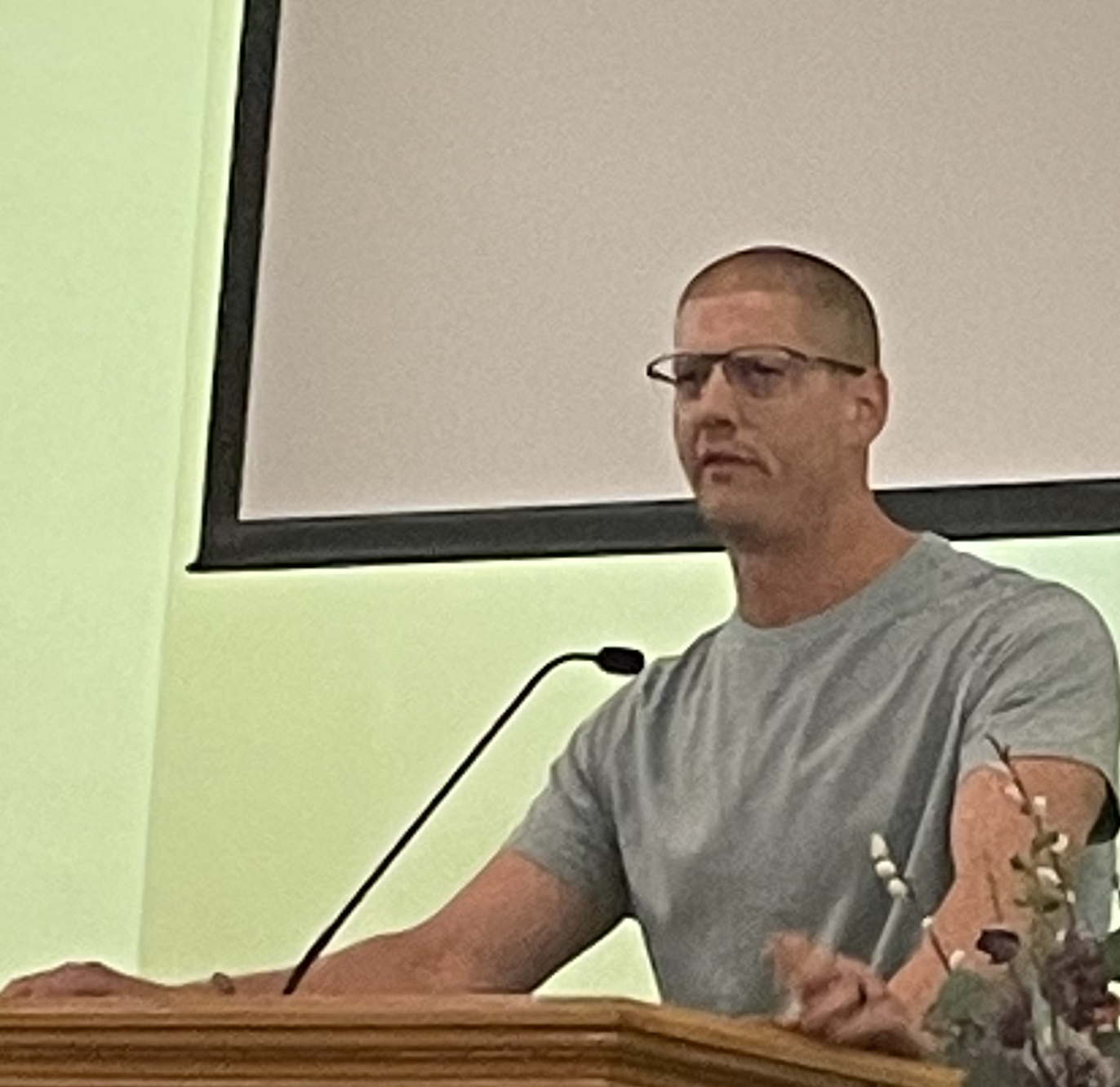
Dave Steeves speaking for the first time encouraged the Lehman congregation with his words and his example!
I’m a big fan of old fashioned lighting, especially old kerosene lanterns because they’re simple. I went to light one of my lanterns and the flame wouldn’t stay alive for more than a few seconds. I thought, “Maybe the vent is covered in carbon and there isn’t enough oxygen for the flame.” So, I took it apart, cleaned it out, and put it back together. I was sure it was the vent.
To my chagrin, the flame died within seconds even after the lantern was cleaned. Next I trimmed the wick because it seemed too dark; perhaps having a fresh wick would allow the flame to stay alive. It wasn’t a stopped vent, so it had to be the wick. Sure enough, the flame died even with a fresh wick. At this point I was stumped.
The next day it occurred to me whilst putting gas in my car: the lantern was just out of kerosene! It was obvious to the extreme. I knew Chelsea would never let that one go. When I got home I put the kerosene into the lantern which, of course, was the solution to a simple problem that I overcomplicated.
This is a mundane example of a profound truth: we make mistakes as humans. Worse yet, some people put words in God’s mouth that He never used. “My God is a God of love – He wouldn’t condemn me just for this one little sin.” “God doesn’t care if we live the way we want.” Some use phrases like this with great confidence while overlooking an obvious truth: God has told us what He does and does not care about in His word.
If we aren’t in the word listening to God and allowing Him to change us, our solutions will end in failure. There was only one solution to keep that flame going in my lantern. There is only one right way to follow God, and He’s told us how to do that! Life will be so much easier for those who look to God for answers before relying on their own wisdom.
Socrates famously said, “The only true wisdom is in knowing you know nothing.” Obviously, Socrates did not say that one cannot learn since that would sabotage his career as a teacher and philosopher. Instead, Socrates meant one could not take what he believes for granted, understanding that his “knowledge” may be incorrect. Socrates told us always to investigate. There is a certain humility arising from this mindset.
Consider an example of two such people who questioned: Copernicus and Galileo. For how many hundreds of years were people taught that the earth was the center of the universe before Copernicus showed them otherwise? Even so, Catholicism banned Copernicus’ book after his death. Within a few decades, Galileo, who assumed Copernicus’ mantle, stood trial for teaching the same heliocentric model. Galileo was forced by the Catholic Church to recant his life’s work. Yet, we know how the story ends. The Ptolemaic geocentric model of the universe, embraced by Catholicism, would not withstand future scrutiny and would be abandoned, vindicating both Copernicus and Galileo.
This virtue of the investigative mindset should not surprise Christians engaged in a study of God’s Word. We are encouraged to be noble Bereans, checking what we hear by the standard of Scripture (Acts 17.11). Furthermore, we must test the spirits to see whether they are of God (1 John 4.1). There is a warning to us that we should reject even an angel’s message if it is contrary to the revealed Gospel (Galatians 1.8). The father of lies is Satan, who used one lie to murder humanity (John 8.44). Since he works to deceive, and his ministers can take on the appearance of servants of righteousness, Paul encourages us to take our confidence in our weaknesses, which highlight God’s strength (2 Corinthians 11.13-15, 30).
Unfortunately, we seem to live in an era encouraging lockstep conformity in thought. There are those calling this “progress.” Critics rightfully call it “cancel culture,” pointing to a desire of “social justice warriors” to cancel contrarian viewpoints. If beliefs can only persist within an ideological vacuum, how is it any different from Catholicism forcing Galileo to recant? It is not. So, those ironically crying “fascism” in the streets act as the brownshirts of Hitler’s fascism in Nazi Germany. (I apply this truth secularly and politically since it is evident on the news and in the streets.)
In regards to politics, of course, the end is inconsequential for the Christian, since he or she must submit to the governing authority (Romans 13). Note we are not told to waste our time trying the political spirits, but those purporting to be spiritual. It may be that in making a stand against false religious doctrine, though, that we will enter into conflict with a political ideology glorifying what God calls abomination and permitting infanticide. However, that is not our principal task.
Praise God that our struggle for wisdom is much simpler than that of Socrates. After all, we believe in an infallible God who gave us His Truth within the Bible (John 17.17). We can admit our ignorance of what that Word says and test those things we hear from preachers, but we are not left to grope blindly for truth. Indeed, “The fear of the LORD is the beginning of wisdom, And the knowledge of the Holy One is understanding” (Proverbs 9.10 NASB). Ultimately, it comes down to adopting the mindset of Paul, who determined to know nothing except Jesus Christ and Him crucified (1 Corinthians 2.2).
I remember it like it was yesterday, I was standing in my brothers’ room while they were trying to convince me that I had swallowed a marble. After enough talking, they finally convinced my 3-year-old self that I had swallowed a marble. A couple of hours later we left the ER after being told by the doctor that there, in fact, was no marble in me. What on earth happened? Well, I’ll tell you what happened. I listened to my brothers and their prank went a little farther than they thought it would.
This reminds me of an account that is recorded in 1 Kings chapter 12, where Rehoboam listens to some unwise advice from his brothers. The people come to him asking their new king to lower the taxes his father Solomon had placed on them. So Rehoboam reaches out to those who served with Solomon, and they tell him to lower the taxes; but Rehoboam didn’t like this answer. In fact, he wasn’t looking for that answer. So he goes to his friends, the guys he grew up with, and this is what they say, “‘My little finger is thicker than my father’s loins!Whereas my father loaded you with a heavy yoke, I will add to your yoke; my father disciplined you with whips, but I will discipline you with scorpions’”(1 Kings 12:10-11). Rehoboam takes the advice of his younger council, and because of this the kingdom of Israel split.
When it comes to who we take advice from, it is always best to come at it with all biases aside. Rehoboam was talked into doing something that split the kingdom. The next time we have a decision to make, we must not make the mistake Rehoboam made or what I did in listening to my brothers. Let’s be wise and make our decision after praying with a heart which honestly seeks God’s will.
Paul writes two letters of instruction to Timothy, the preacher at Ephesus. As his father in the faith (cf. 1 Tim. 1:18), Paul wanted the younger man endowed with the wisdom and courage to be God’s man. Timothy would face pressures and temptations from many different directions. The apostle’s words also provide some common sense to help him do the sometimes difficult task of preaching and ministry.
In a letter full of the theme of godliness, 1 Timothy, Paul gives him some intriguing encouragement in the sixth chapter. He says, “If anyone advocates a different doctrine and does not agree with sound words, those of our Lord Jesus Christ, and with the doctrine conforming to godliness, he is conceited and understands nothing; but he has a morbid interest in controversial questions and disputes about words, out of which arise envy, strife, abusive language, evil suspicions, and constant friction between men of depraved mind and deprived of the truth, who suppose that godliness is a means of gain” (6:3-5). In this brief admonition, he gives Timothy several tips to help him be a useful communicator of God’s truth. He urges Timothy to avoid:
Compromise. Not only here, but throughout the letter, Paul urges Timothy to teach the pure doctrine of Christ, those sound words and that godly doctrine. If we bow to pressures and change the revealed word of Christ, we become deadly communicators.
Conceit. Ironically, the conceited often look down upon others. Yet, Paul ties the arrogance to ignorance (“understands nothing”). When we encounter one who condescendingly communicates, we are prone to tune them out even if they are telling the truth. It is incongruous to have a pompous preacher speak of the lowly Jesus. It’s a credibility killer.
Controversy. We live in the age of controversy. It is splashed all over the traditional media and social media. It is often manufactured, and it is the mark of a morbid (literally, “sick”) mind. The controversialist will be found at the heart of disputes, ever seeking to dig up something, hash and rehash it, and keep it going. We can be accused of that for simply trying to communicate God’s will, especially when unpopular, but some are never far from contention. It is characteristic of them.
Constant friction. This is listed last among several other results of controversy, along with envy, strife, abusive language, and evil suspicions. Have you ever been around someone who keeps up an atmosphere of tension? The chip is always on the shoulder. Their communication is always confrontational. It appeals to the depraved and deprived, according to Paul.
Paul was so bold that he would die for preaching the truth (cf. 2 Tim. 4:1-8). Yet, he urged Timothy to be peaceable, kind, adept, patient, and gentle when communicating it (2 Tim. 2:24-25). Is it possible to courageously stand with the Christ but do so using the precise scalpel of Scripture (Heb. 4:12) rather than the reckless explosives of excess? Yes, and each of us must predetermine that we will do so no matter how others act and react.
Someone wants to be involved in an illicit relationship, defend an unscriptural marriage (or enter into one), engage in some vice or sinful behavior “in moderation” (or otherwise), and they talk to someone who shows them from scripture why it should not be done. Perhaps they ask several people and get the same discouragement. Sometimes, the inquirer is wise enough to let that guide them away from wrongdoing. Other times, they persist in looking for someone to tell them what they want to hear. Without exception, such a searcher will eventually—and probably sooner than later—find someone to validate and endorse their desire.
Solomon wrote, “The thoughts of the righteous are just, But the counsels of the wicked are deceitful” (Prov. 12:5). His father kicked off the songbook of Israel by saying, “How blessed is the man who does not walk in the counsel of the wicked…” (Psa. 1:1a). Job speaks of how he shunned “the counsel of the wicked” (Job 21:16; 22:18). Wicked Ahaziah was rejected by God, in part, “for his mother was his counselor to do wickedly” (2 Chr. 22:3). This characteristic of human nature, whether giving or taking wicked counsel, is timeless. But, seeking counsel from the proper sources is encouraged by Scripture (Prov. 11:14; 15:22; 24:6). How can we make sure that we are hearing what we need to hear, not just what we want to hear?
We must realize our personal accountability (2 Cor. 5:10). No matter what anyone else tells us, we’ll stand individually in the Judgment. Christ’s word, as Judge, is the only one that ultimately matters. What has He said?
We must pray for wisdom and discernment (Col. 1:9). Are we ignoring a pricked conscience, clear teaching, or red flags? Is self in control, or is the Savior’s will?
We must grow in knowledge (2 Pet. 3:18). Have we studied this out yet? Are we convinced beyond a doubt? What does the Lord say?
We must be honest with ourselves (Psa. 15:2). We cannot deal fairly in any situation if we’re deceiving ourselves. Lying to ourselves does not change God’s truth. It simply hurts us.
We must train our hearts to desire what is good (cf. 2 Pet. 2:14). This can be excruciatingly hard! Proverbs 21:10 says, “The soul of the wicked desires evil.” But listen to a cleansed heart: “Behold, You desire truth in the innermost being, and in the hidden part You will make me know wisdom” (Psa. 51:6).
We must put emphasis on the eternal rather than the temporary (2 Cor. 4:16ff). Is what we wish to pursue destructive to heavenly objectives? Are we risking an eternity in heaven for a few years of fleeting pleasure on earth? Nothing is worth sacrificing salvation!
We must weigh the advice of our counselors on the scales of truth (Prov. 18:17). The Berean Christians fact-checked an inspired apostle (Acts 17:6). We owe it to ourselves to compare what our advisers tell us—however much we love and respect them—with what God’s Word says. Many times they will align. If they do not, we must choose God’s Word every time!
Beware! At times, what we want to hear is right and good. Many times, it is not. As we lean on others, let us lean most heavily on “the rock” (Mat. 7:24)!
Jesus said, “wisdom is vindicated by all her children” (Luke 7:35). He said this in response to the hypercriticism and unrighteous judgment of those who condemned both John the Baptist and Him. They said John was too conservative and Jesus was too liberal. They hacked at the methods and message of both, without justification or legitimacy. They were libelous name-callers, but Jesus simply responded with a proverb. What a good one! It’s a needed one today, especially in the face of those who sit and snipe at the works of others. For those who get gun shy at the prospect of such snipers, please remember Jesus’ words and Jesus’ reward for those who keep at the good work. This principle applies to:
Elders and preachers
Missionaries
Worship leaders
Young parents
Bible teachers
Deacons and ministry leaders
Christian Colleges and schools of preaching
Soul winners
Youth ministers
Lectureship and workshop directors
Church program organizers
Christians in the workplace
Teenagers
Students in their various schools
Camp directors
Writers and authors
Publishers
There are undoubtedly other categories of people who fall under the purview of Jesus’ saying, but they share the burden of having their works criticized by naysayers, ne’er-do-wells, nitpickers, and needlers. In Luke 7, Jesus took the magnifying glass and turned it on the critics. We can take heart this idea: “If you address as Father the One who impartially judges according to each one’s work, conduct yourselves in fear during the time of your stay on earth” (1 Pet. 1:17). We have a responsibility to conduct ourselves righteously, but we can rest in the confidence that we will be judged impartially by the perfect, righteous Judge. Let us commend our efforts to His eyes. He will get it perfectly right!
Zadok the priest was neither an Anglican Church member or even British. Many associate his name with Handel’s 18th century coronation hymn, written first for King George II. But, he was a significant, if minor, Old Testament character. We learn at least four great lessons from his character, as revealed in Scripture.
He was a versatile servant of God. He is introduced as “a young man mighty of valor” (1 Chron. 12:28), but also as a priest of God (1 Chron. 15:11). Thus, he was handy in a fight while also helpful in reconciling men to God. What an example of a five or two talent man, able to serve God in more than one way. God has blessed most of us with the ability to do many things well. We should be motivated to use those skills for Him.
He was a respecter of God’s Word. His predecessor, Uzzah, disregarded God’s instructions for transporting the ark and paid for that with his life. Zadok was at the head of the list of priests tapped to do it the right way, according to God’s word (1 Chron. 15:11ff). Nothing we see after this does anything except strengthen the view that Zadok submitted to the divine will. What a legacy to leave, known as one who simply takes God at His word and strives to be obedient to it.
He was a loyal friend. When Absalom rebelled against King David, many in Israel aligned themselves with this usurping son. However, Zadok remained true to David (2 Sam. 15). David relied on him, with Abiathar, to keep tabs on the insurrection while ministering in Jerusalem. David knew he could count on Zadok. In the same way, Scripture praises such loyalty. David’s son penned that “A friend loves at all times, And a brother is born for adversity” (Prov. 17:17). We should be a friend others can count on at all times.
He was a good judge of character. Whether choosing to serve David over Absalom or Solomon over Adonijah, Zadok was an excellent discerner of the right choice. In both cases, these were the righteous and God-approved choices. Even Abiathar, who stood with David over Absalom, got it wrong when Adonijah tried to supplant God’s will concerning David’s rightful successor. For this reason, Zadok took his place alongside Samuel as the only priests to anoint a king during the United Kingdom period of Israel’s history (1 Kings 1:39). It was this event Handel coopted to write his coronation hymn. God had bright hopes for those who feared Him, that they would be able to “distinguish between the righteous and the wicked, between one who serves God and one who does not serve Him” (Mal. 3:18). That was Zadok, and it should be us–regarding preachers, elders, teachers, as well as every child of God we have dealings with. We must grow in our ability to be capable fruit inspectors (cf. Mat. 7:15-20; John 7:24).
Thank God for Bible characters who show us, with their lives, the way to please Him with ours. The times may, in some ways, be drastically different from when Zadok walked the earth. But, with the time God gives us, we would do well to imitate these traits of this priest of God remembering that God desires us to be faithful priests for Him today (cf. 1 Pet. 2:1-9).
Have you ever paid close attention to the ends of especially the epistles? There are a variety of otherwise obscure Bible characters who make their cameos as if in passing. Tychicus is one such early Christian. You find him referenced five times in Holy Writ. He is numbered among the missionaries in Asia (Acts 20:4). Whether or not he preached or taught, he was acting on Kingdom business. In Ephesians 6:21, Paul sends him to Ephesus to make Paul’s conditions and circumstances known to them. He did the same thing for the Colossians (4:7). Paul tells Timothy, very simply, that he sent Tychicus to Ephesus (2 Tim. 4:7). Paul contemplated sending Tychicus to Titus on Crete (Tit. 3:12). Paul obviously considered Tychicus a reliable resource for help.
Have you considered the fact that all of us are carriers of something? What are you carrying?
Bitterness and resentment?
Gossip and talebearing?
Negativity and pessimism?
Filthy, foul, and offensive speech?
Dishonest, deceptive words?
A different gospel?
Harsh, railing verbiage?
Or…?
Gentle, kind words?
Faithful counsel?
Positive, joyful speech?
Encouragement?
Thoughtful, considerate messages?
Meek efforts to restore a fallen soul?
Courageous, lovingly spoken truth?
What would others entrust you with? Would they trust you? That should convict us, shouldn’t it? What traits are we developing? Let’s be concerned about that, recognizing that God needs trustworthy transporters today!
Talk Up Big Plans And Follow Through With Inactivity. This will build frustration and discouragement. Satanfears not the plan, but rather the working of it.
Make No Plans For The Future: Just Accept The Status Quo.Just hope that the future will take care of itself. Buy into the “is/ought” fallacy: “The way it is is the way it ought to be.”
Do Not Practice Church Discipline. Let the disorderly walk unchecked in ungodliness. Let all members see how nonchalantly bad or grossly negligent behavior is treated.
Under-appreciate The Leadership. Do not pray for the elders, actively seek to help them, encourage them, express appreciation for them, submit to their authority (Heb. 13:7,17), or respect them. Just expect them to be without flaw or feelings.
Do Not Actively Enlist. Allow a small nucleus of folks to do the brunt of the work. Leave the majority of the members in the dark as to how and where to be involved. Ignore the fact that people must be personally invested to be faithful.
Pressure Or Allow The Pulpit To Be Form Over Substance. Make sure the preached message is soothing and non-offensive, fostering comfort and expecting little to nothing. Have the pulpit heavy on the social and light on Scripture.
Get Into The “Change Extremes”: “Nothing Is Sacred” Or “Nothing Is Changeable.” Departing from the left or right will kill the church, whether its identity or effectiveness. Buy into every new fad that comes along or suspect and oppose any change which may scripturally improve the life and work of the church.
Make Personal Preferences And Opinions Binding. Equate personal discomfort with doctrinal sin. Take presumptuous positions, supposing there is biblical foundation without finding such. Allow the nay-saying of one or two thwart effective, soul-winning, and needed programs.
Have No Follow-up Program For New Christians. Let them make their own way to heaven after the water of baptism dries. Have no Bible study follow-up, fellowship mechanism, or other effort to integrate and educate these spiritual babes.
Maintain An Unchallenging Budget. Do not risk offending non-sacrificial members. Make plans by sight, not by faith. Do not make ambitious financial goals as a congregation.
Be Distant And Unloving With One Another. Confine association and fellowship to the building, and that in passing. Stay out of each others’ homes. Do not visit. Do not build friendships with those of like faith. Do not be involved in one another’s lives.
Take “Christ” Out Of Christianity. Be secular and worldly. Fail to be distinctive to a world desperately seeking something different from itself.
Ignore The Small And Voiceless. Be it children, elderly members, or the sick and shut-in, let them fall through the cracks of inattention. Treat singles, new Christians, and weak, struggling members as second-class citizens of the Kingdom.
It is easy to arrange things in the local congregation so that the church fails to grow. But, the Lord wants His body to grow. The early church grew (Acts 6:1,7; 9:31). A growing church reflects a church on fire for the Lord’s mission (Mat. 28:18ff) and in focus with the Lord’s desire (2 Pet. 3:9). May we overcome these church-shrinking tendencies and build a great church!
It’s not a Social Media phenomenon, but those platforms have proliferated this problem. Begin by making a provocative statement about race, religion, politics, other social issue, matter of judgment, or the like, then step back and watch while the unrestrained and undisciplined scratch and claw at one another. Soon, the issue is obscured by hateful remarks as combatants escalate the rhetoric. The tactic is utterly worldly, yet too often it is brothers and sisters in Christ with the sinister stick in their hands jabbing at the hibernating grizzly! My consistent question is, “Why?” What is the purpose? Certainly, we should all be more critical thinkers, but such tactics as these generate much more heat than light. Rather than logical, rational points and counterpoints, they usually produce ad hominem attacks, reductio ad absurdum, and other Latin diseases!
When you consider how the New Testament governs our speech and guides our conduct in dealing with each other, you have to ask where the above-mentioned ploys fit in. Here is a sampling of admonitions and instructions the Holy Spirit gives us through Scripture:
“So then we pursue the things which make for peace and the building up of one another” (Rom. 14:19).
“Let your speech always be with grace, as though seasoned with salt, so that you will know how you should respond to each person” (Col. 4:6).
“A perverse man spreads strife, and a slanderer intimate friends” (Prov. 16:28).
[God hates] “one who spreads strife among brothers” (Prov. 6:19b).
“Pursue peace with all men…” (Heb. 12:14a).
“Blessed are the peacemakers, for they shall be called sons of God” (Mat. 5:9).
“Love does not act unbecomingly” (1 Cor. 13:5a).
“Only conduct yourselves in a manner worthy of the gospel of Christ, so that whether I come and see you or remain absent, I will hear of you that you are standing firm in one spirit, with one mind striving together for the faith of the gospel” (Phil. 1:27).
“And the congregation of those who believed were of one heart and one soul…” (Acts 4:32).
Be careful. In an attempt to be clever, relevant, and cutting edge, could we instead be alienating, divisive, and polarizing? There’s a big difference. May we all pray for the wisdom to differentiate. Especially in a divided world that is watching how those who claim to be Christians speak, interact, and treat them and each other, may we “be shrewd as serpents and innocent as doves” (Mat. 10:16). Be dove-imitators, not bear-pokers.



























 The Preacher Pollard Blog