Two Swords and One Cup: What Jesus Meant When He Told the Disciples to Buy a Sword

Brent Pollard

In my daily Bible readings, I have always been intrigued by Luke 22.36. Jesus tells His followers who lack a sword to sell their coats to buy one. When they take inventory, Luke notes that they have two swords, which Jesus declares sufficient (Luke 22.38). When Judas appears, the disciples ask if it is time to use the sword (Luke 22.49). Peter responds by cutting off Malchus’ ear (Luke 22.50; John 18.10). Yet, despite telling the disciples to own a sword, Jesus immediately rebukes Peter and warns him that those who live by the sword die by the sword (Matthew 26.52). What, then, are we to make of Jesus’ counsel for the disciples to buy a sword?

Why Jesus Told His Disciples to Buy a Sword (Luke 22.35–38)

Note Jesus’ words closely. He first summons a memory: “When I sent you out without money belt and bag and sandals, you did not lack anything, did you?” (Luke 22.35). They answered in a single word: nothing. Then the Lord reverses the terms: “But now, whoever has a money belt is to take it along, likewise also a bag, and whoever has no sword is to sell his coat and buy one” (Luke 22.36). The sentence drops like a stone into still water, and the ripples have not stopped since.

Watch what Jesus does next. He refuses to leave the Twelve guessing. Instead, He supplies the reason in the same breath: “For I tell you that this which is written must be fulfilled in Me, ‘AND HE WAS NUMBERED WITH TRANSGRESSORS’” (Luke 22.37). Isaiah drafted the scene seven centuries earlier (Isaiah 53.12). The Suffering Servant would be counted among criminals, and blades in a midnight olive grove handed the arresting party the impression the prophecy demanded. The sword was not tactics. The sword was testimony. Rome saw an insurrectionist and reached for nails. Heaven saw the Lamb.

Two Swords Are Enough: Sufficient for a Sign, Useless for a War

The disciples, gloriously literal, take inventory: “Lord, look, here are two swords.” Jesus answers, “It is enough” (Luke 22.38). Enough for what? Not for a campaign. Two blades against a temple detachment armed with swords and clubs (Matthew 26.47) is not a battle plan; it is arithmetic that insults the word. The term means sufficient for the purpose, and the purpose was prophetic, not military. A signature occupies an inch of paper and settles an entire estate. Two swords occupied one dark garden and settled an ancient oracle. Christ needed exactly as much steel as the sign required, and not one blade more. The money belt and knapsack carry the same honesty: the season He had welcomed had closed, and He said so in advance (John 16.4).

Peter’s Sword and the Cup Christ Refused to Set Down

Torchlight moves through the trees. Judas arrives with a kiss, and the disciples ask, “Lord, shall we strike with the sword?” (Luke 22.49). Peter, who never in his life waited for an answer, swings first. Malchus loses an ear (John 18.10). As my father likes to point out, Peter wasn’t only aiming for an ear. Peter’s swing exposes his intention.

Jesus immediately rebukes Peter. “Put your sword back into its place; for all those who take up the sword shall perish by the sword” (Matthew 26.52). Matthew preserves the principle; John preserves the purpose: “the cup which the Father has given Me, shall I not drink it?” (John 18.11). Luke records the mercy: “Stop! No more of this,” and He touched the man’s ear and healed him (Luke 22.51). The final miracle before Calvary repaired damage inflicted by a disciple defending Christ.

Peter’s failure was not cowardice. Cowards keep the blade sheathed. His courage simply ran the wrong direction, and misdirected courage wrecks more than fear ever does. Earlier Jesus had prayed, “yet not as I will, but as You will” (Matthew 26.39). Peter, steel shining, answered that prayer with a flat no. Affection that resists the revealed will of God is idolatry wearing love’s coat, and it always leaves someone bleeding.

No Contradiction: Possession Versus Presumption

Compare the two sayings directly, and the difference becomes clear. Jesus never commanded, “Destroy the sword.” He commanded, “Put your sword back into its place.” The weapon possessed a place; Peter’s hand in that hour was not it. Luke 22.36 permits possession — chiefly for the fulfillment of Scripture, secondarily for the ordinary hazards of a hostile road. Matthew 26.52 forbids a use: the violent obstruction of God’s redemptive will. The verses never collide, because they never occupy the same ground.

“All those who take up the sword shall perish by the sword” is a proverb of judgment, not a footnote about weaponry. Since Genesis 9.6, God has guarded human life as His own image; men who make violence their vocation are ground beneath the millstone they quarried. Christ refuses to have His kingdom defended by steel: “My kingdom is not of this world. If My kingdom were of this world, then My servants would be fighting” (John 18.36). Jesus names the reason His men are not swinging. Not incapacity. Allegiance.

Sheathe the Sword: Faithful Christian Living in a Hostile World

We still carry swords, forged of speech and silence and the timing of a strategically placed truth: the reply that ends the argument and the friendship together, the grudge polished until it gleams. Every one of us knows a Malchus, and most of us swung before we asked the Lord anything.

God armed His church, but He stocked the armory Himself: “the weapons of our warfare are not of the flesh, but divinely powerful for the destruction of fortresses” (2 Corinthians 10.4). One blade only hangs in the Christian’s kit, and it is not ours to sharpen — “the sword of the Spirit, which is the word of God” (Ephesians 6.17). Grace hands us that sword and then trains the hand: “the grace of God has appeared, bringing salvation to all men, instructing us to deny ungodliness and worldly desires and to live sensibly, righteously and godly in the present age” (Titus 2.11–12). Unmerited favor never leaves a man where it found him. It pardons, then it disciplines, and the disciplined man discovers that obedience is where the joy was hiding all along. Our Lord proved it first. He “for the joy set before Him endured the cross, despising the shame” (Hebrews 12.2), drinking the cup Peter tried to knock from His hand — gladly, because He saw us at the bottom of it. Every restraint He exercised in that garden purchased something for you (1 Peter 2.23).

Peter learned. Fifty days later he stood in Jerusalem and struck harder than steel ever struck: “Repent, and each of you be baptized in the name of Jesus Christ for the forgiveness of your sins” (Acts 2.38). Three thousand fell that day, pierced to the heart (Acts 2.37) — not by a blade, but by a word — and they rose alive. The fisherman who maimed the high priest’s servant never drew that sword again.

So take your inventory. Whatever hangs at your side, hand it back to the Lord who defines its place. Trust the Father who wrote the script from Isaiah forward and has never missed a line. Sheathe the sword. Drink the cup. Follow the Christ who conquered the world by refusing to fight it on the world’s terms — and then go tell somebody why.

“My Huckleberry Friend” 

Friday’s Column: Brent’s Bent

Brent Pollard

Having a friend that we can confide in and rely on for sound advice is invaluable, but we should be picky about who we choose as friends. Solomon says, “The righteous person is a guide to his neighbor, But the way of the wicked leads them astray.” (Proverbs 12.26 NASB). 

Thus, we will begin with those negative characteristics Solomon says one should avoid when befriending people. Do not befriend: 

  • A gossip (Proverbs 20.19). 
  • The short-tempered (Proverbs 22.24-25). 
  • Drunks and gluttons (Proverbs 23.20-21). 
  • The “unsteady” (Proverbs 24.21-22). [To fully understand this, you may need to check the Hebrew. For example, in one translation, a person “given to change” may join “rebellious officials” in another. This difference is because the Hebrew “shanah” implies repetition (“to repeat, do again”). So, Solomon speaks of those not willing to grow from their mistakes or have fickle loyalties. Hence, such people are unstable in their ways.] 
  • Liars (Proverbs 25.18). 
  • The untrustworthy (Proverbs 25.19). 
  • The inconsiderate (Proverbs 25.20). 
  • The violent (Proverbs 1.10-19). 

Those whom Solomon says to befriend comprise a shorter list. Befriend those: 

  • Who display wisdom (Proverbs 13.20). 
  • Who will point you in the right direction (Proverbs 13.14). 

In addition to telling us who to befriend and who to shun, Solomon gives us wisdom about how we can be better friends with others. This wisdom begins with telling us to avoid certain disruptive practices.  

  • Don’t repeat everything you hear (Proverbs 17.9). 
  • Avoid senseless arguments (Proverbs 14.14). 
  • Don’t overstay your welcome (Proverbs 25.17). 
  • Don’t intrude on others’ arguments (Proverbs 26.17). [Solomon likens this to yanking a dog’s ears.] 
  • Don’t call mistakes and misdeeds a failed attempt at humor (Proverbs 26.18-19). [“I was joking!”] 
  • Don’t gossip (Proverbs 26.20). [Look up Socrates’ three filters: Is it true? Is it good? Is it useful?.] 
  • Don’t be cranky (Proverbs 26.21). 
  • Don’t be inconsiderate (Proverbs 27.14). 

According to Solomon, then, these are the causes of discord among friends. It may be difficult to recover a friend’s trust if they have lost faith in us. Solomon warns, “An offended friend is harder to win back than a fortified city. Arguments separate friends like a gate locked with bars” (Proverbs 18.19 NLT). Solomon, though, advises those of us who have harmed our relationships. If we need to repair a friendship, we must: 

  • Get our relationship right with God, and then others will change their perspective of us (Proverbs 16.7). 
  • Be slow to anger (Proverbs 15.18, cf. James 1.19). 
  • Not speculate (Proverbs 18.13). 
  • Not quarrel (Proverbs 20.3). 
  • Speak gently (Proverbs 15.1). 
  • Speak less (Proverbs 10.19). 
  • Be loving (Proverbs 10.12). 
  • Offer honest criticism instead of flattery (Proverbs 28.23). 

Yes, correctly applying God’s wisdom can ensure that we enjoy the blessings of good friends in this life. And there is a blessing in a friendship that Solomon reminds us of in Ecclesiastes 4.9-12: 

“Two are better than one because they have a good return for their labor. For if either of them falls, the one will lift up his companion. But woe to the one who falls when there is not another to lift him up. Furthermore, if two lie down together they keep warm, but how can one be warm alone? And if one can overpower him who is alone, two can resist him. A cord of three strands is not quickly torn apart.” (Ecclesiastes 4.9-12 NASB1995)  

Let us seek and be good friends with one another. 

The Christian Decision

Carl Pollard

Our family used to hike a lot when we lived in Colorado. There were many hikes that I went on that were straight up miserable. Ive always been the chunky kid, but the worst part about this was that I  was surrounded by a healthy and very active family.. This meant that on every hike I was the one in the back feeling like I was about to pass away. Hiking was never really something I was the best at. There are several times I remember thinking, “I’m not going to make it.” 

We used to hike a trail called “Moffit Tunnel” It was an 11 mile hike that ended with a summit path that gained 3000 feet of elevation in under half a mile. As you can imagine the path was practically vertical, and filled with rocks, mud, snow, and sadness. 

When I think of “a hard path” this is what comes to my mind. In Matthew 7:13-14, Jesus describes the way to salvation as a path that isn’t for the faint hearted; it’s for the dedicated Christian that is determined to reach eternal life. There’s no denying that the Christian life can be tough. It is filled with persecution, especially for those who aren’t as fortunate to have the freedoms we enjoy in America. The Christian life is tough because we will face persecution, but we are more likely to face rejection in our society today for standing up for some very unpopular teachings. If we are devoted to teaching and standing with God’s Word this means we must defend God’s view on homosexuality, marriage, divorce, and remarriage, baptism, sin, hell, and many more divisive topics. If we are devoted to walking the difficult path we must remain faithful in the rejection, hatred and persecution we will face. 

But the rejection and hate from the world isn’t the only thing hard about this path.

As Christians we are commanded to put ourselves to death. Matt. 10:37-39 say,  “Whoever loves father or mother more than me is not worthy of me, and whoever loves son or daughter more than me is not worthy of me. And whoever does not take his cross and follow me is not worthy of me. Whoever finds his life will lose it, and whoever loses his life for my sake will find it.”

Walking the difficult path means we have put ourselves to death. In doing so we are saying we love Christ more than our parents, our children and ourselves. In order to walk the difficult path we must be willing to take up our cross and follow Jesus. The cross is an instrument of death. The cross we pick up is the instrument of death that we have used to crucify ourselves on. Once we have taken up our cross we have made the decision to love Christ over anyone and everyone. We no longer serve ourselves because we have died to Christ. 

When we choose to walk the difficult path we are no longer living without purpose. We have a goal, a meaning for our lives. God uses us to spread His saving word to others. We have purpose in everything we do. We are here to encourage each other, to save souls, and to glorify God. One of humanity’s most asked question, “Why am I here?,”is answered by God. How we serve God will ultimately change someone else’s eternal destiny. We are given the true words of life that are able to save our most valuable possession, our souls. We also experience the blessing of having confidence in death. Death is scary. Why are so many scared of death? It’s the unknown, the end of our existence as we have known it. As Christians, when we choose to walk the difficult path, we are given the promise that when we face death we can be confident in knowing our soul is in the hands of almighty God. We know what is coming, and we can find hope in this. 

It was a hard climb, but what a payoff!

Zadok The Priest

Neal Pollard

Zadok the priest was neither an Anglican Church member or even British. Many associate his name with Handel’s 18th century coronation hymn, written first for King George II. But, he was a significant, if minor, Old Testament character. We learn at least four great lessons from his character, as revealed in Scripture.

  • He was a versatile servant of God. He is introduced as “a young man mighty of valor” (1 Chron. 12:28), but also as a priest of God (1 Chron. 15:11). Thus, he was handy in a fight while also helpful in reconciling men to God. What an example of a five or two talent man, able to serve God in more than one way. God has blessed most of us with the ability to do many things well. We should be motivated to use those skills for Him.
  • He was a respecter of God’s Word. His predecessor, Uzzah, disregarded God’s instructions for transporting the ark and paid for that with his life. Zadok was at the head of the list of priests tapped to do it the right way, according to God’s word (1 Chron. 15:11ff). Nothing we see after this does anything except strengthen the view that Zadok submitted to the divine will. What a legacy to leave, known as one who simply takes God at His word and strives to be obedient to it.
  • He was a loyal friend. When Absalom rebelled against King David, many in Israel aligned themselves with this usurping son. However, Zadok remained true to David (2 Sam. 15). David relied on him, with Abiathar, to keep tabs on the insurrection while ministering in Jerusalem. David knew he could count on Zadok. In the same way, Scripture praises such loyalty. David’s son penned that “A friend loves at all times, And a brother is born for adversity” (Prov. 17:17). We should be a friend others can count on at all times.
  • He was a good judge of character. Whether choosing to serve David over Absalom or Solomon over Adonijah, Zadok was an excellent discerner of the right choice. In both cases, these were the righteous and God-approved choices. Even Abiathar, who stood with David over Absalom, got it wrong when Adonijah tried to supplant God’s will concerning David’s rightful successor. For this reason, Zadok took his place alongside Samuel as the only priests to anoint a king during the United Kingdom period of Israel’s history (1 Kings 1:39). It was this event Handel coopted to write his coronation hymn. God had bright hopes for those who feared Him, that they would be able to “distinguish between the righteous and the wicked, between one who serves God and one who does not serve Him” (Mal. 3:18). That was Zadok, and it should be us–regarding preachers, elders, teachers, as well as every child of God we have dealings with. We must grow in our ability to be capable fruit inspectors (cf. Mat. 7:15-20; John 7:24).

Thank God for Bible characters who show us, with their lives, the way to please Him with ours. The times may, in some ways, be drastically different from when Zadok walked the earth. But, with the time God gives us, we would do well to imitate these traits of this priest of God remembering that God desires us to be faithful priests for Him today (cf. 1 Pet. 2:1-9).

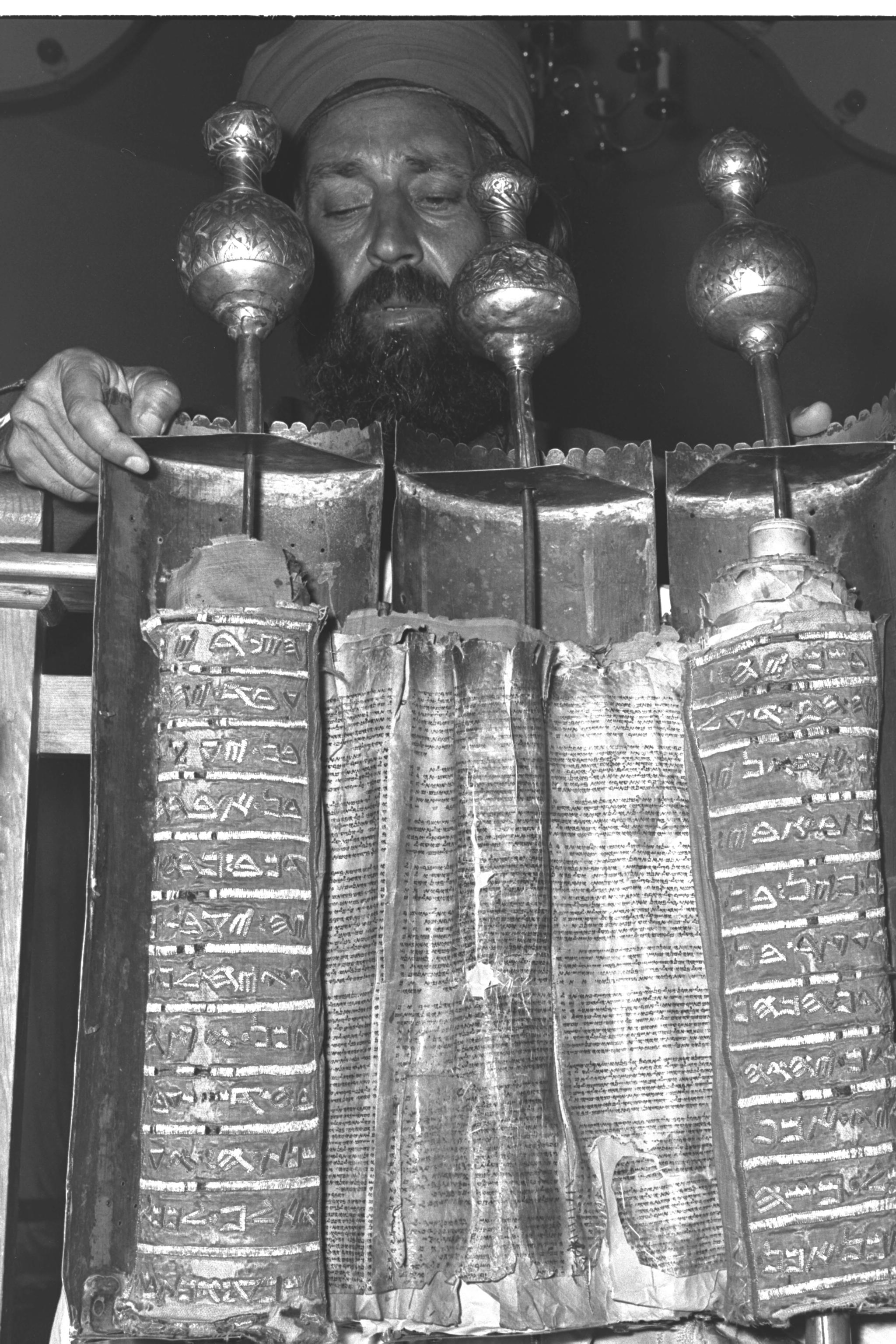
flickr_-_government_press_office_gpo_-_samaritan_priest_zadok_ben-avisha_hacohen