Division

Wednesday’s Column: Third’s Words

Gary III

Gary Pollard

In this volatile political climate, many Christians face some uncomfortable dilemmas. Is party line a salvation issue? How do we handle seemingly irreconcilable differences? What do we do going forward?
 
Rather than delving into those questions, I’d like to focus on the attitude of the early church, which faced internal division–Jew/Gentile controversies like in Acts 15, opinions over cultural matters as seen in I Corinthians 8 and Romans 14, and external pressures.
 
In keeping with the spirit of the early church, let’s focus on the following list.
 
  1. We must focus on and grow our own spiritual culture, independent of our earthly nationality (while observing Romans 13).
  2. We must be faithful Christians who value being righteous, no matter the cost.
  3. We must manage our concerns and worries by spending MORE time with each other and developing our faith.
  4. We may need to see ourselves less as Americans and more as Christians. If we remember that our kingdom is the church first, we will be far more united.
  5. Be awesome citizens. When outsiders hear about us, it should be that we never cause trouble, we are loyal to each other, we are selfless, we help people, we have strong families, we rely on each other, we are pleasant to be around, we are dedicated to our faith, and we love people who treat us poorly.
  6. We must remember that priority number one is heaven. Everything else is second.
  7. We must avoid talking or posting on social media about non-salvation issues that can and do create division or offense, out of courtesy and respect for each other (Romans 14.1-4; 13ff).
 
If these are the things we worry about and focus on, no political division or any other heartburn-inducing unpleasantness can affect us. Besides being happier, we’ll be a stronger church!

The Unified Church

Thursday’s Column: Carlnormous Comments

tempImagehquiDk

Carl Pollard

In a society of division and separation, many churches have begun to struggle with unity. Members are bickering with each other, elders are unsure of how to respond to the events that have unfolded in the past year, and deacons are struggling to maintain the proper relationship with each member.. All of these factors combined has caused several churches to split or lose the unity they once had. 

Paul writes in 1 Corinthians 11:17ff  that some who came to worship would be hungry, while others would be drunk and incapable of edifying each other. His point? Far too many churches are split due to a lack of understanding. We fail to understand why it is that we assemble together in the first place. Having a unified assembly starts with the individual. No church will find harmony if each member is unwilling to submit to God’s will and to His church family. 

When we come to worship, there are key aspects that we must insure take place (1 Corinthians 14:12-25). We must make sure what we do edifies others (v. 12). Paul in the context of tongues and prophecy says,  “So with yourselves, since you are eager for manifestations of the Spirit, strive to excel in building up the church” (14:12). 

Our actions must help build up the Christians around us. Our words must edify our brothers and sisters who are dealing with problems we may never even know about. And so the questions we must constantly be asking ourselves are these: How am I edifying? Am I being an encourager (making my fellow Christians stronger)? Am I building up others (boosting their confidence to help them deal with the world)? Am I promoting unity? 

As humans we thrive on encouragement.  We feel good when we receive a compliment. That’s because there is power in edification. As fellow brothers and sisters we should be actively trying to find ways to build each other up. 

This also means we must be sure to understand the power of our words and actions. Rather than spreading gossip or discord with our lips we must make it a priority to edify, encourage, lift up, serve, compliment, and look out for the good in our church family.

Six Lessons From The Tower of Babel

Tuesday’s Column: Dale Mail

DaleandJanelledirectorypic
(Happy birthday to Janelle)

Dale Pollard

 
We all know the story of the Tower Of Babel. It’s the event that gave us all the diverse languages of the world. That account is not just for our entertainment or education, but there are many spiritual applications that can be pulled from the event. Here are just six from Genesis 11:1-9. 
  1. What we are building will only be successful if God designed the blue prints. What are we building? Where do we choose to place our time and effort? Making a name for ourself? Making the most money? Getting the most pleasure out of life? If this is the life we’re building, like the foolish man that’s a life built on sand. 
  2. We are free to do as we want, but for every bad decision there are consequences. 
  3. There is a truth to what God said about our ability to accomplish much as a unified people. There’s also a positive side to this not so positive account. When the church body is unified there is no limit to what we can accomplish. When there’s dissension we are weaker. 
  4. Ignorance does not mean a blissful existence. It was ignorant to think that a closer relationship with God involved building a stairway into the sky that in their minds would allow God to have the ability to descend to earth. The opposite is true. God built us a way to go to Him. 
  5. Be mindful of the presence you keep and the vision you share. It seemed that most if not all mankind at this time was unified under one vision. “To make a name for themselves,” they worked together. They planned, schemed, spent resources and time to build something that would change the world forever— but it wasn’t God’s vision. The presence you keep and the shared vision matters. What are we building? 
  6. Accounts in the Bible that seem unrealistic or mythical should not weaken our faith but strengthen it when we do our due diligence in digging into His word. God is capable of great things, and that hasn’t changed. We serve a powerful God who has big plans for the world. Are we willing to side with Him? 

KNOCKING DOWN THE WALLS OF JERICHO

Monday’s Column: Neal At The Cross

pollard

Neal Pollard

God had promised the land of Canaan as early as Abraham (Gen. 15:18ff). The first city of Israel’s conquest was Jericho (Josh. 6:1). The word about and reputation of God’s people preceded them, so Jericho “was tightly shut because of” them. Despite this, the LORD told Joshua that “the wall of the city will fall down flat” (Josh. 6:5). Israel followed God’s unorthodox battle plan and “the wall fell down flat” and “they took the city” (6:20). Though they’d suffer a setback because of one man’s disobedience, this was the dramatic start of what would be the accomplishment of the land promise made to Israel.

God also promised Abraham that in his seed all the nations of the earth would be blessed (Gen. 22:18). This was fulfilled through Christ (Gal. 3:28). One of the ways Jesus proved that He was the Christ was “with miracles and wonders and signs which God performed through Him” in their midst (Acts 2:22). He started His ministry in Galilee (Mat. 4:17) and ended it in Jerusalem (Mat. 16:21), but near the end He had His own Jericho triumphs. He had not one, but two that are recorded by the gospel writers. One involved Him performing one of His many miracles, gaining a victory over sickness, but the other was a triumph of a different kind gaining a victory over Satan. 

Luke indicates Jesus was approaching Jericho when He encounters a blind beggar (Luke 18:35). Matthew and Mark also seem to record the same miracle, identifying this man as Bartimaeus, and showing perhaps “that the Saviour went in and out at the same gate of the city, and that the miracle falls into two parts” (Lange 282). But Jesus’ knocks down the wall between the haves and have nots, the socially acceptable and the socially unacceptable, when He has mercy on him and gives him his sight (Luke 18:37-43). Immediately after Bartimaeus, Jesus enters Jericho and passes through (19:1). Now, he knocks down the wall between the righteous and the sinner (19:7). He went to be a guest in the house of Zaccheus, who wanted to see Jesus so badly that he climbed a tree. The end result of this encounter is “salvation” (19:9). 

Isn’t it interesting that the Hebrew name for Jesus is “Joshua”? Isn’t it also interesting that Jesus performs these miracles in proximity to the walls of Jericho? The walls that Jesus knocks down are important to us today. They tell us that the gospel is for the poor, the hurting, the needy, the seedy, the rejects, and the sinner. Wasn’t God preparing us for this when Joshua spares a harlot and her family in the destruction of Jericho (Josh. 6:22-23)? 

Jesus was certainly about knocking down the walls we can be quick to build. Who does Jesus want us to be taking the gospel to today? Certainly, He’s not against those who are financially blessed (Zaccheus was). He’s not against those who are socially well-connected (many Christian converts in Acts and the epistles were). But, here is where Jesus is revolutionary. As Paul puts it, “God has chosen the foolish things of the world to shame the wise, and God has chosen the weak things of the world to shame the things which are strong, and the base things of the world and the despised God has chosen, the things that are not” (1 Cor. 1:27-28). He chose “the poor of this world to be rich in faith and heirs of the kingdom” (Jas. 2:5). 

What should His church look like today? The gospel transforms lives and lifts people morally and spiritually higher. But, He’s interested in the Rahabs, Bartimaeuses, and Zeccheuses of our day! Jesus wants to break down barrier walls (Eph. 2:14). He wants you and me using the gospel to do the job for Him today! 

Kathy in Jericho, March, 2018

“Soft Civil War”

Wednesday’s Column: Third’s Words

Gary III

Gary Pollard

It is no secret that we are politically divided in this country. Larger cities are typically progressive, while the majority of a state’s rural populations are conservative. This has even dictated what kind of news we watch! If you watch CNN, you fit in with progressives. If you watch Fox News, you are most likely conservative. Both approach reality with their own highly specific bias in order to appeal to their respective audiences. As a result of this, we have entered into what is being called a “soft civil war.” Liberals speak with extreme hatred against conservatives. Conservatives speak with great hatred against liberals. It may be a soft civil war right now, but it would not take much at this point to become a full-fledged war.

As a church, we are a kingdom. Our king is Christ and the citizens of this kingdom are Christians. Sadly, the church is not immune to soft civil wars. In Philippians 4, Paul strongly rebukes Euodia and Syntyche because their argument was destroying the church. How easily we can become heated and hateful over matters of opinion! The way we handle differing opinions on matters not pertaining to salvation determines whether we will be unified as a church or whether – like Euodia and Syntyche – we will be a force for division. The greatest tragedy of the American Civil War was that families fought on opposing sides and killed one another. As the body of Christ, let us continue to handle our differences with godliness, love, and patience.

Monday Through Saturday Relationships

Gary Pollard

We get an interesting glimpse into the life of the early church in Acts 2.44-47. While it is not practical for us to live in that same way, there is one principle that we should examine. The early church spent a great deal of time together outside of their worship on the first day of the week. Acts 2.46 says, “And day by day, they were devoted to the temple together and breaking bread in their homes, they received their food with glad and generous hearts, praising God and having favor with all of the people.” What’s going on here? The members of the church dedicated time every day to growing in their relationships with one another. To them, “church” was so much more than just showing up for worship every time the doors were open. It was the Monday through Saturday relationships that fortified their faith. 
What was the result of this dedication? “And the Lord added to their number day by day those who were being saved” (Acts 2.47). Are we likely to live for a faith we have not invested in? Are we likely to stand up under trials if we do not have a sense of community in the church? Are we likely to resist temptation without strong ties in God’s family? The early church faced trials we could never understand, yet they remained faithful because of their strong relationships and resulting faith. 
The early church relied on constant contact with one another to help them build their faith. Nothing builds a Christian’s faith more than being around a group of people who want the same thing (to live like Christ), genuinely care for one another, and share a common goal (heaven). 

The Tie That Binds 

Tuesday’s Column: Dale Mail

image

Dale Pollard

When it comes to the families that make up the church, what ties us together is a common bright future. While every family has it’s differences, one constant remains— the church. All strive to follow those guidelines laid out in Scripture. Paul says in Philippians 1:6, “And I’m SURE of this, that He who began a good work in you will bring it to completion at the day of Jesus Christ.”

The writer speaks with assurance, and that confidence is well placed. From His-story we see that God always completes His projects. He never dreams, He creates. He decided to create the world and here it is. He decided to save the world, and here we are.

Paul also would write in Romans 7-8 that the flesh tends to get in the way of the spiritual. God is perfect, but we’re not. That’s what makes us a work in progress. Aren’t we thankful that God provides the solutions to “fix” us up?

We’re involved in a great work because there simply is no better work than what is being done by His church. That being said, many of us struggle with overcomplicating things. We try to make sense of our individual lives, and when we leave God out it all becomes a discouraging battle. Where’s the peace? Joy? Confidence? Maybe it was left behind when we left God’s path. Thankfully God came down to earth years ago to teach us everything we need to know. We see that in His interactions with people. Even His twelve original followers were an odd group.

Each had a diverse background. Some were Fishermen and some tax collectors.

Each one had a unique personality too! They ranged from timid to assertive.

Each one had spiritual battles from greed to crippling doubt.

Yet each one rallied under His leadership and were united through a common hope.

What’s changed? Not much.

The personalities, talents, backgrounds, and flaws mixed together create a unique blend that make up each one of us. Yet, here we are rallied under His leadership, united in common hope.

800px_colourbox1580110

Maybe Nobody’s Right?

Tuesday’s Column: Dale Mail

DaleandJanelledirectorypic

Dale Pollard

Wasted potential is a terrible tragedy and this could not be more true when it comes to those who squander their potential in the church. Consider two common examples we find in many congregations today. There may be an older man who uses the respect, earned by his lengthy life experiences, as a platform to give strong opinions— disguised as gospel truth. Or, what about the young woman who has been labeled as a liberal? She has these new and fresh ideas, but many aren’t Divinely authorized in scripture.

Both of these individuals could not be any different, yet both have caused severe damage in their local church families. The older man clearly has a commanding presence. When he speaks, people will listen. What a gift! He could build up and strengthen the church in numerous ways— if he put his mind to it. He owns the power of persuasion, a talent others deeply desire. The young woman also has talent. She’s outspoken, energetic, and inspiring to many of her peers. She’s loving, gentle, and full of life. With so much to offer, how could she throw it all away by pushing her modern, but unbiblical views?

The elderly may argue that the problems we find in the church today are on account of young minds with liberal beliefs. The younger generation have become disenchanted with “church” because they believe it’s outdated, hypocritical, legalistic, and impossibly demanding. While there is truth to be found on both sides of the fence, it’s also true that talent is a tool that is often misused.

The elderly bring experience and wisdom. The young bring energy and enthusiasm— though I do acknowledge that these stereotypes may occasionally be seen in members of both groups. If there are thoughtless accusations, without thoughtful solutions, you end up with a congregation full of members fighting for the spoon which stirs the pot. A serious solution can only be scriptural. After all, God made people and He knows how to fix them.

Maybe we need to go back to those basic and foundational principles that we find in that thriving first century church. Despite adversity and an overwhelming hostile environment, they had Jesus’ power over the world (John 16:33). Since this is the case, may we never fool ourselves into believing the lie that the strange darkness of our time is too dark for The Light that is Christ. When this poison is digested, the devil smirks, and droves of people stumble into eternity unprepared all on account of a literal and tragically damning lie.

God has allowed us to discover hope, experience growth, and uncover a calming peace when simple Christianity is practiced. It’s this beautiful simplicity that makes God’s will a rewarding journey to seek and follow. The power of God can turn a struggling congregation into a thriving one, but there must be a radical transformation in the heart of each individual that makes up that Body. It’s radical, but it’s not complicated. It will take prayer, a reliance on God, courage to act, and a willful determination to follow Jesus wherever He goes (Luke 9:57-62).

So where do we begin? With a dedication to the understanding of Him, and those made in His image.

6016780468_67a298ed8e


Some Beautiful ‘Truths About Race

Monday’s Column: Neal at the Cross

65093899_10156405640240922_1795016641457684480_o

Neal Pollard

I wonder if we’ll ever live in a world free of racial turmoil, tragedy, inequity, and bigotry. Whenever we make assumptions, blanket statements (or beliefs), or judgments about people based on something so literally superficial as skin color, we miss the deeper possibilities–love, relationship, and unity, just to name a few. One thing we can never legitimately do, when seeking to prop up racial prejudice, is to lean on the Bible to do so.

Scripture highlights the racial tensions that existed on both sides of the Jewish-Gentile divide in both testaments. Yet, instead of endorsing it, the Bible–especially through Christ–seeks to transcend and destroy it. Consider some beautiful truths it teaches about race.

–“He made from one man (literally, “from one”; some versions say “one blood” and others “one ancestor”) every nation of mankind to live on all the face of the earth…” (Acts 17:26). As many have put it, “We’re all related through Adam.” Malachi rhetorically asks, “Do we not all have one father?” (2:10). There is biological unity among the races.

–“Let us make man in Our image, according to Our likeness…” (Gen. 1:26). The Godhead declares this at the creation, when making that first man. Every person of every race shares this marvelous, identifying trait. No human should suffer an identity crisis, in the ultimate sense. We’re made in the image of God! There is existential unity among the races.

–With no qualifier, Scripture says “it is appointed for men to die once and after this comes judgment” (Heb. 9:27). There may be different genetic predispositions or conditions that strike each of the races of humanity, but this inevitable ending awaits us all. There is corporeal or physical unity among the races. 

–Among so many passages that relates a similar principle, Solomon writes, “A joyful heart makes a cheerful face, But when the heart is sad, the spirit is broken” (Prov. 15:13). Each individual has a particular makeup, whether we speak of extroverts or introverts, moodiness or even-temperedness, expressiveness or reservation, or the like, but all of us have an emotional makeup. There is emotional unity among the races. 

–“For all have sinned and fall short of the glory of God” (Rom. 3:23). Each one of us has unique struggles, weaknesses, and temptations. Ultimately, none of us escapes this reality. There is spiritual unity among the races. This extends to the fact that One man died for all sinners (2 Cor. 5:20). Then, beautifully, because of this, He places every obedient believer in Christ in one body (Eph. 2:16). As Paul declares, “There is neither Jew nor Greek, there is neither slave nor free man, there is [a]neither male nor female; for you are all one in Christ Jesus” (Gal. 3:28).

Men will try to stoke and foment division. The carnal will embrace and inflame such baseness as racial prejudice, with its fear, assumption, and blind ignorance. But let all who do so step away from the Bible and away from the cleansing blood of the Savior. For neither cover such sin! Instead, let us answer the call of Scripture to strive toward unity in every area God sets forth. 

24174316_10155156548665922_2149664945060573230_n
Tyler King studying the Bible with a truth seeker. 

Untied States

Wednesday’s Column: Third’s Words

20638721_440919206307154_5479040032968788217_n

Gary Pollard

My wife and I were watching an NCIS episode where terrorists attempt to use fake currency to carry out an attack on the U.S. power grid. Their trail was picked up when instead of “United States” on the bills, “Untied States,” was found. 

With the pandemic we’re facing, we have briefly enjoyed some unity not seen in seven decades. A lot of the partisan stuff has slowed, a lot of the animosity between political parties has simmered down, and people are beginning to treat each other like neighbors again. 

With the cautiously optimistic breakthroughs in our fight against this virus, we seem to be slipping back into the “Untied States.”  I think our enjoyment of the peace accompanying this unity will stick around and we’ll be as neighborly as we have been, even after quarantines have been lifted. We’re witnessing the ugliness of a government not unified and perhaps we will have gained some perspective as a result of this global trial. 

That feeling of relief, calm, peace, reset, unity, and love has to be what God feels when His church is unified. It is what we experience when we put others above ourselves and treat each other like family. 

We have a super cool opportunity once quarantines are lifted! I miss my family at Hebron like crazy – I’m not alone in missing my church family. We have a chance to use that momentum to love more, be more selfless, argue less, and encourage more. If we take these qualities and run with them, the church will grow like wildfire. Beyond that, the world will see the love we have and will want to be a part of it. 

John 13.35 

christmas-dinner-2428029_960_720
Scene from a church potluck

A PROVEN RECIPE FOR PEACE

Wednesday’s Column: Third’s Words

10423661_10207901451272315_9069631728203375436_n

Gary Pollard

Peace conjures a number of different images in our minds; from hippies to nature’s beauty to inner calm to lack of anxiety. Nearly every group of people in the world craves peace – no rational human being wants to live in constant upheaval. We all want to have peace, but our world somehow is still getting worse and worse. Why is this? The prince of this world is not a being who desires peace (II Corinthians 4.4; Ephesians 2.2; John 12.31). His very existence is dedicated to bringing down anyone who believes in God (I Peter 5:8) and he has no care or concern for the fate or well-being of anyone on this earth. Total, lasting world peace will never be possible as long as time continues (see Romans 8.18-25: sin caused the earth to be subjected to futility). 

Total, lasting world peace may not be possible in this life, but this does not mean the world cannot experience any peace at all. How can we experience peace in our lives? 

Firstly, it has to come from us. The world will never act in a way that brings peace. Anytime the world wishes to better its conditions, it incites civil unrest, riots, protests, and other not-very-peaceful behaviors. Christians, however, are called to be different. I Timothy 2.1ff tells us that praying to God on behalf of all men, for kings, and all who are in authority will allow us to lead quiet and tranquil lives in all godliness and dignity. We can have peace by being obedient to government authorities – even if we do not agree with them politically – because God put them in place (Romans 13). If we want peace, we have to show that peace by how we live. Since man is naturally attracted to peace, our quiet, godly lives will draw others to Christ. 

Secondly, even if our world is in chaos we can have inner peace. Philippians was written to break up a nasty fight between Euodia and Syntyche. To have the “peace beyond what we can understand,” they had to rejoice in the Lord, be reasonable, not be anxious, and reach out to God for their every need. The same applies to us today! Do we get our joy from God or from worldly pursuits? Are we worried about meeting personal needs or do we rely on God (see Phil. 4.19; Matt. 6.25)? Do we try to fix our own problems, relying on our own strength, or do we place them in God’s hands and work with His guidance and providence? The Christian life is not easy, nor is it always peaceful, but the inner peace that a faithful Christian experiences, knowing that their name is in the book of life and that nothing in this short life can disrupt God’s love for them, makes every struggle in this life worth the pain. 

If we want peace, we have to be that peace. We have to live peaceful lives. We have to submit to governing authorities (as long as it is within the parameters of godliness). We have to be unified as a church. We have to look to God for all of our needs. We have to trust that He will take care of us, even if that isn’t in this life. If we can do these things, we will have peace.

33335219_10155570504230922_7279042811561771008_n

Unity Between The Old And The Young

Wednesday’s Column: Third’s Words

10423661_10207901451272315_9069631728203375436_n

Gary Pollard

An engine needs three things to run: fuel, spark, and air (compression). Engines have come a very long way since their initial designs and unless you’re driving an e-car, these items still have to be in place and tuned properly. I’m partial to older engines simply because they’re easy to understand and work on. 

When diagnosing a problem, you can often tell if you’re getting fuel by looking at the in-line filter or simply smelling for it. You can tell if you’re getting spark by disconnecting a plug, grounding it to the body, and looking for a spark. You can tell if you have compression by sticking your finger over a plug-hole and turning the engine over. The older engines were simple. 

Newer engines are far more difficult. They operate under the same basic rules, but computers and fuel injection systems and tight spaces make it much harder to work on them. However, they are generally more reliable, fuel efficient, and powerful. Carl’s 1986 F-150 with a 351 Windsor (5.9L V8) has about half the power (and a third of the fuel economy) of his 2017 F-150 with a 2.7L Ecoboost, for example. 

The church is made up of more than just one generation. There are both old people and young people. Both are prone to emphasizing the strengths or weaknesses of their generation when it comes to the health of the church. Young people might complain that old people move too slowly (getting things done), are too traditional, and have no place in the future of the church. Old people might complain that young people are too quick to change things, don’t take church seriously, and are self-centered. 

Both generations are vital to the health of the church. The elderly bring experience, toughness, and proven life experience to the table. They’ve been through it, they’ve seen it, and they got through it. Younger Christians must learn from this experience and show older Christians the love and respect they deserve. Younger Christians bring energy, enthusiasm, and a willingness to execute vision to the table. As stated before, modern engines still have the critical components of older engines at the heart of their function. They may be more efficient, but would not be operational without those functions. 

When the church works together, older and younger alike, to promote growth, unity, and faithfulness, the result is awesome. No other group can enjoy that kind of peace! A church that works together will influence the world in ways that terrify satan. Not only is this something we should want, it’s also commanded (I Timothy 5.1; Romans 12.10; See also Leviticus 19.32; Proverbs 16.31). 

In a polarized world, we can really make a difference when we’re loving and respectful to everyone in our spiritual family. It is a breath of fresh air to anyone who experiences it, it proves the church is from God, and it will save lost souls. 

august2008pictures154
My brothers and me with Ela Beth and George Bailey at Polishing the Pulpit, 2008

“They Were Together”

Monday’s Column: Neal At The Cross

pollard

Neal Pollard

When I study the phenomenal growth of the New Testament church, there is no doubt that they owed that growth to the divine source of the message they preached and the dedicated way in which the early Christians spread the good news. They also believed that message with all their heart, and that faith drove a sense of dedication and commitment no matter what obstacles they encountered. But, along with factors like those, they grew because they needed one another. They spent time together, not just in their assembly times, but at other times.

Luke highlights this fact. “They were continually devoting themselves to fellowship” (Acts 2:42).  “They were taking their meals together with gladness and sincerity of heart” (Acts 2:46). “And the congregation of those who believed were of one heart and one soul” (Acts 4:32). They got together to pray (Acts 4:23ff; 12:5,12). They got together daily for preaching and teaching (Acts 5:42). Though the word is used in a wide variety of contexts, you’ll find the word “together” over 30 times in Acts. 

Isolation is the word to best describe the trend in the current culture. Much of it is self-imposed, with so many withdrawing from social contact for such reasons as the ironically-named “social media” and technology. We have created a virtual world that, to some degree, has replaced authentic, face-to-face interaction. 

“Community” is built upon commonality and likemindedness. Sports, politics, civic and social interests, and the like all draw people together into circles of sameness. Nothing should compel any of us more than our faith in Christ, the salvation He freely gave us, and the incredible, eternal future He has promised us. What an ironclad bond, this “like precious faith” (2 Pet. 1:1)! There is no greater bond of closeness I can imagine than spending time with people whose hearts are open and submissive to the commands of Scripture and whose lives are lived in faith and hope in the promises of Scripture. They can help me grow and build my desire. Or, as the Hebrews writer says regarding assembly times, we can “stimulate one another to love and good deeds” (10:24). 

When I was a teen, I remember a song that captured this sentiment perfectly, if simply: “Fellowshipping with one another as we’re walking in the light, when we give our hearts to each other you can feel the love inside. For there’s nothing as sweet as fellowship as we share each other’s lives” (Lancaster). Not bitterness, isolation, suspicion, grudge-bearing, apathy, or disinterest. Sweet fellowship! A church that grasps this will grow and thrive, strengthened and sustained through trials, problems, and opposition. May we be a church that’s remembered this way–“They were together!”

82004486_3488315787906452_613787694597668864_n
Photo credit: Rachel Wheat

A Passage I’ve Neglected To Apply To Myself

Neal Pollard

To be fair, there have been several passages I’ve neglected to apply to myself, but, given the time of year we are in, this is certainly one. Paul writes,

“One person regards one day above another, another regards every day alike. Each person must be fully convinced in his own mind. He who observes the day, observes it for the Lord, and he who eats, does so for the Lord, for he gives thanks to God; and he who eats not, for the Lord he does not eat, and gives thanks to God. For not one of us lives for himself, and not one dies for himself; for if we live, we live for the Lord, or if we die, we die for the Lord; therefore whether we live or die, we are the Lord’s. For to this end Christ died and lived again, that He might be Lord both of the dead and of the living. But you, why do you judge your brother? Or you again, why do you regard your brother with contempt? For we will all stand before the judgment seat of God” (Romans 14:5-10). 

When we encounter a passage in Scripture, we are well-served to consider its practical application for daily life.

According to this passage, an individual is permitted to regard one day above another and another may choose not to do so. How might that apply to us today? What if one personally regarded December 25th over, say, August 17th (which, while it’s National Custard Day and National Thrift Shop Day, was an attempt to pick an ordinary day on the calendar)? Is that wrong? 

According to this passage, one may elect to observe a day (or not) and eat certain foods (or not) “for the Lord.” If they observe and eat, they aren’t wrong and should not be judged. Remember what Paul says elsewhere: “Therefore no one is to act as your judge in regard to food or drink or in respect to a festival or a new moon or a Sabbath day—things which are a mere shadow of what is to come; but the substance belongs to Christ” (Col. 2:16-17). Is application restricted just to customs under the Old Law, or could someone today act as our judge regarding some or all of these things? Even in Colossians, Paul was dealing with more than Judaisers. 

According to this passage, we must consider our actions in light of how they impact each other. As a local church and even an entire brotherhood, we don’t act in isolation because we are part of one big spiritual family. It also means each member, every weak and strong Christian, should first apply this passage to himself/herself and not just project it onto others. It is a two-way street. If one wants to personally show homage to Christ on a specific day, should he or she be respected and left alone to do that? That seems a fair application of this text.

According to this passage, we must watch judging our brother in matters like these. Further, we must avoid seeing him with contempt. That’s a strong word, meaning “to show by one’s attitude or manner of treatment that an entity has no merit or worth, disdain” (BDAG 352). Jesus reserved a scathing parable of two men praying in the temple for some because “they trusted in themselves that they were righteous, and viewed others with contempt” (Luke 18:9). Every weak and strong Christian, along with the rest of humanity, “will all stand before the judgment seat of Christ.” That should temper my spirit and speech, especially in matters which upon fair investigation turn out to be matters of judgment.

When I was younger, I sadly admit that I passed judgment on Christians who sent me religiously-themed Christmas cards or put up a nativity scene in their yard. Any sign that they attached religious significance to this season I attributed to their being spiritually weak and inferior. In light of Romans 14, I believe I was wrong to do this. This was a personal liberty granted to them by God through Paul in that text. If, as I presumptuously assumed, I was their “stronger brother,” then I should not act as their judge in the matter. I should set an example of patience, compassion, and acceptance.

This passage does not authorize the church to observe Christmas or to conclude, as one wise brother put it, “If I can do it, we can do it.” Scripture is filled with condemnation for the church, in its worship and teaching, setting up what God set down and setting down what He set up. Paul, in Romans 14, is talking about an individual Christian engaging in a personal observance. In a mountain of doctrinal and moral crises, let’s be sure to put this in proper perspective. More than that, let’s be careful to avoid being in either the camp which looses where God has bound or which binds where God has given liberty. And let it begin with me.


nativitysilhouette1

Knowing What D.C. Stands For

Neal Pollard

Inasmuch as we don’t want laws or policies enacted that violate God’s Word and we want precious freedoms, especially religious ones, preserved and protected, we can really get into what is going on in Washington, from Capitol Hill to Pennsylvania Avenue. Many know that “D.C.” is an abbreviation for “District of Columbia,” an area of land created at about the time of our nation’s founding under the direct jurisdiction of the U.S. Congress that is not a state.

However, as politics has vied for sports and entertainment as an idol in our culture, it has become the source of unnecessary and even immoral strife between Christians. Blind support and allegiance for one major political party or the other can do more than make us inconsistent. It can make us a stumbling block. It seems to me that D.C. can stand for some dangerously different things.

Distracted Christians. Search high and low in your New Testaments, written during the time of the wicked, often unfair-to-Christians, Roman Empire.  The disciples were about the business of evangelism (Acts 8:4) and growing the church (Acts 6:7). Can the rumblings and drama from the nation’s capitol get us so transfixed that we cannot see past it or through it to our individual and collective mission as God’s people? He has us here to get people into the Kingdom of His dear Son (Col. 1:13). Everything else is secondary. 

Divided Churches. For as long as I’ve been preaching, I’ve seen politics come between brethren in the local church. Thankfully, it does not usually become significant enough to trouble the entire congregation but I have seen it do so. What’s more, I’ve seen brothers and sisters become so confrontational and flagrant about politics–especially through the relatively recent medium of social media–that it has been a stumbling block to new and weak Christians. Perhaps the political world in our country has never been so intensely divisive as it currently is, and what typically troubles the world troubles the church. But, when souls are negatively impacted, God will hold the offenders accountable. 

Devil’s Cauldron. Please don’t misunderstand. Politics, like money, is a neutral matter. But, like money, it can become the root of all sorts of evil (cf. 1 Tim. 6:10)–enmities, strife, outbursts of anger, disputes, dissensions, and factions (Gal. 5:20). Just prior to this list of activities that are the carrying out of the desires of the flesh (Gal. 5:16), Paul warns, “For the whole Law is fulfilled in one word, in the statement, ‘You shall love your neighbor as yourself.’ But if you bite and devour one another, take care that you are not consumed by one another” (Gal. 5:14-15). Who benefits when things like politics distract and divide Christians? It is not the lost, the church, or the Lord!

I can think of a least three godly, wonderful Christians who are public servants in political office and making a profound impact for good–Bill Reiboldt, Sheila Butt, and John DeBerry. They demonstrate that God’s people can devote themselves to politics without sacrificing their faith and example. For those of us “on the outside looking in,” in our love of country and freedom, may we never allow our attitude, words, or actions to betray our highest calling. The more effectively we reach lost souls, reflect the mind of Christ, and reveal the hope of the gospel, the better our nation (and world) will become. What will that make us? Disciples of Christ!

11168488_10153052239815922_846243704468580330_n
From my last trip to Washington, a few summers ago. 

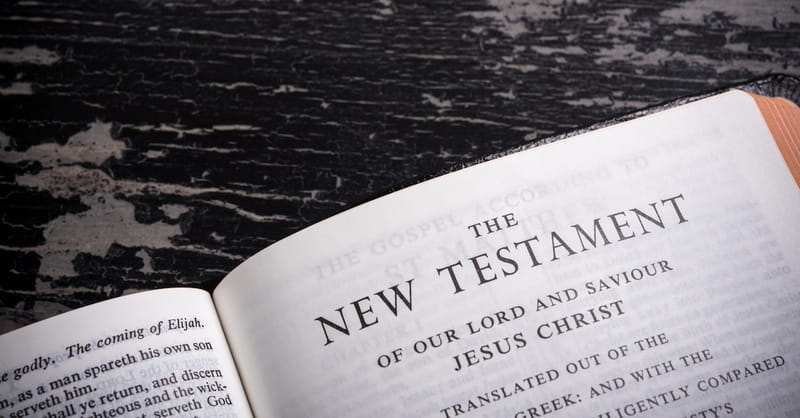
New Testament Christianity

Neal Pollard

  • The New Testament claims to be the source of authority for all we do of eternal importance, no matter when or where we live (Col. 3:17; 2 Pet. 1:3,20-21; 2 Tim. 3:16-17).
  • The New Testament will not share authority with any other book or “revelation” (Gal. 1:6-9; Jude 3).
  • The New Testament reveals how a person becomes a Christian (Acts 2:37-47; Eph. 4:4-6).
  • The New Testament teaches us that the Lord adds Christians to His church (Acts 2:47).
  • The New Testament shows us how that church is organized and led (Acts 20:28; 1 Tim. 3:1-12; Phil. 1:1; 1 Pet. 5:1-4).
  • The New Testament gives us the day the Christians met to worship (Acts 20:7; 1 Cor. 16:1-2).
  • The New Testament clarifies for us the various roles and responsibilities God has given to each gender of Christians in the work and worship of His church (1 Tim. 2:8-15).
  • The New Testament teaches the Christian how God wants to be worshipped (John 4:24).
  • The New Testament outlines the Christian’s purpose and work (Eph. 4:11-16).
  • The New Testament is dedicated to showing how one, as a faithful Christian, has eternal life and the hope of heaven (Ti. 1:2; Rev. 2:10; ch. 21-22).
  • The New Testament helps one understand how God wants marriage and family to function, to build Christian homes (Mat. 19:1-12; Eph. 5:22-6:4; 1 Pet. 3:1-7).
  • The New Testament urges Christian growth and thoroughly teaches how that is accomplished (2 Pet. 3:18; Ti. 2:11-14; John 15:1ff; etc.).
  • The New Testament constantly speaks of how the Christian needs to and benefits from developing an intimate relationship with the Godhead (1 Th. 5:17; 2 Tim. 2:15; John 15:14; Mat. 22:36-40).
  • The New Testament teaches that Christians prove to others their discipleship to Christ by loving one another (John 13:34-35).
  • The New Testament reveals that Christians are tasked with duplicating themselves by teaching the gospel to those outside of Christ (Mat. 28:18-20; Acts 8:4; Col. 1:23).
  • The New Testament asserts itself as the unfailing, universal guide regarding anything that will ultimately matter (2 Pet. 1:3; John 14:26; 16:13; etc.).

If what we are after is divine guidance for who a Christian is, what he or she does, and how God wants one to live, where else would we turn but to the New Testament? A God who engineered us for eternity and tells us we have but two eternal dwelling places would be cruel and unloving if He did not give us clear, thorough answers to any matter that is important to Him. How loving and faithful for God to give us such an unambiguous guide.

58366-nt-rely.800w.tn_

Of One Blood

Neal Pollard

The NHS (National Health Service of Great Britain) says, “Blood is made up of red blood cells, white blood cells and platelets in a liquid called plasma. Your blood group is identified by antibodies and antigens in the blood” (nhs.uk). There are eight blood types among human beings in the world. In most countries, more people have either [A+] or [O+], although a few countries have more [B+] blood types. But the type of blood a person has is not specific to a race. [O-] blood types can give to all blood types, and [AB+] blood types can receive from all blood types. Most blood types can give to and receive from more than one blood type. You may not think much about your blood type, but it matters to you when you need a transfusion. It matters to everyone when you donate blood. 

In Paul’s incredible sermon in Athens, he cites a scientific truth now accepted by all science. He says that God “made of one blood all nations of men for to dwell on all the face of the earth” (Acts 17:26). While the word translated “blood” is found in the Greek New Testament, modern translations do not have that original word in the text. Instead, it has literally “He made from one (“man” inserted by translators) every nation of mankind…” (NASB, ESV, ) or “he made of one every nation of men” (ASV). This produces no great tension between versions. Science tells us that blood type is determined by genetics, so the same conclusion can be drawn from either rendering. Humanity is bound together by something that transcends racial barriers. In fact, all mankind–regardless of race–is related. God saw to that by the creating us all from the same person. He designed the human body, whatever skin color or ethnicity, to survive through the same vital substance (Lev. 17:11)–blood! 

We live in a world that desperately wants to divide us by political party, nationality, skin color, gender, and a thousand subcategories. Division is worldly minded and contrary to God’s Spirit (Jude 19). I find it incredible how God reminds us, even in Paul’s subtle phrase in an apologetics lesson, that He desires us to be united according to His will. What matters to Him is not measured by such superficial, external things as race. It is the content of character. Most of all, it’s the blood of His Son!

kids-race.jpg

How To Unite In A Culture Of Division

Neal Pollard

It’s no news flash to observe that our culture seems hopelessly divided along political lines. That seems to impact race, gender, and other lines, too. The most tragic consequence of this is that it has not left the church unaffected. Social media is often a barometer for how emotional and passionate brethren on both sides of this divide can become when discussing some specific aspect of this. We cannot hope that social media will provide the answer. Who your friends are and what their leanings are on political issues influence what shows up on your homepage as they share politically or socially charged blogs, videos, and the like. Pundits have, for a few years, theorized and analyzed the reality of a “political social media bubble.” Barton Swaim, in an August 1 article on The Weekly Standard online, said, “more than any other social media platforms, Facebook and Twitter are avenues for the kind of acrimony that has embittered our politics and poisoned reasonable dialog” (https://www.weeklystandard.com/barton-swaim/a-political-social-media-bubble). It’s not just conservative publications making that observation. Google the term “political social media bubble” and conservative, moderate, and liberal outlets can at least agree about its existence (a trip to The Guardian, New York Times, National Review, et al finds plenty of material if written from different points of view drawing different conclusions).  Too often, God’s people get drawn into this hurtful, messy arena and turn on each other like gladiators in the Roman Colosseum. The God of heaven must certainly weep.

This weekend, I visited the Lord’s church in Chesapeake, Virginia, a state that is often a political cauldron boiling hotter than many other places. I’m not sure how many congregations were represented, but we had to have had close to half white and half black people attending (with various Asian and Hispanic visitors there, too). Politics were mentioned a few times, but only in the sense that they have too often become a stumbling block and distraction in the Lord’s church and that they cannot solve our nation’s problems. But I was beholding the answer without it having to be pointed out. Those in attendance had a thirst for a “thus saith the Lord.” People of different colors lovingly, naturally worshipped, fellowshipped, visited, laughed with, and enjoyed each other throughout the weekend. It was genuine. It was deep. It was powerful. And it was neither contrived nor manipulated. Its glue and bond was the blood and body of God’s Son. Christ is the great uniter. As we unite on His terms and His way, we destroy barriers. That’s by design.

What Paul says to Jew and Gentile in Ephesians 2:14-18 can have application between black and white, Republican and Democrat, rich and poor, male and female, or however our country wants to erect barriers. Christ is our peace and can break down the barrier of any dividing wall. He helps us view each other as “fellow citizens” and “family” (2:19) who are “together” (2:21,22). When we get ahold of that, nothing can keep us apart!

43368956_10155859106275922_391409913101811712_n
At yesterday’s PM worship services at the Chesapeake church of Christ

You Push That Way And I’ll Pull This Way

Neal Pollard

While it is true that each of us possesses unique abilities within the Lord’s body (Rom. 12; 1 Cor. 12), that fact bears closer scrutiny. God can use each of us, with our unique personalities, backgrounds, and experiences, to reach so many among the lost and to help so many among the saved. Yet, it is easy to lose sight of how we contribute to the health and growth of the congregation we are a part of. 

For example, the following should not be considered talents useful to the Lord’s cause:

  • Being gossips and busybodies (2 Th. 3:11; 1 Tim. 5:13).
  • Causing strife and being jealous (Rom. 13:13; 1 Cor. 3:3).
  • Judging your brother (Rom. 14:10; Jas. 4:11).
  • Returning evil for evil and insult for insult (1 Pet. 3:9). 
  • Being an obstacle or a stumbling block in a brother’s way (Rom. 14:13).
  • Speaking deceit (1 Pet. 3:10).
  • Giving the devil an opportunity (Eph. 4:27).
  • Keeping your leaders from doing their work with joy and not with grief (Heb. 13:17).

Certainly this is not an exhaustive list of ways we may misuse the stewardship of our speech and actions as members of the body of Christ. It can be so tempting, when we look at the church’s imperfections and people’s inevitable shortcomings. We have new Christians. All Christians have weaknesses. Those who lead and conduct the church’s work could inevitably do it better. 

What does the Lord want each of us to do as individual members of the Lord’s church? He calls for living in harmony in the Lord (Phil. 4:2). He wants us fitted, built, and held together (Eph. 2:21-22; 4:16). He wants us “being of the same mind, maintaining the same love, united in spirit, intent on one purpose” (Phil. 2:2). Practically speaking, this means getting behind the work of the local church, contributing to it and building it up. It means asking how we can help and throwing our energy into that. It means constructively helping when a work is lagging or in need of direction. It means lovingly, respectfully interacting with the other members of the body. 

Comedian Steve Harvey compared his rise to success with pulling a wagon uphill. He said that many people may hop on that wagon and contribute something, He said they all need to be doing something to help you get that wagon up the hill. He warned against those who get on the wagon and have no value (via OWN, 9/12/14). Perhaps you’ve found yourself pushing toward a spiritual objective, only to feel the resistance of someone working against you. This is frustrating! However, never find yourself opposing good, needed works through misuses of your resources in ways like those in the bulleted list above. In the worst case scenario, we may even find that in doing so we “may even be found fighting against God” (Acts 5:39). Let’s do all we can to help build up the body of Christ, prayerfully studying what that does and does not mean!

compromise-donkey

Abraham Lincoln’s Memorandum Of August 23, 1864

Neal Pollard

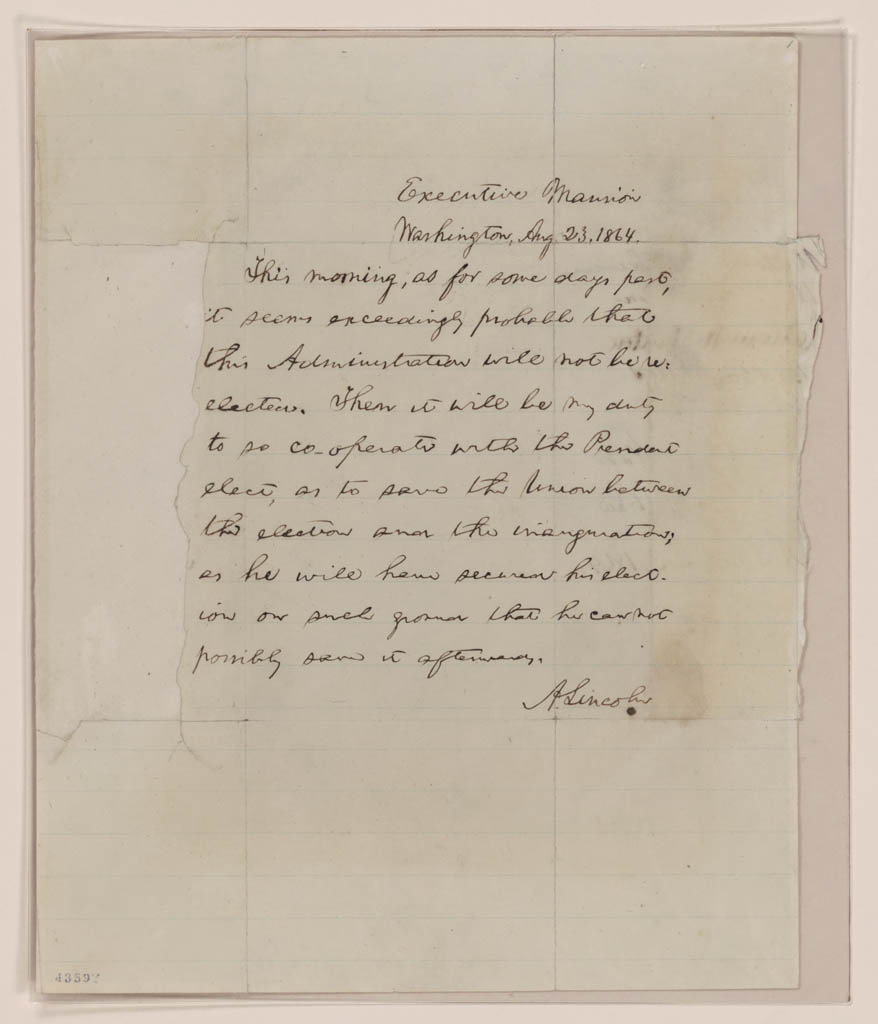
Somehow, I was unaware of the existence of a document which Abraham Lincoln drafted and had endorsed by every member of his cabinet, though unseen by them, and which remained sealed until November 11, 1864. These were not only dark times for the nation, embroiled in civil war for over three years at that point, but gloomy for the war-weary north which could not end the conflict against the greatly outmanned but tactically superior south. Politicians and citizens were unhappy with the perceived lack of success and progress at such high cost—the death and disabling of so many of her sons in the prime of their lives.  Lincoln detected that popular sentiment was such that he would not be reelected. Thus, he drafted his memo, which read, 

This morning, as for some days past, it seems exceedingly probable the this
Administration will not be reelected. Then it will be my duty to so cooperate
with the President-elect as to save the Union between the election and the
inauguration: as he will have secured his election on such ground that he
cannot possibly save it afterward (Coolidge 139). 

Lincoln seemed to think that the north had had enough of this war and would rather sue for peace and allow our sea to shining sea to be two nations rather than continue with such devastating effects a war they could see no end to. He appears dedicated to whatever he could do to preserve unity.

Of course, several things changed the course of Lincoln’s fate in his bid for reelection that swept him decidedly into office for a second term. There was the north’s victorious show in The Battle of Atlanta, Fremont’s withdrawal from candidacy, the Democrats internal division between the Copperheads—eager to end the war now—and the War Democrats, and the fact that no electoral votes were counted from the Confederate States of America.  But, Lincoln could not see the future. He was preparing for what he saw as the worst.

There is a well-worn battle taking place in our world. It is not technically between two factions. It might be framed as Christianity versus other world religions. It could be cast as New Testament Christianity versus so many individual denominations. Yet, internally, there are multiple stressors to the biblical unity Christ prayed and died for, too (John 17:20-21). 

Christians are soldiers (Eph. 6:10ff), but our battle is not with flesh and blood (Eph. 6:12).  Our war and weapons are not “of the flesh” (2 Cor. 10:3-4). All the same, many have grown weary of fighting the good fight and not a few feel as though we are fighting in a losing cause. The restoration ideal of doing Bible things in Bible ways seems archaic and impossible to growing numbers of saints. Some fight with equal vigor to preserve traditions not rooted in Scripture, and unnecessarily harm the great cause. 

As we strive at all costs to be true to the pattern of New Testament Christianity, let us do so going to whatever lengths we can to maintain unity wherever possible. Not for a moment does that mean sacrificing truth or compromising even one “thus says the Lord.” But it does mean embracing a spirit of love and protectiveness for the precious Bride of Christ, the church. That involves loving and working with those who are the members of it. 

Ultimately, the Lord’s cause will prevail. His victory is as assured as every other divine promise. We must be striving on His side to share in that. For now, we cannot give up the fight! Let’s cooperate wherever and however we can, standing unitedly on the foundation of Christ and His will. The rest (which is most of it), we will leave to our Great Commander In Chief!

Works Cited:
Coolidge, Louis A. American Statesman Ulysses S. Grant (New York: Chelsea House, 1983).

blind-memo-recto-al0204