For Their Community. Patriotic, civic-minded, generous, helpful, involved, and connected, God’s people strive to be good citizens and neighbors. Acts 2:47a; 5:13b).
For Visitors. Smiling, greeting, welcoming, inviting, and connecting, God’s people know that many visitors to church events and assemblies are future brothers and sisters and they want to do what they can to help facilitate that objective. Colossians 4:6; Philippians 2:15; Matthew 5:13-16.
For The Lost. Co-workers, family, friends, fellow-students, acquaintances, neighbors, and strangers, God’s people see the people in their lives as fellow-strugglers whose souls will spend eternity somewhere and they want it to be in heaven with them. Daniel 12:3; James 5:19-20; Proverbs 11:30
For Each Other. Empathetic, tuned-in, concerned, familiar, intuitive, and loving, God’s people rise to occasions of crisis and love in ordinary moments because they are intimately connected to each other by precious blood and like precious faith. 1 Thessalonians 5:11; Romans 12:9-10.
For Children. Wise, visionary, foresightful, nurturing, and of tender affection, God’s people hear their Savior’s admonition to imitate, encourage, and develop these impressionable, dear ones. Matthew 18:3ff; 19:14
For The Elderly. Concerned, attentive, prayerful, and connected, God’s people know it’s wise and important not to neglect and forget the part of our population that grows more lonely, isolated, frail, and needy with each passing day and they let them know they see and care. James 1:27; Proverbs 16:31; Proverbs 23:22
For Their Families. Responsible, judicious, properly-prioritizing, and consistent, God’s people realize that no advancement or success in the world is worth sacrificing the souls they most cherish and can most influence. Matthew 6:33; Ephesians 6:1-4; Proverbs 22:6; Deuteronomy 6:6-7
For Their Souls. Vigilant, conscientious, self-aware, and introspective, God’s people know all too well their humanity, weakness, and inconsistencies but grow more in love with God and heaven and less in love with this world every day. 1 John 2:15-17; Matthew 22:37-40.
For God’s Will. Whether gospel meetings, retreats, ladies days, daily Bible reading, workshops, lectureships, special or regular Bible classes, or worship assemblies, God’s people so often show up hungry for the bread of life and the spiritual meat, thirsty for the milk of the word, and considering all of it sweeter than honey. Hebrews 10:24-25; John 6:35; Hebrews 5:14; 1 Peter 2:2; Psalm 19:10
Aren’t there so many reasons to love God’s people?

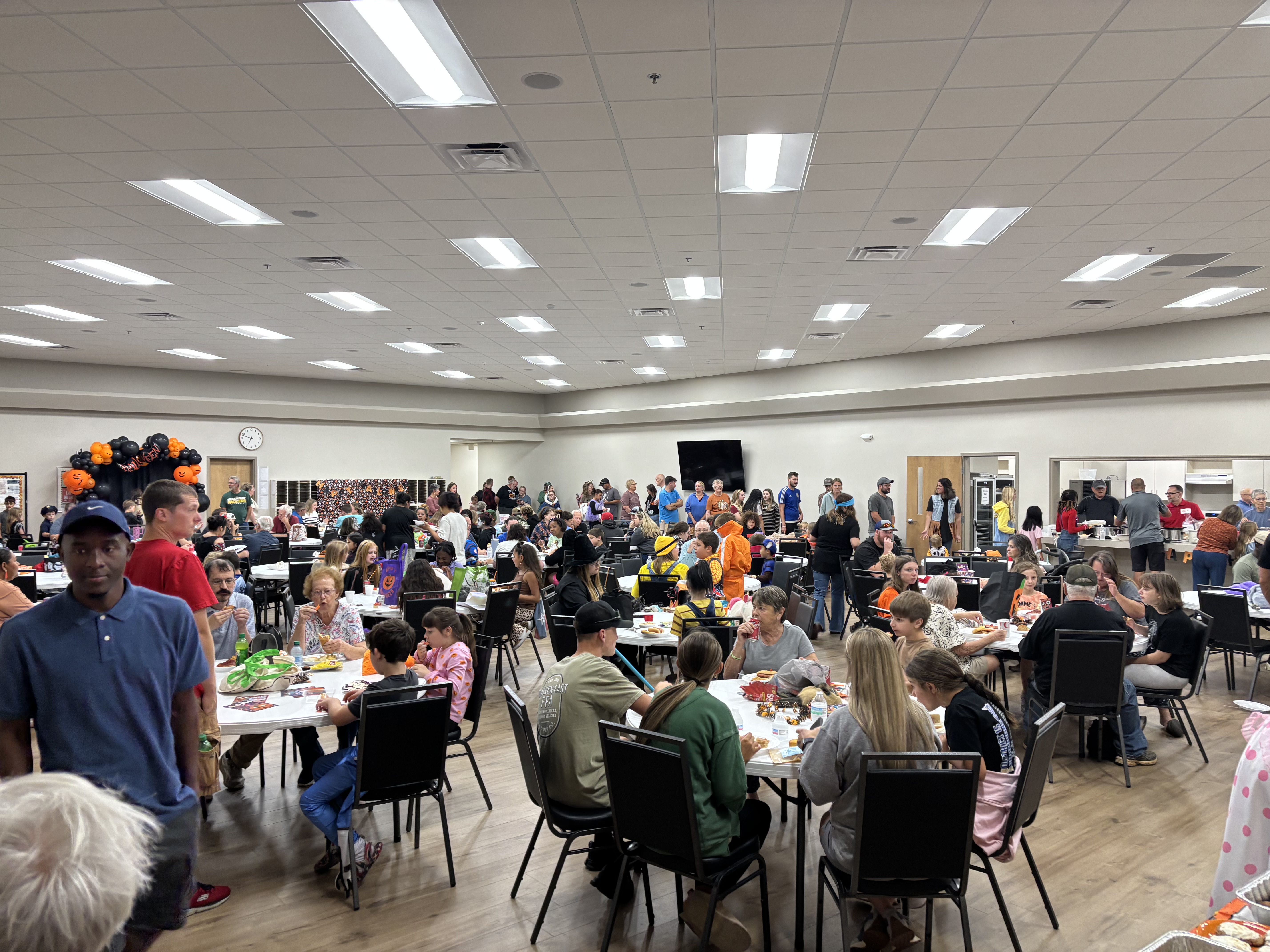
A couple of pictures (credit Russell Simpson) from Saturday night’s Trunk or Treat. God’s people at Cumberland Trace really shined!

Excitement. From the moment they are part of the body of Christ, new Christians need to experience our joy over them. This needs to be sustained over their first weeks and months as a Christian. While developing relationships cannot stay at this initial phase forever, neither should they feel forgotten in a few days (cf. Acts 15:3; Phil. 1:25).
Embracing. While hugs and affection can be an effective means of helping everyone, including spiritual babes, I mean here making new Christians feel a part of the “group.” They have likely exchanged circles of influence and will have to give up some unwholesome relationships. They will do so, often still “rough around the edges” or still working through some worldly ways. They need our friendship and acceptance, our mature assistance as they are grafted in to the body (Rom. 15:7).
Example. New Christians by their nature do not know a lot about how to be a Christian. They rely on role models. Therefore, we will watch our attitude, our general speech, our words about others, our choices (recreation, clothing, entertainment, etc.), and our actions. Much is at stake (Mat. 18:6-7).
Enlistment. New Christians don’t have exhaustive experience with what the Christian life is to be like. They don’t know what next steps are, though they are usually “on fire” for the Lord and raring to go! Our task is to help them see that Christians are to do more than “be,” they are to “do.” We need to call them alongside and help them serve. If we can do this from the beginning, they will not have instilled in them the habits of inactivity or reduce the Christian life to a few hours assembling. Take them visiting, get them to help teach, have them sit in on Bible studies, and generally find what they are good at and help them find outlets to exercise their gifts (Rom. 12:6-8; Eph. 4:16).
Edification. That requires time spent together. Whether this occurs through table fellowship, social interests, church work, and just quality time, they need to be built up in the faith. If we will deepen the relationship generally, they will be more receptive to the most important way to be uplifted–through the assemblies (Heb. 10:24-25). This instruction remains vital, to “encourage one another and build up one another” (1 Th. 5:11).
The words of Paul have never been more urgently needed: “For since in the wisdom of God the world through its wisdom did not come to know God, God was well-pleased through the foolishness of the message preached to save those who believe” (1 Cor. 1:21).
Neal Pollard
Last night, we finished our third annual EQUIPPED workshop. It was uplifting for so many reasons, too many to try and list here. I want to focus on just one. Certainly, the speakers we had represented a diversity of style, background, schooling, age, race, and personality. To the person, each shared the common value of presenting God’s word faithfully, richly, and beneficially. In every session I attended (and I floated into multiple sessions many hours), I admired how effectively each exposed God’s message!
We also had representatives from six schools of preaching (Bear Valley Bible Institute, Brown Trail SOP, Florida SOP, Georgia SOP, Tri-Cities SOP, West Virginia SOP), not including speakers training preachers from these schools and in the Memphis SOP, Faulkner University, and Freed-Hardeman University. I talked with several of these men, and they speak of the urgent need we have to meet the surging preacher shortage crisis facing God’s people. Often, this shortage causes or hastens congregations having to shut their doors. At best, it hamstrings the work the local church can do. It is a reminder of our pressing need to emphasize the wonderful life preaching is, encouraging our sons to preach, and our daughters to want to marry preachers.
The best part of this weekend was seeing preachers from all over who came to feast on God’s word and get practical ideas to enhance their local works. If there was anything better than that, it was the several “prospective” preachers that were in attendance. Talking to young men who shared with me their aspiration to go preach, those who were making their plans to attend school for that purpose, and seeing young men who just need a person of influence in their lives to gently nudge them in that direction.
The words of Paul have never been more urgently needed: “For since in the wisdom of God the world through its wisdom did not come to know God, God was well-pleased through the foolishness of the message preached to save those who believe” (1 Cor. 1:21). Because we believe that, let’s encourage men to engage in the greatest mission God ever gave.
Humanity faces its greatest challenge: sin, which creates a chasm between us and God. Yet, the church stands at the very heart of God’s divine solution to bridge this separation. In 2 Corinthians 5:17-21, we are reminded that in Christ, we are made anew, and through His church, the possibility of reconciliation with God is made real. The church is not just a body; it is where the ministry of reconciliation is both exercised and experienced.
The church plays an integral role in our ultimate salvation. Here, we are nurtured in our faith, guided by the teachings of Christ, and supported as we navigate the path toward eternal life. However, it’s disheartening to acknowledge that we often hesitate to share the remarkable gift of salvation. Now is the time for boldness!
We are God’s plan to bring the gift of life to the world! People need the church, and they need what you and I possess. Be strong and courageous as we face the unknown together as a family in Christ. Acts 4:29 encourages us, “And now, Lord, look upon their threats and grant to your servants to continue to speak your word with all boldness.” In the preceding verses, we see Peter and John standing before the council, threatened and commanded not to speak of the gospel. But instead of cowering, the church prayed for boldness to be the light they were called to be.
As we read in Acts 4:13, “Now when they saw the boldness of Peter and John, and perceived that they were uneducated, common men, they were astonished. And they recognized that they had been with Jesus.” The boldness of Peter and John was evident, and despite their lack of formal education, God was using them in significant ways. This is a powerful reminder for us today; it doesn’t matter if you stumble over words or if you think “sanguine” refers to a type of bird—God can still use you in incredible ways! Let’s pray that, as members of His church, we will be bold and share the marvelous news of salvation, ensuring that the legacy of the early church continues in our future.
The early church was bold, but it was also known for its generosity. The church holds a distinct position as the manifestation of God’s eternal purpose, unlike any other human institution. God calls us to embody generosity in every aspect of our lives. Being part of the church means fostering a culture of generosity, where we care for one another’s needs and create an environment filled with Christ’s love. We become each other’s safety net—not just financially, but spiritually and emotionally as well. We are generous with our time, our love, our resources, and our forgiveness.
Acts 4:34-35 describes a beautiful picture: “There was not a needy person among them, for as many as were owners of lands or houses sold them and brought the proceeds of what was sold and laid it at the apostles’ feet, and it was distributed to each as any had need.” God designed us to be a family that leans on one another, ensuring that any need is met here in our community. You’d be amazed at how powerful generosity can be as a tool for evangelism. There’s a reason God designed us this way—it draws people in.
Lastly, the early church exemplified commitment. We should strive to become a group of believers who are committed in every aspect of church life. Let us be dedicated to fellowship, encouragement, and love. We must commit ourselves to the Gospel, to our elders, and to the work of the church. It begins with each individual—no one can fulfill your role for you!
Acts 4:33 states, “And with great power the apostles were giving their testimony to the resurrection of the Lord Jesus, and great grace was upon them all.” Reflect on this: “This is my church. It is composed of people just like me. It will be friendly if I am. It will do a great work if I work. It will make generous gifts to many causes if I am generous. It will bring others into its fellowship if I bring them. Its seats will be filled if I fill them. It will be a church of loyalty and love, of faith and service. If I who make it what it is, am filled with these, Therefore, with God’s help, I dedicate myself to the task of being all these things I want my church to be.”
What do you envision for the body of believers where you attend? Be the change you wish to see. Commit personally, regardless of what others may say or do. You are part of the body of Christ, and He desires for you to be actively involved in His work. Embrace the boldness, generosity, and commitment that defined the early church, allowing us to fulfill our calling in today’s world.
How do you talk to a people about spiritual reality and was takes place in the invisible realm who can watch CGI, have AI, and experience things (like flying and global communication) which most of history never experienced? The Bible is a timeless book…
Gary Pollard
Our technological advancements over the last two or three centuries (particularly the last century) have distracted many from a fundamental truth: What we call “spiritual” is an inseparable part of reality. We have been able to rely on means of transportation, subsistence, medical care, and exploration that would’ve historically been considered supernatural (eg. flight, drought and famine-resistant farming, robotic surgery, genetic manipulation, space exploration). We can travel in airplanes. We drive cars. We communicate instantly across vast distances. Organ transplants are a thing. These no longer exist only in our imaginations, they are right in front of our eyes. For many people the spiritual has become something either to reject or to relegate to an entirely different reality (often called the “spiritual realm”).
As I have mentioned (perhaps ad nauseam) before, the way “spiritual” is used by the world and by many believers does not necessarily reflect the understanding our ancient believing predecessors had. It could mean wind, influence, message, teaching, breath, manifestation of power, etc. It was used of people whose concerns transcended earthly pursuits. It was used of a class of beings who inhabited the air. Its conceptual meaning seems to be something like, “Invisible force with visible effect.” Concepts are not visible, as they exist only in our minds. But bringing a concept into “reality” means making visible what existed only in our minds. Our minds are still part of this physical universe, and we don’t banish them to a parallel realm or universe because of their invisibility. In the same way, God and his servants are invisible (except for Jesus, Col 1.15), though they can and have certainly taken visible forms. I have yet to encounter any compelling evidence of these invisible powers occupying a reality outside of our own (though I’m open to the possibility if any such evidence appears). They may not be visible to our physical senses, but they are no less a part of our world.
It may be helpful to see how many of the ancients viewed our relationship with the invisible powers of this world. I will include quotes from non-biblical writers after some New Testament passages. This is not to communicate a teaching but to get an idea of how these were understood by believers in the past.
“You should pray this way: ‘Our father who is in heaven…” (Mt 6.9).
“Be careful. Do not disregard these little ones. I tell you, their angels in heaven always have the attention of my father in heaven” (Mt 18.10).
“When you are praying and remember that you are angry with another person for something, forgive them. Forgive them so that your father who is in heaven forgives you” (Mk 11.25).
“When it says ‘he went up’ what does it mean? It means that he first came down low to earth. So Christ came down, and is the same one who went up high above to fill everything with himself” (Eph 4.9-10).
“Masters, in the same way, be good to your servants. Don’t say things to scare them. You know that your master and theirs is in heaven and he treats everyone the same” (Eph 6.9).
“Our fight is not against people on earth. We are fighting against the rulers and authorities and the powers of this world’s darkness. We are fighting against the spiritual powers of evil in the heavenly places” (Eph 6.12).
“And you began waiting for God’s son to come from heaven, the one God raised from death. He is Jesus, the one who is rescuing us from God’s coming anger” (I Thess 1.10).
“Those beings, whom other philosophers call demons, Moses usually calls angels; and they are souls hovering in the air. And let no one suppose that what is here stated is a fable, for it is necessarily true that the universe must be filled with living things in all its parts, since every one of its primary and elementary portions contains its appropriate animals and such as are consistent with its nature — the earth containing terrestrial animals, the sea and rivers containing aquatic animals, … It is therefore necessary that the air should be full of living beings. And these are invisible to us, inasmuch as the air itself is not visible to mortal sight. But it does not follow, because our sight is incapable of perceiving the forms of souls, that for that reason there are no souls in the air” (Philo: On the Giants II.6-9).
“Go, say to the watchers of heaven, who have sent you to petition for them: ‘You should petition for men, and not men for you. Why have you left the high, holy, and eternal heaven, laid with women, defiled yourselves with the daughters of men? … But you were formally spiritual, living the eternal life, and immortal for all generations of the world. So I have not appointed wives for you, because the spiritual ones of the heavens belong in heaven.’ Now the giants, who are produced from the spirits and from flesh, will be called demons on the earth, and on the earth shall be their dwelling. Evil spirits have come out of their bodies, because they are born from men; yet from holy watchers is their beginning and primal origin. They will be evil spirits on the earth and they will be called demons. As for the spirits of heaven, in heaven will be their dwelling, but as for the demons of the earth, that were born on the earth, on the earth will be their dwelling” (I En 15.2-10).
You must have a plan. If the leadership has no plan to grow, then the members don’t have a path to follow. According to one Gallup poll taken in 2020, 47% of adults are affiliated with a religious group of some kind in the U.S. Those numbers drop even lower after considering the amount of members that make up the Lord’s church. Of that remnant, the faithful are in the minority. Knowing that God is able to help His church grow is one thing, but creating an environment that encourages growth is another. According to Paul, the more streamlined and dynamic we can be in our service to Him, the more growth occurs.
“…from the whole body, being fitted and held together by what every joint supplies, according to the proper working of each individual.”
Ephesians 4.16
So let’s simplify it.
A growing environment focuses on two areas:
A. For Spiritual Growth…
Have an excellent customized Bible curriculum
Focus efforts on the worship service planning
Emphasis on group focused programs (teens, young adult, & seniors)
B. For Numerical Growth…
Plan to grow your staff (outreach minister, youth minister, co-minister/associate)
Look for needs and create jobs/ministries to fulfill those needs by getting others involved. Churches are often stagnant because there aren’t enough outlets for all members to plug in.
Five Job Ideas For Church Families
Social Tech Team: Perfect for a youth group looking to get involved in public communications. Facebook, Instagram, church websites, podcasts, YouTube channels, e-banners, PowerPoint slides, and numerous other lights to help your “city” (Mat. 5:14) become more visible. Online presence is crucial and a team of young people seem perfect for that job.
Scoop Squad: There are visitors who walk in the back door each Sunday and for some reason they aren’t all coming back. What if your congregation had a few folks who have taken it on themselves to seek them out in the crowd and invite them to lunch? To their home? A cup of coffee? These people are soul focused and they’re determined to keep visitors coming back to hear more about Jesus.
Conversion Crew: Appoint someone with a passion for soul winning to head up a group that’s passionate about training others in the art of conversion. The more capable teachers you have, the more likely your members will invite the lost.
The Howdy Boys: There’s nothing better than a warm smile and a handshake to make your presence in the room feel appreciated. The Howdy Boys (or the Welcome Women?) excel in conversation. They’re extroverts who can make a visitor’s first experience a stress-free one. After all, they get more than a “howdy” from a stranger. They’ll get directions to the nearest child care room, bathroom, classroom, and coffee room. Side note, “Caffeinated Christianity” isn’t a bad Bible study group name.
Builder Brigade: The question, “where can I help?” isn’t bad unless there isn’t an answer because there aren’t any options. Having a person(s) to help others find where their talents can bring Him the most glory is invaluable. If one were to place membership and then their talents were quickly put to work, the chances that apathy set in go down. Remove that “checklist mentality” by removing the option to simply attend without any responsibility. A team designed to create jobs or help others find their job is an important job.
For the next several weeks, I’ll be repeating the book of I Peter in present-day terminology. It’s not a true translation of the book, as I am not qualified to do so. It will be based on an exegetical study of the book and will lean heavily on the SBL and UBS Greek New Testaments, as well as comparisons with other translations (ESV, NASB, NIV, ERV, NLT). My goal is to reflect the text accurately, and to highlight the intent of the author using concepts and vocabulary in common use today.
This is not an essentially literal translation, and should be read as something of a commentary.
I Peter – Pt V
I say this because I love you: stay far away from unhealthy desires. They’re the sworn enemies of your souls, and they attack without mercy. Remember, this isn’t your permanent home. You’re strangers and outsiders on this earth. Remember this when you’re around earthly people. Make sure you behave like you’re supposed to. They’ll treat you badly and say horrible things about you since you don’t act like everyone else. Maybe they’ll notice your awesome morality and follow God themselves!
Speaking of people on earth, God wants us to obey whoever’s in charge of us (as long as it isn’t sinful). If it’s your president, obey him. Anyone acting on the president’s behalf is just as in charge. God uses them to punish bad people and praise good people. By doing what they tell us, we’re doing what God wants. Maybe we’ll even shut down the ignorant things others say about us!
Frank Buck was a true adventurer. He lived in 1900’s and would travel all over the world bringing back all kinds of exotic animals. What set him apart from others in his profession was that he didn’t shoot the animals and bring back their stuffed skins. In Frank’s mind, anyone could gun them down, but who would dare bring back a lion or a rhino— alive?
Frank Buck probably didn’t know it, but he was very scriptural in his approach. Jesus sent us out to seek and to save the lost, not to destroy them. It seems as though some may have forgotten that key element. That infamous Wild West poster we see in movies reading, “WANTED! DEAD OR ALIVE” doesn’t fit the biblical model for evangelism.
Soul-winning is about leading others to Christ. It’s not about winning the argument or flexing our vast amounts of knowledge. It’s not about proving someone how ignorant and wrong they are. It’s not about showing others how impossible we are to defeat in the match of verbal fisticuffs. It’s about saving their souls. Jesus is looking for those gutsy followers. The ones who are willing to take action and get out there! The Greek word “ZOGREO” only appears twice in the New Testament, as far as I know. The word literally means, “to take alive.”
In Luke 5:10 the word is used to express one being taken alive for God. In 2 Timothy 2:26 Paul would us the word when talking about those who have been taken captive by the devil. These two verses remind us that all will be taken somehow. Some from life to death, others from death to life. Matthew 28 is the Great Commission, our permission to baptize people for the remission of their sins. You can be that gutsy follower since Jesus said He’s going to go out with us, “even to the end of the world.” Let’s get out there and bring ‘em back alive.
Such powerful words describe it.The words “convert,” “save,” “restore,” “recover,” and the like depict the job God left Christians to do (cf. Gal. 6:1; 2 Tim. 2:26; Js. 5:19-20; etc.).The awesome business of God’s people is to be builders in the kingdom upon a foundation originating in eternity (1 Cor. 3:9-15).Each child of God is a private engaged in spiritual warfare against a tactician only God has the power to defeat (Eph. 6:10ff).
There is ample reason to be filled with excitement and dread at the task before us!God has entrusted the business of snatching souls out of eternal fire and transferring people out of darkness into His marvelous light to us earthen vessels (2 Cor. 4:7).The moment we come out of the waters of baptism, we rise to walk in newness of life (Rom. 6:3-4).That life entails culling out negative things, bad habits, poor attitudes, old ways of living.Yet, it also calls for actions and ambitions that a non-Christian could not begin to comprehend.The sign of genuine faith taken root is the desire to share the good news we ourselves have learned.
Soul-winning is the frontline focus of the family of God.All else that we do should be an extension or support of this primary work.Benevolence, though done simply for its own sake, can be a springboard of evangelistic opportunity.Fellowship is designed to not only build up the saints, but be an atmosphere — be it worship or fellowship outside the corporate assemblies— that honors God and creates hunger and thirst for righteousness.Non-Christians who come to our assemblies can then believe (cf. 1 Cor. 14:23-24).They share our company, see the light of Christ in us, and want the joy and peace that the world cannot provide (John 14:27; Mat. 5:16).
Everywhere we go, mingling in groups and having various associations, there are opportunities.There is that person who seems to stand out from others who are more frivolously engaged in life.There is the one who, when others have long shut their ears to truth, is open-minded enough and respectful enough of truth to believe and accept the Bible.A song that is used in many soul-winning campaigns is Lead Me To Some Soul Today.God is not going to “lay” anything miraculously on our heart, leading us through some direct operation to some particular person or to say some particular thing.Yet, providentially, He can open doors that leads us to find the one in search of God’s way.Our active desire should be to cultivate our hunger and optimism for this great, primary work of the church.
With all else to distract us or compete with our attention and affection, may we never forget the prime objective! We are saved to save (2 Tim. 2:2). Find the searcher and lead the lost! It’s why we’re here.
While many today have no idea who Jesse Roper Mohorovic is, he was a celebrity from the moment of his birth on March 30, 1942, off Cape Hatteras, North Carolina. The United States had entered World War II only a few months before, and German U-Boats “prowled the Atlantic sea lanes, and the waters off the Virginia-Carolina coast were ‘the most dangerous on earth'” (C. Brian Kelly, Military History, 9/05, 74). In fact, the Germans killed twice as many seamen in their U-boat campaign off the east coast than died at Pearl Harbor.
Jesse’s mother, Desanka, was 8 1/2 months pregnant, traveling on a passenger freighter that was torpedoed. She faced peril after peril, from getting out of her cabin to the harrowing escape in a lifeboat to an overnight storm. In the middle of all of it, the freighter sunk and her doctor injured in their dramatic escape, she gave birth in Lifeboat #4 to a baby boy at 2:30 A.M. Two days later, they were rescued by the Navy destroyer Jesse Roper.
The media covered many of the early milestones of his life, and even documented his interests and favorite baseball team. He later appeared on the TV shows To Tell The Truth and I’ve Got A Secret. He earned a law degree, served in the Navy, and had a career in marketing. He died of lung cancer about two years after his 2003 retirement (via JOC.com).
It is no wonder that “The Lifeboat Baby” would become such a sensation, especially given the real drama behind his birth. Perhaps he would have been part of anonymous tragedy if he and his mother had been among the 5000 who perished, but his birth and life became a symbol of hope and victory. Indeed, “Newspapers heralded Jesse as living proof the Allies could not be defeated” (Kelly).
We live in increasingly grim times. Our current battle is spiritual in nature, as sin and immorality seem to have the upper hand. Souls are perishing in infinitely greater numbers (cf. Mat. 7:13-14). While we cannot save them all, we need to be in search of those we can reach with the gospel. We must muster greater courage to share the good news and help those searching reach safety. They need to know there is hope and victory possible, and that Christ will ultimately win (1 John 5:4-5; 1 Cor. 15:24-25).These babes in Christ are unlikely to capture the attention of the media, but each of them have the rapt attention of heaven. God is counting on you and me helping to deliver them, regardless of how stormy things may be. Each individual matters to God. How wonderful that we might partner with God and His Word, and help a soul be one whose name is written in the Lamb’s Book of Life (Rev. 21:27)!
This post is for the lady across the street. She works at the gas station. This post is for Charles. That’s the guy we always call when the office printer breaks down or a leaky roof needs repaired. This article is for my family. My family means the world to me and if my life can help ensure an eternal future together (and I mean every one of them) then I have accomplished something truly great. This post is for my wife. My wife will be in heaven with me— she must be! The truth is, this post is for the faithful child of God, the disgruntled member in the pew, the discouraged elder, and frustrated preacher— this post is for people. It’s for the new child of God that is still dripping wet from the waters of baptism, to the battle-hardened Christian with years of faithful service. God drew a line in the sand long ago after humans fell from grace and separated ourselves from Him. On one side of that line you have the lost. Their sheer abundance in our communities and the world has caused many congregations to become numb to their horrific eternal state. Still, on the other side of that line you have the faithful. No, not the uncommitted pew-warmers, but the faithful. Sadly there are those inside the church that are on the wrong side of the Divine line. Often they blend in with the faithful because they look and act like the faithful do. This is nothing new, but elderships still scratch their heads over stunted growth and disappearing members. Preachers lose their voices as they pound evangelism and outreach from the pulpit. The reservoirs are being depleted by years of drought.
You’ll hear a lot of this kind of talk in some men’s meetings as the guys will sit around the table. After drinking coffee and filling their bellies with biscuits and gravy, it’s common for them to kick back and discuss what’s going on in the church. Obviously there are some big issues! So, who’s to blame? In an attempt to unmask the villain, one middle aged man exclaims, “if the leaders would _______”. A couple of his friends, who have clearly visited this topic a few times, nod their heads in approval. Another gentleman, with a white mustache, grunts as he repositions himself in his tin folding chair. Talk like this is uncomfortable, and it’s exhausting for many of them. The head hog at the trough clears his throat to let the others know he’s about to offer his respected opinion. He squints his eyes, leans back, then makes this statement. “It’s really society, you know. People just don’t go to church like they did when I was growing up!” Following this declaration, most of them will give their affirming “Mmm”’s and “exactly rights.” It’s at this point the tragic generational blame game begins. The wheels spin for a while, then everyone gets up and goes back to their homes to enjoy the rest of their Saturday. Tomorrow morning they dress up in their suits and ties and drive to worship. At worship they sit in the same spot, as the service carries on in it’s usual order.
In a world full of people intent on destroying and demonizing one another, the church needs to be the church— now more than ever. Our communities, friends, family, and nation need us to be the church. That starts with you and me. Paul said, “Encourage and build one another up…” in 1 Thessalonians 5:11. We can’t do this enough, and we can’t overstate it’s importance. Who have you encouraged and built up this week? How will you do it today? The church is God’s way of improving people, andthe church is God’s perfect project— for people.
I convinced my parents to watch a show I enjoyed with me. I doubt I converted them to watching the same kind of programs as I like but I was happy they enjoyed what we watched together. I was acting as an evangelist, wasn’t I? I told them about something that I felt fervently about, convinced them to look into it themselves, and then encouraged them to commit to following through with it. As I enjoyed the afterglow of the moment, I was hit by a realization. Why is it easy for us to tell others about a book or movie but not about the Gospel of Jesus Christ?
I suppose one answer is fear. If a friend thinks my movie suggestion is stupid, then he will just think I have bad taste in movies. At worst, he won’t ask me my opinion about movies again. The Gospel is different, though. We’re putting ourselves out there. What we present doesn’t just require the forfeiture of an hour and a half, but a lifelong commitment. What we fear is the loss of that companion since we feel as if we are requiring something great from them. The truth, however, is that it is not we who put forth the requirement. God does. We merely relay the information. Thus, regardless of a negative reaction, if we’ve spoken the truth in love (Ephesians 4.15) we’ve done what we are supposed to do in letting them hear what God requires of them (Ezekiel 3.17-19).
I suppose another answer is shame. I don’t fear what my friend thinks about my secular choices. However, I am reminded of the adage that one never publicly discuss religion and politics. Certainly, we have seen with the latter how divisive of a subject it can be. People unfriended me following the last Presidential election simply because they knew I supported the candidate for whom they didn’t vote! Imagine how that person will take the news that the cherished religion of his grandmother was not one that was true to the teaching of the New Testament? The Thessalonians felt their world had been turned upside down (Acts 17.5-8), and I am sure that my friend would feel the same way too.
Yet, that is not the truth, either. I have no power to condemn any grandmother to hell or grant her access to Heaven. God’s Word is truth (John 17.17). If the truth turns one’s world upside down, the fault lies within the worldview that was turned the wrong way, to begin with. As brother Keeble used to say to such a one bothered by the fate of grandmother, “If she had been taught what you’ve been taught, how do you suppose she would have reacted?” Just the fact that discussing religion in polite company is frowned upon is insufficient to dissuade the one genuinely loving his neighbor.
The next time you find yourself excitedly chattering on about something you’re zealous about to a friend, remember that it is possible to talk with them about Jesus that way as well. The only reason that we don’t is that we feel that we cannot. Love casts out fear (1 John 4.18). And if we deny Him before men, He will deny us before the Father (Matthew 10.32-33). Hobbies are great, but may we not find ourselves more energized by them than by the Living God.
My girls recently modified the game of Slug Bug in order to make it more exciting and faster-paced. A couple of months ago, with the whole family in the car, we were introduced to it when we heard the words “gocery bag in a bush” shouted three times in rapid succession followed by “wow! three in a row” from one of the other girls.
The modification was simple. Instead of calling out VW Beetles, we all began to call out grocery bags that were snagged up in a bush alongside the road. We would also accept “tree.” A grocery bag caught in a tree was also acceptable. Turns out, “Grocery Bag In A Bush” is much more exciting and fun than Slug Bug. Tons more action! I’ve never seen so many grocery bags in my life! And you should hear the squeals and laughter when one was spotted so far up in a tree that we all knew that it wasn’t coming down until the tree did.
Good times.
I’ve thought about Grocery Bag In A Bush many times since that day, and have made many observations about it. I’d like to share three of them.
Observation #1
The grocery bags have always been, and will always be, there. I just never “saw” them before. I don’t recall seeing a single slug bug while playing Grocery Bag In A Bush, even though they were probably there.
Conclusion #1
I will see that which I look for. Matthew 7:7-8 says, “Ask, and it will be given to you; seek, and you will find; knock and it will be opened to you. For everyone who asks receives, and he who seeks finds, and to him who knocks it will be opened.”
Observation #2
Grocery Bags don’t belong in a bush or a tree. It’s not what they were created for, but somehow they have found themselves hopelessly ensnared. They will most likely remain ensnared until someone cares enough to pick them up, or a violent storm rips them away from the unreachable limb where they are trapped. And if no one stops and picks them up, they will most likely drift away until they find themselves ensnared in another bush.
Conclusion #2
While we may excel at “stopping to say hello” when a brother is in the way, we should not let the business of “rolling our gospel chariots along” keep us from our responsibility to the lost to “stop and pick them up”.
Observation #3
We all financially support a vast army of sanitation workers through taxes and fees. We even personally pay for these services out of pocket so that they will come by our house each week to take our trash, and grocery bags, to where they belong. And yet, the grocery bags are everywhere.
Conclusion #3
Christianity cannot be outsoursed. It’s not enough to pay for, or support others, to do the work for us. This world is not our home, but it becomes a more beautiful place when each of us can see those around us who are ensnared in sin, and gently help them get to where they belong.
Feel free to make your own observations from this parable. It’s not perfect, and I’m certainly not equating those trapped in sin with trash. But before we start asking God to provide us with more opportunities, we might first ask ourselves if we are really in the game. Because once you know what to look for, the opportunities are everywhere.
[Scott Phillips serves as a deacon at the Bear Valley church of Christ. He and Tammi have a son and 7 daughters!]
Allow me to take you back to the early 1930’s, when the U.S. economy was in the throws of the Great Depression. It was a time of record setting negative economic growth. Many Americans lost their means to sustain basic life functions. Many Americans lost all Hope.
At the time, President Herbert Hoover believed in the importance of the role of individuals in society and the economy.
He said, “Economic depression cannot be cured by legislative action or executive pronouncement. Economic wounds must be healed by the action of the cells of the economic body – the producers and consumers themselves.”
Now, let us fast forward to the church today. We find the church in a time of record setting negative growth. And according to a 2014 Pew Research Study, less than 27% of Millennials (defined as ages 18 to 35) regularly attend religious services. Yet, 67% say they believe in a heaven and 84% think there is a God. So, what does the mean?
I think deep down inside, millennials believe there is a God, but worldly distractions and alternate priorities keep them from contemplating what that really means. A lack of understanding or knowledge of the truth translates into a lack of action. Their ignorance may lead to eternal demise.
So, let’s rewrite Hoover’s insight:
“Church growth cannot be cured by the action or pronouncement of church leaders. Church wounds must be healed by the actions of the members of the church body – the producers and consumers themselves.”
Church growth will not be achieved by elders, deacons or preachers alone. It must be cured by each of us also doing our part.
So I ask myself, “Am I a producer, or a consumer?”
In Matthew 5, Jesus said,
“You are the light of the world. A city set on a hill cannot be hidden; nor does anyone light a lamp and put it under a basket, but on the lampstand, and it gives light to all who are in the house. Let your light shine before men in such a way that they may see your good works, and glorify your Father who is in heaven.”
Honestly, I have been a consumer long enough. I sit in my pew every worship service, I do my daily bible reading, and dwell on God’s word… I have been a faithful Christian, with a proverbial basket over my head.
I want to be a producer…
–Sharing, Caring, and Acting to make a difference for the Lord’s church.
I want to be a producer…
–Proclaiming to others the Truth found in the Bible.
I want to be a producer…
–Openly Praising the Lord, each and every day, in my words and actions.
I want to be a producer…
–Participating in the building up of the body of our church by being involved in the work of the church.
I can no longer be just a consumer, I want to be a producer… Finding creative ways to prick the heart of a lost soul, for the sake of Christ!
Now here is the challenge:
I want to do these things… But, will I?… And how about you?
My brothers and sisters, I pray that each one of us can get up out of our “consumer” pew and DO Something Each Day to help our Lord’s church grow! I pray that we can all become “producers” for Christ.
I leave you with this thought…
In one of my favorite movies, Shenandoah, Jimmy Stewart played the role of the father, Charlie Anderson. He sat at a campfire with his family as they were searching for his lost son. They were all about to give up hope when Charlie said: “If we don’t try, we don’t do. And if we don’t do, why are we here on this earth?”
Brothers and Sisters, if we truly love the Lord’s church, we must try, we must do!
Jonathan Martindale punctuated an unforgettable worship service yesterday morning with one of the most thoughtful prayers I have ever been privileged to be a part of. What made it so effective was the people and issues he prayed about. This is not exhaustive, but here are some of the specific people he prayed for among his beautiful words.
Individuals in nursing homes that are facing the end of life (they believe they are prepared for eternity, but are not)
Individuals who are in college who are not being adequately equipped for the challenges and skepticism being thrown at them (both those who are fighting for their faith and those who have started to drift)
Individuals who are have been rocked by broken families
High Schoolers who are dealing with temptation
Junior high youth (trying to figure out who they are in life and those dealing with depression)
Elementary kids that have not made the decision to follow Christ yet but still need prayers to learn Christ correctly and led to that decision.
Those who are in the world who are perfectly content with where they are but still do not have Christ
Those who are good moral people but don’t have Christ
Those who are in the world and caught up with various vices (drinking, drug use, pornography)
Those who have fallen away (and our being visionary and courageous to help them)
That prayer reflected true thoughtfulness, contemplating those who are lost or drifting. While I’ve heard other prayers devoted to groups of people, I cannot remember one exactly like Jonathan’s.
It reminded me of Samuel’s words to Israel after the coronation of Saul. They had sinned against God by rejecting Him as their king. He assured them of God’s care, adding, “Far be it from me that I should sin against the Lord by ceasing to pray for you” (1 Sam. 12:23). It seems that, in principle, we can be guilty of sinning against God and our spiritual family by not praying for them. James encourages praying for one another when sin infiltrates our lives (Jas. 5:16). The church prayed for Peter (Acts 12:5). Paul wanted Thessalonica to pray for him (1 Th. 5:25; 2 Th. 3:1). So did the writer of Hebrews (13:18). So often, Jesus and His inspired spokesmen urged His followers to carefully, considerately pray for each other.
Let’s take every opportunity to do that today. Sit down and make a list of people—especially those who may get overlooked. Then, pray for them. Be as specific as you can about them. Talk with them and find out what they need from us in prayer. What a hedge of protection we may be giving one another by taking the time to pray for each other. What a huge blessing we can be for one another through prayer!
Ad consultant Peter Zollman issued a report in June 2014 saying that more than 40 slayings and 30 convicted killers have been linked to Craigslist (Stephanie Slifer, CBS News online, 1/28/15). Robbery is most often the motive behind the crime. Parry Aftab, a lawyer who specializes in Internet privacy and security law, offers these precautions:
Never go alone
Meet at a central location
Make sure someone else knows where you’re going and communicate frequently with them throughout the transaction
Research the seller’s name and address on the web
Don’t get cornered
When you arrive, snap a picture of the person and/or their license plate
Use common sense and if you’re uncomfortable, leave (ibid.).
If you’re like me, you’ve used Craigslist many times and have lived to tell the tale. We’ve not always followed all these rules, though a great many of them seem like common sense. We’ve bought and sold and have had great experiences with decent, friendly folks. The worst I can recall is that someone in our immediate family bought a vehicle from one less than forthcoming about all its flaws.
While these are very helpful public service tips, there is a danger far greater and much more common. What is at stake is even more serious than the taking of physical life as it involves the soul. The Bible warns about teachers who project themselves to be speakers of truth but are far from it.
By smooth speech and flattering words, they deceive the hearts of the simple (Rom. 16:18).
They turn the grace of God into lewdness and deny Christ (Jude 4).
They bring in destructive heresies which many follow (2 Pet. 2:1-2).
They exploit people with deceptive words (2 Pet. 2:3).
They prey on those inclined to turn their ears from truth toward fables (2 Tim. 4:3-4).
They are detestable, disobedient and unfit for anything good (Ti. 1:16).
They pervert the gospel of Christ (Gal. 1:7).
They captivate the impulsive (2 Tim. 3:6).
So often, these teachers find those already looking for a cheap and easy message. However, often they draw in sincere folks who allow themselves to be misled. In either case, while God holds teachers responsible (Jas. 3:1), He also holds hearers responsible (Lk. 8:18; Acts 17:11; 2 Tim. 2:15). We must make ourselves accountable for what we and our families hear—eternity is on the line!
They use every opportunity to make it a part of the conversation. It is as if they have a one-track mind. However they can promote their cause, they do. They will not quit until they convince you that what they believe is right and that you should accept it, too. They are bold and willing to risk and sacrifice to get their point of view not only heard but accepted. That there are still several places in the world where what they are preaching is unacceptable does not daunt or deter them. Say what you will, they believe in their conviction and will continue to spread it. They are purpose-driven.
Can you imagine Jews and those of the Roman Empire saying this about the Christians in the first century? Armed with a living hope (1 Pet. 1:3), they, even in the worst times, “went everywhere preaching the word” (Acts 8:4). They were accused of having “turned the world upside down” with their teaching (Acts 17:6). They had the reputation as “the sect…that [was] spoken against everywhere” (Acts 28:22). Yet, they would not stop until they had shared the good news everywhere (Col. 1:23). They were not interested in popularity or even acceptance. They were trying to get their point of view not only heard but accepted because it originated from the very mind of God.
Aren’t there people in this world who seem to have such a singular obsession? They are in special interest groups, and they have the cooperation and acceptance of rich and powerful people in the media, politics, education, and even athletics. They are indefatigable, tirelessly and relentlessly pursuing their agenda.
What about the church of the 21st Century? Do we have an aggressive agenda? Are we willing to share the Word of God, whatever it costs to whomever we can? It necessitates this question. Do we truly believe it is both right and essential? If it captures our minds, hearts and souls, we will not be able to keep quiet about it. May we develop the reputation for steadfast single-mindedness!
Alabama was handling Notre Dame handily. There was not much to notice on the field, so Brent Musburger observed the Tide signal-caller’s girlfriend in the stands, saying, “You quarterbacks, you get all the good-looking women. What a beautiful woman.” Kirk Herbstreit agreed, and the cameramen could not show her enough. By now, many have heard that her Twitter followers jumped from 2,300 that morning to 96,000 by night’s end. She’s a celebrity favorite, and she will appear in a reality show, perhaps on “Dancing With The Stars,” and the ever-lascivious Sports Illustrated Swimsuit edition this year (via http://www.ibtimes.com). I mention this certainly not to endorse a woman whose prior greatest claim to fame, besides her attachment to A.J. McCarron, being finishing sixth in the Miss Alabama contest. She epitomizes our culture’s obsession with sexuality and the body (Paul urges the godly woman to accentuate the inward, spiritual self in 1 Timothy 2:9-10).
My point in bringing her up is to show the power of the “right” word spoken at the “right” time. Musburger had a national audience and he had something to talk about that was of interest to many of those listeners. Certainly, Ms. Webb, as she assesses from a carnal standpoint, would consider herself a winner.
You and I have the most vital message the world could ever hear, the heart of which is the eternal salvation of the soul. We may never have a forum like Mr. Musburger did on the night of the BCS National Championship, but we have daily opportunities to share this good news. The Bible says, “Like apples of gold in settings of silver is a word spoken in right circumstances” (Prov. 25:11). A timely word is “delightful” (Prov. 15:23). In the context of evangelism, Paul says, “Let your speech always be with grace, as though seasoned with salt, so that you will know how you should respond to each person” (Col. 4:6). Repeatedly, God conveys the power of the “right” word being spoken at the “right” time.
How can we do this? Pray. Be discerning. Open your eyes. Have courage. Genuinely care about souls. Keep Ephesians 4:15 dear.
Consider that what you are after is infinitely more noble than any earthly ambition. Do well in this and heaven’s population will grow. What is more, you add fruit to your own account and are in position to have the acclaim of heaven on the greatest day of notoriety and infamy that will ever be (Prov. 11:30; 1 Cor. 3:11ff).