For Their Community. Patriotic, civic-minded, generous, helpful, involved, and connected, God’s people strive to be good citizens and neighbors. Acts 2:47a; 5:13b).
For Visitors. Smiling, greeting, welcoming, inviting, and connecting, God’s people know that many visitors to church events and assemblies are future brothers and sisters and they want to do what they can to help facilitate that objective. Colossians 4:6; Philippians 2:15; Matthew 5:13-16.
For The Lost. Co-workers, family, friends, fellow-students, acquaintances, neighbors, and strangers, God’s people see the people in their lives as fellow-strugglers whose souls will spend eternity somewhere and they want it to be in heaven with them. Daniel 12:3; James 5:19-20; Proverbs 11:30
For Each Other. Empathetic, tuned-in, concerned, familiar, intuitive, and loving, God’s people rise to occasions of crisis and love in ordinary moments because they are intimately connected to each other by precious blood and like precious faith. 1 Thessalonians 5:11; Romans 12:9-10.
For Children. Wise, visionary, foresightful, nurturing, and of tender affection, God’s people hear their Savior’s admonition to imitate, encourage, and develop these impressionable, dear ones. Matthew 18:3ff; 19:14
For The Elderly. Concerned, attentive, prayerful, and connected, God’s people know it’s wise and important not to neglect and forget the part of our population that grows more lonely, isolated, frail, and needy with each passing day and they let them know they see and care. James 1:27; Proverbs 16:31; Proverbs 23:22
For Their Families. Responsible, judicious, properly-prioritizing, and consistent, God’s people realize that no advancement or success in the world is worth sacrificing the souls they most cherish and can most influence. Matthew 6:33; Ephesians 6:1-4; Proverbs 22:6; Deuteronomy 6:6-7
For Their Souls. Vigilant, conscientious, self-aware, and introspective, God’s people know all too well their humanity, weakness, and inconsistencies but grow more in love with God and heaven and less in love with this world every day. 1 John 2:15-17; Matthew 22:37-40.
For God’s Will. Whether gospel meetings, retreats, ladies days, daily Bible reading, workshops, lectureships, special or regular Bible classes, or worship assemblies, God’s people so often show up hungry for the bread of life and the spiritual meat, thirsty for the milk of the word, and considering all of it sweeter than honey. Hebrews 10:24-25; John 6:35; Hebrews 5:14; 1 Peter 2:2; Psalm 19:10
Aren’t there so many reasons to love God’s people?
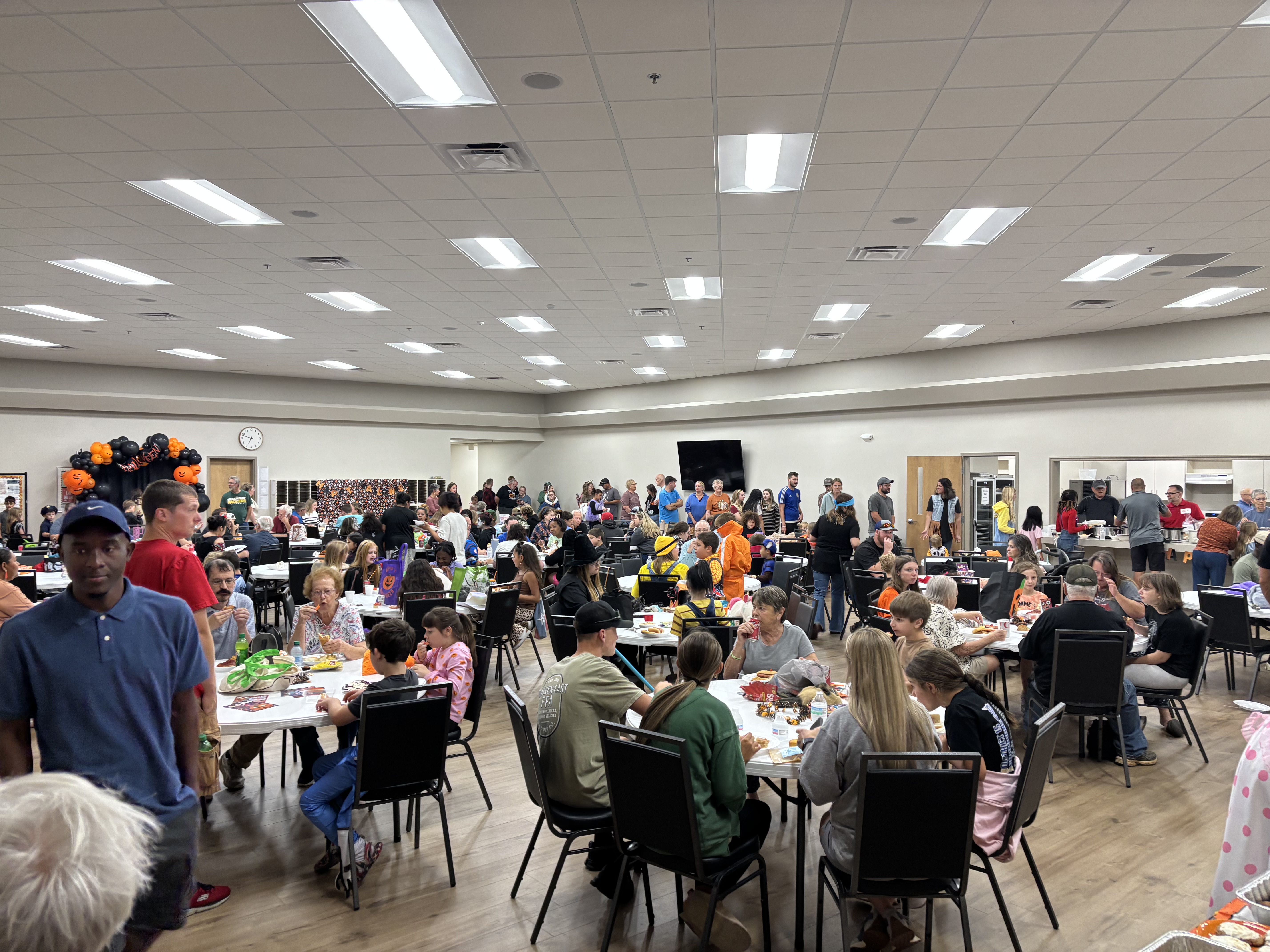
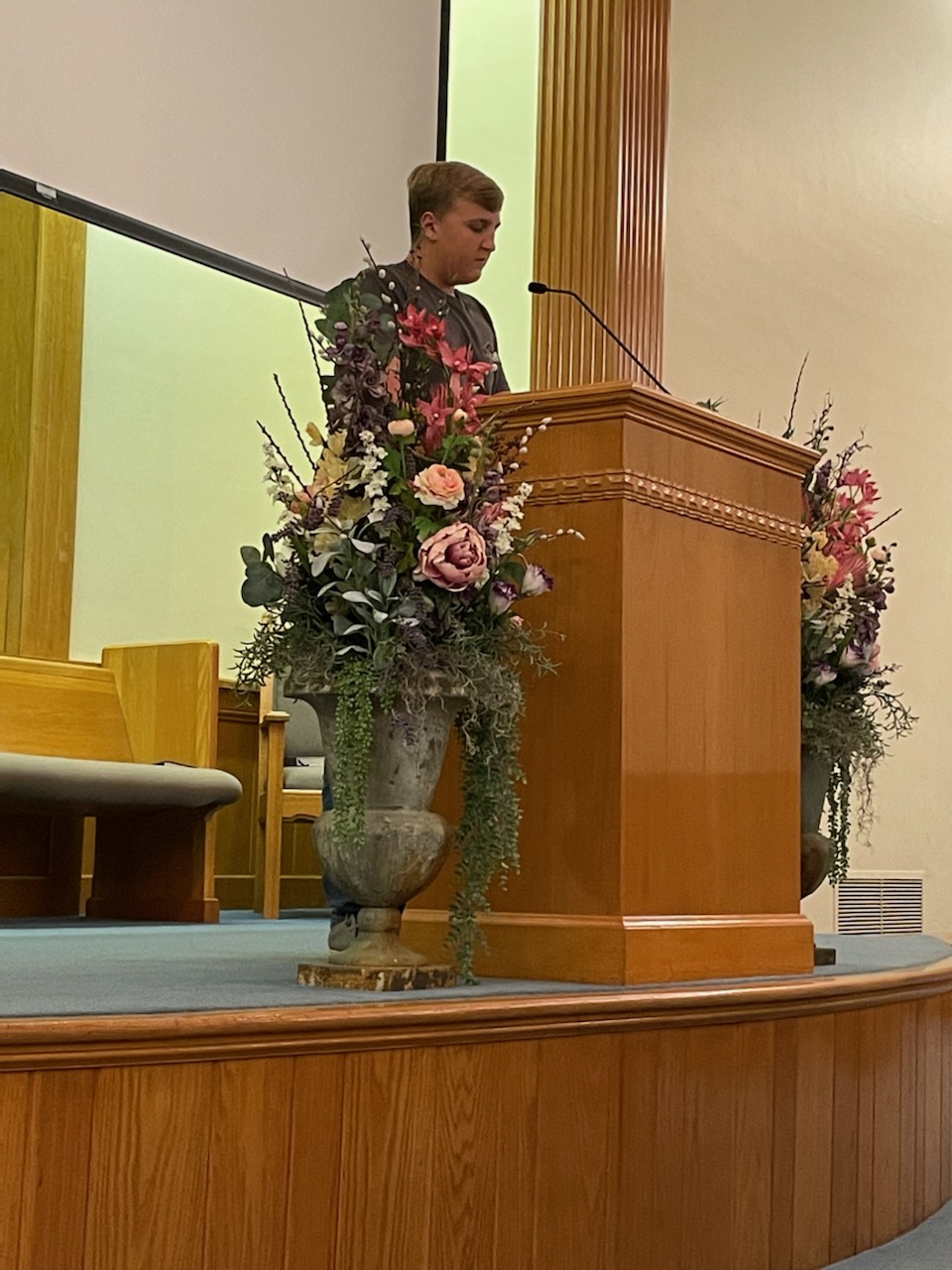
A couple of pictures (credit Russell Simpson) from Saturday night’s Trunk or Treat. God’s people at Cumberland Trace really shined!
H.G. Wells, an English writer, was never particularly religious, but after he had studied the history of the human race and had observed human life, he came to an interesting conclusion. He said, “Religion is the first thing and the last thing, and until a man has found God and been found by God, he begins at no beginning, he works to no end. He may have his friendships, his partial loyalties, his scraps of honor. But all these things fall into place and life falls into place only with God.”
I am thankful there is a God. That He exists, that He is in control, and that He offers eternal life. My life would be nothing if it wasn’t for His grace and love. There are a million different ways one could go about describing God the Father. Kind, loving, merciful, jealous, powerful, etc. Knowing God requires revelation. All that we know about Him is revealed in scripture. He chose to tell us who He is and what He has done for us.
To dwell on the revealed knowledge of God is one of life’s highest pursuits. There is no better way to spend your time than to learn of the God who created, restored, and saved us. In scripture we read of His perfect attributes, His unfathomable love, His gift of salvation. If we took every writer, philosopher, poet, Christian, and put them to work describing the nature of the Father, the book would be added to until the end of time. As finite humans, it is impossible for us to comprehend the infinite. Our limits will forever keep us from fully knowing God.
To know God completely and totally we would have to be God.
Of all the places in scripture we could look, there is one that stands out. It’s not John 3:16, Eph. 2:8, Rom. 1:16, 1 John 4:8, 2 Peter 3:9. This perfect description for God isn’t found in 10,000 words, it is found in one.
One single, Hebrew word incapsulates all of scripture, the theme of the Bible, and the attributes of God.
In the beginning God created the heavens and the earth, the sea and all that is in them. He created with His words, the very world we see today. However, the world we are in now isn’t exactly what it used to be.
God made man in His image, His likeness is found in us. He created Adam first, then Eve.
We ruled the earth, God’s prize possession.
He created us to love, to tend to the garden, to be with Him in perfect harmony. That is exactly what we see in Genesis 1-2, but things fundamentally changed in chapter three. The God who lovingly created the world, the garden for Adam and Eve, gave one single command. Don’t eat from the tree of knowledge.
This command gave His special creation a choice. A choice to love, or a choice to disobey. True love is a choice, it is never forced. Sadly as we are familiar with, Eve listened to the serpent and ate of tree. She then turned to her husband and He ate. It is at this moment they realize they are naked and made clothes for themselves. And then…nothing happens. No lighting bolt, no death, no thundering voice from God condemning them to hell forever. The Lord himself comes out to Adam, and notice how he comes. He comes walking. He wasn’t in a hurry to strike the offender. walking in the garden. “In the cool of the day”—not in the dead of night when things are all the more scary.
God is longsuffering, slow to anger, and of great mercy; and so He came walking, in the cool of the evening, when the sun was setting on the last day of Eden. Adam runs and tries to avoid the very God he had once met with confidence, the One he had the sweetest fellowship, talking with him as a man talks with his friend.
Gen. 3:9 The Lord God called to the man, and said one word, “ayyekkah” which is translated, “where are you?” Imagine hearing the voice of God as He cries, “Adam, where are you? This question reveals more than we have time to discuss. It showed that Adam was lost, or God would not have needed to ask him where he was.
Until we have lost something, we do not need to enquire about it. God’s first words after the fall, a question posed to His creation. In this one Hebrew word is compressed a whole theology. In this ONE word, we find the nature of God. Understand these are God’s first words to the FIRST sinner. In asking this question we learn that
God Pursues The Lost Sinner.
What Adam and Eve did was wrong.
They knew it, and so did God. God was very clear on what would happen if they ate of the fruit. “In that day you will surely die” are the exact words God used. When Adam and Eve heard God walking they chose to hide.
Why? Man had sinned against God. Notice the alienation of the heart that sin causes in the sinner. Adam should have sought out his Maker. He should have been running through the garden crying out for God,
“My God, my God, I have sinned against you. Where are you?” Adam should have fallen in humility at the feet of the Father.
He had a closer relationship with God than anyone in today. HE LIVED IN THE PRESENCE OF God. He should have called out to God, ran to His feet, and fallen on his face begging for mercy. But instead, Adam flees from God. The sinner does not come to God; God comes to him. It is not “My God, where are you?” but the first voice that broke the silence after the fall is the voice of grace, “Sinner where are you?” God comes to man; man does not seek his God.
Isn’t this how it has always been? From this one Hebrew Word, we read of a God who reaches out to us, even when we have done our best to hide ourselves from Him. “But God shows His love to us, in that while we were sinners, Christ died for the ungodly (Romans 5:8).” While we spit on the body of Christ, God is crying out, “where are you, sinner?” In this one word, a love like mankind has never experienced is displayed. When God asked, “where are you?” We learn of a God who pursues the sinner.
Today He continues to call, hoping that we will come to Him.
Recently I had the privilege to attend the funeral of a godly man. Since he lived faithfully— it was a celebration. Funerals have a negative connotation with them but they’re really only all bad when the one who’s passed on did so outside of Christ.
You and I may wish for a longer life for ourselves and those we love but the ironic truth for the faithful Christian is this— the first to accept God’s decision of death is the one who died.
The faithful go to heaven and the lost do not. While we enjoy talking about and thinking about those who will and have been eternally saved, it’s just as important to remind ourselves of those who find themselves in the other camp.
It’s easy to forget that people are lost and maybe it’s because they’re easier to push to the back of our minds. It’s not a pleasant thought by any means and doing something about it tends to make us uncomfortable.
It hurts and it’s hard to become attached to anyone who isn’t living faithfully because they’re lost. That means they’re not going to heaven. Sometimes the lost pretend as if that’s not their reality by distracting themselves with the things that make them feel as if they’re not lost (Ecc. 2.24-25).
There’s a good chance that you know people who aren’t going to heaven and it’s even likely that you love people who aren’t. We’ve got to convince them to hear Jesus out— no matter what it takes.
What can we do?
We can simplify spiritual concepts so that people can understand a message that they desperately need to hear. Try to teach Jesus differently. Approach His will for their lives from different angles. How can Jesus help their marriage? Their children? Their addiction?
Please don’t let anything get in your way of going home. Don’t let friends and loved ones who aren’t living faithfully bring you down. Not only do you ultimately lose, but your loved ones outside of Christ have lost their greatest chance of coming into the Light.
Don’t ever lose hope. There may be unique and seemingly impossible odds stacked against you and your mission to convert the lost, but don’t put God in a human-sized box. Pray often and live in hopeful expectation.
“For those who live according to the flesh set their minds on the things of the flesh, but those who live according to the Spirit set their minds on the things of the Spirit.”Romans 8.5
In loving the lost we should imitate the father in Luke 15:11-32. Notice his response to his son:
He was hopeful for his son to return
He was waiting and saw him from far off
He was compassionate
He runs out to him
He showered him with love
In loving the lost, do we show this same care and concern as the father in this parable? It is a command that we love the lost and we search for them, because what is lost has an eternal impact.
Notice the structure of Luke 15:
1 out of 100
1 out of 10
1 out of 2
Each one is just as valuable as the next. Every soul is worth loving. Every soul is worth fighting for.
In London there is an official governmental office for lost and found items. It is the London Transports “Lost Property Office.” It is located on the side of the Baker’s Street Station, just across the street from the fictitious residence of Sherlock Holmes. It has been there since 1933 and it is where all the lost items found on or in any of London’s transportation systems… subways, buses, cabs, etc., are placed to be reclaimed. Every year between 150,000 and 200,000 items are found and turned in to the LPO where officials attempt to locate owners and return their lost items.
Every year people lose wheelchairs, false teeth, watches, backpacks and lunch pails, umbrellas, cell phones, and what have you… between 2009 and 2010 38,000 books, 29,000 bags and 28,000 pieces of clothing were turned in. Oddities found and turned in included urns with human remains, a suitcase full of money, a human skull and a lawnmower.
People lose valuable items all the time, but most have lost their soul, the most valuable of their possessions, and they don’t even realize it. The sheep knew it was lost when it couldn’t find the flock, and some people will understand that something is missing in their life and search for it. The coin didn’t realize it was lost, because…well it was a coin. Some today will live as if nothing is missing. The prodigal son illustrates those who are lost, and know where to return to when they wish to come home.
Our job today as Christians is to show people what is missing. We are to be a shining light to them in darkness.
“This is good and acceptable in the sight of God our Savior, who desires all men to be saved and to come to the knowledge of the truth” (1 Tim. 2:3-4). When I was lost in Walmart I regretted that I went and chased after the toy dinosaur. All I wanted was to find my mom again. I was so happy when I saw her.
You may have a close friend that is searching for truth, and you will see the happiness you give them when they find what is missing, as Christians we are tasked with loving the lost, and what a privilege it is to be apart of sharing the joy of salvation with a lost and dying world.
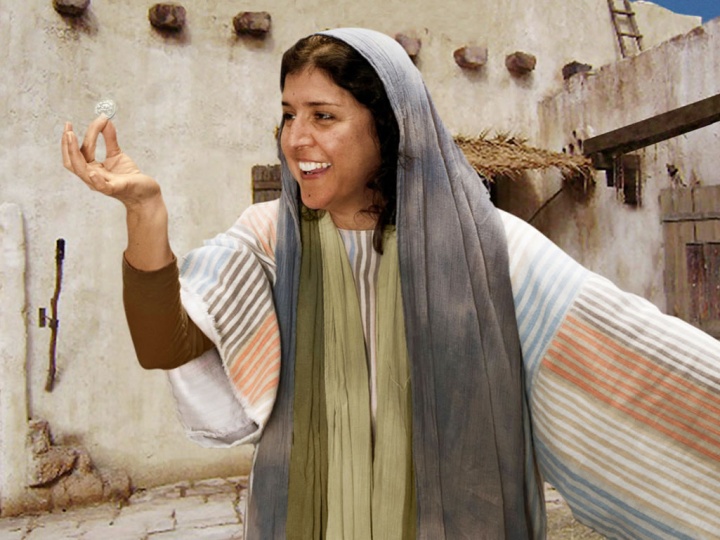
“Or what woman, if she has ten silver coins and loses one coin, does not light a lamp and sweep the house and search carefully until she finds it? When she has found it, she calls together her friends and neighbors, saying, ‘Rejoice with me, for I have found the coin which I had lost!’ In the same way, I tell you, there is joy in the presence of the angels of God over one sinner who repents.”
I don’t want to throw my brother, Dale, under the bus, but that dude loses everything. It’s almost a daily occurrence where he will ask me if I’ve seen his keys, or wallet, or shoes, or his car. There’s something about losing a valuable that unsettles us. We search and search and search for it. But when we finally find it, we’re thrilled.
The coin this woman was looking for was worth about one day’s wage. In today’s standards that’s about $3.25. Time and time again Luke stresses the value of one. Forget about the nine other coins, the one missing is what has value. If only we had this mentality with the lost souls around us. Imagine the impact we could have if we put this kind of energy into saving someone who is lost.
In Luke 15 Jesus tells us that you can be lost out of ignorance (the sheep), you can be lost out of carelessness (misplacing the coin), and finally you can be lost by choice (the prodigal son). Just because one was out of ignorance and one was out of carelessness, does not negate the fact that they are lost. A found soul causes joy in heaven!
I’ll be repeating the book of I John in present-day terminology. It’s not a true translation of the book, as I am not qualified to do so. It will be based on an exegetical study of the book and will lean heavily on the SBL and UBS Greek New Testaments, as well as comparisons with other translations (ESV, NASB, NIV, ERV, NLT). My goal is to reflect the text accurately, and to highlight the intent of the author using concepts and vocabulary in common use today.
This is not an “essentially literal” translation, and should be read as something of a commentary.
Love & Hate
Loved ones, I’m not giving you a new commandment here. It’s the same one that’s existed since the beginning of time: love each other deeply. You’ve heard this before. It is new in a way, though. The same truth that existed in Jesus now exists in you. Darkness is disappearing and the true light is already shining through.
If someone claims to be in this light but hates their Christian family, they’re actually in darkness. If you love your Christian family, you’re a part of this light. You don’t trip other people in their walk, either. Anyone who hates their spiritual family lives and walks in darkness. They’re lost because the darkness has blinded them.
A Song
Children, I’m writing to you because Jesus forgave your sins.
Fathers, I’m writing to you because you’ve known this from the beginning.
Teens, I’m writing to you because you’ve defeated the evil one.
Children, I’m writing to you because you’ve always know the father.
Fathers, I’m writing to you because you’ve known this from the beginning.
Teens, I’m writing to you because you’re strong. God’s word lives in you, and has defeated the evil one.
Over the next few blogs I want us to explore one of the Bible’s most powerful chapters, Luke 15. These parables spoken by Jesus transformed the lives of those who heard back then, and continue to do so today.
I was six years old and had no idea where my parents were. Every time we went to Walmart, mom would tell us to stay by her side. But I saw the coolest toy dinosaur I had ever seen. So I went to go look at it, and got lost. I ran up and down aisles but I couldn’t find her. So I started crying and just stood there. Eventually mom found me, and apparently they had been announcing over the loud speaker that my mom was up at the front, but I never heard.
It’s a terrible feeling to be lost. We’ve all experienced it before. There’s a very special chapter in the book of Luke. It’s called by many, “God’s Lost and Found Department.” Luke 15 contains three parables that convey God’s love for the lost. If we want to be a true child of God we must love what the Father loves. In this chapter we find three examples of the lost and God’s love for them. In this chapter, one of the things that stands out the most is God’s concern for sinners, but also His overflowing joy for their return. In this chapter we will understand better God’s love for mankind and the value of a soul. The true Christian will try to imitate this same love for the lost soul that is found here in this chapter.
I encourage you to read Luke 15 with God’s powerful love in mind. See you next week.
It hurts and it’s hard to become attached to anyone who isn’t living faithfully because they’re lost. That means they’re not going to heaven. Sometimes lost people pretend like that’s not their reality by distracting themselves with things that make them feel like they’re not lost (Ecc. 2.24-25).
There’s a good chance that you know people who aren’t going to heaven and many of you love people who aren’t and we’ve got to convince them to hear Jesus out.
What can we do?
We can simplify spiritual concepts so that people can understand a message that they desperately need to hear.
Please don’t let anything get in your way of going home. If you think something might be in your way, God can use us to help you. There are more things to fear than Covid, vaccines, tornados, elections, and riots.
Everybody responds to the invitation that Jesus extends. Many choose to say no— but nobody ever regrets saying yes.
To you, responding might be a personal resolve and commitment to christ.
“For those who live according to the flesh set their minds on the things of the flesh, but those who live according to the Spirit set their minds on the things of the Spirit.”
What if someone were to offer you a thousand dollars for every soul you would earnestly try to lead to Christ? Would you try harder to lead more souls to Him than you are endeavoring to do now? Is it possible that we would attempt to do for money what we sometimes hesitate or shrink from doing now in obedience to God’s command? Is money a stronger motivator than our love for God? What hinders us from thinking about other people? Many times we will make excuses and say, “that person won’t listen,” or “they’re too far gone.” We are called to plant the seed of the gospel, not examine the soil and determine if it’ll take the seed. We share the gospel message no matter what soil it lands on. It may be rocky, it may fall among thorns, it may land on the road and never take root, or it may land on good soil. We love the lost because it is a command (Phil. 2:3; Rom. 13:8-10), it imitates Christ’s example (1 Jn. 4:16,19), and it is our calling as Christians (Jn. 13:34-35, Eph. 4:32). So how can we show our love to the lost? What does it mean for us to love others? It means suffering with those who suffer. Hurting with those who are hurting. Helping those who need a hand. Picking up someone when they are down. Being a friend to the lonely. Writing a card to the grieving. Making a meal for those who are mourning. Bringing the good news of salvation to the lost. As God’s children, let’s show Who we belong to by loving the souls that are around us.
A little boy was riding his bike in the cemetery while his mother ran. Obviously this mother isn’t very bright because who in the world runs in a cemetery surrounded by dead bodies. Anyway, this boy rode his bike along the path and eventually could not find his mother. After looking and calling for her, he became frantic. His mother was also frantic at the far end of the cemetery. She picked up her pace and ran to retrace her steps. The further she ran the more frantic she became. Almost in tears she saw no sign of the little boy. She ran to the gate leading out of the cemetery. And that is where the little boy was. The boy was very young and I don’t know a lot about this story but what I do know is that I have a lifelong fear of cemeteries.
The Parable of the Lost Coin
We readabout a woman in Luke 15:8. It states, “Or what woman, having ten silver coins, if she loses one coin, does not light a lamp, sweep the house, and search carefully until she finds it?And when she has found it, she calls her friends and neighbors together, saying, ‘Rejoice with me, for I have found the piece which I lost!’ Likewise, I say to you, there is joy in the presence of the angels of God over one sinner who repents.” This woman in the parable of the lost coin lit a lamp. She uses the light to see. She knows the light is what she should follow to find the coin. She also swept the WHOLE house. She uses her physical energy to find the coin. She doesn’t wait for the coin to just reappear; she puts effort into looking for it, and she receives her reward by finding the coin. She spends time rejoicing with her neighbors.
If you lost a coin, would you search your whole house? Would you turn your house upside down just to find one coin? If I lost a coin I would not care one bit about that one coin that I lost. Matter of fact, I have lost a bunch of coins and I have never swept the house just to find them.
It may be that you haven’t searched for God so you can have a home in heaven in the end, and maybe it is that you want to fix that issue. Or maybe you need to get your life on track. Whatever your need may be, do not remain lost!
I was connecting in Dallas for my flight back to Denver and had just come down the escalator from the SkyLink. Around the corner from me, I heard an agonizing cry. At first, I didn’t recognize it for what it was. Then, I heard it again. And again. It was chilling. Walking just a few steps, I saw the source. A very large man was laying face down in the middle of the concourse. He was immobile. Several people were gathering around him, but no one seemed to know what to do. Most had no idea what had happened to him. I feared it was a heart attack and wondered if this was going to be a fatal event. EMTs soon arrived with a gurney to administer aid to this traveler. While I have no idea how this will turn out, what struck me was the looks on everyone’s faces. He was trying to maintain his dignity, but people everywhere around this scene were visibly distraught and felt for this man. They looked fearful or at least concerned. Things like this do not happen every day, to say the least.
Seeing this unforgettable scene made me appreciate the sober picture God has painted for us in His Word about those who are separated from Him. Galatians 5:4 terms it “fallen from grace.” Hebrews 6:6 speaks of some who have “fallen away.” Revelation 2:5 reveals that the Ephesus church had “fallen.” Jesus speaks of some who “fall away” (Luke 8:13). Romans 11:11 speaks of one stumbling so as to fall. The rich can fall (1 Tim. 6:9), but so can any child of God (Heb. 4:11; 2 Pet. 3:17). Repeatedly, this imagery is used of those who enter spiritual peril. It’s a dangerous position!
How often do I look at the people I encounter every day, who may seem physically fit and strong, but whose sins are not covered by Christ’s blood? Do I realize how dire their situation is? Too often, I’m afraid I don’t. As I looked at this poor, fallen man in Dallas, I thought about his soul. But in those moments, I did not think as soberly about the souls of the concerned onlookers. Statistically speaking (cf. Mat. 7:13-14), nearly all of them had to be traveling the broad rather than the narrow way. Would you help me to see the souls of men in this way, to feel a concern and sense of urgency for them? I know the Great Physician and know that He can help every case! May God grant us the courage to step through the open doors that may spell the eternal difference between life and death!
When we think of the parable in Luke 15, we inevitably think of the younger son who left home for the far country of sin. We appreciate God giving us the prodigal (reckless; wastefully extravagant) son in this parable to illustrate hope, love, and forgiveness, no matter what we may have done. Then we think of our favorite character in this story, the father. He represents God and reveals God’s eagerness to embrace and restore a sinner who repents. He gives the undeserved, unexpected, and unanticipated (cf. Eph. 2:4-8).
Then, there’s that other main character in the story. How does he strike you? After all, his brother has been reckless and irresponsible and his dad lets him off scot-free and even throws him a party. He robbed his father blind, and he isn’t even punished one bit. How do you see the brother who stayed home? Let at the text more closely and see how God sees him.
He was guilty of self-righteousness. He complains to the father about the reception his brother received (29). With self-righteousness, there’s an exaggerated view of our own goodness. There’s an exaggerated view of the other guy’s badness. There’s a comparison where we come out on top of the other guy. There are often judgmental assumptions made about the other guy. Let’s not forget that Jesus condemns self-righteousness (cf. Luke 18:10-14). If the Father walked up on some of our condescending conversations, He would spoil our fun since the spirit of self-righteousness is so far removed from the spirit of a loving Father who longs for His wayward children to come home.
He lacked self-control (28). He appears quick-tempered, not waiting for an explanation. We have the conversation between the younger son and the father, and the older son and the father. Where is the conversation between the two brothers. Didn’t he claim to be the good, righteous one? There was no self-control in the way he talked to his father or about his brother. “If anyone thinks himself to be religious, and yet does not bridle his tongue but deceives his own heart, this man’s religion is vain” (Js. 1:26).
He was selfish. Why did he wring his hands about the younger brother’s wasteful spending? The father, who knew this son, answered, “All that I have is yours.” There is no evidence that the older brother was concerned about his formerly depraved brother or his once-grieving father. He seems more interested in how these things impacted him. He appears faithful to his father, but for the wrong purpose. What difference would it have made if the older brother saw the prodigal as someone to serve rather than slam?
He had an unforgiving spirit. His brother has sinned against him, but he was unwilling to forgive him. One of the servants called him “your brother” (27), the father calls him “this brother of yours” (32), but the only time he directly refers to him he calls him “this son of yours” (30). Behind these parables, the Pharisees and scribes grumble at Jesus receiving sinners. In the first two parables, people sought the lost. In this last parable, the older brother made no effort to go after his brother. God implies as early as Cain and Abel that we are our brother’s keeper (cf. Gal. 6:2; Js. 5:19-20). Not only did he not search for his brother, but now he won’t forgive him.
He was jealous. He thought the father was better to his erring brother (29-30). You can almost hear him saying, “You love him more than you love me.” He couldn’t stand to see his brother honored. How contrary to the way God wants His children treating each other (Rom. 12:10; Eph. 4:31-32). The older brother was making accusations and he hadn’t even spoken to him. He thinks the worst of him and is utterly lacking in brotherly affection.
He was not humble, but rebellious against his father’s will. He wanted to tell the father how to run his house. Do you notice the younger son respectfully addressing his father (21)? There’s little if any respect from the older son (29-30). The Bible condemns self-will. Peter condemned those despising authority and the self-willed (2 Pe. 2:10). Some people are loyal to the church as long as they can have their own way.
Some of us may find ourselves in the position of the prodigal. None of us will ever be in the position of the father. May we never find ourselves in the position of the boy who stayed home. If we do, we may lose our place in the father’s house!
While visiting Ray and Lupida Lewis yesterday, I got to hear the story behind her current situation. This upbeat, sweet-spirited Christian woman was minutes from undergoing the first of at least three extensive back and neck surgeries necessitated by injuries suffered as she was walking and was struck by a driver going 35 miles per hour.
Lupida has had a degenerative eye condition since childhood. It had gotten to the point that she could barely see more than shapes, but, given her educational background, she had been recruited to serve as a teacher in the Colorado School for the Blind. By last year, despite corrective eye surgery, Lupida could only see light and nothing more. That fateful September day last year, she was struck in the crosswalk by the inattentive driver and suffered brain, neck and back injuries. Some of that may be remedied, and other issues will never be resolved. One that appears permanent is that her head injuries caused her to wake up without even the ability to see light. She says, “I see only darkness now. The light has gone away.” She observed that one cannot really imagine the huge difference between being able to see light and being in total darkness.
We did not discuss it together, but I believe Lupida would agree with me that, as tragic as her circumstances are, there is a blindness worse than her own. Lupida lives with a faith and hope which assures her that her situation is, at worst, temporary. The song says, “Faith will be lost in heavenly sight.” She embraces that promise.
Today, you will constantly encounter people who may have the eyesight of an eagle when they submit to a physical test but who suffer a far greater blindness. Scripture often makes reference to wickedness as “walking in darkness” (Ps. 82:5; Prov. 2:13; Ecc. 2:14; Isa. 9:2; John 12:35; Eph. 5:8; 1 Jn. 1:6; 2:11). Tragically, it’s not the result of an accident–though it could be ignorance. Millions reject the light and pursue the darkness. They have every opportunity to see, but they don’t want to see. Ultimately, their voluntary journey through darkness leads to the outer darkness of condemnation (Mat. 8:12; 22:13; 25:30). Fortunately, their condition is reversible thanks to the Great Physician, but time is growing shorter by the moment. Ask God to lead you to those who are spiritually blind, and may we all endeavor to avoid such a condition ourselves (cf. Mat. 15:14; Rev. 3:17)!
You may have heard that I was caught in a rip tide during Carl’s senior trip. We were at St. Pete’s Beach in the Tampa-area, swimming and playing in the water not far from a fishing pier. Somehow, I was pulled into a riptide and quickly pulled out toward the Gulf. The shore quickly grew distant and my subpar swimming abilities were tellingly useless. A couple of fishermen told me I was caught in it and my best hope was to try and move parallel to the waves and angle for a point about a half-mile up from where I was. That was a painfully slow process, and the water kept taking me where it wished. I was on the other side of the pier, moving generally toward that point but still in the grips of the tide, when Dale swam out and helped pull me out of the current until I could finally get to shallower water and make my way back onto the beach. At the risk of sounding melodramatic, I believe Dale saved my life.
Only after this did I learn that, according to the CDC, there was an annual average of 3,536 fatal, unintentional drownings in the United States from 2005 to 2014. That’s about ten deaths per day. Nearly 80% of all people who die from drowning are male. A lack of swimming ability is the greatest risk factor in drowning, and 57% of all people, age 15 and over, who drown do so in “natural water settings” (like the ocean)(cdc.gov). I also was reminded, from the Pandora playlist Dale piped through our van’s sound system, that he has an interesting sense of humor—playing “Under the Sea,” “The Ocean,” “High Tide, Low Tide,” “In Too Deep,” “Riptide,” “Drowing,” and “How To Save A Life” (plus a bunch more).
But I also have a different perspective toward some of the songs in our songbook:
“Soul you are drifting along on the tide, out on life’s ocean so boundless and wide…”
“Some poor fainting, struggle seaman, you may rescue, you may save…”
“Throw out the lifeline, someone is drifting away…”
“While on the sea hear the terrible roaring…”
As I look back, the currents were strong but the force was subtle. It did not take long for me to be moved away from the shore and taken away. Making the right efforts played a part in my staying afloat. Ultimately, however, I needed outside help to come back to shore.
The writer of Hebrews says, “For this reason we must pay much closer attention to what we have heard, so that we do not drift away from it” (2:1). A.T. Robertson says of the word “drift”: “Here the metaphor is that ‘of being swept along past the sure anchorage which is within reach’ (Westcott), a vivid picture of peril for all” (342). BDAG says it is an imagery of flowing water and means “be washed away” or “drift away” (770). The Greek Old Testament uses the word in Proverbs 3:21, where Solomon urges his son to not let wisdom “vanish from [his] sight.” The epistle’s nautical metaphor pictures vividly what can happen in our spiritual lives. We can lose sight of where we are, and we may begin to struggle and start to succumb to the pull of the current. We must continue to make the effort to pull away and we should accept the attempts of those who seek to rescue us.
Spiritually, none of us want to become a casualty. We do not want to perish. May we realize that falling away from God is not usually sudden or dramatic. It is often subtle and gradual. Let’s pay much closer attention to what we have heard! It’s our lifeline.
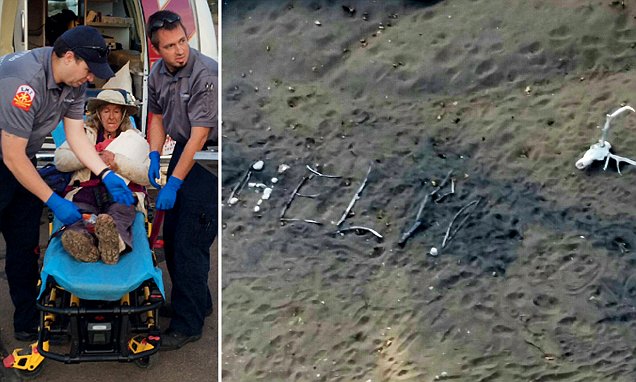
In an interview given at her home, Ann Rodgers appears a bit eccentric but a wonder to behold. The 72-year-old woman survived 9 days in an Arizona desert by eating plants and drinking pond water. She was driving to Phoenix via a remote stretch of back country road on the White River Indian Reservation when she got lost and subsequently ran out of gas. Thus began a series of efforts, building signal fires to draw the attention of rescuers or the forest service. She got lost while climbing a series of ridges trying to get cell signal. She and her dog faced gloomy odds, but she kept trying. She went missing on March 31st. On April 3rd, she used sticks and rocks to spell out “help.” To further draw attention to it, she found an antelope skull nearby and placed it with her message (via nbcnews.com). Since moving out west, I have learned that people frequently get lost in the vast stretches of deserts and mountains. I cannot find statistics for how many people get lost or how many are found alive or dead in the United States, but each incident is obviously traumatic for those involved. Can’t you imagine how desperately and completely those who realize their lostness long to be saved?
Wherever you go today, the vast majority of the people you encounter are going to be wandering through this world lost in the most profound way. Without rescue, they are heading for a fate infinitely worse than physical death. “Lost” is the way Jesus, the Good Shepherd, describes those not right with God. While He uses the word that way in three of the four gospels (Mat. 10:6; 18:11; Luke 19:10; John 18:9), it is the parables of Luke 15 that most vividly speak in these terms. The first parable, that of the lost sheep, draws on the search and rescue metaphor (Luke 15:4). That’s how Jesus likens the situation with one outside of God’s redemption.
Be watching for signs from the lost. They often send signals, if we are looking in the right places. Whether personal problems, major life changes (like marriage or having children), those new to the area, or those demonstrating an open mind, they may be just like the Ethiopian Eunuch and hoping for someone to guide them (Acts 8:30-31). Jesus has us here to conduct search and rescue missions. May we have our eyes peeled and keep ourselves equipped to rescue the lost. They are out there everywhere.
The lost are convicted, too. Don’t let anybody say they’re not. Some of the strongest-held beliefs, some of the most fully-persuaded minds, and some of the most determined hearts are attached to lost individuals. Even in the Bible, one finds the deepest rooted convictions in the heart of the lost sinner. If one wants to find a people wholly dedicated, he should take a trip into Noah’s world (see Gen. 6:5). If one wants to find a people completely set in a given pursuit, he should visit with King Solomon about the sons of men (Ecc. 8:11).
We should abhor rather than admire the lifestyle of the lost. This statement, if it has ever been true, applies to the people who spread themselves around Pilate’s judgment seat. Grounded in their hatred and jealousy of Jesus, the chief priests, the elders, and the persuaded multitude had as their singular focus the destruction of Jesus. They wanted Him gone, and any way they could do it they were willing to try. The rulers of the people had tried to ridicule, embarrass, trap, frustrate, tempt and discourage Him, but they had failed. One would think that, after three years of trying, they would have given up on their task. But, they were convicted.
The mob who finally “got rid of Jesus” (actually, they fulfilled God’s eternal plan for their and our salvation, and they did not foresee the resurrection) was a crowd we could learn a few lessons.
THEY WERE UNITED (Mat. 27:22). Pilate asked them what he should do with Jesus. All of them said, “Let Him be crucified.” No dissension is recorded by Matthew. Together, they forced a governor to submit to their wishes. How unfortunately that they were united to do evil.
When the righteous are united under the proper standard (Eph. 4:13), “how good and how pleasant it is…” (Psa. 133:1). Think of the untold good Christ’s disciples can do under the banner of brotherly love (Heb. 13:1), outdone only by our love, devotion and obedience to the Lord (Heb. 5:9).
THEY WERE DECISIVE (Mat. 27:21,22). There were no long committee meetings. There were no endless business meetings. They did not vacillate in this moment of decision. Pilate knew who they wanted crucified and who they wanted released. Though iniquitous, their decision was most expedient for their stated goal.
The Lord’s church in most places does an adequate job of planning its local work. Alas, in some cases, their best laid plans get lost somewhere between the forming and fulfilling. No congregation wants to rashly enter any endeavor–whether it be picking up support of an extra missionary or the execution of a needed program or plan. Yet, at times, the church can be overcautious and ponderous in discharging their responsibilities. Surely God was thrilled at the decisive way the disciples in the early church mobilized, spread the gospel, and reached the lost. The book of Acts is the model of decisiveness for today’s church.
THEY ACCEPTED RESPONSIBILITY (Mat. 27:25). Pilate wanted to know who was going to take moral responsibility for killing the just Jesus (24). Seemingly without hesitation, “All the people…said, His blood be on us, and on our children.” They collectively pointed the finger of guilt at themselves. Later, when Peter’s Pentecost preaching pricked their hearts, in a different way they took responsibility for this heinous acts (Acts 2:36-37).
Every person must take responsibility for his actions. Everyone must reap what he, individually, has sown (Gal. 6:7-8). In the congregational setting, the eldership must accept responsibility for what goes on among its members. When congregations individually begin to accept responsibility for themselves, theretofore avoided subjects will again be addressed courageously and frequently by the pulpit, eldership, and classroom.
We do not admire those responsible for slaying the sinless Savior. They were callous-hearted wretches darkened by the night of sin. However, they teach us the power of a united people ready and eager to stand accountable for what they decided to do. Churches will grow who follow God’s blueprint for His kingdom with enthusiasm and conviction. Let us maintain our convictions in “well doing” (Gal. 6:9).
A visitor comes to worship services for the first time. This person is searching for meaning, purpose, and answers, perplexed and troubled by life and wanting to know the way. The services have already started, and the visitor slips into the first vacant seat available. This one is intrigued and engaged by what has gone on, benefiting from the preaching, appreciating the singing, and eventually standing with everyone else for a final, uplifting prayer. The visitor has experienced enough to consider returning. The prayer concludes, and the visitor, with everyone else, begins to head for the aisle.
So much, good or bad, can happen in these next 60 seconds.
The visitor, not knowing a soul, either stands or slowly walks out of the auditorium, hoping for a friendly face, a smile, or words of kindness and encouragement.
The family seated next to the visitor have wrestled their baby throughout services. Exhausted and flustered, they hurry past the visitor never making eye contact.
Several members, each on an important “mission,” walk past the visitor to talk to that person or do that thing that, if they don’t hurry, they’ll forget or miss.
The visitor does make it to the preacher, shaking his hand and thanking him “for the service.” While standing with the preacher, the visitor notices a handful of those who are apparently members warmly greeting the preacher but feeling the full force of being treated as if invisible by them. These folks are good folks, but they just aren’t observant (or accustomed to being “on the lookout” for visitors).
Moving past the preacher, the visitor encounters the eye contact of a few people who politely smile or even say hello. These good people wonder if this is a member, someone they should know, and, afraid to offend this one, do not follow up with conversation.
The visitor walks past a shy member, one who would like to greet the visitor but who is afraid of being embarrassed in some way.
As the visitor departs, ignored by and large and concluding that while the services were unique and intriguing the people were cold and unfriendly, God looks down from heaven. He has seen that last minute unfold. He knows the tagline under this church’s bulletin masthead asserts that this is the friendliest church in town. He watches members who know one another and are comfortable with each other laughing and talking together, wanting to be together, but are oblivious to the precious opportunity embodied in that visitor. God sees that visitor as a soul precious enough to give His Son for, an impressionable person reached or rejected by the reception (or lack thereof) made by His people. He knows this visiting one has heard truth and experienced worship in spirit and truth, but that this one also believes that the participants are exclusive and disinterested.
The devil has to be delighted that this visitor leaves dejected and resentful, determined not to visit that unfriendly congregation again.
Though I would like to say that the scenario above is far-fetched and purely fictional, it is one I have seen play out repeatedly over a quarter-century as a preacher. Our efforts (or lack thereof) to engage and show interest in those who visit our assemblies is our only opportunity to make the first impression redeemed, soul-conscious Christians should make. We must never assume that it’s others’ job to or that others are doing the job of making our visitors feel appreciated and welcomed. What if every Christian present would take every opportunity presented to make every visitor feel as though they’ve “come home” when they come to our services? Will you consider what you do with your first minute after the last “amen”? Who knows the eternal difference it will make, especially with some soul searching for the Savior?
“Two little lines I heard one day,
Traveling along life’s busy way;
Bringing conviction to my heart,
And from my mind would not depart;
Only one life, ’twill soon be past,
Only what’s done for Christ will last.”
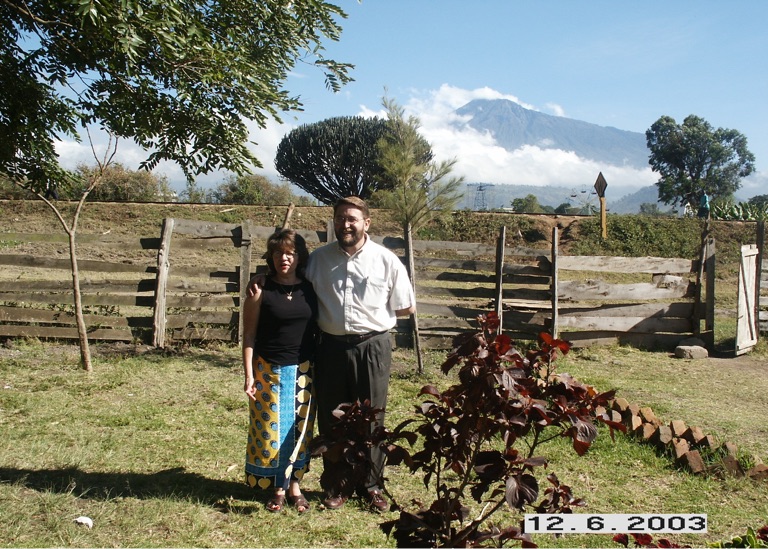
The first stanza of the powerful, convicting poem by C.T. Studd has been the seeming anthem of one of God’s great, 21st Century spiritual warriors, Cy Stafford. I first met Cy around 2000, and his balanced, measured information and guidance helped us identify and deal with a false teacher in East Africa. His interest and concern were for the Christians, new and more seasoned, who might be impacted by this man’s influence. That godly zeal for God’s people was an indicator of the mind of a missionary, minister, and mentor of men. The subsequent years have shown me what a true leader and visionary, with God’s help and to God’s glory, can accomplish. Cy is not larger than life, gregarious, charming per se, or glossy in any way. He is steady, focused, and determined. He has helped change the world by equipping men and women to reach the world. Alongside so many missionaries and Christians indigenous to East Africa, Cy has steadily worked to grow the church and its influence where some of the earth’s poorest and humblest people live. He often has spoken of the window of opportunity that daily shrinks and he has worked with an urgency to do what he can to make sure everyone has the opportunity to hear the gospel at least once.
Cy and Stephanie have made countless sacrifices of time, comfort, safety, and security because their mission was far broader than themselves. While some in ministry appear motivated by self-interest, self-promotion, and self-absorption, the Staffords have valiantly sought to put the spotlight foremost on Christ and then upon others’ needs. On whatever day each exchanges the cross for the starry crown, their legacy will have been that of living beyond themselves. What a convicting challenge to each of us to engage in thoughtful self-examination! What is my agenda? What is my aim? What is my aspiration?
“Give me Father, a purpose deep,
In joy or sorrow Thy word to keep;
Faithful and true what e’er the strife,
Pleasing Thee in my daily life;
Only one life, ’twill soon be past,
Only what’s done for Christ will last.”
Hebrews 11 speaks of great Old Testament heroes of faith who lived and died as those with a “desire” for “a better country, that is, a heavenly one…” (16). These same ones are called “strangers and exiles on the earth” (13), whose sight was set much higher than self. The whole of the New Testament reveals that a heart set on heaven will reside in one who also has his eyes on others (cf. Phil. 2:3-4). All too rarely do we receive such vivid examples of individuals who have so fully committed themselves to the Great Commission, who challenge us to imitate them in living beyond self. Cy is one of the best examples of this I will ever know.
“Only one life, yes only one,
Now let me say,”Thy will be done”;
And when at last I’ll hear the call,
I know I’ll say “twas worth it all”;
Only one life,’twill soon be past,
Only what’s done for Christ will last. “
God, give us more Christians like Cy Stafford! Let that begin with me.
The hope of finding survivors on the cargo ship El Faro has severely dwindled, as one of two lifeboats, severely damaged, has been discovered as well as one body. While the other lifeboat from the ship, with a capacity for 43 persons, has not been found in the ocean waters off the Bahamas, the 735 foot long ship sent a distress signal Thursday from near the eye of Hurricane Joaquin as it battled 20-30 foot waves. The Coast Guard is hopeful, but the realistic expectation is that this will soon be a recovery rather than rescue mission (info from cbsnews.com and reuters.com). Out of all the frightening ways to face death, being lost at sea has to be near the top. There’s the foreboding strength of battering waves, the immense, liquid darkness of the deep, the mystery of what lies beneath the surface, the horrific experience of drowning, and the overall helplessness in the face of a fierce overwhelming force. Since maritime history goes back for millennia, people both ancient and modern have faced the terrors of shipwreck. Dating at least as far back as the ship found off Dokos, Greece, dating back to 2700-2200 B.C. carrying a cargo of pottery (read more at http://www.mhargolid.nl/data/webb1992.pdf), mankind has experienced the sinking of ships.
No wonder New Testament writers seize on this common situation of life. Luke records (Acts 27:14) and Paul looks back on (2 Cor. 11:25) literal shipwrecks the apostle survived. How fitting that he is the one who describes those who lose their faith as those who have “suffered shipwreck” (1 Tim. 1:19). Preventing shipwreck, according to Paul, necessitates.
A fighting (1:18). Just as crew members must strain at their tasks on deck, despite weathering difficult winds and choppy seas, we cannot be passive and yielding in spiritual storms. Paul warns Ephesus against being “tossed here and there by waves and carried about by every wind of doctrine, by the trickery of men, by craftiness in deceitful scheming” (4:14). Faith is vital to equipping one for the spiritual fight.
A keeping (1:19). You can imagine someone clinging to ropes and rails or staying at the helm or rudder as they weather the storms of life. But the lifelines to which we must cling in such torrents is faith and a good conscience (see 1:5). Our spiritual constitution and fortitude spell the difference between survival and lostness.
A teaching (1:18-20). Training often spells the difference in surviving out at sea. Certainly, keeping a cool head and being able to use, when needed, that which has been previously learned is vital! Paul says as much regarding the survival of spiritual shipwreck. He mentions an entrusted command (1:18), prophesies (1:18), and being taught (1:20). The best teaching may not help the literal sailor in storm-tossed seas, but heavenly teaching is guaranteed to rescue those so equipped even in the face of the most seemingly insurmountable difficulties of life.
We had the feeling of finality of those lost at sea. Thankfully, as long as one lives, he or she can be recovered from spiritual shipwreck. But, they must come back from such depths and take hold of God’s life preserver, His Son Jesus Christ! Let us do our part to rescue the perishing, snatching them with pity from sin and the grave (2 Pet. 3:9).
We are now several days into an unspeakable tragedy that is equally mysterious. Despite sophisticated tracking methods and multi-national radar, a Malaysia Airlines jet disappeared without warning or a trace on Saturday, March 8, 2014. The disappearance of Flight 370 is an enigma because “there are only a handful of scenarios that could explain how a usually reliable wide-body jet could seemingly vanish from a clear sky with no distress call and no obvious debris field” (Tracy Connor, NBC News online). At this point, all experts have are theories—mechanical malfunction, bomb or explosion, hijacking, pilot error or sabotage (ibid.). None of the theories is entirely satisfactory, however, and friends and family from 14 nations find no consolation or closure from this heretofore unsolved mystery.
Though it fails to make the news or be as dramatic, there are mysterious disappearances continuously occurring. It is usually possible to physically find the missing, but it can be just as hard to understand exactly why they came to be “missing” all the same. There are multiple causes, but that does little to bring consolation or satisfaction. I am referring to Christians who fall away from faithfulness.
Some fall away because of structural problems, a failure on the part of the congregation or some negative influence within it (cf. Mat. 18:6). Bad example, being a stumbling block, and thoughtless speech are ways we can contribute to a Christian falling. Some fall away because of something that “explodes” or “blows up” in their lives—financially, relationally, emotionally, or the like (Luke 8:13). Some fall away because their faith is hijacked, maybe by a false teacher or even a well-meaning family member who is bothered by their “changing religions” (cf. Gal. 1:6-9; 3:1). Some simply fall away because of “pilot error”—their own failure to successfully navigate the difficulties of living the Christian life (Luke 8:14; Heb. 6:4-6). No matter how it happens, it should be a source of sadness and concern to those of us still striving to walk in the light. More than that, we must become part of the search and rescue team. Galatians 6:1-2 and James 5:19-20 are just two of the passages that should convict and challenge us in this work. Not even the loss of a single person should be considered acceptable loss. Not with so much at stake and not given the high price Jesus paid for each and every soul!


















 The Preacher Pollard Blog