What’s The Point?

Neal Pollard

Years ago, Wes Autrey sent me a copy of the “Idiot Report.” To this day, I still wonder why he thought of me as he read something with that title. I found all the entries hilarious, but one attributed to a Wichita probation officer was particularly funny. This august report said, “the stoplight on the corner buzzes when it’s safe to cross the street. I was crossing with one of my coworkers, who asked if I knew what the buzzer was for. I explained that it signals blind people when the light is red. Appalled, she responded, “What on earth are blind people doing driving?” Hopefully, you get where she missed the purpose of the corner buzzer. If not…

How many miss the point of Christianity? The decision to become a Christian is the best and most important decision this side of time. Living the Christian life is the best life to live. Worshipping the living God is a privilege that is awe-inspiring and of unsurpassed joy. Prayer is a lifeline without which none of us should feel equipped. Bible study with an eye toward applying its truths is vital to growing stronger and closer to God.

To go through life as a Christian filled with fear, sadness, anxiety, envy, anger, apathy or resentment really misses the point of what it means to be in Christ. That does not mean that we will automatically be immune from any of these feelings and attitudes. In fact, all of us will be confronted by them throughout life. But, if we spend a lifetime given in to these things, we have missed the point! Being in Christ means having the only true access to courage, happiness, trust, satisfaction, peace, zeal and acceptance that there is. We could go so many places in the New Testament which affirm this, but just look at Ephesians one. In Christ are the faithful saints (1:1), every spiritual blessing (1:3), election (1:4), grace (1:6), redemption (1:7), all-sufficiency (1:10), hope (1:12), the seal of the Holy Spirit (1:13), and strength (1:19-20). We have a forgotten past, a purposeful present, and a hopeful future in Christ!

The world’s values and thinking are backward (cf. Isa. 5:20). Do not fall prey to their convoluted way of thinking. We are Christians! We know why we are here and where we are going! That’s the point!


crosswalk-button-1

Evangelism Effectively Executed (POEM)

Neal Pollard

We need to know the Bible, to study and apply,
And teach and share with others, their faith to solidify.
But often, before they’ll listen to a consonant or vowel,
They need to see us on our knees, with our basin and our towel.

For fine speech can lose its luster, and argument its shine
When its power in our own lives, is unseen and unapplied.
“I’d rather see a sermon than hear one any day,”
Is the common man’s mantra, as he’s searching for the way.

And a teacher whose compassion and listening ear is offered,
Will open up a heart before one single verse is proffered.
For the adage, often spouted, is a proverb we need to share,
People do not care how much you know til they know how much you care

The way to reach an eternal soul involves more than the mind,
And every servant of Jesus knows it takes service pure and kind.
Loving care that costs us in terms of money, effort, and time,
Will soften hearts made hard by worldly greed and grist and grime.

Dear Christian as you pray to God, “Lead me to some soul today,”
Keep your eyes peeled for a struggling, straggling soul astray,
Then be a neighbor, show him mercy, you just might be surprised,
When he listens to the truth of God you have actively exercised. 

towel-and-basin

Make It A Momentous Monday

Neal Pollard

  • Pick out a local church leader and pray for him and his family for several minutes, being very specific in your petitions on their behalf.
  • Email a missionary to encourage them and get an update on how their work is going.
  • Buy a gift card and try to give it anonymously to a young or struggling family you know.
  • Thoughtfully select several people to compliment and encourage by writing on their Facebook wall or other social media platform.
  • Briefly visit a brother or sister in an assisted living facility or nursing home.
  • Ask a co-worker, classmate, or neighbor what you can be praying for them about.
  • Listen to a book of the Bible in its entirety on your commute.
  • Let go of a grudge or deep-seated resentment.
  • Do an unexpected deed of kindness for a random stranger.
  • Speak to someone you see regularly about your faith–what God is doing in your life, what’s going on at church, etc.
  • Spend some one-on-one time with one of your children (playing a game they enjoy, going for a walk, taking them out to eat, etc.).
  • Show love to your mate in some tangible way you know he/she enjoys (speak their “love language”).
  • Practice pleasantness with everyone you meet today, being mindful of your facial expressions and body language.
  • Carve out some time for meaningful, personal devotion (including Bible reading, singing, and prayer)–make worship more than a Sunday matter!

None of these are overly time-consuming. Pick as many as you can. If you cannot get to them all today, then pick up where you left off tomorrow. Grow your list. Use your imagination and creativity. Find yourself looking and acting more like Jesus!  See yourself in Matthew 5:13-16.

candle-335965_960_720

Every Day Is “New” With God

Neal Pollard

  • We sing a new song (Ps. 40:3; Isa. 42:10; Rev. 5:9).
  • We gain new strength (Isa. 40:31).
  • We have a new name (Isa. 62:2; Rev. 2:17).
  • We have a new covenant (Jer. 31:31; Heb. 8-9). 
  • We have God’s compassions which are new every morning (Lam. 3:23). 
  • We have a new heart and a new spirit (Ezek. 36:26).
  • We observe a new commandment with each other (John 13:34).
  • We walk a new life (Rom. 6:4). 
  • We are new creatures (2 Cor. 5:17). 
  • We are part of that new man, united with all children of God (Eph. 2:15).
  • We have put on the new self (Eph. 4:24; Col. 3:10). 
  • We have been given a new and living way (Heb. 10:20).
  • We are looking for new heavens and a new earth (2 Pet. 3:13).
  • We anticipate the day when Christ makes all things new (Rev. 21:5).

Even though these promises were made thousands of years ago,  they are as fresh and bright today as they have ever been. Some help us overcome the guilt of our past. Others give us strength for the present. All of them give us hope for the future. We don’t need “new truth,” but so many of the truths of Scripture deserve our renewed dedication and attention. As a New Year descends, try and put your arms around all the daily renewal our great God makes available to us on January 1st and every other day of the year! 

” Therefore we do not lose heart, but though our outer man is decaying, yet our inner man is being renewed day by day” (2 Cor. 4:16). 

800px-22Wishing_You_a_Happy_New_Year.22

Out-Cheered At Home

Neal Pollard

It’s hard to beat the weather and the views at the average Rockies baseball game. This past Tuesday, 29 Bear Valley guys converged on the upper deck overlooking first base as the “good guys” took on those world-champion Houston Astros. For the unfamiliar (or disinterested), the Astros are the defending Worlds Series champions. They’re very good this year. But, so are the Rockies. Whenever Colorado can sniff first place when August is in view makes it a “great” season, by their standards (spoken by a long-suffering fan). We came into that game having won 12 out of 16 games in July. Several of us got there early–for a game which would start an hour late due to bad weather–and the thing that struck us was how many orange shirts and jerseys there were. Again, for the uninitiated, those are Astro rather than Rocky colors. But, it wasn’t their apparel that stuck out. It was their boisterous, relentless cheering. As much as I like Colorado baseball, I get frustrated with how quiet the average fan in the stand is (perhaps they are lulled into a tranquil state by those rich sunsets and cool breezes. Opposing teams’ fans seem less affected. We were louder than usual, but they were louder than us.

“Home field advantage.” It’s supposed to mean something, but Tuesday night was a reminder that it can be taken away. These were committed fans. We saw Texas license plates in parking lots. No doubt, some arranged their travel to attend a game while visiting our fair state. Or, they’re locals whose allegiance is strong enough to brave the prospects of tens of thousands of people who oppose their point of view. They weren’t embarrassed or ashamed to proclaim their loyalty. They were eager.

We often sing, “This world is not my home.” Truly, Peter calls the Christian an alien and stranger (1 Pet. 2:11). Our citizenship is in heaven (Phil. 3:20). The Devil has control of this world and its domains (Eph. 2:2; 6:12; John 12:31; 1 Cor. 15:24; etc.), though Jesus will win in the end and He causes us to triumph now (2 Cor. 2:14; 1 John 4:4). 

We enter the daunting arena of the world clothed with Christ. He wants us to stand out and to be heard. No, not obnoxious, but He expects us to infiltrate it with His influence (Mat. 5:13-16). We won’t sway the crowd or determine the outcome, but we will make a difference if we show up, stand up, and speak up. The world will be aware of our presence, even if it disapproves. That’s not really the point is it–to have their approval? The point is to show our unswerving loyalty. We know that we are on the winning side! With humility but also boldness, we should make that known!

37756309_10155703074395922_7614667387320664064_n

Cure Them With Kindness!

Neal Pollard

A comedienne draws attention for being mean-spirited and cutting when roasting a White House press secretary recently. While cringe-worthy, it’s hardly an isolated incident. Nor is it confined to Washington politics, being seen across the spectrum of society. Civility has taken a beating in the current culture. Social media may be a breeding ground for insults, attacks, hostility, and animosity, but it’s hardly confined to just that forum.

Make no mistake, a lack of kindness is a hallmark of worldliness and unrighteousness. It is the antithesis of a quality God demands of the Christian. Ephesians 4:32 commands, “Be kind to one another….” The original word translated “kind” here is found seven times in the New Testament, and it is a divine quality. In fact, in six of the seven references, God demonstrates it. In Ephesians 4:32, it is to be exhibited by us in view of God’s having shown it to us through Christ. It means “pertaining to that which is pleasant or easy, with the implication of suitability” (Louw 246). It causes no discomfort, meets a high standard of value, is morally good and benevolent, and is beneficent (BDAG 1090). In common usage in New Testament times, the word, when referring to people, was synonymous with being decent, of good disposition, gentle, good-hearted, and morally upright (Kittel 1320). In other words, people in society could and did recognize its presence in people. Its absence is also, sadly, noteworthy. 

The old adage “kill them with kindness” might imply utilizing kindness to get an advantage or revenge on someone unkind, making us look good and them look bad. God calls for something more out of those of us striving to hold up the Light to a dark world. The world is sin-sick, and rude, coarse, hateful attitudes, words and actions are but a symptom of this. We have the medicine the world needs, even if it fails to see its need. Some will be drawn to it when they see it in us. 

Paul counsels Rome with inspired advice that will help us cure the rude, ugly, spiteful, and vicious behavior we often encounter. He says, “Never pay back evil for evil to anyone. Respect what is right in the sight of all men. If possible, so far as it depends on you, be at peace with all men. Never take your own revenge, beloved, but leave room for the wrath of God, for it is written, ‘Vengeance is Mine, I will repay,’ says the Lord. ‘But if your enemy is hungry, feed him, and if he is thirsty, give him a drink; for in so doing you will heap burning coals on his head.’ Do not be overcome by evil, but overcome evil with good” (Rom. 12:17-21). Look closely at what he says. Avoid the payback mentality. Go to great lengths to preserve peace. Leave revenge to God. Don’t stoop to the world’s level. 

This imitation of God with revolutionize the places where we practice this. The moral malignancy plaguing our world cries out for medicine, and we as Christians know where to access it. Let’s discipline ourselves to use it, even in the face of those spreading the spiritual sickness of spite. 

8717079909_141f57a7de

Paul’s Portrait Of God For Timothy

Neal Pollard

Devoting himself to a theme of godliness in writing his spiritual son, Timothy, Paul writes to encourage him to teach godliness to people who enjoy financial prosperity (1 Tim. 6:3-10, 17-19). Part of his instruction is to point rich Christians (the case can easily be made that American Christians qualify as this in nearly all instances and many preachers in foreign lands on U.S. support do, too, among their fellow natives) to where the truest treasures lay. Along with encouraging righteous behavior, Paul points to God. He gives life to all things (13). Paul also points to Christ Jesus, who is faithful (14) and who is coming again (14) to give “life indeed” in “the future” (19). Certainly, as Christ is divine, this picture describes Him, though it is obvious this is a portrait of God. He depicts God as:

  • Privileged—“Blessed” (15)
  • Particular—“Only” (15); “Alone” (16)
  • Predominant—“Sovereign” (15)
  • Preeminent—“King of kings and Lord of lords” (15); “Whom no man has seen or can see” (16)
  • Possessor—“Possesses immortality” (16)
  • Phenomenal—“Dwells in unapproachable light” (16)
  • Praiseworthy—“To Him be honor and eternal dominion!” (16)

Why would Paul remind a preacher (or have a preacher remind Christians) about who God is? As we see in the second letter to this young man, motivation is vital! What keeps me serving God when life is difficult? When the world around me ignores Him, mocks Him, rebels against Him, blasphemes Him, and dismisses Him, I need to serve and glorify Him. What will help me do that? I need to see Him for what He truly is! So Paul pulls out a series of superlatives to drive home the point, “How great is our God!” 

In a world full of ungodliness, of “worldly and empty chatter and the opposing arguments of what is falsely called ‘knowledge’” (20), we must be on “guard.” Nothing clarifies the task better than intently focusing on the nature of God. He provides (1:4), He is (1:17), He saves (2:4; 4:10), He is one (2:5), He lives and rules (3:15;4:10), He created (4:3-4), and He sees (5:21). What motivation!

p46

“PRCHNG1”

Neal Pollard

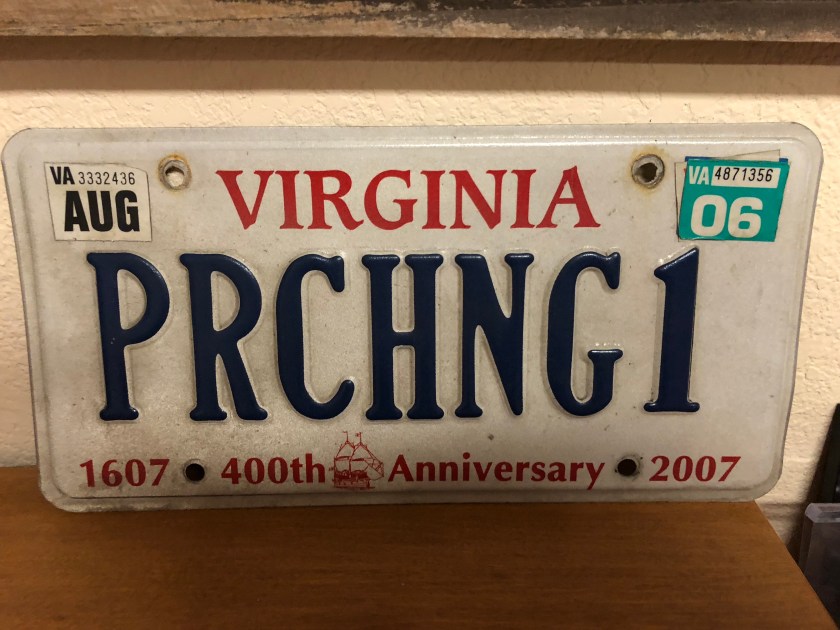
The title above, PRCHNG1, was once the vanity tag on a truck I owned. When in 2004 I said a sentimental goodbye to the “Black Bullet” (as Kathy affectionately named my 1985 Chevrolet Custom Deluxe pickup, which I traded in on a “new” 1992 Dodge Dakota), I transferred the tags down at the DMV.

As I picked up a number at the front counter, I had my tags in hand, and the receptionist saw them. It launched an interesting conversation.

She said, “Oh, I’ve always wanted to try that. I bet that’s so fun. Is it scary?”

I was puzzled and said so.

She said, “Your tags. How long have you been parachuting?”

I guffawed.

You may have surmised by now that my tag stood for “Preaching One.” I worked with DMV originally to find something that gave that clue. “Preacher,” “Mr Preach,” “Preacher,” and several others were already snagged. So I settled on “PRCHNG1.”

I thought it was clear, but apparently my fellow motorists either thought I was in some airborne division or maybe purchased hand guns. I don’t know.

As Christians, we’re told to be salt, light, and leaven, to clearly point others to Jesus.

When others see your works (cf. Mat. 5:16; 1 Pet. 2:12), do they conclude that you are a Christian? Or does the general tone and slant of your life lead people to contrary conclusions?

Be careful! Others are watching us, and they make assumptions about our character and lives by what they see. Let us make it plain (cf. Hab. 2:2)!

IMG_4176


Resolutions Reinforcements–#6

Neal Pollard

“Who cares?” That is not necessarily an expression of apathy or scorn. All of us need to feel like we have people in our lives who care about us and our wellbeing. Such people should do more than offer positive reaffirmation and reassurance. We benefit from those who keep us honest and are willing to say even the difficult things we need to hear. When we talk about goals and resolutions, we need at least someone whom we seek out to hold us accountable. Accountability, in its strictest sense, means “liable to judgment and punishment” when used of God’s holding mankind accountable (Rom. 3:19; BDAG 1037).  Today, we typically mean by accountable that we are responsible to someone to explain or defend our actions. Am I succeeding or failing? Who will help me accurately assess that?

Augustine of Hippo, in his fourth-century Confessions, wrote, “A brotherly person rejoices on my account when he approves me, but when he disapproves, he is loving me. To such people I will reveal myself. They will take heart from my good traits, and sigh with sadness at my bad ones. My good points are instilled by you and are your gifts. My bad points are my faults and your judgements on them. Let them take heart from the one and regret the other. Let both praise and tears ascend in your sight from brotherly hearts, your censers. …But you Lord…Make perfect my imperfections.” We are well-served to have those willing to disapprove, to sigh, and to render gentle judgment as much as give their positive counterparts.

Do you have someone in your life right now who can help you stay accountable to your goals? Ideally, it would be your spouse, but maybe it’s a trusted friend, a sibling, a local Christian, a church leader, or a parent. Find someone in whom to confide your goals and then establish a system to have them evaluated. Just knowing that someone else knows what you’re aiming at may dramatically improve your likelihood of hitting it.

accountability-1024x703

Working Together To Survive The Hunt

Neal Pollard

1 Peter 5:8 calls the devil a roaring lion prowling around seeking someone to devour. It is obvious that Peter’s readers would have seen or at least heard about these kings of the jungle for the analogy to make sense and be practical.  Lions lurk, longing for lunch.

In the savannas of East Africa, their meal of choice is usually either the wildebeest or zebra. Despite this, these two animals continue to graze and migrate together. In fact, because they are chief prey of the lion (and other big cats), they need to stick together. Various observers and experts give different explanations for why. Zebras have great farsightedness and the wildebeests have excellent peripheral vision, but each are poor at seeing what the other sees well. Others explain that wildebeests have mouths better suited for short grass while zebras’ are made for the long grass that grow intermittently together on the plains. Still others point to the zebras superior memories, recalling the safety routes of the previous year, and the wildebeests uncanny ability to find water even when such is scarce. Probably, it is the combination of these facts that cause the symbiotic relationship between these two large mammals. They do not all survive, but the vast majority do. The reason is because they utilize their own abilities but also because they rely on the abilities of others.

In a letter where Peter is addressing a people who were at times spiritual prey, he does more than use the simba simile. He urges Christians to stick together and look out for one another. He calls for sincere, fervent, from the heart love for one another (1:22; 4:8). He urges complaint-free hospitality toward one another (4:9). He commands serving one another (4:10). He teaches there to be mutual humility displayed toward one another (5:5). He ends the letter exhorting an affectionate, loving greeting of one another (5:14). As much as anything, this is a recognition of mutual dependence.

If we understand that we are not at home in this world (2:11) and are living and longing for the inheritance in heaven (1:4), we should come to understand our mutual need of each other. That does not just mean looking for others’ help, but also giving it. This is by God’s design. Notice, for example, the proactive protection we provide each other by being “harmonious, sympathetic, brotherly, kindhearted, and humble in spirit; not returning evil for evil or insult for insult, but giving a blessing instead…” (3:8-9a). Right before the lion passage, Peter talks about different groups looking out for and helping each other (5:1-6).

Any of us, through suffering, temptation, doubt, or some other factor, could drift away from the safety and security of the fold. Let us be more than mindful of each other. Let us depend on each other to survive the hunt and make it to eternal safety.  I will face the lion many times in this life, and I depend on you to help me survive.

DSCN0368

Putting A Price Tag On The Value Of Our Youth

Neal Pollard

Perhaps you’ve seen the news story about the six year old boy who made $11 million dollars this year on YouTube reviewing toys. Ryan, of Ryan ToysReview, has been reviewing toys since he was three years old. He has over 10 million subscribers to his channel, which had a 40-week streak of most viewed YouTube channel this year. He even had NBA star Kevin Durant appear in one of his video reviews in September. His videos are described as simple, innocent, and personable (Samantha Schmidt, Washington Post, 12/11/17 via www.washingtonpost.com/news/morning-mix).

That’s incredible! Such savvy, drive, and entrepreneurship. One of the traps we need to avoid is selling the intelligence and abilities of young people short. That’s even truer in the church than in the world.

When I look at our youth, I see perhaps the most evangelistic demographic in our congregation. Teens invite classmates to church just to “see what it’s about.” Then, our other teens reaching out and welcoming them into the group. They have a fearlessness about them that can drive the rest of us to greater effectiveness in this arena.

When I look at our youth, I see tenderheartedness. It doesn’t just drive them to be baptized or to publicly respond to the invitation. It moves them to be compassionate, to help the unfortunate or to be concerned for those who others may overlook. They are shamed by their sins and moved by praising the greatness of God.

When I look at our youth, I see a boundless resource of energy. They are active and alive, and when they channel that to serve–whether our elderly, the homeless, or each other–it’s exciting to see. You see it when they get together, talking and laughing. So many of us feed off of their vitality.

When I look at our youth, I see hope and idealism. Life too often depletes them of these priceless commodities. We need to do more to build them. Hope is about confident expectation, and isn’t the Christian life to be founded upon that (Romans 8:24)? Idealism may be seen as having higher expectations than are realistic, but it’s this mountain-moving faith that causes churches to grow and do what only can be done when God is factored into the equation. He is perfect and able (Ephesians 3:20-21).

Through their evangelism, example, energy, and expectation, our youth are of inestimable value to the church as a whole. Let’s nurture them and help them grow. Let’s give them opportunities to make an impact right now. All of us will reap infinite value from these infinitely valuable ones (cf. Matthew 18:1-6).

17523151_10212884844293080_7163968835894994377_n


If Today Was My Last Day On Earth (Poem)

Neal Pollard

[NEAL’S NOTE: This poem was from the conclusion to the sermon I preached on this subject from Psalm 90]

If today was my last day and tomorrow found me gone
How would life be different, if that unknown somehow was known

Would I be a better person, would I live a better life
How much would I feed resentment, envy, bitterness and strife?

How would I choose to live, and what would be my emphasis
Being a blessing or a burden, full of service or selfishness?

Where would God be in my life, what place would He occupy,
If today was my last day, and before tomorrow I would die.

If today was my last day, and second chances all were through
And I stood before my judge and my eternal fate I knew

I would mourn and fall before Him, if I had not done what’s right
If I had chosen self and sin, if I had chosen eternal night.

But there’s no reason for apprehension, I can die w/head held high
If I die to self & live to Him, it won’t matter when I die.

“Being A Christian Is Hard”

Neal Pollard

The church office receives a monthly publication called Faith Connect. In the latest edition, they include some data from Barna Group on faith in America. In a sidebar of statistics to an interview with Barna’s Vice President, Bill Denzel, writer Kelly Russell reveals what the research organization found in interviewing those who identify themselves as Christians. They report feeling:

  • “Misunderstood” (54%)
  • “Persecuted” (52%)
  • “Marginalized” (44%)
  • “Sidelined” (40%)
  • “Silenced” (38%)
  • “Afraid To Speak Up” (31%)
  • “Afraid Of Looking Stupid” (23%)

These findings accompany the assertion that America is a “Post-Christian nation,” having forgotten or rejected its roots, history, and former culture and practices (Summer 2017, 49-51). The thing that strikes me is how “Christians” report feeling. Barna did not exist in the first-century, and as such there is no record of any polling of the original Christians. But if there was, can you imagine the New Testament church answering the way these respondents did? I’m sure they felt misunderstood and persecuted. How could they not? Reading New Testament books like Acts, Hebrews, 1 Peter, and Revelation, along with early church fathers, we’re sure the Jews and Romans sought to marginalize, sideline, and silence them from the marketplace to the temples and synagogues. Our ancient spiritual family members were arrested, murdered, driven from their homes and cities, ostracized, stolen from, ridiculed, and more.

How they responded to such treatment is instructional for us today.  Peter reports their feeling:

  • “Living hope” (1:3)
  • “Great rejoicing” (1:6; 1:8)
  • “Love” and “believing” (1:8)
  • “Joy inexpressible” (1:8)

There are a lot of imperatives and exhortations throughout the rest of this epistle, written to encourage them to hold onto their faith however poorly they were treated by the people around them. Peter wants them living holy lives, but he also wants them to appreciate how great living the Christian life is. That’s a message we need to take to heart.

I hope we never put the focus in our spiritual lives on how hard it is to be a Christian. It can be! But, what will make the greatest adversity bearable is keeping our focus on our purpose, our promise, our privileges, and our peace. There is no better life than the Christian life. May we focus on our opportunities rather than our obstacles!

carry-cross-600x350

A Proverb To Ponder

Neal Pollard

Now, not all our attenders are members,
And not all our members are attenders,
But if all our attenders were members,
And all our members were attenders

THEN…

We’d have more trouble menders,
More gospel defenders,
And more true soul-winners!

BUT…

We’d have fewer people offenders,
Fewer spiritual hinderers,
And fewer religious pretenders!

SO…

Let us all render a more tender surrender
To the Commander of a love full of splendor!
As we meander on this earth full of sinners,
Let us engender a life with the Lord at the center.

Coarse Discourse

Neal Pollard

Is it just me or are we much more open about using profanity in ordinary discourse? Our sitting president has exhibited an unprecedented amount of “curse words” in the public square, even if transcripts of historic documents reveal that a great many of the last several presidents have used language salty enough to make sailors blush. Hollywood reactors to the president have seemingly been trying to “trump” his salacious speech and have, in many cases, upped the ante in indecent language. Recent news story include Bette Midler, congresswoman Kamala Harris, and Kirsten Hillibrand (aka “Senator Potty Mouth,” via The Daily Mail) using shocking words that the thoroughly secular media acknowledges as inappropriate and indecent—at least measured by cultural norms and moors.

I have to admit being thoroughly baffled by church members, even teachers and preachers, who adamantly argue that Scripture has nothing to say about such things. Implicitly, even explicitly, their point is that such speech is legitimate for a follower of Christ. While we must be careful not to make laws God does not make in His Word, neither can we be so reckless as to hurt Christ’s cause by encouraging the Christian to mimic the world’s behavior, speech, or attitudes without discernment. When godless media, non-believing coworkers, classmates, and cul-de-sac compadres, and others in society associate certain words with the rebellious, humanistic lifestyle, shouldn’t we take pause?

Is there room in Paul’s admonition to Ephesus (4:29; 5:4) and Colosse (4:6) or Jesus’ public discourse (Mat. 12:34ff) for the kind of words that so many in society still find shocking and inappropriate? Are the principles of godly influence (Luke 17:1), salt and light (Mat. 5:14-16), example (cf. 1 Tim. 4:12), and the like not enough to cause us to feel strongly about how we use our words with people? Do we feel like well-chosen swear, scatological, and smutty words are essential to successfully relate to and connect with the rougher elements of society in an effort to win them to Christ?

We can relate to and reach people without resorting to irreverent and indecorous words. We can keep pure in speech without becoming isolationists in society. It does not have to be an either-or proposition.  May we realize that what we say (and how we say it! See Gal. 5:20, Rom. 3:14, and Jas. 10, for example) will impact people like we do not realize and in ways that we do not realize. It extends well beyond just our speech, but our words paint a picture of us for the very people we should desperately want to reach for Jesus. Please, give thought to the power of your words (cf. Prov. 18:21).

597px-profanity-svg

BARRIERS TO COMMUNICATION

Neal Pollard

I was asked by a preacher from Texas to go and provide emotional support to a family of brand new Christians he reached with the gospel. In a tragic circumstance, the matriarch of this family was in the hospital Sunday morning to have a gallstone removed and doctors accidentally severed the hepatic portal vein going into her liver. This led to multi-organ shutdown that ultimately ended her life. In this atmosphere of unanticipated emotional pain and suffering, family had gathered from all over the country to see her before doctors removed the lines keeping her alive. I was unable to communicate very much comfort or support because most of them spoke no English and I speak virtually no Spanish. I sat in the waiting room with them throughout the afternoon, watching their anguish but having little more than smiles and sympathetic looks to offer. The matriarch’s granddaughter spoke good English, but it was hard to expect her to continually provide translation as she struggled with her own grief. Hopefully, they knew I cared and will allow the church to provide further encouragement. Thankfully, we have several members who do speak Spanish fluently who could help in ways I cannot.

As I was driving home and thinking about the best way to quickly learn Spanish, I had another humbling thought. How many opportunities do I pass up with people with whom my communication barrier is not language? There are some other, more sinister barriers that can keep us from speaking up for Christ in situations He is counting on us to take advantage of. There is fear—fear of rejection, opposition, or being ostracized. There is apathy—failure to consider or care about the eternal destination of the souls of those we encounter. There is selfishness—as we are so absorbed in our own pursuits that we do not open our hearts to the lost in our lives. There is sin—the presence of personal lifestyle issues for us that render us ineffective as sharers of the gospel message. These and other matters are much more frequently the roadblocks that keep us from reaching out to the people we encounter.

It will help us, I believe, to remind ourselves daily that this world is not our home and that every person is heading to an eternity that swiftly comes. We must have the courage to share with people how to prepare for that, to understand the great love God has for them and His desire to save them. We must keep the conviction strong that Jesus is the only way to salvation and that His applied blood is their only hope for such. We must care about people, enough to pray for boldness and wisdom, enough to walk through our open doors, and enough to share the good news with them. People are at the heart of our purpose as Christians. Let’s serve them by sharing the good news whenever, wherever, and however we can.

language-barriers-in-training

THE KIND OF LIFE WE SHOULD LIVE

Neal Pollard

Most of us are familiar with the intimate words spoken by Jesus to His followers in John 14:1-6. They were words of active comfort for a man who was imminently facing the worst suffering humanity could ever know. Yet, from those gentle words of guidance, we find a beacon to show us what kind of life it is possible for us to live—no matter what!

We can live a fearless life (John 14:1). Our hearts don’t have to be troubled. That doesn’t mean we won’t face fears and uncertainties. How can we avoid it? But we can let our fears be subjugated to our Father. We can trust the Bible’s promises and follow its guidance on this (cf. John 14:27; Phil. 4:7).

We can live a faith-filled life (John 14:1b). A “theocentric” (God-centered) point of view will influence our decision-making and daily living. We can have assurance and conviction (Heb. 11:1), but we must have a faith accompanied by works of obedience (Js. 2:20). All of us have lives centered around something that we make most important of all. There are many noble things that could fill in that blank—profession, family, friends, or the like. These may be part of our identity, but they should not define us. Our faith should define us.

We can live a focused life (John 14:2-4). Jesus urges His disciples to focus on at least three things:

  • Focus on the Father’s house (2). Long for heaven.
  • Focus on the Son’s coming (3). Anticipate His return. We know death is an appointment followed by the Judgment (Heb. 9:27).
  • Focus on God’s fellowship (4). Long to be where God is and to follow where He leads. Let that desire lead you to fellowship with Him and His saints publicly and privately in your personal devotional life.

We live in a world full of distractions—technology, appointments, hobbies, politics, and sports. Never let any of those things get your life out of focus.

We can live a follower’s life (John 14:6). We must believe that Jesus is the only way. We must shun the politically-correct notion that says there are many ways. We must live the exclusive way that Scripture teaches. We cannot serve God on our own terms. We must submit to His way and His truth, and we can enjoy the eternal life He offers.

Fame, fortune, fun, friendship, and such may draw and lure us. But none of those things will last. Jesus points to the kind of life we should live. May we be wise enough to listen.

blaine_mansion_during_renovation

Do Brotherhood

Neal Pollard

Hayden Holland, who obeyed the gospel less than three years ago, taught his first Bible class last night at Teens in the Word. It was an excellent, hour-plus long study of the parallels between serving in the military and living the Christian life. In this very practical study, Hayden mentioned the Army’s concept of brotherhood. The fraternity and bond built by basic training and the structural philosophy of the armed forces creates this sense of brotherhood among soldiers.  Without fellowship, he said, disputes will pull soldiers apart. Throughout his lesson, Hayden urged us to “do brotherhood.” Brotherhood is a noun, meaning “the feeling of kinship with and closeness to a group of people or all people” (Dictionary, version 2.2.1, 2016). Peter uses the word in 1 Peter 2:17, a word, according to BDAG, meaning, “A group of fellow-believers, a fellowship” (19; cf. 1 Pet. 5:9—“brethren”). Hayden’s exhortation to us was to do what it takes to create that feeling and fellowship.  Saying we are brethren, even acknowledging and teaching what God says is necessary to become part of that brotherhood, is insufficient of itself.  There is something to be done!

He directed us to the seven values touted by the army—“loyalty, duty, respect, honor, integrity, courage, and selfless service”—as examples of how we can “do brotherhood” in the Lord’s Army (cf. Eph. 6:10ff). Doing brotherhood means taking time to listen to and help our brothers and sisters in Christ when they are struggling. It means spending time together, engaging in each others’ lives. It means being faithful to live out what we say we believe daily, in the world and in the absence of our church family, because we love them and don’t want to let them down. It means talking out our problems and disagreements. As we work to see ourselves as a part of something bigger than just ourselves, the effect is revolutionary. Non-Christians see the bond we have with our brethren and it draws them. Jesus told His disciples that this brotherly love would be their identifying mark to a searching world (John 13:34-35).

How often it has been observed that Christianity is more than a state of being; it requires a life of doing. The brotherhood consists of all those within the body of Christ. But, that “group” has to be maintained, sustained, and retained. Such requires action! My action and your action. Let’s be sure we are “doing” brotherhood!

17862689_10212031358357411_591145317067498345_n

Wanting To Want To


Neal Pollard

Do you want your marriage to flourish and grow?
Do you want to read through the Bible this year?
Do you want to lead someone the Savior to know?
Do you want to live life without worry and fear?
Do you want to lose weight and be healthy and fit?
Do you want to attain to more financial discipline?
Do you want self-confidence, courage, and grit?
Do you want to get better at caring and listening?
Do you want a closer place near the heart of God?
Do you want to trust Him when trouble finds you?
Do you want to have heaven after earth you’ve trod?
Then it all must begin with you wanting to want to! —NP

Call it desire, motivation, or willpower.  Whatever you call it, it is central to succeeding at whatever your goals are. What does it take to become a Christian? Wanting to! What does it take to defeat the sin in your life? Wanting to! What does it take to break bad habits and repeated blown judgment calls? Wanting to! What does it take to be a stronger, more faithful Christian? Wanting to! That is not to minimize or ignore our dependence on God and the strength He provides. But He is not going to overwhelm or overtake our will and make us do or be something. He did not operate that way in the age of miracles.

What will be your motivation? There are so many potential incentives. There’s the love God has shown us (2 Cor. 5:14). There’s the fear of hell (Mat. 10:28). There’s the yearning for heaven (John 14:1-3). There’s the concern about how we influence other’s destiny (Mat. 5:14-16). There’s the love we have for God (1 Jn. 4:19). There’s the longing to be like Jesus (1 Jn. 3:2). For each of us, some motivations are more powerful than others. Whatever it takes to be more for God in this needy world, latch onto it and pursue it. You can do it because you won’t be doing it alone. God gave you the church, His Word, prayer, and a personal will to help arrive at the ultimate goal. Don’t let up. Don’t look back. Don’t lose hope. Want to want to!

img_4387
4 people have motivated me to run over the past 19 years: Kathy, Joe, Bob, and Wes. Today was a 6 miler in the snow when it felt like 4 degrees. 

My Daily “To-Do” List

Neal Pollard

  1. Be Productive With Your Time (Eph. 5:16).
  2. Be Pure In Your Heart (Mat. 5:8).
  3. Be Proactive In Your Relationships (Eph. 5:21-6:4).
  4. Be Peaceable With Your Provokers (Rom. 12:17-21).
  5. Be Purposeful With Your Life (Rom. 8:28).
  6. Be Praiseful With Your God (Psa. 150).
  7. Be Pleasant In Your Demeanor (Prov. 16:24).
  8. Be Prayerful In Your Decisions (Phil. 4:6).
  9. Be Patient In Your Challenges (1 Th. 5:14; Psa. 37:7).
  10. Be Positive About Your Future (Phil. 1:20-21; 4:13).
  11. Be Persistent In Your Evangelistic Pursuit (1 Cor. 9:19-22; Mat. 28:19).
  12. Be Pitying Of The Downtrodden (Prov. 19:17).
  13. Be Picky About Your Associates (1 Cor. 15:33).
  14. Be Passionate About Your Spirituality (Rom. 12:11).
  15. Be Perseverant In Your Trials (2 Th. 1:4).
  16. Be Prospective In Your Opportunities (Gal. 6:10).
  17. Be Petrified Of Falling Away From God (Heb. 6:1-6; 10:26-31).
  18. Be Powerful In Your Faith (Luke 7:9; 2 Th. 1:3).
  19. Be Persistent In Your Study (2 Tim. 2:15).
  20. Be Penitent In Your Sins And Failures (2 Cor. 7:10; Acts 3:19).
  21. Be Plentiful In Your Gratitude (1 Th. 5:18).
  22. Be Permeating In Your Influence (Mat. 13:33-34).
  23. Be Profuse In Your Generosity (3 John 5; Prov. 11:25).
  24. Be Prolific In Humility (Mat. 23:12; 1 Pet. 5:5).
  25. Be Pining For Heaven (Heb. 11:16; Phil. 1:23).

to-do-list-tools