A Better Brain

Dale Pollard

The largest brain on record belongs to the sperm whale. A sperm whale’s brain can weigh around 17-20 pounds which is significantly larger than a human brain, which weighs about 3 pounds on average. The sperm whale’s brain is not only the largest in weight but also in size, which fits their equally impressive body size as one of the largest mammals in the ocean. 

But what makes the human brain special isn’t its size. The ability to communicate with and even adopt similar characteristics as the God who made it is what sets it apart. 

Persecution makes life fearful for the faithful but Timothy’s obstacles are both external and internal. On the outside he faces pagan people, jealous Jews, and the sword swinging soldiers of Rome. On the inside, the Christians who make up this young congregation are being led and taught by a young man— Timothy. He battles self doubt and a lack of confidence in his own abilities. To top it off, his mentor is in prison. 

Paul pens the inspired words that would lift young Timothy’s spirit by reminding him that the human spirit was designed to handle and persevere under such daunting circumstances. Paul writes (from a cell), 

“God did not give us a spirit of fear but of power, love, and a sound mind.” 1.7

The spirit (πνεῦμα) referred to here is not the Holy Spirit, but it’s the “disposition or influence which fills and governs the soul of any one.”  God did not give us the spirit of skittishness so that we’d cower under confrontation or burn out under prospects of suffering. Holiness amidst hostility is an ability that comes standard on the base model human spirit. It’s not a possibility, it’s a guarantee. 

Power

We’re equipped with power (δύναμις) that is, “inherent power, power residing in a thing by virtue of its nature.”

Love 

That aggressive strength is powerfully combined with love (ἀγάπη). In this case the word refers to an affection or good will towards others. The God given spirit is not heartless. We have the power to show affection yet some choose to pretend as if their personalities are simply not capable of showing this attribute. 

Self-control 

A sound mind (σωφρονισμός) is simply the ability to control yourself. We share a commonality with Paul’s protégé. Some have tried to cheapen and downgrade the human race, God’s focal point of creation, to an animalistic status. It’s taught by educated but ignorant scholars who try to deny an undeniable God. We’ve been fashioned in the image of an eternal Being and our spirits drive an immortal soul. We aren’t designed to live in a constant state of timidity we’re creations of courage. Courage is not the absence of a fearful feeling but it’s the ability to face that fear— and move forward.  

Executed, But Still Rescued

Neal Pollard

In the very intimate correspondence to his spiritual son that we call the epistle of 2 Timothy, Paul seems very aware that the time of his departure from this earth had come (4:6). Paul was not under house arrest, like we read at the end of Acts. He is in chains (1:16). 

The city of Rome burned between July 19-24, 64 AD. The fire started in the Circus Maximus stadium, but burned 10 of the city’s 14 districts before it was extinguished. Some historians blame Nero, but there is no doubt Nero blamed the Christians. He rounded up Christians already in the city, including Peter (cf. 2 Pet. 1:14-15), and had many of them executed that same fall. 

Lenski says Paul was in Spain at the time of the fire, but he was captured in a continuing dragnet of Christians: “Christianity had become a religio illicita, and especially its propagation became a crime against the state. Not long after Paul’s return from Spain he was arrested. Now he would be charged with a crime; Paul was, therefore, thrown into a dungeon as a felon. After some delay he was tried and executed. Tradition asserts that he perished under Nero who died June 9, 68. The details of his martyrdom are not known. He must have been condemned to death for spreading a religio illicita” (474).

So, as the time drew nearer for him to die, Paul uses an interesting word to describe his anticipated situation. He reviews some of the events of his first missionary journey, reminding Timothy that at Antioch, Iconium, and Lystra he endured many persecutions, “and out of them all the Lord rescued me!” (3:11). You may remember that this including being stoned by the Jews and left for dead. That was a miraculous rescue!

Now, confined to chains with an insane emperor breathing down his neck, Paul says that the Christians had deserted him. Considering the enormous scrutiny they were under simply for being Christians, visiting a notorious, incarcerated Christian was risky! He charitably prayed that it might not be counted against them (4:16). Then, he says that he was rescued from out of the lion’s mouth (4:17), and “interpreters have identified the lion as the literal lions of the amphitheater, the emperor Nero, or Satan” (Lea and Griffin, The New American Commentary, Vol. 34, 256). But, we cannot be sure. But, even if the lion was figurative, the rescue was literal.

At nearly the end of his last letter, Paul confidently adds, “The Lord will rescue me from every evil deed, and will bring me safely to His heavenly kingdom” (4:18).  Consider Nero and the Roman machine! He had already been beaten numerous times. Who knows the terrible hardships he endured in the squalor of this dungeon? Yet, he would state with confidence that God would rescue him from the worst of them. Perhaps weeks or days after he dispatched this letter to Timothy, guards unlocked him and took him to the chopping block where, as a Roman citizen, he died by beheading rather than a harsher death like crucifixion or burning.  What about his inspired words in 2 Timothy 4:18?

Paul teaches us to think eternally and heavenly. On the other side of that beheading, there was safety and arrival to God’s heavenly kingdom. It was what he lived for. It was what he died for. What a reminder as we live in this body for such a short time, that we await our rescue. Our rescuer is Jesus, “who rescues us from the wrath to come” (1 Th. 1:10). He “delivered us from so great a peril of death, and will deliver us, He on whom we have set our hope. And He will yet deliver us” (2 Cor. 1:10). 

Bearing the Marks of Truth:

Living the Gospel in the Footsteps of Paul

Brent Pollard

Paul made a statement in Galatians 6.17 that is worth considering. Inspired by the Holy Spirit, he declared, “From now on let no one cause me trouble, for I bear on my body the marks of Jesus” (ESV). This statement raises the question: was he speaking literally? Did his fearless preaching of Jesus Christ result in physical marks? Considering the hardships listed in 2 Corinthians 11—195 stripes from the Jews, beatings with rods, and being stoned in Lystra—it’s plausible that Paul bore physical scars from these experiences. It’s unlikely any of us bear such marks for Jesus.

However, Paul’s message delves deeper than the physical scars. His letter to the Galatians also defended against accusations of being a false apostle. Critics claimed he received his message from men, not from divine revelation. Paul countered this by pointing to his scars as evidence of his apostleship and dedication to God’s truth. Thus, his physical marks were not just scars but proof of his faithfulness and the truth he preached.

This proof leads to a reflective question: if someone examined your life closely, would they see the truth of God’s Word as clearly as they might see the physical scars on Paul? It’s a challenging thought. Paul encourages us to bear the marks of Jesus, the marks of truth, in our lives. Remember Jesus’ words in John 17:17, “Sanctify them in the truth; your word is truth” (ESV). God’s word, the Bible, calls us to bear its marks in our lives actively.

Bearing the marks of Jesus Christ means living in alignment with His teachings and principles, allowing His truth to permeate every aspect of our lives. This involves reflecting His love, grace, and forgiveness in our interactions and consistently seeking to grow in understanding and applying His Word. As we embody God’s truth, we become living testimonies of His transformative power and a beacon of hope to those around us.

In conclusion, the marks of Jesus Christ that Paul bore are a profound metaphor for Christian life. Whether physical scars from persecution or the spiritual imprints of living according to Christ’s teachings, these marks signify a life committed to the gospel. Paul’s dedication serves as a reminder of discipleship’s cost and divine truth’s strength. As followers of Christ today, we are challenged to bear our own marks through our actions and life choices, not necessarily through physical suffering but through a commitment to living out His teachings. Let us strive to make the gospel’s truth visible in our lives, serving as clear indicators of our faith and commitment to Jesus Christ, thereby honoring the legacy of apostles like Paul and contributing to the witness of God’s kingdom on earth. 

It’s Alright

Gary Pollard

I Pt 4.12-19 is another difficult passage. God doesn’t want us to be caught off-guard when bad things happen to us because of our faith. We shouldn’t think that we’ve been intentionally singled-out. If we’re going to suffer, it should be because we’re doing what God wants. The process of judgment began for the world, and it started with the church. If we live for God, we’re going to be ok. But we have to avoid living like the world because they won’t be saved at the end.  

Chapter 5 is addressed to elders in the first four verses. Elders who are proactive in watching out for peoples’ souls will get a huge reward at the end. Jesus will personally give out that reward. Verse 5 reminds the rest of us that we should submit to the authority God gave elders, because God is against pride but will lift up people who practice humility. 6-11 is Peter’s parting encouragement to these Christians facing imminent death. Be confident in God! No matter what happens to us here, everything will be alright in the end. God will personally ensure that everything we go through in this life will be worth it!

The Foundation We Build On

Gary Pollard

I Pt 2.1-3 (bad chapter break): because we have this unstoppable hope for new life after this one’s over, we have to be good to each other. Stop hurting each other. Stop lying. Stop trying to trick people. Stop being jealous. Quit gossiping. Crave God’s word as if it was life-giving nutrition (because it is). We already know it’s beneficial, so we shouldn’t stop craving it. 

2.4-10 reassures us that Jesus is the only way to go. If the church is a house, Jesus is the primary load-bearing structural component. Each Christian makes up the other materials used in construction. Between Jesus and his church, we have a complete, functional house. It’s word imagery that may not be native to our thinking, but it works. The rest of the world doesn’t think Jesus should be the foundation we build on. They don’t think his teaching or existence is worth anything (7-8). Beyond seeing no value in our lifestyle, they even get offended at the things we believe and practice. God will take care of them in the end, they’re not our problem. 

2.11-12 — What is our problem is how we live. The world hates who we are and what we believe. We can’t let them pressure us into giving up or living like they do because it’s easier. If we live morally pure lives, they’ll be forced to acknowledge God (and us— 2.12; 4.13; 5.12) when he returns!

Revelation’s Resounding Relevance In A Changing World

Brent Pollard

Historically, I’ve seen the Book of Revelation as rooted in a bygone era, primarily relevant to the early Christians of the first and second centuries. Therefore, Revelation 2.10, which urged faithfulness to achieve eternal life, crystallized the central message for contemporary Christians. Earlier readings of Revelation painted it as a cryptic missive, but recent interactions, set against the backdrop of current news and social media, have reshaped my understanding of its relevance to our times. (And, no, I’m not referring to premillennial notions of the end times.)

Faith & Integrity:

Revelation emphasizes the importance of unwavering allegiance to one’s beliefs. Individuals today frequently navigate the turbulent waters of societal expectations and political correctness, just as early Christians did with the imposing orthodoxy of the Roman Empire. The letters to the seven churches can be read as a call to fortitude, warning against surrendering one’s values to the winds of societal change.

Furthermore, the church in Pergamum, which Jesus chastised for its flirtation with idolatrous teachings, serves as a stark warning against even seemingly minor compromises. Deviating from long-held Biblical teachings for modern ideologies can resemble the ancient seduction of the Imperial Cult.

Perseverance & Opposition:

Revelation encourages perseverance, especially when faced with persecution. Like their forefathers, modern Christians may face scorn or disdain for their steadfast adherence to biblical values. On the other hand, Revelation offers solace by promising rewards for unwavering faith.

Hope & Future:

In the grand narrative, Revelation emphasizes the transient nature of earthly regimes. The predicted demise of “Babylon” (Rome) is a powerful reminder of the transient nature of societal norms and structures. Current political correctness or societal mores are fleeting, particularly when viewed through eternity.

Revelation’s resounding theme is hope despite its occasionally bleak portrayals. Regardless of current challenges, the promise of the New Jerusalem and God’s ultimate triumph herald a brighter horizon.

Discernment & Judgment:

The rich tapestry of symbols and visions in Revelation invites discernment. This challenge reflects today’s environment, which is rife with competing narratives and information overload. The imperative is to cut through the noise and identify truths that align with biblical beliefs.

In conclusion, Revelation is not limited to the period in which John wrote it. It sends an enduring message, urging believers throughout the ages to remain steadfast in the face of external pressures and to cherish the eternal promise. This message emphasizes Revelation’s continuing relevance, encouraging our forefathers and current believers to consider its teachings.

For even more on the book of Revelation, we highly recommend Hiram Kemp’s study of Revelation at Lehman Avenue church of Christ (all archives are on our YouTube page and the class is a little over halfway done.

Perseverance And Faith:

Understanding Revelation’s Message for Then and Now

Brent Pollard

John wrote the Book of Revelation when the Roman Empire persecuted Christian communities. Emperor Domitian had exiled John to the island of Patmos. So, while in exile during Domitian’s reign, John wrote to encourage other persecuted Christians. Given the focus of the first three chapters on seven specific churches in Asia Minor (i.e., Turkey), as well as the emphasis on this being an urgent message (1.3; 22.10), we can conclude that the original audience of John’s apocalypse was these seven churches located in the heart of the imperial cult.

The imperial cult’s prominence in Asia Minor created significant tensions for Christians in Ephesus and Smyrna, two of the seven cities to which Jesus sent His message. Polycarp, a disciple of John, was martyred in 155 AD in his hometown of Smyrna. Domitian (81–96 AD) declared himself to be a god, adopting the title “Dominus et Deus” (Lord and God). Loyal Romans believed participating in cultic rites was a way to pledge allegiance to the emperor and Rome. We can quickly see how this caused problems for the burgeoning Christian community, which only referred to Jesus as their Lord and God.

The Christian community suffered socioeconomic consequences as a result of this refusal. Evidence shows that participation in the Imperial Cult was a prerequisite for engaging in certain types of business or trade in some parts and times of the Roman Empire. Members of trade guilds, which governed various kinds of commerce and industry, for example, might be expected to participate in the Imperial Cult as part of their membership.

Christians who refused to worship the emperor would have been economically marginalized. It’s no surprise that John compares imperial cult submission to having the “mark of the beast” (Revelation 13.16–18). The gematria system reveals the meaning of the number “666” to be “Nero Caeser.” As such, the beast was Rome, with Nero as the first prominent persecutor of Christians, responsible for the deaths of Peter and Paul, among others.

The calls for faithfulness and warnings against compromise in Jesus’ direct messages to the seven churches would have resonated in the context of the temptation to assimilate and abandon spiritual beliefs for worldly acceptance or prosperity. While the specific nature of persecution differed across time and emperors, the struggles referenced in Revelation reflect a consistent tension between the emergence of Christianity and the Roman imperial system.

Symbols like Babylon the Prostitute and the Beast represent the decadence and oppression of Rome, especially under despotic rulers who declared themselves gods and demanded worship. Revelation transitions from tribulation under oppressive powers to expressing hope in God’s ultimate triumph over evil. This message of persevering faith leading to redemption would have encouraged early Christian communities to face real-world hardships and persecution.

While modern forms of oppression differ, Revelation reminds believers that staying true to one’s values in adversity is critical. Its themes demonstrate that faith and integrity will triumph over darkness. Deliverance comes through steadfast devotion. And, in a world of growing groupthink and social credit systems, Christians in the twenty-first century may need this message of perseverance even in the face of socioeconomic isolation and persecution as a reminder not to bow the knee to anyone but Christ. 

Revelation, with its intricate tapestry of symbols, warnings, and prophecies, is a testament to the enduring human spirit in the face of overwhelming oppression. Its timeless message transcends its ancient origins, providing comfort and guidance to generations. As believers faced the might of the Roman Empire in the past, today’s challenges, while different, are no less demanding. Revelation reminds us that faith can move mountains in any age and that the light of truth, no matter how dimmed by adversity, will always find its way.

The Life We Get After We Die

Gary Pollard

I Peter 1.1-2 tells us that God chose us a long time ago. This doesn’t mean we have no say, it just means he’s always known who would and wouldn’t follow him. Broadly speaking, it means that he specifically chose Christians to be the ones who leave with him at the end. This means three things: One, he wants us to have a spirit of moral purity. Two, he wants us to obey him. Three, he wants us to be made clean by Jesus’s sacrifice. 

1.3-12 — Our reason for living this difficult life is hope. In the context of this letter, hope is the anticipation of what we’ll get after we die. The entire letter points to the next life as our primary incentive for living morally pure lives. When Peter says to do something difficult or painful, he usually follows it up with a reminder that this life is nothing. Everything we do is in view of the next life. Below are a few examples (we’ll look at the rest next week): 

  • 1.3 — His mercy gave us new life. 
  • 1.3 — This new life makes us live with anticipation for the next life and gives us a powerful, unstoppable hope. We only have this hope because Jesus came back to life, proving that we can and will, too. 
  • 1.4 — This new life has us waiting for God to reward us at the end. 
  • 1.4 — We know it’s at the end because vs 4 says that it’s being guarded by God for us. Unlike our current life, which is subject to the law of entropy, the next is not capable of wearing down or losing any of its value or novelty. Things that are new and exciting to us in this life can get boring after a while. Hobbies may eventually become an expensive ritual, rather than something that gives fulfillment or excitement or purpose. New Earth has none of that. It’ll be just as exciting on day one trillion as it was on day one! 

Christianity Should Change You

Neal Pollard

Reading Luke’s account of things, Saul may have been the chief threat to the Christians at the time recorded in Acts 8-9. He was “ravaging the church” (8:3), “breathing threats and murder against the disciples of the Lord” (9:1). He was doing “much harm” to the saints (9:13). He would look back on this part of his life, calling himself a harmful persecutor and killer of Christians (22:3ff; 26:9ff; 1 Cor. 15:9; 1 Tim. 1:13). The last thing we would expect, reading about his violent exploits against followers of Christ, would be a complete turnaround. But that’s what happens in Acts 9. 

SAUL’S PLANS ARE CHANGED (1-3). He had letters from the High Priest to authorize his imprisoning of Christians. His zeal and passion to stop Christianity is as strong as could be, but Christ has a message for him. It literally stops him in his tracks. The Christian life can be a sudden, abrupt change even today. When one comes face to face with who Jesus is, it will cause unforeseen, dramatic changes in one’s life!

SAUL’S MIND IS CHANGED (4-7). His entire worldview about who Jesus is changes in what happens on this road to Damascus. He sees a light and hears a voice asking, “Saul, Saul, why are you persecuting Me?” (4). He’s not sure who he’s speaking to, but he knows it’s no mere man. Jesus tells Saul who He is, then tells Saul what to do next. He’s not saved on the road, but told to go to Damascus to await news of what he should do (6). The greatest question of life just may be, “Who is Jesus?” Saul thought he knew, but is finding out that everything he thought he knew was wrong. 

SAUL’S PERSPECTIVE IS CHANGED (8-18). Saul is blinded on the road. He doesn’t eat, drink, or see for three days. Meanwhile, the Lord commissions a man named Ananias to go preach to Saul. Jesus could have easily laid it out there for Saul, but He chose the “foolishness of preaching” to save this persecutor (cf. 1 Cor. 1:21). Naturally, Ananias was apprehensive about his mission, knowing full well all that Saul had done to the saints (13-15). The Lord reassures the preacher that Saul has changed his mind and is ready to hear what he must do, so Ananias obediently goes to Damascus and preaches to him (17). The hardships and realities of life can totally change our perspective, leaving us receptive to the will of Christ. We might not have been seeking before suffering. 

SAUL’S CONDITION IS CHANGED (18). In this moment, he could see–physically and spiritually. With spiritual sight restored, he “got up and was baptized.” Saul would later look back on this and tell us more of what Ananias preached to him. “The God of our fathers has appointed you to know His will and to see the Righteous One and to hear an utterance from His mouth. ‘For you will be a witness for Him to all men of what you have seen and heard. ‘Now why do you delay? Get up and be baptized, and wash away your sins, calling on His name'” (22:14-16). Baptism changed his spiritual condition before God. It washed away his sins. It brought about the change of condition, opening door to a change of mission. Baptism is but part of God’s saving plan, but it is the point at which sins are forgiven for a penitent believer. 

SAUL’S FELLOWSHIP IS CHANGED (19ff). His environment is no longer Christian-haters. It’s the hated Christians. He spends several days with them. He would prove to be such an asset to the saints at Damascus, and he is ultimately, readily accepted as one of them. He fought against the very ones he fought for before becoming a Christian (22), until his former allies plot to kill him (23-24). His new spiritual family helps him steal away (25). He seeks to fellowship with the disciples in Jerusalem, but in an age long before instant communication and technology the word had not reached these saints. They fear he’s an infiltrator, coming among them to do them harm. Can you imagine sitting down for a fellowship meal with the man that imprisoned or killed a friend or loved one? That’s possibly the situation for Saul and these saints. Barnabas, the generous encourager we met in Acts 4, paves the way for Saul’s acceptance. He is ultimately welcomed into the fellowship. Sometimes, our comfort zone is challenged with the addition of new Christians into our fellowship. It could be their worldly background, their income bracket, their skin color, or some similar difference that requires our adjustment. God expects that we’ll overcome any such superficial barriers and see what ties us together–our faith in and following of Jesus.  

SAUL’S MESSAGE IS CHANGED (20-31). He proclaimed that Jesus is the Son of God (20). He proved to opposing Jews that Jesus is the Christ (22). He spoke boldly in the name of Jesus (27). He spoke boldly in the name of the Lord, talking and arguing with the Hellenistic Jews (28-29). As hard as he had been fighting against Jesus, he was now fighting that hard for Him. 

No wonder the most operative word is “change.” A change of life changes our mind and outlook, setting up a change of our spiritual state (if we respond properly to teaching) that reflects itself in a change of our spiritual environment and a change of our purpose and mission. No, it won’t happen with the flair and drama that Saul experienced, but the gospel is as powerful today as it was then (cf. Rom. 1:16). If being a disciple of Jesus hasn’t dramatically changed who we are and what we do, it may help us to look at Saul’s life and then our own. He can be an encouraging example that prompts us to go deeper and further in our faith. Conversion involves real change. Jesus says conversion is essential to entering the kingdom of heaven (Mat. 18:3), spiritual healing (John 12:40), and for sins to be wiped away (3:19). May people be able to see the change Jesus has made and is making in us!

Persecuted, But Not Abandoned

Thursday’s Column: Captain’s Blog

“persecuted, but not forsaken; struck down, but not destroyed;” 2 Corinthians‬ ‭4‬:‭9‬ ‭

In a world that grows ever darker, there are moments where Christians can feel lonely. This isn’t a new phenomenon. Since the beginning of time, those who God chose to serve Him often felt rejected and alone. 

The apostles who followed Jesus felt persecution and rejection at almost every turn. Paul especially faced difficulties in his ministry. 

We sometimes fail to understand what Paul and the other Christians were being persecuted for. They were proclaiming the Word of God. Paul is trying and pressing on through this persecution, because of the message that he had to proclaim. But those who were lost by their actions were rejecting the very thing that could save them!

Paul realized the value of their souls and continued on through the persecution. Paul also realized that even though they were rejecting The Word and persecuting him, he knew he that he was never forsaken by God. Satan wants us to feel abandoned by our Father. Many struggling people have questioned where God was in their lives when they felt they needed Him most. I have. But realize this is Satan! We know for a fact that God hasn’t forsaken us. If being persecuted for God is all it takes to get to Heaven then that’s definitely a steal. 

Paul says in Philippians 1:21, “For to me, to live is Christ and to die is gain.” We have what can solve the world’s sin-problem, and we need to realize the importance of our commission. Jesus said in Matthew 16:26, “For what will it profit a man if he gains the whole world and forfeits his soul?” The earth has been estimated to be worth over 30 trillion dollars. To put this in perspective, the average 10 dollar bill is about 6 inches long. If we lined up 30 trillion dollars worth of ten dollar bills it would stretch over 3.4 billion miles. Our souls are more precious than this entire world. Why be afraid of persecution when we have the power to save something as valuable as a soul, even if it’s just one?

 We have been promised that we will face persecution for Christ, but we can have assurance in knowing that no matter what we go through God will never forsake us.

Carl Pollard

Our Motives, Mission, And Message

Wednesday’s Column: Third’s Words

I Thessalonians 2.1-6 reminds us that our motivation for staying faithful shouldn’t be selfish. We’re not here to gain a following or expand a financial portfolio. Those things aren’t intrinsically wrong, but using Christianity as an opportunity for financial gain is terrible. We’re faithful because it’s what God wants, and because we want to live with him forever. 

The application of 2.7-12 is that God expects us to tell people about his son’s return, even if we have to do it alone. This means we don’t expect financial help as a condition for service. This means we teach with great patience. It means we share our time generously. It means we work hard. It means we invest all of our emotional resources into the work. 

2.13-16 teaches that our message originated with the creator. It has a powerful effect on people who believe it. It also draws negative attention from people who find it too otherworldly to accept. For the most part, people find it difficult to accept the idea of a God. Beyond that, most find it even harder to believe that this God will destroy the planet, and will only rescue those who follow him. To most it reads like science fiction. As with other things that don’t fit a naturalistic narrative, our worldview is attacked as bring fringe or fantasy or irrational. But God will handle those who try to stop his message from spreading, so our job is to keep at it until our time is up! 

Gary Pollard

When the Wolf and the Lamb Eat Together

Friday’s Column: Brent’s Bent

Brent Pollard

Isaiah 65.17-25 is interesting. Some have mistakenly concluded that it is a prophecy of Christ’s “millennial kingdom” because it resembles passages in John’s revelation. However, we might agree that it refers to the millennium only if others use that term to describe the entire period between Jesus Christ’s two advents. 

Contextually, this prophecy appears alongside others concerning the church or the kingdom. Paul summarizes the blessings God promised Isaiah in this passage: “Blessed be the God and Father of our Lord Jesus Christ, who has blessed us with every spiritual blessing in the heavenly places in Christ” (Ephesians 1.3 NASB1995). 

And we’ve been in these final days since Pentecost (Acts 2.16-21). As a result, we should not be surprised by its longevity (i.e., more than two millennia and counting) because God metaphorically predicted that its cohorts would live a long time (Isaiah 65.20). Furthermore, this extension is advantageous because it provides opportunities for those who need to repent (cf. 2 Peter 3.9). 

But what does Isaiah 65:25 mean by the wolf eating with the lamb? Because wolves and lambs are predators and prey, people assume it must refer to the millennial kingdom. Otherwise, the wolves would be the ones devouring the lambs. So, we can’t discuss anything current. Nonetheless, they fail to remember that there once existed a time when wolves and lambs ate together. They did so on the ark that God instructed Noah to build. The ark served as God’s refuge during His wrath. 

Today, the church serves as that refuge. Even when wolves are nearby, lambs will still be able to eat within that place of safety. Some people believe God’s providence protects His children, so they have no fear despite living in a wolf-infested world. Others argue that because God changes the obedient’s nature through the Gospel, the wolves and lambs can eat together within the church because their personalities have changed. They are brand-new creatures (2 Corinthians 5.17). All of these interpretations are correct, but there is an intriguing corollary. 

Who was the primary apostle to the Gentiles? Peter’s sermon converted the first Gentiles (Acts 10.34ff), but the Lord chose to send Paul to the Gentiles (Acts 26.17). Jesus tore down the dividing wall between Jew and Gentile (Ephesians 2.13-15), allowing those like Paul to welcome the Gentiles into Zion (cf. Isaiah 62.1-3). However, what do we know about Paul’s history? Paul belonged to the Benjamite tribe. 

God allowed Israel to prophesy his sons’ futures as he lay dying (Genesis 49.1-27). According to Jacob, “Benjamin is a ravenous wolf; In the morning he devours the prey, And in the evening he divides the spoil” (Genesis 49.27 NASB1995). Paul was thus a ravenous wolf whose conversion caused him to eat with the lambs (Acts 20.7). No longer a church persecutor content to put Christians to death for their crime of faith in Jesus, Paul became Christ’s ambassador to increase the flock of Christ. 

A true example of the wolf eating with the lamb is found only in God’s kingdom, the church. 

1 Peter–Part VII

Wednesday’s Column: Third’s Words

Gary Pollard

For the next several weeks, I’ll be repeating the book of I Peter in present-day terminology. It’s not a true translation of the book, as I am not qualified to do so. It will be based on an exegetical study of the book and will lean heavily on the SBL and UBS Greek New Testaments, as well as comparisons with other translations (ESV, NASB, NIV, ERV, NLT). My goal is to reflect the text accurately, and to highlight the intent of the author using concepts and vocabulary in common use today. 

This is not an essentially literal translation, and should be read as something of a commentary. 

I Peter – Part VII

While we’re on this topic, wives must listen to their own husbands. If your husband doesn’t believe, maybe you’ll win him over with just your good example! You wouldn’t even have to say anything. Pure and respectful behavior speaks volumes. Don’t obsess over your physical appearance or fashion. Show off who you are inside! A gentle, easy-going demeanor is timeless; it’s also extremely valuable to God. Remember the women lived a long time ago? They were considered special because God was their hope, just like he’s your hope. They also expressed their beauty by deferring to their husbands. Sarah did that for Abraham – she considered him to be her leader. You are just like her when you do the right thing without being afraid of anything. 

Husbands, you’re not off the hook. You share a living space with your wife, so you have to be a student of her needs and wants. Don’t treat her like one of the guys. Remember the differences between men and women. Don’t be rough with her. Make sure you show her how valuable she is! She has just as much a claim to God’s promise as you do. If you aren’t good to her, God will block your prayers. 

Finally, you all need to work together. Show sympathy to each other. Be kind to each other. Don’t think too highly of yourselves. Don’t insult people who insult you. Don’t get even with people who hurt you. Do something good for them instead! That’s actually why God called us, and he wants to do good for us, too. You’ve read, “Anyone who wants to live a good life should watch their mouth. They should avoid evil and do good things. They should look for peace and chase it. God watches out for good people and listens to their prayers, but he’s against people who practice evil.” 

Who’s going to hurt you if you’re obsessed with being good to people? Even if someone hurts you because of your faith, you’re ok! Don’t be afraid of their threats, don’t let it shake you up. Put Jesus in the center of your heart at all times. Have a logical answer ready whenever you’re interrogated for your faith. Tell them about your hope, but make sure you’re gentle and respectful. Make sure your moral lives are good so they can’t legitimately attack your character. If you’re doing the right thing, they’ll answer for how they treat you. It’s better to be attacked for doing the right thing than for doing the wrong thing. 

By 3rd century monk – Link

1 Peter–Part VI

Wednesday’s Column: Third’s Words

Gary Pollard

For the next several weeks, I’ll be repeating the book of I Peter in present-day terminology. It’s not a true translation of the book, as I am not qualified to do so. It will be based on an exegetical study of the book and will lean heavily on the SBL and UBS Greek New Testaments, as well as comparisons with other translations (ESV, NASB, NIV, ERV, NLT). My goal is to reflect the text accurately, and to highlight the intent of the author using concepts and vocabulary in common use today. 

This is not an essentially literal translation, and should be read as something of a commentary.

I Peter – Part VI

We’re independent of any human government, but don’t use that as an excuse to disobey your governments. You have to see every person as valuable. You have to love each other. You have to obey your government. Employees must listen to their employers. Be respectful to them, even when they aren’t good to you. We don’t do this for them, we do it for God. He thinks very highly of us when – because we love him – we act like we should, even when we’re being mistreated. You don’t get credit for putting up with mistreatment if you bring it on yourself with bad behavior. If you’re mistreated because you’re trying to do the right thing, though, it makes God happy. 

This is why God called us in the first place! Jesus suffered to benefit us. He intended for that to be the example we could follow. He never did anything wrong, he never said anything wrong, he didn’t fire back at people who said hurtful things. He never threatened anyone who put him through suffering. He constantly trusted God, knowing that God judges perfectly. He voluntarily took the punishment for our sin when he physically suffered on the cross. He did that to give us the chance to kill our old lifestyles and live morally pure lives. His injuries healed us. We had no direction, aimlessly wondering around like a sheep. Now we follow the one who leads us and protects us. 

Remembering

https://www.wetrainpreachers.com/extension-news/2022/3/1/breaking-news-from-ukraine

Remembering:

Monday’s Column: Neal At The Cross

Neal Pollard

My first foreign mission trip was to eastern Ukraine in the Spring of 2002. I returned in 2003, and each time we flew in and out of Kharkiv (which is under siege as I type). We worked with the Bear Valley Bible Institute’s first foreign extension school, but also worked with brethren in the village of Slavyanogorsk.

I took this picture of Slavyanogorsk from the monastery overlook.

We held Bible studies and taught English using the book of Mark and enjoyed success especially with young people and young adults. The influence of the Russian Orthodox Church was strong among the locals, but there was a congregation of about 30 there.

Russian Orthodox monk at the monastery in Slavyanogorsk.
Having fellowship with the brethren at Slavyanogorsk. The local preacher at the time, Victor Semikoz, is barely in view (right). Terry Harmon, at the time the director of the Bear Valley extension, is wearing the tie.

On my second trip, Kathy was able to go with me along with several other members of the Cold Harbor Road congregation in Mechanicsville, Virginia, where I preached at the time.

Members of the Cold Harbor and Pikeville, KY, congregations at the Kharkiv airport. Do you see Kathy?

The memories we made together and with our brothers and sisters in Ukraine have left a lasting impression on my mind and my faith. Though I had always known that the church existed in places outside the United States, this was my first tangible experience with them. While we were separated by language and cultural barriers, we were drawn together by our common faith and hope. These first few trips increased my desire to teach and evangelize not only those in other nations, but also motivated me to try harder to do so locally. Those travels to Ukraine were extremely faith-building.

Right now, those brethren are displaced, distressed, and disturbed by the Russian invasion well underway. Their relatively modest houses and apartments have been at the center of fighting between Ukrainians and Russian separatists, with many of the cities in that region controlled by those separatists. They are in the crosshairs of danger, facing an uncertain future.

As I read the New Testament, inspired writers addressed congregations and asked them to care about, pray for, and provide the needs of brethren who faced various crises. There were the poor and needy saints of Jerusalem, whom Paul tells Rome that Macedonia and Achaia had financially supported (Rom. 15:26; cf. 1 Cor. 16:1). The writer of Hebrews told his audience, “Remember the prisoners, as though in prison with them, and those who are ill-treated, since you yourselves also are in the body” (13:3). He praised them earlier in the letter for showing sympathy to the prisoners (10:34). We never know when similar circumstances might befall us. As Paul told Thessalonica, “For you, brethren, became imitators of the churches of God in Christ Jesus that are in Judea, for you also endured the same sufferings at the hands of your own countrymen, even as they did from the Jews, who both killed the Lord Jesus and the prophets, and drove us out. They are not pleasing to God, but hostile to all men, hindering us from speaking to the Gentiles so that they may be saved; with the result that they always fill up the measure of their sins. But wrath has come upon them to the utmost” (1 Th. 2:14-16). While their suffering was primarily spiritual persecution, Paul urged empathy and endurance.

What can we do for our brethren who are at ground zero of this awful conflict? We can better inform ourselves of the specifics there (https://christianchronicle.org/ukraineexplainer/). We can pray, congregationally and individually (daily!). We can listen for opportunities to assist our brethren. Heaven will be filled with saints from every nation (Rev. 7:9). These brethren are part of our “household”; let us stand ready to do good for them (Gal. 6:10). Remember them as they suffer!

Having tea in our sister, Luba’s, apartment on a rain-soaked evening in Slavyanogorsk.

What Are You Prepared To Do?

Friday’s Column: Brent’s Bent

brent-portrait

Brent Pollard

In Brian De Palma’s The Untouchables (1987), loosely based on historical events, Elliot Ness must stop gangster Al Capone. Ness, portrayed by Kevin Costner, is recruiting capable men to help him accomplish his task. One of the men he selects is an Irish beat cop, Jimmy Malone. Malone, played by Sean Connery, asks Ness what he is prepared to do to stop Al Capone. Ness replies he is willing to do anything within the law. However, Malone reminds him that Capone doesn’t play by those rules, implying that Ness will have to dirty his hands to bring Capone to justice. Sadly, one of Capone’s cronies mortally wounds Malone later in the movie. As he lay dying, he again asks Ness what he is prepared to do. Malone’s death finally causes Ness to take his gloves off and give Capone a hard fight. 

Obviously, our devotional thoughts are just as loosely based on The Untouchables as the said movie was on the actual events occurring during Prohibition. Thus, I am primarily focusing on Malone’s question of what one is prepared to do. This question strikes me as pertinent to two parables spoken by Jesus to His disciples in Matthew 13.44-45. There are seven parables in Matthew 13, but Jesus gave only four of those to the assembled masses. The remaining three he spoke to the disciples alone. Of those three parables, two deal with people making an incredible discovery and the lengths they go to secure it. The Pearl of Great Price and the Hidden Treasure is parables requiring sacrifice from those wishing to obtain what Jesus equates to the kingdom of heaven. 

Wait a minute. Are these not disciples to whom He addresses these parables? Yes. So, have they not already found the treasure, having decided to follow Jesus? Indeed, they have. However, there remains something even they must do. Even though they have acknowledged that there is something special about Jesus, that He is the Messiah, there is still a price to be paid. If they wish to complete their faithfulness, they must be willing to forfeit all to secure God’s precious promises. In the case of some, this knowledge came because of a diligent search. For the others, they had chanced upon the Messiah. Regardless of the circumstances, though, both groups had to surrender everything to receive the kingdom.  

Recalling Matthew’s original audience, we note Matthew’s message is Jesus is the Messiah. Thus, he wrote primarily for the benefit of the Jews looking for the Messiah. They had to recognize that Jesus of Nazareth was He about whom the prophets had spoken, even Moses. Yet, they had to do more than mentally assent to Jesus’ identity. The believer’s conviction would cause them even to forfeit their former spiritual wealth obtained under the Law of Moses since God’s kingdom is invaluable in comparison. Elsewhere in Matthew’s Gospel, Jesus tells those who would follow Him that they had to remove all stumbling blocks from obedience, even if that were a foot or an eye (Matthew 18.7-9). Jesus was using this language figuratively, of course, as He was not advocating self-mutilation. But the message is the same as that of the Pearl of Great Price and the Hidden Treasure. You must remove absolutely everything coming between you and the acquisition of the kingdom of heaven without prejudice.  

That is a sober message for those of us reading Matthew’s Gospel today. We may have satisfied ourselves with the knowledge that we have grasped the identity of Christ. Perhaps, we have even taken steps to become Christians. We are His disciples. But even to us, Jesus asks, “What are you prepared to do?” If the answer is not the equivalent of forfeiting all for the sake of the kingdom, then we have not yet done enough. As those to whom the Hebrews’ writer wrote, “You have not yet resisted to the point of shedding blood in your striving against sin” (Hebrews 12.4 NASB1995). The implication, of course, is Christians elsewhere in the first century were shedding their blood for their faith. Hence, the road taken by the recipients of the Hebrews letter was calmer in comparison. Thus, as I read those parables of the Pearl of Great Price and the Hidden Treasure, I must ask myself if I likewise will give my all to receive the kingdom of heaven. So then, when the situation calls for it, I must do whatever it takes to receive the kingdom of heaven. Only then will I have obtained the Pearl of Great Price and the Hidden Treasure.      

Persecution And Hope (Part Two)

Wednesday’s Column: Third’s Words

Gary III

Gary Pollard

Last week we looked at an account from Tacitus describing the brutality of Nero against Christians who lived during his reign. Here are a few points to take away:
 
  • Jesus was a historical person.
  • Early Christians suffered immensely. If we want an idea of Christian endurance, we should look to this as an example. We do not really face persecution in the modern world.
  • That account makes inspired passages like I Peter 1.13-2.2 and I Peter 4.7 more personal. In 1.13-2.2, the Spirit tells Christians how to live while dealing with persecution with five commands:
    • Fix Your Hope (13)
    • Be Holy (15)
    • Conduct Yourselves in Fear (17)
    • Love Each Other (22)
    • Long for Pure Milk of the Word (2.2)
  • It gives more context for the desire to be in Heaven that early Christians had (II Peter 3.13; Romans 8.20-24; II Timothy 2.12).
 
“If only for this life we have hope in Christ, we are of all people most to be pitied” (I Corinthians 15.19).
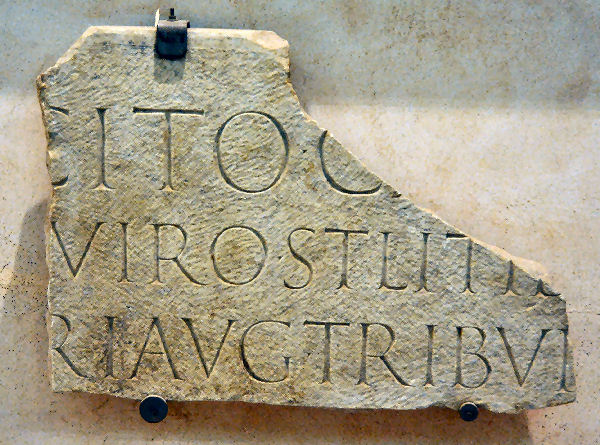
Tombstone of Tacitus (via Rome Museum)

Persecution And Hope (Part One)

Wednesday’s Column: Third’s Words

Gary III

Gary Pollard

Gaius Cornelius Tacitus (AD 56-120) wrote two secular historical works describing the reigns of Tiberius, Claudius, Nero, and Gabba, Otho, Vespasian, and Vitellius (Annals and Histories).
 
He was the son-in-law of Agricola, the Roman General responsible for Roman expansion throughout Europe, especially northern Britain. He was not a Christian by any means, but a patriotic Roman with a family heritage tied to its conquests.
 
In the following excerpt, Tacitus mentions Jesus (referred to as Christus) and details the persecution of early Christians. I have abbreviated some of the excerpt (ellipsis), given contextual explanation (brackets), and added emphasis (bolded text). The information in his writings is fascinating, but I found the following to be shareable.
 
“…The next thing was to seek means of propitiating the gods [because of the burning of Rome], and recourse was had to the Sibylline books… But all human efforts, all the lavish gifts of the emperor, and the propitiations of the gods, did not banish the sinister belief that the conflagration was the result of an order.
 
Consequently, to get rid of the report, Nero fastened the guilt and inflicted the most exquisite tortures on a class hated for their abominations, called Christians by the populace. Christus, from whom the name had its origin, suffered the extreme penalty during the reign of Tiberius at the hands of one of our procurators, Pontius Pilatus, and a most mischievous superstition [of resurrection], thus checked for the moment, again broke out not only in Judæa, the first source of the evil, but even in Rome…
 
Accordingly, an arrest was first made of all who pleaded guilty; then, upon their information, an immense multitude was convicted, not so much of the crime of firing the city, as of hatred against mankind. Mockery of every sort was added to their deaths. Covered with the skins of beasts, they were torn by dogs and perished, or were nailed to crosses, or were doomed to the flames and burnt, to serve as a nightly illumination, when daylight had expired.
 
Nero offered his gardens for the spectacle, and was exhibiting a show in the circus, while he mingled with the people in the dress of a charioteer or stood aloft on a car. Hence, even for criminals who deserved extreme and exemplary punishment, there arose a feeling of compassion; for it was not, as it seemed, for the public good, but to glut one man’s cruelty, that they were being destroyed.”
 
Annals of Tacitus Book XV

Division

Wednesday’s Column: Third’s Words

Gary III

Gary Pollard

In this volatile political climate, many Christians face some uncomfortable dilemmas. Is party line a salvation issue? How do we handle seemingly irreconcilable differences? What do we do going forward?
 
Rather than delving into those questions, I’d like to focus on the attitude of the early church, which faced internal division–Jew/Gentile controversies like in Acts 15, opinions over cultural matters as seen in I Corinthians 8 and Romans 14, and external pressures.
 
In keeping with the spirit of the early church, let’s focus on the following list.
 
  1. We must focus on and grow our own spiritual culture, independent of our earthly nationality (while observing Romans 13).
  2. We must be faithful Christians who value being righteous, no matter the cost.
  3. We must manage our concerns and worries by spending MORE time with each other and developing our faith.
  4. We may need to see ourselves less as Americans and more as Christians. If we remember that our kingdom is the church first, we will be far more united.
  5. Be awesome citizens. When outsiders hear about us, it should be that we never cause trouble, we are loyal to each other, we are selfless, we help people, we have strong families, we rely on each other, we are pleasant to be around, we are dedicated to our faith, and we love people who treat us poorly.
  6. We must remember that priority number one is heaven. Everything else is second.
  7. We must avoid talking or posting on social media about non-salvation issues that can and do create division or offense, out of courtesy and respect for each other (Romans 14.1-4; 13ff).
 
If these are the things we worry about and focus on, no political division or any other heartburn-inducing unpleasantness can affect us. Besides being happier, we’ll be a stronger church!

“It’s Not About Me” In 1 Peter 3 (Part Two)


Wednesday’s Column: Third’s Words

Gary III

Gary Pollard

 
1 Peter 3.8ff is a passage with tons of application. What I’d like to do is simply break it down and apply as we go.
 
3.8 –   Is addressed to every Christian, as opposed to the gender-specific commands of the previous section. Christians are told to have a unified mindset, understanding of the needs of others, affection for each other, compassion for each other, and a sober view of self.
 
3.9 – In the context of being ridiculed or outright persecuted for faith, we’re commanded not to stoop to a hostile person’s level. Instead, we are only to say good things to and about them. The word for “bless” here would be like us giving a glowing review of someone, even when they’re hostile to us. Why? Because God promised us a glowing review, even though our lifestyle was hostile to Him before we were faithful.
 
3.10-12 – If we want to have good days, we have to control our tongues, reject evil, and actively do beneficial things for others. If we do, God looks at us with approval. If not, He is against us.
 
3.13 – If we pursue doing good things with energy, no one can say anything against us. Who can assault the character of someone passionate about bringing good into others’ lives?
 
3.14But even if they do is a contrast not as plainly seen in English. This verse starts with a powerful contrastive (αλλα) that points to how we should act in the face of totally unwarranted hostility. Even if our pursuit of good gets us in trouble, we can still be happy! Even in this life we cannot lose. We cannot let fear dictate our behavior, and we cannot let anyone’s intimidation cause us to react with hostility.
 
3.15 – Instead, we should make the most special place in our heart God’s place. We don’t serve fear, we serve God. If someone shows hostility to us when we’re doing good, we have to be ready to give a rational explanation for our hope with an attitude that proves our supernatural allegiance. Our fear of God must be greater than our fear of man.
 
We do this because our goal is to bring others to God! It’s hard, but we can only do it when we remove self from the equation. People tend to attack what they do not understand. By using reason and by restraining our emotional response, we can help save their souls. We were all hostile to God at one point, but we now have mercy. Being controlled and rational while under “attack” is not a normal human response. Our response can mean the difference in someone’s eternal destination!