When Caesar Lives Rent-Free in the Christian’s Mind

Praying for Nero, Submitting to Authority, and Keeping Christ on the Throne

Brent Pollard

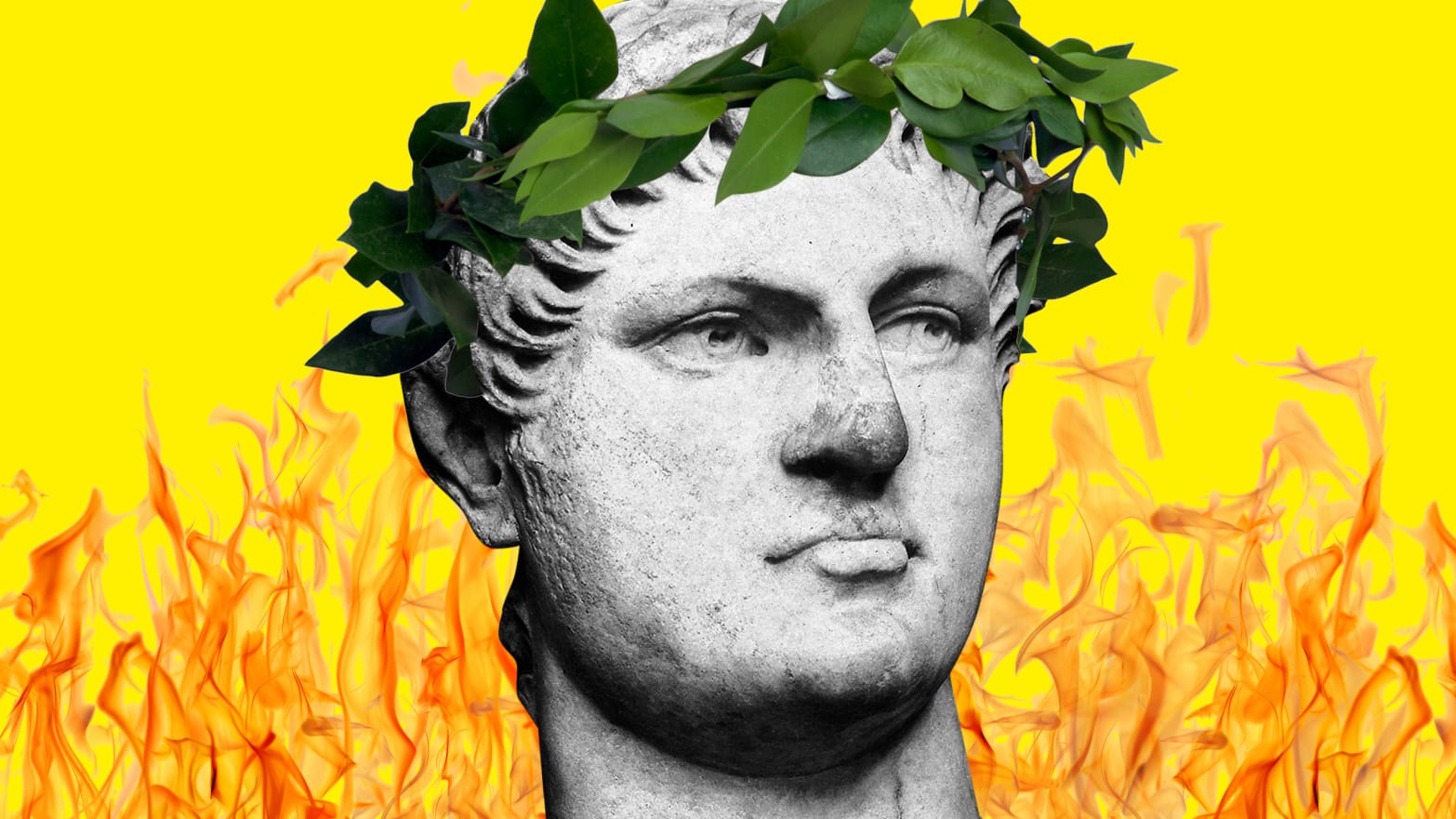
Roman Emperor Nero is a deeply fascinating core figure in ancient Roman history. Suetonius, an ancient Roman historian, included Nero’s life and deeds in his chronicle of the emperors of the Julio-Claudian dynasty: Nero’s father, Domitius, was of extremely poor moral character; when Nero was born, his father made an ill-omened prophecy, saying nothing good could be produced from his union with his wife, Agrippina. Nero lost his father at the age of 3; his mother, Agrippina, was exiled and only regained imperial favor after Claudius ascended the throne.

Via careful planning, Nero was adopted by Claudius, tutored by Seneca, and married to Octavia, Claudius’ daughter, to link his lineage to the imperial royal bloodline. He ascended to the throne at age 17 following Claudius’ death. In the early period of his reign, he governed using Augustus as a model, and according to Suetonius’s records, his acts of benevolence correspond to the timeframe of Paul’s Chapter 13 of the Book of Romans.

The initially promising start to Roman Emperor Nero’s rule collapsed abruptly. He indulged heavily in vain, ostentatious displays, public entertainments, and musical pleasures. The ancient Roman historian Suetonius recorded that Nero slid from youthful missteps into outright vice; the monarch who was supposed to uphold order was instead dragged into ruin by his own desires and the flattery of those around him.

The cruelty of Roman Emperor Nero earned him an unspeakably infamous legacy. According to records from the ancient Roman historian Suetonius, Nero murdered his adoptive father Claudius, his stepbrother, his mother, his wife, and his tutor; he plundered wealth to build his lavish Golden Palace, persecuted Christians, and was also accused of deliberately setting fire to destroy the city of Rome.

The Roman Empire then turned against Nero, and revolts broke out across its territory one after another. General Galba was acclaimed as the new emperor. Nero, who had lost all his trusted personal guards, fled and hid in the residence of a freedman. Left with no escape route, he committed suicide with the assistance of his secretary Epaphroditus. Having spent his entire life pursuing acclaim as an artist, he ultimately met a lonely, frightened, and disgraced end. It was a fate that stood in marked contrast to his harsh and oppressive rule.

Every generation has its own Caesar. People hold a range of attitudes toward him: admiration, fear, ridicule, hatred, defense, justification, or even excessive obsession. But the question is simpler and sharper: Is this illegitimate usurper of the mind, who holds no land deed and pays no rent, occupying territory that rightfully belongs to Christ?

The Apostle Paul lived under the rule of Nero, the Roman tyrant infamous for his vanity, cruelty, and persecution of Christians; yet he taught believers to submit to governing authorities and to pray for sovereign rulers. Therefore, today, we must never allow transient political figures to disrupt our personal peace, fellowship, and inner serenity.

Submitting to Governing Authorities Without Worshiping the Ruler

Paul wrote Romans 13 within the context of the Roman Empire’s rule. The opening verse of that chapter requires submission to the office of authority, rather than to the individual who holds that authority. This authority is a grace ordained by God, intended to curb chaos in the world.

Here’s a distinction the angry heart overlooks: We may honor the office without approving the officeholder. We can pay our taxes, obey just laws, respect public order, and soberly admit that the show of governance is often vain or corrupt, or cruel. Nero is the proof in the pudding. He was not a pious person, but Paul never let Nero become the focus of Christian identity. The believer bows to the structure God established, not to the sins of the one within it. That’s no failure; it is the calm strength of a soul whose genuine allegiance lies elsewhere.

Praying for Kings and Rulers Instead of Raging at Them

Then Paul makes the point, and his words indict our reflexes: “First of all, then, I urge that entreaties and prayers, petitions and thanksgivings, be made on behalf of all men, for kings and all who are in authority” (1 Timothy 2:1-2). He does not just say endure kings. Pray for them, he says. The first Christian response to a ruler should not be mockery, panic, or tribal applause. It should be intercession.

Think what such a prayer does to the one who prays it. It is a strange and holy difficulty to plead honestly for a man while nursing hatred against him; the two cannot long inhabit one heart. We can ask God to restrain the ruler’s power, to give him wisdom and repentance, to protect the innocent under his rule, and to open a door for the gospel in his land. The reason goes all the way to heaven, because it is pleasing to “God our Savior, who wants all men to be saved and to come to the knowledge of the truth” (1 Timothy 2:3-4). The man you want to hate is the man God would save. Pray like that, and watch the poison ooze out of your own soul.

When Political Obsession Becomes Idolatry of the Heart

Now we need to speak plainly. The believer on the right who can’t stop talking about one president, and the believer on the left who can’t stop talking about another, suffer the same disease from opposite ends. The names are not the same, but the slavery is. When a Christian talks more of Caesar than Christ, fears the ballot box more than the judgment seat, and finds warmer fellowship in party than in the body of the Lord, politics has quietly become a rival religion.

A ruler who has only reigned for a few years should not occupy more of your heart than the eternal King. Your heart was made for a higher throne. “For our citizenship is in heaven, from which also we earnestly wait for a Savior, the Lord Jesus Christ” (Philippians 3:20). “Keep seeking the things above, where Christ is, seated at the right hand of God” (Colossians 3:1). The true joy of believers has never been the rise or fall of earthly governments, but the unshakeable sovereignty of Christ, who sits above all parliaments and palaces. Caesar cannot fill your soul. Quit expecting him to.

Obeying God Rather Than Men: Submission Is Not Surrender

If you think submission means you have to be spineless, Scripture specifies the line. Peter answered, when the council forbade the apostles to preach, “We must obey God rather than men” (Acts 5:29). Biblical submission was never blind obedience. When the state demands what God forbids or forbids what God commands, the Christian’s higher loyalty is spoken – and it is spoken unapologetically.

But listen to the warning from the other side. Not all political frustrations are Acts 5:29 moments. We are very good at baptizing irritation as courage, rebranding contempt as discernment, and stubbornness as conviction. Even Pilate, who held Christ’s life in his hands, was told, “You would have no authority over Me, unless it had been given you from above” (John 19:11). The throne above all thrones never threatened the seat of power in Judea. And today, no other earthly authority is in danger. So discern the difference between a hill worth dying on and a mood worth indulging in.

Christ Reigns Forever: Keep the King on His Throne

As recorded in Daniel 2:21, “It is He who changes the times and the epochs; He removes kings and establishes kings.” Solomon reminds us, “The king’s heart is like channels of water in the hand of the LORD; He turns it wherever He wishes” (Proverbs 21:1). Worldly rulers are merely clay in the potter’s hand, and He is “the blessed and only Sovereign, the King of kings and Lord of lords” (1 Timothy 6:15). Nero’s ignoble death and the fall of the Roman Empire are clear proof of this, and only the reign of Christ endures forever.

Each person’s heart is like a throne room. Believers should remove anger that has taken the place of Christ’s sovereignty, reaffirm His lordship, and avoid elevating secular rulers to the throne of their hearts. The lesson is clear: pray for governing authorities you disagree with, speak the truth without hatred, and express criticism without anger.

Persecution And Hope (Part Two)

Wednesday’s Column: Third’s Words

Gary III

Gary Pollard

Last week we looked at an account from Tacitus describing the brutality of Nero against Christians who lived during his reign. Here are a few points to take away:
 
  • Jesus was a historical person.
  • Early Christians suffered immensely. If we want an idea of Christian endurance, we should look to this as an example. We do not really face persecution in the modern world.
  • That account makes inspired passages like I Peter 1.13-2.2 and I Peter 4.7 more personal. In 1.13-2.2, the Spirit tells Christians how to live while dealing with persecution with five commands:
    • Fix Your Hope (13)
    • Be Holy (15)
    • Conduct Yourselves in Fear (17)
    • Love Each Other (22)
    • Long for Pure Milk of the Word (2.2)
  • It gives more context for the desire to be in Heaven that early Christians had (II Peter 3.13; Romans 8.20-24; II Timothy 2.12).
 
“If only for this life we have hope in Christ, we are of all people most to be pitied” (I Corinthians 15.19).
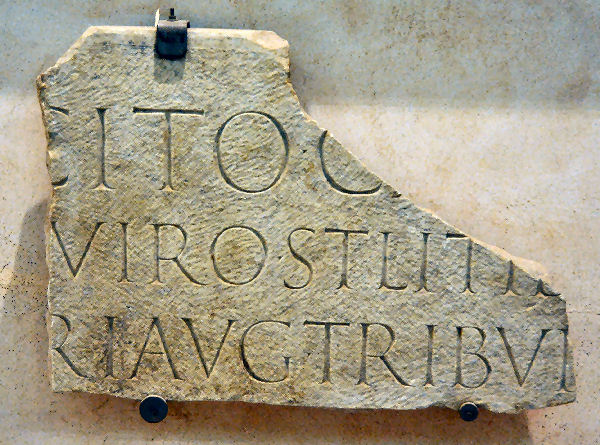
Tombstone of Tacitus (via Rome Museum)

Persecution And Hope (Part One)

Wednesday’s Column: Third’s Words

Gary III

Gary Pollard

Gaius Cornelius Tacitus (AD 56-120) wrote two secular historical works describing the reigns of Tiberius, Claudius, Nero, and Gabba, Otho, Vespasian, and Vitellius (Annals and Histories).
 
He was the son-in-law of Agricola, the Roman General responsible for Roman expansion throughout Europe, especially northern Britain. He was not a Christian by any means, but a patriotic Roman with a family heritage tied to its conquests.
 
In the following excerpt, Tacitus mentions Jesus (referred to as Christus) and details the persecution of early Christians. I have abbreviated some of the excerpt (ellipsis), given contextual explanation (brackets), and added emphasis (bolded text). The information in his writings is fascinating, but I found the following to be shareable.
 
“…The next thing was to seek means of propitiating the gods [because of the burning of Rome], and recourse was had to the Sibylline books… But all human efforts, all the lavish gifts of the emperor, and the propitiations of the gods, did not banish the sinister belief that the conflagration was the result of an order.
 
Consequently, to get rid of the report, Nero fastened the guilt and inflicted the most exquisite tortures on a class hated for their abominations, called Christians by the populace. Christus, from whom the name had its origin, suffered the extreme penalty during the reign of Tiberius at the hands of one of our procurators, Pontius Pilatus, and a most mischievous superstition [of resurrection], thus checked for the moment, again broke out not only in Judæa, the first source of the evil, but even in Rome…
 
Accordingly, an arrest was first made of all who pleaded guilty; then, upon their information, an immense multitude was convicted, not so much of the crime of firing the city, as of hatred against mankind. Mockery of every sort was added to their deaths. Covered with the skins of beasts, they were torn by dogs and perished, or were nailed to crosses, or were doomed to the flames and burnt, to serve as a nightly illumination, when daylight had expired.
 
Nero offered his gardens for the spectacle, and was exhibiting a show in the circus, while he mingled with the people in the dress of a charioteer or stood aloft on a car. Hence, even for criminals who deserved extreme and exemplary punishment, there arose a feeling of compassion; for it was not, as it seemed, for the public good, but to glut one man’s cruelty, that they were being destroyed.”
 
Annals of Tacitus Book XV

“No One Supported Me, But All Deserted Me”

Neal Pollard

These are some of the last words written by one of the greatest men who ever lived. He wrote them while in prison, waiting to die for his faith. He has just spoken of people he trusted who had deserted him. He is lacking even the bare essentials. A man, knowing how difficult his life was, had done additional great harm to him. No wonder he would open this window into his suffering soul and let us all look inside. Despite all this, he was not bitter.

Have you ever felt mistreated, even felt like people were actively against you? Or perhaps felt like people you count on abandoned or neglected you when you needed them? Maybe you have suffered for your faith. It is tempting to become bitter, even to lash out against the church and God.  Paul is a great example of how to think when you feel unsupported and deserted by those you count on. After making that statement in 2 Timothy 4:16, he says some other things that can help us when we feel, at least in a small way, the way Paul felt. 

  • Focus On The Lord. He could see how the Lord had helped through his darkest hours in the past (17). But, as importantly, he had confidence that the Lord would help him through future trials (18). Despite his unfair treatment, he could still say, “To Him be the glory forever and ever. Amen.” When people hurt and disappoint you, look higher!
  • Find Your Higher Purpose. Incredibly, Paul could sift through these sorrows and see God at work to accomplish His will. He’s suffering, but he can see a greater good. He says that he endured these hurts “…so that through me the proclamation might be fully accomplished, and that all the Gentiles might hear.” Can you look for what God, who doesn’t cause suffering, can do to bring good even out of those times? We’re prone to feel sorry for ourselves when God may be showing us and others His power through these situations to save souls and help lives. 
  • Forgive.  Paul doesn’t hold a grudge. Concerning those who let him down and even hurt him, he could say, “May it not be counted against them” (16). Doesn’t that sound like a Savior who asked God to forgive His tormentors? What a mindset! We can nurse perceived offenses, but how much better to be magnanimous toward those who we feel failed us in our hour of trial?

If you’ve never felt unsupported and deserted, you probably will at some future time. The temptation will be great to let it become a spiritual problem for you. Why not remember Paul’s response when he was in his deepest valley? It’s the way up to the spiritual mountaintop. 

paul-in-chains


Remarkable Statements, In Historical Context

Neal Pollard

AD 30—Tiberius, who became cruel and mad, was the Roman Emperor when the church was established. Under his reign, right around the time of Pentecost, Rome was filled with terror after the murder of his once trusted advisor turned traitor, Sejanus (tribunesandtriumphs.org). Sanderson Beck comments that he was “preoccupied with sexual and sadistic perversions” the last several years of his life (he is believed to have been murdered)(san.beck.org). Jerusalem was directly governed by Rome. Acts, though probably written in the 60s, begins its historical chronicle around AD 30.

  • Acts 2:41—“So then, those who had received his word were baptized; and that day there were added about three thousand souls.”
  • Acts 4:4—“But many of those who had heard the message believed; and the number of the men came to be about five thousand.”
  • Acts 5:14—“And all the more believers in the Lord, multitudes of men and women, were constantly added to their number.”
  • Acts 6:7—“The word of God kept on spreading; and the number of the disciples continued to increase greatly in Jerusalem, and a great many of the priests were becoming obedient to the faith.”
  • See also Acts 12:24 and Acts 19:20,

AD 62-63—Nero, described as licentious, cruel, tyrannical, murderous, criminal, arson, vain,  perverse (tribunesandtriumphs.org) and, by historian Donald Wesson as a “cross-dressing exhibitionist” (ancient.eu), spearheaded the first organized persecution of Christians (N.S. Gill, ancienthistory.about.com). Tacitus says he blamed the Christians for his own burning of Rome. Many are the accounts of the cruel ways Nero put them to death (eyewitnesstohistory.com). Eusebius reports that Nero put both Paul and Peter to death (Church History, Book 2, Ch. 25). Before his death, Paul would report of such rapid growth throughout Nero’s reign. Peter’s outlook could not have been brighter.

  • Colossians 1:23—“if indeed you continue in the faith firmly established and steadfast, and not moved away from the hope of the gospel that you have heard, which was proclaimed in all creation under heaven, and of which I, Paul, was made a minister.”
  • 1 Peter 1:3—“Blessed be the God and Father of our Lord Jesus Christ, who according to His great mercy has caused us to be born again to a living hope through the resurrection of Jesus Christ from the dead.”

AD 90s—Domitian, best remembered as “the evil emperor who murdered thousands of Christians” (tribunesandtriumphs.org), reigned when John wrote his epistles and the book of Revelation. He was notorious for his cruelty and detachment from reality. John writes Revelation in large part to steady the Christians to withstand the onslaught of persecution caused by Domitian. His message to the Christians during the reign of Domitian was consistent:

  • 1 John 4:4—“You are from God, little children, and have overcome them; because greater is He who is in you than he who is in the world.”
  • 1 John 5:4—“For whatever is born of God overcomes the world; and this is the victory that has overcome the world—our faith.”
  • Revelation 1:6-7—“He has made us to be a kingdom, priests to His God and Father—to Him be the glory and the dominion forever and ever. Amen. Behold, He is coming with the clouds, and every eye will see Him, even those who pierced Him; and all the tribes of the earth will mourn over Him. So it is to be. Amen.”

How bad did things look, from an earthly perspective, during the reigns of evil rulers like Tiberius, Nero, and Domitian? The thing is, the early Christians did not look at things from an earthly perspective. As those trying to walk in the footsteps of New Testament Christians, will we imitate their faith and that perspective?

vespasianus03_pushkin