The Kind Of Church God Doesn’t Want Us To Be

  Within the one body (Colossians 3:15) He claims, however, are individual congregations who in time depart from His doctrine, lose their distinctiveness, or drift from their evangelistic direction.  When this happens, even these are in danger of rejection (John 12:48).  Churches in Asia Minor felt this sting (cf. Revelation 2:5).  What kind of church does God not want us to be?

Neal Pollard

    The commercials are eye-catching.  The products have differed, but the aim of the ad has been the same.  Sit people, blindfolded, before a TV camera.  Parade a line of tastes and smells before them and let them choose their favorite.  Of course, the camera keeps only the records of the consumers who pick their product over the others.  How many others, whose experiments lay dead on the cutting room floor, choose “the leading brand” over the competitor paying for the commercial?  All of that is neatly set aside, thanks to the selective wonders of technology.

    How many religious groups parade themselves before God in each generation?  From His exalted throne up in heaven, He discards with perfect omniscience all who carry the doctrines of men along with their faith in Christ, their intense morality, or their evangelistic zeal (cf. Matthew 15:13).  He claims only one religious group, the one for which His Son gave His life (Acts 20:28), the one founded upon the foundation of Christ (Matthew 16:18), and the one following the pattern He has left them (John 16:13).

    Within the one body (Colossians 3:15) He claims, however, are individual congregations who in time depart from His doctrine, lose their distinctiveness, or drift from their evangelistic direction.  When this happens, even these are in danger of rejection (John 12:48).  Churches in Asia Minor felt this sting (cf. Revelation 2:5).  What kind of church does God not want us to be?

    God does not want weary churches.  Paul warns against weariness in well-doing (Galatians 6:9).  It is possible to find the narrow way so difficult to travel that a congregation finally gives up on doing right.  The right way is rarely the easiest way.  The opposition of the world pressures God’s people, and faint-hearted saints must strive to endure.

    God does not want weakened churches.  He abhors church leaders who are so afraid of losing “contributors” that they kowtow to them.  His wrath is kindled by preachers so pensive about their pension that they fall prey to tickling the ears of the worldly (2 Timothy 4:3). He has difficulty stomaching a lukewarm membership, made tepid in failing to be distinct (cf. Revelation 3:16). As always, those who stand for nothing will fall for anything.

    God does not want worldly churches.  He warns against it (James 4:4).  When churches try so hard to look like the world to the world, they ultimately fail to reach it.  They have nothing to offer it which it does not already have.  But, in the process, they lose God’s acceptance.

    God does not want “wanting” churches.  Belshazzar was “weighed in the balances” and “found wanting” (Daniel 5:27).  The goal of any church is to get beyond this stage of “wanting” (i.e., lacking) maturation and completion (James 1:4).  But, what about churches who are not trying to grow, win souls, train her males to be preachers, elders, deacons, and teachers, and train her females to be strong, convicted, pure, and holy Christian women, and learn more and more of God’s Word?

    God does not want wasteful churches.  American churches have the overwhelming majority of the money, trained preachers, facilities, schools, persons of influence, healthy bodies, and related resources.  That we are not “turning the world upside down” (Acts 17:6) is surprising.  No church, in these affluent circumstances, should struggle to meet unchallenging budgets.  Brethren should not be begged and prodded to do personal work.  Involvement and commitment should be assumed traits of born-again people!  We are sitting on a gold mine of opportunity and material wealth.  We must be able to stand before the King some day and make a good accounting of our stewardship of these things.

    Opportunities abound before us (Galatians 6:10).  Let us blossom into the churches the Father wants us to be (James 1:27)  — Jesus died for us to be (cf. Titus 2:14), and the Spirit teaches us to be (Revelation 2:7ff).  God wants a willing, working, waiting, and watchful church.  At all costs, let us avoid becoming a church God does not want us to be.

The Most Beautiful Attribute?

Can something commanded also be a thing of beauty? Paul indicates as much to a young man he mentored, showing us how versatile and needed this quality is in a world which needs it to stand out.

Neal Pollard

Some of the most breathtaking moments of my life have been walking through a mountain meadow in summertime. In those high altitudes where snow falls in abundance for many months, the resulting flowers that briefly bloom there seem to stand out all the more against the high, rocky backdrops. While majestic in their own right, those crags and peaks are accented and highlighted by the reds, purples, pinks, violets, and yellows that dot the paths and cling to the alpine hillsides (cf. Matt. 6:29-30). We are set apart from the world and set apart to glorify Him, in part by living holy, consecrated lives. These appropriate beliefs and devout practices that stand out in our world are called “godliness,” an attribute that even bears God’s glorious name.

1 Timothy was written by Paul to Timothy, a young preacher for the church at Ephesus. In 1 Timothy 3:15, he states that the purpose of his writing was to reveal what was proper conduct in the church that belongs to God, and so it is no surprise to see that Paul fills the letter with instructions about how to behave. And it’s also not a surprise that the word “good” occurs 20 times in the letter, and godliness 15 times. Godliness seems to play an especially key role in Paul’s message. 

  • Paul previews what he says in the heart of the letter by saying law exists for, among other, the “ungodly” (1:9).
  • Starting in chapter two, getting down to business (“First of all,” 2:1), he says our attitude toward those in government must be “in all godliness” (2:2) and that Christian women conduct themselves in a way that makes good their claim to “godliness” (2:10).
  • Elders (3:4) and deacons (3:8) must be men of “dignity” (same word), and the women addressed in 3:11 must likewise be “dignified” (same word). Jesus is the embodiment of the “mystery of godliness” (16). 
  • In chapter four, godliness is defined as distinguishing between what lasts and what will not last (4:7-8).
  • In chapter five, godliness is tied to properly treating and caring for our family (5:5–“show piety”).
  • In chapter six, godliness relates to having the right attitude toward wealth and material things (6:3,5,6,11)

Taken as a whole, Paul shows godliness to be crucial in our church life and roles, our personal devotional life, the doctrine we teach, the things we prioritize, the role models we follow, and the way we treat our family. Clearly, godliness must be a part of every facet of our lives; it’s what and who we must be. Nothing is more beautiful than a life that reflects God in thoughts, words, and deeds. Let’s let His Word guide us so that we will properly conduct ourselves as children in His house. 

Handling Our Sins As Christians

Neal Pollard

The Bible makes it very clear that every one sins (Rom. 3:10, 23). The Apostle John was a very righteous man. When all the other apostles ran away as Jesus was arrested and put through so much agony, John went with Jesus all the way to the cross (Jn. 19:25-27). He was called “the disciple whom He loved” (Jn. 13:23). But, this great apostle said, “If we say that we have no sin, we are deceiving ourselves and the truth is not in us”  (1 Jn. 1:8). The apostle Paul confessed to the fact that he struggled with sin, despite the fact that we recognize him as a faithful, fruitful Christian (Rom. 7:14-25).

 The question is, “Do I need to be baptized every time I sin?” The Bible makes it very clear that a person must be baptized in order to be saved. From the first time Jesus was preached to people, they asked what they should do. They were told to repent and be baptized for the forgiveness of their sins (Acts 2:38). The last New Testament scripture to deal with the sub- ject of baptism says, “Baptism saves you” (1 Pet. 3:21). There is no doubt but that God requires a person to be baptized in order to be saved.

However, once one is baptized into Christ (Gal. 3:27), he or she does not cease from sinning. That would be nice, but it is impossible (cf. Rom. 3:23).  We still struggle with temptation, weakness, and desires of the flesh. Yet, nowhere do we read in the New Testament of a command, example, or implied statement concerning being baptized to cover each sin one commits as a Christian. That is significant. We follow the New Testament as the pattern for our conduct, worship, and teaching on all matters.

So, what does a person do as a Christian when he or she sins? Let us return our focus to 1 John one. There, John writes, “If we say that we have fellowship with Him and yet walk in the darkness, we lie and do not practice the truth; but if we walk in the Light as He Himself is in the Light, we have fellowship with one another, and the blood of Jesus His Son cleanses us from all sin. If we say that we have no sin, we are deceiving ourselves and the truth is not in us. If we confess our sins, He is faithful and righteous to forgive us our sins and to cleanse us from all unrighteousness. If we say that we have not sinned, we make Him a liar and His word is not in us” (6-10). First, notice that one can claim to have fellowship with God but will disprove that claim by walking in sin. One cannot walk in darkness and have their sins covered.

Second, notice that fellowship with God is maintained by walking faithfully in Christ. The blood that forgives our sins in baptism continues to cleanse us as our walk is righteous. However, “walking in the Light” is not the same as sinless perfection. What John says in the next three verses proves this.  We are actually sinful to claim sinless perfection (8,10).

Third, notice what one does to maintain fellowship with God while coping with and trying to overcome sin. In verse 9, John speaks of an honest awareness of the presence of sin in our lives that leads us to confess our sins. Some deny, defend, or excuse their sins, but that makes one like those John warns about in verses 8 and 10. Instead, a humble, penitent heart that is quick to see and acknowledge the presence of sin in his or her life is one who will enjoy cleansing from a God faithful and just to forgive such sinners. How does a Christian handle personal sin? Do not make it a matter of lifestyle (7), but when sin does occur be ready to confess it (9).

 One other element implied by John and explicitly stated by Peter is the idea of repentance. In Acts 8, a man named Simon committed sin. Peter rebuked him for the sin, saying, “Therefore repent of this wickedness of yours, and pray the Lord that, if possible, the intention of your heart may be forgiven you” (22). Repentance and prayer are necessary acts for a Christian who sins. Paul praises the Corinthians for following the same pattern to handle their sins as Christians (see 2 Cor. 7:10-11).

It would be wonderful if we did not sin as Christians, but such is just not possible. Thus, when we do sin, we need to have an awareness of it, a heart that is sorry about it, and a determination to overcome it, repenting of it, confessing it, and praying about it.

Women’s Role Isn’t The Issue

Neal Pollard

Anecdotal and emotional appeals are made. Expressions of dissatisfaction with how things are “done in churches of Christ” and anxious concerns that we are in the minority seem to ignore something much more significant. What does the Bible say?

A preacher recently wrote, “I wonder how many of our members are as dumbfounded as many of our ministers about our current practices with women in our churches, but have allowed fear and caution to keep them silent as our practices remain the same. Is it groupthink? Do we have well thought out theologies supporting our current practices? Do most of us realize the oddity of our male dominated services in 21st century society? Perhaps there are more who want to ask these questions than we sometimes imagine.”

In an age when women have been allowed by society to ascend all the way to the top of the corporate ladder, assuming the heads of companies, the fields of medicine, science, politics, and education, it may seem odd to some that she does not lead singing, lead prayers, “preside” over or serve the Lord’s Supper, preach, or serve as an elder or deacon in mainstream churches of Christ. Is this a civil rights issue? Is it a cultural issue? Exactly what is the issue?

The reason that those certain preachers feel “there comes a time that silence must give way to words and actions” seems bigger than a single issue. The reason has to do with a basic approach to the Bible and an attitude toward what it is and how it serves today. If the issue was simply what the Bible has to say, the issue would be an open and shut case. In 1 Timothy 3:15, Paul tells Timothy he is writing that letter “so that you will know how one ought to conduct himself in the household of God, which is the church of the living God, the pillar and support of the truth.” This follows a “household of God” matter already mentioned by Paul in 1 Timothy 2:8- 15. Amid a discussion of women’s role, Paul says, “A woman must quietly receive instruction with entire submissiveness. But I do not allow a woman to teach or exercise authority over a man, but to remain quiet” (11-12). The reason he gives is not tied to first century culture. As Timothy was the preacher at Ephesus and was half-Greek himself, Paul did not appeal to ethnicity. He goes back to the creation, a different time, place, and ethnicity. Cultural practice or norm was not the issue.

Here is the issue. What is our attitude toward the Bible? Is it God-breathed, equipping man for every good work (2 Tim. 3:16-17)? Is the God who created each of us, our world, and the universe, with every amazing intricacy of design, smart enough and powerful enough to successfully communicate to man in written form in a way that would stand the tests of time, transmission (making copies from original documents), and translating it into different languages? Certainly, man would be incapable of this, but dare we say that God did not do this? Especially should we be careful when the Bible claims over and over again that God did communicate through inspired men.

If scripture is not reliable as the standard of religious authority and does not contain an established pattern for teaching and practice, so many other matters are up for grabs–the institution of marriage as it is, homosexuality, abortion, calling our Creator “Jehovah” rather than “Allah,” the Deity, atonement, and resurrection of Christ, and the list is truly inexhaustible. On what grounds do we reject clear teaching on women’s role in churches of Christ while accepting that there is no way to the Father but through Christ? Beware! This is bigger than a single issue. One’s attitude toward the inspiration and authority of scripture is the real, underlying issue!

The Plan Is Perfect, But The Church Isn’t

Tuesday’s Column: Dale Mail

Real cowboys from the American frontier, both the good guys and the bad guys, had no interest in the big, bulky Stetsons that everyone associates with them. Contrary to our more modern cowboys, the most popular headgear among 19th century gunslingers was the bowler, sometimes called a derby.

Many people have an idea in their minds of what the church looks like, but it just might be the case that the image doesn’t match scriptural teaching. 

The “church” in the Bible is a singular, unified group of God’s people spread out across the globe in the form of multiple likeminded congregations. Though the people are God’s— they’re still people. People have problems. The difference between His family and the world, though, is that there’s a solution and a hope for His own. 

When New Testament Christians claim that there’s one church they don’t mean there’s only one group of people who have all the answers and can do no wrong. They simply acknowledge the Biblical truth that God made plans for only one church and that plan had been in motion before the creation of the world (Eph. 3.10-11). 

The New Testament is largely made up of letters that were written to correct and admonish our natural human tendencies. When these things are left unchecked and unbridled they produce more pain and destruction, which can clearly be seen all around us. For most, the product of sin is self-evident but the power of the Savior isn’t— and that’s where the church comes in. The main function of the church is to seek, save, and keep the saved saved. This is done by walking, speaking, and acting like Jesus. The form and function of  His family is simple because God’s goal is to save as many as possible (Jn. 3.16-17). The New Testament church is meant to be the hands, feet, and mouth of God. The church is to work, walk, and speak only the things He would and that’s only possible if a group of people are living by His instruction. Since God only wrote one book, there’s only one manual. Since following the instructions will produce one church family then there’s only one church. In the same way you can assembly an entertainment system wrong by incorrectly following the plans, you can also assemble the church wrong. There’s a right way and there’s a wrong way and one needs only to reference His instructions to be certain. 

Dale Pollard

Worship That Wearies God

Monday’s Column: Neal At The Cross

Neal Pollard

If we are honest, some days it is easier to worship with focus and enthusiasm than others. We’re human and we struggle. With mental preparation and prayer, we can minimize the frequency of such times, but they happen to the best of us.

Have you ever thought about God getting tired of the worship brought by His people? I don’t mean worship done incorrectly and according to the will of men which violates what He commands. Apparently, He rejects such worship (Mat. 15:9). I don’t mean the idea that He gets bored and had rather skip a Sunday here and there. No such picture is ever painted of God.

But through the prophets, He repeatedly talks about being weary of the worship brought by His people. 

“I have had enough…I take no pleasure in…your worthless offerings…an abomination to me…I cannot endure…They have become a burden to Me; I am weary of bearing them” (Isaiah 1:11-14).

“I hate, I reject your festivals, nor do I delight in your solemn assemblies…Take away from Me the noise of your songs; I will not even listen to the sound of your harps” (Amos 5:21,23).

“Oh that there were one among you who would shut the gates, that you might not uselessly kindle fire on my altar! I am not pleased with you,” says the Lord of hosts, “nor will I accept an offering from you” (Malachi 1:10). 

Each prophet is dealing with specific circumstances prompting such a response from God, but it should cause us to take notice that just coming into the “meeting house” and going through the motions does not equal acceptable worship. Neither does simply following the New Testament pattern for the acts of worship. You will find in each of the passages above that the people were at the right place offering the right sacrifices on the right day led by the right people. The problem was either one of attitude, hypocrisy, or outright worldly living. Jeremiah documents how the people lived just like the world for the rest of the week, then filed into the temple to sing, “Redeemed, how I love to proclaim it!” (7:4-10). 

Worship is a special privilege, to come into the presence of our Maker and Savior. At our best, we worship Him with sin and weakness in our lives. He knows that and the cross proves that He knows it. He is not expected sinless perfection, but He is looking for characteristics in our worship just beyond doctrinal accuracy.  He wants:

  • Feeling (Psalm 95:6; John 4:24).
  • Engagement (Matthew 15:8).
  • Effort (Hebrews 13:15).
  • Gratitude (Ephesians 5:20; Colossians 3:16-17).
  • Thoughtfulness and Intentionality (Ephesians 5:19; Colossians 3:16).
  • Devotion (Acts 2:42).
  • Consideration of one another (Hebrews 10:24). 

It is such a blessing that God communicates with us not only about the “what,” “when,” and “who” of worship, but also the “how” and “why” of it. When we are assembled for worship, He tells us what worship should look like. Between the assemblies, He tells us what a life looks like that partners with that worship.

God speaks of the various sacrifices of His children being a “fragrant aroma” to Him (Philippians 4:20; ). He likens the prayers of His faithful people to incense (Revelation 5:8; 8:1ff).  Jesus assures us that true worshippers offering true worship are highly sought after by God (John 4:23). That’s the aim, isn’t it? The idea of presenting God with both a worshipper and worship which enthuses Him is the pinnacle of excitement! 

Next Sunday, before we come together in worship, we can read Psalm 95, Psalm 96, Isaiah 6, or a similar chapter which reminds us of Who we get to worship. Today and every day, let us strive to build on the most recent worship we have offered by a life of faithful service and sincere devotion. That will set the table for worship God can’t wait to receive! 

Dear Christian Teen,

Thursday’s Column: Captain’s Blog

Carl Pollard

Dear Christian Teen, 

Most of you have heard 1 Timothy 4:12, “let no one look down on your youthfulness,” at some point in your lives. But what about the second half of the verse? In I Timothy Paul has been instructing Timothy on how to deal with men like Alexander and Hymenaeus. These men had been blaspheming and teaching false doctrine. Paul clearly states that the goal of their instruction should be love from a pure heart, a good conscience and a sincere faith (1:5).

Skipping down to chapter four, Paul tells Timothy that no one should look down on him because of his age. Timothy is charged to teach the gospel and handle the men that have been teaching false doctrine. To do so, he can’t let others’ view of him cause him to stop doing his job. When Paul says “youthfulness,” the original text uses a word that could be ascribed to someone as old as 30. Paul’s main point is that in “speech, conduct, love, faith and purity, show yourself an example of those who believe.” This is what Timothy should have been doing. Forget the age, forget what other men are saying, and LIVE as an example. Paul wanted Timothy to be a “tupos” or “type” that men can follow. Timothy could do nothing about his age, so his effectiveness was to be rooted in his example.

So, young Christians today, what can we do to be an example? There are five things we can do. First involves our speech. This is external. People can hear the way you talk in your everyday life. Make sure it is blameless and pure. Don’t give someone a reason to reject you because of how you speak in your private life. Second involves our conduct. Once again this is external. Having proper conduct is vital if people are to see you as something more than just a youth. Be a man/woman of God whether you’re being watched or not. Third involves love. This is more internal than external. This love is an agape love. Sacrifice for others at the expense of your own good. This also goes back to 1:5 “love from a pure heart.” Fourth involves faith. This is also internal. Work on your own faith. Build your own relationship with God. Last involves purity. Be pure in your relationships and in your life when no one else is around. Do these things as “an example (type) to those who believe.”

Paul continues on in verses 4:13ff to discuss other ways he can be an example: giving attention to the public reading of scripture, exhorting and teaching, and using his spiritual gift he had been given by the Holy Spirit. 

Paul wanted Timothy to be a living example. When these men were looking down on him for his age, Paul didn’t tell him to focus on his experience, but on the source. Focus on your own spiritual life, your own personal reading of God’s Word, your own prayer life. Don’t blame them or use them as an excuse. Be an example they can respect and follow. Show them what a true Christian looks like.

Timothy had a hard job on his hands, since he was facing false teachers and blasphemers that were tearing apart the church. He had to work and be the proper influence for the Christians there at Ephesus. As teens today, you also have a hard task ahead of you. Many in the church think that you don’t need to be working yet. God says otherwise. You can and should be an example for others to see. Each one of you has your own group of friends that only you can influence. So be the example. In your speech, in your conduct, in your love, your faith and your purity. Show them the truth, and never neglect your own Christianity.

A Simple Way To Identify The Church Jesus Started 

Tuesday’s Column: Dale Mail

IMG_1381

Dale Pollard

There are just too many voices in the world today muddying the waters when it comes to 21st century Christianity. In fact the term, “Christianity,” doesn’t mean much the average person. In fact, the average person will most likely have several friends who carry this title and they know based on their morals— they’re not really different. Sadly it’s a description that doesn’t describe much, other than an individual that believes in God. That’s really it! This word has been tragically stripped of what we understand to be the most rewarding life you could possibly live. There’s simply no higher calling, there is no greater purpose in life, and you just can’t beat the retirement plan. 

Now let’s do something to help the seeking world out. 

Let’s make it our priority to understand the church in such a way that we can simplify her mission and her origin. 

Here are two terms that will help:

  1. The term “restoration” may sound similar to “reformation”, but the two terms could not be more contrary to each other. Restoration is an attempt to return the church to the pattern we find in the New Testament, while reformation is a changing of what currently exists. It’s a modification or addition which creates something new entirely. The Old Testament is filled with the pleas of the prophets for the people to restore their relationships with God. 

    2.  The definition of the word “denomination” is evidence that restoration is not only possible, but needed. Denomination, in the religious world, describes a branch off of an  original. Any branch coming off of the New Testament church, is simply not it. 

Five Facts About The Lord’s Church 

  1. The New Testament church was established by Jesus, not Luther, Henry the 8th, Calvin, Smith, or Wesley
  2. The New Testament church was established in Jerusalem, not Oxford, London, or Amsterdam
  3. In New Testament times people were told to believe in Jesus, repent of their sins,  be baptized by a total immersion of water, and to live faithfully (Acts 2:38, 16:30-31, 2:16, Mark 16:15-16; Romans 6:1-4; Revelation 2:10) 
  4. Christians in the New Testament met on the first day of the week to partake in the Lord’s Supper (Acts 20:7)
  5. The New Testament church was a united church, while denominationalism is, by its very nature, divided. 

If the church you are a part of can say the same, you can be confident that it is the church that Jesus established. If this is not what the church you are a part of teaches and practices, then perhaps this will be some information that will help you begin a life-changing search to find God’s will for your life. 


A Simple Way To Identify The Church Jesus Started 

Tuesday’s Column: Dale Mail

image

Dale Pollard


There are just too many voices in the world today muddying the waters when it comes to 21st Century Christianity. In fact, the term “Christianity” doesn’t mean much to the average person. In fact, the average person will most likely have several friends who carry this title and they know based on their morals— they’re not really different. Sadly it’s a description that doesn’t describe much, other than an individual that believes in God. This word has been tragically stripped of what is the most rewarding life you could possibly live. There’s simply no higher calling, there is no greater purpose in life, and you just can’t beat the retirement plan.

Now let’s do something to help the seeking world out.

Let’s make it our priority to understand the church in such a way that we can simplify her mission and her origin.

Here are two terms that will help

  1. The term “restoration” may sound similar to “reformation”, but the two terms could not be more contrary to each other. Restoration is an attempt to restore the church to the pattern we find in the New Testament, while reformation is a reforming of what currently exists. It’s a modification or addition which creates something new entirely. The Old Testament is filled with the pleas of the prophets for the people to restore their relationships with God.

2.  The definition of the word “denomination” is evidence that restoration is not only    possible, but needed. Denomination, in the religious world, describes a branch off of an  original. Any branch coming off of the New Testament church, is simply not it.

Five Facts About The Lord’s Church

  1. The NT church was established by Jesus, not Luther, Henry the 8th, Calvin, Smith, or Wesley
  2. The NT church was established in Jerusalem, not Oxford, London, or Amsterdam
  3. In NT times people were told to believe in Jesus, repent of their sins,  be baptized by a total immersion of water, and to live faithfully (Acts 2:38, 16:30-31, 2:16, Mark 16:15-16)
  4. Christians in the NT met on the first day of the week to partake of the Lord’s Supper, Acts 20:7
  5. The NT church was a united church, while denominationalism is, by it’s very nature, divided.

If the church you are a part of can say the same, you can be confident that it is the church that Jesus established. If this is not what the church you are a part of teaches and practices, then perhaps this will be some information that will help you begin a life changing search to find God’s will for your life.

church

The Tie That Binds 

Tuesday’s Column: Dale Mail

image

Dale Pollard

When it comes to the families that make up the church, what ties us together is a common bright future. While every family has it’s differences, one constant remains— the church. All strive to follow those guidelines laid out in Scripture. Paul says in Philippians 1:6, “And I’m SURE of this, that He who began a good work in you will bring it to completion at the day of Jesus Christ.”

The writer speaks with assurance, and that confidence is well placed. From His-story we see that God always completes His projects. He never dreams, He creates. He decided to create the world and here it is. He decided to save the world, and here we are.

Paul also would write in Romans 7-8 that the flesh tends to get in the way of the spiritual. God is perfect, but we’re not. That’s what makes us a work in progress. Aren’t we thankful that God provides the solutions to “fix” us up?

We’re involved in a great work because there simply is no better work than what is being done by His church. That being said, many of us struggle with overcomplicating things. We try to make sense of our individual lives, and when we leave God out it all becomes a discouraging battle. Where’s the peace? Joy? Confidence? Maybe it was left behind when we left God’s path. Thankfully God came down to earth years ago to teach us everything we need to know. We see that in His interactions with people. Even His twelve original followers were an odd group.

Each had a diverse background. Some were Fishermen and some tax collectors.

Each one had a unique personality too! They ranged from timid to assertive.

Each one had spiritual battles from greed to crippling doubt.

Yet each one rallied under His leadership and were united through a common hope.

What’s changed? Not much.

The personalities, talents, backgrounds, and flaws mixed together create a unique blend that make up each one of us. Yet, here we are rallied under His leadership, united in common hope.

800px_colourbox1580110

“First, Sit Down…”

Screen Shot 2019-12-21 at 9.08.51 AM
Not pictured: Riley, who was under the weather. 

Neal Pollard

In Luke 14, Jesus gives a couple of short parables about counting the cost of discipleship. He prefaces them by saying, “If anyone comes to Me, and does not hate his own father and mother and wife and children and brothers and sisters, yes, and even his own life, he cannot be My disciple. Whoever does not carry his own cross and come after Me cannot be my disciple” (26-27). If we drink deeply of this statement, we see exactly how challenging it is. The choice is always between Jesus and everything and everyone else. How badly do we want what only Jesus can give? Think hard, then decide!

Then come the parables. The first is a construction parable, of one building a tower. He first sits down and calculates the cost in order to be able to finish and avoid ridicule (28-30). The second is a military parable, of a king going into battle. He first sits down and considers whether or not he can win (31-32). The common denominator in both parables is to first sit down and deliberate. Ultimately, there is action which follows, but the planning precedes it.

In how many congregations do elderships or men in the absence of elders never get proactive and formulate a plan for the immediate, intermediate, and far off future? Leadership must cast the vision and deliberate about where that congregation is going and how it will get there. What will be done to grow? How can we get more members active? How can we best utilize the collective resources of the congregation? The Bible reveals all the answers, but it is essential for the church’s leaders to gather around the drawing board.

It was exciting to spend a few hours at the Lehman elders’ 2019 retreat to discuss the short-term plans of the congregation. These men are convicted about the stewardship of the work they eagerly consented to do as our shepherds. They want us to be more effective, but they are determined to set the tone and example for us. I’m amazed at how deeply they care about us and the growth they want us to collectively experience. Words like emphasis, accountability, and purpose continually came up. Building a biblical culture, which works against our contemporary culture of consumers rather than producers, is foremost in their minds. They desire for us to “grow together” as a church, drawing those outside of Christ to our spiritual family.

I cannot wait to see what God will do through such capable leaders in 2020 and beyond. We are blessed with such godly, conscientious elders. Please don’t miss a day praying for Russell, Riley, Kevin, John, Darrell, and Bobby and their families. Also, please never miss an opportunity to express your love, encouragement, and support of them as they strive to do their best to fulfill their God-given duty. Or, as Paul put it, “But we request of you, brethren, that you appreciate those who diligently labor among you, and have charge over you in the Lord and give you instruction, and that you esteem them very highly in love because of their work. Live in peace with one another” (1 Th. 5:11-12). 

They are first sitting down this weekend, but then they will challenge us all to “rise up and build” (cf. Neh. 2:18). 

THERE IS A PATTERN OF TEACHING

Neal Pollard

The Bible claims to hold the answer to your greatest problem. Not only that, but it helps you to identify what that problem is which you may or may not even know about. In Romans 6:16-18, Paul talks about a “form of teaching” given to those at Rome. 

Paul writes this powerful epistle to emphasize that salvation is by faith and not by works of law, but faith in what? One might say, “Faith in Jesus,” and Paul makes that point repeated in Romans (3:22; 3:26, for example). But how do we have faith in Jesus? He says, “So faith comes from hearing, and hearing by the word of Christ” (10:17). 

Elsewhere, Paul reminds us that there is “one faith” (Eph. 4:5), so a purely subjective faith (what we think we should believe) is not the faith commanded in Scripture. So, we’re looking a t a faith produced by reading, learning, and following God’s Word.

No wonder, then, that Paul emphasizes the importance of obedience in this text. Does God want you and me and everyone else to obey the same thing? Or can you pick what you want to obey while I pick what I want to obey and everyone else do the same? Paul talks about an objective standard of teaching that is for everyone, everywhere, for all time. Look closer at what he says in this brief passage of Scripture and what it means for us today.

THE FACT OF THE PATTERN (Rom. 6:17)

Paul talks about a form, a kind, class, or thing that suggests a model or pattern (BDAG 1020). It is the word used in the Greek Old Testament in Exodus 25:40 and quoted by Stephen (Acts 7:44). Translators chose the word form (“standard,” ESV, or “pattern,” NIV) in this verse. 

For those who pour concrete, you use “form boards” to cause it to conform to their shape in width, length, and height. Without some way to hold the concrete, what a waste of time and money! The concrete would be totally useless. It’s the same concept for those who bake and use cake moulds, muffin pans and cookie cutters. If you put dough or mix into a round pan, you don’t expect a rectangular finished product. 

Paul talks about a teaching that conforms to a certain form or pattern, having definite, identifiable structure. So, the Romans received teaching that was meant to produce the same result in every case. A growing number of people look at the Bible as basically shapeless and formless. They reject the idea of pattern theology, the very thing Paul appeals to in Romans 6:17. The alternative to there being a pattern for salvation, worship, church leadership and organization, sexuality, morality, gender roles, and all teaching is that we have no pattern.

Without a standard to appeal to, how do we determine right and wrong? Historically, when humanity rejects an absolute standard, we choose what we think is right and wrong (cf. Jud. 17:6). This is a fatal way to live (Prov. 16:25), and it destroys societies (Prov. 14:34). But everyone is going to appeal to something as the final say and authority, even if it’s only self. There is a “standard of sound words” (2 Tim. 1:13). It must be retained and it carries with it the authority of Christ Jesus.

THE FRUIT OF THE PATTERN (Rom. 6:17-18)

Since there is a pattern of teaching, what are the consequences? Paul implies that we must obey it and commit to it, just as the Romans did. The end result of such obedience is that we become slaves to the right master. Everyone will inevitably be enslaved, whether to sin or righteousness. This pattern shows us the right choice to make. We’re not just talking about information, but rather information which leads one to do something and become something. 

THE FREEDOM OF THE PATTERN (Rom. 6:18)

Ironically, those who reject the idea of pattern theology claim that such unfairly restricts and inhibits us. But, Paul draws a different conclusion. Obeying the form of teaching and committing themselves to it led them to be free from sin. Sin brings spiritual death (5:12), condemnation (5:16), enslavement (6:6), and deception (7:11). If we understand the true nature of sin (which biblical teaching defines), we will want to be free from the burden of it.  The form of teaching shows us how to do that. Anyone who wants freedom from sin can have it, but anyone who wants freedom from sin must follow the pattern. 

Obeying Christ’s teaching is not legalism. It is faith in His power, but also submission to His will. There is truth. We can know it (John 8:32). We must obey it (Rom. 6:17). It will free us (John 8:32)! 

fh07may_pourc_01-2

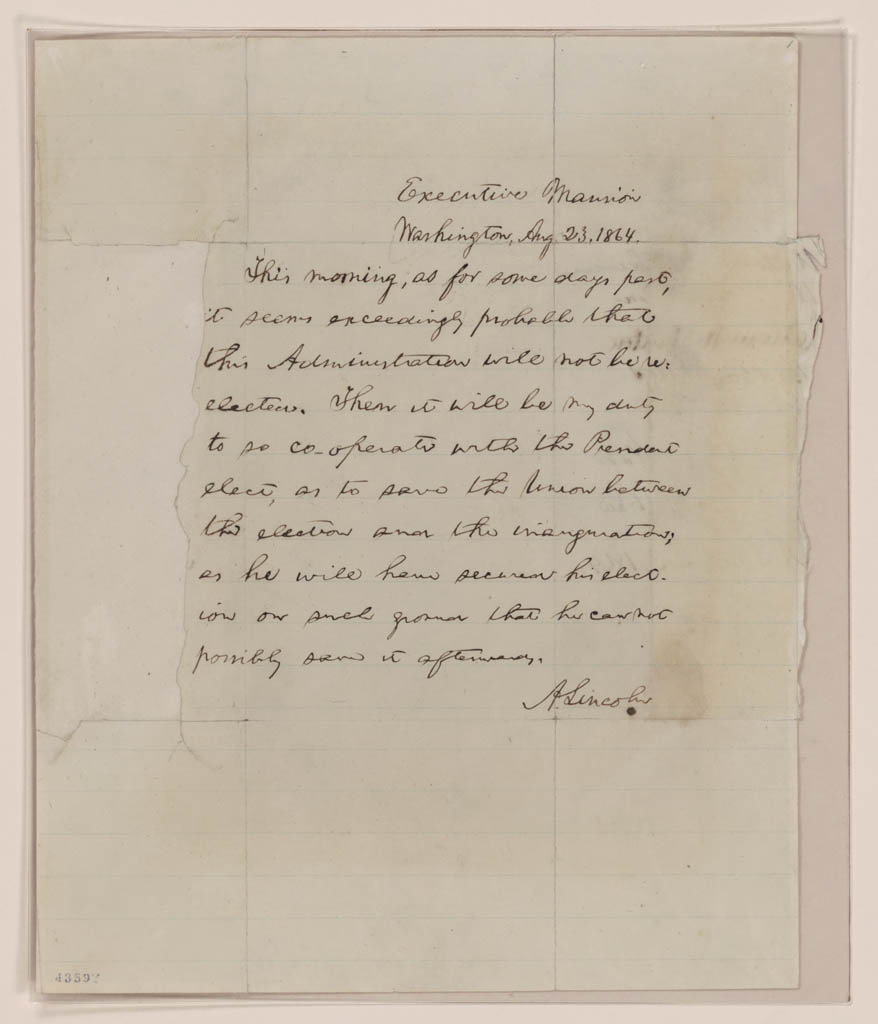
Abraham Lincoln’s Memorandum Of August 23, 1864

Neal Pollard

Somehow, I was unaware of the existence of a document which Abraham Lincoln drafted and had endorsed by every member of his cabinet, though unseen by them, and which remained sealed until November 11, 1864. These were not only dark times for the nation, embroiled in civil war for over three years at that point, but gloomy for the war-weary north which could not end the conflict against the greatly outmanned but tactically superior south. Politicians and citizens were unhappy with the perceived lack of success and progress at such high cost—the death and disabling of so many of her sons in the prime of their lives.  Lincoln detected that popular sentiment was such that he would not be reelected. Thus, he drafted his memo, which read, 

This morning, as for some days past, it seems exceedingly probable the this
Administration will not be reelected. Then it will be my duty to so cooperate
with the President-elect as to save the Union between the election and the
inauguration: as he will have secured his election on such ground that he
cannot possibly save it afterward (Coolidge 139). 

Lincoln seemed to think that the north had had enough of this war and would rather sue for peace and allow our sea to shining sea to be two nations rather than continue with such devastating effects a war they could see no end to. He appears dedicated to whatever he could do to preserve unity.

Of course, several things changed the course of Lincoln’s fate in his bid for reelection that swept him decidedly into office for a second term. There was the north’s victorious show in The Battle of Atlanta, Fremont’s withdrawal from candidacy, the Democrats internal division between the Copperheads—eager to end the war now—and the War Democrats, and the fact that no electoral votes were counted from the Confederate States of America.  But, Lincoln could not see the future. He was preparing for what he saw as the worst.

There is a well-worn battle taking place in our world. It is not technically between two factions. It might be framed as Christianity versus other world religions. It could be cast as New Testament Christianity versus so many individual denominations. Yet, internally, there are multiple stressors to the biblical unity Christ prayed and died for, too (John 17:20-21). 

Christians are soldiers (Eph. 6:10ff), but our battle is not with flesh and blood (Eph. 6:12).  Our war and weapons are not “of the flesh” (2 Cor. 10:3-4). All the same, many have grown weary of fighting the good fight and not a few feel as though we are fighting in a losing cause. The restoration ideal of doing Bible things in Bible ways seems archaic and impossible to growing numbers of saints. Some fight with equal vigor to preserve traditions not rooted in Scripture, and unnecessarily harm the great cause. 

As we strive at all costs to be true to the pattern of New Testament Christianity, let us do so going to whatever lengths we can to maintain unity wherever possible. Not for a moment does that mean sacrificing truth or compromising even one “thus says the Lord.” But it does mean embracing a spirit of love and protectiveness for the precious Bride of Christ, the church. That involves loving and working with those who are the members of it. 

Ultimately, the Lord’s cause will prevail. His victory is as assured as every other divine promise. We must be striving on His side to share in that. For now, we cannot give up the fight! Let’s cooperate wherever and however we can, standing unitedly on the foundation of Christ and His will. The rest (which is most of it), we will leave to our Great Commander In Chief!

Works Cited:
Coolidge, Louis A. American Statesman Ulysses S. Grant (New York: Chelsea House, 1983).

blind-memo-recto-al0204

Having Real Wasabi

Jackson Davidson

Who here likes wasabi?  Who here even knows what wasabi is?  It’s a spicy, green plant used in or with many Japanese foods like sushi, and chances are,  you’ve never had the real thing.  Only thirteen percent of wasabi is the real thing.  Most is just horseradish colored green.  And the reason that most is fake is that there just isn’t enough to go around.   Wasabi is one of the hardest foods to cultivate. One plant takes fifteen months to grow.  If there is too little sunlight, the plant won’t grow.  Too much, and the plant withers and dies. Aso, the pure spring water that flows through the plants has to be 13-18 degrees Celsius.

In many ways, this is like denominations.  Many churches claim to be the right church and make it look quite convincing.  Others try to be right, often times trading out the truth for opinion.  Matthew 24:24 says,  “For false messiahs and false prophets will appear and perform great signs and wonders to deceive”

We should also consider Psalms 18:30,  which says “as for God, His way is perfect, the Lord’s word is flawless, He shields all who take refuge in Him.”

We have to be careful to make sure we as the church are teaching the truth, God’s perfect way, and are Wasabi in its pure form, and not Wasabi that is just green horseradish.

fresh_wasabi_rhizomes


The Best Thing To Do For The Body This Year

Neal Pollard

When it comes to caring for the physical body, I have a lot to learn. While I work out nearly day, my most developed muscle is the table one. I will be working to use that muscle far less this year. But judging from all the new faces in the gym this morning, there are a lot of people who are going to be exercising their bodies who haven’t been doing so—at least for the next few days or weeks.

When it comes to caring for the spiritual body of Christ, I have even more to learn. Helping the church grow, develop, and fulfill its purpose better is a challenge that grows more daunting with each new year as our culture changes, our own distractions mount, and our sight is so easily eclipsed by the influence of this world. With that in mind, there is something we can do for His body that will give it its best opportunity to please God.  It centers around what we do with the Bible, as a church.

We must have confidence that God’s Word will give us what we need to have to be what we need to be. Through such, we will be “nourished on the words of the faith and of the sound doctrine” (1 Tim. 4:6). It takes the Word to cause “the growth of the body for the building up of itself in love” (Eph. 4:16). Isn’t this what Paul is also saying to Colosse, when he urges them to hold fast to the head so that the body would grow “with a growth which is from God”? (Col. 2:19).  We cannot hope to strengthen and protect Christ’s spiritual body locally without consulting the training manual of the Great Physician.  Let’s make that specific and practical:

  • Preachers must lovingly preach even the difficult subjects (i.e., God’s law of marriage, divorce, and remarriage, the distinct plan of salvation, the undenominational, singular nature of the New Testament church, God’s sexual ethics, the role of men and women, God’s pattern of worship, personal purity, etc.) and be a living example of the believer as their ethic is driven by that Word.
  • Elders must shepherd guided by the infallible Word and not with personal favoritism, deciding solely on popularity or what the majority favors, bending to political correctness, fear of offending influential members, and the like.
  • Deacons must function in a way that shows discipline, dedication, devotion, and discretion which is shaped and guided by the New Testament pattern for their works.
  • Members must follow with love, esteem, and cooperation when their leaders urge them to follow God’s truth, even if it’s distasteful to us or challenges our comfort and complacency.
  • Individual Christians must discipline their hearts and minds to be open and submissive to what they encounter in Scripture rather than be defensive and rebellious.
  • Families must dedicate themselves to studying and honoring the Word at home, in their daily lives, to grow and mature in the Words of truth.
  • Each of us must see the mandate to save souls, repeated throughout the New Testament, as a personal responsibility for which God holds us all accountable.

Isn’t it exciting to think about how much stronger the body of Christ where we are might be this time next year? If each of us will allow God’s inspired word to be the beacon and guide of our lives, His body is going to be powerful, noticeable, and desirable. We will draw men to Christ. We will be the picture of spiritual health. As you make your resolutions, won’t you determine to let the Word of Christ richly dwell within you (Col. 3:16).

Working out

WHERE ARE THE ELDERS?

Neal Pollard

  • At the hospital, attending a surgery
  • At home, hosting a family or families and getting closer to the sheep
  • Hosting and attending church activities
  • In private meetings with hurting, needy members
  • In meetings together, praying over and discussing the needs of the sheep
  • Spending time with their wives and children, nurturing that needed part of their lives
  • On their knees and in their Bibles, strengthening their walk with the Good Shepherd
  • Teaching our Bible classes, leading our worship, and even preaching as needed
  • On the job, exemplifying Christ before the world in a superlative way
  • Weeping with the weepers at funerals
  • Found among our graduates, parents of newborns, celebrating newlyweds, and other happy moments experienced within the flock
  • In Bible studies with non-Christians or Christians wrestling with some Bible matter
  • Looking for visitors and new faces in our assemblies
  • Working, sleeves rolled up, on workdays and other occasions where they can serve
  • Enjoying fellowship, their very actions reminding us they’re normal and one of us
  • Watching and listening carefully, especially at the teaching and preaching that is done, ensuring the spiritual food their sheep ingest is healthy and nourishing
  • Holding up the hand of faithful gospel preaching, having their hands help up by their preachers
  • Touching base with the deacons, encouraging and aiding their success in ministry
  • Attentive to little children, the elderly, the alone, and others that many might unintentionally overlook
  • Ensuring the unity of the Spirit in the bond of peace, rooting out divisiveness
  • On the phone and in the homes with erring sheep, striving to retrieve them and, sadly, if necessary, leading the flock to withdraw fellowship from the irretrievable
  • Setting the spiritual tone, emphasis, and direction of the flock

Our elders, like faithful elders everywhere, do a lot that is unseen by the majority.  It is hard to quantify the time and effort each of these godly men put into their work, but God sees it. What is more, God rewards it. My prayer is that righteous elders everywhere will take heart at what an inspired elder once wrote: “Therefore, I exhort the elders among you, as your fellow elder and witness of the sufferings of Christ, and a partaker also of the glory that is to be revealed, shepherd the flock of God among you, exercising oversight not under compulsion, but voluntarily, according to the will of God; and not for sordid gain, but with eagerness; nor yet as lording it over those allotted to your charge, but proving to be examples to the flock. And when the Chief Shepherd appears, you will receive the unfading crown of glory.”

13239021_10153682591930922_3851531815462243933_n
Bear Valley elders among our 2016 High School graduates

The Logical Progression Of The Line

Neal Pollard

Suddenly, it has become imperative that bathroom concessions be made for those who are struggling with gender identity issues. The comprehensively consuming coverage it has garnered, the blistering backlash against any opposing of this baffling blurring of the lines, and the preeminent priority this has become for a problem pestering a puny percentage of the population is actually not surprising. At least, it should not be.

The premise behind “transgender rights” is the same as that behind gay rights, but also the “right” to choose abortion, the “right” to become sexually active before marriage, the “right” to divorce and remarry at will—as well as the “right” to commit adultery. Neither does this clamor for rights reserve itself to matters identified in scripture as sexual sins. The watchwords of our culture include “feel,” “want,” “choose,” and the variants of “I,” “me,” and “my.” Self has been enthroned and each call to express, practice, and flaunt each co-opted right is expected to be not just tolerated by everyone else, but wholly embraced by them.

If you think our society lost its collective mind overnight, you have not been paying attention. If you think that this sickening syndrome was born in the 21st Century, you are likewise mistaken. We are seeing the spoiled fruit of sinister seed planted by mankind in every generation since the first generation.  There is a moral ebb and flow in every civilization and generation, but the issue is ever-present. The majority succumb to the temptation to crown our desires and condemn the declarations of Deity.

It was an illuminating moment, looking at Mark 8:34-35 last night during Teens In The Word. Michael Hite pointed out a thread used by Mark that’s summed up in those two verses. Several times, Mark speaks of what individuals “want” or “desire.” Herodias wanted to kill John the Baptist (6:19). Her daughter wanted his head as payment for the dance which pleased Herod so much (6:25). Herod did not want to refuse her (6:26). People did whatever they wished with John the Baptist (9:13). Jesus speaks of those who desire to be first (9:35). James and John wanted a position of prominence (10:35). Jesus warns about those who desire greatness (10:43-44). But, if we desire to come after Jesus—to be His disciple—we must put self to death! This is a radical idea, one completely rejected by the world. Instead, the world says to keep moving the line to wherever you want it. You decide! You’re the boss. Discipleship acknowledges that God and His Word determine where the lines are drawn. We follow Jesus and stay behind His lines.

But Jesus does not ask us to do what He did not do to the greatest degree. Facing His imminent death on the cross, Jesus prayed in the garden, “Abba, Father, all things are possible for You. Take this cup away from Me; nevertheless, not what I will, but what you will” (14:36). All these words, variously translated “desire,” “want,” and “will” in Mark’s gospel, are from a single Greek word meaning “to desire to have or experience something; wish to have” (Louw-Nida, BDAG). Jesus followed His Father’s will and denied His own. In essence, He says to us in Mark 8:34-35, if you want My salvation, you must do the same thing. The world doesn’t get that, but we must! This life is not about getting everything we want. It’s about self-denial, murdering self-will, and following Jesus. It’s about staying within His lines when it comes to everything. That’s a message we must gently share with a world bent on a self-destructive, self-guided journey!

line-in-the-sand

Five Facts About A Faithless People

Neal Pollard

The percentage of Americans who identify as atheists doubled from 2007 to 2014 (Michael Lipka, Pew Research Center). But that hardly tells the whole story. Our culture is drowning in a political correctness that stigmatizes Christian Values and that makes nearly any public stand or statement regarding what Scripture says about such things as homosexuality, objective truth, the sanctity of life, and creation a point of fierce contention and object of greatest scorn. A moral erosion and slippery slope has been in motion for several generations that has brought us to our current position. The Bible foresaw such decline as comes when a people turn their backs on God (cf. Prov. 14:34). In discussing the universal problem of sin, Paul points out five facts about a faithless people (Rom. 1:18-32):

  • Faithlessness ignites God’s fury (18). Wrathfulness is as much a part of God’s nature as graciousness. In fact, we appreciate grace so much because God gives it when we deserve His wrath. Paul says the object of His wrath is all ungodliness and unrighteousness. The unrighteous behavior Paul specifies is “men who suppress the truth in unrighteousness.” They don’t live the truth and they don’t want the truth to be told. Paul ends the section by pointing these out as those who practice ungodliness and heartily approve of those who do the same (32). It is clear that those who remain faithless are “sinners in the hands of an angry God.”
  • Faithlessness ignores the facts (19-20). Paul says that faithlessness is not due to an absence of facts, but a willful ignorance of them. He says that even the faithless can see God as they look inside themselves and outside themselves at the creation. It takes a deliberate effort to arrive at a position of unbelief. So much has to be continuously ignored.
  • Faithlessness includes futility (21). Faithlessness is built upon a flimsy foundation. It’s the slab of speculation. The faithless spend their lives running from the facts in favor of a worldview that makes no sense, gives no purpose, and instills no hope.
  • Faithlessness involves folly (22-23). It’s not just empty, it’s foolish. Paul’s words here are akin to David’s words in Psalm 14:1 and 53:1, that “the fool has said in his heart, ‘There is no God.’” Paul describes intelligent people who have made the most fundamentally foolish decision of all. They exchange faith in an infallible God for faith in fallible man.
  • Faithlessness instigates a fall (24-32). Paul pictures how a person arrives at wholesale immorality. One must first turn from God and run the other way. Then, God lets them go to find out what lies at the end of that broad way. He gives them over in the lusts of their hearts to impurity (24), He gives them over to degrading passions (26), and He gives them over to a depraved mind (28). The lusts led to the wrong object of worship and submission. The passions led to unnatural desires. The depraved minds led to every imaginable behavior, a long list of actions that have in common the fact that they lead to spiritual death. It encompasses both the perpetrators and those who validate them and tell them it’s OK to do them.

Why does Paul mention these faithless ones? It is proof of divine inspiration, because although this was written 2000 years ago it perfectly describes the current culture. But, there is a more important reason for Paul to write this. This horrible condition has a remedy. The theme of Romans is contained in the four verses prior to this section. The gospel has the power to save us from this. The solution is faith. Faith saves (1:16) and it gives life (1:17). The world is being swallowed by spiritual darkness, but God’s light is brighter. We who have faith have the light. We must share it. When we do, we help people have the most important possible commodity: faith!

birth_of_all_hope_by_mr_morph-d62i5un

NOT WHAT HE MADE IT FOR

Neal Pollard

Karl Friedrich Benz invented the first true gasoline-powered automobile in Germany in 1885, a 3-wheeled, 4-cycle internal combustion engine (via lib.gov). The vehicle has come a long way since then.  To date, the fastest car on record (0-300 km) is the Hennessey Venom GT (13.63 seconds, guinnessworldrecords.com). The Bugatti Veyron Super Sport achieved the fastest recorded speed (267.857 mph) in 2010 (topgear.com).  Benz may not have foreseen how fast or sophisticated the automobile would become.  Given the speeds most cars can achieve, he may not have anticipated that people would get behind the wheel drunk or high, texting, severely sleep-deprived, or with car bombs.  We would not blame Benz, Ford, or the Dodge brothers for the way Timothy McVeigh misused that Ryder truck in 1995.  Who would dispute that the automobile, used properly, has made such a positive impact on the average person’s life for over a century?  But, when abused, it has contributed to profound heartache for millions of people.

Paul reveals the church as part of God’s eternal purpose (Eph. 3:9-11).  That means God had the church in mind from the eternity before creation!  He sent His Son to shed His life’s blood in order to purchase the church (Acts 20:28).  Paul affirms that Jesus loves the church and died for it (Eph. 5:25). We read of the beginning of that church in Acts 2. God intended for the church to be the means through which He receives glory and honor (Eph. 3:21). Untold numbers of people over 20 centuries of time have been blessed because they were introduced to and became members of His church.  Through faithful, righteous members of His church, people have come to believe in, follow and fall in love with God.

That there are so many claiming to be members of His church who contradict His teachings, who have subjugated His will to the whims of the culture, or who have lived unwholesome, unholy lives to the detriment of its influence cannot be successfully disputed.  That there are so many who are members of it whose attitude, hypocrisy, selfishness, prejudice, and exclusivity have repelled those who are not members of it can also be easily, if anecdotally, established.  In a larger sense, those who kill and harm others in the name of the God of the Bible no more reflect the nature and character of that God than one who takes anything man made for good and misuse it.

What we can never do is mistake the abuse of the name of God, the Bible, or His church as the fault of God.  He left clear instructions, a pattern for people to follow.  If they do not follow it, they are to blame.  The challenge for you and me, today and every day, is to be the best ambassadors for Christ we can be (2 Cor. 5:20).  Let’s show the world the wisdom of God by helping the church be what He intended it to be!

SEXUAL DEVIANCE

Neal Pollard

On this trip to Cambodia, there have been insights into some things I did not know and reminders of things I did know.  Polygamy is routinely practiced in the villages, trafficking of minors to wicked and perverse men is a problem, and promiscuity is getting more common.  Some of these issues are matters of exploitation, while others are matters of choice in the culture.  However, these kinds of departures are to be found all over the world.  In our own country, a great many live together and engage in a sexual relationship without the thought of marriage.  Divorce without biblical reason and remarriage is commonplace.  Homosexuality in the last few years has been a cause celebre, something you are confronted with just about everywhere you turn.

To say something is sexually deviant does not mean that it is not popular in a culture.  If deviance means “different from what is considered to be normal or morally correct” (Webster), a lot of things condemned in scripture are considered normal by people today. The world may not see these departures are deviant, but what the world thinks cannot overthrow the will of God.  God made us and knows how we best function in every area of life.  He also created sex as a blessing for people to enjoy within the boundaries He has set.  We deviate from that standard to our own individual hurt and to our own society’s peril and demise (cf. Prov. 14:34).  Jesus warned that what came out of man’s heart defiles him, defilement that includes evil thoughts, fornication, adultery, coveting, wickedness, and sensuality, among other things (Mark 7:20-23).

No country or even time has a monopoly on sexual deviance. The Bible warns about it in both testaments, with even graphic illustrations of the problem and how God feels about it, but He does so because He knows what’s best for us.  The couple (or individuals in the marriage) who turn to pornography to “spice up” their marriage will suffer for it. Those who tinker with God’s marriage plan in whatever way will see the bitter fruit of it.  What God wants is for us to see what He has laid down for us to follow, strive to follow it, and enjoy the great reward that comes in doing things His way!  We must not deviate into deviance, but will do so to our own hurt! Let’s keep confidence that His way is the only way and it is the best way.