Who Can Be Against Us?

Neal Pollard

Have you ever had someone that seemed to have it out for you? Not only did they not like you, but they actively undermined you. They may have slandered you or even lied about you. You may have even felt that they were trying to ruin your life!

Have you ever had something that seemed to overwhelm and overshadow you? It could be something from your past, present, or future, worry, guilt, regret, fear, trouble, pain, problem, or other stress. Maybe it was something that was nearly impossible to shake or something of which you were constantly reminded.

In a beautiful context writing about assurance, Paul asks, “If God be for us, who can be against us?” (Romans 8:31). That is an eminently fair question to ask. Here are some potential foes that could undo us: tribulation, distress, persecution, famine, nakedness, sword, death, life, angels, principalities, powers, the present, the future, height, depth, or any other created thing (35, 38-39). Examine that list closely. Doesn’t it include just about every potential threat and trial? Do we believe the assertion of Romans 8:31, this rhetorical question firmly implying that God is bigger and stronger than any potential problem or person?

When it comes to our righteous plans, isn’t this same principle vital to our process? What can we do and be as a church? The only limitation is that which goes against God’s will or that which can dominate God’s will. We must give great care to the first part, but we need not worry for a second about the second part. There will be factors that strain or intimidate. There will be reverses and failures. But, if we will persist and persevere, what can defeat us?

How exciting, in our personal and congregational lives, to serve a God more powerful than any foe or fear! We can succeed by His help and to His glory, come what may! Let us trust this timeless truth and live our lives as though we believe it!


24587741766_468160c634_b

OPTIMISM

Neal Pollard

Joshua and Caleb were positively optimistic. They surveyed the situation and saw the taking of Canaan as a no-lose situation (cf. Num. 14:7-9). But have you stopped to consider what made them so optimistic? When the majority was cursed with a pessimistic spirit, these men saw looming victory.

They were optimistic about the land (7). They didn’t just refer to it as the land, but as a good land. They saw it not just as a “good land,” but an exceedingly good land. The Hebrew word translated “exceedingly” means “power and strength.” The idea is that it’s exceptional. It’s the same word used in Deuteronomy 6:5, that “you shall love the Lord your God with all….”  The word is a word with great depth and the word God used to describe His view of creation in Genesis 1:31, which was “very” good. A passion that strong can’t be faked or contrived! They saw such potential in Canaan.

They were optimistic about the labor (9). Their faith led them to the optimistic conclusion that the Canaanites were their prey and that those native people’s protection was removed from them. They repeatedly admonished Israel not to fear them. Someone has said, “Fear wants to give your present to your past so you don’t have a future.”

They were optimistic about the Lord (8). He was the heart of their optimism. Joshua and Caleb mention His name three times in encouraging the people to take possession. They say that the Lord is with them and is pleased with them. To act with the assertion that the Lord is on our side is the height of optimism. They weren’t fooling themselves. God had already said He’d be with them, and they could look into the past and see His assistance and provision.

We have the same reasons to see this life with the same level of optimism. We don’t have a physical territory to inherit, but we still have a heavenly inheritance. Hebrews 9:15 tells us it’s eternal. Our labor is different, but we still should be optimistic about the battle with the enemy (Heb. 2:14-15). We live in a different age, but we serve the unchanging God (Mal. 3:6). A.W. Tozer has said, “He is immutable, which means that He has never changed and can never change in any smallest measure. To change he would need to go from better to worse or from worse to better.  He cannot do either, for being perfect He cannot become more perfect, and if He were to become less perfect, He would be less than God.”  All of this should give us the fuel for optimism however dark or doubtful the situation seems!

7755365008_6b2c390a60_o

See The Living God (Poem)

Neal Pollard

I cannot stop staring at the mountains and the skies

The beauty is so breathless, an endless feast for my eyes

I cannot look at all this and give credit to luck or chance

I’m a victor of the Creator, not a victim of circumstance.

The heavens preach this sermon, Our God He loves and lives

All nature shares the message, what joy and hope it gives

He’s up in heaven waiting until the day He’ll bring us home

For now He’s left us evidence, and we pray, “Lord Jesus, come.”

I cannot stop looking into my little baby’s eyes

I see his parents’ imprint when he laughs and when he cries

In awe my tears are welling as his face shows eternity

This little one God’s endless power shows to all who clearly see

You cannot look at people and fail to see the living God

Our design says a designer, to say “no God” is to play the fraud

He’s patiently waiting for more people to come to Him and live

What will you do with this moment?  Give what you have to give.

I cannot stop reading this Book that explains it all

My cause, my purpose, my destiny, His plan, His way, His call

It has proven to be perfect, it’s been tried and tried again.

It says there is an answer to my problem it calls sin.

The Bible shares the mind of God, it helps us find the way

It helps us understand His heart, and how to live today

It pierces our hearts so we’ll make room to put His will inside

How great our God to show us the path where we can walk at His side

THE MORE I KNOW, THE LESS I KNOW

Neal Pollard

It is a true paradox. Today,  I’ve been married longer than I have ever been.  I’ve been a father longer than I have ever been.  The same is true for me as a Christian, a preacher, and every other relationship I am in.  My experience in all of these has never been greater than it is right now.  Yet, as I examine things, I realize just how much I do not know.  I am not saying that truth is unknowable, for such a statement would be false and contradictory to what God affirms in Scripture (John 8:32; Eph. 1:18; 1 Tim. 3:15; etc.).  It is just that I realize how little I understand compared to what needs to be understood, that I find the challenge of putting truth into practice in every situation requiring wisdom and understanding as daunting as I ever have.  Yet, despite such a realization, my optimism has never been greater.  Why?  Because I have never believed more strongly in the power and wisdom of God, nor have I ever depended more on Him for strength and provision where I am lacking than I do today.  I feel smaller, but He seems bigger.  While the walk on the narrow way seems a steeper, more strenuous, incline each day and the challenges to faith more daunting, more than proportionate to this is my realization that God “is able to do exceedingly abundantly above all that we ask or think, according to the power that works in us” (Eph. 3:20). My conviction about what the Bible says has never been stronger. My belief in God’s existence, involvement, concern, and righteousness has never been more than this moment.  Yet, my awareness of my finiteness and limitations, the transiency of this life, and the ferocity of the adversary is acute.  Incredibly, this doesn’t cause me to despair. It causes me to hope. It takes the focus off me and puts it where it belongs—on Him! He is able to establish me through His Word (Rom. 16:25). He is “able to make all grace abound to” me, that I, “having all sufficiency in all things, may have an abundance for every good work” (2 Cor. 9:8).  The most important thing for me to know, every day in every challenge and responsibility, is that God is able (Rom. 14:4; Phil. 3:21; 2 Tim. 1:12; Heb. 2:18).

Don’t misunderstand me. I am not despairing. I am not even frustrated. I am hopeful and excited.  One of the greatest promises of Scripture is, “But He gives more grace” (Jas. 4:6). He will walk with me through the darkest valleys (Psa. 23:4). As He holds my hand and guides me through His word and His providence, He also points me toward His house.  He tells me He will help me get home and when the narrow way becomes too steep or arduous for me to walk alone, He will carry me in His everlasting arms (cf. Deu. 32:7). I will keep studying His inspired guidebook and striving to apply it to my life.  And as I do, I will increase my dependence and reliance upon Him, confident that “He who has begun a good work in [me] will complete it until the day of Jesus Christ” (Phil. 1:6).  That’s really all I need to know!

If The Bible Is God’s Word…

Neal Pollard

  • It answers the biggest mysteries of this life that so baffle humanity.
  • It reveals the plan of the Creator of everything.
  • We are accountable to it.
  • It tells us where we are going.
  • It will give us a guide we can have confidence in as we head to the future.
  • We cannot refuse to follow it.
  • We should share it with as many people as we possibly can.
  • It is not on a par with other books; it is superior to all of them.
  • He disapproves of religious division.
  • There is a right way to worship Him.
  • We can know the truth.
  • We discover some great, precious and exciting truths and promises.
  • The New Testament church is eternally important.
  • We should read and study it faithfully.

Investigate the Bible and explore its origin and the book as it is today.  God’s Word is not afraid of investigation.  It has been more scrutinized than any other book ever written, and it still stands.  It is a foundation we can confidently build our lives upon.  It is a guide that can safely lead us now and forever.  Have you been in the book of books today?

What Do We Make Of God’s Second Chances?

Neal Pollard

We were living in Cairo, Georgia, and I was in the third grade. It was during a game of kickball on the playground and I was the “pitcher.”  A kid kicked it hard and I caught it.  As the ball hit me in the gut, I felt a sharp pain.  Something wasn’t right.  My parents took me that week to see the local doctor.  He thought it might be a hernia. Exploratory surgery in Thomasville instead revealed a tumor on my liver.  My parents and I flew to Atlanta, Georgia, where I was checked into Egleston Children’s Hospital.  Extensive testing there and Emory Hospital, the general campus for Egleston, led my team of doctors to the same conclusion. It was cancerous. They tried to prepare my parents for how slim my chance of survival was.  Even if their diagnosis was wrong, surgery and attending blood loss may well be more than I could stand. My parents maintained great faith, and my dad solicited prayers from congregations all over the place. Dr. Gerald Zwiren, who led a team of highly-skilled doctors, brought the news to my parents that I survived the surgery and later shared the oncology report that my tumor was benign. That was close to 40 years ago and to this point I have never had further complications. I certainly received a second chance.

Periodically, I ponder at length what I have done with that second chance. The scar I bear from that surgery has long since become invisible to my daily view.  I suffer no lingering consequences. That event is certainly not why I chose to become a preacher, as if to try and pay a debt to God for saving me. Sadly, despite His mercy in sparing me, I have sinned in ways great and small that reveal, in addition to all else, a failure to appreciate that blessing. Spiritually, whether as a preacher, husband, father, or Christian, I am saddled with the realization of how far I have to go.  With the help of His Word, His providence, and His strength, I continue to try to make the most of this extra time He gave me back in 1979.

All of us who are New Testament Christians face the same spiritual situation.  We suffered the terminal condition of lostness in sin. By all human calculations and efforts, nothing could be done to save us.  Yet, when we responded to His grace by believing, repenting, and being baptized (cf. Mark 16:16; Acts 2:38), He gave us all a “second chance.”  We passed from death to life.  More than that, God gave us a way to continually receive the benefits of the blood and grace of His Son as we strive to walk in His light (1 Jn. 1:7-10).  You may have messed things up badly in your life.  You may feel that it is impossible for God to love and forgive you.  Friend, “With people this is impossible, but with God all things are possible” (Matt. 19:26).  God is the God of the second chance!  His diagnosis is perfect, and His is the only one that counts!  Trust in the Great Physician.  He has never lost a patient who followed His prescription!

Picture of me (2nd from left) about a year after the surgery.

The Holocaust: What Can Be In Men’s Hearts

Neal Pollard

Though mankind can construct a fantasy to explain our origin and propagate it in places like The Natural History Museum, we have a harder time skirting around our moral outrage at the atrocities committed by the Nazis from 1933 to 1945.  I made my third ever visit to the United States Holocaust Memorial Museum and, more than ever, I was dumbfounded at how anyone could perpetrate torture and treatment like the European Jews received at their hands.  Words like “wrong,” “immoral,” “evil,” “wicked,” and “barbaric” flow freely from the mouths of the visitors who see pictures or watch videos of the organized pogroms and the aftermath of the death cities they called concentration camps. Witnessing such depravity makes it easier to understand how men could take an innocent man like Jesus and be hardened enough to have Him crucified.  It also helps us appreciate how necessary that sacrifice was.

Hitler, if he worshipped anything, worshipped the occult.  He seemed not to truly acknowledge the existence of God, using His name only as a shield to defend his dictatorial policies.  His regime is an extreme example of what men, apart from God, are capable of doing.  With no sovereign standard to submit to and no transcendent truth to believe in, men become their own gods and write their own laws.  They so often do so without regard for the welfare and lives of other people.  They do as they please and what pleases them so often destroys them but also others.

Jesus warned of such a mindset in Luke 16, speaking to the Pharisees, saying, “You are those who justify yourselves before men, but God knows your hearts. For what is highly esteemed among men is an abomination in the sight of God” (15).  He warned on another occasion that “what comes out of a man defiles a man” (Mark 7:20), including “evil thoughts, adulteries, fornications, murders, theft, covetousness, wickedness, deceit, lewdness, an evil eye, blasphemy, pride, [and] foolishness” (21-22).  When men try to negate the nature of God and escape the existence of God, it leads to the perishing of people and the harm of humanity.  The answer is simple, if demanding: “‘Now, therefore,’ says the Lord, ‘Turn to Me with all your heart, With fasting, with weeping, and with mourning.’ So rend your heart, and not your garments; Return to the Lord your God, For He is gracious and merciful, Slow to anger, and of great kindness; And He relents from doing harm” (Joel 2:12-13).  Either way, it’s a matter of the heart! May our hearts get right and stay right.

A TRUTH IN THE MIDST OF TRANSIENCE (poem)

Neal Pollard

Waters vast and oceans deep create a marvel and wonder
By its volume and power but also the creatures that you’ll find thereunder.
The stars and planets, galaxies, the universe, the vastness of outer space
The finest particles and smallest molecules, the most infinitesimal place.
The power of the greatest man who rules upon the land
The lowliest person who grovels around unseen and far from grand.
The outward beauty and loveliness of the Lord’s most fair person
The inward workings and intricate details of us all makes this so very certain.
To look upon the mountains high, whether green or rocky or tall
To investigate the tiniest plant and the creatures so delicate and small
Look afar or microscopically, dig and search, uncover
Test it, taste it, see it, smell it, here’s what you’ll discover
Locked within our DNA or viewed from light years away
You see the same truth, over and over, a fact that’s here to stay.
We are the evidence of a Being whose power and knowledge are unending
Who makes what is made extraordinary, through His infinite nature expending
But making what’s made and doing what’s done, His resources are not depleted
Because He is God, He’s never without. He never needs completed.
He’s worthy and mighty, He’s wonderful and true, the God we worship and serve
He’s faithful and ingenious, active and gracious, from perfection He cannot swerve
As you walk through the day and make observations, what you see or happens to you.
Whatever may change, crumble, fall, or fade away, God will still be faithful and true.

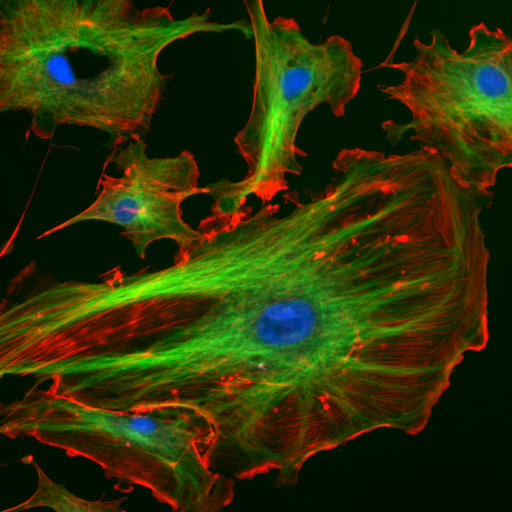
                             Endothelial cells viewed under a microscope

What Does God See In You?

Neal Pollard

The inimitable historian, David McCullough, has churned out another masterpiece in his new book, The Wright Brothers.  Chronicling their lives before, on, and after that famous December day in 1903 in Kitty Hawk, North Carolina, McCullough, in his unique way, peels back the layers of the people who made the history.  One particular example of this is seen in the author’s conveyance of Wilbur Wright’s misgivings about what he was going to make of his life.  Writing to his older brother Lorin, Wilbur said, “The boys of the Wright family are all lacking in determination and push. That is the very reason that none of us have been or will be more than ordinary businessmen” (24). It is amusing to think that Wilbur made this statement in 1894, less than a decade before that historic first flight.  Every airplane trip you make is a testimony to the Wrights’ determination, push, and extraordinary industry of the bicycle shop brothers, Orville and Wilbur Wright.

What do you see when you look at your life?  Are you dismissive of your talents and opportunities?  Do you think yourself in terms of your “can’ts” or your “cans”?  Perhaps you are prone to discount your potential.

If that is you, you should consider the case of a few other people.  Moses resisted leadership, claiming to be a nobody (Exo. 3-4).  Saul hid himself in the baggage (1 Sam. 10:22).  Jeremiah apparently tried to hide behind his age (Jer. 1:6-7).  Timothy seems to have been fearful (2 Tim. 1:7).  Yet, each rose to a position of greatness and played an important part in God’s plan.  What was the “X” factor in every case?  As God told Judah through Jeremiah, “I know the plans I have for you, declares the Lord, plans for welfare and not for calamity to give you a future and a hope” (Jer. 29:11).  Solomon would say, “Commit your works to the Lord and your plans will be established” (Pro. 16:3).  Then, a millennia later, Paul tells the church at Philippi, “It is God who is at work in you, both to will and to work for His good pleasure” (Phi. 2:13).

Relax! Take the pressure off of yourself because, frankly, it is not about you.  It is about the God who is at work in you.  Chart a course that puts Him first in your life and dedicate yourself to trying, as hard as you can, to please Him.  Isn’t He strong and smart enough to open the right doors?  Is He able to do great things? Yes!  The incredible thing about that is that He has chosen to do great things through lowly people like you and me! Stop and consider this.  What does God see in you? What will He do through you to His glory?  Never stop asking that question!

Remember I Am Dust (Poem)

Neal Pollard

I read the words of David today
They were so full of hope and trust
They spoke of God’s merciful way
That He is mindful we’re but dust.

He knows that transgressions we commit
That His forgiveness is a must
His lovingkindness He gives those who try to quit
Because He knows that we are dust.

Like David, I’m glad God has not dealt
Just with justice toward my anger, sin, and lust
As exalted His nature, so His tender heart will melt
Because He’s mindful we are but dust.

Like a father pities his erring child,
He reacts with compassion, not disgust,
When we fear Him, we learn He’s tender and mild.
He is mindful that we are but dust.

So as I embark on this unique day,
I know God is holy, perfect, and just,
But He balances this with a most merciful way
As He dwells on the fact that we’re but dust.

How should I treat you, my fellow pilgrim
Who’s also driven by imperfection’s fierce gust?
May I see you as I’m seen by Him,
And remember that you are but dust.

Extend you grace and excuse your stumbles,
Be willing to forgive, forget, adjust,
Because David’s inspired truth forever humbles,
He is mindful that we are but dust!

Implications of God’s Existence

Neal Pollard

“God is.” God is real. God is alive. God is watching. God is in control. All these ideas and an infinite number besides are implicit in the fact of God’s existence. That God is implies other things.

God can work through every event of life among men to accomplish His sovereign purpose (Rom. 8:28).  God, in an amazingly intricate way, weaves together the innumerable actions and occurrences that transpire in daily life on every continent according to His will. He does not make or force anyone to do anything, but He can work through even tragedies caused by men to effect good. The problem comes when one tries to define goodness on his or her terms rather than the transcendent good that is larger than the single person.  Strength in trial, character in tragedy, example in spite of great loss or pain are all transcendent good that can occur even in the reverses we face in our individual lives.

God has not left us alone (Rom. 8:35-39).  Deism suggests that God created it all, then took a Divinely giant step backward forever out of our affairs. Yet, God isn’t aloof and indifferent to man. This was best proven at the cross of Calvary. It is proven in the perfect Word He has left to guide us. It is proven through the strength derived from prayer. It is proven by the fellowship and companionship provided through the church He eternally purposed (cf. Eph. 3:9-11).

God holds us accountable (Rom. 14:12). What a privilege to be counted as part of the human race, made in the likeness of God (Jas. 3:9), and to be recipients of countless blessings! So “…from everyone who has been given much shall much be required; and to whom they entrusted much, of him they will ask all the more” (Luke 12:48). Especially is this true in relationship to God. He has given us life, an everlasting spirit, material and spiritual blessings in abundance, talent, time, and opportunity. For all of these resources, we shall give an account for our stewardship of them.

Only a fool would deny what is so clearly seen (Ps. 14:1; 53:1; Heb. 11:3). Since God is, we must respond appropriately. We should do so both from gratitude and a sober realization that His existence requires our proper response.

JAMES 1:17

Neal Pollard

Life, love, happiness, and health,
Water, worth, worship and wealth
Food, faith, dogs and dreams
Smiles, sunshine, singing and streams
Marriage, mothers, prayer and play
Friendship, flowers, tomorrow, today
Calvary, Christ, heaven and hope
Rain, resurrection, snow and soap
Family, frost, babies and birth
Books, baking, monkeys and mirth
Mountains, moonbeams, coffee and cake
Jokes, justification, serenades and steak
Aromas, affirmation, the dawn and the deep
Holidays, hiking, snuggling and sleep
Forgiveness, freedom, umbrellas and unity
Sports, service, internet and immunity
Jesus, joy, earth and eternity
Scripture, speech, fishing and fraternity
Prayer, pillows, picnics and Pickups,
Memory, mornings, happiness and hiccups
Whether obvious or subtle, earthly or spiritual
Why not create this euphoric, emphatic ritual
Count blessings and name them, you’ll never run out
In the process you’ll challenge your most serious doubt
God doesn’t have to, but He gives a continuous lift
When did you last thank Him for His every good gift?
The more that you dwell on them, the longer the list,
Engage in this enjoyable exercise and you’ll insist,
There’s no God like Jehovah, never was, never will be,
Add up your assets and this you’ll undoubtedly see.

“Go To The Ant, You…DARPA?”

Neal Pollard

The Defense Advanced Research Projects Agency was formed in 1958 for technological advancements and has been responsible for so many of the gadgets and conveniences we enjoy today. They use a variety of means to “both advance knowledge through basic research and create innovative technologies that address current practical problems through applied research” (darpa.mil). SRI International, one of the agencies DARPA partners with, “has taken inspiration from the giant mound of insects, to create their own swarms of tiny worker robots that can put together mechanical assemblies and electronic circuits” (Michael Trei, dvice.com). The military has given thought to using these robots to rebuild and repair, even in the midst of battle.  Who can foresee where this technology may show up in our daily lives?

People can be incredibly brilliant and innovative.  There is no limit to our imagination and invention.  Yet, this (and many other examples) points up to God in at least two ways.  First, our intelligence points to an intelligent designer. Moses informs us that we are made in the very image of our Creator (Gen. 1:26-27).  Second, our brightest developments and designs are drawn from what God’s created world.  Solomon once admonished, “Go to the ant, O sluggard, Observe her ways and be wise, Which, having no chief, Officer or ruler, Prepares her food in the summer And gathers her provision in the harvest” (Prov. 6:6-8).  They say imitation is the highest form of flattery.  How ironic that in a world growing more unbelieving, mankind keeps paying tribute to the wisdom and power of the One who made it all.

“The People…In The Wilderness”

Neal Pollard

Shortly before Joab turns the tide of Absalom’s rebellion by killing him, David, the rebel’s father, had reached a low ebb in his reign.  David and his faithful followers had been on the run from Absalom for some time, hiding and trying to escape rout and death. Worry was a regular exercise for David during this time (2 Sam. 15:14), as was weeping (2 Sam. 15:30) and weariness (2 Sam. 16:14).  Just before the fateful day of his son’s death, David and his loyal followers fled for their lives and survived thanks to the crafty counsel of Hushai.  The state of the people, at this point, is described in 1 Samuel 17:29: “The people are hungry and weary and thirsty in the wilderness.”  They were at the end of their rope, worn and frazzled by their very real problems.

Have you wrestled with worry, weeping, and weariness lately?  Can you relate?  Maybe you are feeling overwhelmed and overmatched by things going on in your life.  As we read this account, there are several reasons to hope.

THEY WERE NOT ALONE.  2 Samuel 17:22 notes that it was “David and all the people who were with him” who arose and crossed the Jordan to go to Mahanaim.  Each struggled, anxious and uncertain, but how comforting that they were able to go together.  The Christian should never have to go it alone.  There are those around us who to help bear our burdens (Gal. 6:2).  From the beginning of the church, this has been the case.  Acts 2:44 says, “All who had believed were together.”  While each of us may be struggling with individual problems, struggling is part of the human condition (Job 14:1).  In God’s wisdom, He has made the church a place where we can help and support each other (1 Th. 5:11).

THEY WERE BENEFICIARIES OF KINDNESS. What happens when they get to Mahanaim? Shobi, Machir, and Barzillai are waiting for them.  That had to be encouraging by itself.  But look what they had with them—“beds, basins, pottery, wheat, barley, flour, parched grain, beans, lentils, parched seeds, honey, curds, sheep, and cheese of the herd” (28-29a).  Those three men saw their brethren were suffering, hurting, and needy.  So what did they do?  I have seen this in the church more times than I can remember.  A brother or sister was in financial, emotional, or spiritual need, and their brethren showered them with kindness and love. So many of God’s people take to heart Paul’s exhortation, “Be kind to one another, tender-hearted…” (Eph. 4:32a).  See 1 Corinthians 13:4, Colossians 3:12-15, and 1 Peter 3:8, and you see the heart of so many of our fellow-Christians.  How helpful when we are in the wilderness!

THEY WERE SOON VICTORIOUS.  David draws up a battle plan in 2 Samuel 18:1, and before long the threat was quelled. There were still plenty of challenges that lay directly ahead, but they had doubtless learned a valuable lesson in the wilderness. Their victory did not mean that they were exempt from further problems, but they had experienced God’s deliverance. What a powerful lesson for us!  Yes, we will continue to struggle so long as we are pilgrims on this earth (cf. 1 Pet. 2:11), but there is a victorious “day of visitation” on the horizon (1 Pet. 2:12).

Are you “in the wilderness”?  Hang in there!  Focus on the people God has put in your life, be attuned to their kindness and encouragement, and remember the great victory God has promised you.

KNOWING GOD THROUGH THE BIBLE

Neal Pollard

The tendency to try and make subjective experience as more meaningful and valuable than objective truth is age old. We would rather feel something than learn or obey something. Yet, notice how thoroughly the Bible shows that adequate knowledge of God relies upon studying and knowing the Bible.

• GENESIS (24:12-14)–God’s KINDNESS is knowable.
• EXODUS (14:4-18)–God’s MATCHLESS HONOR is knowable.
• LEVITICUS (23:43)–God’s PROTECTING NATURE is knowable.
• NUMBERS (16:28)–God’s SPOKESMEN are knowable.
• DEUTERONOMY (4:35)–God’s PREEMINENCE is knowable.
• JOSHUA (23:13)–God’s CONDITIONS are knowable.
• JUDGES (6:37)–God’s INTERVENTION is knowable.
• RUTH (2:12)–God’s REWARD is knowable.
• 1 SAMUEL (17:46-47)–God’s MEANS OF SALVATION is knowable.
• 2 SAMUEL (7:18-29)–God’s PROMISES are knowable.
• 1 KINGS (20:28)–God’s SUPREMACY is knowable.
• 2 KINGS (19:19)–God’s UNIVERSAL AUTHORITY is knowable.
• 1 CHRONICLES (28:9)–God’s DIVINE QUALITIES are knowable.
• 2 CHRONICLES (25:16)–God’s DISAPPROVAL is knowable.
• EZRA (7:25)–God’s LAWS are knowable.
• NEHEMIAH (9:14)–God’s REVELATION is knowable.
• ESTHER (4:14 + rest of book)–God’s USE OF PROVIDENCE is knowable (even if we don’t know what is or isn’t providence).
• JOB (19:25)–God’s REDEMPTIVE WORK is knowable.
• PSALMS (100:3)–God’s CREATIVE POWER is knowable.
• PROVERBS (24:12)–God’s LIMITLESS ABILITY is knowable.
• ECCLESIASTES (3:14)–God’s PERFECTION is knowable.
• SONG OF SOLOMON–God’s DEVOTION TO MARRIAGE is knowable.
• ISAIAH (60:16)–God’s SALVATION & REDEMPTION are knowable.
• JEREMIAH (16:21)–God’s NAME & MIGHT are knowable.
• LAMENTATIONS–God’s STANDARD FOR PUNISHMENT is knowable.
• EZEKIEL (5:13)–God’s ZEALOUS WORD is knowable.
• DANIEL (11:32)–God’s STRENGTHENING is knowable.
• HOSEA (13:4)–God’s WORSHIP REQUIREMENTS are knowable.
• JOEL (2:27)–God’s PRESENCE is knowable.
• AMOS (3:2)–God’s HATRED OF INIQUITY is knowable.
• OBADIAH–God’s FEELINGS TOWARD PRIDE are knowable.
• JONAH (4:2)–God’s GRACIOUSNESS is knowable.
• MICAH (6:5)–God’s RIGHTEOUSNESS is knowable.
• NAHUM (1)–God’s PROTECTIVE CARE is knowable.
• HABAKKUK (2:14)–God’s GLORY is knowable.
• ZEPHANIAH (2:3)–God’s DESIRE TO BE SOUGHT is knowable.
• HAGGAI–God’s MISSION is knowable.
• ZECHARIAH (2:9-13)-God’s PLAN OF SALVATION is knowable.
• MALACHI (2:4-5)–God’s COVENANT is knowable.
• MATTHEW (22:16)–God’s TEACHINGS are knowable.
• MARK (1:24)–God’s HOLINESS is knowable.
• LUKE (11:13)–God’s BENEVOLENCE is knowable.
• JOHN (17:3)–God’s UNIQUENESS is knowable.
• ACTS (2:36-47)–God’s REQUIREMENTS FOR SALVATION are knowable.
• ROMANS (8:28)–God’s ASSURANCE TO THOSE WHO LOVE HIM is knowable.
• 1 CORINTHIANS (2:12)–God’s SPIRITUAL BLESSING OF REVELATION is knowable.
• 2 CORINTHIANS (8:9)–God’s GRACE is knowable.
• GALATIANS (3:7)–God’s HEIRS are knowable.
• EPHESIANS (1:17-19)–God’s BESTOWED WISDOM & HOPE are knowable.
• PHILIPPIANS (3:8-11)–God’s SON is knowable.
• COLOSSIANS (4:1)–God’s MASTERFUL ROLE is knowable.
• 1 THESSALONIANS (1:4)–God’s MEANS OF ELECTION is knowable.
• 2 THESSALONIANS (3:7)–God’s GOOD EXAMPLES are knowable.
• 1 TIMOTHY (3:15)–God’s CODE OF CONDUCT IN THE HIS HOUSEHOLD is knowable.
• 2 TIMOTHY (3:15-17)–God’s HOLY SCRIPTURES are knowable.
• TITUS (1:9-16)–God’s SOUND DOCTRINE is knowable.
• PHILEMON–God’s FREEDOM FROM SIN & CALL FOR SERVICE IN CHRIST is knowable.
• HEBREWS (8:11-13)–God’s SUPERIOR SALVATION is knowable.
• JAMES (2:20)–God’s DEMAND FOR ACTIVE FAITH is knowable.
• 1 PETER (1:18-19)–God’s INCORRUPTIBLE MEANS OF SALVATION is knowable.
• 2 PETER (3:17)–God’s FOREWARNINGS are knowable.
• 1 JOHN (4:2)–God’s SPIRIT is knowable.
• 2 JOHN 1–God’s TRUTH is knowable.
• 3 JOHN 12–God’s INSPIRED WRITERS’ TRUTHFUL RECORD is knowable.
• JUDE (4-23)–God’s ENEMIES are knowable.
• REVELATION (2:10,17)–God’s REWARD is knowable.

This does not begin to exhaust the list of things which the Bible tells us we can know! God has not left us to grope in the dark. Neither has He left it up to us to decide to live however we want to live.

Little Things?


Neal Pollard

Look what one look at a woman bathing on her rooftop cost a man, his home, and his country.  The pronunciation of one word spelled the difference between life and death for a nation of people.  One word inserted by a serpent changed the course of human history forever.

One visit to a website, one indiscreet email or phone call, one moment of anger and fury, one rash and foolish decision made before a new Christian, or one “white lie” can create unbearable consequences to the heart, destiny, and influence of a person.  Rationalization that it’s only once or only a little can be fatal, both to self and others.

But this “little thing” principle applies to attitude, too.  A brief, gossiping conversation may seem harmless, but discourage or devastate the subject of it.   Small, snide comments about the elders, Bible class teachers, deacons, or others may divide friends for a long time.  A grudge-bearer may help divide a church over a single, relatively minor incident having long since occurred.  “Little,” too often, is in the eye of the beholder.

A dear preacher friend of mine, David Sain, once illustrated this point very well.  He wrote:

I once read a statement that really got my attention.  It declared that a
tiny gnat can wreck an automobile.  Of  course, I wondered, “How?”
The article then explained that a tiny gnat had wrecked a car by flying
into the eye of the driver at a critical time, causing him to lose control.
So often in life, little things can do great harm.  It is easy for us to be
like that gnat.  Our petty criticisms, murmuring, complaints, and fault-
finding can “wreck” the most ambitious person or program.  Friend,
what our world needs is builders-not “wreckers.” (via Eastern Meadows Church
Bulletin, Montgomery, AL).

Let’s be careful with our influence, not minimizing our impact on others by our words, acts, and attitudes.  We want to do the little things that make a church great, through those same mediums.  As David says, let us build rather than wreck!

GOD HATES SHORTS!


Neal Pollard

 You may be thinking that the title is presumptuous, opinionated, and even out of line.  Let me disclaim what follows by asserting that God does not hate all shorts.  He does, however, hate the following types of shorts.

But not these. 🙂


GOD HATES SHORTCUTS.  At least, He hates humanly devised shortcuts for which He has given no authorization.  Man has devised shortcuts to salvation that cut out divine commands.  He has made shortcuts in ethics and morality to justify and rationalize behavior God condemns.  We should examine such “shortcuts” carefully to make sure they are not detours off of the narrow way.

GOD HATES SHORTCHANGES.  In Malachi 3:8-10, God condemns His people for “robbing Him” in their giving.  They did not give with appropriate gratitude and generosity.  Those who fail to put Him first (cf. Matt. 6:33) are shortchanging God of the time, talents, resources, and service He deserves.  

GOD HATES SHORTSIGHTEDNESS.  When we make decisions based on instant gratification or immediate benefits without giving thought to longterm implications, we often make a mess of our lives.  This is true of church plans, the person we choose to marry, unbiblical changes to the church and teaching to attract the unchurched, and the like.  Certainly, one can be too deliberate and methodical to the point of lethargy and apathy.  Yet, neither is it proper to leap before adequately looking.

GOD HATES SHORTCOMINGS.  God’s hatred for sin is so great that He sent Christ to the cross as payment for it.  Sin is falling short of God’s mark.  The sobering thing is that all of us come short of God’s glory as the result of our sin (Rom. 3:23).  The great news is that while God hates shortcomings, He deeply loves shortcomers.  That’s also why He sent Jesus to die for us.

God hates these shorts, but He has provided an alternative regarding all of them.  By full and trusting obedience, we avoid shortcuts.  By recognizing our debt and feeling heartfelt gratitude to God for paying it, we avoid shortchanging Him.  By growing in wisdom and Christlikeness, we avoid shortsightedness.  By walking in the light as children of God, we avoid the eternal ramifications of our shortcomings.  That’s because God loves us!

Heaven Really IS For Real

Neal Pollard
While so many in religion and even the media latch onto sensational tales of traveling to the “other side” and coming back with stories about heaven (they do not ordinarily wind up going the other direction), these individuals often claim (necessarily without proof) to have seen or heard things from God, Christ, and other heavenly inhabitants. Sadly, much of what they claim to have experienced is at odds with or even contradicts what God communicated to us through His Word. Despite the high-drama and mystical tales, these undoubtedly sincere folks are right about something incredibly important. Heaven IS for real!

The Bible describes it (Rev. 21-22). Jesus is preparing it (John 14:1-4). The Father lives there (Mat. 5:16; etc.). Those who travel the “narrow road” (Mat. 7:13-14) and are faithful unto death (Rev. 2:10) are going to be allowed to dwell there forever (cf. Ps. 23:6; Mat. 25:46; 1 Th. 4:13ff). The Bible communicates that it is a place reserved for those who believe and obey the will of God (2 Th. 1:5ff). It is not for those who refuse to submit to His authority (Gal. 5:19-21; etc.).

Heaven is described as a place where treasure is (Luke 18:22). It is described as a place where our citizenship can be (Phi. 3:20). It is a place where our hope can be laid up (Col. 1:5). It is a place where our name can be reserved (Heb. 12:23). It is a place where we can have an inheritance (1 Pe. 1:4). It is a place described as that which will be new (Rev. 21:1).

I suppose it is human nature for us to want to have blanks filled in and details more fully supplied. That’s why claims of going to heaven and back have long captivated people. Perhaps it strikes the chords of our hearts and imagination more than words, howbeit Divine words, on a page. Yet, those words produce living hope to those who are staking everything on the truth of those words (1 Pe. 1:3). They are neither fairy tales nor wisps of wishes. God has given us enough to know, as we measure the claims alongside His providence and answered prayers, that His Word can be trusted. We don’t have the full picture yet, but we know it will be more glorious and joyous than we are able to understand in this body confined by time. Thank God that Heaven really is for real!

God Knows Where They Are


Neal Pollard

At a preachers’ meeting I attended today, a brother led us in prayer specifically about the men, women, and children who were onboard the missing Malaysian Airlines Flight 370 as well as their families.  While there have certainly been many other prayers for these folks, this brother said something that should have struck me before today.  He prayed, “God, we know that you already know exactly where they are, but please help those searching for them to find them.”  Has that thought truly struck us?  Our omniscient God knows the precise point on this globe where those 239 passengers are.  If we let that sink in, it reminds us of a much further-reaching point.  God knows everything about everyone of us, where we go and what we do.

Scripture teaches this many times over, in both testaments.  2 Chronicles 16:9 tells us the eyes of the Lord move to and fro throughout the earth.  “He sees all the sons of men…all the inhabitants of the earth” (Ps. 33:13-14).  “His eyes behold, His eyelids test the sons of men” (Ps. 11:4). Hebrews 4:13 affirms that “there is no creature hidden from His sight, but all things are open and laid bare to the eyes of Him with whom we have to do.”  The mysteries of the ages that have long confounded our greatest minds could not be more plainly known to Him.  Whether or not the massive coordinated efforts of nations, militaries, technology, and resources solve this enigma is yet to be seen, but God knows the answer to this as readily as He does the greatest conundrums with which man has ever been confronted.

One day, God will cleave the skies and bring all unsolved mysteries to an end, with every secret, cloak and dagger, and clandestine activity which may have perplexed men for centuries.  He will bring these secrets into the judgment (Rom. 2:16).  While there is so much that we may not know, let us rest assured that we stand beneath the gaze of the All-Seeing eyes of God.

Take Not The Day For Granted (POEM)

Neal Pollard
Take not the day for granted,
Who knows what the morrow brings,
What present joy be recanted,
What shut the mouth that now sings.
Too often we long for tomorrow,
Assuring ourselves it will be perfect,
Dissatisfied with present perceived sorrow
Viewing only today’s every defect.
But right now, this moment, is precious
It holds a bright and unique treasure
For the one with wisdom who confesses
Trust in Him who blesses without measure
Yes, God gave us this day in His kindness
To use for His glory and pleasure
How tragic to be struck with a blindness
To how rare and how useful that treasure.
So many have not been gifted these hours
They’ve ceased their ability to live them
Who long for what now exceeds their powers
Whose light is put out, not just dim.
What are we doing with the present
To build a spectacular time ahead
To make others’ lives blessed, not just pleasant
To bring life to the spiritually dead
Take not the day for granted,
It was given to be managed astutely
Embrace it, don’t be disenchanted
Do your best with it, strive resolutely!