“The forest devoured more people that day than the sword” (2 Samuel 18.8).
David’s son, Absalom, rebelled. He’s amassed an army and David’s been on the run. Finally, it all comes to a head and the battle spread over the face of all the country. In total, twenty thousand of Absalom’s followers are killed—but the bulk of the casualties fell in the forest of Ephraim. Wait, no, they didn’t fall. The text says that they were devoured.
Is it possible that thousands of men were eaten by trees?
Some of the oldest legends of man-eating trees come from Central and South America. According to local legends, the tree would lie perfectly still until an unsuspecting person walked over its roots. The tendrils would snap upward, wrap around the victim, and squeeze them to death. The tree’s leaves were said to be lined with sharp, tooth-like spines that pierced the skin to drain the victim’s blood
Similarly, British explorers returning from central Africa told tales of giant trees that produced a super-adhesive sap that coated their low-hanging branches. If a human brushed against the branch, they became completely glued to it. They would become helplessly stuck, and the tree would eventually absorb them.
The Greeks and Romans had several myths of trees being cut, bleeding real human blood, and screaming in agony. Specifically, the association of ancient oaks and terebinths with human sacrifice is deeply documented. The premier Roman historian Tacitus wrote extensively in the 1st century AD about how the Germanic tribes viewed some of these oak groves. In his work Germania, he describes the Semnones tribe, who spoke of a forest that nobody could enter unless bound with chains.
“At a stated period, all the tribes of the same blood gather by their delegations in a wood consecrated by the auguries of their forefathers and by ancient awe. There they publicly sacrifice a human being, celebrating the horrific opening of their barbarous worship” (Tacitus, Germania, Chapter 39).
Lucan describes a sacred grove near Massilia that Julius Caesar ordered his men to chop down. The Romans were paralyzed with fear because of the rumors of human blood feeding the ancient oaks
“There was a grove which from earliest times had never been violated… No woodland nymphs or Pan resided here, instead there were savage rites and barbarous worship, massive upright stones used as horrible altars; every tree was made sacred with human blood… Crude effigies of gods fashioned from fallen trunks were all around” (Lucan, Pharsalia, Book III, line 399ff).
Josephus records that the tree that Abraham met the three angels by (Gen. 18.1-2) was a terebinth that had stood there since the creation of the world. He noted that locals venerated it. The exact location of this encounter was identified as Ramat El-Khalil, just north of modern-day Hebron. For thousands of years, a single massive tree stood at this site drawing millions of pilgrims. Well, then came Constantine.
By the Roman era, Jews, Christians, and Pagans were all holding joint festivals at the tree, offering sacrifices, and pouring drinks down Abraham’s well. The Emperor Constantine was disturbed by these pagan rituals that he ordered the altars destroyed and built a massive Christian Basilica directly over the roots of the tree to claim it.
None of this proves that trees ate thousands of soldiers in the forest of Ephriam, but it does prove that the concept isn’t a new one. Trees were considered dark, holy, hungry, and special for some reason or another. However, at least one tree played a part in the death of a man, though. Following the verse describing a forest devouring people we read:
“…Absalom was riding his mule, and the mule went under the thick branches of a great oak, and his head caught fast in the oak, and he was suspended between heaven and earth, while the mule that was under him went on” (2 Sam. 18.9).
Joab and ten others would stab him and beat him to death while he hung from the tree.
Across the ancient Levant you’d find some of the largest stone structures ever assembled. It boggles the mind to think these were built at a time before cranes or diesel engines. Even with their help, some of the stones used in and around Baalbek— still couldn’t be moved.
If the ancient builders quarried, transported, and precisely positioned stones weighing hundreds of tons, the only logical conclusion is that giants must have done it. Or at least, some of these places.
The Bible mentions that parts of Canaan were inhabited by some big boys.
“The Emim… were a people great, and many, and tall, as the Anakim” (Deuteronomy 2:10).
“For only Og king of Bashan remained of the remnant of the Rephaim… his bedstead was of iron… nine cubits was its length” (Deuteronomy 3:11).
The spies sent by Moses also reported seeing the Anakim:
“We saw the Nephilim… and we seemed to ourselves like grasshoppers” (Numbers 13:33).
Baalbek
At Baalbek, the famous Trilithon consists of three limestone blocks weighing roughly 800 tons each. Nearby lie even larger stones, including one estimated to exceed 1,000 tons. These remain among the largest stones ever quarried by any ancient civilization— ever.
Big stones in an area known for big people? Well— mystery solved!
The Jewish historian Josephus referred to the descendants of the Anakim as a race of giants whose bones could still be seen in his day (Antiquities 5.2.3).
The Phoenician historian Philo of Byblos, whose writings survive through Eusebius, preserved traditions about beings of extraordinary size and strength building the very earliest monuments.
In fact, it was the Greeks who even coined the term “Cyclopean masonry” because they believed that only the giant Cyclopes could have constructed walls made from enormous, tightly fitted stones, like those found at Mycenae and Tiryns.
Can we say for certain which Canaanite fortifications were built by giants? Not entirely. But based on the evidence one could make some pretty good guesses. Giants probably built the biggest ones.
Sources
• Antiquities of the Jews 5.2.3.
• Fragments of Philo of Byblos in Eusebius, Praeparatio Evangelica.
• UNESCO documentation on Baalbek.
• Pausanias, Description of Greece (on Cyclopean masonry traditions)
The exact identity of the “wild ox” mentioned in Job 39 is unknown, but the text implies a powerful and strong beast whose strength was beyond human control.
One alternative theory is that it might just be referring to the extinct woolly rhinoceros—one of the largest mammals of the ice age.
God asks Job:
“Will the re’em be willing to serve you? Will he spend the night at your manger? Can you bind the re’em in the furrow (earthen trench made by plowing) with ropes? …will you trust him because his strength is great?” (39.9-12).
Unlike oxen, rhinos have never been successfully domesticated, despite their tremendous strength. A modern rhino could easily pull half of its body weight, and they’ve used been known to use their sheer neck and shoulder strength to toss multi-ton objects, including hippos, water buffaloes, and entire cars—into the air (BBC Science Focus Mag., Top 10 Strongest Animals).
The woolly rhino was among the largest land mammals of the past. Fossil remains discovered in Russia, Germany, France, England, and Kazakhstan reveal that it grew to be 13 feet long and stood over 6 feet at the shoulder. It weighed in at around 8,000lbs and its prominent front horn has been measured at 4-6 feet in length. Preserved carcasses in the chilly permafrost of Siberia have even retained their reddish-brown fur, skin, and their last meals still sitting in their bellies.
The Greek translation of the Old Testament– or Septuagint– translates the Hebrew re’em as monokeros, meaning “one-horned.” Jerome’s Latin Vulgate translated it as rhinoceros. The translators lived far closer to the biblical world than modern readers and evidently associated the re’em with a rhino-like creature.
No woolly rhinos have ever been uncovered in the region where Job was thought to have lived (modern Palestine), however several references in Job seem to indicate the right conditions that would allow our big-horned brute to feel right at home. Some theologians date Job towards the end of the ice age—here’s a few verses used as evidence.
“Which is dark and turbid by reason of the ice, and wherein the snow is hidden” (6.16).
“By the breath of God ice is given, and the broad waters are frozen fast” (37.10).
“From whose womb comes the ice? And the frost of heaven, who gives birth to it? The waters harden like stone, and the surface of the deep is frozen” (38.29-30).
Is the re’em really a giant woolly rhino? There’s no way to know for certain, and since there’s no definitive answer– it makes the theory a cool one (little pun there for ya, pilgrim).
Stephen Fry is a well-known actor, activist, humanist, and athiest. When asked what he would say to God in a face-to-face, he replied, “Bone cancer in children, what’s that about? … How dare you create a world where there is such misery that is not our fault?” There’s more to the quote, but this sums it up.
“How can evil and a loving God coexist?” At some point, we have to confront this question in our own faith. Some can accept the problem of evil as being a byproduct of a fallen world. Others – especially those who have experienced evil firsthand – have a hard time justifying the two.
Most answers offered sound something like this: “The creation groans with the pains of childbirth up to now. Man, as a free moral agent, transgressed God’s law and brought the consequences of sin upon humanity. God cannot look upon evil, and certainly does not cause it. Every good thing and every perfect gift comes down from the father of lights, with whom there is no variation or shifting shadow.”
While the principles in this explanation are correct, it fails to address the question on at least two levels. One, it does not answer how God could allow evil to affect humans. We exist, technically, against our will. Two, it utilizes jargon. It’s easier to say religious-sounding things to answer difficult questions, but anyone struggling with this problem knows how frustrating this answer can be. It doesn’t address the question, and sometimes comes across as avoiding it altogether.
The following is based on personal study, as I’d wrestled with this problem, too. To be very clear: God loves us, and the existence of evil does not change that at all. This question was answered for me through an unrelated study that put a few things into perspective. Here’s the condensed version:
God created reality, and it was flawless (Gen 1.31). In fact, Jesus described heaven as being a return to this flawlessness (Matt 19.28). The code of reality was intact. God didn’t force us to love him, he gave us freedom to choose for ourselves. According to Romans eight, nature was fundamentally affected by the choice we made. This choice essentially introduced a bug into the code of reality. God didn’t create evil, we did.
Even though our choice has consistently been rejection – and we’re solely responsible for messing everything up – he still gave up everything to give us a second chance. Yes, Jesus sacrificed himself on a cross. This was extremely selfless and loving in itself. But this was NOT the only sacrifice he made.
Jesus – the one who designed and built reality (John 1) – permanently demoted himself for humans. He gave up his status to die for us (Heb 2.7). He’s in the father’s chair right now, but will step back down after the end of time (Heb 1.14; 2.8-9). He is still God, but permanently lower because he’s still human, too (I Tim 2.5; I Cor 11.3; I Jn 3.1-3; Heb 2.11-18).
So, how can evil and a loving God coexist? We’re stuck with the way reality is now, but he fundamentally changed himself to give us a second chance. He works full-time to get his family home (Rom 8.27; I Tim 2.5; I Jn 2.1-2). We changed the terms, but he changed the consequences. The most powerful entity in the universe stepped down – forever – knowing most of us would ignore it. When we look at it that way, it puts our own culpability into perspective and demonstrates God’s infinite capacity to love.
The biblical account of Jonah being swallowed by a “great fish” (often called a whale) has long been under scrutiny by biblical skeptics. This short investigation hits a few different areas that may give the reader some more food for thought.
We’ll cook up a theory using—
Some historical maritime context of ancient seafaring practices
A sprinkle of marine biology
A pinch of paleontology
A tad of textual linguistics
A ladle of literary evidence
With all that we’ll explore some plausible candidates for the big fish.
Potential Location of the Storm and Jonah’s Route
The Mediterranean stretch between Rhodes and Cyprus was notoriously treacherous. Jonah sailed from Joppa (modern Jaffa, Israel) toward Tarshish (likely Spain), covering approximately 430 oceanic miles from Rhodes to Joppa or a neighboring Phoenician port. The route passed close by Rhodes and Cyprus, exposing vessels to sudden violent storms.
This seems to be a decent area to focus on. While other parts of the Mediterranean are known to be more dangerous, they’re closer to Spain. No marine animal capable of swallowing a human could make that swim in just three days. While it could have been a specialized super-swimmer designed by God— for the purpose of this article we’re going to stick with candidates that were currently aware of.
Candidate Creatures
1. Sperm Whale
Probably the most common theory, for good reason. Sperm whales have
• Large sinus air chamber and integrated blowhole allowed any gobbled prophets to breathe.
• Massive throat capable of swallowing large prey whole instead of crushing or suffocating
2. Fin Whale (Detailed Physiology)
From the Christian Research Journal (Vol. 48, No. 03, 2025), the fin whale’s lunge-feeding allows it to engulf enormous volumes of water (60–82 m³). Its forestomach can hold ~500 L of fluid, but the narrow esophagus (~10 cm) suggests Jonah was likely held in the expandable oropharynx (“belly”). Survival challenges include trauma, hypothermia, slippery surfaces, and air supply (mitigated by frequent surfacing every 5–15 minutes).
3. Basilosaurus (extinct)
• Fits biblical themes of large serpentine sea monster (Amos 9.3)
• Fluid-filled bones for near-surface swimming
• Elbow-like fins for shallow-water maneuverability, ideal for expelling prey onto beaches.
• Ancient artwork in the region resembles it. This is perhaps the coolest point that we’ll revisit.
4. Megalodon (Otodus megalodon)
• Largest known shark in the ancient Mediterranean, up to 50 feet long.
Was It a Whale, a Fish, or a “Ketos”?
Hebrew dag gadol (“great fish”) and Greek ketos (used in the Septuagint and Matthew 12:40) are general terms for a large sea creature or monster, not precise biological categories. Historian Bill Cooper and others note that ketos consistently referred to a dog-headed sea-dragon or serpent in ancient Mediterranean mind. Dr. Henry Morris notes its “mega-sized” connotations.
Ancient writers used specific terms for such creatures, while New Testament authors employed broader language.
Ancient Literary and Artistic Evidence for the “Ketos”
Historical evidence from authors and historians who best knew the Mediterranean Sea consistently used ketos to mean “a sea serpent.”
This is supported by:
• Literary sources (from ca. 700 B.C. onward): Homer (9th–8th century B.C.), Euripides, Aristophanes, Lycophron, Aristophanes (various dates), Manilius, Marcus Terentius Varro, Diodorus Siculus, Claudius Aelianus, Oppian of Apamea, Pausanias, Eustathius, Hesychius, and Johannes Moschus, among others.
Artistic depictions:
First-century paintings from a Roman catacomb show Jonah being thrown into the sea monster with a dog-like head, flexible neck, and often coiled body. Numerous artifacts (carvings, coins, ivory, wood, stone) depict the ketos with a dog-like head, prominent teeth, plume-like flaps or frills above the head and neck, and a slender, coiled form. These consistent renderings across Rome, Africa, Turkey, and elsewhere strongly identify the ketos as a sea serpent.
The visual and textual tradition closely resembles creatures like Basilosaurus and supports a naturalistic but still divinely orchestrated interpretation of the biblical “monster.”
BONUS:
Interesting Historical Sighting
Strabo records Poseidonius’ eyewitness account (ca. 130–51 BC) of a massive “fallen dragon” (~30 m / 100 ft long) on the northern Levant coast with enormous jaws. It was so big that two riders on horse back couldn’t see each other if they were on either side of its belly.
Bonus Notes:
Clues from Jonah’s Prayer (Jonah 2)
• Repeated references to depth and deep water.
• “Moors or roots of the mountains” — possibly the Eratosthenes Seamount near Cyprus.
• Calypso Deep is the deepest point, Jonah might be referring to it.
Travel Feasibility
A blue whale’s comfortable speed of ~5 mph could cover ~360 miles in the relevant Rhodes-area voyage, making that in distance in 72 hours (three days).
References:
• Christian Research Journal, Vol. 48, No. 03 (2025).
• Brian Thomas, Ph.D., Institute for Creation Research.
• Bill Cooper, The Authenticity of the Book of Jonah (2012/2013).
• Dr. Henry Morris on ketos.
• Strabo, Poseidonius, and the extensive list of classical authors cited.
Type it into any search engine, and the question appears predictably: if God exists, why does He permit pain? The skeptic asks it as a checkmate. The grieving parent whispers it through tears. The college sophomore hurls it like a stone. The believer wonders it himself in the small hours, when the house is quiet, and the news will not stop.
Yet this is a loaded question—one whose phrasing smuggles in conclusions before any response can be given. If we answer it as posed, we risk losing the conversation at the outset.
The Hidden Assumptions Behind the Challenge
Notice what the question quietly assumes. It assumes God must love as we do. It assumes good means avoiding all discomfort. It assumes that freedom and goodness go together, and that a loving Creator must protect His creatures from harm, as if wrapping them in cotton. The question has already decided what God must be before it asks whether He is.
Given this, the honest seeker should pause before answering too quickly. To engage well, he must instead reframe the prompt and unwrap its hidden parcels, one by one.
The Moral Standard Behind the Outrage
Press the skeptic for a moment. To call something evil, we must have a fixed measure of right and wrong. A bent stick can only be named bent because we know what a straight one looks like. Where does that straight stick come from?
If morality is shifting group opinion, then evil is only what most people dislike this decade. But if it is more written on the conscience itself, we have stumbled into the very God the question denies. Paul says those without the Law “show the work of the Law written in their hearts, their conscience bearing witness” (Romans 2.15). The protest against evil is an unwitting prayer.
Free Will and Its Frightful Cost
God did not make us machines. He made us in His image. We can love, but we can also refuse. A robot does not love. A puppet does not worship. True devotion needs the real chance of rebellion.
This is the high cost of being human. The freedom that lets a mother cradle her child also lets a tyrant order a massacre. The same tongue that sings can also slander. Without the risk of cruelty, there could be no real love. God, in His wisdom, judged a world with true sons and daughters to be worth the risk of true sin.
Suffering as the School of the Soul
Suffering is not an unexpected flaw in the divine plan. Scripture calls it a workshop where God shapes character. James says, “Consider it all joy, my brethren, when you encounter various trials, knowing that the testing of your faith produces endurance” (James 1.2-3).
A surgeon’s scalpel is terrible in an enemy’s hand but merciful in a healer’s. The same cut changes depending on who holds the blade. The question is not if we will bleed, but whose hands will hold us when we do. Paul promises, “God causes all things to work together for good to those who love God, to those who are called according to His purpose” (Romans 8.28). This is not just a verse for coffee mugs. It is a fortress for the soul.
The Serpent We Often Forget
Notice how often people debate as if Satan did not exist. The Word will not let us forget him. Jesus called him “a murderer from the beginning” and “the father of lies” (John 8.44).
Here is the dark whisper in many tragedies. He does not force; he flatters. He does not command; he hints. He coaxed Eve while in the garden. He coaxes us in the supermarket, the boardroom, and the bedroom. Every war begins in someone’s heart. Every malice is first a thought. The blood is human, but the poison behind it is ancient.
Yet Satan is not a rival god. He is a creature on a leash, allowed to snarl only within the boundaries God has set. In Job, he asks permission. He does not seize power. He is real, deadly, and on a chain.
The God Who Entered Our Suffering
Here, the Christian answer stands apart. God not only explains suffering from above. He comes down and bears it. The cross is not a footnote to the problem of evil. It is its center.
Peter writes, “He Himself bore our sins in His body on the cross, so that we might die to sin and live to righteousness; for by His wounds you were healed” (1 Peter 2.24). Think about that. The One who could end all suffering with a word chose to take it into His own flesh. He did not excuse Himself from the world He made. He entered it, suffered in it, died in it, and rose to redeem it.
A Conclusion Worth Standing On
The skeptic’s question does not destroy faith. It shows that we are not framing the conversation well. Suffering does not refute God’s existence, for even the idea of evil borrows from His moral light. His goodness endures pain, for He has given purpose to our wounds and faced worse than we ever will.
Until the day when “He will wipe away every tear from their eyes; and there will no longer be any death; there will no longer be mourning, or crying, or pain” (Revelation 21.4), we live by faith. It is not a faith that denies the dark, but a faith that sees Light moving through it. Lean on the One who is good, even when life is not.
You’re approaching a teeny-tiny town. As you do, there’s a weird tickle in your nose. Your face contorts, your neck cranes, your eyes close, and an obnoxious glass-shattering sneeze explodes from your very soul. It’s over in a couple of seconds and you’re left shaking, but you’re fine. Wait, now where’s the town? It was so itty-bitty– you missed it.
Syene is just like that. It’s mentioned only once in scripture and if you’re not paying attention, your eyes cruise past it. Today we call this small region– China. Maybe you’re not familiar with Syene, but there’s a high probability that you’ve heard of Asia.
Now that you know what to look for, put your peepers on this.
“Behold, these shall come from afar, and behold, these from the north and from the west, and these from the land of Syene” (Isa. 49.12).
The China hypothesis is based on two primary clues found in the text:
Directional clues
In Claudius Ptolemy’s 2nd-century work, Geographia, “China” is placed on the easternmost edge of the known world through two regions:
Serica (North)
Sinae (South)
Linguistic similarities
In ancient Hebrew Sînîm is phonetically similar to the Latin Sinae and the Sanskrit Cīnah (ancient names for the Chinese people).
Cool Notes:
Even the Chinese Union Version of the Bible translates Syene as the Kingdom of Qin, the dynasty that first unified China way back in the day (aprox. 860 BC).
The ancient Chinese have a flood legend and the main character’s name is Nuwa. Sounds a lot like Moses! Wait, no- Noah!
The Miao people of southern China have an oral tradition involving a global flood where a couple named Nu-ah and Gao-bo survived. Once again, Bible readers know exactly who they’re talking about.
It’s rainy in Bowling Green Kentucky and you know what that means! Well, maybe you don’t. Either way, we’re diving into the water cycle— found in the Bible.
Dale Pollard
It’s rainy in Bowling Green Kentucky and you know what that means! Well, maybe you don’t. Either way, we’re diving into the water cycle— found in the Bible.
Long before meteorology became a science, the Bible described the natural water cycle with remarkable (but unsurprising) accuracy. Those ancient writers—without access to modern instruments—somehow came up with a process that closely mirrors our modern understanding of evaporation, condensation, and precipitation. Of course, if you believe the Bible is God’s word, you know exactly how they came to this knowledge.
Check out these Biblical Descriptions of the Water Cycle:
1. Ecclesiastes 1:7 (ESV) “All streams run to the sea, but the sea is not full; to the place where the streams flow, there they flow again.” This verse depicts the hydrological cycle—rivers flow to the sea, water evaporates, and returns again as rain. Amazing. Or what about…
2. Job 36:27–28 “For he draws up the drops of water; they distill his mist in rain, which the skies pour down and drop on mankind abundantly.” This description sounds a lot like the process of condensation. The vapor forms into raindrops, which then fall back to earth. Nice.
3. Amos 9:6
“Who builds his upper chambers in the heavens and founds his vault upon the earth; who calls for the waters of the sea and pours them out upon the surface of the earth—the Lord is his name.”
Just one more text describing evaporation and rainfall, linked to one great cycle all under divine control. The Bible has a little bit of everything in it and always proves itself to be of heavenly origin.
Throughout history, soldiers have been remembered for their courage and skill — but sometimes, a warrior stands out for their extreme endurance. In high stress situations, combatants have been known to grip their weapon so tightly that their fingers can’t release them— even after the danger is gone.
Dale Pollard
Throughout history, soldiers have been remembered for their courage and skill — but sometimes, a warrior stands out for their extreme endurance. In high stress situations, combatants have been known to grip their weapon so tightly that their fingers can’t release them— even after the danger is gone. This phenomenon is known as “grip lock” (or, in death, cadaveric spasm) and it appears in sources from the Biblical record to various other battle chronicles.
The Biblical Case of Eleazar
One of the earliest recorded examples comes from 2 Samuel 23:9–10 (10th century BC). Eleazar, one of David’s “mighty men,” fought the Philistines long after the rest of the army had retreated. His effort was so great that “his hand clung to the sword” after the battle — an epic but physiologically accurate description of “sustained tetanic muscle contraction” from hours of exertion and an extreme adrenaline overload.
More Military Accounts
Battle of Marathon (490 BC) – Herodotus records Athenian hoplites whose hands were “welded” to their spear shafts after the fight.
Battle of Cannae (216 BC) – Polybius describes Roman infantry unable to drop their shields or swords, even in retreat, with some death grips preserved in fallen soldiers.
Boudicca’s Revolt (AD 60–61) – Tacitus notes Briton warriors locked to their chariot rails or spears, requiring force to release them.
Battle of Stiklestad (AD 1030) – Norse sagas speak of hands “frozen to the sword like ice to iron.”
Physiology
Modern science explains grip lock as a combination of:
Adrenaline surge – The sympathetic nervous system floods the body with epinephrine and norepinephrine, boosting muscle contraction power.
Full recruitment of fast-twitch fibers – Grip muscles in the forearm contract at maximal force, overriding fine motor control.
Loss of inhibitory signals – The brain suppresses “release” commands in favor of survival-driven holding or pulling actions.
Muscle fatigue and tetany – After prolonged strain, the muscles seize in a sustained contraction, sometimes lasting minutes or hours.
Eleazar’s hand that refused to let go eliminates any chasm between a myth and medical reality. The Bible is accurate down to the finest details and it teaches us more than just history; it shows us the future (Rev. 22, 1 Thess. 4.16-18, Matt. 24.42-44).
“…..but Eleazar stood his ground and struck down the Philistines till his hand grew tired and froze to the sword. The LORD brought about a great victory that day. The troops returned to Eleazar, but only to strip the dead”
The argument is often made that biblical writers ripped off much older myths and adapted them for a monotheistic faith. The problem with this is that, while creation order and chaos are indeed reflected in many of these legends, that’s basically where the similarities end.
Gary Pollard
“Chaoskampf” is a prominent theme in the myths of Babylon, Egypt, Canaan, Greece, and even the Norse sagas. It’s also in our Bible, but with obvious differences. In the Babylonian tablets collectively called the Enuma Elish, creation begins with a great battle. Marduk defeats Tiamat, a sea goddess who represents chaos. He fashions the heavens and the earth from her remains after defeating her in battle. In Canaanite myth, Baal battles Yam, the sea god, also a symbol of chaos. In Egyptian stories, Ra must overcome the serpent Apep every night—a coiling monster of darkness and disorder (and don’t forget Osiris/Seth). In Norse mythology, at the edge of the world lies Jörmungandr, the world serpent, who they said will one day rise in Ragnarök, the day of final chaos. In Greek mythology, the Titans battle the Olympians and the victors reorder the destroyed world.
The pattern is the same: a divine being, representing order and stability, faces the chaos of the sea, often personified as a serpent. Genesis 1 is greatly simplified and much cleaner — “In the beginning God created the heavens and the earth. The earth was formless and empty, and darkness covered the deep waters. And the Spirit of God was hovering over the surface of the waters.” The great patriarchs were raised in these traditions: Abraham was from Ur of Babylonia, and Moses was raised and educated in Egypt. Asaph wrote, “With your great power you split open the sea and broke the heads of the sea monster. Yes, you smashed the heads of Leviathan and left his body for the animals to eat. You make the springs and rivers flow, you make the rivers dry up. You control day and night. You made the sun and moon. You set limits for everything on earth, and you created summer and winter” (Ps 74).
The argument is often made that biblical writers ripped off much older myths and adapted them for a monotheistic faith. The problem with this is that, while creation order and chaos are indeed reflected in many of these legends, that’s basically where the similarities end. Unlike other cultures, whose myths are all about cosmic battles between gods, Moses and Asaph speak of the unchallenged power of the God who tamed the seas and chaos with just his words.
Revelation ties this theme up nicely. John says, “Then I saw a new sky and a new earth. The first sky and first earth had disappeared. Now there was no sea. And I saw the holy city, New Jerusalem, coming down from God, down from the sky.” The detail about the sea might seem out of place, but it’s not. “Sea” was often synonymous with chaos, violence, death, and fear. It was personified as a great enemy that had to be defeated. On New Earth, tehom — chaos, the abyss, Tiamat, Leviathan, the sea — is finally gone forever.
Three quick things:
Chaos is nothing to panic over. We serve the God who calmed the seas with a word (Mk 4).
God can and does bring order from chaos. Our life might feel “formless and void” but God will ultimately bring order and beauty (Rom 8).
God has already won — the sea is on borrowed time, Leviathan has lost.
While skeptics might claim that the formation is made up of natural limonite, counter evidence such as the uncanny alignment/shape, subsurface architecture, ancient marine traces, and organic soil signatures prove to be an ensemble unlikely to occur by chance. Yes, I was looking for an excuse to use the word “ensemble.”
Dale Pollard
LATEST NEWS: NOAH’S ARK
Shrouded in snow and a little suspicion, the Durupınar Formation is a mysterious boat-shaped mound just over 18 miles south of Mount Ararat, is at the center of a groundbreaking (ha!) discovery.
CAPTURING THE PAST
Soil samples collected after 2021 by a collaborative team from Istanbul Technical University, Ağrı İbrahim Çeçen University, and Andrews University put its dramatic past on display. These samples contain clay-like sediments, marine deposits, and mollusk shells, dating between 3,500–5,000 years ago—coinciding with the biblical “Great Flood” era. Some coincidental findings, if you believe in coincidences.
MULTIPLE DECKS
At approximately 538 feet long, the formation mirrors the ark dimensions (300 × 50 × 30 cubits). However, the real juicy discoveries lie beneath the surface: re‑analyzed 2019 ground‑penetrating radar (GPR) scans reveal angular structures, central corridors stretching 234 ft, and a tunnel measured at 13 ft—features that align uncannily with the arks multi‑deck design (Gen. 6.16).
WE FOUND SOME WOOD
Inside the formation, the vegetation tells its own story—grasses grow with altered color and vigor, tied to elevated organic matter, higher potassium levels, and lower pH readings. These soil anomalies suggest the decay of ancient wood remnants. The author is no scientist, but old wood sounds good.
The project, led by Andrew Jones and William Crabtree of Noah’s Ark Scans, aims for a carefully controlled excavation—delayed until non‑invasive scans, thorough soil mapping, and site preservation methods are fully in place. When? Who knows!
SKEPTICS & EVIDENCE
While skeptics might claim that the formation is made up of natural limonite, counter evidence such as the uncanny alignment/shape, subsurface architecture, ancient marine traces, and organic soil signatures prove to be an ensemble unlikely to occur by chance. Yes, I was looking for an excuse to use the word “ensemble.”
What Comes Next?
• Continued GPR and radar surveys,
• Core drilling for deeper context,
• Last but not least, a permitted excavation under strict guidelines.
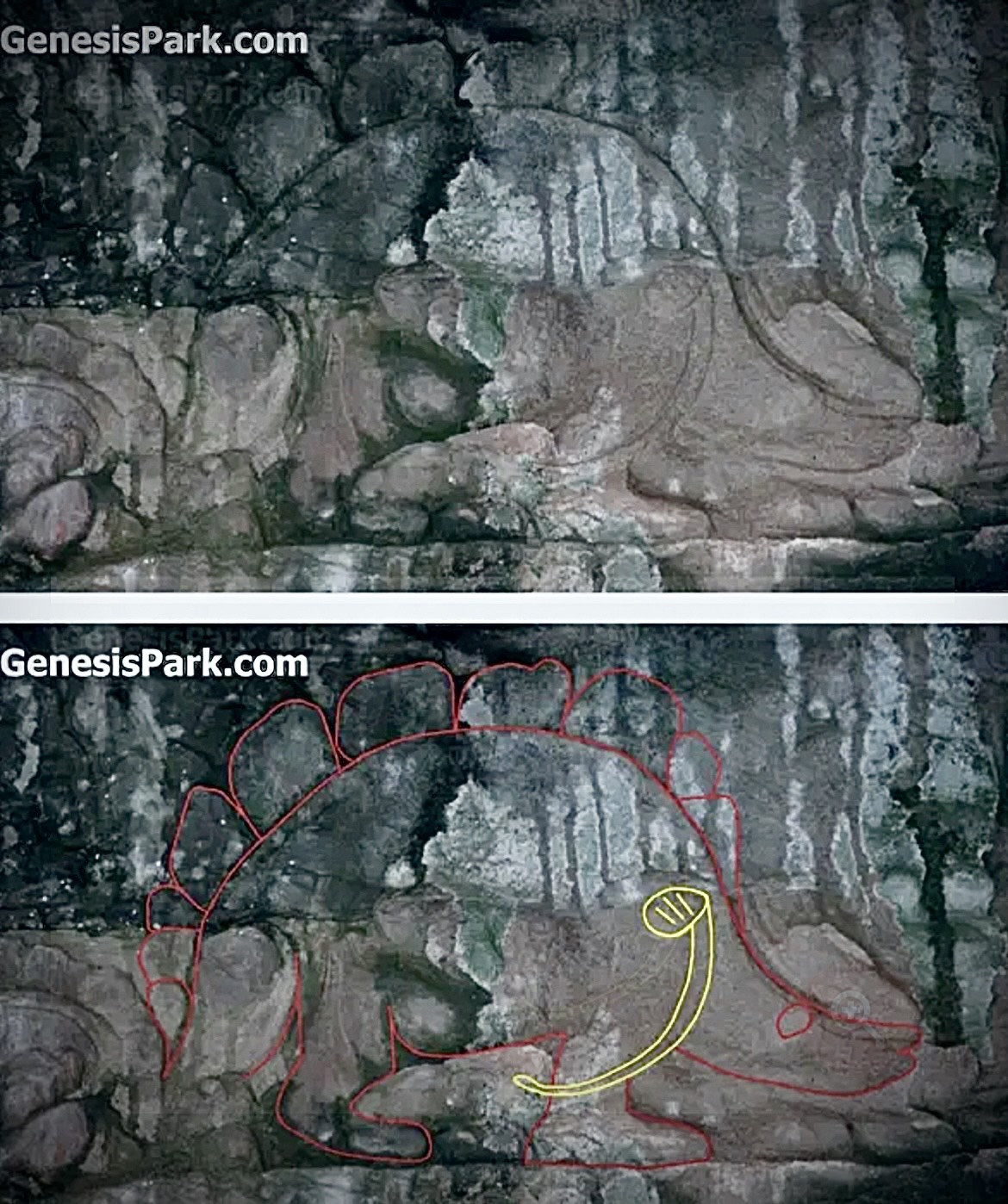
A carving on a temple wall shows an animal with a row of vertical plates along its back, sharply resembling a Stegosaurus. Some arguments have been levied against this claim but they’re hardly worth covering as most, upon seeing it, know exactly what’s being depicted. It’s not a porcupine.
Dale Pollard
The Ta Prohm Temple Stegosaurus
Location: Angkor, Cambodia
A carving on a temple wall shows an animal with a row of vertical plates along its back, sharply resembling a Stegosaurus. Some arguments have been levied against this claim but they’re hardly worth covering as most, upon seeing it, know exactly what’s being depicted. It’s not a porcupine.
In addition to that well-known stegosaurus carving, the existence of a second, lesser-known relief can be found in the same complex. This carving is larger and more eroded but the features of a stegosaurian dinosaur are clear enough. A bulky body, dorsal plates, and tail are easily made out— along with something else. Interestingly, the head appears elongated and slender in comparison to the first making it more realistic, but it’s what’s on the head and neck that you’ll find amazing.
An unusual feature around the neck shares uncanny similarities to a bridle or harness— suggesting domestication. The work that could (hypothetically) be done with an animal of that size is fascinating to think about. Perhaps it could even explain the massive amounts of stone which were moved to complete the temple it was carved into. Many don’t realize that the volume of stone used at the Angkor Wat complex is greater, proportionally, than even the largest pyramid on Giza plateau in Egypt. But back to the stegosaurus bridle. The evidence is mainly that it mirrors other carvings around Ta Prohm depicting bridles on horses, elephants, and oxen in the same manner.
The Triceratops Rider
Location: Acambaro, Mexico
A clay sculpture depicting a human figure riding a Triceratops was discovered in 1944. This piece is part of a larger collection of around 33,000 ceramic figurines near Acámbaro, Guanajuato, Mexico, by a German man named Waldemar Julsrud.
In the 1950s, Professor Charles Hapgood investigated the site and supported the idea that the artifacts were genuine. Apparently, thermoluminescence dating was done in the 1960s and 1970s (don’t ask me how that works) and the results indicated that the figurines might have a pre-Columbian origin.
Could it be that the mainstream evolutionary timeline is that blatantly false? The author obviously believes that to be the case. Humans and dinosaurs walked the earth at the same time. While some were predators that our ancestors feared (Job 40-41), it seems that some were also tamed and used in a ways not unlike the ox or horse. Could you imagine?
In 2 Corinthians 10:4-5, Paul reminds his readers that, though we live in the world, we don’t fight the same way the world fights; instead, he says, “For the weapons of our warfare are not carnal but mighty in God for pulling down strongholds, casting down arguments and every high thing that exalts itself against the knowledge of God…”
In that spirit, I want to share an argument that I’ve come across somewhat recently that argues against God, and how to counter it.
The argument goes as follows: First, God knows all things; therefore, He knows what He can say or do that would convince any particular person to believe in Him. Second, God can do all things; therefore, He is able to do whatever would convince any particular person to believe in Him no matter how hard it may seem by human standards. Finally, God has stated in the Bible that He wants “all men to come to the knowledge of the truth” (1 Tim. 2:4). However, not everyone believes in God; therefore, He either doesn’t know what can convince someone, can’t do what would convince someone, or is lying about His desire for everyone to come to the knowledge of the truth.
At first, it can seem like a strong argument, but there are cracks in its façade. First, it’s true that God does know all things. In fact, He knows more about people than they know about themselves. Richard Dawkins used to say that he would only be convinced that God was real if he ever heard that trumpet call and saw Jesus coming down from heaven with the angels and the resurrected saints on the Day of Judgment. Nowadays, he says that even if he saw that, he would assume he was hallucinating. I saw another prominent atheist, when asked if there were any evidence that could convince him of God’s reality, ultimately responded that even if he were to see the stars in the sky move and arrange themselves to spell out “Believe in me, John,” that he would more likely believe that aliens were messing with him. There are some people who will refuse to believe no matter what evidence is presented, and in those cases, God will allow people who don’t love the truth to exchange it for a lie (Romans 1:25).
Furthermore, God is interested in something far deeper than some mere mental assent. He doesn’t want people to simply believe that He exists or even believe that He is powerful or even good and just leave it at that. Adam and Eve believed that God exists and must have been convinced of His power (He had made the world) and even His goodness (He had given them everything), but did that stop them from sinning? Cain talked with God, but still murdered his brother. The Israelites at the foot of Mount Sinai were convinced of God’s existence and power, but they still made a golden calf to stand in for the Lord of heaven and earth (and that against His express command). Even the demons believe in God as James tells us, but God wants more than our acknowledgment. He wants our love and He wants our faith. And He deserves it, too!
Because the second point is that God can do all things, and He has done the unimaginable just to prove how much He really loves us. He became flesh and blood. The infinite God wrapped up in a finite, mortal shell. I can’t understand any better than I could understand turning myself into an ant. And then to sacrifice Himself to save us from our own sins!
The people who demand that God prove His existence to them in some miraculous way are arrogant. It reminds me of the Pharisees who, after Jesus had done numerous miracles, still asked for a sign. God wants everyone to come to the knowledge of the truth, and He has done everything necessary to show that. The ball is now, so to speak, in your court.
This week’s question is a new one for me: What is beauty? A follow-up question some of you may ask is, “What does that have to do with Christianity?” More than we might think! Beauty is a powerful evidence of intelligent design, an aspect of reality that inspires both fear and wonder.
God shows us what he’s like through what he created. As Paul puts it, “There are things about God that people can’t see — his eternal power and all that makes him God. But since the beginning of the world, those things have been easy for people to understand. They are made clear in what God has made, so people have no excuse for the evil they do” (Rom 1.20).
Inquisitive minds have marveled at the beauty/symmetry of nature for millennia. A pattern is obvious in so many seemingly-unrelated things! The “Golden Ratio” under various names has been important to our study of reality for thousands of years. It can be seen in the number of leaves on a stem, in the pattern of a nautilus shell, and even the proportions of our faces.1 Not all of us are remotely mathematically minded (at least I’m not), but I don’t need to understand the properties of Φ to appreciate its role in nature’s beauty! I have eyeballs and some level of consciousness, so it’s self-evident.
The question wasn’t, “Why is beauty important to a believer?” Some consider this topic irrelevant or unimportant or even repulsive, but beauty plays such a powerful role in showcasing God’s unlimited power and love!
So what is beauty? In nature, it is symmetry and something that inspires awe. Snowcapped mountains and roaring seas each have their own beauty (see I Cor 15.40-41 for other examples). Awe is fear with beauty, the goosebumps we might get when we see something truly incredible or terrifying.2 God made nature and people beautiful as an expression of himself! From almost the very beginning, humanity’s enemies hijacked beauty to interact with it in ways God never intended. There’s nothing new under the sun — beauty is just one of a few things God created for good that have potential for abuse.
In the abstract, beauty is (at least in part) whatever we might call “good” or “beneficial”. When someone helps another person we call that “beautiful”. When a person’s actions and disposition align with what is good, we call that “beautiful”. It is difficult to describe, but God has written a moral code in each person’s heart. Some listen to it, many do not. But we don’t have to delineate this code to know when something is beautiful! Anything done by that ethic is beautiful.
So God created humans in his own image. He created them to be like himself. He created them male and female. God blessed them and said, “Have many children. Fill the earth and take control of it. … God looked at everything he had made. And he saw that everything was very good” (Gen 1.27-28, 31).
1 Examples of the golden ratio you can find in nature. (n.d.) Sacramento State University. https://www.csus.edu/indiv/m/mirzaagham/math1/SQ5.pdf 2 See also Mcphetres, J. & Zickfield, J. (09.2022). The physiological study of emotional piloerection: A systematic review and guide for future research. International Journal of Psychophysiology, 179 (pp. 6-20). https://doi.org/10.1016/j.ijpsycho.2022.06.010
Sennacherib is on a campaign to control all routes across the Syrian Desert leading to the Mediterranean Sea. Assyria had already carried the Northern Kingdom of Israel off into captivity and invaded the southern kingdom of Judah.
Jerusalem is now under threat of attack and king Hezekiah sends his servants to the prophet Isaiah to ask for prayers on behalf of the people. Yahweh, through Isaiah, tells the people to not be afraid. For as unlikely as it seemed to the surrounded inhabitants of Jerusalem, their salvation would come in the middle of the night.
“That night the angel of the LORD went out to the Assyrian camp and killed 185,000 Assyrian soldiers. When the surviving Assyrians woke up the next morning, they found corpses everywhere” (2 Kings 19.35).
Sennacherib Cylinder Evidence:
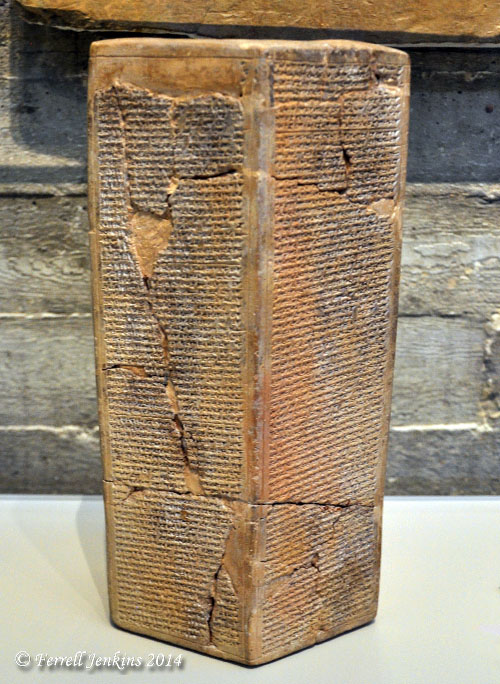
Sennacherib left behind a record of his campaign against Judea and it can still be seen in the British Museum today.
Here’s a translation of his inscription,
“As to Hezekiah, the Jew, he did not submit to my yoke. I laid siege to 46 of his strong cities, walled forts, and to the countless small villages in their vicinity. I drove out of them 200,150 people, young and old, male and female, horses, mules, donkeys, camels, big and small cattle beyond counting and considered [them] spoils. Himself I made a prisoner in Jerusalem, his royal residence, like a bird in a cage.”
Sennacherib claims he conquered all of Judea except Jerusalem. He also claims that he surrounded the city of Jerusalem with his army, and trapped Hezekiah “like a bird in a cage.”
Curiously, that’s where he chose to end the story. To continue any further would mean to either fabricate or include a loss of such magnitude that it would tarnish the reputation of a proud Assyrian king.
It’s so encouraging that many public figures (by extension, many of their audiences) have rejected outright atheism and godless evolution! Even those who would never consider themselves believers have rejected some of the main pillars of evolution. Among them are people like Joe Rogan, Randall Carlson, Graham Hancock, Jordan Peterson (who does describe himself as a believer in some capacity), Ben Van Kerkwyk, and many others.
What have they rejected (minus Peterson)? Gradualism/Uniformitarianism — a belief (it is a belief) that current processes are sufficient to explain how things were in the past. Uniformitarianism is the foundation supporting a belief that our earth is billions of years old, that geological processes take millions of years, and it serves as the bias behind radiocarbon/radioisotope dating.
So what’s the problem? These same proponents of catastrophism (the belief that geological processes are best explained through natural disasters rather than gradual changes over long periods of time) still view the earth as being billions of years old. They still have an evolutionary view of our timeline. Progress is progress, so I don’t want to be harsh in discussing these people!
But I would like to remind myself (and whoever may read this) of why I don’t believe the earth is any more than (at most) 12-15,000 years old:
Population of earth — We double in population every couple of decades. Allowing for disasters, if humans (or humans-ish, as evolutionists say) came onto the scene 1,000,000 years ago, we’d have something like 1×105000 people on earth today. The known universe couldn’t hold anywhere near that many people, much less our one planet. Since the current population of earth is around 8.02 billion (according to commerce.gov), we can safely assume that we’re no older than 12-15,000 years.
Sediment layers across our ocean floors are far too “thin” to support an age of hundreds of millions of years. Sediment should be “choking the oceans” if the oceans were that old. The salinity (saltiness) of the oceans is another problem for old-earth proponents — it has been convincingly proven that our oceans are getting saltier with time (rather than remaining constant). Based on current salinity, our earth is no more than several thousand years old.
Many other brilliant authors have written much more than can be contained here. I recommend perusing the Institute for Creation Research’s website, as well as Apologetics Press and Answers in Genesis for more proofs. While the secular world is still off on quite a few things, we shouldn’t overlook the fact that progress is being made.
At least for right now, there does seem to be a positive trend in society’s thirst for meaning! Let’s make the most of this by showing God’s love even more. Let’s prove to the world that there’s no better life than a Christian life! Our God is coming back — when he does, the entire world will see him. Let’s show them that we believe in him enough to love like Jesus!
Sumerian culture talks about a ziggurat dubbed “Etemenanki” and it was hailed as the “House of the Foundation of Heaven and Earth.” It was dedicated to Marduk, a serpentine/dragon deity, and the patron deity of Babylon. It was said to have measured three-hundred feet tall and featuring seven stacked levels.
Famed Assyriologist, George Smith (1840-1876), provided a translation of some Sumerian clay tablets and here’s his brief summary of the inscription:
“…we have the anger of the gods at the sin of the world, the place mentioned being Babylon. The building or work is called tazimat or tazimtu, a word meaning strong, and there is a curious relation, lines 9 to 11, that what they built in the day the god destroyed in the night.” (The Chaldean Account of Genesis, 1876, p. 162).
Egypt’s Babel
A portion of the Qur’an makes a few claims that resemble the legendary biblical tower— save a few key differences. In the Islamic story, the event takes place in Egypt and the Pharaoh orders a minister named Haman to build a tower that reaches the heavens.
Mexico’s Babel
Pedro de los Rios, writing sometime before 1565:
“Before the great inundation which took place 4,800 years after the erection of the world, the country of Anahuac was inhabited by giants, all of whom either perished in the inundation or were transformed into fishes, save seven who fled into caverns. When the waters subsided, one of the giants, called Xelhua, surnamed the ‘Architect,’ went to Cholula, where, as a memorial of the Tlaloc which had served for an asylum to himself and his six brethren, he built an artificial hill in the form of a pyramid. He ordered bricks to be made in the province of Tlalmanalco, at the foot of the Sierra of Cecotl, and in order to convey them to Cholula he placed a file of men who passed them from hand to hand. The gods beheld, with wrath, an edifice the top of which was to reach the clouds. Irritated at the daring attempt of Xelhua, they hurled fire on the pyramid. Numbers of the workmen perished. The work was discontinued, and the monument was afterwards dedicated to Quetzalcoatl.” (Mexico as it is and was, 1844, Brantz Mayer, p. 28)
Non-Canonical Coincidences
In the Greek Apocalypse of Baruch (written between the 1st-3rd Cen.) we find a description of the condition of Jerusalem after the sack by Nebuchadnezzar.
The Greek Apocalypse details a vision of Baruch ben Neriah and in it he sees the punishment of the builders of the “tower of strife against God,” which sounds remarkably similar to the Tower of Babel.
Abydenus (a Greek historian of the mid-fourth century B.C.), as quoted by Eusebius, spoke of a great tower at Babylon which was destroyed. The record notes:
“[U]ntil this time all men had used the same speech, but now there was sent upon them a confusion of many and divers tongues”
Josephus, the Jewish historian, quoting from an ancient source, records these words:
“When all men were of one language, some of them built a tower, as if they would thereby ascend up to heaven, but the gods sent storms of wind and overthrew the tower, and gave every one his peculiar language; and for this reason it was that the city was called Babylon”
(Antiquities of the Jews, 1.4.3).
THE TRUTH BEHIND THE TOWER
While we don’t need the extra biblical evidence and anecdotes to prove what God already told us, it’s certainly interesting and faith-building to discover. We shouldn’t forget the main message of His account. When humans are united we’re either powerfully wicked or powerfully righteous. The top of our metaphorical towers will either touch heaven or hell and the end result depends on what we’ve decided to unite under. If Christ is on the banner we fly then we’ll find success. If pride, greed, or any other selfish ambition brings us together— that tower will inevitably fall.
The Birth of Behemoth-Buildings
First to Scrape The Sky:
The first skyscraper was built in Chicago by William LeBaron Jenney in 1885. While that nine story structure no longer stands, many skyscrapers from that time period remain.
King of the Towers:
The Burj Khalia in Dubai is the tallest building in the world— standing at 2,717 feet tall.
Jenney’s “Home Insurance Building” (demolished in 1932 to make room for a larger building)
“The Nephilim were in the earth in those days, and also after that, when the sons of God came in unto the daughters of men, and they bore children to them; the same were the mighty men that were of old, the men of renown.”
(Gen.6.4).
“And there we saw the Nephilim, the sons of Anak who come of the Nephilim; and we were in our own sight as grasshoppers, and so we were in their sight.”
(Num.13.32-33).
A HUGE HISTORY
The Sumerian culture has become famous for their giants. However, nearly every ancient culture had legends and records of either a co-existence with giant races or knowledge of them. Some of their megalithic structures were even allegedly built by them, with many ancient cultures indicating that they were ruled by giants. The Norse, Egyptians, Greeks, Native American, Mesopotamian, and South American cultures represent just a fraction of the ancient societies whose legends and early mythology are dominated by tales of giants.
SUPERSIZED SIDE-BY-SIDE
GOLIATH – 11th Cen. BC – Height: 9’9”
KING OG – 11th Cen. BC – Height: ~12’
KING GILGAMESH – 26th Cen. BC – Height: 18’
ENOCH’S GIANTS – 200-300 BC – Height 450’
The following accounts and descriptions come from a Newspaper published in 1905 called the Lawrence Daily Journal (03, JUN, Pg. 3)
ROUEN GIANT
“In 1830 one of these giants, who was exhibited at Rouen, was ten feet high…
FANNUM
“…lived in the time of Eugene II., was 11 feet in height.”
TENERIFFE GIANT
“The Chevalier Scrog in his journey to the Peak Teneriffe found in one of the caverns of that mountain the head of a giant who had 60 teeth and who was not less than 15 feet high.”
KENTOLOCHIS REX
“In 1623 near the castle in Dauphine a tomb was found 30 feet long. 16 feet wide and eight feet high. on which were cut in gray stone the words “Kentolochis Rex.” The skeleton was found entire and measured 25¼ feet high, ten feet across the shoulders and five feet from breastbone to the back.”
FARRAGUS
“Slain by Orlando, the nephew of Charlemagne, according to reports, was 28 feet high.”
ISOLENT
“In 1814 near St. Gernad was found the tomb of the giant who was not less than 30 feet high.”
HOGSHEAD
“Near Magrino, in 1816, was found the skeleton of a giant of 30 feet, whose head was the size of a hogshead and each tooth weighed 5 ounces.”
SICILY GIANTS
“Near Palermo, Sicily, in 1516 was found the skeleton of a giant 30 feet high, and in 1559 another 44 feet.”
What Happened To The Giants?
The post-fall and post-flood world began the slow decline in height and strength of the giant races. Thoughtful theories and speculations are proposed such as the deterioration of their DNA through genetic lines, radical changes in earth’s atmosphere, and possible health-related issues. While the more scientific explanation(s) could shed light on their decline and ultimate disappearance, the philosophy of Occam’s razor says that the most simplistic answers are the closest to the truth.
The simple answer? Many accounts describing giants depict them as mighty warriors. Their heads were highly coveted trophies of war and any giant-slayer was surely bound to be immortalized in history. The harrowing attempts to kill a giant on the battlefield were successful and those men reached legendary status— their stories told for thousands of years (2 Samuel 23.8-38).
While the regional and genetic factors play a part in the shrinking stature of giants in the archeological record, it seems that their height may also give one an indication of their age and placement on the historical timeline. The closer to the present day period, the smaller they became. The days of lumbering 40’ tall terrors were numbered and their descendants were born with heads much closer to the ground.
Non-Canonical Coincidences
JOSEPHUS
Ist Century Historian Flavius Josephus writes in his Antiquity to the Jews, “For which reason, they (Israelites) removed their camp to Hebron; and when they had taken it, they slew all the inhabitants. There were till then left the race of giants, who had bodies so large, and countenances so entirely different from other men, that they were supposing to the sigh and terrible to the hearing. The bones of these men are still shown to this very day, unlike to any credible relations of other men.”
THE BOOK OF ENOCH
Extra-biblical texts such as the famous book of Enoch and its accompanying Book of Giants serve as valuable supplementary material backing the biblical claims of giants and their existence. While mere fragments were recovered from the Qumran site in the 1950s, the texts are fascinating. Here’s a portion from the manuscripts translated by Dr. H. B. Henning, a German scholar and expert in Iranian languages:
“Thereupon the giants began to kill each other and [to abduct their wives]. The creatures, too, began to kill each other. . . before the sun, one hand in the air, the other . . . whatever he obtained, to his brother . . . . imprisoned . . . . . . over…To the angels . . . from heaven. to . . . threw (or: was thrown) into the water. Finally. . . in his sleep saw three signs, [one portending . . .], one woe and flight, and one . . . annihilation. Narīmān saw a gar[den full of] trees in rows.”
TIMELINE OF ACCOUNTS
1519 – Diaz Castillo sees the remains giants who once roamed the land in ancient Tlaxcala, Mexico. In his book, “The Memoirs of the Conquistador Bernal Diaz Del Castillo,” he recalls, “They (the Tlaxcalan tribe) said their ancestors had told them that very tall men and women with huge bones had once dwelt among them. But because they were very bad people with wicked customs they had fought against them and killed them, and those of them who remained had died off. And to show us how big these giants had been they brought us the leg-bone of one, which was very thick and the height of an ordinary-sized man, and that was a leg-bone from the hip to the knee. I measured myself against it, and it was as tall as I am, though I am of a reasonable height. They brought other pieces of bone of the same kind, but they were all rotten and eaten away by soil. We were all astonished by the sight of these bones and felt certain there must have been giants in that land.”
1520 – Ferdinand Magellan’s expedition chronicler writes about a race of giants they encountered while in Patagonia, “But one day we saw a giant who was on the shore, quite naked, and who danced, leaped, and sang, and while he sang he threw sand and dust on his head. Our captain [Magellan] sent one of his men toward him, charging him to leap and sing like the other in order to reassure him and to show him friendship. Which he did. Immediately the man of the ship, dancing, led this giant to a small island where the captain awaited him. And when he was before us, he began to marvel and to be afraid, and he raised one finger upward, believing that we came from heaven. And he was so tall that the tallest of us only came up to his waist. Withal he was well proportioned…” Interestingly, the name Patagonia means “Land of the Bigfeet.”
1608 – Captain John Smith explores the Chesapeake Bay and Lower Susquehanna River where he runs into a tribe of giant Indians. He describes them as “…a giant-like people. They measured the calf of the largest man’s leg, and found it three-quarters of a yard about (twenty-seven inches), and all the rest of his limbs were in proportion.”
1857 – Chief Rolling Thunder of the Comanches, a tribe from the Great Plains, gave the following account of an ancient race of white giants. “Innumerable moons ago, a race of white men, 10 feet high, and far more rich and powerful than any white people now living, here inhabited a large range of country, extending from the rising to the setting sun. Their fortifications crowned the summits of the mountains, protecting their populous cities situated in the intervening valleys.”
1881 – Prof. Timmerman was exploring the ancient ruins of the Isis temple on the banks of the Nile— sixteen miles below Najar Difard. It was here where several tombs dating back to the year 1043 B.C would be excavated for the first time. Inside, not one, but sixty giant skeletons had been buried. The smallest skeleton was an astonishing seven feet and eight inches in length, the largest being eleven feet and one inch. Many stone memorial tablets were also discovered, but there was no record that indicated that they were in memory of the giants. It’s believed that the tombs date back to the year 1043 B.C.
1899 – Horatio Bardwell Cushman penned the following in his book, History of the Choctaw, Chickasaw, and Natchez Indians,
“The tradition of the Choctaws did tell of a race of giants that once inhabited the now State of Tennessee, and with whom their ancestors fought when they arrived in Mississippi in their migration from the west. … Their tradition states the Nahullo (race of giants) was of wonderful stature.”
1907 – Friar Alonso de Espinosa travels to Tenerife, the largest island of the Canary Islands, to convert the natives. In Espinosa’s book he writes about the locals, “This people had very good and perfect features and well shaped bodies. They were of tall stature, with proportionate limbs. There were giants among them of incredible size; and that it may not appear fabulous, I will not repeat what is said on the subject. Of one it is generally said, as verified and ascertained fact, that he was fourteen feet high and had eighty teeth in his mouth. It is said that the great body is in Guadamoxete, the ancient burial place of the Kings of Guitar, whose nephew he was. He fell in a battle with the King of Tegueste, and they say that, having been killed by the enemy, one of his lineage took his banot (a kind of weapon) to avenge his death, which he did.”
The debate between creationists and atheists is probably not new to you. This heated debate frequently takes the form of verbal duels, with each side trying to persuade onlookers to take their side. Unfortunately, these arguments rarely convince their opponents to change their minds. In most cases, they are speaking to an already confident audience.
Since I hold a creationist worldview, I frequently read works that reinforce that view. Unfortunately, the strategy used to make the case for God’s existence often comes off as bland and unpersuasive. These tactics wouldn’t have influenced me had I not already convinced myself.
Ultimately, faith is the deciding factor. We can’t provide indisputable evidence since we weren’t around for the “Big Bang” or creation. We found our faith in the evidence that we found most convincing, be it ancient fossils or direct revelation from God. This truth leads me to an essential aspect of my approach when discussing my faith.
When asked about my faith, I usually explain why I think there must be a higher power, pleading only for tolerance and acceptance. I want to debunk the myth that people who believe in God are stupid. To this end, allow me to provide two fundamental arguments that offer compelling evidence of a Creator.
First, I’d like to discuss the concept of a “God-shaped void” in every person’s soul. Aurelius Augustinus Hipponensis, a theologian born roughly 320 years after Jesus of Nazareth, is widely credited with developing this idea. However, the French mathematician Blaise Pascal may be a more likely originator. Pascal’s perspective gives us much to ponder.
According to Pascal, the search for and disappointment in material happiness are signs of a more profound spiritual longing. He contended that only something infinite and unchanging, like God, could fill this gaping chasm. This void brings us to an intriguing point about our universal need for worship.
We can’t help but wonder if there is a universal, hardwired urge to worship. How come religion is so pervasive? What accounts for the universality of references to spiritual phenomena like ghosts and ghouls? How do some people discover spirituality in the great outdoors? These occurrences point to an innate desire to worship. Skeptics, however, might have a different take on this.
Skeptics may write off religion as the product of neuroses, thereby tagging the vast majority of humanity as mentally ill. The paradox here is apparent: It takes neurosis or paranoia to believe you’re the only sane person in the room. Interestingly, skeptics themselves seem to show a form of devotion.
Even skeptics have their form of religious devotion. Non-believers hold science in high regard and defend its tenets with great zeal. Like accusations of heresy in religious contexts, challenging their scientific beliefs can elicit strong reactions. This reaction has led me to question the source of our knowledge.
While I value science’s role, I am skeptical of its origins. Believers credit their knowledge to God or a higher power. Atheist scientists rely heavily on human-made discoveries and theories with inherent flaws. Changes in academic science are possible and frequent. However, God’s Word does not change. This immutability brings me to another critical argument I wish to present.
The ontological argument is my second piece of evidence for God’s existence. Anselm of Canterbury first advanced this line of a priori knowledge-based philosophical reasoning in 1078. Here’s what Anselm proposed:
Anselm theorized that God must exist because He is “a being than which no greater can be conceived.” This argument may seem complicated, but it claims that God must exist because everyone can imagine a supreme being and that having a physical presence is one measure of greatness. The universal nature of belief in God provides further credence to this argument.
The fact that people all over the world believe in God lends support to this claim. It resonates with the concept of a “God-shaped void,” implying a global recognition of a supreme entity Whom men desire to worship. With these points in mind, what do I conclude about the existence of God?
Is there a God? Yes, I think so. I suggest you give that idea some thought, too. Perhaps you already know about God but still, feel something is missing. Seek Him out; you won’t regret it. I believe that you can find Him because I have found Him.
We’re impressed by the intricacies of craftsmanship or artistry. A well-made instrument or diorama or painting can sell for thousands or more. Watching the process of those things coming to life leaves an even more profound impression of the talent required! I’ve lost track of time while watching hyper-realistic dioramas take shape (by other artists, not me). The sheer effort involved is incredible. While those artists are very, very talented and impressive, they’re nothing compared to reality’s architect! Hours, weeks, or months are invested in breathtaking artwork, yet those pieces come from extant materials and are based on extant concepts. Humanity cannot create anything new. It took God less than a week to fabricate an unfathomably large universe. We explore and investigate our world, only to be blown away by its complexities. Even the simplest life forms require highly intelligent minds and sophisticated equipment to understand. The more we discover, the more we understand how little we know. For several years, science has been adopted by many as an explanation for reality. Besides the fact that science is merely our observations of what already exists, it still leaves plenty of questions unanswered. For example, look into how many medications say something like (paraphrased, of course), “We don’t know how this works, but we think it…” We can perform complex surgeries using robots, but we can’t cure the common cold. We can explore our galaxy, but we’re not sure how exactly some antidepressants work to alleviate symptoms. Humanity has accomplished some amazing things, but even the most “basic” issues continue to evade our understanding. Therefore, it isn’t entirely unreasonable to assume that something or someone intelligent was responsible for our incredible existence. Our greatest accomplishments pale in comparison to the magnitude of our universe. Every great piece of art has an artist behind it. Every piece of groundbreaking technology has a design team behind it. Our universe must have also had an immensely powerful, creative, compassionate designer. Far from somehow disproving the existence of God, our greatest accomplishments merely highlight how powerful God really is. He gave us a beautiful world and way more than we need to survive. The sheer beauty of this planet alone should tell us that our God is a loving God. “I look at the heavens you made with your hands. I see the moon and the stars you created and I wonder, ‘Why are people so important to you? Why do you even think about them? Why do you care so much about humans? Why do you even notice them?’ But you made them only a little lower than angels and crowned them with glory and honor. You put them in charge of everything you made. You put everything under their control…Lord our Lord, your name is the most wonderful name in all the earth” (Ps 8.3-9)!











 The Preacher Pollard Blog