The Unified Church

Thursday’s Column: Carlnormous Comments

tempImagehquiDk

Carl Pollard

In a society of division and separation, many churches have begun to struggle with unity. Members are bickering with each other, elders are unsure of how to respond to the events that have unfolded in the past year, and deacons are struggling to maintain the proper relationship with each member.. All of these factors combined has caused several churches to split or lose the unity they once had. 

Paul writes in 1 Corinthians 11:17ff  that some who came to worship would be hungry, while others would be drunk and incapable of edifying each other. His point? Far too many churches are split due to a lack of understanding. We fail to understand why it is that we assemble together in the first place. Having a unified assembly starts with the individual. No church will find harmony if each member is unwilling to submit to God’s will and to His church family. 

When we come to worship, there are key aspects that we must insure take place (1 Corinthians 14:12-25). We must make sure what we do edifies others (v. 12). Paul in the context of tongues and prophecy says,  “So with yourselves, since you are eager for manifestations of the Spirit, strive to excel in building up the church” (14:12). 

Our actions must help build up the Christians around us. Our words must edify our brothers and sisters who are dealing with problems we may never even know about. And so the questions we must constantly be asking ourselves are these: How am I edifying? Am I being an encourager (making my fellow Christians stronger)? Am I building up others (boosting their confidence to help them deal with the world)? Am I promoting unity? 

As humans we thrive on encouragement.  We feel good when we receive a compliment. That’s because there is power in edification. As fellow brothers and sisters we should be actively trying to find ways to build each other up. 

This also means we must be sure to understand the power of our words and actions. Rather than spreading gossip or discord with our lips we must make it a priority to edify, encourage, lift up, serve, compliment, and look out for the good in our church family.

THE IMPERATIVES OF ROMANS 15

Monday’s Column: “Neal At The Cross”

16174665_10154303308455922_2453812807432667966_n

Neal Pollard

When examining a passage that we need to put into practice, one of the most important things we can do is to find the imperatives in that passage. For example, the Great Commission in Matthew 28 contains one imperative–“make disciples” (19).  Two participles tell us how to do that: “baptizing” and “teaching” (19-20). Another example is Ephesians 5:18-21. There is a double imperative here: “Do not be drunk with wine” (18), but “be filled with the Spirit” (18). How do you obey the command to be filled with the Spirit? There are five ways, according to Paul. You are filled with the Spirit by “speaking,” “singing,” “making melody,” “giving thanks,” and “being subject to one another.” 

In his closing appeal to the Romans, Paul is concerned about how church members are treating each other. There are apparent struggles among them over their diverse religious past. Paul pictures this as those “weak in faith” (14:1)  and those who are “strong” (15:1). The strong is also called one who has faith (14:2). Apparently, God not only expects that congregations will have both categories of Christians, but He expects us to successfully work through situations that arise out of this fact. 

Apparently, one of the most damaging ways we handle such differences is by “judging” one another (14:3-4,10,13). The way Paul uses that word here means to “pass an unfavorable judgment upon, criticize, find fault with, and condemn” (BDAG 567). The issues in their circumstance were things like eating meets offered to idols and observing special days (14:5-6). Those things seem strange, even trivial, to us today. But the church in every generation has their own petty problems to negotiate, things that are struggles of faith nonetheless (14:16-23). This clash of convictions and maturity levels must be successfully met and overcome. How?

That’s where we turn to Romans 15. Paul gives two imperatives that are at the heart of negotiating the prickly situations like those we are facing right now. They are “please your neighbor” (15:2) and “accept one another” (15:7). Those two commands can be the hardest thing to do when we disagree with how our brother (or sister) handles a matter, especially matters without clearcut instruction. To “please” is to accommodate others by meeting their needs and sacrificing self-interest. None of us wants to do that, but if you are strong (15:1) it’s what you do. It’s what Jesus did (15:3)! To “accept one another” is best defined by contrasting it with its opposite, which in this context is to “regard with contempt” (14:3). That’s reflected in a sinful attitude, dismissing, disdaining, judging, and looking down on. 

Think about the difference when one obeys or disobeys these two God-given commands. If our mentality is to “please” and “accept,” how does that affect our relationship with those drawing different conclusions in matters of judgment? If we choose to please ourselves and reject our spiritual family based on their different conclusions, where do we wind up? According to Paul, it’s not a good place (14:12,15). 

I have yet to hear of a congregation without at least “two sides” in negotiating all that’s involved in reacting to the current pandemic. Everything from masks to isolating versus assembling to rational versus irrational fear gets dragged into the conversation. It’s easy to dig our trenches deeper and draw our lines bolder. What is to govern us in these tedious, perilous times? At the heart of it all, we must obey our Lord’s instruction. “Please your neighbor for his good, to his edification” (15:2) and “accept one another, just as Christ also accepted us to the glory of God” (15:7).  Never lose sight of this! 


KNOCKING DOWN THE WALLS OF JERICHO

Monday’s Column: Neal At The Cross

pollard

Neal Pollard

God had promised the land of Canaan as early as Abraham (Gen. 15:18ff). The first city of Israel’s conquest was Jericho (Josh. 6:1). The word about and reputation of God’s people preceded them, so Jericho “was tightly shut because of” them. Despite this, the LORD told Joshua that “the wall of the city will fall down flat” (Josh. 6:5). Israel followed God’s unorthodox battle plan and “the wall fell down flat” and “they took the city” (6:20). Though they’d suffer a setback because of one man’s disobedience, this was the dramatic start of what would be the accomplishment of the land promise made to Israel.

God also promised Abraham that in his seed all the nations of the earth would be blessed (Gen. 22:18). This was fulfilled through Christ (Gal. 3:28). One of the ways Jesus proved that He was the Christ was “with miracles and wonders and signs which God performed through Him” in their midst (Acts 2:22). He started His ministry in Galilee (Mat. 4:17) and ended it in Jerusalem (Mat. 16:21), but near the end He had His own Jericho triumphs. He had not one, but two that are recorded by the gospel writers. One involved Him performing one of His many miracles, gaining a victory over sickness, but the other was a triumph of a different kind gaining a victory over Satan. 

Luke indicates Jesus was approaching Jericho when He encounters a blind beggar (Luke 18:35). Matthew and Mark also seem to record the same miracle, identifying this man as Bartimaeus, and showing perhaps “that the Saviour went in and out at the same gate of the city, and that the miracle falls into two parts” (Lange 282). But Jesus’ knocks down the wall between the haves and have nots, the socially acceptable and the socially unacceptable, when He has mercy on him and gives him his sight (Luke 18:37-43). Immediately after Bartimaeus, Jesus enters Jericho and passes through (19:1). Now, he knocks down the wall between the righteous and the sinner (19:7). He went to be a guest in the house of Zaccheus, who wanted to see Jesus so badly that he climbed a tree. The end result of this encounter is “salvation” (19:9). 

Isn’t it interesting that the Hebrew name for Jesus is “Joshua”? Isn’t it also interesting that Jesus performs these miracles in proximity to the walls of Jericho? The walls that Jesus knocks down are important to us today. They tell us that the gospel is for the poor, the hurting, the needy, the seedy, the rejects, and the sinner. Wasn’t God preparing us for this when Joshua spares a harlot and her family in the destruction of Jericho (Josh. 6:22-23)? 

Jesus was certainly about knocking down the walls we can be quick to build. Who does Jesus want us to be taking the gospel to today? Certainly, He’s not against those who are financially blessed (Zaccheus was). He’s not against those who are socially well-connected (many Christian converts in Acts and the epistles were). But, here is where Jesus is revolutionary. As Paul puts it, “God has chosen the foolish things of the world to shame the wise, and God has chosen the weak things of the world to shame the things which are strong, and the base things of the world and the despised God has chosen, the things that are not” (1 Cor. 1:27-28). He chose “the poor of this world to be rich in faith and heirs of the kingdom” (Jas. 2:5). 

What should His church look like today? The gospel transforms lives and lifts people morally and spiritually higher. But, He’s interested in the Rahabs, Bartimaeuses, and Zeccheuses of our day! Jesus wants to break down barrier walls (Eph. 2:14). He wants you and me using the gospel to do the job for Him today! 

Kathy in Jericho, March, 2018

“Soft Civil War”

Wednesday’s Column: Third’s Words

Gary III

Gary Pollard

It is no secret that we are politically divided in this country. Larger cities are typically progressive, while the majority of a state’s rural populations are conservative. This has even dictated what kind of news we watch! If you watch CNN, you fit in with progressives. If you watch Fox News, you are most likely conservative. Both approach reality with their own highly specific bias in order to appeal to their respective audiences. As a result of this, we have entered into what is being called a “soft civil war.” Liberals speak with extreme hatred against conservatives. Conservatives speak with great hatred against liberals. It may be a soft civil war right now, but it would not take much at this point to become a full-fledged war.

As a church, we are a kingdom. Our king is Christ and the citizens of this kingdom are Christians. Sadly, the church is not immune to soft civil wars. In Philippians 4, Paul strongly rebukes Euodia and Syntyche because their argument was destroying the church. How easily we can become heated and hateful over matters of opinion! The way we handle differing opinions on matters not pertaining to salvation determines whether we will be unified as a church or whether – like Euodia and Syntyche – we will be a force for division. The greatest tragedy of the American Civil War was that families fought on opposing sides and killed one another. As the body of Christ, let us continue to handle our differences with godliness, love, and patience.

What Does The Bible Say?

Monday’s Column: Neal at the Cross

pollard

Neal Pollard

Most people have very strong convictions, pro or con, about religious matters.  Many who claim to be religious form opinions and draw conclusions with very little if any biblical consultation.  How ironic is it to claim to follow God while ignoring and even rejecting His very revealed will?

Many religious people, church attenders and not, are guided by their feelings, desires, opinions, preferences, and consciences (cf. 2 Tim. 4:3; Prov. 14:12).  Perhaps they have a favorite preacher or other religious figure they implicitly trust.  Their religion may be submitted and subjugated to the message of the culture or even the media. It may be based on convenience and comfort.  Throughout time, man has attempted to serve God on his own terms and based on what he thinks is right.  Whether ignorantly or defiantly, he puts himself on a throne upon which only Jesus belongs (Mat. 28:18).

How long could religious error survive if potentially divided parties could lay aside personal interests and objectively study the sacred text?  So often, the religious world is divided because of man-made doctrines and traditions.  Instead of looking to the Bible to answer the important questions of time and eternity, men often come up with the answers they want and then go looking for Bible verses to support their predetermined views.  Consider that some of the most popular religious ideas—salvation by saying the sinner’s prayer, premillennialism, speaking in tongues, women worship leaders, once-saved, always-saved, and instrumental music—are not practiced or believed based upon their being taught in Scripture but instead their being the beliefs and views of mankind.  How thrilling it would be if we could unite every religious person in the desire to come to the text, the glasses of prejudice or sectarian beliefs removed, and let God tell us what to believe and how to live!  That is possible, but it begins with each of us humble, sincerely asking, “What does the Bible say?”

4543060842_e4fdb33047_b


God is Protective of His Church

Wednesday’s Column: Third’s Words

Gary III

Gary Pollard

Many have heard, “Do not be deceived: bad company corrupts good morals” (I Corinthians 15.33). It’s not difficult to understand the concepts in this verse. If our closest relationships are with worldly people, our ethics and behavior will reflect this. Fun fact: the word for company here is ὁμιλία (homilia). The first part of the word sounds a lot like “homie,” so it’s easy to remember. 

I want to look at the word “corrupt” a little more closely. At first, I thought it might be similar to Ephesians 4.29, “Let no corrupting talk come out of your mouths…” But that word is completely different and more closely describes decomposition. “Corrupt” in I Corinthians 15.33 means, “To cause deterioration of the inner life” (BDAG 1054). 

Paul uses this same word earlier in the book. In I Corinthians 3, Paul talks about the church and her foundation (as in, her foundation is God and not men). By verse seventeen – still addressing the church – he says, “If any man destroys the temple of God, God will destroy him, for the temple of God is holy, and that is what you are” (emp. mine). 

“Destroy” is usually ἀπόλλυμι (apollumi) or λύω (luo), but in this verse it’s the same word that’s translated “corrupt” in I Corinthians 15.33. 

So what does this mean for us? It’s an extremely solemn warning to those who are corrupting or dividing the church today. At Corinth, the division was due to worldliness and basing their Christianity on prominent men like Paul or Apollos. 

If our conduct is dividing the church, we need to read I Corinthians 3.17. 

If what we’re talking about corrupts the bride of Christ, we need to read I Corinthians 3.17. 

If we abuse the influence we have in the church, we need to read I Corinthians 3.17. 

If our opinions, preferences, political views, or behaviors are in any way eroding the family of God, we have to quit them. A bad argument was enough for Paul to tell Euodia and Syntyche to, “Work out your salvation with fear and trembling” (Philippians 2.12). Their argument was hurting the church at Philippi, so Paul told them to get it together or their souls would be lost. 

If love for the church does not motivate us to pursue unity, then it is time for us to cultivate a healthy fear of what negative actions can do to our souls. The church is eternally important and infinitely precious, so what could go wrong if we’re always looking out for others? 

cross-cornerstone

Chasing Calm In The Chaos Of Conflict

Wednesday’s Column: Third’s Words

Gary III

Gary Pollard

Conflict stinks. It’s unpleasant, uncomfortable, and far too easy to do poorly. Conflict is a delicate game balancing a desire to achieve a certain outcome without causing unnecessary escalation.

We live in a world where evil is alive and well. No one wants evil to exist, but it does because of sin. Both good and bad people sometimes do evil things. Those people should be held accountable and justice meted. Our country has had a consistent pattern of civil unrest after an injustice. We no longer know how to have healthy conflict. 

  • Do you want to perpetuate hate? Use the actions of an evil person as an excuse to harm others, burn businesses, and contribute to civil unrest. 
  • Do you want to stifle positive change? Share polarizing rhetoric. It will flawlessly push either side more firmly into their ways. 
  • Do you want to keep a rift between entire groups of people? Play the blame game instead of holding those responsible accountable. And, when those responsible have been held accountable, continue to accuse others of complicity. 

Every single person on the planet is guilty. Every single person on the planet is hopeless without God. Every person on the planet would die lost if not for Jesus and the forgiveness He offers. Not one person is perfect. 

  • Do we want peace? Be good to all people (Galatians 6.10). 
  • Do we want to eradicate prejudice? Unite within the family of God (Galatians 3.28). God created people, not factions. 
  • Do we want to eliminate hatred? Be patient, kind, humble, not jealous, not self-centered, not easily provoked, not a grudge-holder, not someone who relishes in dysfunction, love truth, not retaliatory, and be full of hope (I Corinthians 13). 

We must face the fact that the only way to have true stability, love, acceptance, and goodness is to go through God. Only when we look to an objective standard – one that cannot change simply because man’s threshold of tolerance has – will we have peace. 

“Happy are the peacemakers, because they will be called children of God” (Matthew 5.9). 

dab46cd60d45467fbeb55e9d8cd36b60

Walk With Me Through The Crowd

Monday’s Column: Neal At The Cross

pollard

Neal Pollard

Walk with me through the crowd. At times, it will be frightening, heartbreaking, disgusting, even angering. Some are in masks. Some aren’t. You see far-left and far-right extremists, assaulting each other and maybe threatening you. Past the rioters, the protesters, the grief-stricken. You even see political activists posing as Christians spewing divisive rhetoric around–acting and reacting. There are racists of every color. Politicians. The lukewarm and apathetic. Some are jobless. Some homeless. Some wealthy and well-to-do. Many enjoy a comfortable lifestyle. They are from literally every walk of life. In many ways, this crowd is full of folks who are nothing alike or have little in common with others in it. But, in the way that counts most, they are so much alike.

You try to push through the enormous crowd full of the listless, the rudderless, the hopeless, the lonely, and the misunderstood. As you get back behind them, there’s the devil and his angels pouring over their playbook. He is the ruler of this world (John 12:31), unleashing the spiritual forces of wickedness (Eph. 6:12). There is a connection between this “prince of the power of the air” and “the spirit that is now working in the sons of disobedience” (Eph. 2:2). He wants us all distracted from what he’s trying to hide behind him. He’s pushing the crowd further away from it. But look. You see bands of faithful, committed disciples at the foot of a rough hewn cross. You join them there and look up at your Savior. It was worth the effort to swim through the crowd and see through the devil at God’s answer. He is hanging there for that enormous crowd, to help them escape the clutches and curse of darkness.  He offers light, love, grace, goodness, hope, forgiveness, reconciliation, and life. Contrast this with the carnage you have just sifted through.

Now, go back through that crowd and find someone else who needs Him, someone who realizes that for all the sin, evil, suffering, and problems they will not find the answers in that crowd. They certainly will not find it in the one who’s behind that crowd, inciting and inflaming it. Get them through the crowd to the cross (Mat. 7:13-14). Each one liberated from the crowd will be eternally grateful!

150624-A-TR629-023

Some Beautiful ‘Truths About Race

Monday’s Column: Neal at the Cross

65093899_10156405640240922_1795016641457684480_o

Neal Pollard

I wonder if we’ll ever live in a world free of racial turmoil, tragedy, inequity, and bigotry. Whenever we make assumptions, blanket statements (or beliefs), or judgments about people based on something so literally superficial as skin color, we miss the deeper possibilities–love, relationship, and unity, just to name a few. One thing we can never legitimately do, when seeking to prop up racial prejudice, is to lean on the Bible to do so.

Scripture highlights the racial tensions that existed on both sides of the Jewish-Gentile divide in both testaments. Yet, instead of endorsing it, the Bible–especially through Christ–seeks to transcend and destroy it. Consider some beautiful truths it teaches about race.

–“He made from one man (literally, “from one”; some versions say “one blood” and others “one ancestor”) every nation of mankind to live on all the face of the earth…” (Acts 17:26). As many have put it, “We’re all related through Adam.” Malachi rhetorically asks, “Do we not all have one father?” (2:10). There is biological unity among the races.

–“Let us make man in Our image, according to Our likeness…” (Gen. 1:26). The Godhead declares this at the creation, when making that first man. Every person of every race shares this marvelous, identifying trait. No human should suffer an identity crisis, in the ultimate sense. We’re made in the image of God! There is existential unity among the races.

–With no qualifier, Scripture says “it is appointed for men to die once and after this comes judgment” (Heb. 9:27). There may be different genetic predispositions or conditions that strike each of the races of humanity, but this inevitable ending awaits us all. There is corporeal or physical unity among the races. 

–Among so many passages that relates a similar principle, Solomon writes, “A joyful heart makes a cheerful face, But when the heart is sad, the spirit is broken” (Prov. 15:13). Each individual has a particular makeup, whether we speak of extroverts or introverts, moodiness or even-temperedness, expressiveness or reservation, or the like, but all of us have an emotional makeup. There is emotional unity among the races. 

–“For all have sinned and fall short of the glory of God” (Rom. 3:23). Each one of us has unique struggles, weaknesses, and temptations. Ultimately, none of us escapes this reality. There is spiritual unity among the races. This extends to the fact that One man died for all sinners (2 Cor. 5:20). Then, beautifully, because of this, He places every obedient believer in Christ in one body (Eph. 2:16). As Paul declares, “There is neither Jew nor Greek, there is neither slave nor free man, there is [a]neither male nor female; for you are all one in Christ Jesus” (Gal. 3:28).

Men will try to stoke and foment division. The carnal will embrace and inflame such baseness as racial prejudice, with its fear, assumption, and blind ignorance. But let all who do so step away from the Bible and away from the cleansing blood of the Savior. For neither cover such sin! Instead, let us answer the call of Scripture to strive toward unity in every area God sets forth. 

24174316_10155156548665922_2149664945060573230_n
Tyler King studying the Bible with a truth seeker. 

A Story You Don’t Hear In Vacation Bible School

Tuesday’s Column: Dale Mail

Daleheadshot

Dale Pollard

Civil war has broken out in the kingdom after Saul’s death. David is a patriot who loves his people so he offers to treat Saul’s followers well after Judah crowns him as king. However, a man named, Abner, takes matters into his own hands and he defies God’s chosen king. He sets up Saul’s son, Ish-bosheth, as their new ruler instead. Abner, who was the general of Saul’s army, along with the servants of Ish-bosheth, make their way to the pool of Gibeon. This was a large pool carved out of rock by Saul’s father. Once they arrive they sit down. On the opposite side of the pool, Joab, David’s nephew, and his servants meet them and sit as well. Behind them, two armies stand in formation, ready for war— brother against brother. Abner, perhaps to prevent the death toll that a larger battle would bring, suggests that their servants fight for them. Joab agrees, but this idea quickly leads to a slaughter. Each servant grabs the other by the head, clinching hair in a tight fist, and cuts each other down simultaneously. This short altercation doesn’t provide a victor, so both armies charge each other. It’s a battle that is fought with so much passion, but God grants David’s army with the win. I imagine the Man After God’s Own Heart did not take joy in this victory. The chaos of war has already taken so much from him, including the life of his best friend, Jonathan.

After the battle of Gibeon has ended, David’s nephew, Asahel, takes off after the fleeing Abner. Asahel was known for his speed and agility, with it being likened to that of a gazelle. This speed allowed him to pass the others that were also in pursuit and he finds himself on the heels of Abner in no time. His swiftness will bring him a swift death. While Abner is not as quick, he is older with more experience. Twice Abner asks Asahel to stop this foolish attempt to take his life, but Asahel doesn’t take this advice. This is when Abner thrusts his spear behind him and the butt end of the spear goes through Asahel’s stomach and out the other side, killing the young warrior. 

This is probably an account you never heard in Vacation Bible School, but there is so much we can learn from this event found in 2 Samuel 2:12-24. We notice how deadly pride can be. First, there is the pride of Abner in rejecting David as king, and then there’s the pride of Asahel. He was famous for being quick on his feet, but clearly slow in thought. Preachers and teachers can become well known for their ability to speak and proclaim God’s word. This fame can also be their own spiritual downfall if they begin to think more of themselves than they should. When we post scriptures, baptisms, or other good deeds on social media for our own praise and admiration, God may be the only One that sees your heart. Those are the only eyes that matter since they belong to the One that will be our final Judge.

We also learn from this story that serving a dead king is futile. As Christians we serve the King of Kings, God’s anointed son. Those standing with Him will always win. Those that chose to take matters into their own hands are fighting a losing battle.

When we read about events like this in the Bible it should also make us thankful for the day when we will enjoy a place where there is no heartache, bloodshed, or wickedness. Even David had to endure his share of trials, but now he’s with the God he modeled his heart after— and, we can assume, Jonathan. No matter what struggle we may find ourselves tangled up in, let’s place our focus on that heavenly reunion. 

2459098871_43ba15f5f3_b
photo via Flickr

Who Will You Listen to? (1 Kings 12) 

Wednesday’s Column: Captain’s Blog

IMG_0806

Carl Pollard

I remember it like it was yesterday, I was standing in my brothers’ room while they were trying to convince me that I had swallowed a marble. After enough talking, they finally convinced my 3-year-old self that I had swallowed a marble. A couple of hours later we left the ER after being told by the doctor that there, in fact, was no marble in me. What on earth happened? Well, I’ll tell you what happened. I listened to my brothers and their prank went a little farther than they thought it would. 

This reminds me of an account that is recorded in 1 Kings chapter 12, where Rehoboam listens to some unwise advice from his brothers. The people come to him asking their new king to lower the taxes his father Solomon had placed on them. So Rehoboam reaches out to those who served with Solomon, and they tell him to lower the taxes; but Rehoboam didn’t like this answer. In fact, he wasn’t looking for that answer. So he goes to his friends, the guys he grew up with, and this is what they say, “‘My little finger is thicker than my father’s loins! Whereas my father loaded you with a heavy yoke, I will add to your yoke; my father disciplined you with whips, but I will discipline you with scorpions’”(1 Kings 12:10-11). Rehoboam takes the advice of his younger council, and because of this the kingdom of Israel split. 

When it comes to who we take advice from, it is always best to come at it with all biases aside. Rehoboam was talked into doing something that split the kingdom. The next time we have a decision to make, we must not make the mistake Rehoboam made or what I did in listening to my brothers. Let’s be wise and make our decision after praying with a heart which honestly seeks God’s will. 

600px-7dbpc315432-marble

Knowing What D.C. Stands For

Neal Pollard

Inasmuch as we don’t want laws or policies enacted that violate God’s Word and we want precious freedoms, especially religious ones, preserved and protected, we can really get into what is going on in Washington, from Capitol Hill to Pennsylvania Avenue. Many know that “D.C.” is an abbreviation for “District of Columbia,” an area of land created at about the time of our nation’s founding under the direct jurisdiction of the U.S. Congress that is not a state.

However, as politics has vied for sports and entertainment as an idol in our culture, it has become the source of unnecessary and even immoral strife between Christians. Blind support and allegiance for one major political party or the other can do more than make us inconsistent. It can make us a stumbling block. It seems to me that D.C. can stand for some dangerously different things.

Distracted Christians. Search high and low in your New Testaments, written during the time of the wicked, often unfair-to-Christians, Roman Empire.  The disciples were about the business of evangelism (Acts 8:4) and growing the church (Acts 6:7). Can the rumblings and drama from the nation’s capitol get us so transfixed that we cannot see past it or through it to our individual and collective mission as God’s people? He has us here to get people into the Kingdom of His dear Son (Col. 1:13). Everything else is secondary. 

Divided Churches. For as long as I’ve been preaching, I’ve seen politics come between brethren in the local church. Thankfully, it does not usually become significant enough to trouble the entire congregation but I have seen it do so. What’s more, I’ve seen brothers and sisters become so confrontational and flagrant about politics–especially through the relatively recent medium of social media–that it has been a stumbling block to new and weak Christians. Perhaps the political world in our country has never been so intensely divisive as it currently is, and what typically troubles the world troubles the church. But, when souls are negatively impacted, God will hold the offenders accountable. 

Devil’s Cauldron. Please don’t misunderstand. Politics, like money, is a neutral matter. But, like money, it can become the root of all sorts of evil (cf. 1 Tim. 6:10)–enmities, strife, outbursts of anger, disputes, dissensions, and factions (Gal. 5:20). Just prior to this list of activities that are the carrying out of the desires of the flesh (Gal. 5:16), Paul warns, “For the whole Law is fulfilled in one word, in the statement, ‘You shall love your neighbor as yourself.’ But if you bite and devour one another, take care that you are not consumed by one another” (Gal. 5:14-15). Who benefits when things like politics distract and divide Christians? It is not the lost, the church, or the Lord!

I can think of a least three godly, wonderful Christians who are public servants in political office and making a profound impact for good–Bill Reiboldt, Sheila Butt, and John DeBerry. They demonstrate that God’s people can devote themselves to politics without sacrificing their faith and example. For those of us “on the outside looking in,” in our love of country and freedom, may we never allow our attitude, words, or actions to betray our highest calling. The more effectively we reach lost souls, reflect the mind of Christ, and reveal the hope of the gospel, the better our nation (and world) will become. What will that make us? Disciples of Christ!

11168488_10153052239815922_846243704468580330_n
From my last trip to Washington, a few summers ago. 

The Fight Between The Skunk And The Snake

Neal Pollard

Some time ago, I wrote, “I passed by a skunk and a snake, fighting tooth and nail. I didn’t stop and pet either or take sides. I got out of there as fast as I could.” That was metaphorical rather than actual, though I’ve had encounters with each animal individually. My point had to do with some of the “fights” that regularly occur on social media about some of the most unnecessary causes.

The common ground of these posts and articles are their extremely polarizing effect, drawing a multitude of allies and opponents. So often, they relate to matters that, of themselves, will not effect a single person’s eternity (though the poor stewardship of time, emphasis, tone, and attitude might imperil more than a few).

I have been tempted to weigh in on probably a thousand of these spats and civil wars, but I do not. It’s not that I do not have decided views on nearly all the debates. Instead, I try to project myself into the future. Will it expand my influence for Christ for good? What will my comment add to the spirit of brotherly love, magnanimity, unity, and church growth? Will I truly be helping struggling souls? Will it elevate the view of Jesus’ bride in the eyes of the lost, the weak, and the wayward? 

After reflecting, the answer is always the same. I cannot answer that for my interjecting brethren. Nor am I one to avoid preaching or personally discussing matters because they may be unpopular or alienating. However, because social media is more impersonal and lacking in the interpersonal dynamics of face-to-face interaction, we run a much greater risk of being misunderstood. 

Today, controversy can be created in real time. As a good friend of mine put it, “Everybody has a megaphone now.” What really requires courage is stepping out from behind a computer or phone and personally interacting with someone we disagree with in civil, loving discourse. It may not foster page views, mass reactions, and reams of online comments, but in the end it may reach more hearts and minds. 

In our current culture, dividing people into camps against each other is incredibly easy. But is it wise? Is it right (Proverbs 6:19b)? 

maxresdefault

How To Unite In A Culture Of Division

Neal Pollard

It’s no news flash to observe that our culture seems hopelessly divided along political lines. That seems to impact race, gender, and other lines, too. The most tragic consequence of this is that it has not left the church unaffected. Social media is often a barometer for how emotional and passionate brethren on both sides of this divide can become when discussing some specific aspect of this. We cannot hope that social media will provide the answer. Who your friends are and what their leanings are on political issues influence what shows up on your homepage as they share politically or socially charged blogs, videos, and the like. Pundits have, for a few years, theorized and analyzed the reality of a “political social media bubble.” Barton Swaim, in an August 1 article on The Weekly Standard online, said, “more than any other social media platforms, Facebook and Twitter are avenues for the kind of acrimony that has embittered our politics and poisoned reasonable dialog” (https://www.weeklystandard.com/barton-swaim/a-political-social-media-bubble). It’s not just conservative publications making that observation. Google the term “political social media bubble” and conservative, moderate, and liberal outlets can at least agree about its existence (a trip to The Guardian, New York Times, National Review, et al finds plenty of material if written from different points of view drawing different conclusions).  Too often, God’s people get drawn into this hurtful, messy arena and turn on each other like gladiators in the Roman Colosseum. The God of heaven must certainly weep.

This weekend, I visited the Lord’s church in Chesapeake, Virginia, a state that is often a political cauldron boiling hotter than many other places. I’m not sure how many congregations were represented, but we had to have had close to half white and half black people attending (with various Asian and Hispanic visitors there, too). Politics were mentioned a few times, but only in the sense that they have too often become a stumbling block and distraction in the Lord’s church and that they cannot solve our nation’s problems. But I was beholding the answer without it having to be pointed out. Those in attendance had a thirst for a “thus saith the Lord.” People of different colors lovingly, naturally worshipped, fellowshipped, visited, laughed with, and enjoyed each other throughout the weekend. It was genuine. It was deep. It was powerful. And it was neither contrived nor manipulated. Its glue and bond was the blood and body of God’s Son. Christ is the great uniter. As we unite on His terms and His way, we destroy barriers. That’s by design.

What Paul says to Jew and Gentile in Ephesians 2:14-18 can have application between black and white, Republican and Democrat, rich and poor, male and female, or however our country wants to erect barriers. Christ is our peace and can break down the barrier of any dividing wall. He helps us view each other as “fellow citizens” and “family” (2:19) who are “together” (2:21,22). When we get ahold of that, nothing can keep us apart!

43368956_10155859106275922_391409913101811712_n
At yesterday’s PM worship services at the Chesapeake church of Christ

What To Do When Faced With A Sinking Ship

Neal Pollard

The ship is breaking apart. The timbers of civility. Crack! The planks of morality. Splinter!  The mast of critical thinking. Pop! As we hope to stay afloat, we cannot help but feel growing apprehension over the current state of our society. It’s not a matter of preserving or plastering over a past. It’s a matter of preserving peace in the present, but only if that means God’s people are serious about sharing the only possible remedy–Jesus! Yet, as it increasingly seems our country is ratcheted by prejudice, hatred, division, and rancor, we see the tranquility and calm from so many quarters threatened with the dark storms of violence and uncertainty.

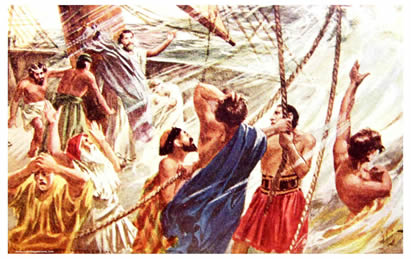
In Acts 27, Paul was with 275 other passengers on a boat bound for Rome from Caesarea, and its captain decided to test the Mediterranean Sea at a turbulent time. A violent storm, known as Euraquilo, caught the ship and ultimately battered it to pieces. It must have been an apprehensive time for the passengers and crew. Luke says the wind was violent, the ship was driven, the sun and moon didn’t appear for days, violently storm-tossed, they incurred damage and loss, and that all hope of their being saved was gradually abandoned. I cannot imagine the helpless, vulnerable feeling they must have felt. At least not literally.

It would be easy to let our national unrest and storminess tempt us to act irrationally (like some on Paul’s ship were tempted) or to give in to fear. But, Paul did five things we should do as we try to respond to the current turbulence.

  • He listened to God (Acts 27:23-24). Nobody else had a better or equal solution to their dire problem. The only way to be saved was to listen to God. Paul sought to persuade the people of this. In the ruckus and tumultuous noise, listen harder to God’s Word! It’s an anchor in stormy waters.
  • He believed God’s Word (Acts 27:25). It’s one thing to comprehend something, but quite another to put your trust in it. What God promised must have seemed quite far-fetched, that this way would save everyone. But, Paul didn’t waver. He said, “I believe God that it will turn out exactly as I have been told” (25). We are surrounded by people who need to witness our faith. As many as are persuaded will escape a shipwreck of faith (cf. 1 Tim. 1:19).
  • He encouraged hope (Acts 27:21-26). Despite the foolishness of their leaders, these people were given a message of hope. Paul says, “Keep up your courage!” (22,25). Despite the frightfulness of the moment, Paul offered a possible escape. Right now, you and I are uniquely positioned to give the only true hope available. It’s like an anchor for the soul, both sure and steadfast (Heb. 6:19)!
  • He warned the disobedient (Acts 27:31-32). There were those trying to break from God’s Word and will and do things another way. They were trying to take matters into their own hands. Paul spoke up against this! Such was defiance against the divine plan. What a message for us, who justify their sins rather than repent of them. We need to keep the message of righteousness, self-control, and the judgment to come before people (Acts 24:25).
  • He prayed faithfully (Acts 27:35). In this ordeal, Paul was a public example of prayer. Read every epistle of Paul’s and you’ll see his faithfulness in and dependency upon prayer. He appealed to the God he knew was the only hope for salvation. How much are we praying about the turmoil in our country (and world)? How much do those around us believe that we are dependent upon God?

Instead of focusing on the frightful winds currently blowing, let’s focus on the One who can calm the storm. Let’s get others to join us in that focus. Whatever happens to our nation, we must save as many souls as possible!

paul20in20storm


WISDOM IS VINDICATED BY ALL HER CHILDREN

Neal Pollard

There was an old joke or riddle that went, “Have you stopped beating your wife yet?” How would a man respond? If he said “no,” it was tantamount to confessing to being a wife beater. If he said “yes,” it suggested that he was a former wife-beater. Either way, the conundrum had him struck.  Have you ever had someone try to place you into such a bind?

It has been said that the only way to avoid criticism is to say nothing, do nothing, and be nothing. If you are striving to serve Christ and fulfill your purpose as a Christian, there is at least some likelihood that you will be opposed and even accused in some way. Jesus discusses that very matter in Luke seven. He’s teaching His disciples and compares His generation to children who criticize no matter what a person does—some criticizing people for being too somber, others criticizing people for being too festive. Jesus uses that illustration to speak of how God’s enemies criticized John the Baptist and then Himself. The criticism revealed that if John had acted like Jesus and Jesus had acted like John, the critics would still have been dissatisfied.

Isn’t it interesting that Jesus did not give us a manual for handling labeling, libelous critics? He does not say to write books or articles, preach sermons, get on TV or the radio, and the like, spending the precious resources of time, money, and influence countering the charges of those who are seemingly not content unless they can bully or intimidate their prey into conforming to the gospel according to them—the arbitrary standard for others they have created and uphold.

Here is Jesus’ summation: “Yet wisdom is vindicated by all her children.”  What does that mean? Look at the offspring of the teaching. What is the result of Jesus’ ministry? People are taught the truth, led to live the way God wants, and are pointed to the narrow way. Criticisms notwithstanding, that’s the fruit.  Speaking of which, Jesus also uses that analogy in the sermon on the mount. He begins and ends the analogy with the idea that “you will know them by their fruits” (Mat. 7:16,20).  But, this is a fair test for everyone.

What is the fruit of the hypercritical attacker? Not only ask if what they teach is technically true, but do they meet the tests of honesty, consistency, kindness, fairness, and love. Do they demonstrate the spirit of Christ, bear the fruit of the Spirit, demonstrate the Christian graces, fulfill the inspired definition of love in 1 Corinthians 13, act like the new man, and the like? So often, we do not stop to inspect the inspector. Whether we do or not, the Lord will inspect the work of us all at the end.

Each of us must focus on pleasing God and being absolutely sure that we are submitting to His authority and obeying His will. The standard of judgment at the last day will not be the man-made rules of even the potshot-takers, but instead the words of Christ (John 12:48). Let us be careful to grow in our knowledge of His will each day so we can discern between divine expectations and human regulations. At the end, what we should desire is heavenly vindication. The rest will ultimately take care of itself.

a-the_peanut_gallery-1577449

THE CHRIST?ANS

Neal Pollard

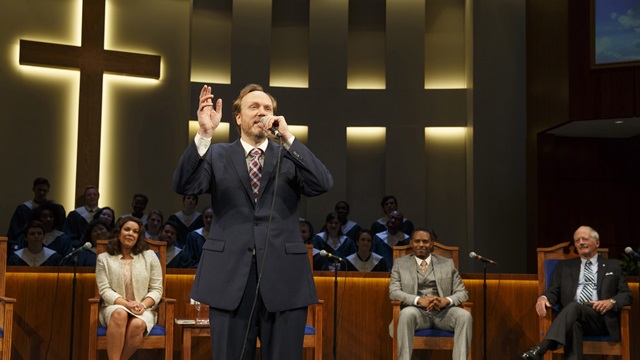
I’ve seen the play advertised locally. Lucas Hnath, a 36-year-old playwright, has a background in religion. His mother attended seminary and he even sat in her classes. The New Yorker reveals that there were expectations early on in his life for him to become a “pastor,” a choice he forewent for the arts instead (“Divine Intervention,” 9/7/15, Hilton Als). The play is about a megachurch preacher who has come to believe there is no hell and who believes God gave him this revelation. The result of his divulging this in a sermon is a church split, led by the assistant pastor who does believe in the reality of hell. While doctrine lays at the heart of the split, the play is said to focus on the personalities and behavior of various folks making up the church. Alissa Wilkinson, in a flamboyantly titled review, says this play resonates because “schisms, church splits, or at least disgruntled storming-outs are familiar to virtually everyone who stays in a church long enough to be committed to its life” (Christianity Today, 9/23/15). At least in advertising I’ve seen, the play title appears “The Christ?ans.” The idea is that, judging from their behavior, it is questionable whether or not they are truly Christians.

There are heartbreaking stories of congregations of the Lord’s church whose internal battles became known to the community and the brotherhood at large. Some have resulted from battles over doctrinal issues, whether regarding morality, fellowship, worship, leadership, or the like. Some have resulted from dueling strong personalities, jockeying for power, position, and prominence. Some have boiled down to squabbles about money. In all of them, tragically, Christ has been relegated to the corner and forced to be quiet while His “followers” duke it out.

While the implications over a doctrinal dispute and a personality power play are different, too often the predominant feature is a show of the flesh.

Many with a background in religion will be able to relate to the theme of the play because they have seen schisms in churches before. The world is a divided place, full of rancor, backstabbing, infighting, and unfair fighting. The church, particularly the church of the New Testament, must never exhibit such traits. Corinth set off such an alarm with Paul for this very reason. He urges no division to mar them (1 Cor. 1:10-13) and goes on to address both doctrine and attitudes in the letter. Philippi had two quarreling women straining the unity of that church (4:2) and Paul goes right to the heart and the mind.

We must strive to conduct ourselves with one another in a way that is always exemplary before the eyes of the community, the brotherhood, and the world. I thank God to work with a church that has been around so long and been through so much and who have weathered those storms by sticking together. Yet, too often, people have aired their dirty, unsightly laundry out on the clothesline of public purveyance. This soils the reputation of the Savior! That fact alone should horrify every child of God. May we always strive to be a beacon of light (Mat. 5:16), shining a spotlight on the Sinless Savior and not squabbling saints!

63611

A Divided People

Neal Pollard

As David let flow from his divinely-inspired pen the peaceful refrain, “Behold, how good and how pleasant it is for brothers to dwell together in unity!” (Psa. 133:1), he knew something of the absence of unity.  Though God through Samuel had anointed him king, “there was a long war between the house of Saul and the house of David”  (cf. 2 Sam. 3-4). This internal strife spanned seven years and six months (2 Sam. 5:5). While he would reign over a united kingdom for the next 33 years, his grandson would cause a rift within Israel that would never be repaired (1 Kings 12). Division weakened them, dividing brother against brother, diminishing their influence and making them more vulnerable. Israel was unique among the nations of world history, being both a physical people and the spiritual people of God. Their division was not just a geo-political problem, but also a religious one.

Our nation has known the pain and injury of division. An entire war was fought that put states and communities at odds with one another.  Currently, we are being reminded of how sharp a difference exists in this nation along so many cultural, philosophical, social, and ethnic lines. It is openly displayed with words and even protests. How that will be resolved only time will tell.

For many centuries, there has been division between people who all profess belief in and allegiance to Christ. “Denominationalism” is a word that inheres division. Because men have inserted their own will and dogma, transposing it onto Scripture, there has been massive division that has been a stumbling block for unbelievers pointing to disunity among those who claim the same Jesus as Lord. Unbelievers have seen division, often shown in ugly and worldly ways.

Among those seeking to restore New Testament Christianity, seeking to be the church of the Bible and be non-denominational or pre-denominational, there has also been so much division. Some have foisted division upon the church by introducing doctrines not authorized by Scripture or in violation of Scripture. Those in such doctrines cease to be Christ’s church so long as they continue in them. Others have created doctrines beyond what Christ has authorized, making themselves the standard and arbitrator of right and wrong instead of recognizing Christ as such. Sadly, these, too, have caused division among God’s people. It is truly difficult to get self out of the way and to be governed only by the will of God.

So it is with every matter that divides us. Self, with all its ugly, blind, poor, and wretched tendencies, so often becomes a wedge making biblical unity difficult. Paul laments that it comes in the wake of lining up behind men and following them (1 Cor. 1:10-13). If ever the world has needed to find repose from rancor, ridicule, and roiling, it is the present hour. If they ever needed a safe haven where they found people who love one another (John 13:34-35), are patient, tolerant, compassionate and forgiving with each other (Col. 3:12-13), and who treat others with respect and kindness (cf. Luke 10:30-37), it is now. Each of us needs to examine our own work (Gal. 6:4). Are we helping our community, our congregation, our friends and our family see the good and pleasant unity found in making Jesus Lord–Lord of our lives, our tongues, our jobs, our classrooms, our social media accounts, our positions, etc.?   This is a stewardship that demands tender care. May we ever be about the diligent work of destroying division! Jesus died to do the same (John 17:20-21).

divided-states

The Brooks-Sumner Affair

Neal Pollard

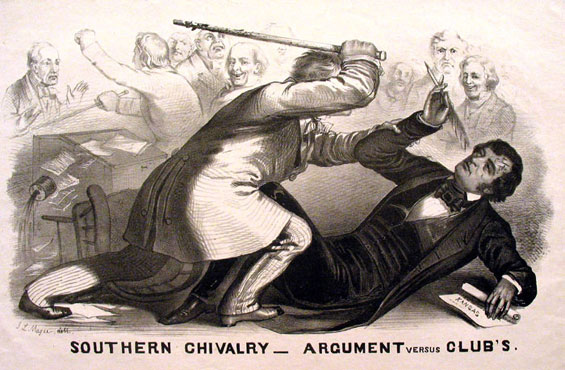
In 1856, Charles Sumner, a Massachusetts Senator, delivered an excoriating speech full of vicious name-calling and personal insults—especially against Senators Douglas and Butler—for their defense and advocation of slavery and especially the violence in Kansas in response to the actions of John Brown and his followers. The speech went on for two days, and shortly after its completion a man named Colonel Preston Brooks, a U.S. representative from South Carolina and distant relative of Andrew Butler, retaliated by beating Sumner with a cane. It was a serious enough beating that Sumner would take years to recover. Sumner would become an iconic hero to northerners and Brooks, who as punishment for the crime was fined $300, a darling of the south. Newspaper headlines of the time, in each region, painted their man a hero and the other man a demon (read a sample here: http://history.furman.edu/benson/docs/sumenu.htm). It is not the loathsome sin of slavery that I wish to highlight here, but the age-old tendency to blindly defend a person or position one feels inclined toward and the incredible efforts to vilify those on the other side of the issue—no matter what.

People are inclined to line up behind men rather than the Messiah. It is not just during political season or for certain social agenda items that this occurs, but more importantly in every season of the year when it comes to religious matters. Paul decried men’s tendency to be “of Paul…of Apollos…and…of Cephas” (1 Cor. 1:12). In the religious world, division has occurred because men have lined up behind some man’s teaching. Often, this teaching is a misconstrued view of a passage (for example, John 3:16, Acts 16:31, Mark 16:17, etc.) or a teaching without benefit of a passage (for example, having an experience of grace, saying a sinner’s prayer, infant baptism, etc.). As with politics, people can become blind apologists for their leaders and champions who promote what they already believe. Often, no amount of reason and logic can overcome the predisposed bias of the adherents. Lost in the cacophony of religious debate can be clear, simple biblical truth. Religious division is not the product or prompting of God (1 Cor. 1:10; 14:33). It is entirely of human origin. While there are some matters where God has not legislated, there are also some clear “right” and “wrong” matters in Scripture. Where God has spoken, we must take His word and will over that of absolutely anyone else. Otherwise, we will find ourselves guilty of elevating one above the One we must all ultimately give an account to. That would be an injustice and violation to top even “The Brooks-Sumner Affair.” May we keep our allegiance to God free from the taint of personal prejudices, even in the matter of our religious convictions. Psalm 119:89.

southern_chivalry

TO THOSE WHO DIVIDE BRETHREN

Neal Pollard

—“A perverse man spreads strife, and a slanderer separates intimate friends” (Prov. 16:28).
—“A worthless person, a wicked man is one who…spreads strife” (Prov. 6:12,14).
—“There are six things which the LORD hates, yes, seven which are an abomination to Him: …one who spreads strife among brothers” (Prov. 6:16,19).
—“Hatred stirs up strife, but love covers all transgressions” (Prov. 10:12).
—“Though his hatred covers itself with guile, his wickedness will be revealed before the assembly” (Prov. 26:26).
—“Keeping away from strife is an honor for a man, but any fool will quarrel” (Prov. 20:3).
—“Through insolence comes nothing but strife, but wisdom is with those who receive counsel” (Prov. 13:10).
—“The beginning of strife is like letting out water, So abandon the quarrel before it breaks out” (Prov. 17:14).
—“He who loves transgression loves strife…” (Prov. 17:19a).
—“Like charcoal to hot embers and wood to fire, So is a contentious man to kindle strife” (Prov. 26:21).
—“An arrogant man stirs up strife, But he who trusts in the Lord will prosper” (Prov. 28:25).

Suffice it to say, the Lord has not been silent on the matter. Our age is marked by the manufacturing and fanning the flames of controversy, endless argument, and divisive issues. Men seem to take pride in starting strife and stirring the pot. When we share the gospel, in gentleness (2 Tim. 2:24) and love (Eph. 4:15), it can still be met with devastating disagreement and vehement vituperation. But, thanks to mediums like social media, some among us have seized the platform to spread division where they could as easily work to promote love and unity among brethren.  I cannot presume heart or motives, but the fruit has been to start brotherhood brawls and to stratify schisms. It is worrisome that while we manufacture outrage on politics, race, law enforcement, “guilt by association,” nitpicking the church, or constantly bringing up the latest “what’s wrong with the church” scenario, 151,600 people die around the world every day (via http://www.ecology.com/birth-death-rates/)! Most of that number will have traveled the broad way that leads to destruction. Surely we can redirect our passion and conviction away from divisive diversions and do our part to stem the tide of such an eternal tragedy!

Meanwhile, we can resolve to see people, not skin color, God’s sovereignty, not party affiliation or uniform, the local church’s autonomy, not an opportunity to be a busybody, and with every other, similar scenario, not major in the minors. Jesus condemned the Pharisees for neglecting the weightier provisions of the law, justice, mercy and faithfulness while scrupulously focusing on matters comparatively minor (Mat. 23:23).  We have a brief time to use our talents and influence on this earth. Will our cause be social justice, brotherhood policing, or political activism, or will it be building up the kingdom through evangelism, edification, and benevolence? May God grant us all the wisdom to “not work for the food which perishes, but for the food which endures to eternal life…” (John 6:27). Be a builder, not a basher!

arguing-1296392_960_720