Labor Day

(Bulletin Preview)

Neal Pollard

Tomorrow, most of us will be able to celebrate the Labor Day Holiday. That means, ironically, that most of us will have a day off from–well–labor. Schools and workplaces across the nation will shut their doors and many will be off for their last “summer vacation.” Friday, an anticipated 3 million passengers took to the friendly skies to enjoy the long weekend. We can either thank Peter McGuire or Matthew Maguire for being the mastermind of this holiday, both secretaries for New York labor unions who made significant efforts to recognize a day for American workers.

The U.S. Department of Labor has published a lot of useful information about this holiday, which it states was started as a “national tribute to the contributions workers have made to the strength, prosperity, and well-being of our country” (dol.gov). It was a local observance in the northeast at the height of the Industrial Age, though Oregon was the first state to pass statewide legislation to observe the holiday. That same year, 1887,  Colorado, Massachusetts, New Jersey, and New York followed suit. In 1894, Congress made it a legal holiday to be celebrated the first Monday of September. 

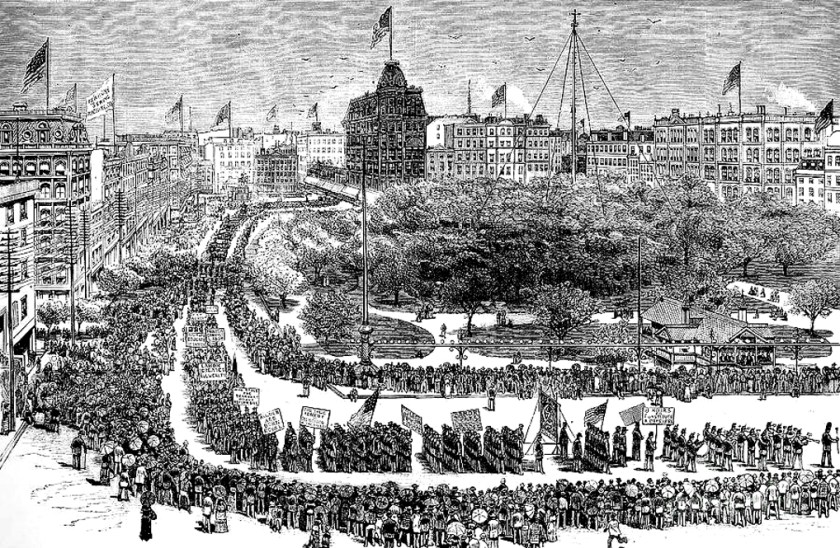
In the early days, there were picnics, street parades, speeches by prominent men and women, and “Labor Sunday” which was “dedicated to the spiritual and educational aspects of the labor movement” (ibid.). The first parade, in New York City in 1882, had up to 20,000 marchers as well as “Windows and roofs and even the lamp posts and awning frames…occupied by persons anxious to get a good view of the first parade in New York of workingmen of all trades united in one organization” (ibid.).

I find it interesting that we honor work with a day of rest and that the holiday itself has seen a shift in emphasis and expression. That’s neither a complaint or criticism. I intend to enjoy Labor Day with Kathy, taking the vacation day given to me in my working agreement. 

But, as we celebrate this national holiday, it’s fitting to recognize the hard work done by so many in this congregation. When you teach Bible classes, lead in worship, decorate bulletin boards, provide transportation to services, stock our pantry, do work on our facilities, engage in soul-winning efforts, practice hospitality, serve officially as church leaders (whether elders, deacons, or someone else tasked with some work), prepare the communion, clean the kitchen, organize the teacher’s work room, go on mission trips, make visits, handle church finances, coordinate worship, serve as ushers and greeters, host youth devotions, or the many, many other things you do, you are doing honored work. Jesus taught that greatness comes through service (Mat. 20:25-28; Jn. 13:12-17). New Testament writers honored those who work among us, Paul urging us not to “be weary in well doing” (Gal. 6:9) and to “always give yourselves fully to the work of the Lord” (1 Cor. 15:58, NIV). Often, Scripture speaks of the Godhead working. It instructs us to be “to the work.” Enjoy the holiday tomorrow. Yet, in the general, ongoing sense, “We must work the works of Him who sent Me as long as it is day; night is coming when no one can work” (Jn. 9:4). Labor on, brothers and sister!

labor_day_new_york_1882

The Difference Between Current And Relevant

Neal Pollard

Relevant—Appropriate to the current time, period, or circumstances; of contemporary interest
Current—Belonging to the present time; happening or being used or done now

I think most of us would find the above definitions of these words to be satisfactory. In the context of the church, we are often concerned with both the matter of being current and relevant. The degree to which and the ways in which to achieve currentness may differ from congregation to congregation, but every congregation, to some degree, wishes to be current. It’s what drives members to arrive in automobiles, to paint and remodel the building, to use powerpoint for lessons and songs, have wifi access, a (hopefully) updated website, and the like. So long as the tool, idea, or method for being current is in harmony with Scripture, including proper stewardship as well as adhering to God’s pattern and authority, we should be as forward thinking as possible.

Relevance is, perhaps, a more subjective matter. With the maturing of each succeeding generation, we tend to obsess about whether or not our planning, actions, communication, and the like are sufficiently relevant to each generation. In other words, we might ask, “Are we relevant to millennials?” or “Will this resonate with iGens?” There are tools, ideas, and methods we should use to be “appropriate to the current time, period, or circumstances.” But, may we not lose sight of the fact that Scripture could not be more relevant, and it is never more relevant than when it is countercultural. The world’s ideas for how we should dress, talk, think, act, or respond to God may be the very definition of what’s current, but such is not relevant to God’s objective right and wrong on those specific matters. What we teach may be relevant to those areas of concern, but may seem old-fashioned or not what is being used or done now by the majority. 

We must emphasize that in our current circumstances, God’s Word, with its precepts and principles, is what is relevant! It’s what the world needs, and it’s what we each need. The church, so long as it boldly, lovingly declares those things, is the very essence of relevant. Let’s just let God’s Word and not the world define that for us. 

relevant


You Push That Way And I’ll Pull This Way

Neal Pollard

While it is true that each of us possesses unique abilities within the Lord’s body (Rom. 12; 1 Cor. 12), that fact bears closer scrutiny. God can use each of us, with our unique personalities, backgrounds, and experiences, to reach so many among the lost and to help so many among the saved. Yet, it is easy to lose sight of how we contribute to the health and growth of the congregation we are a part of. 

For example, the following should not be considered talents useful to the Lord’s cause:

  • Being gossips and busybodies (2 Th. 3:11; 1 Tim. 5:13).
  • Causing strife and being jealous (Rom. 13:13; 1 Cor. 3:3).
  • Judging your brother (Rom. 14:10; Jas. 4:11).
  • Returning evil for evil and insult for insult (1 Pet. 3:9). 
  • Being an obstacle or a stumbling block in a brother’s way (Rom. 14:13).
  • Speaking deceit (1 Pet. 3:10).
  • Giving the devil an opportunity (Eph. 4:27).
  • Keeping your leaders from doing their work with joy and not with grief (Heb. 13:17).

Certainly this is not an exhaustive list of ways we may misuse the stewardship of our speech and actions as members of the body of Christ. It can be so tempting, when we look at the church’s imperfections and people’s inevitable shortcomings. We have new Christians. All Christians have weaknesses. Those who lead and conduct the church’s work could inevitably do it better. 

What does the Lord want each of us to do as individual members of the Lord’s church? He calls for living in harmony in the Lord (Phil. 4:2). He wants us fitted, built, and held together (Eph. 2:21-22; 4:16). He wants us “being of the same mind, maintaining the same love, united in spirit, intent on one purpose” (Phil. 2:2). Practically speaking, this means getting behind the work of the local church, contributing to it and building it up. It means asking how we can help and throwing our energy into that. It means constructively helping when a work is lagging or in need of direction. It means lovingly, respectfully interacting with the other members of the body. 

Comedian Steve Harvey compared his rise to success with pulling a wagon uphill. He said that many people may hop on that wagon and contribute something, He said they all need to be doing something to help you get that wagon up the hill. He warned against those who get on the wagon and have no value (via OWN, 9/12/14). Perhaps you’ve found yourself pushing toward a spiritual objective, only to feel the resistance of someone working against you. This is frustrating! However, never find yourself opposing good, needed works through misuses of your resources in ways like those in the bulleted list above. In the worst case scenario, we may even find that in doing so we “may even be found fighting against God” (Acts 5:39). Let’s do all we can to help build up the body of Christ, prayerfully studying what that does and does not mean!

compromise-donkey

What Are We Saying About The Church?

Neal Pollard

Recently, in an excellent lesson about gossip, the teacher recounted an incident I, and many others, could echo from the background of our own experience either in ministry or our personal lives. A mother asked her wayward daughter why she no longer was a member of the church. Her convicting reply, “The way that you always talked about the church, why would I be?” The way this daughter heard her parents talk about the church, she concluded the church was full of hypocrisy, flaws, and inadequacy. She was simply modeling what she heard them say throughout the years.

I’m thankful for the sound counsel we received well before we had children. We were advised never to speak ill of the church in front of our children, to run down elders, deacons, preachers, and other members. Knowing Kathy, she would have done this intuitively. For me, it was extremely helpful with my impetuous nature. Even whispered words in the front seat of the car, going home from church, will inevitably be heard by the little ears in the back seat (the same is true of the dinner table and other times the family is together). We may be blowing off steam, we may not have deep vendettas against the object of our criticism and complaint, and we may soon forget what we’ve said, but impressionable ears and hearts may internalize the words and materialize the message with their deeds and lives. 

The attitude, relationship, and loyalty our children have toward the church is most shaped and determined, for good or ill, by our example as parents. What will help us speak well of the Lord’s church? 

  • Remember who conceived of it, from nature to organization to purpose, etc. (Eph. 3:9-11).
  • Remember whose it is (Mat. 16:18-19; Eph. 5:33).
  • Remember our mission to bring others into it and that our home is our primary mission field (Mat. 28:19).
  • Remember how Jesus feels about the church (1 Tim. 3:15; Eph. 5:25).
  • Remember that the church is the location of the saved and we should do all we can to help our children make up that number (Acts 2:47; 1 Cor. 12:13).
  • Remember all that the Bible says God seeks to accomplish through the church: growth (Eph. 4:16), His glory (Eph. 3:20-21), and His grace (2 Cor. 8:1), among so many other things.

We may struggle to see our family harbor grudges and hard feelings against the church. Many factors may contribute to that, but we should begin with ourselves. What are we saying about the Lord’s bride? What is our attitude toward her? I cannot imagine that anything is more impactful than that, and that is probably the thing we can most control! May our family remember that our theme song, concerning the church, is, “I love Thy kingdom, Lord!” Surely this will influence how they feel about her, too. 

3

VISITORS—HANDLE WITH CARE!

Neal Pollard

I’m not sure where the phrase, “handle with care,” originated. It’s usually reserved for advice regarding that which is fragile or even volatile. It really is applicable to those who visit our assemblies because of their value and importance. They came through the doors of our church building intentionally and with a purpose. Initially, we cannot know why or how sincere their purpose. That process of discovery could not be more important. Consider some reasons why we should handle every visitor with care:

  • Each has an eternal soul (cf. Mat. 25:46). 
  • God could not love that visitor any more than He does (John 3:16; 1 Tim. 2:6).
  • God loves that visitor as much as He loves you and me (Acts 10:34-35). 
  • That visitor is likely seeking spiritual guidance (cf. Mat. 7:7).
  • Each visitor is subjected to a first impression, being left by you and me.
  • That visitor is going to make judgments about the church, the Bible and Christ based on what he or she sees (or fails to see) from you and me.
  • The smallest gesture of kindness toward such a one could lead to the salvation of a soul.
  • We cannot know what anyone else is doing to make their first visit a good one.
  • Each one is being exposed to the Bible and to New Testament worship, and follow up can lead to further interest.
  • That soul is connected to many others, who might subsequently be reached (2 Tim. 2:2). 
  • You and I are official ambassadors for Christ (2 Cor. 5:20).
  • The Golden Rule should prompt our warmth, helpfulness, and sensitivity (Luke 6:31).
  • We are each part of a team, trying to connect each of them with what only Christ can offer them (1 Cor. 12:18; John 14:6).
  • There is no guarantee that there will be a next time (Prov. 27:1).
  • Statistics tell us that most visitors find the churches they visit to be unfriendly toward “outsiders” (see, for example: Thom Rainer).
  • Loving others is commanded, and visitors are included in “others” (Rom. 13:9; Gal. 5:14; Jas. 2:8; etc.).
  • Visitors constitute perhaps the easiest inroad to developing interest in a Bible study, as such have reached out to us by attending.
  • Our excuses (“I’m shy,” “That’s not my job,” “I’m not good at it,” “I’m busy”) ring hollow when carefully examined. 
  • We love the church and believe in its relevance and importance.
  • Each contact is a valuable way you and I can contribute service for our Servant-Savior (cf. John 13:12ff; Mat. 20:28).

The list is far from exhaustive. I am convinced that none of us neglects a visitor out of contempt or even indifference. Yet, it is good for you and I to encourage each other, to “stimulate one another to love and good deeds” especially as it pertains to assembly-related matters (Heb. 10:24-25). Wouldn’t it be exciting to be the friendliest church around, especially if our message and practice is faithful to God’s Word? What a powerful combination! Let’s help each other earn such a reputation, for reasons such as the above. 

fellowship201

Still Restoring

Neal Pollard

The idea of restoring New Testament Christianity is “that God set forth His standard of acceptance in salvation, worship, church organization and daily living” and “to follow the teachings of God, revealed in the New Testament, to direct our lives in the same way as He did first century Christians” (therestorationmovement.com/about.htm). We can open our Bibles and find a pattern for what the New Testament church is to look like, not in customs and culture, but in commands and cause. Yet, a tendency we must guard against is a haughty spirit that portrays the idea that we have already arrived. Consider four areas where we need to keep at the restoration plea and overcome neglect.

  • CHURCH DISCIPLINE. For years, I have seen this referred to as “the forgotten commandment.” At times, people will say of it things like “it doesn’t work,” “it’s harmful,” “it runs people away,” etc. Were we to substitute that argumentation for subjects like women’s role, worship, or baptism, wouldn’t we cry heresy or apostasy? However, in far too many instances, we have simply ignored and failed to practice this plain, New Testament teaching (Mat. 18:15-17; Rom. 16:17; 1 Cor. 5; 2 Thes. 3; Ti. 3:10-11).
  • EVANGELISM. It is so much easier to focus upon ourselves, to devote all our resources to internal issues.  Is there a spirit of evangelistic zeal running rampant among us? Is this an area to restore, to be like the early church? Perhaps we may be intimidated by the culture of political correctness. It could be the risk of ruining relationships or even rejection that causes us to avoid efforts at soul-winning. It could even be that we need to build our conviction for or commitment to this imperative given by the resurrected Savior Himself (Mat. 28:18-20;Mark 16:15-16;  Luke 24:44-47).
  • CHURCH ORGANIZATION. It is very likely that the number of churches of Christ which have elders are in the minority. At times, the reality of a shortage of qualified men is to blame. At other times, preachers or others prefer not to have elders. But, even where churches are “scripturally organized” (i.e., having elders and deacons), there is room for restoration— Preachers preaching and evangelizing, elders leading and shepherding (pastoring), and deacons actively carrying out  and administrating the ministries and works of the local church.  At times, there is a need to restore the roles of each of these works so that the proper, appointed men are doing the work Scripture outlines for them.
  • BROTHERLY LOVE. This is difficult, in a world increasingly characterized by hate, discord, and general worldliness. In our culture, where it’s easy to become disconnected with others—even our Christian family—we must strive to restore the beacon and central identification mark Jesus urged when He said, “ A new commandment I give to you, that you love one another, even as I have loved you, that you also love one another. By this all men will know that you are My disciples, if you have love for one another” (John 13:34-35). Isn’t there room for more concentration upon this command, which will be reflected in how we treat each other locally and in the brotherhood as a whole (1 Pet. 2:17)?

I love to spend as much time as possible talking about what the church is doing right. It is doing so much right. By following the New Testament pattern regarding salvation, worship, the church’s purpose, and the like, we stand out in a religious world that has lost its way. Meanwhile, however, let us stay at the business of restoring the church to the pattern revealed in Scripture, even in areas that are more difficult and demanding though just as necessary.

Making sparks

“What’s Your Passion?”

Neal Pollard

Most of us, repeatedly throughout our lives, get asked or ask ourselves the question, “What’s your passion?” The word, defined as “a strong and barely containable emotion,” is one we may use for ourselves but one as likely to be used by others to describe us. Thanks to social media, we can see people’s interests, hobbies, and diversions whenever we choose. They post pictures, make comments, and talk about them with great frequency. However, there are some people whose focus is so intent on some topic that their emotion spills over. If anyone else brings it up, they cannot refrain from jumping in “with both dogs.” Yet, they themselves are always finding and sharing relevant material that supports or upholds their views. Maybe it’s guns (for or against), race (black, white, or hispanic), politics (R or D), illegal immigration (for or against), or some equally charged issue. Have you ever noticed someone whose passion seems to be for being argumentative and disagreeable? Passion is unmistakeable.

Not only through social media, but through my every social interaction, my life is declaring what my passion is. Those closest to me are best equipped to reveal what that is, but everyone who is exposed to me for any period of time can figure it out. What a sobering thought! I know what I would want that to be. Paul said, “For I determined not to know anything among you except Jesus Christ, and Him crucified” (1 Cor. 2:2). In Philippians 3:10, he simply says, “I want to know Christ—yes, to know the power of his resurrection and participation in his sufferings…” We have the corpus of Paul’s inspired writings, and it is filled with his expressing that passion. We have eyewitnesses to his ministry, especially Luke, who verify that this is what drove him and ignited his passion.

A lot of people know that I enjoy dark roast coffee, all things Georgia Bulldogs, running, peanut butter, traveling, and my family, but do they see passion for Christ in my life? I don’t get to say what my passion is, simply by thinking about what it should be in some moment of reflection. It is what my life shows that it is. When all is said and done, what will have been the great passion of my life? What about you?

coffee_beans_closeup

A Warm And Welcoming Church

Neal Pollard

Once, I received a call from a woman who watched our TV program. She shared her religious background with me, including the fact that she was raised in a church of Christ. While she was baptized many years before, she committed fornication, became pregnant, and had a child out of wedlock. She said that she publicly repented, coming forward to ask forgiveness. While some forgave, one prominent member wouldn’t let her forget her past sins. Ultimately, she left that congregation and soon after left the Lord’s church altogether.

She joined a large denomination in the area in 1985. She gave some interesting reasons for joining them. Reflect upon them for a moment.

(1) She received personal visits from church members.

(2) She was warmly welcomed by many who greeted her when she attended the services.

(3) She was quickly put to use in the church’s works.

Very simple formula, wouldn’t you agree? Some fundamental needs were recognized by that religious group: Approach. Accept. Assimilate. While their doctrine was wrong in vital areas, their practical wisdom was on target! While she traded truth for error regarding their teaching, she sought but didn’t find among God’s people the very things many seek today. None of the things she sought were wrong.

In the church, the main emphasis should be serving rather than being served. But look at what she sought. She sought personal contact from concerned people. The denomination responded. She sought acceptance, not of sinful choices, but of herself—the sinner. She received that. She sought ways to be involved, ways to serve. She was given opportunities despite some physical handicaps that restricted her.

There is much to do, much more than is being done, though we are doing much. Some bare essentials that all of us can be doing is visiting our visitors, making visitors feel like honored guests, and finding ways to include those who become members in the work of the church.

We have opportunities every week that walk through our doors. Are we doing our part to make ourselves a warm and welcoming congregation? People will form lasting opinions about the Lord’s church by what we do to make them feel welcome. Each individual Christian is accountable for visiting (Mat. 25:34ff), accepting (Js. 2:1-13), and including (1 Th. 5:11).  Let us glow with the warmth of Christ! Who knows who we will turn onto the narrow path or who we will help stay on it?

1


Working Together To Survive The Hunt

Neal Pollard

1 Peter 5:8 calls the devil a roaring lion prowling around seeking someone to devour. It is obvious that Peter’s readers would have seen or at least heard about these kings of the jungle for the analogy to make sense and be practical.  Lions lurk, longing for lunch.

In the savannas of East Africa, their meal of choice is usually either the wildebeest or zebra. Despite this, these two animals continue to graze and migrate together. In fact, because they are chief prey of the lion (and other big cats), they need to stick together. Various observers and experts give different explanations for why. Zebras have great farsightedness and the wildebeests have excellent peripheral vision, but each are poor at seeing what the other sees well. Others explain that wildebeests have mouths better suited for short grass while zebras’ are made for the long grass that grow intermittently together on the plains. Still others point to the zebras superior memories, recalling the safety routes of the previous year, and the wildebeests uncanny ability to find water even when such is scarce. Probably, it is the combination of these facts that cause the symbiotic relationship between these two large mammals. They do not all survive, but the vast majority do. The reason is because they utilize their own abilities but also because they rely on the abilities of others.

In a letter where Peter is addressing a people who were at times spiritual prey, he does more than use the simba simile. He urges Christians to stick together and look out for one another. He calls for sincere, fervent, from the heart love for one another (1:22; 4:8). He urges complaint-free hospitality toward one another (4:9). He commands serving one another (4:10). He teaches there to be mutual humility displayed toward one another (5:5). He ends the letter exhorting an affectionate, loving greeting of one another (5:14). As much as anything, this is a recognition of mutual dependence.

If we understand that we are not at home in this world (2:11) and are living and longing for the inheritance in heaven (1:4), we should come to understand our mutual need of each other. That does not just mean looking for others’ help, but also giving it. This is by God’s design. Notice, for example, the proactive protection we provide each other by being “harmonious, sympathetic, brotherly, kindhearted, and humble in spirit; not returning evil for evil or insult for insult, but giving a blessing instead…” (3:8-9a). Right before the lion passage, Peter talks about different groups looking out for and helping each other (5:1-6).

Any of us, through suffering, temptation, doubt, or some other factor, could drift away from the safety and security of the fold. Let us be more than mindful of each other. Let us depend on each other to survive the hunt and make it to eternal safety.  I will face the lion many times in this life, and I depend on you to help me survive.

DSCN0368

Putting A Price Tag On The Value Of Our Youth

Neal Pollard

Perhaps you’ve seen the news story about the six year old boy who made $11 million dollars this year on YouTube reviewing toys. Ryan, of Ryan ToysReview, has been reviewing toys since he was three years old. He has over 10 million subscribers to his channel, which had a 40-week streak of most viewed YouTube channel this year. He even had NBA star Kevin Durant appear in one of his video reviews in September. His videos are described as simple, innocent, and personable (Samantha Schmidt, Washington Post, 12/11/17 via www.washingtonpost.com/news/morning-mix).

That’s incredible! Such savvy, drive, and entrepreneurship. One of the traps we need to avoid is selling the intelligence and abilities of young people short. That’s even truer in the church than in the world.

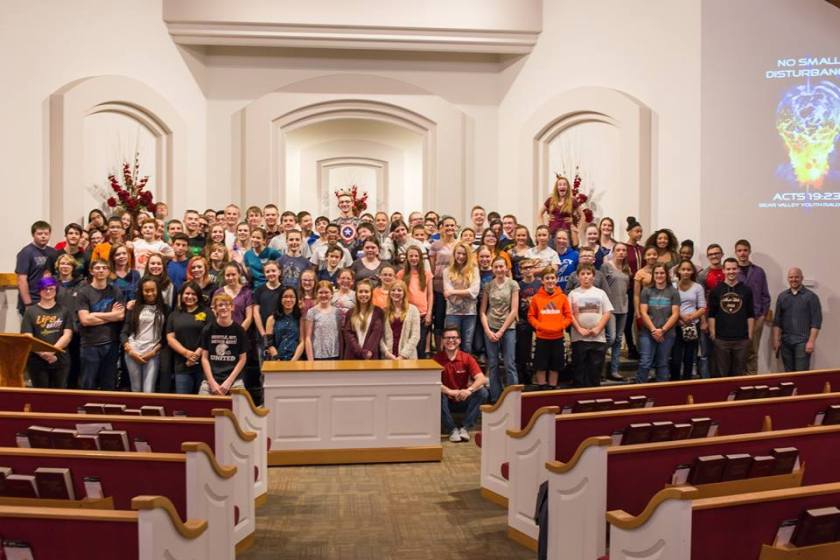
When I look at our youth, I see perhaps the most evangelistic demographic in our congregation. Teens invite classmates to church just to “see what it’s about.” Then, our other teens reaching out and welcoming them into the group. They have a fearlessness about them that can drive the rest of us to greater effectiveness in this arena.

When I look at our youth, I see tenderheartedness. It doesn’t just drive them to be baptized or to publicly respond to the invitation. It moves them to be compassionate, to help the unfortunate or to be concerned for those who others may overlook. They are shamed by their sins and moved by praising the greatness of God.

When I look at our youth, I see a boundless resource of energy. They are active and alive, and when they channel that to serve–whether our elderly, the homeless, or each other–it’s exciting to see. You see it when they get together, talking and laughing. So many of us feed off of their vitality.

When I look at our youth, I see hope and idealism. Life too often depletes them of these priceless commodities. We need to do more to build them. Hope is about confident expectation, and isn’t the Christian life to be founded upon that (Romans 8:24)? Idealism may be seen as having higher expectations than are realistic, but it’s this mountain-moving faith that causes churches to grow and do what only can be done when God is factored into the equation. He is perfect and able (Ephesians 3:20-21).

Through their evangelism, example, energy, and expectation, our youth are of inestimable value to the church as a whole. Let’s nurture them and help them grow. Let’s give them opportunities to make an impact right now. All of us will reap infinite value from these infinitely valuable ones (cf. Matthew 18:1-6).

17523151_10212884844293080_7163968835894994377_n


Biggest Misunderstandings About Public Responses

Neal Pollard

There are a couple of examples of public responses to the gospel message in the Bible, both in Acts.  One is positive and the other is negative.  As Peter was preaching that God has made Jesus Lord, the Pentecost crowd interrupted him with the question, “What shall we do?” (Acts 2:37).  As Stephen was delivering a similar message, his audience stopped listening and they cried out with a loud voice before putting the preacher to death (Acts 7:54ff).  Mention is made of a one another response that could apply to the corporate assembly, confessing sins (Jas. 5:16; 1 Jn. 1:9).  How public the setting was when Peter called for Simon to repent we do not know for certain (Acts 8:18-24).  So, why do we end our sermons with a call to publicly respond?  Is this simply borrowed from the denominations or is it just a rote tradition devoid of deeper purpose?

Often, we have explained the invitation as being an “expedient,” which I think it is.  When we speak of an “expedient,” we refer to a practice that is thought convenient, practical, suitable or appropriate but neutral (neither right nor wrong) and a-biblical (not found in the Bible but not unbiblical).  It is a sensible activity.  Hopefully, the sermon contains a call to change and is persuasive in nature.  Maybe, the person comes in the door that day convicted of his or her need to become a Christian or repent of public sin.  Affording a moment that makes it easy for one needing to obey Christ in one of these ways to do so is appropriate.

I have been in assemblies in this country and overseas that do not have such a time set aside or that do so at other times during the gathering—some do so at the beginning of the service so that a person can worship without being alienated from God (cf. Mat. 5:24), some invite anyone who needs to publicly respond to remain standing after the lesson and a song, some encourage people who need to respond to write their need on a card or piece of paper and hand it to an usher, the preacher, the elders, or someone designated to collect such communication.

While I think it is good for us to consider that there is more than one way to do this and that we are not mandated to do it at all in the assembly, I believe our current arrangement is a fine way to try and help people who need to make spiritual changes and improvements.   Yet, someone who feels the need to make such a response often hesitates or decides against it.  Certainly, the problem on such an occasion might be fear or delay, but is it ever due to some misunderstanding such a one has?  Here are a few of the biggest misunderstandings people have about responding to the invitation:

  •  Nobody but me is struggling with sin in their lives.  Truth: Romans 3:23.
  •  It is a sign of weakness to respond publicly.  Truth: Luke 15:10, 17
  •  Everybody will look down on me, judge me, or gossip about me if I respond.  Truth: Luke 15:28-32
  •  People will distance themselves from me if I respond.  Truth: 1 Corinthians 12:26-27.

Maybe you are thinking this or something similar.  May I assure you that every righteous person on earth and all the inhabitants of heaven would like nothing better than to help you be right with God.  Death and the Judgment loom, and we cannot let anything keep us from making proper preparation for them.  So, if you need to respond today or any day, won’t you come?

14-church-carpet

A Family, A Fraternity, And A Fellowship

Neal Pollard

A little over a week ago, my son Dale called me to tell me one of his elders gave him tickets for the Georgia-Missouri football game. He asked if I could swing coming. Thanks to a generous travel voucher from American Airlines, I was able to go on short notice on their nickel. The best part of this trip was getting to see one of my adult children for a couple of days. We made the most of those moments, and that game between the hedges was not a disappointment. Though Dale had watched games with me on TV, he was not the diehard fan I have been since 1979. We made the drive from Valdosta to Athens. Once on campus, he got his first glimpse into “Dawg Nation.” By the time we left the game, he was hooked. Georgia has another diehard fan. What did the trick? Perhaps the camaraderie between people who otherwise would not come into contact with each other. There was the shared lingo, shared knowledge, shared passion, and even shared clothing color schemes. There were traditions to partake in. People were excited for every play and intensely interested in the outcome. That was infectious! It was an unforgettable experience we plan to duplicate in the future.

As I look back on that great memory, I got to thinking about an infinitely stronger bond I have. Even regarding this game, I think about the part they played. I’m talking about the Lord’s church and the Christians who make it up. There was Doug Jones, the elder who gave us the tickets. There was Wes Hazel, who let Dale borrow his car so he didn’t have to pick me up from the airport or carry me around on the back of his motorcycle. There were Lance and Susan Leavens, who opened their home to allow Dale and me to take a nap before I caught a flight back to Denver yesterday morning and Dale drove back to Valdosta. While I was in Georgia, Kathy was in Texas doing a ladies day, and Carl was experiencing major trouble with his truck, an overwhelming, generous response from literally dozens of Christians helped make it possible for our youngest to resolve that heart-sinking trouble.

All too frequently, I see people who major in pointing out the perceived problems and seeming shortcomings of the saints. To listen to them, we do nothing right and even do those things from sinister motives. As a preacher’s kid who’s lived a life of a full-time preacher for more than a quarter century, I am far from naive. The church, without exception, is comprised of flawed, faulty, and finite folks. I have been extremely disappointed in the actions of church members, from the leadership to the membership. I have tearfully witnessed Christians abandon the church for the world, breaking many hearts in the process. But, the church is special. It is unique, from the doctrinal standpoint, dedicated to speaking where the Bible speaks and being silent where it is silent and seeking to replicate New Testament Christianity.

In addition to that, there is the common bond we share. What a fellowship! What a family! What a fraternity! You read it when you open up the New Testament. As importantly, you experience it today when you open your heart and life to all the others who make up this special group. We’re incurably imperfect. We should strive to be more patient and gracious. But, God’s people are the greatest in the world! Thank God for that blessing today and every day.

22540060_10155051132935922_8341247926958187048_n

My Social Media Pledge

Neal Pollard

  • I will try to use social media to encourage and edify others (1 Thess. 5:11; 1 Cor. 14:26b).
  • I will avoid the shocking, inflammatory, and divisive tactics increasingly characteristic of S.M. (cf. 1 Cor. 1:10; Prov. 12:18; Prov. 15:2,4; etc.).
  • I will ask, “Would I say this in the way I am saying this?,” if face to face with this person or this group of people (Prov. 23:7).
  • I will not use Social Media to pick fights or put people on the defensive (cf. 2 Tim. 3:1ff).
  • I will not be Nellie Nitpicker and Contrary Charlie. About. Every. Single. Little. Thing.
  • I will respect that my connections have connections that are not Christians and I want to be sure to say what I say in accordance with Ephesians 4:15 and 2 Timothy 2:24-26.
  • I will sever connections with individuals who consistently display a lack of self-control with their words and attitudes. Souls are too precious.
  • I will abhor the thought of doing what would put Christ to an open shame (cf. Heb. 10:29).
  • I will double-check myself to avoid bragging and self-promotion (1 Cor. 13:4-5).
  • I will conquer the desire to have the last word, pile on, or fight fire with fire (Mat. 5:39-42).
  • I will not let the false teaching, bad attitude, or meanness of another be my rationale for behaving in a way that brings Christ shame or jeopardizes my own soul (cf. 1 Cor. 9:24-27).
  • I will always be trying to set the table for productive evangelism or retrieving the wayward (Jas. 5:19-20; Col. 4:6).
  • I will always try to portray the doctrinal, moral, and ethical values of my Lord, thus avoiding reflecting and glorifying whatever values conflict with His (Mat. 5:14-16).
  • I will try to promote, not pummel, the bride of Jesus, appreciate, not attack, the elders, and unite, not untie, wherever possible.
  • I will shun passive aggression in myself first, but also in others.
  • I will deal with dirty laundry in its appropriate way, which is not on Social Media.
  • I will actively try to show grace to everyone, including cantankerous curmudgeons.
  • I will, foremost, realize my own imperfections and try every day I use Social Media to do so in the way Jesus would, if He had Facebook, Snapchat, Instagram, Twitter, a blog, LinkedIn, etc. In a way, through you and me, He does. I will let that sink in!

20080704_p070408jbweb-0279-515h

Avoid Being Ironic

Neal Pollard

Friday night, Carl and I flew to Bismarck, North Dakota. Why? Well, of course, we wanted to attend the “Melita Banana Days” in Melita (pronounced Meh LIT Uh), Manitoba. That, and stay in a Bed and Breakfast in Carnduff, Saskatchewan, that doubles as an ice cream shop. Saturday night, we were back in our own beds sleeping. While we were registering at the festival  on Saturday morning and talking with some of the organizers, we told them we had flown up from Colorado to check them out. From what we could tell, we were the only attendees from America. They were mildly intrigued by that fact, but basically brushed us off. Which was fine. We also wanted to check out Oak Lake beach about 60 miles north of there. But it was ironic to read on their website that this event is about promoting tourism. Perhaps our tepid reception was an exception to how they welcomed outsiders checking them out.

On a family vacation not too long ago, our family visited a small congregation on a Wednesday night. We drew a few stares from the local members as we took our seat right as Bible class began. Afterward, we were briefly greeted by one member who explained that their little group was going to have a meeting to discuss strategies for being more evangelistic. We were a family of strangers to them, and we might have been newcomers or non-Christians. They would not know. None of them tried to connect with us. We were essentially shown the door. We found this ironic.

It is ironic to sing, pray, preach, teach, and otherwise emphasize about the church’s mission and then to practically ignore it. Our assemblies are foremost about worshipping God and building up the body, but even first-century gatherings were attended by those other than the local Christians (cf. 1 Cor. 14:22-25).  In our zeal to deepen and build our relationships with one another, we must not ignore or be cold toward those who “enter” our assemblies. Instead, we should seek opportunities to start conversations and create opportunities to open doors which lead them to Christ. Certainly, they should leave our assemblies aware of our intense interest in them. To do otherwise is to undermine our very purpose and mission. That would be the ultimate irony!

20729287_10154898594805922_5226860467365340615_n

Traditions Of Men Versus The Word Of God

Neal Pollard

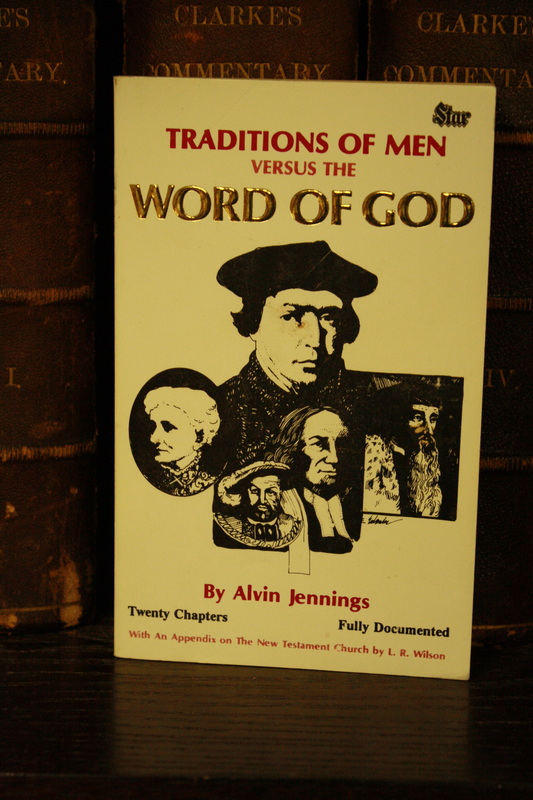
For as long as I have been preaching, I have had at least one copy of the Alvin Jennings’ book bearing the title above. The book was originally printed in 1972, but it has been reprinted several times. Jennings clarifies the way he uses the word “traditions” in his title. Rather than the sense of being a writing handed down from God (2 Th. 2:15; 3:6; 1 Co. 11:2), he used the word to refer to “religious laws and traditions originating from the minds of men and handed down orally and/or in printing from generation to generation” (iv.). He rightly points out that such traditions were condemned by Christ (Mat. 15:2-3,6; Mark 7:3,13; Col. 2:8; 1 Pet. 1:18; Gal. 1:14). Some of the problems with these traditions were that they got in the way of obedience to what God commanded, caused negligence regarding and the setting aside of God’s commands, enslaved one to something or someone other than Christ, and created a zeal that could lead to unhealthy consequences. The traditions Jennings examines substituted  false, human ideas for clearly revealed, divine truth. Anything that binds where God has not bound or gives permission where God doesn’t permit must be rejected. It’s a tradeoff with the gravest consequences (cf. Rev. 22:18-19).

However, I hope that as we strive to follow the pattern for New Testament Christianity we will be careful about elevating any tradition to be on a par with Scripture. There are some traditions we may choose to observe (or not):

  • Offering an invitation after every sermon
  • Having worship leaders, including the preacher, wear suits and/or ties
  • Women wearing dresses to church services
  • Songs or songbooks reflecting a particular time period (whether old or new)
  • Mandating a specific Bible version be utilized in the public assemblies
  • Choosing to have an evening assembly
  • Replicating the format of the morning assembly (in lieu of using the time for class, for example)
  • A particular order of worship (including whether the Lord’s Supper precedes or follows the sermon)
  • Offering the Lord’s Supper on Sunday evening
  • Any practice or tradition that arises from expedience or the realm of judgment, but that is not specifically mandated in Scripture

The church finds itself at a crucial crossroads. Undoubtedly, there is nothing new under the sun, but we do find ourselves at a unique place in cultural history. Since we live in an argumentative, rancorous atmosphere fueled by everything from cable news to social media, we should be careful to maintain a spirit of love and kindness whenever we sort through matters like these. We should never cherish non-binding traditions more than we do people. Those of us who are older and presumably more mature should consider carefully where and when we might compromise regarding matters not tied down in Scripture. More than that, we should foster rather than fear an environment that allows for such discussions to occur—without animosity or distrust. This will mean spending much more time developing our relationships with one another on the local church level (across generations). The better we know each other and the more we grow our love for each other, the better equipped we should be to sort through such things. Coupled with serious Bible study, this will hopefully sharpen our ability to distinguish between traditions and truth. May we have the grace to listen to each other without prejudice or minds already made up. Instead or ridiculing or caricaturizing the church in demeaning ways, let all of us “put on a heart of compassion, kindness, humility, gentleness and patience; bearing with one another, and forgiving each other, whoever has a complaint against anyone…” (Col. 3:12-13a). 

s702601590478870340_p115_i1_w533

THE HUMAN CHAIN AND SALVATION

Neal Pollard

Incredibly, nine people in one family were in serious danger of drowning as they were swept into a riptide in Panama City Beach, Florida. It started with some little boys, but soon included would-be rescuers that included their mother and some other relatives. All of them were floundering in about 15 feet of water. The USA Today story seems to indicate that Jessica Simmons and her family thought of the idea of creating a human chain out to the imperiled family and towing them back to shore. About 80 people “started a football field-sized human chain to help bring them back to shore” (Mary Bowerman, 7/11/17, online ed.). The mother, Roberta Ursrey, summed it up well when she said, “I owe my life and my family’s life to them. Without them, we wouldn’t be here” (ibid.).

What a great story! It reveals the possibility of unity for profound purpose. It shows the power of working together. It says something about the best part of the human heart. It also illustrates the power of rescue and salvation.

The Bible makes it clear that God is the one who saves (Titus 2:11). His Word is His power to save (Romans 1:16). His divine plan is the means of salvation (Acts 16:30-31; Romans 10:9-10,13; Ephesians 2:8; 1 Peter 3:21). But, the Bible makes it just as clear that He does His saving through the preaching, teaching, influence, and efforts of His people, sharing the good news with those who are languishing in the waters of iniquity. That’s suggested in “The Great Commission” (Matthew 28:18-20; Mark 16:15-16; Luke 24:46-47). It’s demonstrated in the constant efforts of New Testament Christians, taking the message of Christ with them throughout the world to those lost in sin (cf. Acts).

Think of the church as the God-given human chain, reaching out to the struggling, needy soul. They are drowning in sin and in desperate need of help. Unreached, they will drown (see the imagery of 1 Timothy 6:9). God wants you and me, as those who ourselves have been saved, to join hands and help others who need to be helped onto the shores of safety! We cannot delay! We must act while there’s time. Lives—souls!—depend on it.

mjxbw1M3

No Time For Worship!

Neal Pollard

According to Stephen Eckstein, Davy Crockett was among those who began a journey from north Alabama bound for the “promised land” of Texas in 1835. This group, who wanted to settle in that locale despite the drum beats of revolution and ongoing fighting with Mexico, was comprised mostly of members of the church of Christ. Crockett traveled with them as far as Memphis, Tennessee, but grew impatient of the delays. The group stopped to rest and worship each Sunday, and they became known as the “church on horseback and wheels.” So, on the other side of the Mississippi River, Crockett and 60 other volunteers rushed ahead of the group shouting “hurrah for Texas!” (History of the churches of Christ in Texas, 9). That group, sans Crockett and his cohorts, established the first Texas congregation of the Lord’s church on January, 17, 1836, at Ft. Clark, Texas, known today as Clarksville (ibid.).

48 days after the group’s arrival at Ft. Clark, Crockett was among 188 who died defending the Alamo in San Antonio, 412 miles south of Ft. Clark. While this is probably something lost to history, I wonder if Crockett’s personal history would have been different if he had stayed with the “church on horseback and wheels.” There is no indication that he was a part of the services or influenced by them or the members. Already a man of renown in politics and frontier settlement, he was also renowned for being full of himself. He and the rest of the Tennesseans who left the church members volunteered for six months of duty with the provisional government of Texas on January 14, 1836. He arrived at the Alamo on February 8th (Hardin, Stephen L., Texian Iliad, 117).

Crockett’s interests seemed mostly political and economic, which made him no different from most of his contemporaries. Yet, life might have been different for Crockett had he stayed with the group of Christians. He would not likely be the legend his death at the Alamo made him, but might His name have been in the Lamb’s book of life?

We find ourselves rushing headlong toward our life’s goals. In that rush, what time and place are we giving to our Lord and to His people? The world bestows no honor and glory on faithful service to Christ, but the Christ will bestow honor and glory beyond what the world can give or comprehend to all who take the time to honor Him. May our greatest desire be to win His recognition through lives of faithful obedience.

1916541_174815860921_4621141_n
Mansil Matthews, doctor, teacher and and preacher, who established the first church of Christ in Texas in 1836 at Ft. Clark, TX (with the group known as the “church on horseback and wheels.”

My Hope For Youth

Neal Pollard
This week has reaffirmed a fundamental view I have about youth. It has been affirmed by what I see in  our youth group, but it is bolstered by what I have seen in so many young people this week. Hearing youthful voices singing whenever they found an opportunity, I thought about how hopeful I felt for the church’s future as these beautiful voices blended in heartfelt song. Our world is growing more vile and wicked each day, but I have bathed in a spiritual oasis this week. It led me to think about how much hope we rest on the future of the church, but how much we should.
My hope for our youth is that they will develop their own faith. Some of those youth I speak of were converted, but many more are the product of Christian homes and heritages that go back for generations. Apathy and indifference can infect our youth who go through motions they have been taught but which have not been internalized. As one in that latter category myself, I found that a challenge I faced as a youth. I want our youth to grow a conviction and belief system founded upon the rock solid nature of God and His Word.
My hope for our youth is that they will maintain their purity. The aforementioned world is bombarding all of us with insidious messages. On every hand, the devil tempts us to let go of holiness. With so many ways to “get in,” I pray our youth will lock the door of their heart when evil is on the stoop.
My hope for our youth is that they will have proper examples in us. How heavily this point hits home! So much of what we hope for our youth begins, continues and ends with our impact upon them. They will be, in large part, the product of our training, what we emphasize, value and show to be important, and what our passions and priorities are. They will have great difficulty rising above what we model before them!
I certainly hope so much more for them, but in all of this my hope is that whatever peril or persecution they must face in the years to come they will be faithful even to the point of physical death. But I believe in them! They have showed me so much now, and faith is built before the storms of life come.

19224994_10154730412325922_1050303890532924516_n
2017 edition of the Denver Future Preachers Training Camp in a more serious moment

Appreciating The Blessings In A Key Text

Neal Pollard

Joshua 21:43-45 is the key text in that book because at this point that Joshua can say that God gave everything that had been promised. With the settling of the land, the land promise made to Abraham was now fulfilled. Israel was not fully a nation after becoming a people and having law, but now they are. Notice the facets of God’s promise to them.

“So the Lord gave Israel all the land which He had sworn to give to their Fathers” (43). God gave them physical blessings. They owned and called home the land God promised their ancestors.

“The Lord gave them rest on every side” (44). He gave them emotional blessings. This was a long time in coming for these battle-weary warriors. The anxiety of being the underdog, of facing frightening foes, all of that (at least for now) was behind them.

“No one of all their enemies stood before them; the Lord gave all their enemies into their hand” (44). He gave them spiritual blessings. These idolaters and heathen people could not stand before them and the Lord dispossessed them, giving them into the hands of His chosen people.

No wonder this summary statement is made: “Not one of the good promises which the Lord had made to the house of Israel failed; all came to pass” (45). This was the God of Joshua. It’s also the God of us.

This text shows us how comprehensively God blessed the lives of His children. These verses speak of a material inheritance. Even if it is the choicest spot on the globe, it cannot compare to what God will give to His faithful. Let’s rejoice in the hope Peter shares, regarding the promise of His coming (2 Pet. 3:4). He writes, “But the day of the Lord will come like a thief, in which the heavens will pass away with a roar and the elements will be destroyed with intense heat, and the earth and its works will be burned up. Since all these things are to be destroyed in this way, what sort of people ought you to be in holy conduct and godliness, looking for and hastening the coming of the day of God, because of which the heavens will be destroyed by burning, and the elements will melt with intense heat! But according to His promise we are looking for new heavens and a new earth, in which righteousness dwells” (2 Pet. 3:10-14).

18664277_10155415084714198_6856619033011736779_n
The supposed “Garden of Gethsemane” (photo credit: Carla Moore)

Is There No Balm In Gilead?

Neal Pollard

Jeremiah asks that question rhetorically? It comes at the end of an oracle God gave this prophet to share with his people, Judah. He had asked if the people had turned to idolatry because God was not in Zion (Jer. 8:19). He then ends by saying, “Is there no balm in Gilead? Is there no physician there? Why then has not the health of the daughter of my people been restored?” (8:22). In context, the people were sin-sick, but the cure was available. It was not because God was unable to restore them that they were ailing, but because they refused to seek the cure.

Certainly, today’s society mirrors this attitude of Jeremiah’s contemporaries, but this, in context, was spoken to those who had been healed in the past. These were God’s people. Now, they were spiritually sick and not getting better. The logical question is the one Jeremiah asked—“Why not?” When we are sick with sinful habits, lifestyles, attitudes, and speech, why don’t we turn to God for the cure?

  • Sometimes, we are oblivious to our symptoms.  Paul speaks of some who are “past feeling” (Eph. 4:19). We can become callous to our condition and rationalize it. As long as we persist in that state, it is as if there is no balm.
  • Sometimes, we look elsewhere for the cure. Judah had her idols, and so can we. People struggling with life turn to so many poor substitutes to numb, deaden, and try to eliminate the pain. Nothing can substitute for the Balm of Gilead (cf. Jer. 3:23).
  • Sometimes, we feel ourselves to be a hopeless case. As we struggle with our temptations and sins, we can get to the point where we feel we’ve gone too far or been too often to reverse the problem. This is not God’s message. He provides hope to every one who will come to Him for help (Heb. 6:9-12).
  • Sometimes, we underestimate God’s power. Jeremiah’s predecessor, Isaiah, shares God’s message regarding this, saying, “The Lord’s hand is not so short that it cannot save” (59:1). Jeremiah would echo this idea, writing, “Ah Lord God! Behold, You have made the heavens and the earth by Your great power and by Your outstretched arm! Nothing is too difficult for You” (32:17; keep reading in context for more beautiful truth along this line). Though we should know better, sometimes we forget God’s power to save.
  • Sometimes, we neglect our support system. God gave the church as a hospital where all of us, sick with sin, can not only receive healing from Him but help each other. In a sense, we’re a leper colony that has found the One who will keep us from dying. But we need each other for help to survive this spiritual sickness (Gal. 6:1-2).
  • Sometimes, we don’t avail ourselves of God’s medicine. How tragic to die from spiritual disease when God has the means to heal us. We have His Word as a divine prescription. We have prayer. We have the confidence of faith. We have the trust in His providence. He has armed us sufficiently with the cure, if we accept it (cf. Luke 5:31).

While they await the cure for cancer, cystic fibrosis, ALS, multiple sclerosis, and the like, our greatest illness has already been remedied. This illness carries with it the greatest repercussions. We cannot neglect the cure. But if we spiritually die, it will not be because there is no balm and no Physician. It will be because we would not come to Him for healing. May we not let this be the reason.

hqdefault