The Courage To Try

Neal Pollard

About nine months ago, a man walked into our building a day after being immersed into Christ. He had been searching diligently for the truth, a man whose hunger for the Bible caused him to study his Bible for hours every day (including on audio at his job as a metal fabricator). He continues those habits today.

A man whose life is as interesting as his name–Roberto Yrey–has been a blessing to us at Bear Valley.  One of the reasons I’ve grown to love him so much was on full display last night. Each Wednesday, a different man delivers a 90-second devotional talk. Last night, Roberto spoke. Don’t misunderstand. He writes devotions, short sermons, and articles all the time in order to articulate his understanding of a Bible chapter or topic he has been studying. He changed his mind multiple times before settling on the one he delivered last night. If you were there, you know that Roberto was nervous. He has told several of us how difficult public speaking is for him. His only previous public speaking opportunity was a Scripture reading during a devotional back during the holidays.

What he chose to speak about last night so aptly reveals a mindset that makes him so endearing. His message was that you don’t have to know everything to study with someone. Don’t be afraid to tell someone, “I don’t know.” It’s OK if you don’t know or understand everything. He encouraged us, “Say, I don’t know but let me ask someone who might know. Or let’s fellowship and find the answer.”  But his message was to not let the fear of not knowing keep you from talking to someone about the Bible.

I admire the fact that Roberto had the courage, as a babe in Christ, to speak to a room full of people some of whom have been preachers and teachers for decades, teachers in our Bible school for many years, and are mature, seasoned Christians. But I admire him even more for practicing what he was preaching. In our midst last night were two visitors–Estevan (there for the first time) and Sean (who’s become a regular attender with Roberto for several months). He had the courage to invite them. Today, we baptized Sean into Christ for the forgiveness of his sins. A young Christian has already brought a friend to Jesus. All it took was the courage to try, to do what anyone can do who is moved by simple, trusting faith to just do what God has told us to do. I don’t know about you, but Roberto’s example helps me have the courage to try harder!


6EDBBE5E-E7F1-45A2-A97C-7BDFAFAE2790
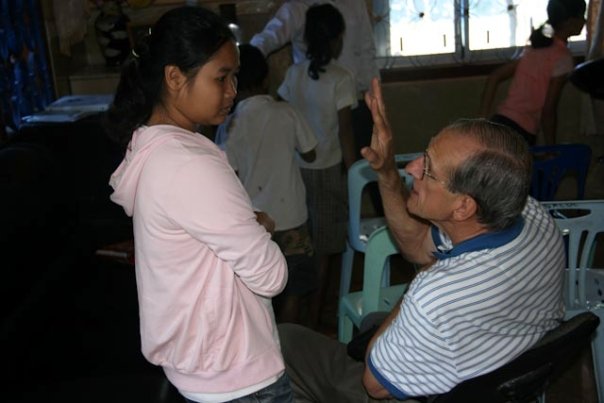
(L) Sean being baptized today by Allen Javellana, who studied with him. (R) Roberto preaching at Bear Valley last night.

VISITORS—HANDLE WITH CARE!

Neal Pollard

I’m not sure where the phrase, “handle with care,” originated. It’s usually reserved for advice regarding that which is fragile or even volatile. It really is applicable to those who visit our assemblies because of their value and importance. They came through the doors of our church building intentionally and with a purpose. Initially, we cannot know why or how sincere their purpose. That process of discovery could not be more important. Consider some reasons why we should handle every visitor with care:

  • Each has an eternal soul (cf. Mat. 25:46). 
  • God could not love that visitor any more than He does (John 3:16; 1 Tim. 2:6).
  • God loves that visitor as much as He loves you and me (Acts 10:34-35). 
  • That visitor is likely seeking spiritual guidance (cf. Mat. 7:7).
  • Each visitor is subjected to a first impression, being left by you and me.
  • That visitor is going to make judgments about the church, the Bible and Christ based on what he or she sees (or fails to see) from you and me.
  • The smallest gesture of kindness toward such a one could lead to the salvation of a soul.
  • We cannot know what anyone else is doing to make their first visit a good one.
  • Each one is being exposed to the Bible and to New Testament worship, and follow up can lead to further interest.
  • That soul is connected to many others, who might subsequently be reached (2 Tim. 2:2). 
  • You and I are official ambassadors for Christ (2 Cor. 5:20).
  • The Golden Rule should prompt our warmth, helpfulness, and sensitivity (Luke 6:31).
  • We are each part of a team, trying to connect each of them with what only Christ can offer them (1 Cor. 12:18; John 14:6).
  • There is no guarantee that there will be a next time (Prov. 27:1).
  • Statistics tell us that most visitors find the churches they visit to be unfriendly toward “outsiders” (see, for example: Thom Rainer).
  • Loving others is commanded, and visitors are included in “others” (Rom. 13:9; Gal. 5:14; Jas. 2:8; etc.).
  • Visitors constitute perhaps the easiest inroad to developing interest in a Bible study, as such have reached out to us by attending.
  • Our excuses (“I’m shy,” “That’s not my job,” “I’m not good at it,” “I’m busy”) ring hollow when carefully examined. 
  • We love the church and believe in its relevance and importance.
  • Each contact is a valuable way you and I can contribute service for our Servant-Savior (cf. John 13:12ff; Mat. 20:28).

The list is far from exhaustive. I am convinced that none of us neglects a visitor out of contempt or even indifference. Yet, it is good for you and I to encourage each other, to “stimulate one another to love and good deeds” especially as it pertains to assembly-related matters (Heb. 10:24-25). Wouldn’t it be exciting to be the friendliest church around, especially if our message and practice is faithful to God’s Word? What a powerful combination! Let’s help each other earn such a reputation, for reasons such as the above. 

fellowship201

Paul’s Portrait Of God For Timothy

Neal Pollard

Devoting himself to a theme of godliness in writing his spiritual son, Timothy, Paul writes to encourage him to teach godliness to people who enjoy financial prosperity (1 Tim. 6:3-10, 17-19). Part of his instruction is to point rich Christians (the case can easily be made that American Christians qualify as this in nearly all instances and many preachers in foreign lands on U.S. support do, too, among their fellow natives) to where the truest treasures lay. Along with encouraging righteous behavior, Paul points to God. He gives life to all things (13). Paul also points to Christ Jesus, who is faithful (14) and who is coming again (14) to give “life indeed” in “the future” (19). Certainly, as Christ is divine, this picture describes Him, though it is obvious this is a portrait of God. He depicts God as:

  • Privileged—“Blessed” (15)
  • Particular—“Only” (15); “Alone” (16)
  • Predominant—“Sovereign” (15)
  • Preeminent—“King of kings and Lord of lords” (15); “Whom no man has seen or can see” (16)
  • Possessor—“Possesses immortality” (16)
  • Phenomenal—“Dwells in unapproachable light” (16)
  • Praiseworthy—“To Him be honor and eternal dominion!” (16)

Why would Paul remind a preacher (or have a preacher remind Christians) about who God is? As we see in the second letter to this young man, motivation is vital! What keeps me serving God when life is difficult? When the world around me ignores Him, mocks Him, rebels against Him, blasphemes Him, and dismisses Him, I need to serve and glorify Him. What will help me do that? I need to see Him for what He truly is! So Paul pulls out a series of superlatives to drive home the point, “How great is our God!” 

In a world full of ungodliness, of “worldly and empty chatter and the opposing arguments of what is falsely called ‘knowledge’” (20), we must be on “guard.” Nothing clarifies the task better than intently focusing on the nature of God. He provides (1:4), He is (1:17), He saves (2:4; 4:10), He is one (2:5), He lives and rules (3:15;4:10), He created (4:3-4), and He sees (5:21). What motivation!

p46

Still Restoring

Neal Pollard

The idea of restoring New Testament Christianity is “that God set forth His standard of acceptance in salvation, worship, church organization and daily living” and “to follow the teachings of God, revealed in the New Testament, to direct our lives in the same way as He did first century Christians” (therestorationmovement.com/about.htm). We can open our Bibles and find a pattern for what the New Testament church is to look like, not in customs and culture, but in commands and cause. Yet, a tendency we must guard against is a haughty spirit that portrays the idea that we have already arrived. Consider four areas where we need to keep at the restoration plea and overcome neglect.

  • CHURCH DISCIPLINE. For years, I have seen this referred to as “the forgotten commandment.” At times, people will say of it things like “it doesn’t work,” “it’s harmful,” “it runs people away,” etc. Were we to substitute that argumentation for subjects like women’s role, worship, or baptism, wouldn’t we cry heresy or apostasy? However, in far too many instances, we have simply ignored and failed to practice this plain, New Testament teaching (Mat. 18:15-17; Rom. 16:17; 1 Cor. 5; 2 Thes. 3; Ti. 3:10-11).
  • EVANGELISM. It is so much easier to focus upon ourselves, to devote all our resources to internal issues.  Is there a spirit of evangelistic zeal running rampant among us? Is this an area to restore, to be like the early church? Perhaps we may be intimidated by the culture of political correctness. It could be the risk of ruining relationships or even rejection that causes us to avoid efforts at soul-winning. It could even be that we need to build our conviction for or commitment to this imperative given by the resurrected Savior Himself (Mat. 28:18-20;Mark 16:15-16;  Luke 24:44-47).
  • CHURCH ORGANIZATION. It is very likely that the number of churches of Christ which have elders are in the minority. At times, the reality of a shortage of qualified men is to blame. At other times, preachers or others prefer not to have elders. But, even where churches are “scripturally organized” (i.e., having elders and deacons), there is room for restoration— Preachers preaching and evangelizing, elders leading and shepherding (pastoring), and deacons actively carrying out  and administrating the ministries and works of the local church.  At times, there is a need to restore the roles of each of these works so that the proper, appointed men are doing the work Scripture outlines for them.
  • BROTHERLY LOVE. This is difficult, in a world increasingly characterized by hate, discord, and general worldliness. In our culture, where it’s easy to become disconnected with others—even our Christian family—we must strive to restore the beacon and central identification mark Jesus urged when He said, “ A new commandment I give to you, that you love one another, even as I have loved you, that you also love one another. By this all men will know that you are My disciples, if you have love for one another” (John 13:34-35). Isn’t there room for more concentration upon this command, which will be reflected in how we treat each other locally and in the brotherhood as a whole (1 Pet. 2:17)?

I love to spend as much time as possible talking about what the church is doing right. It is doing so much right. By following the New Testament pattern regarding salvation, worship, the church’s purpose, and the like, we stand out in a religious world that has lost its way. Meanwhile, however, let us stay at the business of restoring the church to the pattern revealed in Scripture, even in areas that are more difficult and demanding though just as necessary.

Making sparks

A GREAT FISHERMAN

By: A blessed fish

Let me tell you about the greatest fisherman I have ever known.

He has always found success at his favorite fishing hole. A special place where the inlet was fruitful, and many fish loved to be caught. His technique is simple. A welcoming lure. A handshake, a hug and a smile. Just to let you know you’re wanted.

He will always catch-n-release and the fish always feel better for the experience. Many wide eyed and spiritually young fish will enter the inlet, hoping that someone would catch them and show them the kind of love this great fisherman offers. He never judges a fish – their size, beauty, wealth or position. He only lets them know how glad he is to see them at the inlet.

His success is solely based on persistence, perseverance and patience. Three times a week you can always count on him being right there at the inlet. Waiting for the opportunity to hook’em and hold’em. He always makes every fish feel welcome and wanted.

He knows every fish by name. If he thinks a fish has drifted off down steam, he will go in search, armed with a tackle box full of Christian love and do his best to bring them back to the inlet. Not for him, but for their sake and for God’s sake.

He hooked this fish over 11 years ago. My wife led me to the inlet. But, he hooked me and let me know that I was welcome here. He helped save this soul for eternity.

I think he is getting tired now, but few may notice.  So many years of fishing, but he is still there almost every Sunday morning, Sunday night, and Wednesday night. I think he wants to share his favorite inlet with others who share his passion. Man, woman, or child, he wants us to join him. We don’t have to wait. We don’t have to be assigned the duty. We just need to step into the water and follow his lead. There is plenty of room at the inlet. Let’s all join this fisherman at the Bear Valley inlet and make sure every fish that enters knows they are wanted and welcome.

The great fisherman’s name is Clint and this fish will always love him.

Mathew 4:19-20

And He said to them, “Follow Me, and I will make you fishers of men.” Immediately they left their nets and followed Him.

———————————————

 NEAL’S NOTE: This was submitted to me by someone who wants to remain anonymous. Truer, more fitting words could not be spoken about one of the most special people any of us have ever known. We’re very blessed to have Clint Stephens as a member at Bear Valley, one of the men who was at the time a shepherd when I was hired. Enjoy!

1919171_1242785955488_6164179_n
Clint “fishing” on a mission trip in Cambodia a few years ago. 

Misusing The Bible

Neal Pollard

Ashley Despain now holds a dubious, ignominious distinction. Visiting an inmate in a Nevada, Missouri, jail, Ashley tried to sneak him marijuana and methamphetamines by sticking them into the binding of the Bible. Officials say they have seen many ways used to smuggle drugs to prisoners, but it’s the first time the Bible was the means chosen (via http://fox2now.com/2018/03/29/).

File that under “truth is stranger than fiction.” As incredible (and audacious) as that sounds, Ashley was not the first to misuse the Bible. How many have tried to use the Bible as a means of enriching themselves? Peter speaks of false teachers who exploit listeners with false words because of the teachers’ greed (“make merchandise of,” KJV, 2 Pet. 2:3). How many have tried to use the Bible as a means of defending personal sin or a sinful lifestyle? How many have tried to use the Bible as a billy club to pound their own hobbies, convictions, and opinions over the heads of others? How many have tried to use the Bible to peddle some false doctrine? Peter experienced that, too (2 Pet. 3:16). How many have tried to use the Bible to manipulate others into doing things they themselves aren’t doing? Jesus warned against that very thing (Mat. 23:4). How many have tried to use the Bible to tempt others into disobeying God? That’s literally a Satanic trick (cf. Mat. 4:6).

James warns potential teachers to be careful, examining themselves in light of the judgment (3:1). This is not meant to scare potential Bible teachers away, but instead should help us consider carefully how we use the Bible. Paul mentions some that misused the Bible, even if what they said was true. From prison, he writes, “ Some, to be sure, are preaching Christ even from envy and strife, but some also from good will; the latter do it out of love, knowing that I am appointed for the defense of the gospel; the former proclaim Christ out of selfish ambition rather than from pure motives, thinking to cause me distress in my imprisonment” (Phil. 1:15-17).

Like Paul, we have a stewardship (1 Cor. 9:17; Eph. 3:1-2). Let’s be faithful stewards! None of us will probably try to smuggle drugs with a Bible. But, in every sense, let’s be sure to be “accurately handling” it (2 Tim. 2:15)!

ashley-despain-mug

Romans 16:17

Neal Pollard

Why did Paul have to say this? After all those words of commendation to the wonderful Christians at Rome, culminating with, “Greet one another with a holy kiss. All the churches of Christ salute you” (16), he follows with, “Now I urge you, brethren, keep your eye on those who cause dissensions and hindrances contrary to the teaching which you learned, and turn away from them. For such men are slaves, not of our Lord Christ but of their own appetites; and by their smooth and flattering speech they deceive the hearts of the unsuspecting” (17-18). Apparently, it was because dissension and division are always possible.  The same is true today. A loving, caring church can have one or more who are intent on causing trouble. Look at Paul’s words more closely.

The problem: “Dissensions and hindrances contrary to the teaching which you learned….” Specifically, what does Paul mean. Comb through the whole letter. There are doctrinal truths about salvation, Jesus, and discipleship especially in chapters 1 through 11. Then, there are moral and social truths about how we are to treat each other in chapters 12 though 15. Anyone who violated any of the teaching here was the object of Paul’s warning.

The prescription: “Keep your eye on [them]…and turn away from them.” Paul is saying, “Keep your eyes peeled.” Who are we looking for Paul? Anyone causing dissension (“a division into opposing groups…‘to cause people to be angry at one another’ or ‘to cause people not to like one another’ or ‘to cause people to think of one another as enemies.’” (Louw-Nida 493) or hindrances (the Greek word here is the one from which we get our word “scandal”; cause for stumbling; that which causes offense or arouses opposition, ibid.).  Watch out for people who stir up trouble, cause a scene, or instigate problems through a sinful attitude, sinful speech, or sinful conduct. Then, “turn away from them.” In passages dealing with church discipline, God says, “keep away from every brother who leads an unruly life” (2 Th. 3:6), “do not associate with him, so that he will be put to shame” (2 Th. 3:14), “reject a factious man after a first and second warning” (Ti. 3:10), and “do not receive him into your house, and do not give him a greeting” (2 John 10).

The perpetrator: Paul gives multiple descriptions of the dissension-maker. They are slaves of their own appetites. They sin with their speech.  They deceive the unsuspecting. In other words, they may appear to be one thing, but they are actually something else. They may seem like a victim, when they are the aggressor. They may claim innocence, when they are guilty. They present one side of the story, but there is way more to the story.

The Lord wants His church to grow, building on the foundation of the truth of Scripture. Satan wants the Lord’s church to suffer, divide, and be distracted. We decide whose side we are fighting on. We must always act to protect the precious bride of Christ from any and every attack, from without or within. God help us do so with love and courage!

HOW IS TRUTH DETERMINED?

Neal Pollard

Recently, I received some feedback on a recent article (Truth Is Truth, No Matter Who Disagrees With It). Negative feedback is not rare, but expected when we put ideas down on paper (or on electronic media like blogs). This feedback was not personal, nor unkind. Yet, it reflects the thinking of so many who shun the idea of absolute, objective truth. Consider the major arguments made by the one who wrote:

—No matter what you believe, the majority disagrees with you.
—You are no smarter or more sincere than those who disagree with you.
—Everyone is certain their religion is right, but this is a function of the brain and proof of nothing
—Conflicting views within the “Restoration Movement” shows the fallacy of being certain about truth
—Certainty is dangerous because it does not allow for change

The last three arguments seem more of a confrontation of certainty than arguments against truth, but consider each of these individually.

Does the inevitability of disagreement nullify the idea of absolute truth? If someone argues our answer that two plus two equals four, and were able to get a majority to side with them that the answer is five, does that nullify the truth of what two plus two equals?

If a person with demonstrable intellectual capacity and apparent sincerity nonetheless avers that two plus two equals five, do we rewrite the laws of addition and reprint the textbooks? If not, why not? Is it not because we can take two of something, add it to two more of the same something, like integers or apples or books, and find the inescapable, universal truth that now there are four?

Can any religion be certain that they are right, but be wrong? Universalists believe everyone will ultimately be saved. Those who believe that murdering those they deem “infidels” pleases their God and they teach others that this is truth. Cults often dub their leaders the Messiah. On what basis would we object or oppose any religious tenet, like these, without an objective standard of truth?

Does the imperfection of people in applying revealed truth impugn the reality of absolute truth? It will never be suggested that anyone is perfectly interpreting or applying the perfect standard of truth, including those trying to restore New Testament Christianity (which, incidentally, implies belief in a perfect, objective standard of truth). But, does that mean restoration can or should be rejected for ideas which clearly contradict what the New Testament says (i.e., “sinner’s prayer’ versus how the New Testament teaches people were saved)?

If there is a conflict between the certainty of New Testament teaching and the desire for change, which is to be preferred and chosen? The religious world has changed a myriad of things that the New Testament explicitly teaches must be done or taught a certain way. Isn’t it a faulty premise to choose change proposed by men, when it assaults a certainty revealed by God?

That there is religious confusion and division is indisputable. It is disheartening. The Bible warns that articulate, polished religious leaders would teach things contrary to the revealed truth of the New Testament (Gal. 1:6-9; 2 John 9-11; Rev. 22:18-19). Let us never put confidence in man, but let us ever put confidence in the truth of Scripture.

OLYMPUS DIGITAL CAMERA

“I Praise, I Participate, I Proclaim”

Neal Pollard

Yesterday afternoon, the Bear Valley eldership stood before us one by one to talk about their priorities both for themselves and for us. They distilled them into five simple words that describe five profound concepts: (1) Worship, (2) Communication, (3) Fellowship, (4) Accountability, and (5) Leadership. They told us that as the religious world is growing more homogenous in their worship style (a la community church model; rock concert-ish), distinctive New Testament worship has a chance to stand out even more. Yet, we need to always be improving our efforts in leadership and participation. They emphasized that communicating news, ideas, and needs is a process that will always need work and priority. No church ever arrives in this regard. They spoke of the importance of building a closer church family, knowing each other through age-related opportunities and entire congregation opportunities. This happens when we’re all together, in the classroom, and away from the building. They stressed the importance of holding one another accountable, for faithfulness, commitment, and support. Otherwise, there is no way to move from ideas to action. They told us that all of us exert leadership in some area. There is formalized leadership positions, as outlined in the New Testament (elders, deacons, preachers, teachers). But, inasmuch as we all have a sphere of influence (cf. Mat. 5:14-16), God expects us to lead. Throughout their entire presentation, they were specific about strategies aimed at helping us be successful. I appreciated the great challenge this was for us to work and grow. There were so many quotable sayings from their collective lesson, but the one that struck me most was made near the end. As we have adopted three planks of emphasis as a church, based on Acts 2:42-47 (praise—worship, participation—fellowship, and proclamation—evangelism), we were challenged to think: “I praise,” “I participate,” and “I proclaim.” It can be so easy for us to approve the church’s need to grow and improve in these areas or to expect the elders to do these things. But, no matter who we are, we can and must ask, “What can I do?” The key to being a great church is the willingness of every member to make personal application. It’s not, “What are they doing?,” “what are you doing?,” or even “what are we doing?” No! It must always primarily be, “What am I doing?” I’m thankful that our elders spoke with confidence and clarity about the fact that there is plenty of opportunity to be involved in making Bear Valley a strong, relevant church, a city set on a hill shining a light in spiritual darkness. Thank God for strong leadership, which encourages me to say, “Here am I, send me!” (cf. Isa. 6:8).

29513166_10155440294575922_8869656347900125980_n

Selling Children

Neal Pollard

In March of 2007, in Owensboro, Kentucky, a couple tried to sell the woman’s 15-month-old daughter for $3000 and an SUV. The noble purpose behind this attempted transaction was “money to pay off [the boyfriend’s] fines for previous criminal charges.” Surprisingly, they denied the allegations and maintained their innocence, an effort that would eventually be unsuccessful.

How heartbreaking that anyone could act so heinously. Truly, “Children are a gift of the Lord…a reward” (Psa. 127:3). Yet, while they are a gift from the Lord to us, in another sense they still belong to Him (cf. Ezek. 18:4). We cannot sell what ultimately does not belong to us.

What Charles Hope, Jr., and Amber Revlett did in Kentucky was certainly criminal, but they are far from salon among those trying to “sell” their children for one reason or another. In order to give their children popularity, gratification, or material success, some parents are encouraging their children to live a life of sin, worldliness, and selfishness. Secular courts would never convict them, but what they are doing is even more heinous than that attempted by those lowbrow schemers from the Bluegrass State. As Christian parents, we have an obligation to recognize this tendency and not “sell our children” out to anything that could replace their undivided loyalty to serve Christ. We want their hearts centered around Christ and His will (Mat. 6:33).

Let us both teach our children and realize ourselves their intrinsic value as ones made in the very image of God (Gen. 1:27). Within each of our children is a soul, every one of which is more valuable and important than the whole world (Mat. 16:26). May we never do anything that would lead them to exchange their souls. Whatever they gain, they will lose everything! To the extent we, as parents, can influence this, let us do with diligence. God has placed their training and spiritual wellbeing into our hands (cf. Deu. 6:4-9; Eph. 6:1-4).

Stack Of Cash

Recognizing And Resolving Ineffective Problem-Solving

Neal Pollard

FIGHT…WOUND…WITHDRAW…REPENT…REPEAT.

That has never worked, but it’s the way many people approach problems in marriage. And, it’s not only newlyweds. Some people live out a lifetime of handling conflict this way. The sad and dangerous thing is that such a methods of dealing with disagreements can destroy a marriage.

The point of contention arises, whether financial, emotional, spiritual, or physical. The couple argues. One, then the other personalize the issue, attack one another, and exhibit sinful anger. This can escalate to the point that hurting words or actions occur. Finally, exhaustion, hurt or anger stops the fight. Each returns to his or her corner. Each treats his or her wounds or maybe even plots the next move. Soon or later, guilt or remorse overcomes each of them. For either peace or relief, they eventually hit the “kiss and make up” stage. Life then goes on.

Perhaps it is at this juncture that the greatest damage occurs. What did not happen? The cause of the conflict wasn’t resolved. So, what happens? The disagreement about whatever is still a problem. Eventually, it will resurface. Then, the cycle will continue. There will be more FIGHTING, WOUNDING, WITHDRAWING, and REPENTING.

If this system is so agonizingly painful and counterproductive, why is it so commonly practiced? Pride, unwillingness to compromise, selfishness, or inflexibility all may factor in. How can we break this vicious cycle? The answer is easy to come up with, but it requires great discipline and patience to achieve. Consider.

  • Do not let conflict “sneak up on you.” Fatigue, stress, and illness can effect demeanor, even when we’re not conscious of it. Resolve not to react without careful consideration of what you will say or do.
  • Practice the golden rule. Never say or do anything you wouldn’t be happy to hear or receive (Mat. 7:12).
  • Give your mate due courtesy. The Mills Brothers sang, “You always hurt the one you love.” That may be the tendency, but we need to do better than that. Should you speak more harshly and impatiently to your mate than to your boss, employees, neighbors, friends, or attractive stranger? Don’t let familiarity breed contempt.
  • Swallow your pride. Do you feel the need to always be right, to always win? That’s not healthy or conducive to a happy marriage. Pride has damaged innumerable relationships (Prov. 16:18).
  • Act like Jesus. While He wasn’t married, He did interact with many people. Not all of those were friendly. Many were prone to be antagonistic. Jesus preached, “Blessed are the peacemakers” (Mat. 5:9). He also urged conflict resolution as a high priority (Mat. 5:24). Jesus lived a perfect life (1 Pet. 2:22), a life of example for the rest of us (1 Pet. 2:21).

None of us will ever be sin-free and perfect! Disagreements will continually pop up between husbands and wives, simple because no two individuals see everything alike. But, the vicious cycle of fighting, wounding, withdrawing, repenting, and repeating is hurting more marriages than we want to admit. It’s time to get off the roller coaster. Let’s start today!

character_back_to_back_male_woman_argue_hurt_attack_insult-1215684.jpg!d

“PRCHNG1”

Neal Pollard

The title above, PRCHNG1, was once the vanity tag on a truck I owned. When in 2004 I said a sentimental goodbye to the “Black Bullet” (as Kathy affectionately named my 1985 Chevrolet Custom Deluxe pickup, which I traded in on a “new” 1992 Dodge Dakota), I transferred the tags down at the DMV.

As I picked up a number at the front counter, I had my tags in hand, and the receptionist saw them. It launched an interesting conversation.

She said, “Oh, I’ve always wanted to try that. I bet that’s so fun. Is it scary?”

I was puzzled and said so.

She said, “Your tags. How long have you been parachuting?”

I guffawed.

You may have surmised by now that my tag stood for “Preaching One.” I worked with DMV originally to find something that gave that clue. “Preacher,” “Mr Preach,” “Preacher,” and several others were already snagged. So I settled on “PRCHNG1.”

I thought it was clear, but apparently my fellow motorists either thought I was in some airborne division or maybe purchased hand guns. I don’t know.

As Christians, we’re told to be salt, light, and leaven, to clearly point others to Jesus.

When others see your works (cf. Mat. 5:16; 1 Pet. 2:12), do they conclude that you are a Christian? Or does the general tone and slant of your life lead people to contrary conclusions?

Be careful! Others are watching us, and they make assumptions about our character and lives by what they see. Let us make it plain (cf. Hab. 2:2)!

IMG_4176


Enlightening Journey

Neal Pollard

I have been preaching full-time for 26-plus years, and made my first attempts over three decades ago. I’ve taught Bible classes about the same length of time and taught in a preacher training school for a dozen years. I’m a preacher’s son and feel like a fairly diligent student. But, this trip has been enlightening in many ways.

I’ve learned more about the physical features of the land. Today is just a sampling of that. Going to the Shephelah, the Judean foothills or lowlands, we looked at ruins of the Old Testament town of Tel Beit Shemesh. It was a fertile, strategically important area and the site of conflict between particularly the Israelites and Philistines.  The valley of Elah, also a famous location of conflict between Israel and Philistia, was a playing field surrounded by two stadiums, those Judean foothills where each army camped. We got to walk in the creek bed where David retrieved his five smooth stones. But far to the south, where we ended up in the afternoon, we reached the arid, though surprisingly green, area at the very south of the nation–Beersheba. It is south of the mountains of Jerusalem, at the northern edge of the hot, flat Negev desert. Each day, we’ve been surprised and enlightened by the secrets of this land unlocked with our GeoBasics book, an expert guide, and an extremely knowledgeable tour group leader.

I’ve learned more about the people I’m traveling with. Each day, I’ve said something about them, but the blessing continues with every new day. You can’t travel with anyone for this long without learning new and interesting and unexpected information.

I’ve learned something about the religion of the land I’m in. I know far less about Judaism than I do areas of Christendom, but tonight we had a rabbi speak to us after dinner. He is a conservative rabbi that grew up an Orthodox Jew. He shared with us the viewpoint of at least a portion of the Jews in Israel and the rest of the world. When I heard him, it showed me how much there is for us to share with so many people in this world. It also told me something of the unique hope found in the New Testament.

Ive learned more principles about the Word of God, especially as viewed through the lens of Bible Geography. Wes Autrey gave a powerful lesson overlooking the valley of Elah, where David defeated Goliath. Adeptly using that story, he urged us to see the stone fired by David as faith in action. Donnie Bates, at Bersheva, related how the God revealed there is literally the living God who sees me. In the wilderness, God was there to be with His people. Masterful! Every day, the lessons have tied the geographical location to a spiritual lesson that has helped me in my relationship to God, His Word, and this land. I’ll never forget it.

I’ve learned more about me.  These days have exposed those areas in me that need more work. They’ve shown me what touches my heart and how. They’ve shown me what I should be doing more effectively and why. It seems strange that a place would help do this, but it has done exactly that.

The journey still has about three days left. The days are long and tiring, but thrilling, too. And, as today perfectly represents, they are so enlightening.

rabbi


A Joyful Journey

Neal Pollard

One thing becomes more clear each day as this trip unfolds, and that’s the bond and enjoyment among the travelers this trip is producing. No trip is without it’s bumps and bruises, but the days have brought us closer together as we collective experience the often “overwhelming” moments of the day. It’s wonderful to love and like the people you travel with. There’s lots of laughing and talking, perhaps accentuated by the incredible things we see each day. That’s the result of leadership, and John and Carla Moore have done an incredible job setting a happy tone. But there’ll be more to say about that later.

This day started at an incredible site, uncovered only about a decade ago. After spending the night in Bethlehem (it’s so cool just to type that!), we went down from Bethlehem toward the biblical city of Tekoa. There, we saw the Herodium, one of the palaces of Herod the Great and the place he was buried. Michael Hite contrasted his opulence and extravagance, destined for ruin and decay, with the living stones that make up God’s spiritual house (cf. 1 Pet. 2:9-10). Afterward, we enjoyed a few hours at the Israel Museum, seeing so many artifacts collected from various archaeological sites–including many tels we have visited on this trip.

From there, we went into the old city of Jerusalem for the first time. We went to the presumed site of the city of David, then down into Hezekiah’s tunnel. This wet tunnel goes for over 1700 feet with water as high as the thigh. It was an incredible engineering feat that protected Jerusalem’s water supply when the Assyrians laid siege during Hezekiah’s reign. We sang our way through much of the tunnel, and laughed a lot, too. Several Israeli teenagers were just ahead of us and enjoyed our singing so much they asked for an encore when we arrived at Siloam’s pool. Tyler King shared a great lesson with us from John 9.

After dinner, several of us went down to the old city at night. We walked in through the Damascus Gate in the Muslim quarter and eventually wound our way over to the western wall. We were treated to a hoard of sights and smells, then wearily returned to our hotel rooms. Every day is thrilling, educational, and overwhelming, but the people continue to bring as much joy and enjoyment as the places we are going (cf. Isa. 52:8-9).

IMG_3056

An Emotional Journey

Neal Pollard

This being the only Sunday in Israel on this journey, it’s not surprising that this day would be so highly emotional. We began the day at the Dead Sea, where we worshipped together (being several hours away from the Nazareth congregation). The songs we sing are always profound, but something about looking out a window at the landscapes of the Holy Land honestly evoked even more feelings as we sang “How Great Thou Art,” “He Could Have Called 10,000 Angels” or “Surround Us Lord.” The tight bond of fellowship with other New Testament Christians was (and is) intense. Dan Owen challenged us not just to know the Word of God, but to do it! What a challenging gap between the two! Then, we saw and explored the grounds of perhaps the greatest discovery of the 20th Century, the caves of Qumran. We heard that just this past week a scroll containing text from the book of Esther found in one of the caves, marking the fact that the entire Old Testament was discovered in them (read this interesting article). Such thrilling, faith building facts, pointing to the faithful transmission of copies of the original autographs of the biblical canon.

From there, we went to the Jordan River to the approximate place where Jesus obeyed the will of God being baptized by John. Watching particularly those of the Russian Orthodox religion being baptized en masse, this was a site of faith for so many people. As John Moore said, “It shows the great challenge to faithfully declare the Word of God to the world.” Despite the misguided beliefs of the crowds at this hallowed spot, how encouraging to see so many who believe in God, His Son, and the importance of His coming.

We moved along to Jericho for an incredible experience, standing at the oldest city in the world. It was the place where the greatest generation of Israel began their conquest of the land promised by God to their forefather Abraham. It was also the site of so many important events in Jesus’ ministry, from Zaccheus to Bartimaeus. It was also one end of the journey made by the unfortunate man in Jesus’ parable of the Good Samaritan. A place we’ve studied about since we are little children, Jericho lay out before us as a marvel our eyes could behold. Donnie Bates brought it vividly to life, speaking to us there with the admonition that when we do things God’s way there’s victory but when we go our own way there’s defeat. What a feeling of awe and excitement, being soldiers of Christ!

Then, oh the emotion of making the initial drive into Jerusalem. Stopping at the Ma’ale Adummim, imagining the Jews en route to Jerusalem and singing the songs of Ascent (Psalm 120-134), we were mesmerized by the grandeur of the wilderness even as we were surrounded by Bedouins extra eager to hawk their wares and baubles to us as we read Scripture and prayed. The initial view of the Mount of Olives and the walls of Jerusalem brought exclamations from people all over the bus. It’s hard to describe the well of emotion kindled by such views. A stop at Mt. Scopus, with an exceptional view of the Temple Mount, part of which we recognize as Mt. Moriah, intensified so many feelings.

Today, there were so many smiles, songs, and tears, but also many moments of solemn silence. How better to describe it than emotional? It makes the needed feelings of dedication and diligence raw and real, I’m so thankful I got to experience it and to experience it with such wonderful people.

29062594_10215100748250240_2565927107465052160_n
Cave Four, Qumran (photo by Kathy Pollard)

Journey To The Top Of The Lowest Place On Earth

Neal Pollard

Today marked a slower paced day filled with significant stops. One of our group, Melissa Herbelin, would later say that she was not excited about the prospect of our first stop before she arrived but afterward was thrilled to have been there. We woke up at the Dead Sea, the lowest place on earth. But our first stop, Masada, was over 1300 feet up from the ground. It was home to a fortress and palace built by Herod the Great as a place of refuge were he to need it for political reasons in the often tenuous times of the Roman Empire with its intrigues and alliances. Accessed today by a cable car, the steep mountain detached from the rest of the Moab Mountains was thought impregnable. It was there that the last of the Jewish zealots and rebels against Rome, 960 of them, withstood the great Roman legion until finally committing suicide. The remains are impressive, from Herod’s three-tier palace to the deep cistern and other edifices like the synagogue, storehouses, and the ingenious aqueduct system the king put in place. Herod never lived there, but the insurrections held up there until their deaths signaled the end of the revolt. Many have wondered if David wrote some of the psalms from this impressive spot before Herod build his stronghold there. Dan Owen chose to focus us on the tenacity of the Jewish zealots and Roman army as each fought to defeat the other, and he told us their cause was not eternal. He encouraged us to fight with that intensity for our eternal goals.

About ten miles north of Masada, we arrived at En Gedi. This is an oasis of incredible lushness in the midst of the dry, brown Negev desert. Home to the rock badger, Nubian ibex, and endangered starling, among other creatures, it is home to two large and several smaller waterfalls. Ron Crawforth led us to consider events, like Saul’s pursuit of David (1 Sam. 24) and some of David’s Psalms, like Psalm 37, that could well have occurred in this precise oasis location. Not many other places would fit the description so well.

Finally, we came back to the Dead Sea to see one of God’s great marvels. It is pondered that this area was part of the grazing area seen by Lot and part of the choice land he took for himself and his herds, an area later destroyed by God with fire and brimstone (cf. Deut. 29:23–“brimstone and salt”). Several of our group floated or stood in the water of this unique, mineralized sea. They played and marveled at the lowest place on earth.

We continue to make this journey as a group bound by Christ and being bound closer to one another. Very little complaining is heard and a general spirit of joyful fellowship wins each day. Thank God for the times in which we live and the opportunity we have to journey in the footsteps of Christ.

The Ambition Of A Burmese Python In The Everglades

preacherpollard's avatarThe Preacher Pollard Blog

Neal Pollard

No, I have not gone geographically goofy!

It’ll take more than a sack lunch to go from Florida to southern Asia, but because some pet owners have deposited their no-longer-wanted pythons into the Everglade Swamp there have arisen some interesting ecological dilemmas. The most spectacular one I have seen had pictorial documentation to prove itself. There, in the black and white of the newspaper, was a Burmese python that had burst in its attempt to swallow…an alligator!

What about you? Do you have big goals and dreams? Where do you see yourself this time next year? By retirement time? In eternity? What tangible things are you “biting off” to make those goals reality? Do you have soul-winning and other spiritual goals? Would you like to be a “lighthouse Christian” whose example motivates many to be like Jesus?

How big are you thinking? How big can you think?

Remember…

View original post 166 more words

Journey To The Sea And To The South

Neal Pollard

Today was a day about the Changeless and change. As we got on the bus to depart, we sang to John Moore who saw a change from one year to the next as we celebrated his birthday. Our tour started at the Jordan River at the northern end of the Sea of Galilee, where Jesus’ baptism signaled a change in His life and the beginning of His public ministry. We rode a boat on the Sea of Galilee, which led our thoughts (as Michael Hite spoke to us) to a life-changing experience for the apostles as they watched their Teacher show His miraculous power over winds and waves. Just the stiff westerly breeze we experienced helped us appreciate what a violent,east driven storm would have done to change courage to fear in an instant. We went to Beit She’an, where Saul’s body was nailed after his violent death in battle. This signaled a change in Israel’s leadership. In New Testament times, the city was one of ten cities known as the Decapolis where Jesus did miracles and brought His message of eternal change (Mark 5:20; 7:31ff). Ken Dawdy spoke to us of this city as we sat in the well-preserved theatre. Then, we made the two-plus hour journey southeast to the Dead Sea. We watched the gradual change of terrain and topography, going from lush, hilly and green to arid, dry, brown and accented by the dramatic contrast of the Dead Sea. All along the way, I thought of the words, “Change and decay in all around I see; Oh Thou who changes not, abide with me.” Thousands of years of rich history reside in this hallowed land. Change aptly describes the land. We passed through territory claimed by dozens of nations through time. Overseeing and ruling over it all is the God who changes not! Praise God for His steady, unchanging hand, a hand we count on to hold, protect, and comfort us whatever changes come into our lives!

IMG_6494
View of Beit She’An (Photo: Neal Pollard)

Journey To Jesus’ Hometown

Neal Pollard

The last two days have been full of interesting events, We went to Nazareth to see where Jesus grew up. In the place He learned Joseph’s trade and where Jews hearing Him open the door to the Gentiles wanted to throw Him off the brow of the hill, we visited the only known congregation of the Lord’s church in the whole nation. They served us lunch, We sang, prayed and fellowshipped with them. We saw the spot where it’s posited that Mary received news that she would conceive a child. We visited Mt. Precipice, thought by some to be the place where the Jews angrily tried to throw Jesus down. Wayne Burger shared some tremendous truths from Luke four. It was a surprisingly emotional day, especially because of the deep connection I felt with the family of Christ I was able to share it all with,

This morning, we woke up at the Sea of Galilee. Keith Kasarjian and I went for a run and then I nearly sliced off my finger with a cheese knife (on cheese I never got to eat). But the day was eventful again, visiting two cities where we know Jesus walked. The towns and synagogues of Capernaum, where Denny Petrillo shared some interesting facts and applicable truth, and Chorazin hold so much history in them, We went up to the ancient city of Dan, which even earlier than the conquest period was a Canaanite city almost certainly visited by Abraham. It became infamous as one of the two cities set up by Jeroboam as a center of idolatrous worship. We then were able to travel to Caesarea Philippi, where Jesus and the disciples stood amid unbelievable pagan idolatry and affirmed the truth of His Deity. Tyler King told us how precious the truth of His Lordship is.

Amid all these startling scenes and thoughts, as John Moore reminded us near the Israeli-Syrian U.N. controlled buffer zone, we serve a Christ who came to bring unity and peace in a divided world. We came close enough to see across into both Lebanon and Syria, both of whom have been enemies of Israel for some time. Israel itself is a nation not friendly to foreign missionaries preaching New Testament Christianity and evangelism is difficult among the Orthodox Jew and Muslim populations. But we visited places where Jesus started everything, not just a movement that changed the world but THE movement of all movements. It’s what has us moving from place to place in this beautiful country and what moves our hearts so deeply,

IMG_1551.jpg

Adjustments On The Journey

Neal Pollard

We encountered a delay in Newark, New Jersey, that slowed down our journey. Our plane had made the long haul from Hong Kong and needed some maintenance work before we could take off. This meant that we arrived in Tel Aviv over an hour behind schedule. Between that and the lengthy customs process, we were a couple of hours behind schedule. John and Carla put together such an incredibly thoughtful itinerary. Because of the delay, however, we had to eliminate the first stop from the planned journey. Aphek, where Joshua apportioned the tribal inheritance, where the ark was stolen, and where Israel fought Syria. Instead, we journeyed up to the an amazing city, with its harbor, the place where Paul was interred and transferred to Rome (Acts 21-25), where Pilate stayed, and which Herod the Great built. Caesarea Maritima, with its impressive colosseum and hippodrome, with its engineering marvel, the aqueducts, and with its ingeniously designed harbor, sits at the Mediterranean Sea. Philip preached here (Acts 8:40). Peter saw his vision calling him to preach to the Gentiles here (Acts 10:1ff). Herod died his gruesome death here (Acts 12). While we had to hurry through this incredible site, we sat and listened to John Moore deliver a powerful devotional lesson about the blessings God gave Israel, the testing ground of faith and trust in God’s leadership, and the challenge to us to trust in Him and receive His blessings today. How incredible that we got to do this on the day of our arrival, jet lagged and fatigued as we all were. Even in our mental fog and physical exhaustion, what a blessing to be able to share in all of this with so many of our Bear Valley family members. There are 39 of us on this journey, experiencing the expected and unexpected, soaking in the powerful places and principles that seem to be as fruitful as the orange, fig, avocado, fig, date palm, and banana trees we saw along the journey from Tel Aviv to Caesarea. Not everything will go smoothly. With about 40 people moving from place to place, flexibility will be the name of the game. Each new day, we will adjust yet we will appreciate every detail!

IMG_4709