Identifying As A Christian

Neal Pollard

There are so many “identifying” stories these days. A white woman, Rachel Dolezal, identifying as a black woman, was back in the news over the weekend. A biological female who identifies as male and has taken testosterone, Mack Beggs, won the Texas girls wrestling title. In a recent interview, Dr. Keith Ablow suggested that such delusional (he is using the term in a psychological, not pejorative, sense) reasoning opens the door for a young person who “identifies” as a 65-year-old to receive Medicare benefits (foxnews.com). Really, every new case of “identifying” reveals the absurdity behind the thinking. All the wishing, wanting, and hoping in the world cannot change ironclad facts. As we used to say discussing reality of any kind growing up, “It is what it is.”

If there is anything more harmful than delusion, it may be denial. For centuries, good, sincere people have claimed to be Christians who have not followed what the New Testament reveals is necessary to become one. They have followed some humanly-devised plan or idea (accept Jesus in your heart by faith, say a prayer, believe the Holy Spirit gives you an experience of grace, etc.). Leaders and teachers who have devised such ideas do not do so from a sustainable, biblical source.  Repeatedly, whether in the gospels (Mark 16:16), the book of history (Acts 2:38; 22:16), or the epistles (Rom. 6:4; Gal. 3:27; Col. 2:12; 1 Pet. 3:21), we find a simple, but essential, act that stands between one not being and being a Christian. But the idea that one can fail to do this and still be a Christian is pervasively taught, believed, and practiced.

Akin to this is the belief that one can claim to be a Christian, then live any way they wish. Their speech, conduct, and attitude can exactly mirror and mimic the world’s. Their aspirations, pursuits, and values can be completely worldly. But, when death visits a loved one or comes to them or at some similar time when it would be advantageous to claim so, they aver that they are a Christian. While they may have followed God’s plan to become one, they think of themselves as saved and safe even while walking in darkness (cf. 1 John 1:6-9).

It takes more than a claim. Facts are stubborn things. The ultimate source of what is factual is God’s Word. It educates us about gender (Gen. 1:27) and race (Acts 17:26). It educates us about who a Christian is (Acts 2). It educates us about faithful Christian living (cf. Rom. 12:1-2). If we wish to be accurate in the way we “identify” ourselves, we must let Scripture inform our view!

rachel_dolezal_speaking_at_spokane_rally_may_2015

The “Nothings”

Neal Pollard

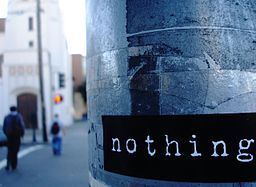
What the child is always doing, despite evidence to the contrary (“nothing”). What is wrong with one’s spouse who sits nearby, quietly and tightlippedly fuming (“nothing”). What the interrupted person was going to say (“nothing”). The word which defines itself is “nothing.” The Bible teaches, “For if anyone thinks he is something when he is nothing, he deceives himself” (Gal. 6:4).

Those low in self-esteem think of themselves as nothing. Children and spouses who are constantly told so think of themselves as nothing. Those not as wealthy as their friends or neighbors often conclude themselves to be nothing. Those unrecognized for their accomplishments can feel like they are nothing. But the inspired apostle refers to some who think themselves to be something who are actually “nothing.” The Bible makes mention of that arrogant family, The “Nothings.” They are a haughty, proud, self-involved, earthly-minded crew.

Meet The Nothings.

There Are The “Good For Nothings.” Jeremiah introduces them. He says, “This evil people, which refuse to hear my words, which walk in the imagination of their heart, and walk after other gods, to serve them, and to worship them, shall even be as this girdle, which is good for nothing” (Jer. 13:10). They were unaware of problems they had. They were evil, spiritually deaf, selfish, and idolatrous. He compares them to a good for nothing, straight from a hole in the ground, dirt-soiled belt!

No one is inherently worthless, but we can choose a lifestyle that is wicked, lukewarm, or indistinct (cf. Mat. 5:13). Christians, by our distinctive nature, are of great value to God (1 Pet. 2:9). Yet, by surrendering our Christian influence, we can become “good for nothing.”

There Are The “Brought To Nothings.” After referring to the danger of making decisions based solely on human reasoning, Jeremiah prays that God will not bring him to nothing (Jer. 10:23-24). God will rename some the Brought to Nothings, those who believe man’s ideas over God’s facts. Paul warns that God will “destroy the wisdom of the wise, and will bring to nothing the understanding of the prudent” (1 Cor. 1:19; Isa. 29:14). The wisest and most scholarly man who discounts God’s Word will be a regretful member of the Brought To Nothings someday.

There Are The “Need Of Nothings.” These are the overly comfortable, spiritually out of shape members of the Nothings clan. They live their lives saying, “I am rich, and have become wealthy, and have need of nothing,” and they do not know that they “are wretched and miserable and poor and blind and naked” (Rev. 3:17). They aren’t really bad people, but they aren’t all that good either. They’re just quite satisfied with what they have done for Christ, which isn’t all that great and not too bad. They merely yawn through their spiritually lives, only occasionally stirring from spiritual sleep (cf. Eph. 5:14). They half-heartedly do just enough to deceive themselves into thinking they’re pleasing the Lord.

Unrelated to these Nothings are some good folks, like the Ashamed In Nothings (Phil. 1:20), Terrified By Nothings (Phil. 1:28), Anxious For Nothings (Phil. 4:6), and the Wavering In Nothings (Jas. 1:6, KJV). But the Nothings family mentioned above are black sheep in God’s family. No one should want to “take after” them.

256px-nothing_is_nothing

WHY WE KEEP FAITHFULLY SERVING AND LEADING

Neal Pollard

It took the Expert House Movers of Sharpstown, Maryland, 17 years and 23 days to complete the move of the Cape Hatteras Lighthouse 2900 feet away from the eroding Atlantic Ocean beach on the North Carolina Outer Banks location where it had been standing. They started in 1982 and finished in 1999. Little things may get done quickly, but big things take time.  Someone once said, “Most people tend to overestimate what they can do in a week and underestimate what they can do in a lifetime.” Paul was in a position to look back over his life and see, if his humility allowed it, a lifetime just since his conversion to Christ that was marked by much fruitful labor.  Luke chronicles some of that work from Acts 11-28. Paul reflects back on some of it in 2 Corinthians 11. But in what is firmly believed to be his last inspired writing, 2 Timothy, he has a brightly lit torch in his condemned hand. He is ready to hand it off to the young preacher, Timothy.

I imagine most of you are blessed to lay claim to someone, either still living or now dead, who was a Paul to you. Having a mentor or mentors to help us grow and develop, spiritually, is priceless. When Paul tells Timothy what he does in 2 Timothy 4:1-8, a passage we typically use to encourage preachers, he is urging a precise attitude and precise teaching. The reasons why he wanted that for Timothy are reasons that should motivate us to live faithfully and to encourage our own Timothys to persevere until the current pressures. Here are three reasons why Paul encouraged Timothy to be faithful:

  • BECAUSE PROBLEMS ARE COMING (3-4). It was a fourfold problem (you’ll notice it by reading these two verses). Paul told Timothy to handle it with great patience and teaching. You cannot always anticipate what the problem is going to be, but as long as you come in contact with people there will be problems. You cannot hope to be an influence on them if you do not cultivate the attitude of patience. When problems arise, be patient and stick to the doctrine of Christ.
  • BECAUSE YOU ARE DIFFERENT (5). No matter how you are treated (or mistreated), you cannot stoop to the level of unethical, immoral, or unscrupulous people. These false teachers Paul references were willing to discard truth, and many wanted that kind of teacher. We will encounter people who don’t play by the Lord’s rules, but we must be different. We must be sober in all things, endure hardships, do the work of an evangelist, and fulfill our ministry. We are to have a better character, and we have a better message. We aim higher because we are the people of God.
  • BECAUSE JUDGMENT IS COMING (6-8). Paul looks ahead to the very end of all things. Because he was faithful, he anticipated the crown of righteousness. Why do you want to serve the Lord? Is it for prominence, popularity, or influence? To successfully endure, do what you do in view of the Judgment. God won’t forget your faithfulness (see Heb. 6:10)!

Your faith will be tested. You may be resisted, rejected, ignored, disbelieved, and debated. The question is, “How are you going to handle it?” Will it make you better or better. It will try your patience, but will you be found guilty or not guilty? If you will be patient and faithful to God’s Word, you will be an example to more than you’ll ever know. Keep your eyes open for your own Timothys to train and members to mentor. The more we have who listen to and follow the advice of this passage, the greater the influence of Christ will be in this dark, sinful world.

3_30_home_pass_the_torch_before_it_goes_out__148950268

Christian, Who Are You?

Neal Pollard

  • You Are An Insurance Agent—Life (Philippians 2:16), Health (cf. 1 Peter 2:24), and Fire (2 Peter 3:9-10).
  • You Are A Tour Guide (1 Peter 2:9; Acts 8:31).
  • You Are A Soldier (Ephesians 6:10ff; 2 Timothy 2:1-3).
  • You Are A Slave (Romans 6:17).
  • You Are A Firefighter (Jude 23).
  • You Are An Ambassador (2 Corinthians 5:20).
  • You Are A Priest (Revelation 1:6).
  • You Are A Conductor (2 Corinthians 2:14; 9:11).
  • You Are A Day Laborer (John 9:4; cf. Matthew 20:1ff).
  • You Are A Farmer (2 Timothy 2:6; Luke 8:5).
  • You Are A Fisherman (Matthew 4:19).
  • You Are A Gem Distributor (Colossians 1:27).
  • You Are A Taste Tester (Colossians 4:6; Hebrews 5:14).
  • You Are Royalty (Revelation 1:5-6).
  • You Are A Student (2 Timothy 2:15).
  • You Are A Body-Builder (Ephesians 4:16).
  • You Are A Restorer (James 5:19-20; Galatians 6:1).
  • You Are A Physician’s Assistant (Hebrews 12:12-13; cf. Mark 2:17).
  • You Are A Standard-Bearer (Philippians 3:16; 2 Timothy 1:13).
  • You Are A Builder (1 Corinthians 3:10).
  • You Are A Judge (John 7:24; 1 Corinthians 6:2).
  • You Are A Nutritionist (1 Timothy 4:6).
  • You Are A Maintenance Worker (Phlippians 2:2; Titus 3:8,14, KJV).
  • You Are A Cleaner (2 Timothy 2:21; James 4:8).
  • You Are A Runner (1 Corinthians 9:24; Galatians 2:2; 5:7; etc.).
  • You Are A Boxer (1 Corinthians 9:26).

I’d be amazed if I did not leave out several of our job titles and descriptions. Suffice it to say that there is plenty of work for all of us to do. The next time we find ourselves figuratively twiddling our spiritual thumbs, wondering how we can be involved, let’s draw from the exhaustive inventory of tasks the Lord has left us!  Remember, “Whatever you do, do your work heartily, as for the Lord rather than for men” (Col. 3:23).

laborer

Why Travel The Road Less Taken?

Neal Pollard

Gunnar Garfors is the youngest “hobby traveler” to have visited every country in the world. He’s written a book about it, entitled 198: How I Ran Out Of Countries. I have not read the book, but his website offers a very interesting article on The 25 Least Visited Countries in the Whole Wide World. Guess which one is least visited. He tells us, statistically, it is Nauru, a Pacific island country with no capital and no armed forces. It is 8.1 square miles in size, having only 10,000 inhabitants. They have the world’s highest level of type 2 diabetes and the highest obesity rate in the world (97% of men and 93% of women are overweight or obese). It has no seaport and no daily news publications. Perhaps some or all of these factors lead this country to be most frequently avoided by travelers, but somebody has to own that distinction (read more here: Independent UK, BBC, and Gunnar Garfors).  Perhaps none of these facts inspire you to work to help Nauru lose its notorious tourism distinction.

Robert Frost wrote his famous poem about the two roads which diverged in a yellow wood. He took the one less traveled by, and that made all the difference.  It appears he may have actually stood before such a fork, but he used the experience to speak metaphorically. We can all appreciate this figurative choice. We must choose a path in life, and the one we choose does make all the difference!

Jesus uses such a metaphor to describe the way of life we choose on this earth. He says, “Enter through the narrow gate; for the gate is wide and the way is broad that leads to destruction, and there are many who enter through it. For the gate is small and the way is narrow that leads to life, and there are few who find it” (Mat. 7:13-14). In this familiar passage, He gives us multiple reasons why we should take His way.

  • Its aim (“leads to life”).
  • Its alternative (“leads to destruction”).
  • Its autonomy (it is a road each one chooses to “enter through”; it is not arbitrarily chosen for us).
  • Its assumption (one must choose between these two, and no other, ways).
  • Its accessibility (it can be “entered” and “found”).
  • Its attainability (Jesus says “few” find it and not “none” find it).
  • Its associability (one is not absolutely alone, for there are “few” rather than “none”).

Jesus compares our brief time on this earth with a road trip. We are not fated to stay on the broad way, but we are not unconditionally guaranteed a spot on the narrow road. As Frost surveyed the two paths and made his choice, so must we. Jesus says we make this decision daily (cf. Lk. 9:23). And our choices determine which path we are traveling. Be deliberate and prepared for this arduous journey that terminates all too quickly. The right choice is the one less taken and most avoided, but take it anyway!

2784284196_2d950420d6_b
That’s the whole country of Nauru

Characteristics of Hope

Neal Pollard

An epistle centering around the superiority of Christi as our all-sufficient One would certainly be expected to contain a message of hope. While some had apparently given up Jesus as their hope (6:4-6), the writer of Hebrews had a higher estimation of those to whom he writes. for one thing, they had a legacy of good works and brotherly love and benevolence (6:10). His desire was that they would continue to stay strong. In expressing this, the writer suggests hope as an integral tool to keep them hanging onto their faith in Christ. In these final ten verses of Hebrews six, he mentions three qualities of hope that would help them–and will help us–hang onto our hope in Christ no matter what.

This hope is durable (11). Look at the language he uses. This hope was tied to an assurance that would endure “until the end.” It was a hope that would lead them to “inherit the promises” (12), just as Abraham’s hope in God led him to his inheritance (13-17). God desires to show us, as heirs of the promise through Christ, His unchanging purpose (17), so He guarantees that promise through an oath build upon the foundation of Himself. Hope which is guaranteed by the very nature and character of God is hope that will outlast anything! Nations rise and fall. Presidents serve only one or two terms. Supreme court justices, at most, can serve only a lifetime. Our hope transcends time.

This hope is tangible (18). These Christians needed to count on a refuge in difficult times (see 12:4), and we desire the same thing in our lives! Knowing that God is so trustworthy, we are encouraged to “take hold of hope” that is found only in Christ. To say that we can take hold of hope and that it is set before us means that it has substance. In a world where nothing seems certain, evidence from scripture, nature, order and design of the universe, and so much more allows us, by faith, to grab this hope. He had already told them to hold onto that hope in Christ earlier in the letter (3:6) and to encourage this response he points them to scripture (cf. 3:7-11; Psa. 95:7-11). Scripture helps us see the solid hope we have in Jesus.

This hope is stable (19). It is an anchor. Anchors keep a vessel from drifting, an appropriate illustration since the Christians were tempted to drift from Christ (2:1). By maintaining their hope, they could anticipate three blessings: (1) sureness, (2) steadfastness, and (3) the service of the sacrificial Savior (19-20). All three of these descriptions of this Almighty anchor underline the security found in keeping ourselves anchored in Christ. Those who keep Jesus as their hope are able to weather the most horrific storms of life!

As Christians, we may find ourselves ready to abandon Jesus as our hope. So many things attempt to pull us from Him. Let us draw encouragement from this inspired writer, as surely these first Christians did, and rejoice in these changeless characteristics of hope!

anchor_england_-_scan01

The Demeanor Of A Disciple


Neal Pollard

Jesus had taught them about money (Luke 16), causing weak, new Christians to stumble (Luke 17), the coming of the church and the end of the world (Luke 17), and prayer (Luke 18). Now, He continues to teach but shifts His focus to attitude and outlook. In doing so, He leaves a pattern for the kind of perspective we should have if we are truly a follower of Jesus.

  • There is a pride to swallow (Luke 18:9-14). Jesus tells a parable about a Pharisee and a tax collector. Both were in the temple. Both were praying. Both were addressing God. But, the prayer was different, the attitude was different, and the result was different. Jesus’ point in the parable is clear:  Instead of justifying ourselves and looking down on others, we need to keep our eyes open to the fact of our sinfulness. This will keep us from sinful pride and will keep us humble
  • There is a purity to seek (Luke 18:15-17). Jesus presents children as our example. We should receive the kingdom like them or we’ll be rejected. Children are innocent, receptive, trusting, and want to please—that’s got to be us, too!
  • There is a possession to seize (Luke 18:18-22). The rich young ruler seems exemplary. He came to Jesus (18), wanted Jesus to teach him (18), was respectful of Jesus (18), and was a moral person (20-21). But he knew he had a problem. Jesus knew he had a problem. His ultimate reaction was rejection. Do we ever let “stuff” keep us from spiritual health, from taking hold of the only thing that ultimately matters?
  • There is a principle to see (Luke 18:23-27). The Bible gives us a catalog of individuals who maintained deep spirituality while having deep pockets (cf. Abraham, Barzillai, Joseph of Arimathea, Barnabas, etc.). But Jesus makes a strong point that it’s exceedingly difficult for the rich (i.e., Americans) to enter heaven. Can the rich be saved? Yes! How? By having a proper attitude toward riches.
  • There is a prize to share (Luke 18:28-30). Jesus promises you cannot give up more than you will get by following Jesus. He promises reaping now and eternal life in the age to come. He’s saying it pays in the most important ways to follow Jesus.
  • There is a prophesy to satisfy (Luke 18:31-34). Jesus goes from telling His disciples what they stood to gain to talking about what He was going to lose for their sakes and ours. It is a thorough (31), costly (32-33), hopeful (33b), and hidden (34) fulfillment. Fulfilled prophesy is a vital way of proving Jesus as God’s Son. After the resurrection, they get it (Luke 24:44-47). Do we?
  • There is a pauper to serve (Luke 18:35-43). We end the chapter reading about Bartimaeus. He was in physical, financial, and spiritual need. But Jesus takes time to interact with him and gives us an example. Discipleship means ministering to the needy.

They had a strange contest in Deerfield Beach, Florida. The prize was a python worth $850. How did they determine the winner? They had a roach and worm-eating contest. Edward Archibald was among 20 to 30 contestants. He won, but soon after the contest ended, he fell ill and started to regurgitate. Eventually, he fell to the ground and was rushed by ambulance to a nearby hospital where he was pronounced dead. The cause of death was choking from arthropod body parts stuck in his airway. Archibald entered the contest to win the python and sell it for a profit. It was foolish and costly.  What are we trying so hard to get on this earth and what are we doing to get it? Jesus urges a proper outlook, one that is essential for His disciples. May we embrace that and act accordingly.

16418889391_2ce83876cf

I Don’t Want To Know!

Neal Pollard

Too often, it’s a great disappointment to learn about the personal lives of politicians, athletes, musicians, actors and actresses, and other professional entertainers. Their public persona and abilities may attract, inspire, and move us, but the aforementioned details are all too sordid. What might look wholesome on closer examination has a very seedy side.  Perhaps this says as much about any of us who place them on a pedestal, but that doesn’t lessen the chagrin.

Hypocrisy is something that can occur among “normal” people like Christians, too. Sadly, we can appear to be one thing around those of “like, precious faith” but have a different side that we show away from them. This is a spiritual malady that can afflict anyone, preachers, elders, deacons, and their families included. It can have such a devastating effect. To think that our poor example could cause a new, a weak, or any other Christian to stumble and fall should fill us with dread.  The precious influence we build by our talents and positions must never be squandered by defects of character or even bowing to pressures in specific circumstances.

Peter preached the first and second recorded gospel sermons. He was an apostle and one of Jesus’ closest friends on earth. Yet, Paul recalls an occasion where Peter succumbed to his flesh and sinned in a way that hurt his influence. In Galatians 2:11-14, Paul says,

But when Cephas came to Antioch, I opposed him to his face,
because he stood condemned. For prior to the coming of certain
men from James, he used to eat with the Gentiles; but when they
came, he began to withdraw and hold himself aloof, fearing the
party of the circumcision.  The rest of the Jews joined him in hypocrisy,
with the result that even Barnabas was carried away by their hypocrisy.
But when I saw that they were not straightforward about the truth of the
gospel, I said to Cephas in the presence of all, “If you, being a Jew, live
like the Gentiles and not like the Jews, how is it that you compel
the Gentiles to live like Jews?

Peter was driven by fear and favoritism. His action was devastating, dragging even “the son of encouragement” to follow his discouraging behavior. Thankfully, Paul loved Peter (and the Lord) enough to challenge the hypocrisy.

Friends, none of us will ever be perfect. We’re continually susceptible to sinful words and deeds. But let us guard against secret, double, or insincere lives knowing that such can totally destroy the faith of those who look to us to show them what Christlikeness looks like. In other words, let us be what we tell others that we are and that they should be. Consistency and integrity are some of the Lord’s most potent tools in our lives to bring others to Him.  Take care of His tools!

SONY DSC

FORGOTTEN FRUIT

Neal Pollard

Paul especially urges a particular quality that seems rarer these days. However, this is not a trait disappearing only with those in the world, but one that seems harder for us who claim to be disciples of Christ. He uses a word in Galatians 5:23, Ephesians 4:2, Colossians 3:12, and 1 Timothy 6:11, among others—James does, too (1:21; 3:13). The word, πραΰτης, means “gentleness of attitude and behavior, in contrast with harshness in one’s dealings with others” (Louw-Nida, Greek-English Lexicon, 1996, n. pag.). They suggest the word includes “always speaking softly to or not raising one’s voice” (ibid.). Another Lexicon, in defining the word, speaks to what may prevent one demonstrating gentleness, namely “…being overly impressed by a sense of one’s self-importance” (Arndt, Danker, et al, 2000, n. pag.). Yet, surely there are other impediments to our bearing the fruit of gentleness.

We struggle to be gentle, don’t we?

  • With our children’s weaknesses and mistakes.
  • When responding to our spouse, whether in impatience or aggravation.
  • With rude fellow-shoppers, incompetent cashiers, or pokey or inattentive drivers.
  • Being at odds with a brother or sister in Christ in a clash of personalities or purposes.
  • Having thoughtless or rude neighbors.
  • Engaging in a disagreement with a faceless, nominal acquaintance on social media.
  • Dealing with customer service, especially if we get an ESL representative.

This is just a sampling of situations which tempt us to abandon a gentle spirit. Aristotle called this quality “the middle standing between two extremes, getting angry without reason…and not getting angry at all” (Zhodiates, Dictionary, 2000, n. pag.). The New Testament does not tell the Christian that we cannot defend ourselves, protect our rights, or get what we pay for, for example. But, in addressing concerns, needs, and problems, how we do this makes all the difference.

For many of us, gentleness needs to be intentional. It doesn’t come naturally.  We need to pray about it, prepare ourselves for it, and practice it. Our passion needs to be harnessed. Our speech needs to be tempered. Just making the need for gentleness a conscious priority in our lives will greatly improve our performance, with family, friends, brethren, and strangers. It is a powerful tool to win hearts and shape lives, beginning with our own.

fruit-basket-396622_960_720

Driving Heavy Trucks Over Old Roman Bridges

Neal Pollard

Periodically, the Bear Valley Bible Institute shows the student body Francis Schaeffer’s classic video series, “How Should We Then Live?” There is a book of the same title that covers the same essential material. A part that particularly stands out in my mind is this analogy:

“A culture or an individual with a weak base can stand only when the pressure on it is not too great. As an illustration, let us think of a Roman bridge. The Romans built little humpbacked bridges over many of the streams of Europe. People and wagons went over these structures safely for centuries, for two millennia. But if people today drove heavily loaded trucks over these bridges, they would break. It is this way with the lives and value systems of individuals and cultures when they have nothing stronger to build on than their own limitedness, their own finiteness. They can stand when pressures are not too great, but when pressures mount, if then they do not have a sufficient base, they crash—just as a Roman bridge would cave in under the weight of a modern six-wheeled truck. Culture and the freedoms of people are fragile. Without a sufficient base, when such pressures come only time is needed and often not a great deal of time-before there is a collapse” (transcript via thedailyhatch.org, Everette Hatcher III).

His point is clear. When a culture’s base is atheism (there is no God), evolution (we are the product of mindless, aimless chance), materialism and humanism (things are god and man is the supreme authority), and hedonism (pleasure is the highest good), it can survive, at least for a time, in the absence of trial and pressure.  However, when a culture is subjected to tests and challenges, it only has its foundation to stand upon.

It is in times of pressure that passages we may see as simplistic and straightforward take on profound new meaning.  Ending His great sermon teaching about this very principle, Jesus said, “Therefore whoever hears these sayings of Mine, and does them, I will liken him to a wise man who built his house on the rock: and the rain descended, the floods came, and the winds blew and beat on that house; and it did not fall, for it was founded on the rock. But everyone who hears these sayings of Mine, and does not do them, will be like a foolish man who built his house on the sand: and the rain descended, the floods came, and the winds blew and beat on that house; and it fell. And great was its fall” (Matt. 7:24-27). Those word pictures make an ideal children’s song for Bible Class and VBS, but they also contain an imperative message for every society.  We cannot reject God and His Word, replace it with inferior substitutes, and remain in peace, prosperity, and protection. Jesus’ warning has eternal implications regarding everlasting destiny, but how often has Proverbs 14:34 played out in a society that removes its bedrock foundation to build its life on shifting sand?

Our task, as God’s people, is to double down our commitment to take the gospel to our neighbors (Matt. 28:18-20) and spread the message that hope and peace comes through submitting to the authority of Christ and His word and living by this as the pattern of life. What a beautiful transformation the Christian life provides us, no matter what frightening things happen around us. There is no test or pressure weighty enough to make that foundation crumble!

fas-iii-pic-1

What Does 1 Timothy 4:8 Mean?

Neal Pollard

“The Battle of the Bulge.” It was not just a crucial conflict in a world war. It has come to describe America’s battle with its expanding waistline. Obesity is a national problem. Weight gain often seems inevitable.  “Dunlap’s Disease” is many man’s (and woman’s) problem.  Solomon is rebuking many of us when writes, “Put a knife to your throat if you are a man given to appetite (Prov. 23:2)! A Christian’s body belongs to the Lord and must be properly maintained (cf. 1 Cor. 4:2; 6:19). One’s body can be harmed by overeating and being overweight as it can with alcohol and tobacco.

One tried and true way to prevent disease and bodily harm stemming from being overweight is exercise. Doctors say that no diet is complete without it! Proper exercise aids in the prevention and management of heart problems, diabetes, cancer, and several other serious conditions.

Many times, perhaps defending their own inactivity, well-meaning people cite 1 Timothy 4:8: ” For bodily exercise profits a little, but godliness is profitable for all things, having promise of the life that now is and of that which is to come.” Their basic position seems to be that, since exercise “profiteth little” (KJV), they are justified to live out a couch potato’s life. Let us consider Paul’s statement.

THE VERSE IS SPEAKING COMPARATIVELY. The “little” in the first part of the verse is contrasted with the “all things” in the second part of the verse. Compared to godliness (i.e., God-likeness), which impacts one’s earthly and eternal existence, bodily exercise pales in importance. The same can be said of retirement efforts (Matt. 6:19-21), recreation (1 Tim. 5:6), household chores (Luke 10:41-42) and even work (John 6:27).  Yet, all of these are legitimate, even necessary, pursuits. So it is with bodily exercise.

THE VERSE REVEALS THAT EXERCISE DOES PROFIT. What does it do a “little”? It profits. It benefits. It gives advantage. The healthful benefits of exercise are well-documented. Some would contradict Paul and say it does no good at all.

THE VERSE WARNS AGAINST EXTREMISM.  The fitness craze can become fanaticism. Some seem to have made bodily exercise their god! They are obsessed. The Greco-Roman culture, to which both Paul and Timothy were regularly exposed, were extremists on this point. The Greek Games were the original Olympics. The gymnasiums and other venues showed it to be a constant obsession. Paul says such extreme devotion is ludicrous. So it is today!

THE VERSE WARNS AGAINST POOR PRIORITIZING. Anything put before service to the Lord is in the wrong place. It is possible for exercise (and gluttony, TV, video games, etc.) to come between one and putting God first. To this extent, any activity or pursuit is sinful (Matt. 6:33). If you spend several hours per week exercise and only a few minutes studying the Bible, visiting the sick and needy, praying to God, evangelizing, and doing Christian service, your priorities are wrong! If some gave as much devotion to godliness as they did bodily exercise, our churches would be much stronger!

But let us avoid abusing this–and any–passage! Paul is not denouncing exercise. To the contrary, exercise will improve us physically and mentally. It can improve our attitude and performance as a Christian. It must, however, be kept in its proper place. If we are going to be fanatical about anything, let it be our service to God as Christians (Rom. 12:1-2). That is the key to making everything, well, “work out”!

“Is It Possible To Be Born With The Wrong Skin?”

Neal Pollard

Freedom of speech may be a constitutional right, but do you ever wish people did not feel so free to exercise that right?  It’s hard not to bemoan the cultural lunacy that appears to be another step down the slippery slope from rational to irrational thought.  Bruce Jenner claims to identify as a woman despite the biology of his birth.  Now, Rachel Dolezal, the president of the Spokane chapter of the NAACP who is born to two white parents, identifies herself as African-American.  Her story has ignited yet another “identity crisis” conversation, complete with its own Twitter Hashtag (#WrongSkin).  Some who have posted there are engaging in some intelligent tongue in cheek and sarcasm, but many more seem to be seriously conflicted about their racial identity.  Our ancestors would be in utter disbelief of the lack of critical thought they would hear in such discussions.

But let’s carry this line of “thought” further:

  • I was born to middle class parents, but I identify as the son and heir of Bill Gates.
  • I barely passed High School, but I identify as a Rhodes Scholar.
  • I am a lazy couch potato, but I identify as an elite triathlete.
  • I cannot carry a tune in a bucket, but I identity as a musical virtuoso.
  • I scorch water and ruin Ramen noodles, but I identify as a world-class chef.

You know, you can claim anything, but that does not make it so.  Sometimes, the best way to expose an absurdity is to escort them further down that slope.  Then, they can get a better look at themselves.

Claiming to be a woman when you are a man or to be one race when you are another is head-scratching, but did you know that there are people making a much more serious claim whose incorrect conclusion is infinitely more grave?  A great many people, asked if they are a Christian, say “yes.”  However, though they identify as a Christian, they have not followed the plan God put in place whereby one becomes a Christian.  Jesus says that claiming does not equate to being (cf. Mat. 7:21-23).  He also says there is but one way (John 14:6).  We can strongly identify ourselves as a Christian, but have we actually been “born of water and the Spirit” (John 3:5)? Jesus said, “He that believes and is baptized shall be saved…” (Mark 16:16).  Peter said, “Repent and each of you be baptized in the name of Jesus Christ for the forgiveness of your sins” (Acts 2:38).  Ananias said, “Get up and be baptized, and washing away your sins, calling on His name” (Acts 22:16). Paul wrote, “We have been buried with Him through baptism into death, so that as Christ was raised from the dead through the glory of the Father, so we too might walk in newness of life” (Rom. 6:4). He also said, “All of you who were baptized into Christ have clothed yourselves with Christ” (Gal. 3:27). Peter wrote, “Baptism now saves you” (1 Pet. 3:21).  Now, Scripture sets other conditions in place one must meet in order to receive God’s grace and salvation, but the overwhelming majority do not reject faith and repentance.  They do, however, dismiss the role of baptism as a divine condition for salvation. In light of the above Scriptures (and there are others, too), how can one refuse to obey this and yet still claim to belong to Christ (cf. Luke 6:46)?

“Let Them Alone”

Neal Pollard

It is a commendable mixture of righteous indignation, conviction, and affection for the Lord and His church to want to answer all the critics, rebut all the troublemakers, defend all the reputations, and fight all the false teaching out there.  Knowing how best to deal with the pot-stirrers or the novel-doctrine-peddlers can cause quite the consternation.  Do we answer every allegation and oppose every little quibble?  Are there times where the best answer is to simply ignore “one who sows discord among brethren” (Prov. 6:19) or those who attempt to “preach any other gospel” (Gal. 1:9)?  That requires great wisdom and judgment as to the specific situations which arise, but it is clear that the Bible has given disciples the counsel to just let some things lie.

A NEGATIVE EXAMPLE: The Pharisees Of Matthew 15.  These religious leaders elevated human traditions (1-2,6,9), made their own rules they bound others to follow or else (3-6), had heart problems (7-9), and spoke defiling words (11).  They intimidated the disciples, who were concerned that Jesus offended the Pharisees (12). Jesus pointed ahead to the judgment that would determine the nature of their work (13), but counseled His followers to “let them alone; they are blind guides of the blind. And if a blind man guides a blind man, both will fall into a pit” (14).  So often, those who strive and divide, as well as those swayed by them, experience the fruit of their work in this life.  Others, unheeding of cautions and pleadings to the contrary, find out in the end (cf. 1 Tim. 5:24-25).  While the Pharisees ultimately nailed Jesus to the cross, His view of their divisive tactics was to simply “let them alone.”

A POSITIVE EXAMPLE: Peter And John In Acts 5.  Gamaliel, a respected teacher of the Law and member of the Sanhedrin Council, weighed in on the work of Peter and John, two faithful gospel preachers. He looked at past movements of those claiming to be someone, Theudas and Judas, and compared them to these followers of Christ. His advice, “stay away from these men and let them alone, for if this plan or action is of men, it will be overthrown; but if it is of God, you will not be able to overthrow them; or else you may even be found fighting against God” (Acts 5:38b-40).  While we have no indication that Gamaliel’s advice is inspired, as Caiaphas did (John 11:49ff), it is hard to find fault with his logic.  In the case of the apostles in Acts five, their plan and action was of God. In the case of the other two “leaders,” it was of men.  Time typically tells.  Inspect the fruit.  Listen to the words.  Watch the attitudes.  Discern the actions demanded and urged. Examine it all in the light of carefully studied Scripture.

Apathy and indifference can lull us to sleep.  The antagonistic or the agents of unscriptural change can both serve to wake us up, get us to reexamine our stand, get into our Bibles, and work to ensure our message and our methods are “by the book.”  But do we have to accept every challenge and dare?  Jesus once drew in the dirt in the face of those who demanded an answer from Him.  There are some times when the best answer is silence.  As for those who make demands of us? Sometimes, we’re best to just “let them alone.”

No Fans?

Neal Pollard

Baltimore was the host of history yesterday.  Never, in nearly 150 years of professional baseball in America, has a regular season baseball game between two Major League teams been closed to the public.  I estimated the crowd inside Camden Yard to have been exactly zero fans in the stands, breaking Baltimore’s old record-low attendance of 655 on August 17, 1972, also against the White Sox.  There were fans behind the stadium gates in left-field and a small group gathered on the balcony of the Baltimore Hilton yesterday who could somewhat see the action, but their reaction as the home team won was muffled and faint as far as the players were concerned. The game was played this way because of the ongoing Baltimore riots, for the safety of fans and players.  The latter, when interviewed, talked about how eery and bizarre it was to play a game in front of no fans.

While we could chase the political and cultural rabbits stirred by the fact of those teams playing that game yesterday, let’s think about the players.  How hard is it to concentrate when you are on the field and can hear the sportswriters typing or the two scouts in the stands talking?  What’s it like to have success at the plate or on the mound and the appreciation be the deafening silence of the empty seats?  These guys make a whole lot of money, but, as Chris Davis said after the game, “When you’re rounding the bases, and the only cheers you hear were from outside the stadium, it’s a weird feeling. I’ll take any home run I can get at any time I can get it, but it’s definitely more fun when there are fans in the stands” (info via Dan Connolly, The Baltimore Sun online, 4/30/15, and baseball-almanac.com).  I think any of us could imagine how surreal and distracting that would be.

We are not running the Christian race to glorify self, for earthly accolades and recognition.  In fact, Jesus condemns such an approach to religion in Matthew six.  Yet, God knows how we are made, that we thrive on encouragement.  He tells wavering saints in Hebrews about the “great cloud of witnesses surrounding us” (12:1).  He mentions the crowd in the midst of the metaphor of running the race. While we cannot hear or see those referenced there, we can be audible and visible support for each other—strengthening weak hands, feeble knees, and heal others (12:12-13).  We must cheer each other on and “encourage one another and build up one another” (1 Thess. 5:11).  The world will not applaud us for standing up for what’s right and living the way God instructs. But, we have each other.  It’s not the size of the crowd, but the vociferousness of the cheering, that will make the difference.  Let’s be fans of one another, today and every day.

BEGGAR IN A BENZ

Neal Pollard

Melissa Smith contacted KGTV in San Diego, California, to make an interesting report.  She had watched a pregnant woman and her little boy beg for money at a local shopping center.  Many people gave the woman money.  Melissa happened to watch the woman, who held a sign reading “Please Help,” get into a car with a man driving a Mercedes Benz. A follow up story, a few months later, found what appears to have been the same couple driving a brand new Mini-Van that still had dealer plates.  The address for the Benz owner was an upscale apartment that rented for $2500 per month (10news.com). There are many people in legitimate need of financial help, and there are many more legitimate ways to contribute to their assistance than handing money out of a car window.

Yet, there’s an application I want to draw from this extreme case.  As incongruous as it is for a Benz owner in a fancy apartment to stand on a corner and beg, there is something more out of place.  In Colossians, Paul describes Christians as those qualified to share in an inheritance (1:12), attaining to all the wealth attached to that (2:2), partaker of all treasures (2:3), and owners of an unparalleled prize (2:18).  Do we ever live like spiritual paupers?  We do when we allow worry, doubt, immorality, fear, guilt, or any similar thing to cause us to live like and act like the impoverished world who has no access to these wonderful spiritual blessings.  We have a place in glory reserved with Christ (3:4).  We have no need to beg for the scraps the world can offer.  Let us live like the rich children of God that we are!

The “Moral Compass” Of The Modern Culture

Neal Pollard

If a nation or people will move back toward the Bible, it must overcome three philosophical barriers.  I mentioned these in an earlier blog (read here).  Here are the three barriers:

  • The Cultural Sickness Of Subjectivity.  Subjectivism, in its final form, makes the individual “god” and their views supreme. Thoughts and feelings trump a rational look at an individual matter, and even searching for an objective viewpoint is disdained.
  • Society’s Warped View Of Tolerance.  Rather than “hate the sin, love the sinner,” the mantra is “there is no sin and no sinner.”  Though everyone has a line in the sand somewhere, no one wants anyone putting their behaviors on the other side of the line.
  • The Average Person’s Ignorance Of The Bible.  Of course, we are getting past the point where the average person believes the Bible or has a favorable view of it.  The fruit of the seeds of biblical illiteracy is more than immorality.  It includes prejudice against the Bible and contempt for those who seek to upheld it in most any forum.

Certainly, those professing to follow the Bible and its guidelines have hurt their own cause through ungodly attitudes, hypocrisy, isolation, and prejudices of their own.  Christians must be willing to make the first (and even second and third) steps (cf. Mat. 5:41).  We must model biblical teaching with righteous lives (Mat. 5:14-16; 1 Pet. 2:9).  We cannot expect the world to act Christlike, but we must expect that Christians will not be worldly.  We can effect the change we want to see, and, in time, align the culture’s moral compass with the Creator’s.

“MY BROTHER SHOT ME!”

Friday’s Column: Brent’s Biblical Bytes

pollard

(Guest appearing for Brent, who had the first of several surgeries yesterday. He is in Erlanger Hospital and doctors are trying to get him stabilized and prepped for further procedures. PLEASE PRAY for him)

Neal Pollard

ORIGINALLY POSTED IN 2014

My sons have had some notable incidents involving guns, particularly the air-soft variety.  While these all are thankfully memories from the past, they continued a less than proud tradition from their father.  I have stories involving my BB gun, easter eggs set on a fence, and a custom van parked in the next yard, “old west shootouts” involving BB guns and all our neighborhood buddies (including the loss of at least one permanent tooth), and one other BB gun story that stands out in my mind more than any other.  It was shortly after the easter eggs incident, and my brother and I were playing cowboys and Indians on a warm Spring Sunday afternoon.  It had been a tough week for Brent, not yet school-aged. Just a few days before he was climbing on a stair rail, lost his grip, and fell head first onto the concrete.  He had recuperated enough from that to be outside with me.

Our shoutout rules were typical.  If you got shot, you had to fall down and play dead for 10 seconds. Then, you got back up and resumed action. Brent had a cool toy flintlock pistol. I had my trusty BB gun in hand. As I recall, Brent came running around the house right into my ambush.  I cried out, “Bang, bang, bang!” He fell to the ground and got up crying.  He was bleeding under his eye and had a frightening gash.  We both had great imaginations, but not that great!

Our parents heard the commotion and Brent told them, “Neal shot me!”  That was sufficient investigation, given that the concussion and the easter egg incident were both fresh on their minds.  Dad took my Daisy and in an incredible show of strength ended its functional use with a single application to his knee.  A spanking quickly followed.  Meanwhile, Mom had done triage on Brent enough to ascertain one additional fact.  I had only pretended to shoot him (the Daisy was not loaded) and Brent fell on the sight of that pistol and produced that gash.  Dad felt terrible and apologized to me before taking Brent to get stitches.  Of course, with my checkered past with my low-powered air gun, I was not very incensed.

Since I have “grown up,” I have drawn my own conclusions without having all the facts.  I have done this with my sons, and I have done it with my wife.  I have done this at times with my brothers and sisters in Christ.  I was sure I had all the facts and I reacted.  More than once, I’ve felt the regret of being hasty and premature.

When that brother or sister seems cold, distant, or unfriendly, they may simply be having a terrible day or dealing with an incredibly heavy burden.  When it seems that son or daughter has misbehaved, take the time to ascertain all the facts before reacting.  When  in a spousal spat, stave off assumptions, perceptions, and prejudices that may lead you to a hasty, false conclusion.

How many have fallen prey to “friendly fire” from loved ones? Be careful not to accidentally shoot first and ask questions later.  If you do, have the humility to admit your mistake and make it right!  If we can, we should avoid a “shoot out.” If we must, then we must fight fair!


A great pic of my favorite brother!

The “Religious Condition Of The People”

Neal Pollard

After describing the “religion of the heart, not of the head,” scripture-less sermons of his contemporaries, a certain writer then focused on the consequent religious condition of the people.  He wrote,

The religious condition of the people very greatly corresponded to the teaching
of these preachers. The native common sense of some told them, that if God
gave a revelation to man, it certainly was one that man can understand.  That
it was unreasonable God should give a revelation of his will, and then need an
interpreter of it to the very men, for and to whom he gave it, so they studied it
for themselves, and learned many of its truths…

But the masses of the people did not study the Bible, made no effort to learn
what God had revealed in this Book to men, looked at it as a sealed Book to
them, made no effort to a religious life further than to live a respectable moral
life, obey the laws of the land, and maintain a reputable character among their
fellowmen…The religious life was one of impulse and feelings, days of sunshine
and cloud, moments of joy and hope, succeeded by long periods of doubt and
despair. They had no though of regular, faithful, self-denying obedience to God
bearing the fruit of joy and peace in the Holy Ghost.
(Lipscomb, David. Life and Sermons of Jesse L. Sewell.
Nashville: Gospel Advocate, 1891. p. 35-36).

Lipscomb wrote concerning those in mid-19th Century Tennessee, but it was probably true of mainstream America at the time.  They experienced different religious influences, particularly the ideas of hardline Calvinism.  Yet, how similar it sounds to even our own day.  Some are willing to hold themselves personally accountable for knowing the Bible, God’s written revelation.  They know they need to study and follow it, and they are open to do that.  Yet, the masses still try to live a self-guided, vaguely “moral” life of doing good things without learning for themselves what God’s instruction book says.  As the result, they meander through life in a sort of rudderless fashion.  That is, they have no concrete guide and show no serious interest in what God wants them to do.  At least, their interest is not great enough to drive them to read, study, and try to understand the Bible.

We have an obligation to seek searchers and point them to “the Book.” We also have a responsibility to ourselves, to faithfully delve into the Sacred pages, discern God’s will and then be changed by it.  The masses will likely always be as they were in Lipscomb’s and our day.  Our task is to go deeper and help others do the same.

Her Closet Was Her Refuge

Neal Pollard

42-year-old Sefa Cebeci was with her husband in a seven-story building in Duzce, Turkey, when just before 7:00 P.M. local time on November 12, 1999, a 7.2 magnitude earthquake shook the city.  The building collapsed, and when all was said and done nearly 1,000 people were dead—including Sefa’s husband who was right beside her.  Despite rescue team leaders from some countries calling off the search for survivors after three days, an Israeli team pulled her from the rubble after nearly 5 days without food and water.  She would have to have an arm amputated and her kidney failure from dehydration nearly killed her.  She was able to survive in freezing temperatures for 105 hours under tons of concrete. How? A closet fell on top of her and protected her from her collapsed house.  Her closet became her refuge (facts via BBC News articles, 5/11/13 and 11/17/99).

Have you ever noticed a Christian whose life seemed to be crashing in all around them?  You would not imagine they could survive the spiritual carnage.  Yet, they survive.  The reasons certainly vary, but one variable that has to be in place for them has to do with their “closet.”  Do you remember in Jesus’ great sermon that He said to “enter into thy closet” to pray rather make a vain, public show of prayer (cf. Mat. 6:6, KJV)?  That word “closet,” variously translated “inner room,” “your room,” “private room,” and “inner chamber” is one found almost exclusively in the Septuagint (Greek Old Testament) and the gospels.  It is translated “storehouse” or “warehouse” (Luke 12:24; Mat. 24:26), but also “bedroom” or “chamber” (Gen. 43:30; 2 Ki. 6:12; Zodhiates, Spiros. The complete word study dictionary: New Testament 2000: n. pag. Print).  It refers to any place of privacy where one cannot be easily seen (ibid.).

Isn’t that where spiritual survival is made or broken, not necessarily and not primarily in our public assemblies or fellowship activities but in private?  When I am alone, do I seek refuge by entering into the closet of prayer, study, and private devotion?  In happy, prosperous times, I should be found there.  It will prepare me for calamitous, catastrophic events.  When my life is shaken to the core, I will survive if in my closet.

Jesus does not specify what kind of reward enjoyed by those whose prayer life is genuine rather than showy, but certainly there is no greater reward than enduring the trials of life spiritually intact. We may come away scarred and hurt, but we will survive!  Be a spiritual survivor!  Spend as much time as you can in your closet.

Actual photo of Sefa Cebeci in an Istanbul hospital (1999)


“How’s Your Day Going?”

Neal Pollard

As we go about our day, we often hear that question.  It is an exercise in pleasant politeness, and at times it is asked with genuine, heartfelt concern.  It can also be not only asked mindlessly, but answered in the same manner.  Some are conditioned to say “fine” without stopping to assess.  Others are more curmudgeonly bent and can spout off a litany of complaints without breathing hard, if asked for an assessment of how their day is going.

As we reach the anniversary of certain events in Boston and West, Texas, or as we think back to recent tragedies in South Korea, Malaysia, or Washington state, both those who survived unscathed, who bear permanent scars, or who even perished had no doubt been asked the equivalent of that question.  Probably, some were cheerful and positive and maybe some were more negatively inclined.  Yet, especially for survivors, their view of each day was understandably and permanently altered.

Here in the land of freedom and opportunity, we can easily take for granted how well, materially and physically, things are for each of us.  Catastrophes and tragedies often alter that.  Pain and loss rearrange our priorities and refine our perspective.  Those hard events can help us see that happiness and fulfillment do not depend on external forces applied to us but radiate from within us.

I cannot help but think of the undoubtedly grimy, malnourished, and mistreated preacher scratching out those inspired words from his likely poorly lit and intemperate climes.  Body worn and disfigured from beatings, stonings, shipwrecks, endless road and boat trips, eyesight failing, and heart burdened with concern for churches and individuals, Paul could still say, “Not that I speak in regard to need, for I have learned in whatever state I am, to be content: I know how to be abased, and I know how to abound. Everywhere and in all things I have learned both to be full and to be hungry, both to abound and to suffer need. I can do all things through Christ who strengthens me” (Phil. 4:11-13).  How could one improve on that general approach to life and each day?  May God help us to appreciate the blessings and opportunities we are given today, and use them as advantageously as possible to achieve the glorification of God! Make today a great day.