In Ephesians 4:2, the Apostle Paul urges Christians: “Be completely humble and gentle; be patient, bearing with one another in love.” This verse comes as Paul transitions from the profound doctrines of God’s grace in chapters 1–3 to practical living. Having been called into one body through Christ’s redemptive work (Ephesians 4:1), we are to “walk worthy” of that calling. These four virtues, humility, gentleness, patience, and forbearance in love, form the foundation for preserving “the unity of the Spirit in the bond of peace” (Ephesians 4:3).
Humility means having a low estimation of oneself, not out of self-loathing, but from recognizing our utter dependence on God’s grace. It is the opposite of pride, which destroys relationships. Jesus exemplified this perfectly, saying, “Take my yoke upon you and learn from me, for I am gentle and humble in heart” (Matt. 11:29). Philippians 2:5–8 calls us to have the same mindset as Christ, who emptied Himself and took the form of a servant. Without humility, we cannot serve one another or maintain unity.
Gentleness, often translated as meekness, is strength under control. Aristotle described it as the balance between excessive anger and passivity. It is not weakness but controlled power, as seen in Jesus driving out the money changers yet never sinning in anger. Galatians 5:23 lists gentleness as fruit of the Spirit. In a divided church, gentleness defuses conflict and reflects Christ’s character.
Patience. or longsuffering, means being “slow to anger.” It mirrors God’s character: “The Lord is… patient with you, not wanting anyone to perish” (2 Peter 3:9). Love “is patient” (1 Corinthians 13:4). In relationships, patience endures irritations without retaliation, remembering how much God has patiently borne with us.
Finally, we are to “bear with one another in love.” This means making allowances for others’ faults, forgiving as God forgave us (Colossians 3:13). Agape love motivates this forbearance, seeking others’ good even when it costs us.
These virtues are not optional suggestions but commands for every follower of Christ. In a world defined by division, pride, and impatience, the church must shine as a countercultural community. Imagine families, workplaces, and congregations transformed by this grace. But we cannot manufacture these traits in our strength; they flow from the Spirit as we abide in Christ (Galatians 5:22–23).
So, examine your heart: Where do pride or impatience hinder unity? Repent and yield to God. Walk in humility, gentleness, patience, and love, for in doing so, you glorify the One who first loved us and display the beauty of His calling to a watching world!
The apostle John introduces us to the work of John the Baptist by sharing the contentious back and forth between the priests and Levites and this preacher. The Pharisees had sent these leaders from Jerusalem to ascertain who this unconventional, but popular, preacher was.
Neal Pollard
The apostle John introduces us to the work of John the Baptist by sharing the contentious back and forth between the priests and Levites and this preacher. The Pharisees had sent these leaders from Jerusalem to ascertain who this unconventional, but popular, preacher was. He confessed, “I am not the Christ” (John 1:21). His circumstances were somewhat different from anyone else. His express job was to come as a forerunner, a herald to prepare people for Jesus’ coming.
But he was not the last person who needed to acknowledge that truth.
What about church leaders and servants? It can be easy to develop a Messiah Complex, seeing ourselves as people’s saviors. Whether they come for counsel or attach themselves to us for spiritual guidance, role confusion can happen easily–not just for the receiver, but also for the giver. We may take on their problems and our lives may get out of balance in seeking to help. Others need to understand, as we do, that we are not the Christ. We are His ambassadors (2 Cor. 5:20), but our task is to get them connected to Jesus. He alone can save (Acts 4:12).
What about those in close relationships? Whether a spouse, sibling, children, parent, or friend, one may find himself or herself enabling someone whose problems and issues become their own. We cannot be their conscience, moral compass, warden, or parole officer. We want to help and bear burdens (Gal. 6:2), but at some point each must bear their own load (Gal. 6:5).
What about me? In a much different sense, I cannot substitute my convictions, feelings, opinions, or preferences for Jesus’ word and will. He has all authority (Mat. 28:18). When it comes to how I live, I don’t get to decide where He has already spoken (John 12:48).
We can learn a lot from John. He consciously set about to maximize Christ and minimize self (John 3:30). It can be tricky to be a servant of Christ without becoming a substitute for Christ, but that is the challenge! Perhaps it starts with a deliberate effort, praying to remember who we are in God’s scheme of things. But is also means remembering who we are not!
Excitement. From the moment they are part of the body of Christ, new Christians need to experience our joy over them. This needs to be sustained over their first weeks and months as a Christian. While developing relationships cannot stay at this initial phase forever, neither should they feel forgotten in a few days (cf. Acts 15:3; Phil. 1:25).
Embracing. While hugs and affection can be an effective means of helping everyone, including spiritual babes, I mean here making new Christians feel a part of the “group.” They have likely exchanged circles of influence and will have to give up some unwholesome relationships. They will do so, often still “rough around the edges” or still working through some worldly ways. They need our friendship and acceptance, our mature assistance as they are grafted in to the body (Rom. 15:7).
Example. New Christians by their nature do not know a lot about how to be a Christian. They rely on role models. Therefore, we will watch our attitude, our general speech, our words about others, our choices (recreation, clothing, entertainment, etc.), and our actions. Much is at stake (Mat. 18:6-7).
Enlistment. New Christians don’t have exhaustive experience with what the Christian life is to be like. They don’t know what next steps are, though they are usually “on fire” for the Lord and raring to go! Our task is to help them see that Christians are to do more than “be,” they are to “do.” We need to call them alongside and help them serve. If we can do this from the beginning, they will not have instilled in them the habits of inactivity or reduce the Christian life to a few hours assembling. Take them visiting, get them to help teach, have them sit in on Bible studies, and generally find what they are good at and help them find outlets to exercise their gifts (Rom. 12:6-8; Eph. 4:16).
Edification. That requires time spent together. Whether this occurs through table fellowship, social interests, church work, and just quality time, they need to be built up in the faith. If we will deepen the relationship generally, they will be more receptive to the most important way to be uplifted–through the assemblies (Heb. 10:24-25). This instruction remains vital, to “encourage one another and build up one another” (1 Th. 5:11).
Have you ever been to Cookout? My first visit was shortly after my family moved to Kentucky, and I still remember the experience vividly. As we went through the drive-thru, I was struck by the sheer size of their menu. The number of options was overwhelming. Should I go for a quesadilla, a chicken wrap, a classic burger, or maybe a hot dog? And then there are the sides—crispy onion rings and fries
One of the highlights of their menu is the “Cookout Tray.” Believe it or not, there are over 54,000 different ways to customize that tray. To put that into perspective, if you decided to eat there every day and tried a different combination each time, it would take you 148 years to sample every option. With such an abundance of choices, it’s no surprise that there are websites dedicated to helping you navigate the menu!
While having options is great, sometimes the sheer number of them can be paralyzing. This feeling of being overwhelmed doesn’t just happen at fast-food joints; it mirrors the significant decisions we face in life.
Think about it: What career should I pursue? Which school is the right fit? How do I choose a spouse? What home should I buy? What car should I drive? Which church should I attend? With so many possibilities, figuring out the right direction can feel impossible.
In moments like these, the teachings of Jesus provide crucial guidance. In Matthew 7:13-14, He presents us with two distinct paths: one that leads to life and one that leads to destruction. This part of His Sermon on the Mount emphasizes the importance of making intentional choices.
“Enter through the narrow gate,” Jesus commands, showing us a critical decision we each must face.
Two Gates
The Wide Gate: This path is inviting and seems easy to walk through. Many people choose this route because it feels comfortable and promises instant gratification. However, it ultimately leads to destruction.
The Narrow Gate: Fewer individuals find this gate. It requires effort, commitment, and sometimes sacrifices to walk this path. Though less traveled, it leads to something far more significant—eternal life.
Two Ways
The Broad Way: This path is crowded, filled with people seeking pleasure and quick fixes. Unfortunately, it leads to spiritual emptiness and destruction.
The Narrow Way: While it’s challenging, this path brings real fulfillment and aligns with God’s purpose for us. It’s about growth, discipline, and faith.
Two Groups
The Many: The broad way is full of travelers who might not even realize the dangers waiting for them. They can easily get distracted by worldly desires.
The Few: In contrast, the narrow way is trodden by a smaller group—those who genuinely seek truth and righteousness. They face challenges because they know the promise of life is worth it.
Two Destinations
Destruction: The broad way ends in spiritual death and separation from God. As Proverbs 14:12 reminds us, “There is a way that appears to be right, but in the end, it leads to death.”
The narrow path leads to fulfillment and a deeper relationship with God. John 10:10 reassures us of this promise: “I have come that they may have life, and have it to the full.”
“Few there are that find it.” That’s a tough pill to swallow. How few is “few”? With Noah and the flood out of an estimated ten million people, only eight were saved— 0.00008 percent of the population (Genesis 7).
In 1 Kings 19, God reveals to Elijah that only 7,000 people in Israel remained faithful and had not bowed to Baal, amidst a population that likely exceeded ten million. So how many is few? I have no idea. But the word suggests a fraction of all people who have ever lived.
The takeaway is clear: while we may not know how many walk the narrow path, it is our responsibility to be among the few. We are called to live authentically, reflecting Christ’s love and guiding others toward that narrow gate.
What does Cookout and Christianity have in common? Both have an endless number of decisions to make. However, when we ground ourselves in the teachings of Jesus, we can cut through the noise and distractions. The path we choose not only shapes our lives but also influences those around us.
One of the most legendary fighting forces in military history is the U.S. Army Rangers, the elite fighters of that branch of the armed forces. Their fame and lore is derived from many true stories of valor and bravery. The modern Rangers began service in World War II, though their heritage is traced back to the early 17th Century.
In World War II, Darby’s Battalion infiltrated the German lines in Sicily and wiped out nearly all of a “German parachute regiment during close in, night, bayonet and hand-to-hand fighting” (Ranger Handbook, ii). Two other Ranger battalions were in action on D-Day, landing at Omaha Beach in Normandy, France, and engaged in bitter fighting that allowed the allies to breakthrough and drive inland from the beaches they invaded. There, their motto was formed, that “Rangers lead the way.” “Merrill’s Marauders,” as other Ranger units serving in the Pacific Theatre were known, were volunteers of “a high state of physical ruggedness and stamina” who were to come from jungle-trained and tested units (ibid.).
The official 75th Ranger regiment website speaks of their many attributes, like physical strength, intelligence, toughness, courage, and discipline. They state, “Rangers are self-starters, adventurers, and hard chargers” (www.goarmy.com). They are model soldiers who have it engrained in them to never quit. They are soldiers of personal excellence and character, on and off duty.
While these soldiers are among the most elite to have ever fought and died for the freedoms we enjoy, there is another group of soldiers whose mission is greater, whose character must be more outstanding, and whose potential peril outweighs all others. They are the soldiers about whom Paul speaks in Ephesians six. They fight “against the rulers, against the powers, against the world forces of this darkness, against the spiritual forces of wickedness in the heavenly places” (6:12). This formidable enemy is led by none other than a devil whose schemes (6:11) have eternally defeated the majority of mankind in human history to have ever faced him. Defeating him and his forces requires divinely designed and issued armor (6:10, 13-17). Souls are in the balance, and the Lord needs us to rescue them. Eternity is what is at stake. How we live and conduct ourselves in this world spells the difference in our success and failure. Romans 12:2 urges Christians not to be conformed but be transformed. Are we being led by the world, or are we spiritually those “who lead the way”? The Lord needs nothing from us that exceeds this!
“For the grace of God has appeared that offers salvation to all people. It teaches us to say “No” to ungodliness and worldly passions, and to live self-controlled, upright and godly lives in this present age..” (Titus 2:11-12).
Paul records and reminds us of some profound truths in the second chapter of Titus. He says that the greatest gift ever given to mankind, salvation, was motivated by God’s grace. A grand and priceless gift was freely given from His perfect heart. The gift of Christ is then to motivate us in return to live contrary to our instincts. We willingly give up and give back to God because it’s a response to His love and grace.
While the English translations certainly capture the intended meaning of the text (Titus 2.11-12), there’s some weightier implications that can be found when we take a closer look at the word “No” or “deny” in verse twelve. The word (or: renounce, no, deny) means “to act entirely unlike himself” (STRONGS, G720).
In context we find that it’s our grace-given salvation that teaches us how to act entirely unlike ourselves. Why would someone renounce ungodliness and worldly passions of all kinds? What incentive does one have to live self-controlled, upright, and godly lives? The reason (love and grace) that God gave us His son (our salvation) is what should motivate us to love and live juxtaposed to the rest of the world. It is beautifully simple and elucidates the perfect God that we can happily serve.
The P.C. train gets longer and more unsightly all the time. Self-appointed elitists shelter their pet groups and blast and decry any who offend the sensitivities of these select groups in any way.Under the Political Correctness shelter are certain groups defending sexual immorality in various forms, anti-Christian groups, and the generally philosophic liberals.
Certain words mobilize their police force, terribly offensive words like God, Bible, work, men, patriotism, fossil fuels, and sin. Despite all the foregoing, I have decided that I want to be “P.C.” In fact, I think God wants us all to be. Let me explain.
I want a “pure conscience.” The New Testament word “good” (1 Tim. 1:5; 1 Pet. 3:21; etc.) modifying “conscience” means upright and excellent. It is possible to have an unbothered or permissive conscience, but we can get this from blindness to our own faults, improper teaching, or by being guided by feelings over truth. I want a conscience, trained, softened, and guided, by a diligent attempt to know God’s Word and please God’s heart.
I want to be a “passionate Christian.” We can get passionate about our ideas, pet projects, feelings, opinions, and worldly interests, but that’s not what I mean. I want to be in love with the Lord. I want to care deeply about those things about which He cares deeply– lost souls, truth, the church and each member thereof, etc.
I want to be a “peace creator.” It’s easy to do this through compromise and unscriptural change. That’s not true peace (cf. Jer. 6:14). Yet, I do not want to be the center of strife, division, and conflict among God’s people however I can help that (1 Cor. 1:10). I want people to be truly at peace with their Lord (Eph. 2:17). I want harmony to follow in the wake of my path.
I want to be a “pride crusher.” I do not want to be a crusader that stamps out others’ pride. That’s their cross to bear. I want to look at myself in THE mirror (Jas. 1:23) and see myself as God sees me. Wherever I find pride in my heart and life, I want to eradicate it (cf. 1 Pet. 5:5ff). I want true conviction that “pride goes before destruction” (Prov. 16:18) and that “selfish ambition” invites “disorder and every evil thing” (Jas. 3:16). I want to remember that “every way of a man is right in his own eyes” (Prov. 21:2; cf. 12:5), but that does not clear me with God’s perfectly discerning eye!
Let me be “P.C.” in these ways, at least for starters. I am not out to please the world or to sacrifice my relationship with God to make either sinners or the self-absorbed happy. In these and other ways, I can truly be a “Paradise chaser.” I want that! Don’t you?
The Lord delivered a dire warning to the people through Moses, saying, “But if you do not drive out the inhabitants of the land from before you, then those of them whom you let remain shall be as barbs in your eyes and thorns in your sides, and they shall trouble you in the land where you dwell” (Num. 33:55). Well, from mighty Judah to lowly Dan, Israel did not drive them out. The rest of the book of Judges reveals the consequences of this spiritual failure, which are first mentioned in Judges chapter one.
Notice how the writer chronicles this.
It was a failure on the part of all the tribes and their territories (19, 21, 27. 29-31, 33). The statement is repeatedly made that they did not drive them out. Not even one tribe could claim they did what God told them to do.
It caused Israel to live with the Canaanites in the land (21, 29-30, 32-33). “Living among” the natives would cause the ways of the Canaanites to live inside of them. They would ultimately become guilty of as heinous and deplorable deeds as the natives ever did (read Moses’ dire warning about this in Deuteronomy 8 or Joshua’s dire warning about this in Joshua 23-24, for example).
They did not drive out the people completely (28). I have heard it said that “partial obedience” equals “full disobedience.” In the end, either we have done what the Lord commanded or we have not. For national and spiritual purity to exist, God knew they had to totally eliminate the unrighteous beliefs and practices of the godless natives. Israel failed in this task.
The Canaanites were more persistent than the Israelites (27,35). Manasseh was tasked with clearing out five villages and their inhabitants, and they failed in each task. Why? “The Canaanites persisted in dwelling in that land.” The “world” was more tenacious in their work than God’s people.
They compromised (30,33,35). The divine instructions called for complete annihilation. But, when the Israelites faced resistance or grew weary in their task, they chose an alternative to the Lord’s command. Instead of killing them, they subjected them to forced labor. They were planting the seeds that would produce the deadly crop of every man doing what was right in his own eyes (17:6; 21:25).
They were even overcome by the Canaanites (34). In the pathetic case of Dan, the Amorites drove the Danites back into the hill country and “did not allow them to come down to the plain.” Instead, the Amorites persisted in dwelling in their territory. Only with the “house of Joseph” coming to their aid did Dan get to live in their allotted area.
Judges 1-2 are a recap of highlights in the second half of the book of Joshua. The primary focus of the book of Joshua is on the people’s obedience and the resulting blessings of possessing the promised land. The primary focus of the book of Judges is on the people’s disobedience and the resulting trouble that followed. This was the message of Moses, in preparing them to possess Canaan. He told them, “For if you will be careful to do all this commandment that I command you to do, loving the Lord your God, walking in all his ways, and holding fast to him, then the Lord will drive out all these nations before you, and you will dispossess nations greater and mightier than you. Every place on which the sole of your foot treads shall be yours. Your territory shall be from the wilderness to the Lebanon and from the River, the river Euphrates, to the western sea. No one shall be able to stand against you. The Lord your God will lay the fear of you and the dread of you on all the land that you shall tread, as he promised you. See, I am setting before you today a blessing and a curse: the blessing, if you obey the commandments of the Lord your God, which I command you today, and the curse, if you do not obey the commandments of the Lord your God, but turn aside from the way that I am commanding you today, to go after other gods that you have not known” (Deut. 11:22-28). Ultimately, they chose the curse.
What is the take away for us under the law of Christ today? Our mission is to save the world, not destroy it (Mat. 28:19). We are to live in the world, but are not to be “of” the world (John 17:15). We are to be salt and light for them (Mat. 5:13-16), not to be conformed to them (Rom. 12:2). God wants us to enjoy every spiritual blessing in Christ (Eph. 1:3ff), but we labor under a potential curse (1 Co. 16:22; Gal. 1:6-9). We cannot live perfect lives, but we are expected to keep our hearts soft and submissive to the will of God. We must keep to our purpose and maintain our resolve to be transformed by the renewing of our minds (Rom. 12:2; Eph. 4:20-22). Let us strive to leave a legacy of obedience!
In the Sermon on the Mount, Jesus states a simple but profound truth: “Ask, and it will be given to you; seek, and you will find; knock, and it will be opened to you” (Matt. 7:7). This is a promise! For our particular focus, notice the middle promise. If you seek, you will find! Seeking implies striving to find for one’s own interest or advantage.
We often talk about someone who has yet to obey the gospel but who is looking as a seeker. That seems to be the thought shared by Jesus here. But seeking does not end at the baptistery steps. It is a lifestyle, an ongoing decision that may be challenged by distractions and substitutions. There are other things people seek–worldly wisdom (1 Cor. 1:22), their own righteousness (Rom. 10:3), self-interest (1 Cor. 10:24; 13:5; Phil. 2:21), pleasing men (Gal. 1:10), glory from men (1 Th. 2:6), and similar poor alternatives.
But God is seeking those who keep seeking Him and what He offers. This extends beyond the process of becoming His child. Various New Testament writers describe the seeking life.
Seek Christ’s kingdom above material things (Mat. 6:33).
Seek the glory and honor and immortality that God offers (Rom. 2:7).
Seek souls that can be saved (1 Cor. 10:33).
Seek to use your gifts for the strength of the whole church (1 Cor. 14:12).
Seek the realities of heaven (Col. 3:1).
Seek peace and pursue it (1 Pet. 3:11).
“The word implies serious effort, and can be used of seeking information (e.g., John 16:19) and of seeking to perform an action” (Luke 6:19)(Mangum, Lexham Theo. Wdbk., np). Have you ever searched for something valuable you owned but misplaced? The greater its value to you, the more intense and sustained your search. What Jesus offers is worth more to us than the whole world (cf. Mat. 16:26)! He wants us to have and keep a mindset that never ceases from serious effort to pursue. How can we be a daily seeker?
Include it in our daily prayers, that we will seek God’s will each and every day.
Be bold enough to make uncomfortable choices that accomplish His will.
Look for people who need His saving gospel and share Him!
Keep earthly interests and material things in their perspective, as tools to use for God’s glory and not idols to displace Him.
Put Him above every relationship, which means letting no relationship cause us to live contrary to His will or disobey His Word.
Do not let the world do our thinking for us on any moral, ethical, or similar issue.
Immerse ourselves in His Word, feeding and nourishing not only our soul but also our resolve.
Live joyfully, demonstrating thanksgiving for God’s good and perfect gifts.
An enormous rodent originally from the tropical forests of South America, the capybara has recently gained popularity online. According to the BBC, these magnificent creatures can weigh as much as an adult man. Capybaras love water, so you can usually find them relaxing by bodies of water like rivers and lakes. Aside from their peculiar propensity to consume their excrement, their primary diet comprises grass. An internet sensation in 2020, a meme depicting a capybara the size of a dog won over viewers all over the globe.
Capybaras are not only large but also highly social animals. According to the Encyclopedia of Life, they live in family packs of dozens of individuals. Their sociability, however, extends beyond their species. As the amusing blog Animals Sitting on Capybaras points out, these rodents frequently serve as a resting place for other animals.
Capybaras are depicted post after post on that site as the animal kingdom’s lounge chairs, seemingly content as various creatures perch atop them. Because of their charming personalities and adorable antics, capybaras have become viral sensations online.
I even saw an incredible photo showing a capybara and a crocodile relaxing beside a river bank. I was surprised to learn this is a common sight, as crocodiles don’t usually prey on capybaras. What impressed me the most about the picture was how chill the capybara appeared while lounging only a few feet away from the crocodile’s dagger-like teeth and strong jaws.
Though it’s common for people to make jokes about having a spirit animal, it makes sense that the capybara would be a reasonable choice. It is friendly, laid-back, and fearless. Certain dietary choices aside, there is an excellent illustration we can draw from capybaras as Christians. Their observable behavior illustrates several Scriptures.
In no particular order:
Proverbs 18.24. In the New King James Version, the verse reads, “A man who has friends must himself be friendly, but there is a friend who sticks closer than a brother.”
There is disagreement about how to translate this verse, specifically whether modern English translations based on older manuscripts are more accurate in their interpretation. I am unable to translate because I am not fluent in Hebrew. However, I have access to the same resources as others and have discovered that the verse may contain a pun, which adds to the translators’ confusion. The root of “friend” is the same as the root of “ruin.” This reason is why the verse is rendered differently in newer translations. As a result, I refer to the Jewish Publication Society’s translation of the Tanakh for more information.
Upon doing so, I read: “There are companions to keep one company, and there is a friend more devoted than a brother.”
Capybaras seem to surround themselves with companions, whether fellow capybaras or other creatures. You also see obvious advantages in other social animals, such as protection from their predators (e.g., jaguars), improved foraging proficiency, and stress reduction. Like birds, some animals remove parasites from capybaras’ fur. Capybaras also make noise to alert other animals to predators.
So, having friends, especially close friends you can rely on, is positive. In Ecclesiastes 4.9–12, Solomon reminds us that two are better than one.
Romans 12.18. Paul writes, “If possible, so far as it depends on you, live peaceably with all” (ESV).
Capybaras are calm and docile. Thus, they do not disturb the animals around them. As herbivores, capybaras lack predatory instincts. So, other animals know they are safe around capybaras. Capybaras are also non-territorial. Hence, they will allow other animals to approach them without showing aggressive behavior to drive them away.
Although the Lord doesn’t command us to let the world walk all over us, we should still take responsibility for promoting a peaceful environment wherever we find ourselves. While it is true that there are ornery people with whom no one can live peaceably, you can ensure that you are not the one causing difficulties.
As an aside, this idea is one of the reasons I marvel at the Japanese, who, though not a Christian nation, manage to embody this Christian concept so well. This is because “wa” (harmony) is central to Japanese society and influences many aspects of daily life and interpersonal interactions. Within this framework is the concept of “omoiyari,” which we can render as empathy or consideration for others, lacking a direct English translation. Omoiyari is the sympathy and compassion for others that lead to thoughtful action. The key points are anticipating someone’s needs and providing for them in advance. To practice omoiyari, you must think in the other’s shoes and give them what they need without verbally expressing it. This awareness also leads to behaviors like refraining from talking loudly on the phone in public places and forming orderly lines when waiting for trains or buses.
It shouldn’t be surprising that capybaras are popular in Japan.
Most importantly, incorporating this “capybaric” disposition that Paul encourages gives us more opportunities to share the Gospel. No one will be interested in hearing God’s Good News if we seem cantankerous or aloof.
Philippians 4.5. Smack dab in the middle of a rich section of Paul’s letter to the Philippians, Paul writes, “Let your gentle spirit be known to all men. The Lord is near” (NASB 1995).
We’ve already said much about how chill these giant rodents are. I challenge you to look at a picture of a capybara and see if you perceive something other than the epitome of gentleness.
If you briefly consider the immediate context of Philippians 4.5, you will note that Paul addresses several key points.
Paul urges two members of the Philippian church, Euodia and Syntyche, to reconcile their differences and work together in the Lord, emphasizing the importance of unity. (Philippians 4.2-3)
Paul encourages the Philippians to always rejoice in the Lord and not to be anxious about anything. Instead, they should pray and make their requests known to God. (Philippians 4.4-6)
After encouraging the Philippians to pray, Paul assures them that the peace of God, which surpasses all understanding, will guard their hearts and minds in Christ Jesus. (Philippians 4:7)
Paul encourages believers to fix their thoughts on true, honorable, right, pure, lovely, admirable, excellent, and praiseworthy things. (Philippians 4:8-9)
In this context, Philippians 4:5 serves as a bridge between these points. It highlights the importance of gentleness (or moderation, forbearance) in dealings with others, a quality that should be visible to all people, especially given the Lord’s return.
As part of Paul’s concluding advice, this verse instructs Christians to demonstrate their faith in their behavior, especially in their dealings with others. They should be mindful of God’s constant presence and that He will return soon.
The capybara’s amiable character is a striking parallel to the biblical teachings that emphasize the need for harmony, compassion, and tranquility. Although they have some unusual habits, these giant, peaceful rodents from South America show us how to live in peace with others, a universal quality that can serve as an example.
The capybara is an excellent example of how one should lead one’s life with calmness, empathy, and peaceful coexistence with others. This lesson can be learned from the scriptural wisdom of Solomon or Paul, as the capybara’s behavior is a testament to these virtues’ enduring power and appeal. By embracing these qualities, we can have more meaningful interactions with others and create opportunities to spread the uplifting message of the Gospel. The capybara sets an example by effortlessly endearing itself to its kind and other species.
It doesn’t matter how much bible knowledge a person has — if they don’t love other people, their knowledge is worthless (cf. I Cor 8.1; 13.1-3).
Hating a Christian brother or sister disqualifies a person from eternal life (I Jn 4.20).
Christianity has many gray-area freedoms that make some people uncomfortable. For either side of an issue: “Be willing to accept those who still have doubts about what believers can do. And don’t argue with them about their different ideas” (Rom 14.1).
And, “Why do you judge your brother or sister in Christ? Or why do you think that you are better than they are? We will all stand before God, and he will judge us all … So each of us will have to explain to God about the things we do” (Rom 14.10, 12).
And, “So we should stop judging each other. Let’s decide not to do anything that will cause a problem for a brother or sister or hurt their faith” (14.13).
And, “Don’t allow what is good for you to become something they say is evil” (16).
And, “Let’s try as hard as we can to do what will bring peace. Let’s do whatever will help each other grow stronger in faith” (19).
Finally, “You should keep your beliefs about these things a secret between yourself and God. It is a blessing to be able to do what you think is right without feeling guilty” (Rom 14.22).
Perhaps the biggest aspect of Jesus’s sacrifice was to become human and stay that way for our sake (cf. I Tim 2.5; Phil 3.20-21; I Jn 3.2-3). He is still human now, though in the kind of perfect body we’ll enjoy when he comes back for us.
God never calls Christians to publicly protest the evil behavior practiced by the world. In fact, he expects the opposite from his children (I Tim 2.1-4; I Cor 6.2; Rom 13.2; I Pt 2.11-17).
For the next couple of weeks, I’ll attempt to condense biblical truths into easy-to-understand sentences. These truths have lifted my own spirit, stimulated thought, caused me to praise God, and fortified confidence in him. These will just be thoughts I’ve found interesting or helpful:
God’s visible form (Logos) created the earth from water (Col 1.15; Jn 1.1-4; II Pt 3.5).
Logos became human to give us a second, permanent life (Col 1.15; Jn 3.17, 11.25, 20.31).
Jesus will save humanity when earth is destroyed (II Pt 3.7, 10; I Thess 4.14-17; Jn 20.31). He will take us to a new, perfect world without any possibility of evil (II Pt 3.13, Mt 19.28).
Jesus defends us when we sin, and forgives every sin (I Tim 2.5; I Jn 1.7; Hb 4.15).
God is more powerful than our guilty consciences (I Jn 3.20).
Logos became human, lived a perfect life, was illegally executed, and came back to life (Jn 1.14; II Cor 5.21, 15.4). This message — and his promise to come back for us — is the core of our faith.
Jesus gives us new life through our faith in him; he freed humanity from a rules-based religious system (Gal 3.11-14, 21).
On a totally unrelated note, exercise and selfless acts are the best cure for seasonal depression (and many other issues). This is by no means a requirement for godly living, but exercise makes it much easier to help others, help self, and discover more about God’s amazing nature!
In the lead up to the College Football Playoff National Championship, I have read a few articles about tonight’s game. More than once, the players and coaches have talked about the need to “trust the process.” That idea applies to the entire program, to the season, to preparing for every game including this last one, to both sides of the ball, down to the individual player’s preparation for this game. “The process” is comprised of every fundamental principle intended to bring about the highest success. There will be trying moments and setbacks, even failures. But when the tendency to doubt is the greatest, it is then that you most need to “trust the process.”
They say that athletics are a metaphor for life. The inspired apostle Paul thought so. Long before Nick Saban or Kirby Smart and their players used the mantra, the first-century native of Tarsus was teaching the idea in the Bible. Here is how he put it, “Share in suffering as a good soldier of Christ Jesus. No soldier gets entangled in civilian pursuits, since his aim is to please the one who enlisted him. An athlete is not crowned unless he competes according to the rules. It is the hard-working farmer who ought to have the first share of the crops” (2 Tim. 2:3-6). No, he does not say, “Trust the process.” He gives it instead: Endure, focus, follow the rules, and work hard. Just as coaches use metaphors, making comparisons to chopping wood, flying the plane, rowing the boat, etc., Paul refers to the soldier, the athlete, and the farmer to illustrate principles in the process of living the Christian life.
Our goal is the enjoy ultimate success. The Bible defines that as overcoming the world (Jn. 16:33; 1 Jn. 4:4; 5:4; Re. 2:7,11,17, etc.). There are times this is very difficult, but at all times we must “trust the process.” Trust the process…
When you are encountering various trials (Js. 1:2ff).
When you are aiming at church growth (Acts 2:42-47).
When you are combatting temptation (Js. 4:7-8).
When you are offended or have offended (Mt. 5:23-24; 18:15-17).
When you are trying to win back a fallen brother (Gal. 6:1-2).
When you are seeking to follow Jesus (Lk. 9:23-26).
When you are working on your marriage (Eph. 5:22-33).
When you are running the marathon of childrearing (Eph. 6:1-4; Dt. 6:4-9).
When you are building your relationship with God (Ps. 1; Col. 3:1ff).
When you are shepherding the flock (1 Pt. 5:1-4; Acts 20:28).
When you are dealing with prosperity (1 Ti. 6:17-19) or poverty (Js. 1:9-12).
When you are struggling with sins of the tongue (Js. 3:1-12).
When you are wondering if it’s worth it to keep going (2 Tim. 4:1-8).
When you are being persecuted for your faith or for no good reason at all (Mt. 5:38-48).
In other words, whatever our specific struggle, problem, difficulty, or trial, God has given us a proven process. How many, through the ages, have overcome and won simply because they trusted it? As a loyal, long-suffering fan of the guys in red and black, I am hoping their overall process ends a 41-year drought. If it doesn’t, life will go on. As you follow Jesus, I am hoping that by trusting the process found throughout Scripture you win the crown of eternal life (Js. 1:12). When all is said and done, that is all that matters!
The life of a true Christian is filled with change. We learn where we are weak, and try to be better. It’s kind of like a never ending home improvement project. There will always be areas of our spiritual walk with God that could be better. Because this is the case, many religious books, sermons and Gospel meetings are created around a theme that will help us to grow. In the Church there is a plethora of information to help us in our Christianity, but I want to focus on the basics and answer a vital question. What does it mean to be a Christian?
I want to answer this question with a passage in scripture that we may not immediately think of. We may think of 1 Timothy 1:5, or 2 Peter 1:5-7, which are great verses, but I’d like to suggest that Jesus in Luke 18:15-17 gives us the bottom line of Christianity.
It reads, “Now they were bringing even infants to him that he might touch them. And when the disciples saw it, they rebuked them. But Jesus called them to him, saying, “Let the children come to me, and do not hinder them, for to such belongs the kingdom of God. Truly, I say to you, whoever does not receive the kingdom of God like a child shall not enter it.”
Jesus teaches the importance of humility. You want to enter the Kingdom of God? Have an attitude of humility. He uses the example of children, and Luke even uses the Greek word for infant. These are very young kids and babies that are being brought to Jesus. So He uses this as a moment to teach a valuable lesson.
Babies show their humility in their inability to provide for themselves. Every child that is born is completely dependent on its parents and has a wholehearted trust in them to provide what they need. What does it mean to be a Christian? It means being humble enough to admit that we need God. It means we trust in God, rather than our own “power.”
Humility plays an important role in every aspect of Christianity. It helps with showing love to others, it helps us subject ourselves to God’s Word, it helps us treat others the way we want to be treated, it helps us accept the hard topics that scripture contains, and the list goes on and on.
Do you want to be a part of the Kingdom? Make humility an everyday practice. That is what it means to be a Christian.
I stood at the doorway of her humble apartment in a small Kentucky town. This Christian woman in her mid 80s, mother of three and newly-widowed, was adopted by the local church and seen after especially by a son who lived in the same town. I had received a sweet letter from her, expressing her appreciation for the great work being done by especially World Video Bible School. Her former preacher in the 1990s had introduced it to her, and she told me that she gave their DVDs away all the time.
Between the time I received her letter and dropped by her home, I talked to another lady in that same, small congregation. She praised the character and good works of the woman who wrote me the letter. I was told of the various hardships and challenges faced by my penpal. She was raised in religious error, but learned the truth from her husband’s family. The husband never obeyed the gospel and did not encourage her faith. Despite being subject to cruel treatment, she was not only a faithful, submissive wife, but she was full of righteous works. She became a walking Bible, the fruit of tenacious daily Bible study. She has written, supported, and encouraged missionaries all over the world for over 40 years. For decades, she has graded Bible Correspondence Courses.
The woman I met had the humility and sweet spirit of a child. She bore the marks of hardship, having undergone hip replacement and other maladies of aging and falls. But the thing that struck me was the twinkle in her eye and the genuine joy she has in being a Christian. As she talked about her life and as I had ultimately heard about her life from a few of her church family members, I could not help but think that this woman has suffered so much physically and emotionally. But you could not tell it from her attitude and disposition. The gentle enthusiasm I first read in her writing translated to a winsome smile and zeal face to face.
She had been weathered and battered by life, yet she had all the marks of a triumphant overcomer. Still faithful to meet with the saints every time the doors are opened, she lives Christ in her daily life. I could not help but think of the woman Mark tells us about in his gospel, the one who anointed Jesus’ head with “an alabaster vial of very costly perfume of pure nard” (14:3). In praising her “good deed” (14:6), Jesus summed it up by saying of her, “She has done what she could” (14:8). No one knows this dear sister across our brotherhood. She’s not an author, public speaker, gospel writer, or appointed church leader. But she epitomizes greatness as defined by Jesus.
I left my visit doing some serious self-examination. How’s my attitude? What am I doing with what God has given me? How am I blessing the lives of others? When others have been around me or speak about me, what characteristics come to mind? Every life is given a variable amount of resources and opportunities (Mat. 25:14-30). We will account for how we used them. Have we tried to tell others about Jesus? Have we reminded others of Jesus? Helen reminded me of my Savior! I left resolved to be more like her, trying to imitate her as she so clearly imitates Him (1 Cor. 11:1)!
Life has been found in some of the most uninhabitable spots on earth. Bacterial life thrives in Lake Vostok in Antarctica, for example. Thiolava veneris was found thriving in the aftermath of a violent submarine volcanic eruption near the Canary Islands. Organisms that thrive in extreme environments are called “extremophiles” (noaa.gov). We’re always amazed when life thrives in extremely hostile environments.
The moral climate of our planet makes it extremely difficult to thrive. Humanity has created a moral environment consisting of self-interest, violence, apathy, and general dysfunction. In terms of population, they have the clear advantage. Christians are, by definition, extremophiles. We defy all expectations by thriving in an overwhelmingly hostile environment.
That said, we are studied by those who make up our environment. Many will come to the conclusion that we’re strange and warrant no further interest. Many will consider our loyalty to a supernatural morality to be hostile (II Tim. 3.12; Rom. 5.3,4). Few will wonder how we’re able to have hope, purpose, direction, resilience, and happiness in any condition.
Why would anyone want to be an extremophile? Why would anyone willingly assume a lifestyle that automatically puts them at odds with their own environment? Here’s why:
1. Everyone is going to live forever (Jn. 5.28,29). We want to live with the creator in a perfect world (II Pet. 3.13; Rev. 21.1,2; Rom. 8.18-25), not in an even worse world (Matt. 25; Rev. 21.8; II Thess. 1).
2. We didn’t make up the moral code we follow. Human error is not a factor in our worldview because it came from the creator (II Tim. 3; Jer. 31.31ff). This system can’t be corrupted and doesn’t take advantage of its constituents (unlike many human laws). We’re secure and confident because of this.
3. The creator went to extreme lengths to make sure we could easily have access to a perfect eternity (I Jn. 5.3; Heb. 9.11ff). Who wouldn’t want to follow a perfectly selfless leader?
4. We enjoy peace and existential purpose because our worldview isn’t from around here (I Pet. 1.1-10). It doesn’t matter what happens to us, we’re more than fine.
5. We’re not afraid of death (Heb. 2.14f). Self-preservation is not our main priority – how many people have done horrible things out of self-preservation? Lots! We don’t have a death wish, we’re just not afraid of death.
That’s just a sample of why we voluntarily become extremophiles. Done correctly, ours is the best life possible! It makes this one better, it makes the next one perfect. We can’t lose!
What got early Christians through hard times? What helped them grow? How were they able to thrive when their jobs, families, and personal safety were threatened?
They focused on hope. Biblical hope is confident expectation. God promised us a perfect life after this sometimes stinky one. The early church’s hope for death’s freedom gave courage and comfort (I Peter 1.3). Their hope for a perfect life had the same effect (II Peter 3.13; Romans 8.18ff).
They focused on grace. It keeps us from falling out with God, and it helps keep our motivation high (Romans 7.15ff; I John 1.7)!
They focused on God’s message to humans (I Peter 2.2). We have to view reality through God’s eyes. This isn’t possible without deep, meaningful, and unbiased study! The Bible is a collection of rich, fascinating insights into God’s nature and our future! It’s very helpful to use a version that’s easy to read and modern.
They focused on each other. The early church spent a ton of time together (special circumstance, but still cool: Acts 2.44). Their relationship provided encouragement and strength! Managing conflict healthily is also crucial for the church’s health (Matthew 18).
They focused on selflessness. We aren’t animals, so we should put the needs of others above our own (Romans 14; I Corinthians 8; All of Philippians). A selfless family can get through anything!
We would all like to improve in many ways, but many of us are also well aware of the flaws we feel are holding us back. Those shortcomings tend to get in the way, slow us down, or even prevent us from achieving the quality of life that we desire. While there is plenty of room for improvement in my life, I have found that there is a simple way to clearly envision where I am currently, and also plan for where I would like to be in the future.
It’s true that our burdens often come from our blessings. For example, the blessing of having a car may result in the burden of expensive bills that follow a mechanical issue.
I believe that there are five major buckets of blessings that we all must give our time and attention to. They are the five categories that if purposefully tended to, our lives can be wonderful. On the other hand, if neglected, we find ourselves in a head spinning spiral of worry and anxiety.
These buckets are:
Faith
Mental maturity
Physical health
Relationships
Work
If one of those buckets isn’t filled with the proper content, I’m sure you’re aware of the negative effects. If these crucial categories are filled correctly, our quality of life will only improve.
God is the Creator of life itself which makes Him the leading authority on the subject. Consider how He can help you in each of the five areas listed above.
Faith
By denying self, our focus is diverted away from our negative self- absorption. Putting God and others first can give you a better, fresh, and positive perspective.
Acts 20:35
Mental maturity
When we seek to understand our own minds and what makes us tick, we’ll be able to identify where these negative thoughts and reactions originate.
Philippians 4:8
Physical health
Poor health habits like fast-food diets, lack of physical exercise, and sleep deprivation only make dealing with stress all the more difficult. God designed your body to function properly when properly taken care of.
Luke 1:37
Relationships
Every kind of relationship, whether marriages, friendships, family, co-workers, or the church, has one thing in common—they were made by God. Thankfully, God wrote a book to help us understand who we are to be to each individual that make up those groups.
Romans 12:16
Work
God built us to work— He expects us to. Some choose to be lazy and suffer. Others choose to constantly work to the neglect of the four other areas mentioned. There must be a balance, and God knows that.
Psalm 128:2
While there’s a lot more to be said concerning these five categories, I hope this simplified things and helped you refocus on what really matters.
Hopefully, looking at life through His divine lens has reminded you of Who you should turn to for everything. He has given you the ultimate assurance— and He is willing to give you the ultimate assistance.
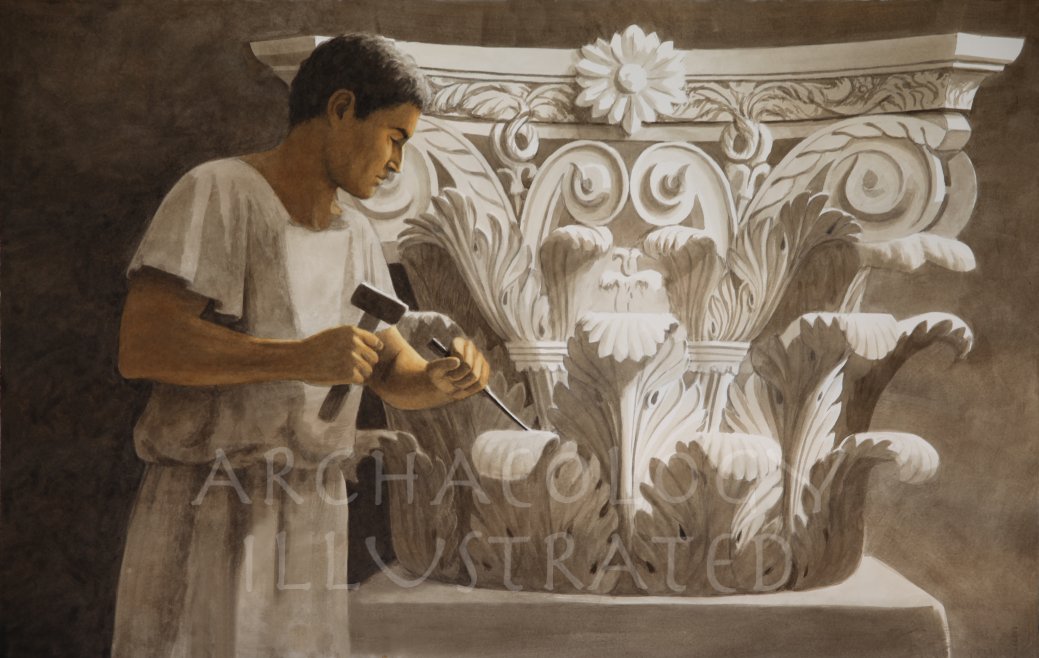
We don’t know that much about the life of Christ between the ages of twelve and thirty, but many of us have this image of Jesus in our minds doing the work of a carpenter with His father, Joseph.
One Hebrew scholar, by the name of James Fleming, makes the argument the word “carpenter” in Mark 6:4 and Matthew 13:56, could actually be a bad translation of the Greek word “Tekton.” Fleming points out that the homes in Nazareth were largely made of Stone, not wood. We also know that the Herod at the time, Antipas, spent a great deal of energy making the city of Sepphoris (Zippori) his “Jewel of Galilee” by giving it a total makeover. This developing city was located only three miles away from the hometown of our Lord.
There was a rock quarry half way between Nazareth and Sepphoris where Jospeh, and perhaps Jesus, could have spent their time cutting stones for the Herod’s great project. An undertaking of this size would have likely employed all the surrounding builders, including those in Nazareth. Of course, Jospeh and Jesus working as stonemasons is pure speculation.
Scripture doesn’t give us a detailed account of Jesus’ childhood, but Luke 2:52 tells us that He, “…grew in favor with God and men.” This passage indicates that Jesus was well liked by those who knew Him growing up, but when you compare this verse with Matthew 13:57, that “favor with man” isn’t there anymore. Matthew records, “And they took offense at Him.”
In both Matthew and Marks account of Jesus’ returning to His hometown, the locals ask the question, “Is this not the son of a carpenter?” After Christ is questioned, He doesn’t perform any great miracle for all to see, but He heals a few of their sick. He doesn’t try to argue with them, but He goes through the town teaching. The gospels don’t tell us exactly what He was teaching, but there’s a simple lesson here for all of us.
Don’t be a carpenter.
Jesus lost favor with many when He broke out of their social mold and when He did things they weren’t accepting of. People no longer liked Him when He also began teaching things they weren’t used to hearing. The identity of Jesus was not wrapped up in the job He was trained to do, He was and is much more than that. If you’re a follower of Christ, your identity is not your profession.
Jesus is not the son of a carpenter, He’s the Son of God. He’s given us a new identity, and we should never cheapen who we are by seeing ourselves as doctors, engineers, truck drivers, preachers, teachers, butchers, bakers, and candlestick makers. We’re Christians.
Even when He lost some positive popularity, Jesus looked for those who were willing to be healed and willing to hear. This is exactly what should be filling our time as well. Who do you know that needs to be spiritually healed by Jesus? Who do you know that needs to hear the wonderful soul-saving truth about the real Identity of Jesus?
Death Valley. The very name is foreboding. Yet, Death Valley is the home to an extraordinary phenomenon known as “sailing rocks.” On the border of California and Nevada, there is a section of the Death Valley National Park called the Racetrack Playa. It is a dry riverbed. Why is it referred to as a “racetrack?” Dotting the Racetrack Playa are those sailing stones that seemingly move of their own accord. No human eye has observed one of the rocks move, and yet, it is evident that they do. Stones weighing even hundreds of pounds move across the dry riverbed, leaving evidence of their journey in a trail through the sand behind them. One of the longest observed tracks was 1,500 feet long. And so, these rocks race across Death Valley.
First recorded in the early 1900s, scientists have endeavored to discover the truth behind the sailing stones. In 2014, scientists were finally able to capture the movement of the rocks using timelapse photography. As the National Parks website suggests, “The results strongly suggest that the sailing stones are the result of a perfect balance of ice, water, and wind.” 1 The National Park Service further detail the findings of cousins, Richard and James Norris:
Their observations show that moving the rocks requires a rare combination of events. First, the playa fills with water, which must be deep enough to allow formation of floating ice during cold winter nights but shallow enough to expose the rocks. As nighttime temperatures plummet, the pond freezes to form sheets of “windowpane” ice, which must be thin enough to move freely but thick enough to maintain strength. On sunny days, the ice begins to melt and break up into large floating panels, which light winds drive across the playa pool. The ice sheets shove rocks in front of them and the moving stones leave trails in the soft mud bed below the pool surface. 2
It is undoubtedly a remarkable sight. The wonder this phenomenon instills likewise reminds us of the majesty and power of the Invisible Intelligence (cf. Romans 1.20), creating the very physics making moving rocks possible.
As I read about the sailing stones, I could not help but recall the words of Jesus when asked by the Pharisees to rebuke His followers. The occasion was Jesus’ triumphant entry into Jerusalem. The people were crying out their “hosannas” to the Lord. Jesus told the Pharisees, quoting from the prophet Habakkuk, that “if these become silent, the stones will cry out!” (Luke 19.40 NASB; Habakkuk 2.11) Indeed!
If you ever question your worth to God, recall the sailing stones. Without the benefit of intelligence or purpose, they still point to their Creator. They appear to be immovable, and yet are pliable by the laws God put in place. As I take stock of what I can do, I note that even I can do more than the sailing stones, possessing locomotion and free will. How shameful, then, when I choose to sit silent as a boulder. May God use me like a rock so others can see my deeds and give God the glory (Matthew 5.13-16).
























 The Preacher Pollard Blog