Paul is writing about the second coming, trying to straighten out the misinformation of false teachers, whose message threatened to shake the faith of some newer Christians. He makes a transition after exposing their teaching and warning about the outcome for such men. There is a contrast in tone and message for these who embrace and follow the truth. As hopeless as the end will be for those who believe a lie and are condemned, there is great hope for the righteous believer. As we strive to be such today, we stand to benefit in the same way.
We have been chosen (2 Thes. 2:13). God intended from before time to bless those who believed in the truth. He loves those who go against the tide of popular opinion and embraces what He has to offer, and He sets us apart! We are special to Him. The word “chosen” here indicates “to choose or select for the purpose of showing special favor to or concern for” (Louw-Nida, 360).
We have been called (2 Thes. 2:14-15). This word means “choose for receipt of a special benefit or experience” (BDAG, 503). The benefit identified is “the glory of our Lord Jesus Christ.” The way we “obtain” it is by the gospel and “the traditions” given by apostolic teaching. This word tradition simply means teaching handed down, but it means something binding and originating from God. The point is that God reserves His benefits and blessings for those who believe and obey His gospel! Read Ephesians 1 or 1 Peter 1 for a small sample of these!
We have been given consolation (2 Thes. 2:16). This is the idea of emboldening someone to believe or do something. When there is opposition and false teaching, we need encouraged to follow what’s right. What gives us encouragement and hope? God’s grace! To know that God gives us what we don’t deserve, but the very thing we need, will keep us going in the hardest times. It should lift our spirits to know that the worst we face in this life cannot keep us from the best God has to offer.
We have been given comfort (2 Thes. 2:17). While the word entailed the “setting aside of grief,” Paul speaks of God’s unchanging nature and character. So He’s more than able to set aside whatever grief we feel. Yet, it’s more than removing a negative feeling. He encourages and establishes us so that we can accomplish His will, “every good word and work.” A few sentences later, he elaborates that this involves being strengthened and protected from the evil one (3:3). Seeing the havoc he can wreak, that’s practical comfort every faithful Christian needs!
Do you feel deflated, discouraged, defeated, and dismayed? Here’s a passage you can return to repeatedly! It will remind you of what you mean to God and how He proves it! It’s the substance that can help you weather the worst Satan throws at you this week! Will you remember how much you mean to Him, then show Him how much He means to you?
The life of a true Christian is filled with change. We learn where we are weak and try to be better. It’s kind of like a never-ending home improvement project. There will always be areas of our spiritual walk with God that could be better. Because this is the case, many religious books, sermons and Gospel meetings are created around a theme that will help us to grow. In the Church there is a plethora of information to help us in our Christianity, but I want to focus on the basics and answer a vital question. What does it mean to be a Christian?
I want to answer this question with a passage in scripture that we may not immediately think of. We may think of 1 Timothy 1:5 or 2 Peter 1:5-7, which are great verses, but I’d like to suggest that Jesus in Luke 18:15-17 gives us the bottom line of Christianity.
It reads, “Now they were bringing even infants to him that he might touch them. And when the disciples saw it, they rebuked them. But Jesus called them to him, saying, “Let the children come to me, and do not hinder them, for to such belongs the kingdom of God. Truly, I say to you, whoever does not receive the kingdom of God like a child shall not enter it.”
Jesus teaches the importance of humility. You want to enter the Kingdom of God? Have an attitude of humility. He uses the example of children, and Luke even uses the Greek word for infant. These are very young kids and babies that are being brought to Jesus. So He uses this as a moment to teach a valuable lesson.
Babies show their humility in their inability to provide for themselves. Every child that is born is completely dependent on its parents and has a wholehearted trust in them to provide what they need.
What does it mean to be a Christian? It means being humble enough to admit that we need God. It means we trust in God, rather than our own “power.”
Humility plays an important role in every aspect of Christianity. It helps with showing love to others, it helps us subject ourselves to God’s Word, it helps us treat others the way we want to be treated, it helps us accept the hard topics that scripture contains, and the list goes on and on.
Do you want to be a part of the Kingdom? Make humility an everyday practice. Without this, one cannot be a Christian.
A few months ago, Lehman and a bunch of other churches went to church camp. During that week, I got to think about family. A quote I read once by Lisa Weed said, “Being a part of a family means you are a part of something very wonderful. It means you will love and be loved for the rest of your life.”
Let me start off by defining family. According to Webster’s dictionary, one definition is “the group of one or more parents and their children living together as a unit.” That kind of family can be shown through the illustration of a loving husband giving his wife some facial masks on Christmas Morning. As she opened the gift, her 5-year-old daughter asked what they were. The Mom replied, “It’s a present to make me beautiful.” After the mom applied one of the facial masks, the little girl looked at her mom and replied, “Mom, it didn’t work.”
Another definition Webster’s gave is “all the descendants from a common ancestry.” To me, that sounds like the relationship God has with His church. 2 Corinthians 6:18 says, “And I will be a father to you, and you shall be sons and daughters to Me,” says the Lord Almighty. Ephesians 5:25-27 defines the church family as being without blemish. “Husbands, love your wives, just as Christ also loved the church and gave Himself for her, that He might sanctify and cleanse her with the washing of water by the word, that He might present her to Himself a glorious church, not having spot or wrinkle or any such thing, but that she should be holy and without blemish.”
Thankfully, God has given us the opportunity to be part of a perfect family. Maybe you’re not a member of the church family, and you would like to put Christ on in baptism or you want us to pray with you and for you so you can get your life on track. Whatever your need, please reach out to God’s perfect family.
Christians live on planet earth and aren’t immune to social issues. The vaccine is one of them. This article is NOT about vaccination specifically. I am not qualified to write about it, but this wouldn’t be an appropriate forum even if I was.
However, this issue has influenced the church in a few timeless ways: misapplying scripture, creating division, and engendering hostility.
Misapplying Scripture: Applying Romans 13 to this subject is not appropriate. Nothing about the passage sheds light on which governing authority we should follow. What if federal law contradicts state or local law? Which do we follow then? I Peter 2.13-14 does address varying levels of governing authority, but does not specify which takes precedence. Both passages demand submission to everyone who has authority over us because it’s what God wants. As it stands now, neither passage applies to this issue. We cannot use God’s word to enforce or condemn issues that have no bearing on salvation. When state or local law is in conflict with federal law (or vice versa) and the issue at hand isn’t a salvation issue, it falls under the jurisdiction of Romans 14.
Creating Division: Differences in opinion aren’t new to the church. No reasonable person will call this a salvation issue, so it does fall under the purview of Romans 14. We need to remember the commands in this passage: accept those who have different opinions (1), do not think poorly of those who disagree (3), do not judge someone who exercises preference (3), make decisions based on conviction (5), do not condemn each other over opinions (13), don’t let opinions destroy relationships (15), and don’t let your decision become a problem (16). What does this mean for us? Respect your Christian family’s decision, do not think less of them because of their decision, make the decision you feel is best for you, don’t condemn someone based on their decision, and don’t let an issue that has no bearing on our Christian lives become a source of division.
Hostility: The previous point addresses this somewhat, but sinful behavior has come out of this. Thinking less of a Christian who gets the vaccine is sinful. Thinking less of a Christian who doesn’t get the vaccine is sinful.
Nothing about this issue is new or different. Controversial opinions over military service, firearms, holiday observance, or vaccination are not handled any differently. God expects us to put these kinds of issues in their proper place: the back seat.
“We have to love each other, because love comes from God and everyone who has love belongs to God and knows him. Anyone who doesn’t love doesn’t know God, because God is love” (I Jn. 4.7-8).
“Love each other deeply with a pure heart” (I Pt. 1.22). “You must continue to love each other” (Heb. 13.1). “Pursue righteousness, godliness, faithfulness, love, endurance, and gentleness” (I Tim. 6.11).
THE BLOG WRITTEN BY HIRAM KEMP (ALONG WITH FOREST ANTEMASERIS), the newest minister on staff of the Lehman Avenue church of Christ. What an excellent resource!
New converts should be made to feel welcome. But, more than that, new converts should be part of the family of God! The church can do better.
— Read on firstcenturyfaithtoday.com/new-converts-church/
When it comes to the families that make up the church, what ties us together is a common bright future. While every family has its differences, one constant remains— the church. All strive to follow those guidelines laid out in scripture. Paul says in Philippians 1:6, “And I’m SURE of this, that He who began a good work in you will bring it to completion at the day of Jesus Christ.”
The writer speaks with assurance, and that confidence is well-placed. From “His-story” we see that God always completes His projects. He never dreams; He creates. He decided to create the world and here it is. He decided to save the world, and here we are.
Paul also would write in Romans 7-8 that the flesh tends to get in the way of the spiritual. God is perfect, but we’re not. That’s what makes us a work in progress. Aren’t we thankful that God provides the solutions to “fix” us up?
We’re involved in a great work because there simply is no better work than what is being done by His church. That being said, many of us struggle with overcomplicating things. We try to make sense of our individual lives, and when we leave God out it all becomes a discouraging battle. Where’s the peace? Joy? Confidence? Maybe it was left behind when we left God’s path. Thankfully God came down to earth years ago to teach us everything we need to know. We see that in His interactions with people. Even His twelve original followers were an odd group.
Each had a diverse background. Some were Fishermen and some tax collectors.
Each one had a unique personality too! They ranged from timid to assertive.
Each one had spiritual battles from greed to crippling doubt.
Yet each one rallied under His leadership and were united through a common hope.
What’s changed? Not much.
The personalities, talents, backgrounds, and flaws mixed together create a unique blend that make up each one of us. Yet, here we are rallied under His leadership, united in common hope.
Several Lehman ladies (men are at the table in the foreground) enjoying “Federal Grove” the night before it (sadly) closed, being regaled with one of Kathy’s stories. I think this one was about snakes crawling out of a hole.
The word frequently translated “opposed” and “resist” is a compound word that means to “arrange against” (Zodhiates, np).It was a military term describing “to set an army in array against, to arrange in battle order” (ibid.). Louw-Nida tell us it means, “to oppose someone, involving not only a psychological attitude but also a corresponding behavior” (491). This word is found in some form five times in the New Testament. Three of the occurrences refer to a person resisting another person, when the Jews in the synagogue of Corinth “resisted” Paul’s teaching about Christ (Acts 18:6), when people resist governing authorities (Rom. 13:2), and when the poor man did not resist his rich oppressor (Jas. 5:6). The other two occurrences both quote the same Old Testament passage, Proverbs 3:34, which speaks of God opposing and resisting a man. What man? Peter and James quote the proverb, writing, “God is opposed to the proud, but gives grace to the humble” (Jas. 4:6; 1 Pet. 5:5).
Perhaps you have made someone powerful your enemy–the principal at school, the boss at work, or someone else who had the power to make your life unpleasant. If you have, you know how difficult it is to thrive and succeed under such circumstances. But the Bible says it is possible to make God opposed and resistant to you. That’s unparalleled unpleasantness! Thankfully, God tells us what triggers such a response in the omnipotent God.
These two inspired writers could have written that murder, adultery, lust, lying, stealing, greed, or hatred draws His active opposition, but both single out “pride.” It goes with insolence and boastfulness in Romans 1:30, arrogance in 2 Timothy 3:2, and blasphemy and folly in Mark 7:22. Each of those passages reveals a dangerous state of mind that comes from turning away from God.
Arrogance keeps us from admitting wrong, makes us have an inflated sense of self and a lowered view of others, leads to a feeling of self-importance, and is at the heart a self-centered point of view. All of that will damage earthly relationships, friendships, marriages, with fellow church members, and those we deal with on the job and at school. But, even beyond those negative repercussions, sinful pride makes God an enemy! Think about that. When we allow pride to take root in our lives, God arranges Himself against us. Imaging God in battle order against me conjures an image of the most uneven fight possible. Pride may cause misery and damage in my relationship with others, but more than even that it effects my relationship with Him!
The antidote is the same in both Peter’s and James’ writing–“humility.” Not pretentious, but modest and obedient to His will. It’s being lowly in heart, able to see and admit wrong and guilt, having a fair and realistic view of self that acknowledges when we are wrong. Is it easy? No! Is it fun? Not at all. But, when we actively work at being humble and eradicating pride, God will fight for us and not against us. I get to decide which way I want it!
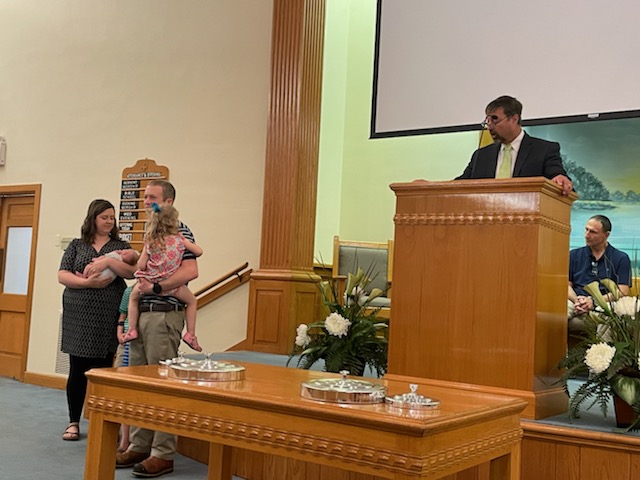
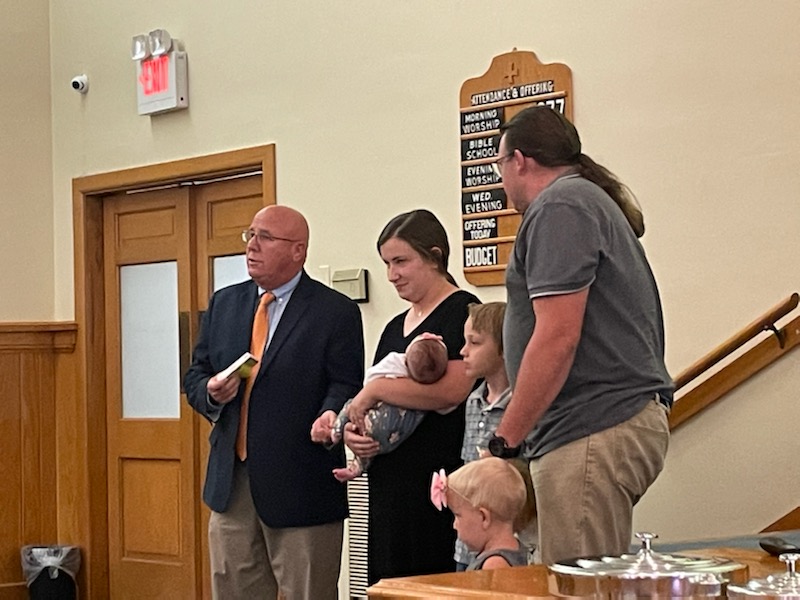
It is our custom for the elders to give the parents of our newborns a Bible. No wonder God uses children to illustrate humility! Here is just the latest couple of presentations, with several more to come in ’21!
For the past 18 months, there have been many changes that we have had to get accustomed to- new guidelines and restrictions due to the Covid-19 pandemic .There are a lot of political issues and differences, a lot of immoral activities you see on the news. These topics I have just mentioned has given me anxiety over the past 18 months and I’m sure you can agree with me.
We all deal with anxieties, stress and fear:
–Loss of a loved one, rather that be family member or friend. The toughest situation I have ever dealt with so far in my life is losing my dad almost seven years ago to liver cancer. It was very tough to see him battling liver cancer and the toil it took on his body.
–Dealing with health issues of our own, spouse, child or other family members.
–Moving to a new area – Unfamiliar community, people, tough on the whole family
–Jobs can be stressful or give us anxiety – A lot of time at work I don’t like change.
THAT’S ENOUGH GLOOM AND DOOM – LETS LOOK AT SOME GOOD NEWS!
Psalms 34:19 reads, “Many are the afflictions of the righteous, but the Lord delivers him out of them all.”
Consider three promises you can believe for anxiety. These are things that God tells us to do with our heart, mind, and eyes to combat our anxiety:
1. In Philippians, we learn what to do with our hearts when we are anxious. For you math lovers, like me, apostle Paul actually gives us a mathematical equation to tech us what to do with our hearts: “Be anxious for nothing, but in everything by prayer and supplication, with thanksgiving, let your requests be known to God; and the peace of God, which surpasses all understanding, will guard your hearts and minds through Christ Jesus” (Philippians 4:6-7). Did you catch the equation? Prayer + Supplication=Peace! God wants to hear all about our anxieties because he cares for us. Supplication means asking for something humbly. That something is peace. Because of our pride, we want to be in control of our own lives. To receive true peace, we must humbly go to God and release the control to him. The result of the equation is peace – when we have true peace from God, he protects you against temptations to be anxious.
2. In Isaiah, we learn what to do with our minds to receive God’s perfect peace. “You will keep him in perfect peace, whose mind is stayed on you, because he trusts in you” (Isaiah 26:3). It is difficult to keep our minds on Christ when we are going through trials here on Earth. Our minds want to focus on what we are going through. Anxiety is not of the Lord but from the Devil as a distraction to the work of kingdom. We worry about our lives and are blinded from the opportunities God is giving us to serve him. “Bring every thought into captivity to the obedience of Christ” (2 Corinthians 10:5). When you have anxious thoughts, surrender them to the only one who is ALWAYS in control of this ever-changing world.
3. We learn in Psalms what to do with our eyes when we are overwhelmed with our circumstances. “I will lift up my eyes to the hills-From where does my help come from? My help comes from the Lord, who made heaven and earth. He will not allow your foot to be moved. He who keeps you will not slumber” (Psalms 121:1-3). By shifting your focus from your situation to the never changing promises of God, you begin to trust Him more. As you trust Him more, your anxiety begins to fade away because you realize how big God is in comparison to your troubles. God promises those who look to him that he will never forsake them and will never let them fall. You may stumble through struggles in life, but God will always be there to catch you if you keep your eyes on Him.
Always remember, whenever you are struggling with anxiety, align your heart, mind, and eyes with God. God promises to never leave you and he will provide you with peace-perfect peace.
“Discipline your thoughts to trust Me as I work my ways in your life. Pray about everything; then leave outcomes up to Me. Do not fear My will, for through it I accomplish what is best for you” (Jesus Calling – Enjoying Peace in His Presence , Sarah Young). We should always trust God and Jesus in whatever circumstance we are going through. Always go to him in prayer with what is on our hearts. God knows what is best for us and we should have nothing but absolute trust in Him!
Todd delivering this lesson at Lehman Avenue Wednesday night. Excellent!
The Redwood National Park in California is home to the world’s tallest tree. Standing at over 380 feet tall this tree is incredible to look at. The California Redwood is estimated to be able to reach a staggering 425 feet in its lifetime. It continues to grow all its life and there’s a reason it gets so tall, as the lifespan of this tree is up to 2,200 years. Think about that! There are redwood trees that are still growing today that were planted 200 years before Christ was born.
The California Redwood is massive. It is over 29 feet in diameter and has a root system that spreads over three miles underground. These trees are truly incredible. But like most trees, the key to their growth is water. California redwoods consume over 56,000 gallons of water each year or 150 gallons of water each day!
In Psalm 1:1, we are given this description: “Blessed is the man who walks not in the counsel of the wicked, nor stands in the way of sinners, nor sits in the seat of scoffers.” This person is blessed when they avoid the progression of sin. Notice how the psalmist describes the progression:
Walk not in the counsel of the wicked.
Nor Stands in the way of sinners.
Nor Sit in the seat of the scoffers.
These steps illustrate what people do when they are tempted by sin. They walk among it, noticing the wicked and their deeds. Once they walk among it, their curiosity gets the best of them and they begin to pause and spend time in the presence of sinners. Finally they are fully drawn into sin and they sit down and practice the evil that they have observed.
Rather than walking, standing and sitting with sinners, the righteous man delights in the law of the Lord. Verse two says, “But his delight is in the law of the Lord, and on his law he meditates day and night.” The choice is obvious for the righteous man. He avoids the sin and chooses the Word of God over anything else.
Verse three reads, “He is like a tree that is planted by the waters that yields its fruit in its season, and its leaf does not wither, in all he does he prospers.” The source of life for this tree is water. Just like the California Redwood needs water in order to grow, the saved man spends his time next to the source of life. What is this water? John 4:14 reveals, “But whoever drinks of the water that I will give him will never be thirsty again. The water that I will give him will become in him a spring of water welling up to eternal life.” For the Christian, our source of life comes from Christ. We are able to grow and thrive on the words of God.
Let’s make the decision daily to be firmly planted in the words of life. That way, we too can be counted as righteous!
Hugh Glass decided to live the difficult and adventurous life of a fur trapper and pioneer. He embarked on an expedition to North Dakota in early August, 1823. The vast wilderness of the Badlands set the stage for the events that transformed him from a man to a legend. North Dakota, also known as the “Rough Rider State,” would not reach it’s statehood for another sixty five years. In these wild days thousands of buffalo still roamed the endless plains and were hunted by the Native American tribes, of which were the Mandan tribe. Hugh Glass and his men would encounter the Mandan early on in their expedition and a skirmish would ensue. Hugh would emerge alive, but not unscathed. Before his wound had time to heal, the largest predator on earth, the Grizzley Bear— nearly takes his life. The nature of his gruesome injuries were such that two men were ordered to remain with Glass until he met a seemingly inevitable end. Due to either their impatience or threatening weather, the two men hurriedly dig a shallow grave, lower Hugh inside— and leave. But Hugh wasn’t dead. He claws out of his grave and over the next two months he would make a grueling three hundred mile trek to Fort Kiowa near modern day Chamberlain. His will to live was matched by his determination to wreak revenge on the two who had prematurely laid him to rest. For the time being, however, Hugh found himself on his hands and knees making agonizingly slow progress but— he inches forward.
In the months to follow Hugh Glass would make a full recovery and in that time, he also forgives the wrongs that were done to him. He had buried his grudge and unlike him— it would remain buried (source).
While the long journey of Hugh Glass took a great deal of grit and resolve, the journey Jesus made from Jericho to Jerusalem is far more inspiring.
When we get to Matthew 20 the cross is already on our Savior’s mind. The following chapters will focus on the teachings of Jesus and the moments leading up to the His ultimate sacrifice. We won’t read about miraculous healings after this point, but the final healing that Jesus makes on that walk from Jericho to Jerusalem, is a special one.
Ahead of Jesus and one excited crowd, are two men intently listening on the side of the road. They’re blind. They survive off of the charity that’s shown to them by a minority. As Jesus draws ever closer they begin to yell in desperation for His attention. There are some in the crowd, perhaps those closest to them on their side of the road, who scold them.
Can’t these sad beggars see that Jesus has more pressing matters on His mind?
The rebukes don’t quiet the men from calling out; in fact, they raise their voices above the crowd. Christ wasn’t lost in any thoughts about a military takeover, but we can assume that Calvary was on His mind. Now Calvary— that was a pressing matter.
Nobody would blame Him for ignoring two blind men. After all, the crowd didn’t need to witness some miracle to solidify their belief in His power (John 6.30), and beggars on the side of the road were a common sight.
Even so, Jesus stops.
He calls out to them and then asks, “What would you like me to do for you?”
The blind men respond with, “Lord, we want our sight.”
These men should have been paying attention when the Rabbi’s read from the scrolls of Daniel or Isaiah. The Jewish people had hundreds of years to piece together the true nature of the Messiah’s mission.
Yet, the response of Jesus is compassion and it’s followed by His touch.
That masterful plan was set in place the foundations of the earth were waiting to be laid. A plan that involved Jesus trading heaven for earth in order to answer the call of two blind men. He created time for them and He proved it by making time for them a second time— so that they could see it.
Life has been found in some of the most uninhabitable spots on earth. Bacterial life thrives in Lake Vostok in Antarctica, for example. Thiolava veneris was found thriving in the aftermath of a violent submarine volcanic eruption near the Canary Islands. Organisms that thrive in extreme environments are called “extremophiles” (noaa.gov). We’re always amazed when life thrives in extremely hostile environments.
The moral climate of our planet makes it extremely difficult to thrive. Humanity has created a moral environment consisting of self-interest, violence, apathy, and general dysfunction. In terms of population, they have the clear advantage. Christians are, by definition, extremophiles. We defy all expectations by thriving in an overwhelmingly hostile environment.
That said, we are studied by those who make up our environment. Many will come to the conclusion that we’re strange and warrant no further interest. Many will consider our loyalty to a supernatural morality to be hostile (II Tim. 3.12; Rom. 5.3,4). Few will wonder how we’re able to have hope, purpose, direction, resilience, and happiness in any condition.
Why would anyone want to be an extremophile? Why would anyone willingly assume a lifestyle that automatically puts them at odds with their own environment? Here’s why:
1. Everyone is going to live forever (Jn. 5.28,29). We want to live with the creator in a perfect world (II Pet. 3.13; Rev. 21.1,2; Rom. 8.18-25), not in an even worse world (Matt. 25; Rev. 21.8; II Thess. 1).
2. We didn’t make up the moral code we follow. Human error is not a factor in our worldview because it came from the creator (II Tim. 3; Jer. 31.31ff). This system can’t be corrupted and doesn’t take advantage of its constituents (unlike many human laws). We’re secure and confident because of this.
3. The creator went to extreme lengths to make sure we could easily have access to a perfect eternity (I Jn. 5.3; Heb. 9.11ff). Who wouldn’t want to follow a perfectly selfless leader?
4. We enjoy peace and existential purpose because our worldview isn’t from around here (I Pet. 1.1-10). It doesn’t matter what happens to us, we’re more than fine.
5. We’re not afraid of death (Heb. 2.14f). Self-preservation is not our main priority – how many people have done horrible things out of self-preservation? Lots! We don’t have a death wish, we’re just not afraid of death.
That’s just a sample of why we voluntarily become extremophiles. Done correctly, ours is the best life possible! It makes this one better, it makes the next one perfect. We can’t lose!
The story of Rahab the harlot is one of the better-known stories of the entire Conquest Period. Perhaps it is because it occurs before but is connected with the most famous (and first) place to be conquered, Jericho, but it is also because of who the heroine of the story is. Three New Testament writers mention her, Matthew for her place in the Messianic genealogies (Mat. 1:5), the writer of Hebrews for her faith (Heb. 11:31), and James for her works (Jas. 2:25). But, there is no escaping who she was or how she made her living when Israelite spies paid her a visit. The Hebrew word, ZANA, means “to commit fornication, be a harlot, play the harlot, illicit heterosexual intercourse,” TWOT). They say, “Such persons received hire (Deut 23:19), had identifying marks (Gen 38:15; Prov 7:10; Jer 3:3), had their own houses (Jer 5:7), and were to be shunned (Prov 23:27)” (ibid.). She is not only a Canaanite, but she operated a sordid business.
But from the moment we hear from her in Scripture, we can see that there is much more to her than the aforementioned description. Despite the fact that she needed to do more growing (don’t we all?), she shows the difference God can make in even the most unlikely places. What do we find in Joshua two?
When God conquers a heart, one will be ruled by His authority (2-5). The Bible doesn’t sanction Rahab’s lie, but consider for a moment that she was ordered by the King of Jericho to surrender the two spies from Israel. She feels no allegiance to the earthly ruler, and she will explain that it is because of her faith in Jehovah (9). If God has conquered our hearts, won’t we say with Peter and John, “We must obey God rather than men” (Acts 5:29)?
When God conquers a heart, one will help His people (6-7,14-21). She saved the spies’ lives. She hid them and helped them escape. She recognized these men as God’s servants doing God’s business. She wanted to serve and protect them. Ultimately, she lets them down through her window and enables their escape (15, 20). Those whose hearts God possess are allies of the righteous (Mal. 3:18).
When God conquers a heart, one has faith in God’s provision (8-13). Nothing in the text tells us that the spies preached to her, yet somehow she had arrived at the conviction that she could have hope of salvation. She says she knew God had given Israel the land (9), something these spies’ fathers most likely did not believe (cf. Num. 13-14). She saw how afraid her fellow-citizens were of God’s wrath and power, working through His people (9). She had faith based on the signs and works God had performed from the Red Sea to the Amorites (10). It led her to acknowledge God as “God in heaven above and on earth beneath” (11). Therefore, she asked, in exchange for protecting the spies, for the deliverance of her family and herself (12-13). She hadn’t seen the battle yet, but she believed that it belonged to the Lord. It takes genuine faith to draw a conclusion like that. We’ve not experienced death, the resurrection, the judgment, and an eternal destiny, but do we have faith that God will provide for us through them (cf. 1 Pet. 1:3-9)? If God possesses our hearts, we do!
When God conquers a heart, one will meet the conditions of salvation (14-21). The spies made the salvation of Rahab and her family conditioned upon three things: tie a scarlet thread in her window (18), gather all she wanted to be saved into her house (18), and not tell anyone these spies’ business (20). There was no picking and choosing what she preferred to follow. Obedience meant the difference in life and death (5:25). So today, a heart which God owns will not shun to do anything His Word commands. There’s no arguing, bargaining, debating, or rationalizing, but instead a faith that does what God wills.
The spies’ mission was a great success and Joshua was encouraged (22-24). They were ready to do battle, ready to conquer. Back in Jericho, there was a woman born into a life of godlessness who had lived a life of worldliness who now faced the hope of happiness and righteousness. Great things follow when we allow God to conquer our hearts!
Neal’s Note: I send out an email most mornings that I call “The Lehman Learner.” I walk through books of the Bible (in the past I’ve done the Psalms, Luke, 1-2 Corinthians, 1-2 Kings, etc.). This article is from last week. If you would like to receive The Lehman Learner, write to this email and request it. You will be added to the mailing list.)
In Mark 11:12-14, we read a short and slightly strange account of Christ and his disciples, “On the following day, when they came from Bethany, he was hungry. And seeing in the distance a fig tree in leaf, he went to see if he could find anything on it. When he came to it, he found nothing but leaves, for it was not the season for figs. And he said to it, “May no one ever eat fruit from you again.” And his disciples heard it.” Why did he curse the tree?
It seems to me that it would make more sense if he cursed the tree because it was in season and failed to bear fruit, but it wasn’t in season. So why curse the tree? It wasn’t supposed to have fruit. Many people say that what Jesus did was a little extreme. It appears that the only reason Jesus cursed the tree was because He was hungry and was upset that it had no fruit. At first glance His actions seem harsh and unwarranted, but Christ is illustrating a very important lesson.
This tree illustrated hypocrisy. Jesus cursed the fig tree because it had the appearance of being fruitful, but it was a lie. It lacked fruit. It was this lie that caused Jesus to curse the tree. It clearly states that this tree was not in season, but it still had leaves. So from far off it seemed to have the appearance of fruit, but it offered nothing but leaves. Jesus doesn’t want us to have the appearance of holiness; He wants us to bear fruit.
It’s not about looking like a Christian, but living like one.
Emily told me a story from when she was younger and literally had a run in with a peach tree. She was driving a golf cart at a friend’s house and ran over a young peach tree. The golf cart stripped off the bark and flattened the small tree. The owners had to spray fake bark onto the tree just to keep it alive and healthy, and to this day it’s an ugly tree. But, despite being deformed and mangled, this tree, according to Emily and all her friends, makes the best peaches out of all the peach trees on the property.
What’s the point? It’s not about how you look. It’s about what you produce. Jesus doesn’t care about our appearance and if we look like a Christian. The ONLY thing that matters is if we are bearing fruit.
This tree was an illustration of the hypocrisy that was found in the Pharisees in Matthew 23:27-28. Like the whitewashed tombs which Jesus references in these verses, the fig tree looked beautiful on the outside. It looked like it was ripe with fruit! But upon closer examination, it was a lie.
It had nothing. It made itself out to be something it wasn’t. Christ had no tolerance for hypocrisy. If we claim to be Christians and that we have a relationship with God, and yet fail to dwell on His word and spend time in prayer, we are living a life of hypocrisy. Jesus uses this tree to show us how he feels about those who claim to be one thing, when in reality it is all a lie.
After Jesus curses the fig tree, they immediately enter the temple and what do they see but a living example of the fig tree? In verse 15 Jesus sees people using the temple as a place to rip off others. They had turned the temple into a den of thieves. The fig tree had the appearance of having fruit to offer, but it gave none. The temple, Jerusalem, and the Pharisees had the appearance of having holiness and offering salvation, but had none.
We must use this account as motivation to practice what we preach and be who say we are to those around us.
How does Jesus feel about us? He created us, became human, and let us kill Him so He could make a new deal with us (Heb. 9.15-17). Most disregard Him, many are outright hostile. How could He love us at all? Because we know how most view God, it’s easy to lump ourselves into the same group as the hostiles.
Ephesians gives some awesome insight into how Jesus feels about his people.
1.3 – He gave us spiritual blessings through His sacrifice. 1.4 – He had us in mind before He even started creating things. 1.5 – He intended to make us part of His family. 1.6 – He gave us grace. 1.7 – He died to give us freedom. 1.7 – He gives us forgiveness. 1.9 – He told us what He wants. 1.11 – He is going to give us an inheritance. 1.11-14 – He knows His own, and He’s looking to get us back home.
He didn’t just do nice things for us, though. Here’s how He feels about it:
1.5 – Love motivated Him. 1.5 – He wanted to do it. 1.7 – He’s generous with His grace. 1.8 – He’s generous with His grace. 1.9 – He wanted to do it.
We don’t deserve Him, but He loves us to death. We let Him down, but He gives us grace. He’d have every right to be exasperated with His imperfect family, but He’s not. People get on our nerves and societies fall apart, but we have the best family on the planet. Remember whose you are when you’re discouraged. No one wants you more than He does!
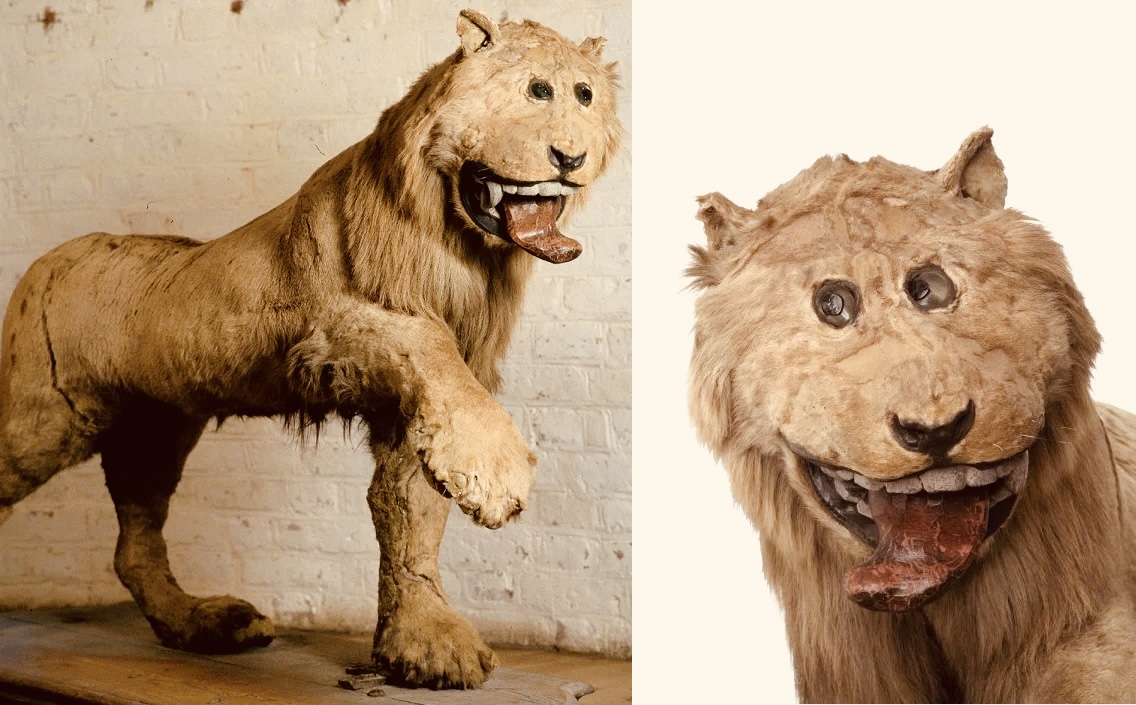
The Gripsholm Castle, in Sweden, is home to the world’s oldest portrait gallery. This might be of interest to some art enthusiasts, but there’s something else in this castle you’d never forget seeing. Inside of a glass box in Gripsholm’s upper armory, there is an 18th century stuffed lion. This lion, nicknamed “Leo,” is a beast that tends to provoke a wide arrange of emotions from it’s viewers. It has a disfigured face and human like teeth with an oversized (fake) tongue hanging out of it’s mouth. The history of the lion is also somewhat of a mystery. However, there’s a particular legend about this taxidermy terror that the writer finds hilarious. In 1731 the king of Sweden was given an incredible gift. He was once the proud owner of a handsome lion and he loved this beast. Unfortunately, it died at a young age and the king’s heart was broken. He sent the lion’s pelt and bones to a taxidermist to have it stuffed so that it’s memory would be kept “alive.” There was only one problem. The taxidermist had no idea what a lion actually looked like because he had never seen one before. This being the days before the internet, he was forced to try his very best. The finished product remains part atrocity and part masterpiece to this day.
In 1 Peter 5.8 we are warned about our adversary, the Devil, and that he is currently stalking the earth looking for his next potential prey. The sad truth is the fact that many in this world aren’t sure what this lion looks like. The Devil can disguise himself in the form of sinful pleasures and promises and as a result he has become the, “King of this world” (John 12.31). The Scriptures and the king of Sweden can both agree that things will get ugly if we aren’t sure what a lion looks like.























 The Preacher Pollard Blog