How Will We Be Remembered?

Neal Pollard

Seven churches in Asia Minor (modern-day Turkey). Each remembered for an overall characteristic. The same is true for individual Bible characters, isn’t it? Most remember Moses, Samson, David, Jeroboam, Jonah, Jeremiah, Nehemiah, Judas, Peter, Paul, and John for a particular attribute, whatever else could describe their lives. That’s more than fascinating. It’s sobering.

What about you and me? Is there a word others–those we attend school with, work with, live near, attend church with, or share family ties with–would use to describe us? Here are some possibilities:

  • Grumpy
  • Disagreeable
  • Dishonest
  • Hot-tempered
  • Unreliable
  • Divisive
  • Worldly
  • Gossiping
  • Selfish

Such attributes are the cumulative result of the attitude, words, and actions that we portray each day we live. Everybody has good days and bad days. But, there is an overall tenor and flavor to our lives that cause people to associate something with us. However, the word might be different:

  • Gentle
  • Patient
  • Loving
  • Kind
  • Serving
  • Sacrificial
  • Unselfish
  • Humble
  • Uniting
  • Faithful
  • Courageous

That, too, is being built moment by moment, day by day.

With both groups of words, we can think of people who epitomize characteristic above. But I want to know, “Which one would best describe me?” Don’t you want to know that about you?  The good news, if you don’t like the answer there’s time to change that. Dickens’ Christmastime novel about Ebenezer Scrooge is written to make that very point. Infinitely more importantly, the Bible is written to make that point. We can be transformed through the influence of Christ in our hearts and lives (Rom. 12:1-2; 2 Cor. 3:18). How will you be remembered? 

40178175_715421765474325_1935029354081812480_n

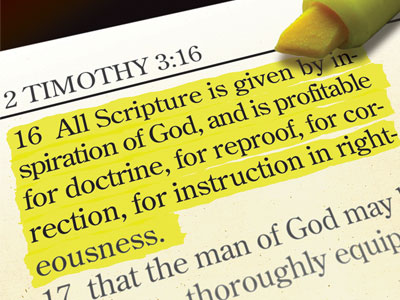
WHAT DOES IT REQUIRE TO ACCEPT INSPIRATION?

Neal Pollard

It is of no little concern to me that men who are supposed to be gospel preachers, many of them men tainted by a corrupted higher education at denominational theology schools, have a poor opinion of the doctrine of inspiration. Like little hungry lambs, these men are led by their “scholarly” shepherds who are eager to bring them to the poisoned waters of the “Q” theory and the documentary hypothesis. They consume the rancid food of deutero-Isaiah and trito-Isaiah.

Their erudite educators push them to believe extrabiblical theories rather than internal claims. Where they get their sermon material and on what they preach would be quite interesting to know, and to what authority they appeal even more so. What does it take to simply accept that the Bible is completely, inerrantly, and plenarily from God through inspired men?

A Belief In A Personal God, Able And Willing To Communicate With Man. If we can accept that the Creator God continues to care and be interested in us and what becomes of us, can we also trust that His love would lead Him to accurately, honestly communicate His will–a will He would accurately supervise from beginning to completion and preserve through the process of transmission through the ages?

A Belief In Divine Omnipotence. Is God powerful enough to give us the Word as the Bible claims and is He loving enough and of character sufficient to let the Bible be what it claims to be? Could He provide for us in the 21st century His complete will? Do we have trouble with the idea that God is able to breathe out His Word to and through men and then preserve it for all time?

A Belief That The Bible’s Claims Take Precedence Over Man’s Criticisms. Humanistic thought is quick to accept man’s opinions and conclusions over what the Bible simply says. What qualifies any man to do that? Are we better off to accept the claims made by the most tested, assaulted, yet exonerated book of all times, which, when followed, leads man to the greatest and highest life, or the claims made by men, which repeatedly prove to lead man to emptiness, misery, and hopelessness?

It is frustrating to hear arrogant, though feeble, frail, finite, and flawed men taking cheap shots at scripture, undermining the divine inspiration of the Bible. Herein lies a very critical rub. John 12:48 says the words of Christ will one day judge us. Revelation 20:12 speaks of the books and the book of life being opened, judging mankind.

What will be the standard of judgment? The words of Q, deutero, and JEDP? It just does not make sense, and swallowing such a low view of inspiration will undermine the faith of many. May we have the humility and trust to accept the Bible at face value, believing it to be what our capable God claims that it is!

2_timothy_3_16

The Art Of Conversation

Neal Pollard

With conversation, when both are active listeners, you are exchanging ideas. Along with this, there’s body language and tone of voice which give clues to what the words mean to the speaker. You negotiate, reason, affirm or deny, and continue through these patterns while discussing any number of subjects. This process is invaluable to building relationships, working together, and even evangelism. For all its advantages, social media lacks almost all of those dimensions.

MIT professor and psychologist Sherry Turkle, in the book Reclaiming Conversation (New York: Penguin, 2015), makes the case that we are talking more than ever but we’ve lost the art of conversation.  Turkle observes, “From the early days, I saw that computers offer the illusion of companionship without the demands of friendship and then, as the programs got really good, the illusion of friendship without the demands of intimacy” (7).  What demands? Paying attention, building trust, having empathy, and giving thoughtful responses (as opposed to rude, reckless ones). 

I’m not trying to militate against the use of social media platforms, texting, or emailing. But the more we gravitate toward those to do our “communicating,” the less we successfully navigate the more difficult, yet more rewarding, art of conversation.

When we read the Bible, we are struck–from beginning to end–with the pervasive importance of dialogue and conversation. From Genesis one, where we read the Godhead’s conversation, “Let us make man…,” to Jesus’ conversation with John in Revelation 22, conversation is indispensable. Not only did God create interpersonal relationships and the vehicle of conversation to build them, but He models it throughout the pages of Scripture.

This article seeks to inform, teach, and even persuade, but it is only one dimension of communication. One might argue that other forms of communication are not only necessary, but in many cases will be more effective. The snippets and soundbites of social media postings, much more condensed and lacking context, while being pithy and thought-provoking, are no substitute for what happens face to face in the tension, hard work, and unpredictable dynamic of conversation. Conversation necessitates practice, attention, and mental engagement. 

From the dawn of time, God observed that it’s not good for man to be alone (Gen. 2:18). As suggested by the title of another book by Turkle, Alone Together, we find ourselves increasingly isolated from others and more ill-equipped for building real life relationships. The antidote to that is simple and so attainable.

Let’s engage people more. Let’s resort more to making real life connections and less to hiding behind screens. Let’s look for opportunities to do this with friends, acquaintances, and strangers. Let’s connect more in real life. As with anything, the more we practice the better we’ll get at it. 

36061_1459393010529_4771877_n
Photo credit: Michael Hite


Labor Day

(Bulletin Preview)

Neal Pollard

Tomorrow, most of us will be able to celebrate the Labor Day Holiday. That means, ironically, that most of us will have a day off from–well–labor. Schools and workplaces across the nation will shut their doors and many will be off for their last “summer vacation.” Friday, an anticipated 3 million passengers took to the friendly skies to enjoy the long weekend. We can either thank Peter McGuire or Matthew Maguire for being the mastermind of this holiday, both secretaries for New York labor unions who made significant efforts to recognize a day for American workers.

The U.S. Department of Labor has published a lot of useful information about this holiday, which it states was started as a “national tribute to the contributions workers have made to the strength, prosperity, and well-being of our country” (dol.gov). It was a local observance in the northeast at the height of the Industrial Age, though Oregon was the first state to pass statewide legislation to observe the holiday. That same year, 1887,  Colorado, Massachusetts, New Jersey, and New York followed suit. In 1894, Congress made it a legal holiday to be celebrated the first Monday of September. 

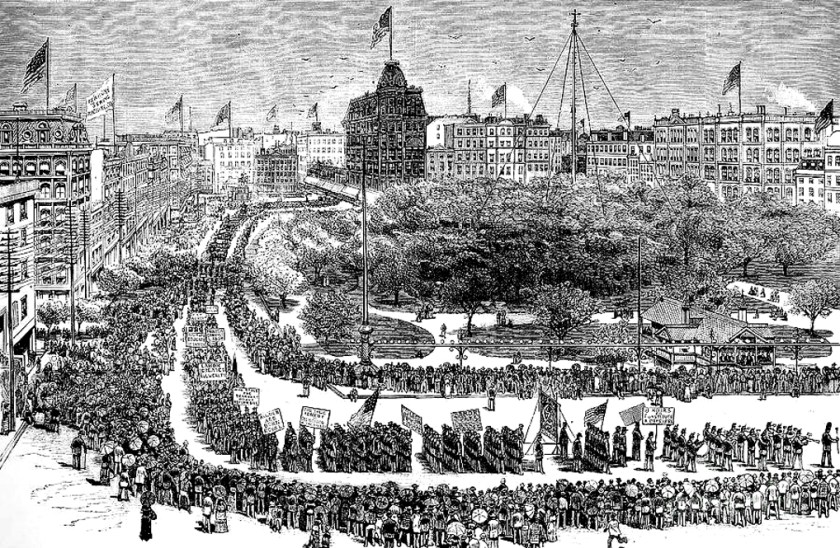
In the early days, there were picnics, street parades, speeches by prominent men and women, and “Labor Sunday” which was “dedicated to the spiritual and educational aspects of the labor movement” (ibid.). The first parade, in New York City in 1882, had up to 20,000 marchers as well as “Windows and roofs and even the lamp posts and awning frames…occupied by persons anxious to get a good view of the first parade in New York of workingmen of all trades united in one organization” (ibid.).

I find it interesting that we honor work with a day of rest and that the holiday itself has seen a shift in emphasis and expression. That’s neither a complaint or criticism. I intend to enjoy Labor Day with Kathy, taking the vacation day given to me in my working agreement. 

But, as we celebrate this national holiday, it’s fitting to recognize the hard work done by so many in this congregation. When you teach Bible classes, lead in worship, decorate bulletin boards, provide transportation to services, stock our pantry, do work on our facilities, engage in soul-winning efforts, practice hospitality, serve officially as church leaders (whether elders, deacons, or someone else tasked with some work), prepare the communion, clean the kitchen, organize the teacher’s work room, go on mission trips, make visits, handle church finances, coordinate worship, serve as ushers and greeters, host youth devotions, or the many, many other things you do, you are doing honored work. Jesus taught that greatness comes through service (Mat. 20:25-28; Jn. 13:12-17). New Testament writers honored those who work among us, Paul urging us not to “be weary in well doing” (Gal. 6:9) and to “always give yourselves fully to the work of the Lord” (1 Cor. 15:58, NIV). Often, Scripture speaks of the Godhead working. It instructs us to be “to the work.” Enjoy the holiday tomorrow. Yet, in the general, ongoing sense, “We must work the works of Him who sent Me as long as it is day; night is coming when no one can work” (Jn. 9:4). Labor on, brothers and sister!

labor_day_new_york_1882

When Will I Ever Be Free…

Neal Pollard

…Of concerns over the future–decisions to make, the specter of tomorrow, growing old, retirement?
…Of sin–fighting temptation and not always winning, beating one thing and then finding another cropping up in its place, and the guilt it brings?
…Of disappointment–both of what I inflict and what is inflicted upon me?
…Of fear–when it comes to my spouse, my children, my parents, my brethren, our nation?
…Of doubt–whether in the process of prayer, struggles with asking God “why?,” or especially doubting myself?
…Of neglect–leaving undone things central to my purpose as a Christian due to apathy, distraction, misplaced priorities, and the like?
...Of failure–trying and not succeeding, not trying hard enough, not knowing what or how to try, and of simply falling short?
…Of betrayal–whether through gossip, lying, broken promises, insincerity, or treachery?
…Of insecurity–that can result from any of these and other struggles?

We don’t always have days when we wonder these things, but they come around often enough that they can prey on our minds. Sometimes, we face these questions due to our shortcomings. Other times, it’s because of the failings of others. Both can lead to despair.

The wonderful news is that we can be free of them all. There is a day coming when none of these will weigh us down ever again. I love the encouragement of the Hebrews’ writer, who urges, “Therefore, since we are surrounded by so great a cloud of witnesses, let us also lay aside every weight, and sin which clings so closely, and let us run with endurance the race that is set before us, looking to Jesus, the founder and perfecter of our faith, who for the joy that was set before him endured the cross, despising the shame, and is seated at the right hand of the throne of God. Consider him who endured from sinners such hostility against himself, so that you may not grow weary or fainthearted” (12:1-3). 

Whether we are struggling due to our sinfulness or if it is any other weight, we’re encouraged to hang on and hang in there. When the struggle might be the greatest, that’s when we’ve got to turn and fix our focus on Jesus. Watch how He won! See what He did! Remember that He helps make it possible for us to fight and win.  

If you are in the valley of despair right now, for whatever reason, don’t give up! Look to Jesus. Hang on! The end is in sight. Through Him, we will overcome!

4345500222_b70e4f3204_b


Encouraging To Read The Mind Of Our Teens

Neal Pollard

In a recent question and answer session, it became apparent what’s really on the hearts and minds of our teens. You could see the depth and conviction of the questions and concerns filling the hearts of our teens. They want to know more about how to share their faith, what to say and how to say it. They want to know how to be a bigger influence on the world around them. They want to know what the Bible says about a wide variety of matters. 

It’s hard for our teenagers to live in this world. They are facing challenges we never even imagined could be a reality. The world’s worldview is drifting and dangerous, yet these courageous young people have a David-like heart of faith and are showing dauntless daring to do what’s right. I have no idea what they’ll ask or how they’ll drive our conversation for the next couple of days, but I look forward to it based on what I’ve already seen. They are from all over the country, facing problems and pressures that in some cases are based on their region of the country and, thanks to mediums like social media, some things in common with every other teen in the room with them. As BJ remarked, the more things change the more they stay the same. In broad principle, there is nothing new under the sun. But, I’m encouraged to see how God’s people of this generation are embracing the challenge with a desire to know what God has to say about it. We’d appreciate your prayers as we seek to encourage so many teens who have already encouraged us greatly!

IMG_3874
A still from a singing in the Atrium at PTP from a few nights ago.


PREACHER, DON’T BE DISCOURAGED

Neal Pollard

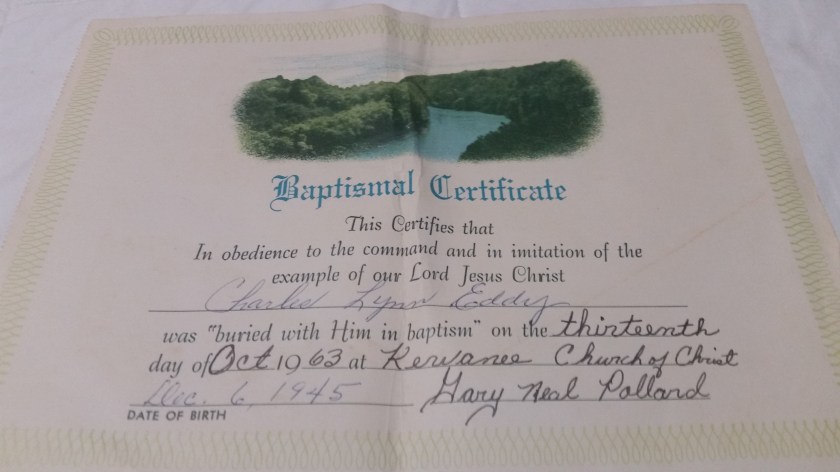
Recently, a young woman present to hear me speak in Kentucky asked me if I was related to a “Neal Pollard” who preached in Missouri in the 1960s. She had just attended her father’s funeral, and in going through his things after his death she found his baptismal certificate. I was elated to hear these details. Her dad and his mother, her grandmother, were baptized on October 13, 1963, by a young Freed-Hardeman student. This young man who was baptized would go on to serve for many years as an elder in the Lord’s church. Later that night, I called my dad and found out that Charles Eddy was one of 15 people who was baptized when he preached his “tryout” sermon at Kewanee. He had only preached four times in his life and this was his only sermon at that point. It was on the judgment and entitled, “What Will The End Be?” He had no idea what had happened with any of these men and women he baptized when only 19 years old. That was 55 years ago.

I have seen my dad go through some trials as a gospel preacher. There have even been times when he has been mistreated, but he has faithfully preached the gospel for well over half a century. In that time, he has done countless Bible studies, counseled Christians and non-Christians over literally tens of thousands of hours, ministered to young and old, healthy and sick, preached “in season and out of season” (2 Tim. 4:2) and even occasionally “endured hardship” while fulfilling his ministry (2 Tim. 4:5). He is a man of great faith and prayer, but I’ve seen him discouraged. He has wondered if his efforts mattered very much. That is often a side-effect of service.  But, I reveled to hear his excitement as we relived that memorable day and talked about that first work–of course, he was hired after having 15 baptisms in his “tryout” sermon! Dad also has done local work in Tennessee, Kentucky, Mississippi, West Virginia, North Carolina, and Georgia for those five-plus decades. Now that he’s retired, he still preaches every week for the church in Andrews, North Carolina. At 74-years-old, he’s still studying with and baptizing people and helping to build the faith of all different kinds of people. My dad has always been very evangelistic, but I don’t know how many have been baptized under the influence of his preaching. But, he’s also helped so many stay faithful and encouraged their growth and development. Occasionally, I still get to hear from them in person or through social media.

There are so many men through the years who have labored, like my dad, in anonymity–not considered “big names in the brotherhood.” Yet, many, many people will be in heaven because of their work. May every one, including but not limited to preachers, be encouraged in doing the Lord’s great work!  “But as for you, brethren, do not grow weary of doing good” (2 Th. 3:13).

20180805_213935.jpg
The first of many, many times my dad would fill out one of these. 

“Just A Broken Guy…”

Neal Pollard

The chilling audio from Richard “Beebo” Russell reveals an internal conflict nobody, not family, friend, or co-workers, knew was going on. The 29 year old ground worker at Seattle-Tacoma International airport took a Horizon Air Dash-8 airplane on an unauthorized joy ride, complete with complicated aerial stunts before crashing into a remote island on Puget Sound. Before crashing, he spoke with air traffic controllers and pilots and confessed to the inner turmoil. The words used by loved ones to describe him range from “warm” and “compassionate” to “happy” and “regular” (Alex Horton, Washington Post, 8/13/18).  Of course, the behavior was irregular and bizarre, and it ended tragically for the young man as he fatally crashed the plane.

As we walk through this world, we meet and interact with people who may be projecting an outward appearance that is masking inward pain and trouble. It may lie behind their broad smile. That’s a disturbing thought, but what can we do? We cannot read their minds. There is no full-proof way to prevent every tragic action, but we may have more power than we think. Consider some things all of us can do with everyone in our lives.

Be kind. Look people in the eyes. Smile at them. Even if it slows you down from some important task, don’t overlook the people God puts in your path. Your helpful word might sink deeper into their spirit than you realize. Let’s be like the inhabitants of Malta, who showed Paul and his companions “extraordinary kindness” as they simply “kindled a fire and received” them all (Acts 28:2). We’re told as Christians to put on a “heart of kindness” (Col. 3:12). How will anyone know the proof of our kind hearts? We will display it.

Be concerned. We fear being nosy or busybodies. Don’t do that. But there is room for active concern. Such is more apt to listen than advise, to help and not gossip, and to do than to judge. People who are surrounded by those they know care for them have a better chance at emotional survival. Look at the example of Paul, pressured by the concern for congregations and intensely concerned for individuals led into sin (2 Cor. 11:28-29). The word Paul uses for his concern for individuals literally means “to cause to be on fire; burn” (BDAG, 899). It’s the word used to describe the heavens being on fire (2 Pet. 3:12). Paul was “inflamed with sympathy, ready to aid” (ibid.). That’s got to be us, too!

Be helpful. Our Christianity should be tangible, not theoretical. We must be attuned to needs and ready to help (cf. Titus 3:14). Let’s avoid empty words that lack the intent of action. Acts of service, doing for others, are powerful and penetrating. God tells us, “On the day of salvation I helped you” (2 Cor. 6:2; Isa. 49:8). A helper sees a need and meets it. Oh, the impression that can make on a weary struggler. 

Listen, for all we know, this young man was surrounded by people who were kind, concerned, and helpful. Ultimately, each of us is individually accountable for our actions (2 Cor. 5:10). But, our neighborhoods, cities, states, and nations will be a better place when Christians are active bearers of such faithful fruits. Treat everyone you see as the eternally-bound souls that they are! Help them. We know the One who mends the broken (cf. Ezek. 34:16). 

a6866107-2a6b-41a4-a91e-365513e5516c-seattle_plane

He Understands Me

Neal Pollard

Marge Singleton and Merle Kilgore cowrote a song that was a hit for Teresa Brewer at the end of the “doo wop” era, entitled “He Understands Me.”  The heart of the lyrics, which are repeated, is: “He understands me the way you never did. He loves me the way you never did. 

He takes the time to notice I’m around. He builds me up, he never lets me down.” This is obviously a song about young love and a young woman who has found somebody much better than her “ex.” This is the age old complaint of many a man and woman, of feeling taken for granted. 

But in the most important relationship you can have, you have Someone who understands you better than you understand you. He wants a relationship with you and He went further to prove it than anyone else ever will or could. He left a place of safety to suffer. He left a position of supremacy to be a servant. He left the peer-ship of sovereignty for submission. He limited Himself to humanity without surrendering His deity to save the most important of every person, including you.  Because He successfully navigated the perils of this life, He can offer you eternal life.

Meanwhile, there are daily benefits for you because “the Word became flesh” (John 1:1-2,14). 

Intercession. Paul says, “Who is the one who condemns (cf. lays a charge against God’s elect, 33)? Christ Jesus is He who died, yes, rather who was raised, who is at the right hand of God, who also intercedes for us” (Rom. 8:34). The Hebrews’ writer adds, “He always lives to make intercession for [those who draw near to God through Him]” (Heb. 7:25). He earnestly appeals to God with urgency and intensity for you. Try to picture that. He’s addressing God for you!

Intervention. Hebrews 2, which warns against the possibility of drifting away from Jesus, gives a multitude of reasons why you would never want to do that. One reason was He became one of us to die for us (9). His appearance here helped Him understand by experience your struggles (10). He claims you as spiritual family (11-13). He went to war with the devil for you and won (14-15). He gives you help (16). He paved the way for God’s favor toward you (17). The writer says He had to become one of us to be a “merciful and faithful high priest…,” and being tempted “He is able to come to the aid of those who are tempted” (17-18). When you appeal to Him for help, He will!

Invitation. Knowing that Jesus has been through what you’ve been through, by itself, is comforting. Hebrews 4:15 says your high priest sympathizes with your weaknesses, having been tempted in all things like you are except that He never sinned. Those facts lead to a consequence, signaled by the “therefore” of verse 16. Because Jesus successfully took your place, you get to go someplace you otherwise never could! You can go directly to the Father’s throne of grace. You can do so confidently (boldly!). When you do, you will not only find “help” (same word as “aid” in 2:18) but you also grab hold of mercy and grace. You can step inside the greatest power source in the universe for help, pity, and favor, and you are invited to do so!

Do you know why you have intercession, intervention, and invitation? Because He understands you! He’s been through what you’ve been through. He knows. He gets it. But, combined with that, “He is able” (Heb. 7:25)! Are you taking advantage of these benefits? Why would any of us neglect to do so?

weeping

Which Is Worse: Lawbreaking Or Lawmaking?


Neal Pollard

Scruples, proclivities, judgments, convictions,
“I would prefers” as well as “It’s betters”
Men put these on par with divinely revealed positions
Make laws they bind on others like fetters

Freedoms, liberties, rights, excesses,
“God’s grace” gives me license to sin,
Men loose themselves, and self-will professes,
“No matter how I live I’m still ‘in.'”

Perhaps all men lean to the left or the right
Are prone to rebel or restrict
But it’s darkness to be away from the light
Whichever direction one picks

These extremes are two sides of one penny
Only one way to correct either faulty course
Be sure it’s in Scripture, for way too many
Are self-led and don’t seek a heavenly source

No “thus saith the Lord,” no book, chapter, verse
That in context supports their position,
Instead, they labor under that ancient curse
Placed on binding and loosing, both are sedition!

Our task is most clear, to place ourselves under
The Sovereign will God left in His Work of inspiration
Other ground is sand, leaves our souls all asunder
Such is to build on the only firm foundation!

Man walking and balancing on rope over precipice in mountains

Out-Cheered At Home

Neal Pollard

It’s hard to beat the weather and the views at the average Rockies baseball game. This past Tuesday, 29 Bear Valley guys converged on the upper deck overlooking first base as the “good guys” took on those world-champion Houston Astros. For the unfamiliar (or disinterested), the Astros are the defending Worlds Series champions. They’re very good this year. But, so are the Rockies. Whenever Colorado can sniff first place when August is in view makes it a “great” season, by their standards (spoken by a long-suffering fan). We came into that game having won 12 out of 16 games in July. Several of us got there early–for a game which would start an hour late due to bad weather–and the thing that struck us was how many orange shirts and jerseys there were. Again, for the uninitiated, those are Astro rather than Rocky colors. But, it wasn’t their apparel that stuck out. It was their boisterous, relentless cheering. As much as I like Colorado baseball, I get frustrated with how quiet the average fan in the stand is (perhaps they are lulled into a tranquil state by those rich sunsets and cool breezes. Opposing teams’ fans seem less affected. We were louder than usual, but they were louder than us.

“Home field advantage.” It’s supposed to mean something, but Tuesday night was a reminder that it can be taken away. These were committed fans. We saw Texas license plates in parking lots. No doubt, some arranged their travel to attend a game while visiting our fair state. Or, they’re locals whose allegiance is strong enough to brave the prospects of tens of thousands of people who oppose their point of view. They weren’t embarrassed or ashamed to proclaim their loyalty. They were eager.

We often sing, “This world is not my home.” Truly, Peter calls the Christian an alien and stranger (1 Pet. 2:11). Our citizenship is in heaven (Phil. 3:20). The Devil has control of this world and its domains (Eph. 2:2; 6:12; John 12:31; 1 Cor. 15:24; etc.), though Jesus will win in the end and He causes us to triumph now (2 Cor. 2:14; 1 John 4:4). 

We enter the daunting arena of the world clothed with Christ. He wants us to stand out and to be heard. No, not obnoxious, but He expects us to infiltrate it with His influence (Mat. 5:13-16). We won’t sway the crowd or determine the outcome, but we will make a difference if we show up, stand up, and speak up. The world will be aware of our presence, even if it disapproves. That’s not really the point is it–to have their approval? The point is to show our unswerving loyalty. We know that we are on the winning side! With humility but also boldness, we should make that known!

37756309_10155703074395922_7614667387320664064_n

What Does “Mean” Mean?

Neal Pollard

Does that question seem strange to you? Mean is a verb defined as “intend to convey, indicate, or refer to” (Apple Dictionary, Version 2.2.2). Postmodernism claims that there is no purely objective knowledge, truth, or norms. Therefore, meaning is what you make it mean. Several years ago, James Sire gave the framework for what we see in ever-increasing, ever-encroaching ways in our society when he wrote that the postmodernist believes “human beings make themselves who they are by the languages they construct about themselves” (181). He continues, “In postmodernism the self is indeed a slippery concept” (182). How does this play out? Science is what scientists say it is. History is what historians say it is. But, morality, law, and so many other pillars of society are influenced by this approach to truth and reality. Abortion, euthanasia, sexual ethics, gender issues, and the like are subject to what institutions and individuals determine about them. Even religion, down to New Testament Christianity, has felt the pervasive tentacles of this worldview. Where does this philosophical mindset end? What’s out of bounds, if truth is whatever you and I each say it is for ourselves? Ultimately, there can be no values, standards, or absolutes. And no one wants to live in a society where those are the “rules,” if you can call them that.  And no one can for long. It’s a system destined to collapse.

Winfried Corduan worse, “Relativism plays the role of Zorro in the world of knowledge. It stays in concealment for long periods of time only to suddenly appear at crucial moments, conquer the day, and go back into hiding” (37). In other words, we don’t want relativism on the operating table, when it’s a choice of saline or strychnine in the I.V. (i.e., “What’s ‘saline’ to you is ‘strychnine’ to me”). We don’t want it at our banking institution, when it’s a choice of debit or credit. We believe in absolutes…until we don’t. What’s right or wrong? Again, Corduan helps by defining truth as what corresponds to reality (39). We may have to explore, investigate, evaluate, and test, but we can ascertain it!

We don’t want to live in a world without a transcendent way to determine truth and meaning. We cannot. Meaning is meaningful! Amidst all the wild experimentation of our postmodern world, there is a trustworthy source of truth. It in internally cohesive and universally applicable. It has been successfully tried for thousands of years. But it makes expectations of us. It asks commitments of us. It involves sacrifice, self-denial, and submission. But it is right and it works! It is Divine Revelation. The Bible. May we have the courage to follow it and share it.

Works cited:

Corduan, Winfried. No Doubt About It: The Case For Christianity (Nashville: Broadman & Holman, 1997).
Sire, James W. The Universe Next Door: A Basic Worldview Catalog (Leicester: InterVarsity, 1997).

creativity-as-a-search-for-meaning

LANDMINES IN RESOLVING CONFLICT

Neal Pollard

“I.” The late Wendell Winkler once said that beneath most marital conflict is basic selfishness. “What about my needs?” “What have you done for me?” “I am not happy, fulfilled, etc.”  The Bible warns of the destructive nature of selfishness (Luke 9:23; Eph. 4:22,24; Phil. 2:3; 2 Tim. 3:2)! One of the most frequent casualties of selfishness is marital happiness. 

“You.” This is really the other side of the conflict coin that blows up progress and growth in relationships. If selfishness is blind to the needs and concerns of the other person, blame and deflection is the total denial of guilt or shared responsibility. “You don’t treat me right.” “Why don’t you pull your weight?” “You are not enough of ‘X’ or too much of ‘Y’!” Accusation, which puts one’s mate on the defensive, is a poor framework for resolving conflict. The very first couple played the blame game, to no avail and with no success. 

“They.” A mirage is “something that appears real or possible but is not in fact so.” We usually think of a mirage in the desert, an optical illusion created by extreme conditions. How often do married couples in conflict see marital mirages? A couple is hurting, and as they look across the burning sand they see “perfect couples” and “perfect marriages.” We are not helping ourselves by comparing ourselves to what is not what it appears anyway (cf. 2 Cor. 10:12). Every marriage is comprised of flawed, sinful people who are constantly faced with overcoming. Whatever you think you see in other couples “is not in fact so.”

“God.” Now, hear me well. God is the answer to all conflict, if we consult Him. Yet, when we blame God or let conflict affect our faith, then our attitude toward God can become a major landmine preventing resolution. “God doesn’t care.” “God isn’t listening to my cries and prayers.” “Where is God when I need Him?” Trials are going to test our faith, but be careful not to give God credit for blame that rests upon us and our spouses. 

The good news is that “I,” “you,” “they,” and “God” can all play a fruitful role in resolving conflict. When “I” am humble and honest and focus on my role and responsibility, good will result. When “you” are treasured, valued, and sincerely loved, things will start looking up. When “they” are reasonably treated as role-models and inspiration, it can be helpful. When “God” is totally trusted and obeyed, there is no insurmountable problem! I wish marriage had no saboteurs or hazards, but the best of them do. Let’s work to avoid triggering them, trusting that God’s pattern for everything, including marriage, gives us the best shot at success. 

blast

I Wish The Church…

Neal Pollard

  • Was more evangelistic
  • Had dynamic worship
  • Ministered to every age group
  • Encouraged people to become leaders
  • Was more visible in the community
  • Invested in the home
  • Provided more fellowship opportunities
  • Had a thriving education program
  • Had a passion for world missions
  • Was attentive to visitors
  • Cared more about X, Y, or Z
  • Spent more on X, Y, or Z

Through the years, these statements and similar ones have been made in some form or fashion. People want the church to do more and be more. Referring to her in that nebulous, generic way–“the church”–is a comfortable, broad stroke-painting way of making a sweeping indictment of an institution which can then be made a scapegoat of any religious problem that we feel plagues us.

What I must remember is that I am the church–at least I am a member of it (1 Cor. 12:27). I cannot exempt myself from her problems or duties. Am I evangelistic? Am I an enthusiastic, engaged worshipper? Do I reach out to all ages? Present in my community and home? Attentive to visitors? The church, which is a Divine creation (Eph. 3:9-11), depends on every member contributing in every way each can (Eph. 4:16). This encourages getting whole hands involved rather than using fingers to point at others. Could the church be doing more, reaching more, reflecting God more? Absolutely! I know this because I can be doing all those things more. Let’s each focus on what we can do to build a stronger church, in every way we possibly can! The Lord is counting on us.

The Kindest Elder I’ve Ever Known

Neal Pollard

He was appointed an elder during the Reagan administration. At the very time he was appointed, the congregation was reaching the climax of a very traumatic incident. A man who was a charter attender, but not a member, when Bear Valley began meeting, he has seen every great work this congregation has dared to do, walked through its every valley, and he has done so with as even-keeled and unflustered way as I have ever known. I have heard him preach both here and abroad, watched him do short-term missions, make difficult shepherd visits, hug and encourage more people than I can remember, and seen his kindness and humor generously displayed. He was not usually the first to speak when elders conversed, but his insights have always been profound. He always did what he did with class and compassion.

I was crestfallen when I recently heard Maynard Woolley tell the eldership that he was ready to step aside as an elder after nearly 30 years of service. Only Harry Denewiler served more years in that role for the Bear Valley church of Christ. He stayed on a couple of years after five great men were appointed to this work in 2016, helping them to acclimate, learn, and grow under his, Ernie Barrett’s,  and Dave Chamberlin’s tutelage. A telling tribute to the breadth of his leadership was the collective, deeply respectful, regret that he was going to resign. Maynard is a man who one appreciates more and more the longer one works alongside him.  His faithful wife, Donna, has both encouraged him and endured, as an elder’s wife for so long, what not many women living have.

Some men impress with refined oratory, outspoken and charismatic ways, and larger-than-life personalities. Others live more understated ives, but their value cannot be overstated. Maynard Woolley is such a man. We will miss his formal oversight, but we look forward to his continued faithful service and loving example. Thank you, Maynard, for what you’ve done and for who you are.  Bear Valley bears the imprint of your bearing.

35328348_1752403114806253_5029729612142215168_n

The Difference Between Current And Relevant

Neal Pollard

Relevant—Appropriate to the current time, period, or circumstances; of contemporary interest
Current—Belonging to the present time; happening or being used or done now

I think most of us would find the above definitions of these words to be satisfactory. In the context of the church, we are often concerned with both the matter of being current and relevant. The degree to which and the ways in which to achieve currentness may differ from congregation to congregation, but every congregation, to some degree, wishes to be current. It’s what drives members to arrive in automobiles, to paint and remodel the building, to use powerpoint for lessons and songs, have wifi access, a (hopefully) updated website, and the like. So long as the tool, idea, or method for being current is in harmony with Scripture, including proper stewardship as well as adhering to God’s pattern and authority, we should be as forward thinking as possible.

Relevance is, perhaps, a more subjective matter. With the maturing of each succeeding generation, we tend to obsess about whether or not our planning, actions, communication, and the like are sufficiently relevant to each generation. In other words, we might ask, “Are we relevant to millennials?” or “Will this resonate with iGens?” There are tools, ideas, and methods we should use to be “appropriate to the current time, period, or circumstances.” But, may we not lose sight of the fact that Scripture could not be more relevant, and it is never more relevant than when it is countercultural. The world’s ideas for how we should dress, talk, think, act, or respond to God may be the very definition of what’s current, but such is not relevant to God’s objective right and wrong on those specific matters. What we teach may be relevant to those areas of concern, but may seem old-fashioned or not what is being used or done now by the majority. 

We must emphasize that in our current circumstances, God’s Word, with its precepts and principles, is what is relevant! It’s what the world needs, and it’s what we each need. The church, so long as it boldly, lovingly declares those things, is the very essence of relevant. Let’s just let God’s Word and not the world define that for us. 

relevant


You Push That Way And I’ll Pull This Way

Neal Pollard

While it is true that each of us possesses unique abilities within the Lord’s body (Rom. 12; 1 Cor. 12), that fact bears closer scrutiny. God can use each of us, with our unique personalities, backgrounds, and experiences, to reach so many among the lost and to help so many among the saved. Yet, it is easy to lose sight of how we contribute to the health and growth of the congregation we are a part of. 

For example, the following should not be considered talents useful to the Lord’s cause:

  • Being gossips and busybodies (2 Th. 3:11; 1 Tim. 5:13).
  • Causing strife and being jealous (Rom. 13:13; 1 Cor. 3:3).
  • Judging your brother (Rom. 14:10; Jas. 4:11).
  • Returning evil for evil and insult for insult (1 Pet. 3:9). 
  • Being an obstacle or a stumbling block in a brother’s way (Rom. 14:13).
  • Speaking deceit (1 Pet. 3:10).
  • Giving the devil an opportunity (Eph. 4:27).
  • Keeping your leaders from doing their work with joy and not with grief (Heb. 13:17).

Certainly this is not an exhaustive list of ways we may misuse the stewardship of our speech and actions as members of the body of Christ. It can be so tempting, when we look at the church’s imperfections and people’s inevitable shortcomings. We have new Christians. All Christians have weaknesses. Those who lead and conduct the church’s work could inevitably do it better. 

What does the Lord want each of us to do as individual members of the Lord’s church? He calls for living in harmony in the Lord (Phil. 4:2). He wants us fitted, built, and held together (Eph. 2:21-22; 4:16). He wants us “being of the same mind, maintaining the same love, united in spirit, intent on one purpose” (Phil. 2:2). Practically speaking, this means getting behind the work of the local church, contributing to it and building it up. It means asking how we can help and throwing our energy into that. It means constructively helping when a work is lagging or in need of direction. It means lovingly, respectfully interacting with the other members of the body. 

Comedian Steve Harvey compared his rise to success with pulling a wagon uphill. He said that many people may hop on that wagon and contribute something, He said they all need to be doing something to help you get that wagon up the hill. He warned against those who get on the wagon and have no value (via OWN, 9/12/14). Perhaps you’ve found yourself pushing toward a spiritual objective, only to feel the resistance of someone working against you. This is frustrating! However, never find yourself opposing good, needed works through misuses of your resources in ways like those in the bulleted list above. In the worst case scenario, we may even find that in doing so we “may even be found fighting against God” (Acts 5:39). Let’s do all we can to help build up the body of Christ, prayerfully studying what that does and does not mean!

compromise-donkey

What Are We Saying About The Church?

Neal Pollard

Recently, in an excellent lesson about gossip, the teacher recounted an incident I, and many others, could echo from the background of our own experience either in ministry or our personal lives. A mother asked her wayward daughter why she no longer was a member of the church. Her convicting reply, “The way that you always talked about the church, why would I be?” The way this daughter heard her parents talk about the church, she concluded the church was full of hypocrisy, flaws, and inadequacy. She was simply modeling what she heard them say throughout the years.

I’m thankful for the sound counsel we received well before we had children. We were advised never to speak ill of the church in front of our children, to run down elders, deacons, preachers, and other members. Knowing Kathy, she would have done this intuitively. For me, it was extremely helpful with my impetuous nature. Even whispered words in the front seat of the car, going home from church, will inevitably be heard by the little ears in the back seat (the same is true of the dinner table and other times the family is together). We may be blowing off steam, we may not have deep vendettas against the object of our criticism and complaint, and we may soon forget what we’ve said, but impressionable ears and hearts may internalize the words and materialize the message with their deeds and lives. 

The attitude, relationship, and loyalty our children have toward the church is most shaped and determined, for good or ill, by our example as parents. What will help us speak well of the Lord’s church? 

  • Remember who conceived of it, from nature to organization to purpose, etc. (Eph. 3:9-11).
  • Remember whose it is (Mat. 16:18-19; Eph. 5:33).
  • Remember our mission to bring others into it and that our home is our primary mission field (Mat. 28:19).
  • Remember how Jesus feels about the church (1 Tim. 3:15; Eph. 5:25).
  • Remember that the church is the location of the saved and we should do all we can to help our children make up that number (Acts 2:47; 1 Cor. 12:13).
  • Remember all that the Bible says God seeks to accomplish through the church: growth (Eph. 4:16), His glory (Eph. 3:20-21), and His grace (2 Cor. 8:1), among so many other things.

We may struggle to see our family harbor grudges and hard feelings against the church. Many factors may contribute to that, but we should begin with ourselves. What are we saying about the Lord’s bride? What is our attitude toward her? I cannot imagine that anything is more impactful than that, and that is probably the thing we can most control! May our family remember that our theme song, concerning the church, is, “I love Thy kingdom, Lord!” Surely this will influence how they feel about her, too. 

3

Seeing God In Nature: Volcanos

Neal Pollard

As we received word of the volcanic eruption near Guatemala City, Guatemala, yesterday, where Bear Valley Bible Institute has had an extension school for several years, we were reminded of the omnipotence of God. The power God displays through nature and His creation reveal how such a powerful effect reveals an even more powerful cause. Volcanic activity for which there is no recorded history, like at Yellowstone, Deccan Plateau, and Santorini, stand alongside several we do know about. Perhaps Pompeii or Mt. Saint Helens is most infamous, but the Mount Tambora volcano in Indonesia has been called the most explosive and deadly for which there is historical recounting. Mount Tambora’s eruption began on April 5, 1815, and the mountain blew apart on the evening of April 10th. “The blast, pyroclastic flows, and tsunamis that followed killed at least 10,000 islanders and destroyed the homes of 35,000 more” (britannica.com). It went from being a mountain 14,000 feet high to being a caldera (a crater) 3.7 miles across. Its effects were intense and global. It shot megatons of material into the atmosphere, preventing so much sunlight from reaching the earth’s surface that 80,000 more Indonesians died from famine and disease. The earth’s average temperature was reduced over five degrees. Western Europe and eastern North America experienced heavy snow and killing frost in June, July, and August, causing “crop failures and starvation in those regions, and the year 1816 was called the ‘year without a summer’” (ibid.).

Volcanos are so awesome and powerful that they evoke a strong response from us. They illustrate several things of a spiritual nature. As noted above, they are demonstrations of an all-powerful God. So often, they erupt without specific warning. There may have been tremors and signs for years, but nothing out of the ordinary. Then, too rapidly for many to escape, the cataclysmic occurs. It is a testimony of good that comes from tragedy, too. The Department of Geosciences at Oregon State University reminds us that volcanic soil is very rich and conducive to a dramatic agricultural comeback following these geological events (volcano.oregonstate,edu). These events should help remind us of a truth Bible writers like Peter teach us, that “…the day of the Lord will come like a thief, in which the heavens will pass away with a roar and the elements will be destroyed with intense heat, and the earth and its works will be burned up. Since all these things are to be destroyed in this way, what sort of people ought you to be in holy conduct and godliness, looking for and hastening the coming of the day of God, because of which the heavens will be destroyed by burning, and the elements will melt with intense heat!” (2 Pet. 3:10-12). 

Please pray for our brethren in Guatemala and for the hearts of all men outside of Christ, that they might come to a saving knowledge of the truth before it is eternally too late. May the evidence gleaned from places like nature, including volcanic events, persuade mankind of the reality and power of God. So persuaded, perhaps their hearts will be open to learning more about Who this God is as we share the revelation of Him as found in His Word!

caldera_mt_tambora_sumbawa_indonesia
Mount Tambora caldera

Abraham Lincoln’s Memorandum Of August 23, 1864

Neal Pollard

Somehow, I was unaware of the existence of a document which Abraham Lincoln drafted and had endorsed by every member of his cabinet, though unseen by them, and which remained sealed until November 11, 1864. These were not only dark times for the nation, embroiled in civil war for over three years at that point, but gloomy for the war-weary north which could not end the conflict against the greatly outmanned but tactically superior south. Politicians and citizens were unhappy with the perceived lack of success and progress at such high cost—the death and disabling of so many of her sons in the prime of their lives.  Lincoln detected that popular sentiment was such that he would not be reelected. Thus, he drafted his memo, which read, 

This morning, as for some days past, it seems exceedingly probable the this
Administration will not be reelected. Then it will be my duty to so cooperate
with the President-elect as to save the Union between the election and the
inauguration: as he will have secured his election on such ground that he
cannot possibly save it afterward (Coolidge 139). 

Lincoln seemed to think that the north had had enough of this war and would rather sue for peace and allow our sea to shining sea to be two nations rather than continue with such devastating effects a war they could see no end to. He appears dedicated to whatever he could do to preserve unity.

Of course, several things changed the course of Lincoln’s fate in his bid for reelection that swept him decidedly into office for a second term. There was the north’s victorious show in The Battle of Atlanta, Fremont’s withdrawal from candidacy, the Democrats internal division between the Copperheads—eager to end the war now—and the War Democrats, and the fact that no electoral votes were counted from the Confederate States of America.  But, Lincoln could not see the future. He was preparing for what he saw as the worst.

There is a well-worn battle taking place in our world. It is not technically between two factions. It might be framed as Christianity versus other world religions. It could be cast as New Testament Christianity versus so many individual denominations. Yet, internally, there are multiple stressors to the biblical unity Christ prayed and died for, too (John 17:20-21). 

Christians are soldiers (Eph. 6:10ff), but our battle is not with flesh and blood (Eph. 6:12).  Our war and weapons are not “of the flesh” (2 Cor. 10:3-4). All the same, many have grown weary of fighting the good fight and not a few feel as though we are fighting in a losing cause. The restoration ideal of doing Bible things in Bible ways seems archaic and impossible to growing numbers of saints. Some fight with equal vigor to preserve traditions not rooted in Scripture, and unnecessarily harm the great cause. 

As we strive at all costs to be true to the pattern of New Testament Christianity, let us do so going to whatever lengths we can to maintain unity wherever possible. Not for a moment does that mean sacrificing truth or compromising even one “thus says the Lord.” But it does mean embracing a spirit of love and protectiveness for the precious Bride of Christ, the church. That involves loving and working with those who are the members of it. 

Ultimately, the Lord’s cause will prevail. His victory is as assured as every other divine promise. We must be striving on His side to share in that. For now, we cannot give up the fight! Let’s cooperate wherever and however we can, standing unitedly on the foundation of Christ and His will. The rest (which is most of it), we will leave to our Great Commander In Chief!

Works Cited:
Coolidge, Louis A. American Statesman Ulysses S. Grant (New York: Chelsea House, 1983).

blind-memo-recto-al0204