I’ll be repeating the book of II Peter in present-day terminology. It’s not a true translation of the book, as I am not qualified to do so. It will be based on an exegetical study of the book and will lean heavily on the SBL and UBS Greek New Testaments, as well as comparisons with other translations (ESV, NASB, NIV, ERV, NLT). My goal is to reflect the text accurately, and to highlight the intent of the author using concepts and vocabulary in common use today.
This is not an essentially literal translation, and should be read as something of a commentary.
Message is Credible
Family, you have to make sure you’re in a good place when it comes to your relationship with Jesus. If you’re practicing all those qualities we just talked about, you’ll be ok. You’ll make it to eternal life. You know this stuff already, but it’s always a good idea to remind you. You’re already in a good place, but as long as I’m alive, I’ll keep reminding you. I’m going to die soon. Jesus made that clear to me. Because of this, I want to make sure you’ll remember everything I taught you. What we taught you originally is still valid. Jesus is powerful and he’s coming back to us. We weren’t duped into believing an intricate lie. We were firsthand witnesses to his superior nature! One time, the ultimate power – God – validated this by saying, “This is my son. I love him and I think very highly of him.” He said that right in front of us while we were with Jesus on a mountain. His voice came from the sky. This made us confident that we have the right message. Since we’re confident in this message, you should be, too! Focus on what we’ve told you like you’d focus on a light source in a dark room. Hang onto this until the end, when everything will be light and darkness won’t exist. It’s very important that you understand something: we don’t get to decide what a prophecy means. No human has ever produced a legitimate prophecy. Those came from men who were influenced by God’s spirit.
For the next several weeks, I’ll be repeating the book of I Peter in present-day terminology. It’s not a true translation of the book, as I am not qualified to do so. It will be based on an exegetical study of the book and will lean heavily on the SBL and UBS Greek New Testaments, as well as comparisons with other translations (ESV, NASB, NIV, ERV, NLT). My goal is to reflect the text accurately, and to highlight the intent of the author using concepts and vocabulary in common use today.
This is not an essentially literal translation, and should be read as something of a commentary.
Everything’s about to come to an end. You have to be reasonable and self-controlled for the sake of your prayers. Most importantly, don’t ever lose your love for each other. Love hides all kinds of mistakes. Take care of each other without complaining. Use your assets to help each other, since God helps us in so many ways. If your talent is speaking, speak as if you’re talking for God. If helping others is your talent, do it with limitless energy. This way every aspect of our lives gives credit to God by our dedication to Jesus. He gets all recognition and authority forever!
Family, don’t let these hard times shock you. Don’t feel like you’ve been targeted. You are suffering like Jesus did, so let that keep your spirits up! When he comes back, we’re going to be indescribably happy! If people insult you because you love Jesus, you’re lucky! The full weight of God’s spirit and power is with you. Just make sure none of you suffer because of something you’ve done wrong, like murder, stealing, practicing morally bad things, or sticking your nose where it doesn’t belong. If you suffer because of your faith, though, don’t feel bad! Instead, give all the credit to God.
We’re about to be judged by God. Since we’re going to be judged first, how do you think it’s going to be for people who rejected God? It’s hard enough for a morally good person to be saved, so what’s going to happen to morally bad people who don’t follow God? Since we’re about to suffer, we have to trust God with our lives. He’s going to take care of us if we’re doing the right thing!
Since we’re about to face difficulties, it’s very important that your elders lead you carefully. I’m an elder, too, and also look forward to sharing in the recognition we have coming to us. Elders, don’t lead people because you feel like you have to. Do it because it’s what God wants! Don’t lead because you want to get something financially out of it. Don’t abuse your power, but lead by example. When the ultimate leader shows up, your reward will be indestructible!
For the next several weeks, I’ll be repeating the book of I Peter in present-day terminology. It’s not a true translation of the book, as I am not qualified to do so. It will be based on an exegetical study of the book and will lean heavily on the SBL and UBS Greek New Testaments, as well as comparisons with other translations (ESV, NASB, NIV, ERV, NLT). My goal is to reflect the text accurately, and to highlight the intent of the author using concepts and vocabulary in common use today.
This is not an essentially literal translation, and should be read as something of a commentary.
I Peter – Part VI
We’re independent of any human government, but don’t use that as an excuse to disobey your governments. You have to see every person as valuable. You have to love each other. You have to obey your government. Employees must listen to their employers. Be respectful to them, even when they aren’t good to you. We don’t do this for them, we do it for God. He thinks very highly of us when – because we love him – we act like we should, even when we’re being mistreated. You don’t get credit for putting up with mistreatment if you bring it on yourself with bad behavior. If you’re mistreated because you’re trying to do the right thing, though, it makes God happy.
This is why God called us in the first place! Jesus suffered to benefit us. He intended for that to be the example we could follow. He never did anything wrong, he never said anything wrong, he didn’t fire back at people who said hurtful things. He never threatened anyone who put him through suffering. He constantly trusted God, knowing that God judges perfectly. He voluntarily took the punishment for our sin when he physically suffered on the cross. He did that to give us the chance to kill our old lifestyles and live morally pure lives. His injuries healed us. We had no direction, aimlessly wondering around like a sheep. Now we follow the one who leads us and protects us.
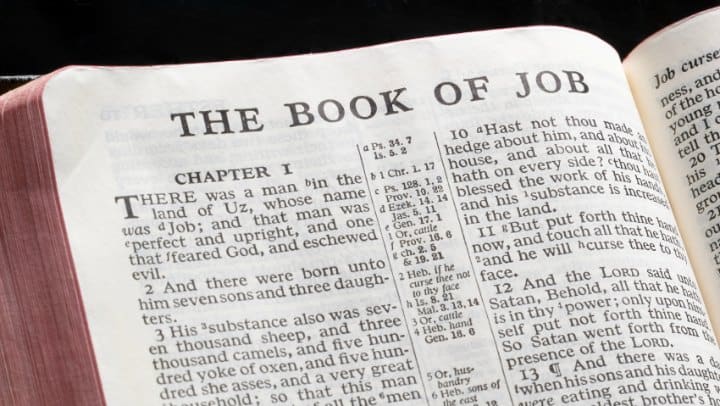
Recently at the suggestion of some teachers and podcasts I listen to, I took some time and in one setting read through whole books in the Bible. If you haven’t done this I would highly recommend it. Just read through the book not looking for anything or zeroing in on any specific point; just read through the book and let it teach you its main themes and allow it to speak for itself. One of the books I recently read through and want to briefly discuss is the book of JOB. We are very familiar with this book and story and can learn a lot of things from it including sufferings, patience, steadfastness, God’s perspectives, and others. However, I would like to share with you what really stood out and stayed with me as I read through the 42 chapters of this book. Job 1:8-9 says,
Then the Lord said to Satan “Have you considered My servant Job, that there is none like him on the earth, a blameless and upright man, one who fears God and shuns evil?” So, Satan answered the LORD and said, Does Job fear God for nothing?
Right there is the true question: “Will you fear and serve God for nothing.” It is not only a question that Satan asks the Lord referring to Job, but it is also for us today. Satan was assuming that Job would have a transactional relationship with God, that as long as he was doing what was righteous that Job would assume that he has earned his blessings or somehow God is obligated to bless him. Do we fall into this mindset that Satan is stating her is verse 9? Is it easy to fear and serve God while things are going good in our life or for fear of punishment? Do we have this transactional relationship that says I have done all these righteous X’s so I deserve these Y’s (blessings)? Would we serve God if everything (wealth, family, health) in an extremely short period of time was taken from us and we were in the situation Job found himself in? Satan is saying that taking comforts of this life away will push even the strongest to curse God to his face. Satan states this in Ch 1:11 and notice that as early as 2:9 Job’s wife actually uses the same language when she tells Job, “Do you still hold fast to your integrity? Curse God and die!”
Sometimes bad things happen because we make bad decisions and we must deal with those consequences. However, Job shows us that sometimes bad things happen outside of our decisions and we do not know all like our Creator GOD. God lays this out in his answer to Job out of the whirlwind in Chapters 38-42 basically stating that, “I created everything and have it all under My control, I AM GOD, even when you don’t realize it and so you must trust Me no matter what circumstances you find yourself in.” In chapter 42 we read exactly what Job did in response to God’s challenge to Job. Now as he repents and fears God he is in dust and ashes. This is the definition of serving God for nothing. Every worldly comfort had been taken from him and he had nothing, not even physical health, and nothing as of yet had been restored to him. But he through great tribulation feared God for nothing except he is God the creator and sustainer of everything.
We do need to serve God just because he is God and the creator of all things but the good news is we don’t serve him for nothing. Read Job 19:25: For I know that my Redeemer lives, and he shall stand at last on the earth; Just as we read Job and see his longing for a mediator between him and God, we now have that through Jesus. God gives us eternal life that can be found in Christ our mediator, not because we deserve it like a transactional agreement but because He is a benevolent, gracious and loving God.
My first foreign mission trip was to eastern Ukraine in the Spring of 2002. I returned in 2003, and each time we flew in and out of Kharkiv (which is under siege as I type). We worked with the Bear Valley Bible Institute’s first foreign extension school, but also worked with brethren in the village of Slavyanogorsk.
I took this picture of Slavyanogorsk from the monastery overlook.
We held Bible studies and taught English using the book of Mark and enjoyed success especially with young people and young adults. The influence of the Russian Orthodox Church was strong among the locals, but there was a congregation of about 30 there.
Russian Orthodox monk at the monastery in Slavyanogorsk. Having fellowship with the brethren at Slavyanogorsk. The local preacher at the time, Victor Semikoz, is barely in view (right). Terry Harmon, at the time the director of the Bear Valley extension, is wearing the tie.
On my second trip, Kathy was able to go with me along with several other members of the Cold Harbor Road congregation in Mechanicsville, Virginia, where I preached at the time.
Members of the Cold Harbor and Pikeville, KY, congregations at the Kharkiv airport. Do you see Kathy?
The memories we made together and with our brothers and sisters in Ukraine have left a lasting impression on my mind and my faith. Though I had always known that the church existed in places outside the United States, this was my first tangible experience with them. While we were separated by language and cultural barriers, we were drawn together by our common faith and hope. These first few trips increased my desire to teach and evangelize not only those in other nations, but also motivated me to try harder to do so locally. Those travels to Ukraine were extremely faith-building.
Right now, those brethren are displaced, distressed, and disturbed by the Russian invasion well underway. Their relatively modest houses and apartments have been at the center of fighting between Ukrainians and Russian separatists, with many of the cities in that region controlled by those separatists. They are in the crosshairs of danger, facing an uncertain future.
As I read the New Testament, inspired writers addressed congregations and asked them to care about, pray for, and provide the needs of brethren who faced various crises. There were the poor and needy saints of Jerusalem, whom Paul tells Rome that Macedonia and Achaia had financially supported (Rom. 15:26; cf. 1 Cor. 16:1). The writer of Hebrews told his audience, “Remember the prisoners, as though in prison with them, and those who are ill-treated, since you yourselves also are in the body” (13:3). He praised them earlier in the letter for showing sympathy to the prisoners (10:34). We never know when similar circumstances might befall us. As Paul told Thessalonica, “For you, brethren, became imitators of the churches of God in Christ Jesus that are in Judea, for you also endured the same sufferings at the hands of your own countrymen, even as they did from the Jews, who both killed the Lord Jesus and the prophets, and drove us out. They are not pleasing to God, but hostile to all men, hindering us from speaking to the Gentiles so that they may be saved; with the result that they always fill up the measure of their sins. But wrath has come upon them to the utmost” (1 Th. 2:14-16). While their suffering was primarily spiritual persecution, Paul urged empathy and endurance.
What can we do for our brethren who are at ground zero of this awful conflict? We can better inform ourselves of the specifics there (https://christianchronicle.org/ukraineexplainer/). We can pray, congregationally and individually (daily!). We can listen for opportunities to assist our brethren. Heaven will be filled with saints from every nation (Rev. 7:9). These brethren are part of our “household”; let us stand ready to do good for them (Gal. 6:10). Remember them as they suffer!
Having tea in our sister, Luba’s, apartment on a rain-soaked evening in Slavyanogorsk.
Character is defined as the mental and moral qualities distinctive to an individual and involves a person’s good reputation. The Greek word “charakter” first referred to the die used in minting coins, then came to include the sense of an image, stamp, seal, or copy. The Greeks used the word to speak of the typical features of an individual or nation, from which came the idea of “moral character” and then “the “distinctiveness” of a language, the “style” of a writer, or a “type” of philosophy (Kittel and Bromiley, TDNT, 1308). Arndt tells us the word means something produced as a representation or reproduction, and that human beings are formed by God as a representation of His own identity (1078).
The word is only found in the Bible in Hebrews 1:3. The epistle’s writer is describing Jesus, saying, “He is the radiance of His glory and the exact representation of His nature, and upholds all things by the word of His power.” It is an absolutely amazing truth that we are made in the image of God (Gen. 1:27), but the writer of Hebrews is saying something even more powerful about Jesus in Hebrews 1:3. He was not created by God as a reflection of God’s identity. The writer uses this specific word in Hebrews as part of His explanation that the Son is God! The NASB and NIV translate χαρακτήρ (CHARAKTER) as “exact representation.” The ESV has “exact imprint,” the NKJV has “express image,” the NLT says “expresses the very character of God,” and the ASV puts “the very image of His substance.”
The author of this epistle leads out in his overall theme that Jesus is better by establishing the most important reason why. He is God. The writer uses Old Testament Scripture to prove it, citing Psalm 45 and Isaiah 61 to call Him God (Heb. 1:8-9). He then quotes Psalm 102:25 to say of Jesus, “You, Lord, in the beginning laid the foundation of the earth….” Then, in Hebrews 1:13, he quotes Psalm 110:1, which begins, “The LORD (Yahweh) said to my Lord (Adonai)….”
Let’s not miss the initial point of the letter driven home by the unknown writer. With a multitude of Old Testament passages, he proves this point about the essential character of Jesus Christ. He is God. He is as much God as Father and Holy Spirit. He is as powerful, all-knowing, omnipresent, perfect, sovereign, transcendent, self-existent, eternal–He is as Divine as Deity can be.
That makes His willingness to be made a little while lower than the angels to taste death for everyone (Heb. 2:9) and to call us His brethren (2:11ff) all the more incredible. God lowered Himself not only to save us but to make us part of His family. We could spend the rest of the day meditating on that profound truth and still not fully grasp it.
Here’s the question. God made us, became one of us, died for us, and then opened the door to us to be His brother. What does that say about His character? As we try to fathom and appreciate that, it should give rise to another question? How should that affect our character?
We don’t typically associate salvation with death. Normally the opposite is true! In the New Testament salvation normally describes forgiveness of sins (Acts 4.12, for example). Escaping spiritual death is how the word is primarily used. The exception to this rule is fascinating and sobering.
Human instinct compels us to avoid unpleasantness, suffering, and death. When faced with danger or difficulty, our default response is avoidance at all cost. This was a great temptation for many in the early church.
Peter wrote to Christians who were about to face some awful hardships. He encouraged them by promising salvation, but it was a hard message to swallow. In the following examples, Peter used “salvation” to mean something different (it would have been understood to mean this because of context):
I Peter 1.5 – Death
I Peter 1.8ff – Death
I Peter 2.2ff – Death
How is death the same thing as salvation? For those who were suffering and stayed faithful, death was the ultimate salvation. For those whose lives were upended because of persecution, being with God forever was salvation. For those who lost their family members, salvation meant reunion. The ultimate result of faith is eternal life with God.
How do we view difficulty? Do we compromise faith to avoid suffering? At worst, suffering leads to death. At best, suffering leads to death. Nothing can slow a faithful Christian down! We have salvation in this life (guilt does not weigh us down), and the end of this life is salvation. We have an awesome God.
Since March Madness begins later this week, I was reading about all the teams to help me fill out my brackets. I came across the incredible story of Damian Chong Qui, a guard for the Mount St. Mary’s basketball team that won the Northeast Conference tournament and will play Texas Southern for the right to play against Michigan. The odds of Mount St. Mary’s winning the NCAA tournament are so astronomical that the team is more likely to be hit by an asteroid in their team bus going to the arena to play, but Chong Qui symbolizes the team’s grit, determination, and uncanny ability to defy the odds. His story is both heartbreaking and inspiring. Born and raised in crime-riddled East Baltimore, his father and mother were shot in separate incidents less than two months apart in 2002, when he was only four. His father recovered, but his mother was murdered. Eight years later, his father was shot again and paralyzed from the waist down. Damian has been his father’s most consistent caregiver since then, dressing him and helping him into his wheelchair. Damian found an outlet in basketball, starting on his High School basketball team as a freshman. He was only 4 feet, 9 inches tall. A growth spurt helped him reach his current height of 5 feet, 8 inches tall. No Division One teams showed interest, so he walked on with the Mountaineers. Not only did he go on to earn a scholarship, but he is a star and the heart and soul of this scrappy squad. From his father to coaches and teammates, Damian is called dependable, hardworking, and focused (much biographical data from a 1/17/20 Baltimore Sun article by Edward Lee: “…Damian Chong Qui has overcome tragedy to shine at Mount St. Mary’s”).
There is no one who would want to go through what this young man has endured. Many might use such tragedy as an excuse or a crutch to let life defeat them, but Chong Qui shows the resiliency and resolve which is in mankind. While the Chong Quis do not sound especially devout, Damian’s father, Edward, said of him, “I feel like God has been working things out for him” (ibid.).
God does not cause evil (Jas. 1:13), but God is able to bring about good in the worst of circumstances. It is evidence of His omnipotence and omniscience. Do you remember Job’s wise and righteous assessment, even as he was in the dark about the cause of his pain and suffering? He tells God, “I know that You can do all things, And that no purpose of Yours can be thwarted” (42:2). As James assesses Job’s situation, he writes, “We count those blessed who endured. You have heard of the endurance of Job and have seen the outcome of the Lord’s dealings, that the Lord is full of compassion and is merciful” (5:11). Paul experienced this, too. He speaks of his “thorn in the flesh,” which God saw fit to allow him to retain. Why? Paul explains, “And He has said to me, “My grace is sufficient for you, for power is perfected in weakness.” Most gladly, therefore, I will rather boast about my weaknesses, so that the power of Christ may dwell in me. Therefore I am well content with weaknesses, with insults, with distresses, with persecutions, with difficulties, for Christ’s sake; for when I am weak, then I am strong” (2 Cor. 12:9-10).
Maybe you are struggling with some thorn in the flesh, some pain and suffering, some adverse circumstance that looms over you and seems poised to undo you. How will you respond? Will you see it as an advantage? A chance for God’s power to be perfected in weakness? For the power of Christ to dwell in you? As the means of strength in weakness? Do not forget that there is no force, earthly or spiritual, that can withstand the advantages that God can bring into your life even in times of greatest adversity! His purpose cannot be thwarted. And if our lives are being lived according to His purpose (Rom. 8:28), that is confidence that can propel us through the worst of situations!
This week we will do a brief study of I Peter 3.17-22.
In verse 17, the emphasis in the original text is “doing good.” If it is God’s desire (this is emphasized) that we suffer, it is better (stronger, more prominent, more advantageous) that we suffer for doing good works than evil works. How much more powerful a message do we send when we come under fire for doing something that benefits others? If we suffer for doing something bad, we’re just another criminal. But to suffer in the act of doing something good – in context – is a far more powerful evangelistic tool.
In the following verses, Peter gives a powerful example of Christ’s focus on getting rid of sin. He put everything into saving mankind – including giving His own life – so that we could all have the opportunity to come to God. Even before the destruction of the world through the flood He made sure everything had the opportunity to hear about their spiritual state. Whether this was done through Noah and his sons or whether He had a more direct hand in this is immaterial. The point of the text is that the message got out to those who are “now in prison.” His goal was to bring others to God, even when it caused Him suffering.
Only those who did listen and obey – eight people – were rescued from evil by the waters of the flood. Notice that the Spirit does not record Noah’s ark as being what saved them! They were saved in the important sense by the destruction of evil. Our focus is not earthly.
Just as water saved Noah and his family from evil, water saves us from spiritual death. Being immersed in water is how we make a formal appeal to God for a clear conscience! Some translations render this, “A promise to God from a good conscience,” as if baptism is some kind of outward sign of an inward faith. This is not reflected in Greek; it is a conscience cleared by an appeal to God, because of the resurrection of Jesus. He has all power, so He can clear our record when we submit to Him.
Having all of this as a background, we have some motivation to keep our actions pure, suffer for doing good things, and understand that God’s power is what saves us. Peter gives many other phenomenal motivators for living a pure life, which we will look at in detail in the coming weeks.
1 Peter 3.8ff is a passage with tons of application. What I’d like to do is simply break it down and apply as we go.
3.8 – Is addressed to every Christian, as opposed to the gender-specific commands of the previous section. Christians are told to have a unified mindset, understanding of the needs of others, affection for each other, compassion for each other, and a sober view of self.
3.9 – In the context of being ridiculed or outright persecuted for faith, we’re commanded not to stoop to a hostile person’s level. Instead, we are only to say good things to and about them. The word for “bless” here would be like us giving a glowing review of someone, even when they’re hostile to us. Why? Because God promised us a glowing review, even though our lifestyle was hostile to Him before we were faithful.
3.10-12 – If we want to have good days, we have to control our tongues, reject evil, and actively do beneficial things for others. If we do, God looks at us with approval. If not, He is against us.
3.13 – If we pursue doing good things with energy, no one can say anything against us. Who can assault the character of someone passionate about bringing good into others’ lives?
3.14 – But even if they do is a contrast not as plainly seen in English. This verse starts with a powerful contrastive (αλλα) that points to how we should act in the face of totally unwarranted hostility. Even if our pursuit of good gets us in trouble, we can still be happy! Even in this life we cannot lose. We cannot let fear dictate our behavior, and we cannot let anyone’s intimidation cause us to react with hostility.
3.15 – Instead, we should make the most special place in our heart God’s place. We don’t serve fear, we serve God. If someone shows hostility to us when we’re doing good, we have to be ready to give a rational explanation for our hope with an attitude that proves our supernatural allegiance. Our fear of God must be greater than our fear of man.
We do this because our goal is to bring others to God! It’s hard, but we can only do it when we remove self from the equation. People tend to attack what they do not understand. By using reason and by restraining our emotional response, we can help save their souls. We were all hostile to God at one point, but we now have mercy. Being controlled and rational while under “attack” is not a normal human response. Our response can mean the difference in someone’s eternal destination!
We’re going through I Peter in the college class at Lehman Avenue and we most recently studied part of chapter three. This chapter further discusses the theme of submission (giving up our power willingly to another) frequently appearing throughout the book. Christians are essentially told, “It’s not about me,” that we should get rid of certain behaviors, and an explanation for why we give up certain behaviors or power is given.
For example, we should get rid of hatred, taking advantage of others, hypocrisy, jealousy, and character assassination (2.1), because we know that God has shown us mercy (2.9, 10). That’s hard. We should listen to our government, even when we disagree with them (as long as it doesn’t violate God’s word), because God uses them to maintain some semblance of law and order (2.13-17). That’s hard. We should be good employees, even when our bosses aren’t fair, because Christ suffered, too, and God looks at us favorably when we suffer for doing the right thing (2.18ff). That’s hard.
In the same way – that is, keeping with the theme of surrendering our own power and doing something difficult for the sake of goodness – Peter addresses women and men specifically in chapter three.
This is an interesting study because it sheds light on a controversial topic: wives being submissive to their husbands. Let’s look at the text:
Γυναίκες (wives/women): Submit to ιδιοις (your own) husbands. Not all men, just husbands. Peter is not saying that women are inferior and should submit for that reason.
Ινα (in order that): For the purpose of cultivating godliness and influencing a fallen husband. It’s not for the purpose of manifesting inferiority, but to influence a lost husband! This involves a difficult task – as in 2.18 – which demonstrates the power of the word.
Δια (through/by): γυναικών αναστροφής (womanly or “wifely” conduct). Through her submission to her husband and through an emphasis on timeless inner beauty, she can save his soul. “Men and women have different ways of expressing godliness. Peter is showing how women can powerfully influence their husbands, which is by submitting to them” (Edwin Jones).
This sensitive topic is nonetheless a powerful one. Wives are not told to submit because it’s “just what women should do,” or because of a belief that women are somehow inferior, but are told to submit because it can save souls. Men are told to assign value to their wives and to be respectful and considerate with them if they want to be right with God (3.7), followed by a general set of commands for all Christians to act a certain way for the sake of godliness (3.8ff).
We submit and suffer as Christians to save souls and to remember that, “It’s not about me.”
(Gary teaching 1 Peter in the college class at Lehman Avenue)
Peer pressure is a topic that is usually directed toward young people. While this is something that is possibly more temping to teens and young people, adults will struggle with it as well.
Since I was in my teens just two years ago, I can still clearly remember all the times I was pressured into doing something dumb. I sometimes hung with a rowdy crowd (my brothers), and ended up paying the consequences. Fishing on a golf course at night is apparently illegal, and that can get the police called on you. Shooting at geese with a slingshot is apparently animal harassment, and park rangers won’t exactly be happy. Stringing a dead beaver over a walking trail is illegal and you can be fined up to 10,000 dollars. These are just a few random examples or hypothetical scenarios…and definitely not something I did personally.
Peer pressure is a problem we will face. Whether we are in high school, college, or at work. Our peers won’t always make the right choices, but the question is whether or not we will participate? Notice with me four steps that will help us overcome peer pressure:
Develop A New Mindset.
1 Peter 4:1 says, “Since therefore Christ suffered in the flesh, arm yourselves with the same way of thinking, for whoever has suffered in the flesh has ceased from sin.” Think like Christ. Do what’s right, even if it leads to suffering. If we say no to peer pressure we won’t be popular, we won’t feel like we fit in, we won’t feel accepted and we may even lose a few friends. But since we are in Christ we focus on what’s truly important. Christ focused on the bigger picture. Instead of listening to the mindset of the day, He stuck to his purpose.
Peer pressure will tempt us to desert Christ. We don’t join in because we have developed a new mindset. We are reborn and no longer live like the world (Rom. 6:1-2; Gal. 5:24).
Make Decisions Based On This New Mindset.
1 Peter 4:2 says, “so as to live for the rest of the time in the flesh no longer for human passions but for the will of God.” We have ceased from sin so that we can make the most of our time on earth. No longer living for ourselves or for human passions, but for the will of God.
How can we avoid the sin of peer pressure? Make decisions based on our new mindset. We have established our reasoning. We now have a higher calling, and now our decisions are based on this new mindset in Christ.
Love The Sinner, Hate the Sin.
The mood always seems to feel a little uncomfortable when we say no to participating in sin. Our friends may get upset or call us a wet blanket, or even try and say we are acting “holier than thou.” This is one of the biggest obstacles we will face as Christians.
When we say no we must keep 1 Peter 4:8-9 in mind: “Above all, keep loving one another earnestly, since love covers a multitude of sins. Show hospitality to one another without grumbling.” How can we overcome peer pressure? Love the sinner, but hate the sin. We love the sinner because we want them to receive the same forgiveness and salvation we received. We hate the sin because it’s ugly and opposed to God and our new way of living.
Build Positive Relationships.
Find likeminded people that won’t tempt you to join in with sin. 1 Peter 4:10-11 says, “As each has received a gift, use it to serve one another, as good stewards of God’s varied grace: 11 whoever speaks, as one who speaks oracles of God; whoever serves, as one who serves by the strength that God supplies—in order that in everything God may be glorified through Jesus Christ. To him belong glory and dominion forever and ever. Amen.”
What do we use our gifts from God for? If you’re good at working on cars or lawn mowers are you using it for good? Are you good at cooking? Use it for the glory of God. If you’re a funny person, use it for the glory of God. Each one of us must use what God has given us to build positive and strong relationships, ones that are built on support and encouragement.
How can I overcome peer pressure? Build relationships that are centered around Christ. Around His church. Around His plan. Around His people. Build relationships filled with a mutual love and zeal for God.
Why do we hurt? In Bible classes and in sermons you have been pointed to scriptures such as James 1:2, which says, “Count it all joy my brethren, when you fall into various trials.” You may then find yourself wondering about that specific trial you are forced to miserably wade through.
Perhaps you think, “But what good could possibly come from this?” Or maybe you even question, “why would God let me experience this kind of heartache?” This is when a faithful Christian may sink into a pessimistic kind of bitterness that slowly steals each smile and smothers even the faintest glimmer of hope. If Jesus could sit with you and lovingly give you some wisdom, I’d imagine this is what He’d say.
I dreaded that cross, the cruel instrument of death. I felt such intense emotion with each painful and strained breath.
Embarrassed, I was stretched naked amid a hateful crowd—
but prayed for their forgiveness, with my bleeding head bowed.
I intimately knew trauma, isolation, abandonment, and shame. I lost everything for everyone, so peace and glory you would gain. It’s that joy I’ve set before you, even seen through tearful eyes,
that will push you, as it did Me, through each valley and each sigh.
No matter what you’re fighting here, don’t worry, stress or fear. Today it hurts, tomorrow it’s over, in the twinkling of an eye I’ll appear. Life is brief and fragile like that of a lowly dove, and like the dove, with broken wing still mending,look hopefully above.
–Dale Pollard (These words were inspired by the words found in Hebrews 12:1-3.)
I’d like to encourage you, if you’re suffering through a trial in life, to read Psalm 69. It’s a lament psalm, which may help you put into words what your aching heart is feeling.
“What we really need and what the psalms of lament provide is a way to live through times of disorientation with God as an intimate traveling companion.”
– Glenn Pemberton
This is a question that has been asked for centuries. If God is all powerful, why doesn’t He just kill Satan? In order to adequately answer this question we will need to look at a few different aspects of the Devil himself, as well as the attributes of God.
It’s not hard to find evidence of a world filled with sin, and logically it would make sense for God to just destroy the source of the problem…or would it? Let’s notice a few things about Satan.
Where did he come from? In Genesis 1:31, God sees His creation and it says, “everything was very good.” All of God’s work was perfect. From this we can conclude that Satan started off as good and became evil. While Scripture doesn’t reveal his exact origin, it says enough for us to draw a logical conclusion. For example, 2 Peter 2:4, Matthew 12:24, and 25:41 point to Satan as the leader of a groups of angels that have abandoned heaven. So we have to ask, why was Satan cast out of Heaven?
Based on the previous verses and what we read in Jude 6, the angels were created with free choice. And Peter explains that the angels sinned (2 Peter 2:4). We read the phrase “The Devil and HIS angels” so Satan was most likely the leader and instigator of this rebellion in heaven. Satan tried to rebel against God and failed miserably and will face the consequences of his actions (Revelation 20:1-3). Since Satan cannot win against God, he now wants to get payback by taking his anger out on God’s creation.
So why doesn’t God destroy Satan? Aside from the fact that he’s an angel and killing him would be different from killing a human, we run into another issue.
Even if Satan were destroyed, man would still sin. James 1:14 tells us that as humans we are carried away by our OWN desires, and these desires lead to spiritual death. Satan doesn’t cause everyone to sin, at every location on earth, because he doesn’t have this kind of power. Even if God destroyed Satan, there would still be sin on earth.
There is one other aspect we must look at in order to answer this question; What is the definition of good? Without evil, how can good exist? If God is good, then evil must exist. Without darkness, how can we recognize light? There is balance and perfection in everything.
We are given free will, and if there were no other choice except faith in God, we would not have faith by choice. We would have faith by force. I think about when I was younger and got in a fight with my siblings. Mom would force us to hug each other. That hug was not done out of love, but by mom telling us to get it done. Do you prefer to be loved by choice or by force?
Satan will get what he deserves, but God is defined as a God of love. If God took away our free choice (either to serve Him or sin) then He would be a God of Force. God has the power to destroy Satan, but in doing so we would still be in a fallen world filled with sin. God loves us enough that He wants us to come to Him by choice. This is something each one of us should strive to do.
Walk with me through the crowd. At times, it will be frightening, heartbreaking, disgusting, even angering. Some are in masks. Some aren’t. You see far-left and far-right extremists, assaulting each other and maybe threatening you. Past the rioters, the protesters, the grief-stricken. You even see political activists posing as Christians spewing divisive rhetoric around–acting and reacting. There are racists of every color. Politicians. The lukewarm and apathetic. Some are jobless. Some homeless. Some wealthy and well-to-do. Many enjoy a comfortable lifestyle. They are from literally every walk of life. In many ways, this crowd is full of folks who are nothing alike or have little in common with others in it. But, in the way that counts most, they are so much alike.
You try to push through the enormous crowd full of the listless, the rudderless, the hopeless, the lonely, and the misunderstood. As you get back behind them, there’s the devil and his angels pouring over their playbook. He is the ruler of this world (John 12:31), unleashing the spiritual forces of wickedness (Eph. 6:12). There is a connection between this “prince of the power of the air” and “the spirit that is now working in the sons of disobedience” (Eph. 2:2). He wants us all distracted from what he’s trying to hide behind him. He’s pushing the crowd further away from it. But look. You see bands of faithful, committed disciples at the foot of a rough hewn cross. You join them there and look up at your Savior. It was worth the effort to swim through the crowd and see through the devil at God’s answer. He is hanging there for that enormous crowd, to help them escape the clutches and curse of darkness. He offers light, love, grace, goodness, hope, forgiveness, reconciliation, and life. Contrast this with the carnage you have just sifted through.
Now, go back through that crowd and find someone else who needs Him, someone who realizes that for all the sin, evil, suffering, and problems they will not find the answers in that crowd. They certainly will not find it in the one who’s behind that crowd, inciting and inflaming it. Get them through the crowd to the cross (Mat. 7:13-14). Each one liberated from the crowd will be eternally grateful!
I want you to think about the furthest place you have ever traveled from home. For me, the furthest I have been is Cambodia which is approximately 9,320 miles from where I live in Alabama. There are a lot of places we could travel to that are very far away. There’s Africa, Asia, Russia or Antarctica, but there is one place in our relationship with God that is further than any place on earth.
Jesus, when he was talking about the final judgment in Matthew 25, tells of people who will be cast away from God. In verse 34, He says there will be sheep on His right and tells us of the blessing they will receive– an eternal life with God. They received this because of their good works they did on earth and their willingness to follow God.
Verse 41 says, “Then he will say to those on his left, ‘Depart from me, you cursed, into the eternal fire prepared for the devil and his angels.” This word “depart” is a very interesting word. It is the Greek word “poruomai,” which is described as, “go away [or to keep] walking the way you originally were headed.” These people have already made their choice. In life they were already headed for destruction. God just tells them to depart or to keep walking the way they had already chosen to walk.
This place is one of eternal separation from God. This is the farthest place we could be from our heavenly home. I know that no one wants to go to this place, yet sadly many are unknowingly drifting away from God. Some even choose to live a sinful life and are throwing away an eternity of perfection for a brief moment of pleasure.
The good news is that God is a God of love. He wants us to be with him, and we have the opportunity to repent and turn to God. As you’ve been reading this, I want you to think about the direction you are walking. Is it toward eternal life or an eternity of suffering?
Brent is a 1998 graduate of Faulkner Univ. He’s done full-time ministry in AL, TN, VA, and NC.
Brent Pollard
Without delving into the minutiae of my medical history, suffice it to say I’ve been through a lot. Consequently, I could not accomplish all I hoped and dreamed to do in life. If you were to ask others about my legacy, you might well hear expressions of admiration about how I deal with adversity. Had I the righteousness of Job and could imagine my plight the consequence of a conversation between God and the adversary, in which God allowed the latter to test me, then I might find a little bit of solace in the thought. Stripping away the complimentary aspect of those words, though, people are telling me I suffer well. Nevertheless, I suppose it permits me a small measure of wisdom, rooted in Scripture, I can share with others.
Jesus calls us to complete submission. As gracious as His invitation is (Matthew 11:28-30), it requires acceptance of a yoke. Though ours is not an agrarian society, we remain familiar with a yoke’s purpose. Yokes enable control over beasts of burden. Agriculturally-engaged animals experience harm, despite benevolent masters, only when fighting the guidance of said masters. (Consider Jesus’ words to Saul on the road to Damascus about kicking against the goads in Acts 9:5; 26:14.)
How many realize that with acceptance of a celestial yoke, one agrees to give up any pretense of control he had over his life? I am not referring to self-control, in which we govern our passions. We should discipline our bodies (1 Corinthians 9:27). Yet, we’ve been told it is hubris to make plans with disregard to Divine will (James 4:13-15). Hence, Robert Burns’ maxim: “The best-laid plans of mice and men often go awry.” There are too many factors beyond our purview to speak confidently of anything aside from that established in God’s word. Sadly, because of false confidence, it takes only tragedy to remind us of reality.
How then should we act? Obviously, we cannot be like the Thessalonians who seemingly gave up on life as they awaited the perceived imminent return of Christ. There are responsibilities that are ours alone. For example, a man must work to eat (2 Thessalonians 3:10-12). Outside of what is our concern alone, though, everything falls to the Will of God. Even the politics over which we too often become preoccupied is a matter of God’s will for the nations of the earth (Daniel 2:21; Acts 1:6-7; Romans 13:1). And what of life’s length? Barring our Lord’s return, we even have an upcoming appointment with death we cannot change (Hebrews 9:27). These truths drive home Solomon’s inspired observation:
“The conclusion, when all has been heard, is: fear God and keep His commandments, because this applies to every person. For God will bring every act to judgment, everything which is hidden, whether it is good or evil.” Ecclesiastes 12:13-14 NASB)
Thus, despite how glib it may sound, lesson one is: “Let go and let God.”
God’s people around our nation are praying for our brethren at the West Freeway church of Christ outside Fort Worth, Texas. Most congregations I know have long since devised church security solutions, including security cameras, personnel to watch at entrances, and procedures for handling potential threats. In likely every congregation, there are a number of individuals both with concealed and visible firearms. Though this is a politically divisive issue, the fact that a gunman disrupted the most sacred moment of worship makes this preeminently relevant. You likely feel very strongly about this matter, regardless of where you stand on it.
Whatever your position on the second amendment of the U.S. Constitution, did you know that the Bible commands us to be armed? Consider what the Holy Spirit through various writers has to say regarding something that transcends time and earth. Wherever we go, we must not be without these weapons for our spiritual warfare.
–“Be armed with the purpose of suffering” (1 Peter 4:1). This word means to take up arms. It is in the context of suffering righteously for Christ’s sake. In a world filled with people who are aimless, Christians have the ultimate purpose. In fulfilling that purpose, we will be opposed, threatened, and tempted to quit. Only by preparing ourselves for the Christ-life will we survive whoever or whatever attempts to destroy our faith.
–“Be armed with the weapons of righteousness for the right hand and the left” (2 Cor. 6:7). Paul did not want Corinth to receive the grace of God in vain. That is, He wanted the sacrifice of Jesus and the hope of heaven to benefit these Christians. Part of that required them to live lives which didn’t discredit their ministry (3) and commended themselves as servants of God (4). One of several ways they could do that was by being armed with the weapons of righteousness. What are these? Well, Paul will address that in 2 Corinthians 10:1ff as well as in his writing to the church at Ephesus (6:10ff). In simplest terms, righteousness itself is a powerful weapon. We are made right (5:21) to do right (6:7). In a world of darkness, light stands out. In a world going wrong, doing right and being right is powerful!
–“Be armed with divinely powerful weapons for the destruction of fortresses … against the knowledge of God” (2 Cor. 10:4-5). Paul contrasts the flesh and spirit, identifying this as the ultimate battlefield. How do you win against such frightening foes and forces? Arm yourself with the only weapon that is divine and destructive. What it destroys is what stands against God. Don’t think fleshly (or bodily). This goes beyond that.
I fear that the gun rights-gun control debate will rage on in the culture of politics and the politics of culture. But, do not be distracted! There is an eternal war going on which requires every one of us to be equipped. Do not dare be unarmed for that fight!
Problems aren’t inherently negative. Will you remember that? The middle-aged man with the persistent pain goes to the doctor, who discovers the malignant mass and gets him to the surgeon. The man’s life is saved by pain. The teenage Christian girl who endures the hurt of breaking up with the boy who is ungodly but who she loves feels pain. Eventually, though, as she raises her four children and enjoys marriage with a strong Christian man, she thanks God for that former pain. Illustrations of this point are endless.
How do you view your pain? By human nature, we tend to view suffering as the very worst thing that could happen to us. The anxiety of the medical test, the chronic disease that impacts every portion of our day and life, the permanent loss of a loved one through whatever events, or a rift in the family all can seem unbearable.
Will you remember that, as with the physical body and the emotional makeup, pain in our spiritual lives can have a positive benefit? We can learn from the painful thing. Pain can cause us to grow. Pain can serve as a spiritual refinery. After all, problems aren’t inherently negative. It is how we respond to the problems that makes all the difference. If we give up due to the problems we face, it’s devastating. If we sin in response to our pain, we fail and inflict damage on ourselves and others. If we blame God, we are in danger of allowing our pain to conquer us.
Despite those possibilities, though, none of these things have to occur. The encouraging thing is that how we respond to our problems is fully under our own control. We can be the example, in our suffering, that leads a lost soul to Christ or an erring Christian back home. We can be the role models others remember when they go down the road of trouble. We can bring glory to God by faithfully enduring such things.
Problems aren’t inherently negative! Thank God for this.
“Three babies are crying across the auditorium… Somebody dropped a songbook… Everybody has a cough today… Oh, good… brother So ‘N So sure prayers nice prayers… My big toe sure is bother me… I think I forgot to write out the check for the giving again… Better do… Wow! Are we done already?”
That scenario probably happens in many a mind more frequently than we care to admit. The greatest memorial of all time can also provide one of the greatest mountains to climb– concentration and distraction. The Lord’s Supper is a congregational activity, but it is participated in by individuals. What does it take to maintain concentration on the significance of this feast?
Examination. See 1 Corinthians 11:28. We should examine our state of mind, taking care to dwell on Christ’s suffering sacrifice, His triumphant resurrection, our debt to Him, the depth of heaven’s love shown in this sacrifice, and the joyful hope we have through His act. We should examine our lives and see where we can live better and eliminate sin–checking our motives, morals, and mindset. Self-examination should mark this time.
Forgetting. We should forget the daily, mundane affairs of life. We are focusing on something of much greater and eternal significance. Other things should be shut out of the mind. This is the Lord’s time.
Fellowship. We take the Supper with every other saint present. This is a special moment of fellowship (Acts 2:42). In a sense, we are also taking it with all our brothers and sisters throughout the world. The communion provides a bond of fellowship that has special meaning and ties together all baptized believers in fellowship with Christ.
One. We commemorate the Lord in the one body according to the instructions of the one Spirit with the one hope that Christ’s atonement saves us and gives us access to the Father. We honor that one Lord and follow the one faith in obedience to the will of the one God. the Supper unites us with God as well as each other (Eph. 4:4-6).
Remembrance. The Lord’s Supper is a time to reflect on the cross with its manifold significance. Until He comes again, the Lord’s Supper is an appointed, weekly, and mental trip back to His death (1 Cor. 11:26). One remembers, with the help of the gospel writers, the body wounded on the tree and the saving blood flowing from the body of God in the flesh.
Thanksgiving. The Lord’s Supper is a time for deep appreciation and gratitude. Because He suffered, we can have peace. Because He died, we can have eternal life. Because He arose, we can rise from sin to newness of life.
Paul had to remind Corinth that the Lord’s Supper was not just another meal (1 Cor. 11:20-34). Modern Christians, too, need always to keep that fact in mind when we lose focus and concentration or forget why we’re partaking. What we need, despite the distractions, is EFFORT! May the Lord’s Supper never grow old for any of us!































 The Preacher Pollard Blog