Thursday’s Column: Captain’s Blog

Carl Pollard


Without delving into the minutiae of my medical history, suffice it to say I’ve been through a lot. Consequently, I could not accomplish all I hoped and dreamed to do in life. If you were to ask others about my legacy, you might well hear expressions of admiration about how I deal with adversity. Had I the righteousness of Job and could imagine my plight the consequence of a conversation between God and the adversary, in which God allowed the latter to test me, then I might find a little bit of solace in the thought. Stripping away the complimentary aspect of those words, though, people are telling me I suffer well. Nevertheless, I suppose it permits me a small measure of wisdom, rooted in Scripture, I can share with others.
Jesus calls us to complete submission. As gracious as His invitation is (Matthew 11:28-30), it requires acceptance of a yoke. Though ours is not an agrarian society, we remain familiar with a yoke’s purpose. Yokes enable control over beasts of burden. Agriculturally-engaged animals experience harm, despite benevolent masters, only when fighting the guidance of said masters. (Consider Jesus’ words to Saul on the road to Damascus about kicking against the goads in Acts 9:5; 26:14.)
How many realize that with acceptance of a celestial yoke, one agrees to give up any pretense of control he had over his life? I am not referring to self-control, in which we govern our passions. We should discipline our bodies (1 Corinthians 9:27). Yet, we’ve been told it is hubris to make plans with disregard to Divine will (James 4:13-15). Hence, Robert Burns’ maxim: “The best-laid plans of mice and men often go awry.” There are too many factors beyond our purview to speak confidently of anything aside from that established in God’s word. Sadly, because of false confidence, it takes only tragedy to remind us of reality.
How then should we act? Obviously, we cannot be like the Thessalonians who seemingly gave up on life as they awaited the perceived imminent return of Christ. There are responsibilities that are ours alone. For example, a man must work to eat (2 Thessalonians 3:10-12). Outside of what is our concern alone, though, everything falls to the Will of God. Even the politics over which we too often become preoccupied is a matter of God’s will for the nations of the earth (Daniel 2:21; Acts 1:6-7; Romans 13:1). And what of life’s length? Barring our Lord’s return, we even have an upcoming appointment with death we cannot change (Hebrews 9:27). These truths drive home Solomon’s inspired observation:
“The conclusion, when all has been heard, is: fear God and keep His commandments, because this applies to every person. For God will bring every act to judgment, everything which is hidden, whether it is good or evil.” Ecclesiastes 12:13-14 NASB)
Thus, despite how glib it may sound, lesson one is: “Let go and let God.”

Neal Pollard
God’s people around our nation are praying for our brethren at the West Freeway church of Christ outside Fort Worth, Texas. Most congregations I know have long since devised church security solutions, including security cameras, personnel to watch at entrances, and procedures for handling potential threats. In likely every congregation, there are a number of individuals both with concealed and visible firearms. Though this is a politically divisive issue, the fact that a gunman disrupted the most sacred moment of worship makes this preeminently relevant. You likely feel very strongly about this matter, regardless of where you stand on it.
Whatever your position on the second amendment of the U.S. Constitution, did you know that the Bible commands us to be armed? Consider what the Holy Spirit through various writers has to say regarding something that transcends time and earth. Wherever we go, we must not be without these weapons for our spiritual warfare.
–“Be armed with the purpose of suffering” (1 Peter 4:1). This word means to take up arms. It is in the context of suffering righteously for Christ’s sake. In a world filled with people who are aimless, Christians have the ultimate purpose. In fulfilling that purpose, we will be opposed, threatened, and tempted to quit. Only by preparing ourselves for the Christ-life will we survive whoever or whatever attempts to destroy our faith.
–“Be armed with the weapons of righteousness for the right hand and the left” (2 Cor. 6:7). Paul did not want Corinth to receive the grace of God in vain. That is, He wanted the sacrifice of Jesus and the hope of heaven to benefit these Christians. Part of that required them to live lives which didn’t discredit their ministry (3) and commended themselves as servants of God (4). One of several ways they could do that was by being armed with the weapons of righteousness. What are these? Well, Paul will address that in 2 Corinthians 10:1ff as well as in his writing to the church at Ephesus (6:10ff). In simplest terms, righteousness itself is a powerful weapon. We are made right (5:21) to do right (6:7). In a world of darkness, light stands out. In a world going wrong, doing right and being right is powerful!
–“Be armed with divinely powerful weapons for the destruction of fortresses … against the knowledge of God” (2 Cor. 10:4-5). Paul contrasts the flesh and spirit, identifying this as the ultimate battlefield. How do you win against such frightening foes and forces? Arm yourself with the only weapon that is divine and destructive. What it destroys is what stands against God. Don’t think fleshly (or bodily). This goes beyond that.
I fear that the gun rights-gun control debate will rage on in the culture of politics and the politics of culture. But, do not be distracted! There is an eternal war going on which requires every one of us to be equipped. Do not dare be unarmed for that fight!

Neal Pollard
Problems aren’t inherently negative. Will you remember that? The middle-aged man with the persistent pain goes to the doctor, who discovers the malignant mass and gets him to the surgeon. The man’s life is saved by pain. The teenage Christian girl who endures the hurt of breaking up with the boy who is ungodly but who she loves feels pain. Eventually, though, as she raises her four children and enjoys marriage with a strong Christian man, she thanks God for that former pain. Illustrations of this point are endless.
How do you view your pain? By human nature, we tend to view suffering as the very worst thing that could happen to us. The anxiety of the medical test, the chronic disease that impacts every portion of our day and life, the permanent loss of a loved one through whatever events, or a rift in the family all can seem unbearable.
Will you remember that, as with the physical body and the emotional makeup, pain in our spiritual lives can have a positive benefit? We can learn from the painful thing. Pain can cause us to grow. Pain can serve as a spiritual refinery. After all, problems aren’t inherently negative. It is how we respond to the problems that makes all the difference. If we give up due to the problems we face, it’s devastating. If we sin in response to our pain, we fail and inflict damage on ourselves and others. If we blame God, we are in danger of allowing our pain to conquer us.
Despite those possibilities, though, none of these things have to occur. The encouraging thing is that how we respond to our problems is fully under our own control. We can be the example, in our suffering, that leads a lost soul to Christ or an erring Christian back home. We can be the role models others remember when they go down the road of trouble. We can bring glory to God by faithfully enduring such things.
Problems aren’t inherently negative! Thank God for this.

Neal Pollard
“Three babies are crying across the auditorium… Somebody dropped a songbook… Everybody has a cough today… Oh, good… brother So ‘N So sure prayers nice prayers… My big toe sure is bother me… I think I forgot to write out the check for the giving again… Better do… Wow! Are we done already?”
That scenario probably happens in many a mind more frequently than we care to admit. The greatest memorial of all time can also provide one of the greatest mountains to climb– concentration and distraction. The Lord’s Supper is a congregational activity, but it is participated in by individuals. What does it take to maintain concentration on the significance of this feast?
Examination. See 1 Corinthians 11:28. We should examine our state of mind, taking care to dwell on Christ’s suffering sacrifice, His triumphant resurrection, our debt to Him, the depth of heaven’s love shown in this sacrifice, and the joyful hope we have through His act. We should examine our lives and see where we can live better and eliminate sin–checking our motives, morals, and mindset. Self-examination should mark this time.
Forgetting. We should forget the daily, mundane affairs of life. We are focusing on something of much greater and eternal significance. Other things should be shut out of the mind. This is the Lord’s time.
Fellowship. We take the Supper with every other saint present. This is a special moment of fellowship (Acts 2:42). In a sense, we are also taking it with all our brothers and sisters throughout the world. The communion provides a bond of fellowship that has special meaning and ties together all baptized believers in fellowship with Christ.
One. We commemorate the Lord in the one body according to the instructions of the one Spirit with the one hope that Christ’s atonement saves us and gives us access to the Father. We honor that one Lord and follow the one faith in obedience to the will of the one God. the Supper unites us with God as well as each other (Eph. 4:4-6).
Remembrance. The Lord’s Supper is a time to reflect on the cross with its manifold significance. Until He comes again, the Lord’s Supper is an appointed, weekly, and mental trip back to His death (1 Cor. 11:26). One remembers, with the help of the gospel writers, the body wounded on the tree and the saving blood flowing from the body of God in the flesh.
Thanksgiving. The Lord’s Supper is a time for deep appreciation and gratitude. Because He suffered, we can have peace. Because He died, we can have eternal life. Because He arose, we can rise from sin to newness of life.
Paul had to remind Corinth that the Lord’s Supper was not just another meal (1 Cor. 11:20-34). Modern Christians, too, need always to keep that fact in mind when we lose focus and concentration or forget why we’re partaking. What we need, despite the distractions, is EFFORT! May the Lord’s Supper never grow old for any of us!

Neal Pollard
This statement in Psalm 104:10 is spoken literally of God’s physical provision for His creatures. But, have you ever thought about how that is true for you and me when we find ourselves in the valleys of life? In between the mountaintops of successes and happy days, we can find ourselves seemingly down in the valley of the shadow of death (cf. 23:4). I am so thankful that in those moments that might seem dry and thirsty, God sends forth springs in the valleys of life. Whatever creates the valley for us, it can seem like a deep place hard to climb out of. How does God send forth spiritual and emotional springs for us, even in the valleys of life?
Many years ago, I heard Franklin Camp talk about the valleys of his life and how he overcame. His young daughter accidentally burned to death in a brush fire. He faced other huge losses in life, but brother Camp through it all was a man who had his eyes fixed on the ultimate mountaintop experience. In the valleys of life, let us look for the springs God sends. They will refresh, renew, and relieve us until our journey is complete.

Neal Pollard
Springtime in the plains is a notorious time for storms. I was driving through northwest Texas near the time when three storm chasers were killed southwest of me on Tuesday afternoon. They died pursuing the storm, not directly because of it. They were there because conditions were ripe for tornadoes. 17 people were killed by tornadoes in 2016, but 24 have already died in them this year. Hollywood has captured our awe and fascination with them since The Wizard Of Oz. We view storms as mysterious, ominous, powerful, and frightening. They come in so many forms—hurricanes, floods, blizzards, cyclones, and more. But “storms” are synonymous with fear and sorrow.
Wouldn’t you classify some of the major, traumatic events of your life as storms. They build and threaten, they strike, then they leave aftermath. The storm may take but a moment, but recovery can take days, months, or even years. Not surprisingly, the Bible uses the storm metaphorically to describe such moments in our lives. David wrote, “I would hasten to my place of refuge from the stormy wind and tempest” (Psa. 55:8). The man we most associate with such figurative storms, Job, laments, “You lift up the wind and cause me to ride; And you dissolve me in a storm” (30:22). Most frequently, the Bible uses storms representatively to describe God’s judgment. But, as Job and David show, sometimes storms strike the innocent and undeserving.
What do we do when facing a storm? We heed precautions. We take shelter. We wait and endure. We ask for and trust God’s protection.
The world is full of people riding out storms today. That includes Christians. These storms are assaulting their bodies, bank accounts, relationships, spiritual strength, and spirits. Some feel safely sheltered, while others feel as if they are barely holding on. How do we face our storms?
* Seek help from others (Heb. 12:12-13; Ecc. 4:9-10).
* Search for possible benefits from it (Psa. 66:10; Rev. 21:3-4; Js. 1:2-4; etc.).
* See God’s power to help in it (Psa. 18:19; Rom. 8:28-38; 2 Pet. 2:9a).
* Shelter in the place of safety (Exo. 33:22; Psa. 91:1; Mat. 7:24-27).
God doesn’t cause evil or sin, but He allows it. We will always struggle with the “why” of this. But, we can grow our dependence on our great, perfect God when we are being battered. He is faithful. He wants to help. Lean on Him through your storms!

Neal Pollard
Have you ever had a problem or struggle that started out small but kept growing until it was larger than life? Did it come to consume your thoughts, keep you up at night, and become an overwhelming obsession? Maybe you devoted a lot of emotion to it.
Just by virtue of living on this earth, we will struggle (Job 14:1-2). Job knew struggle and turmoil! He lost one thing after another. His life seemed to unravel before his eyes. Teddy Roosevelt is credited with saying, “When you are at the end of your rope, tie a knot and hold on.” Have you ever found yourself struggling at the end of your rope of faith? You are certainly far from alone in that. We certainly see Job dangling there, asking, “Why was I ever born?” (3:11) and “Why can’t I go ahead and die?” (3:20-22). David was there (Psa. 22:1). So was Jeremiah (ch. 37-38).
Of course, trouble takes on many forms and comes from many directions. Any number of passages can help us cope with the struggle of trouble, but consider Psalm 10. It refers to the wicked seven times and to the afflicted four times. It also speaks synonymously of the wicked as the greedy (13), evildoer (15), and those of the earth (18). It speaks of the afflicted as the unfortunate (8,10,14), humble (14), the orphan and oppressed (14,18). We know that our trouble can come from the wicked, but it can also come from no one source we can identify though it hurts just the same. Consider this Psalm about our troubles and what we can do about them.
Our perception in times of trouble (1-11). Our vision can become blurry by tears or rage, but our point of view is altered when trouble comes. The psalmist goes through this. He sees God as being distant (1). He saw the wicked as being in control or prospering (2-11). God seemed far away and life seemed unfair. The majority of every generation is wicked, and each generation of God’s faithful must reconcile the seeming success of the wicked and oppression of the affilicted righteous. We don’t begrudge the psalmist for his struggle to see through spiritual eyes. We can relate.
Our prayers in times of trouble (12-15). The psalmist admits his own struggle, then he shows us how to overcome it. His first response is to pray. He asks God to deliver (12). He asks God to remember (12-14). Finally, he asks God to vindicate (15).
Our praise in times of trouble (16). Before the prayer he’s perplexed and indignant. Afterward, he has insight, peace, and greater confidence. He springs from his knees with new perspective. Doesn’t prayer do that for us? The psalmist acknowledges God’s nature—“Lord” (Jehovah, five times in the Psalm), position—“King”, and duration—“forever and ever.” Do we spend more time focusing on the source of our troubles than on the solution?
Our proper perspective in times of trouble (17-18). The psalmist is confident at the end of this psalm, saying, “you have heard” and “you will strengthen and listen.” Do you approach God that confident in His ability and desire to do what is best? We can be as confident as he is that God hears and helps when we hurt.
What is the greatest trouble we can face in this life? A disfiguring accident? Financial ruin? Loss of a parent, spouse, or child? The deterioration of health? The fall of our nation? Through Christ, none of these are too difficult to overcome. This Psalm reminds me that God still cares and He won’t abandon me. You and I can look at the cross and the church and be reassured of that. We know we can trust God (Rom. 8:28). God is able and willing to help us through every trouble.

Neal Pollard
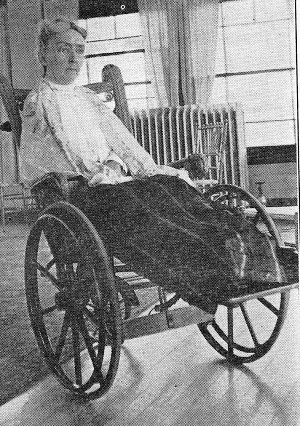
She was born the year after the Civil War. Her mother died when she was three. Her father dropped her and her newborn sister off at the home of the widow of an army friend. Unable to care for the girls, the widow ultimately transferred care to a sweet, religious couple in the community. The girls spent happy years through their school days, but the older sister came to suffer from rheumatoid arthritis as a teenager. It steadily grew worse until she could not walk. Their adopted parents died within months of each other, and the young women were poor and had little prospect of earning money for themselves. Before her affliction, she had developed aspirations as a concert pianist and shown great promise as a poet and writer. Arthritis robbed her on the musical dreams, but she flourished as a poet and hymn writer. Rather than seek relief from her pain through suicide, she channeled her suffering into beautiful writing that continues to comfort others as it did in her lifetime. Ravi Zacharias summarized her suffering, saying, “Her body was embarrassed by incontinence, weakened by cancer, and twisted and deformed by rheumatoid arthritis. She was incapacitated for so long that according to one eyewitness she needed seven or eight pillows around her body just to cushion the raw sores she suffered from being bedridden” (“The Cry For A Reason In Suffering,” np; other information from The Story of Annie Johnson Flint, Rowland Bingham). Her poetry and songs are not riddled with bitterness or even soul-wrenching questions of why. You’ll find titles like “The Grace Of God,” “Not Down, But Through,” “Rest, Tired Heart,” “Grace Sufficient,” “He Giveth More Grace,” “He’s Helping Me Now,” and on the hopeful, positive compositions flow.
We have only one of her hymns in our song book, and it is entitled, “The World’s Bible.” These familiar words include the lines, “Christ has no hands but our hands to do His work today, He has no feet but our feet to lead men in the way….” I appreciate the living testimony Ms. Flint was of the way one who believes in Christ ought to respond to the tragedies and difficulties that can strike in this fallen world. I pray that I will never be wracked by such suffering, but if I do I would want the world to see the spirit in me that so many saw in her. Her life was one of trust in God’s sufficiency and strength through the darkest moments of life.
Our state (Colorado) was one of a few that has passed physician-assisted, right to die legislation in the recent election cycle. Besides the ethical slippery slope of people, even doctors and patients, selecting when to end life, there is in such an effort a failure to see the intrinsic value of life as well as God’s sovereign right over His creation. Ms. Flint’s situation makes us cringe in discomfort at first blush, but we see the refined beauty of a trusting heart to impart profound comfort despite life’s harshest turns. To persecuted Christians, Peter offers this hope for all strugglers when he writes, “After you have suffered for a little while, the God of all grace, who called you to His eternal glory in Christ, will Himself perfect, confirm, strengthen and establish you” (1 Pet. 5:10; cf. 1 Pet. 1:6-7). Whatever the trial, we can choose life instead of death, trust in God rather than trust in our own thoughts. Let us live in triumphant expectation, no matter what we may have to endure for the moment (Rom. 8:38-39; Psa. 30:5).

Neal Pollard
Satan is the accuser of the brethren (Rev. 12:10). He is the author of audacity, and he showed it first in Eden. He is at work today through temptation and suffering to try and dismantle our faith. He is a presence in our personal lives (1 Pet. 5:8). If there’s hurt, he’s happy. If there’s sin, he’s satisfied. He can’t force anyone to sin (Js. 1:13-15). He can’t make us fall away (John 10:28-29). But, he’s at work. Paul writes about something that has long mystified the Bible student, in 2 Corinthians 12:7-10. In that passage, we have:
Paul reveals Satan’s involvement in that thorn. This troubles me. I have never asked for a thorn in the flesh and I have no reason to think Paul asked for his, but he got one anyway. What do you do when you have a thorn in the flesh? Consider at least three things Paul teaches us in this powerful passage.
No one is immune from thorns. Who’s talking in this text? The great apostle Paul, a man God gave revelations, who’s preaching across the world, converting so many, and achieving name recognition for the best of reasons. If you ever thought anybody would be sheltered for doing right, it would be him. But Paul says there was given to him a thorn in the flesh. That makes me uncomfortable. I need spiritual lessons about God and myself, as Paul and even Job, who Satan was allowed to buffet, did. If a great Old Testament patriarch and great New Testament preacher had thorns to deal with, I know I am not immune.
Sometimes, God lets the thorn stay. We may have to accept that our given affliction may never come to an end as long as we’re on this earth. A recurring or chronic illness, constant adversary, or irreversible limitation may not be removed. I wish I knew why God told Paul “no” and why he sometimes tells us “no” when we ask for our thorns to be removed. But, even if we keep the thorn, God’s grace is sufficient and He can use that very thing to accomplish good through us for the Kingdom. God uses thorns to supply us with humility and grace. If our thorn comes and stays rather than comes and goes, God will use it for our good and to accomplish good if we will properly view it.
Thorns are growth opportunities. If we remain faithful to God through our thorns, we will spiritually grow. Satan is rebuffed and defeated, as he was with Paul and Job. But, for every Paul and Job, how many have let affliction and adversity destroy their faith? We know God’s power eclipses Satan’s. But don’t underestimate this enemy (2 Cor. 2:11; 11:14; 12:7). One of Paul’s final points in the letter is about God’s great power (13:4). Paul was weakened by affliction, but he could endure because of faith. God is more powerful than Satan and Paul’s thorn is but one proof of it. Lyte wrote,
As woods, when shaken by the breeze, take deeper, firmer root,
As winter’s frosts but make the trees abound in summer fruit;
So every Heaven-sent pang and throe that Christian firmness tries,
But nerves us for our work below, and forms us for the skies.
Is it a trial or a blessing in disguise? Doesn’t it depend on how we view it and what we do with it? Satan wants to use afflictions to destroy us, but God is greater. He can transform our tragedies into triumphs. Trust Him through the thorns. The roses will appear!

Neal Pollard
Jesus died an awful death. Ruthless assassins, terrorists, sadistic and serial killers, savage and perverted criminals have all received much more humane treatment than He received that day. What Jesus endured at the cross can only be described as vicious. Consider the violent aspects of His crucifixion.
There was physical torture. He was scourged, beaten with a jagged whip (Mat. 27:27). He was fitted with a crown of thorns (Mat. 27:29). He was hit on the head repeatedly with a staff (Mat. 27:30). The soldiers struck Him with their hands (John 19:3). He carried His heavy cross until it fell on Him (John 19:17). He was nailed to that cross (John 20:25).
There was mental anguish. His countrymen hatefully yelled for His death (Mat. 27:25). Soldiers mocked Him and pretended to worship Him (Mat. 27:29). People hurled abuse at Him (Mat. 27:39,40). Religious leaders mocked Him (Mat. 27:44). The Heavenly Father left Him alone (Mat. 27:46). His disciples followed Him, mourning and wailing (Luke 23:37). Earlier, all His disciples forsook Him and fled (Mark 14:50).
There was social embarrassment. They stripped Him (Mat. 27:25). He was spit upon (Mat. 27:30). The soldiers gambled for His clothes (Mat. 27:35). He was watched like a sideshow (Mat. 27:36). They jokingly put an elegant, purple robe on Him (Luke 23:11). He endured great shame (Heb. 12:2).
The sheer brutality of the crucifixion tells one how serious sin is! The proposal from heaven is, “Stop sinning and serve the Savior!” In the light of the cross, examine Heaven’s every demand, command, and reprimand. What expectation from the Father or requirement from the Son is too great? Before answering, look back at the cross!

Neal Pollard
“Tell us father, were you really there that day?
Did they make you take His burden the rest of the way?”
“Son, I stood in the crowd when I got my painful commission,
And they thrust it on me without asking my permission.
He was staggering and bloody and gripped by exhaustion
I was pressed into service, whether expediency or precaution.
The skull-shaped brow scowled back from a distance,
As I offered that Sufferer my lowly assistance
I was far from the lush valley that cradled my idyllic town
In the bustling, boisterous crowd full of heckles and frowns
Taking outside of Jerusalem this rough-hewn beam
Accompanied by His friends and more foes, what a curious team
Every step in the cacophony of the heckling hateful
When I got to the spot, I was wearily grateful
To cease my assignment and be through with this affront
But I stayed long enough to see men with a malice so blunt
Take the man I relieved and affix Him securely
To the implement I’d carried so slowly but surely
With frightening precision they attached Him with nails
To the cross which they lifted, oblivious to any wails
For the pain, sons, I know must have been unrelenting
As I watched this plain gentleman hang, with no champions dissenting.
No, the crowd with their clamors. bloodthirsty and wild
Made a contrast with this Man, His face loving and mild.
He hung for six hours, and during that ordeal,
Things happened that day, both incredible and surreal.
At the end, after the torture and the mockery were through,
He’d said, “Father, forgive these who know not what they do.”
Now He offered the Father Himself, His own spirit,
I wonder how many of the rabble there could hear it.”
Alexander and Rufus, the sons of this infamous servant
Had a father involved in a task he did, whether feckless or fervent.
We know him today, though we know not what became of the man.
Did it cause him to follow or, like Pilate, to wash his hands.
Was the Rufus of Romans Simon’s son, whom Paul adored?
Was Alexander the villain Paul scornfully deplored?
We won’t know on this earth just who all these men were,
Though we’d like a clear picture in place of the blur,
But we know on that morning, when we gained by Christ’s loss,
That this Simon of Cyrene carried Jesus’ cross.
Today we are called to assume a great load,
Not His cross, but ours, is the burden that’s bestowed.
The cross of self-denial, we must kill our self-rule
And be His, day by day, until our journey is through.

Neal Pollard
Friends, the cross spells the difference between heaven and hell, hope and hopelessness, joy and sorrow, night and day!

Neal Pollard
Chameleons are truly one of God’s most fascinating creations. Their tongue can be twice the length of their body! Their feet are climbing marvels. Their eyes can focus on two objects at once, and they have a 360-degree arc of vision. They can see both visible and ultraviolet light (information via Journal of Comparative Physiology, 2/98, PNAS, Vol. 107, No. 12, A Field Guide to Amphibians and Reptiles, et al). Despite all of this, what do we associate the chameleon with? It changes colors to blend in with its environment. From this alteration of appearance, we have come to use the word in a figurative sense. To be a chameleon has come to mean one who becomes like those around them in order to blend in with them. Often, the term is not used in a complimentary way.
Paul tells us that he was able to relate to people of different circumstances, adapting himself to peoples of different backgrounds in 1 Corinthians 9:19-22. Context and other passages would not lend support to the idea of compromising biblical truth in order to fit in with anyone. He would not sacrifice doctrine for fellowship with those in error nor would he sacrifice moral truth to accommodate those of a worldly mindset. Motivated by a burning desire to convert the lost to Christ, Paul went among the Jews, those under the Law, those without the law, and the weak and used his knowledge, experience, and familiarity with people in those circumstances “for the sake of the gospel” (23). But he did all of that, being under the law of Christ, in a disciplined way (27).
We are tempted to alter our speech, compromise our convictions, hedge our beliefs, and place ourselves in ungodly situations in order to fit in with people whose acceptance we seek. We may feel we have to put our lights under a basket (cf. Mat. 5:15) to appease a client, coworkers, non-Christian family, or others whose association or friendship we’ve made. It can feel more comfortable to blend in, to conform to them (cf. Rom. 12:1).
Peter writes to Christians faced with persecution, encouraging them to suffer in this world in order to gain unsurpassed joy and blessings in eternity. They were tempted to enjoy comfort and acceptance here only to forfeit God’s acceptance at the Judgment. It is so hard to see past what we’re facing right now, but we must ready to suffer with Christ (cf. 1 Pet. 4:12-19). Our challenge is to relate to as many people as possible, understanding and loving them without participating with them in what’s not right or making them think that they are right in living contrary to the way of Christ. Politicians may “go along to get along,” but Christians have a higher calling. Make sure your Christian light shows up in the crowd!

Neal Pollard
I have never lost a child and pray that I will precede them all in death. Imagining the difficulty of that situation in no way equips me to feel the grief involved in such a loss. Yet, the Bible is the answer book on this, as with any, situation.
In 2 Samuel 12:18-24, the Bible says, “And it came to pass on the seventh day, that the child died. And the servants of David feared to tell him that the child was dead: for they said, Behold, while the child was yet alive, we spake unto him, and he would not hearken unto our voice: how will he then vex himself, if we tell him that the child is dead? But when David saw that his servants whispered, David perceived that the child was dead: therefore David said unto his servants, Is the child dead? And they said, He is dead. Then David arose from the earth, and washed, and anointed himself, and changed his apparel, and came into the house of the LORD, and worshipped: then he came to his own house; and when he required, they set bread before him, and he did eat. Then said his servants unto him, What thing is this that thou hast done? thou didst fast and weep for the child, while it was alive; but when the child was dead, thou didst rise and eat bread. And he said, While the child was yet alive, I fasted and wept: for I said, Who can tell whether GOD will be gracious to me, that the child may live? But now he is dead, wherefore should I fast? can I bring him back again? I shall go to him, but he shall not return to me. And David comforted Bathsheba his wife….”
The occasion of the death o a pre-born, newborn, infant, or young child must be a peculiarly difficult burden to bear. It is untimely. It is filled with the most painful of mysteries. It is a most intense reminder of the ultimate end of all humanity (Hebrews 9:27). Yet, it offers a ray of hope and comfort like no other funeral can. Even as tears stain the cheek, there can be rejoicing in knowing the child is eternally safe. It will never know the heartache, pain, disappointment, shame, guilt, fear or betrayl through which we routinely go simply by virtue of earthly life.
The Bible says that other parents lost small children. An unnamed woman lost a son to death at the age of three days old (1 Kings 3:16-27). 1 Kings 14 tells of the death of Abijah, son of Ahab and Jezebel. All we can tell from the term “child” in that text is that he was anywhere between infancy and adolescence; thus, a small child. In the New Testament, Jairus lost a “little daughter” (Mark 5). From ancient Job to the New Testament widow of Nain to today, parents have endured the difficult, unnatural task of burying their children. Yet, there are special lessons to be learned in the account of David and Bathsheba’s little boy. Consider four things, from the above text, to be gained when dealing with the loss of a little child.
Do not forget your relationship with God (20). When David hears news of the child’s death, what is the first thing he does? He arises from the dust of dejection and goes to church! He had been praying to God all the time the child was dying. It is natural that David continued his relationship with God.
It must have been a test of David’s faith. Read the Psalms and you find the man after God’s own heart (cf. 1 Samuel 13:14) often asking God “why?”. In Psalm 10:1, he said, “Why, O LORD, do you stand far off? Why do you hide yourself in times of trouble?” He later says, “My God, my God, why have You forsaken me? Far from my deliverance are the words of my groaning. O my God, I cry by day, but You do not answer; And by night, but I have no rest” (Psalm 22:1-2, NASU). Remember that David cried seven days and nights over the child he lost. Certainly, he knew that God was near, God cared, and God loved him, but he was hurting and things surely seemed unfair.
You may very well feel the same way when you lose a child. Remember that this is natural, but do not forget your relationship to God. Know that God is near, cares for you and loves you, too. An oft-quoted but appropriate saying goes, “Where was God when my child died?” “Exactly where He was when His Son died.” Tragedy and suffering can always serve to build spiritual strength. It can cause us to realize our dependence upon God. It can help us sharpen our focus on heaven. It can lead us to count our blessings and remember what we do have.
Remember that your lives must resume (20-22). No, not today… or tomorrow. In an unavoidable way, life could never be exactly the same. Grief is natural and necessary, and it has no exact timetable.
Yet, look to David. He got back to daily life. When he received news of his baby’s death, he got up, went to worship, ate a meal, and resumed his work affairs. As painful as such a loss has to be, one can be thankful and mindful of all that remains that is to be lived for and the many loved ones with whom one has left to live. As hard as it is to imagine in the midst of grieving such a peculiar loss, you will laugh again and enjoy life again when the time is right.
Let a heavenly reunion motivate you (23). To me, these are the most impressive words of the story. David says, “I shall go to him, but he shall not return to me.” We know where the baby was, so we know where David wanted to go.
Those who lose a little child have an extremely powerful motivation to go to heaven. Not just that heaven is infinitely better than the awful alternative. Not just the excitement of seeing God “face to face.” There is a little child up there waiting for the arrival of his/her parents. Imagine what a sweet reunion that will be, to see it there. Each time such parents sing, “Won’t it be wonderful there…?,” they will have an extra measure of appreciation of those words. Parents grieving this loss can live the remainder of their lives determined to “go to him.”
Find comfort in one another (24). There is something in the text easy to overlook. David goes and comforts his wife, Bathsheba. Didn’t David need comforted, too? Yes, but Bathsheba had a bond and relationship with the child that David did not. Her emotional makeup and needs, in such loss, were different from his own.
There is a special need for a wife and mother at such a time as this. As this tragedy can bring parents closer to God, it can also bring mutually aggrieved mates closer to one another. It is a time when you can better appreciate Ecclessiastes 4:9, that “two are better than one….” Thessalonica was going through tremendous heartache and even loss, and you will notice that at least seven different times Paul admonishes them to “comfort one another.” God knew there would be times when we would need support. There is special support available from one’s help-meet and companion.
When a little child dies, there is grief because of that tragedy. There is also cause for rejoicing because of the assurance that can be had concerning the baby’s soul. The sun will shine again through the clouds of sorrow. The brightness of God’s love will break visibly before the dewy gaze once more. Thank God for the comfort possible only in Christ.


Neal Pollard
The ISIS beheadings so frequently in the news and readily available on the internet are terrifying to behold and consider. If terrorism is, as the Mac Dictionary defines it, “the use of violence and intimidation in the pursuit of political aims,” such would be terrorist activity. The latest spectacle, involving 21 “Coptic Christians” (Egyptian Orthodox religion), seems to show the Islamic State organization is eager to isolate and persecute those seeking to follow Christ.
Do you ever wonder if there will come a day where New Testament Christians in this country may face the threat of death for standing up for Christ? It has certainly happened to God’s people in the past, especially when the church was first established. We read about the persecution that started with Stephen then extended to the saints at Jerusalem in the book of Acts. We read of individuals like Paul, who suffered for Christ on many occasions (2 Cor. 11). Then, there are the statements made to encourage Christians who might be rattled or scared at the prospect of such treatment. Twice, writing the Thessalonians, Paul was concerned they would be disturbed by trouble (1 Th. 3:3; 2 Th. 2:2). He wrote about how persecution was, at times, inevitable (Ph. 1:29; 1 Th. 3:4; 2 Tim. 2:3; 1 Pt. 3:14). Of course, Christ showed us His way includes suffering (1 Pt. 2:21ff).
The Bible also gives us great encouragement in the face of the disturbing prospect of suffering for our faith. Consider a few highlights:
I don’t think any of us relish or welcome the thought of suffering under any circumstances. Yet, God has communicated these truths to us to help us decide in these potential trials. Perhaps it will help us be less disturbed and more determined to be faithful even to the point of death (Rev. 2:10).

Neal Pollard
The United Nations’ very conservative estimate is that well over 2,000 people have died in the Donetsk region of Eastern Ukraine in fighting between that nation’s government have clashed with separatists. So many of the towns and cities in the region have congregations of God’s people, many of their preachers trained in our foreign extension school that for years was in Kramatorsk and of late has been in Gorlovka. One of our graduates reports that two gospel preachers have been kidnapped this month, though one of them has since been released. Our brethren in Ukraine have been facing the terror of daily bombing and shooting as well as fear for their safety when they assemble.
The ebola outbreak is an ongoing health concern and it is not yet contained. Nations affected include Liberia, Guinea, Sierra Leone, and even Nigeria. One of two Americans on medical missions in Liberia, Dr. Kent Brantly, is a member of the church. While its not clear whether any of our native brethren in these African nations have gotten sick or died, they certainly feel the threat and concern of a disease that claims between 50 and 90 percent of those who contract it.
Around the world at any given time, we have brothers and sisters who face health scares, hunger, harm, and hatred. Persecution, natural disaster, famine, and war are no respecter of persons, and “our people” are often affected. How they need our constant prayers as well as whatever assistance we can prudently provide.
On our pews in the local church, though without the drama and press coverage, there are always those who are struggling with hurts, heartaches, health, home, and hardship. They may not trumpet their complaints or even publicly ask for encouragement, silently suffering. As we interact with each other, let us keep in mind the potential hidden concerns and burdens being borne.
Paul encourages us, in the spirit of unity, to “have the same care for one another” (1 Co. 12:25). He tells Colosse, “Put on a heart of compassion, kindness, humility, gentleness, and patience” (Col. 3:12). He tells Philippi to to look out “for the interests of others” (Phi. 2:4). Are we busy and bothered by our own concerns? Certainly! But may we ever cultivate greater sensitivity toward the silent suffering of our spiritual family, both near and far.

Neal Pollard
As part of the personal evangelism class I just taught in Cambodia, I had the students engage in role-playing for a couple of days. It was wonderful and memorable. Some of the students are brand new Christians and have no experience doing personal work. All of them got into it wholeheartedly. Perhaps the most poignant moment came about purely accidentally. We had a table set up, with a teacher, silent partner, and student. The “student” was to come up with the issue or dilemma for the “teacher” to solve. In one particular scenario, the “student” hit the teacher with his true background. He said, “When I was born, I did not even get to see my parents. They died and I am an orphan. If there is a God, why did this happen?” His teacher gently and unassumingly said, “I think I understand. I lost my parents when I was young, too, and I am an orphan.” There followed a beautiful lesson on God’s love and pretty good insights on why there is suffering in this world. But the fact his teacher not only comprehended, but experienced his situation made a huge impact on everyone in the room.
We will suffer in a great many ways throughout our short sojourn on this earth. At times, we may think that not another soul on earth understands. Perhaps, there will come a time when that is actually true. However, we will never encounter a single trial but that someone will always understand. He may not be on earth, but He is ever-present. He is actually omnipresent. The Hebrews writer says of Him, “For we do not have a high priest who cannot sympathize with our weaknesses, but One who has been tempted in all things as we are, yet without sin. Therefore let us draw near with confidence to the throne of grace, so that we may receive mercy and find grace to help in time of need” (Heb. 4:15-16). As we bring our biggest, most debilitating issues into His presence, He gently says, “I think I understand.” Praise God!

Neal Pollard
Untold millions are unaware of the value of the blood of Jesus. You and I must decide what the blood of Jesus means to us. Interestingly, in four different ways, the Bible tells us that what the blood does for us we obtain the benefit of through baptism.
—The blood of Christ sanctifies (Heb. 13:12). We are sanctified by baptism (Eph. 5:25-27).
—The blood of Christ washes away sins (Rev. 1:5-6). Sins are washed away at baptism (Acts 22:16).
—The blood of Christ remits sins (Mat. 26:28). Sins are remitted through baptism (Acts 2:38).
—Jesus shed His blood in His death (John 19:34). We contact the dead of Jesus at baptism (Romans 6:3-4).
The Bible makes clear not just what the blood of Christ means to our souls, but also how we get the benefit of that blood. May we do what God says do to receive the benefits of Jesus’ blood and continue to walk in the light of Christ in order to have that blood continually cleanse us from all unrighteousness (1 Jn. 1:7).


Neal Pollard
Marilyn J. Abraham revealed something remarkable that a forest ranger told her about how trees protect themselves. The ranger said that when a tree’s life is threatened, stressed by fire, drought, disease, or whatever, it twists beneath its bark to make itself stronger. You cannot see this new inner strength on the surface. The bark often looks the same. It is when the exterior is stripped away or the tree is felled that its inner struggles are revealed.
The ranger’s story tells us several helpful things. Often, we do not know the depths and extremes of others’ suffering. Too, usually, no one knows the depth and extreme of our suffering. But, God is able to help make us stronger even through the struggles through which we go.
Asaph wrote, “My voice rises to God, and I will cry aloud; My voice rises to God, and He will hear me. In the day of my trouble I sought the Lord; In the night my hand was stretched out without weariness; My soul refused to be comforted” (Psa. 77:1-3). Asaph depicts a mighty inner struggle, one wallowing in the pit of despair. When things seemed most hopeless, the struggler saw that His pain had changed His view of God. He had focused on God’s anger and seeming rejection. But, then, He remembered who God is. He thought about God’s deeds, His power, His holiness, and His leadership. Then, he had the help he needed to handle the hurts.
To those who are hurting, remember who God is and what He can do! Think about the strength and growth God can produce in you through the trials you are enduring. May all of us understand, as we deal with others, that we may not be able to tell how much others are hurting when we see them. Let us deal gently with others, since we do not know their inner struggles.