
Gary Pollard
You’ve probably felt distant from the scriptures at some point because of their archaic origin. If we’re honest with ourselves, it can be difficult to resonate with texts so far removed from our own experiences. We have aircraft that’ve operated in excess of 85,000 feet altitude, traveling at over three times the speed of sound. We manufacture mind-bogglingly complex things at a microscopic scale with ease. Robots perform surgeries. We can stare at the Orion Nebula, Jupiter, Saturn, Mars, Venus, and other celestial wonders in our backyards with cheap, mass-produced telescopes. Unfortunately, we also have weapons capable of erasing hundreds of thousands of lives in a fraction of a second.
This barely scratches the surface, and anyone who likes to research the limits of human ingenuity knows that “DARPA1 is always about 25 years ahead of what the public is aware of.” The phones in our pockets are millions of times more powerful than the guidance computer that put man on the moon2, and even the AGC was lightyears ahead of anything a shepherd in antiquity could comprehend.
We live in a world that feels, in many ways, totally disconnected from the one that birthed the divine texts we rely on for guidance and godly living. So what makes them useful, relevant, or invaluable? Their use of symbolism and their appeal to transcendent principles. It’s as if the authors of the New Testament were aware of the trajectory humanity would follow! Why not communicate using mathematics? We consider math to be the universal language — something that has its roots in vastly ancient times. But math can only reach a limited number of people: few can understand it adequately (least of all me). Instead, the New Testament writers employed stories, parables, and first principles to set up a system that would never be truly irrelevant.
No matter how advanced our technology becomes, its principles will always be powerful. “Take care of the vulnerable.” “Love other people, even your enemies.” “Live like you’re going to stand before a judge after you die.” “Put the needs/desires/feelings of other people ahead of your own.” On a more concrete level, the New Testament speaks of earth’s impending destruction — a final one this time. We have the passage in Hebrews (quoting Haggai), “Once again I will shake the earth, but I will also shake the sky.” The geological record (and our own eyeballs) shows incontrovertible evidence of colossal destruction at some point in the past. Earth was repaired (cf. Ps 104), but is destined for complete destruction and final repair (cf. II Pt. 3). All of its messages have the same power today that they had millennia ago!
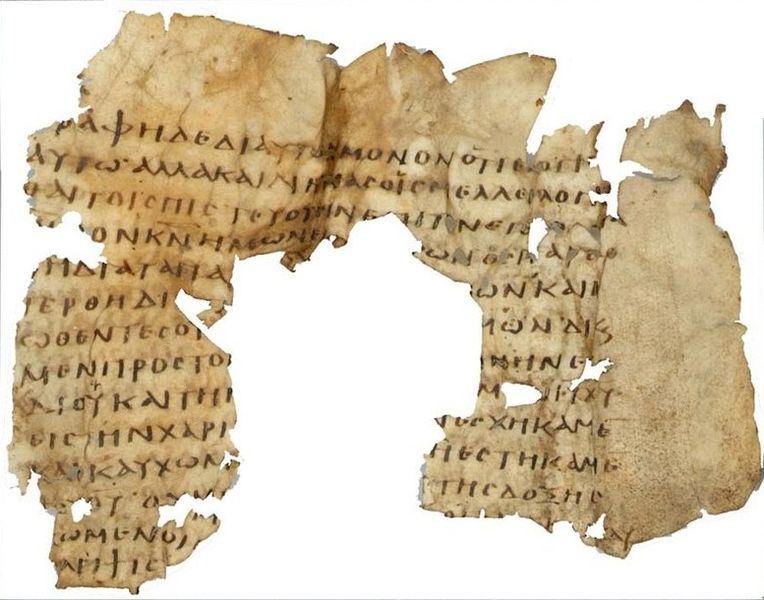
The language of the New Testament can be understood by just about anyone, especially if using a half-decent, Easy-to-Read3 translation. That the New Testament doesn’t bog itself down with messages relevant only to the culture of the ancient world is a powerful evidence of a divine origin. There are other internally-consistent, well-attested ancient writings with seemingly-anachronistic scientific knowledge and profound philosophical principles — but these can only be understood after immersion in their historical-culture contexts and symbolisms. Few have the time, energy, or desire to do so. Even in their day, that knowledge was closely guarded, available only to kings, elites, or the initiated. The New Testament presents many of those same principles (without the baggage, of course) in language any truth-seeker can comprehend. The message of the New Testament tangibly alters the feelings, perceptions, and behaviors of its adherents in ways that only benefit everyone — if practiced without the interference of human traditions and bad motives. God’s word stands on its own and needs no assistance.
So, the message of the New Testament remains as relevant today as it was 2,000 years ago. Rather than feeling disconnected from it, we should appreciate its extreme value more than ever! It has never been more relevant to our world than it is now! Our “advances” have had an inversely proportional effect on our capacity for goodness. Only God can save us, and we welcome his return.
You have to be aware of this: There are some terrible times coming in the last days. People will love only themselves and money. They will be proud and boast about themselves. They will abuse others with insults. They will not obey their parents. They will be ungrateful and against all that is pleasing to God. They will have no love for others and will refuse to forgive anyone. They will talk about others to hurt them and will have no self-control. They will be cruel and hate what is good. People will turn against their friends. They will do foolish things without thinking and will be so proud of themselves. Instead of loving God, they will love pleasure. They will go on pretending to be devoted to God, but they will refuse to let that “devotion” change the way they live. Stay away from these people!
1 Defense Advanced Research Projects Agency. Its former director (Lukasik) once said, “If you need a weapon system and don’t already have it developed, it’s too late.”
2 I realize this is increasingly considered controversial. Whether man visited the moon or not, the AGC is a real component on a real spacecraft which can be viewed today at the National Air and Space Museum’s Steven F. Udvar-Hazy Center in Chantilly, VA.
3 I’m not biased at all.




















 The Preacher Pollard Blog