CHECK THOSE LOTTERY NUMBERS CLOSELY!

Neal Pollard

Today, we are finding out that three winning lottery tickets were sold in the record-setting Powerball jackpot, one in California, one in Florida, and one in Tennessee. Each ticket is worth $528.8 million dollars. That’s an attention-getting number.  Here are a few more.  $70.1 billion dollars, the amount Americans spend on lottery tickets every year (more than Americans spend on sports tickets, books, video games, movies, and music combined). $755. That’s the average per-capita spend on lottery tickets in South Dakota. $800. That’s the per-capita spend in Rhode Island, who holds the ignominious distinction of leading the nation in this category. $230. That’s the per-capita average spend of every man, woman, and child in the 43 states where the lottery is played. One-third and one-half.  The poorest third of households buy half of all lottery tickets (statistics via theatlantic.com, Derek Thompson, “Lotteries: America’s $70 Billion Shame”).

Newscasters often report on these jackpots and encourage viewers to “check the numbers.” Lottery commercials often vie with beer commercials as some of the more humorous, clever ones to be seen. In the media and public venues, lottery ticket purchasing is usually portrayed as a harmless, even exciting, diversion. Perhaps many have failed to look more closely at what these other numbers mean for a person’s ethics and morality.

John A. Hobson, in the January 1905 edition of International Journal of Ethics, examined “The Ethics Of Gambling.” In an examination of gambling, including lottery contests, Hobson observes:

Gambling involves the denial of all system in the appointment
of property: it plunges the mind in a world of anarchy where
things come upon one, and pass from one miraculously. It does
not so manifestly sin against the canons of justice as do other
bad modes of transfer, theft, fraud, sweating (sic.), for every one
is said to have an equal chance; but it inflicts a graver damage
on the intellect. Based as it is on an organised rejection of all
reason as a factor, it removes its devotees into a positive atmosphere
of miracles, and generates an emotional excitement that inhibits
those checks which reason more or less contrives to place upon
emotional extravagances. The essence of gambling consists in
an abandonment of reason, an inhibition of the factors of human
control (Vol. 15, No. 2, 138).

Hobson was looking at the underlying psyche of those so eager to gain as much as possible while exerting as little effort as possible. But he decries more than laziness. He puts his finger on the most dangerous aspect of things like playing the lottery—the Bible calls it “covetousness.” It is an irrational, often compulsive, attempt to obtain wealth.

The BDAG lexicon defines the covetous person as “one who desires to have more than is due, a greedy person, whose ways are judged to be extremely sinful by Christians and many others. In Hellenic society this was a violation of the basic principle of proportion and contrary to the idea of beneficent concern for the citizenry” (Arndt, William, Frederick W. Danker, and Walter Bauer. A Greek-English lexicon of the New Testament and other early Christian literature 2000 : n. pag. Print.). Greed is not confined to practices like playing the lottery, but it is legitimate for one to ask what motivates their play?

What is clear is what Scripture says about covetousness: it prevents one’s inheriting the kingdom of God (1 Cor. 6:10), it is idolatry which again prevents inheriting this kingdom (Eph. 5:5), it is a failure to love one’s neighbor (Rom. 13:9), and it is a defilement of the heart (Mark 7:22). Let’s make sure that greed and covetousness do not “have our number.”


1st_california_lottery_tickets1

How Do You Spell “Cross”?

Neal Pollard

  1. “SEE”– Look at Calvary. Don’t turn away. I know it’s not easy. What is done to Him is shameful. I know. But, look closely! Past the spittle. Beyond the blood. There. In His eyes. Friend, that is love. It is love for you! See the nails in His hands and feet, fastening Him to a tree He created for man’s use. Look at the love He has for you!
  2. “ARE?”–Are you able to see that He bled and died for you? Are you willing to admit you’re lost without Him? Are you ready to submit to His will, to obey Him, and to live for Him? Are you prepared for eternity? Are you convinced?
  3. “OH”–Hear His cries of pain and agony. The death of a thousand deaths. Bitter moans of His disciples. The gasp of heaven’s angels. The sorrow of a Father for His only begotten Son! The gasps and exclamations of a hateful mob.
  4. “SS”–That’s the hiss of the beguiling serpent. The one who is bruising the heel of the perfect One, putting God the Son in the tomb. This is his moment of triumph. Though resurrection will soon spell victory for Christ and hope for man, at the cross the devil must be enjoying his front row seat at Calvary. Doesn’t he anger you? Disgust you? Motivate you? Live for Jesus, the Lion of Judah. Don’t live for the roaring, devouring lion.

Friends, the cross spells the difference between heaven and hell, hope and hopelessness, joy and sorrow, night and day!

4468491785_0c64a0f076_o_d

CHAMELEONS

Neal Pollard

Chameleons are truly one of God’s most fascinating creations.  Their tongue can be twice the length of their body! Their feet are climbing marvels. Their eyes can focus on two objects at once, and they have a 360-degree arc of vision. They can see both visible and ultraviolet light (information via Journal of Comparative Physiology, 2/98, PNAS, Vol. 107, No. 12, A Field Guide to Amphibians and Reptiles, et al). Despite all of this, what do we associate the chameleon with?  It changes colors to blend in with its environment.  From this alteration of appearance, we have come to use the word in a figurative sense. To be a chameleon has come to mean one who becomes like those around them in order to blend in with them.  Often, the term is not used in a complimentary way.

Paul tells us that he was able to relate to people of different circumstances, adapting himself to peoples of different backgrounds in 1 Corinthians 9:19-22. Context and other passages would not lend support to the idea of compromising biblical truth in order to fit in with anyone. He would not sacrifice doctrine for fellowship with those in error nor would he sacrifice moral truth to accommodate those of a worldly mindset. Motivated by a burning desire to convert the lost to Christ, Paul went among the Jews, those under the Law, those without the law, and the weak and used his knowledge, experience, and familiarity with people in those circumstances “for the sake of the gospel” (23). But he did all of that, being under the law of Christ, in a disciplined way (27).

We are tempted to alter our speech, compromise our convictions, hedge our beliefs, and place ourselves in ungodly situations in order to fit in with people whose acceptance we seek. We may feel we have to put our lights under a basket (cf. Mat. 5:15) to appease a client, coworkers, non-Christian family, or others whose association or friendship we’ve made. It can feel more comfortable to blend in, to conform to them (cf. Rom. 12:1).

Peter writes to Christians faced with persecution, encouraging them to suffer in this world in order to gain unsurpassed joy and blessings in eternity. They were tempted to enjoy comfort and acceptance here only to forfeit God’s acceptance at the Judgment. It is so hard to see past what we’re facing right now, but we must ready to suffer with Christ (cf. 1 Pet. 4:12-19). Our challenge is to relate to as many people as possible, understanding and loving them without participating with them in what’s not right or making them think that they are right in living contrary to the way of Christ. Politicians may “go along to get along,” but Christians have a higher calling. Make sure your Christian light shows up in the crowd!

bradypodion_pumilum_cape_chameleon_female_img_1767_cropped

Are You Willing To Be A Maintenance Worker?

Neal Pollard

Near the end of the epistle to Titus, Paul writes, “And let our people also learn to maintain good works, to meet urgent needs, that they may not be unfruitful” (3:14). This verse teaches that Christianity involves maintenance work. Everyone enjoys a finished product, few like putting it together, and fewer enjoy repairing or maintaining it. In the same way, “maintaining good works” in the local church can be tedious business. Everyone enjoys a comfortable building, but who will help work on it? Everyone is concerned about the sick and hospitalized, but who will take the time to call, write, and visit them? Everyone likes hospitality and good fellowship, but who is willing to provide it?  The church must be filled with maintenance workers.

On the personal level, it is sad but true that some individual Christians just “fall away.”  Jesus once taught, “They on the rock are they, which, when they hear, receive the word with joy; and these have no root, which for a while believe, and in time of temptation fall away” (Luke 8:13). In this verse, Jesus laments the failure of some believes to do that necessary, personal “maintenance work.” Preventatively, He teaches that we must maintain our joy of God’s Word. Nothing does this like reading and studying the Bible. Only those who are involved daily in this come to truly appreciate the precious value of its truth. Christ teaches that we must maintain our faith in God’s Word. It is hard to believe, but Jesus says that individuals can cease to believe in Him. This is dangerous, as Peter teaches one is better off knowing Christ than rejecting Him (2 Pet. 2:20-21). Christ also teaches that we must maintain our strength by God’s Word. Otherwise, temptation will pull us away from Him.

When Thomas O. Davis accepted the presidency of a civic club, he was not facetious when he prayed, “Now I get me up to work, I pray the Lord I may not shirk, and if I die before tonight, I pray my work will be all right.” An old proverb goes, “God gives every bird its food, but he does not throw it into the nest.” Too, God has given every man a Savior, but He will not just put salvation in our lap without our doing anything. In both the case of the bird and the man, there is work to be done to obtain and maintain what is needed. May all of use do good works eagerly (“be ready,” Titus 3:1), thoroughly (“to every good work,” Titus 3:1), blamelessly (“speak evil of no man,” Titus 3:2), and gently (Titus 3:2). That’s the way to excel in the maintenance business!

14833345841_cd20318b76_o

HOLDING THE CIGARETTE OUT THE WINDOW

Neal Pollard

I saw an older man, trying to negotiate a turn, with the window partially down and balancing a cigarette out of that window. It was 25 degrees, so my guess would be that he was not overheated by his tiny, burning cylindrical distraction. It’s not an uncommon occurrence, though I’ve normally observed teens doing this. A friend of mine in High School said he dangled his cigarettes out the window to keep his mom from smelling it in the car.  There may be more than one reason why people do this, but concealing the fact of one’s smoking (or at least its pungent smell) seemingly factors in.

Trying to conceal actions we know are wrong or think others will disapprove of is as old as the Garden of Eden. After Adam and Eve disobeyed God’s command, “the man and his wife hid themselves from the presence of God among the trees of the garden” (Gen. 3:8b). From that point forward, mankind has shown a remarkably similar tendency—regardless of century, geographical location, gender, age, or other demographical details—to try and cover up his sins. David, one whose heart was ordinarily pleasing to God, conceived such deception and dishonesty in an effort to hide his egregious sin with Bathsheba (cf. 2 Sam. 11:6-27). Solomon issues multiple warnings to those who, rather than repenting, attempt to conceal their iniquity (Prov. 10:6,11,18; 28:13).

It extends beyond just trying to conceal the smell of smoke, doesn’t it? Guilt, fear, worry, and shame usually leads the pornography addict, participant in an illicit relationship or affair, the problem drinker or drug user, as well as the general hypocrite, to use up a lot of energy and attention to covering up their wrongdoings. The hope is that they can keep discovery out of the reach and detection of the ones whose acceptance and approval they greatly desire to have. So often, these concealers have forgotten someone very important. Such is a serious miscalculation since that someone cannot fail to notice. The eyes of the Lord watch all the ways of man and his paths (Prov. 5:21) and “are in every place, watching the evil and the good” (Prov. 15:3). “The Lord looks from heaven; He sees all the sons of men” (Psa. 33:13).

We may conceal deep, dark secrets from even those closest to us for a lifetime.  Yet, ultimately, no one will get away with a lifestyle of sin.  God won’t be duped. We won’t pull the wool over His all-seeing eyes. Instead, our energy should be directed toward overcoming sin and looking to Him to give us the strength we need to do so.  All of us struggle with temptation and sin, but how we address it is an indicator of our character. May we be transparent with our God and honest with one another!

5870730384_7d062dd4d3_b

Carrie Fisher Wisdom: Do AND Deny

Neal Pollard

Social media is abuzz about both the caustic criticism of fans commenting on how poorly they think Carrie Fisher has aged and her withering response to their mean, thoughtless remarks. Barely in her twenties when she appeared as Princess Leia in the original Star Wars in 1977, she reprised her role 38 years later almost in her sixties. You will inevitably add some wrinkles and lose some tone in four decades. Fisher gave an interesting interview to Good Housekeeping that appeared just before the debut of the historic blockbuster earlier this month. Apparently, she felt she had to lose a significant amount of weight for the movie. How did she lose the 35 pounds? She says, “I did it the same way everybody has to—don’t eat and exercise more! There is no other way to do it. I have a harder time eating properly than I do exercising. It’s easier for me to add an activity than to deny myself something” (Good Housekeeping UK, staff, 12/7/15).

Most of us can relate to her insight. Being active and doing something takes some resolve and endurance, but withholding or removing what does not belong often challenges our appetites, desires, and cravings much more. This battle rages on an infinitely more serious front than weight-loss, though. Jesus makes self-denial a salient ingredient of discipleship (Luke 9:23).  BDAG indicates this word for deny means, “To refuse to pay attention to, disregard, renounce (oneself in this passage)” (Arndt, William, Frederick W. Danker, and Walter Bauer. A Greek-English lexicon of the New Testament and other early Christian literature 2000 : n. pag. Print.).  Restraining myself from saying a sarcastic, bitter, angry word is harder than lifting my voice in song or prayer. Fighting the urge to give in to a temptation requires more effort than doing something kind or necessary for someone in need. Our relationships are not just damaged through neglect or omission, but also by failing to conquer unhealthy and unwholesome attitudes, words, and actions.

Doing and denying are dual elements essential to overcoming this world. God wants obedience, but He also wants self-control. It was a staple expectation of Paul’s gospel preaching (Acts 24:25). It is listed among the fruit of the Spirit (Gal. 5:23). It is among the Christian graces (2 Pet. 1:6). But as we regularly master it, we will shine Christ to those around us in a memorable way! As we do God’s will, let’s also deny ourselves.

file_carrie_fisher_at_wondercon_2009_4

How Well Do We Listen?

Neal Pollard

A Dilbert comic strip by Scott Adams is a side-splitter! Dilute is sitting in one of what seems like an endless series of meetings, and the fellow next to him is droning on and on about something. Dilbert thinks to himself that he will substitute an optimistic remark for listening and winds up making an inappropriate and awkward remark. The droner is aghast!

Listening is not a forte for most of us. In casual conversation with either acquaintances or intimate friends we often are much more intent to have our say than to hear out the other person. McKay and Davis, in Messages, mentions no fewer than 12 “listening blocks” (comparing, mind-reading, judging, dreaming, sparring, placating, etc.) (8-12). On just about anyone’s list of main contributors to marital difficulty is communication breakdown. A spouse may even hear what the other is saying but still miss the deeper messages being sent. Our children will find an audience to share their fears, questions, confusions, frustrations, and hopes. Parents who do not give their children an open forum, no matter how inconvenient it may be for them at times, lose their spot at that precious roundtable. In the church, we often lose our members–especially when they are in emotional, financial, or spiritual crisis–because we are not listening to what they say is going on with them.

We know how frustrated we feel when we think we have not been heard. Preachers and Bible class teachers usually have moments along the way when they think, “If I stopped talking right now, would anybody know or care?” Soul-winners may feel that their students sometimes respond to their teaching by tuning out the message. Elders and members often feel that way toward each other, that they are not being heard.

Let me encourage you to, borrowing the words of Jesus, “take heed how you hear” (Luke 8:18). A friend and former elder, John Langham, once reminded me of Proverbs 18:13, that “he who answers a matter before he hears it, it is folly and shame to him.” Make a special effort, in whatever position as listener you may find yourself, to work hard to actively, faithfully tune in to the one speaking to you. It is not only polite, but it allows you to be more clearly heard. Let’s practice today!

11810426815_dbb54f8e8c_o

Grateful For This Moment

Neal Pollard

We are enjoying health, with loved ones near
Calm and peace and moments of cheer
A cupboard full, everyone safe and warm
Blessings of every type and form
Enjoying salvation, much to look forward to
We have a quiet day with not much to do
Serenity sweeps over the entire home
Blue skies are coloring a cloud-touched dome
Our children are close, all are serving the Lord
They make us laugh and beam by deed and word
I have a godly spouse I love and she loves me
We live in a land of freedom and prosperity
Tomorrow’s uncertain and undeserving of worry
But for today I’m in absolutely no hurry
I will bask in this moment, aware of Who bestowed
And thank Him profusely for to Him all is owed.

12299193_10153299921990922_8528593862146508233_n

HONESTY PAID JOHNNY DUCKWORTH NEARLY $4,000

Neal Pollard

A customer who ate at Randy’s Southside Diner in Grand Junction unluckily left $3,000 in a bank envelope at his booth. Fortunately, his busboy was Johnny Duckworth. Johnny gave it to his boss, who through the ATM bank slip in the envelope was able to track down the rightful owner. That unnamed person gave Johnny a $300 tip, but strangers started a “gofundme” page for the struggling Duckworth and have raised nearly $4000 for the young man. In an interview, he said he did not for a moment consider keeping the money, adding, “I work for a living” (denverpost.com).

You’ve not likely had honesty pay so well for you. At least not financially. But, as the proverbial adage goes, “honesty does pay.”  How?

  • In reputation. Honestly builds businesses, friendships, leadership, and the like, when people have implicit confidence in your word (cf. Proverbs 14:25).
  • In relationships. People trust you and are closer to you when you are honest with them. The opposite is true, too, that people keep their emotional distance from you if you are dishonest (Ephesians 4:25).
  • In righteousness. Your character is built through dedication to unconditional truthfulness (Proverbs 12:17).
  • In reliability. Who will people come to, lean on, and go to? The honest. They know where they stand with such a one (Proverbs 12:19).
  • In respect. While you may fear hurting feelings and alienating others through courageous honesty, you gain the admiration of most through transparency and scrupulous speech and behavior (1 Kings 22:13-14).

Sadly, doing the right thing was once routine but now it merits newsworthiness. May the tribe of Johnny Duckworths increase. When we as Christians are renowned for our kind honesty, we will draw a world in search of goodness and trustworthiness to the One who “cannot lie” (Titus 1:2).

WE WILL WEAR A CROWN

Neal Pollard

Miss Colombia, Ariadna Gutiérrez Arevalo, wore the crown of Miss Universe for a couple of minutes, before Steve Harvey came out and sheepishly admitted that he accidentally mixed things up. She was actually first-runner-up to Miss Philippines.  Though I don’t get pageants at all, I understand human nature. In a sequence of awkward moments now blowing up social media, none is worse than the seemingly endless time before the crown is finally removed the head of a tearful Arevalo. She was confused, disappointed, and totally embarrassed. While these moments will live on in infamy, they will fade into insignificance soon enough.

Scripture illustrates the culmination of a faithful Christian life with the giving of a crown. Several New Testament writers speak of this crown, a prize or reward given to those who have turned in an outstanding performance. The New Testament extends this hope, that there is not just a crown for one contestant but for all who successfully compete and complete the most grueling obstacle course of all—life. Notice a few facts about this crown:

  • It’s Faithful (Jas. 1:12; Rev. 2:10). The one who faithfully handles his or her trials will receive the crown of life. We can be assured that it won’t be snatched from us because “the Lord has promised [it] to those who love Him” (Jas. 1:12). Jesus says, “Be faithful until death, and I will give you the crown of life” (Rev. 2:10). As great as the promises of God is the assurance that a faithful life will be followed by a faithful crown.
  • It’s Future (2 Tim. 4:8). We will not be crowned in this life but after successfully completing the Christian life. Paul was confident that the Lord would make no mistake in handing out this crown. He says that the Lord, the righteous Judge will award it to all who love His appearing on that Day of Judgment. At the end of the contest, the crown will be placed upon the heads of the winners!
  • It’s Fadeless (1 Pet. 5:4). Specifically, this promise is made to the church’s shepherds who faithfully execute their task. Peter calls it “the unfading crown of glory.” Some have argued this is a passage teaching degrees of reward, but whose heavenly crown will tarnish? Instead, here is another tribute to the fact that we will have a reward and recognition that never loses its luster.

The 2015 Miss Universe finale has been dubbed “cringeworthy.” What a deflating turn of events for a person who actually had the crown of victory snatched from her head!  Aren’t you thankful that, as we face eternity, we have a perfect Judge who will get it right in every case. Once we are crowned, He won’t take it back! Let’s keeping competing and complete the contest the culminates with the crown.

oops

Make The MOST Of Your Opportunities

Neal Pollard

A “TD” is a touchdown, also known as “crossing the goal line,” “getting in the end zone,” and simply “scoring,” the TD is a measure–maybe the most emphasized measure–of a player’s success.  Back in the late ’70s and early ’80s, a halfback from tiny California Lutheran College, all 5’10” and 200 pounds of him, played seven seasons with the San Diego Chargers. His name was Hank Bauer.

Most of his rushing statistics are quite forgettable. He ran the ball only 123 times for 377 yards, for an unimpressive 3.1 yards per rush. For the uninformed, those numbers will not get you into the Hall of Fame. It will land you on the practice squad. But, Hank Bauer was the ultimate opportunist. Running the ball, he broke the plane of the goal line eighteen times! 18 TDs in 123 carries is incredible! In 1978, he scored more rushing TDs than the great Franco Harris. He ran for more TDs than 1,000 yard rushers Terry Miller (Bills), Tony Reed (Chiefs), Tony Dorsett (Cowboys) and John Riggins (Redskins) did. In 1979, he ran for more TDs than Dorsett, Ottis Anderson (who ran for over 1,600 yards), Terry Bell (1,253 yards), and William Andrews (1,023 yards). Running for 1,000 yards is the watermark that determines success for running backs. But, Hank Bauer scored 8 TDs while carrying the ball 22 times for a whopping 28 yards! He also scored two TDs catching the ball, though he caught only 12 passes for a measly 97 yards in his career.

If you had trouble understanding the data above, Hank Bauer made the most of his limited opportunities. He came out of a tiny college, proving himself so important and dependable that he was given the ball whenever the Chargers were near the goal line. Twenty times, Bauer cashed in on his opportunities.

What about you? How much are you making of your opportunities? You were born in the wealthiest nation in the world, if you are in America. You have the world’s best healthcare, housing, food, raw materials, technology, water works, and standards of living. You also live in a nation that, by percentage, has more Christians than any other on the globe. It can be assumed that, since you are reading this article, you have also been exposed somewhere along the line to God’s plan of salvation (If not, here it is: Hear, Believe, Repent, Confess, and Be Baptized. Write me for more details). There is a pretty good chance you are a New Testament Christian.

Are you taking advantage of your opportunities? To pray? To attend worship services and Bible classes in a land fully granting you the freedom to do so? To study your Bible? To tell a lost soul about Jesus? To shine the light of Christ? To lead your family to heaven?

Pro football has had few Hank Bauers. On the other hand, a goodly number of Heisman Trophy winners (remember Larry Kelly, John Huarte, Gary Beban, Steve Owen, Pat Sullivan, Gino Torretta, Rahsaan Salaam, Eric Crouch, and Troy Smith?) fizzled out when given the opportunity to transform college immortality into professional greatness. I fear that too many of us squander our opportunities to use their time, money, energy, and abilities for God and good! Whether misplaced priorities or crippling sin habits or materialistic greed or simple apathy and inactivity or fear, too many of us are dropping the proverbial ball!

Make the most of your opportunities. Find folks to teach. Find time to develop your relationship with God. Find a way to defeat the sin in your life. Find the church building when the saints are meeting. Find out how good it feels to make the most of your opportunities for the Lord! In the end, you will find Heaven’s “Hall of Fame.”

hank-bauer-08272014

Could You Survive A Medieval Winter (Or An Ancient Persecution)?

Neal Pollard

How would you like to try and negotiate a Russian winter the way our Medieval forbears did, sans electricity, modern food conveniences, and Netflix? The Middle Ages, an approximate 1,000 years from about the time of the fall of the western Roman Empire (in Rome, Italy) to the time of the collapse of the eastern Roman Empire (in Constantinople, Turkey), also had a “Little Ice Age” from 1300 to “about 1870.” Sandra Alvarez writes, “Winter was a frightening time for many people; if there was a poor harvest, you could starve to death, and there was always the chance of contracting illnesses that could easily kill you, like pneumonia…. Winter was the most dangerous time in the medieval calendar year” (medievalists.net). A few years ago, a medievalist reenactment group (who know such existed?) selected one of their own “to live on a farmstead, with only ninth century tools, clothing and shelter for six months” (ibid.). Once a month they checked on him to make sure he was still alive.  The volunteer was undoubtedly hearty, but he could have left if he needed or wanted to. His more ancient counterparts could not.

I find it interesting to think about how people lived in the past, throughout the different periods of history. Dave Chamberlin is the master of transporting his students back to Bible history, describing the housing, diet, habits, and mindset of those in Old and New Testament times. It is incredible that people who lived so starkly different from us had the same feelings, needs, desires, and thoughts that we do today. How masterful that God wrote a book as ancient as the beginning of time and as modern as the morning news. It guides and directs us more adroitly than the best-selling survival guide by the world’s finest team of experts could.

As a Christian interested in restoring New Testament Christianity, I think about my first-century forbears. I assemble to worship in a much different style of clothing, singing songs with different tunes and illustrating sermons with different current events. As Christians visited at the conclusion of worship, did they have ancient equivalents for our talk of football, medical procedures and doctor visits, children’s and grandchildren’s social, athletic, and educational activities, and the like? Often, their pressing problems centered around surviving in a culture that, at times, detested them even while they enjoyed the great benefits of their godly lives. Their thoughts and prayers periodically centered around losing their jobs and possessions for being Christians (cf. Heb. 10:34) and even their homes, safety, and the threat of death (Acts 8:1ff; 12:1ff).

In some ways, our times are decidedly different. We enjoy many advantages and suffer a few disadvantages compared to our physical and spiritual ancestors. The time may come when we must face a winter without cars, electricity, and store-bought food. The time may come when we must face a culture so hostile to our faith that it costs us in a way none of us has yet experienced. The way to cope then would be the way we must cope now, by trusting a God whose provisions we often take for granted, whose love for us is greater than we could fathom, and whose promises are more enduring than life, death, and the grave. In the greatest trials, we can say with Paul, “31 What then shall we say to these things? If God is for us, who is against us? He who did not spare His own Son, but delivered Him over for us all, how will He not also with Him freely give us all things?” (Rom. 8:31-32). Nothing can separate us from His perfect love (Rom. 8:35-39). That, my friend, is timeless!

2992730336_d7f06aca71_z

We Need Strong “D”

Neal Pollard

Defenses win championships. The best offense is a good defense. You’ve heard these cliches. While it is insufficient to rely only on defense, you cannot succeed in sports without it. Defending one’s product is key in the business world, defending one’s nation is vital in the global sense, and defending one’s faith is essential for Christians in the spiritual realm. Paul said, “I’m set for the defense of the gospel” (Phil. 1:17). Several times, he had to defend his decision to preach Christ (Acts 22, 24, 25-26, etc.), his work for Christ (1 Cor. 9:2-3), and even his life because of his faith (2 Tim. 4:16). Peter says we are to be ready to defend our faith against the onslaught of unbelievers (2 Pet. 3:15).

We need strong “D” as a part of our Christian ethic. How do we cultivate it?

Study. You cannot defend what you do not know and understand yourself. Delight in the law of the Lord (Psa. 1:2). “Take pains with these things; be absorbed in them, so that your progress may be evident to all” (2 Tim. 4:15). Study is required to better know and understand God, Satan, the world, your neighbor, your brother and yourself.

Be sturdy. If you are on the battlefield, you’ve got to be able to endure the offensive onslaught of the enemy. Satan is hurling darts at you (Eph. 6:16). He’s stalking you (1 Pet. 5:8). He’s using his intelligence capabilities to infiltrate your defenses (2 Cor. 2:11). Since the Christian race is a long-distance event, there will be many occasions where you’ll want to quit and quite a few excuses you may give for quitting (cf. Heb. 12:1-2). Be durable and steadfast.

Be steady. Sports has its “streak players.” Some are professionally characterized as “on again, off again,” a euphemistic way of saying “unreliable.” You cannot be a successful defender of Christ by being inconsistent and sporadic. As a part of the local church, you are a member of the body and the other “body parts” rely on you working as you should (Rom. 12:5). It may be harder facing life as an amputee, but it surely must be aggravating to have a body part present that you can never count on to function.

Be ready. Have a ready mind (2 Cor. 8:13). Be ready to share (1 Tim. 6:18). Always be ready to be offered (2 Tim. 4:6). Be ready to every good work (Tit. 3:1). Be ready to answer for your faith (1 Pet. 3:15). Above all, be ready for Christ’s coming at any time (Mat. 25:10). That means being ready at every moment to live for Christ or die in Christ (Phi. 1:20-21). this is the ultimate defense of the soul, a readiness to suffer, sacrifice, and serve (Acts 17:11; 2 Cor. 8:5,11).

Good “D” necessitates that we study, be sturdy, be steady, and be ready. All of these attributes not only help to defend the cause of Christ, they are essential to the progress of the church and New Testament Christianity. How’s your “D”?

steelers_defense

I LOVE TO LEARN HIS WORD (Poem)

Neal Pollard

Each exploration is an expedition
Into new, uncharted depths
As deeper I go, with each new mission
I steady my faltering steps.

So much to learn and understand
I will never reach the summit
But the journey is sweet, His precepts grand
That guard me from a spiritual plummet.

Desire to know enlarges each time
I dig for unsearchable treasure
Better than gold and far more sublime
Than earth can weigh, feel, or measure.

Lord, help me to grow as deeper I go
Into Your will and mind
And help me to practice the truth that I know
So the fairer land some day I’ll find.

3668060306_88cc3d93fc_b

LET’S BE CAREFUL WITH OUR SCRUPLES!

Neal Pollard

The word “scruple” comes to us, as many words do, from a Latin word (in this case, scrupus) and it literally meant “rough pebble” and figuratively meant “anxiety.” It has come to mean “a feeling of doubt or hesitation with regard to the morality or propriety of a course of action” (Apple Dictionary, version 2.2.1, 2005-2015). All of us have scruples that reveal themselves in the standards we set for ourselves.  Often, our “doubt” or “hesitation” arises because of Bible teaching. We disapprove of sexual immorality because God forbids it. We shun drunkenness because Scripture condemns it. Where God commands something be done or avoided, we are simply exercising obedience by following His Word and even echoing His will by teaching it to others. In such cases, we are not making law but only seeking to be obedient to what God has already commanded. Yet, there are areas that fall within the realm of judgment where we must be careful to distinguish between our tastes, proclivities, and convictions and what God has actually said about it. In its more serious and sinister form, we may even draw lines of fellowship or form judgments about someone because they violate, not Scripture, but our scruples. Consider a short list of areas and examples:

  • That men must wear a suit and/or tie to the assemblies and women must wear a dress to the assemblies (most especially that the preacher must don suit and tie when he preaches).
  • Abstaining from watching all TV.
  • That putting up a Christmas tree or otherwise celebrating the season is wrong.
  • That one must offer an invitation after every sermon.
  • That there must be an evening worship assembly offered for a church to be sound.
  • Opposing tattoos of any shape, size, or place.
  • That children must be educated at home or in the public school system.
  • That allowing one’s teenaged children to date is inherently sinful.
  • That a preacher must support himself with a secular job.
  • That an organized youth program is wrong.

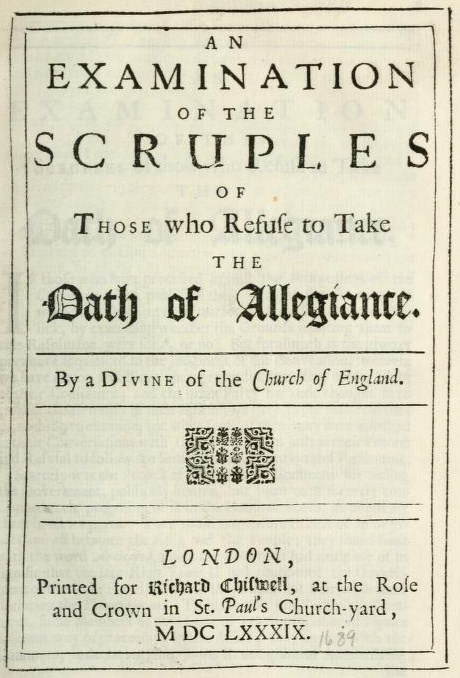
There is no way to be exhaustive with such a list, but what all of these (and other things) have in common is that we cannot find book, chapter, and verse that causes these scruples to rise to the level of commandment. I’m not talking about whether they are wise or unwise, what role principle might play in decision-making, or what is or is not the best judgment.  Short of a heavenly mandate, we must tread so carefully.  Most of the examples above have been the source of friction between faithful brethren who otherwise stand together upon the gospel foundation. I have strong, decided feelings on most of the matters mentioned above. A few might surprise you, but many may not. When it comes down to the brass tacks of practicality, though, we need to remember to balance Paul’s injunction to not only “bear with the scruples of the weak, and not to please ourselves” (Rom. 15:1) but also “receive one who is weak in the faith, but not to disputes over doubtful things” (Rom. 14:1). This requires such Christian qualities as wisdom, grace, patience, understanding, and love. Some battles can distract us from the real enemy. Let’s not allow that to happen!

allix_examination_of_the_scruples

“Weapons Of Mass Instruction”

Neal Pollard

The Department of Homeland Security has a fact sheet about the threat of chemical, radioactive, and biological weapons, euphemistically referred to as “weapons of mass destruction.” The International Atomic Energy Agency’s director, Yukiya Amano, spoke recently about the potential harm terrorists could inflict if they get their hands on such materials (cf. dhs.gov; iaea.org). A self-defining term, such weapons, bombs equipped with such agents as smallpox or ricin, could tear through populated areas and cause havoc in communities. Weapon implies something aggressive and powerful. Mass suggests an untold, large number. Destruction means done away or undone. The prospect of such is unnerving.

Yet, the Bible calls itself a weapon. It’s a sword (Eph. 6:17). It is a precise, sharp sword (Heb. 4:12). God says His “word” is “like fire…and like a hammer which shatters a rock” (Jer. 23:29). The word of God fights and destroys evil. It tears down prejudice. It melts away stubborn disobedience. It slaughters the old man. Everyone who does not yield to it now will ultimately do so (Phil. 2:10-11).

This weapon is intended for the masses. As the gospel is the power of God to save (Rom. 1:16) and the gospel must be preached to save (Rom. 10:10-17), the Great Commission—“Go into all the world and preach the gospel to all creation” (Mark 16:16)—entails taking the weapon out of hiding and applying it is “all the word” by preaching it. We’re not permitted to conceal it. If the weapon is appropriately received, it elevates man in his plight here (John 10:10) while it cuts away the spiritual dross (Ps. 119:119), circumcises the heart (Col. 2:11-12), and surgically removes the sin that will keep a soul from heaven (cf. Jer. 4:4). There is not a soul on the globe that can do without exposure to this weapon.

This weapon, meant for the masses, builds up and enlivens (John 6:63). It bears fruit (Luke 8:15). It gives spiritual health (Prov. 4:22). It is an aid and help (Psa. 119:147) At least 48 times, God’s word is called instructions. The word is said to be profitable because it instructs (2 Tim. 3:16). It instructs us on how to walk and please God (1 Th. 4:1), how to have fruitful discussion (1 Tim. 1:5), and how to have wisdom and understanding (cf. Prov. 23:23). It is a weapon which, when used, can save a life for eternity.

Are we working as agents to disseminate this weapon of mass instruction? We do not want to be guilty of far worse than war crimes as we stand before the heavenly tribunal! Eternity demand that we use this weapon!

6891372851_bddcc8d834_o

Driving Heavy Trucks Over Old Roman Bridges

Neal Pollard

Periodically, the Bear Valley Bible Institute shows the student body Francis Schaeffer’s classic video series, “How Should We Then Live?” There is a book of the same title that covers the same essential material. A part that particularly stands out in my mind is this analogy:

“A culture or an individual with a weak base can stand only when the pressure on it is not too great. As an illustration, let us think of a Roman bridge. The Romans built little humpbacked bridges over many of the streams of Europe. People and wagons went over these structures safely for centuries, for two millennia. But if people today drove heavily loaded trucks over these bridges, they would break. It is this way with the lives and value systems of individuals and cultures when they have nothing stronger to build on than their own limitedness, their own finiteness. They can stand when pressures are not too great, but when pressures mount, if then they do not have a sufficient base, they crash—just as a Roman bridge would cave in under the weight of a modern six-wheeled truck. Culture and the freedoms of people are fragile. Without a sufficient base, when such pressures come only time is needed and often not a great deal of time-before there is a collapse” (transcript via thedailyhatch.org, Everette Hatcher III).

His point is clear. When a culture’s base is atheism (there is no God), evolution (we are the product of mindless, aimless chance), materialism and humanism (things are god and man is the supreme authority), and hedonism (pleasure is the highest good), it can survive, at least for a time, in the absence of trial and pressure.  However, when a culture is subjected to tests and challenges, it only has its foundation to stand upon.

It is in times of pressure that passages we may see as simplistic and straightforward take on profound new meaning.  Ending His great sermon teaching about this very principle, Jesus said, “Therefore whoever hears these sayings of Mine, and does them, I will liken him to a wise man who built his house on the rock: and the rain descended, the floods came, and the winds blew and beat on that house; and it did not fall, for it was founded on the rock. But everyone who hears these sayings of Mine, and does not do them, will be like a foolish man who built his house on the sand: and the rain descended, the floods came, and the winds blew and beat on that house; and it fell. And great was its fall” (Matt. 7:24-27). Those word pictures make an ideal children’s song for Bible Class and VBS, but they also contain an imperative message for every society.  We cannot reject God and His Word, replace it with inferior substitutes, and remain in peace, prosperity, and protection. Jesus’ warning has eternal implications regarding everlasting destiny, but how often has Proverbs 14:34 played out in a society that removes its bedrock foundation to build its life on shifting sand?

Our task, as God’s people, is to double down our commitment to take the gospel to our neighbors (Matt. 28:18-20) and spread the message that hope and peace comes through submitting to the authority of Christ and His word and living by this as the pattern of life. What a beautiful transformation the Christian life provides us, no matter what frightening things happen around us. There is no test or pressure weighty enough to make that foundation crumble!

fas-iii-pic-1

What Does The “Sunday Morning Only” Christian Miss?


Neal Pollard

It is an eclectic club.  Some of its members have only ever come one service per week, whose perceivable spiritual progress has been hard to measure.  Others, perhaps more tragically, have waned from greater faithfulness in the past to the more tepid attitude toward the assemblies at which God is always present.  The Bible makes it clear that those who fail to put Christ first have put something in that place.  This is an unenviable position to be in.  Yet, these who neglect faithful attendance deprive themselves of so much.

  • They miss information.  Bible classes, sermons, table talks, and mid-week devotional talks all help increase our knowledge and strengthen our conviction in what we already know.  This information is like a flashlight for the journey in a dark, dark world (Ps. 119:105).  If we take heed to that word, we do well (2 Pet. 1:19).  To identify the enemy, you must know all about him.
  • They miss association.  The people dearest to God are there.  Christ, our Savior, friend, older brother, King, Shepherd, Door, and Mediator, is there.  The earliest Christians were stedfast in fellowship with each other, a fellowship contextually shown to be spiritual in nature (Acts 2:42).  Paul reminds us we should prefer one another, something we fail to show when we give preference to some other place and event (Rom. 12:10).
  • They miss inspiration.  We need our spirits lifted.  Others need us to lift their spirits, too (Heb. 10:24; cf. Phil. 2:3-4).  In worship we can get our spiritual batteries charged.  Coming together helps us each face the world.  We are to be renewed in the spirit of our minds (Eph. 4:23-24).  The assemblies aid us in this.
  • They miss provocation.  Often, we do things we know we should not do.  As such, we need to be provoked or stimulated to do what we already know is right (Heb. 10:24).  At the assemblies, we lift each other up and hold each other’s hands in our common life (cf. 1 Thess. 5:14).
  • They miss edification.  We have a responsibility to be here and build up other Christians.  Remember, love edifies (1 Cor. 8:1).  You cannot do that as well from a remote location.  We are to use our abilities to help perfect the saints, to work in ministry, and to build up the body of Christ (Eph. 4:12).  That’s a “done together” activity in which those withholding their presence cannot engage.
  • They miss immunization.  The world is infected with sin and it is often hard to live for Christ (cf. 1 John 5:19).  We can and do “inject” ourselves with strength at every service, an injection that will help us fight off the cancer of sin (cf. Jer. 7:18).  Attending all the services strengthens our spiritual health (Ps. 42:11).  Who thinks he or she is better equipped to fight alone than with the collective help of the church as well as the special strength available as by God’s design when we assemble together?
  • They miss jubilation.  There is nothing as seemingly miserable as the Christian who feels that it is his “duty” to come to the services (look at David–Ps. 122:1).  It is a shame that “S-M-O” Christians miss the excitement of baptisms and others who come forward for prayers, the encouragement of seeing new Christians participate in worship or young people demonstrating their faith, and the example of others whose words, actions, and attitudes make us glad we are Christians.  Few whose hearts and minds have been fully engaged in an assembly will walk away regretting it or being more depressed than when they arrived.
  • They miss obligation.  We are mutually accountable (Rom. 1:14; Heb. 3:13; Col. 3:13; etc.).  We are indebted to God (Rom. 8:12).  We are commanded by Him to come together (Heb. 10:25).  None of these obligations comes with an expiration date.  We consider those who shirk their obligations to be irresponsible.  What obligation outweighs the one laid upon us by the Lord?

The many, many principles of scripture lead to an unavoidable conclusion.  We should want to be together with Christ and His people at every opportunity.  If we do not want this enough to make it happen, maybe something is terribly wrong with our “affections” (cf. Col. 3:1-2).

00HomepageSlide2_0

INSTANT GRATIFICATION

Neal Pollard

I am probably one of the few fans in “Bulldog Nation” unhappy with the firing of Georgia Head Coach Mark Richt.  It’s not primarily because I believe him to be the most decent, devout role models in all of coaching, though that it significant. It’s because of why he was fired. He leaves as the second winningest coach in Georgia history, winning nearly three-fourths of the games he coached, taking the team to a bowl game every year of his tenure, and getting them within 10 seconds of playing for the National Championship just three years ago.  However, he had not ever led the Dawgs to hoist the big trophy and lost some “spotlight games.”  Angry fans can produce some statistics that show perceived shortcomings, but fans of most all other college programs (minus your Alabamas, Ohio States, LSUs, and a very short list of others) would gladly trade for the success Mr. Richt brought so far in the 21st Century.

Certainly, many of you would rightly point out how relatively trivial sports are and how inordinately its fanatics obsess and exude over it. But, as that fanbase represent a significant part of our current culture, observing their mindset and worldview helps us understand a lot of other things going on in this culture.  It is seen in the way we spend money and accumulate material things.  It is seen in the impatience and impulse in relationships that leads to wrongs from sexual immorality to divorce. It is even seen in the road rage that comes when we feel somebody is slowing us down or keeping us from getting to our destination as quickly as we possibly can.  No doubt, you could help me build an impressive list of other ways society is bent on the instant gratification of its wants and longings.

It Is significant to read about how God wants His people to behave.  I cannot imagine He cares about who coaches what team except when passion turns to sinful words and actions.  But, in a general way, He has spoken in His Word about the mindset Christians should adopt in every circumstance of life.  He commands His people to be patient in this life, when dealing with everyone in this life (1 Th. 5:14) and when living in view of the end (Js. 5:7-8). In fact, Paul tells the Colossian Christians, “So, as those who have been chosen of God, holy and beloved, put on a heart of compassion, kindness, humility, gentleness and patience” (Col. 3:12). Reconcile that with a spirit of impatience that demands its wants and wishes immediately. We must be careful to incorporate principles that show a self-disciplined life like Paul’s who could be content whatever the circumstances (Phil. 4:11-12).

I’m not worried about Coach Richt and I’m still a UGA fan. I know that weight rooms, stadiums, and memorabilia will be in the big bonfire at the end of time.  What we all need in our lives is a spirit that clearly demonstrates to the world what Christlike patience, endurance, and self-control looks like in our daily dealings!

aaron-murray-mark-richt-778201

Count Your Blessings

Neal Pollard

Today, you have probably:

  1. Bathed in a shower, with hot, running water.
  2. Opened an electric refrigerator, retrieving nutritious (though perishable) foodstuffs.
  3. Used a disposable or electric razor.
  4. Discussed plans or swapped news with someone by telephone, cell phone, email, or another electronic medium.
  5. Been made comfortable by electric, gas, or wood heating
  6. Spent money from a generous paycheck.
  7. Sheltered yourself from the elements in an insulated, modern house.
  8. Traveled otherwise impossible distances in your automobile, and
  9. Passed by or visited a doctor at an office or hospital.

Pause for a moment and consider the following about our world in general:

  1. Most people must bathedrink, and cook from water used as an animal latrine and in which deadly amoebae lurk.
  2. Most people eat less in a week than we do at one meal!
  3. Health care is typically scarce and/or unavailable.
  4. The average person makes less money in a year than the “average American” makes in several days.
  5. Most people do not have an animal to ride, much less a car.
  6. Appliances are as unknown as insulated, four-wall housing.
  7. Exposure, hypotermia, heat stroke, etc., are daily battles.
  8. Schools, hospitals, and stores are inconceivable.
  9. Toys are hand-made, extremely hand-me-down, or completely not in hand at all.
  10. Child labor and over-strenuous labor is matter of course.
  11. Sufficient clothing (much less designer clothing) is unknown.
  12. Retirement is foreign, as are “savings.”

Isn’t God long-suffering? Another over-abundant resource in our nation is “belly-aching” citizens. Lawsuits abound. Whining is commonplace. the wounded cry of “victim” gluts the air. The sickening air pollution made by complaining is ruining souls and destroying character. Not only do we not sufficiently count our blessings, we sourly ignore them. We have had so much for so long, we see the amenities and luxuries of life as entitlements and hard-core necessities.

Long ago, Jeremiah logically pondered, “Why should a living man complain?” (Lam. 3:39). Paul said, “Not that I speak in respect of want: for I have learned, in whatsoever state I am, therewith to be content” (Phil. 4:11). God knows people to be ungodly sinners by their murmuring and complaining (Jude 15-16). The directive of God is, “do all things without murmurings and disputing” (Phil. 2:14). Are we listening to Him?

Murmuring is a sin which will not go unpunished (1 Cor. 10:10). It is counter-productive (Acts 6:1). Most of all, it is an utterly ignorant disposition in the face of God’s giving and saving love (cf. John 3:16; 1 John 3:1; 4:8). Count your blessings. Take a few moments and thank God for even the “little (?) things.”  “…And it will surprise you what the Lord hath done” (Johnson Oatman).

countblessings