Victories Of Our Friends And Family Day

[Disclaimer: I mention specific names, knowing that I cannot possibly know every story and detail. These are included to encourage. God saw it all and will reward accordingly!]

Neal Pollard

  • There was an air of excitement. We did not meet our numerical goal, but there was a noticeable buzz yesterday. So many new faces milling around and so much focus on that, from Bible class to worship to the sermon, just charged the atmosphere.
  • We were very deliberate and thoughtful about how we approached worship.  Thom Vaught and Michael Hite put together the “explanation slides” for the acts of worship (which would be great to use every Sunday, I think). Doug McNary did a masterful job planning the worship and each man shined in leading us. There appeared to be such enthusiastic participation. Thom’s elder remarks at the end were worth the price of admission!
  • Many of our members got out of their comfort zone to meet and greet visitors. This is a significant area where we need to grow, but where we have grown. While there will always be some who do not step outside the known, so many did!  Some were “pulled in.” Others did the pulling in (Mike Ripperton was almost like a traffic cop in the foyer!). A warm, loving church is merely reflecting the face of Jesus.
  • We got future commitments from invitees.  Many of us invited several people to come, but they did not come or even backed out. Madie Murphy had two friends back out yesterday morning, but one is coming next week and bringing her mother! The Parkers and Maria Thompson invited a wonderful young couple who are searching for a church home. Look for that to bear fruit! I believe we will see people show up in the weeks and months to come because of our Friend And Family Day.
  • We asked people to come to church. Dean Murphy called this the biggest victory of the day, 100 people asking people to come to church. That is who we all need to become if we are not already that. God saw your attempts and was pleased. And if you, like me, had to fight nerves and fears to invite friends, keep practicing! It gets easier with the effort.
  • We planted so much seed. I am convinced that efforts like these will pay off in many ways we do not anticipate. I have never seen an endeavor like yesterday fail to yield return visits, Bible studies, community impressions, and unseen impacts that yield souls won to Christ. What we did in inviting friends and family was right and pleasing to God! He will not let that work produce nothing.
  • There were great, individual victories. Many of us did have non-Christian visitors in the assembly. The Walkers had a neighbor there. Danielle Thompson had her husband there. Guy and Kathryn Lindsay had a guest. The Fleury guys were back. No doubt there were other individuals. Derek Rose tracks our visitors and says that our response was off the chart. But the day would have been worth it if the only success was Janice Edwards. She’s not been a member of the Lord’s church very long, but she had NINE family members come with her yesterday—four children, two in-laws, and three grandchildren!
  • We focused on our “3 P’s.” Our mantra is “devoted to getting it right, inside and out” from Acts 2:42-47. That involves praise (worship), participation (family/community), and proclamation (evangelism). The more we can remind ourselves of our purpose as a church, the more productive and successful we will be at accomplishing the Lord’s work to His glory.

I loved the Bear Valley church of Christ before yesterday, but I love her even more this morning! Thank you for loving the Lord and souls enough to do what you did. Now, let’s keep doing it.

17352047_1358574034165630_9157918034812969913_n


Struggling Through Our Troubles

Source: Struggling Through Our Troubles

Struggling Through Our Troubles

Neal Pollard

Have you ever had a problem or struggle that started out small but kept growing until it was larger than life? Did it come to consume your thoughts, keep you up at night, and become an overwhelming obsession? Maybe you devoted a lot of emotion to it.

Just by virtue of living on this earth, we will struggle (Job 14:1-2). Job knew struggle and turmoil! He lost one thing after another. His life seemed to unravel before his eyes.  Teddy Roosevelt is credited with saying, “When you are at the end of your rope, tie a knot and hold on.” Have you ever found yourself struggling at the end of your rope of faith? You are certainly far from alone in that. We certainly see Job dangling there, asking, “Why was I ever born?” (3:11) and “Why can’t I go ahead and die?” (3:20-22). David was there (Psa. 22:1). So was Jeremiah (ch. 37-38).

Of course, trouble takes on many forms and comes from many directions. Any number of passages can help us cope with the struggle of trouble, but consider Psalm 10. It refers to the wicked seven times and to the afflicted four times. It also speaks synonymously of the wicked as the greedy (13), evildoer (15), and those of the earth (18). It speaks of the afflicted as the unfortunate (8,10,14), humble (14), the orphan and oppressed (14,18). We know that our trouble can come from the wicked, but it can also come from no one source we can identify though it hurts just the same. Consider this Psalm about our troubles and what we can do about them.

Our perception in times of trouble (1-11). Our vision can become blurry by tears or rage, but our point of view is altered when trouble comes. The psalmist goes through this. He sees God as being distant (1). He saw the wicked as being in control or prospering (2-11). God seemed far away and life seemed unfair. The majority of every generation is wicked, and each generation of God’s faithful must reconcile the seeming success of the wicked and oppression of the affilicted righteous. We don’t begrudge the psalmist for his struggle to see through spiritual eyes. We can relate.

Our prayers in times of trouble (12-15). The psalmist admits his own struggle, then he shows us how to overcome it. His first response is to pray. He asks God to deliver (12). He asks God to remember (12-14). Finally, he asks God to vindicate (15).

Our praise in times of trouble (16). Before the prayer he’s perplexed and indignant. Afterward, he has insight, peace, and greater confidence. He springs from his knees with new perspective. Doesn’t prayer do that for us? The psalmist acknowledges God’s nature—“Lord” (Jehovah, five times in the Psalm), position—“King”, and duration—“forever and ever.” Do we spend more time focusing on the source of our troubles than on the solution?

Our proper perspective in times of trouble (17-18).  The psalmist is confident at the end of this psalm, saying, “you have heard” and “you will strengthen and listen.” Do you approach God that confident in His ability and desire to do what is best? We can be as confident as he is that God hears and helps when we hurt.

What is the greatest trouble we can face in this life? A disfiguring accident? Financial ruin? Loss of a parent, spouse, or child? The deterioration of health? The fall of our nation? Through Christ, none of these are too difficult to overcome. This Psalm reminds me that God still cares and He won’t abandon me. You and I can look at the cross and the church and be reassured of that. We know we can trust God (Rom. 8:28). God is able and willing to help us through every trouble.

6359108530478803001617573448_1112-gmat-struggle-970-630x420

WISDOM IS VINDICATED BY ALL HER CHILDREN

Neal Pollard

There was an old joke or riddle that went, “Have you stopped beating your wife yet?” How would a man respond? If he said “no,” it was tantamount to confessing to being a wife beater. If he said “yes,” it suggested that he was a former wife-beater. Either way, the conundrum had him struck.  Have you ever had someone try to place you into such a bind?

It has been said that the only way to avoid criticism is to say nothing, do nothing, and be nothing. If you are striving to serve Christ and fulfill your purpose as a Christian, there is at least some likelihood that you will be opposed and even accused in some way. Jesus discusses that very matter in Luke seven. He’s teaching His disciples and compares His generation to children who criticize no matter what a person does—some criticizing people for being too somber, others criticizing people for being too festive. Jesus uses that illustration to speak of how God’s enemies criticized John the Baptist and then Himself. The criticism revealed that if John had acted like Jesus and Jesus had acted like John, the critics would still have been dissatisfied.

Isn’t it interesting that Jesus did not give us a manual for handling labeling, libelous critics? He does not say to write books or articles, preach sermons, get on TV or the radio, and the like, spending the precious resources of time, money, and influence countering the charges of those who are seemingly not content unless they can bully or intimidate their prey into conforming to the gospel according to them—the arbitrary standard for others they have created and uphold.

Here is Jesus’ summation: “Yet wisdom is vindicated by all her children.”  What does that mean? Look at the offspring of the teaching. What is the result of Jesus’ ministry? People are taught the truth, led to live the way God wants, and are pointed to the narrow way. Criticisms notwithstanding, that’s the fruit.  Speaking of which, Jesus also uses that analogy in the sermon on the mount. He begins and ends the analogy with the idea that “you will know them by their fruits” (Mat. 7:16,20).  But, this is a fair test for everyone.

What is the fruit of the hypercritical attacker? Not only ask if what they teach is technically true, but do they meet the tests of honesty, consistency, kindness, fairness, and love. Do they demonstrate the spirit of Christ, bear the fruit of the Spirit, demonstrate the Christian graces, fulfill the inspired definition of love in 1 Corinthians 13, act like the new man, and the like? So often, we do not stop to inspect the inspector. Whether we do or not, the Lord will inspect the work of us all at the end.

Each of us must focus on pleasing God and being absolutely sure that we are submitting to His authority and obeying His will. The standard of judgment at the last day will not be the man-made rules of even the potshot-takers, but instead the words of Christ (John 12:48). Let us be careful to grow in our knowledge of His will each day so we can discern between divine expectations and human regulations. At the end, what we should desire is heavenly vindication. The rest will ultimately take care of itself.

a-the_peanut_gallery-1577449

STUBBORN TRUTHS

Neal Pollard

—And I say to you, whoever divorces his wife, except for immorality, and marries another woman commits adultery (Mat. 19:9).
—Repent, and each of you be baptized in the name of Jesus Christ for the forgiveness of your sins; and you will receive the gift of the Holy Spirit (Acts 2:38).
—For this reason God gave them over to degrading passions; for their women exchanged the natural function for that which is unnatural, and in the same way also the men abandoned the natural function of the woman and burned in their desire toward one another, men with men committing indecent acts and receiving in their own persons the due penalty of their error (Rom. 1:26-27).
—And He put all things in subjection under His feet, and gave Him as head over all things to the church, which is His body, the fullness of Him who fills all in all…There is one body (Eph.1:22-23; 4:4).
—And do not get drunk with wine, for that is dissipation, but be filled with the Spirit, speaking to one another in psalms and hymns and spiritual songs, singing and making melody with your heart to the Lord (Eph. 5:18-19).
—A woman is not allowed to teach or exercise authority over a man, but to remain quiet (1 Tim. 2:11-14).

Passages like these are hotly debated, denied, and derided by those who either cast them against other Scripture or subjugate them to current cultural expectations. Those who desire to accept verses like those above as simple truth are often thought to be ignorant or, worse, dangerous.

The same book reveals the person and sacrifice of Jesus. It reveals the nature and attributes of God. It tells us where we came from and where we are going. It speaks of grace and faith. We accept these truths at face value. But when we come to passages that go against the grain of popular opinion (in or out of religion), cultural mores, or religious orthodoxy, we somehow attempt to say they do not say what they say they say. Jehoiakim’s scribe’s knife and his brazier fire did not eliminate truth (Jer. 36:23). It actually intensified the message against him (36:29ff). The number of academic degrees, religious followers, or oratorical skill will not change the truth of Scripture. It is what it is. Our role is to humbly submit to it or forever beat ourselves against it. May we love and revere God enough to always do the former.

pic_related_050115_sm_burning-books

But, They Were Certain!

Neal Pollard

Have you ever been absolutely sure about something, only to find out you were wrong? Maybe, it was the name of the band that sang your favorite song or the name of the third baseman on your favorite team when you were in elementary school. Sometimes, the stakes are higher and being wrong more costly than that.

Erik Larson’s book, Isaac’s Storm: A Man, A Time, and the Deadliest Hurricane in History, is about a man and an entire bureau’s certainty that cost probably 6,000 their lives. And because they were so certain that a hurricane could not strike Galveston, Texas, a lot of people made fatal choices based on their own certainty—they were certain of houses that would stand, trains and tracks that would get them to their destinations, and that the slope of the coast would deter tidal waves and storm surges. Yet, in September, 1900, on Saturday and Sunday, probably the worst hurricane in modern history struck the exposed, helpless booming Texas city.

Some have been so certain about spiritual matters, but were wrong. They have been certain about what to bring God to worship (Gen. 4:2-3), about how to be saved from death (2 Kings 5:11-12), and about how to carry out God’s command (1 Sam. 15:13ff).

In the Sermon on the Mount, Jesus speaks of some who seemed certain, but were certainly wrong. Depicting the Judgment scene, Jesus preaches, “Not everyone who says to Me, ‘Lord, Lord,’ will enter the kingdom of heaven, but he who does the will of My Father who is in heaven will enter. Many will say to Me on that day, ‘Lord, Lord, did we not prophesy in Your name, and in Your name cast out demons, and in Your name perform many miracles?’ And then I will declare to them, ‘I never knew you; depart from Me, you who practice lawlessness’” (Mat. 7:21-23). These folks will have done religious acts in Jesus’ name. They will haven been certain they were on the right path, but Jesus says they will have been mistaken. They will not have done the will of the Father.

How many people will this ultimately describe? They have confidence in a preacher, a teaching, a tradition, a feeling, or a belief. Sadly, they have not even questioned whether or not it might not be what the Bible says on the matter. Jesus ends His sermon by talking about storms. This storm is more powerful than the one Larson writes about. It determines destiny (Mat. 7:24-27). We must base our certainty on the Rock!

ursuline_academy_galveston
Ursuline Academy in Galveston, Texas, before the hurricane.

Learning About Worship From Children

Neal Pollard

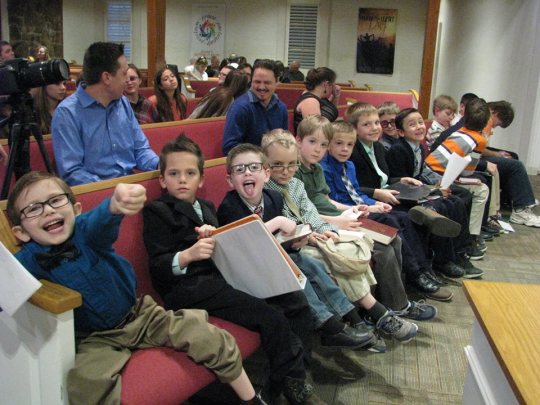
Thom Vaught gave the “elders remarks” last night after the Young Lions participated in their annual program of Scripture reading, song leading, prayer, and preaching. The fourteen first through six graders obviously listened well and learned much. Thom noted how we look at the Christian life as a marathon, but these boys (and the seventeen God’s Precious Daughters who hosted a tea in the fellowship hall at 4:00 PM yesterday afternoon for 80 Christian women!) were actually the next leg in a relay race.  Everybody seemed to leave the assembly last night so spiritually full and energized. Perhaps that was because of what we had seen (and learned) throughout last evening’s service.

…That genuine enthusiasm is infectious.
…That worship should be characterized by purity.
…That you cannot easily fake sincerity.
…That sometimes truth gets told most poignantly and effectively from such an innocent heart.
…That it is encouraging to see someone overcome their fears to lead.
…That we appreciate seeing those who lead us unashamedly show us their hearts.
…That worship should be joyful.
…That we should carry the experience of worship out the door with us into our lives.

When Thom asked those present last night who had formerly been through Young Lions and God’s Precious Daughters to stand along with the 31 children involved this year, it was overwhelmingly encouraging to see so many scattered among our healthy crowd last night who had received this wonderful training. The leadership training they have received through the years has contributed to the teenagers and young adults they have become, serving Christ and others. Some of them are married now. Others have graduated from preacher training schools or are students there. Others have gone on to Christian Colleges. They lead us in every phase of our worship regularly and effectively. We appreciate the men and women who came up with this program and all those who have served through the years. All of us are the better for it. Last night was a reminder of something Trent Woolley, who helped lead this year’s program, said to us, “Truly I say to you, unless you are converted and become like children, you will not enter the kingdom of heaven” (Mat. 18:3).  I pray we will carry these lessons learned into worship with us next week and the weeks beyond that!

17191020_997645827047006_5867707409707217276_n

16939339_803329306482297_3212391089732137726_n

“3-2, With The Bases Loaded”

Neal Pollard

Dave Stewart, former Oakland A’s pitcher known for pitching well in the big games, was asked how he was able to shine when the spotlight was brightest. He explained that as children he and his brother would play against each other in the backyard. They would pretend they were in the “big game,” and it was always “3-2, with the bases loaded.” So, Dave would face the situation as if it were always the big game. He conditioned himself to confront the pressure situations, and through this he came to excel in the playoffs and World Series.

How do we excel in life? It is not by expecting and waiting for smooth sailing and an easy life. You do not grow in life when the sun is shining and there is zero wind resistance. Why not embrace challenges as catapults for personal growth? Look adversity in the eye and take it on.

The first-century church was in a situation where they faced opposition on an ongoing basis. They probably did not welcome this, but neither did they cower before it. In the face of fiery trials, they won the lost and kept the faith. In our own personal lives, we may dislike the thought of suffering. However, looking back, we may find these as the times where most growth occurred.

How do we face life? Are we looking for a beautiful, problem-free life? If so, we will be disappointed! More than that, we shall fail. We must through much tribulation enter the kingdom of God! Former Minnesota Vikings head football coach Dennis Green once told his team, “We are going to go on in the road, in the cold, in a hostile environment, and we don’t want it any other way.” That’s the philosophy to embrace in our spiritual lives. The world opposes us as we stand faithfully for Christ. That’s OK! It is a chance to excel to the glory of God.

dave_stewart_on_august_1_2009

Wells And Cisterns

Neal Pollard

In 1980, my family moved to the thriving metropolis of Glenn, Georgia. Dad brought in a Jim Walters Home on the property that already held a barn, smokehouse, and considerable spring. However, it proved difficult to bore a well there because of the rock that stood between the surface and the water table. I’m sure that was one of the more trying experiences my parents ever had in their decades of home-owning. Because we could not access fresh water, my siblings and I had to make regular trips up to the neighbor’s house for drinking water (I say up because the driveway was a long, steady incline to the highway, and our neighbor, the Buckners, had their house just off the highway to our north).

We rarely think about the blessing we enjoy in this nation simply to turn on a faucet and have safe drinking water on demand. Many places I have visited around the world do not enjoy that same extravagance, but must at times travel a great distance to get water from a well. Others must risk drinking water contaminated with bacteria, parasites, and viruses that cause typhoid fever, cholera, Hepatitis A, giardia, and similar, deadly pathogens.

It is not surprising that God uses a substance so basic to our existence to illustrate great spiritual truths. It’s not just the water itself that is presented figuratively, but the source and reservoir of it. The well is the source, while the cistern is the container of water. As followers of Christ, we draw from a divine source but it is contained within us. If we’re not putting it in, we will not keep it or have it to use. The Bible tells us that:

—Wells May Need Dug Again (Gen. 26:18). In Isaac’s day, that was literal. Today, that may mean reviewing the basics even if we feel like people should already know them (2 Pet. 1:12; 3:1).

—Cisterns Need To Be Clean (Lev. 11:36). That was true physically, and it needs to be true of our hearts today. How well can we keep divine water in a dirty pool?

—One Must Draw From His Own Cistern And Well (Prov. 5:15). Solomon uses the cistern figuratively to speak of the imperative nature of faithfulness in the marriage relationship. Be satisfied with your spouse alone.

—One May Foolishly Decide To Draw From Broken Cisterns (Jer. 2:13). Jeremiah speaks of how Judah rejected God for the thinking of men. It was doomed to failure then, just as it is today.

—We Must Drink From The Well Springing Up To Eternal Life (John 4:14). Jesus uses physical water to speak of eternal life. We cannot go to a source other than Him and hope to receive it.

Water is an essential part of us and a necessity to maintain us. That’s true spiritually, too. Are we going to the right source? Are we a good reservoir for that living water? When we lived in Virginia, we had a well. We were told to pour a little Clorox into it on occasion to keep it from contamination. However helpful that is to drinking water, it is vital that we let the water of life serve us in its pure and unadulterated form. Then, let us share that with the people around us dying of spiritual thirst.

one_of_the_16_rockcut_cisterns_at_pavurallakonda_bheemili

Identifying As A Christian

Neal Pollard

There are so many “identifying” stories these days. A white woman, Rachel Dolezal, identifying as a black woman, was back in the news over the weekend. A biological female who identifies as male and has taken testosterone, Mack Beggs, won the Texas girls wrestling title. In a recent interview, Dr. Keith Ablow suggested that such delusional (he is using the term in a psychological, not pejorative, sense) reasoning opens the door for a young person who “identifies” as a 65-year-old to receive Medicare benefits (foxnews.com). Really, every new case of “identifying” reveals the absurdity behind the thinking. All the wishing, wanting, and hoping in the world cannot change ironclad facts. As we used to say discussing reality of any kind growing up, “It is what it is.”

If there is anything more harmful than delusion, it may be denial. For centuries, good, sincere people have claimed to be Christians who have not followed what the New Testament reveals is necessary to become one. They have followed some humanly-devised plan or idea (accept Jesus in your heart by faith, say a prayer, believe the Holy Spirit gives you an experience of grace, etc.). Leaders and teachers who have devised such ideas do not do so from a sustainable, biblical source.  Repeatedly, whether in the gospels (Mark 16:16), the book of history (Acts 2:38; 22:16), or the epistles (Rom. 6:4; Gal. 3:27; Col. 2:12; 1 Pet. 3:21), we find a simple, but essential, act that stands between one not being and being a Christian. But the idea that one can fail to do this and still be a Christian is pervasively taught, believed, and practiced.

Akin to this is the belief that one can claim to be a Christian, then live any way they wish. Their speech, conduct, and attitude can exactly mirror and mimic the world’s. Their aspirations, pursuits, and values can be completely worldly. But, when death visits a loved one or comes to them or at some similar time when it would be advantageous to claim so, they aver that they are a Christian. While they may have followed God’s plan to become one, they think of themselves as saved and safe even while walking in darkness (cf. 1 John 1:6-9).

It takes more than a claim. Facts are stubborn things. The ultimate source of what is factual is God’s Word. It educates us about gender (Gen. 1:27) and race (Acts 17:26). It educates us about who a Christian is (Acts 2). It educates us about faithful Christian living (cf. Rom. 12:1-2). If we wish to be accurate in the way we “identify” ourselves, we must let Scripture inform our view!

rachel_dolezal_speaking_at_spokane_rally_may_2015

Before You Type Or Talk Today


Neal Pollard

A pick, a poke, a controversy,
Hit and run, a verbal grenade,
We may see it as clever, though without mercy
And own it like an accolade

But are we making people think
When what and how we say it scars?
If it causes a stir, a strife, a stink
Instead of edifying it maligns and mars?

People should be thinking anyway
And what they think should be of good report
Let’s meditate on what we say
Not load up on sarcastic, sardonic retort.

The world already knows that tactic
And uses it at the drop of scarf and hat
It brightens no story, dresses up no didactic
But stokes the fire and escalates the spat

Here’s something requiring greater skill
You won’t find it in general practice
Restraint and kindness, grace and good will
Be a rose in a field of cactus.

When entering today the public sphere
And the marketplace of varied ideas
Let the Jesus in you shine bright and clear
So they can look at you and believe He is!

imageedit_39_6587200324-compressed

Service With A Smile

Neal Pollard

Jesus showed the greatness of service by washing the disciples’ feet (John 13:12-17). As they fought over who was the greatest, Jesus revealed that He came to serve and not to be served (Mat. 20:25-28). God refers to Him in the great prophesy about His suffering as “My Servant” (Isa. 52:13; 53:11). Why, then, are we more apt to jockey for prominence, position, power, and prestige? Is it not that, in such times, we’ve lost our focus and stopped “looking unto Jesus” (cf. Heb. 12:2)? What are some practical ways we can reflect Jesus through service? Consider the following as a pump-primer:

  • Write a note of encouragement
  • Pleasantly let a merging driver merge in front of you
  • Fervently pray for the good of someone who has been hurtful to you
  • Meet a widow(er) for lunch or coffee
  • Volunteer to babysit so a young couple can go on a date
  • Anonymously send a small amount of money or gift card to a college student, preacher student, or missionary
  • Visit a shut-in
  • Participate in a feeding the homeless event
  • Tell an elder you love and appreciate him
  • Pay for the meal of a young family who looks like they could use the help
  • Ask a neighbor if there is something you can be praying about on their behalf (and, if they’re willing, pray for that on the spot)
  • Text or email someone you know is in a stressful circumstance and express confidence in them
  • Take a small group to go sing for someone confined to a hospital or nursing home
  • Volunteer to work with small children to make a craft or baked good for the elderly
  • Police the bathrooms and pews at church and tidy up little messes you see
  • Make visitors to our assemblies feel welcome and help them find a class or a seat (with a pleasant smile)

There may be profound ways we can serve, but realize that any act of service may be far more profound than we think. We may not know in this life how a simple act opens a heart and opens a door of opportunity for Christ. Think like a servant and seek ways to serve! The greater others think you are, the greater your need to serve. But however much or little you think of yourself, think of others. Then, serve them!

2159516316_763603c0c9_z

Jane Roe/Norma McCorvey

Neal Pollard

She was used by pro-abortion and pro-life groups, but in fairness nobody outdid Norma McCorvey at trying to use others for personal advantage. Her effort to abort her third child, in Texas in 1970, was the case used to go to the Supreme Court. By the time the appeals process wound up in legalizing abortion at the federal level, her baby was almost three years old and in the home of adoptive parents. She was the product of neglect and horrible abuse, was promiscuous, bisexual—though mostly lesbian, and was known to try to make her way by hook or crook for most of her life. She tried to leverage her infamy into financial advantage or at least a living wage.

It’s wonderful to see that this tormented woman publicly changed her position regarding the right and sanctity of the unborn, but her home life and adult life symbolize the growing immorality stemming from a breakdown in the home. A father fairly well abandoned his role in the home. Alcohol and drugs complicated and clouded the decisions and thinking within the home. Sexual immorality created multiple problems. Sin was perpetuated from poor examples there (The Washington Post, Emily Langer, 2/18/17).

Pew Research found that 46% of “U.S. kids younger than 18 years of age are living in a home with two married heterosexual parents in their first marriage. This is a marked change from 1960, when 73% of children fit this description, and 1980, when 61% did” (Gretchen Livingston, 12/22/14). This is only part of the story. I know of several scripturally divorced and remarried couples, with blended families, who have raised righteous, believing children. But, the general breakdown of the home is at the heart of so many of society’s woes.

The foregoing is far from revelatory. Sermons, articles, and Bible classes have trumpeted it for years. What I see in our broken society is endless opportunity. It will require patience, time, and lots of love, but homes like the one McCorvey grew up in and the one she attempted herself are craving what only Christ can supply—fulfillment, joy, peace, and direction. That is where you and I come in. Let us remember what we’ve been told by God: “But you are a chosen race, a royal priesthood, a holy nation, a people for God’s own possession, so that you may proclaim the excellencies of Him who has called you out of darkness into His marvelous light” (1 Pet. 2:9). Let’s be shining!

2211858253_9a8fa45364_b

Managing Stress & Anxiety

Stay Calm…and read this great article!

Kathy Pollard's avatarLife and Favor (Job 10:12)

By Kathy Pollard

I wish I could title this post, “Getting Rid of Stress And Anxiety,” but I don’t think that’s very realistic.  With the exception of perhaps childhood, each new phase in life presents its own unique set of challenges.  Maybe you find yourself in one of the following situations:

  • New marriage, new baby, new home, new work.  While these are exciting and wonderful, they also call for stamina and courage and wisdom.
  • Long-term care of an aging parent.  In addition to the physical exhaustion is the emotional turmoil of seeing your loved one suffer.
  • School/ work load.  I know some students right now who are being stretched in more ways than they ever expected.  Perhaps you’re in the midst of a project or job requirement that’s been going on for so long you can’t remember your last decent night of sleep.
  • Poor health.  After months or years of…

View original post 937 more words

The Tactics Of The Tactful

Neal Pollard

“To ensure people listen to you, insult their race, politics, and intelligence. Be sarcastic. Be close-minded. Don’t attempt to hear what they have to say. Do not gently reason and certainly do not be patient and thoughtful. Courtesy should be thrown to the wind, along with assuming the best and thinking before speaking. Inflammatory statements are sure to win the hearts of people on the fence or on the other side of the issue from you. When they disagree or offer a dissenting view, really let them have it. Call them names, make baseless assumptions and accusations, and angrily dismiss them. Persuade them with harsh, rude, coarse, crude words and phrases, and even resort to cursing to strengthen your point.”

I don’t suppose I’ve ever seen anyone give the advice above, but an incredibly large number of people seem to have adopted those very tactics through social media to promote their own points of view and to attack those of others. Beyond the right and wrong of specific issues, there is the attitude and demeanor the Christian is to maintain. The late Wendell Winkler would often tell us “preacher boys” that “you can be right and still be wrong.” How sad to lose the moral high ground of an issue because we yield to the fleshly tendency to rip, tear, and insult “the other side.”

Scripture counsels this approach instead: “Be kind to one another, tender-hearted, forgiving each other” (Eph. 4:32); “The Lord’s bond-servant must not be quarrelsome, but be kind to all, able to teach, patient when wronged, with gentleness correcting those who are in opposition” (2 Tim. 2:24-25a); “Do not be overcome by evil, but overcome evil with good” (Rom. 12:21); “Let your speech always be with grace, as though seasoned with salt, so that you will know how you should respond to each person” (Col. 4:6); “A gentle answer turns away wrath, But a harsh word stirs up anger” (Prov. 15:1).

Oh, sure. People will rationalize their ugly, insulting speech through distorting the words and actions of Jesus, Paul, and others. People often rationalize their sin and disobedience. How many have done the same thing in the face of Scripture commanding baptism and teaching the singular nature of the church? But, make no mistake about it! Venomous, hateful, insulting speech is not the way of the faithful Christian.  The source of that is from a distinctly different direction!

Be convicted and courageous, but cloak it in Christlike kindness! In addition to being right, it will be far more successful. May our goal be to win hearts and souls and not just arguments!

636044778227119944-152056580_another20guy20yelling20at20his20computer

The Ever-Fixed Mark

Neal Pollard

This phrase is taken from Shakespeare’s Sonnet 116 to describe love. While it is an apt, poetic description of love, it also is the perfect modifier of God’s Word. If there is a word to describe the current culture, it is “change.” Our world is enamored with it, constantly changing its mind, its values, its standards of right and wrong, its worldview, and its priorities. Swept up in all of this are societal attitudes about so many things.

What was once right is now wrong. What was wrong is now right. And while not every instance of this is wrong, so many of them are the product of mankind pushing the envelope of previous norms and standards of decency. Let me cite some specific examples:

  • The definition of marriage
  • The definition of gender
  • Sexual mores
  • The sanctity and humanity of the unborn
  • The view of the inspiration and authority of Scripture
  • Male and female leadership roles
  • The move from monotheism to polytheism (one God to many Gods)
  • The existence of God and the deity of Jesus Christ
  • The ethics of honesty, hard work, and service

Our list could be much longer, but these representative items have all fallen victim to the world’s push for what it sees as greater freedom, satisfaction, and happiness. Those who rely on the Bible as their infallible guide already know how the story turns out for those who make themselves the standard. “I know, O Lord, that a man’s way is not in himself, nor is it in a man to direct his steps” (Jer. 10:23). More solemnly, Solomon says, “There is a way which seems right to a man, but its end is the way of death” (Prov. 16:25). In Paul’s day, suppressing, speculative, sensual, and subverting souls rejected God in deference to self-guidance with destructive results (Rom. 1:18ff). Thus it will always be when man builds upon the foundation of himself.

What happens with us, individually and collectively, when we build upon the rock of Scripture is survival in the severest tests (Mat. 7:24-25). When we see Scripture as something to change us rather than something subject to our changes, we have a sure standard by which to chart our lives. Antecedent societies have experienced the trauma of spiritual self-determination (cf. Prov. 14:34). In a world enamored with unrighteous change, may we determine to fix our gaze on the ever-fixed mark of Scripture!

harrows_bristle_board_bullseye

Help Them On Their Way!

Neal Pollard

As Paul nears the close of his short epistle to Titus, he urges, “Diligently help Zenas the lawyer and Apollos on their way so that nothing is lacking for them” (3:13). Whatever Paul had in mind, whether financial, transportation, lodging, emotional, or similar help, it is an interesting plea. It isn’t said, but is fair to infer, that “their way” involved spiritual business. Lange and others surmise that these were on Crete but wanting to head out on a missionary journey and that Titus must have been a man of financial means who could see to their provisions. Maybe, but let’s not miss the bigger principle. One Christian is told to help others along their way.

God’s great work is still going on today. Each of us has a role to play in advancing it, but we should not discount the importance of helping others on their way in this effort. We should do so thoroughly and thoughtfully. As we look within the local congregation, we should ask who we could help on their way.

  • Those who organize the Bible School program, as they look for teachers and helpers
  • Those who organize the worship services, as they seek those to lead it
  • Those who desire to engage in mission work, as they try to raise the necessary funds
  • Elders and deacons, who appeal for help in their respective works
  • Those who need a ride to the doctor
  • Those on our prayer list, as they have various needs we can carry to the throne of God
  • The homeless, imprisoned, and otherwise needy, as they represent Jesus (Mat. 25:35ff)
  • Our youth who would benefit from godly, spiritual leadership and mentoring
  • Young mothers who would be encouraged by sympathy and kindness as they strive to train their children in the assemblies
  • Those who organize workdays and need help from the rest of us
  • Those who have recently suffered a loss, as they struggle to retain balance and stability
  • A lost neighbor, co-worker, and family member who may be struggling to find the truth
  • Whoever I may have missed who needs you or me to be God’s hands and heart

Mary Barrett wrote, “Lend a hand to help a brother who is striving hard and true, don’t forget that in the valley there is someone needing you.” May we take that personally. Don’t discount what you might do to help a brother or sister on their way. What might we find, when we get to heaven, which came of taking that precious moment to supply what they needed in such a situation?

share-burden1

Lessons Learned From The “Hot Seat”

Neal Pollard

—Nobody wants it.
—It’s easier when you’re not on it.
—You don’t get used to it.
—You can’t handle it without God.
—It’s impossible to adequately prepare for it.
—You grow (faith, trust, divine dependency) by being on it.
—You don’t stay on it forever (in this life, anyway).
—You can think of an infinite number of people you think would be better suited for it.
—Your admiration grows for those who’ve spent much time on it.
—You greatly anticipate the time you are no longer on it.
—It’s a humbling experience.
—You think about what you should have done differently while on it.

crow

We Need More Kevin Tortorellas!

Neal Pollard

Let me preface this by saying I did not get to meet Kevin Tortorella. I know next to nothing about him. Here is what I do know. He reached out and brought Cy Stafford to Christ. Ultimately, as we heard from Cy’s funeral on Saturday, there are 500 churches that have been planted throughout a quarter century of service by Cy and Stephanie in east Africa. There may be literally thousands of people in heaven connected to the work God did through the Staffords in their time in Tanzania. It began in North Carolina, when Kevin taught Cy the gospel. He is not a full-time gospel preacher. All I know is that his courage and care has made a gigantic impact on the Kingdom, whoever else he ever tells the story of Jesus to.

That is the amazing thing about evangelism! God works through men, often even ordinary men, to do extraordinary things which change the world and grow the church. Whatever else we know about Andrew, he brought Peter to Christ and also left an indelible mark on church history. Paul tells us that all, in building on the foundation of Christ, who bring people to Jesus will bring those who will be tried with fire (1 Cor. 3:11-15). While there will be those who do not pass the test of fire, some are said to be gold, silver, and precious stones. It would seem that these are converts who not only pass the test but prove themselves of such great value. Who would question that Cy was a “gold conversion”?

You and I encounter various people throughout life who we have the power to influence. We may fear or hesitate to speak to them about Jesus. We may think it will do no good to speak to them. We may think they are not interested. We might even fail to realize how much they, through our influence and the influence of others, could amount to. But if we will look at the Peters and Cys that have come along in the history of the church, we will be encouraged to take that first step and have that conversation. Don’t worry about what comes next. Just step up. Be a soul-winner. Be a Kevin Tortorella!

148635_1351737054045_6900631_n
Kevin
16265880_10211385854540219_8443766096963464040_n
Cy

Producers Versus Consumers

Doug McNary

Allow me to take you back to the early 1930’s, when the U.S. economy was in the throws of the Great Depression. It was a time of record setting negative economic growth. Many Americans lost their means to sustain basic life functions. Many Americans lost all Hope.

At the time, President Herbert Hoover believed in the importance of the role of individuals in society and the economy.

He said, “Economic depression cannot be cured by legislative action or executive pronouncement. Economic wounds must be healed by the action of the cells of the economic body – the producers and consumers themselves.”

Now, let us fast forward to the church today. We find the church in a time of record setting negative growth. And according to a 2014 Pew Research Study, less than 27% of Millennials (defined as ages 18 to 35) regularly attend religious services. Yet, 67% say they believe in a heaven and 84% think there is a God. So, what does the mean?  

I think deep down inside, millennials believe there is a God, but worldly distractions and alternate priorities keep them from contemplating what that really means. A lack of understanding or knowledge of the truth translates into a lack of action. Their ignorance may lead to eternal demise.

So, let’s rewrite Hoover’s insight:

“Church growth cannot be cured by the action or pronouncement of church leaders. Church wounds must be healed by the actions of the members of the church body – the producers and consumers themselves.”

Church growth will not be achieved by elders, deacons or preachers alone. It must be cured by each of us also doing our part.

So I ask myself, “Am I a producer, or a consumer?”

In Matthew 5,  Jesus said,

“You are the light of the world. A city set on a hill cannot be hidden; nor does anyone light a lamp and put it under a basket, but on the lampstand, and it gives light to all who are in the house. Let your light shine before men in such a way that they may see your good works, and glorify your Father who is in heaven.”

Honestly, I have been a consumer long enough. I sit in my pew every worship service, I do my daily bible reading, and dwell on God’s word… I have been a faithful Christian, with a proverbial basket over my head.

I want to be a producer…

–Sharing, Caring, and Acting to make a difference for the Lord’s church.

I want to be a producer…

–Proclaiming to others the Truth found in the Bible.

I want to be a producer…

–Openly Praising the Lord, each and every day, in my words and actions.

I want to be a producer…

–Participating in the building up of the body of our church by being involved in the work of the church.

I can no longer be just a consumer, I want to be a producer… Finding creative ways to prick the heart of a lost soul, for the sake of Christ!

Now here is the challenge:

I want to do these things… But, will I?… And how about you?

My brothers and sisters, I pray that each one of us can get up out of our “consumer” pew and DO Something Each Day to help our Lord’s church grow! I pray that we can all become “producers” for Christ.

I leave you with this thought…

In one of my favorite movies, Shenandoah, Jimmy Stewart played the role of the father, Charlie Anderson. He sat at a campfire with his family as they were searching for his lost son. They were all about to give up hope when Charlie said: “If we don’t try, we don’t do. And if we don’t do, why are we here on this earth?”

Brothers and Sisters, if we truly love the Lord’s church, we must try, we must do!

nakedspur_trailer_3