When Adversity Makes You Feel Unproductive

Friday’s Column: Supplemental Strength

brent 2020

Brent Pollard

If there’s one thing disappointing me most, it’s the lack of productivity I often feel. There are many things I want to do. I don’t think I get even a quarter done. For many facing a similar predicament, it’s a matter of poor time management. Time is precious. We’re told to make the most of it since the days are evil (Ephesians 5.16). Contextually, this pertains to the efforts made by first-century Christians in their daily walk. Persecution was coming. Indeed, for some, their lives would soon be at an end. Did they want to depart for eternity’s shore feeling as if more could have done but had not been? That message remains prescient today. We enjoy civil liberties now including religious freedom. However, a tempest has been growing for half a century which seeks to strip away the vestiges of religion and morality from the body politic. In but a short time we may face the same uncertain prospects as they. Hence, our struggle to be productive is as important as ever.

This exhortation may be limited in scope, but I wish to address those who might have certain mitigating factors making Paul’s inspired admonition more difficult to keep. It’s one thing to be a timewaster when one is able-bodied. It’s another matter entirely when you’re limited from accomplishing as much by the limitations of the flesh. There are those accustomed to doing much. One day they young, full of vigor. In the blinking of an eye, though, they no longer recognize the person staring back at them in the mirror. The snow of many winters covers what hair is left on their heads. For such, it hurts getting out of bed. Something as simple as buttons on garments becomes a time-consuming challenge. They may be asking, “Why can’t I get as much done as I used to?” This can be especially vexing, spiritually.

Perhaps, you have an illness of the body or mind. Maybe you don’t have old age to blame for your aches and pains but an autoimmune disease that others dismiss because, from appearances, you look fine. Not only are you in pain but you feel alone because some have unfairly surmised you’re just lazy. It could be that you’ve had chemotherapy and experience what has been termed “chemo brain.” You find yourself struggling to remember simple details. If you don’t write something down, you’ll forget about it. Truly, I could share a plethora of other scenarios in which some malady besets the body or mind and causes one to feel unproductive or a timewaster. These should suffice.

Fortunately, we serve a gracious God. Not only is His grace sufficient for coping with our lot in life (2 Corinthians 12.9), but it takes into consideration our current estate. One can debate whether there are degrees of punishment from Luke 12.48. That’s not my purpose. A principle is established here, however, stating that we’re held accountable according to the responsibility entrusted to us. Why would God hold the enfeebled or impaired to the same standard as the able-bodied? This must be true of redeeming one’s time as well. Note, one cannot forsake his or her Christian duty. Yet, rather than beat up on yourself because of what you left unaccomplished, trust that God knows your situation intimately. The main thing is to show up and do the work of which you are capable (Matthew 20.1-16; 21.28-32). This is how you remain productive even while facing adversity in these evil days.

20190621_113147


6 Things About Gossip That I Don’t Like

Neal Pollard

As masterfully and humorously portrayed in the 15th episode of the first season of the Andy Griffith Show (“Those Gossipin’ Men”), gossip can seemingly appear, full-blown, out of thin air. It can be personally hurtful, but it’s part of the territory of living and breathing.  Here are 6 things I particularly dislike about the ugly specter of gossip.

  • It’s GallingIt “reveals secrets” (Prov. 11:13). It separates friends (Prov. 16:28), yeah even “intimate friends” (Prov. 17:9). While cowardly, it still takes a lot of nerve!
  • It’s Obstructive. Billing itself as “helpful” and “instructive,” it usually serves the opposite purpose. It “reveals secrets” (Prov. 20:19) and is the hallmark of idle busybodies (1 Tim. 5:13).
  • It’s Spurious. As previously mentioned, gossip is as apt to be false and inaccurate as it is to be trustworthy.  Even if there is a grain of truth, it can have an admixture of inaccuracy blended in.  Tragically, it is often received as the truth and nothing but the truth.
  • It’s Sinful. Find it listed alongside “strife,” “jealousy,” “slanders,” and “arrogance” (2 Cor. 12:20). God calls the spreader of such “a fool” (Prov. 10:18). It’s an “evil weapon” (cf. Isa. 32:7) and “stubborn rebellion” (Jer. 6:28). See also Romans 1:29, 2 Timothy 3:3, and Titus 2:3.
  • It’s Inconsiderate. Few gossips would want to be treated the way they treat their subjects (Luke 6:31).  Repeatedly, Christians are urged to “be kind to one another” (Eph. 4:32). We’re to love each other without hypocrisy and “be devoted to one another in brotherly love; give preference to one another in honor” (Rom. 12:9-10).  Gossiping is rarely wrapped in forethought and careful circumspection.  It’s not “friendly fire.” It’s just fire.
  • It’s Presumptuous. Gossip is acting with entitlement, believing that it is fair and right to spread (whether true or false) information about the subject thereof. The gossip believes himself or herself qualified to share something about someone else, and such are usually mortified if the tale is traced back to them.

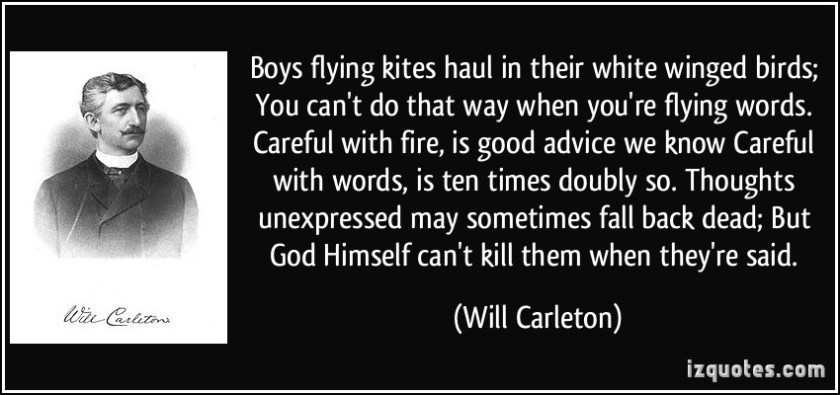
Yet, indignation should be tempered with realization.  Few have so mastered the tongue that they are above the fray we mention here.  Let’s be convicted to practice saying good and kind things behind each other’s backs. Remember to investigate before you propagate, and even then only carefully and prayerfully. Usually, prayer and care will render the “juicy tidbit” dead on the floor of your mind, safely unspoken and incapable of doing any harm. Remember the famous words of 19th Century Michigan poet Will Carleton: “Boys flying kites haul in their white winged birds; You can’t do that way when you’re flying words. Careful with fire, is good advice we know Careful with words, is ten times doubly so. Thoughts unexpressed may sometimes fall back dead; But God Himself can’t kill them when they’re said.”

quote-boys-flying-kites-haul-in-their-white-winged-birds-you-can-t-do-that-way-when-you-re-flying-words-will-carleton-377399

The Bible Is Not Boring (“Grace”

65093899_10156405640240922_1795016641457684480_o

Another of the episodes Gary, Dale, Carl, and I recorded in Fort Payne, Alabama, recently. In this episode, we discuss an often misunderstood, misapplied, but absolutely vital Bible subject. This topic is anything but boring.

Click here for audio

The Mouse And The Cups 

Thursday’s Column: Dale Mail

83538761_557569434843824_1603081807199207424_n

Dale Pollard

In the pantry there’s a package of white foam cups. A small gray mouse struggles to carry a cup out into a man’s front yard one at a time. Just one cup and one each day. The man sticks to a normal routine. He goes to work early, and he comes home late. He watches TV, cooks a meal, tinkers on projects in the garage, and goes to bed. It’s mindless, it’s robotic, but day in and day out the cycle repeats itself. He leaves for work and the mouse drags yet another cup out onto his lawn. It isn’t until his yard is filled with foam cups that the man takes notice. What a mess! He walks through the yard and picks a few of them up. As he examines them he says, “What a waste. Perfectly good cups, now useless and dirty. We have a limited amount of foam cups in our package, and there’s a day when the mouse will grab the last one. We better put them to use. ”

If God came to you and gave you the chance to make a single request, what would you ask for? Our prayer lives are usually filled with our personal wants and needs. There are countless things that tug at different areas of our heart as we approach our Father, the Creator of the universe. He can do anything, He has all the power, and in one way or another we all desire some Divine intervention. I would like my family to be healthy and happy. I would like to live out the rest of my days with no more worries or anxieties. I would like the peace that comes with total financial stability. I wish my dog would live to be one hundred and five. I would like to be successful in everything I put my mind to.

There are five hundred wants in my heart, but what do I desire more than anything? The answer to that question is deeply connected to our spiritual life. What my heart chases after, where my time and energy goes, and even what I ask God for spreads my top priorities before me. David writes in Psalm 27:4, “One thing I ask of the Lord, this is what I seek. That I may dwell in the house of the Lord all the days of my life, to gaze upon his beauty and inquire in His temple.” David is known as the man after God’s own heart, simply because his heart was after God. David’s one desire was to form a deep and meaningful relationship with God. He understood what truly matters in this life. He even makes that his specific and singular request of the Lord. He puts his faith in action as he seeks that relationship with God. His life was built around this, and everything else is secondary to him. His seeking was that hopeful expectation— the effort he put in to this pursuit was a demonstration of that belief in God’s ability to grant him his one thing. David spent his time wisely. Almost every day that was granted to him he used as an opportunity to seek His Lord.

God is the Alpha the Omega, the beginning and the end. His eyes can see the very point in time in which He decided to create everything. He can also step back and look at His timeline and see the exact moment in which He will bring all things to an end. The Bible is a gift and glimpse into His mind. In it we can see the powerful beginning to the world we live in. We can see how God works in our present, and we can read about a grand event that will come when the days run out.

What is that one thing you want more than anything else? Don’t let the cups pile up in your yard. Let’s all use the time we have to pursue the only thing that matters.


racing-mouse-3499446_1280

the Bible is not boring (episode one)

Click above to hear a sample of our latest project. We’re working on a new program which will air on the Gospel Broadcasting Network (watch GBN here) in the future. The premise is just as the program title suggests: “the Bible is not boring!” It is exciting and fulfilling to drill down and study God’s Word. Each episode will follow the same format, a general topic which the four of us (Gary, Dale, Carl, and myself) will break down and discuss. Our aim is to help encourage Christians and open a door for those who may be searching for God’s truth out there. This first episode explores how to approach the Bible itself. We hope you enjoy!    –Neal


Serving the Living God 

Thursday’s Column: Captain’s Blog

IMG_0806

Carl Pollard

I know I’m not old enough to say this, but when I was younger I used to lay in bed at night and try to imagine what God looked like. I would try to put a face to Him, I’d wonder what He was doing, and I would ask myself if God knew that I was thinking about Him. I still ask those same questions to this day. I’m sure that most if not all of you who are reading this believe that there is a God, and that He does see and hear all that we say. So the question I’d like to ask is, “since there is a God that has all power, why do we sometimes have difficulty following the commands that we find in the Bible?” I’d like to look at a verse that may help us realize the importance of following what God has told us to do as Christians.

Jeremiah 10:12 says, “It is He who made the earth by His power, who established the world by His wisdom; and by His understanding He has stretched out the heavens.”

God has ALL power. There isn’t an area that He is lacking power in. He controls the weather, He created us, and, as Jeremiah 10:12 said, He made this earth that we live on. I believe that we sometimes forget just how powerful God truly is. Since God has all power, shouldn’t we be following what the Creator of everything has told us to do? In seven days He thought of everything we see around us. Think of it this way. We’ve never had an original thought. For example, I could say that I’m the only person to have ever thought about a pink Aardvark. But before I thought of pink Aardvarks, there was such thing as the color pink, and there were Aardvarks before I thought of them. So what I’m actually doing is taking two things that God created and putting them together. God has given us specific commands to do as Christians. Since God has given us rules on how to live, we shouldn’t have a problem following them. They may be difficult, but God knows how to take care of His creation. The thought of the God of the universe watching out and guiding me through life is a great comfort to me!

But what if we aren’t following what God has told us to do? There’s a saying that we all have heard that says, “Actions speak louder than words.” Our actions are a direct window to how we truly feel. If I don’t do what God has commanded, then that’s like us saying to God, “I don’t truly believe that there are consequences to my actions.” But that is a deadly place for us to be, because God IS real and there ARE consequences to our actions. God is real and the consequences of our actions are very real! In the end, it comes down to this: Not obeying what God has said is a reflection of how real we make God out to be. If we truly believe He is real, then we shouldn’t have a problem doing what He tells us to do. As Christians, we serve the one true God, and He is very real. I pray that this fact will push us to obey the commands He has given us because our God is alive and we all have an eternity with Him if we do what He tells us to do.

Looking back at when I was younger, I’ve realized that I asked the right question, but the most important part of those questions is how I answer them. Will I show through my actions that I truly believe He is alive? Or do I doubt the reality of God by not taking His commands seriously? Let’s try to always prove God is alive by following what He has told us to do!

maxresdefault

“They Were Together”

Monday’s Column: Neal At The Cross

pollard

Neal Pollard

When I study the phenomenal growth of the New Testament church, there is no doubt that they owed that growth to the divine source of the message they preached and the dedicated way in which the early Christians spread the good news. They also believed that message with all their heart, and that faith drove a sense of dedication and commitment no matter what obstacles they encountered. But, along with factors like those, they grew because they needed one another. They spent time together, not just in their assembly times, but at other times.

Luke highlights this fact. “They were continually devoting themselves to fellowship” (Acts 2:42).  “They were taking their meals together with gladness and sincerity of heart” (Acts 2:46). “And the congregation of those who believed were of one heart and one soul” (Acts 4:32). They got together to pray (Acts 4:23ff; 12:5,12). They got together daily for preaching and teaching (Acts 5:42). Though the word is used in a wide variety of contexts, you’ll find the word “together” over 30 times in Acts. 

Isolation is the word to best describe the trend in the current culture. Much of it is self-imposed, with so many withdrawing from social contact for such reasons as the ironically-named “social media” and technology. We have created a virtual world that, to some degree, has replaced authentic, face-to-face interaction. 

“Community” is built upon commonality and likemindedness. Sports, politics, civic and social interests, and the like all draw people together into circles of sameness. Nothing should compel any of us more than our faith in Christ, the salvation He freely gave us, and the incredible, eternal future He has promised us. What an ironclad bond, this “like precious faith” (2 Pet. 1:1)! There is no greater bond of closeness I can imagine than spending time with people whose hearts are open and submissive to the commands of Scripture and whose lives are lived in faith and hope in the promises of Scripture. They can help me grow and build my desire. Or, as the Hebrews writer says regarding assembly times, we can “stimulate one another to love and good deeds” (10:24). 

When I was a teen, I remember a song that captured this sentiment perfectly, if simply: “Fellowshipping with one another as we’re walking in the light, when we give our hearts to each other you can feel the love inside. For there’s nothing as sweet as fellowship as we share each other’s lives” (Lancaster). Not bitterness, isolation, suspicion, grudge-bearing, apathy, or disinterest. Sweet fellowship! A church that grasps this will grow and thrive, strengthened and sustained through trials, problems, and opposition. May we be a church that’s remembered this way–“They were together!”

82004486_3488315787906452_613787694597668864_n
Photo credit: Rachel Wheat

The Fox In The Pew 

Tuesday’s Column: Dale’s Mail

IMG_1381

Dale Pollard

Foxes are known for their cunningness. They are often portrayed as animals full of deceit and trickery like in Disney’s Pinocchio. We can expect a fox to be out in the wild but seeing one in your backyard or neighborhood makes the wise take the necessary precautions such as taking your small dogs indoors, locking up the chicken coop, and keeping on the alert when night falls. In the same way, the Christian shouldn’t be too surprised to see the devil prowling around in the world but how do we respond when we see him in our own backyard?

When the devil is seen prowling the pews of the church building or sneaking into our families, what is our response? Paul paints a vivid picture for the Philippians by describing those seeking to harm the church as “wild dogs,” “evil doers,” and “mutilators of the flesh” in Philippians 3:2. You can be sure that there’s a fox in the flock by looking for the signs. If you see trash littering the ground, feathers scattered around the hen house, or fresh paw prints, the evidence might suggest that a fox is to blame for the carnage. When the saints are gathered together and you notice the trash of gossip, division, strife, selfishness, or greed, follow the tracks. The signs may point to the most cunning fox of all–Satan. Here are just a few practical suggestions to guard yourself and families from his destruction.

Make sure the gate of your heart is locked. It can be tempting to join in the gossip or even provide a listening ear. When there is division among brothers and sisters, we should take a closer look at our own actions and be sure that we are not contributing to the problem but seeking those things that unify.

Secondly, don’t feed the fox. Sometimes we can be guilty of this by simply doing nothing at all and allowing it to take up a permanent residence among us. Tolerating sin is just as destructive as being a part of it. This tends to happen by avoiding the problem or assuming that it’s not our job to step up and do something about it and this can be very costly. Remember, the longer the fox is allowed to hang around, the more damage will be done.

Third, be watchful. It’s the moment that we let our guard down that we can expect unwanted intruders, and if it has a tail poking out of a nice tailored suit, be wary.

Fourth, the walls we build up should be strong. Even if Satan has damaged the congregation you attend or even your own family, there is still hope. Nehemiah undertook the daunting task of rebuilding the walls that once protected God’s people. He knew surrounding armies were a serious threat to their wellbeing and even under threats and insults he was able to rebuild their peace of mind. The army of Samaria lurked on the outskirts and one individual named Tobiah the Ammonite makes the obnoxious attempt to demoralize the builders by yelling, “Even a fox climbing up on that wall would break down those stones!” Yet the work continued on because Nehemiah said in Nehemiah 4:6, “…the people worked together with all their heart.” This is the key to success. When God’s people work together and are motivated to keep evil out a spiritual wall of protection is built. There will always be the threat of evil lingering outside and looking for a way in, but God is far bigger and stronger than they are.  

“Father’s Table Grace”

Monday’s Column: “Neal At The Cross”

16174665_10154303308455922_2453812807432667966_n

Neal Pollard

In 1960, Otho Jones and Homer L. Sewell wrote a song made popular by Flatt and Scruggs. It’s a song written from the point of view of a man’s oldest son, a son who felt he was old enough to be on his own and leave home. He describes his father as simple and not filled with a formal education, but also as one very devout and the spiritual leader of his home. He describes himself as “young and foolish.” When I listen to this song, I think about the way I could be as a teenager and how I tried my parents’ patience. My dad, a gospel preacher since 1964, has always been a diligent praying man. While I never heard him say these words in my presence, I wonder if he ever prayed them about me in my younger days.

“Our gracious heavenly father we all gathered here today
To give the things for blessings so humble we pray
My oldest son is leaving but I’m sure he knows what’s best
But just in case would you stand by and help him stand the test

Lord he’s awful neglectful about church on Sunday morn
And if he gets with a wrong crowd would you let him hold your arm
And if he flies too high would you clip his wings
But don’t let him fall too hard, I’m sure you can handle things

I’ve tried my best from day to day to teach him right from wrong
And he’s grown to be a fine young man and he always blessed our home
We pray dear Lord for guidance that he won’t build upon the sand
But I won’t worry half as much if I know he’s in your hands

And oh yes Lord it won’t be long till I’ll be coming home
Don’t make me wait too long
We pray dear Lord for guidance please cleanse us from our sins
So we can all be together in heaven in Jesus name amen.”

Those words are neither perfectly autobiographical nor an apt description of my dad (who has much more formal education than I do). But I think a lot of parents who continue to labor over their children in prayer, concerned for their safety as they turn them loose in this world. However large the physical or financial threats may be, what should concern us most are the spiritual ones. We will never outgrow our concern for them. We should never stop being the right kind of example to them. May we never sin against them by failing to pray for them. They need us to be the type of Christians described by James, of whom he writes, “The effective prayer of a righteous man can accomplish much” (Jas. 5:16). 

Making Sense Of Grace

Wednesday’s Column: “Third’s Words”

10423661_10207901451272315_9069631728203375436_n

Gary Pollard III

Grace is a touchy subject. As with many other words commonly used in religious circles, it has potential to be misused or misunderstood. My hope is that this brief study on grace will shed some light on a confusing subject.

First, grace is possible for all men to have (Titus 2.11). It has been clearly displayed and advertised to everyone. The word “appeared” in that passage is epiphane, which means “to make an appearance.” No one is exempt from grace if they follow the right steps to receive it!

Second, grace keeps us in good standing with God if we are walking in the light (I John 1.7,8). In Acts 2.47, chairo (pronounced ky-roe) is translated “favor.” In Luke 6.32-34 Jesus uses it in a very interesting way. He says, “If you only love those who love you back, what credit is that to you?” Credit is charis, the word for grace.

So what is grace? What does it mean to you and me? If we are walking in the Light – trying our very best to follow God’s commands and allowing our faith to be the driving force of our lives – God takes care of our sin problem. When we slip up and make a mistake, God removes it from our record. This does NOT mean that we can sin all we want and God will just overlook it (see Romans 6.1,2). It does, however, mean that God is not waiting to strike us out of the book of life the moment we make a mistake.

Grace is what happens when God wants to do good for mankind. Luke 6.35 says, “Love your enemies, and do good, loan to others without expecting anything back; and your reward will be great, and you will be sons of the Most High; for He Himself is kind to ungrateful and evil men.” The word kind in the bolded phrase is charis: grace. It does not mean the same thing for evil men that it does for the Christian, but it does help us to get a better sense of what this word means.

God is rooting for His children (Christians). He WANTS us to get through this life and die in Him (Psalm 116;15). He isn’t our accuser waiting for us to slip up so He can condemn us. He helps us along the way, He shows good will to us, and He gives us His grace so that we can spend an eternity with Him as long as we are walking in the Light.

THE HEART OF JONAH

TUESDAY COLUMN: “DALE MAIL”

IMG_1381.jpeg

Dale Pollard

The book of Jonah is a unique book in the Old Testament. Unlike other prophetic books, God chooses to focus on the prophet himself rather than the message being preached by him. While many lessons can be pulled from this four chapter book, there’s one in particular that we can all benefit from hearing from time to time. That lesson is that in order for true change to occur in our lives there must be a genuine transformation of the heart.

The book begins with God’s call to Jonah to preach to the wicked people of Nineveh and then closes with God’s response to Jonah’s anger at the penitent hearts of the Ninevites. Between these two divine speeches you read about the prophet’s incredible experience in the belly of a great fish. Many artist’s have painted pictures of Jonah desperately trying to keep his head above the waves while a terrifying monster breeches the surface with its mouth wide open preparing to swallow him. While this may be the image that comes to mind, Jonah gives us an interesting detail in his prayer. He recalls how the waters closed over him and he eventually reaches the sea floor where he is helplessly tangled in the weeds. While the murky waters cloud his vision his fate seemed very clear. Jonah admits that he called out to the Lord provoked by his great distress and this mental plea was a desperate attempt to preserve his life. God answers this cry by sending him a slippery savior. Jonah, while known to be a little on the dramatic side, will later recall how it was in the moment when his life was fainting away that he “remembered the Lord.” God saved a blatantly rebellious man who in no way deserved that salvation but He also allowed Jonah to reach great depths and come face to face with his own spiritual reality. Jonah was a long way from God, but not geographically.

Before Jonah became soaked by the stormy seas, he was soaked in a sin problem that had taken root in his heart. God allowed Jonah to physically experience rock bottom so that he could acknowledge some spiritual issues that distanced him from God. While Jonah may have desired to run from God, he came to the conclusion that being away from God was not the relief he thought it would be.

As traumatic as this event was, Jonah seems to emerge from the belly of the fish with lingering spiritual issues. Though he preaches to the city of Nineveh, there is still anger and hatred dominating his heart. The last chapter gives us a glimpse of this as he directs this anger towards the very God that saved him. In order for true change to occur, there must be a genuine change of heart. While low points can help us examine our heart health for a moment, relentless determination to live life differently is the key to success. A hopeful reminder for anyone who may find themselves in the depths of sin, there is no place too dark where God is not able to hear your prayers. 

THE DAILY PLANNER

MONDAY COLUMN: “NEAL AT THE CROSS”

16174665_10154303308455922_2453812807432667966_n

Neal Pollard

It’s the time of year when so many are buying or receiving calendars and planners or using an electronic version of the same. These can be key to organizing our lives, maximizing our time management, and strategizing ways to grow and improve in the future. Good stewardship really demands that you are “making the most of your time, because the days are evil” (Eph. 5:16).

In this task of planning life each day, please consider planning to do the following each and every day of 2020:

  • Tell someone about what Jesus has done for you every day.
  • Tell God how great He is and grateful you are for Him as you pray every day.
  • Let God speak to You through His Word every day.
  • Tell your spouse, children, and family you love them every day.
  • Show someone the servant heart of Jesus in your deeds every day.
  • Do something that will help you look more like Jesus every day.
  • Help people see the joy and satisfaction of living the Christian life every day.
  • Encourage someone (via card, social media, phone, etc.) every day.
  • Compliment someone every day.
  • Examine yourself every day.
  • Provide an example of leadership to someone every day.
  • Invest in someone every day. 
  • Count your blessings every day.

That’s enough to keep idleness from plaguing us, isn’t it? Consider how helpful this will be, not just on January 1, but also March 19, June 6, September 25, and December 30. This life is about overcoming (1 John 5:4), but perseverance is as much about the daily grind as it is the dramatic and grand. Zig Ziglar wrote that “people often say that motivation doesn’t last. Well, neither does bathing – that’s why we recommend it daily.” How profound! Plan on being a better you and on doing what that requires, day by day. 

“I’m Armed”

Neal Pollard

God’s people around our nation are praying for our brethren at the West Freeway church of Christ outside Fort Worth, Texas. Most congregations I know have long since devised church security solutions, including security cameras, personnel to watch at entrances, and procedures for handling potential threats. In likely every congregation, there are a number of individuals both with concealed and visible firearms. Though this is a politically divisive issue, the fact that a gunman disrupted the most sacred moment of worship makes this preeminently relevant. You likely feel very strongly about this matter, regardless of where you stand on it.

Whatever your position on the second amendment of the U.S. Constitution, did you know that the Bible commands us to be armed? Consider what the Holy Spirit through various writers has to say regarding something that transcends time and earth. Wherever we go, we must not be without these weapons for our spiritual warfare.

–“Be armed with the purpose of suffering” (1 Peter 4:1). This word means to take up arms. It is in the context of suffering righteously for Christ’s sake. In a world filled with people who are aimless, Christians have the ultimate purpose. In fulfilling that purpose, we will be opposed, threatened, and tempted to quit. Only by preparing ourselves for the Christ-life will we survive whoever or whatever attempts to destroy our faith.

–“Be armed with the weapons of righteousness for the right hand and the left” (2 Cor. 6:7). Paul did not want Corinth to receive the grace of God in vain. That is, He wanted the sacrifice of Jesus and the hope of heaven to benefit these Christians. Part of that required them to live lives which didn’t discredit their ministry (3) and commended themselves as servants of God (4). One of several ways they could do that was by being armed with the weapons of righteousness. What are these? Well, Paul will address that in 2 Corinthians 10:1ff as well as in his writing to the church at Ephesus (6:10ff). In simplest terms, righteousness itself is a powerful weapon. We are made right (5:21) to do right (6:7). In a world of darkness, light stands out. In a world going wrong, doing right and being right is powerful!

–“Be armed with divinely powerful weapons for the destruction of fortresses … against the knowledge of God” (2 Cor. 10:4-5). Paul contrasts the flesh and spirit, identifying this as the ultimate battlefield. How do you win against such frightening foes and forces? Arm yourself with the only weapon that is divine and destructive. What it destroys is what stands against God. Don’t think fleshly (or bodily). This goes beyond that.

I fear that the gun rights-gun control debate will rage on in the culture of politics and the politics of culture. But, do not be distracted! There is an eternal war going on which requires every one of us to be equipped. Do not dare be unarmed for that fight!

13844066275_2ea2f384e0_b


Some Practical Tips For Personal Evangelism

79461688_525421068058661_8720707992451809280_o

Dale Pollard

  •  If you have time, avoid self checkouts. You have a golden opportunity to talk to employees while they’re scanning your items. Make them smile, be happy, be natural, and if they open up look for that chance to invite them to church or study. Just breaking out of your shell and chatting with everyone you come in contact with will eventually open doors. If people can tell you care they’ll be more inclined to, at the very least, hear you out.
  • Try not to be an “office rat” and be intentional about creating friendships. Your neighbors, members neighbors, and coworkers of members can be a good foot in the door. If they end up visiting they’ll be more comfortable seeing a familiar face sitting in the pews and a friendly face of someone who cared enough to reach out to them in the pulpit. That also makes the message you preach to them more powerful.
  • If they’re interested in studying, start with what you have in common with each other or how God can help them with a specific problem that’s unique to him/her.
  • If they struggle with addiction, relationship with spouse, anger, depression, or heartache, start there. That’s what’s on their mind and they need to know how God can heal and improve our lives. If they clearly see their need for Jesus they’ll want to know more about Him.
  • Be intentional about talking with as many people as possible. Look for the lonely or hurting people. The guy eating alone at a restaurant, anxious/worried person in the hospital waiting room, single parents with small children, homeless people, elderly people sitting on their front porch, or people coming out of Cash In A Flash. These are the people who most likely need to hear some Good News.
  • Volunteer at funeral homes to preach for free for grieving families that can’t afford to spend much.
  • Ask the staff at hospitals/retirement homes about any occupants that may not get many visitors.

Minister to people all week and not just on Sunday.

“First, Sit Down…”

Screen Shot 2019-12-21 at 9.08.51 AM
Not pictured: Riley, who was under the weather. 

Neal Pollard

In Luke 14, Jesus gives a couple of short parables about counting the cost of discipleship. He prefaces them by saying, “If anyone comes to Me, and does not hate his own father and mother and wife and children and brothers and sisters, yes, and even his own life, he cannot be My disciple. Whoever does not carry his own cross and come after Me cannot be my disciple” (26-27). If we drink deeply of this statement, we see exactly how challenging it is. The choice is always between Jesus and everything and everyone else. How badly do we want what only Jesus can give? Think hard, then decide!

Then come the parables. The first is a construction parable, of one building a tower. He first sits down and calculates the cost in order to be able to finish and avoid ridicule (28-30). The second is a military parable, of a king going into battle. He first sits down and considers whether or not he can win (31-32). The common denominator in both parables is to first sit down and deliberate. Ultimately, there is action which follows, but the planning precedes it.

In how many congregations do elderships or men in the absence of elders never get proactive and formulate a plan for the immediate, intermediate, and far off future? Leadership must cast the vision and deliberate about where that congregation is going and how it will get there. What will be done to grow? How can we get more members active? How can we best utilize the collective resources of the congregation? The Bible reveals all the answers, but it is essential for the church’s leaders to gather around the drawing board.

It was exciting to spend a few hours at the Lehman elders’ 2019 retreat to discuss the short-term plans of the congregation. These men are convicted about the stewardship of the work they eagerly consented to do as our shepherds. They want us to be more effective, but they are determined to set the tone and example for us. I’m amazed at how deeply they care about us and the growth they want us to collectively experience. Words like emphasis, accountability, and purpose continually came up. Building a biblical culture, which works against our contemporary culture of consumers rather than producers, is foremost in their minds. They desire for us to “grow together” as a church, drawing those outside of Christ to our spiritual family.

I cannot wait to see what God will do through such capable leaders in 2020 and beyond. We are blessed with such godly, conscientious elders. Please don’t miss a day praying for Russell, Riley, Kevin, John, Darrell, and Bobby and their families. Also, please never miss an opportunity to express your love, encouragement, and support of them as they strive to do their best to fulfill their God-given duty. Or, as Paul put it, “But we request of you, brethren, that you appreciate those who diligently labor among you, and have charge over you in the Lord and give you instruction, and that you esteem them very highly in love because of their work. Live in peace with one another” (1 Th. 5:11-12). 

They are first sitting down this weekend, but then they will challenge us all to “rise up and build” (cf. Neh. 2:18). 

“Weaponizing” The Bible

Neal Pollard

While politicians have quoted the Bible as far back as the founding fathers, have you noticed the trend especially in the last 20 years or so to use Scripture to push a policy or score a point? Perhaps it’s to pander to a group or to reinforce one’s position. During the historic impeachment proceedings in the House of Representatives, the Bible was “weaponized” by both sides of the aisle in embarrassing, repulsive ways. One side compared the impeachment trial of the President to Jesus before Pilate, producing a tasteless, horrific analogy. The other side ripped Romans 1:25 from context to admonish the President’s supporters as worshipping the “creature” more than the “Creator”–I wonder if this extremely liberal politician bothered to read the very next few verses? The God of heaven must be filled with righteous wrath over such misuses of His Word!

Unbelievers have long tried to weaponize the Bible against those who believe God’s Word is inspired. A favorite “go to” is Matthew 7:1 (“judge not that you be not judged”) as a shield for any number of immoral deeds which Scripture itself condemns. This is often an effort to turn what people claim to follow (the Bible) against them to defend their actions. John 8:7 (“let him that is without sin cast the first stone”) is a close second and used similarly 

Yet, each of us needs to be careful not to remove a Bible verse from its context to make it say what it is not saying. Peter warned that “the untaught and unstable distort” the Scriptures to their own destruction (2 Pet. 3:16). Often, it’s a general ideas like “God wants me to be happy” or misuses of Scripture like “where two or three are gathered together in my name” to have it say what it does not mean.  Perhaps we defend our actions with our physical or Christian family by appealing to wonderful Bible concepts like grace, love, and freedom, but in effect weaponize them to suit our lifestyle choices. Scripture itself says these concepts can be misappropriated (Jude 4, 1 Cor. 13:4-7, Gal. 5:13, etc.). 

Scripture is a powerful weapon which God intends for us to use in spiritual warfare (Heb. 4:12; Eph. 6:14-17). But, as with every weapon, it must be handled properly (2 Tim. 2:15). I must understand that God will be displeased if I misuse this omnipotent tool. Used properly and in context, Scripture is powerful. Used otherwise, we will hurt ourselves and probably others!

221b Baker Street

A Passage I’ve Neglected To Apply To Myself

Neal Pollard

To be fair, there have been several passages I’ve neglected to apply to myself, but, given the time of year we are in, this is certainly one. Paul writes,

“One person regards one day above another, another regards every day alike. Each person must be fully convinced in his own mind. He who observes the day, observes it for the Lord, and he who eats, does so for the Lord, for he gives thanks to God; and he who eats not, for the Lord he does not eat, and gives thanks to God. For not one of us lives for himself, and not one dies for himself; for if we live, we live for the Lord, or if we die, we die for the Lord; therefore whether we live or die, we are the Lord’s. For to this end Christ died and lived again, that He might be Lord both of the dead and of the living. But you, why do you judge your brother? Or you again, why do you regard your brother with contempt? For we will all stand before the judgment seat of God” (Romans 14:5-10). 

When we encounter a passage in Scripture, we are well-served to consider its practical application for daily life.

According to this passage, an individual is permitted to regard one day above another and another may choose not to do so. How might that apply to us today? What if one personally regarded December 25th over, say, August 17th (which, while it’s National Custard Day and National Thrift Shop Day, was an attempt to pick an ordinary day on the calendar)? Is that wrong? 

According to this passage, one may elect to observe a day (or not) and eat certain foods (or not) “for the Lord.” If they observe and eat, they aren’t wrong and should not be judged. Remember what Paul says elsewhere: “Therefore no one is to act as your judge in regard to food or drink or in respect to a festival or a new moon or a Sabbath day—things which are a mere shadow of what is to come; but the substance belongs to Christ” (Col. 2:16-17). Is application restricted just to customs under the Old Law, or could someone today act as our judge regarding some or all of these things? Even in Colossians, Paul was dealing with more than Judaisers. 

According to this passage, we must consider our actions in light of how they impact each other. As a local church and even an entire brotherhood, we don’t act in isolation because we are part of one big spiritual family. It also means each member, every weak and strong Christian, should first apply this passage to himself/herself and not just project it onto others. It is a two-way street. If one wants to personally show homage to Christ on a specific day, should he or she be respected and left alone to do that? That seems a fair application of this text.

According to this passage, we must watch judging our brother in matters like these. Further, we must avoid seeing him with contempt. That’s a strong word, meaning “to show by one’s attitude or manner of treatment that an entity has no merit or worth, disdain” (BDAG 352). Jesus reserved a scathing parable of two men praying in the temple for some because “they trusted in themselves that they were righteous, and viewed others with contempt” (Luke 18:9). Every weak and strong Christian, along with the rest of humanity, “will all stand before the judgment seat of Christ.” That should temper my spirit and speech, especially in matters which upon fair investigation turn out to be matters of judgment.

When I was younger, I sadly admit that I passed judgment on Christians who sent me religiously-themed Christmas cards or put up a nativity scene in their yard. Any sign that they attached religious significance to this season I attributed to their being spiritually weak and inferior. In light of Romans 14, I believe I was wrong to do this. This was a personal liberty granted to them by God through Paul in that text. If, as I presumptuously assumed, I was their “stronger brother,” then I should not act as their judge in the matter. I should set an example of patience, compassion, and acceptance.

This passage does not authorize the church to observe Christmas or to conclude, as one wise brother put it, “If I can do it, we can do it.” Scripture is filled with condemnation for the church, in its worship and teaching, setting up what God set down and setting down what He set up. Paul, in Romans 14, is talking about an individual Christian engaging in a personal observance. In a mountain of doctrinal and moral crises, let’s be sure to put this in proper perspective. More than that, let’s be careful to avoid being in either the camp which looses where God has bound or which binds where God has given liberty. And let it begin with me.

nativitysilhouette1

Why Is A Generation Leaving Religion?

Neal Pollard

Pew Research Center recently revealed that “Four in ten millennials (those, according to this source, currently between 23 and 38) now say they are religiously unaffiliated”(fivethirtyeight.com). The data seems to indicate that “today’s younger generations may be leaving religion for good” (ibid.). A contemporary study put out by the American Enterprise Institute reveals at least three reasons why: (1) They didn’t have strong religious ties growing up, (2) Their spouses are more likely to be nonreligious, and (3) They feel religious institutions are not relevant for shaping the morality and religion (or nonreligion) of their children. Parental example, dating choices, and biblical literacy and faith, then, are major drivers in this discussion. 

Those polled revealed their thinking. A majority felt that religious people are less tolerant of others, less informed or even intelligent than their secular counterparts, and less necessary for shaping their family’s moral viewpoints. At least, reading this one study and the authors’ interpretation, it seems that leaving church is a deliberate lifestyle choice of people who at least sometimes are encouraged out the door by poor examples of faith. 

Notice the startling closing paragraph of the article, which states,

Of course, millennials’ religious trajectory isn’t set in stone — they may yet become more religious as they age. But it’s easier to return to something familiar later in life than to try something completely new. And if millennials don’t return to religion and instead begin raising a new generation with no religious background, the gulf between religious and secular America may grow even deeper (“Millennials Are Leaving Religion And Not Coming Back,” 12/12/19, Cox, Daniel, and Amelia Thompson-DeVeaux). 

I found it important to share those findings for these reasons:

  • It is a matter of crisis. People abandoning God’s Word and will is foreboding (Judges 2:10ff; 2 Timothy 3:1ff; 4:3-4; 2 Peter 3:3ff). It is happening, and it must matter to us. It does to God. 
  • It is a matter of correction. The home can change course if it is on the broad way. Individual Christians can improve their ethics and morality in public (Ephesians 4:25ff). Soul-conscious Christians can make the most of our opportunities to share Jesus in Christlike fashion (2 Timothy 2:24-26). We must change what we can change. 
  • It is a matter of consequence. A culture does not get where ours currently is as the result of sincere devotion to Christ and His Word. Hosea 4:6 is incredibly relevant. The law of sowing and reaping is immutable, for good and bad (Galatians 6:7-8). Whatever we exalt as guide is leading us somewhere.
  • It is a matter of courage. The only way I can see for this to change is for you and me to not just believe something or hold a conviction. The early Christians didn’t confine their faith to the holy huddles of the assemblies. They stood up for Jesus every day and every way. 

Two of my three sons are millennials and the third is only a couple of years too young to qualify. This is, largely, their generation. They and their faithful Christian peers are faced with reaching them, and they need our help. Talk to them and have honest conversation about how to raise your effectiveness together in stopping and reversing this exodus. This is not about preserving a comfortable lifestyle, which is threatened by sin (Proverbs 14:34). This is about preserving souls, which will face Jesus some day (Matthew 25:31ff). 

Walking Away

You Are Making Waves!

Neal Pollard

Near the end of August, 1883, a humble working woman of Panama, Ceylon, carrying a sheaf of paddy from rice fields, was “swept away from the harbor bay by an immense influx of water.” This poor, anonymous woman was killed by a long wave produced by the unparalleled explosion of Mount Krakatoa, a volcanic island almost 2,000 miles away. Though the natural disaster claimed (mostly by tsunami) nearly 40,000 lives almost all within the Sundra Strait between Java and Sumatra in what is now part of Indonesia, look at how far its effects were felt (Winchester 276).

Do you sometimes wrestle with a sense that you are not making any difference in this world? Day after day, you go through the motions of life repeating a seemingly monotonous routine. Have you considered the ripple effects of your life? It’s not just cataclysmic explosions that effect others. We all emit long waves by words and actions which reach others. They cascade over and through our homes. They wash over coworkers and schoolmates. They inundate neighbors and friends, even often strangers. A smile, kind word, Christian example, prayer, text, phone call, visit, encouragement, demonstration of moral courage, courtesy, charity, or hug may produce a manifold result. Aim high and seek to do great things to the glory of God, but consider that your farthest-reaching legacy might be otherwise obscure and almost entirely anonymous except for its recipient. That life might be eternally impacted. The ripple effects are endless.

Illustration from Krakatoa

Story via Winchester, Simon. Krakatoa: The Day the World Exploded: August 27, 1883 (New York: HarperCollins, 2003).

It Isn’t Hard To Find The Flaws

star_rating_1_of_5

Neal Pollard

Take a moment to think about what happens in the course of a typical day. The coffee’s too hot (or not hot enough) or it tastes funny. The car in front of me is going too slow. The internet’s malfunctioning. The waitress has forgotten me. My coworker is lazy or undependable. My spouse did that annoying thing again. I can’t believe my child left that mess or didn’t do the simple thing I asked. My friend was thoughtless. Think about how easy it is to become critical of everything and everyone. Basic to human nature is a tendency to point out what’s wrong with something and that tendency spills into our speech (or posts). 

One subject that seems to find its way into the crosshairs of critics is the church. Increasingly, we are given privy to its weaknesses, problems, shortcomings, mistakes, failures, ineptnesses, inadequacies, ignorances, and derelictions. Virtually any facet of the church seems fair game, but church leadership, mission, purpose, and function are predictable among the topics. It might be a lengthy article or a quick, social media rant. Scroll through a news feed and do your own research. Did you find one (or a few)? Or look through private groups you are a member of. Is it even worse there?

In every aspect of church life, regarding the “human side,” there will always be room for improvement. The church is full of people, and people sin and fall short of God’s glory. One does not have to look too far or too deep to find problems. 

Each of us has work to do to be a better soul-winner, steward, visionary, time manager, encourager, servant, prayer warrior, student, etc. But it would be very cool to see a revival of communication (written and oral) that says, “Do you know what I love and appreciate about the church?” That does not mean we bury our heads, ignoring problems and especially sin. Instead, it’s about challenging ourselves to be balanced. Whatever we look for, we typically find. Let’s just spend more time looking for what’s right and great about the Lord’s Bride.