Ulfbehrt 

Friday’s Column: Brent’s Biblical Bytes

81121814_2462862270639428_5746232403106463744_n

Brent Pollard

There were Viking swords 800 years ahead of their time, made of crucible steel. These blades bear a Frankish name, “Ulfbehrt.” It is unknown if this was the sword maker’s name or used in connection with crosses by the Vikings to invoke magic or like a coveted logo, such as Gucci or Apple is today. So prized were these swords that someone went to the trouble of making counterfeits. The difference? Well, the steel quality, primarily, but also the brand. Genuine Ulfbehrt swords are marked as follows: “+Ulfbehr+t.” The fake version has this mark, instead: “+Ulfbehrt+.” Modern metallurgists are puzzled by the existence of these weapons. A medieval swordsmith should not have been able to make such swords before the Industrial Revolution. 

To put that notion to the test, a blacksmith in Wisconsin set out to recreate the blade using medieval technology. It took a lot of work, but he replicated the Ulfbehrt sword. Even so, he wondered where the ancient swordsmith could get the steel he used to make these superior blades. The leading hypothesis was that the steel originated in the Middle East and traveled into Europe via the Volga trade route. Viking traders could trade Nordic goods for steel. Whatever the origin, Ulfbehrt swords remain a remarkable testimony of workmanship, whether medieval or modern. 

I should not be surprised that people esteem our ancestors as inferior to modern man. The prevailing thought is that ancient peoples were comparatively ignorant. Plus, they lacked our “superior technology.” Hence, as an example of ludicrously held beliefs, some say the ancient Egyptians must have needed extraterrestrials to help build the pyramids. No, the truth is the Egyptians were intelligent and figured it out on their own. If you go back to our recorded beginning, you will note men working with brass and iron just a few generations after Adam and Eve (Genesis 4.22). Some religious people, still unable to accept our brilliant ancestors, likewise make excuses that other heavenly visitors, the fallen angels, gave man such technologies as metallurgy. So, rather than Tubal-Cain, the apocryphal book of Enoch says that Azazel taught men how to make swords.  

Yet, God created a being intelligent enough that at a few minutes old, not only could he ascertain his situation, that he lacked a helpmeet suitable to him, but could also provide names to all the animals (Genesis 2.18-20). Let us not forget, as the adage states, “With age comes wisdom.” Our primordial ancestors lived hundreds of years. That is hundreds of years of trial and error teachable to subsequent generations. And given that these early men and women were close to being “very good,” the status assigned to the initial creation by God (Genesis 1.31), why wouldn’t their IQ be likewise? If anything, if entropy applies to intelligence, as some suggest, perhaps WE are the ones running out of it?  

So, the next time you are watching a documentary in which someone expresses surprise at the skill or intelligence demonstrated by the ancients, remember Tubal-Cain. Long before what archaeologists dubbed the “iron age,” he worked with iron. Why? Because God created us with the requisite intelligence.       

Work Consulted: 

Kliger, Isabelle. “The Secret Science behind the Viking Supersword ‘Ulfberht.’” Linde Stories, Linde, 22 Jan. 2018, linde-stories.com/the-secret-science-behind-the-viking-supersword-ulfberht/

Guard

Gary Pollard

We tend to protect our valuable stuff. When my wife leaves her purse in the car, she locks the car. Most people keep their money in a bank. Those with influence or fame are often guarded closely while in public. If it has value or potential risk, it is locked up or otherwise guarded. We understand this concept.
 
The New Testament talks about guarded stuff quite a bit. What follows is an abridged list of ways τηρεω (tereo) is translated, in a very informal word study format. Specific definitions come from BDAG (a fantastic lexicon).
 
  1. Prisoner/Person in Custody – It is used of Jesus (Matt. 27.36ff), Paul and Silas (Acts 16.23), Angels Who Sinned (II Peter 2.4), and Peter (Acts 12.5).
  2. To Preserve or Hold Someone or Something – It is used of the “good wine that was kept until after the bad wine was consumed” (John 2). It is used to describe our inheritance, which is being held and is waiting for those who die in Christ (I Peter 2.4). It is used to describe the universe and the earth, which is being preserved because its destruction will be caused by God at the end of time (II Peter 3.7; Cf. Romans 8.22-24). For the Christian, this seems to resolve the climate change issue since God is keeping the earth intact until the last day.
  3. To Not Give Up Something – Paul uses it urging Christians to persist in being united (Eph. 4.3). He also used it to tell Timothy that he had held onto his faith, even up to his imminent death (II Timothy 4.7). John uses it to describe our spiritual protection from being lost if we’re trying to live faithfully (I John 5.8).
 
For the sake of brevity, we’ll stop there. How cool is that our eternal home is being held by God, or that our record is kept clean by Jesus if we’re trying to be faithful? The two most important assets a Christian has is their eternal home and spiritual state. The first can never be taken away, and the second can only be lost if we give it up willingly and intentionally. God is good.

Managing Stress And Anxiety — Life and Favor (Job 10:12)

By Kathy Pollard I wish I could title this post, “Getting Rid of Stress And Anxiety,” but I don’t think that’s very realistic.  With the exception of perhaps childhood, each new phase in life presents its own unique set of challenges.  Maybe you find yourself in one of the following situations: New marriage, new baby, […]

Managing Stress And Anxiety — Life and Favor (Job 10:12)

“Light Of The World” TV Program

This Sunday, January 31, 2020, the Lehman Avenue church of Christ will debut a brand new TV Program called “Light Of The World.” Neal Pollard will be the speaker. Please subscribe to the YouTube channel for future videos and TV Programs as NBC makes them available to us. Also, please subscribe to The Lehman Avenue church of Christ YouTube Channel to help us promote all our local preaching and teaching in addition to the TV program.

Here is the link to subscribe to the TV program YouTube channel:

Light Of The World YouTube Channel

Logo by Michael Hite, Bear Valley Bible Institute International (Denver, CO)

Breaking Bad Habits

Thursday’s Column: Carlnormous Comments

tempImagehquiDk

Carl Pollard

Every person struggles with bad habits. We all may not have the same bad habits, but the process of breaking them is the same across the board. A habit is an acquired behavior pattern regularly followed until it has become almost involuntary. The world labels actions such as nail biting, smoking, and excessive drinking as bad habits, but as Christians we understand that any continual action or thought that is sinful is a bad habit in need of breaking. So how do we break it? 

Psychology Today wrote an article titled “How To Break Bad Habits.” While the information is helpful in telling us how to break habits such as nail biting and smoking, it fails to tell us how to break sinful habits. If sin has become an acquired behavior pattern that is almost involuntary, that is, if we find ourselves practicing the same sins continually, we are no longer walking in the light. A habitual sin problem is the definition of walking in darkness. It is at this point that we have lost our salvation, and the sinful habit needs to be broken. 

Psychology Today’s article on breaking bad habits was missing one very important resource: God’s Word. Let’s follow the steps they mention, but incorporate scripture into them so that we can break our sinful bad habits. 

Define the concrete behavior you want to change or develop. It’s good to say “I’m going to stop sinning,” but that’s too vague. In order to break a sinful habit we need to be specific. David wrote an entire psalm specifically asking God to forgive him of his sin with Bathsheba (Psalm 51). Peter told Simon the sorcerer to repent and pray to God concerning a specific wicked deed he had done (Acts 8). Be specific in identifying the sin, and in praying to God. 

Once we have pinpointed the sin, identify the triggers. For example, if you struggle with pornography, identify the trigger. Things like being alone with your computer or phone. Identify and recognize the temptation when it comes. Joseph was faced with temptation in the form of Potiphar’s wife in Genesis 39. 

Identifying the triggers is the first step, but we must also learn to deal with the triggers. This is where we must be proactive. If we wish to break a sinful habit, we must actively look for ways to avoid the temptation. Jospeh did so by running away and leaving his coat in Potiphar’s wife’s hands (Gen. 39). 

Next we need to develop a substitute plan. As Psychology Today points out, breaking a habit isn’t about stopping but substituting. Once we have dealt with the trigger, we must substitute the sin with something else. In this case the best substitute for sin would be scripture or time spent in prayer. When Jesus was tempted by Satan, He refuted the Devil using scripture (Matt. 4). He substituted the sinful propositions with God’s word. The habits we are breaking should be substituted with something that will help us continue breaking our sinful habits. In this case, that would be God’s Word. 

Next we must change the larger pattern. It’s no longer just about a singular sinful habit. It’s about focusing on our Christian walk as a whole, changing our daily routine so that it’s harder for sin to have a place in our everyday lives. If we are focused wholeheartedly on living for Christ, sin will no longer be relevant to our goal (Luke 9:23). 

To help us in our goal we must also get supports. Find a brother or sister in Christ to talk to and pray with. When the temptations come we should use our Christian family resources. God designed the church as a place we can go to for help, encouragement, and support (1 Thes. 5:11)

In everything we must be persistent and patient. Realize that we aren’t prefect and as humans it will take some time to completely rid ourselves of a sinful habit. Don’t use a single “mess up” as an excuse to quit altogether, and don’t see it as an impossible task. Living a godly life takes persistence and patience (Col. 2:6). 

Finally, if we have done everything we can to rid ourselves of a sinful habit and we can’t seem to break it, get professional help. This may be in form of a Christian counselor, an elder, a preacher, or someone you look up to. Ask for help from those that are grounded and rooted in their faith. There’s no such thing as a professional Christian, but each one of us can think of people that have wisdom and knowledge far greater than our own. Seeking out help means swallowing our pride and admitting we can’t do it on our own (Matthew 8:5). 

Source consulted: Psychology Today Article

Choose or Refuse to Live in Fear — Life and Favor (Job 10:12)

By Janelle Pollard Each new year brings with it excitement and hope. While 2020 was not without countless blessings, it will forever be remembered as a time when fear gripped the lives of millions. “What if I get COVID-19?,” “What if someone I love gets it?” These are just a couple of questions many of […]

Choose or Refuse to Live in Fear — Life and Favor (Job 10:12)

Effective

Wednesday’s Column: Third’s Words

1C7A60F4-5581-47D0-BD3D-C752D2F0A072

Gary Pollard

How do we know if we’re effective Christians? We’ll look at II Peter 1.5ff for answers.
 
  1. Faith is a starting point (5). Believing in God is critical, but far from adequate (James 2.19).
  2. Add excellent character to faith (5). This word is αρετή, which describes someone with dedication to a flawless character, often in a civic setting. In this case, a character that reflects dedication to God.
  3. With great character, add knowledge (5). This is more than an intellectual understanding of something, it is an application of what we know. Gaining knowledge is important, but living it out is what makes us effective.
  4. With that knowledge we have to add self-control (6). This means restraining emotions, impulses, and desires.
  5. Self-control should naturally lead to endurance (6). This is the ability hold up under difficulty. It naturally follows self-control, a quality that gets us outside of self. Once we adopt a selfless and restrained character, we can more easily deal with life’s difficulties.
  6. With these qualities in place, we adopt godliness (6). It is interesting that godliness is this far down the list! Godliness comes after faith, excellent character, applied knowledge, self-control, and endurance.
  7. Godliness should naturally lead to affection for our church family (7). We can’t claim to be godly and not have affection for our own eternal family!
  8. With that affection must come a selfless kind of love (8). “If these qualities are yours and continue to grow, you will not be ineffective or unfruitful in the knowledge of our lord Jesus Christ” (8).


It’s Time To Wake Up

Thursday’s Column: Carlnormous Comments

tempImagehquiDk

Carl Pollard

Lately I’ve been shocked at the worldliness I’ve seen around me…oh wait, no I haven’t because it’s THE WORLD! The world is a place filled with corruption and pure evil. We shouldn’t be surprised when a godless world continues to live in darkness. But what has been a shock is the despair and hopelessness that has shown itself in the Church. We of all people should know better than to put our faith in man because eventually a nation that has left God will fail. 

It’s sad to see the hopelessness that has crept into the Church, but it is easy to see why it has happened. We are surrounded by sin almost 24/7. At times, the news twists reality to pander to the majority or to push their own opinions. No one wants to read about unity, peace, and pleasant events. Some news outlets go out of their way to find drama and depressing stories. Social media isn’t exactly helping, either. It is filled with false hope, fighting, and fake connections. Rulers and those in power have lost the trust of many by showing their true colors. Once again we shouldn’t be shocked by the world’s selfishness and greed.

Everywhere we look, it seems as if there is nothing but hatred, lies, filth, and sin. That’s why it has never been more crucial for the Christian to stand up and proclaim the power of God. It is time to defend our beliefs. It is time to show our convictions. It is time for a wake up call. Now more than ever is the time to trust in the King of Kings. We have hope in knowing that Jesus is Lord of everything. He has overcome the world and now we must have the courage to proclaim Him to those in sin. 

Christ is the Savior of the world, the ONLY Savior. He is the only hope for mankind. We know this is true, but sometimes we need a reminder.  We need a reminder that Christ is bigger than the world around us and that we shouldn’t worry because God is in control. Sometimes we need to be reminded of Who Jesus is.  

John 1:1-5 says, “In the beginning was the Word, and the Word was with God, and the Word was God. He was in the beginning with God. All things were made through him, and without him was not any thing made that was made. In him was life, and the life was the light of men. The light shines in the darkness, and the darkness has not overcome it.” 

The next time you feel discouraged remember Who OUR Savior is. He is: 

      • The Almighty God (Jn. 1:1)
      • The Creator of all things (3)
      • The Source of Life (4) 
      • The Conquerer of Darkness (5) 

It is time we start acting like we actually believe these facts. It is time to wake up and proclaim these truths with conviction to a lost and dying world. 

“In The Wilderness” — The Preacher Pollard Blog

Tuesday’s Column: Dale Mail Dale Pollard The original Hebrew name literally mean, “In The Wilderness.” Later on, Greek translators referred to these inspired writings as “Numbers.” For the Israelite people, it was the historical records of how they were shaped and Divinely-groomed while making an unnecessarily long hike through desert lands (Not to be confused […]

“In The Wilderness” — The Preacher Pollard Blog

“All Our Yesterdays” 

Friday’s Column: Brent’s Biblical Bytes

81121814_2462862270639428_5746232403106463744_n

Brent Pollard

The original Star Trek series’ penultimate episode (“All Our Yesterdays”) had a compelling plot about how the residents of a planet chose to save themselves from impending doom from when their star would go nova. There were disks within a library enabling travel through a machine to any point in the planet’s past. Kirk, Spock, and McCoy, the show’s leading trio of protagonists, inadvertently got sent back into two different epochs of the planet’s history. Fortunately for the three, their bodies had not been “prepared” for living in the past. Thus, they could return. No sooner were they able to return to the library that the librarian, Atok, leaped into the machine just in time to be spared the planet’s destruction. Kirk signaled the ship to transport himself, the science officer, and the doctor to theEnterprise. In the remastered version, the star explodes, and you see the planet they had been on being dissolved as the ship moves away and the end credits begin to roll.   

“All Our Yesterdays” is one of my favorite Star Trek episodes. It is a favorite since I wonder what it might be like to live within our planet’s past. If I could pick up with my life in the 1950s, would I do it? Before watching a program about the CIA’s overthrow of a legitimate Guatemalan government in the 1950s to help an American banana company, I might have said, “yes.” It turns out that my idealized slice of Americana had a moldy underside. I had seen other signs of this, of course. However, I still clung to the idea that the 1950s HAD to be better than today. The politicians of the 1950s were just as “swampy” as they are today, though. The only difference was how the press chose to cover them. And even if there were the “June and Ward Cleavers” of America, vis-à-vis Leave It to Beaver, there were likewise the Rosa Parkses having to sit at the back of the bus and drink from separate water fountains because of skin color. As Solomon reminds us, “That which has been is that which will be, and that which has been done is that which will be done. So there is nothing new under the sun” (Ecclesiastes 1.9 NASB1995). That truth means that there truly was no ideal time for fallen humanity, despite our desire for there to be so. 

Psychology suggests we indulge in nostalgia more often when we are depressed than happy. We use nostalgia like medicine to treat our sadness. However, like the “wrong” flu shot, e.g., Type A vaccine for a Type B outbreak, it may not rectify the problem but make it more bearable. Since nostalgia does not “solve” our problems, it is incredible that it becomes a panacea for some. Such cannot be said of the Apostle Paul, though. The Apostle Paul was not one to indulge nostalgia even when reflecting on his past (Philippians3.2-11). He considered his past achievements under Judaism as rubbish (8). Paul told us to strive to live in the future of a better tomorrow instead (Philippians 3.12-14). Paul said that his “today” belonged to the church’s work (Philippians 1.21-26). And Paul encouraged us to imitate him as he imitated Christ (1 Corinthians 11.1).   

It may be that all our yesterdays may seem sweeter to us but may we ever “press on toward the goal for the prize of the upward call of God in Christ Jesus” (Philippians 3.14 NASB1995).  


Two Cats On A Clothes Line

Thursday’s Column: Carlnormous Comments

carl-pic

Carl Pollard

Did you know that there can be union without having unity? A union is an association or group formed by people with a common interest or purpose, while unity is the state of being united or joined together as a whole. There can be union without unity. For example, you can tie two cats together by their tails and throw them over a clothes line. By doing so you have created a union, but there won’t be unity between these two cats, only fighting and chaos.

The church formed by Christ is a union, but that doesn’t mean there will always be unity. God understood this when He created the church. He knew that we wouldn’t always get along, so He gave us His word to help us in this matter. Paul spends a few chapters in the book of Romans discussing Christians and their relationships. In 12:17-13:14 he writes about our relationship with the world. In Romans 14:1-16:27,  his focus is on getting along with our brothers and sisters in Christ.

Beginning in chapter 15, Paul spends a few verses talking about the responsibility of those who are strong in faith. Romand 15:1-3 says, “We who are strong have an obligation to bear with the failings of the weak, and not to please ourselves. 2 Let each of us please his neighbor for his good, to build him up. 3 For Christ did not please himself, but as it is written, “The reproaches of those who reproached you fell on me.”

Paul commands the strong in faith to bear the weakness of those without strength (be patient), not be pleasers of self (Phil. 2:3-4), do that which is for the weaker ones’ good, and follow the example of Christ. Paul then spends a moment talking about the power and importance of the Old Testament in verse four.. It was written to teach us (there’s value in studying the O.T.), it was written to encourage us (by reading of faithful people, as in Heb. 11), and it also helps us achieve unity through its teachings. The rest of this chapter is focused on unity. We are given many commands on how to grow our relationship with each other.

Why should we follow these commands? It brings about unity in Christ. Have you ever driven a car that backfires? Or that isn’t firing on all cylinders? It is usually caused by an engine that is out of timing, faulty wiring, or fouled spark plugs. A church that isn’t unified in Christ, runs like a car that is mechanically unstable. Without unity and timing in the cylinders, you experience a lack of horse power and worsened gas mileage. It fails to function the way it was designed to run. The Lord’s body needs maintenance and work in order to function properly.

Our relationship with one another helps us to achieve this perfect unity and efficient operation. A great example of unity is a snowflake. While it is a rare sighting in Alabama, we know what they look like. Snowflakes are one of nature’s most fragile things, but just look at what they can do when they stick together. The church is made up of fragile and imperfect people, but through unity we can accomplish so much more for Christ.

Purloining

Thursday’s Column: Carlnormous Comments

IMG_0806
Carl Pollard

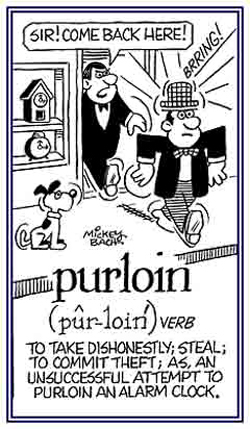
Today I walked in on someone purloining. I was scared and confused because honestly…I don’t even know what purloining is.  Does this word confuse you? Well you’re in luck because you just clicked on an article dedicated to defining the word “purloin.” You may be thinking to yourself, “self, why would I read an article on the word purloin?” And to that I would say, “because there isn’t another article I’ve seen on this topic, and no one knows what it means.” 

The Bible is our most valuable possession we have here on earth, so our goal should be to understand what it says. There have been times that I’ve read verses that have used some confusing words, and instead of trying to understand what it means, I just skipped over it and kept reading. But there are some valuable insights that we can gain from looking more in-depth at these words. Let’s define purloining as it is seen in scripture. 

Titus 2:10 says, Not purloining, but shewing all good fidelity; that they may adorn the doctrine of God our Savior in all things” (KJV). Purloining here is the Greek word “nosphivo”which is only found 3 times in New Testament,  and only translated as purloining in one verse.  The Greek word is translated as, “to put aside for oneself, to keep back, to steal.” This word originally was used as a descriptor of what the Roman soldiers would do when they were looting. They would be tempted to hold back treasure for themselves as they plundered cities, rather than giving the full amount to the Roman Empire. They would steal and hold back, and that’s exactly how Paul uses this word in Titus 2:10. 

Going back to this verse, how is this term used in context? Verse 10 is the launching point for the rest of Paul’s point in chapter one.  When he says “purloining” he’s referring to bondservants and their attitude towards their master.  Rather than pilfering and stealing, they should show faith in God to take care of them. In essence this verse is an appeal to live in accordance to the teachings of God in everything. Servants who were not Christians would steal and cheat from their masters any chance they could get. As Christians we are to have a faith in God to provide for us, not stealing and being dishonest. 

In summary, if you were to use this in everyday conversation, you could say something like, “I have never purloined in my life, “Purloining is wrong” or, “I’m going to teach my kids to be honest and not run around purloining.” Or you could just say “steal” or “withhold” instead.  Although a few translations chose to use an interesting word to convey this idea of stealing, the point is still very valid for us today. I challenge each one of us to have faith in God to provide, to trust that His commands are in our best interest, and to rely on God to take care of our needs rather than purloining. I also challenge each one of us to use this word as many times as possible in the upcoming new year. 

Dark Providence

Friday’s Column: Brent’s Biblical Bytes


Brent Pollard

We think of providence as wholly positive. Yet, there is a sense in which it may accomplish something we perceive as “negative” (or “dark”). Lexico provides this secondary definition for providence: “Timely preparation for future eventualities.” (“Providence”) We relish the thought of God preparing events to work things together for our advantage. We know God promises to do so for the church (Romans 8.28). But what must God do if He must punish or chastise us? Does that not also require preparations? 

Habakkuk deals with the difficulty of the titular prophet accepting God’s prescribed punishment for Judah. Habakkuk could not understand God’s selection of a particular people to carry out His sentence. Yes, God was empowering Babylon to punish Judah for her sins. To empower Babylon, however, required God to remove Assyria from preeminence within Mesopotamia. God provided another prophet, Nahum, with a prophecy regarding the fall of Assyria’s capital, Nineveh (Nahum 3). Secular history offers the rest of the story.  

The fate of Assyria is the same of all earthly powers that have completed their usefulness–Judgment. After telling Habakkuk about allowing Babylon to rule the region, God said that Babylon would likewise be held guilty (Habakkuk 1.11). In other words, for as long as Babylon could exact the punishment God intended to bring upon Judah, they would remain. God determined that this punishment’s timeframe was seventy years, then God would punish the Babylonians for their atrocities (Jeremiah 25.11-12). 

Do we presume that God is not still in the “king-making business?” Romans 13.1 teaches us that all earthly authority comes from God. So, God is the reason that 195 countries exist today. The problem is that you and I, with our finite minds and lifespans, cannot comprehend God’s eternal purpose for each country. Do nations not help to keep their neighbors in check? Sometimes that is the case. The twentieth century saw two global conflicts serving to restrain the avarice of a few aggressor-states.  

There is no earthly Christian theocracy today, but God has His Kingdom, and it is not of this world (John 18.36). There is no political boundary capable of keeping God’s Kingdom in check, fulfilling prophecy (Daniel 2.44). That is the Kingdom we must put first (Matthew 6.33). Even so, the proverb remains that God exalts righteous nations (Proverbs 14.34). Hence, we desire moral governance even in the secular world.  

Much was said by the Founding Fathers about the role of faith in creating the American republic. John Adams said that the Constitution was incapable of ruling any but a moral and religious people. Yet, among the same men preaching liberty in the eighteenth century, some held other men in slavery. Thomas Jefferson was not oblivious to the irony, though. He said that he knew God was just and that His justice could not sleep forever. In the 1860s, the United States engaged in a bloody civil war that claimed the lives of upwards of 700,000 men. And even if it still took the Civil Rights Movement of the 1960s to finalize the work begun by men like Frederick Douglas, America finally made progress in living up to its foundational documents regarding equality for all men.  

Yet, there are many other sins besides slavery, of which America remains guilty. America is an immoral nation, albeit a sinful nation peppered with righteous people. The requisite “ten” must still be present to prevent God’s Judgment (cf. Genesis 18.20-32). However, we must not forget about God’s “dark Providence.” He may well cultivate another nation, another “Babylon,” to punish countries like America for their collective sins. Though we can’t know about all the preparations God is making for “future eventualities,” we understand His justice may necessitate doing things we esteem negatively to chastise us.  

We are foolish if we think that what happened to Assyria or Babylon cannot happen here. As with slavery, God’s justice regarding abortion on demand, mainstreaming perversion, philandering, and political grift will not remain asleep forever. However, rather than be fearful, we must live faithfully unto death (Revelation 2.10). God will be our Rock even if our world crumbles around us (Psalm 46).  

Works Cited 

“Providence.” Lexico Dictionaries | English, Lexico Dictionaries, www.lexico.com/en/definition/providence.  

PARALLELS OF CHRIST’S BIRTH AND DEATH

Thoughts of Jesus at this Holiday Season…

preacherpollard's avatarThe Preacher Pollard Blog

Neal Pollard
Undoubtedly, one could find more contrasts than comparisons between Christ’s birth and death. Yet, a study of both reveals some interesting parallels. Both changed the world and have altered the impact of eternity. Consider the following:

1) At both, He was rejected of men (Luke 2:7; Mark 15:15).

2) At both, He was cast “outside” (Luke 2:7; Hebrews 13:12).

3) At both, Mary was there (Luke 2:7; John 19:26).

4) At both, myrrh was present for use upon Him (Matthew 2:11; John 19:39).

5) At both, there was darkness (Matthew 2:10,14; Matthew 27:45).

6) At both, His body was wrapped in clothing (Luke 2:7,12; Mark 15:46).

7) At both, a Herod becomes curiously involved (Matthew 2:7ff; Luke 23:7ff).

8) At both, there was worship-though the first was genuine and the second
mocking (Matthew 2:11 and Luke 2:13-14; Mark 15:19).

9) At both, wise men recognized His deity (Matthew…

View original post 67 more words

Speaking In Chapel At Bear Valley (12/2/20)

Tyler King asked me to speak to the students and faculty at the Bear Valley Bible Institute during their chapel several days ago. It has been my privilege to do this many times through the years. I’m very grateful for the work this great school does and for my ongoing relationship with them.

The Care and Feeding of Feral Cats

Friday’s Column: Brent’s Biblical Bytes

Brent Pollard

During my father’s recuperation from quadruple bypass surgery, I’ve had a Sisyphean task: feeding and caring for feral cats. Yes, we have been killed by kindness at the Pollard home nestled in the northeast Georgia mountains. In the summer of 2016, a desperate kitty with soulful eyes showed up begging for food. We do have a soft spot for God’s critters and thought having a mouser around would be useful. Plus, cats are also good at taking care of snakes. So, we fed her, not realizing that her desperation to approach us, though feral, was fueled by her pregnancy. I think you know what is coming next. Yes, we are now a cat sanctuary, a FERAL cat sanctuary.  

I must use a broom to sweep the doorway so that no feral cats come inside. (Being feral, they would quickly tear the house apart. We know this from experience.) Once I exit, the cats start meowing at me as if starving. A few of the cats I am trying to feed will batt at the other cats, effectively bullying them, attempting to jockey for a better position at the bowls. Sometimes, I must retrieve many of their bowls since they have knocked them off the porch into the yard. One of the more annoying things they do is stick their heads over the food bowl I am trying to fill, and the kibble often bounces off their heads, scattering everywhere. When I move to a new bowl, many will abandon a bowl, I just put food into, coming to eat at the new bowl even though it is the same food! I realize that they cannot understand me, but I still tell them that I don’t feed certain ones anything “special” and do my best to give them the same amount of food in every bowl.  

Despite my equal food distribution efforts, some larger cats will gobble up more food than they should eat. There are cats with timid personalities who will hang back and eat the remnants. I will try to sneak them some more kibble, but their characters cause them to yield that extra portion to the assertive one who is willing to steal. It is very frustrating since they cannot understand. And how can we achieve understanding? God gave me dominion over them, and the difference between our kinds is too significant. One idiomatic expression keeps coming to mind, “Like trying to herd cats.” It feels like an impossible task. 

But, then, when you are about to make a phone call and turn yourself in to animal control, one of the cats rubs up against your leg rather than joining the tumult clamoring for the food bowl. Despite being feral, a few cats learn to appreciate their benefactors. These same cats allow you to pet them and may even approach you for the same. A select couple will even walk with you as you walk down to the mailbox or go on a two-mile hike. Yes, I know, that kind of behavior is more what one associates with canines.  Yet, some cats manage to worm their way into your heart.  

I want to tread with care as I make an application. First, we brought this situation on ourselves.  Second, if we had moved after the first cat had delivered her kitten, having her spayed, we would have nipped our current situation in the bud. But catching them to spay and neuter them would be another nigh-impossible task under our circumstances. 

As I think about our feline predicament, though, I wonder what it must be like to be God looking down on a creation choosing rebellion over obedience. Could it be that He feels as if He is “herding cats?” He sends His rain on the just and unjust, but there are still the unscrupulous, defrauding others, failing to be benevolent. There are people He made in His image attacking others He has likewise made in His image. How often does He hear complaints rather than thanksgiving? Why won’t these people listen to what He says? But there are also the few on the “strait and narrow.” These desire a relationship with their benefactor, despite being feral. These walk with God. Do they buoy His heart? We do know God promised Abram that He would have spared Sodom for the sake of ten righteous souls (Genesis 18.32). It is possible. It is upon this consideration of God’s vantage over His feral creation that I ask with David, “What is man that You think of him?” (Psalm 8.4) Yes, I think that feral cats’ feeding and care is a fitting metaphor to describe God’s task of dealing with fallen humanity.   


Unmasking Pride 

Tuesday’s Column: Dale Mail

image

Dale Pollard

In the best cartoon ever made, “Scooby Doo Where Are You?” from the 60s, the episodes would predictably end when the monster is unmasked and the man beneath is revealed. The gang was always shocked! The culprit would then say that famous line, “I would have gotten away with it too if it weren’t for you meddling kids and that dog.”

There is a monster in the Bible that is mentioned in almost every book of the Bible in some form or fashion and for good reason, too. The monster is “pride,” and we’re going to unmask it so that we know exactly what it does– and what it looks like.

Pride is a form of insanity— a blindness to our reality.

Judah didn’t have many great kings, but Hezekiah was one of the rare exceptions. In 2 Kings 18-20 we read about his eventful life (as well as in Isaiah, I Chronicles, Nehemiah, and Zephaniah). While he was a righteous king, he had to battle his pride. He had seen God’s great power in action in the lives of those in Jerusalem as a whole, and in his own personal life. God saved them from Sennacherib and his army and then Hezekiah was cured of a deadly illness. However, Hezekiah had a difficult time giving God the glory for those victories. He repented and turned back to the Lord (2 Chron. 32:25-26), but his children still suffered the consequences. There’s no such thing as a “self made man” and Hezekiah needed to be reminder that he was a “God-made man.” This proves that even the righteous man can struggle with the monster, pride. 

Pride is a destructive form of amnesia.

How easy it is to turn to God when we’re in dire straights. Nebuchadnezzar had seen God save three men from a blazing fire he threw them in for not feeding his own ego by worshiping a giant image of himself. After witnessing this miraculous event, he acknowledges the Lord briefly, but his life isn’t transformed. While walking on his temple rooftop he says, 

“Is not this great Babylon, which I have built by my mighty power as a royal residence and for the glory of my majesty?” (Daniel 4:30).

He seemed to have had a little more gloating to do, but while “the words were still in his mouth…” God drives him from the land and he is fed grass like an ox for seven years (4:25). You would think his son, Belshazzar, would not forget the difficult lesson that his father had to learn but he falls victim to pride as well. 

Five Symptoms Of Pride

1. FEAR – We will find ourselves in fearful situations when we become consumed with self-reliance. We refuse to see that some things are really out of our hands. 

2. ENTITLEMENT – Romans 3-6 says we deserve death on account of sin. We’re not entitled to anything but pride makes us think we’re better than we are and that we deserve more than we do. 

3. PEOPLE-PLEASING – Pride is a form of self-worship and self-perseveration. We want the approval of others over God’s approval. Gal. 1:10 – “If I’m trying to please man I’m not a servant of God.”

4. HYPOCRISY – Elevating of status, forgetting God’s mercy, “holier than thou” mentality and quick to point out faults in others. 

5. REBELLION – The one whose actions say, “I know better than God.”

Pride is a destroyer of lives. Let’s strive for humility so that God can use us in great ways. 

Daniel 4:37 “…those who walk in pride He is able to humble.”

Hezekiah’s Tunnel (Jerusalem)

Dale Pollard

www.youtube.com/watch

“Change My Mind”

Tuesday Column: “Dale Mail”

DaleandJanelledirectorypic

Dale Pollard

You’ve probably seen a few videos bouncing around where there’s a person sitting at a table with a controversial statement on a sign placed in front of them.  The sign may say one of the following— 

“American civilians should carry guns. Change my mind.” 

“Abortion is wrong no matter what. Change my mind.” 

“There’s no such thing as white privilege. Change my mind.” 

“Your vote doesn’t matter. Change my mind.” 

You get the idea. The irony is that most of these people who are sitting at the table and demanding that someone change their mind— are actually hoping to change your mind. From the moment they set up that sign, sat in their chair, and placed the chip on their shoulder, they’ve already decided that their own minds won’t be changed. While some of the examples used above are important topics to think about, I’d rather talk about our mindset. 

When we read God’s Word, regardless of what we may think we know, if we find something that God has said that contradicts how we think or feel we must be willing to change anyway. 

In fact, it’s the goal of every faithful Christian to have their minds changed everyday! Each day, we are to be transformed to be a little more like the mind of Jesus. 

There were several moments in the life of Christ when the Pharisees tried to get Him to change their mind, but Jesus knew their minds had been firmly made already. They would say things like,

 “You’re not son of God! Show us a sign from heaven!” 

To minds that could not be changed, Jesus replied, “you are an evil and adulterous generation.” 

Though His followers would question Him and lose faith at times, we can still find several occasions in the gospels where we read concerning His disciples, “they understood.” 

The word used for “understand” means that they came to a higher and more complete level of thought. One such instance happens in Matthew 17:13ff. Jesus has just shown them who He truly was after His transfiguration. As He, Peter, James, and John walk down the mountain they ask, “Jesus, why do the scribes say that Elijah must come before the Messiah?” Jesus tells them that Elijah had already come, and he’s just been killed. The text says, “And the disciples understood He was speaking of John the Baptist.” Even though they had grown up in a society that had immersed them in Jewish teachings and beliefs, they were still willing to change their minds for the teachings of Jesus. Many of us could take a page out of their book. At times we’re so convinced that we’re right that we refuse to change even in the face of truth. Perhaps it’s because of the way we were raised or the church we’ve always gone to. Christ demands our minds, so we should be willing to change them for His sake. Change my mind! 

No Matter What, We Win

WEDNESDAY’S COLUMN: THIRD’S WORDS

Gary III

Gary Pollard

 
Today is a scary day; we’ve lost sleep, we’ve experienced no small amount of anxiety, we have legitimate fears about the future of our country, we have legitimate fears about our safety, economic prosperity, fundamental rights, and national security.
 
I’m writing this article on election day, about 16 hours before it gets posted and several hours before we will know the outcome of the election (NOTE: As of this publishing, it is still not decided). I had to study and think and pray because this day really has me (and most of us) on edge.
 
My hope is not in either man (personally, I cannot vote for someone who allows the murder of unborn children). If I’m honest with myself, I haven’t put much faith in God’s plan for our country this election cycle. I’ve been more focused on who I want in the White House.
 
The saying, “Our hope isn’t in the president,” is so often repeated at every election that it’s become very annoying to read. I know Romans 13 explicitly tells me that God controls the outcome of every election. I know that my hope isn’t in a man. I know that my rights are specific only to my brief time on earth. I know there are more important things to worry about as a Christian. Intellectually, these things are burned and imprinted into my mind. They just haven’t made their way to my heart! It’s a struggle I share with many Christians.
 
Maybe God puts whoever he puts in power to show us that we put way too much stock in man. Maybe God puts him in power to eradicate our prosperity and force us to rely on Him. Priorities become more clear when we have fewer earthly distractions. Maybe God puts him in power because our sins as a nation have brought us to the point of judgment. Maybe God puts him in power to create conditions similar to what the first century church experienced; the church grew, lost souls were saved, Christians who were faithful were all-in. Maybe God puts him in power to impress on us our own mortality and lack of control. Maybe God puts him in power because our wealth and ease has made many of us milquetoast Christians.
 
So, what if the outcome is more favorable for Christians? This should be a wakeup call. Maybe we’ve bought four more years of relative peace and prosperity. Maybe we can hang onto some rights. Maybe we can hang onto some earthly comforts. If the last couple of years have shown us anything, it’s that our lives can be changed dramatically regardless of who’s in office. What we must not do is maintain the status quo.
 
Regardless of who wins, we must start taking our faith more seriously. We must stop dividing the church. We must start thinking souls. We must desire, above all else, an eternal home with God and each other. More than just intellectually knowing these things, we must start living as if they’re real and as if our eternal destination depends on it.
 
Whoever the president is by the time this is published should mean little to us. Whoever it is, we have been given a reminder that we’re absolutely not in control and that God needs us to focus on eternity. No matter what, we win. If we suffer and die as Christians, we win. If we can save some souls who realize their need for God, we win. If we strengthen and grow the church, we win. Whoever the president is when you read this, we win!