The original Hebrew name literally means, “In The Wilderness.” Later on, Greek translators referred to these inspired writings as “Numbers.” For the Israelite people, it was the historical record of how they were shaped and Divinely-groomed while making an unnecessarily long hike through desert lands (Not to be confused with “dessert land” which sounds far better). The book of Numbers also served, and still serves, as a way for God’s people to get a bird’s-eye view of how our lives are significantly better when we are following our Leader. While there are far too many spiritual applications to be in just one article, here are three great ones.
There is no one more patient than the Lord. It’s easy to cringe when the Israelites complain or rebel time and again but God showed them more patience than any of us are capable of.
God always keeps a promise. It may have taken them 40 years to reach Canaan, but He kept His promise. We’re on a wild ride right now as a country, but God is predictable when it comes to keeping His Word. You can make a no-risk bet that heaven is coming and it’s better than what you imagine it to be.
God is always glorified in the end. When you look at Numbers and the big picture, God is the hero. He’s rejected and tossed aside by the people on several occasions, but just like at the end of this age— He gets all the glory.
“Therefore humble yourselves under the mighty hand of God, that He may exalt you at the proper time, casting all your anxiety on Him, because He cares for you” (1 Pet. 5:6-7). Peter has just told younger men to be subject to elders (1-5), and for each group to conduct themselves with humility toward each other. The motivation for this is to avoid God’s rejection. Peter quotes Proverbs 3:34 to reinforce the point.
Peter then urges everyone to humble themselves in their relationship with God. That’s the same word that describes what Jesus did by being obedient to the point of death on the cross (Phil. 2:8). It means to go lower, to surrender prestige or status (BDAG 990). This humbling concerns a specific aspect of all of our lives. Each of us has “anxiety” to cope with. By definition, an anxiety is “a feeling of apprehension or distress in view of possible danger or misfortune” (Louw-Nida 312).
Right now, there are no doubt things which make you apprehensive and distressed. You may be facing danger or misfortune. On some level and to some degree, that describes the pressure and reality for nearly all of us these days. As beings created with the freedom of choice, we can try to cope with that ourselves with our own coping tools. Maybe, in our pride, we boast in our own ability to handle it all. Not only is that a delusion and a self-deception, it is flirting with disaster. Why not choose a better way? Peter lays that out for us.
Let’s survey the facts here.
GOD IS ABLE–You are entrusting yourself in His mighty hand. He is in control and has the power to rule in every situation. This is the same hand He holds you in the hollow of (Isa. 40:12).
GOD IS AWARE–He has the exclusive benefit of perfect foreknowledge. He knows what is going on now and He can see what will happen. As He works through time and events, He is choosing the proper time to lift you as you have surrendered yourself to His power and His wisdom. He knows everything that is going on in your situation. In fact, He knows about it at a much more intimate level than even you do.
GOD IS AFFECTIONATE–What motivates Him to act? He cares for you! Peter is telling us to throw all our anxiousness on God, like the disciples threw their coats on the colt so that Jesus could sit on it (Luke 19:35). Take each burden, fear, and worry you are carrying right now, that is weighing you down, and toss it into His mighty hand (a hand you will examine and find very capable–read Isaiah 40:12 again). Peter says He feels anxious concern for us. Sure, He can handle it. But it’s more than that. He wants to handle it. Why? Because you mean that much to Him!
I read this promise and I admonish myself. Why am I trying to carry this all by myself when God is offering to do this for me? He tells me to get myself out of the way and let Him handle this. Faced with my limitations and His limitless resources, it is futile and foolish to face these distressing matters in any other way!
The original Star Trek series’ penultimate episode (“All Our Yesterdays”) had a compelling plot about how the residents of a planet chose to save themselves from impending doom from when their star would go nova. There were disks within a library enabling travel through a machine to any point in the planet’s past. Kirk, Spock, and McCoy, the show’s leading trio of protagonists, inadvertently got sent back into two different epochs of the planet’s history. Fortunately for the three, their bodies had not been “prepared” for living in the past. Thus, they could return. No sooner were they able to return to the library that the librarian, Atok, leaped into the machine just in time to be spared the planet’s destruction. Kirk signaled the ship to transport himself, the science officer, and the doctor to theEnterprise. In the remastered version, the star explodes, and you see the planet they had been on being dissolved as the ship moves away and the end credits begin to roll.
“All Our Yesterdays” is one of my favorite Star Trek episodes. It is a favorite since I wonder what it might be like to live within our planet’s past. If I could pick up with my life in the 1950s, would I do it? Before watching a program about the CIA’s overthrow of a legitimate Guatemalan government in the 1950s to help an American banana company, I might have said, “yes.” It turns out that my idealized slice of Americana had a moldy underside. I had seen other signs of this, of course. However, I still clung to the idea that the 1950s HAD to be better than today. The politicians of the 1950s were just as “swampy” as they are today, though. The only difference was how the press chose to cover them. And even if there were the “June and Ward Cleavers” of America, vis-à-vis Leave It to Beaver, there were likewise the Rosa Parkses having to sit at the back of the bus and drink from separate water fountains because of skin color. As Solomon reminds us, “That which has been is that which will be, and that which has been done is that which will be done. So there is nothing new under the sun” (Ecclesiastes 1.9 NASB1995). That truth means that there truly was no ideal time for fallen humanity, despite our desire for there to be so.
Psychology suggests we indulge in nostalgia more often when we are depressed than happy. We use nostalgia like medicine to treat our sadness. However, like the “wrong” flu shot, e.g., Type A vaccine for a Type B outbreak, it may not rectify the problem but make it more bearable. Since nostalgia does not “solve” our problems, it is incredible that it becomes a panacea for some. Such cannot be said of the Apostle Paul, though. The Apostle Paul was not one to indulge nostalgia even when reflecting on his past (Philippians3.2-11). He considered his past achievements under Judaism as rubbish (8). Paul told us to strive to live in the future of a better tomorrow instead (Philippians 3.12-14). Paul said that his “today” belonged to the church’s work (Philippians 1.21-26). And Paul encouraged us to imitate him as he imitated Christ (1 Corinthians 11.1).
It may be that all our yesterdays may seem sweeter to us but may we ever “press on toward the goal for the prize of the upward call of God in Christ Jesus” (Philippians 3.14 NASB1995).
Did you know that there can be union without having unity? A union is an association or group formed by people with a common interest or purpose, while unity is the state of being united or joined together as a whole. There can be union without unity. For example, you can tie two cats together by their tails and throw them over a clothes line. By doing so you have created a union, but there won’t be unity between these two cats, only fighting and chaos.
The church formed by Christ is a union, but that doesn’t mean there will always be unity. God understood this when He created the church. He knew that we wouldn’t always get along, so He gave us His word to help us in this matter. Paul spends a few chapters in the book of Romans discussing Christians and their relationships. In 12:17-13:14 he writes about our relationship with the world. In Romans 14:1-16:27, his focus is on getting along with our brothers and sisters in Christ.
Beginning in chapter 15, Paul spends a few verses talking about the responsibility of those who are strong in faith. Romand 15:1-3 says, “We who are strong have an obligation to bear with the failings of the weak, and not to please ourselves. 2 Let each of us please his neighbor for his good, to build him up. 3 For Christ did not please himself, but as it is written, “The reproaches of those who reproached you fell on me.”
Paul commands the strong in faith to bear the weakness of those without strength (be patient), not be pleasers of self (Phil. 2:3-4), do that which is for the weaker ones’ good, and follow the example of Christ. Paul then spends a moment talking about the power and importance of the Old Testament in verse four.. It was written to teach us (there’s value in studying the O.T.), it was written to encourage us (by reading of faithful people, as in Heb. 11), and it also helps us achieve unity through its teachings. The rest of this chapter is focused on unity. We are given many commands on how to grow our relationship with each other.
Why should we follow these commands? It brings about unity in Christ. Have you ever driven a car that backfires? Or that isn’t firing on all cylinders? It is usually caused by an engine that is out of timing, faulty wiring, or fouled spark plugs. A church that isn’t unified in Christ, runs like a car that is mechanically unstable. Without unity and timing in the cylinders, you experience a lack of horse power and worsened gas mileage. It fails to function the way it was designed to run. The Lord’s body needs maintenance and work in order to function properly.
Our relationship with one another helps us to achieve this perfect unity and efficient operation. A great example of unity is a snowflake. While it is a rare sighting in Alabama, we know what they look like. Snowflakes are one of nature’s most fragile things, but just look at what they can do when they stick together. The church is made up of fragile and imperfect people, but through unity we can accomplish so much more for Christ.
I have some hobbies/passions that require caution: motorcycles, shooting, off-roading, auto mechanics. These are things that could be dangerous, but are enjoyable and safe if appropriate caution is used.
The reason any person would get on a motorcycle or under their vehicle or into a swamp or behind an optic is the reward associated with those activities. There’s no freedom like riding back roads or around beautiful scenery on a cruiser. Saving hundreds on auto repairs makes the effort worth it. Seeing how much mud/water/rock/terrain you can keep moving through is a blast. Racing the timer and improving consistency, all while hearing the satisfying “ding” of a steel target is exhilarating.
If an activity is enjoyable – potentially risky, but fun – we tend to do it anyway, with appropriate caution. Even those who don’t enjoy these kinds of activities are likely licensed drivers and are glad to assume the risks involved with driving (according to the WHO, 1.25 million die in a wreck worldwide every year, with an additional 20-50 million getting injured or disabled).
I cannot justify being willing to assume risks in many other aspects of my life, but cutting out the one aspect that impacts eternity. The CDC has accidents as the third leading cause of death in the U.S. Most of us drive to go anywhere or do anything more than a mile or so away, and we do this without a second thought.
Even if Christian fellowship were the most dangerous activity possible (for many in the early church it was, for some today it might be), we should be willing to pursue it. We could never hope for a greater reward than we will receive for the risk we might assume when we come together as a church.
We all know the story of the Tower Of Babel. It’s the event that gave us all the diverse languages of the world. That account is not just for our entertainment or education, but there are many spiritual applications that can be pulled from the event. Here are just six from Genesis 11:1-9.
What we are building will only be successful if God designed the blue prints. What are we building? Where do we choose to place our time and effort? Making a name for ourself? Making the most money? Getting the most pleasure out of life? If this is the life we’re building, like the foolish man that’s a life built on sand.
We are free to do as we want, but for every bad decision there are consequences.
There is a truth to what God said about our ability to accomplish much as a unified people. There’s also a positive side to this not so positive account. When the church body is unified there is no limit to what we can accomplish. When there’s dissension we are weaker.
Ignorance does not mean a blissful existence. It was ignorant to think that a closer relationship with God involved building a stairway into the sky that in their minds would allow God to have the ability to descend to earth. The opposite is true. God built us a way to go to Him.
Be mindful of the presence you keep and the vision you share. It seemed that most if not all mankind at this time was unified under one vision. “To make a name for themselves,” they worked together. They planned, schemed, spent resources and time to build something that would change the world forever— but it wasn’t God’s vision. The presence you keep and the shared vision matters. What are we building?
Accounts in the Bible that seem unrealistic or mythical should not weaken our faith but strengthen it when we do our due diligence in digging into His word. God is capable of great things, and that hasn’t changed. We serve a powerful God who has big plans for the world. Are we willing to side with Him?
I am a lifelong fan of the SEC (Southeastern Conference), as a diehard, if long-suffering, Georgia Bulldog. In fact, I was born in Oxford, Mississippi, home to the Ole Miss Rebels football team that took on and beat the Indiana Hoosiers on January 2 at the Outback Bowl in Tampa, Florida. But, I could not help but love the charisma and philosophy of Indiana’s head football coach, Tom Allen. They had a remarkable season, giving Ohio State all it could handle in the Big Ten Championship game. They are up-and-comers. They are over-comers. A big reason why is Allen’s motto. It has helped them deal with internal tragedy and loss. It has brought them together in a year that tore so many people apart, politically, racially, and philosophically. The motto is simply “L-E-O”: Love Each Other. He preaches to his players to live for something larger than themselves. He explained, “…You have to live your life with core values and core principles. There are anchors in your life. This is what we talk about all the time, that when these storms come — not if they come, when they come — you have a rock-solid foundation that cannot be shaken” (Jon Blau, Bloomington, IN, Star-Times, 1/3/21). He sees his opportunity as head coach as about much more than wins and losses, but about shaping young men at a crucial time in their lives. And what they need to succeed, he’s convinced, is “brotherly love.”
As fantastic as that, promoted by a man of faith like Allen, he’s simply echoing the motto Jesus already gave His disciples 2,000 years ago. John records Jesus’ admonition to His followers, when He said, “A new commandment I give to you, that you love one another, even as I have loved you, that you also love one another. By this all men will know that you are My disciples, if you have love for one another” (John 13:34-35). OK, technically, that’s L-O-A, but, when we remind each other, it’s L-E-O. More than a motto, it is our identifying mark. Jesus knew the power of selfless, sacrificial love. Love, defined as “the quality of warm regard for and interest in another” (BDAG, 6), helps us through the storms of life. It gives us something bigger than ourselves to lean on.
New Testament writers tell us what L-O-A will do:
It causes us to serve one another (Gal. 5:13)
It roots and grounds us (Eph. 3:17)
It helps us show tolerance for one another (Eph. 4:2)
It makes us spiritual laborers (1 Th. 1:3)
It leads us to highly esteem one another (1 Th. 5:13)
It shows us as proper examples of a believer in Christ (1 Tim. 4:12)
It will cover a multitude of sins (1 Pet. 4:8)
Of course, the list is much longer than that, but think about the impact we can make on the world, especially right now, if we will work to master such a motto in the body of God’s Son. Love each other! Don’t divide into camps, suspect, prejudge, accuse, isolate from, and indict each other. That’s the world’s modus operandi (M.O.). We do that, and we have nothing to offer them that they do not already have. Offer them love, and you help fill a crucial void. God’s nature is love (1 John 4:8). It’s to be our nature, too! Let’s love each other. A desperate world is waiting.
We have entered the vestibule of a new year. Upon reflection, one might realize how subjective the significance of this day is. Neil deGrasse Tyson likes to point this out annually. For example, in 2011, he tweeted: “January 1, 2011: Happy New Year to all –at this arbitrary spot in Earth’s orbit around the Sun.” (Tyson) Consider China. They may observe the Gregorian calendar to conduct global business, but they will not celebrate the new year until February 12, 2021. Why is there a discrepancy? The Chinese, like the Jews, have a lunar-based calendar. God may have created time as a construct in our material universe, but the only “clocks” He provided were the moon and the sun (Genesis 1.14-19), and it is easier to mark time by the moon since we watch it wax and wane. The sun may appear a little lower or higher in the sky, but it is always making its same east-west circuit.
Even so, we choose January 1 as a special day to begin making necessary or desirable changes to our lives. I would hope that in an age of “fear porn,” the child of God will choose calm. I apologize if the use of that four-letter word is offensive. However, “fear porn” is an expression that has entered our vernacular. Oxford defines this specific usage of the word “porn” as follows: “[in combination or with modifier] Television programs, magazines, books, etc. that are regarded as emphasizing the sensuous or sensational aspects of a nonsexual subject and stimulating a compulsive interest in their audience.” (“Porn”) Perhaps the definition provided by a user of the less-authoritative Urban Dictionary is more accessible. “Mainstream Media content that deliberately and enticingly plays on people’s fears about disaster, disease, and death.” (Animalfarm1984)
While addressing the Great Depression, Democrat Franklin Delano Rosevelt famously stated, “…the only thing we have to fear is fear itself.” Among others, Michael Reagan, speaking of his political opponents, has altered the maxim to be “the only thing we have to offer is fear itself.” (Reagan) I imagine there are those considering that indictment up to debate. However, it is not my point to assign blame to political parties or politicians. Many thrive on instilling fear regardless of political affiliation. As one writer for a pop-psychology magazine opined, fear is “the most powerful motivator of all.” (Wilson)
I set out to recall a time in my life in which no Chicken Little was trying to scare me about something. I fail to remember a season when all was well with the world. In nearly a half-century of life, alarmists told me of the perils I face from nuclear war, a new ice age, a hole in the ozone layer, acid rain, killer bees, the deforestation of the Amazon region, the policies of Ronald Reagan, Y2K, global-warming-no-wait-let’s-call-it-climate-change-to-cover-all-our-bases, the policies of Barrack Obama, Ebola, the very existence of Donald Trump, the Illuminati, Globalists, Antifa, Black Lives Matter, COVID-19, and, now, Joe Biden’s socialist regime. Phew. Sadly, I have occasionally given such Chicken Littles a greater hearing than the assurances found in God’s Word.
What was it that the inspired Apostle John said? “You are from God, little children, and have overcome them; because greater is He who is in you than he who is in the world” (1 John 4.4 NASB1995). Jesus created and now sustains creation (Colossians 1.16-17). It is He who will destroy it when the time comes (2 Peter 3.10). In the interim, as God promised Noah: “While the earth remains, seedtime and harvest, and cold and heat, and summer and winter, and day and night shall not cease (Genesis 8.22 NASB1995).” It may be that we figuratively see the writing on the wall as Belshazzar indeed did in Daniel 5, but even so, God will be our Rock. Even if the mountains crumble and fall into the sea, He is still our refuge (Psalm 46). It is OK to face uncertainty with apprehension like Habakkuk did as he awaited the impending Babylonian invasion (Habakkuk 3.2,16). Yet, like Habakkuk (and the Apostle Paul), we must bravely move forward, recognizing our dependence upon Providence (Habakkuk 3.17-19; Philippians 4.11-13). Regardless of what 2021 may hold, if you seek God and His Kingdom first, God has your back (Matthew 6.33)!
Works Cited
Tyson, Neil deGrasse (neiltyson). “January 1, 2011: Happy New Year to all –at this arbitrary spot in Earth’s orbit around the Sun.” 1 January 2011, 2:55 p.m. Tweet.
“Porn: Definition of Porn by Oxford Dictionary on Lexico.com Also Meaning of Porn.” Lexico Dictionaries | English, Lexico Dictionaries,www.lexico.com/en/definition/porn.
Reagan, Michael. “Stories in the News – Ketchikan, Alaska – The Fear Peddlers.” Sitnews, Stories in the News, 15 May 2003, 4:25 p.m.,www.sitnews.net/Columnist/051503_reagan.html.
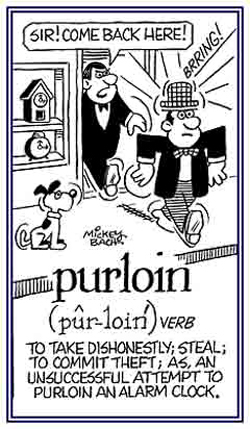
Today I walked in on someone purloining. I was scared and confused because honestly…I don’t even know what purloining is. Does this word confuse you? Well you’re in luck because you just clicked on an article dedicated to defining the word “purloin.” You may be thinking to yourself, “self, why would I read an article on the word purloin?” And to that I would say, “because there isn’t another article I’ve seen on this topic, and no one knows what it means.”
The Bible is our most valuable possession we have here on earth, so our goal should be to understand what it says. There have been times that I’ve read verses that have used some confusing words, and instead of trying to understand what it means, I just skipped over it and kept reading. But there are some valuable insights that we can gain from looking more in-depth at these words. Let’s define purloining as it is seen in scripture.
Titus 2:10 says, Not purloining, but shewing all good fidelity; that they may adorn the doctrine of God our Savior in all things” (KJV). Purloining here is the Greek word “nosphivo”which is only found 3 times in New Testament, and only translated as purloining in one verse. The Greek word is translated as, “to put aside for oneself, to keep back, to steal.” This word originally was used as a descriptor of what the Roman soldiers would do when they were looting. They would be tempted to hold back treasure for themselves as they plundered cities, rather than giving the full amount to the Roman Empire. They would steal and hold back, and that’s exactly how Paul uses this word in Titus 2:10.
Going back to this verse, how is this term used in context? Verse 10 is the launching point for the rest of Paul’s point in chapter one. When he says “purloining” he’s referring to bondservants and their attitude towards their master. Rather than pilfering and stealing, they should show faith in God to take care of them. In essence this verse is an appeal to live in accordance to the teachings of God in everything. Servants who were not Christians would steal and cheat from their masters any chance they could get. As Christians we are to have a faith in God to provide for us, not stealing and being dishonest.
In summary, if you were to use this in everyday conversation, you could say something like, “I have never purloined in my life, “Purloining is wrong” or, “I’m going to teach my kids to be honest and not run around purloining.” Or you could just say “steal” or “withhold” instead. Although a few translations chose to use an interesting word to convey this idea of stealing, the point is still very valid for us today. I challenge each one of us to have faith in God to provide, to trust that His commands are in our best interest, and to rely on God to take care of our needs rather than purloining. I also challenge each one of us to use this word as many times as possible in the upcoming new year.
This word has no positive meaning. Fouling on a spark plug means it’s time to replace it. A foul smell is an unpleasant one. Fouling in the barrel means it’s time to clean your gun. In sports, a foul is usually bad for your team.
In older English translations, “foul” is used to describe something impure, unholy, or evil (Mark 5.8; Luke 6.18; Revelation 16.13). Regardless, we understand that something foul is not what we want attributed to our character or in contact with our senses.
Are our words foul (Eph. 4.29)? Unwholesome here is σαπρός (sapros), which means “rotten, bad, or harmful.” It describes any kind of speech that has no positive effect or worth. Christians, there is no world in which cursing is excluded from this definition.
Consider the following:
I Corinthians 9.19ff encourages us to follow culture as long as it doesn’t violate God’s law. Even our secular culture recognizes that some words are not appropriate. Every culture has a set of words, phrases, postures, etc. that are offensive or recognized as inappropriate. These are σαπρός, and have no place in our lives.
I Peter 3.10 points out that our words have an effect on our quality of life. This includes avoiding lies and evil speech. Evil here is κακός (kakos), which means “bad, injurious, harmful, or wrong.” Lots of words fall under this category, but why are some exempting curse words? How do those not fit σαπρος or κακός?
In the last few years, even some theologians have argued that cursing is not under the purview of these passages. Far too many Christians use words that our culture understands to be curse words.
Ephesians four is a chapter about leaving our old lives behind. Part of leaving our old self behind is controlling our speech and using it to encourage others (28). By using foul language (σαπρος), we grieve (offend, distress, cause to become sad) the Holy Spirit (29)!
If we know that our words can have an effect on the Spirit that translates our deepest emotions and loss for words into meaningful petitions to God (Romans 8.26, 27), why would we use words that could very easily be described as worthless, harmful, or wrong?
Peace on earth? Is that even possible? I mean boy look at this place.
Could it be that peace and joy mean something else entirely?
It’s true that for the faithful Christian peace and joy await us, but there are some who believe we can only experience these blessings in heaven.
We may feel that we are allowed only moments of Joy.
History shows us only times of peace, but never peace everywhere.
Can we have peace and joy for our life here on earth?
Let’s look at how this is most definitely possible. Perhaps it’ll make the holiday season that much more enjoyable and hopefully every day after.
Real PEACE
Peace is not the lack of war— we know we’re in a spiritual battle (2 Cor. 10:3-5)
We can have peace knowing that Jesus already won the ultimate war of death and gave us the victory.
Peace comes from confidence in your salvation (Romans 8:31-38)
God is on our side. He’s bigger than any problem we will ever face— peace comes from knowing what many assume to be the unknown.
Real JOY
What is joy?
It’s not happiness
Like peace, it relies on an understanding of faith and and the appreciation of victory.
It’s also a conscious awareness that God is active in our lives. James 1:2 says, “Count it all joy!” That doesn’t mean when trials tumble in you embrace them with a smile, but it’s an awareness that God is working in the world and that He has everything under control.
What’s there to be joyous about?
If you’re a faithful Child of God— there’s everything to be joyous about. Your life is one of abundant joy, but you may just need to choose it.
Decide how you will view future trials ahead of time. Now is a great time at the beginning of a new year.
These are God’s gifts to you that keep on giving— all year long.
Peace to you and may this new year be the one we all decide to be joyful about the certainty we share in a world full of uncertainty.
It was such a beautiful moment yesterday morning. A brother in Christ from our area who has been attending with us for a few months responded to the invitation. As Kevin and I took his confession, he spoke of sins in his past that fill him with regret. Though he was raised in the church, he has been away from the Lord for a long time. Among the things he expressed from his tender heart, he confessed, “Ive been toying with God all my life.” His point was simple. He felt doubt about God’s existence and concern for him, and it led him to make regrettable choices. But, recently, his study of God’s word and fellowship with God’s people led him to see how real God is and how much he needs Him in his life.
I wonder how many of us could confess that, at times and in ways, we’ve toyed with God in some way. Perhaps we appealed to Him only when we were in trouble that we couldn’t solve ourselves. Maybe we promised Him we’d be faithful if only He’d give us something we specifically prayed for or thought we needed, and when we got it we broke our promise. It might have been a time or season when we “played church” and acted the role of Christian in the building but acted like the world when around them.
This is not a tendency that started in our current generation. It is a human tendency. Bible writers exposed such thinking. God tells Ezekiel, “But as for you, son of man, your fellow citizens who talk about you by the walls and in the doorways of the houses, speak to one another, each to his brother, saying, ‘Come now and hear what the message is which comes forth from the Lord.’ They come to you as people come, and sit before you as My people and hear your words, but they do not do them, for they do the lustful desires expressed by their mouth, and their heart goes after their gain. Behold, you are to them like a sensual song by one who has a beautiful voice and plays well on an instrument; for they hear your words but they do not practice them” (Ezek. 33:30-32). This is similar to what Isaiah wrote (29:13) and Matthew (15:8-9) and Mark (7:6,7) quote. It’s playing with God to speak as though we desire His Word and even listen to it but be driven by desires and a heart that practice something different (cf. Jas. 1:21-25).
I need to have the good heart our dear brother expressed on Sunday morning. One who wants others to see and know how much He believes in God, loves Him, and intends to serve Him. May we all keep our hearts tender to God’s Word and let its power do its surgical work in removing what doesn’t belong and moving us to act on what does belong.
Are you hoping for a “white Christmas” like the ones that Irving Berlin alleged to know? If so, I have some disappointing news for you. The reality is white Christmases are rare. They have always been rare, at least as long as we have been keeping meteorological records. Yet, what of the picturesque scenes painted by Currier and Ives? What about the romantic notions of a snowy Christmas extolled by Bing Crosby, Rosemary Clooney, Danny Kaye, and Vera-Ellen in Michael Curtiz’s “White Christmas?” Yes, those are likewise a fabrication of Hollywood too.
There are two reasons that the belief in a “white Christmas” is faulty. First, there is the fact that Britain was a late adopter of the Gregorian calendar (1752). Hence, December 25th used to be January 6th. That makes a big difference from a meteorological standpoint. Second, Charles Dickens, the man who gave us our concept of the “modern Christmas,” lived during the coldest, snowiest part of the Little Ice Age (1805 to 1820). If one is prone to indulge in nostalgia, he allows his youth to color his perceptions of the present and future. So, young Charles Dickens enjoyed very snowy Christmases. In his earlier days, the snow fell and stuck around for some time. From his perspective, then, idyllic Christmases were white. America, in turn, blindly accepted the Dickensian Christmas as its role model.
It is not charming to learn that we have founded our hopes on a myth, correct? At least the desire for a white Christmas is innocent. Yet, how many are investing their hopes in salvation based on the equivalent of tradition or myth? In Philippians 2.12, Paul tells us to “make an end of your own salvation with fear and trembling” (GNV). I chose this early English translation (Geneva) because it well-conveys the message from the Holy Spirit. Though salvation is a gift from God (Ephesians 2.8-9), we must endeavor to receive it. Thus, we make “an end” to it. Like the football thrown by the quarterback, we must catch the ball, tuck it in securely, and run to the endzone.
Why would someone purposely mislead another? The real answer, perhaps, is something known only by God. One of the most tragic narratives of the Old Testament is that of the young and old prophet. 1 Kings 13 records how God dispatched a young prophet to cry out against Jeroboam’s idolatry. Jeroboam wanted the young prophet to intercede on his behalf with God. God told the young prophet that even if Jeroboam offered half of his house, he would not dine with anyone but go straight home following a different route. So, the young prophet rejected Jeroboam’s request, repeating what God said.
The story does not end there, however. An old prophet living in Bethel asked the young prophet to dine with him. The young prophet repeated what God had told him. In response, the old prophet lied and told the young prophet that an angel spoke to him, permitting him to dine with him. In a sense, the young prophet did not “make an end of (his) salvation with fear and trembling.” Rather than consulting God about the truth of what the old prophet said, he accepted the old prophet’s invitation. While sitting at the old prophet’s table, the old prophet told the young prophet that he would die since he disobeyed God. The young prophet finished his final meal and traveled the road towards home, where he met a lion that killed him. And despite being the instrument of his destruction, the old prophet lamented the young prophet after retrieving his dead body.
Just as with white Christmases, there are other myths we want to believe. We want to think that older people sharing kinship with us have our best spiritual interests at heart. For example, most people have “saintly” mothers and grandmothers who took them to a particular church in their youth. They paid attention to some preacher at those services who told them to believe in Jesus to receive salvation. And he calls himself a preacher, correct? Hence, he should be someone you can trust. As with the young prophet, there is a failure to learn the truth directly from the source: God. Jesus promises that we can know that truth (John 8.32) and identifies that knowable truth as God’s word (John 17.17).
However, rather than God’s truth, many would instead believe the doctrines of men, like Calvinism’s predestination, dubbed “the most comforting doctrine.” And they may embrace this false teaching as sincerely as Saul had embraced Judaism before meeting Jesus on the road to Damascus. Ultimately, their rationale has the same fragile foundation as a Dickensian novel or a Currier and Ives lithograph. Warm, fuzzy feelings serve as the basis for belief. That feeling is related to nostalgia for the “faith” of mom or dad or the beloved preacher, not truth. It is a feeling predicated on the myth that a loving God would not condemn any sincerely religious person even though Jesus said that those failing to obey the Father would depart (Matthew 7.21-23).
In conclusion, I’d advise you to heed Solomon’s counsel. “Buy the truth, but sell it not: likewise wisdom, instruction, and understanding” (Proverbs 23.23 GNV). Make sure your salvation has a better foundation than a white Christmas.
How much do you trust a liar? A study was conducted by Psychology Today where they asked 1000 people how many lies they’ve told in the last 24 hours. The average answer was two lies, but 75 percent of men said they would lie if they were talking about their social status. 80 percent of women said they have lied about their weight.
The average person we come in contact with has no problem lying to us. Whether it’s at work, in school or to friends and family, the majority of people feel that it’s morally okay to lie.
Ephesians 4:25 says, “Therefore, laying aside falsehood, speak truth each one of you with his neighbor, for we are members of one another.”
“Therefore” is a grammatical tie to previous verses. Each time we read this word we should see it as a finger pointing up to the previous verses. Contextually Paul is saying, “Therefore, since we have put on the new self lay aside falsehood.”
If you’re a Christian reading this verse, you have put on the new self. So we are commanded to stop lying and be truthful in our interactions with others.
Paul commands us to tell the truth. This seems like a simple command, yet sadly we get caught up in telling lies. We want what’s easiest. Many are tempted to take what seems to be the easy way out.
But there is something to keep in mind the next time we are tempted to lie:
Our reputation is ruined by dishonesty. If people catch us lying, why would they believe us at all? The boy who cried wolf is a prime example of this very fact. We all know how this story goes, and the bottom line is we lose our credibility if we lie. When we are honest and choose to tell the truth, people will trust us, and God’s Word has a better chance of reaching the lost.
When it comes to our Christianity, we want people to trust us. When we lie we lose our credibility and our ability to proclaim the gospel is harmed. Telling the truth in every situation is an attribute we are to have in our new walk with Christ. Plus, nobody wants to be friends with a liar.
Angels are not the dainty, long-haired Western Europeans they’re often depicted as being. In Matthew 28, their appearance was like lightning and they had white clothes. Evidently their appearance was other-worldly enough to frighten these soldiers almost to death (28.4). Whether this was some cardiac event or simply shock we cannot know. But to frighten someone that tough to that extent would take something pretty crazy.
But some of these same guys still went straight to the chief priests and took a bribe to keep quiet and spread disinformation (28.11-15). After what they had just seen and experienced, you’d think they would run to a therapist and not the chief priests to help perpetuate something they knew to be false.
We can be tempted sometimes to think that evangelism requires more than just showing someone the word. We might think the miraculous or incredible could persuade even the most stubborn non-believer. The power of our job (making disciples) is in the Word and in faith. The Bible has many accounts of people seeing incredible feats of supernatural power with their own eyes and still rejecting God. Abraham informed the rich man in Luke 16.29-31 that God’s Word is what saves; if that is rejected, no miracle will change this.
If we place our faith in the power of the Word and work to deepen our understanding of the Word, we have all we need to show the power of Jesus.
Such powerful words describe it.The words “convert,” “save,” “restore,” “recover,” and the like depict the job God left Christians to do (cf. Gal. 6:1; 2 Tim. 2:26; Js. 5:19-20; etc.).The awesome business of God’s people is to be builders in the kingdom upon a foundation originating in eternity (1 Cor. 3:9-15).Each child of God is a private engaged in spiritual warfare against a tactician only God has the power to defeat (Eph. 6:10ff).
There is ample reason to be filled with excitement and dread at the task before us!God has entrusted the business of snatching souls out of eternal fire and transferring people out of darkness into His marvelous light to us earthen vessels (2 Cor. 4:7).The moment we come out of the waters of baptism, we rise to walk in newness of life (Rom. 6:3-4).That life entails culling out negative things, bad habits, poor attitudes, old ways of living.Yet, it also calls for actions and ambitions that a non-Christian could not begin to comprehend.The sign of genuine faith taken root is the desire to share the good news we ourselves have learned.
Soul-winning is the frontline focus of the family of God.All else that we do should be an extension or support of this primary work.Benevolence, though done simply for its own sake, can be a springboard of evangelistic opportunity.Fellowship is designed to not only build up the saints, but be an atmosphere — be it worship or fellowship outside the corporate assemblies— that honors God and creates hunger and thirst for righteousness.Non-Christians who come to our assemblies can then believe (cf. 1 Cor. 14:23-24).They share our company, see the light of Christ in us, and want the joy and peace that the world cannot provide (John 14:27; Mat. 5:16).
Everywhere we go, mingling in groups and having various associations, there are opportunities.There is that person who seems to stand out from others who are more frivolously engaged in life.There is the one who, when others have long shut their ears to truth, is open-minded enough and respectful enough of truth to believe and accept the Bible.A song that is used in many soul-winning campaigns is Lead Me To Some Soul Today.God is not going to “lay” anything miraculously on our heart, leading us through some direct operation to some particular person or to say some particular thing.Yet, providentially, He can open doors that leads us to find the one in search of God’s way.Our active desire should be to cultivate our hunger and optimism for this great, primary work of the church.
With all else to distract us or compete with our attention and affection, may we never forget the prime objective! We are saved to save (2 Tim. 2:2). Find the searcher and lead the lost! It’s why we’re here.
There’s a reason why we know who Galileo is. In 1610, with his telescope, the astronomer discovered four moons orbiting Jupiter. The same year, he discovered a strange oval around Saturn eventually known to be its rings. Then, in 1623, he observed an astronomical event, happening once every 20 years, known as the “Great Conjunction.” This is when the two giant planets in our solar system, Jupiter and Saturn, travel together across the sky and appear aligned. In fact, they are so close that to the naked eye they almost appear to be one giant star (known popularly as “The Christmas Star”)(Bill Keeter, Nasa.gov). Tonight, 12/21/2020, is the closest our two biggest planets have appeared together since that night 397 years ago when Galileo dubbed this phenomena with its popular name. The last time most of the earth had the view it will have tonight was March 5, 1226. A popular theory for “the star” of Matthew 2:2, which drew the Magi from the east, was the “Great Conjunction” (which happened three times in 7 B.C., in May, September, and December)(Joe Rao, space.com).
Did God, in His providence and the process of holding all things together (Col. 1:17), make the “Great Conjunction” part of His fulness of time (Gal. 4:4) that brought about the events surrounding the wise men and Herod in Matthew two? We cannot know that, but it is a powerful demonstration of the order and design of an omnipotent creator.
This God of order has made known some other “Great Conjunctions” through His eternal word:
Belief and baptism (Mark 16:16)–Together, they bring salvation
Faith and works (James 2:14-26)–Together, they ensure life
Repentance and baptism (Acts 2:38)–Together, they effect remission of sins
Faith, hope, and love (1 Cor. 13:13)–Together, they are the “abiding” things
Repentance and belief (Mark 1:15)–Together, they form the gospel of God
Righteousness, peace, and joy (Rom. 14:17)–Together, they constitute the kingdom of heaven
Life and peace (Rom. 8:6)–Together, they are consequences of the mind set on the Spirit
Spirit and truth (John 4:23-24)–Together, they form the essentials of true worship
Goodness, righteousness, and truth (Eph. 5:9)–Together, they form the fruit of the light)
Deed and truth (1 John 3:18)–Together, they demonstrate true love
There are actually so many more of these “combinations” or conjunctions that God has brought together. As compelling and awe-inspiring as His creative power is, as shown in tonight’s incredibly rare celestial occurrence, it simply builds our faith in His ability to fulfill the many great promises that saturate His Word. I hope skies are clear where you are tonight and that you will take the time to view the southwest sky right after sunset. Why not take a moment, as you gawk, to thank and praise the God who has so thoroughly revealed to you who He is and what He wants for your life?
We think of providence as wholly positive. Yet, there is a sense in which it may accomplish something we perceive as “negative” (or “dark”). Lexico provides this secondary definition for providence: “Timely preparation for future eventualities.” (“Providence”) We relish the thought of God preparing events to work things together for our advantage. We know God promises to do so for the church (Romans 8.28). But what must God do if He must punish or chastise us? Does that not also require preparations?
Habakkuk deals with the difficulty of the titular prophet accepting God’s prescribed punishment for Judah. Habakkuk could not understand God’s selection of a particular people to carry out His sentence. Yes, God was empowering Babylon to punish Judah for her sins. To empower Babylon, however, required God to remove Assyria from preeminence within Mesopotamia. God provided another prophet, Nahum, with a prophecy regarding the fall of Assyria’s capital, Nineveh (Nahum 3). Secular history offers the rest of the story.
The fate of Assyria is the same of all earthly powers that have completed their usefulness–Judgment. After telling Habakkuk about allowing Babylon to rule the region, God said that Babylon would likewise be held guilty (Habakkuk 1.11). In other words, for as long as Babylon could exact the punishment God intended to bring upon Judah, they would remain. God determined that this punishment’s timeframe was seventy years, then God would punish the Babylonians for their atrocities (Jeremiah 25.11-12).
Do we presume that God is not still in the “king-making business?” Romans 13.1 teaches us that all earthly authority comes from God. So, God is the reason that 195 countries exist today. The problem is that you and I, with our finite minds and lifespans, cannot comprehend God’s eternal purpose for each country. Do nations not help to keep their neighbors in check? Sometimes that is the case. The twentieth century saw two global conflicts serving to restrain the avarice of a few aggressor-states.
There is no earthly Christian theocracy today, but God has His Kingdom, and it is not of this world (John 18.36). There is no political boundary capable of keeping God’s Kingdom in check, fulfilling prophecy (Daniel 2.44). That is the Kingdom we must put first (Matthew 6.33). Even so, the proverb remains that God exalts righteous nations (Proverbs 14.34). Hence, we desire moral governance even in the secular world.
Much was said by the Founding Fathers about the role of faith in creating the American republic. John Adams said that the Constitution was incapable of ruling any but a moral and religious people. Yet, among the same men preaching liberty in the eighteenth century, some held other men in slavery. Thomas Jefferson was not oblivious to the irony, though. He said that he knew God was just and that His justice could not sleep forever. In the 1860s, the United States engaged in a bloody civil war that claimed the lives of upwards of 700,000 men. And even if it still took the Civil Rights Movement of the 1960s to finalize the work begun by men like Frederick Douglas, America finally made progress in living up to its foundational documents regarding equality for all men.
Yet, there are many other sins besides slavery, of which America remains guilty. America is an immoral nation, albeit a sinful nation peppered with righteous people. The requisite “ten” must still be present to prevent God’s Judgment (cf. Genesis 18.20-32). However, we must not forget about God’s “dark Providence.” He may well cultivate another nation, another “Babylon,” to punish countries like America for their collective sins. Though we can’t know about all the preparations God is making for “future eventualities,” we understand His justice may necessitate doing things we esteem negatively to chastise us.
We are foolish if we think that what happened to Assyria or Babylon cannot happen here. As with slavery, God’s justice regarding abortion on demand, mainstreaming perversion, philandering, and political grift will not remain asleep forever. However, rather than be fearful, we must live faithfully unto death (Revelation 2.10). God will be our Rock even if our world crumbles around us (Psalm 46).
Growing up, April first was a nightmare in our house. Dale and I would plan months in advance all the pranks we would do to each other. April Fool’s Day would start with small, harmless pranks. I would put soap on Dale’s toothbrush, Dale would tape my matchbox cars to the wall. And everything would be fine…but not for very long. It always ended up getting out of hand. As the day progressed the pranks got meaner and dirtier. I’d get mad and put salt in Dale’s drink, and he would turn around and get revenge by pouring salad dressing in my shoes. I’d get even more upset and would light one of his toys on fire, and Dale would lock me in a closet. But there was one instance I can still remember clearly; it was near the end of April Fool’s Day so we were both at the peak of mean pranks. I stole Dale’s hat while we were at the park, and threw it in the pond. And Dale got his revenge by taking my brand new scooter and throwing it into the lake. It was never seen again. Needless to say, mom banned pranks on April Fool’s for the rest of our time at home.
I say all of that to illustrate the very simple point that revenge never ends well. It doesn’t cultivate relationships, and it never strengthens our influence. Romans 12:19 reads, “Beloved, never avenge yourselves, but leave it to the wrath of God, for it is written, “Vengeance is mine, I will repay, says the Lord.”
Taking revenge can be quite tempting. Our sin-fueled, human emotions will naturally push us to take revenge and to get even with those who hurt us. We want to hurt those who hurt us. We want to insult them and avenge ourselves. Why? Because if we are honest, it feels good. It feels good to brake check the person that cut us off. It feels good to insult the person that spoke rudely to us. It feels good to take revenge because. WE want to get even with others. We take revenge because we selfishly think only of ourselves and how it’ll make US feel. But if we want to be called God’s children we must leave the avenging to our Father.
As Christians we should expect the world to hurt us because it’s driven by sin. The Christian, however, shouldn’t be the same because we are led by God. Taking revenge harms our influence, and it shows that we don’t truly trust that God will avenge us. God is our avenger and we must be careful to not practice what God has rightfully claimed. By following this command, not only are we letting God take care of us, we also open the door to a healthy relationship with those in the world as well as in the Church.






















 The Preacher Pollard Blog