Are You Stuck In The Doldrums?

Neal Pollard

According to NASA’s Earth Observatory, “The Intertropical Convergence Zone, or ITCZ, is the region that circles the Earth, near the equator, where the trade winds of the Northern and Southern Hemispheres come together” (via http://earthobservatory.nasa.gov).  The ITCZ (“itch”) is a major weather player, affecting rainfall, storms, and wind currents across the world along the equator but also extending north and south as the position of the earth to the sun changes seasonally.  Another feature of the ITCZ is the dead calm it can cause at sea, a weather event sailors long ago named “the doldrums.”  A sailing ship that gets caught in that area of the world can be stuck there for days due to windless conditions. It is said to be from an Old English word that gives us the modern word “dull” (via online Etymology Dictionary, http://www.etymonline.com).

Have you ever heard someone say that they were stuck in the doldrums?  They mean they feel a prolonged sense of sadness and depression. Sometimes, this can occur and the sufferer does not even know exactly why.  Since we live in an imperfect world, times like these are inevitable. People disappoint us, discouragement paralyzes us, sadness overwhelms us, and anxiety overtakes us.  What can be done if we find ourselves “stuck in the doldrums”?

Smile.  A dose of determined joy and deliberate happiness may be necessary.  Proverbs 15:13-15 says, “A merry heart makes a cheerful countenance, but by sorrow of the heart the spirit is broken. The heart of him who has understanding seeks knowledge, but the mouth of fools feeds on foolishness. All the days of the afflicted are evil, but he who is of a merry heart has a continual feast.”

Serve.  Distracting yourself from the doldrums may remedy them. There is no better way to accomplish this than by seeing someone in need and helping them.  As Christians, we have been called to “through love serve one another” (Gal. 5:13).

Supplicate.  No earthly power may be able to put wind in your sails, but the power of God in heaven never fails.  We should ask, when in our doldrums, have I spoken to God about it?  Paul says, “Be anxious for nothing, but in everything by prayer and supplication, with thanksgiving, let your requests be made known to God” (Phil. 4:6).  Supplication is a noun meaning “to make known one’s particular need” (Zodhiates, δέησις).

Hang in there!  The winds will resume and push you forward.  Just be alert when they begin to blow so you can leave those doldrums behind you!

SOLA SCRIPTURA?

Neal Pollard

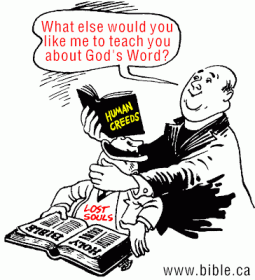
Pythagoras is said to have been the earliest outside of Scripture (Isa. 40:22) to contend that the earth is round. He did not make the earth round with his assertions, but identified what already was.  Sir Isaac Newton certainly did not create gravity, but he is credited for our modern understanding of it.  Likewise, the term “sola scriptura” is not found in scripture (similar to terms like “trinity” and “omniscience”), but it was coined during the “Reformation Movement” as part of Martin Luther’s protests against perceived corruptions of the Catholic Church.  It was a “Latin phrase (literally ‘by Scripture alone’) describing the Protestant theological principle that Scripture is the final norm in all judgments of faith and practice. Church traditions and customs, pronouncements of church officials, civil law or any other purely human source, including human reason, must yield to clear scriptural pronouncements” (Reid, Daniel G., et al.  Dictionary of Christianity in America, 1990: n.p.).  Did the Protestant Reformers, who, incidentally, got unfortunately got so many things wrong, originate that idea?  Because they were wrong on many doctrinal conclusions, does that automatically make the idea of “sola Scriptura” incorrect? It seems to me that at least three questions are in order regarding this subject.

What does “by Scripture alone” mean?

It means that the Bible does not share authority with anyone or anything else.  One author says it meant “’the freedom of Scripture to rule as God’s word in the church, disentangled from papal and ecclesiastical magisterium and tradition.’ It viewed the Word as supreme over tradition and the sacraments” (McArthur, John. Expository Preaching, 1992. Dallas: Word Pub., 47). A creed book, discipline, or annual church conference may vote and decide about what a religious group’s view on a matter should be.  They may even change their view from a previously held, correct view.  Or, a religious group may claim to have received latter day revelation and may produce a book they claim to be co-authoritative with the Bible.  Or, they may say “the church” and “church tradition” is co-authoritative.  The idea of “by Scripture alone” rejects competing or co-authoritative standards.

It does not eliminate the need to “handle aright” or involve hermeneutics (the science of interpretation).  That is a cognitive necessity.  You cannot read even the simplest of instructions or follow the most basic of tasks without employing logic, reason, and deduction.  That is not the same thing as a person, group, or book that claims to rival or co-authorize with Scripture.

What is the alternative?

That question has really already been answered.  The alternative is to suggest that Scripture alone is insufficient or inadequate, that is not the sole authority on matters of truth and right.  Some would even call the idea of following only Scripture as destructive heresy. Yet, the alternative to Scripture alone is Scripture along with something else, whether a man, group, council, church, or governing body.

Why is it so important?

This is the crux of the matter.  Scripture is God-breathed, making one spiritually complete (2 Tim. 3:16-17).  If Scripture is sufficient, what need is there for anything beyond it?  On what basis would we accept anything more or less than or different from the Bible?  How could fallible man be equal to or co-authorize with the perfect law of the Lord?  Let us accept no substitute or rival to the Bible!

The reader is encouraged to consider some excellent thoughts on this subject from here: https://www.christiancourier.com/articles/557-what-is-sola-scriptura


The Blood of Christ

Neal Pollard

The topic above should cause one’s mind to focus on some precise areas. Naturally, the blood of Christ implies thoughts of the “incarnation” of Christ (that Christ took on the form of man, while all God, and thus had blood coursing through His veins; Philippians 2:8). The blood of Christ further induces from one’s thoughts the atonement Christ made for all mankind through the shedding of His blood on the cross (cf. Hebrews 9:12-14). The blood of Christ also elicits reflection upon the suffering and death of the sinless man from Nazareth (1 Peter 2:24). And on one might reflect.

The phrase, the blood of Christ, appears verbatim in the New Testament in four verses. With each reference one finds important lessons about the function and significance of His blood. Christ’s blood is central in the Father’s plan of salvation and life within His favor. What does the blood of Christ bring to needy man?

The Blood of Christ Brings Redemption (1 Peter 1:19)
In 1 Peter 1, one sees the inspired apostle speaking to persecuted (1), predestined (2), purified (2), and pliant (2) people of God. What would cause a Christian to suffer wrong for doing right? What would cause a Christian to search out from the Scriptures the term of election, accept the terms of pardon, and follow the terms of Christian living? Simply, an understanding of redemption.

Perhaps the verse most loved and quoted is John 3:16. Yet, so be known and familiar, this verse is sorely misunderstood and under applied. Jesus, the speaker of the words recorded in this verse, foretells the act of redemption. With His divine foreknowledge, Christ understood that the gift of the Father’s only begotten Son (Himself) meant the shedding of His blood at Calvary. The purpose of that shed blood, He knew, was to redeem the lost race of man from the power and hopelessness of sin. Paul says, “But when the fullness of the time was come, God sent forth His Son, made of a woman, made under the law, to redeem them that were under the law, that we might receive the adoption of sons” (Galatians 4:4,5). By inspiration, Paul reinforces this with Titus (Titus 2:14).

The Blood of Christ Brings Removal (Hebrews 9:14)

The King James Version uses, in this verse, the word “purge” in translating the effect of the blood of Christ upon the conscience of one to whom that blood is applied. Purge means “to purify, especially of sin, guilt, or defilement” (The American Heritage Concise Dictionary, 1994). Thayer shows the original word translated “purge” in this verse means “free from the guilt of sin” (The New Thayer’s Greek-English Lexicon, 312). Clearly, the Spirit-guided writer of Hebrews speaks of the effect of the applied blood of the Savior. The audience of Hebrews, of which modern man is a part, needs some agent to remove the guilt of sin (dead works) from their lives. The blood of Christ is that agent. For the agent to be effective (to do the job as it was intended to do), one must come in contact with it. Where does one come in contact with the blood?

Jesus shed His blood when He died (John 19:34). Paul writes “that so many of us as were baptized into Jesus Christ were baptized into his death” (Romans 6:3). One cannot literally go over to Jerusalem to a hill called Mt. Calvary and find the man Jesus bleeding to death on a cross. Furthermore, because one cannot do this, one cannot in some literal way reach up to Him and take some of His shed blood and apply it to himself. Thus, there is no literal, physical way for today’s man or woman to contact the actual, shed blood of our Lord.

Yet, Revelation 1:5 reveals that Christ, on His cross, washed us from our sins in His shed blood. God would not allow His Son to shed His life-blood and then provide no means for mankind to contact that blood in some way. And, there is a way and only one way. In identifi[cal] terminology, Acts 22:16 says that baptism washes away sins. In summation, Christ shed His blood in His death. We are buried with Christ in baptism. Christ washed our sins with His blood. We wash away our sins in the act of baptism. The blood of Christ and baptism, inseparably joined, remove the sins of those who recognize and submit to the authority of Christ in being baptized for the remission of sins (Acts 2:38; 1 Peter 3:21).

The Blood of Christ Brings Return (Ephesians 2:13)
At the creation of man, there was no need for means whereby man could return to a right relationship with Jehovah. The idea in Ephesians 2 that, specifically here, the Gentiles were “far off” implies the need to return. How could they come back to God? Paul stresses the fact that Christ’s blood was the only means whereby reconciliation could be made. Thus, Paul penned the glorious fact that Christ “made peace through the blood of his cross, by him to reconcile all things unto himself” (Colossians 1:20). As if an inseparable gulf was crossed by Adam and Even through their sinning at Eden, that gap of sin separated man from God (cf. Isaiah 59:1, 2; Note: This is not to suggest that all inherit Adam’s sin – the false idea of Hereditary Depravity – but rather that through Adam sin entered the world, Romans 5:17; and, consequently, all have sinned, Romans 3:23). Not with acts of goodness or meritorious works could man ever earn his salvation (Titus 3:5). Yet, there are conditions that God expects man to meet in order to have past sins forgiven and the restoration of a right relationship with the Father (Titus 2:12; Hebrews 5:9; Ephesians 2:8). By shedding His blood, Christ paved a road of return (i.e., the “narrow road” of Matthew 7:13, 13) to take us back to God. There was no access before and without Him and after sin was in the world (cf. 1 Timothy 2:5; John 14:6). How did Christ affect this return with His blood?

He took the first, old covenant God made with Moses and Israel out of the way by dying on the cross (Ephesians 2:12, 14-15). He placed all believers in the faith into one body [the church] (Ephesians 2:14, 15, 16; 4:4). He provided the message of reconciliation in commissioning the preached word to all men (Ephesians 2:17; Acts 1:8). He opened the avenue of prayer by His death on the cross, encouraging petitioning the Father to enhance our relationship with Him (Ephesians 2:18). He sets aside a place in the Kingdom [the church] for all the faithful obedient into which all spiritual blessings flow (Ephesians 2:19-22; 1:3; Matthew 16:18-19). To all who obey the commandments of God relative to entrance into His church, reconciliation and return to God are provided.

The Blood of Christ Brings Remembrance (1 Corinthians 10:16)

As Eden shows the importance God stressed in mankind before the cross to anticipate that great event, this verse shows the importance God stresses in mankind after the cross remembering it. Those washed in the blood of Christ, contacted in baptism, are added to the church (Acts 2:41-47). Therein, those added (Christians) are governed by the Word of God in worship and conduct. A vital part of New Testament worship is the weekly participation in the Lord’s Supper (Acts 20:7). Why has God authorized that Christians do so, and with such frequency?

The answer is “communion.” In connection with the Lord’s Supper, this word is translated “communion” only once in the New Testament. Yet, the original word from which it is translated is koinonia, among the most recognized of all Greek words even among those who have little knowledge of that language. Most often, koinonia is translated as “fellowship.” “Fellowship” is also employed by the inspired New Testament writers to make reference to the “Memorial Feast.” The apostles and early Christians continued steadfastly in the fellowship of the Lord’s Supper (Acts 2:42). The fellowship of the Lord’s Supper was not to be defiled by the presence of idolatry at Corinth (1 Corinthians 10:20), but rather the communion was to be exclusively with the Lord.

In 1 Corinthians 10:16, Paul stresses that there is communion. That fellowship is with the blood of Christ, which suggests a multitude of things. First, the blood of Christ places one into the one body (the church – Colossians 1:18; Acts 20:28). Therefore, the fellowship of the Lord’s Supper involves corporate (collective) activity. Together, children of God are drawn closer to one another remembering the Savior whose blood purchased them from sin. This communion, then, is a means of expressing encouragement and thanksgiving together as the redeemed. The Lord’s Supper cannot, then, have significance to those not members of the body as there is no celebration and fellowship with Christians. Also, the Lord’s Supper provides a communion between the individual Christian and his Lord. Thus, Paul instructs each to “examine himself” (1 Corinthians 11:28). None other can obey the command of self-examination and remembrance for another in the Lord’s Supper or in any spiritual matter. Yet, the Lord’s Supper is special because of both the sharing with others and the individual responsibility. As an institution, the Lord’s Supper is, in both regards, a crucial means whereby Christians remember the sacrifice, suffering, and death of Christ in shedding His blood on the tree.

The blood of Christ purchased man’s pardon (1 Peter 1:19). The blood of Christ purges man’s conscience (Hebrews 9:14). The blood of Christ propels man closer to God (Ephesians 2:13). The blood of Christ provides recollection of atonement (1 Corinthians 10:16). His blood was important in prophesy (Isaiah 53:3-5). His blood was important [physically] (John 19:34). His blood is important in perusal (Matthew 26:28; 1 Corinthians 11:28).


This World Is Not My Home: Some Reminders


Neal Pollard

  • “My team” got crushed last night in embarrassing fashion. Today, life continues.
  • A talented actor succumbed to his cruel coping mechanism and craving and is found dead in his apartment. Heroin is not the answer.
  • Unrest and fighting in Bangkok, Kiev, Aleppo, Moscow, and Bangui remind us that men of various earthly motives continue to use carnal warfare to gain power and subjugate their enemies.
  • Conservationists and whalers literally colliding their ships in Antarctica show how passionate we can be about things that ultimately cease. The same is true of those arguing over a pipeline from out of the north.
  • Even morally conservative people cheer the “good news” that abortion rates are their lowest since 1973—but over a million babies per year were still slaughtered in that 13% decline.
  • Handwringing over government healthcare and economic volatility dominates some people’s focus, while so little attention is given to the church’s mission to get heaven’s inheritance into the hands of as many as possible.
  • One “alternative lifestyle” is trumpeted, promoted, and force-fed the public through every media means possible, while the most important “alternative lifestyle”—Christianity—is sneered at and belittled.

Hey, but the reminders are not nearly all so negative.

  • I derive deep joy and peace from my daily communion with my Creator.
  • The church, though imperfect, is filled with people who are trying to please God and help each other get to heaven.
  • Jesus is greater than every challenge, discouragement, and strife.
  • Every spiritual blessing in Christ keeps every faithful child of God buoyed up in the most turbulent circumstances.
  • So many are going against the popular tide out of devotion to Him.
  • In the darkest times, the promises of God shine their brightest.
  • Nothing can separate us from the love of God. Nothing!

So, what kind of day are you having.  Maybe adjusting your perspective will help!

  • Our happiness is not tied to our net worth, worldly acceptance, or access to pleasure and ease. It is often most found where these are most lacking.
  • Evangelism still works and will always work.
  • Through consistent compassion and Christlikeness, we can reach the hearts of people struggling with so many of the ills previously mentioned and explode their stereotypes and prejudices against Christianity.
  • In the end, we will be victorious through Christ!


Our Words Reveal Us

Neal Pollard

I was recently checking the customer reviews for an upcoming hotel stay.  The reviews were from verified members of the hotel club of that particular chain.  74% of the raters gave it the highest possible rating, but it was interesting to read the remarks of the smattering of people who ranked it poorly.  One said, “I’d rather drive an extra 30 miles than stay at this hotel. The staff is impossible to deal with.” Another put, “This hotel is nothing more than regular. Expect nothing great for a high price. Bad choice for the night of your wedding.”  A third wrote, “Very overpriced for quality of accommodations. Mold in bathroom, poor upkeep, poor bed quality. Would not recommend this hotel.”  Surrounding these aberrations are gushing reviews overflowing with superlative words like “by far the best,” “amazing,” “could not have asked for better,” “very happy,” “very clean,” etc.  My best guess is that somebody did something to upset the “exceptions” or, as experience has shown, the guests may not have handled themselves well and helped matters escalated.

Here is something that is certain.  So often, our complaints, angry words, unrestrained speech, and foul mood reveals far more about who we are than the object of our disgruntlement.  Two people could receive the same customer service and react completely differently.  Two aggravated people express themselves totally unlike one another.  The waitstaff may be lacking at a restaurant, and one encourages while another berates.  A teacher may have a bad day and one student might sympathize while another brutalizes.

Paul urged Colosse, “Let your speech always be with grace, seasoned with salt, that you may know how you ought to answer each one” (Col. 4:6).  This is said in the context of evangelism, though the principle prevails in all our interactions.  The late Wendell Winkler often said, “If you are not kind, you are the wrong kind.”  Are we cognizant of the power of our tongues to heal or kill (Pro. 18:21)?  Jesus says, “But those things which proceed out of the mouth come from the heart, and they defile a man” (Mat. 15:18).  More than once, my parents admonished me in my formative years to “watch my mouth!” What sage advice for grown-ups, too! We might think we have good hearts, but our words reveal who we really are!

Unprepared For The Conditions

Neal Pollard

As one who was born in Mississippi and raised in south Georgia, I am very proud of my southern roots.  Frankly, I could not hide them even if I was inclined.  It is a heritage that includes the Bible Belt, sweet tea, BBQ, lemon icebox pie, peanut butter, gnats, humidity, pecan trees, Georgia mud cats, the Georgia Bulldogs, and the Atlanta Braves (including the bad years).  But, one thing we rarely needed to be ready for was treating the roads for snow and ice.  Therefore, even a light or moderate amount of snow means impassable roads and gridlock in traffic.  The historic snowstorm that has hit the deep south has come with power outages, massive traffic jams, stranded motorists, numerous wrecks, and seven states of emergency.  Typically, southern cities do not have chemicals for road treatment, a bevy of snow plows, or organized plans because these events are so rare.


I am not criticizing these locales and governments because of this lack of preparation.  Of course, I was not trying to get home from work or school in those conditions. If you were, you likely feel differently.


Yet, there is a general state of unpreparedness for something that is 100% likely to occur at some point in the future.  Every single person could potentially make completely ready for it.  It has been forecast with the greatest of certainty.  It has been described in clear enough detail.  The preparation is outlined in clear and simple detail.  There are even a number of people who have been employed and enlisted to aid in warning and educating the general public.  Those tasked with being prepared and preparing others will be held accountable for whether or not they were involved in enacting that plan.  Every single person who is unprepared will nonetheless be accountable and liable for the consequences of their not being ready (Mat. 25:1-13).  There is absolutely no reason why anyone should be unprepared for the Judgment Day.  May each of us do our part to help prepare as many as possible for it!


Chris Greicius

Chris, less than a week before he died.

Neal Pollard

Make A Wish Foundation has granted 310,000 wishes worldwide with the help of 30,000 volunteers in 49 countries as well as numerous, generous donors.  Very often, the wishes are granted to children with life-threatening conditions.  This is appropriate since this is the genesis of the now highly-successful collection of nonprofit organizations which grants a wish to a child an average of once every 38 minutes.

But it began in 1980 with a 7-year-old boy named Chris Greicius.  He wanted to “catch bad guys.”  His mom, Linda, was friends with a U.S. Customs Agent’s wife in Arizona.  Several individuals were able to solicit help, pull strings, and get Chris a police uniform in his size and a helicopter ride to tour the Arizona Department of Safety facilities. Four days later, Chris dies.  But he dies a happy little boy, and several people allow his dream to come true (info via wish.org).

Perhaps the most beautiful part of this touching story is the powerful impact for good that follows when people work together, selflessly, for a common cause.  When no one is looking for credit but everyone devotes their energy to a good and noble cause, who knows to what extent it can grow?  God’s people have that power, and David proclaims it, saying, “Behold, how good and how pleasant it is for brethren to dwell together in unity!” (Ps. 133:1).  “Good” depicts the action and “pleasant” demonstrates the effect of it.

The function of evangelism campaigns, workshops and lectureships, mass mail outs, organized home Bible studies, friendship evangelism, Vacation Bible Schools, and the like can be the saving of souls.  When we see our congregational events and activities as opportunities to work together to reach the lost, beautiful results follow!  Heaven’s heart is touched by the earthly efforts of Christians to seek and save them (cf. Luke 19:10).  Who knows what profound, positive things follow the conversion of even a single soul?  So, let’s find ways to work with our Christian family to save souls from death (cf. Jas. 5:20)!

IF THE CHURCH OF CHRIST WILL TRULY BE UNDENOMINATIONAL

Neal Pollard

The Restoration Plea is valid, vital, and victorious!  It urges every believer in Christ to throw off the shackles of humanly-devised traditions and beliefs that undermine and contradict the sole, supreme authority of Christ.  Religious division has been spawned through time because of men’s preference for their own creeds and doctrines.  Reason and rationale becomes, “We’ve always done this” or “We prefer this” rather than “Thus saith the Lord!”  With human nature, we are often prone to see such faulty thinking in others while being blinded to our own potential guilt.  This happens to us individually and it certainly can happen to us collectively.  Painfully aware of my own limitations and shortcomings, may I offer some cautions to us out of a sincere love of Christ and His glorious bride?

If the church of Christ will truly be undenominational,

  • We must build our faith and beliefs from the “text out” rather than assert our beliefs and then find verses to support it.
  • We must avoid blind loyalty to any individual, congregation, school, work, and the like.
  • We must determine not to press our inclinations, preferences, judgments, and opinions to the extent that such divides brethren or becomes matters of fellowship.
  • We must strive to preach and practice “the whole counsel of God,” even in unpopular matters or those we may have neglected (church discipline, evangelism, marriage, divorce, and remarriage, moral purity, first-century-like benevolence, etc.).
  • We must be patient and loving within and towards congregations, be they Thessalonicas or Corinths.
  • We must avoid unconditionally venerating and idolizing men above the Lord.
  • We must repent of our intensely “in-reach” philosophy and rededicate ourselves to intense “outreach” in our communities.
  • We must avoid convenient silence in our pulpits and classrooms regarding New Testament distinctiveness and doctrine.
  • We must increase our faith in the absolute, unqualified Lordship of Jesus.

This list is inevitably incomplete and imperfect.  How could it not be, since it is put forward by one who is certainly both those things?  Yet, it is put forward to emphasize that there is an urgent need for us to continually examine our beliefs and practices making sure our allegiance is to the Christ and not men—however great and noble they seem to us.  Our Lord said, “He who rejects Me and does not receive My sayings, has one who judges him; the word I spoke is what will judge him at the last day” (John 12:48).

Innocent Blood And Bloodguiltiness

Neal Pollard

This week marked the the anniversary of one of America’s darkest days when abortion became legal in our nation.  Since pro-abortion websites tend not to deal in reporting specific numbers and pro-life websites certainly do, it is from the National Right to Life website we discover that over 56 million babies have been aborted since January 21, 1973.  That works out to an average of 3,000 every day in the past 41 years.  As one protestor’s sign read, “The abortion doctor has killed more Americans than all our wars combined.”  Yet, those 56 million people were naked and completely defenseless.  They were totally innocent.

The Psalmist decries the apostasy of the chosen people of old, saying, “But they mingled with the nations And learned their practices, and served their idols, which became a snare to them. They even sacrificed their sons and their daughters to the demons, and shed innocent blood, The blood of their sons and their daughters, whom they sacrificed to the idols of Canaan; And the land was polluted with the blood” (Psa. 106:35-38).  Proverbs 6:17 declares “shedding innocent blood” as something God hates, while Isaiah reveals that those separated from God include those who “hasten to shed innocent blood” (59:7).  In discussing one who was murdered without cause, Moses warned that those who shed innocent blood face bloodguiltiness (Deu. 19:10).

The last passage indicates a responsibility carried by the one who shed innocent blood, whether an adult having done nothing worthy of death—per that context—or anyone else who has done nothing worthy of having his or her life ended. Consistently, the Old Testament shows God’s attitude toward taking innocent lives.  As God certainly sees the unborn as living human beings (Jer. 1:5; Psa. 139:15-16; Luke 1:15; etc.), He sees the taking of those lives as the shedding of innocent blood!  The consequence of that is bloodguiltiness.

Whatever consequence our nation faces for this multi-generational practice, we need to reach out to our friends, neighbors, and co-workers.  With such a high number of abortions, many of them know, firsthand and in another sense, the bloodguiltiness.  Perhaps there are those who callously look back at the act, but most undoubtedly wrestle with guilt, regret, and loss.  What an opportunity to minister to so many who understand the weight and burden of sin!  May we share the good news of the innocent Man whose blood was shed to provide them the realistic expectation of forgiveness.


DENNIS RODMAN AND FORGING FRUITFUL FELLOWSHIP

Neal Pollard

The latest twist in the latest Dennis Rodman saga, being admitted to rehab, may help explain what led to his state of mind in his recently-completed “diplomacy trip” to North Korea.  Except for his most ardent supporters, people were left scratching their heads over his extremely friendly overtures and fawning over a regime recently described by Robert Marquand in this way: “The regime is repressive in a way unthinkable in the West. Loyalty to the Kim family is paramount. There is no exile movement, no dissent, no opposition newspaper. Access to South Korean media is outlawed, as is free travel. Famously repressive Cold War states like Albania and Romania were fabulous models of freedom compared to the North today” (via Christian Science Monitor, 1/19/14).  Execution, torture, and starvation is a routine form of population control there, and this is a nation possessing nuclear weapons.  Why Rodman would call its dictator a “beloved friend” and a “very good guy” is beyond baffling.  He seems out of touch with reality.

The Bible warns the Christian against forging associations that hurt the cause of Christ.  In 2 Corinthians 6:14-18, Paul addresses the matter of being “bound together with unbelievers.”  Notice what the text reveals.

THE EXHORTATION (14).  He writes, “Do not be bound together with unbelievers.”  Paul found this matter both urgent and important.  Who we connect ourselves with makes a difference.

THE EXPLANATION (14-16).  Paul says such fellowship is spiritually irrational, showing examples of how non-sensical it is.  He also says such fellowship disregards the fact that we are God’s temple.  We cannot be flippant about that!

THE EVIDENCE (16-17).  Paul cites at least six different Old Testament passages, proof for his point of the destructiveness of these evil associations (Ex. 29:45, Lev. 26:12; Jer. 31:1; Ezek. 37:27; Ex. 25:8; Isa. 52:11).  By doing this, Paul shows that this is a concept—avoiding fellowship with unbelievers—proven by Scripture.

THE ENRICHMENT (18).  When we avoid unrighteous fellowship, we help open the door to fellowship with God.  He welcomes us, adopts us, and forges relationship with us.  The choice of enjoying fellowship with God or the unbeliever seems clear and easy.

I cannot understand guys like Mr. Rodman.  He may be seeking attention.  His motives may never be known.  Yet, when it comes to how we as Christians conduct ourselves with the world, we are going to have the spiritual insight to choose wisely!


Is Your Life “Award Winning”?

Neal Pollard

CBS News reports on 19-year-old Chris Strickland, a very ordinary young man who seems unaware of how heroic his split-second action was. In his first job, Chris, working at a Home Depot in Anchorage, Alaska, happened to turn around and face a shopping cart at the moment an unattended baby fell out of a baby seat sitting atop it.  Store surveillance video captures the whole thing, as Strickland rushes over and reaches out to catch the falling infant.  For this simple, profoundly important act, Strickland will receive the Home Depot Angel Award, “reserved for those who perform exceptional acts of heroism” (via http://www.cbsnews.com/news/quick-thinking-home-depot-employee-saves-falling-baby/).

If all goes well, some day that baby will grow up, maybe get married and have children, and, optimists might say, do some great thing—become president, save an entire burning building full of people, or, better yet, become a faithful Christian responsible for scores of folks getting to heaven.  No matter what happens with the child, it will not diminish the heroism of this young man who, at the right place and right time, chose to save another human being and one literally helpless.

In 2 Timothy 4:8, Paul speaks of Christ giving an unequaled reward on the Judgment Day.  It will be for those heros and heroines who loved His coming and appearance, who fought, finished, and kept the faith (7).  In a parable about the Judgment, Jesus speaks of the award winning “sheep” who will enter heaven.  What did they do?  Cared for those who had needs.  James 1:12 speaks of a reward Christ will personally give to those who persevere under trial.

You didn’t consider yourself a “hero,” did you?  Passages like those above speak of how ordinary folks like us can receive the highest honor of all time and eternity.  How?  By faithful endurance, service, and response to Jesus, the Lord!  Congratulations!

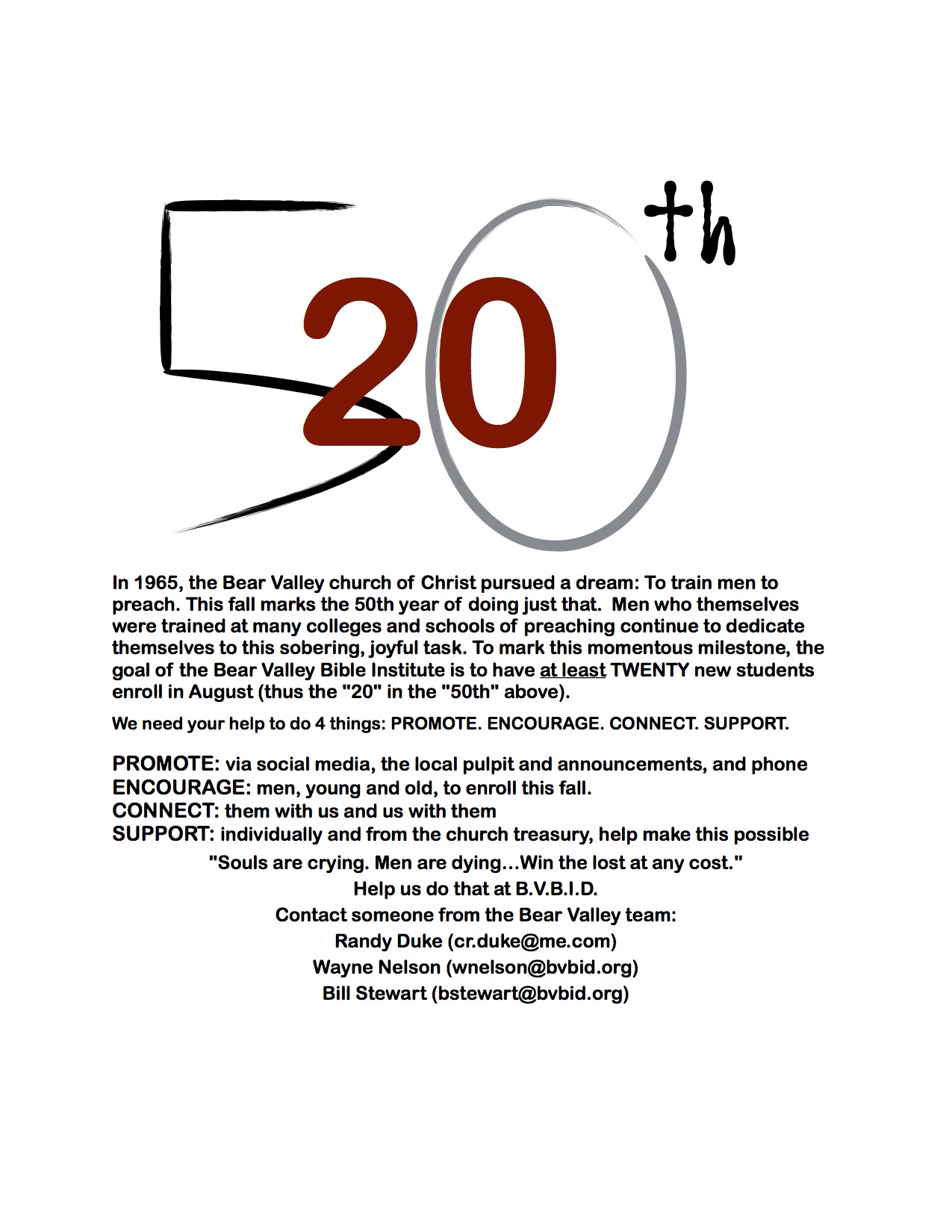
A Mass Appeal To Help Us Reach A Worthy, Wonderful Goal!

50th anniversary

Melvin Otey’s lecture from the 2013 lectures. Stay tuned for details on 2014’s program!

Addicted To The Taste

Neal Pollard

On a slightly different life’s path, Kathy could easily be a world-famous, wealthy celebrity on Food Network.  Her culinary skills and creativity in the kitchen has yielded some incredible dishes that would cave the iron-willed. Incredibly, she has learned through the years to make things that are good for you not simply palatable but tasty!

In 1 Peter 2, Peter urges Christians, facing an ultimate inheritance from a God who wanted them though impeded by persecution by a world who did not want them, “Therefore, laying aside all malice, all deceit, hypocrisy, envy, and all evil speaking, as newborn babes, desire the pure milk of the word, that you may grow thereby, if indeed you have tasted that the Lord is gracious” (1-3).

Peter urges them to purge from their spiritual diet those dangerous additives of attitudes in verse one.  They are more than malnourishing; they are poisonous!  Instead, he calls for them to hanker for the pure milk of God’s Word.  What would heighten their craving was having tasted the Lord’s graciousness.

May I suggest that this is a cyclical process.  In other words, we must be willing to begin feeding on the word.  For most, this is an acquired taste.  But from the first serving, the reader gets a taste of God’s good food.  It nourishes and satisfies.  It illuminates the soul.  It is practical in daily application.  It helps forge a closeness with God.  It gives strength in a difficult world.  The blessings of Scripture are multifarious, endless, and inexhaustible. The very experience of all of this by the consumer drives him or her right back into the Word for more!

Are you addicted to the sweet savor of Scripture?  If you are not partaking, you are starving your soul!  Those hunger pangs you feel cannot be satisfied by adulterated alternatives. Let us say with the ancient patriarch Job, “I have not departed from the commandment of His lips; I have treasured the words of His mouth more than my necessary food” (23:12).


“Ain’t No Stoppin Us Now”

Neal Pollard

When did I first know I wanted to be a preacher? I’m not sure, but I remember the day I addressed the city council in Cairo, Georgia.  I was only nine.  We were walking home from school.  Every day, we’d make the trek from 10th Avenue across Broad Street to our house on 12th Avenue.  It was a straight shot, but there was a penny candy store if you went south.  A couple of blocks south, between us and the store, was the court house. Of course, every self-respecting boy looks for shortcuts. Mine was through the court house that day.  It appeared empty to me, so I was singing the far out, new McFadden and Whitehead hit, “Ain’t No Stoppin’ Us Now.”  Just one more set of doors between me and the back door, I thought. So I burst through them bellowing, “…We’re on the move.”  With that, I brought the city council meeting to a stop and in the instant before my beet-red face welled up with tears of embarrassment, I think I saw looks of irritation as well as amusement.  For some reason, I was feeling really good that day…until that moment.

Do you ever feel unstoppable? Maybe you are bounding with energy, excited, or happy without even knowing why.  It may cause you to sing, exercise, eat, kiss your spouse, give exploding knuckles to a stranger, or pause in grateful thanks to God.  Every moment cannot feel euphoric and golden, but how wonderful when it happens.

Depression is a real malady that many people, including good Christians, experience.  Some deal with clinical depression, physiological and demanding chemical treatment.  However, some without such an excuse seem to have a hard time finding joy in their lives.  It could be because they have conditioned themselves toward negativity, constantly complaining, bemoaning, wallowing in self-pity, and being their own one-person thunderstorm.  Some seem to stand there, waiting for the lightning strike on a cloudless day.

As Christians, we are not expected to be out of touch with reality or even our own feelings.  Yet, only we can choose our outlook and attitude.  Isn’t it amazing that we are all exposed to national politics, economic uncertainties, sickness, disappointment, and betrayal, but some are resilient while others are resentful.  Some count blessings, but others court burdens.  May we, as God’s children, always focus more on what we have been given by Christ, what we have through Christ, and what we look forward to with Christ.  I tell you, it will make you feel unstoppable!

Would You Let Your Kids Sit On The Goat?

Neal Pollard

Have you heard about a “goat situation” in Oklahoma City that, well, stinks?  Members of a Satanic Temple there want a 7-foot Satanists’ statue to be placed at the capitol building right next to a monument of the 10 commandments.  The group submitted to a panel with oversight of the capitol grounds “an artist’s rendering that depicts Satan as Baphomet, a goat-headed figure with horns, wings and a long beard that’s often used as a symbol of the occult. In the rendering, Satan is sitting in a pentagram-adorned throne with smiling children next to him” (via Huffington Post, Sean Murphy, 1/6/14). Temple spokesman Lucien Greaves added, “”The statue will also have a functional purpose as a chair where people of all ages may sit on the lap of Satan for inspiration and contemplation” (ibid.).

I first heard about this from one of our local news networks, reporting on the story.  They were aghast and appalled at the very idea, especially the thought that this would potentially be a place where children could sit on Satan’s lap.  While I wholeheartedly agree that even the idea is disturbing, we as parents need to make sure we do not, in our negligence, allow our kids to figuratively do such.

That means being plugged into our kids’ social media (they are abandoning Facebook for other forms like Instagram, Snapchat, and Twitter, by the way), knowing who their friends are and something of their friends’ character, safeguarding our homes from ways Satan gets in (TV, computer, movies, phone, etc.), and modeling proper and biblical values as parents.  It also means arming them, encouraging and sharing Bible study, prayer, and Christian service with them.  It is about setting our affections on things above, not on things of the world (Col. 3:1-2).  It is about being transformed and not conformed to this world (Rom. 12:1-2).

While most everyone would never set their children in that creepy Satan statue, are we, through their wardrobe, activities, friends, priorities, and the like, doing what is tantamount to that?  God has entrusted us with an eternal stewardship—our children!  Like those in Luke 18:15-17, let us ever be bringing our children to the “lap” of Christ!

Church Cooperation

Neal Pollard

I have become more acutely aware of the importance of “church cooperation” working with a congregation that operates a school of preaching.  To get every student here and to support every teacher who prepares them for ministry, several congregations and individuals must give to make this a reality.  Those who contribute range from the very wealthy to the financially struggling, the highly educated to those not as much, the urban to the rural, and from the west coast to the east coast.  Congregations who give may be large or tiny.  But, all are needed and each works together to help produce men prepared to fulfill their ministry.

“Church cooperation” also is a term which applies to a necessary, internal function.  Within the church, there must exist a spirit and willingness to work together despite our differences—be it race, societal status, religious background (whether raised in the church or converted), and the like.  God anticipated such diversity, but still expects unity.  He is displeased with multiple, divergent “agendas” and frowns most emphatically upon self-seeking and self-serving individuals.  Whatever would fuel division, pride, fleshly lusts, greed, or worldly philosophies, must be identified and scuttled.  Paul wrote one congregation, saying, “Therefore if there is any encouragement in Christ, if there is any consolation of love, if there is any fellowship of the Spirit, if any affection and compassion, make my joy complete by being of the same mind, maintaining the same love, united in spirit, intent on one purpose. Do nothing from selfishness or empty conceit, but with humility of mind regard one another as more important than yourselves; do not merely look out for your own personal interests, but also for the interests of others” (Phi. 2:1-4).  Why cooperate?  Because of Christ and what He has done. How cooperate? Positively, by oneness of mind, love, spirit, purpose, and humility. Negatively, by avoiding selfishness, conceit, and serving self-interest.

How easy it is to read that divine guidance, but how hard to practice!  Yet, it is essential to a congregation thriving and growing…together!  The sobering thing is that each of us is either a cooperator or a coagulator (hardening and hindering).  That is determined by our attitude, words, and decisions.  May we each resolve to be a “church cooperator”!

DID CLAIRE DAVIS’ FATHER FORGIVE HER MURDERER?

Neal Pollard

Claire Davis’ father spoke at a memorial service honoring his daughter, an Arapahoe High School student shot by a classmate who was angry with his debate team coach.  In the course of his extremely emotional, but poignant talk, Michael Davis said, “My wife and I forgive Karl Pierson for what he did.  We would ask all of you here and all of you watching to forgive Karl Pierson. He didn’t know what he was doing” (http://www.denverpost.com/news/ci_24829368/). This young man entered the school with a shotgun, 125 shells, a machete and three homemade bombs (ibid.).  He ended his own life.  Despite all these facts, Davis says that he forgives Pierson.  Is that possible?

Some say that this is not Mr. Davis’ right nor is he able to do so.  I disagree.  Mr. Davis says that he did and I have no reason to disbelieve him.  His forgiving Pierson cannot effect the young man’s eternal destiny.  He does not have the power to absolve or wash away Karl’s sins.  Only the blood of Christ can do that.  But Mr. Davis’ incredible, magnanimous step is not only possible, it is vital.  Taking the step to forgive someone who has sinned against us is a crucial part of healing our own hearts and preventing ourselves from spiritual struggles like bitterness, anger, hatred, malice, and vindictiveness.

A heart ready to forgive is something that must characterize the Christian, for sure.  He or she may be hurt or violated in some way by a person who is impenitent and brazen.  While the Bible does not suggest that we allow ourselves to be hurt and sinned against repeatedly and without recourse or protection, God’s child eagerly hopes for the best and stands ready to extend forgiveness to others.

Mr. Davis is to be admired for his gesture.  It will not bring his daughter or even that young man back from death, but it may be key to his own mending.  Many who have been sinned against and have stood ready to forgive have found this to be beneficial to themselves.

The Father in heaven will not forgive those who are not abiding faithfully in His Son, but who doubts that He stands ready to welcome the vilest sinner who truly comes to Him?  That disposition could not be more worthy of our adopting.  Even in tragedies like that involving Miss Davis we can be reminded of the power of forgiving!

A NEW YEAR (poem)


Neal Pollard
Today a new calendar is hung
After auld lang syne was sung
Reflection and recollection done
New plans have arisen with the sun.
Yesterday is forever buried
New expectations now carried
Hope for a better tomorrow
Desire to avoid bitter sorrow
This year will bring the unexpected
Old goals may be resurrected
No crystal ball can reveal it
Or legislation force or repeal it
What will you do with this annum,
Which itself will next year be a phantom?
Will you take its reins with vigor
Or delay and await for what’s bigger?
Make each new day really count
Let not fear or worry surmount
Trust in God, the giver of time
Keep aiming for an eternity sublime.

PRODIGIES OR PRISONERS?

Neal Pollard

There is a video clip all over the internet showing five very young children playing an incredible piece, each with full-sized guitars.  Not only is it a complicated piece, “Our Kindergarten Teacher,” but their synchronized performance from the play to the choreography, is mind-boggling.  The children are from North Korea, leaving many to speculate whether this is a group of children with enormous desire and natural ability or a group of children playing for their and their parents’ lives.  The talent is rare and undeniable, but the hope is that this is born of choice and not coercion.


There have been people in nations and societies who have been brainwashed, blackmailed, bullied, and beaten to force their compliance in one way or another.  While such tactics may produce the results desired by those in positions of power, they usually control the body without winning the heart.  No child, spouse, employee, citizen, or other person wants to be made to do what they do or prevented from actions and behaviors without the exercise of their own free will.


While a Christian is one who has submitted to the will and Lordship of Christ, God has made this completely voluntary.  There are extreme consequences involved in not giving one’s life to Him and great reward for one who does, but He has made us with the freedom to choose.  Men and women have done tremendous acts of Christian service and have even made the ultimate sacrifice for Christ, but not as His prisoners without volition.  What sets Christianity apart from other religions is this very thing, that people love and revere Him so much that they are willing to lay down their lives for Him.  True Christianity is not based on one trying to earn salvation.  Paul says our salvation is “not as a result of works, so that no one may boast” (Eph. 2:9).  Christianity does not thrive and grow through guilt, manipulation, terror, or brute force.  Instead, this occurs when people truly get ahold of the depth of God’s love and the value of His sacrifice.  For those with good and honest hearts, this produces obedience and “good works” (Eph. 2:10).  Let us understand why we serve Him—not because we are pushed but because we are passionate to reciprocate His love!

Take Not The Day For Granted (POEM)

Neal Pollard
Take not the day for granted,
Who knows what the morrow brings,
What present joy be recanted,
What shut the mouth that now sings.
Too often we long for tomorrow,
Assuring ourselves it will be perfect,
Dissatisfied with present perceived sorrow
Viewing only today’s every defect.
But right now, this moment, is precious
It holds a bright and unique treasure
For the one with wisdom who confesses
Trust in Him who blesses without measure
Yes, God gave us this day in His kindness
To use for His glory and pleasure
How tragic to be struck with a blindness
To how rare and how useful that treasure.
So many have not been gifted these hours
They’ve ceased their ability to live them
Who long for what now exceeds their powers
Whose light is put out, not just dim.
What are we doing with the present
To build a spectacular time ahead
To make others’ lives blessed, not just pleasant
To bring life to the spiritually dead
Take not the day for granted,
It was given to be managed astutely
Embrace it, don’t be disenchanted
Do your best with it, strive resolutely!