Oise-Aigne American Cemetery Plot E

Neal Pollard

My brother and fellow preacher, Brent Pollard, finds the most interesting historical facts—an ability which makes his preaching illustrations most interesting.  He sent me an article about the Oise-Aigne Cemetery in northern France.  Though I have actually visited that cemetery, I had no idea about the existence of an auxiliary burial plot known as “Plot E.”  While the 6012 military personnel buried in the four main burial plots lost their lives in World War I, the 94 interred in Plot E are infamous, disgraced soldiers who died for their crimes during or after World War II.  These men either murdered fellow soldiers or raped and/or murdered 71 people in England, France, Belgium, Germany, Italy and Algeria.  “No US flag is permitted to fly over the section, and the numbered graves literally lie with their backs turned to the main cemetery on the other side of the road” (warhistoryonline.com).

These men were supposed to be fighting for the freedoms and rights of American citizens, but instead they were most dramatically undermining the pursuit of life, liberty, and happiness of the unfortunate ones who crossed their paths.  For their crimes, they not only paid the ultimate penalty but were buried in disgrace and immortalized with infamy. They are remembered as “the dishonorable dead.”

The book of Revelation refers to the “book of life” (20:12), implying that it is possible for one’s name to be blotted out of it (3:5).  However, those whose names are not found in that book will be “cast into the lake of fire” (20:15). Those who take away from the words of this revelation—and by application any other (cf. Gal. 1:6-9)—“God shall take away his part of out of the book of life” (22:19).  More specifically, John says, “And nothing unclean, and no one who practices abomination and lying, shall ever come into it, but only those whose names are written in the Lamb’s book of life” (21:27).  For the ungodly and disobedient, John lays out in apocalyptic terms how unthinkably horrible it will be to die unfaithful to Christ.  He says, “He also will drink of the wine of the wrath of God, which is mixed in full strength in the cup of His anger; and he will be tormented with fire and brimstone in the presence of the holy angels and in the presence of the Lamb. And the smoke of their torment goes up forever and ever; they have no rest day and night…” (14:10-11a).

Everyone will stand before the judgment seat of Christ (2 Cor. 5:10).  The faithful will receive glory and honor and reward (Mat. 25:34-40).  The unrighteous, however, will go away into everlasting punishment (Mat. 25:46).  No one will deserve heaven, but will go there thanks to God’s amazing grace and his or her conscious effort to walk in the light (1 John 1:7-10). Those who know not and obey not the gospel will endure something eternally worse than a firing squad, a hangman’s noose, or blameworthy burial (2 Th. 1:8-9).  Though the world may believe less and less in the reality of hell, the Bible’s position on the matter has not changed. Knowing the terror of the Lord, may we persuade others and, ourselves, be persuaded (2 Cor. 5:11).

The Lightning March

Neal Pollard

It was unusual for foot soldiers to play a major role in the Middle Ages. Harold II of England’s 7000 infantrymen were an exception. He marched them from London to York, about 216 miles, in a week. The rate of the march was 30 miles per day for an entire week!  “A sustained rate of thirty miles per day for seven days was in most circumstances unheard of. A sustained twenty miles per day would have been considered extraordinary.”  The army moved faster than news of its approach. This helped turn the Battle of Stamford Bride in 1066, known as “Harold’s Lightning March”  (Hackett, Jeremiah.  World Eras, Vol. 4: Medieval Europe, 814-1350, p. 128). What seems lost to history is how Harold motivated such rapid movement.  To build such resolve and determination in so many people, in unified purpose, must speak to Harold’s leadership ability.

All of us are marching with rapid pace toward the end of life and eternity.  Hasn’t it been going by so quickly?  It truly is a “lightning march.”  At the end of the march, will we have won the battle?  The church of every generation, and not just individuals, are making this march.  What impression are we leaving on the world around us, what battles of significance will have been won?  Think of the first-century church.  They “turned the world upside down” (Acts 17:6).  They “preached to every creature under heaven” (Col. 1:23).  They permeated their immediate communities, surrounding communities, and the remotest communities (cf. Acts 1:8-11).  Think of those brave, sacrificial Christians during the 19th Century who rallied together around the principle of restoring New Testament Christianity.  With a great reverence for the pattern of Scripture, they sought to imitate the faith and practice of that first-century church.  In their wake was growth and influence.

In both cases, profound as their influence was, they rapidly left the scenes of time.  Their influence remained, but succeeding generations of the Lord’s Army—for whatever reasons—slowed their pace considerably.  We may glorify the church of the 1950s, at one time known as the fastest growing religious group in our country.  But most of them have gone and those who remain have grown slower in their pace. What about the church of the early 21st Century?  How will we be remembered?  Never forget that, in part, this is influenced by what you and I are doing as soldiers under the Lord’s direction.  We could not want for better guidance and a better Commander.  We should have ample motivation.  It is high time we pick up the pace!  Victory awaits (1 Cor. 15:54-58).

The Holocaust: What Can Be In Men’s Hearts

Neal Pollard

Though mankind can construct a fantasy to explain our origin and propagate it in places like The Natural History Museum, we have a harder time skirting around our moral outrage at the atrocities committed by the Nazis from 1933 to 1945.  I made my third ever visit to the United States Holocaust Memorial Museum and, more than ever, I was dumbfounded at how anyone could perpetrate torture and treatment like the European Jews received at their hands.  Words like “wrong,” “immoral,” “evil,” “wicked,” and “barbaric” flow freely from the mouths of the visitors who see pictures or watch videos of the organized pogroms and the aftermath of the death cities they called concentration camps. Witnessing such depravity makes it easier to understand how men could take an innocent man like Jesus and be hardened enough to have Him crucified.  It also helps us appreciate how necessary that sacrifice was.

Hitler, if he worshipped anything, worshipped the occult.  He seemed not to truly acknowledge the existence of God, using His name only as a shield to defend his dictatorial policies.  His regime is an extreme example of what men, apart from God, are capable of doing.  With no sovereign standard to submit to and no transcendent truth to believe in, men become their own gods and write their own laws.  They so often do so without regard for the welfare and lives of other people.  They do as they please and what pleases them so often destroys them but also others.

Jesus warned of such a mindset in Luke 16, speaking to the Pharisees, saying, “You are those who justify yourselves before men, but God knows your hearts. For what is highly esteemed among men is an abomination in the sight of God” (15).  He warned on another occasion that “what comes out of a man defiles a man” (Mark 7:20), including “evil thoughts, adulteries, fornications, murders, theft, covetousness, wickedness, deceit, lewdness, an evil eye, blasphemy, pride, [and] foolishness” (21-22).  When men try to negate the nature of God and escape the existence of God, it leads to the perishing of people and the harm of humanity.  The answer is simple, if demanding: “‘Now, therefore,’ says the Lord, ‘Turn to Me with all your heart, With fasting, with weeping, and with mourning.’ So rend your heart, and not your garments; Return to the Lord your God, For He is gracious and merciful, Slow to anger, and of great kindness; And He relents from doing harm” (Joel 2:12-13).  Either way, it’s a matter of the heart! May our hearts get right and stay right.

Imposters!

Neal Pollard

C.J. Schexnayer reports of the hilarious antics of some South Carolina football fans almost 54 years ago. It seems that a certain USC fraternity, Sigma Nu,  commandeered official-looking Clemson uniforms, chartered a bus and went to the Gamecocks’ stadium. They were able to fool the police, who let them go inside and run through the tunnel onto the football field. Clemson fans wildly cheered with enthusiasm as they welcomed “their team.”  Schexnayer writes, “On Nov. 11, 1961, with more than 47,000 spectators on hand in Colombia’s Carolina Stadium the group put their plan into action. As the bands warmed up for the game the Sigma Nus suddenly came streaming out the Southeast corner of the end zone as if they were the Clemson squad. They were accompanied by one prankster dressed as the Clemson’s folksy coach complete with a pillow under his shirt to approximate Howard’s girth…The Clemson band started playing the school’s fight song and the team’s fans began cheering for the group on the field they believed were their players. Everything seemed normal as the bogus Clemson squad assembled as if to do their warm ups. But after a few minutes, the group began to display some… problems.  The punter began kicking the ball behind him, running backs were doing somersaults at the line of scrimmage and everyone wearing orange seems incapable of holding onto the ball. The faux Frank Howard began spitting massive spurts of tobacco juice just about everywhere. Finally the whole group gathered in the end zone to perform ‘the most prissified dance you’ve ever seen’ according the participant’s accounts” (from http://www.footballstudyhall.com).  That story made me laugh, as I considered the creativity of those hijinxers! It got points for flamboyance, originality, and hilarity. Those poor Clemson fans!

Yet, something infinitely sobering takes place in our world today. There are people getting fooled into thinking that certain men who make out as though they are preaching the Bible who are teaching something different. It is false. They have ways to convince people who are otherwise intelligent, thoughtful, and undoubtedly sincere and committed. Paul says such preachers use “smooth and flattering speech” to “deceive the hearts of the unsuspecting” (Rom. 16:18). Peter says that some would introduce destructive heresies. He warns, “And in their greed they will exploit you with false words…” (2 Pet. 2:3). He says they are really slaves, yet they promise others freedom (2 Pet. 2:18). Again, it was Paul who pleaded, “Let no one deceive you with empty words” (Eph. 5:6).  Everyday and everywhere, people are getting sold a raw bill of goods. When they ask what to do to be saved, how to worship, about the end of the world, and how to live morally, they are told lies (cf. 1 Tim. 4:2). There is more at stake than pride and embarrassment. Too many people will not know they were deceived until the repercussions are eternally serious!

Watch out for imposters.  Jesus says they will sneak into other “uniforms,” too (Mat. 7:15). Listen closely, watch, and observe. As you study diligently, you will be able to distinguish between the fakes and the genuine article!

Barsabas Was a Great Man, Too

Neal Pollard

Having fallen from grace, Judas soon thereafter fell headlong a corpse and a reminder of the depths to which sin will take an individual (Acts 1:17-20). Though he had a part in the ministry of God the Son, he chose a commission as henchman in the army of perdition.

His death, as an apostle, left a void in the ranks of the handpicked, special followers of Jesus (Acts 1:20). By divine guidance (Acts 1:24, 26), the apostles chose a man among men to pick up the armor vacated by the deserter. The man chosen, Matthias, was a great man. This is obvious, for his appointment was based on his spiritual character (Acts 1:21). However, what of the man Barsabas, about whom very little is spoken? Was he not also a great man?

He was faithful to Christ (Acts 1:22). Swete explains faithfulness to Christ (as in Revelation 2:10) as proving “…thyself loyal and true, to the extent of being ready to die [for Christ’s sake”] (The Apocalypse of St. John). Faithful suggests reliability and trustworthiness, as well as submissiveness. All of this describes Barsabas. From the ministry of the Baptizer to the ascension of the Savior, Barsabas was numbered among the disciples. Apparently, he withstood even the difficult teachings of Christ (see John 6:66-69). He did not turn away, even after the seeming defeat of Calvary (Acts 1:22). Faithfulness is, in God’s eyes, a sign of greatness.

He was recognized as a spiritual leader (Acts 1:23). This is very subjective. The author sees the appointment of Barsabas as the result of his spiritual excellence among the “company.” Assuming that, Barsabas would appear to have been perceived as a leader. Truly, fervent humble and obedient discipleship sets one apart (1 Peter 2:5, 9) as salt (Matthew 5:13) and light (Matthew 5:14) in this world.

He was willing (cf. Acts 1:22-23). Apparently, from the text, Barsabas did not shirk the call to duty. No excuses could have been uttered, for the apostles were left to “give forth their lots” (see McGarvey’s commentary on Acts, p. 22) to pick Judas’ successor. How seemingly rare to find men both qualified and eager to serve, men of Isaiah’s stripe who cry, “Here am I, send me” (Isaiah 6:8). Willingness precedes work, and Barsabas appeared ready to “take part in his ministry and apostleship” (Acts 1:25a).

Faith, works and attitude all add up to greatness in God’s eyes, even if not in men’s blinded vision. Though not God’s choice to fill the shoes of an apostle, Barsabas was distinguished as his servant. How wonderful one day it will be to walk with Barsabas on the street of gold and thank him for his example of greatness in service to Jesus.

Do You Love Your Country?

Neal Pollard

Are you one who looks back with affection,
Reminiscing about days of yore?
Waving flags and praying for protection,
For your nation from shore to shore.
There are songs and celebrations sweet
Speeches that rouse the emotion
Fierce loyalty for the land beneath your feet
That inspires a most patriotic notion

But what about the better land beyond,
The place you can truly call your own?
Is that yearning great, is that hope fond,
To live in the land of the Risen Son?
If so, are you packing and preparing
For the journey that will reach beyond time?
Down here do you feel alien and wayfaring?
Is citizenship there of importance most prime?

Join a people most ancient whose love was great
For a better, a heavenly country
Who felt like exiles here, were the object of hate
By earthly counterparts who put their scorn bluntly
Fix your eyes on a grand immigration
Made possible by the Great Emancipator
Make sure you’re a member of the holy nation
And your eternal home will be infinitely greater.

Ft. McHenry (Maryland)

MY FAMILY TREE

Neal Pollard

Years ago, for a school project, I was asked to trace my ancestry and make a family tree. In the process I learned some things I did not know about my heritage. Some of that made me proud, and some of it did not. I also learned that a family tree is always living and growing. Now that I am a husband and father, I appreciate that my children (and, one day, grandchildren) will be affected by how I lead my family.

You are nourishing your family tree, too. How are you caring for it? That is called a legacy. It will affect those who live after you are gone. Consider some things every family tree has, and ask yourself what kind of tree you are growing in your home.

Your family tree has…

  • ROOTS. Something is central to your home. It is what drives and motivates you. It is where you have your primary interest and investment, measured in dollars, energy, and time. For your family tree to survive, you must be “firmly rooted and…built up in [Christ]” (Col. 2:7).
  • BRANCHES. Your home is an influence on the larger community surrounding you. Every facet of your life, your job, your friends, the church you attend, and your community, is impressed, positively and negatively, by your home. You have a reputation. You are seen. As your family branches out into the world, what impact is it making for Christ? Remember, “If the root be holy, the branches are too” (Rom. 11:16).
  • NUTRIENTS. God made the tree to eat and drink, and by such it lives. If the nutrients are cut off (via drought or disease or damage), the tree dies. Likewise, our family tree must be nourished properly to keep each member of it alive. We must keep “constantly nourished on the words of faith and of the sound doctrine” (1 Tim. 4:6).
  • FRUIT. It may be acorns, cones, blossoms, or edible fruit, but trees bear fruit. When a fruit-bearing tree ceases production, it is a sign of trouble. At best, such a tree has lost its value. Our family tree will be known by its fruits (cf. Mat. 7:16,20). Failing to bear good fruit (Gal. 5:22-23) or bearing bad fruit (Luke 6:43) is condemned by God.
  • PREDATORS. “Dutch Elm Disease,” beetles, ants, and termites can all prematurely end the life of a tree. Sometimes, what kills the tree cannot be readily seen. Trees can be eaten from the inside out, and by the time the damage is visible it is too late. How like the damage predators do to the home! Three are so many! Tragically, sometimes the damage comes from within—what we do or allow to happen in the family. Satan is the predator of the home, but he works through human agency.
  • LEAVES. There are evergreens, conifers, and pines, but hardwoods are the most fascinating to me. I like their annual cycle. In Spring, the trees are in bloom and put on their leaves. They flourish in Summer. In Autumn, they are vibrant in color and beautiful. In Winter, they die and leave the tree. Parents, think of your children as those “leaves.” From birth, they bud and grow. Hopefully, in the teen years after trial and tribulation they begin to absorb and emulate the good principles we have taught. It can be a beautiful time. Then comes the time for them to leave. Remember that they are going to leave home some day. Make sure they leave spiritually and eternally prepared.

Should We Let The Devil Make The Rules Of Engagement?

Neal Pollard

Thanks to the hospitality of my good friend, Jason Jackson, I had the opportunity to visit beautiful AT&T Park in San Francisco, witnessing a rarity (a Rockies win) against his beloved Giants.  It was LGBT Night at the old ballpark, an annual sponsorship of “SF Pride.” It was also the day of the historic Supreme Court decision mandating the recognition of same-sex marriage in all 50 states. The crowd was enthusiastic about that event in Washington, D.C., cheering when it was proclaimed over the P.A.  The videoboard featured gay and lesbian couples for its “kiss cam.”  While San Francisco is renowned for its “sexual progressiveness,” the city of Denver has earned a reputation for similar liberality of thought regarding homosexuality. In a growing number of places in our nation and especially among those under a certain age, there is welcoming, sanctioning language for homosexuality and vehement intolerance for the least word of condemnation of the behavior as sinfulness.  Even among those professing to be Christians, there is a changing posture in how or if it is dealt with.  Understanding that no sin is worse than any other, that it is not right to display an ungodly attitude in addressing any sin, and that there should not be an inordinate amount of time, attention, and energy given to any sin to the exclusion of the other, I wonder if even some of our Christian brothers and sisters have become unwitting pawns of the prince of this world regarding this matter.  The devil is at war against the Word and will of God, and he is at war against anyone loyal to such (Rom. 13:12; 2 Cor. 10:3-6; Eph. 6:10ff; etc.).  He wants his cause, the ultimate end of which is the spiritual destruction of all men, to succeed, and he wants the cause of Christ to be overthrown.  We know that his mission will ultimately fail, with there being those who are welcomed by our Lord to heaven (1 Cor. 15:24; Mat. 25:34-39). Yet, most will follow him to everlasting punishment and destruction (Mat. 25:41-46).  He has the bulk of the resources and influence of this world, as he almost always has had in every generation. He has powerfully allies and mouthpieces from Washington to Hollywood and most media and education outlets in between.

  • Who is behind the idea that we are not loving the sinner when we speak of homosexuality as sin?
  • Who would have us believe that we are mean-spirited or unrighteous if we use terms like “unnatural” (Rom. 1:26), “exceedingly grave sin” (Gen. 18:20), “ungodly” (2 Pet. 2:6), “gross immorality” and “going after strange flesh” (Jude 7) to describe homosexual behavior?
  • Who would sell us on the idea that loving the homosexual means keeping quiet about their practice of it, failing to warn them to repent (Ezek. 33:8)?
  • Who would seek to equate a behavioral choice (1 Cor. 6:9) with one’s race or skin color (Acts 17:26; Acts 10:34-35)?

What happened in our nation’s highest court last Friday may have been necessary to shake the church out of its general lethargy and indifference regarding evangelism.  What happened there will ultimately be overruled in the highest court there is (Mat. 25:31ff).  What happened there should not become our obsession, but neither are we wrong to take note of how this is a significant societal erosion.  Jesus implies how intolerable it would be for Sodom and Gomorrah at the Judgment (Mat. 10:15). The Lord overthrew them in “in His anger and in His wrath” (Deut. 29:23). Homosexuality is not the only sin there is nor is it the chief sin, but may we not be intimidated away from calling it what it is—“sin.”

THE MASTER’S MATERIAL

Neal Pollard

A while back it was popular in the religious world to talk about Jesus’ encounter with two disciples on the road to Emmaus. The emphasis has often been on the disciples’ experience. I believe the biblical emphasis is on the character of Jesus. The disciples are contemplating Him even as they encounter Him. They describe Jesus as “a man who was a prophet mighty in deed and word before God and all the people” (Luke 24:19). Notice three reasons why He was so mighty in word before all the people.

JESUS KNEW HIS MATERIAL. Luke 24:27 says, “And beginning with Moses and all the Prophets, He interpreted to them in all the Scriptures the things concerning Himself.” Truly His knowledge is perfect and ours is not, but there is no excuse for failing to study–both on our own and for a class we are teaching or sermon we are preaching.

JESUS KNEW HOW TO RELATE ITS MEANING EFFECTIVELY. The men journeying to Emma’s, after walking with Jesus, said, “Did not our hearts burn within us while He talked to us on the road, while He opened to us the Scriptures?” (Luke 24:32). The dismal method of too many Bible classes is to essentially read and paraphrase in verse by verse fashion. Preaching can too often be disorganized in delivery or vague in message. Paul told Timothy, “Do your best to present yourself to God as one approved, a worker who has no need to be ashamed, rightly handling the word of truth” (2 Tim. 2:15, NIV).  Robertson says of “rightly handling” that it means “cutting straight…Since Paul was a tent-maker and knew how to cut straight the rough camel-hair cloth, why not let that be the metaphor?” (Vol. 4, 619). As presenters of truth, tell what it meant then and in context, and then apply it!

JESUS KNEW HOW TO MAKE THE MATERIAL LIVE IN HIS STUDENTS. Luke 24:45 says, “He opened their minds to understand the Scriptures.” That is just what we are after as teachers, preachers, and proclaimers of the Word. We are not just fact-reporting. We are trying to get into the heart. Remember that Jesus sought to change lives with His teaching.

Only Jesus was the perfect teacher. But we can always be better and great. Let us mimic the Master’s approach to His material!

Dangerous Clothing!

Neal Pollard

Have you ever heard of clothing that puts you in the hospital?  A 35-year-old woman in Adelaide, Australia, had to be treated at the Royal Adelaide Hospital for loss of circulation.  She was on an IV for four days! Why? The official report used scary words like “hypoattenuation,” “oedema of muscles,” and “myonecrosis.”  The bottom line was that her skinny jeans were too tight.  Coupled with squatting frequently while helping a family member move and wearing these overly compressed pants, her legs and lower extremities were so numb that she could not walk (via jnnp.bmj.com).  The truth is truly stranger than fiction.

Is there any dangerous clothing in your closet or wardrobe?  Especially as summer weather heats up, some reveal clothing that could be dangerous to themselves and others.  Consider this.

  • Clothes may be too tight.
  • Clothes may be too short.
  • Clothes may be otherwise too revealing.
  • Clothes may contain provocative words or sexually suggestive phrases.

Frustrating for both those trying to defend or condemn immodest clothing is the fact that Scripture does not give specific guidelines for clothing God finds either acceptable or unacceptable.  True, we can point to how God clothed the first couple in the Garden of Eden, but they had the right to see each other completely unclothed.  We can talk about the priests’ garments under the Old Law, but they wore it doing things, offering animal sacrifices and worshipping with mechanical instruments, that keep us from binding that as a pattern for clothing today.  New Testament passages about modest clothing (1 Tim. 2:9-10; 1 Peter 3:3-4) seem to primarily address over-dressing, though the principle about clothing which can easily produce lust may be applicable.  Yet, especially clothing that strongly resembles lingerie and undergarments, extremely short-shorts, clothing that clearly outlines parts of the body that should not be publicly seen, and the like can be dangerous for the wearers and the observers. God made men and women sexual creatures, and clothing that “feels” and “looks” sexy can stir feelings in people toward people they do not have the right to feel.

As we assess the clothing in our wardrobes, it is good to ask some important spiritual questions:

  • Does it help me present my body as a sacrifice that is holy and acceptable to God (Rom. 12:1)?
  • Does it reflect that I am conforming to the world or being transformed by God’s will (Rom.12:2)?
  • Is it an “anything” that causes my brother to stumble (Rom. 14:21)?
  • Is it “lust-producing” (cf. Mat. 5:28)?

Frustratingly, this requires some common sense and some thoughtful examination.  Individuals must use propriety in the absence of a “thou shalt” or “thou shalt not.”  Yet, neither should we feign ignorance in a world where fashion designers tout clothes that are “hot,” “sexy,” “dangerous,” or the like.  No preacher or Bible teacher can force their personal standards of modesty on anyone else, but he or she can appeal to the heart and ask that Christlike love for the souls of others be exercised.  After all, clothes can be dangerous even if they don’t land you in the hospital!

A SWEET OLD PERSON

Neal Pollard

Today, I talked with some godly, sweet, and loving elderly people.  They are people I respect and admire.  They are full of rich memories, have vast experience, and profound wisdom.  You are drawn to them.  The people I’m referring to are neither superhuman nor necessarily those whose lives have been easier. Their sweetness is a product of their good attitudes.  Not every elderly person I talk to are those I’d consider godly, sweet, or loving.  They are bitter, rude, mean-spirited, selfish, and even, at times, belligerent. While dementia might transform the occasional person’s personality, there is a simpler explanation for how some old people get to be unpleasant. They were that way when they were younger.

Life is about the sum total of the choices we make, the way we bend our will, and our reaction to the adversities of our lives.  We are building character, one day at a time, one reaction at a time.  As I think about it, I know some godly, sweet, and loving children, teens, young adults, and middle-agers. I also know too many who are none of these things. If they live long enough, they’ll grow into more hardened, exaggerated forms of themselves.  Gossips can become worse gossips in the golden years because they may have more time and have had more practice. Grouches seem to grow worse with time and opportunity.  The impure of heart, after years of harboring filth, allow it to spill over far more often in words and deeds (how many of us have encountered a “dirty old man”—a more elderly form of the “dirty young man”).  Worriers in youth make fretful worriers in the twilight time of life. So many traits of character and attitude in the old have been in the making in the young.

In Psalm 119:9, David asks, “How can a young man keep his way pure? By keeping it according to Your word.” Solomon saw among the youths a young man lacking sense (Prov. 7:7). He also counseled one to remember his creator in days of youth (Ecc. 12:1). God can be our confidence from our youth (Psa. 71:5). These and so many other admonitions aimed at those in days of youth will also protect and preserve those who reach old age.  What can I do to make sure I am a sweet old person?

  • Be intentional.  Take steps to be sweet.  It’s not many people’s natural mode of operational.  Spending much time with God and learning to imitate Him helps with this.
  • Be introspective. Take time and effort to examine yourself. Are you ill-tempered, impatient, easily irritated, easily put out, and the like?  Warning!  You’re well on your way to being a crotchety curmudgeonly coot!
  • Be interested. Selfishness is behind those traits that lead one to be unpleasant in the winter of life. Be genuinely, actively interested in the welfare, needs, and interests of others.  Taking the focus off self will aim you toward sweetness.

We could probably think of more suggestions, but here’s a good start.  Surely, we’d all like to be sweet old people when the day comes.  But, don’t wait! Start now!

A TRUTH IN THE MIDST OF TRANSIENCE (poem)

Neal Pollard

Waters vast and oceans deep create a marvel and wonder
By its volume and power but also the creatures that you’ll find thereunder.
The stars and planets, galaxies, the universe, the vastness of outer space
The finest particles and smallest molecules, the most infinitesimal place.
The power of the greatest man who rules upon the land
The lowliest person who grovels around unseen and far from grand.
The outward beauty and loveliness of the Lord’s most fair person
The inward workings and intricate details of us all makes this so very certain.
To look upon the mountains high, whether green or rocky or tall
To investigate the tiniest plant and the creatures so delicate and small
Look afar or microscopically, dig and search, uncover
Test it, taste it, see it, smell it, here’s what you’ll discover
Locked within our DNA or viewed from light years away
You see the same truth, over and over, a fact that’s here to stay.
We are the evidence of a Being whose power and knowledge are unending
Who makes what is made extraordinary, through His infinite nature expending
But making what’s made and doing what’s done, His resources are not depleted
Because He is God, He’s never without. He never needs completed.
He’s worthy and mighty, He’s wonderful and true, the God we worship and serve
He’s faithful and ingenious, active and gracious, from perfection He cannot swerve
As you walk through the day and make observations, what you see or happens to you.
Whatever may change, crumble, fall, or fade away, God will still be faithful and true.

                             Endothelial cells viewed under a microscope

FAITH IN PEOPLE

Neal Pollard

There are some people with “trust issues.”  They are stuck in a negative frame of mind, believing the worst in others with little expectation that they will improve.  They may even castigate anyone who would encourage you to put faith in people.  Certainly, our greatest faith must always be in God.  He never fails, forsakes, or leaves us (Heb. 13:5-6), but people invariably do those things.  We cannot put more faith in people than God, listening to and following them when they contradict His will. That’s a false, wrong extreme, but so also is a cynicism that fundamentally, inherently distrusts people to do the right thing.  This does not mean that there are people in our lives who do not struggle with sin because we all do (Rom. 3:23).

Let me encourage you to have faith in God’s people. Why?

  • Jesus did.  He selected twelve men, salty fishermen, shady tax collectors, strident nationalists, and selfish materialists.  While the latter let Him down, the other eleven grew and accomplished much.  Jesus entrusted His mission to them (Mat. 28:18-20), having faith that they would accomplish it.  But, Jesus also had faith in others—the woman at the well, the woman caught in adultery, Zaccheus, Bartimaeus, Nicodemus, and so many others.  Some He put faith in failed Him and even left Him, but that did not ever stop Him from investing that faith in others.  Do you remember what He said to Peter after He had failed? “I have prayed for you, that your faith may not fail; and you, when once you have turned again, strengthen your brothers” (Luke 22:32; emph. mine).  That was faith in Peter!
  • It empowers others.  When somebody expresses faith in your ability to accomplish something, how do you respond?  When you are given responsibility with the explicit or tacit understanding that the giver believes in you, don’t you give it your all to live up to that trust?  2 Timothy 2:2 seems to imply this reaction is a natural consequence of being entrusted with something.
  • People live up (or down) to our expectations.  Have you ever had someone in your life who handled you this way:  “You’re no good!”; “You’ll never amount to anything!”; “You’re hopeless!”?  Maybe they don’t say it, but they convey it.  Preachers and teachers communicate the word through such a pessimistic prism. Leaders convey it in ways both spoken and unspoken.  Love “believes all things, hopes all things” (1 Cor. 13:7).
  • It brightens life.  Would you like to maintain a PMA (possible mental attitude)?  Never lose the ability to believe in others!  A glass half full approach is necessary to retaining an optimistic, hopeful way of life. I’m not saying to be delusional, but you can improve your own quality of life with a fundamental belief that most people, when they know what’s right, want to do what’s right.
  • It is biblical.   Paul had confidence in Philemon’s obedience (Phile. 1:21). He had confidence that Corinth would do the right thing (2 Cor. 2:3). He had confidence in Galatia’s doctrinal resilience (Gal. 5:10). He had confidence in Thessalonica’s continued faithfulness (2 Th. 3:4).  What an example, and oh how we should imitate him in this!

Teresa of Calcutta is often associated with certain verses found on the wall of her children’s home, even credited for authoring it. Kent Keith is the likely author.  In the composition, “Do It Anyway” (aka “The Paradoxical Commandments”), he notes that people will criticize and be petty.  He encourages doing good, loving, and serving anyway.  You can choose how you will spend your life, expecting the best or worst of others. May I urge you to have the most faith in God, but leave room for faith in people—especially God’s people! You will not regret it.

Christ-less In Crisis

Neal Pollard

It is hard to describe the beauty of faith evidenced in Room 913 yesterday as all the elders and their wives, Wes and Teri Autrey, and Tiffanie and Bethany Vaught stood with Myrna and the rest of the Murphy family at University Hospital yesterday.  We sang songs and Dave Chamberlin prayed a touching, loving prayer.  Moments later, a godly, wonderful woman made her transition from this life to the better one. Despite the inevitable, natural flow of tears, the heartache of separation, and the final earthly stanza of a beautiful, 59-year-old love song played by Ray and Myrna.  Myrna was an obvious success as a mother, wife, grandmother, and friend, but central to everything she did and who she was was Christ.  She did not fear death nor the condition that brought it.  She was ready because of Christ.

When I think of the red-letter days that have occurred in our nation and world during my lifetime, whether the bombing of the Murrah Building, the horrors of 9/11, the unbelievable natural disaster of the December 26, 2004, tsumami (“Boxer Day Tsumami”), the disappearance of the Malaysia Airliner, and the like, I am made to think how many stood in the wake of such tragedy without the hope and promise made possible through Christ.  Yet, every ordinary day where death looms through the natural course of life, people come to those final moments either ignorant or bereft of the bright prospect of what happens beyond death.  Certainly, some think they have hope, but it is not hope rested in what they can find in Scripture but rather what they think, feel, or have been told is real and true.  In some ways, those situations are the most tragic of all. Others are convinced that we are the result of chance and will cease to be when we draw our last breath, yet they continue to try and live with purpose and even act in the interest of others without bothering to ask why they behave civilized with such an animalistic point of view.

But for the one whose hope is built on the truth of what God’s Word says, there is no tidal wave of heart or explosion of life powerful enough to wrench us free from that hope. Paul exalts that we are saved by unseen hope (Rom. 8:24-25). In the rest of the chapter, he proclaims the unfailing love and promise of God for the redeemed who place their trust in Him.  Paul encourages the Thessalonians not to face death, sorrowing like a world without hope (1 Thess. 4:13).  Without Christ’s resurrection, there is no hope (cf. 1 Cor. 15:19-20).  However, because He lives, we can face tomorrow, all fear is gone, we know who holds the future, and life is worth living (Bill Gaither lyrics from “Because He Lives”).

The Murphys will have sorrow and grief to bear.  This is a testimony to their humanity.  But they look at tomorrow with an even brighter anticipation.  This is a testimony to the Christ who lives in them.  It is available for us all!

A dear sister in Christ, Myrna Murphy

“Is It Possible To Be Born With The Wrong Skin?”

Neal Pollard

Freedom of speech may be a constitutional right, but do you ever wish people did not feel so free to exercise that right?  It’s hard not to bemoan the cultural lunacy that appears to be another step down the slippery slope from rational to irrational thought.  Bruce Jenner claims to identify as a woman despite the biology of his birth.  Now, Rachel Dolezal, the president of the Spokane chapter of the NAACP who is born to two white parents, identifies herself as African-American.  Her story has ignited yet another “identity crisis” conversation, complete with its own Twitter Hashtag (#WrongSkin).  Some who have posted there are engaging in some intelligent tongue in cheek and sarcasm, but many more seem to be seriously conflicted about their racial identity.  Our ancestors would be in utter disbelief of the lack of critical thought they would hear in such discussions.

But let’s carry this line of “thought” further:

  • I was born to middle class parents, but I identify as the son and heir of Bill Gates.
  • I barely passed High School, but I identify as a Rhodes Scholar.
  • I am a lazy couch potato, but I identify as an elite triathlete.
  • I cannot carry a tune in a bucket, but I identity as a musical virtuoso.
  • I scorch water and ruin Ramen noodles, but I identify as a world-class chef.

You know, you can claim anything, but that does not make it so.  Sometimes, the best way to expose an absurdity is to escort them further down that slope.  Then, they can get a better look at themselves.

Claiming to be a woman when you are a man or to be one race when you are another is head-scratching, but did you know that there are people making a much more serious claim whose incorrect conclusion is infinitely more grave?  A great many people, asked if they are a Christian, say “yes.”  However, though they identify as a Christian, they have not followed the plan God put in place whereby one becomes a Christian.  Jesus says that claiming does not equate to being (cf. Mat. 7:21-23).  He also says there is but one way (John 14:6).  We can strongly identify ourselves as a Christian, but have we actually been “born of water and the Spirit” (John 3:5)? Jesus said, “He that believes and is baptized shall be saved…” (Mark 16:16).  Peter said, “Repent and each of you be baptized in the name of Jesus Christ for the forgiveness of your sins” (Acts 2:38).  Ananias said, “Get up and be baptized, and washing away your sins, calling on His name” (Acts 22:16). Paul wrote, “We have been buried with Him through baptism into death, so that as Christ was raised from the dead through the glory of the Father, so we too might walk in newness of life” (Rom. 6:4). He also said, “All of you who were baptized into Christ have clothed yourselves with Christ” (Gal. 3:27). Peter wrote, “Baptism now saves you” (1 Pet. 3:21).  Now, Scripture sets other conditions in place one must meet in order to receive God’s grace and salvation, but the overwhelming majority do not reject faith and repentance.  They do, however, dismiss the role of baptism as a divine condition for salvation. In light of the above Scriptures (and there are others, too), how can one refuse to obey this and yet still claim to belong to Christ (cf. Luke 6:46)?

“Moral Leadership?”

Neal Pollard
This is how Seth Fiegerman at Mashable summarized new Apple CEO Tim Cook’s recent moves, an array of social activist “statements” that includes an Apple gay pride parade and declaring himself homosexual, calling to attention to perceived environment and climate change, and associated causes. Fiegerman also synonymously dubbed his activism as “moral authority” and “staking out moral ground.”   The evocative title of the article is “Apple’s new moral era begins” (6/8/15). As a happy “Macster” with an iPad and iPhone, I am not a frustrated PC user looking for an opportunity to rage against the Apple machine.  It is what it is.
Whether or not you agree with Cook, he is most certainly assuming definite moral leadership.  Indeed, it is not overstating things to say he is “moralizing,” as vehemently as any preacher, professor, or reformer could.  In his powerful position at one of the most influential companies in the world, Cook is spending his leadership capital in a profound, definite, and specific way.  However, it is not as if he invented moral leadership.  Anyone with any influence in any point in history is wielding moral leadership, staking out moral ground with at least some degree of moral authority.  The defining question is, “Whose morality?”
The Bible defines morality.  As the product of a transcendent, all-powerful authority, the Bible is the only legitimate standard of morality.  It outlines a specific way of living, using words like godliness (see especially 1 Tim. and 2 Pet.), moral excellence (2 Pet. 1:5), detailing a moral lifestyle (cf. Gal. 5:22-23), and the like. It also forbids a specific way of living, using terminology like immoral and immorality.  Its standard is specific.  Consider a few examples:
  • If a man marries a woman and her mother, it is immorality (Lev. 20:14).
  • Divorcing your wife and marrying another woman is adultery, unless your wife is guilty of sexual immorality (Mat. 19:9).
  • A man who had his father’s wife was guilty of immorality (1 Cor. 5:1).
  • Sodom and Gomorrah were guilty of gross immorality and going after strange flesh (Jude 7).
  • Along with a covetous, idolatrous, drunk, or swindling person, God says to avoid the immoral (1 Cor. 5:11).
  • Immoral men are placed alongside homosexuals, kidnappers, liars and perjurers as contrary to sound teaching (1 Tim. 1:10).
  • Esau selling his birthright is called immoral (Heb. 12:16).
There are many other examples of Scripture defining morality, often by pointing out its opposite.  People who use their influence to lead people to do the immoral are certainly exerting moral leadership, but it is leadership contrary to the heart and will of God.  There is a vital need for you and me, as those who love and trust God’s Word, to exert true, moral leadership, to exalt His morality.  A saying attributed variously to Edmund Burke, John Stuart Mill, and Charles Aked, is very familiar to most: “The only thing necessary for the triumph of evil is that good men should do nothing.”  May we step forward and exert moral leadership that honors God.

A LINK TO HISTORY

Neal Pollard

He was named after a World War I general, born in Los Angeles in 1918 just after the American doughboys went “over there.”  There are four men who played Major League Baseball older than Robert Pershing (“Bobby”) Doerr (Mike Sandlock in 99, Eddie Carnett and Alex Monchak are 98, and Carl Miles in 16 days older than Bobby), but his Major League debut was the earliest.  Unlike anybody else among the top 15 oldest living baseball players, Doerr was an everyday player who achieved some notoriety. He’s the oldest living player who is in the Hall of Fame.  But, making his debut in 1937, Doerr is a part of these interesting facts.  He played against Lou Gehrig, Joe Dimaggio, Mel Ott, Hank Greenburg, Schoolboy Rowe, Lloyd and Paul Waner, and Pie Traynor, as well as many other all-time greats.  Jimmy Foxx and Lefty Grove were teammates. Lefty pitched to Babe Ruth, Ty Cobb, and Tris Speaker. In 1925, his rookie season, Grove sat across the dugout from Jimmy Austin (age 46), Oscar Stanage (age 42) and Chief Bender (age 41). Sitting in his dugout, though, was Jack Quinn (age 42), who was a teammate of Austin’s on the 1909 New York Highlanders, a team that also included Willie Keeler and Jack Chesbro. We could keep going, but we’ll stop there. Doerr, a man still in his right mind, could tell you all about Lefty Grove and heard who knows how many stories Grove told about players who played in the 1800s, connections to the earliest days of baseball.  Doerr is a link to history (info via baseball-reference.com).

How many have pointed out the interesting facts from the Genesis genealogies, where it is possible that Noah’s grandfather, Methusaleh, may have known Adam?  They were most certainly contemporaries, and that covers a span of 1656 years (https://answersingenesis.org/bible-timeline/timeline-for-the-flood/).  Noah and Seth, Adam’s third son, would have been alive together for 34 years before Seth’s death. To appreciate how incredible that is, consider that 1656 years ago was the year 359 A.D., 4 years before Constantine’s grandson, Julian the Apostate, becomes Roman emperor (http://www.fsmitha.com/time/ce04.htm).

It would not take a lot of digging around in our congregations to find individuals who provide us a link to church history.  Consider Bear Valley for a moment. Johnson Kell had Hugo McCord stay in his home one summer several decades ago, the two even going on a long run together.  Converted as a soldier during World War II, Johnson would have been in the church when great preachers like Marshall Keeble, N.B. Hardeman, and others were helping the church grow so much.  Harry Denewiler grew up in the church, and at nearly 90, could have been in the assemblies when great preachers of the 1920s were filling the pulpits of the midwest.  Two of our members, Jean Wilmington and Maurya Fulkerson, were baptized by Rue Porter when they were school-age girls. No doubt others have recollections of the church that reach back to the 1920s and 1930s, like Neva Morgan, Carolyn Barber, the Brennans, and others. Many conversations I had some years ago with Rooksby and Bea Stigers centered around their recollections of those who spoke of the establishment of the church in the Denver area.

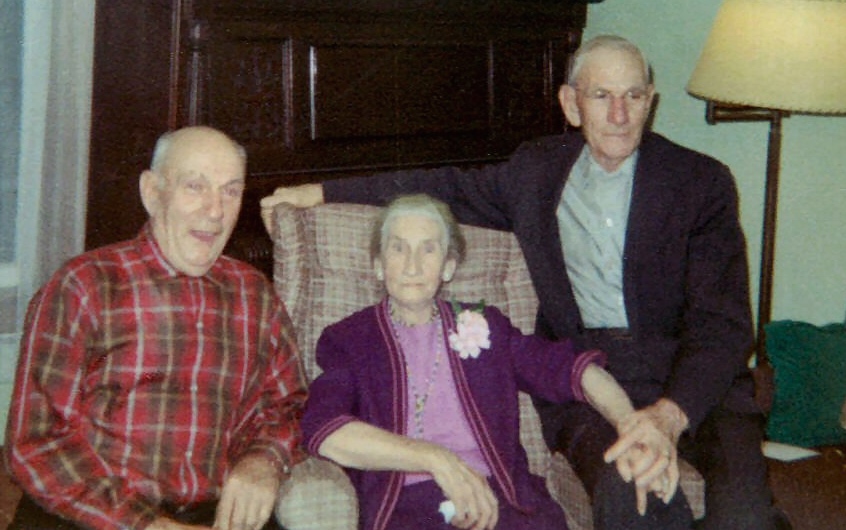
As a lover of history, I am thrilled in my soul to think that we are linked to great men and women of God who helped start and build up the Lord’s church.  When I was seven years old, my family and I visited in the home of Zana Michael, a then 100-year-old sister in Christ who was a member where dad was preaching in Barrackville, West Virginia.  She was four years old when the church there was established. Some of the great preachers of the 19th Century traversed the bergs and valleys around Barrackville and sister Michael heard several of them. We got to hear her, regaled by her clear recollections, and linked through her to such wonderful history.

Screen Shot 2015-06-10 at 9.53.39 AM
Zana Michael is the lady in the middle

Isn’t it thrilling to think of ourselves as being surrounded by so great a cloud of witnesses (Heb. 12:1), sometimes getting to hear from those who heard from those who take us further back in time toward the beginning of the church?  This afternoon, as Carl and I sit and watch the Rockies and Cardinals lock horns on the baseball diamond, we’ll get another chance to join the historical continuum of a grand old game. Every Lord’s Day, as we engage together in worship to God, we join in the grandest historical continuum of all, linked ultimately to Peter, Paul, John, and the rest. Until we exult in heaven some day, what could exceed that thrill?

Laying Aside “Every Weight”

Neal Pollard

I try to write very seldom about my favorite hobby, running, which I picked up when our baby, who Pooh Duke has dubbed “Carlnormous,” was still in the womb (This is Carlnormous).  Running produces so many wonderful benefits, physically, psychologically, and mentally.  Yet, as I have heard said, exercise is only about 20% of weight management.  Therefore, until I have recently begun beefing up my “push back” exercises from the dinner table, I have been running at over 200 pounds for much of those 17 years.  I am 15 pounds lighter than I was this time last month, and Strava does not lie.  Today, I logged a 10K at a pace of 8:19/mile (Strava is cool), while listening to a mellow “Fleet Foxes And More” playlist from Amazon Music (Will Fleet Foxes reunite?)—not exactly heart-pumping exercise music.  This time last month, I was about a full minute slower per mile.  Since today I’m inevitably older than I’ve ever been, the difference has to be the fewer pounds I’m dragging around.  Hopefully, I’ll drop more weight, and if I do I anticipate that my pace may quicken and I’ll feel even better doing it.

New Testament writers use the running analogy on several occasions, but consider what the writer of Hebrews says:  “Therefore, since we have so great a cloud of witnesses surrounding us, let us also lay aside every encumbrance and the sin which so easily entangles us, and let us run with endurance the race that is set before us, fixing our eyes on Jesus, the author and perfecter of faith, who for the joy set before Him endured the cross, despising the shame, and has sat down at the right hand of the throne of God. For consider Him who has endured such hostility by sinners against Himself, so that you will not grow weary and lose heart” (12:1-3). The NASB says “encumbrance” (NKJV, “weight”), and the word means “that which serves to hinder or prevent someone from doing something—‘hindrance, impediment’ (Louw-Nida, 13.149). While the implication is “of an athlete stripping himself of clothing which would impede his performance” (Ellingworth, NIGTC, np), how much more does something like 15 pounds “impede”?

This passage encourages endurance with at least three ideas.

Laying Aside The Weight Is Meaningful. It helps one with endurance as it helps eliminate obstacles to a successful run.  It shows up in a better quality of life. It impacts more than just the run you are on that day.  The effects are enduring and they impact such vital areas as blood pressure, cholesterol, blood sugar, etc.  So it is spiritually.  This is about defeating sin, staying faithful, endurance, and overcoming.  In line with the thrust of the whole letter of Hebrews, it is about not falling away and leaving Christ!  We do not want to hang on to anything that interferes with that eternal prospect.

Laying Aside The Weight Is Measurable. I can tell the difference in myself when I have or have not lost that extra weight.  Certainly, the same is true spiritually.  When something is weighing me down, distracting, depressing, deceiving, or drawing me away, I can tell.  I can see it in my devotional life, it shows up in my speech, my attitude, my ethics, and countless similar ways. Other people can see it, too.  I know that God sees every bit of it!

Laying Aside The Weight Is Motivational.  By laying aside the encumbrances and entanglements, I feel better and improve my physical quality of life. The Hebrews’ writer tells us about a transcendent motivation which follows lightening our spiritual loads of sin problems.  Removing the impediments, I am better able to fix my eyes on Jesus and His example while not growing weary or losing heart.

Past experience tells me that weight can be picked up even easier than it can be laid aside.  This is an ongoing discipline.  But it is so worthwhile!  Oh, that I can remember that as I run the course of earth toward eternity.

What Do We Do At The End Of The Sermon?

Neal Pollard
People who attend our services may be perplexed by the way we end each sermon. I, or whoever is in the pulpit, invite those present to respond to the lesson if they need to become a Christian or if they need to share a need for prayers or even forgiveness for living sinfully. This is a perfectly acceptable, logical thing to do, since the message will often be persuasive and call for a change of heart and action. We never find an example of “offering the invitation” in scripture or a command to do it after the preaching, but it is an suitable, convenient, and advantageous thing to do. The power of God’s Word, when preached, has frequently touched and convicted hearts (Acts 2:37; 7:54). Many have come face to face with the reality of who God is and wanted to know what to do to be saved (cf. Acts 16:31). Our preaching answers that question, after most every sermon. One can respond to Christ’s invitation (cf. Rev. 22:17) any time of day or night, in a public assembly or privately. Many times, the sermon will simply build our desire to live more like Jesus . We may not come to the front row, but we have that resolve within ourselves.
But, let me make this confident pledge to you. If you feel like you need to publicly respond after the sermon, you will not be judged, criticized, looked down upon, or rejected by any godly, faithful Christian. The overwhelming majority of those present will simply hug your neck and a great many will add you to their daily prayers. You will feel the love and support of a loving and supportive church. You will understand that we are all dealing with the same struggles and temptations, all of us trying to make it to heaven! We often build up fear and anxiety about how traumatic “responding to the invitation” will be, but that is almost always a figment of our imagination. God gave us the blessing of the church so that we would have a spiritual family to aid us on our spiritual journey. Never fear taking that step “down the aisle,” if it is necessary. Your example may be the catalyst for someone else to consider their need to come forward, too!

THE CHURCH OF CHRIST

Neal Pollard

Within five minutes of the Bear Valley church building, you will find Atonement Lutheran, Landmark Tabernacle, Bear Valley Church of God of Prophesy, Bear Valley Fellowship, Christ Congregational Church, Hope Crossing Church, and Light of Christ of Anglican.  Expand the search by just a mile or so and that number increases quite a lot.  For the casual passerby, who observes our plain, ordinary facilities, they likely consider us just another in a series of churches or denominations.  In fact, to them, the words are exact synonyms.  Were they to visit each of the churches listed, including us, these observers would conclude that we all share a certain number of things in common while each having uniquenesses that set us apart.  Their deduction from this would run the gamut of perplexity, amusement, curiosity, inquisitiveness, and even, perhaps, disdain and hostility.  When we all meet in large, four-walled edifices with foundations and roofs, with classrooms, an auditorium, some sort of rostrum, a foyer, and even some type of baptistery or “font.”  So, just seeing us from the road or even stepping inside of our building is not enough to tell them who we really are.

If we are serious about the belief that we are trying to be the church of the New Testament, pre-denominational, and apart from Catholic or Protestant ancestry, what is our responsibility?  What is our responsibility to God, one another, and the culture at large?  Are there principles or precepts that should guide us in seeking to be faithful to the pattern the Lord left for His church to follow?  If so, here are some priorities we must emphasize:

  • Identity.  Are we known to our neighbors, friends, co-workers, and family? If so, what are we known for? A deacon here recently related a conversation his boss made about her nephew, who she contemptuously related was a member of the “church of Christ,” an “ultraconservative” group that “doesn’t believe in instruments and women preachers.”  Certainly, her statement said a lot about her, but is that how we want to be identified?  What I mean is, when someone thinks of the church of Christ, wouldn’t we rather be known for what we do believe in and what we are for?  Remarkably, Jesus impresses His disciples with this command: “”A new commandment I give to you, that you love one another, even as I have loved you, that you also love one another. By this all men will know that you are My disciples, if you have love for one another” (John 13:34-35).  The early church exemplified this (see Acts 2:42-47).  Their loving way did not make them popular of universally beloved.  That is not the goal of discipleship or the intention of our Savior (see Matthew 10:37), but we are to demonstrate love.
  • Authority.  To the untrained eye who visits our assemblies, the male leadership, the a cappella singing, the every-week-observance of the Lord’s Supper, the sharing of a “plan of salvation” that necessitates baptism, and the like may or may not evoke serious consideration.  Elsewhere, in denominational churches, they will see choirs, rock bands, “tongue-speaking,” women preachers, babies sprinkled, priests officiating, and liturgical recitations (maybe in a different language).  The thrust of evangelism, not to mention a periodic, thoughtful explanation of why we do what we do in worship and teaching, is to explain why we do (or don’t do) what we do (or don’t do).  Essentially, it boils down to the principle spelled out in Colossians 3:17: “Whatever you do in word or deed, do all in the name of the Lord Jesus, giving thanks through Him to God the Father.”  He has all authority (Mat. 28:18).  He is the head of the church (Eph. 1:22; 5:23). He guided His apostles into all truth (John 14:26; 16:13).  Thus, our concerted, ongoing effort is to honor and submit to His will wherever He specifies a matter (cf. 2 Pet. 1:3).  If He has specified it, we do it exactly and only that way.  If He has not specified it, we use our best judgment and the most expedient way to carry it out.
  • Practicality.  Synonyms might be “applicable,” “relevant,” or “relatable.” Our mission, first of all, is to enact the truth of God’s word in our everyday lives. This is a matter of example or influence.  Many a member of the body has given the Head a black eye by not following what the church teaches we believe.  Our mission is also a matter of trying to build a bridge to the community around us.  In matters that do not equate to “right and wrong,” can we establish rapport? To the extent that we do not violate Scriptural principles like modesty and decency, does our dress make it easier or harder for us to reach others? So long as their message is biblical and fulfill the criteria of psalms, hymns, and spiritual songs, do our songs’ melodies and words help “outsiders,” younger members, and new Christians understand His Word and will? Or do they need an lexicon for archaic words? Do our Bible School materials, tracts, bulletin boards, and visual aids seem 21st Century or like a first edition work of Gutenberg’s press? It is possible that there are some who pant for every new, trendy, shiny thing that comes along, hoping it will lure the unsuspecting unchurched one into our midst.  That extreme should not drive us to be obtuse or mysterious in terminology, outmoded in approach, and outlandish in frugality or form.  To be clownish or undignified is unacceptable, but neither should we be cold or unnatural.

This is not the irreducible minimum, the end all of the discussion.  But, if we will take who we are, whose we are, and who we are here for seriously, the uniqueness of simple, New Testament Christianity will shine through us and cause us to impact our community and our world for Christ.  Isn’t that what we should desire?