Galatians is written to a group of non-Jewish Christians. Paul converted them with a simple message: Jesus came to earth to give us grace and immortality. We get that by believing what we’ve heard about him coming back to life and by being baptized into his grace. At some point, Jewish converts infiltrated their church and started aggressively promoting Jewish traditions. They told the Galatian Christians that if they really wanted to be saved, they needed to follow certain Jewish customs. The entire book is both a refutation of that teaching and a dire warning to any Christian who tries to add to God’s requirements.
Jesus’s sacrifice was to free us from this evil world we live in. Romans 8.22-25 says, “We know that everything God made has been waiting until now in pain like a woman ready to give birth to a child. Not only the Earth, but we also have been waiting with pain inside us. We have God’s Spirit as the first part of his promise. So we are waiting for God to finish making us his own children. I mean we are waiting for our bodies to be made free. We were saved to have this hope. If we can see what we are waiting for, that is not really hope. People don’t hope for something they already have. But we are hoping for something we don’t have yet, and we are waiting for it patiently.”
The whole purpose of Christianity is to anticipate Jesus’s return, and help the rest of the world face that day prepared. Paul reminded the Galatians that they weren’t saved by any old human way. The only legitimate source of truth and hope is God.
Romans 8:26 says, “Likewise the Spirit helps us in our weakness. For we do not know what to pray for as we ought, but the Spirit himself intercedes for us with groanings too deep for words.”
We don’t like to be weak. Admitting weakness means admitting we are powerless. It means that we have to accept that we can’t fix our problems on our own. As humans we sometimes don’t like to admit that we need help. It’s in our nature to try and take care of our own problems.
The problem is that if we want to have a relationship with God, we have to admit that we are weak. We must come to terms with the fact that we are helpless without God. Sin has separated us from God. We are weak, but the Spirit helps us with this weakness. Paul uses the word astheneai, meaning a “lack of confidence or feeling of inadequacy.” The Spirit restores our confidence through prayer. The Spirit takes the inadequate, and makes it adequate.
Our weakness is taken away by the Spirit, and the only hurdle left is our own humanity. We need to understand that we can have confidence in prayer. We should also accept the fact that we need God’s help. How wonderful that our God can hear us even with our weakness!
If we are honest, some days it is easier to worship with focus and enthusiasm than others. We’re human and we struggle. With mental preparation and prayer, we can minimize the frequency of such times, but they happen to the best of us.
Have you ever thought about God getting tired of the worship brought by His people? I don’t mean worship done incorrectly and according to the will of men which violates what He commands. Apparently, He rejects such worship (Mat. 15:9). I don’t mean the idea that He gets bored and had rather skip a Sunday here and there. No such picture is ever painted of God.
But through the prophets, He repeatedly talks about being weary of the worship brought by His people.
“I have had enough…I take no pleasure in…your worthless offerings…an abomination to me…I cannot endure…They have become a burden to Me; I am weary of bearing them” (Isaiah 1:11-14).
“I hate, I reject your festivals, nor do I delight in your solemn assemblies…Take away from Me the noise of your songs; I will not even listen to the sound of your harps” (Amos 5:21,23).
“Oh that there were one among you who would shut the gates, that you might not uselessly kindle fire on my altar! I am not pleased with you,” says the Lord of hosts, “nor will I accept an offering from you” (Malachi 1:10).
Each prophet is dealing with specific circumstances prompting such a response from God, but it should cause us to take notice that just coming into the “meeting house” and going through the motions does not equal acceptable worship. Neither does simply following the New Testament pattern for the acts of worship. You will find in each of the passages above that the people were at the right place offering the right sacrifices on the right day led by the right people. The problem was either one of attitude, hypocrisy, or outright worldly living. Jeremiah documents how the people lived just like the world for the rest of the week, then filed into the temple to sing, “Redeemed, how I love to proclaim it!” (7:4-10).
Worship is a special privilege, to come into the presence of our Maker and Savior. At our best, we worship Him with sin and weakness in our lives. He knows that and the cross proves that He knows it. He is not expected sinless perfection, but He is looking for characteristics in our worship just beyond doctrinal accuracy. He wants:
Feeling (Psalm 95:6; John 4:24).
Engagement (Matthew 15:8).
Effort (Hebrews 13:15).
Gratitude (Ephesians 5:20; Colossians 3:16-17).
Thoughtfulness and Intentionality (Ephesians 5:19; Colossians 3:16).
Devotion (Acts 2:42).
Consideration of one another (Hebrews 10:24).
It is such a blessing that God communicates with us not only about the “what,” “when,” and “who” of worship, but also the “how” and “why” of it. When we are assembled for worship, He tells us what worship should look like. Between the assemblies, He tells us what a life looks like that partners with that worship.
God speaks of the various sacrifices of His children being a “fragrant aroma” to Him (Philippians 4:20; ). He likens the prayers of His faithful people to incense (Revelation 5:8; 8:1ff). Jesus assures us that true worshippers offering true worship are highly sought after by God (John 4:23). That’s the aim, isn’t it? The idea of presenting God with both a worshipper and worship which enthuses Him is the pinnacle of excitement!
Next Sunday, before we come together in worship, we can read Psalm 95, Psalm 96, Isaiah 6, or a similar chapter which reminds us of Who we get to worship. Today and every day, let us strive to build on the most recent worship we have offered by a life of faithful service and sincere devotion. That will set the table for worship God can’t wait to receive!
I’ll be repeating the book of I John in present-day terminology. It’s not a true translation of the book, as I am not qualified to do so. It will be based on an exegetical study of the book and will lean heavily on the SBL and UBS Greek New Testaments, as well as comparisons with other translations (ESV, NASB, NIV, ERV, NLT). My goal is to reflect the text accurately, and to highlight the intent of the author using concepts and vocabulary in common use today.
This is not an “essentially literal” translation, and should be read as something of a commentary.
Friend or Foe
This is how you know you’re with him: he gave us his spirit.1 Loved ones, don’t believe every spirit, but really put them to the test to see if they came from God. You’ll need to test them because a whole lot of fake teachers were sent2 to the world.
This is how you know if a spirit came from God: every spirit that comes from God will acknowledge that Jesus was sent to earth as a human. If a spirit refuses to acknowledge this, it isn’t God’s. In fact, it’s the spirit of Jesus’s enemies. You heard that the spirit of Jesus’s enemy was coming — it’s here now.
Young ones, you are from God and have already beaten these spirits. How? Jesus is far more powerful than his enemies, and he’s with you. These enemies come from the world, so they talk like it — and the world listens to them. But we came from God. If you know God, you’ll listen to us. God’s enemies are the ones who don’t listen to us. This is how you can tell the difference between a legitimate spirit and a fake one.
1 In this context, πνευματος is used to mean something like “ethos” or “system of teaching”. God sent a legitimate belief system, then Satan counterattacked by sending a ton of illegitimate information to make truth more difficult to find.
2 This is further evidenced by εξεληλυθασιν in 4.1 and εληλυθοτα in 4.2. The former describes false teachers sent to earth. The latter describes the one true teacher sent to earth.
In Romans 12:6-8, Paul lists some marvelous gifts that help us be living sacrifices that overcome this world (1-2) who don’t think too highly of self (3). These gifts include such beautiful attributes and actions as proclaiming the gospel (6), service (7), teaching (7), exhortation (8), giving (8), leading (8), and mercifulness (8). Who could fail to see the value of these gifts, on full display and at work in the body of Christ?
That being said, let’s be reminded that the following are not gifts:
Hypercriticism
Complaining
Gossip
Strife
Drama
Outbursts of anger
Pride and boasting
Selfcenteredness
Manipulation
Grudge-bearing
Too often, these drain the life of a congregation and are a drag on its attempted works. God is not glorified and the body is not edified. In Paul’s discussion about some specific gifts in 1 Corinthians 12-14, the word edification repeatedly comes up as rationale for the exercise of those gifts (14:3-5,12,17, 26). Gifts build up by design.
It’s proper and necessary for us to gauge our actions, to see if we are living as Paul urges the churches of Galatia: ” Now those who belong to Christ Jesus have crucified the flesh with its passions and desires. If we live by the Spirit, let us also walk by the Spirit. Let us not become boastful, challenging one another, envying one another” (Gal. 5:24-26).
God desires us to find our gifts and place in the body and pursue using them for His glory. The “non-gifts,” He wants us to crucify! They take no talent, but they rob us of peace and joy.
I’ll be repeating the book of II Peter in present-day terminology. It’s not a true translation of the book, as I am not qualified to do so. It will be based on an exegetical study of the book and will lean heavily on the SBL and UBS Greek New Testaments, as well as comparisons with other translations (ESV, NASB, NIV, ERV, NLT). My goal is to reflect the text accurately, and to highlight the intent of the author using concepts and vocabulary in common use today.
This is not an essentially literal translation, and should be read as something of a commentary.
Message is Credible
Family, you have to make sure you’re in a good place when it comes to your relationship with Jesus. If you’re practicing all those qualities we just talked about, you’ll be ok. You’ll make it to eternal life. You know this stuff already, but it’s always a good idea to remind you. You’re already in a good place, but as long as I’m alive, I’ll keep reminding you. I’m going to die soon. Jesus made that clear to me. Because of this, I want to make sure you’ll remember everything I taught you. What we taught you originally is still valid. Jesus is powerful and he’s coming back to us. We weren’t duped into believing an intricate lie. We were firsthand witnesses to his superior nature! One time, the ultimate power – God – validated this by saying, “This is my son. I love him and I think very highly of him.” He said that right in front of us while we were with Jesus on a mountain. His voice came from the sky. This made us confident that we have the right message. Since we’re confident in this message, you should be, too! Focus on what we’ve told you like you’d focus on a light source in a dark room. Hang onto this until the end, when everything will be light and darkness won’t exist. It’s very important that you understand something: we don’t get to decide what a prophecy means. No human has ever produced a legitimate prophecy. Those came from men who were influenced by God’s spirit.
Each Sunday, Christians come together to worship our Creator. But before we can properly worship God, we need to know what He wants from us. We can’t just come together and do what we think God would want. There is no guesswork required because God has plainly told us. This isn’t an article on our singing, taking the Lord’s supper, or reading scripture. But worship requires knowledge, and this knowledge will help us to properly prepare when we come together.
If our knowledge is lacking, what happens? In Leviticus 10, Nadab and Abihu offered God something He did not ask for. “Now Nadab and Abihu, the sons of Aaron, took their respective firepans, and after putting fire in them, placed incense on it and offered strange fire before the Lord, which He had not commanded them. And fire came out from the presence of the Lord and consumed them, and they died before the Lord” (1-2).
“Strange fire?”
Depending on your translation there are several different interpretations of what they offered.
ESV “Unauthorized”
NKJV “Profane”
RSV “unholy”
None of these translations speak well of their actions, and we read the consequences of their actions. They offered God a sacrifice without proper knowledge. Some would say that how God responded was uncalled for, and while His actions may seem extreme, there are several facts we learn about Worship.
We learn that when God tells us how to do something, we better listen. We learn that proper knowledge of how to worship is essential. We learn that God takes worship seriously.
I’m thankful that God doesn’t deal with us today in the same way. The times that I’ve caught my mind wandering in the songs we sing, or when I loose my train of thought during the Lord’s supper, I’m sure that God has had plenty of opportunities to strike me down.
Leviticus 10 is a sobering reminder. And we need to ask ourselves, “Are we offering strange fire to God?”
We can avoid doing this by having the proper knowledge of what God has commanded.
It’s not about what we think sounds good, or what we think God would like.
It’s about our Creator. We don’t need to guess; He has clearly told us. In John 4:23-24, Jesus in speaking with the Samaritan woman says, “You worship what you do not know; we worship what we know, for salvation is from the Jews, But an hour is coming, and now is, when the true worshipers will worship the Father in spirit and truth; for such people the Father seeks to be His worshipers.”
What does God want us to know about worship? The people God seeks to be His are the ones who worship in Spirit and Truth.
The word Spirit literally means, “As the source and seat of insight, feeling, and will.”
Basically what Jesus is trying to convey is that:
When we sing, we sing with feeling
When we pray, we pray with feeling
When we remember Christ, we feel the weight of the sacrifice.
When we read God’s word, we do it with feeling.
God wants our hearts to be in worship.
A knowledge of God helps us accomplish this command. Which is exactly why Jesus says to worship in spirit, but also in Truth. Our emotions and feelings are based on the truth that God has revealed. The truth that comes from divine inspiration. If we worship in spirit and neglect the truth, we are offering strange fire. If we worship in truth alone without emotion, we are offering strange fire to God.
In order to worship, we must have a knowledge of what God wants from us.
It hurts and it’s hard to become attached to anyone who isn’t living faithfully because they’re lost. That means they’re not going to heaven. Sometimes lost people pretend like that’s not their reality by distracting themselves with things that make them feel like they’re not lost (Ecc. 2.24-25).
There’s a good chance that you know people who aren’t going to heaven and many of you love people who aren’t and we’ve got to convince them to hear Jesus out.
What can we do?
We can simplify spiritual concepts so that people can understand a message that they desperately need to hear.
Please don’t let anything get in your way of going home. If you think something might be in your way, God can use us to help you. There are more things to fear than Covid, vaccines, tornados, elections, and riots.
Everybody responds to the invitation that Jesus extends. Many choose to say no— but nobody ever regrets saying yes.
To you, responding might be a personal resolve and commitment to christ.
“For those who live according to the flesh set their minds on the things of the flesh, but those who live according to the Spirit set their minds on the things of the Spirit.”
From the title, one might assume I am writing an article about hell. While it is true that God’s Word describes hell as eternal torture for disobedient spirits, my topic is something else entirely. You see, I have become more aware of a disparity between those three parts comprising my singular being with each passing birthday. There is my intellect that still recalls youthful exuberance. In my mind, I can still free climb Mount Yonah in White County, Georgia. My body snarkily responds, “Are you crazy?” And then there is that part of me that will never die. Yes, my spirit. My spirit becomes tired. Not only do I crave to be clothed with my heavenly habitation (2 Corinthians 5.1ff), but I also want to leave this body that is subject to the temptation of sin (cf. Romans 7.14-8.1). I grow weary of hurting God.
Fortunately, God created the “inner man” with the ability to experience daily renewal (2 Corinthians 4.16). Yet, this renewal will not occur if I am passive, sitting around waiting on God. Yes, He provides the inner man with strength through His Spirit (Ephesians 3.16). But you and I must engage in spiritual service, thereby enabling this renewal (Romans 12.1-2). This service requires that we strive for mastery over the boorish flesh holding our spirits prisoner. If we indulge our flesh, we will reap corruption (Galatians 6.8). Conversely, if we sow to the Spirit, we will reap eternal life. This choice makes all of the difference.
So, to facilitate our daily renewal, our mindset plays a crucial role. Following Paul’s exhortation to “be anxious for nothing,” he reminds us that we have better things upon which to meditate (Philippians 4.6-8). In addition, we must follow David’s example of hiding God’s Word in our heart to prevent sin (Psalm 119.11). Thus fortified from within, we positively affect our actions (cf. Proverbs 23.7; Matthew 15.18-20). The execution of this task comprises the majority of our battle against the whims of our flesh. When successful, we maintain a tender heart that retains awareness of sin and prompts swift repentance when we occasionally stumble.
Yes, we are all tortured spirits imprisoned by crude flesh. But “Thanks be to God through Jesus Christ our Lord!” (Romans 7.25a NASB1995) His blood will offer continuous cleansing as long as we walk in fellowship with Him (1 John 1.7).
“Pollard Boys” practicing for a great Doyle Lawson tune for Carl’s wedding today.
Most of us have favorite songs and hymns. My favorite category of hymns is songs about the cross. I love the somber, dramatic feel of Beneath the Cross of Jesus, a hymn penned right after the close of the Civil War by Elizabeth C. Clephane and one set to the music we sing with it by Frederick Maker a dozen years later in 1881. The cross of Calvary is treated as a metaphor of protection for one in a wilderness. One might envision the wandering Israelites making their way to the Promised Land and apply that, figuratively, to our journey through this world of sin toward heaven. But the song will change scenes multiple times until, in the last verse, it is a most personal challenge to each of us to be faithful disciples of this crucified Lord.
The first verse introduces the foot of the cross as a shadow of a mighty rock where we find relief and a home to rest in from trials and difficulties while pilgrims in a weary land (the world). We might easily think of Israel’s exodus from Egypt. Some songbooks have a notation to define “fain,” a word used in the first line. It means “gladly.” I am happy to shelter behind Christ’s cross in adversities.
The second verse builds upon the metaphor of the first verse, then subtly shifts to an event from the book of Genesis. The cross is, again, a shelter and refuge. But, then, he shifts to an allusion to Jacob’s dream (Genesis 28:10ff). He has left his father’s house and his brother’s wrath and beds down near Haran. He lays down, using stones for a pillow, and falls asleep. Moses writes, “He had a dream, and behold, a ladder was set on the earth with its top reaching to heaven; and behold, the angels of God were ascending and descending on it.And behold, the Lord stood above it and said, “I am the Lord, the God of your father Abraham and the God of Isaac; the land on which you lie, I will give it to you and to your descendants” (12-13). This is where God reaffirms the promise He had made to Jacob’s grandfather and father to make of them a great nation. It symbolized hope, reward, and heavenly assistance. The song writer says the cross is just like the ladder in Jacob’s dream, except that I ascend to heaven by way of the cross. Again, Clephane uses a poetic, if obscure word, in this verse: “trysting.” The word means “meeting.” At the cross, God’s perfect love and justice meet. His love is shown and His justice satisfied by Christ’s sacrifice.
The third verse becomes a straightforward look at a literal remembrance of the graphic, horrific suffering of Jesus on the cross. She focuses on what our reaction should be–a smitten heart, tears, and a proper conclusion. How great is His love! How unworthy I am that He would demonstrate it to me (cf. Romans 5:8).
The last verse is the challenge to respond to that sacrifice. We are to live in the shadow of the cross, daily reflecting upon it and letting it affect how we live. We are to ignore all else to focus on Him. Clephane seems to allude to Paul’s words in Galatians 6:14, if ever so subtly. Too, there’s a challenge to not be ashamed of Jesus and the cross, but reserve our shame only for the sin in our life that made the cross necessary.
It is beautifully and intricately woven. Despite some unfamiliar, even archaic, poetic words, it is powerfully written. What a great song to prepare our minds for the Lord’s Supper or to sing when our motives gets clouded and our priorities get muddled. May we take the time, when we sing it, to consider the truth it teaches and the challenge it contains.
“Enmities” is a work of the flesh, found in Galatians 5:20. It’s something we may not quite understand. How do “enmities” arise and is this something you and I may fall prey to?
Enmities arise by holding a grudge. In fact, it can be very difficult to know when you cross the line from the one to the other. When you harbor feelings of resentment toward someone from an offense real or imagined, it will eventually grow into hostile feelings and possibly hostile acts. The old law warns against bearing a grudge and even makes it antonymous (i.e., opposite) with love (Lev. 19:18). The Lord tells us what to do when we have a problem with a brother or sister (Mat. 18:15ff). If we do not follow this, to whom are we listening?
Enmities arise through prejudice. Prejudice occurs on much more than the basis of the color of one’s skin or one’s ethnicity. Prejudice is nothing more than a preformed opinion, one formed without all the facts but instead through “insufficient knowledge, irrational feelings, or inaccurate stereotypes” (Encarta Dictionary). How often, based on how we think, feel, or believe another to be, do we work ourselves up against another and allow enmity to rule our hearts?
Enmities arise when the mind is set on the flesh (Rom. 8:7). Paul is contrasting the Old Law with the gospel of Christ in this context, but he reveals a compelling principle. When we fail to live spiritual lives, but instead make our decisions driven by our passions and fleshly inclinations, we open ourselves up to works like enmity. Incidentally, this same bent will lead one further and further down the road of those ensuing works in Galatians 5. Notice that this hostility is pointed toward God and His law (cf. Jas. 4:4), but it will impact our demeanor and attitude in all relationships. This hostility plays out “in the flesh” (Rom. 8:8), the very activities and attitudes upon which Paul focuses in Galatians 5:19-21.
Are you and I immune from “enmities”? We can strengthen ourselves against such
especially through the “antidote” of love in the fruit of the Spirit (Gal. 5:22). Love actively seeks and strives for others’ good. If we sincerely give our hearts to loving others, our brethren or the lost, we will have a harder time harboring hostility and hatred for them. Maybe if we will take the time to know others better and try to get insight into their circumstances, struggles, and challenges, it will temper our feelings toward them. It will certain demonstrate that we are led by the Spirit and not by the flesh!
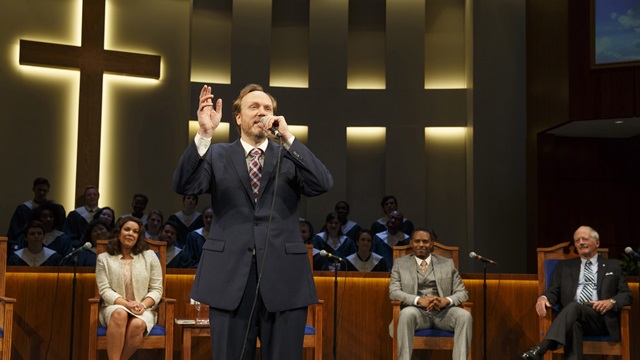
I’ve seen the play advertised locally. Lucas Hnath, a 36-year-old playwright, has a background in religion. His mother attended seminary and he even sat in her classes. The New Yorker reveals that there were expectations early on in his life for him to become a “pastor,” a choice he forewent for the arts instead (“Divine Intervention,” 9/7/15, Hilton Als). The play is about a megachurch preacher who has come to believe there is no hell and who believes God gave him this revelation. The result of his divulging this in a sermon is a church split, led by the assistant pastor who does believe in the reality of hell. While doctrine lays at the heart of the split, the play is said to focus on the personalities and behavior of various folks making up the church. Alissa Wilkinson, in a flamboyantly titled review, says this play resonates because “schisms, church splits, or at least disgruntled storming-outs are familiar to virtually everyone who stays in a church long enough to be committed to its life” (Christianity Today, 9/23/15). At least in advertising I’ve seen, the play title appears “The Christ?ans.” The idea is that, judging from their behavior, it is questionable whether or not they are truly Christians.
There are heartbreaking stories of congregations of the Lord’s church whose internal battles became known to the community and the brotherhood at large. Some have resulted from battles over doctrinal issues, whether regarding morality, fellowship, worship, leadership, or the like. Some have resulted from dueling strong personalities, jockeying for power, position, and prominence. Some have boiled down to squabbles about money. In all of them, tragically, Christ has been relegated to the corner and forced to be quiet while His “followers” duke it out.
While the implications over a doctrinal dispute and a personality power play are different, too often the predominant feature is a show of the flesh.
Many with a background in religion will be able to relate to the theme of the play because they have seen schisms in churches before. The world is a divided place, full of rancor, backstabbing, infighting, and unfair fighting. The church, particularly the church of the New Testament, must never exhibit such traits. Corinth set off such an alarm with Paul for this very reason. He urges no division to mar them (1 Cor. 1:10-13) and goes on to address both doctrine and attitudes in the letter. Philippi had two quarreling women straining the unity of that church (4:2) and Paul goes right to the heart and the mind.
We must strive to conduct ourselves with one another in a way that is always exemplary before the eyes of the community, the brotherhood, and the world. I thank God to work with a church that has been around so long and been through so much and who have weathered those storms by sticking together. Yet, too often, people have aired their dirty, unsightly laundry out on the clothesline of public purveyance. This soils the reputation of the Savior! That fact alone should horrify every child of God. May we always strive to be a beacon of light (Mat. 5:16), shining a spotlight on the Sinless Savior and not squabbling saints!
Paul especially urges a particular quality that seems rarer these days. However, this is not a trait disappearing only with those in the world, but one that seems harder for us who claim to be disciples of Christ. He uses a word in Galatians 5:23, Ephesians 4:2, Colossians 3:12, and 1 Timothy 6:11, among others—James does, too (1:21; 3:13). The word, πραΰτης, means “gentleness of attitude and behavior, in contrast with harshness in one’s dealings with others” (Louw-Nida, Greek-English Lexicon, 1996, n. pag.). They suggest the word includes “always speaking softly to or not raising one’s voice” (ibid.). Another Lexicon, in defining the word, speaks to what may prevent one demonstrating gentleness, namely “…being overly impressed by a sense of one’s self-importance” (Arndt, Danker, et al, 2000, n. pag.). Yet, surely there are other impediments to our bearing the fruit of gentleness.
We struggle to be gentle, don’t we?
With our children’s weaknesses and mistakes.
When responding to our spouse, whether in impatience or aggravation.
With rude fellow-shoppers, incompetent cashiers, or pokey or inattentive drivers.
Being at odds with a brother or sister in Christ in a clash of personalities or purposes.
Having thoughtless or rude neighbors.
Engaging in a disagreement with a faceless, nominal acquaintance on social media.
Dealing with customer service, especially if we get an ESL representative.
This is just a sampling of situations which tempt us to abandon a gentle spirit. Aristotle called this quality “the middle standing between two extremes, getting angry without reason…and not getting angry at all” (Zhodiates, Dictionary, 2000, n. pag.). The New Testament does not tell the Christian that we cannot defend ourselves, protect our rights, or get what we pay for, for example. But, in addressing concerns, needs, and problems, how we do this makes all the difference.
For many of us, gentleness needs to be intentional. It doesn’t come naturally. We need to pray about it, prepare ourselves for it, and practice it. Our passion needs to be harnessed. Our speech needs to be tempered. Just making the need for gentleness a conscious priority in our lives will greatly improve our performance, with family, friends, brethren, and strangers. It is a powerful tool to win hearts and shape lives, beginning with our own.
I’ve known individuals whose sole purpose in the assemblies has seemed to be to critique those who lead the worship or show up to engage in it, from their appearance to their aptitude. While we certainly need to avoid having someone blatantly engaging in sin and error (that’s an article for a different occasion), if that is one extreme then hypercriticism of the worship and worshipper can be another. If you or someone you love is tempted to play this deflating part, consider the following.
It’s unwarranted. Who earns the right to be the official analyst of the worship? How does one properly and fruitfully engage himself and herself in John 4:24 worship while assuming this presumptuous activity? The Bible nowhere portrays such a one in a positive light. One critic of another’s worship we do read about is unflatteringly presented and unfavorably analyzed by God in Luke 18:9-14. We should ask why we feel it necessary that we grade and rate others present with us before the Great I Am.
It’s unscriptural. This can be the case in many possible ways. First, if we gossip or speak about someone rather than addressing it with them, that’s wrong (1 Pet. 2:1; Mat. 18:15). Second, if our tone is biting, sarcastic, and unloving, that’s wrong (2 Tim. 2:24; Eph. 4:15). Third, if in being critical we ourselves are not properly engaged in worship, that’s wrong (John 4:24).
It’s unwise. It is so easy to undermine and squander one’s own influence who reduces himself or herself to nitpicking others in the assemblies. It can cause others to lose respect for us and even seek to avoid us. This is especially important to remember if, in a close and final analysis, what we criticize does not rise to the level of meriting such criticism.
It’s untenable. The critic is exposed as doing what he or she is condemning others for—i.e., not offering acceptable worship. It’s somewhat like the child who sees a sibling with eyes open during the prayer and who tattles to mom and dad, who promptly ask, “How do you know?”
It’s unwelcome. The chronic complainer, sooner or later, develops a reputation for such. It causes others to avoid them for fear of the carnage it could create. The Corinthians were urged to be edifiers in their assemblies (cf. 1 Cor. 14:12,26). The worship critic works against that ever-present need.
It’s unbelievable. How incredible that one would misuse the assemblies to nitpick minutia when the Creator, the Savior, and the Revealer are present and expecting worship from all present! What a gross misunderstanding of our role as Christians to abuse the time in such a way. In fact, it is utter audacity.
There may be a bit of the critic in all of us. Certainly, we should be striving to make worship better in every practical way we can. That involves teaching and training. It involves singing songs with words we actually use and understand. It involves probably 1,000 other things, but let’s not get so lost in the pursuit of “improving” that we forget to do what we assembled to do: worship God!
Inquiring minds want to know. How does God work through providence? How does He answer our prayers to strengthen, help, lead, and endow us with wisdom? We are without doubt that God is active, interested, and involved in our lives today. Deism denies this, saying that a Creator set things in motion and then permanently stepped out of the picture on planet earth. Theism affirms His present involvement and interest in the affairs of men today. The dogmatic at either extreme purport to speak for God, absolutely affirming or denying what He does or does not do. There is an area in which we cannot say how God operates or whether it is the Father, Son, or Spirit who is at work simply because it has not been revealed and we are not in a position to observe what is transpiring in the heavenly realm. Moses once said, “The secret things belong to the LORD our God, but the things revealed belong to us and to our sons forever, that we may observe all the words of this law” (Deut. 29:29). Moses told Israel that some things aren’t revealed to us, but he also said some things are revealed. We are obligated to observe what is revealed. We are on dangerous ground when we affirm what Scripture does not reveal.
Scripture does not reveal that the Spirit is involved in our decision-making in a direct way apart from the Word. It does not indicate that He is stirring inside our hearts, influencing us to think, speak, or act in a given way for a given purpose or moment. He does not give us our words in the miraculous way He did for the apostles, who had no need to prepare or study for a given moment (cf. Matt. 10:19-20). When we boldly assert such things, we stand without the foundation of revealed truth beneath us and, at best, stand upon dangerous conjecture.
The Spirit’s work in written revelation informs my heart and mind, and it (Scripture) awakens me to appreciate and depend upon the power of God through that word and its promises. The Bible says we are strengthened with might through His Spirit in the inner man (Eph. 3:16). We do not know the full implication of that promise, though we are thrilled by it. What a leap it is to go from acknowledging the Spirit strengthens us to claiming He gives us thoughts, ideas, or direct guidance in addition to His Word. If we say, “The Spirit led me to take this job” or “The Spirit told me to speak to that person” or “The Spirit told me I’m saved,” we speak from ignorance (i.e., lack of knowledge or information). Kathy once studied with a woman and showed her the multitude of passages proving the essentiality of baptism, but she replied, “But the Spirit told me I’m saved.” We know that it was her own will and desire in her heart that she attributed to God. That is the danger of such reckless assertions. We easily confuse what we desire and prefer with “the will of God” or even “the Spirit’s work.” God repeatedly warns that our hearts can deceive us, that we can credit God for what, in reality, is our will (Prov. 14:12; 16:25; Jer. 10:23).
We do need to study the personality, the work, and the Deity of the Holy Spirit more. It is obvious, hearing and reading after even some brothers and sisters in Christ, that we have neglected studying about Him. Let us handle each other without suspicion, in a spirit of love and kindness and without attacking people and personalities. Let us also always be careful not to “exceed what is written” (1 Cor. 4:6), never adding to or taking away from what is revealed (Rev. 22:18-19). Yet, let us be grateful that our great God is interested and involved in our lives, being content to affirm only what Scripture reveals.
That some people are not happy unless they’re in a fight with someone.
That there are still lost people hungry for to know God’s will for their lives.
That it is so easy to make excuses and so hard to make the effort.
That I still have so much to learn, so far to go, and so little time to do it.
That some people do not believe it’s possible to lean too far to the right.
That some people do not believe it’s possible to lean too far to the left.
That some people get “preach the truth” but not “in love.”
That some people know how to be loving, but are unwilling to preach the truth.
That there are some who believe they are judge, jury, and executioner.
That some preachers decide what to preach based more on popular opinion and felt needs than honestly, courageously seeking to preach the whole counsel of God.
That some run roughshod over others while hypersensitive to their own rights.
That some can tell you what the preachers’, elders’, and deacons’ jobs are, but think their only job is to tell you that.
That many of God’s people are striving to live right every day, often at great personal sacrifice and despite great opposition.
That there are some who do good all the time, and would be mortified for others to know it.
That some make sure others know every good thing they do.
That everybody is extremely busy, but some are better time managers than others.
That with some people you are guilty until you can prove you are innocent, and you may still be guilty in their minds.
That no one can hand you success, prosperity, or discipline. God gives you the tools, but neither He nor anyone else can make you develop and sustain them.
That elders and preachers who work together create a bond that holds the local church together.
That we have overemphasized specialization (evangelism training, youth workers, Bible class teachers) to the point that many feel unqualified and “opt out.”
That every one of us that gets to heaven will get there with much help from God and brethren.
They are currently touting a diet pill that is a normal size when one takes it, but it expands up to 100 times its original size when taken with a 16 ounce glass of water before a meal. This is to give the one who takes it the exaggerated feeling of being full. Then the pill eventually reduces in size afterwards. Some are calling it the answer for those who are severely overweight but who have a harder time cutting back how much they eat.
Ours is an age prone to offer easy alternatives to what the Bible calls self-control (2 Pe. 1:6). This word is defined as “‘to hold oneself in,’ ‘to command oneself,’ ‘to be a chief of oneself,’ ‘to make one’s heart be obedient,’ ‘to command one’s own desires,’ ‘to be the master of what one wants,’ or ‘to say No to one’s body'” (Louw & Nida, np). Few of us excel at this all the time, but the Holy Spirit through His inspired writers call it a characteristic of the sanctified. Paul preached it to individuals like Felix (Ac. 24:25) and to congregations like Corinth (1 Co. 9:25). Perhaps some limit their understanding of “self-control” to sexual matters. While that is certainly an important area, all passions and desires must be kept in check. Paul told Galatia, “Now those who belong to Christ Jesus have crucified the flesh with its passions and desires” (5:24).
That applies to diet and exercise as surely as it does tobacco, alcohol, and various lusts. If one looks to a pill as a substitute for portion control and healthy food choices, he or she is bypassing the exertion of a trait that is supposed to be a sign of faithful Christian living. How many of God’s people have eaten themselves into health conditions like heart disease, diabetes, and the like? It is often easier to excuse our unhealthy lifestyle by pointing to stress, heredity, metabolism, or busyness than to exert the necessary discipline needed for us to better care for our bodies.
Some of us may have to work harder at this than others thanks to genetics, age, or the other factors just mentioned, but that is what self-control is all about. It is about exerting the effort required to master our wants and say no to our bodies.
This may be an unpopular subject to address, but in our ever-expanding society that has eaten its way into weight problems and obesity God’s people are to lead by example. That means demonstrating self-control not only by what comes out of our mouths or from our deeds, but by what we put into our bodies. We don’t do that by taking a pill, but instead by exerting our will.















 The Preacher Pollard Blog