Persecuted, But Not Abandoned

Thursday’s Column: Captain’s Blog

“persecuted, but not forsaken; struck down, but not destroyed;” 2 Corinthians‬ ‭4‬:‭9‬ ‭

In a world that grows ever darker, there are moments where Christians can feel lonely. This isn’t a new phenomenon. Since the beginning of time, those who God chose to serve Him often felt rejected and alone. 

The apostles who followed Jesus felt persecution and rejection at almost every turn. Paul especially faced difficulties in his ministry. 

We sometimes fail to understand what Paul and the other Christians were being persecuted for. They were proclaiming the Word of God. Paul is trying and pressing on through this persecution, because of the message that he had to proclaim. But those who were lost by their actions were rejecting the very thing that could save them!

Paul realized the value of their souls and continued on through the persecution. Paul also realized that even though they were rejecting The Word and persecuting him, he knew he that he was never forsaken by God. Satan wants us to feel abandoned by our Father. Many struggling people have questioned where God was in their lives when they felt they needed Him most. I have. But realize this is Satan! We know for a fact that God hasn’t forsaken us. If being persecuted for God is all it takes to get to Heaven then that’s definitely a steal. 

Paul says in Philippians 1:21, “For to me, to live is Christ and to die is gain.” We have what can solve the world’s sin-problem, and we need to realize the importance of our commission. Jesus said in Matthew 16:26, “For what will it profit a man if he gains the whole world and forfeits his soul?” The earth has been estimated to be worth over 30 trillion dollars. To put this in perspective, the average 10 dollar bill is about 6 inches long. If we lined up 30 trillion dollars worth of ten dollar bills it would stretch over 3.4 billion miles. Our souls are more precious than this entire world. Why be afraid of persecution when we have the power to save something as valuable as a soul, even if it’s just one?

 We have been promised that we will face persecution for Christ, but we can have assurance in knowing that no matter what we go through God will never forsake us.

Carl Pollard

“Something Must Be Wrong”

Monday’s Column: Neal At The Cross

Not long ago, I was in another state for a few days. On those rare occasions when I travel without Kathy, our routine is pretty fixed. I will call her at the end of the day to say good night. The next morning, I will wait for her to text me to say good morning (she doesn’t set an alarm clock when I’m away, so I don’t want to wake her up).

During the recent aforementioned separation, we talked during the middle of the evening. She assumed that was our good night call. She came home after going to a Bible study and the grocery store, and I got a Ring notification showing her enter our house. About 90 minutes later, I called to say good night. The call went to voice mail. I texted. Nothing. I tried communicating through Alexa. Nothing. I checked Life360. Her phone had died. So, I went to sleep.

The next morning, I tried reaching her again. Ring showed no motion, not even letting our dog Ollie out. Her phone was still dead. My concern grew! This was unprecedented! Something was wrong! Had she hit her head? Had there been a home invasion?

I texted a good friend who lives nearby, asking him if they could check on her. At 6:15, he stopped by with his daughters on his way to taking them to school. He rang the doorbell several times and even knocked hard on both the side and front doors. Finally, Kathy emerged–she thought it was our youngest son’s truck since our friend’s truck looks very similar. She was unharmed, though embarrassed and unprepared for early morning company!

We found out that morning that there was a minor gas leak in our fireplace which might have coaxed her into a deeper state of sleep. The rest was just coincidence. She thought we’d already said good night. She read for a while, then went to sleep. The next thing she remembered was Jeremy banging on our door. There was plenty of embarrassment to go around.

I thought about this situation and how it illustrates several things.

  • It can take some persistent knocking before some will answer (Rev. 3:20)!
  • It is notable when one who usually can be counted on to respond a certain way does not; it is often a sign that something is wrong. If you missed a church service, would people wonder where you are since it was so unusual–or would they expect it (Heb. 10:24-25)? If you lost your temper or sinned with your tongue, would people think that it was uncharacteristic or par for the course?
  • When we truly love and care about someone, we will persistently try and reach them if we think they’re in trouble (Jas. 5:19-20)!
  • Checking on someone we think is in trouble is to risk embarrassment and an uncertain response.
  • Sometimes, it takes another person to do what we tried but could not do (1 Cor. 3:6-9)!

Fortunately, this is something that Kathy and I can laugh about now. We’ve fixed the leak in our fireplace. Hopefully, this will never happen again. But it is an indelible memory for both of us. It also illustrates that there are circumstances that call for urgency and action! As it concerns the soul, the stakes are eternally higher than the physical. May we take Paul’s words to heart as it concerns our spiritual work: “For this reason it says, ‘Awake, sleeper, and arise from the dead, and Christ will shine on you.’ Therefore be careful how you walk, not as unwise men but as wise, making the most of your time, because the days are evil” (Eph. 5:14-16).

Neal Pollard

Sailors, Subs, Shipwrecks, Sharks, Sinners, And Salvation

Monday’s Column: Neal At The Cross

Neal Pollard

Only 11 survivors outlived him, as he died on November 4, 2019, at the age of 95. When the USS Indianapolis went down in late July, 1945, Art Leenerman was a 21-year-old radarman. After five nights and four days in the Pacific Ocean, where many initial survivors of a catastrophic torpedo attack were eaten by sharks or succumbed to the elements, rescuers arrived. A Dumbo Catalina patrol bomber rescue plane snatched 56 survivors out of the water, thanks to a heroic pilot, Lt. Adrian Marks. Marks’ aircrew saw Leenerman’s “lifeless body in the raft and attached it by a line to the plane. At least they could return his body to his family” (Indianapolis, Vincent and Vladic, 266). They did not want to take up precious space inside the plane and on the wings of the plane, but they did not want to leave him behind. The USS Doyle ultimately raced to the area to pick up survivors, and one by one the survivors were lifted topside from Marks’ plane to the ship.

“The last Indy sailor to be pulled up was Art Leenerman, whose corpse Marks had been towing behind the Dumbo in a raft. Just as the canvas sling crossed Doyle‘s rails, Leenerman sputtered awake, shocking his rescuers. No one was more shocked than Leenerman, who had passed out lost at sea and woke up wrapped in canvas and flying across the fantail of an unknown ship” (270-271).

Sadly, the dead were left behind in many cases, but this choice to bring back Leenerman’s body was life-altering for many. He was awarded the Purple Heart for wounds inflicted during the sinking and his ordeal in the sea. He married in his 40s, had a son, four grandchildren, and three great grandchildren. But it only happened because someone took interest in him even when he appeared beyond hope.

Every day, we encounter those whom Scripture describes as “dead in trespasses and sins” (Eph. 2:1) and “dead in transgressions” (Eph. 2:5; Col. 2:13). Struggling in a sea of sin, they need to be rescued–from this present evil age (Gal. 1:4), from the domain of darkness (Col. 1:13), and from the wrath to come (1 Th. 1:10). The idea is of pulling from danger and delivering from peril. Soul-winning depicts such a dramatic mission.

When we take the time and interest to share the gospel, we do something more improbable than Marks and his crew did for Leenerman. We “save a soul from death and hide a multitude of sins” (Jas. 5:20). One of the most beautiful things to behold is the transforming power of the gospel. Many of those who went from “death to life” not only survived, but they brought others to safety themselves. Heaven’s shore will be filled with those whom God’s people helped deliver from the deep! 

The USS Indianapolis before its sinking.

Motivations For Teaching Difficult Things

Monday’s Column: Neal At The Cross

Neal Pollard

It becomes clear from reading the second letter to the Corinthians that Paul feels the need to defend himself and his actions among his readers. He feared that he had been misunderstood in his previous work among them (cf. 1:12-14). In fact, it seems as though this is the purpose of the letter (look also at 5:11-12). If you remember from the first letter, he had some pretty challenging and unpopular things to say about how they were behaving. It’s not far-fetched to think that some of them not only would not appreciate what he said, but would attack him as the messenger for saying it. Sometimes, however lovingly and kindly we share the truth, it will offend the hearer who, instead of repenting, tries to undermine the one who said it.  As we read this section, think of Paul as a man, just like his audience, who has feelings, struggles, difficulties, and temptations, too. He also needed them to know that it was because he cared so much about them that he would not “shrink from declaring to [them] anything that was profitable” (cf. Acts 20:20). What drove Paul to minister to the Corinthians? Notice several things he says in 2 Corinthians one.

THE GRACE OF GOD (12)

He would not boast in himself, whether his abilities or knowledge or influence. Those are empty and unsatisfying. His motives were pure and he was helped by a grace he wanted them to appreciate, too. When we understand our need of God’s grace, it will move us to give Him our all in response. 

THE JUDGMENT DAY OF GOD (13-14)

Paul wanted them to be able to legitimately boast together and of one another at “the day of the Lord” (cf. 5:10). The word “boast” in modern English has negative connotations–bragging, arrogance, and sinful pride. Paul wanted to have confidence in them as they faced this Day, as confident as he hoped they were of him in view of it. We should share the whole counsel of God to make sure people are ready for the most important day of all. 

THE PROMISES OF GOD (20)

He shared the positive and negative, the promises and the warnings, because he knew God meant what He said. He would not equivocate or talk out of both sides of his mouth. He was going to give them “the whole purpose of God” (cf. Acts 20:27). He knew God was the supreme promise-keeper (2 Tim. 4:8; 2 Cor. 5:11-14). 

THE GLORY OF GOD (20)

Paul taught them for the glory of God. The Word is God’s. The promises are God’s. The salvation is from God. How silly for the fragile pottery to brag (4:7); the glory belongs to the Potter. Anything worthwhile we accomplish is always because of God. 

THE WORKING OF GOD (21-22)

Paul was moved by the knowledge that God is the one who establishes men (21), sets us apart (21), and gives us His Spirit (22). Knowing this, we should share Him with people so that God can accomplish His work in their lives. 

THE WITNESS OF GOD (23-24)

Wise teachers and preachers will remember that God is watching their work. He can see where no one else can–our hearts and motives. Knowing He knows me inside and out, I will check myself and do His work to bring the joy and strength of the hearers (23-24). 

THE PEOPLE OF GOD (2:1-4)

We should be moved by genuine love and concern for people. Those who share the word should share life with those who receive the word from them. Building relationships, being together in all the ups and downs of life, is what it is all about. It’s hard to imagine staying motivated to share the gospel with people we isolate ourselves from. 

Perhaps there are some preachers and teachers who just love beating up on their listeners (or readers). Motivation is individual to each one (Phil. 1:15-17). I have to believe that every faithful proclaimer wants not only to please God but also help as many people as possible go to heaven. There are so many great reasons why Christians should want to share God’s Word with others. Paul gives us a handful of them here. 

What Motivates Us To Share Christ

Monday’s Column: Neal At The Cross

Neal Pollard

If we will ever share Christ with anyone, it will be the product of some motivator. It may be romantic love, if we are trying to win a potential mate. It could be a sense of Christian duty. It might be a profound sense of love and gratitude for our own salvation. Bible writers are often trying to guide us to appreciate the value of being motivated to share the good news. That is what Paul does in 2 Corinthians 5. Paul, who has been defending the work he and his fellow-laborers have been doing as servants of Christ, moves to the broader consideration of what should move us to share Him with others. Motivation is key to involvement. Often, when I see the importance of my personal involvement in spreading Christ to others, it will touch my heart and open my lips.  What motives should move us?

THE TERROR OF THE LORD (11)

This actually connects back to verse 10. There’s a great day coming, and all of us will be judged. If one is unprepared for that day, he or she should rightfully feel terrified. Knowing the terror facing those not ready to face Jesus, we persuade men. 

PERSONAL INTEGRITY (12-13)

Paul saw his involvement in reaching souls as a matter of personal integrity and honor. These spiritual servants shared Christ for God and for them (13). Soul-winning is our responsibility, and we should realize our character is at stake. 

THE LOVE OF CHRIST (14-16)

One of the most important and transforming truths is that Christ loves everyone. In fact, Paul says “the love of Christ controls us” (14). He proved that love by dying for all so that all could be reconciled (see 17-19). All are dead outside of Christ, but He can make men spiritually alive. That love for us and them should move us. 

THE TRANSFORMING POWER OF RECONCILIATION (17-19)

Anyone in Christ is a new creation (17). He reconciled us to Himself, and then gave us the ministry of reconciliation (18). He entrusted us with the message of reconciliation (19). We are offering people the ability to restore their relationship with God. Think of the peace, relief, and joy we can bring into people’s lives by offering them the hope of Christ!

OUR RESPONSIBILITY AS AMBASSADORS OF CHRIST (20)

God has given us the job of representing Him to men. He makes His appeal through us. We implore others on behalf of Christ to be reconciled. That doesn’t make us important, but it does mean our job could not be more important!

THE FACT THAT WE ARE MADE RIGHTEOUS IN HIM (21)

Christ is our substitute sacrifice, as He is for the people we need to reach. He makes us righteous through Himself. Knowing that God looks at a saved soul and sees purity and righteousness is powerful! That’s what He sees when He looks at us, covered in Christ. It’s what He sees when He looks at everyone covered in Christ. I want for others what I myself have been given!

This isn’t the totality of our motivation, but if this was an exhaustive list it would be enough! Suffice it to say that I don’t lack reasons for sharing my faith. The reasons are diverse, but each is significant by itself. Let’s pray for wisdom, courage, and tenderness of heart to be God’s voice and hands in reconciling the world to Him. 

The Volunteer Fire Department

Monday’s Column: Neal At The Cross

Neal Pollard

According to the National Fire Protection Association (NFPA), fire departments received 36,416,000 calls to respond in 2020. That included over 23 million for medical aid, 1,388,500 for fires, 750,000 for hazardous materials, and 5,938,500 for other hazardous conditions (NFPA Study). While a relatively small percentage of calls are actually to fires, firefighters leave with a mindset to save a life every time they respond to a call. A study by Hylton Haynes finished in November 2017 for NFPA research, there are 29,067 fire departments in the United States (NFPA Study II). With the total U.S. population above 330,000,000, that’s over 11,000 people for every fire department. But, no community would feel safe without trained firefighters living there. If we could pick the way we died, I can’t imagine any of us would choose death by fire. 

Jude paints a dramatic picture in verse 24 of his short epistle, calling on Christians to “save others, snatching them out of the fire.” That fire is “the punishment of eternal fire” (7). We are talking about a fire which God prepared for the devil and his angels (Mat. 25:41), but will use to punish the spiritually ignorant and the disobedient (2 Th. 1:7-8). It is unquenchable (Mark 9:43). It is a lake of fire (Rev. 20:14-15) that burns (Rev. 21:8). While it is hard to imagine that any would choose that fate, Scripture says the majority will (cf. Mat. 7:13-14; 25:46). So, God enlists you and me as volunteer firefighters. The thing with this fire is that people do not experience tangible warnings of it through their skin or lungs, telling them that this fire is encroaching. The only way to perceive this is with the heart, mind, and the eyes of faith. God is counting on us to appeal to those in danger through these means. God has given us the firefighting equipment we need through His Word and our lives as living examples of that Word. Though many incredibly do not want to be rescued, others do! The exhortation is to “snatch” those in danger of fire, to “grab or seize suddenly so as to remove or gain control; to snatch or take away” (BDAG 134). We cannot forcibly rescue anyone, but we must remain vigilant to pull out of the fire all who would welcome our intervention. 

Society still holds firefighters in high regard and few if any argue against the need for their existence. It is good for us to remember how God regards His children who are firefighters and how much He is relying on us to stay at that job (Dan. 12:3; 1 Cor. 1:21; Jas. 5:19-20)! Let’s keep working on our skills and improving our abilities to “save others, snatching them out of the fire.” Those rescued will be eternally grateful! 

via PxHere (Creative Common)

Loving The Lost

Thursday’s Column: Captain’s Blog

Carl Pollard

What if someone were to offer you a thousand dollars for every soul you would earnestly try to lead to Christ? Would you try harder to lead more souls to Him than you are endeavoring to do now? Is it possible that we would attempt to do for money what we sometimes hesitate or shrink from doing now in obedience to God’s command? Is money a stronger motivator than our love for God? 
What hinders us from thinking about other people? Many times we will make excuses and say, “that person won’t listen,” or “they’re too far gone.” We are called to plant the seed of the gospel, not examine the soil and determine if it’ll take the seed. We share the gospel message no matter what soil it lands on. It may be rocky, it may fall among thorns, it may land on the road and never take root, or it may land on good soil. 
We love the lost because it is a command (Phil. 2:3; Rom. 13:8-10), it imitates Christ’s example (1 Jn. 4:16,19), and it is our calling as Christians (Jn. 13:34-35, Eph. 4:32). 
So how can we show our love to the lost? What does it mean for us to love others? It means suffering with those who suffer. Hurting with those who are hurting. Helping those who need a hand. Picking up someone when they are down. Being a friend to the lonely. Writing a card to the grieving. Making a meal for those who are mourning. Bringing the good news of salvation to the lost. 
As God’s children, let’s show Who we belong to by loving the souls that are around us. 

What I Saw On Sunday

Monday’s Column: Neal At The Cross


Neal Pollard

It was our largest crowd since before the Pandemic. It was a targeted effort to fill the building. The building was full! I asked several how many non-members were present and the most conservative answer was dozens, perhaps fifty. While we know that filling the pews is only one factor in encouraging people to follow Jesus (discipleship), it is a pretty fundamental and important one. Let me share a few exciting things I saw.

I saw the power of an invitation. The elders laid out a challenge to us to invite every non-member we could think of, coworkers, family members, friends, classmates, acquaintances, etc. That’s not revolutionary. Perhaps it was the sheer volume of invitations so many members issued. Such seeds were spread far and wide, and Sunday was an indication that some will come if asked. I am confident that many who were invited will come in the future, if we continue to ask. Philip invited Nathanael to “come and see” (John 1:46), and it changed Nathanael’s life! Andrew told his brother, Peter, “We have found the Christ” (John 1:41)! It changed not just Peter’s life, but the thousands of lives Peter eventually touched. Who knows the eternal impact made by all the invitations issued this weekend, but it shows that there’s still power in a simple invitation!

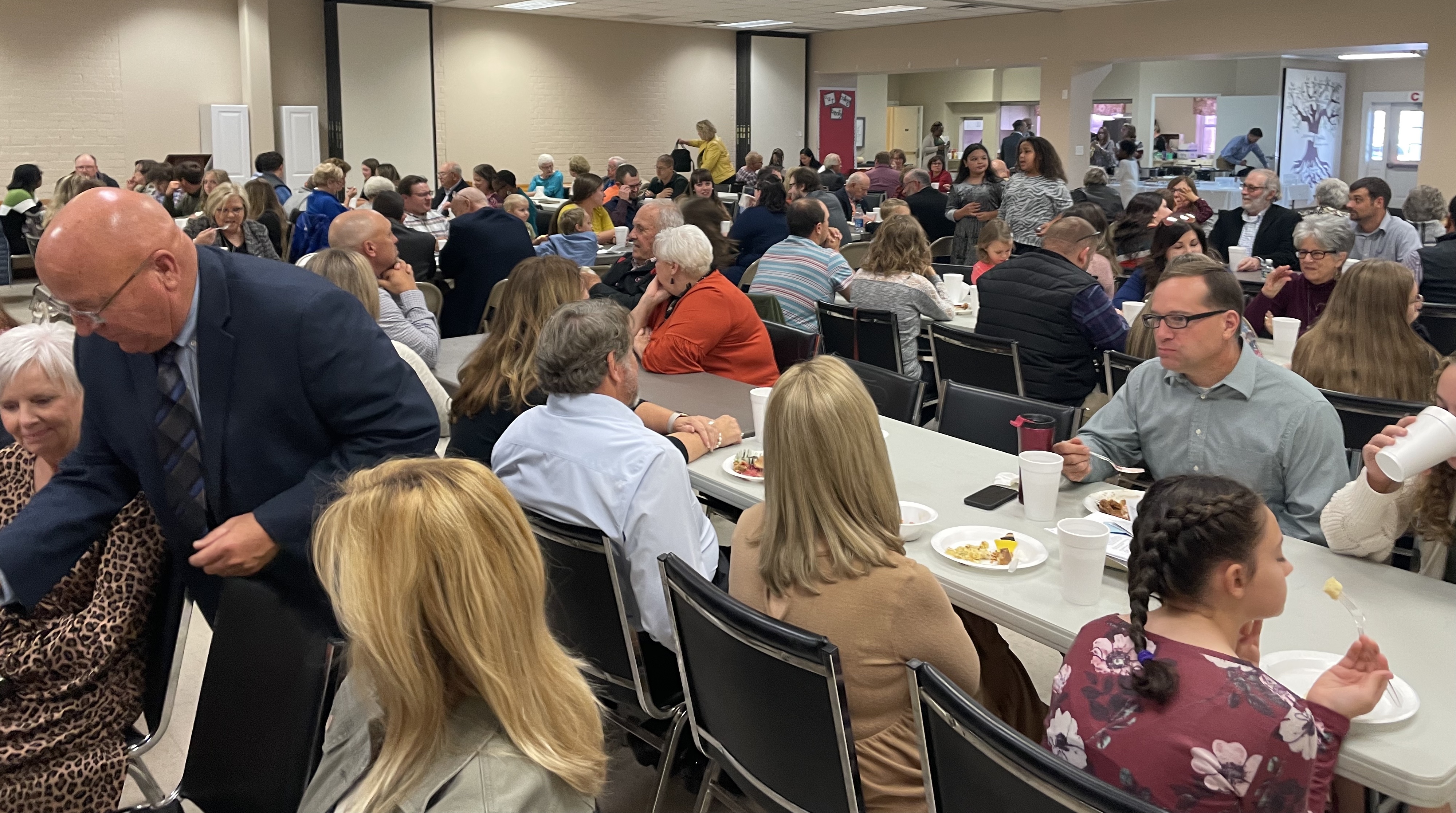
I saw the strength of teamwork. That was on display in so many ways. There was a huge team of people greeting those who entered our doors. Anticipating a lot of visitors, this was organized beyond the ordinary measure. It was exciting to see so many doing this, and it seemed to be infectious. Others joined in. It was evident in the efforts of multiple deacons and vision groups coordinating various works. It extended to members in the auditorium warmly welcoming unfamiliar faces and making our visitors feel at home. It continued on to the potluck after Bible class with the scores of people bringing an abundance of food, serving, assisting, and cleaning up. We were a finely-tuned machine of coordination. I could not help but think of Paul’s words, to Philippi (“make my joy complete by being of the same mind, maintaining the same love, united in spirit, intent on one purpose,” 2:2) and Colosse (“beyond all these things put on love, which is the perfect bond of unity,” 3:14). Sure, he had more in mind that one event on one day, but this is a key way such overall unity is built. 

I saw the example of leadership. This began with the eldership. They not only challenged us to invite, they led the way. It’s not an exaggeration to suggest that the four of them invited hundreds of people by text, phone, and face-to-face. They invited friends, family, acquaintances, and strangers! True leadership shows the way! This included those who led in worship. There was forethought, effort, and coordination from the greeting to the announcements and every act of worship in between them. This involved the membership who enthusiastically engaged in the worship. It also takes in every one that helped people find bathrooms and classrooms. Leadership always breeds more leadership. The writer of Hebrews says, “Remember those who led you, who spoke the word of God to you; and considering the result of their conduct, imitate their faith” (13:7). 

I saw the hope of tomorrow. The effects of the last 18-plus months have been deflating and demoralizing. We have lost members to Covid, physically and spiritually. It has derailed plans. It has distracted us. But Sunday showed that by faith in God and by following His plan, the best is yet to be! As we were reminded at the end of the day yesterday afternoon, we have worship every Sunday so let’s keep inviting. How many Bible studies will result from inviting others to church? How many future preachers, elders, deacons, soul-winners, and Bible class teachers are represented in those who walked through our doors yesterday, some for the first time ever? To some degree, we’ve got to be like Paul and say, “forgetting what lies behind and reaching forward to what lies ahead, I press on toward the goal for the prize of the upward call of God in Christ Jesus” (Phil. 3:13b-14). 

There’s more to do! There’s more inviting to do. There’s more follow up to do. But I see more than a special event in what occurred on Sunday! I see a culture change and a purposed people. Think what God can do with that!

The Art Of Excuses

Thursday’s Column: Captain’s Blog

carl-pic

Carl Pollard

 
Someone once said, “Excuses are tools of the incompetent, and those who specialize in them seldom go far.” Ben Franklin is quoted saying, “He that is good for making excuses is seldom good for anything else.”
 
Jeremiah had a complete list of excuses ready when God called on him to be a prophet to the people of Israel. Many times the excuses of Jeremiah become ours when we are called on to be a preacher to this world. We see that with every excuse Jeremiah made, God gave promises in return.
 
First, Jeremiah said, “the task ahead is difficult.” God says, “Before I formed you in the womb I knew you, And before you were born I consecrated you; I have appointed you a prophet to the nations” (Jer. 1:5).  Notice what God says to Jeremiah: “I have appointed you a prophet to the nations.” The task ahead is difficult, so Jeremiah gives off a list of excuses for why he isn’t the one for this job. God gives a promise for Jeremiah’s excuses; He says, “before I formed you in the womb I knew you.” God knew that Jeremiah was the one for the job, even if Jeremiah didn’t think so.
 
Second, Jeremiah said, “I don’t have the talent.” Jeremiah 1:6 says, “Then I said, “Alas, Lord God! Behold, I do not know how to speak, because I am a youth.” Many times people blame their cowardice on lack of talent. They say that it isn’t a natural talent to them, that there are others more suited for the job; but God knows Jeremiah and the great good he can accomplish. In Jeremiah 1:9, God promises that He would put His words in Jeremiah’s mouth.
 
As Christians today we have these same promises for our worries and excuses. Let’s not blame our cowardice on a lack of talent. That isn’t a good excuse to God. Nothing is. God has promised He will be with us, and we have HIS Word to teach to others. Let’s trust in that.

THE WAY AROMAS HIT PEOPLE 

Monday’s Column: Neal At The Cross

pollard

Neal Pollard

I was originally going to call this, “The way we smell to others,” but thought that might be misleading or inaccurate. Paul uses a very unusual illustration to make an important point in 2 Corinthians 2:12-17. The backdrop of the illustration was when he came to Troas to take advantage of an open door to preach the gospel. It was a trying experience, as he couldn’t find Titus there. He left them for Macedonia (12-13). 

In chapter three, he is going to change metaphors. But, first, he describes their work of sharing the gospel as like God sending His fragrance through them which others evaluate or judge (14-15). The same message “smells” differently to the recipients, based on the receptivity and spiritual condition of those hearers (16). But Paul makes clear that their motives and message are not “rotten,” but if it is rejected it is because the listeners are perishing (17). Think about how so many could hear the Son of God Himself teach and preach, and thoroughly reject it to the degree that they even took Him and nailed Him to a cross! 

When you share Jesus and the message of His saving grace with others, there will be those who find that “fragrance of Christ” (15) a “sweet aroma” (14). It will be so appealing to them that they leave their old life and follow Him, much as the men God chose to follow Him during His ministry. It’s attractive and satisfying. There are still so many with good, receptive hearts out there. We see that when we share Him.

However, be prepared for some to find that same message repulsive. It’s not what they want and not what they are after. Have you ever been sick in such a way that even your favorite foods nauseated you to smell them cooking? There is no more savory and appealing message than the Bible’s story of grace, but many will reject it anyway! It can leave us feeling so inadequate (16), but we must remember that it is not our message. It is Christ’s message. Our job is simply to spread it with personal integrity, honesty, and righteous motivation. His word will work its power on those who seek their satisfaction in Him.  

Fresh baked, homemade sour dough bread from Kathy’s kitchen!

We Can All Use Some Help

Friday’s Column: Learning From Lehman

candela

Steve Candela

Fun fact about myself…  I would be a whole lot more comfortable running into a burning building than I am standing up here speaking.  But just like any situation on a fire ground, the job will get done. 

James 5:19 says,  “My Brethren, if any among you strays from the truth and one turns him back, let him know that he who turns a sinner from the error of his way will save his soul from death and will cover a multitude of sins.”

There have been countless times in my life where help was not only desired or needed, but necessary.  As a Fireman I’d like to tell you that I’m made of iron, nothing can hurt me and I don’t need help from anyone, “I got this”. Problem is, this would be the furthest thing from the truth. In order to get the job done it takes a team. We have guys that fight fire, guys that search for victims, guys that drive the trucks, pump the water, we have guys in charge of the operational strategy, and so on.  We even have guys that their only job on a fireground is to go in and save a fellow firefighter in trouble if they get stuck, disoriented or hurt. This is called a RIT team.  We as Christians work in a similar fashion. Ok, so we don’t have the ranking system, but we all have duties. We all have jobs and responsibilities, right? 

Robert Muszynski was a fire chief in Chicago Ridge, Illinois. He had worked at multiple fire departments throughout his career but this is where he finally decided to retire in 2014 at the age of 58. I do not know specifically if he was a follower of Christ. I do, however, know of his dedication to his work and his firefighters. He was recognized several times in magazines and various fire department-related web articles for his encouraging quotes and respectable works in the fire service. I’d like to share with you a couple of his quotes and how I’ve related it not only to my job but my spiritual life as well. 

 Bob said, “Always stay hungry for the job, and you will never get full.” Complacency causes you to become bored, disengaged, and think that you know it all.  Keeping interest and staying engaged is very important.  You could say for us as Christians to always stay hungry for the word of God, read as often as you can and you’ll never get full. There is always more to learn from scripture. Create discussion among your friends or host a Bible study. Always Stay Hungry for the word. 

He also said, “Good firefighters will know their job. Great Firefighters will also know the job of the person above them as well as teach their job to the people below them.”  As an Engineer I am in between the ranks of firefighter and captain. I have a great relationship with my captain. He’s been a fantastic guide, teacher, mentor, and leader of our crew. I know his job and what it entails, and I strive to be in that position someday. As with the firefighters below me I try to be that role model that teaches them everything it takes to become an engineer and give them ample opportunities to come to me for guidance. A good Christian will know what it takes to be a good Christian, but is that where it stops? No. To be great Christians we need to be aware of what our elders and deacons have in the works. They do so much for us already; maybe there’s something you can help with? Take a task off their plate so they can work on the next important project. What about the people who need saving? You might not see yourself as a great teacher, but there is something inside every one of us that we have to offer to someone else. By creating conversation with our visitors you might reveal their needs. You could be the one to lead them to where they need to be and teach them something along the way. 

As hard as it is to admit, sometimes a Fireman can use a little help.  Christians can too.  Leading up to the scripture reading above, James has been talking to fellow believers in Christ, encouraging them to never give up faith. It’s so easy today for us to stumble and fall. We have people and priorities tugging and pulling us in every direction away from God. James knew this. He makes it clear that we are to help our fellow Christians who may wander from the truth and become worldly. It’s our job to help them get reconnected with God. Like addressing and correcting poor behavior in the firehouse this can be a difficult assignment. We need to be careful in how we complete this task so we don’t fall into the same sin or come across as too “high and mighty” (Galatians 6:1 says, “Brethren, even if anyone is caught in any trespass, you who are spiritual, restore such a one in a spirit of gentleness; each one looking to yourself, so that you too will not be tempted.”) This means be tactful not attacking. Genuine love and care must be the tactic. 

Steve interviewed last year by NBC about the walk to honor firefighters who died on 9/11.

We Are Not Doing Right” (2 Kings 7)

Monday Column: Neal At The Cross

pollard

Neal Pollard 

There was a famine in Samaria and everyone was desperate. The need for food was more pressing than the danger they faced in looking for it. Elisha predicted the end of the famine but Jehoram’s right hand man refused to believe it could happen so quickly. The prophet tells him he’d see it happen but that he would not eat of it (2).

Four lepers decided to throw themselves on the mercy of the Arameans, but God caused the besieging army to hear the sound of enemy armies. They imagine the worst and leave their camp in pursuit. So, when the lepers arrived at the camp, it was abandoned. They found food and riches beyond their wildest imagination. They start to hoard and gorge themselves, then had second thoughts. They say to each other, “We are not doing right. This day is a day of good news, but we are keeping silent; if we wait until morning light, punishment will overtake us. Now therefore come, let us go and tell the king’s household” (9). Several things stand out here.

THESE MEN HAD GOOD NEWS.

IT WAS WRONG FOR THEM TO KEEP SILENT ABOUT IT.

THEY EXPECTED PUNISHMENT IF THEY DIDN’T URGENTLY SHARE IT.

THEY ADMONISHED EACH OTHER TO TELL IT.

They did and they helped save the nation. God caused it to happen but He worked through these four lepers. The famine ended (and the royal officer was trampled at the gate—he saw the famine end but died before it could benefit him).

I am reminded of my task as a Christian, one spiritually sick with sin but in a similar situation. I have found good news. It is wrong for me to keep silent. I must not just share it but do so urgently! I also need to admonish you to realize you are in the same predicament as me. You cannot afford to keep silent! A feast awaits! 

Listen! 

Tuesday’s Column: Dale Mail

Daleheadshot

Dale Pollard

Listen! That’s how Jesus starts His lesson in Mark 4:3. He has just stepped out onto a boat so that He could speak to the large crowd that had gathered to hear Him. This was a very special sermon. Jesus is going to give the secret to all of His parables by telling a unique parable about the farmer who goes out to sow on the various kinds of ground. When Jesus said “Listen!” He was talking to a specific kind of person. 

He wasn’t interested in the one who would hear His words and then fall away later when called to stand up for their faith. He wasn’t looking for the one who would hear His words and then foolishly decide that this world had more to offer. 

Jesus said “listen!” because He knew that some would hear His words and those words would change their lives. They would live out His teachings. They would become those lamps He would later discuss later in the chapter. Those who truly listened to this specific sermon and took it to heart would bear fruit. It’s humbling to think that some only believe they’ve listened to Jesus, but on the last day will find out that they only thought they listened (verse 25). 

Are we listening to the Savior? One way Jesus tells us we can know if we and others are listening is by looking at the fruit being planted. This section of scripture is a great reminder that there are many who will not hear the Lord and His life-changing and life-saving message, but there are also those out there in our communities who are willing and waiting for us to share Him with them.

The Prime Objective

Such powerful words describe it.  The words “convert,” “save,” “restore,” “recover,” and the like depict the job God left Christians to do (cf. Gal. 6:1; 2 Tim. 2:26; Js. 5:19-20; etc.).  The awesome business of God’s people is to be builders in the kingdom upon a foundation originating in eternity (1 Cor. 3:9-15).  Each child of God is a private engaged in spiritual warfare against a tactician only God has the power to defeat (Eph. 6:10ff).

There is ample reason to be filled with excitement and dread at the task before us!  God has entrusted the business of snatching souls out of eternal fire and transferring people out of darkness into His marvelous light to us earthen vessels (2 Cor. 4:7).  The moment we come out of the waters of baptism, we rise to walk in newness of life (Rom. 6:3-4).  That life entails culling out negative things, bad habits, poor attitudes, old ways of living.  Yet, it also calls for actions and ambitions that a non-Christian could not begin to comprehend.  The sign of genuine faith taken root is the desire to share the good news we ourselves have learned.

Soul-winning is the frontline focus of the family of God.  All else that we do should be an extension or support of this primary work.  Benevolence, though done simply for its own sake, can be a springboard of evangelistic opportunity.  Fellowship is designed to not only build up the saints, but be an atmosphere — be it worship or fellowship outside the corporate assemblies— that honors God and creates hunger and thirst for righteousness.  Non-Christians who come to our assemblies can then believe (cf. 1 Cor. 14:23-24).  They share our company, see the light of Christ in us, and want the joy and peace that the world cannot provide (John 14:27; Mat. 5:16).  

Everywhere we go, mingling in groups and having various associations, there are opportunities.  There is that person who seems to stand out from others who are more frivolously engaged in life.  There is the one who, when others have long shut their ears to truth, is open-minded enough and respectful enough of truth to believe and accept the Bible.  A song that is used in many soul-winning campaigns is Lead Me To Some Soul Today.  God is not going to “lay” anything miraculously on our heart, leading us through some direct operation to some particular person or to say some particular thing.  Yet, providentially, He can open doors that leads us to find the one in search of God’s way.  Our active desire should be to cultivate our hunger and optimism for this great, primary work of the church.

With all else to distract us or compete with our attention and affection, may we never forget the prime objective! We are saved to save (2 Tim. 2:2). Find the searcher and lead the lost! It’s why we’re here. 

“It’s Not About Me” In 1 Peter 3 (Part Two)


Wednesday’s Column: Third’s Words

Gary III

Gary Pollard

 
1 Peter 3.8ff is a passage with tons of application. What I’d like to do is simply break it down and apply as we go.
 
3.8 –   Is addressed to every Christian, as opposed to the gender-specific commands of the previous section. Christians are told to have a unified mindset, understanding of the needs of others, affection for each other, compassion for each other, and a sober view of self.
 
3.9 – In the context of being ridiculed or outright persecuted for faith, we’re commanded not to stoop to a hostile person’s level. Instead, we are only to say good things to and about them. The word for “bless” here would be like us giving a glowing review of someone, even when they’re hostile to us. Why? Because God promised us a glowing review, even though our lifestyle was hostile to Him before we were faithful.
 
3.10-12 – If we want to have good days, we have to control our tongues, reject evil, and actively do beneficial things for others. If we do, God looks at us with approval. If not, He is against us.
 
3.13 – If we pursue doing good things with energy, no one can say anything against us. Who can assault the character of someone passionate about bringing good into others’ lives?
 
3.14But even if they do is a contrast not as plainly seen in English. This verse starts with a powerful contrastive (αλλα) that points to how we should act in the face of totally unwarranted hostility. Even if our pursuit of good gets us in trouble, we can still be happy! Even in this life we cannot lose. We cannot let fear dictate our behavior, and we cannot let anyone’s intimidation cause us to react with hostility.
 
3.15 – Instead, we should make the most special place in our heart God’s place. We don’t serve fear, we serve God. If someone shows hostility to us when we’re doing good, we have to be ready to give a rational explanation for our hope with an attitude that proves our supernatural allegiance. Our fear of God must be greater than our fear of man.
 
We do this because our goal is to bring others to God! It’s hard, but we can only do it when we remove self from the equation. People tend to attack what they do not understand. By using reason and by restraining our emotional response, we can help save their souls. We were all hostile to God at one point, but we now have mercy. Being controlled and rational while under “attack” is not a normal human response. Our response can mean the difference in someone’s eternal destination!

The Silent Influence

Thursday’s Column: Carlnormous Comments

IMG_0806
Carl Pollard
 
I can still remember it like it was yesterday. It was a Friday morning and I came downstairs to see dad sitting where he always sat every single morning. He was in his lazy boy recliner drinking what was probably his third cup of coffee, wearing his fuzzy dad slippers and a pair of reading glasses. If I saw that combination, I knew what dad was doing.
 
Every morning he would get up early, grab his coffee, Bible, slippers and glasses, and sit in his lazy boy recliner. And every morning I would see him sitting there reading. When I look back and think about these instances, I now see just how powerful his actions were. He wouldn’t tell us what he was doing, he wouldn’t tell us to join him, he wouldn’t tell us why he was doing it. He would just grab his Bible and read.
 
When I think about influence this is what I think of. A committed man of God. Showing us by his actions how to grow our own relationship with The Father. The silent influence that I saw growing up has shown me the power of actions. Through his actions I saw what his priorities were. I saw what his focus was. I saw who he loved more than anyone else.
 
There’s nothing we should want more as Christians than to have this kind of influence on others. Not preaching at them day and night condemning them and cutting others down, but showing them by our actions what a relationship with God looks like. If we work on perfecting our faith and cultivating a genuine relationship with God, people WILL notice. For others to be affected by our influence we need to get three things straight: our priorities, our actions, and our speech.
 
When we think about winning souls, it’s best to start with our own before looking to others. If we can grow our faith and be fully invested in our relationship with God, people will notice and ultimately glorify God.
 
Matthew 5:13-16

More Than A Fish Story!

Tuesday’s Column: Dale Mail

Dale Pollard

Some times it can feel like our life is a ship on the verge of breaking apart in a violent storm. Maybe we placed too much trust in the now creaking wooden planks that buckle and groan over dark turbulent waters. In a last stitch effort to stay afloat, we madly rush about throwing any non-essentials overboard.

At times we turn to anything or anyone in an attempt to discover some lifesaving advice— perhaps a miracle? If you’re a child of God, you’ve got access to salvation even in the storms. Jonah 1:4-5 depicts chaos, panic, and overwhelming fear. Those sailors on the boat with Jonah had no idea where they should turn for their salvation. With each passing moment their ship threatened to burst into splinters and “each one cried out to his god” (v. 5).

But Jonah? He’s asleep. He has some kind of knowledge and relationship with the Creator, but he doesn’t fully understand how powerful his God really is.

The application, then, is humbling. Today our communities are filled with people whose lives are rocked and they’re looking for a savior with lifesaving power. They turn to the things in which they’ve placed their trust, and to no avail. How many of us hold the answers they need, but at times find ourselves spiritually sleeping— selfishly keeping this message to ourselves?

Mission Possible

Monday’s Column: Neal At The Cross

Neal Pollard

Writing to a church filled with multiple ethnic groups, Paul has a broad goal in mind in writing the Roman epistle.  Having dedicated himself to “world-wide” evangelism, as Acts and his letters show, his heart was on more than winning Jews in one small part of the world.

In Romans ten, Paul is reaching the crescendo of the doctrinal argument he makes in Romans 1:15-17 about salvation through faith in Christ.  In the middle of the chapter, he states some principles that are worthy of our attention.  Consider briefly Romans 10:5-17.

Here, we have the message expressed (5-10).  It is the message Paul has been stressing throughout the letter, a message of “righteousness based on faith” (6).  It is a word of faith (8), one emphasizing what the scriptures say (Paul quotes Deut. 30:12, 14, 21, Psa. 19:4, Isa. 28:16, 52:7, 53:1, 65:1-2, and Joel 2:32 just from Rom. 10:6-21), and a message meant to touch the heart (8) and lead one to eternal salvation (9-10).  Thankfully, the same word that tells us to “make disciples” tells us to do that through the divine message of scripture.

We also have the men envisioned (11-13).  Twice, Paul says that “whoever” (11,13) calls on the name of the Lord will be saved.  The Lord’s riches are for “all who call on Him” (12).  He makes no distinction between Jew and Greek (12).  That underscores the biblical idea that God wants all men everywhere to be saved (cf. 1 Tim. 2:4).  

We have the means executed (14-16).  Paul exalts preaching and preachers.  This is honorable work requiring honorable people.  They are an indispensable part of God’s soul-winning plan (14).  They are divinely sent (15).  They are positively described (15b). They dispense good news (16).  As Paul writes Corinth, preaching is God’s medium for saving men’s souls (1 Cor. 1:18).

Finally, we have the mission embodied (17).  The word of Christ must be heard, and faith results by hearing that word.  People do not teach themselves.  Societies are not won accidentally or incidentally.  There must be deliberate, often sacrificial, activity—preaching, planting seed, and perseverant persistence—to fulfill that mission.

We have mission work to do right here.  We have it to do daily at our jobs and in our more immediate communities and neighborhoods.  Whether you are going across the street or around the world, fulfill your mission! 

Your Impact

Wednesday’s Column: Third’s Words

Gary III

Gary Pollard

On August 6 and 9, 1945, the United States dropped atomic bombs on Hiroshima and Nagasaki. The bomb itself, compared to the city, was quite small; the devastation is still at the front of many minds today.

There is a lot of evidence on earth of multiple meteor impacts. It is chilling to watch re-creations of how those impacts would have affected the earth. A meteor just six miles across has the potential ability to destroy most of this planet, which is 24,901 miles in circumference. So, something just 0.024% of earth’s size can potentially destroy it entirely.

This country has 321,400,000 people. The church makes up about 0.03% of the US Population. We are ahead of meteors in terms of our ability to make an unforgettable impact.

It is far too easy for us to think, “I’m just one person,” or, ”We’re just a couple hundred people in a community of thousands,” but God can do mind-blowing things with just one person. With His Son, He gave all humanity across eons of time the ability to be saved. With just 12 apostles, the church grew into a global fellowship. With just one faithful Christian, an entire community of lost souls can be reached.

When a meteor strikes the earth, it’s not the crater that creates such devastation: it is what happens afterward. Maybe you convert just one soul. That soul turns around and converts his/her family. That family reaches out to their connections and shares their newfound faith. Before you know it, hundreds of lost souls are now in Christ. All because of the effort of one person to convert one soul!

“Let us not lose heart in doing good, for in due time we will reap if we do not grow weary. So then, while we have opportunity, let us do good to all people, and especially to those who are of the household of the faith” (Gal. 6:9-10).

8476682346_b79f19ca87_b

An Evangelist For An Unworthy Gospel?

Friday’s Column: Supplemental Strength

brent 2020

Brent Pollard

I convinced my parents to watch a show I enjoyed with me. I doubt I converted them to watching the same kind of programs as I like but I was happy they enjoyed what we watched together. I was acting as an evangelist, wasn’t I? I told them about something that I felt fervently about, convinced them to look into it themselves, and then encouraged them to commit to following through with it. As I enjoyed the afterglow of the moment, I was hit by a realization. Why is it easy for us to tell others about a book or movie but not about the Gospel of Jesus Christ?

I suppose one answer is fear. If a friend thinks my movie suggestion is stupid, then he will just think I have bad taste in movies. At worst, he won’t ask me my opinion about movies again. The Gospel is different, though. We’re putting ourselves out there. What we present doesn’t just require the forfeiture of an hour and a half, but a lifelong commitment. What we fear is the loss of that companion since we feel as if we are requiring something great from them. The truth, however, is that it is not we who put forth the requirement. God does. We merely relay the information. Thus, regardless of a negative reaction, if we’ve spoken the truth in love (Ephesians 4.15) we’ve done what we are supposed to do in letting them hear what God requires of them (Ezekiel 3.17-19).

I suppose another answer is shame. I don’t fear what my friend thinks about my secular choices. However, I am reminded of the adage that one never publicly discuss religion and politics. Certainly, we have seen with the latter how divisive of a subject it can be. People unfriended me following the last Presidential election simply because they knew I supported the candidate for whom they didn’t vote! Imagine how that person will take the news that the cherished religion of his grandmother was not one that was true to the teaching of the New Testament? The Thessalonians felt their world had been turned upside down (Acts 17.5-8), and I am sure that my friend would feel the same way too.

Yet, that is not the truth, either. I have no power to condemn any grandmother to hell or grant her access to Heaven. God’s Word is truth (John 17.17). If the truth turns one’s world upside down, the fault lies within the worldview that was turned the wrong way, to begin with. As brother Keeble used to say to such a one bothered by the fate of grandmother, “If she had been taught what you’ve been taught, how do you suppose she would have reacted?” Just the fact that discussing religion in polite company is frowned upon is insufficient to dissuade the one genuinely loving his neighbor.

The next time you find yourself excitedly chattering on about something you’re zealous about to a friend, remember that it is possible to talk with them about Jesus that way as well. The only reason that we don’t is that we feel that we cannot. Love casts out fear (1 John 4.18). And if we deny Him before men, He will deny us before the Father (Matthew 10.32-33). Hobbies are great, but may we not find ourselves more energized by them than by the Living God.

pexels-photo-935944