The People Project  

Tuesday’s Column: Dale Mail

Daleheadshot

Dale Pollard

This post is for the lady across the street. She works at the gas station. This post is for Charles. That’s the guy we always call when the office printer breaks down or a leaky roof needs repaired. This article is for my family. My family means the world to me and if my life can help ensure an eternal future together (and I mean every one of them) then I have accomplished something truly great. This post is for my wife. My wife will be in heaven with me— she must be! The truth is, this post is for the faithful child of God, the disgruntled member in the pew, the discouraged elder, and frustrated preacher— this post is for people. It’s for the new child of God that is still dripping wet from the waters of baptism, to the battle-hardened Christian with years of faithful service. God drew a line in the sand long ago after humans fell from grace and separated ourselves from Him. On one side of that line you have the lost. Their sheer abundance in our communities and the world has caused many congregations to become numb to their horrific eternal state. Still, on the other side of that line you have the faithful. No, not the uncommitted pew-warmers, but the faithful. Sadly there are those inside the church that are on the wrong side of the Divine line. Often they blend in with the faithful because they look and act like the faithful do. This is nothing new, but elderships still scratch their heads over stunted growth and disappearing members. Preachers lose their voices as they pound evangelism and outreach from the pulpit. The reservoirs are being depleted by years of drought. 

You’ll hear a lot of this kind of talk in some men’s meetings as the guys will sit around the table. After drinking coffee and filling their bellies with biscuits and gravy, it’s common for them to kick back and discuss what’s going on in the church. Obviously there are some big issues! So, who’s to blame? In an attempt to unmask the villain, one middle aged man exclaims, “if the leaders would _______”. A couple of his friends, who have clearly visited this topic a few times, nod their heads in approval. Another gentleman, with a white mustache, grunts as he repositions himself in his tin folding chair. Talk like this is uncomfortable, and it’s exhausting for many of them. The head hog at the trough clears his throat to let the others know he’s about to offer his respected opinion. He squints his eyes, leans back, then makes this statement. “It’s really society, you know. People just don’t go to church like they did when I was growing up!” Following this declaration, most of them will give their affirming “Mmm”’s and “exactly rights.” It’s at this point the tragic generational blame game begins. The wheels spin for a while, then everyone gets up and goes back to their homes to enjoy the rest of their Saturday. Tomorrow morning they dress up in their suits and ties and drive to worship. At worship they sit in the same spot, as the service carries on in it’s usual order. 

In a world full of people intent on destroying and demonizing one another, the church needs to be the church— now more than ever. Our communities, friends, family, and nation need us to be the church. That starts with you and me. Paul said, “Encourage and build one another up…” in 1 Thessalonians 5:11. We can’t do this enough, and we can’t overstate it’s importance. Who have you encouraged and built up this week? How will you do it today? The church is God’s way of improving people, and  the church is God’s perfect project— for people. 

4029650707_94207d006e_c

Walking with God In a Fallen World

Thursday’s Column: Captain’s Blog

carl pic

Carl Pollard

God’s desire from the very beginning of creation was to walk with man. Scripture tells us that He would walk in the garden in the cool of the day (Gen. 3:8). This was all undone when sin entered the world and created a chasm between God and mankind.
The theme of the Bible is the salvation of man, through Christ, to the glory of God. From the moment sin entered the world, God has been proactive in seeking a relationship with His creation. Through the perfect sacrifice of Christ, that relationship has been restored, and we are once again able to walk with God.
Even though we have peace with God again, at times it feels like we don’t have peace in our everyday lives. We turn on the news and watch as courthouses are set on fire, and a widespread virus continues to harm and kill people that we love. Yes, we have peace with God, but where is the peace in our own lives?
These are questions that most everyone has asked. But there’s one question I want us to focus on for a few moments; how does God want us to react to the events that are going on today? Let’s examine three encouraging verses that tell us how we are to conduct ourselves each day.
Proverbs 15:3. “The eyes of the Lord are in every place, keeping watch on the evil and the good.” God sees the violence, the grieving families, the struggling Christian. But God also sees how His children respond. God is in every part of His creation, at every moment in time. We may feel like He doesn’t see, or that He is indifferent to what’s going on, but His eyes are on the evil and the good. We respond in love because we know that God is watching.
Psalm 23:4. “Even though I walk through the valley of the shadow of death, I will fear no evil, for you are with me; your rod and your staff, they comfort me.” God not only sees what is going on, but He is with His children. The greatest of Christians still struggle with feelings of loneliness (Elijah in 1 Kings 19). Even though we walk through the shadow of death, we don’t fear the evil that we encounter because God has promised that He will be with us. We may see the hate, the hurt and the helplessness of mankind, but the comfort of God gives hope to His people.
Matthew 28:20. “…And behold, I am with you always, to the end of the age.” This is a promise first given by Jesus to His apostles, a promise that we as Christians sometimes fail to remember. The world isn’t perfect because sin has corrupted what God has made perfect. People will do you wrong, they’ll hurt you, and they’ll do whatever they feel like doing. We have a command to fulfill, and it can only be carried out with the presence of God.
Showing love to a world that’s full of hatred can seem impossible at times, but if we will remember who we are and Whose we are, we can and will get it done. Remember that God loves you, and the church loves you. Let’s be an example to those who are without this love.
canada-forest-trees-woods


An Evangelist For An Unworthy Gospel?

Friday’s Column: Supplemental Strength

brent 2020

Brent Pollard

I convinced my parents to watch a show I enjoyed with me. I doubt I converted them to watching the same kind of programs as I like but I was happy they enjoyed what we watched together. I was acting as an evangelist, wasn’t I? I told them about something that I felt fervently about, convinced them to look into it themselves, and then encouraged them to commit to following through with it. As I enjoyed the afterglow of the moment, I was hit by a realization. Why is it easy for us to tell others about a book or movie but not about the Gospel of Jesus Christ?

I suppose one answer is fear. If a friend thinks my movie suggestion is stupid, then he will just think I have bad taste in movies. At worst, he won’t ask me my opinion about movies again. The Gospel is different, though. We’re putting ourselves out there. What we present doesn’t just require the forfeiture of an hour and a half, but a lifelong commitment. What we fear is the loss of that companion since we feel as if we are requiring something great from them. The truth, however, is that it is not we who put forth the requirement. God does. We merely relay the information. Thus, regardless of a negative reaction, if we’ve spoken the truth in love (Ephesians 4.15) we’ve done what we are supposed to do in letting them hear what God requires of them (Ezekiel 3.17-19).

I suppose another answer is shame. I don’t fear what my friend thinks about my secular choices. However, I am reminded of the adage that one never publicly discuss religion and politics. Certainly, we have seen with the latter how divisive of a subject it can be. People unfriended me following the last Presidential election simply because they knew I supported the candidate for whom they didn’t vote! Imagine how that person will take the news that the cherished religion of his grandmother was not one that was true to the teaching of the New Testament? The Thessalonians felt their world had been turned upside down (Acts 17.5-8), and I am sure that my friend would feel the same way too.

Yet, that is not the truth, either. I have no power to condemn any grandmother to hell or grant her access to Heaven. God’s Word is truth (John 17.17). If the truth turns one’s world upside down, the fault lies within the worldview that was turned the wrong way, to begin with. As brother Keeble used to say to such a one bothered by the fate of grandmother, “If she had been taught what you’ve been taught, how do you suppose she would have reacted?” Just the fact that discussing religion in polite company is frowned upon is insufficient to dissuade the one genuinely loving his neighbor.

The next time you find yourself excitedly chattering on about something you’re zealous about to a friend, remember that it is possible to talk with them about Jesus that way as well. The only reason that we don’t is that we feel that we cannot. Love casts out fear (1 John 4.18). And if we deny Him before men, He will deny us before the Father (Matthew 10.32-33). Hobbies are great, but may we not find ourselves more energized by them than by the Living God.

pexels-photo-935944

The Art of Excuses (Jeremiah 1)

Thursday’s Column: Captain’s Blog

IMG_0806

Carl Pollard

Someone once said, “Excuses are tools of the incompetent, and those who specialize in them seldom go far.” Ben Franklin is quoted saying, “He that is good for making excuses is seldom good for anything else.” 

Jeremiah had a complete list of excuses ready when God called on him to be a prophet to the people of Israel. Many times the excuses of Jeremiah become ours when we are called on to proclaim God’s Word to this world. We see that with every excuse Jeremiah made, God gave promises in return. 

First, Jeremiah said, “the task ahead is difficult.” Jeremiah 1:5 says, ““Before I formed you in the womb I knew you, And before you were born I consecrated you; I have appointed you a prophet to the nations.” This is God speaking to Jeremiah, and notice what He says, “I have appointed you a prophet to the nations.” The task ahead is difficult, so Jeremiah gives off a list of excuses for why he isn’t the one for this job. God gives a promise for Jeremiah’s excuses. He says, “before I formed you in the womb I knew you.” God knew that Jeremiah was the one for the job, even if Jeremiah didn’t think so. 

Second, Jeremiah said, “I don’t have the talent.” Jeremiah 1:6 says, “Then I said, “Alas, Lord God! Behold, I do not know how to speak, because I am a youth.” Many times people blame their cowardice on a lack of talent. They say that it isn’t natural to them, that there are others more suited for the job. But God knows Jeremiah and the great good he can accomplish. In Jeremiah 1:9, God promises that He would put His words in Jeremiah’s mouth.  

As Christians today we have these same promises for our worries and excuses. Let’s not blame our cowardice on a lack of talent or the difficulty of the task. That isn’t a good excuse to God. Nothing is. He has promised that He will be with us, and we have HIS Word to teach to others. Let’s trust in that. 

36409255_10155649438010922_3078108464388505600_n

Knowing What D.C. Stands For

Neal Pollard

Inasmuch as we don’t want laws or policies enacted that violate God’s Word and we want precious freedoms, especially religious ones, preserved and protected, we can really get into what is going on in Washington, from Capitol Hill to Pennsylvania Avenue. Many know that “D.C.” is an abbreviation for “District of Columbia,” an area of land created at about the time of our nation’s founding under the direct jurisdiction of the U.S. Congress that is not a state.

However, as politics has vied for sports and entertainment as an idol in our culture, it has become the source of unnecessary and even immoral strife between Christians. Blind support and allegiance for one major political party or the other can do more than make us inconsistent. It can make us a stumbling block. It seems to me that D.C. can stand for some dangerously different things.

Distracted Christians. Search high and low in your New Testaments, written during the time of the wicked, often unfair-to-Christians, Roman Empire.  The disciples were about the business of evangelism (Acts 8:4) and growing the church (Acts 6:7). Can the rumblings and drama from the nation’s capitol get us so transfixed that we cannot see past it or through it to our individual and collective mission as God’s people? He has us here to get people into the Kingdom of His dear Son (Col. 1:13). Everything else is secondary. 

Divided Churches. For as long as I’ve been preaching, I’ve seen politics come between brethren in the local church. Thankfully, it does not usually become significant enough to trouble the entire congregation but I have seen it do so. What’s more, I’ve seen brothers and sisters become so confrontational and flagrant about politics–especially through the relatively recent medium of social media–that it has been a stumbling block to new and weak Christians. Perhaps the political world in our country has never been so intensely divisive as it currently is, and what typically troubles the world troubles the church. But, when souls are negatively impacted, God will hold the offenders accountable. 

Devil’s Cauldron. Please don’t misunderstand. Politics, like money, is a neutral matter. But, like money, it can become the root of all sorts of evil (cf. 1 Tim. 6:10)–enmities, strife, outbursts of anger, disputes, dissensions, and factions (Gal. 5:20). Just prior to this list of activities that are the carrying out of the desires of the flesh (Gal. 5:16), Paul warns, “For the whole Law is fulfilled in one word, in the statement, ‘You shall love your neighbor as yourself.’ But if you bite and devour one another, take care that you are not consumed by one another” (Gal. 5:14-15). Who benefits when things like politics distract and divide Christians? It is not the lost, the church, or the Lord!

I can think of a least three godly, wonderful Christians who are public servants in political office and making a profound impact for good–Bill Reiboldt, Sheila Butt, and John DeBerry. They demonstrate that God’s people can devote themselves to politics without sacrificing their faith and example. For those of us “on the outside looking in,” in our love of country and freedom, may we never allow our attitude, words, or actions to betray our highest calling. The more effectively we reach lost souls, reflect the mind of Christ, and reveal the hope of the gospel, the better our nation (and world) will become. What will that make us? Disciples of Christ!

11168488_10153052239815922_846243704468580330_n
From my last trip to Washington, a few summers ago. 

“Hello, My Name Is Roger Johnson”

Neal Pollard

Yesterday morning, I learned how much of a sense of humor the Lehman Avenue church members have. I prefaced my sermon by sharing a great tip a fellow-preacher passed along to me last week. He told the folks at his new work, “Please introduce yourself by name until I greet you by name when I see you.” So, I decided to give an example, saying, “Every time you introduce yourself, say, ‘Hi, Neal, I’m Roger Johnson (if that is your name)…” Well, that helped me ferret out some of Lehman’s finest comedians. Did you know there are 15 or 20 Roger Johnsons here (except that the guy I thought was Roger introduced himself as “Frank Sinatra” after church). But, everyone was upstaged by young Kamdyn Depp. Kamdyn came up to me right before evening worship, promptly shaking my hand and saying, “Hello, my name is Roger Johnson.” She deadpanned it perfectly, and it took me a while to stop laughing.

Kamdyn may never know how much it meant to me that she did that. First, it meant she was listening to my sermon. Second, as I found out it was her own idea, it meant that I meant enough to her for her to take the time to come tease me (side note: my mom used to tell me that people only tease you if they like you). It told me she was thinking about me. Third, it meant she was willing to engage me. We don’t know each other very well yet (though last night was a great head start), but she took the initiative.

Much talk is made of being a friendly church and how important that is to church growth and evangelism. All of us should take a page from Kamdyn’s playbook. Pay attention to people. Care about them. Don’t be afraid to engage them. You may quickly forget your act, but the recipient won’t!  We will have visitors at most of our assemblies. Your taking just a moment of time with someone might be the first seed that germinates in such a way that he or she ultimately is in heaven. It’s that big of a deal! So, go on up to that new person, smile, look them in the eye, and introduce yourself, but it’s probably best if you use your real name. Even if it isn’t Roger Johnson!

64811583_10214910701869510_838670885136105472_n
This is NOT Roger Johnson

From The Pollard Poetry Archives (II)

The “Wishwewouldas”
Neal Pollard

In the place of “Wishwewoulda”
Lived a people who surely could ‘a
Reached the lost in their great land
But all the “let’s” got soundly canned!

There in impious “Wishwewoulda”
All those Christians surely should ‘a
They had the money, had the skill
But lacked the love, they lacked the will

Those Christian folk in “Wishwewoulda”
Failed to consider the eternal good ‘a
All those lost folks dyin’ in sin
They expected the outsiders to walk on in

In life, they said not, “Wish We Woulda”
Self was tops in the neighborhood ‘a
All those lost folks; But, then, a fearful thing
Those “do not” Christians each went before the King

He asked them, one by one, “Oh, why?
You let these opportunities just lie!
You get no crown, though you sure could have.”
Say they, “We won not one. We wish we would have.”
(December 15, 1996)

Evangelism Effectively Executed (POEM)

Neal Pollard

We need to know the Bible, to study and apply,
And teach and share with others, their faith to solidify.
But often, before they’ll listen to a consonant or vowel,
They need to see us on our knees, with our basin and our towel.

For fine speech can lose its luster, and argument its shine
When its power in our own lives, is unseen and unapplied.
“I’d rather see a sermon than hear one any day,”
Is the common man’s mantra, as he’s searching for the way.

And a teacher whose compassion and listening ear is offered,
Will open up a heart before one single verse is proffered.
For the adage, often spouted, is a proverb we need to share,
People do not care how much you know til they know how much you care

The way to reach an eternal soul involves more than the mind,
And every servant of Jesus knows it takes service pure and kind.
Loving care that costs us in terms of money, effort, and time,
Will soften hearts made hard by worldly greed and grist and grime.

Dear Christian as you pray to God, “Lead me to some soul today,”
Keep your eyes peeled for a struggling, straggling soul astray,
Then be a neighbor, show him mercy, you just might be surprised,
When he listens to the truth of God you have actively exercised. 

towel-and-basin

Dark Churches

Neal Pollard

I was intrigued by an article written by Janet Thompson of crosswalk.com. The eye-catching title asked, “Why Is The Church Going Dark?” She meant this literally. Her complaint was about the design of many auditoriums having dim lighting and being windowless, almost like a movie theatre or concert venue. She wondered if this was to reach a younger generation or to set a certain mood. 

While I prefer a well-lit room, there is a more significant concern. Jesus taught, “You are the light of the world. A city set on a hill cannot be hidden; nor does anyone light a lamp and put it under a basket, but on the lampstand, and it gives light to all who are in the house. Let your light shine before men in such a way that they may see your good works, and glorify your Father who is in heaven” (Mat. 5:14-16). His words have nothing to do with church building designs, LED lighting, or window sizes. Preaching to His disciples, Jesus wants us to know that those reflecting His light cannot be hidden, but shine in such a way that others will see our good works and glorify God. 

  • Dark churches are situated in neighborhoods that know nothing about them.
  • Dark churches are so indistinct that the world can see no difference between themselves and those churches. 
  • Dark churches have no vision or plan to fulfill God’s purpose for them.
  • Dark churches exist to assemble, but not much more.
  • Dark churches focus inwardly, but neither outwardly nor upwardly. 
  • Dark churches operate from fear and prefer the safe route, taking no risks and attempting only what they can produce.
  • Dark churches are disconnected from the Light of the world.

It is good for us to constantly challenge ourselves, when setting budgets, making plans, gauging our true priorities, or evaluating the leadership or the pulpit. Are we doing what will help us be “Light-Bearers” or what will cause us to be “Dark Churches”? What an important question! Our actions determine the answer. 

dark churches

I Just Can’t Share Their Bitterness

Neal Pollard

I write this as someone who has spent his entire life in a preacher’s home. I grew up a preacher’s kid, whose dad was fired twice (once for baptizing a black woman and later for standing against the “New Hermeneutic”). I have been a full-time preacher for nearly thirty years myself. Now, my sons are devoting their lives full-time to preaching. To an extent, our family’s lives have revolved around preaching. Have there been hurts, disappointments, and occasions of mistreatment? Certainly. Of course, plumbers, lawyers, accountants, engineers, and builders will tell you the same. But, we work with Christians, who should know better? That’s true, but they are still humans constantly struggling with the battle of self. 

My dad has always spoken of the value and blessing of the church, even when dealing with personal hurts. He loves the Lord and His church. As we grew up in the home, he taught us to have a high esteem for the precious bride of Christ. In college, I had one teacher who especially counseled us to look at the church–and the people who make it up–with hopeful, optimistic eyes. We generally find what we are looking for. If we are looking for injustices, offenses, and disappointments, we’ll see an endless supply of it whether we’re looking at elders, deacons, long-time members, or new or weak Christians. If we can view the foibles of others with patience, compassion, and empathy, we are likely to help each other grow and transform. We will definitely steer away from an “us versus them” mentality.

If you are in full-time ministry for any length of time, you will have some stories to tell. Some will be full of joy and excitement. Share these generously. They will encourage and edify. Some will be unbelievable, but not in a good way. Use wisdom and discretion about how, who and if you tell those. What are we hoping to accomplish by such sharing?

Preaching is not lucrative business. It’s not paradise on earth. It’s not easy and not everyone can (or should) do it. But, it’s the greatest work in the world! It constantly impacts eternity in seen and unseen ways, in a way that perhaps nothing else can match. There will be some lumps and bumps. Ask Paul (2 Cor. 11:23ff). But, listen to Paul, too. In prison, he wrote of rejoicing about preaching despite its various pitfalls (Phil. 1:14-24). Some seem bitter about how they have been treated in preaching, and I hope they can work through it. But, I love this life so much, and I just can’t share their bitterness!

IMG_6377
Our staff introducing themselves to the 2019 Future Preachers Training Campers

Speaking What Must Be Heard

Neal Pollard

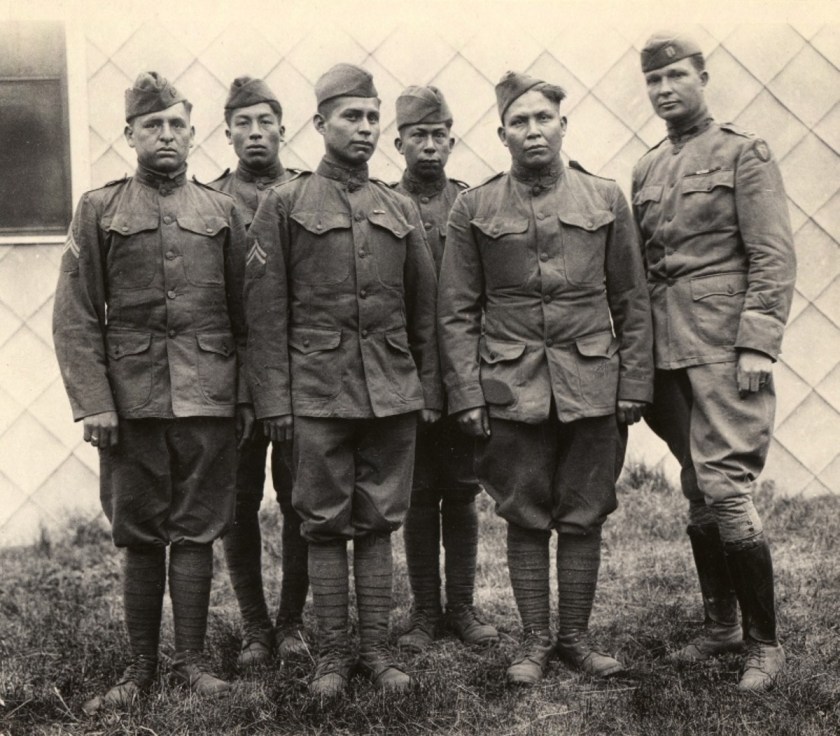
In World War I, German intelligence was able to steal American plans at will. Tapping enemy lines was extremely easy, especially at night. Faced with such a dilemma, a regiment full of Choctaw Indians thought of a potential solution. The commander inquired into how many Choctaws knew their mother tongue. The men hesitated. The first English word some of them had learned was “soap.” In basic training, they were threatened with having their mouths washed out if caught speaking their native language. Now, their regimental leaders wanted them to speak it. The Choctaws were dispersed among the various divisions and attached to communications. From that point to the end of the war, all important orders were passed along in Choctaw. The Germans were stymied and finally caught off guard by the Americans’ war plans (from PBS’ American Experience: The Great War, Episode 3).

Today, our society does not want to hear us speak the message of Christ. Many find it offensive and restricting. They may even put great pressure on us to keep quiet. But, we cannot. These have been taken captive by the devil to do his will (2 Tim. 2:26). Especially when someone sees the spiritual crisis in his or her life, there will be a desperate desire for an answer. Where will they turn? If they have heard us speak of Christ and His way, they may need us to communicate the most important message ever spoken. Don’t keep quiet about Jesus, especially given the dire danger in this spiritual warfare (2 Cor. 10:3-5). God is counting on us to speak for Him, and so is a lost and dying world! Keep sharing Him.

hith-wwi-native-american-code-talkers-choctaw_code_talkers-800x701-2

I-N-V-O-L-V-E-M-E-N-T Equals Church Growth

Neal Pollard

The early church grew (Acts 2:41; 5:14; 6:1,7; 9:31; 11:24). As we read of this growth explosion, we see the key role member involvement played. Christians were spreading the word (8:4), involved in each other’s lives and in the lives of the lost around them. This is such a simple concept, but churches not practicing it are not growing. What is involved in involvement?

  • I–“I” am the heart of involvement. I must resolve to be involved. I must do my part, for I will give an account for my level or lack of involvement (1 Cor. 3:8).
  • N–“Negativity” is the enemy of involvement. “I can’t help.” “It won’t do any good.” “I don’t like working with that person.” Listen closely. Involved Christians rather say “I can do” (Phil. 4:13) and “we are well able” (Num. 13:30).
  • V– “Visitation” is a part of involvement. Matthew 25:34-46 confirms it. Non-Christian visitors, sick, imprisoned, and needy folks need it. Those who do it are richly rewarded, and those who are recipients of it profoundly appreciate it.
  • O– “Obedience” is the cause of involvement. Faithful Christians believe the commands to make disciples (Mat. 28:19), build up brethren (Rom. 14:19), and meet needs (Js. 1:27).
  • L– “Love” is the motive of involvement. Paul says good deeds, without love, are profitless (1 Cor. 13:1-3). The counsel of Scripture is “by love serve one another” (Gal. 5:13).
  • V– “Victory” is the goal of involvement. By being involved, we help others win the victory (Js. 5:19-20), we help the cause of Christ advance, and we aid our own walk in the light that leads to eternal reward (1 Jn. 1:7).
  • E– “Everybody” is the scope of involvement. What able-bodied Christian is excluded from the work God has given the church? Once, a man did nothing and gave every excuse imaginable. We remember how that turned out (Mat. 25:28-30).
  • M– “More” is the adjective of involvement. That is, “more involved” and “more people involved.” Has there ever been a church with too many involved? God is able to do more than we ask or imagine (Eph. 3:20), and He wants to see us always trying to do more for Him!
  • E– “Evangelism” is the fruit of involvement. Active churches attract the curiosity of the community. Those involved in the church’s work naturally grow more spiritual-minded, and by this grow more bold in sharing the gospel.
  • N– “Now” is the time for involvement. What in our lives do we definitely know will change between now and the never-seen tomorrow (Prov. 27:1)? Let’s kill the excuses! Resurrect the enthusiasm! Start today!
  • T–“Teamwork” is the mindset of involvement. We’re to work together. No one man, no staff, no eldership, no group of deacons or others can or should do the work of an entire congregation. The local church is a team.

To become adequately involved, let’s ask three questions.

“What needs doing in this church?”
“Who needs help in doing it?”
“What can I do?”

Be an Isaiah, a child of God who enthusiastically says, “Here am I, send me” (Isa. 6:8)!

41824748_10216815660249540_2034412809957146624_n

THE MYSTERY OF INFLUENCE

Neal Pollard

Several years ago, a fourteen-year-old girl named Shannon Smith was shot to death in her own back yard. A bullet lodged in her brain. Though already tragic and horrific, the story was made more tragic by the inexplicable nature of the shooting. Police, judging from the trajectory made by the entry would, concluded that the bullet fell from the sky. Somewhere nearby, some unknown person had fired a gun for no known reason. The bullet completed its path of travel inside an unsuspecting teenager. Tragic, indeed!

Who fired the gun and why? The action pales next to the consequence. Someone aimlessly fired a weapon. A child died and parents were left to mourn her loss. It was all so unnecessary and avoidable!

Christians are a special people, a God-possessed, holy group (1 Pet. 2:9). The world sees Christians (Matt. 5:16). They react to children of God, either “glorifying” (Matt. 5:16) or “blaspeming” (2 Sam. 12:14) Him. Christians are either transformed from worldliness or conformed to it (Rom. 12:2). Conformity carries tragic consequences.

Influence is an inevitable burden carried by every Christian. Others watch what we do, hear what we say, and evaluate our judgments. What we wear, how we talk, where we go, and with what we entertain ourselves may seem harmless or at least harmful only to us. Yet, we can aimlessly fire and eternally wound another’s soul by our influence.

The man or woman who fired that gun may not realize even now what they did with one “harmless” squeeze of a trigger. Maybe they will not know on this side of time. Just so, we may be shocked on that day to realize how many or exactly whom we influenced. We’re on a spiritual battlefield (Eph. 6). Let’s be careful not to shoot at the wrong side! We may wind up doing harm to the very people we’re commissioned to save. Let’s watch our aim!

635556363784254557-phxdc5-5gjqo8l36pjzj76wfkp-original
Shannon Smith (undated photo)

Self-Control Means Saying “Yes” As Well As “No”

Neal Pollard

Don’t you normally associate self-control with self-denial?  Certainly, Jesus says that following Him means denying self in a variety of ways (Matt. 16:24).  Gluttony, sexual sin, alcoholism and other physically detrimental habits, cursing, and the like involve this negative dimension of self-control.  Yet, how many times have you heard a preacher or teacher emphasize the positive sphere of this fruit of the Spirit?  Doesn’t it take self-control to get up out of the chair on Tuesday night and visit that non-Christian who came to church services the previous Sunday?  Doesn’t it take self-control to work up the nerve to speak to a co-worker about the Bible?  Doesn’t it take self-control to make time for daily Bible study and prayer?  Doesn’t it take self-control to spend quality time with your spouse and children?  My experience tells me that most people say “no” more often than they say “yes.”  Many times, our saying “no” to bad things needs to be quickly coupled with saying “yes” to better and righteous things.  Neither evangelism, edification, nor benevolence get done without this positive side of self-control!  May I encourage us all today to say “yes” to opportunities to serve our Lord, His people, and the lost (cf. Gal. 6:2,10).  He will bless us for such self-discipline.

Screen Shot 2018-12-03 at 11.07.50 AM.png

I Met A Soul Today (POEM)

Neal Pollard

A lonely soul was crying out
For someone to direct
Their mind to know the will of God
But I chose to deflect.

An edgy soul was acting out
Intimidating and coarse
Yet they were searching for the truth
I recoiled with too little remorse.

A hopeful soul was reaching out
And attended our worship service
But I was busy, too much to do
To connect, plus I was nervous.

A hurting soul, in time of loss
Crossed my path today
I felt so bad that he was grieved
But still I hurried on my way.

A lost soul was needing Christ
She is destined for eternity
I was busy, nervous, no zeal for her
Guess I was too caught up in me

The next soul that I come upon
Lord, may I try with zeal
To share your grace and teach your Word
And your matchless love reveal.

a20cold20day2015

PREACHER, DON’T BE DISCOURAGED

Neal Pollard

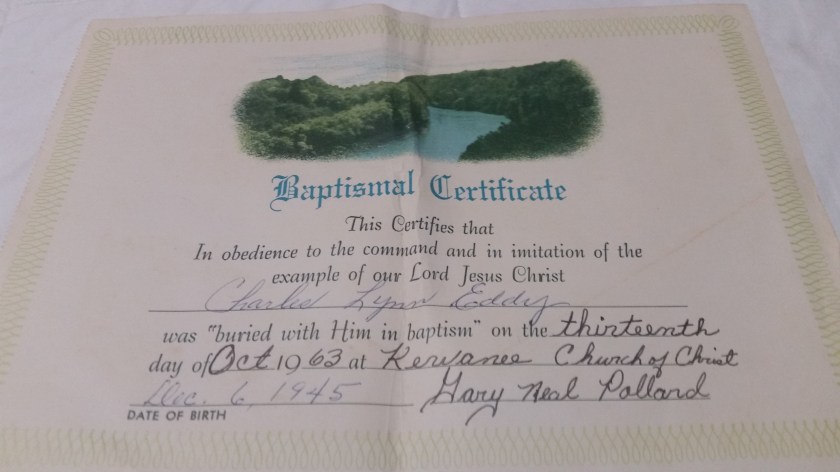
Recently, a young woman present to hear me speak in Kentucky asked me if I was related to a “Neal Pollard” who preached in Missouri in the 1960s. She had just attended her father’s funeral, and in going through his things after his death she found his baptismal certificate. I was elated to hear these details. Her dad and his mother, her grandmother, were baptized on October 13, 1963, by a young Freed-Hardeman student. This young man who was baptized would go on to serve for many years as an elder in the Lord’s church. Later that night, I called my dad and found out that Charles Eddy was one of 15 people who was baptized when he preached his “tryout” sermon at Kewanee. He had only preached four times in his life and this was his only sermon at that point. It was on the judgment and entitled, “What Will The End Be?” He had no idea what had happened with any of these men and women he baptized when only 19 years old. That was 55 years ago.

I have seen my dad go through some trials as a gospel preacher. There have even been times when he has been mistreated, but he has faithfully preached the gospel for well over half a century. In that time, he has done countless Bible studies, counseled Christians and non-Christians over literally tens of thousands of hours, ministered to young and old, healthy and sick, preached “in season and out of season” (2 Tim. 4:2) and even occasionally “endured hardship” while fulfilling his ministry (2 Tim. 4:5). He is a man of great faith and prayer, but I’ve seen him discouraged. He has wondered if his efforts mattered very much. That is often a side-effect of service.  But, I reveled to hear his excitement as we relived that memorable day and talked about that first work–of course, he was hired after having 15 baptisms in his “tryout” sermon! Dad also has done local work in Tennessee, Kentucky, Mississippi, West Virginia, North Carolina, and Georgia for those five-plus decades. Now that he’s retired, he still preaches every week for the church in Andrews, North Carolina. At 74-years-old, he’s still studying with and baptizing people and helping to build the faith of all different kinds of people. My dad has always been very evangelistic, but I don’t know how many have been baptized under the influence of his preaching. But, he’s also helped so many stay faithful and encouraged their growth and development. Occasionally, I still get to hear from them in person or through social media.

There are so many men through the years who have labored, like my dad, in anonymity–not considered “big names in the brotherhood.” Yet, many, many people will be in heaven because of their work. May every one, including but not limited to preachers, be encouraged in doing the Lord’s great work!  “But as for you, brethren, do not grow weary of doing good” (2 Th. 3:13).

20180805_213935.jpg
The first of many, many times my dad would fill out one of these. 

Avoiding Presumption In Evangelism

Neal Pollard

There are several sound, simple methods of teaching the gospel to the lost. As the teacher grows in ability to utilize these methods, his results will improve to God’s glory. The teacher also has as his or her textbook one fo the simplest to comprehend, though only the rare and exceptional student will fail to attain unto “the meat” of God’s Word after consistent, in-depth Bible study (Heb. 5:12-14).

The effort put forth by the student to understand may be great for some. The soul-winner must be aware of this and address it accordingly. Observe a few suggestions that might prove helpful.

  • Watch the student, trying to detect words or concepts that they might not comprehend.
  • Try to establish, from the beginning of the study, a free, comfortable line of communication.
  • When asked to explain words or concepts, avoid patronizing (thereby insulting) the student.
  • Reassure the student that all of us, to one degree or another, need help understanding words and concepts.
  • Be patient and empathetic and never cold and exasperated.

Making sure the prospective Christian understands and is in the flow of the study couldn’t be more important. Each student has a never dying soul that will be somewhere for eternity. As gently and compassionately as possible (2 Tim. 2:24026), be ready to explain and discuss words or questions from the Bible or study which may be giving them problems. Realize that each person comes from a different background and aptitude, not only religiously but also educationally. No doubt, the hearer has a great responsibility and accountability. Often, Jesus admonished, “Be careful how your hear” or “Be careful that you are not deceived” (Luke 8:18; 21:8; etc.). He was warning them to be keen listeners and discerners of biblical truth. Hearing itself is vital (Rom. 10:17), as without it faith can’t be produced. Yet, let us who would teach the lost work to present the simplicity of God’s saving plan and eliminate as many barriers to understanding as we can.

learning-styles_m

The Courage To Try

Neal Pollard

About nine months ago, a man walked into our building a day after being immersed into Christ. He had been searching diligently for the truth, a man whose hunger for the Bible caused him to study his Bible for hours every day (including on audio at his job as a metal fabricator). He continues those habits today.

A man whose life is as interesting as his name–Roberto Yrey–has been a blessing to us at Bear Valley.  One of the reasons I’ve grown to love him so much was on full display last night. Each Wednesday, a different man delivers a 90-second devotional talk. Last night, Roberto spoke. Don’t misunderstand. He writes devotions, short sermons, and articles all the time in order to articulate his understanding of a Bible chapter or topic he has been studying. He changed his mind multiple times before settling on the one he delivered last night. If you were there, you know that Roberto was nervous. He has told several of us how difficult public speaking is for him. His only previous public speaking opportunity was a Scripture reading during a devotional back during the holidays.

What he chose to speak about last night so aptly reveals a mindset that makes him so endearing. His message was that you don’t have to know everything to study with someone. Don’t be afraid to tell someone, “I don’t know.” It’s OK if you don’t know or understand everything. He encouraged us, “Say, I don’t know but let me ask someone who might know. Or let’s fellowship and find the answer.”  But his message was to not let the fear of not knowing keep you from talking to someone about the Bible.

I admire the fact that Roberto had the courage, as a babe in Christ, to speak to a room full of people some of whom have been preachers and teachers for decades, teachers in our Bible school for many years, and are mature, seasoned Christians. But I admire him even more for practicing what he was preaching. In our midst last night were two visitors–Estevan (there for the first time) and Sean (who’s become a regular attender with Roberto for several months). He had the courage to invite them. Today, we baptized Sean into Christ for the forgiveness of his sins. A young Christian has already brought a friend to Jesus. All it took was the courage to try, to do what anyone can do who is moved by simple, trusting faith to just do what God has told us to do. I don’t know about you, but Roberto’s example helps me have the courage to try harder!


6EDBBE5E-E7F1-45A2-A97C-7BDFAFAE2790
(L) Sean being baptized today by Allen Javellana, who studied with him. (R) Roberto preaching at Bear Valley last night.

A GREAT FISHERMAN

By: A blessed fish

Let me tell you about the greatest fisherman I have ever known.

He has always found success at his favorite fishing hole. A special place where the inlet was fruitful, and many fish loved to be caught. His technique is simple. A welcoming lure. A handshake, a hug and a smile. Just to let you know you’re wanted.

He will always catch-n-release and the fish always feel better for the experience. Many wide eyed and spiritually young fish will enter the inlet, hoping that someone would catch them and show them the kind of love this great fisherman offers. He never judges a fish – their size, beauty, wealth or position. He only lets them know how glad he is to see them at the inlet.

His success is solely based on persistence, perseverance and patience. Three times a week you can always count on him being right there at the inlet. Waiting for the opportunity to hook’em and hold’em. He always makes every fish feel welcome and wanted.

He knows every fish by name. If he thinks a fish has drifted off down steam, he will go in search, armed with a tackle box full of Christian love and do his best to bring them back to the inlet. Not for him, but for their sake and for God’s sake.

He hooked this fish over 11 years ago. My wife led me to the inlet. But, he hooked me and let me know that I was welcome here. He helped save this soul for eternity.

I think he is getting tired now, but few may notice.  So many years of fishing, but he is still there almost every Sunday morning, Sunday night, and Wednesday night. I think he wants to share his favorite inlet with others who share his passion. Man, woman, or child, he wants us to join him. We don’t have to wait. We don’t have to be assigned the duty. We just need to step into the water and follow his lead. There is plenty of room at the inlet. Let’s all join this fisherman at the Bear Valley inlet and make sure every fish that enters knows they are wanted and welcome.

The great fisherman’s name is Clint and this fish will always love him.

Mathew 4:19-20

And He said to them, “Follow Me, and I will make you fishers of men.” Immediately they left their nets and followed Him.

———————————————

 NEAL’S NOTE: This was submitted to me by someone who wants to remain anonymous. Truer, more fitting words could not be spoken about one of the most special people any of us have ever known. We’re very blessed to have Clint Stephens as a member at Bear Valley, one of the men who was at the time a shepherd when I was hired. Enjoy!

1919171_1242785955488_6164179_n
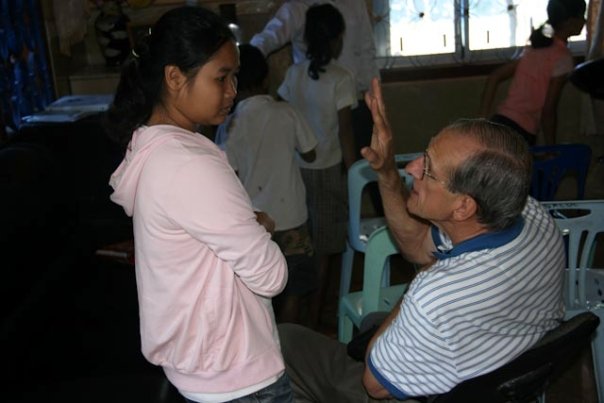
Clint “fishing” on a mission trip in Cambodia a few years ago. 

Grocery Bag In A Bush

Scott Phillips

My girls recently modified the game of Slug Bug in order to make it more exciting and faster-paced. A couple of months ago, with the whole family in the car, we were introduced to it when we heard the words “gocery bag in a bush” shouted three times in rapid succession followed by “wow! three in a row” from one of the other girls.

The modification was simple. Instead of calling out VW Beetles, we all began to call out grocery bags that were snagged up in a bush alongside the road. We would also accept “tree.”  A grocery bag caught in a tree was also acceptable. Turns out, “Grocery Bag In A Bush” is much more exciting and fun than Slug Bug. Tons more action! I’ve never seen so many grocery bags in my life! And you should hear the squeals and laughter when one was spotted so far up in a tree that we all knew that it wasn’t coming down until the tree did.

Good times.

I’ve thought about Grocery Bag In A Bush many times since that day, and have made many observations about it. I’d like to share three of them.

Observation #1
The grocery bags have always been, and will always be, there. I just never “saw” them before. I don’t recall seeing a single slug bug while playing Grocery Bag In A Bush, even though they were probably there.

Conclusion #1
I will see that which I look for. Matthew 7:7-8 says,  “Ask, and it will be given to you; seek, and you will find; knock and it will be opened to you. For everyone who asks receives, and he who seeks finds, and to him who knocks it will be opened.”

Observation #2
Grocery Bags don’t belong in a bush or a tree. It’s not what they were created for, but somehow they have found themselves hopelessly ensnared. They will most likely remain ensnared until someone cares enough to pick them up, or a violent storm rips them away from the unreachable limb where they are trapped. And if no one stops and picks them up, they will most likely drift away until they find themselves ensnared in another bush.

Conclusion #2
While we may excel at “stopping to say hello” when a brother is in the way, we should not let the business of “rolling our gospel chariots along” keep us from our responsibility to the lost to “stop and pick them up”.

Observation #3
We all financially support a vast army of sanitation workers through taxes and fees. We even personally pay for these services out of pocket so that they will come by our house each week to take our trash, and grocery bags, to where they belong. And yet, the grocery bags are everywhere.

Conclusion #3
Christianity cannot be outsoursed. It’s not enough to pay for, or support others, to do the work for us. This world is not our home, but it becomes a more beautiful place when each of us can see those around us who are ensnared in sin, and gently help them get to where they belong.

Feel free to make your own observations from this parable. It’s not perfect, and I’m certainly not equating those trapped in sin with trash. But before we start asking God to provide us with more opportunities, we might first ask ourselves if we are really in the  game. Because once you know what to look for, the opportunities are everywhere.

nhbubq-b88289923z-120141228203836000g7873kqe-10

[Scott Phillips serves as a deacon at the Bear Valley church of Christ. He and Tammi have a son and 7 daughters!]