Tradition is not the enemy. In fact, Scripture speaks positively about certain traditions. Paul wrote, “Stand firm and hold to the traditions that you were taught by us” (2 Thess. 2:15). The early church passed down apostolic teaching, patterns of worship, and faithful practices. In that sense, tradition can be a gift, a guardrail that keeps us rooted in truth. Tradition in this sense was truth handed down by Christ to the apostles (John 16:13).
But there is a difference between biblical tradition and traditionalism. I once heard it described as, “tradition is the living faith of the dead. Traditionalism is the dead faith of the living.”
The clearest warning comes from Jesus Himself. In Mark 7:8–9, He rebuked the religious leaders: “You leave the commandment of God and hold to the tradition of men.” They weren’t condemned for having traditions but for elevating them above God’s Word.
The Pharisees believed they were preserving holiness. In reality, they were nullifying Scripture. Their traditions became filters that distorted God’s intent. Whenever our customs carry more authority than the Bible, we step into dangerous territory.
Traditionalism says, “We’ve always done it this way.” “That’s just how church is supposed to be.” And, “If it changes, it must be wrong.” Scripture tells us, “Test everything; hold fast what is good” (1 Thess. 5:21).
Traditionalism often confuses preference with principle. Worship location, order of service, dress expectations, building designs may be wise or meaningful. But when we bind them where Scripture does not, we risk adding to God’s Word.
In Colossians 2:23, Paul warned about man-made regulations that “have indeed an appearance of wisdom” but lack true spiritual power. Human systems can look holy while missing the heart. Traditionalism tends to resist biblical correction. It fears cultural engagement. It can prioritize comfort over mission. Ironically, many traditions that feel “ancient” are only decades old.
Traditionalism becomes especially harmful when it alienates younger Christians. When faith is presented as a rigid preservation of forms rather than a relationship with Christ, it breeds either rebellion or apathy.
The church is called to guard the gospel, not freeze cultural expressions in time. The message must not change. The methods often must.
At the same time, we should guard against the opposite end of the spectrum, novelty for novelty’s sake. Not all change is healthy. Scripture calls us to contend for “the faith that was once for all delivered to the saints” (Jude 3). Stability matters. The accumulated wisdom of the church matters.
The solution isn’t to abandon tradition but to submit every tradition to Scripture. Does this practice clearly flow from the Bible? Does it help us glorify God and reach people? Or are we defending it simply because it’s familiar?
Traditionalism becomes sin when it binds where God has not bound. It divides over matters of preference (or conscience). It replaces obedience with ritual. It protects comfort over Gods mission.
Jesus didn’t die to preserve our customs. He died to redeem people. Faithfulness isn’t measured by how tightly we cling to the past, but by how fully we submit to Christ in the present. May we cherish biblical tradition, reject human traditionalism, and build churches shaped not by nostalgia, but by the Word of God.
There is no question that the Holy Spirit, as an everlasting personality of God, is unlimited in power. He can do whatever it is possible for God to do, for He is God. It is interesting to read or hear religious people, from preachers to other members, claiming or asserting things the Holy Spirit is doing in churches and lives today. In fact, several of these claims demand an answer, principles from scripture that must be considered before such claims are believed and embraced. What are some things the Holy Spirit will never do?
The Holy Spirit will never override our free will. John Calvin, a 16th century protestant reformer, went to an extreme that placed salvation solely in God’s hands. He contended that man did not have a part in it at all. From this premise came five broad religious ideas that eventually became identified as Calvinism. One of these tenets is called “irresistible grace,” the idea that those God chooses for salvation are led to faith by the work of the Holy Spirit upon the human heart. Tragically, this false idea is supported by many in religion today. Yet, Scripture makes it clear that even in the first century, when the Holy Spirit operated miraculously in confirming the spoken message of Christ, His apostles, and other early Christians, He never directly operated upon the human heart in a way that overtook or overwhelmed the free will of the individual. Cornelius received the Holy Spirit (Acts 10:48-49), but how was he saved? Acts 11:14-15 indicates that it was words told to him whereby he and his house were to be saved. 1 Corinthians 1:18 tells us that God chose to save souls through the message preached. One can look in the Bible from cover to cover and never find a statement or implication that God acts directly upon the human heart in a way that overtakes our will and leads us to belief and salvation. Scripture repeatedly urges man to choose for himself, if he wills (Rev. 22:17; Matt. 11:28-30; etc.). The Holy Spirit works powerfully upon the human heart to persuade man to obey God, but He does so through the powerful word (Heb. 4:12; Rom. 1:16). This message is so compelling and convicting, but God has left it to our free will to decide whether to accept or reject this message.
The Holy Spirit will never contradict revealed truth. Increasing claims are made in churches today about what the Spirit is working in churches to accomplish. Often, the Spirit has been given credit for a church’s change of policy in women’s role, how or on what to spend money (such as for a grandiose campus), or even a strange, new doctrine. Such assertions, however, ring hollow. If these contentions were true, such would reflect most negatively on the character and nature of God. The result of God revealing one thing in scripture, then revealing something else directly, is contradiction and confusion (cf. 1 Cor. 14:40). God claimed that He was giving us His will for all people of all time (John 14:26; 16:13; Jude 3, 2 Tim. 3:16-17; 2 Pet. 1:3). If He is still revealing new truth through the Spirit, was He right in those passages? If He is still revealing new truth through the Spirit, how does this not reflect on His honesty? God cannot lie (cf. Ti. 1:2), but those who claim Holy Spirit guidance in revealing new truth today, if they are correct, make Him such.
The Holy Spirit will never assert what cannot be confirmed. Considering the work of Moses, then the later prophets, Jesus, His apostles, and others who asserted that their message was directly from God, one finds miracles being performed which confirmed without doubt the source of the message. Without such tangible confirmation, how does the one who receives the claim know that claim to be true? Anyone can claim that the Spirit revealed something to them or told them to do something, but how can anyone know they are right without clear confirmation? That is what Aaron’s rod was for. Isaiah (7:14), Jeremiah (44:29), Zechariah (3:8), and others all pointed to a sign that would confirm the veracity of their message. History bears witness to the truthfulness of their claims (cf. Deut. 18:22). After the church was established, Paul was already teaching in the first century that the miraculous gifts would not be needed once the written word was completed (1 Cor. 13:8-12). God has never left Himself unsubstantiated. How do we confirm doctrine? We go to the Word God breathed. It reveals His thoughts and His will. He will not sanction men’s unconfirmed claims, and we are wise not to rest our hopes on such. It is a dangerous and unfounded precedent to simply claim divine guidance without proof. With such an approach, every person can claim a certain revelation, guidance, and heavenly message. Without confirmation, no one’s claims can be tested!
The Holy Spirit is Divine, living, and powerful. As God, He is at work in lives today. He indwells the Christian (Rom. 8:11; 1 Cor. 3:16; 2 Tim. 1:14; etc.). He strengthens the inner man (Eph. 3:16). However, may we never fall prey to the false ideas that man creates and that cannot be verified by scripture (cf. 1 John 4:1). The Bible exists for the reason of testing such ideas as these. It must be the standard that proves and disproves men’s claims today. Know for certain that the Holy Spirit does not today, nor has He ever, overtaken man’s free will. He will never lead one to a conclusion or teaching that contradicts the Word He inspired holy men of God to pen. If one claims a Holy Spirit-given message that is more, less, or different from scripture, it must be rejected! If the alleged Holy Spirit-given message is the same as scripture, then why would God have given us scripture in the first place if He was going to directly dispense the same message apart from the Word? Finally, He will never allow men to pass off as truth that which they cannot confirm in some way that proves, beyond a shadow of a doubt, that the message is divinely given. Let God’s people be diligent students of the Bible and as such able to discern right and wrong in such matters as these!
I was originally going to call this, “The way we smell to others,” but thought that might be misleading or inaccurate. Paul uses a very unusual illustration to make an important point in this paragraph of his second letter to Corinth’s Christians. The backdrop of the illustration was when he came to Troas to take advantage of an open door to preach the gospel. It was a trying experience, as he couldn’t find Titus there. He left them for Macedonia (12-13).
In chapter three, he is going to change metaphors. But, first, he describes their work of sharing the gospel as like God sending His fragrance through them which others evaluate or judge (14-15). The same message “smells” differently to the recipients, based on the receptivity and spiritual condition of those hearers (16). But Paul makes clear that their motives and message are not “rotten,” but if it is rejected it is because the listeners are perishing (17).
Think about how so many could hear the Son of God Himself teach and preach, and thoroughly reject it to the degree that they even took Him and nailed Him to a cross!
When you share Jesus and the message of His saving grace with others, there will be those who find that “fragrance of Christ” (15) a “sweet aroma” (14). It will be so appealing to them that they leave their old life and follow Him, much as the men God chose to follow Him during His ministry. It’s attractive and satisfying. There are still so many with good, receptive hearts out there. We see that when we share Him.
However, be prepared for some to find that same message repulsive. It’s not what they want and not what they are after. Have you ever been sick in such a way that even your favorite foods nauseated you to smell them cooking? There is no more savory and appealing message than the Bible’s story of grace, but many will reject it anyway! It can leave us feeling so inadequate (16), but we must remember that it is not our message. It is Christ’s message. Our job is simply to spread it with personal integrity, honesty, and righteous motivation. His word will work its power on those who seek their satisfaction in Him.
In Phil 2.2 Paul uses an imperative — make my joy complete. Because of this imperative, we know that something was still missing with that church. How were they to complete his joy? By having one mind, possessing one love, working closely with each other, by avoiding selfishness or pride, by practicing humility, by considering others to be more valuable than self, and by investing in the lives of others.
Look at the language used in 2.1 — if you’re encouraged by Christ, if you’re encouraged by love, if you share a common mindset, if you’re capable of compassion and pity, then make my joy complete by being unified and putting others above self.
When we think of issues in a church, our minds usually go straight to false teaching. We want to make sure nothing inaccurate makes its way into our doctrine. That’s definitely an important part of our spiritual health, but it isn’t the only issue we face.
This entire letter is all about how critical it is that we keep our relationships with each other healthy. And this isn’t the only time God communicates that message with us — I Jn 4.20 says, “If you hate anyone in your Christian family, God’s love doesn’t exist in you.” Mt 5.23 tells us that we shouldn’t even worship if there’s bad blood between us and someone else. Mt 18 tells us how important it is to resolve conflicts when they come up.
God has made it very clear that it’s just as important to be on good terms with our Christian family as it is to avoid false teaching.
Paul’s days as a free man are behind him, and he is awaiting execution (2 Tim. 4:6-8). Yet, his pen has not been silenced and he spends his last days encouraging a young preacher he has mentored and trained. He repeatedly calls Timothy “my son” (2 Tim. 1:2; 2:1; Phil. 2:22; 1 Tim. 1:2; 1:18). Especially in this, the last of his letters, Paul seems to reveal a sense of urgency in revealing practical wisdom to help his young protege to productively serve Christ Jesus (2:1,3,8,10). He likens the work to soldiering (2:3-4), competing as an athlete (2:5), and farming (2:6). He points to how God renders aid and assistance to His faithful proclaimers (2:7-13).
Faithful proclamation of the truth is also something that is proven by taking the proper approach to the task. Paul is concerned about unfaithful men being entrusted with the stewardship of teaching others (cf. 2:2,14-26). Timothy is told to remind them and solemnly charge them “not to” do certain things (14) and to “avoid” (16) and “refuse” (23) certain traps that they could potentially fall into as teachers.
It seems that as we consider the visceral, virulent tack taken by voices of influence within our culture to any number of matters–politics, race, morality, religion, education, etc.–the church, tragically, has at times emulated that tack in our dealings with one another. Whereas Paul described it more as “biting and devouring” when addressing the churches of Galatia (5:13), he is extremely concerned that such a spirit has caught hold with some in Timothy’s circle of influence. Therefore, he warns the young preacher against three traps that those tasked with preaching and teaching the gospel fall into. They are still potent and existent today.
TRAP ONE: WRANGLING ABOUT WORDS (2 Tim. 2: 14)
Paul had warned Timothy about this trap in his first letter to him. He writes in 1 Timothy 6:4 about those advocating a different doctrine, including having “a morbid interest in controversial questions and disputes about words….” (NAS, emph., NP). The inspired Paul does more than diagnose the problem. He addresses root causes like conceit, ignorance, envy, strife, abusive language, evil suspicions, and constant friction (4-5). He diagnoses the condition of such teachers, calling them “men of depraved mind and deprived of the truth” (5). To these, religion is simply a way to make money (5).
Now, in this second epistle, Paul warns of additional harm done by such wrangling about words (14). It does not serve a good, edifying purpose and it actually tears down. It’s useless and ruinous.
How might we fall into that trap in the 21st Century and in the current climate? Social media is a major culprit, where people–often laboring under the guise of defense or promotion of the gospel–mercilessly criticize what others post. What motivates such contrariness? According to Paul, it could things like conceit, ignorance, envy, etc.
Teachers and preachers might have or develop a reputation for being a gunslinger, ready to fight and argue about anything big or small. Watch or listen to their sermons and classes, and you can be fairly certain that this kind of wrangling will happen. No doubt, the gospel is adequately provocative and offensive to the sensitivities of the heart-hearted or ungodly, but God’s Word doesn’t need “help” from us through crude, sarcastic, mean-spirited attitudes and vocabulary. If we offend, let it be God’s Word presented in love rather than our vicious, sharp-tongued barbs.
TRAP TWO: WORLDLY AND EMPTY CHATTER (2 Tim. 2:16)
Again, this is a theme in Paul’s writing to Timothy. He actually warns against the profane or worldly three times in the first epistle. The law is for the “profane” (1:9; same word). He is told to have nothing to do with “worldly” fables fit only for old women (4:7; same word). Then, Paul closes warning him to avoid “worldly” and empty chatter and the opposing arguments of what is falsely called knowledge (6:20; same word). To define what Paul means, just look at the results. Such teaching leads to further ungodliness, spreads like cancer, and upsets the faith of some (16-18). It included claims and teaching that was outright false, in this case asserting that the resurrection had already occurred.
It can be hard to resist worldly and empty chatter in a world full of it. Our culture can get fascinated with vacuous, fruitless things from the latest trends, ideas, and causes célèbres. We consume all our time and energy on matters that ultimately will not matter. We need to examine what we teach and preach. Does it lead the worldly further down that road? Does it undermine their faith in God and His will? Whether we do that through being a devil’s advocate or encouraging wickedness (19), we do it at our own peril in addition to the peril of those who listen and follow us.
TRAP THREE: FOOLISH AND IGNORANT SPECULATIONS (2 Tim. 2:23)
These may be connected to the youthful lusts Paul has just mentioned (22) or the quarrelsomeness he is about to warn Timothy about (24). “Speculations,” depending on context, can refer to the noble act of searching for information and investigating (Acts 15:2,7; 25:20). But, almost entirely in the New Testament, it refers to matters for dispute or engagement in a controversial discussion (Arndt, et all, 429). It involves a clash of opinions (Kittel 300).
With the call for faith in matters of doctrine sufficiently divisive, what a tragedy when people of influence in the Bible leverage that authority by dividing brethren over what, when boiled down, is nothing more than opinion, speculation, and conjecture. Romans 14 makes clear that not everything is a matter of faith. Christian living necessarily involves judgment calls, and we fall into a trap to confuse either for the other. While a world is dying lost without hope, can we afford to devolve into debates over things that do not, of themselves, affect the salvation, the work, the worship, or the nature of the church?
The beautiful thing about Paul’s sobering words is that for each trap, there is an escape. More than an escape, it is a healthy, fruitful alternative. What is the escape for “wrangling about words”? A diligent, hard-working handling of the word of truth (15). What is the antidote for “worldly and empty chatter”? The firm foundation of God (20) and the proper preparation of self for every good work (19-21). What is the alternative to “foolish and ignorant speculations”? Labor as the Lord’s bond-servant, being “kind to all, able to teach, patient when wronged, with gentleness corrections those who are in opposition” (24-25a).
The world is watching and we who teach, in whatever format on whatever platform, incur an especially strict judgment (Jas. 3:1). What a privilege to get to share Jesus with the lost and our brethren! As we do, let’s be aware of these teaching landmines. They are not necessary to effectively represent God; instead, they serve the opposite. Be on the lookout for how to please our neighbor for his good and edification (Rom. 15:2).
Sources Consulted
Arndt, William et al. A Greek-English lexicon of the New Testament and other early Christian literature 2000 : 429. Print.
Kittel, Gerhard, Gerhard Friedrich, and Geoffrey William Bromiley. Theological Dictionary of the New Testament 1985 : 300. Print.
Have you ever gotten something—maybe a piece of appliance or a new faucet that you needed to assemble or install—and it seemed too simple? You see all of the pieces that came in the box, and you recognize all of it and their functions. Maybe, because it looked so simple and straightforward, you overestimated your ability to put it together and went straight into installing it by yourself without reading the manual. What happens usually? Well, if you’re lucky (or just that skilled), you may do it just right. But most times you either get stuck and eventually are forced to read the manual anyway, or you think you installed it correctly but actually didn’t do it all that right. Whatever the case is, there are times in our lives when we may have foregone the instruction manual because they are tedious or you think you know the steps, only to find out soon that there is a good reason why the instruction manuals are included with the product!
Even the simplest looking assembly comprised of just a few steps can quickly become quite intricate if there are specific order and method to the process. And if one, out of the abundance of their self-confidence, refuses to read the manual for that crucial piece of information, the process can be very frustrating indeed. Maybe you’ve had to witness someone stubbornly try to put together or operate something without first reading the manual for it.
I’ve heard people describe the Bible as an instruction manual for life. Although this is an oversimplification of the Word of God, I think we can agree for the most part that the Bible contains instructions and concepts that directly impact our lives—both physical and spiritual. We should not develop a dysfunctional view of Scripture as a mere checklist of things to do to get a passing grade to get into heaven, but we should also recognize that the Bible as a whole is a guide for us to internalize as we navigate this life.
The Bible and its contents are profound yet simple, and everyone can understand it. Logically speaking it must be so, because throughout Scripture there is a consistent expectation for the people of God to study and understand the laws (in the Old Testament) and the teachings of Jesus Christ and his apostles and disciples (in the New Testament). We know that “All Scripture is breathed out by God and profitable for teaching, for reproof, for correction, and for training in righteousness, that the man of God may be complete, equipped for every good work” (II Tim. 3:16-17). The gospel is “the power of God for salvation to everyone who believes” (Rom. 1:16). The doctrines, precepts, principles—all of these things contained in Scripture both Old and New Testament are there for us to read, to understand, and to let impact our lives in a meaningful and transformative way.
Now then, how are we to do so without examining the book? The Bible may not be as simple as a checklist of things or like an instruction manual for some furniture assembly, but we cannot deny the reality that it contains guidance that we need for our navigation through this life into eternity. It would be foolish and inefficient at best for us to recognize such a fact but still fail to read it and study its contents. Do not be stubborn and try to go through life without the guide revealed to us by the very Creator who is the source of life itself. Make sure to foster that need to meditate on God’s Word regularly.
It’s hard to have balance while times change. Some seize current social realities and use them as opportunities to push unbiblical ideas (God’s design for marriage, leadership in worship, leadership in the home, etc.). As a result, our human nature kicks in and we’re ready to swing the other way. After all, we don’t want to be associated with groups who don’t teach or practice what God wants, right?
Balance is way more difficult to maintain than reactionary practices in either direction. Both are extremely harmful to the church! Compromising doctrine is never acceptable, but gaining a reputation for being old-fashioned or otherwise incompatible with modern culture is equally harmful.
I Corinthians 9.19-23 is an awesome text for this. We’ll look at a few key points in this passage briefly.
It’s About Serving Other People (9.19)
It’s About Winning Them (9.19)
It’s About Meeting Them Where They Are (9.20-22)
It’s About the Message (9.23)
We do what we do because we want to save souls. We cannot maintain a church culture based on reaction because it does not save souls. It is not a sustainable culture and has led to many viewing the church as being incompatible with the modern world. This was never God’s design! We must never compromise doctrine, but we must always try to win souls. We need to do what we can to meet folks where they are and show them something better.
“I have become all things to all people, that by all means I might save some” (9.20).
Say that three times in a row. Now that you’ve done that, let’s focus on a very important question. Are traditions splitting the church? To answer this we must look at the source of our traditions. As a church we follow both divine and man-made traditions. The ones from God must be followed and taught in the church, but the ones from man have no authority from God.
So, are traditions splitting the church? The word “tradition” means to “pass something down.” Galatians 1:14 says, “and I was advancing in Judaism beyond many of my contemporaries among my countrymen, being more extremely zealous for my ancestral traditions.” Were the traditions that Paul was learning about passed down by man or by God? He labels them as being his “ancestors’ traditions.”
We must be careful to determine if a tradition that is being taught is divine or was instituted by our “ancestors.” For example, serving the Lord’s Supper from the front of the auditorium on a table that says, “Do This in Remembrance of Me”, and using brass plates are man-made traditions. This is not found in scripture.
There’s nothing wrong with practicing this tradition. The problem is when some try to enforce this and say “if you don’t do this for the Lord’s Supper then you haven’t really done what has been commanded.”
This teaching of tradition can split the church and we must be careful that we are enforcing God’s tradition and not our own. To do this we should ask, “Is it a violation of Scripture, or is it a tradition?” It’s okay to go along with traditions, but it is not okay to bind human traditions as a salvation issue.
There are some in the church that have taken their man-made traditions to heart. So we must ask ourselves, are we binding man-made traditions on others for salvation? Do we get upset if someone changes up the order of worship? Maybe we get mad when there are only two songs between the opening prayer and the sermon?
Divine traditions are what we must follow, and we must not force man-made traditions. Galatians 1:8-9 says, “But even if we, or an angel from heaven, should preach to you a gospel contrary to what we have preached to you, he is to be accursed! As we have said before, so I say again now, if any man is preaching to you a gospel contrary to what you received, he is to be accursed!” Paul’s point is this: “Who did you receive it from?”
1 Corinthians 15:1-3 tells us, “Now I make known to you, brethren, the gospel which I preached to you, which also you received, in which also you stand, by which also you are saved, if you hold fast the word which I preached to you, unless you believed in vain. For I delivered to you as of first importance what I also received, that Christ died for our sins according to the Scriptures.” It is important that we check to see where the tradition came from.
Paul got his teachings from Jesus Christ. That is the divine source we must use. Not your preacher or the old wise man. This tradition was divine. Even if it is a tradition that has been around for many years, this does not automatically make it a divine tradition.
We must always keep in mind two facts when it comes to tradition.
Divine tradition is binding while man-made is not.
Look for the source of the tradition in order to clarify fact number one.
Have you ever heard “chimney corner Scriptures”–those things that sound like or we think that are in the Bible but are not (“Let your conscience be your guide” or “confession is good for the soul” or “God works in a mysterious way”). It is not as funny when our hearts and minds are not adequately protected from a teacher or preacher who promotes something as biblical that is not. It may be someone who touts a thing as acceptable to God which the Bible teaches is not. It may be someone who asserts that something must be believed or done, though the Bible does not bind it. Either way, God holds each of us accountable for knowing His will. We are cheating ourselves and our souls who allow a teacher or preacher to dictate to us how we should feel or think about a given matter. I am not saying we should be suspicious or distrusting. Instead, I am saying we should be like the Bereans. One of the most powerful, positive statements made about any group of people is said of them in Acts 17:11: “Now these were more noble-minded than those in Thessalonica, for they received the word with great eagerness, examining the Scriptures daily to see whether these things were so.” You have likely read that passage before, but what is the Holy Spirit saying about them?
They Were Characterized By EXCELLENCE. They were noble-minded. Notice that it began here. All else positive that is said about them began with their mindset. Jesus praises people who hunger and thirst for righteousness (Mt. 5:6). These people were predisposed to accept God’s Word. What higher praise can be lavished on anyone?
They Were Characterized By EAGERNESS. The antithesis of this would be apathy and indifference. These were “word-receivers.” They were sponges, anxious to know God’s Word. The Bible, from cover to cover, touts itself as the message of salvation. Doesn’t it deserve our greatest enthusiasm?
They Were Characterized By EXAMINING. But, they were not uncritical, undiscerning students. They were listening to one of history’s greatest Christians, borne along by the Holy Spirit, but they still checked after him. Every man who purports to be God’s proclaimer deserves that same level of scrutiny.
They Were Characterized By EVERYDAYNESS. They were not content to wait for the next Bible class or sermon. They were daily devourers of these Divine dictates! Aren’t there things you feel compelled to do on a daily basis (eat, sleep, brush your teeth, check social media)? We prove to God we are serious about the blessing of having a relationship with Him by constant, consistent consultation of His revealed mind and desires–we only find that in His Word!
How can we tell whether something is just a man’s conviction or is God’s command? How do we know that some strange, new doctrine is true or false? Do not be content to let somebody be your sole source of gauging that! Be a Berean!
All gas internal combustion engines require three things to operate: fuel, spark, and compression. If one of the three is working improperly, a number of symptoms can arise. This is an oversimplification, of course, but those three systems must be mostly operable in order to be usable.
Troubleshooting can be expensive if a person has little or no experience with this common engine type. Learning to maintain a vehicle and enact basic repairs saves an enormous amount of money! Relying on someone else to do it is often very costly.
We fully understand that not everyone is equipped to be a scholar-level theologian. However, many Christians take this idea and swing the opposite direction. How many have been Christians for decades and have just a basic understanding of scripture? How many multi-generational Christians snore at the thought of advanced biblical studies? How many have only the knowledge they retain from a sermon? How many base their understanding and beliefs on the values held by respected friends or family?
No one is perfect; the more a person learns through deep bible study, the more they are confronted with their own inadequacies. But a dedicated student of the scriptures also gains this:
A profound appreciation for grace and its role in our practical lives.
Mind-blowing discoveries and realizations about the nature of God and eternity that bullet-proof our faith.
The full emotional and intellectual impact of biblical principles.
A deeper understanding of the goals, message(s), meaning, and practical applications of a book.
A heartwarming and emotion-eliciting appreciation for the role of The Word, Jesus, and His hand in creation, sustaining the genetic line that brought about His physical death, the timeless sacrifice He made by subjecting Himself eternally to the Father, and the role He plays today on our behalf.
An ability to defend the faith, refute false doctrine, convert a lost soul, and build faith in others.
An ability to avoid sin more effectively.
A far lesser likelihood of accepting false doctrines or harmful practices.
Excitement, joy, and fulfillment about being a Christian!
A great disdain for arguments over petty issues that are weakening the church, and the ability to shut them down and refute them soundly.
As a bonus, learning to read and translate Greek or Hebrew (at least with the help of a lexicon, a decent understanding of rules of each language, and their proper application in each context) will give even more profound insight into words and concepts we read in our native translations.
Relying on what others tell us is not sufficient! We may find that the cost, eternally, is far steeper than what we would pay to the most expensive mechanic for repairs we could do at a fraction of the cost. Not only will we gain a great appreciation for what we know and live by becoming true Bible students, but it also greatly enhances our ability to live a faithful Christian life.
During a prayer recently, a brother thanked God that our congregation had not been “invaded.” I thought it was an interesting, thoughtful way to thank God for His protection from physical harm, but it also took my mind in another direction. More often than we’ve faced armed intruders, the Lord’s church has had its share of others who have snuck or pushed their way in and to detrimental results.
Churches Have Been Invaded By Wolves. They are described in stark terms, being “ravenous” (Mat. 7:15) and “savage” (Acts 20:29). They do as Ezekiel described, “tearing the prey” (33:27). The Bible is describing false teachers who speak perverse things to draw away disciples after themselves. What’s so alarming is that these are “from among your own selves” (Acts 20:30). These are individuals whose teaching is false by the Bible’s standards, and the fruit of whose teaching causes people to be severed in their relationship to God. Jude describes them as those who can creep in unnoticed, “ungodly persons who turn the grace of God into licentiousness and deny our only Master and Lord, Jesus Christ” (Jude 4). God’s remedies to stop such church invaders are godly, qualified shepherds (Acts 20:28-30; cf. John 10:12) and active, thoughtful Bible students who effectively discern spiritual fruit (Jude 3; Mat. 7:15-20).
Churches Have Been Invaded By Leaven. Paul addresses an issue “within the church” at Corinth (1 Cor. 5:12), which he illustrates by referring to “a little leaven” that “leavens the whole lump” (1 Cor. 5:6). The leavening influence here was unchecked sexual immorality that the church came to accept rather than address. Paul urges Corinth to take action regarding immoralities like those he lists in verses 9 through 11. When a church normalizes and embraces what Scripture condemns, it has been invaded and taken over from God’s will. Churches who adapt views which accommodate the moral decline of their members rather than challenge their members to rise up to The Standard have been invaded.
Churches Have Been Invaded By Legalists. Jesus targeted the Pharisees more often than any other single group in the gospels. He is most plain in Matthew 23, noting that “the scribes and the Pharisees have seated themselves in the chair of Moses” (2). While in context Jesus is dealing with matters under the Old Law, what He observes continues to today. How many have put themselves in the seat that rightfully belongs only to God? They exact rules that are too hard for anyone, even themselves, to follow (4), that are borne of improper motives (5-12), that are harder than God’s rules (13), that make disciples of themselves rather than Jesus (15), that major in the minors (23-25), and that create superficial righteousness and inward rottenness (27-28). Such churches are afflicted with those who appear alive, but are spiritually dead.
Surely we want “to grow up in all aspects into Him who is the head, even Christ, from whom the whole body, being fitted and held together by what every joint supplies, according to the proper working of each individual part, causes the growth of the body for the building up of itself in love” (Eph. 4:15-16). There’s only one Lord for the one body (Eph. 4:5). He is head over all things to the church, which is His body (Eph. 1:22-23). That is the basis and marching orders for us to prevent any and all “church invaders.” May we keep vigilant to protect the purity of His church (cf. Eph. 6:10-17)!
Peter has a sobering warning for the church, writing, “But false prophets also arose among the people, just as there will also be false teachers among you, who will secretly introduce destructive heresies, even denying the Master who bought them, bringing swift destruction upon themselves” (2 Pet. 2:1). He warns them about the model, the methods, and the message of these men. The counterparts of these modern messengers is the false prophets of old.
Jeremiah lived at a time when such prophets flourished, and the result of their work was the destruction of the people. Jeremiah 23 is a graphic depiction of what God helped Jeremiah see as he looked at and listened to these sinful seers. Notice that in Jeremiah 23:9-40), he saw:
Tears (9-10)–Jeremiah was heartbroken, trembling, and overcome, because he knew their message was different from God’s Word and it was taking people off course.
Pollution (11-12)–The Lord found their way wickedness, and this pollution made for a slippery path that would make them fall in calamity and punishment.
Offensiveness (13-14)–They looked to the wrong spiritual source and it led the people of God to commit horrible depravity.
Tragedy (15)–Their message was going to cause their own spiritual sickness and death.
Emptiness (16-18)–The message is from their own imagination and not from the Lord’s mouth, so they tell those who hate God they’ll have peace and those who walk in stubbornness that everything will be fine.
Storms (19-20)–The storm is the tempest of God’s wrath upon the heads of these false messengers.
Audacity (21-25)–They ran, but God didn’t send them; They prophesied, but God didn’t speak to them; God was right there listening when they said, “I had a dream, I had a dream!”
Heart Trouble (26-27)–The prophets had spiritual heart trouble, and their message was loved by people with heart trouble. It resulted in both of them forgetting God.
Straw (28)–Just as straw and grain are totally different things, so is God’s message and their false message.
Judgment (29-40)–God’s Word is like fire and a hammer. He is against their Word and against them for misusing their speaking abilities and leading His people astray. They don’t furnish the people with “the slightest benefit.” They cause the people to forget what truth is.The end result is tragedy.
So many can have a message that sounds good, makes one feel good, but does no good! In fact, their message contradicts what God said in His Word. As we grow our Bible knowledge, it will help us see these messengers and their messages for what they are. God’s Word is a blessing to us, both now and eternally. But, measure their message against the Master’s. Embrace only the words that are from Him! Reject the words that come from them!
I don’t know when I first noticed it, but I’ve noticed that it has dramatically intensified in the last few years. We might call it the “CNN-Foxnews Dissonance” where a specific event is viewed, explained, and interpreted in such different ways that the observer is left believing that it could not be just one single event but two totally different events instead. The cultural divide in our country is distinctly felt, and it is baffling that the world could be seen in such different ways by people who coexist beside each other day by day. Environment partially explains it, where we grew up, who influences us, and what we value. However, what guides our life–our authority–is perhaps the biggest influence on how we see the world. All of us base our lives upon a premise, a purpose, and a prospect (i.e., where we came from, why we’re here, and where we’re going). This belief system materially effects how we see our world.
Your worldview effects:
The value you place on people, especially as compared to other living things (animals, plants, etc.)
The value you place on human life, especially the most vulnerable ones (the pre-born, mentally challenged, chronically ill, terminal, and elderly)
The value you place on other people, especially compared to your own rights, feelings, etc.
The value you place on objective truth (whether or not you believe it exists)
Your stance on moral and ethical matters involving human sexuality
Why and how you interact with people in your various relationships (work, school, family, friends, etc.)
How you think, talk, and act.
It’s no wonder that people see our culture and our world so differently from each other. It’s more a matter of perception than proximity. What erases these typically harmful dissonances is a mutual willingness to submit to the supreme authority. If we let God through His Word tell us how to see the world and if we come to it truly determined to listen to Him without prejudice and hardened hearts, we can see eye to eye on anything that has ultimate meaning and impact. What divides us from each other may be ourselves as much as the other person–our view of God, His will, and our submission to it.
There are few statements or pronouncements that are clearer than Jesus’ words in Matthew 19:9, yet perhaps none, in our current culture, is more intimidating to state. Jesus contrasts His will on marriage, divorce, and remarriage with the already existent stance of the Law of Moses. He says, “Because of your hardness of heart Moses permitted you to divorce your wives; but from the beginning it has not been this way. And I say to you, whoever divorces his wife, except for immorality, and marries another woman commits adultery” (19:8-9). From this brief response (the Pharisees ask the question, testing Him in verse three), we see:
The teaching transcends time and culture—“From the beginning…and I say to you”
The teaching transcends all other authority—“I say”
The teaching transcends only believers—“Whoever”
The teaching transcends the caveats and conditions men have tried to place on the matter of marriage, divorce, and remarriage (not the specific law with its exception).
Yet, despite the clarity of Jesus on the subject, in the spirit of Christ we want to always approach this with utmost compassion, patience, and tenderness. Souls are at stake. Often, children are involved. Emotions are inevitably involved. A cold, callous treatment of people’s lives will surely draw Divine disapproval. That’s why Jesus’ stated position on this matter is one of the hardest to take. But, that cannot mean that we refuse to stand with Him in His teaching. However, we should ask why it is so hard to stand where the Bible stands on this matter?
—Learned men have stated different positions from this.
—Divorce is so prevalent in our culture.
—All of us have family members who are in marriages that violate Matthew 19:9.
—Marriage involves one of mankind’s greatest drives and needs (cf. Gen. 2:18-25).
—Leadership in more and more congregations refuse to deal with marriage, divorce, and remarriage in the classroom, pulpit, or the hands-on shepherding of the local church.
—Few of us relish the role of being “the bad guy” (the one who has to break heartbreaking news to husbands and wives).
I could lengthen the list of reasons, and you could add several to it, but if the list grew to hundreds of reasons, we have one sobering, gut-wrenching question to ask, “Do any of them nullify the strength of Jesus’ teaching?” If Matthew 19:9 were not in the Bible, fewer preachers would have lost jobs, fewer elders would have lost favor, and fewer churches would have seen members go to congregations accommodating their marriages. But, Jesus warned that His way was difficult (cf. Matt. 7:14). He tells aghast disciples that discipleship requires whatever sacrifice is necessary to follow Him (Matt. 19:10-12). That message must be shared lovingly, gently, and patiently. There can be no other way (cf. Eph. 4:15). The harsh, unkind, or mean-spirited will deal with the Judge of all (cf. 1 Pet. 4:5; 2 Tim. 4:1). However, what will be the case for those who neglect, change, or distort what Scripture says to accommodate people? Perhaps there’s no way to ask that question without evoking a visceral reaction from those who have reinterpreted Jesus’ words, but in light of eternity it must be asked. Balance looks for biblical truth in between unbiblical extremes. However unpleasant a position that may put us in, that is the place we must always humbly stand. But, the only enduring place to stand is on the rock solid foundation of Christ (cf. Mat. 7:24-27; 1 Co. 3:11). God give us loving, but courageous, hearts to stand there.
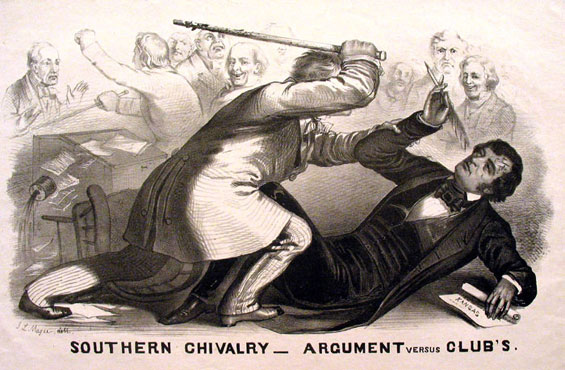
In 1856, Charles Sumner, a Massachusetts Senator, delivered an excoriating speech full of vicious name-calling and personal insults—especially against Senators Douglas and Butler—for their defense and advocation of slavery and especially the violence in Kansas in response to the actions of John Brown and his followers. The speech went on for two days, and shortly after its completion a man named Colonel Preston Brooks, a U.S. representative from South Carolina and distant relative of Andrew Butler, retaliated by beating Sumner with a cane. It was a serious enough beating that Sumner would take years to recover. Sumner would become an iconic hero to northerners and Brooks, who as punishment for the crime was fined $300, a darling of the south. Newspaper headlines of the time, in each region, painted their man a hero and the other man a demon (read a sample here: http://history.furman.edu/benson/docs/sumenu.htm). It is not the loathsome sin of slavery that I wish to highlight here, but the age-old tendency to blindly defend a person or position one feels inclined toward and the incredible efforts to vilify those on the other side of the issue—no matter what.
People are inclined to line up behind men rather than the Messiah. It is not just during political season or for certain social agenda items that this occurs, but more importantly in every season of the year when it comes to religious matters. Paul decried men’s tendency to be “of Paul…of Apollos…and…of Cephas” (1 Cor. 1:12). In the religious world, division has occurred because men have lined up behind some man’s teaching. Often, this teaching is a misconstrued view of a passage (for example, John 3:16, Acts 16:31, Mark 16:17, etc.) or a teaching without benefit of a passage (for example, having an experience of grace, saying a sinner’s prayer, infant baptism, etc.). As with politics, people can become blind apologists for their leaders and champions who promote what they already believe. Often, no amount of reason and logic can overcome the predisposed bias of the adherents. Lost in the cacophony of religious debate can be clear, simple biblical truth. Religious division is not the product or prompting of God (1 Cor. 1:10; 14:33). It is entirely of human origin. While there are some matters where God has not legislated, there are also some clear “right” and “wrong” matters in Scripture. Where God has spoken, we must take His word and will over that of absolutely anyone else. Otherwise, we will find ourselves guilty of elevating one above the One we must all ultimately give an account to. That would be an injustice and violation to top even “The Brooks-Sumner Affair.” May we keep our allegiance to God free from the taint of personal prejudices, even in the matter of our religious convictions. Psalm 119:89.
It allegedly happened in 2014, but now Fred Maldonado is taking In-N-Out Burger to court for what he said he found at the bottom of his cup. While their is some “fishiness” to his story and the restaurant “will vigorously defend [against] these baseless claims,” Maldonado “found a napkin and two capsules in the bottom of his milkshake cup” and “later testing revealed that the capsules contained methamphetamine” (from “Businesstech” article).
Search the internet a little and you will find more stories than you can probably stomach about what people have found in their prepared or packaged food and drinks. As a consumer, the thought of such is enough to make you grow everything you eat and never eat out again. In the supposed “meth” incident, add danger to disgust! There is a certain amount of faith and trust one has that those responsible for getting his or her food (or drink) will give them what and only what they paid for.
Tragically, every Sunday in churches across the globe, people sit down to receive what they sincerely believe to be the “bread of life” (cf. John 6:35) and the “water of life” (John 4:10). They trust that the one who is delivering it to them, maybe one they consider a friend and a spiritual brother, is giving them exactly what is claimed—the Word of God. Yet, Scripture warns that there are those who taint the message with something far more appalling and dangerous than anything else could be. Instead of truth, they get myths (2 Tim. 4:4). Instead of the sure word of Scripture, they get destructive heresies (2 Pet. 1:19-2:1). Instead of light, they get darkness (John 12:46). Instead of Christ, they get philosophy, empty deception, tradition of men, and elementary principles of the world (Col. 2:8).
Paul wrote that divine judgment awaits any who “did not believe the truth, but took pleasure in wickedness” (2 Thess. 2:12). The hearer has a responsibility to check what the teacher says, to make sure it is right and true (Acts 17:11). God will hold everyone responsible for what they did with His Word. Even though teachers face a stricter judgment (cf. Jas. 3:1), He holds you and me responsible for avoiding dangerous, disgusting doctrine. It takes practice to have our “senses trained to discern good and evil” (Heb. 5:14). Take charge of your own spiritual nourishment, from what you hear on Sunday to what you read every day!
Those of us who grew up in the ‘70s and ‘80s remember the infamous Life cereal commercial featuring “Mikey,” the finicky little boy who liked the taste of that cereal. Somewhere along the way, the story got out that Mikey—whose real-life name is John Gilchrist—ate Pop-Rocks candy, washed it down with a Coca-Cola, and had the resulting chemistry experiment explode in his stomach, killing him. How many mother’s absolutely forbad their children eat Pop-Rocks and drink Coke thanks to this story? It turns out to have been a hoax, urban legend, or whatever you’d like to call the fabrication. Today, Gilchrist, who appeared in a total of 250 commercials, is sales director at Madison Square Garden in New York City.
Who knows how these silly rumors get started? It has been said, “There’s a sucker born every minute” (stated by banker David Hannum rather than P.T. Barnum, as is popularly thought, by the way; R.J. Brown, editor-in-chief, historybuff.com). The idea is that people are gullible and many are trusting to a fault. Cynicism is its own problem, and gullibility can be amusing.
Too many, however, have bought into ideas that could not be more destructive. Consider the following sentiments:
“One church is as good as another”
“It doesn’t matter what you believe, so long as you’re sincere”
“God just wants you to be happy”
“Anything’s permissible between two consenting adults”
“Truth is whatever you think it is”
“If it feels good, do it”
Obviously, the list is rather long but these are illustrative of the point. How remarkable it is that such lies are nearly as old as the world itself. The serpent lied to Eve, selling her on the belief that she would surely not die if she ate fruit forbidden by God (Gen. 3:4). Jesus taught a group notorious for changing God’s Word, “You are of your father the devil, and the desires of your father you want to do. He was a murderer from the beginning, and does not stand in the truth, because there is no truth in him. When he speaks a lie, he speaks from his own resources, for he is a liar and the father of it” (John 8:44).
Who are we listening to? Are they telling us the truth? “Beloved, do not believe every spirit, but test the spirits, whether they are of God; because many false prophets have gone out into the world” (1 John 4:1).
The Restoration Plea is valid, vital, and victorious! It urges every believer in Christ to throw off the shackles of humanly-devised traditions and beliefs that undermine and contradict the sole, supreme authority of Christ. Religious division has been spawned through time because of men’s preference for their own creeds and doctrines. Reason and rationale becomes, “We’ve always done this” or “We prefer this” rather than “Thus saith the Lord!” With human nature, we are often prone to see such faulty thinking in others while being blinded to our own potential guilt. This happens to us individually and it certainly can happen to us collectively. Painfully aware of my own limitations and shortcomings, may I offer some cautions to us out of a sincere love of Christ and His glorious bride?
If the church of Christ will truly be undenominational,
We must build our faith and beliefs from the “text out” rather than assert our beliefs and then find verses to support it.
We must avoid blind loyalty to any individual, congregation, school, work, and the like.
We must determine not to press our inclinations, preferences, judgments, and opinions to the extent that such divides brethren or becomes matters of fellowship.
We must strive to preach and practice “the whole counsel of God,” even in unpopular matters or those we may have neglected (church discipline, evangelism, marriage, divorce, and remarriage, moral purity, first-century-like benevolence, etc.).
We must be patient and loving within and towards congregations, be they Thessalonicas or Corinths.
We must avoid unconditionally venerating and idolizing men above the Lord.
We must repent of our intensely “in-reach” philosophy and rededicate ourselves to intense “outreach” in our communities.
We must avoid convenient silence in our pulpits and classrooms regarding New Testament distinctiveness and doctrine.
We must increase our faith in the absolute, unqualified Lordship of Jesus.
This list is inevitably incomplete and imperfect. How could it not be, since it is put forward by one who is certainly both those things? Yet, it is put forward to emphasize that there is an urgent need for us to continually examine our beliefs and practices making sure our allegiance is to the Christ and not men—however great and noble they seem to us. Our Lord said, “He who rejects Me and does not receive My sayings, has one who judges him; the word I spoke is what will judge him at the last day” (John 12:48).
There are a couple of web sites out there regarding churches of Christ. While I do not have the time to read every page and all content, I spent some time looking at them in-depth. These sites have the following in common regarding their view of churches of Christ.
(1) They vehemently affirm that we are a denomination.
(2) They insinuate or explicitly say that we are a cult or close to a cult.
(3) They point out that we defend what we teach and practice with “ad hominem” (i.e., personal and character) attacks or with hateful, abrasive speech.
Given that we have no convention, headquarters, or central, governing body, no one of us can speak on behalf of every congregation or even every member of a congregation. Thus, I will not say that there are not congregations that have become denominational or even a denomination. Regarding denominationalism, what I can say is what I believe and teach (and what many others do). I do not rest my “heritage” in the life and works of Alexander Campbell, Barton Stone, or any other man but Jesus. What I teach is that we need to get “before” Catholicism and Protestantism, striving to teach and follow what New Testament Christians did. Is it possible to worship, teach the same way to salvation, and hold the same moral ideals and principles that the New Testament reveals that the first Christians did?
Regarding the charge of being a cult, religious experts on the subject, like Martin or Ankerberg and Weldon, define and describe a cult in great detail. Their description has been generally accepted as factual and logical. A cult is defined as a group of people who follow a person or that person’s interpretation of the Bible (Mary Baker Eddy, Joseph Smith, Jim Jones, or David Koresh). They consider their own writings of equal authority with the Bible. They redefine the most basic of Bible doctrines of concepts, including the Godhead, the deity of Christ, human suffering, and works. Their redefinition has no roots or resemblance to revealed scripture. They also work through excessive spiritual or psychological regulation or dependence (A&W, XXII). These do not even come close to describing mainstream churches of Christ.
However, let me say something about that last charge. Too often, well-meaning, passionate members of the church have been guilty of lacking adequate kindness and gentleness in responding to individuals like those responsible for the aforementioned websites. I can understand righteous indignation and love for Christ and His church. But, let us remember that it is never right to do wrong. To personally attack anyone, to allow righteous anger to become sinful anger, to be insulting, demeaning, ridiculing, or sarcastic is unjustifiable. Any defense of such tactics falls short of the ethical and moral standard taught in the New Testament. I have often heard it said, and I agree, that “if you’re not kind, you’re the wrong kind” or “you can be right, but be wrong.” Let us study more and sting less, being more knowledgeable and less nasty. Divine truth is powerful enough to stand on its own merit. Let us “speak the truth in love” (Eph. 4:15) and be known for our love (Jn. 13:34-35). It is our most powerful weapon to fight those first two, false charges.
The doctrine of Christ is indispensable! Timothy was told, “Pay close attention to yourself and to your teaching; persevere in these things, for as you do this you will ensure salvation both for yourself and for those who hear you” (1 Tim. 4:16). On the “soul-saving” front, too many have attempted to water down the message. Sadly, some members have sought to defuse a gospel sermon or Bible class, taught kindly but firmly, by apologizing to their non-Christian visitors for the distinctive message of the New Testament. If one is baptized who must be won through conniving, coddling, or coercion, that one will be converted to the wrong person or thing.
Let it also be observed that doctrine must be balanced with an intelligent, sensitive approach to soul-winning. By sensitive is meant, not the paranoid fear of offending which has given us “political correctness,” but a clear awareness of those whom we are trying to win to Christ. By intelligent is meant particularly common sense in reaching out to people.
We need to use discernment to “get them in the door.” This requires being approachable, friendly, and exemplary. If you try to mow them over with doctrine before you lay a foundation of trust and genuine concern, they will “turn you off” on the subject. You must also “use hospitality” (1 Pet. 4:9). Put an “open door” upon the hinges of your home–a warm and welcoming place to attract them to the idea of Christian entertainment, Christian family, and Christian living. “Clean fun,” genuine concern, and agape love demonstrated before them will get them in the door.
We need discernment while they are “inside.” Have a desire to make visitors feel at home. This may not initially be comfortable for you. But, let no one blame God for not making contact with visitors. Too many say, for instance, “It is not in my personality to ‘go up’ to others.” If that is so, modify your personality. Shy, quite people who love souls have moved out of their “comfort zones.” Preachers and teachers should speak the truth in love (Eph. 4:15). It is never necessary to be insulting or belligerent in plainly, firmly presenting the gospel. Watch how you interact with others! An obnoxious comment or rudeness, to whomever it is directed, may forever shut the door. Use more self-control in your dealings with everyone (2 Tim. 3:3).
We need discernment after they become part of the family. Remember, babies cannot eat meet. There needs to be classes for spiritual babes (cf. 1 Pet. 2:2). Exercise patience liberally (1 Th. 5:14). There should be much more intolerance for moral and doctrinal sins by those who have been in the church for a long period of time than for those young in the faith.
The lost are just that–lacking direction as they walk in darkness (1 Pet. 2:9). After Paul asked for prayers for wisdom in speaking to the lost, he charged us to conduct ourselves with wisdom toward outsiders (cf. Col. 4:4-6). Let not one iota of doctrine suffer in that, but use common sense in imparting it!












 The Preacher Pollard Blog