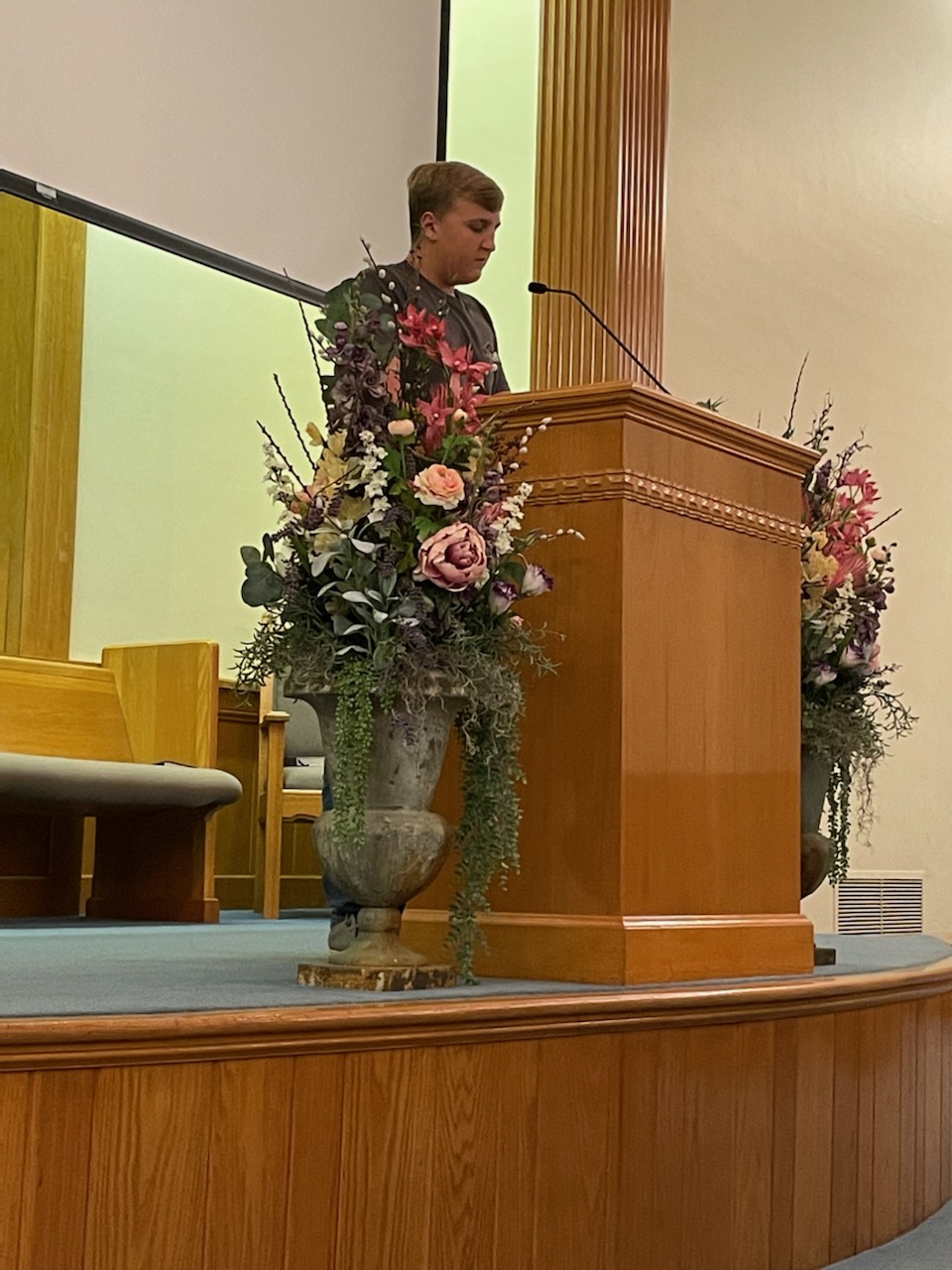
“Let love be genuine.” This phrase from Romans 12.9 is familiar and deceptively simple. It sounds good and feels good! But what does it mean?
It means we can’t pretend to love people. Ανυποκριτος means “not pretending” or “acting” something. In other words, don’t pretend to love people with the goal of getting something out of it. Don’t pretend to love people when we don’t.
We don’t usually show our real selves to other people. Aside from our close friends and family, we show other people who we want them to see. There’s nothing wrong with this; all cultures adopt levels of social scripting and behaviors based on how close we are with another person. The church is a family, and it’s hard to remember that sometimes. We’d rather keep people at arm’s length (I’m guilty of this) than get into the messiness of close relationships.
Once we get past the formal, arm’s length level of closeness, things get complicated and messy. But they’re also rewarding and uplifting! Whatever we see in our Christian family, God expects us to love like we mean it. There’s no room for fake in this family! Since our lifestyle can be challenging, we need to know that we can rely on each other.
God showed us genuine love by proving it. He proves it every day by keeping us “good to go” if we’re walking in light (I Jn 1). Showing real love has personal benefits, sure, but it mainly benefits others. We may never know how much showing genuine love impacts another person, but it could be the pivotal point of their relationship with God! How cool is it that, just by being genuine, we potentially change people’s eternity?!
Most people can think of a specific location that brings them joy. It could be a vacation destination, a certain getaway spot, or a favorite city or park. It’s a location that is filled with memories and good times. We find ourselves dreaming about those places when we are loaded down with life. What we wouldn’t give to be relaxing on that beach, away from all the work and responsibilities. What is it about these places that causes us to long to be there? It’s the thought of being somewhere that’s free of care and worry. In scripture, salvation is often described as being found in a very specific location. The Bible records numerous examples of when God saved His people in a specific location. The Passover in Exodus 12 is an example of this. If the people wanted to keep their firstborn children, they were to spread blood on the doorposts of their homes. By doing this, the death angel would pass over the houses with blood on them. There are several other examples of salvation being in a specific location such as Noah’s ark in Genesis 6-9 and Rahab’s home in Joshua 2. If salvation was found on the ark and in Rahab’s home, where is it now? Scripture teaches us that the church Christ died to establish is the place of safety today.
—The plan: a new covenant (Mark 14:24) –The purpose: save the souls that are added to the body (Rom. 8:1-3) –The promise: eternal life (1 Jn. 5:11)
The Old Testament examples mentioned all contained specific instructions: Build the ark out of gopher wood, pick a certain amount of animals, and tie a scarlet rope to the window. These specific locations brought salvation but only through obedience to God and His plan. What specific instructions do we have today? The contents of the New Testament explain in perfect detail how we can be added to God’s location of salvation. The ark saved Noah and His family from destruction, the scarlet rope tied to the window of Rahab’s home saved her and her family, and baptism (Acts 2:38; 1 Pt. 3:21) will save anyone and everyone that wishes to be added to the church.
There’s the story told of an elderly lady that was amazed at how nice the young man next door was. Everyday he would help her gather things from her car or help her in her yard. One day the old lady finally asked the young man, “Son, how did you become such a fine person?” The young man replied, “Well, when I was a boy, I had a drug problem.” The old lady was shocked and said, “I can’t believe that.” The young man replied, “It’s true, my parents drug me to church on Sunday morning, drug me to church on Sunday night, and drug me to church on Wednesday night.” Have you ever paused and thought about why you go to church? What reason causes you to bring your kids to worship? What’s the point? Contained in the pages of God’s Word we can find at least three reasons why we go to church.
A Past Example
God is a God of remembrance. He would repeatedly instruct, comfort, and encourage the Israelites by reminding them of things He had done in the past. He used reminders of past instances to help motivate His people. God’s Word continues to do that for us today. It is filled with past examples to help remind us why we come together each week. We go to church because of a past example (Acts 2:41-47; Acts 20:7).
A Present Encouragement
1 Thessalonians 5:11 says, “Therefore encourage one another and build one another up, just as you are doing.” Hebrews 3:13 says, “But exhort one another every day, as long as it is called ‘today,’ that none of you may be hardened by the deceitfulness of sin.” Each week in the world we may feel outnumbered trying to live a godly life. When we come together we’re reminded that we aren’t the only ones that are trying to be like Christ. William Ward once said, “Flatter me, and I may not believe you. Criticize me, and I may not like you. Ignore me, and I may not forgive you. Encourage me, and I will not forget you.” Our present encouragement comes from unity and the sharing we all have with each other. We’re encouraged through fellowship, but also praise. Worship is a time to reflect on God and what He has done for us. We focus on His nature and His love and we praise Him because we are blessed beyond belief. Our present encouragement comes from our time spent praising God our Father. We come to worship to receive our present encouragement.
A Future Event
On February 3, 2018, Robert Meilhammer, 51, of Crapo, Maryland, was struck in the head by a dead Canada goose. The bird that hit him was 14 pounds and had a nearly 6 foot wingspan. It plunged from the sky after a fellow waterfowl hunter fired a blind shot on a flock overhead. The goose fell about 90 feet, knocking the hunter out instantly and causing head and facial injuries. If you could see what was coming you would prepare. If Robert Meilhammer would’ve known about the goose coming he could’ve taken a step forward to keep from getting knocked out. If we knew what was coming, we would prepare. God in his love and grace has revealed what is coming and what needs to be done in order to prepare. We come together to remind each other of the day that is coming in the future. We come together to encourage our church family to fight the good fight, keep the faith, and to stay the course. Mark 16:16 says, “Whoever believes and is baptized will be saved, but whoever does not believe will be condemned.” The judgement day is coming and God is clear on what we should be doing. Get prepared and stay prepared by going to church. We assemble as a family on the first day of the week because of a past example, a present encouragement, and a future event.
Jesus has come to Jerusalem and taken the gloves off. By His unparalleled authority, He is directly challenging the religious establishment whose shallow righteousness has been rejected by His Father. He has come to take the Old Law out of the way and establish His church. It’s teaching like this parable in Luke 20:9-18 that will provoke those leaders to the point that they will trump up charges and bribe false witnesses to arrest, try, and have Him crucified. This parable is stark and shocking, and the moral as heavy as an anvil. Notice.
THESE LEADERS WERE GUILTY OF IMPROPER STEWARDSHIP (9). The “man” in the parable represents God, the Father. He made Israel a nation and gave the Jews a Law to follow and keep. The Jews, particularly the religious leadership, were entrusted with faithfully carrying it out, but they did not.
THEY WERE GUILTY OF TAKING WHAT DIDN’T BELONG TO THEM (10). In fact, these leaders–dubbed “the vine-growers” by Jesus in this parable–thought that they were in charge. They sought to make people subject to them, to follow their rules (cf. Rom. 10:3-4). The end result was vain religion (Mat. 15:8-9).
THEY WERE GUILTY OF ABUSING THOSE SENT TO THEM (11-15). The “slaves” sent to them were presumably prophets and teachers, no doubt inclusive of John the Baptist. These were the Father’s spokesmen, come to teach and correct them. Each one sent was treated the same, sad way: they “beat him and sent him away empty-handed.” Last of all, the son was sent (13-14). The “owner” (the Father) sent Him, saying, “I will send my beloved son; perhaps they will respect him” (13). Instead, seeing Him as the heir, they plotted to kill Him (14). Obviously, Jesus is referring to Himself and the very thoughts these religious leaders were thinking as He told the parable!
THEY WERE GUILTY OF LOSING WHAT WAS ENTRUSTED TO THEM (16-18). Instead of being convicted by this parable, these religious leaders recoil at the moral of the parable: “What, then, will the owner of the vineyard do to them? He will come and destroy these vine-growers and will give the vineyard to others” (15-16). Their emotion boils over and they audibly reply to Jesus’ parable, “May it never be!” They missed the travesty of the behavior they and their forefathers had shown to God’s messengers and the sin they were about to perpetrate on His Son. They didn’t want to lose their grip on the power and influence they had taken. But Jesus doubles down, changing the imagery from a vineyard to building construction. They were going to reject Jesus, the stone, but He would be made the chief corner stone. He would judge and destroy them, if they did not abandon their rebellion.
Jesus is full of love, kindness, and peace. But, that’s an incomplete picture of Him. He came to establish His rule and reign. He must be King and Lord of our lives. We must submit to His way and truth to enjoy His life.
When it comes to the families that make up the church, what ties us together is a common bright future. While every family has its differences, one constant remains— the church. All strive to follow those guidelines laid out in scripture. Paul says in Philippians 1:6, “And I’m SURE of this, that He who began a good work in you will bring it to completion at the day of Jesus Christ.”
The writer speaks with assurance and that confidence is well-placed. From His-story we see that God always completes His projects. He never dreams, He creates. He decided to create the world and here it is. He decided to save the world, and here we are.
Paul also would write in Romans 7-8 that the flesh tends to get in the way of the spiritual. God is perfect, but we’re not. That’s what makes us a work in progress. Aren’t we thankful that God provides the solutions to “fix” us up?
We’re involved in a great work because there simply is no better work than what is being done by His church. That being said, many of us struggle with overcomplicating things. We try to make sense of our individual lives, and when we leave God out it all becomes a discouraging battle. Where’s the peace? Joy? Confidence? Maybe it was left behind when we left God’s path. Thankfully God came down to earth years ago to teach us everything we need to know. We see that in His interactions with people. Even His twelve original followers were an odd group.
Each had a diverse background. Some were Fishermen and some tax collectors.
Each one had a unique personality too! They ranged from timid to assertive.
Each one had spiritual battles from greed to crippling doubt.
Yet each one rallied under His leadership and were united through a common hope.
What’s changed? Not much.
The personalities, talents, backgrounds, and flaws mixed together create a unique blend that make up each one of us. Yet, here we are rallied under His leadership, united in common hope.
Members of the church in the Bowling Green area at an FCA fundraiser.
It was our largest crowd since before the Pandemic. It was a targeted effort to fill the building. The building was full! I asked several how many non-members were present and the most conservative answer was dozens, perhaps fifty. While we know that filling the pews is only one factor in encouraging people to follow Jesus (discipleship), it is a pretty fundamental and important one. Let me share a few exciting things I saw.
I saw the power of an invitation. The elders laid out a challenge to us to invite every non-member we could think of, coworkers, family members, friends, classmates, acquaintances, etc. That’s not revolutionary. Perhaps it was the sheer volume of invitations so many members issued. Such seeds were spread far and wide, and Sunday was an indication that some will come if asked. I am confident that many who were invited will come in the future, if we continue to ask. Philip invited Nathanael to “come and see” (John 1:46), and it changed Nathanael’s life! Andrew told his brother, Peter, “We have found the Christ” (John 1:41)! It changed not just Peter’s life, but the thousands of lives Peter eventually touched. Who knows the eternal impact made by all the invitations issued this weekend, but it shows that there’s still power in a simple invitation!
I saw the strength of teamwork. That was on display in so many ways. There was a huge team of people greeting those who entered our doors. Anticipating a lot of visitors, this was organized beyond the ordinary measure. It was exciting to see so many doing this, and it seemed to be infectious. Others joined in. It was evident in the efforts of multiple deacons and vision groups coordinating various works. It extended to members in the auditorium warmly welcoming unfamiliar faces and making our visitors feel at home. It continued on to the potluck after Bible class with the scores of people bringing an abundance of food, serving, assisting, and cleaning up. We were a finely-tuned machine of coordination. I could not help but think of Paul’s words, to Philippi (“make my joy complete by being of the same mind, maintaining the same love, united in spirit, intent on one purpose,” 2:2) and Colosse (“beyond all these things put on love, which is the perfect bond of unity,” 3:14). Sure, he had more in mind that one event on one day, but this is a key way such overall unity is built.
I saw the example of leadership. This began with the eldership. They not only challenged us to invite, they led the way. It’s not an exaggeration to suggest that the four of them invited hundreds of people by text, phone, and face-to-face. They invited friends, family, acquaintances, and strangers! True leadership shows the way! This included those who led in worship. There was forethought, effort, and coordination from the greeting to the announcements and every act of worship in between them. This involved the membership who enthusiastically engaged in the worship. It also takes in every one that helped people find bathrooms and classrooms. Leadership always breeds more leadership. The writer of Hebrews says, “Remember those who led you, who spoke the word of God to you; and considering the result of their conduct, imitate their faith” (13:7).
I saw the hope of tomorrow. The effects of the last 18-plus months have been deflating and demoralizing. We have lost members to Covid, physically and spiritually. It has derailed plans. It has distracted us. But Sunday showed that by faith in God and by following His plan, the best is yet to be! As we were reminded at the end of the day yesterday afternoon, we have worship every Sunday so let’s keep inviting. How many Bible studies will result from inviting others to church? How many future preachers, elders, deacons, soul-winners, and Bible class teachers are represented in those who walked through our doors yesterday, some for the first time ever? To some degree, we’ve got to be like Paul and say, “forgetting what lies behind and reaching forward to what lies ahead, I press on toward the goal for the prize of the upward call of God in Christ Jesus” (Phil. 3:13b-14).
There’s more to do! There’s more inviting to do. There’s more follow up to do. But I see more than a special event in what occurred on Sunday! I see a culture change and a purposed people. Think what God can do with that!
(Tuesday Supplement. Note: I am well aware that there are those who are immunocompromised and cannot attend. This is not in any way meant to discourage or dishearten those in this condition. God knows and understands.)
Neal Pollard
Covid has touched nearly every family I know, including my own. It would be foolish to say that it is harmless. It has claimed nearly 5 million lives as of today. So, I have heard from many good, thoughtful people, this statement: “I can’t come to church because of Covid.” Please accept that with deep, genuine love, there are a few questions that need to be asked alongside of this.
Are we being consistent? Are we still going to the grocery store, the restaurants, the beauty shop, the office, the classroom, the gym, and the doctor? Chances are at least as great that we will contract Covid in one of those places as at church. People are not more clean or careful in those places.
Are we properly prioritizing?Perhaps we see the stores, the job, the school, and the medical as essential and necessary. Jesus puts our spiritual health and that of His body above all else (Mat. 6:33; 16:26). How could we conclude that any of these others are more important than His kingdom?
Are we considering others? Perhaps we console ourselves by saying that we’re getting what we need by watching Facebook, Vimeo, YouTube, or wherever services are live-streamed. But, worship and Bible class is not simply about our being fed. We must consider one another to stimulate unto love and good deeds (Heb. 10:24). That is said in connection with assembling together (Heb. 10:25), and how is this done by one who stays away from the assembly?
Are we weakening our spiritual strength? Is it getting easier to stay away or opt to just catch it on the phone, computer, or TV when we don’t feel like coming? Are we losing our desire to be with God’s people? Isolation has many effects, some more subtle than others.
Are we assessing our fears? Those who are waiting for Covid to go away will be waiting years or longer. This is a virus. Scientists doubt that it can be eradicated. It spreads too quickly. Perhaps it will be like Polio or smallpox, but how long will that be? Will we stay home for years? Meanwhile, where will be, spiritually, years from now if we have disconnected from our spiritual family?
After 18 months, perhaps it is time to do some serious reevaluating? Instead of only allowing news outlets to be our guide, we need to balance that with careful study of God’s Word. Instead of considering just this life on earth, we should balance that by considering this life is for preparing for eternity. We need to be back together–all of us, now more than ever.
“…Cared More About The Lost!” (But, when did I last invite someone to church or invite someone to study the Bible?)
“…Checked On The Sick And Shut In.” (But, when did I last make a call or visit to them?)
“…Was Friendly!” (But, do I talk to, welcome, and make feel at home visitors and more than my close circle of friends?)
“…Did A Better Job With The Singing.” (But, do I sing out, show enthusiasm, and participate with my whole heart?)
“…Invested More In The Youth.” (But, am I doing all I can to help them grow, from my attitude toward the church to my personal investment in them?)
“…Was Active!” (But, do I volunteer when help is needed, prioritizing it over the things of the world?)
“…Was Growing.” (But, how invested am I in being an ambassador for Christ, 2 Cor. 5:20?)
So often, we talk about “the church” in a passive, third-person way. We are critical of her leaders, her activities (or lack thereof), and her members as if we are detached observers. The picture of the early church was of individuals who were personally invested. We are overcome by the consumer mindset of the culture when we sit back and take shots at the perceived shortcomings of our local congregation. Look at the New Testament Christians. Barnabas didn’t fret about how stingy or discouraging the church was; He was generous and encouraging (Acts 4:36-37). Stephen didn’t express his frustration at the church’s lack of courage and conviction; He literally preached himself to death (Acts 6-7). Dorcas didn’t wring her hands at how uncaring and detached the church was; She continually did deeds of kindness and charity (Acts 9:36). They may have been extraordinary in their actions, but they were just “regular members of the church.” They were the church. They didn’t sit in judgment of her. Why? They were too busy working to build her up. When I am tempted to play armchair analyst, I should begin with my own faithfulness and involvement. There is so much the Lord expects me to do to help the church. My investment may cause others to be grateful and excited to be a part of the church! I can most influence me (2 Cor. 13:5)!
On January 20, 1961, in John F. Kennedy’s inaugural address, he uttered the famous line, “Ask not what your country can do for you–ask what you can do for your country.” Here is the very ending of the address: “With a good conscience our only sure reward, with history the final judge of our deeds, let us go forth to lead the land we love, asking His blessing and His help, but knowing that here on earth God’s work must truly be our own.” If that is true of a citizen’s mindset of a nation, how much more a Christian’s mindset in that holy nation, the church?
The Muppets are great. Those classic characters like Kermit the Frog, Animal, and Fozzy Bear have entertained us for years. The writers of that show understood and appreciated the humor found in irony. In one particular episode, Mrs. Piggy is about to marry Kermit and It’s hilarious to see a pig in a wedding dress. Pigs don’t wear dresses…or do they?
The church has been described as the “Bride of Christ” (2 Cor. 11:2-3). What kind of bride are we? An ugly bride is not unified, calloused towards one another, hateful, hard hearted, hard headed, and proud. The truth is, an ugly church can only be made up of ugly people. Sin is an ugly thing, and the display and manifestations of sins such as pride and hatred turn even the worldly away.
Think about 1 Peter 3:8-11, “Finally, all of you, have unity of mind, sympathy, brotherly love, a tender heart, and a humble mind. Do not repay evil for evil or reviling for reviling, but on the contrary, bless, for to this you were called, that you may obtain a blessing. For “Whoever desires to love life and see good days, let him keep his tongue from evil and his lips from speaking deceit; let him turn away from evil and do good; let him seek peace and pursue it.” What we have described and depicted here is an attractive bride. Don’t let your life combined with Jesus be a juxtaposition. Don’t make the Bride of Christ a pig in a dress.
A few months ago, Lehman and a bunch of other churches went to church camp. During that week, I got to think about family. A quote I read once by Lisa Weed said, “Being a part of a family means you are a part of something very wonderful. It means you will love and be loved for the rest of your life.”
Let me start off by defining family. According to Webster’s dictionary, one definition is “the group of one or more parents and their children living together as a unit.” That kind of family can be shown through the illustration of a loving husband giving his wife some facial masks on Christmas Morning. As she opened the gift, her 5-year-old daughter asked what they were. The Mom replied, “It’s a present to make me beautiful.” After the mom applied one of the facial masks, the little girl looked at her mom and replied, “Mom, it didn’t work.”
Another definition Webster’s gave is “all the descendants from a common ancestry.” To me, that sounds like the relationship God has with His church. 2 Corinthians 6:18 says, “And I will be a father to you, and you shall be sons and daughters to Me,” says the Lord Almighty. Ephesians 5:25-27 defines the church family as being without blemish. “Husbands, love your wives, just as Christ also loved the church and gave Himself for her, that He might sanctify and cleanse her with the washing of water by the word, that He might present her to Himself a glorious church, not having spot or wrinkle or any such thing, but that she should be holy and without blemish.”
Thankfully, God has given us the opportunity to be part of a perfect family. Maybe you’re not a member of the church family, and you would like to put Christ on in baptism or you want us to pray with you and for you so you can get your life on track. Whatever your need, please reach out to God’s perfect family.
When it comes to the families that make up the church, what ties us together is a common bright future. While every family has its differences, one constant remains— the church. All strive to follow those guidelines laid out in scripture. Paul says in Philippians 1:6, “And I’m SURE of this, that He who began a good work in you will bring it to completion at the day of Jesus Christ.”
The writer speaks with assurance, and that confidence is well-placed. From “His-story” we see that God always completes His projects. He never dreams; He creates. He decided to create the world and here it is. He decided to save the world, and here we are.
Paul also would write in Romans 7-8 that the flesh tends to get in the way of the spiritual. God is perfect, but we’re not. That’s what makes us a work in progress. Aren’t we thankful that God provides the solutions to “fix” us up?
We’re involved in a great work because there simply is no better work than what is being done by His church. That being said, many of us struggle with overcomplicating things. We try to make sense of our individual lives, and when we leave God out it all becomes a discouraging battle. Where’s the peace? Joy? Confidence? Maybe it was left behind when we left God’s path. Thankfully God came down to earth years ago to teach us everything we need to know. We see that in His interactions with people. Even His twelve original followers were an odd group.
Each had a diverse background. Some were Fishermen and some tax collectors.
Each one had a unique personality too! They ranged from timid to assertive.
Each one had spiritual battles from greed to crippling doubt.
Yet each one rallied under His leadership and were united through a common hope.
What’s changed? Not much.
The personalities, talents, backgrounds, and flaws mixed together create a unique blend that make up each one of us. Yet, here we are rallied under His leadership, united in common hope.
Several Lehman ladies (men are at the table in the foreground) enjoying “Federal Grove” the night before it (sadly) closed, being regaled with one of Kathy’s stories. I think this one was about snakes crawling out of a hole.
Ephesians 4 describes some spiritual gifts. Their purpose is to allow the church to function as it should. A properly functioning church spends eternity with God.
A functional church is on the same page (one mind), has spiritual depth, and is workable (more on that in a bit).
Ephesians 4.12ff is about members’ roles. What are they for? Everyone serves to equip saints. Saints are people who have pledged allegiance to God.
We train for morally good works and become stronger through encouragement (12,16). We work toward a unified mindset, knowing Jesus, spiritual maturity, and we pursue the highest standard (Jesus) (13,14).
We work to avoid immaturity and gullibility (14). We pursue maturity until our mindset emulates Christ’s (15). He’s described (multiple times) as the standard we have to have. There’s no room for spiritual laziness here.
Jesus causes growth spiritually, but only if we’ve become soil that can be worked. If our minds aren’t mature, we aren’t workable. Elders are spiritual farmers, our hearts are the soil. If we use Jesus as our standard, we are workable. If not, we’re spiritually dead.
So, what can we do individually? Make the church strong by pursuing unity, by having spiritual depth, and by being workable. If we work on those things we will spend forever with God.
Christian monasticism arose within the fourth century AD. The proponents of monasticism felt they were able to live holier lives in isolation. There are still monasteries around today, but the movement is not nearly as popular as it used to be. I think all but a few introverts would enjoy the idea of spartan monasticism today. Besides, monasticism is antithetical to Christian teaching since it is hard to be salt and light to the world, secreting yourself away from where you can influence others (Matthew 5.13-16). But, oh, are we not vexed (oppressed) like Lot living in Sodom? (2 Peter 2.7-8) We are. And that is why we sometimes fantasize about living in a genuine, Christian community.
That is a rather funny fantasy, though. Christians do have this community. It is called the ecclesia (the assembly or church). Early Christians availed themselves of it by meeting DAILY for worship and fellowship (Acts 2.46-47). We often use economic rationale to justify limiting our assemblies to a maximum of about four gatherings a week. But did our Christian forebearers not have to work? Did these brethren lack familial responsibilities? We must agree that they learned to make time for what was important to them. These earliest Christians truly embodied the command to seek God’s righteousness and Kingdom first (Matthew 6.33).
However, “Going Galt” is a different concept entirely. The term comes from a dystopian novel by Ayn Rand in the same vein as George Orwell’s 1984. Rand’s book, entitled Atlas Shrugged, presents a mysterious man named John Galt who seeks to persuade those producers exploited by a heavy-handed government to withdraw to seclusion to deprive said government, termed “looters,” from continuing to use them. Ultimately, these “strikers” (striking from participation in said society) desire to establish a new capitalistic society founded on Galt’s philosophies, concepts like individualism and reason. It was a flop in its time but has since become popular among the politically conservative and libertarian.
A person choosing to “Go Galt” in 2021 would move to an area where they can find political kinship with the existing population. In other words, to co-opt our current colorful political nomenclature, someone voting “red” would move from his “blue” majority state to one matching his voting preferences. “Going Galt” would also mean ditching businesses that have become overtly political in their messaging. A recent example of this would be the avoidance of the Coca-Cola Company for embracing critical race theory. As the current bogeyman is socialism, the idea of those advocating “Going Galt” is to deprive champions of socialism of the material needed to advance the political ideology further. Essentially, you cut off their access to taxpayers and lower their profit margins.
Peter referred to the Old Law as being a burden no one could keep (Acts 15.10). In many ways, trying to isolate ourselves from others as Christians or “Go Galt” morally would prove an equally arduous task. It is easy to highlight a particular product to avoid, but the said product’s producer likely makes many other products that we may not escape. Or, if you have a 401(k), your mutual fund may buy into stock in the company you wish to punish. You would have to do your research. I do appreciate the idea. The problem, as always, is one of execution and consistency.
As we often say, “We are in the world but not of it” (cf. John 17.15-18). Jesus said the only way we could avoid these types of problems would be for God to take us out of this world. However, that is not practical since He is sending us out into that world with the Gospel (cf. Matthew 28.19-20; Mark16.15-16). Ultimately, choosing where to live and work or the products one buys, as long as no one supports immorality, falls under the umbrella of Christian liberty (cf. 1 Corinthians 6.12; 10.23;8.1ff; Romans 14.1ff). I may have a problem with the direction that the Walt Disney Company has gone, but I cannot condemn you for subscribing to Disney Plus so you can watch “baby Yoda.” Disney Plus isn’t something like pornography, even if parents need to be mindful of the secular humanistic and evolutionary concepts found in Disney programming today.
The most excellent solution for those contemplating something akin to monasticism or “Going Galt” is to lose yourself in the local church. Seek opportunities for fellowship with your brothers and sisters. In so doing, not only do you find needed support, but you can find those to help shoulder your burdens as you help to shoulder theirs (Galatians 6.2,10). The church, after all, is one of those heavenly places where our blessings may be found (Ephesians 1.3).
Every home has some kind of system in place to keep order. Maybe you were told to take your shoes off at the door, keep your elbows off the table, make your bed in the morning, or brush your teeth more than twice a month. Every home is different and the expectations for conduct and cleanliness vary accordingly. However your home was structured, you were at least bound to a set of rules in some form.
God’s house is no different. I’m not just talking about the building we meet in for worship, but that anytime His family offers up worship to Him we are expected to follow His rules. I Timothy 1.4 talks about God’s “house-law” (often mistranslated “stewardship” or “godly edification”). The word is οικονομία (oikonomia), combining οίκος (house) with νόμος (law). What does this mean in context? In I Timothy Paul publicly berates two members who were teaching “myths and endless genealogies which do not promote the house law of God in faith” (1.3, 4; 20).
If any teaching goes against what God has told us He wants, it’s a violation of His house-law. We understand this when it comes to daily life outside of religious activities. If we break the law we are held accountable to it. We understand that violating the laws our governments put in place to maintain order and promote justice carries consequences. Some, though, do not act as if the same applies to God’s people in a religious context.
God’s house-law is more specifically defined in I Timothy 2.1-8. Anytime and anywhere Christian men and women offer worship together, God expects qualified Christian men to lead. This is made clear with the phrase, “…in every place” (2.8). God’s house, God’s rules.
Not just any man can lead, though! He must be someone who is able to lift holy hands (that is, he is pure in life and can offer worship without the stain of sin), he must be cool-headed, and he can’t be unstable in his faith (2.8). God’s house, God’s rules.
God expects women to avoid drawing undue attention to themselves (2.9, 10) and are to allow godly men to lead them in worship (2.11-14). His house, his rules.
In all of my vast wisdom and experience as a child, I didn’t always agree with or like all of my family’s house rules. Probably every teen and their unfortunate parents experience this. My feelings about a house rule did not alter its validity in any way. It was not my house so I was not in a position to change or violate the rules. Trying to do so was not only futile but often carried consequences.
God’s design for His church is not acceptable to the secular world. In their disagreement or downright hostility toward it they have pushed many churches into changing God’s house-laws. This doesn’t fly in the legal world, the home, or in any setting where rules were set in place by those most qualified to make them. Why would it work with God?
We may not always understand why God made the laws that He did, but this is where the faith aspect of 1 Timothy 1.4 comes into play. We have to ask ourselves, “Do we trust that God knew what He was doing when He made these laws, and do I really want to challenge Him on the rules He made for His own family?” At the end of the day we must remember that in God’s house we follow God’s laws. Many of the problems facing the church in 2020 can be solved simply by accepting this fact! If we do – as in any family – we will not only have harmony in the church, but a permanent, peaceful home with God after this life.
In this volatile political climate, many Christians face some uncomfortable dilemmas. Is party line a salvation issue? How do we handle seemingly irreconcilable differences? What do we do going forward?
Rather than delving into those questions, I’d like to focus on the attitude of the early church, which faced internal division–Jew/Gentile controversies like in Acts 15, opinions over cultural matters as seen in I Corinthians 8 and Romans 14, and external pressures.
In keeping with the spirit of the early church, let’s focus on the following list.
We must focus on and grow our own spiritual culture, independent of our earthly nationality (while observing Romans 13).
We must be faithful Christians who value being righteous, no matter the cost.
We must manage our concerns and worries by spending MORE time with each other and developing our faith.
We may need to see ourselves less as Americans and more as Christians. If we remember that our kingdom is the church first, we will be far more united.
Be awesome citizens. When outsiders hear about us, it should be that we never cause trouble, we are loyal to each other, we are selfless, we help people, we have strong families, we rely on each other, we are pleasant to be around, we are dedicated to our faith, and we love people who treat us poorly.
We must remember that priority number one is heaven. Everything else is second.
We must avoid talking or posting on social media about non-salvation issues that can and do create division or offense, out of courtesy and respect for each other (Romans 14.1-4; 13ff).
If these are the things we worry about and focus on, no political division or any other heartburn-inducing unpleasantness can affect us. Besides being happier, we’ll be a stronger church!
We get an interesting glimpse into the life of the early church in Acts 2.44-47. While it is not practical for us to live in that same way, there is one principle that we should examine. The early church spent a great deal of time together outside of their worship on the first day of the week. Acts 2.46 says, “And day by day, they were devoted to the temple together and breaking bread in their homes, they received their food with glad and generous hearts, praising God and having favor with all of the people.” What’s going on here? The members of the church dedicated time every day to growing in their relationships with one another. To them, “church” was so much more than just showing up for worship every time the doors were open. It was the Monday through Saturday relationships that fortified their faith. What was the result of this dedication? “And the Lord added to their number day by day those who were being saved” (Acts 2.47). Are we likely to live for a faith we have not invested in? Are we likely to stand up under trials if we do not have a sense of community in the church? Are we likely to resist temptation without strong ties in God’s family? The early church faced trials we could never understand, yet they remained faithful because of their strong relationships and resulting faith. The early church relied on constant contact with one another to help them build their faith. Nothing builds a Christian’s faith more than being around a group of people who want the same thing (to live like Christ), genuinely care for one another, and share a common goal (heaven).
There are just too many voices in the world today muddying the waters when it comes to 21st Century Christianity. In fact, the term “Christianity” doesn’t mean much to the average person. In fact, the average person will most likely have several friends who carry this title and they know based on their morals— they’re not really different. Sadly it’s a description that doesn’t describe much, other than an individual that believes in God. This word has been tragically stripped of what is the most rewarding life you could possibly live. There’s simply no higher calling, there is no greater purpose in life, and you just can’t beat the retirement plan.
Now let’s do something to help the seeking world out.
Let’s make it our priority to understand the church in such a way that we can simplify her mission and her origin.
Here are two terms that will help
The term “restoration” may sound similar to “reformation”, but the two terms could not be more contrary to each other. Restoration is an attempt to restore the church to the pattern we find in the New Testament, while reformation is a reforming of what currently exists. It’s a modification or addition which creates something new entirely. The Old Testament is filled with the pleas of the prophets for the people to restore their relationships with God.
2. The definition of the word “denomination” is evidence that restoration is not only possible, but needed. Denomination, in the religious world, describes a branch off of an original. Any branch coming off of the New Testament church, is simply not it.
Five Facts About The Lord’s Church
The NT church was established by Jesus, not Luther, Henry the 8th, Calvin, Smith, or Wesley
The NT church was established in Jerusalem, not Oxford, London, or Amsterdam
In NT times people were told to believe in Jesus, repent of their sins, be baptized by a total immersion of water, and to live faithfully (Acts 2:38, 16:30-31, 2:16, Mark 16:15-16)
Christians in the NT met on the first day of the week to partake of the Lord’s Supper, Acts 20:7
The NT church was a united church, while denominationalism is, by it’s very nature, divided.
If the church you are a part of can say the same, you can be confident that it is the church that Jesus established. If this is not what the church you are a part of teaches and practices, then perhaps this will be some information that will help you begin a life changing search to find God’s will for your life.
Many have heard, “Do not be deceived: bad company corrupts good morals” (I Corinthians 15.33). It’s not difficult to understand the concepts in this verse. If our closest relationships are with worldly people, our ethics and behavior will reflect this. Fun fact: the word for company here is ὁμιλία (homilia). The first part of the word sounds a lot like “homie,” so it’s easy to remember.
I want to look at the word “corrupt” a little more closely. At first, I thought it might be similar to Ephesians 4.29, “Let no corrupting talk come out of your mouths…” But that word is completely different and more closely describes decomposition. “Corrupt” in I Corinthians 15.33 means, “To cause deterioration of the inner life” (BDAG 1054).
Paul uses this same word earlier in the book. In I Corinthians 3, Paul talks about the church and her foundation (as in, her foundation is God and not men). By verse seventeen – still addressing the church – he says, “If any man destroys the temple of God, God will destroy him, for the temple of God is holy, and that is what you are” (emp. mine).
“Destroy” is usually ἀπόλλυμι (apollumi) or λύω (luo), but in this verse it’s the same word that’s translated “corrupt” in I Corinthians 15.33.
So what does this mean for us? It’s an extremely solemn warning to those who are corrupting or dividing the church today. At Corinth, the division was due to worldliness and basing their Christianity on prominent men like Paul or Apollos.
If our conduct is dividing the church, we need to read I Corinthians 3.17.
If what we’re talking about corrupts the bride of Christ, we need to read I Corinthians 3.17.
If we abuse the influence we have in the church, we need to read I Corinthians 3.17.
If our opinions, preferences, political views, or behaviors are in any way eroding the family of God, we have to quit them. A bad argument was enough for Paul to tell Euodia and Syntyche to, “Work out your salvation with fear and trembling” (Philippians 2.12). Their argument was hurting the church at Philippi, so Paul told them to get it together or their souls would be lost.
If love for the church does not motivate us to pursue unity, then it is time for us to cultivate a healthy fear of what negative actions can do to our souls. The church is eternally important and infinitely precious, so what could go wrong if we’re always looking out for others?