Sharing The Filling Fulness Of Christ

Gary Pollard

Some phrases in the Bible are simple to read, but very difficult to comprehend. In this article, I’d like to walk through a process together in an attempt to make sense of a difficult phrase (thanks, Paul). One of those is in Ephesians 1.23: “…the fullness of him who fills all in all.” This is a description of Jesus, specifically as it relates to His being the head of the church. But what does that phrase mean? 

I will not pretend to have the answer, but I would like to make a couple of suggestions. Firstly, “fullness” appears to describe the church. In my limited knowledge of Greek, it seems to be grammatically tied to “body.” The church – His body – is His fullness. Both are nominative, both are the subject of the sentence. 

Secondly, Jesus fills all in all. It’s that last phrase that’s so hard for me to comprehend. What does it mean, that “He fills all in all?” Based on the fact that some form of “fullness” is used three times in a single phrase, it appears to have reference to his nature. He is not confined by time or space and is present everywhere. 

If the church is His fullness (the word is possessive in Greek), and He is omnipresent (or, creation is full of Him), then the church must be extremely important. Again, I am not a scholar, I may be mistaken. 

I would, though, like to attempt to make application from this difficult phrase. If the church is, ideally, representative of the very nature of Christ, are we living up to it? Is our passion for the lost like His was/is? Is our love for each other as strong as His is for the church? Do we treat the church as if it were the body of Christ (because it is)? Do we keep in mind, as we interact with each other, that we all answer to Him? Are we trying to mold culture to His image, or are we being molded to culture? 

We really have to think about this one to try to make sense of it. Comprehending this phrase is anything but easy (at least for me!). But the church – which is one distinct unit, not a series of denominations – is supposed to represent Jesus. Our values, our demeanor, our goals, our mission, our attitudes, our behavior, and our purpose should scream to others, “We are not of this world.” If these do not, we are not representing Jesus. No one will do this perfectly, but the standard is high. 

When we begin to understand this phrase a little more, it shifts from being hard to understand to being hard to hear. We have a huge responsibility, but we also have a global family to support us. The standard is high, but our Head is also our Savior. We’re not just Christians to be good people, we’re Christians to show the world who Jesus is.

The High Cost of Careless Endorsement

Brent Pollard

You’ve received a notice from a page you interacted with through videos. The owner invites you to accept a badge showing you’re a top fan. A simple tap awards a badge for others to see—endorsing a page, personality, or content. It takes less time than a sneeze, but the algorithm remembers and quietly influences your feed. Paul understood quick endorsements early on: “Do not lay hands upon anyone too hastily and thereby share responsibility for the sins of others; keep yourself free from sin” (1 Timothy 5.22).

What the Laying On of Hands Meant in the New Testament Church

Timothy worked diligently in Ephesus under apostolic guidance to organize the congregation. Part of this effort involved appointing capable men to leadership roles. When the church laid hands on someone, it was a meaningful communal act. For example, at Jerusalem, the seven were presented to the apostles, who prayed and then laid their hands on them (Acts 6:6). Similarly, the church at Antioch fasted, prayed, and laid hands on Barnabas and Saul before sending them out (Acts 13.3). Timothy himself received a spiritual gift through prophetic words and the laying on of hands by the elders (1 Timothy 4.14). This gesture represented unity—confirming that the man represented the church, his teachings reflected their doctrine, and his character bore their name.

Because the act spoke loudly, Paul called for deliberate reflection. The qualities in 1 Timothy 3.1–7 and Titus 1.5–9 read like an in-depth character check—nothing a résumé can shortcut—being above reproach, temperate, prudent, able to teach, and maintaining “a good reputation with those outside the church” (1 Timothy 3.7). Paul explains why patience is vital: “The sins of some men are quite evident, going before them to judgment; for others, their sins follow after” (1 Timothy 5.24). Time reveals truth; character shows gradually. Someone who seems golden at first might only be gilded after a year.

Sharing Responsibility for the Sins of Others: The Doctrine of Shared Guilt

Here, the verse takes a serious turn. Paul warns that hastily endorsing someone risks more than embarrassment—it shares responsibility. Similarly, John states: “the one who gives him a greeting participates in his evil deeds” (2 John 11). A simple greeting, yet heaven views it as complicity since endorsement lends credibility, a form of moral currency. When the praised person falls into scandal, your hands are stained in the aftermath.

Paul urges us to avoid darkness and expose it (Ephesians 5.11). God illustrates this. He tested David and Jesus in hidden ways before giving divine approval. Should we rush to commend before celestial insight?

Keep Yourself Free from Sin: Discernment as an Act of Consecration

The verse closes with a call: “keep yourself free from sin”—meaning stay pure. But purity isn’t about primness; it’s about dedication—consciously dedicating your influence, your name, and your affections to what God approves. “How can a young man keep his way pure? By living according to Your word” (Psalm 119.9). The pure heart doesn’t just avoid defilement; it values something nobler. Paul prayed that love would flourish “in genuine knowledge and all discernment, so that you may approve the best things” (Philippians 1.9–10). When practiced rightly, discernment isn’t suspicion; it’s worship. It’s a declaration to God: my approval belongs to You first, and I will not squander Your blessings.

There’s real joy here, more lasting than earning a badge. The believer who chooses his associations sleeps peacefully, keeps a spotless reputation, and finds fulfillment in God’s approval, not algorithms. “You will make known to me the path of life; in Your presence is fullness of joy” (Psalm 16.11). Solomon emphasizes patience: “He who hurries his footsteps errs” (Proverbs 19.2). Rushing wastes time; holiness is savored.

Slow Hands in a Hasty Age: Practical Faithfulness for Today’s Christian

What, then, does obedience to 1 Timothy 5.22 look like when practiced consistently? It looks like the Bereans, who received the word with great eagerness, “examining the Scriptures daily to see whether these things were so” (Acts 17.11)—and they were examining an apostle. It looks like being “quick to hear, slow to speak” (James 1.19), and slower still to publicly commend. Before your congregation appoints a man, before you share a teacher’s video, before you badge a page or sign your name to a cause, let the questions of 1 Timothy 3 do their patient work. Watch the fruit. Wait a season. A hastily lent reputation returns slowly, if it returns at all.

Don’t overlook the vibrant gospel behind the command. When God embraced sinners, He did so purposefully and sacrificially, paying the eternal cost in blood. Christ stretched out His pierced hands and “gave Himself for us to redeem us from every lawless deed and to purify for Himself a people for His own possession, zealous for good deeds” (Titus 2.14). His favor bought your name, which you carry into every new connection. Gratefulness for costly grace calls for careful stewardship.

Keep your hands steady and heart eager—be thoughtful before endorsing, quick to obey. Carefully consider praise. Shine light on darkness instead of joining it. Use your influence for virtue and enthusiasm for good deeds. Remember, the One who never rushed to judgment extended His hands at Calvary. Live to honor that endorsement.

All Scripture quotations are from the New American Standard Bible, 1995 edition.

Serving The Living God

Carl Pollard

I know I’m not old enough to say this, but when I was younger I used to lay in bed at night and try to imagine what God looked like. I would try to put a face to Him, I’d wonder what He was doing, and I would ask myself if God knew that I was thinking about Him. I still ask those same questions to this day. I’m sure that most if not all of you who are reading this believe that there is a God, and that He does see and hear all that we say. So the question I’d like to ask is, “since there is a God that has all power, why do we sometimes have difficulty following the commands that we find in the Bible?” I’d like to look at a verse that may help us realize the importance of following what God has told us to do as Christians.

Jeremiah 10:12 says, “It is He who made the earth by His power, who established the world by His wisdom; and by His understanding He has stretched out the heavens.”

God has ALL power. There isn’t an area that He is lacking power in. He controls the weather, He created us, and, as Jeremiah 10:12 said, He made this earth that we live on. I believe that we sometimes forget just how powerful God truly is. Since God has all power, shouldn’t we be following what the Creator of everything has told us to do? In seven days He thought of everything we see around us. Think of it this way. We’ve never had an original thought. For example, I could say that I’m the only person to have ever thought about a pink Aardvark. But before I thought of pink Aardvarks, there was such thing as the color pink, and there were Aardvarks before I thought of them. So what I’m actually doing is taking two things that God created and putting them together. God has given us specific commands to do as Christians. Since God has given us rules on how to live, we shouldn’t have a problem following them. They may be difficult, but God knows how to take care of His creation. The thought of the God of the universe watching out and guiding me through life is a great comfort to me!

But what if we aren’t following what God has told us to do? There’s a saying that we all have heard that says, “Actions speak louder than words.” Our actions are a direct window to how we truly feel. If I don’t do what God has commanded, then that’s like us saying to God, “I don’t truly believe that there are consequences to my actions.” But that is a deadly place for us to be, because God IS real and there ARE consequences to our actions. God is real and the consequences of our actions are very real! In the end, it comes down to this: Not obeying what God has said is a reflection of how real we make God out to be. If we truly believe He is real, then we shouldn’t have a problem doing what He tells us to do. As Christians, we serve the one true God, and He is very real. I pray that this fact will push us to obey the commands He has given us because our God is alive and we all have an eternity with Him if we do what He tells us to do.

Looking back at when I was younger, I’ve realized that I asked the right question, but the most important part of those questions is how I answer them. Will I show through my actions that I truly believe He is alive? Or do I doubt the reality of God by not taking His commands seriously? Let’s try to always prove God is alive by following what He has told us to do!

My God Is So Big

Dale Pollard

“My problems are so big, my worries so mighty, there’s nothing my anxieties can’t do.” Wait, that’s not how that song goes. It’s been said that the there are more stars in the known universe than all of the sand on earth combined. That being said, in just one grain of sand there are more atoms than all of the stars. That’s pretty amazing. Our planet is but a speck in the grandeur of space. Countless stars, planets, galaxies, lightyears and somehow God is well aware of the happenings of people.

Have you stood on the mountain tops? Have you observed the power of the oceans as the waves crash on the shore? Has your heart almost stopped after the vibrating sensation of a thunder clap resinates in your chest? The might of the Creator is everywhere in the world around us and at times it just demands to be noticed.

1 Kings 19:11-13 is a section of scripture that is mysterious and fascinating. The Lord of hosts is about to show Himself to a depressed and exhausted Elijah, but in a way that he would never forget. “The Lord said, ‘go out on the mountain in the presence of the Lord, for the Lord is about to pass by.’ Then a great and powerful wind tore the mountains apart and shattered the rocks before the Lord, but the Lord was not in the wind. After the wind there was an earthquake, but the Lord was not in the earthquake. After the earthquake came a fire, but the Lord was not in the fire. And after the fire came a gentle whisper. When Elijah heard it, he pulled his cloak over his face and went out to stand at the mouth of the cave. Then the voice said, ‘what are you doing here Elijah?’” In the hush of Horeb, Elijah seeks to avoid the troubles of his world. The acoustics of the mountainous area along with the time spent in silence must have made the shattering rocks, raging fire, splitting hills, and rumbling earth all but deafening and definitely a terrifying display of divine power. Then in sharp contrast, a still whisper comes. This gentleness, no doubt, is the reason Elijah decides to cautiously emerge from his hiding place. God is teaching His worn-out servant a lesson that holds true for us today.

The fact is, there is no more God, His wisdom, power, and presence in an earthquake than there is in the sweet breath of a blooming flower. The quiet ticking of a wrist watch reveals just as much intelligence and purpose as does the striking of a clock tower’s bell. One may walk out into an open field at night and stare up into the vast sky, lit up with numerous twinkling stars and declare, “I’ve found God!” But God is no more in the sky than He is in the blades of grass flattened beneath your feet. The question came to Elijah from that still voice, “What are you doing here?” To the prophet, his problems were too great and too large and his solution was to run and hide. God, in a magnificent way, is trying to remind Elijah of his place. Our place in life is not to take matters into our own hands or solve life’s many difficulties on our own. The answer is not to run away, but to walk humbly with our awesome God. He is strong enough to lift our burdens, wise enough to counsel us, patient enough to allow us to learn, and loving enough to constantly forgive. My God is so big, so strong, and so mighty, there’s nothing my God cannot do— for you, too. 

The Sanhedrin

Neal Pollard

Did they trace their origin to the time of the wilderness wandering, where God tells Moses to appoint 70 elders to help in a specific situation (Num. 11:16-25)? Throughout the Old Testament, we find elders in Israel gathered for specific purposes, but the formal body of administrators, civic and religious instructors, arbitrators, and rulers are not found until less than a century before the birth of Christ. Josephus records friction and hostility between Herod and the Sanhedrin (Antiq. 14:167-180; see more information in the Mishnah, Mishnah). They are a fully-formed authoritative body during the ministry of Jesus. Most English translations do not have the word “Sanhedrin,” but translate the word “Council” (the Greek word is SYNEDRION). 

After Jesus begins His public ministry, teaching and performing miracles and clashing with the religious rulers throughout the nation, they convene to determine how to handle His mounting influence and popularity. In John 11:47-53, they enumerate their concerns: (1) This man is performing many signs, (2) If we let Him go on, all men will believe in Him, and (3) the Romans will take away their place and their nation. Their solution was destined to be unjust, since their conclusion was that “from that day on they planned together to kill Him” (53). Sure enough, they arrest and try Jesus (Matthew 26:47,57-27:2), actively try to pin guilt on Him (Mark 14:55), and bring Him to Pilate (Luke 22:66). Their hands are stained with the guilt of His blood! Later, they will use their influence to try and stop His church from growing (Acts 4-5). They are kindred spirits with all the scribes, Pharisees, Sadducees, lawyers, chief priests, and elders, and they certainly work together with a single purpose to try to discredit and destroy Jesus. Ironically, it was all in the name of pious religion.

While they were Jewish, practitioners of the Old Law, and first century contemporaries, human nature is not restricted to one race, religion, or realm. Their spirit lives on today. What lessons do they teach us? What warnings do they give us?

  • If you have to do wrong to “do right,” you have missed it somewhere. Whether it was false witnesses, deceitfulness, entrapment, lying, or any other sin, they broke their beloved law in their blind hatred of Jesus. 
  • Bible knowledge does not equate to true faithfulness. These men were considered experts, caretakers of God’s Word. Yet, Jesus lays out their wickedness in great detail (Matthew 23). 
  • Pride can blind us to the truth. Pride can’t be corrected, taught, reasoned with, open-minded, fair, or circumspect. All of these dispositions are necessary for the discovery of truth.
  • Religious position and status can become more important than honest character and humble study. The end of John 11 shows that their overriding concern was losing their influence and sway. This mindset was infectious (John 12:42-43). 
  • Never let your love of tradition outweigh your reverence for God and proper treatment of your brethren. Jesus’ answer about the greatest commandments, applauded even by one of their law experts (Mark 12:28-34), is contrasted with their own conduct and character. 
  • Envy yields ironic, yet destructive, results. Even a profane pagan like Pilate could see this (Matthew 27:18; Mark 15:10)
  • Don’t choose the superficial (appearances, men’s praise, etc.) over godly ethics and righteousness. Jesus warned against the shallow righteousness of these men (Matthew 5:18) and even illustrated it (Matthew 6:1-18) in teaching like the Sermon on the Mount. He will condemn it later, in Matthew 23. 
  • Do not begin with a desired outcome and look for evidence to support it. It is a tendency, in and out of the church, to arrive at a position and then hunt down, manipulate, twist, and dishonestly handle Scripture to defend it (cf. 2 Peter 3:16). That is not only backward; it is immoral!
  • We can back ourselves into a corner. How hardhearted were these men? They ignored Jesus’ teaching, His miracles, and the empty tomb. Despite overwhelming evidence, they tried to suppress incontrovertible evidence (Matthew 28:11-15). 

Asleep At The Screen

Brent Pollard

A few nights ago, I made an error while browsing an online store via my tablet in bed on my ventilator. As I slowly dozed off to sleep, my thumb inadvertently pressed a few buttons, ordering a $70 package deal consisting of a new razor, 12 replacement razor blade cartridges, and 5 outdoor straw archery targets. The following morning, I received an email confirmation for the purchase and was also charged the amount from my bank account. (Don’t feel guilty for laughing. It is a humorous anecdote.)

No intention. No awareness. But very real consequences.

My little online shopping incident is a small object lesson in the larger spiritual truth that it is not the big mistakes we make that affect us most, but rather the many small ways we fall short of our best intentions.

Why Spiritual Vigilance Matters: The Warning of 1 Peter 5:8

The Bible says that Christians must be on guard against the temptations they face. The temptation could come at any moment, so we must always be on our guard. The Bible says in 1 Peter 5.8, “Be sober, be vigilant; because your adversary the devil walks about like a roaring lion seeking whom he may devour.” The word néphó, “be sober,” and grégoreó, “be vigilant,” both mean to be awake. Your adversary is like a roaring lion, and a roaring lion does not attack the watchful; the sleeping is what a roaring lion attacks. Peter knew what it was like to be sleeping when something very important was happening. He was sleeping in the garden of Gethsemane when Jesus was struggling with the greatest battle of His life.

The Lord turned to Peter, who was sleeping, and rebuked him, saying, “Could you not watch with Me one hour? Watch and pray lest you enter into temptation; for the spirit indeed is willing, but the flesh is weak” (Matthew 26.41). Yet just a few hours later Peter, while spiritually lethargic, was denying his Lord before the rooster crowed. Today, this same Peter is urging us to “be sober” and “be vigilant” because our adversary, the devil, “is roaming about like a roaring lion, seeking whom he may devour” (1 Peter 5.8).

Our adversary the devil is a wily foe. Instead of bursting through our front doors, he will slip in through an unlocked window. The most harmful temptation for Christians is the one they are unaware of—that they are being tempted to sin against God. Drowsiness is a state that causes the Christian to be less than their full potential, and in this state, the enemy of our souls does his greatest work.

How Does Spiritual Drift Begin?

My accidental purchase started with my unintentional use of my tablet. I picked it up to distract myself from the difficult process of transition from free-breathing to a ventilator. I intended to use my tablet to fall asleep. To that end, my plan was successful. However, my thumb continued tapping here and there. The items I bought were all outside my original plan. Their purchase happened unconsciously. I only realized I purchased something when I received the confirmation email, and I was surprised.

Hebrews 2.1 warns us to pay close attention to the Gospel, likening it to a harbor (pararreó) where we tie our boat to avoid drifting away. The image highlights the danger of slowly, imperceptibly losing our way if we neglect these words. To stay anchored in faith, we must heed these sound teachings, for letting them go leads to drifting.

The sleeper misses something vital: wonder. They might worship, pray, receive the Lord’s Supper, or read the Word of God, but eventually, they lack a great treasure—reverence for God. This is a tremendous loss, unnoticed by the sleeper, who does not tremble before the Holy God, an awe-inspiring being. We must worship with awe and reverence; otherwise, He holds no value for us.

Sowing and Reaping: Why Intent Does Not Erase Outcome (Galatians 6:7)

Drifting is subtle; most of the time, people don’t even realize they have started drifting. They are lost before they even realize it. The main thing to understand to begin to combat this sort of spiritual problem is that whatever a man sows, that is what he will reap. In other words, the intention behind an action does not change its outcome. A person can be spiritually lost even though they were not intentionally trying to lose themselves.

And it matters not whether or not one intended to plant a particular crop. The truth of the matter is that there are two seeds a person can sow. There is the seed of the Spirit, and there is the seed of the flesh. In the case of the seed of the flesh, a person can be sowing it without even realizing it. His neglect of the things of the Spirit can in fact bring about a spiritual famine in his life, resulting in a harvest of dry and lifeless things. The point is, however, that regardless of whether a person intends to reap a particular harvest, he will reap what he sows.

There is hope for those spiritually asleep. While the law of sowing and reaping exists, for Christians it is transformed by Christ’s blood. God’s Word, given by the Spirit, teaches us what to sow to gain eternal life. Salvation is a blessing, not a burden, and comes as we stay spiritually alert. An alert soul is filled with joy in the Lord’s presence and takes pleasure at His right hand forever (Psalm 16.11). Vigilance is not a penalty but a sign of valuing what’s most important and of awaiting its manifestation (Luke 12.34).

Staying Spiritually Awake: Practical Watchfulness for Everyday Faith

This, however, is not to say that we so easily fall into errors. No, we must always guard our hearts and direct our lives in the best fashion possible. And the best way for us to do this is to pay close attention to how we live day to day. If we pay attention to our lives, we can easily avoid errors and make them the best they can be.

We previously urged you to be watchful, as the hour of salvation is near (Romans 13.11). Stay alert in your walk and lifestyle. Sobriety and vigilance are essential (1 Thessalonians 5.6). Don’t wait for the right feelings or go through the motions blindly. Live watchfully daily. Dedicate time for prayer every day. Even before bed, when you might feel less alert, use that time to read the Word meaningfully, not as a tourist but as a resident. Regularly examine yourself during the Lord’s Supper (1 Corinthians 11.28). Beyond private devotion, avoid forsaking the saints, as gathering encourages love and good works (Hebrews 10.24-25). Simple daily practices help prevent error.

Wake up! Trim your wick. Answer the call of your Lord while it is yet today. Be a person of great expectancy as you go through your daily routine, because He is coming at an unexpected hour for His Bride (Matthew 25.13).

Most people don’t intentionally mess up their lives or look to fall from grace. They just fall asleep at the wheel or with a tablet in their hands.

The Eleventh Commandment

Carl Pollard

One of the most misquoted verses in the Bible has to be Matthew 7:1, “Judge not.” Those two words have become the universal conversation stopper. Mention that drunkenness is sinful? “Judge not.” Say that living together outside of marriage isn’t God’s design? “Judge not.” Teach that Jesus is the only way to the Father? “Judge not.”

In our culture, those words have been turned into an eleventh commandment that supposedly means, “Never tell anyone they’re wrong.” But if that’s what Jesus meant, He constantly violated His own teaching. He called people hypocrites. He exposed false teachers. He rebuked cities that refused to repent. Clearly, Jesus wasn’t forbidding every kind of judgment.

The context explains what He meant. In Matthew 7, Jesus is wrapping up the Sermon on the Mount. He’s been exposing the shallow righteousness of the Pharisees, people who looked holy on the outside while their hearts were filled with pride. Then He gives one of the most memorable illustrations in Scripture, a man trying to remove a speck of sawdust from his brother’s eye while a massive plank is sticking out of his own.

The problem isn’t that the brother has a speck. Jesus acknowledges that he does. The problem is the man trying to help while refusing to deal with his own sin. Jesus isn’t condemning correction, He’s condemning correction without self-examination! 

Notice what Jesus says, “First take the log out of your own eye, and then you will see clearly to take the speck out of your brother’s eye.” He doesn’t say, “Ignore the speck.” He says, “Deal with your own heart first.” The goal is to remove both! 

The rest of the New Testament makes this even clearer. Jesus tells us to beware of false prophets (Matt. 7). Paul commands the church to confront open, unrepentant sin (1 Cor. 5). John tells Christians to test the spirits (1 John 4). None of that is possible without discernment. In fact, Jesus Himself later says, “Do not judge by appearances, but judge with right judgment” (John 7:24).

Our culture has redefined love as unconditional approval. Scripture doesn’t. If your child wandered into traffic, love wouldn’t stay silent. Love warns because love cares. In the same way confronting someone living in sin isn’t hateful when it’s done with humility and compassion. Sometimes the most loving conversation is also the hardest one.

Before we correct someone else, though, we need to ask ourselves some honest questions. Am I trying to help this person, or prove I’m right? Have I dealt with my own sin first? Do I genuinely love them enough to seek restoration?

Galatians 6:1 captures Jesus’ point perfectly: restore those caught in sin “in a spirit of gentleness.” The goal is never humiliation, but restoration.

Matthew 7 wasn’t written to keep Christians from speaking the truth. It was written to keep us from speaking the truth with pride. Healthy Christians aren’t blind to sin. They’re aware that they need God’s grace just as much as everyone else. When we remember that, we’ll speak the truth with humility, compassion, and love, the same way Jesus did.

Doubting Can Be Good

Gary Pollard

Today’s article will be a brief excerpt from Today’s Handbook for Solving Bible Difficulties (1990, D.E. O’Brien, pp. 18-19). I do not agree with everything this author wrote and have found some of this excerpt — read in the broader context of his own sometimes-narrow interpretations — to be ironic. If we read this excerpt out of context, though, it’s an excellent reminder to read scripture with the goal of finding truth rather than merely affirming existing beliefs. 

[In] all of Job’s questioning, he never doubted God’s existence or power. What Job couldn’t understand was how his lifelong friends could turn against him. Job didn’t doubt God; he doubted his own intellectualized framework for understanding God. I would paraphrase and condense Job’s argument like this: “If everything I believe about God is true, then what does He think He’s doing?” To understand Job, we need to focus on the incomplete and sometimes inaccurate understanding of God that Job shared with his friends. There was no disagreement among them over the commonly held theology of the day. The difference between Job and his friends was that they had not suffered (16:4-5). Their theology worked in the ivory tower, but not in the misfortunes of life. Job loved God and called out to Him as a bewildered friend (10:8-13), but received no answer. Job’s friends spoke only from the limited wisdom of their sterile lives, which reduced God and all His creation to predictable equations that they could manipulate for their own interests. 

When all the arguing had ended and Job had hurled all his questions heavenward like javelins, God appeared. As Job had affirmed, his redeemer did indeed live and came to take His stand on the earth (19:25) to utter His ringing vindication of His friend’s righteousness (42:7-9). Imagine the chagrin of Eliphaz when his theoretical, theological God appeared before him and said, “I am angry with you and your friends, because you have not spoken of me what is right, as my servant Job has.” At first, Job’s friends had all the answers and Job had all the questions. But when God appeared it was in response to questions, not unthinking certainty. 

George MacDonald wrote some time ago, “True and good and reverent doubts, springing from devoutness and aspiration — are far more precious in the sight of God than many so-called beliefs.” In the throes of his agony, Job intuitively turned to the only one with the answer to his questions. As the answer, God offered Himself. As with Abraham, Job’s doubts were the building blocks of deepened faith. Without the profound questioning that makes up so much of Job’s story, would he ever have been able to say, “My ears have heard of You, but now my eyes have seen You”? 

I don’t want to canonize doubt any more than I want to encourage continued silence. Just as we need to be free to ask genuine questions, we need to learn to recognize an answer when we see it. For many who call themselves Christians but reject the authority of biblical revelation, the perpetual quest for some spiritually impossible dream is the only goal of their faith. If it looks like a duck, walks like a duck, and quacks like a duck, it’s probably a duck, they tell us. In the search for solutions to biblical problems the same holds true. If it looks like a solution, it probably is. 

Just as it dishonors the Lord for Christians to remain in continual ignorance because they are afraid to ask questions, so it dishonors Him when we ask questions for which we really don’t want answers. When we get to the place where we don’t want to be confused with any more information because our minds are made up and we are comfortable, we mire ourselves in spiritual mediocrity. Runners who finish a day’s run dripping with sweat, exhausted, and with their joints aching also feel exhilarated and strangely fulfilled. The Christian’s quest for more of the Lord, a quest that has to be undertaken with both heart and mind, can be like that. The habit of pushing ourselves to the limit of our mental endurance is missing from our American brand of Christianity. The most neglected of spiritual disciplines is a serious study of God’s Word. 

Answers follow questions. Growth follows struggle. Our goal in approaching Scripture is to seek and find, to ask and to have opened. Christians who fear study and questioning remain in darkness, but those who refuse answers are more profoundly darkened because their darkness is self-imposed. The goal of questioning in the Christian life is not to come up with answers, but to conformity with the image of Christ. George MacDonald capture the essence of this quest when he said: “A man may be haunted with doubts, and only grow thereby in faith. Doubts are the messengers of the Living One to the honest. They are the first knock at our door of things that are not yet, but have to be, understood…Doubt must precede every deeper assurance; for uncertainties are what we first see when we look into a region hitherto unknown, unexplored unannexed.” 

Grace Is Not A Cover For Irreverence

Brent Pollard

 Imagine a man who has been fully pardoned by the king—sealed, signed, undeserved—who then strolls into the throne room, drops a bruised apple on the dais steps, and yawns his way through the royal anthem. He has mixed up mercy with permission.  He has mistaken the king’s kindness for the king’s indifference. There were men like this among the prophet Malachi. They were dressed in priestly robes.

“But when you present the blind for sacrifice, is it not evil? And when you present the lame and sick, is it not evil? Why not offer it to your governor? Would he be pleased with you? Or would he receive you kindly?” (Malachi 1.8, NASB). The question stings because it’s fair. The priests would never insult a Persian official with a lame lamb, but here they laid sick animals on the altar of the living God and called the transaction worship. God saw. God spoke. And what He said should still make us tremble.

When Worship Becomes Leftovers: The Warning of Malachi 1

Malachi’s generation never abandoned the temple. That’s the alarming part. They kept the schedule, they fanned the fires, they said the prayers—and God pronounced the whole show evil. Absence was not their sin. It was attendance wearing contempt. They gave God what was least costly to them, and He wasn’t going to pretend that gesture honored Him.

The irony was more than the priests knew, for their ancestors had suffered the Babylonian captivity because of the other side of this same coin. Israel continually worshiped the LORD before the exile, but they would not worship Him alone. They swore by the LORD and by Milcom in the same breath, bowing in His temple one week and burning incense on pagan high places the next (see Zephaniah 1.5), vacillating between two opinions until Elijah demanded a choice they would not make (1 Kings 18.21). They were driven into captivity by divided worship, and when they returned, God was met with diminished worship. Idolatry gives His honor to a rival; irreverence keeps the ritual and withholds honor—but both commit the same treason. Both deny Him the whole heart He demands. Both He rejects with equal fire.

We recognize the pattern because we carry it. The prayer mumbled while the mind is on tomorrow’s errands. The song mouthed without a single thought rising heavenward. The contribution calculated to pinch nothing.  Long before Malachi, David saw the danger and slammed the door on it. When Araunah offered him a threshing floor without charge, the king refused: “I will not offer burnt offerings to the LORD my God which cost me nothing” (2 Samuel 24.24). David knew what the priests of Malachi’s day had forgotten: that a free offering announces a worthless God. Our offerings show what we think He is worth.

Would You Offer It to Your Governor? The Insult of Halfhearted Honor

The argument is from the lesser to the greater, and it is sound. If a defective gift would put you to shame in the presence of a human ruler — a man of dust who rules for a season, and then gives up the office — how can you set it before the Lord of hosts, whose name is feared among the nations? The priests had turned the order upside down. They praised men and blasphemed God. Their best was for those who could promote them and their scraps for God.

This caution is expressed in the first pages of the Bible. Cain brought only an offering, and God disregarded it; Abel brought the firstlings of his flock and their fat portions (Genesis 4.3–5). Nadab and Abihu carried strange fire before the Lord, fire He had not commanded, and learned in a single terrible moment that “by those who come near Me I will be treated as holy” (Leviticus 10.3). God has never let us worship him the way we want to. He defines what is pleasing to Him, and He sees—always—when we swap the convenient for the commanded and the leftover for the firstfruit.

Why God Prefers Closed Doors to Empty Ritual

Then comes the verse that should make every casual worshiper stop in their tracks: “Oh that there were one among you who would shut the gates, that you might not uselessly kindle fire on My altar!” (Malachi 1.10). Read it slowly.  God would rather the temple remain dark than host a charade. He has no love for ritual. He doesn’t care for being buttered up with attendance figures. Heaven doesn’t want our smoke; it weighs our hearts. The same God told Israel through Isaiah that He was fed up with sacrifices from people full of wrongdoings (Isaiah 1.11–15). He also said through Amos that He wouldn’t listen to their music while their lives dishonored Him (Amos 5.21–23).

Why is it so serious? Worship isn’t a tax that God takes; it’s a joy He calls us to. Fake joy offends Him more than silence. “Serve the LORD with gladness” (Psalm 100.2) is not decoration on the command. It is the command. The priests of Malachi’s day sniffed at the altar and sighed, “My, how tiresome it is!” (Malachi 1.13), and in that sigh they revealed everything. A bored worshiper delivers a sermon with each yawn: this God isn’t worth my delight. But those who see Him truly cannot stay bored, for “God is spirit, and those who worship Him must worship in spirit and truth” (John 4.24) — with the whole inner man ignited, and according to the pattern He has revealed.

Grace That Instructs: Reverence as the Fruit of Salvation

A critic will say Malachi thundered under the Old Covenant, but we live under grace. And that is precisely why the bar rises, not falls. Listen to what grace does: “For the grace of God has appeared, bringing salvation to all men, instructing us to deny ungodliness and worldly desires and to live sensibly, righteously and godly in the present age” (Titus 2.11–12). Grace instructs. Grace disciplines. Grace trains the redeemed heart to revere, not to relax. Any concept of grace that encourages disregard for God has been imported from outside the Bible.

The writer of Hebrews, standing on this side of the cross, presses the point further than Malachi ever did: “let us show gratitude, by which we may offer to God an acceptable service with reverence and awe; for our God is a consuming fire” (Hebrews 12.28–29). Notice the order of things: gratitude, then acceptable service, then reverence and awe. Grace doesn’t lower the temperature of worship; it raises it. Indeed, we must live in fear while we are here on earth. We are redeemed not by perishable silver or gold, but by the precious blood of Christ (1 Peter 1.17–19). The more expensive our pardon, the greater our respect should be. Worship that is cheap disrespects a costly cross.

Giving God Your Best: A Call to Wholehearted Worship

Make these questions personal. When the Lord’s day comes, is your heart ready, or just your schedule? When the congregation sings, do you give melody with your heart to the Lord, or do you move your lips while your mind wanders the week? As the plate passes, is your offering like David’s expensive gift or Cain’s convenient one? When the Word is preached, do you lean in as one who hears from the throne, or do you endure it as one who waits for lunch? God demands nothing of us but what He has already given us. Paul arrives at the only reasonable conclusion: “present your bodies a living and holy sacrifice, acceptable to God, which is your spiritual service of worship” (Romans 12.1). Not the leftover hours. Not the blemished remainder. Your mind, your body, your Monday and Sunday, all of them laid out on the altar.

Return to the man in the throne room, pardon in hand, apple on the stairs. And think of the opposite: a forgiven man walking in trembling joy, laying his very best at the King’s feet, because the pardon taught him what the King is worth. Be that man. Be that woman. Close the gates of empty ritual in your own soul, and light instead a fire God will not scorn — the whole burnt offering of a thankful life.

God’s grace is a gift. It is never an excuse to treat Him lightly.

Only The Good Die Young

Gary Pollard

My wife and I were talking about past and recent tragic deaths, which we seem to notice more as adults (especially now as parents). Some of them seemed inexplicable, and all untimely death is horrible. But some, with the benefit of hindsight, seemed like mercy in light of what eventually happened to the rest of the families and/or to the society they lived in. We wondered if perhaps, in some situations, God directly intervened to save the deceased from something much worse. Obviously we cannot and will not know in this life — but hindsight does often dispel the fog of past confusion. 

Moses, the Kings and Chronicles and Psalms, and the Prophets are very helpful resources when collating and corroborating historical accounts. My study had me in the 8th and 7th centuries before Christ, and Isaiah is a goldmine of inspired writing for that era (as are his fellow prophets). I came across 57.1 and was immediately reminded of our conversation: 

“Good people pass away; the godly often die before their time. But no one seems to care or wonder why. No one seems to understand that God is protecting them from the evil to come.”

This does not mean that all (or even most) untimely death is caused or allowed by God to protect that person from fates worse than death. As stated two paragraphs ago, we cannot know why, exactly, tragedies like this occur. But it does mean that God has allowed that to happen. It does suggest that God — who does not change — probably allows that to happen today. It does mean that God — who knows all things — sees more than we do. Grief is a crippling state that often clouds our vision, understandably so. It does mean, as in Isaiah’s day, that God has protected the righteous from being swept up in the awful punishment their culture soon experienced. “Now we only know partially,” but all will be made clear when Christ returns. Isaiah 57.1 could be a source of comfort when a loved one passes too soon — who knows? God does, and his perspective is infinite, as is his love and compassion. 

The Quality That Won The War For Independence

Neal Pollard

This week is the 250th anniversary of the birth of America, as July 4, 1776, was the signing of the Declaration of Independence. Because of this incredible milestone, I have been rereading David McCullough’s classic, simply entitled 1776. It is a captivating chronicle of one of the most monumental events in all human history. What this nation has achieved and the freedom and opportunity its citizens enjoy is unparalleled in so many ways.

As powerful, prosperous, and influential as the United States is on the world stage in 2026, the fledgling, ragtag people seeking its independence from the British was far different. McCullough writes that 1776 was “a year of far too few victories, of sustained suffering, disease, hunger, desertion, cowardice, disillusionment, defeat, terrible discouragement, and fear, as they would never forget, but also of phenomenal courage and bedrock devotion to country, and, that too, they would never forget” (294).

McCullough says this in the context of the leadership of George Washington, whom he describes as without brilliance as a strategist and tactician, not an orator or intellectual, and a general who had made “serious mistakes in judgment” (293). Yet, he preached “perseverance.” McCullough includes quotes from several of Washington’s letters to congress, officers, and general orders where he passionately admonished patience, courage, and perseverance. As McCullough informs us, “the war was a longer, far more arduous, and more painful struggle than later generations would understand or sufficiently appreciate. By the time it ended, it had taken the lives of an estimated 25,000 Americans, or roughly 1 percent of the population” (294).

Perseverance is “the capacity to hold out or bear up in the face of difficulty” (BDAG, 1039). That quality helped a humble, tiny, and outmatched fledging nation emerge victorious against seemingly impossible odds. We still reap the benefits of their endurance.

Far greater than this nation and this world, the Christian must relentlessly fight for something that is literally timeless. Regarding this war, God through His inspired writers urges “perseverance” dozens of times. We must bear fruit with perseverance (Luke 8:15). We must do good in pursuit of eternal life by perseverance (Romans 2:7). Our proven good character is forged by perseverance (Romans 5:3-4). Our hope is shaped by perseverance (Romans 15:4). We are commended as servants of God through perseverance (2 Corinthians 6:4). We are strengthened with all power by perseverance (Colossians 1:11). Spiritual warfare is won by perseverance (1 Thessalonians 1:3; 2 Thessalonians 1:4). The man of God pursues perseverance (1 Timothy 6:11). Perseverance is essential to receive what God has promised (Hebrews 10:36). We must run the spiritual race with perseverance (Hebrews 12:1). Through perseverance, we can be made perfect and complete, lacking in nothing (James 1:4)–like Job (James 5:11). Perseverance is one of those Christian graces that will get us to heaven (2 Peter 1:6). Christ commends multiple churches of Asia Minor for having perseverance (Revelation 2:2-3, 19; 3:10).

The odds are stacked against us. We are Christian soldiers more apt to gaffes and missteps than brilliant tactics and strategies (1 Corinthians 1:26-27). At so many turns, our efforts seem futile and pointless. But, with God’s help and guidance, we are guaranteed victory (1 John 5:4). However, we must not quit!

I am proud to be an American, but I am also reminded by God that “our citizenship is in heaven, from which also we eagerly wait for a Savior, the Lord Jesus Christ” (Philippians 3:20). I cannot let physical and material blessings, even liberty and freedom, to keep me from pursuing “a better country” (Hebrews 11:13-16). The quality that makes the difference in our spiritual fight is perseverance!

Don’t give up the fight!

When Caesar Lives Rent-Free in the Christian’s Mind

Praying for Nero, Submitting to Authority, and Keeping Christ on the Throne

Brent Pollard

Roman Emperor Nero is a deeply fascinating core figure in ancient Roman history. Suetonius, an ancient Roman historian, included Nero’s life and deeds in his chronicle of the emperors of the Julio-Claudian dynasty: Nero’s father, Domitius, was of extremely poor moral character; when Nero was born, his father made an ill-omened prophecy, saying nothing good could be produced from his union with his wife, Agrippina. Nero lost his father at the age of 3; his mother, Agrippina, was exiled and only regained imperial favor after Claudius ascended the throne.

Via careful planning, Nero was adopted by Claudius, tutored by Seneca, and married to Octavia, Claudius’ daughter, to link his lineage to the imperial royal bloodline. He ascended to the throne at age 17 following Claudius’ death. In the early period of his reign, he governed using Augustus as a model, and according to Suetonius’s records, his acts of benevolence correspond to the timeframe of Paul’s Chapter 13 of the Book of Romans.

The initially promising start to Roman Emperor Nero’s rule collapsed abruptly. He indulged heavily in vain, ostentatious displays, public entertainments, and musical pleasures. The ancient Roman historian Suetonius recorded that Nero slid from youthful missteps into outright vice; the monarch who was supposed to uphold order was instead dragged into ruin by his own desires and the flattery of those around him.

The cruelty of Roman Emperor Nero earned him an unspeakably infamous legacy. According to records from the ancient Roman historian Suetonius, Nero murdered his adoptive father Claudius, his stepbrother, his mother, his wife, and his tutor; he plundered wealth to build his lavish Golden Palace, persecuted Christians, and was also accused of deliberately setting fire to destroy the city of Rome.

The Roman Empire then turned against Nero, and revolts broke out across its territory one after another. General Galba was acclaimed as the new emperor. Nero, who had lost all his trusted personal guards, fled and hid in the residence of a freedman. Left with no escape route, he committed suicide with the assistance of his secretary Epaphroditus. Having spent his entire life pursuing acclaim as an artist, he ultimately met a lonely, frightened, and disgraced end. It was a fate that stood in marked contrast to his harsh and oppressive rule.

Every generation has its own Caesar. People hold a range of attitudes toward him: admiration, fear, ridicule, hatred, defense, justification, or even excessive obsession. But the question is simpler and sharper: Is this illegitimate usurper of the mind, who holds no land deed and pays no rent, occupying territory that rightfully belongs to Christ?

The Apostle Paul lived under the rule of Nero, the Roman tyrant infamous for his vanity, cruelty, and persecution of Christians; yet he taught believers to submit to governing authorities and to pray for sovereign rulers. Therefore, today, we must never allow transient political figures to disrupt our personal peace, fellowship, and inner serenity.

Submitting to Governing Authorities Without Worshiping the Ruler

Paul wrote Romans 13 within the context of the Roman Empire’s rule. The opening verse of that chapter requires submission to the office of authority, rather than to the individual who holds that authority. This authority is a grace ordained by God, intended to curb chaos in the world.

Here’s a distinction the angry heart overlooks: We may honor the office without approving the officeholder. We can pay our taxes, obey just laws, respect public order, and soberly admit that the show of governance is often vain or corrupt, or cruel. Nero is the proof in the pudding. He was not a pious person, but Paul never let Nero become the focus of Christian identity. The believer bows to the structure God established, not to the sins of the one within it. That’s no failure; it is the calm strength of a soul whose genuine allegiance lies elsewhere.

Praying for Kings and Rulers Instead of Raging at Them

Then Paul makes the point, and his words indict our reflexes: “First of all, then, I urge that entreaties and prayers, petitions and thanksgivings, be made on behalf of all men, for kings and all who are in authority” (1 Timothy 2:1-2). He does not just say endure kings. Pray for them, he says. The first Christian response to a ruler should not be mockery, panic, or tribal applause. It should be intercession.

Think what such a prayer does to the one who prays it. It is a strange and holy difficulty to plead honestly for a man while nursing hatred against him; the two cannot long inhabit one heart. We can ask God to restrain the ruler’s power, to give him wisdom and repentance, to protect the innocent under his rule, and to open a door for the gospel in his land. The reason goes all the way to heaven, because it is pleasing to “God our Savior, who wants all men to be saved and to come to the knowledge of the truth” (1 Timothy 2:3-4). The man you want to hate is the man God would save. Pray like that, and watch the poison ooze out of your own soul.

When Political Obsession Becomes Idolatry of the Heart

Now we need to speak plainly. The believer on the right who can’t stop talking about one president, and the believer on the left who can’t stop talking about another, suffer the same disease from opposite ends. The names are not the same, but the slavery is. When a Christian talks more of Caesar than Christ, fears the ballot box more than the judgment seat, and finds warmer fellowship in party than in the body of the Lord, politics has quietly become a rival religion.

A ruler who has only reigned for a few years should not occupy more of your heart than the eternal King. Your heart was made for a higher throne. “For our citizenship is in heaven, from which also we earnestly wait for a Savior, the Lord Jesus Christ” (Philippians 3:20). “Keep seeking the things above, where Christ is, seated at the right hand of God” (Colossians 3:1). The true joy of believers has never been the rise or fall of earthly governments, but the unshakeable sovereignty of Christ, who sits above all parliaments and palaces. Caesar cannot fill your soul. Quit expecting him to.

Obeying God Rather Than Men: Submission Is Not Surrender

If you think submission means you have to be spineless, Scripture specifies the line. Peter answered, when the council forbade the apostles to preach, “We must obey God rather than men” (Acts 5:29). Biblical submission was never blind obedience. When the state demands what God forbids or forbids what God commands, the Christian’s higher loyalty is spoken – and it is spoken unapologetically.

But listen to the warning from the other side. Not all political frustrations are Acts 5:29 moments. We are very good at baptizing irritation as courage, rebranding contempt as discernment, and stubbornness as conviction. Even Pilate, who held Christ’s life in his hands, was told, “You would have no authority over Me, unless it had been given you from above” (John 19:11). The throne above all thrones never threatened the seat of power in Judea. And today, no other earthly authority is in danger. So discern the difference between a hill worth dying on and a mood worth indulging in.

Christ Reigns Forever: Keep the King on His Throne

As recorded in Daniel 2:21, “It is He who changes the times and the epochs; He removes kings and establishes kings.” Solomon reminds us, “The king’s heart is like channels of water in the hand of the LORD; He turns it wherever He wishes” (Proverbs 21:1). Worldly rulers are merely clay in the potter’s hand, and He is “the blessed and only Sovereign, the King of kings and Lord of lords” (1 Timothy 6:15). Nero’s ignoble death and the fall of the Roman Empire are clear proof of this, and only the reign of Christ endures forever.

Each person’s heart is like a throne room. Believers should remove anger that has taken the place of Christ’s sovereignty, reaffirm His lordship, and avoid elevating secular rulers to the throne of their hearts. The lesson is clear: pray for governing authorities you disagree with, speak the truth without hatred, and express criticism without anger.

Volunteer Fatigue

Carl Pollard

One of the greatest blessings in the church is people who willingly serve. Every congregation depends on Christians who quietly teach classes, prepare communion, clean the building, visit the sick, organize events, lead singing, mow the lawn, and do a hundred other jobs that often go unnoticed. The church couldn’t function without servants.  But there’s a danger that every congregation faces, volunteer fatigue.

Volunteer fatigue happens when faithful workers become physically exhausted, emotionally drained, or spiritually discouraged because they have carried too much responsibility for too long. The problem isn’t necessarily that people stop loving the Lord, rather that they simply become tired.

Even Jesus recognized the reality of human limitations. After an intense period of ministry, He told His apostles, “Come away by yourselves to a desolate place and rest a while” (Mark 6:31). If the Son of God understood the need for rest, we shouldn’t feel guilty acknowledging our own limitations.

One of the clearest biblical examples is found in Exodus 18. Moses spent all day judging disputes among the Israelites. From morning until evening, everyone depended on him. His father-in-law, Jethro, saw what was happening and gave him some advice. 

“What you are doing is not good. You and the people with you will certainly wear yourselves out, for the thing is too heavy for you. You are not able to do it alone.” (Exodus 18:17-18)

Notice that overwork didn’t just hurt Moses, it hurt the people as well. Jethro told Moses to appoint qualified men to share the workload. God’s work was never intended to rest on the shoulders of one person or a handful of faithful servants.

Acts 6 records another example. As the church in Jerusalem grew, the apostles found themselves overwhelmed by the daily distribution to widows. Instead of trying to do everything themselves, they delegated responsibility to seven qualified men.

When responsibilities were shared, the apostles remained devoted to prayer and the ministry of the word, the physical needs of the widows continued to be met, and “the word of God continued to increase” (Acts 6:7)

Healthy churches don’t rely on exhausted people. Healthy churches develop more servants. Galatians 6:9 days, “And let us not grow weary of doing good, for in due season we will reap, if we do not give up.”

Paul knew that doing good can become exhausting. He didn’t say Christians never become weary. He encouraged them not to quit because weariness is a real battle.

Paul describes the church as a body in 1 Corinthians 12. Every member has a different function, but every function matters. Problems arise when only a few parts of the body are doing all the work while everyone else watches. Imagine a human body where one arm had to do everything while the rest of the body remained inactive. That arm would eventually fail. The same principle applies to the church. God never intended for 20 percent of the members to accomplish 80 percent of the work. Every Christian has been gifted to serve (1 Peter 4:10)!

If you’re one of those servants who always says “yes,” thank you! The Lord sees your labor even when others don’t (Hebrews 6:10). Your work matters. But remember that even faithful servants need encouragement, help, and rest. Don’t be afraid to ask for assistance. Allow others the opportunity to grow by sharing the work with them.

Volunteer fatigue is often a symptom of another problem. Too few people are serving. If you’ve been content to let others carry the load, perhaps you need to ask, “Where can I help?” You may never stand in a pulpit or lead singing, but there are countless ways to strengthen the Lord’s church. Every act of service, no matter how small, glorifies God when done with the right heart.

The healthiest congregations arent the ones with a handful of exhausted and burnt out workers. They are congregations where every member understands that ministry belongs to all of God’s people. When burdens are shared, servants are encouraged. When servants are encouraged, ministries flourish. And when ministries flourish, God is glorified.

May we never take our volunteers for granted! 

How Can Evil And A Loving God Coexist?

Gary Pollard

Stephen Fry is a well-known actor, activist, humanist, and athiest. When asked what he would say to God in a face-to-face, he replied, “Bone cancer in children, what’s that about? … How dare you create a world where there is such misery that is not our fault?” There’s more to the quote, but this sums it up. 

“How can evil and a loving God coexist?” At some point, we have to confront this question in our own faith. Some can accept the problem of evil as being a byproduct of a fallen world. Others – especially those who have experienced evil firsthand – have a hard time justifying the two. 

Most answers offered sound something like this: “The creation groans with the pains of childbirth up to now. Man, as a free moral agent, transgressed God’s law and brought the consequences of sin upon humanity. God cannot look upon evil, and certainly does not cause it. Every good thing and every perfect gift comes down from the father of lights, with whom there is no variation or shifting shadow.” 

While the principles in this explanation are correct, it fails to address the question on at least two levels. One, it does not answer how God could allow evil to affect humans. We exist, technically, against our will. Two, it utilizes jargon. It’s easier to say religious-sounding things to answer difficult questions, but anyone struggling with this problem knows how frustrating this answer can be. It doesn’t address the question, and sometimes comes across as avoiding it altogether. 

The following is based on personal study, as I’d wrestled with this problem, too. To be very clear: God loves us, and the existence of evil does not change that at all. This question was answered for me through an unrelated study that put a few things into perspective. Here’s the condensed version: 

God created reality, and it was flawless (Gen 1.31). In fact, Jesus described heaven as being a return to this flawlessness (Matt 19.28). The code of reality was intact. God didn’t force us to love him, he gave us freedom to choose for ourselves. According to Romans eight, nature was fundamentally affected by the choice we made. This choice essentially introduced a bug into the code of reality. God didn’t create evil, we did. 

Even though our choice has consistently been rejection – and we’re solely responsible for messing everything up – he still gave up everything to give us a second chance. Yes, Jesus sacrificed himself on a cross. This was extremely selfless and loving in itself. But this was NOT the only sacrifice he made. 

Jesus – the one who designed and built reality (John 1) – permanently demoted himself for humans. He gave up his status to die for us (Heb 2.7). He’s in the father’s chair right now, but will step back down after the end of time (Heb 1.14; 2.8-9). He is still God, but permanently lower because he’s still human, too (I Tim 2.5; I Cor 11.3; I Jn 3.1-3; Heb 2.11-18). 

So, how can evil and a loving God coexist? We’re stuck with the way reality is now, but he fundamentally changed himself to give us a second chance. He works full-time to get his family home (Rom 8.27; I Tim 2.5; I Jn 2.1-2). We changed the terms, but he changed the consequences. The most powerful entity in the universe stepped down – forever – knowing most of us would ignore it. When we look at it that way, it puts our own culpability into perspective and demonstrates God’s infinite capacity to love. 

What Gets You Up In The Morning?

Dale Pollard

In Romans one we find that Paul feels a great debt to the lost in the world around him because he’s got a message from above that people need to hear from him. He’s strongly convinced that if he doesn’t speak up, he hasn’t only failed spiritually but he’s failed the people who pass him by. Later in his letter he’ll write, 

“Brethren, my heart’s desire and my prayer to God for them is for their salvation. For I testify about them that they have a zeal for God, but not in accordance with knowledge. For not knowing about God’s righteousness and seeking to establish their own, they did not subject themselves to the righteousness of God. For Christ is the end of the law for righteousness to everyone who believes.” – Roman’s 10.1-4

From these verses we can learn a thing or two about the life of Paul and it serves as a mirror that reflects back to us our own priorities. 

His heart: It’s filled with a desire to spread the message of salvation to others. 

Paul is motivated by the amount of people walking around in darkness. What motivates us? What provokes us to action? For Paul, it was simple. There’s a great number of lost people in the world and we’ve been given an uncertain amount of time to make that number smaller. 

His eyes: They’re looking for those who might be saved. 

Paul is looking for those with a zeal for God, but who aren’t following Him correctly. There are people who are on fire for God, but their fire is misdirected. In other words, we should be looking for that fertile soil. 

His mind: Understands that there’s only one law and one path that the saved are walking. 

Christ is the end of the law for righteousness to everyone who believes. The righteous are the only people who truly believe. That belief is in the singular way to God. Paul was an effective soul winner because he was convinced that there are lost people who will remain lost if he doesn’t act. He was convinced that God’s way is the only way, and he is responsible for the opportunities to share that message with those God places in his life. 

If our motivation isn’t to seek and to save the lost, our priorities must be rearranged. 

What makes you get up in the morning? 

Grieving The Holy Spirit

Neal Pollard

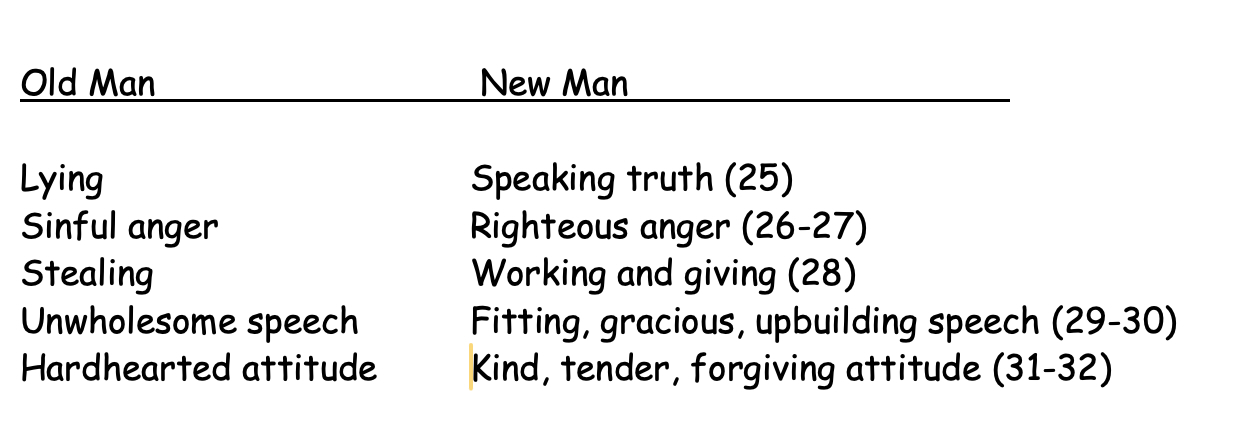
Paul contrasts the “old man” of sin, before conversion, and “the new man” who is striving to live a right and holy life (Ephesians 4:20-24). As such, he gives a list of old and new behaviors:

Screenshot

In some of these contrasting behaviors, he highlights the fact of spiritual warfare, a theme he returns to in chapter six. For example, by giving in to sinful anger, one gives the devil an opportunity (27). By having a godly attitude, we imitate God’s grace in forgiving us (32). Yet, to me, as sobering as anything Paul says in this paragraph is a warning he issues in verse 30: “Do not grieve the Holy Spirit, by whom you were sealed for the day of redemption.”

The Sin. The word “grieve” (“bring sorrow,” NLT) is an intense word, meaning “to cause severe mental or emotional distress” (BDAG, 604). Elsewhere in the New Testament, it describes Herod’s reaction when the daughter of Herodias asked for the head of John the Baptist (Matthew 14:9), the apostles’ reaction when Jesus predicts His death (Matthew 17:23), and the Christian’s response to the loss of a loved one (1 Thessalonians 4:13) and persecution (1 Peter 1:6). But, the cause of such anguish is our actions, specifically our speech. The word “and” closely ties what Paul says in verse 30 to the admonition in verse 29. Truly, willful, habitual sin of any sort would have the same effect, but Paul ties grieving the Holy Spirit to “unwholesome speech.” Zodhiates says that word “unwholesome” (“corrupting,” ESV; “foul or abusive,” NLT) was used to describe spoiled or rotten vegetables, meat, fish, or fruit (Matthew 7:17; 13:48; etc.)(np.). The idea is rotting, decaying, and offensive (TDNT, Vol. 5, 94-95). While Paul doesn’t use the graphic illustrations James does in warning about sins of the tongue (James 3:1ff), his warning is no less intense! We are wise to think about the wholesomeness (or lack thereof) of our words! Words that fail to meet the standard Paul sets in the second half of the verse have to be suspects on the list of unwholesome! Words that are destructive, demeaning, dirty, and the like leave the lasting effect of the intense feeling of sorrow and grief to God Himself! Refusing to stop such speech perpetuates this pain for Him!

The Seal. They made Jesus’ tomb secure with a seal (Matthew 27:66). The Christians in Revelation were said to be marked for identification with a seal (Revelation 7:3). The idea of sealing is to mark, set apart, acknowledge and prove (Newman, 177). Scripture teaches that the Holy Spirit indwells us as a sign or acknowledgment that we are in Christ (Romans 8:9-11; 2 Corinthians 1:22). Let us revisit the idea that the all-knowing, omnipresent Spirit of God is grieved by the unwholesome speech of a Christian. How much more grievous must that be for Him dwelling within us as we think the thoughts that precipitate such speech! Furthermore, how long will He remain in one who continuously, hardheartedly engages in such “old man behavior” (1 Samuel 16:14; Psalm 51:11; Hebrews 6:4-6; 10:26-31)?

The Salvation. Thankfully, each of us gets to choose! We do not have to succumb to the practice of sin, whether unwholesome words, the other old man behaviors in Ephesians 4, the works of the flesh in Galatians 5:19-21, or any other sinful practice disclosed in the New Testament. We have the option to live the Spirit-led life revealed in God’s Word! Nothing will drive us to do so any more than “the day of redemption.” This should be the ambition that wakes us up each day and drives us through the ups and downs of life. However we are pushed, pressured, and tempted, we will bear the fruit of the Spirit that will lead us to be found in Him (Philippians 3:9).

Do you struggle with taming the tongue (see James 3:1ff)? What will motivate you to put that away? How about remembering that God’s Spirit is in you between now and the day of redemption? Won’t this help you think more carefully about what you say and how you say it? Won’t it allow you to use those words which build up and bring grace to those who hear?

The Classroom Nobody Asks To Enter

Brent Pollard

No one ever really wants to come to this school. They never looked at a promotional pamphlet about it. They didn’t circle the first day of school on their calendars with excitement. Yet, God keeps a watchful eye on this ancient classroom. Even after thousands of years, its curriculum hasn’t changed. One of the earliest lessons it teaches is want.

Attendance at this school would never be something we would choose. Left to our own devices, we would design a curriculum brimming with abundance: every prayer answered swiftly, every door welcoming us at the first knock. However, that is not a school; it is a nursery. God doesn’t want to coddle individuals who stay stuck in their growth (see Hebrews 5.11-14).

In the tough times we face, there’s a unique gentleness to be found: the pauses, the imperfections, and the obstacles, which resemble the desks in a classroom, representing our journeys. At these desks, we uncover unique insights that you won’t find anywhere else. Comfort allows us to see the blessings we receive from God, but difficulty is the teacher who helps us grasp our profound need for God Himself. When all comforts are stripped away, the only lesson that endures is the one learned at the desk of deprivation.

Paul’s Diploma from the School of Want

Paul didn’t simply earn his diploma from this “school of want” by focusing solely on theory. He earned it through real struggles: scars, shipwrecks, feelings of emptiness, and even time spent in a prison cell (see 2 Corinthians 11.23-28). From one such cell, he wrote, “I have learned to be content in whatever circumstances I am” (Philippians 4.11). The term “learned” carries weight and meaning. Finding contentment wasn’t a simple task; it required patience and nurturing, much like mastering a new language. Initially, it was a bit uncomfortable and uncertain, but over time, with patience and practice, it became more natural and easier for Paul. Paul’s journey shows how facing challenges can lead to genuine happiness.

This isn’t a blend of stoicism and faith. Stoicism dulls its desires; Paul acknowledges his. He expresses, “I know how to get along with humble means, and I also know how to live in prosperity; in any and every circumstance I have learned the secret of being filled and going hungry, both of having abundance and suffering need.” (Philippians 4.12). He experienced hunger. He experienced a deep sense of humiliation. He just wouldn’t allow either of them to have the last say over his spirit.

Then Paul shares a little secret, almost casually: “I can do all things through Him who strengthens me” (Philippians 4.13). This line, situated between hunger and abundance, highlights that genuine strength comes not from ambition but from Christ’s support. Here, the “strength” isn’t about conquering the world; it’s about remaining authentic and steadfast as you journey through the tough lessons that accompany desire. The metaphor emphasizes a profound faith in God that transcends the world’s temporary victories.

This is the central idea that the message of contentment centers on. Contentment isn’t just about having all our wishes fulfilled; it’s about understanding that even when we face shortages, the goodness of God is always present and unwavering. Paul didn’t just experiment with this while among the safety of his brethren; he put it into practice in a Roman cell, and it really worked.

The Lie That Wealth Whispers

Examine Paul’s testimony alongside his warning to reveal a distinct difference. He shares with Timothy about those “who want to get rich” and who find themselves “in temptation and a snare and many foolish and harmful desires” (1 Timothy 6.9). Money itself isn’t the enemy, but the obsession with it—the idea that adding another zero will somehow bring happiness—definitely is.

Wealth brings dreams that can sometimes feel just out of reach. It’s often said that security is something we accumulate, that we’re always just one transaction away from feeling safe. It’s the enduring charm of attraction, now presented in a portfolio instead of a serpent’s skin. The impact extends far beyond mere financial loss. Paul notes that some people have wandered away from their beliefs, chasing after them and bringing upon themselves “many griefs” (1 Timothy 6.10). You cannot devote yourself to a deity that does not reciprocate your affection.

This is the reason the well-known verse is positioned exactly where it is. It is supported on both sides by the reminder: “Godliness actually is a means of great gain when accompanied by contentment” (1 Timothy 6.6). Seeking gain has always been a valid ambition. We simply searched for it in the wrong field. True gain isn’t about accumulating more possessions. It reflects the soul’s deepening ability to find peace in God, regardless of circumstances.

Christ, the Believer’s Undiminishable Portion

What should you do when a lesson feels like it’s holding on to you? What happens if the job doesn’t materialize, the diagnosis remains unchanged, and our prayers seem to fall silent? Even in those moments, remember that you are not alone—hope awaits you beyond the pain. Don’t force a smile and pretend that pain feels good. Scripture doesn’t make that request. Instead, look beyond your empty hand to the Hand that has always held on.

This is the gentle reassurance found in Scripture: God is the refuge for those who have nothing else. “The Lord is my chosen portion and my cup,” the psalmist sang, long before Paul came along (Psalm 16.5). Not divine blessings. God Himself. God. Even without any blessings, the believer still possesses the one true Blessing.

There’s an incredible tenderness in this moment. A divine being, enveloped in radiant light, humbles themself to become the treasure for those who possess nothing. We were created, in the innermost part of our hearts, for nothing less than Him. Every desire He permits is an act of love, purging that space and making room for only Him to occupy it. It isn’t joy that we seek, but rather the joy that ultimately reveals itself—much like a famine that shows us that bread was never the true goal. He was the center of it all. He was always the center of attention.

Living in the Classroom Today

How do you handle a no in the moment of truth?

Begin with small steps. Communicate honestly and express your desires openly in the presence of God. Do not pretend to have the peace you do not possess. Rely on Philippians 4.13 not just for lofty ambitions but also to find strength when facing challenges. Keep in mind the lesson from 1 Timothy 6: the things you pursue often fall short of what they promise. Finally, return to the intended portion. Whisper it softly until it resonates within you, just as it did for Paul: Lord, I may not have what I desired, but I have You. That is not insignificant. It’s a huge gain.

No one actively seeks to enter this school, yet everyone finds themselves walking its halls and eventually graduating—some with a sense of bitterness, others with a feeling of blessing, some with clenched fists, and others with contented hearts. Christ stands as the enduring guide in this ongoing journey of desire, sharing the essential truth that mere comfort cannot provide: He is, and has always been, enough.

God Shall Wipe Away All Tears

Carl Pollard

Tears are a very interesting and important part of the human anatomy. Tears are produced by the tear gland, which are small glands that are in our upper eyelid. Tears keep the surface of your eyeball clean, and help protect your eye from damage. But there’s another function of tears. They appear when we experience heartache and sadness. They form when we encounter joy, heartbreak, and sometimes for no reason with some people.

When we cry because of something emotionally painful, most of the time we wish that the problem never would’ve happened In the first place. Tears are a natural part of life. It’s going to happen, no matter how tough we claim to be. At some point we are going to break under the pressure of this world. That’s why I’d like to spend a few moments in one of the most encouraging passages of scripture in the Bible, Isaiah 25:8-9. In these two verses we will notice three painful types of tears that will be wiped away.

It reads, “He will swallow up death forever; and the Lord God will wipe away tears from all faces, and the reproach of his people he will take away from all the earth, for the Lord has spoken. It will be said on that day, “Behold, this is our God; we have waited for him, that he might save us. This is the Lord; we have waited for him; let us be glad and rejoice in his salvation.”

The first type of tears that will be wiped away are tears of death (v. 8). Every human on earth will experience death. Our lives will end in death, and scattered all throughout our days on earth we will lose those we love. Death is terrible. It tears us apart– we feel like we are drowning in heartbreak– that this pain will never end. We have to watch as mothers and fathers lose their children, children lose their parents, and spouses lose each other. Death is inevitable and something none of us ever want to go through. But there will come a day when we will never have to shed a tear over a loved one. We will never stand at a graveside again. God will make sure that his children never have to experience this heartache ever again. I long for heaven because the tears of death will be wiped away.

He will wipe away the tears of disgrace (8b). We can all agree that this world is full of evil. There is murder, rape, liars, gossip, and broken homes. This world is a place full of tears over the pain that comes from evil. Homes are torn apart and hearts are broken over the sin of others. A day will come when Christ will wipe away all tears (Rev. 21:4).  A day will come when Christ will mend the hearts of the broken. David spoke of his Joy in God. He says, “Hear, O Lord, and be merciful to me! O Lord, be my helper!” You have turned my mourning into dancing; you have loosed my sackcloth and clothed me with gladness” (Psa. 30:10-11). As Christians we can turn to God with hope, knowing that He is our helper and strength. We don’t have to face the evil of this world on our own. God can turn our heartache into Joy. He can wipe away the tears that sin has placed in our eyes. A time will come when the tears of disgrace will be wiped away.

God will wipe away the tears of distance and discouragement (9). It is common after a tragedy has occurred to hear someone pray, “Jesus come quickly.” We say this because we know that Christ is our way of escape from this world. Christ is our hope. We want Him to come back, to help us escape the sin that is around us. Sometimes this distance from God can cause us to become discouraged and to think that He isn’t coming back to save us. God will wipe away the tears of discouragement.

And on that day we will say, “This is OUR God.” The God that we have placed all hope and faith in. “This is OUR God that we have waited on to save us.” “This is OUR God that has brought us salvation.” The day will come when God will wipe away the tears that have been formed by the distance and discouragement we encounter on earth.

The day will also come when we will be judged for how we lived on earth. Can we say that we have waited on God? Can we rejoice in His return? Can we truthfully say that we have placed our faith and hope in God? On that day our tears will either be wiped away, or they will continue on into eternity. The question we must ask ourselves is this:  “Will God wipe away my tears?”

Learning To Fight Stress From Jesus

Neal Pollard

Christ was busy while on earth, even to the point of depriving Himself (Mat. 8:20). He lost friends and followers (John 6:66-67; Mat. 26:31). He was constantly hounded and threatened (Mat. 22:15; John 5:18).  He was rejected by family and neighbors (Mark 6:4-5).  Jesus knew something about stress.

Luke four records the stressors that came with the beginning of His public ministry. News about Him spread all over the place (14). He taught with authority and was praised by all (15). People spoke well of this powerful preacher (22). His teaching brought angry opposition and an assassination attempt (28-30)!  Then He came to Capernaum, teaching (31), exorcising (35), and healing (39).

Luke four summarizes what life must have been like for Jesus. He was tending to many people’s needs (40), facing people making demands on His time (42), and enduring people trying to interfere with His schedule (42). To a degree, we can relate with the same issues today–people need us, drain our time, and interfere with our schedule.  All of this creates stress.  So, how did Jesus cope with this?

HE TOOK TIME TO HELP EVERYONE (40). That may not sound stress relieving, but it was.  He came to serve (Mat. 20:28). Rather than fret, wring His hands, or succumb to feelings of being overwhelmed, Jesus put His nose to the grindstone. He expended His energy to help “each one of them.”

Sometimes, we compound our pressures not by doing something about them but by wasting time worrying over them.  Such an exercise can quickly turn into self-pity. Give yourself wholeheartedly to your tasks and you will find it fulfilling and even therapeutic.

HE TOOK TIME FOR SOLITUDE AND PRAYER (42; Mark 1:35). Jesus knew the value of taking a break. He got away from the crowds, the work, the requests, and the problems. In His humanity Jesus had to have been emotionally drained and physically exhausted. To keep up the most productive life ever lived, Jesus needed retreat. Notice how He spent that “down time,” in solitude and supplication!

Idleness is not a viable stress reducer. On the other hand, solitary meditation and devotion are key to winning over stress.  Communicating with God can calm the most raging sea in the vast ocean of the mind. It reinforces one for the new stress that inevitably comes.

HE WOULD NOT BE DISTRACTED OR DETERRED FROM HIS PURPOSE (43). When He reconnected with public life, the demands continued. But, Jesus never lost sight of the bigger picture. His life was not solely about helping the needy folks in that one place. It encompassed infinitely more. He helped these folks, but He needed to go further.

Most of us face circular and cyclical tasks, responsibilities and routines that are repeated on a regular basis. Even in that repetitious work, we can be distracted from the big picture by bogging down in the details. We can consume all our energy putting out little fires while our purpose and opportunities go up in smoke.  We must stay focused on why we are here (Ecc. 12:13), letting that impact every area of our lives.

HE RESUMED HIS TASKS (44). Jesus kept on preaching in the country of the Jews (44).  He kept on doing what He was here to do.

It can seem impossible to get everything done, but determination and organization can help us do great, multiplied good. Jesus “kept on” doing what He was here to do. That will help you, when life casts long shadows over you. Just keep going! At the end of the day, you will feel satisfaction for a job well done!

Her Own Tent, or His Dwelling Place?

Brent Pollard

Why Ezekiel 23 Is Still Relevant Today

Some Scripture, like Ezekiel 23, is similar to opening a furnace door. You are met with scorching heat and flame, not pleasantries. The pictures God paints are fierce and even shocking. God calls Samaria and Jerusalem “two sisters” who are “unfaithful,” revealing the spiritual adultery of Israel and Judah. This chapter is full of judgment, sorrow, betrayal, and holy indignation. We need to fully understand and feel the depth of God’s anger and heartbreak.

God doesn’t give just a symbol. He tells a tragic story about spiritual infidelity. Those whom He loved and nurtured turned their backs on Him to chase after paramours. There is a sobering revelation in the sisters’ names that you cannot ignore: even as Jerusalem played the harlot, her very name served as a reminder that God’s dwelling place was supposed to be within her.

The names of the two sisters are Oholah and Oholibah.

Samaria, the northern kingdom, is called Oholah, or “her own tent.” Jerusalem is Oholibah, meaning “My tent is in her.” The linguistic shift is critical because it exposes the root of their sins: while Samaria operated under self-governed worship, Jerusalem betrayed an actual divine indwelling.

Israel strayed from the path God had chosen, establishing rival shrines at Dan and Bethel to forge a separate religious identity under the rival king, Jeroboam. Oholah chose her own way, yet this separation did not exempt her from wrath. Conversely, Judah stuck with the kingly lineage of the man after God’s own heart, maintained the temple and the ordinances of God’s presence. Thus, Oholibah could rightly claim that the divine Council dwelt directly within her borders, rather than remaining at a distance.

The privilege of hosting God’s presence sharpened the distinction. But for Oholibah, that very honor made her unfaithfulness worse than her sister’s. The contrast is not simply about privilege but about the growing burden of responsibility and guilt.

When Holy Privileges Become Heavy Guilt

Ezekiel 23 demonstrates that proximity to holy things is not the same as true holiness. You can live by a river and die of thirst. Judah had God’s altar and name, but her heart pined for idols. The most dangerous place sometimes is an empty pew with a wandering heart.

You can be devoted to all kinds of things and not be in agreement with God. Everyone puts up a tent, but it matters whose tent it is and who lives in it.

The Temple of God Is Not of Stone

This truth deeply informs the New Testament. In this new covenant, God’s presence is no longer confined to a stone temple in Jerusalem but now dwells within His people. He underlines this by reminding the church, “Don’t you know that you are God’s temple and that God’s Spirit dwells in you?” (1 Corinthians 3:16). He also asserts, “Your body is a temple of the Holy Spirit who is in you” (1 Corinthians 6.19).

Think about that for a moment: the God whom even heaven itself cannot contain (1 Kings 8.27) chooses to live in redeemed people. We were made to carry His presence and to rejoice in Him alone, not just to know about God. God still separates the outwardly religious from those in whom He truly dwells.

How Do You Enter God’s Presence? The answer from Acts 2:38.

This difference is not based on emotions, background, sincerity, or spiritual claims. The line is drawn in the New Testament by entrance into Christ. On Pentecost, the convicted asked, “What shall we do?” Peter did not send them off on private religious quests. He said, “Repent and be baptized in the name of Jesus for forgiveness. And you will receive the Holy Spirit” (Acts 2.38). The promise is simple: forgiveness and Spirit.

Baptism is not an empty rite. It’s the transition from the old life to the new life in Christ. Through baptism we are joined with His death, buried with Him, and raised to live anew (Romans 6.3–4). “For all of you who were baptized into Christ have clothed yourselves with Christ” (Galatians 3.27). God’s presence dwells in us only in Christ.

The Holy Spirit: God’s Pledge, Seal, and Guarantee

Paul uses marketplace language for a treasure in heaven. God “sealed us and put the Spirit in our hearts as a pledge” (2 Corinthians 1.22). Jesus’ followers are “marked with a seal, the promised Holy Spirit, who is the pledge of our inheritance” (Ephesians 1:13–14). The Spirit is our guarantee, an indication of what God still has for us. Earnest money guarantees a sale; the Spirit guarantees our inheritance. God has put heaven into us, as His bond, promising to bring us home.

Being a Christian isn’t just choosing a religion like choosing a hobby or neighborhood. Rather, a Christian is one in whom God dwells. There is no greater honor and joy on earth than to be the home of the Almighty.

Living Like the Temple You Were Born

Ezekiel reminds us that we must not make light of this truth. Oholibah kept the house of God, but lived for another. This is a warning to us. God’s presence is not an invitation to complacency, but to holiness. The Spirit comforts us and guarantees our inheritance, but He is also the Holy Spirit who leads us into holy living through Providence and the Word.

We have to face this truth every day. We cannot say “God dwells in me” and make peace with idols at the same time. We cannot take the old tent and re-arrange it to follow Christ. Simply rearranging things is not repentance. Sin cannot be a welcome guest in the temple of God. A temple is only for one thing: to honor the One Who fills it.

Leave Your Own Tent.

The question Ezekiel 23 asks is not just, “Which sister are you?” Its message questions us: Is God really dwelling in you, or are you still clinging to your own tent, the confines of your self-made faith? If you have His Spirit dwelling in you, are you living in all things as the temple of God? This is the ongoing problem and main point of Ezekiel 23.

The gospel does not call us to set up our own tents and ask God’s blessing. Rather, it calls us out of our own tent, into Christ. In baptism, sins are washed away, the old self dies, new life starts, and the Spirit is given. The Christian life is not a life of self-will, but of becoming a proper vessel for the Lord.

Oholah tells us not to make religion in our image. Oholibah is an example of how enjoying sacred privileges cannot excuse unholy living. Christ calls us higher. To be wholly His. Washed. Sealed. Indwelt. Sanctified. God has not been distant; He has placed His Spirit in us as a guarantee.

Let us not retreat into our tents, but live as those in whom God dwells, carrying His presence with intentionality, showing His holiness in all we do, and showing the world what it means to be truly His. Let our lives be temples, not only honored by His presence but changed by it, boldly announcing: God lives here.